
A complete issue · 16 pages · 1899
Judge — April 8, 1899
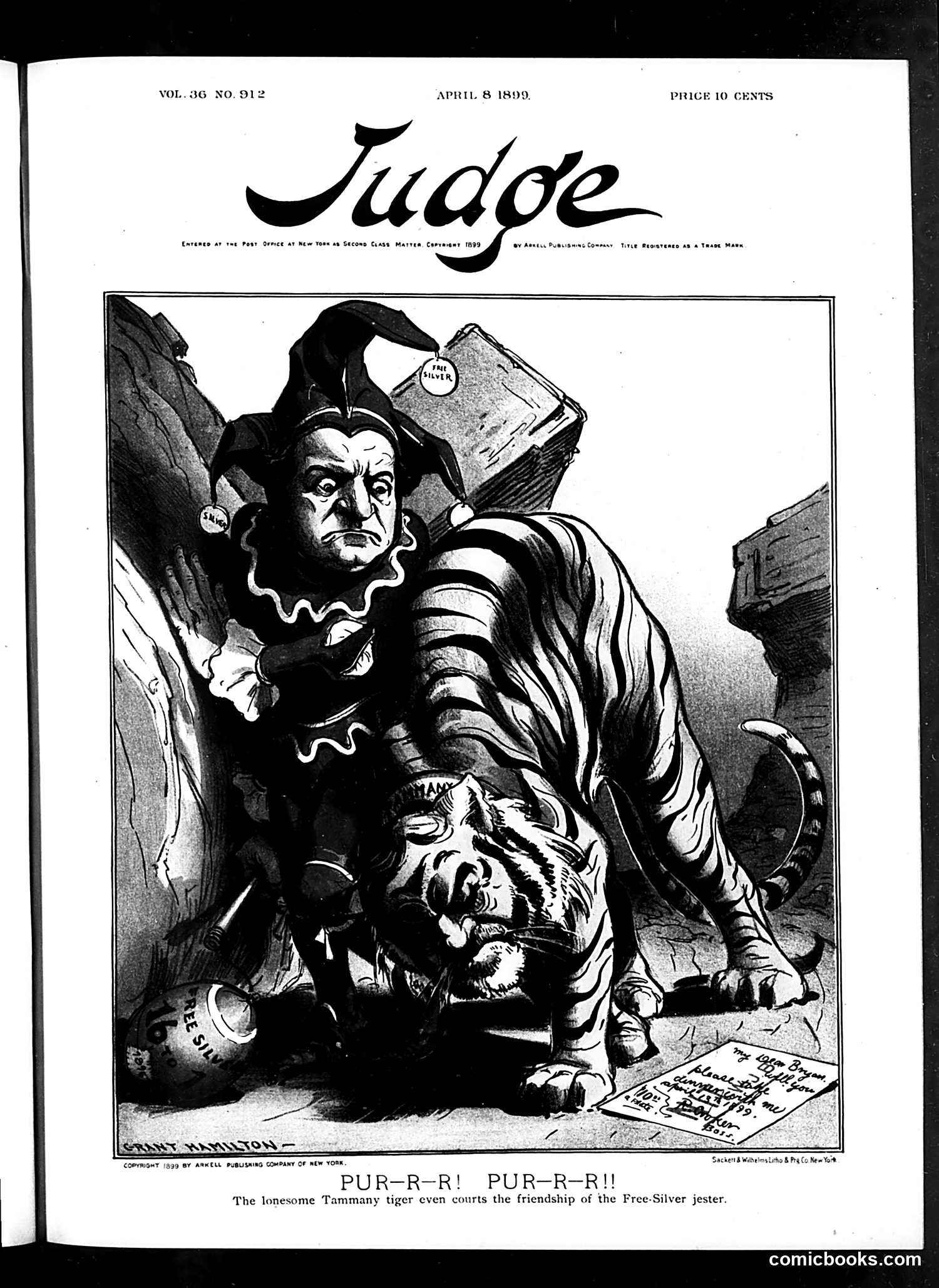
This political cartoon satirizes the **Tammany Hall political machine** and its corrupt leadership. The central figure appears to be a **jester or fool character representing Tammany**, holding what looks like a "Free Silver" document or policy platform. The tiger at his feet is the iconic **Tammany Tiger**, symbolizing the organization's ruthless power. The caption "PUR-R-R! PUR-R-R!!" suggests the tiger is being manipulated or appeased by Tammany's leadership, likely critiquing how Democratic politicians used populist "Free Silver" rhetoric to maintain political control while serving corrupt interests. The surrounding architectural elements suggest a prison or confined space, implying Tammany's corruption traps the city. The satire attacks the hypocrisy of machine politicians claiming reformist positions.
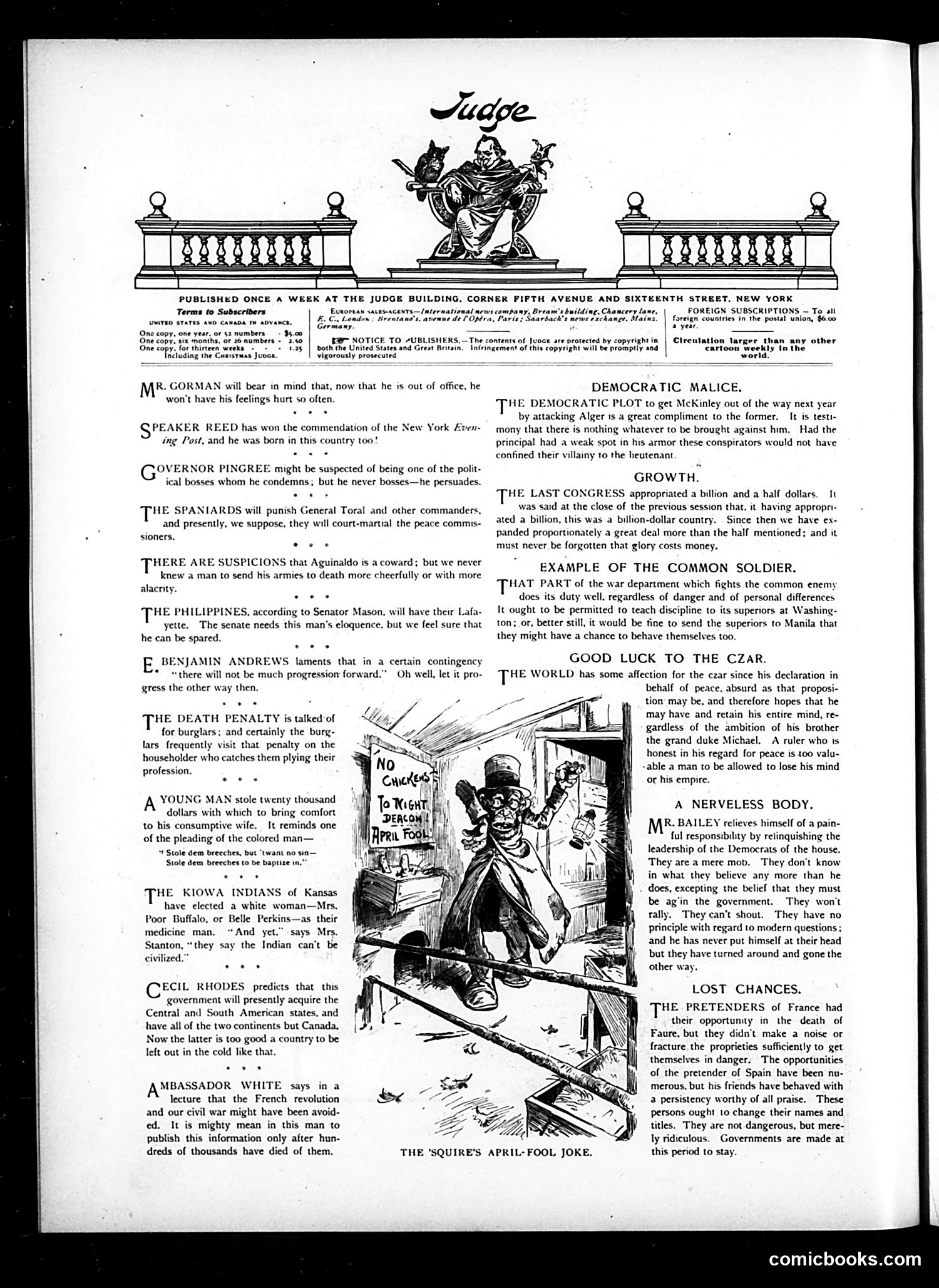
The central cartoon depicts a figure in formal dress perpetrating a cruel prank. The caption "No Gauze / Right / Percon / Help Fool" suggests the victim is being tricked, possibly regarding medical supplies or aid ("gauze"). The text references political figures including McKinley, Alger, and the Democratic Party's strategy for the 1900 election. Multiple short editorial items critique government officials—Speaker Reed, Governor Pingree, and others—suggesting widespread political dissatisfaction. Without clearer identification of the cartoon's specific characters or the referenced incident, the exact target of "The Squire's April-Fool Joke" remains unclear, though it appears to mock either a politician's deception or an administrative failure during this period.
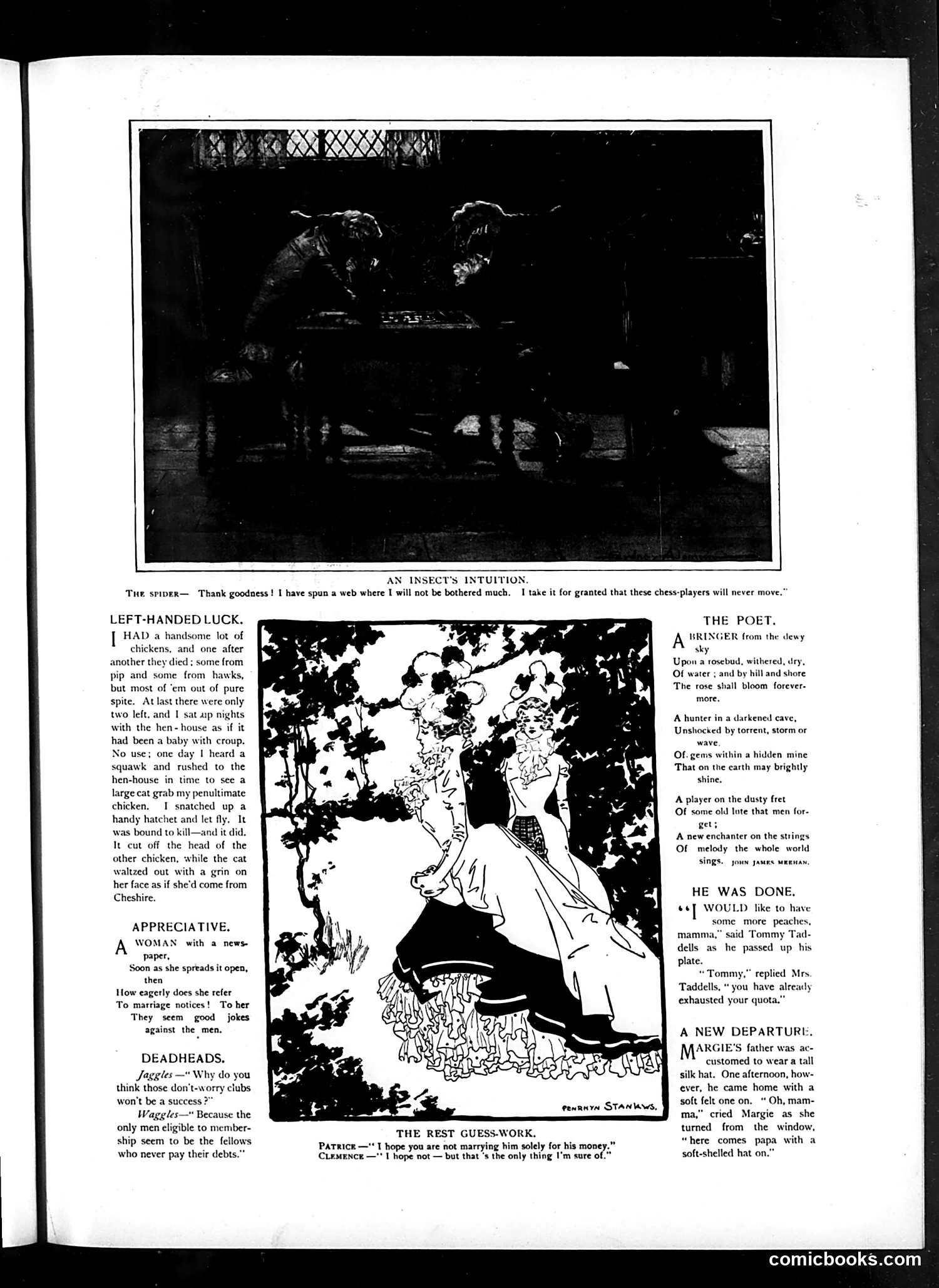
This page from *Judge* magazine contains several short humorous pieces and a central illustration rather than political cartoons. **"An Insect's Intuition"** (top) shows a spider addressing chess players, joking that it has spun a web where the players won't be bothered—implying they're so immobilized by the game they won't move anyway. **"Left-Handed Luck"** and other brief humor pieces use wordplay and situational comedy typical of early 20th-century magazines. **"The Rest Guess-Work"** (center illustration by Penrhyn Stanlaws) depicts a woman in an elaborate dress, likely satirizing fashion or social pretension. The remaining items—"Appreciative," "Deadheads," "He Was Done," and "A New Departure"—are short jokes about social behavior, class, and domestic life, representing *Judge*'s standard mix of light satire and observational humor rather than hard political commentary.
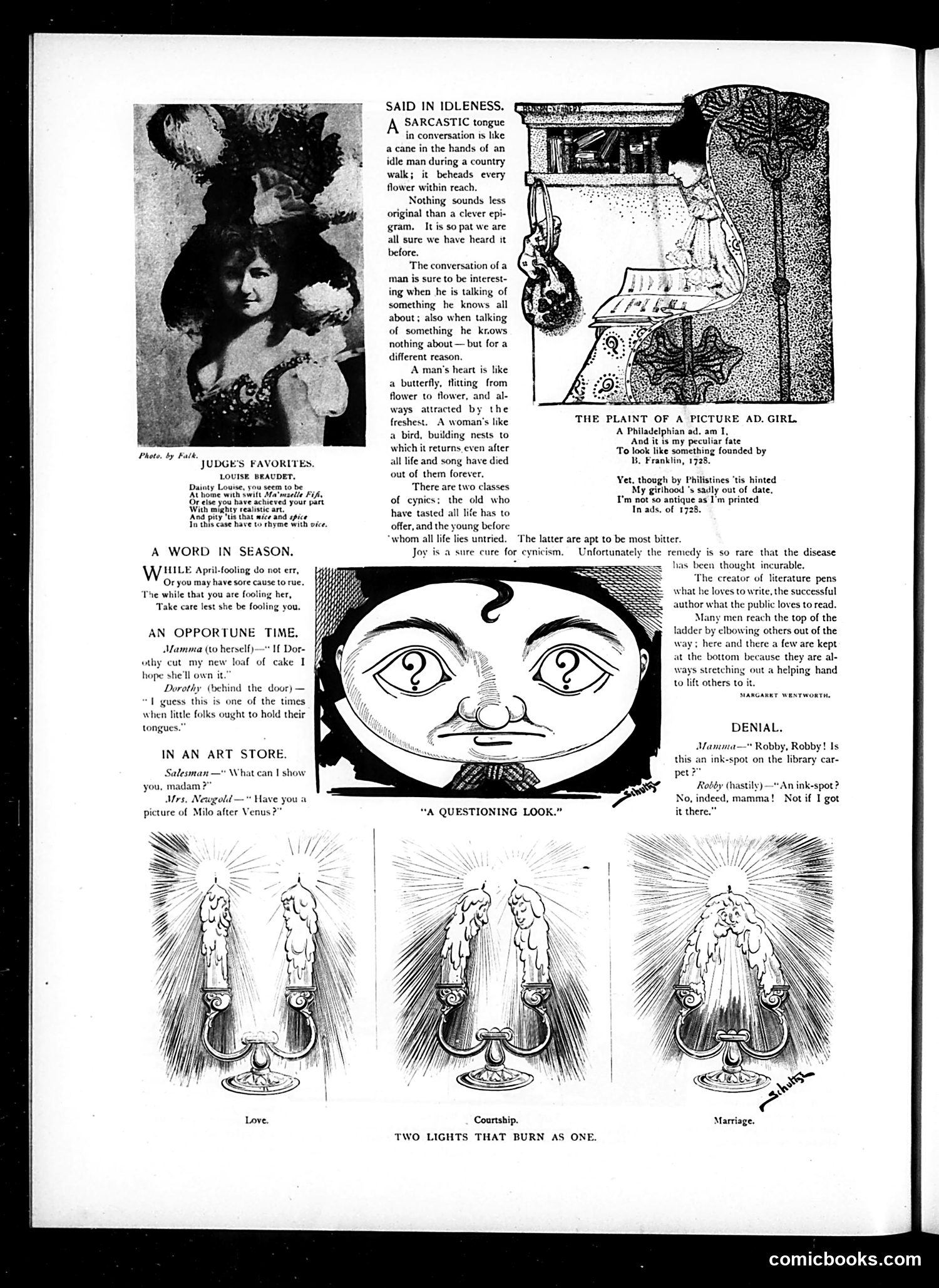
This page contains various short humorous pieces and illustrations typical of early 20th-century satirical magazines: **"Said in Idleness"** offers philosophical musings about conversation, cynicism, and human nature—claiming sarcasm in idle conversation is common, and that men and women have fundamentally different romantic natures. **"A Questioning Look"** is a cartoon showing an exaggerated face with question marks for eyes—a generic illustration about confusion or bewilderment, not referencing a specific political figure or event. **"Two Lights That Burn as One"** depicts an ornamental candelabra transforming across three stages labeled Love, Courtship, and Marriage—a commentary on how romantic intensity diminishes after marriage, a recurring satirical theme. The other pieces are brief witty anecdotes without clear political content or specific historical references.
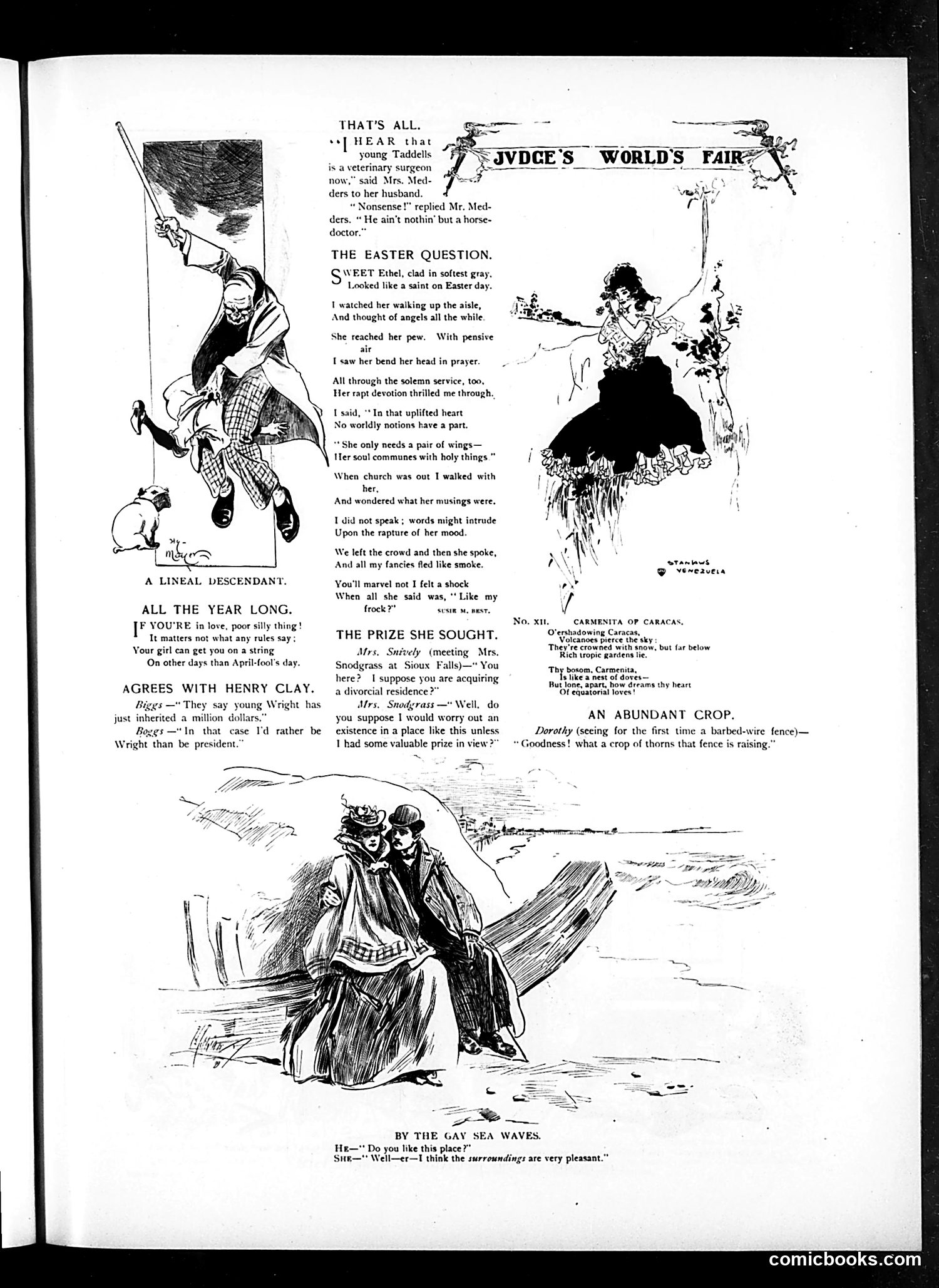
This page contains several brief satirical pieces typical of Judge's humor: **"A Lineal Descendant"** mocks romantic naivety—young women manipulate men year-round, not just on April Fool's Day. **"Agrees with Henry Clay"** jokes that inheriting a million dollars makes someone less desirable than being president (likely referencing Henry Clay's failed presidential ambitions). **"That's All"** punches at the lowly status of veterinarians, calling them merely "horse-doctors." **"The Easter Question"** satirizes superficial piety—a woman appears devoutly spiritual in church, but asks a man about her dress immediately after, revealing vanity beneath religiosity. **"The Prize She Sought"** implies wealthy women flee to places like Sioux Falls (then a divorce destination) seeking divorces rather than genuine companionship. Minor pieces mock romantic clichés and gender relations. The page reflects Judge's focus on upper-middle-class social pretense and domestic humor typical of early-20th-century American satire.
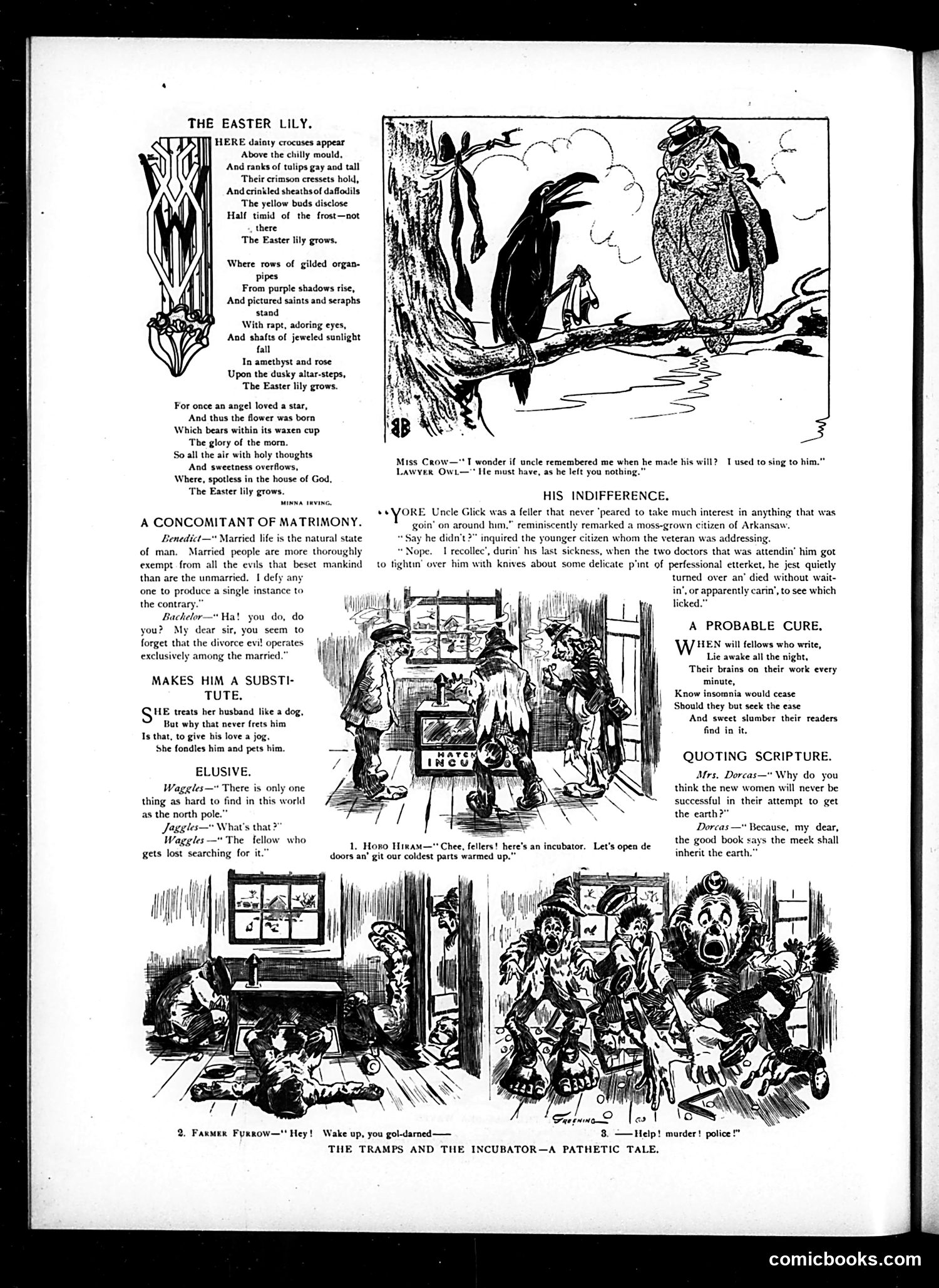
This page contains several short humor pieces typical of early 20th-century satirical magazines: **"The Easter Lily"** is a sentimental poem with decorative illustration—not political satire, but filler content. **The marriage/bachelor jokes** mock contemporary debates about matrimony's value, with the bachelor cynically noting divorce affects only married people. **"The Tramps and the Incubator"** is the page's main comic sequence. Three panels show tramps discovering an incubator (a device for hatching eggs), mistaking it for a heat source. They open it expecting warmth, leading to the final panel's chaos and their arrest. The "pathetic tale" title is ironic—it's slapstick humor about working-class desperation and incompetence. **"Quoting Scripture"** jokes about "new women" (feminists seeking equality) being meek and thus unable to inherit the earth, using Scripture mockingly against women's rights advocates. The page blends genteel poetry, domestic humor, class-based comedy, and anti-feminist jokes—representative of Judge's mixed content appealing to conservative readers.
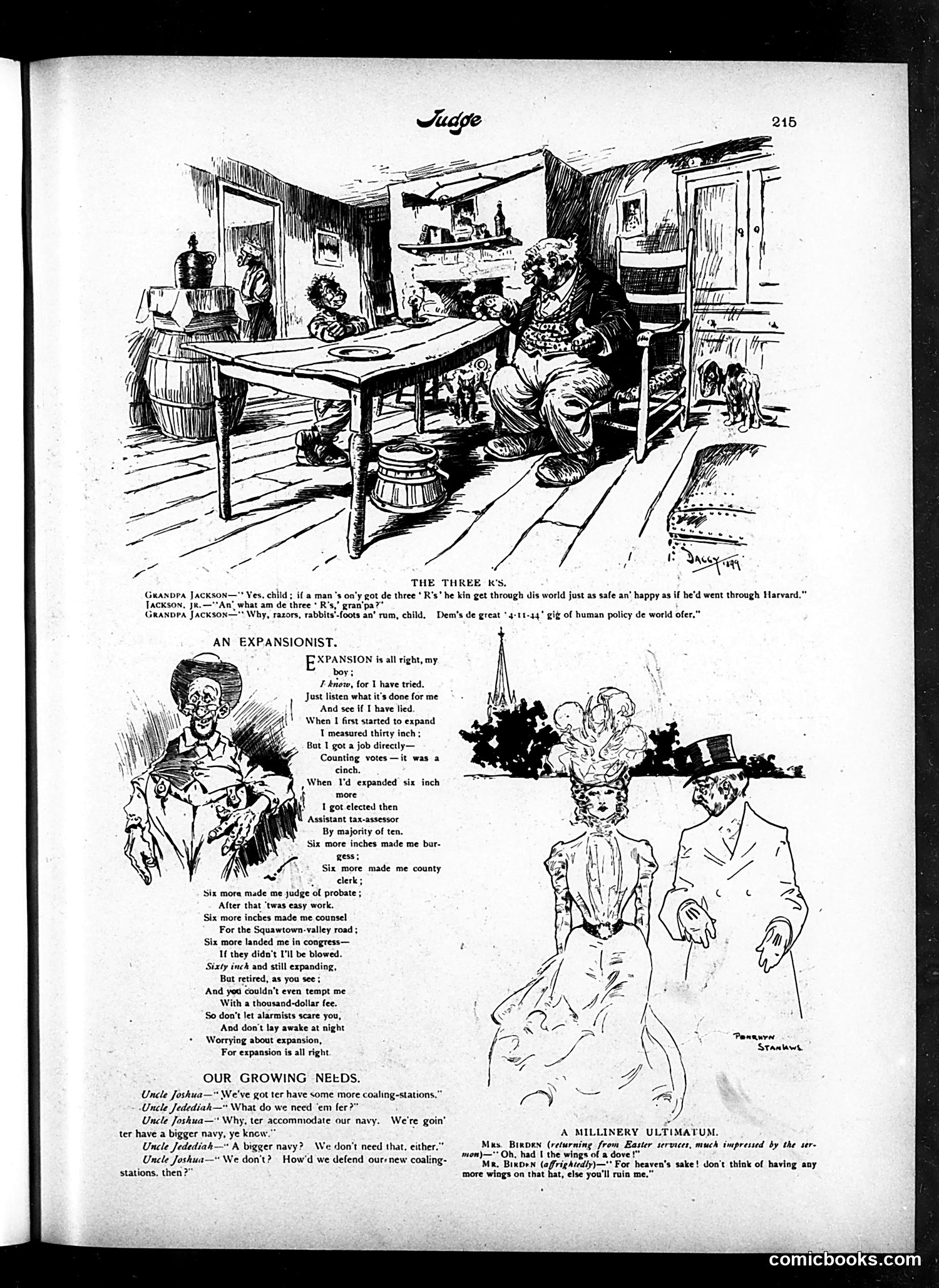
This page satirizes American imperialism and domestic political expansion circa early 1900s. **"The Three R's"** (top): Grandpa Jackson advises that the "three R's" (Readin', 'Riting, 'Rithmetic) are safer life paths than acquiring "razors, rabbits'-foots an' rum"—mocking working-class survival strategies. **"An Expansionist"** (middle): A politician boasts how each six inches of physical expansion brought promotions—vote-counting, assessor, burgess, clerk, judge, congressman. This satirizes how political "expansion" (territorial acquisition) becomes justification for endless bureaucratic growth and self-serving ambition. **"Our Growing Needs"** (bottom): Uncle Joshua and Uncle Jedediah debate circular logic: we need coaling-stations to support a larger navy; we need a larger navy to defend the coaling-stations. This mocks the self-perpetuating rationale for American naval expansion and imperialism. **"Millinery Ultimatum"** (right): Mrs. Bidden threatens hat extravagance; her husband fears financial ruin. A domestic counterpoint to imperial spending excess.
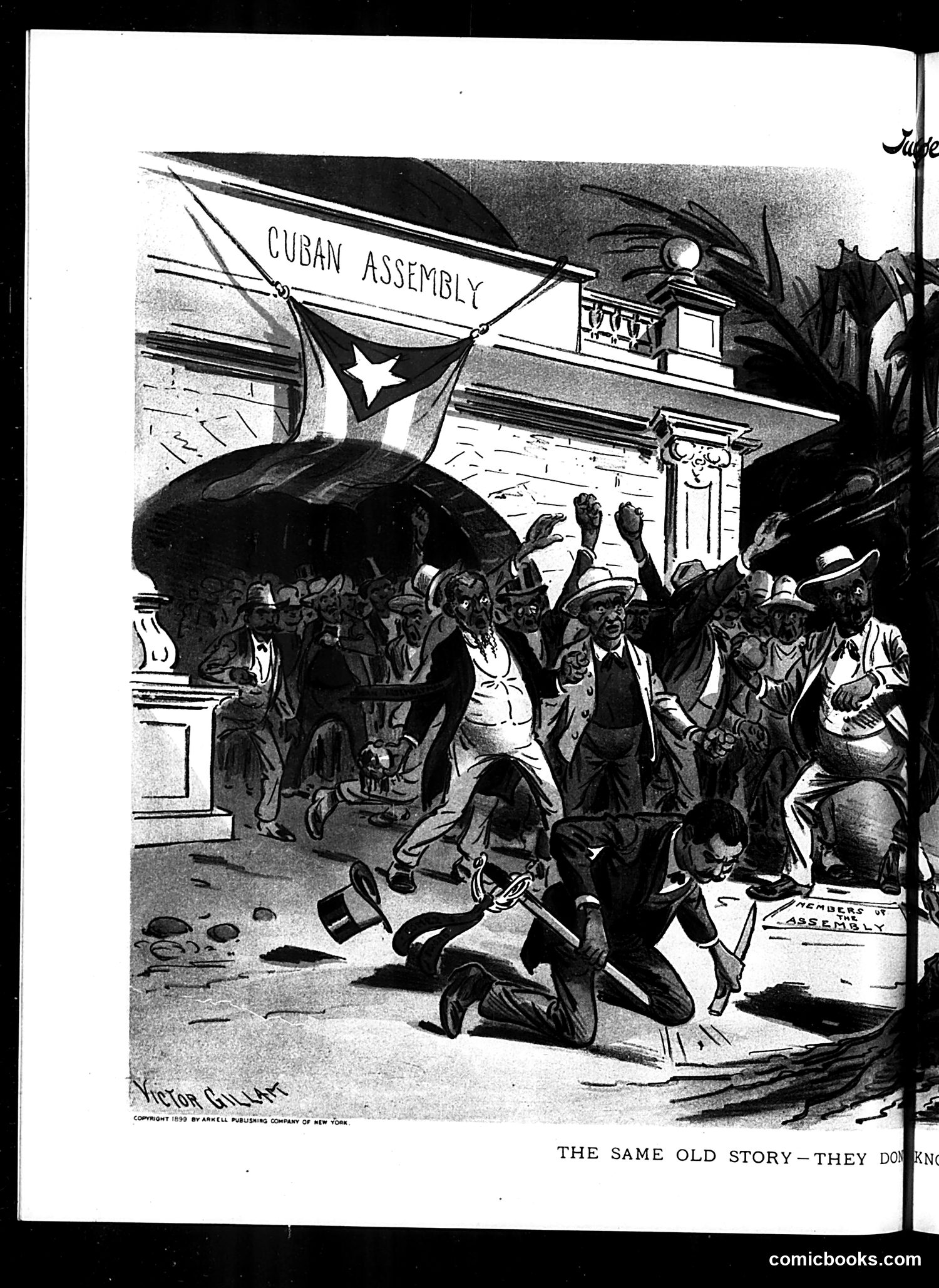
This 1899 Judge cartoon by Victor Gillam satirizes chaos at a "Cuban Assembly." The image shows a violent, chaotic scene outside a building flying the Cuban flag, with figures fighting, falling, and in disarray. The caption's incomplete text ("They Don't Know") suggests ironic commentary on Cuban political instability. This likely references the Cuban War of Independence (1895-1898) and its aftermath. The "Cuban Assembly" probably represents attempts at Cuban self-governance following Spanish colonial rule. The cartoon mocks the disorder and violence accompanying Cuban political organization, suggesting to American readers that Cubans were incapable of orderly democratic processes—a common racist trope used to justify American intervention and eventual occupation of Cuba.
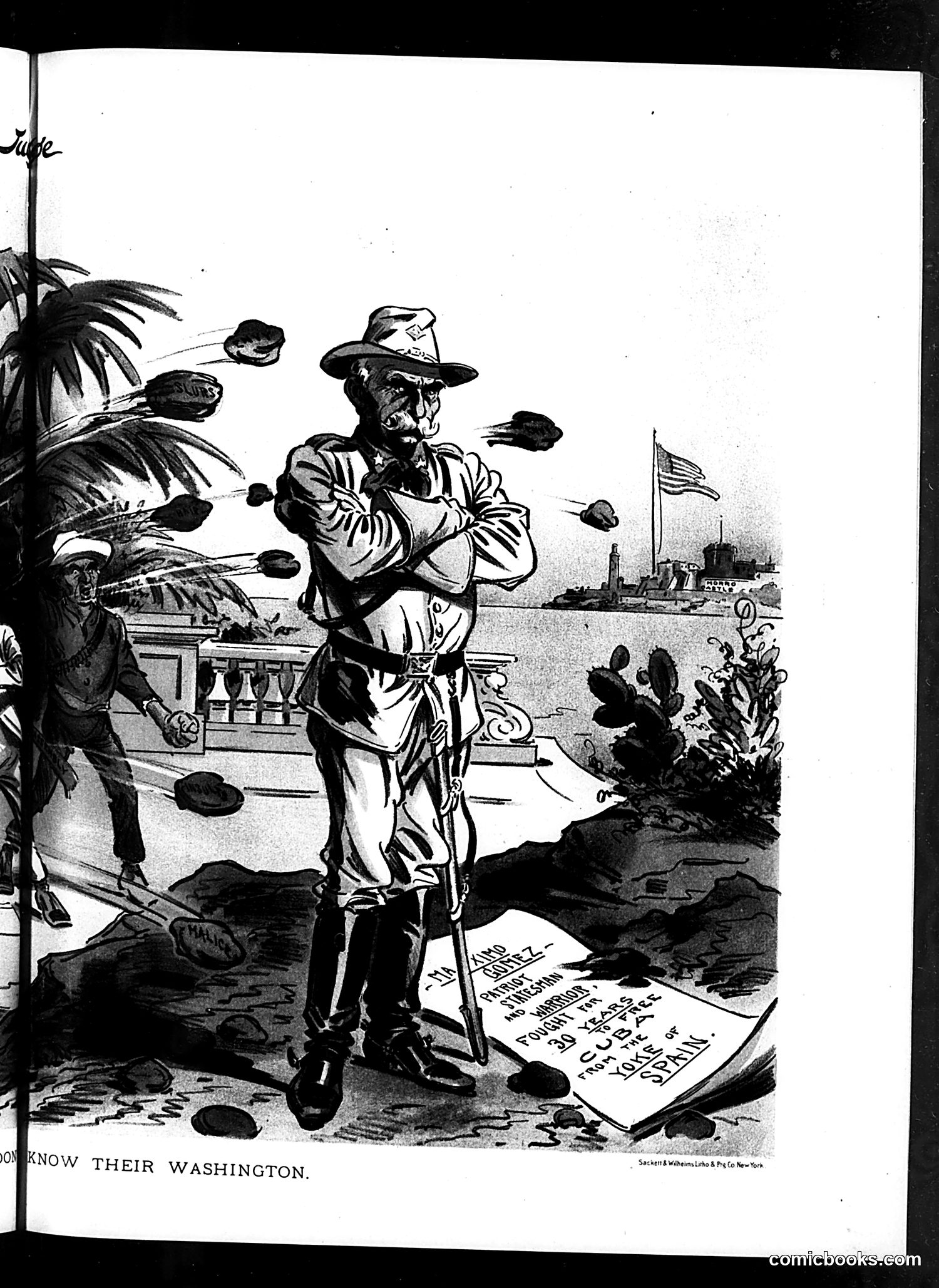
This political cartoon depicts a military officer (likely representing U.S. military leadership or imperialism) standing amid tropical vegetation and naval vessels bearing the American flag. He's shown receiving volleys of criticism or "bullets" (the dark projectiles), while holding what appears to be a document at his feet. The title suggests the cartoon criticizes American political or military figures for being unfamiliar with proper governance or Washington's principles. The tropical setting and warship suggest this relates to American overseas military intervention, possibly from the Spanish-American War era or subsequent imperial expansion. The satire appears to mock military leadership for either ignorance of constitutional principles or reckless foreign policy conducted without proper Washington oversight. The OCR is too corrupted to read the document's text precisely, limiting certainty about the specific target.
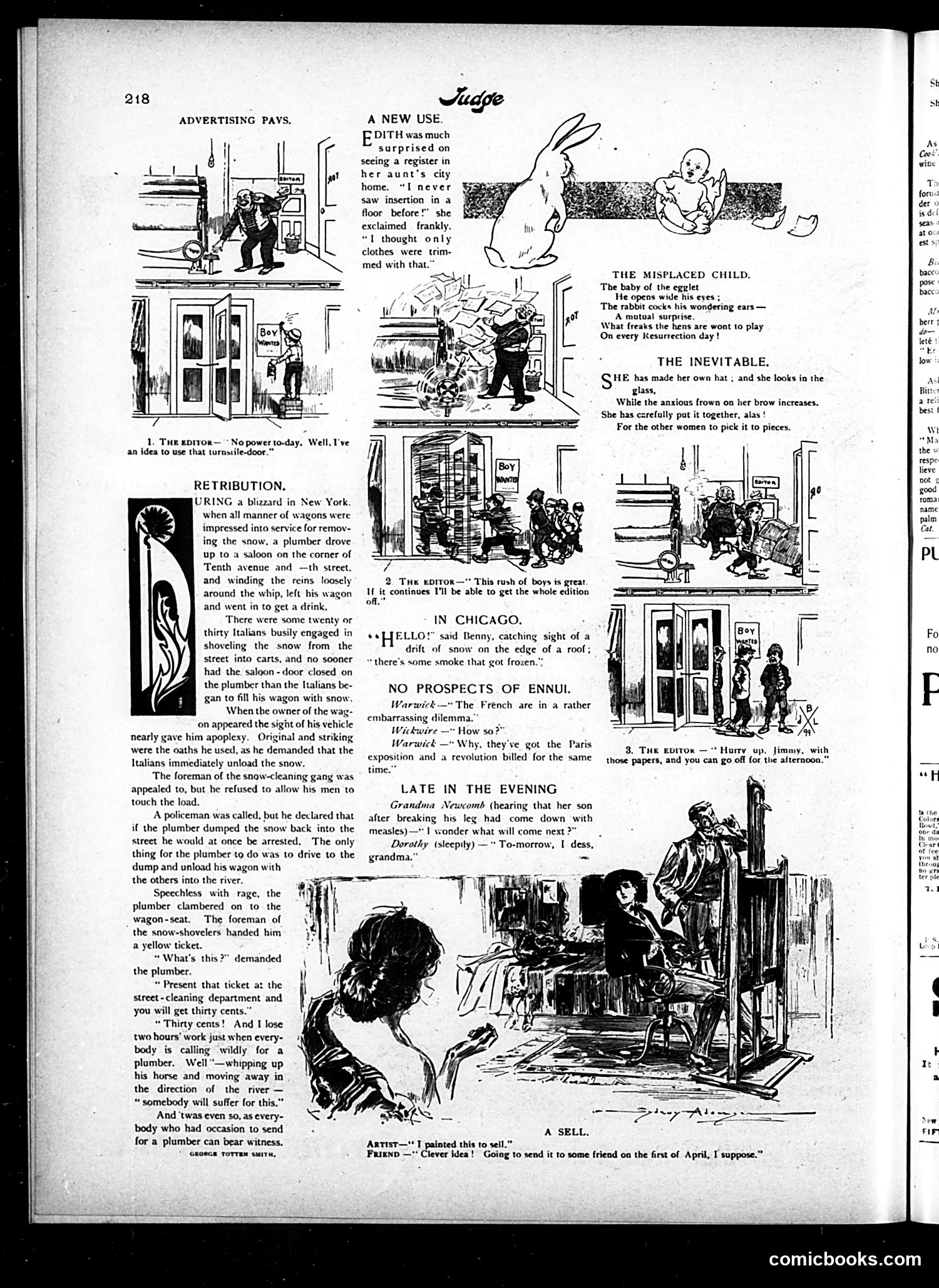
This page contains multiple brief humorous sketches typical of early-20th-century satirical magazines: **"Advertising Pays"** mocks newspaper editors exploiting a turnstile door concept for advertising revenue. **"Retribution"** tells of a plumber whose wagon is maliciously filled with snow by Italian laborers he insulted. Unable to legally dump it back, he loses work hours—the joke being his subsequent revenge on all plumbers' customers, showing how rudeness creates cascading consequences. **"A New Use"** jokes about a country girl's ignorance of heating registers, confusing one with clothing trim. The remaining items are brief comic observations: a Chicago child mistaking frozen smoke for snow; French inability to schedule both a Paris Exposition and revolution simultaneously; a grandmother expecting endless misfortunes; a woman's homemade hat that others will mock; and an editor rushing a boy with newspapers, implying April Fools' trickery. These sketches reflect working-class life, immigrant laborers, and domestic humor typical of Judge's satirical approach.
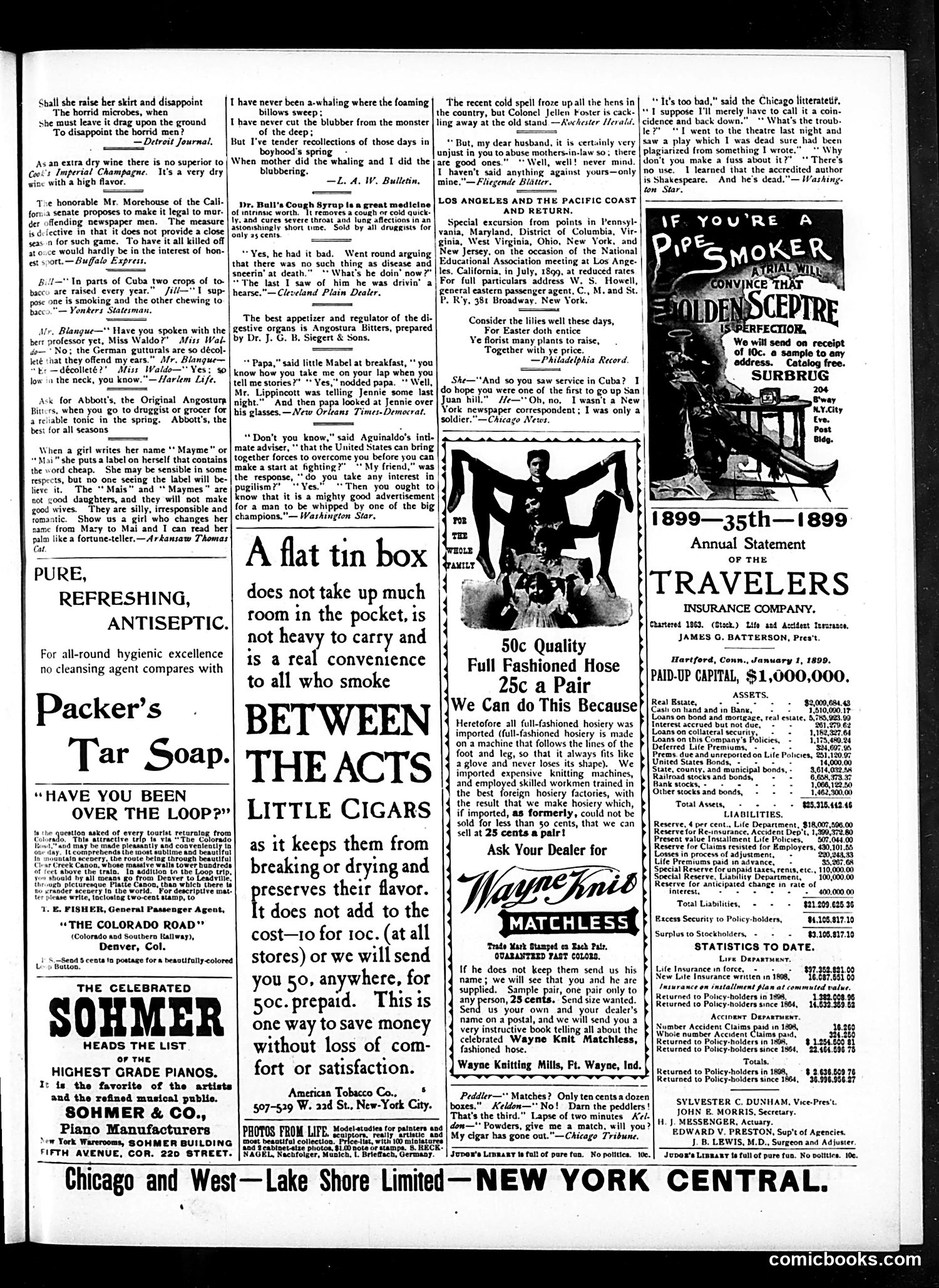
This page is primarily **advertising and humorous filler content** rather than political cartoons. The advertisements promote products like piano manufacturers (Sohmer), soap (Packer's Tar), cigars (Wayne Knit Matchless), and insurance (Travelers Insurance Company). The jokes scattered throughout mock contemporary social issues: women's hemlines and propriety, Cuban tobacco production, German language affectations, and—notably—newspaper censorship. One piece jokes about a California legislator proposing to legalize murdering critical journalists, satirizing press suppression threats. A recurring theme addresses **gender and respectability**: jokes about women with nicknames like "Mayme" or "Mai" being frivolous and unsuitable as wives, reflecting period anxieties about female propriety and naming conventions. The content reflects turn-of-the-century American preoccupations with modernization, propriety, consumerism, and social hierarchy rather than specific political events.
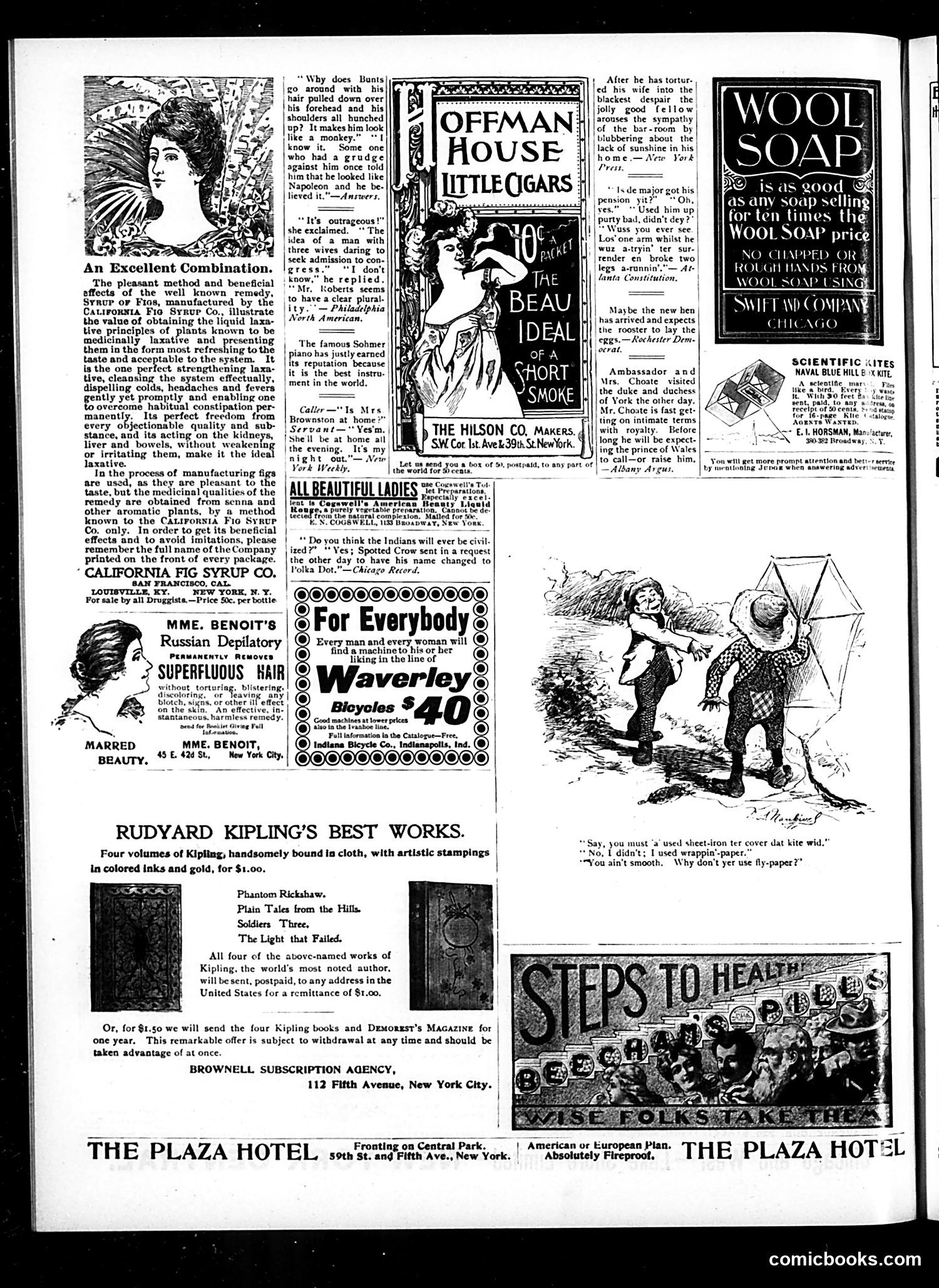
This page is primarily **advertisements and humor snippets** rather than a cohesive political cartoon. The small jokes scattered throughout satirize social absurdities: a man imitating Napoleon's appearance after a cruel jest; a woman objecting to a polygamist seeking admission somewhere (likely a club); commentary on a military veteran's sacrifice ("lost one arm"). The cartoon illustration (lower right) shows two children with a kite—appears unrelated to political commentary. Most notably, the page reflects **early 1900s advertising culture** and period attitudes: prominently featured are products like California Fig Syrup (a laxative), Wool Soap, Waverley Bicycles, and "Mme. Benoit's Russian Depilatory" for removing "superfluous hair"—revealing contemporary beauty standards and consumer concerns. The humor relies on recognizable social types and domestic situations rather than specific political figures or events. The page captures mainstream American magazine culture of the era.
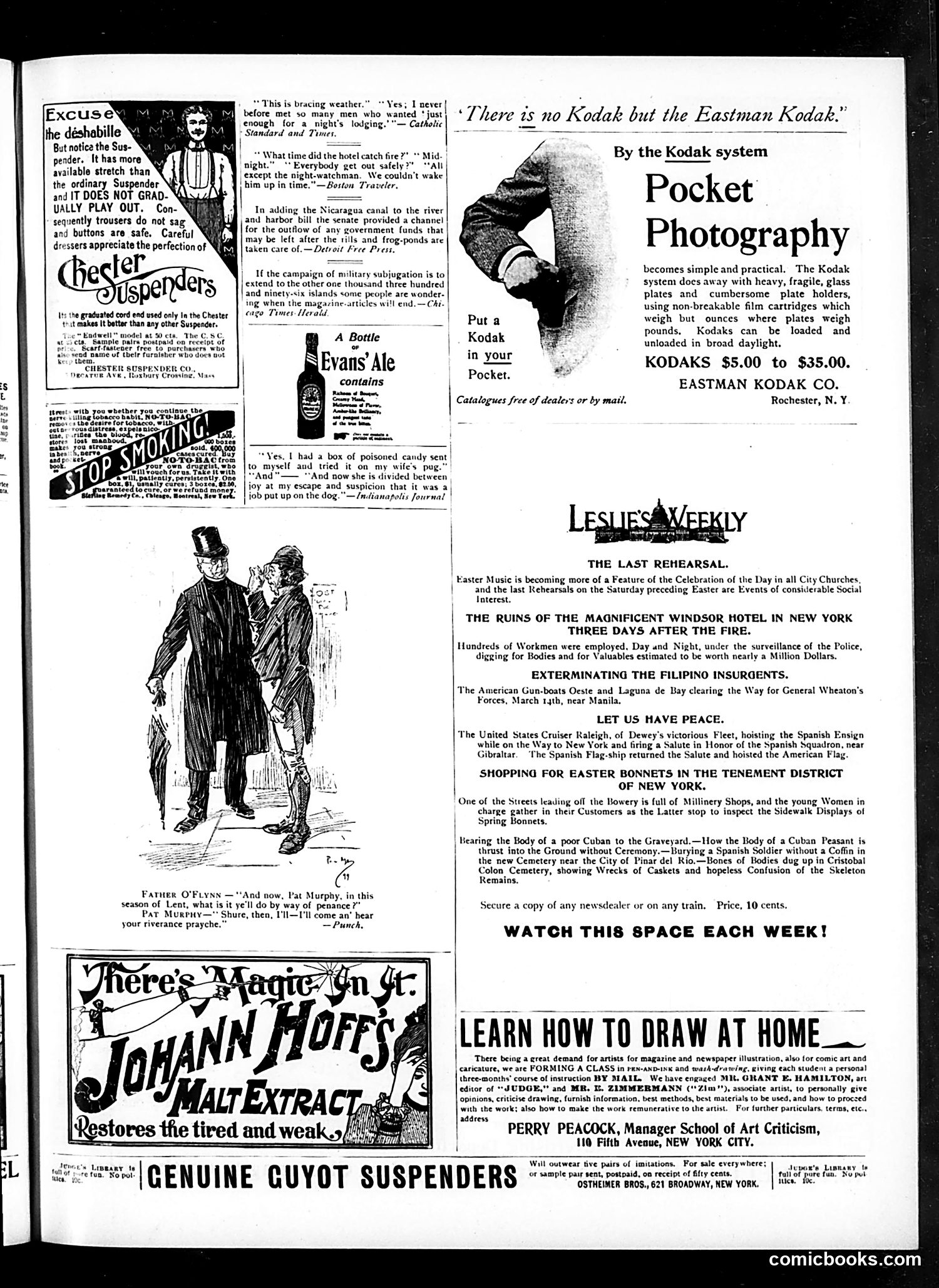
This page is primarily **advertisements and filler content** rather than political satire. The main elements include: **Advertisements:** - Chester Suspenders (with illustrated man in underwear) - Evans' Ale - Kodak cameras ("Pocket Photography") - Johann Hoff's Malt Extract - Drawing lessons course **Small Comic Anecdotes:** Several brief jokes appear, touching on contemporary issues: - Homelessness during economic hardship - A hotel fire where a night-watchman died - The Nicaragua Canal construction (wasteful government spending) - Military campaigns in the Philippines (the "one thousand three hundred and ninety-six islands") - Irish Catholic confession practices **Editorial Photos/Captions:** The right page references current events: the Windsor Hotel fire in New York, Filipino insurgent combat, the Spanish-American War aftermath, and Easter celebrations—typical of Judge's news-illustration format. Rather than sharp political cartooning, this represents the magazine's mixed format of light humor, advertising, and topical news briefs for 1890s readers.
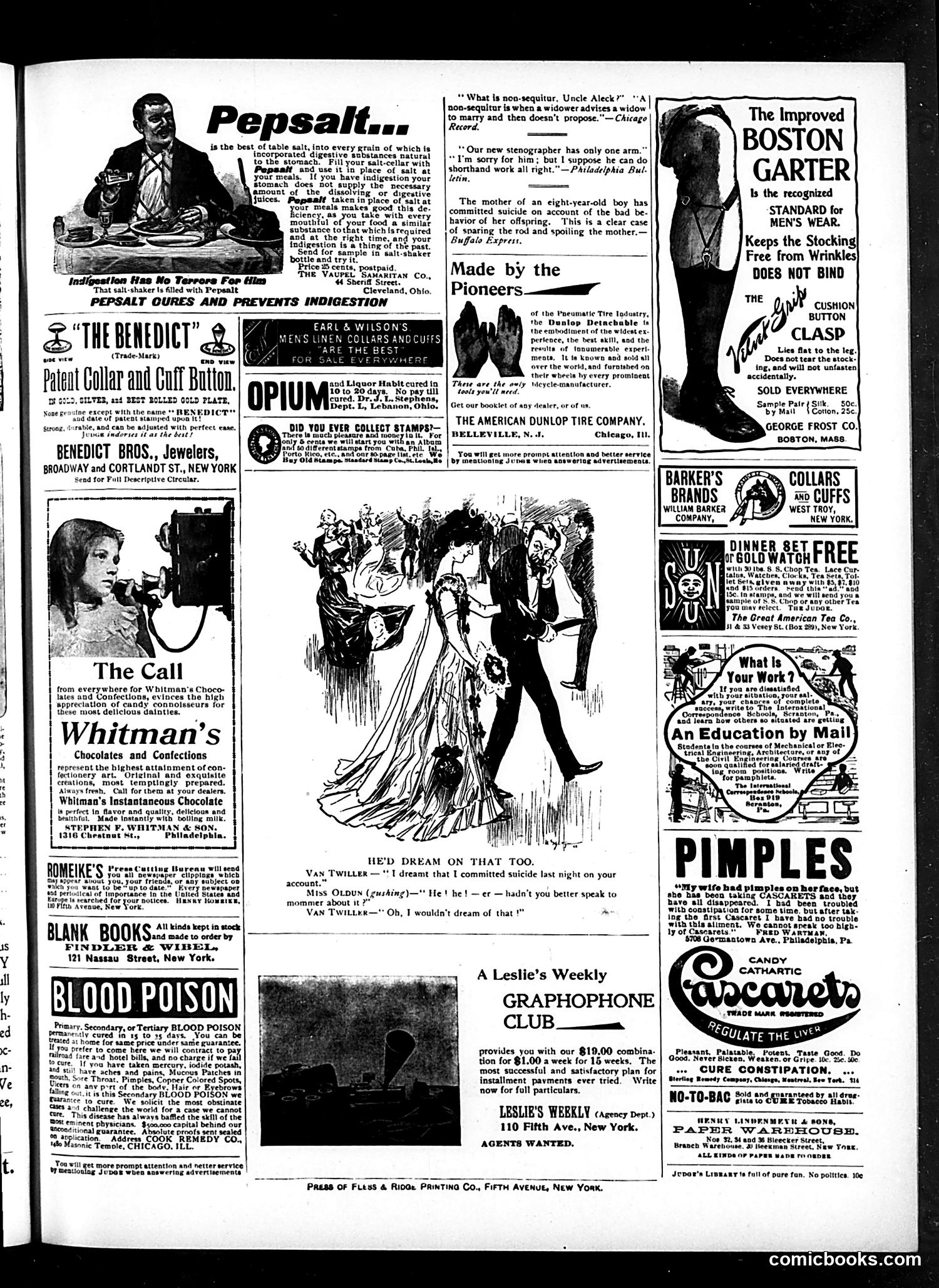
This is primarily an **advertising page** from Judge magazine, not a political cartoon. The page contains numerous commercial advertisements for products like Pepsalt (a digestive salt), collars and cuffs, chocolates, blank books, and medical treatments. The only notable satirical content is a small **joke cartoon** depicting a formal dance scene, with the caption "HE'D DREAM ON THAT TOO." The dialogue references Van Twiller dreaming about committing suicide, with another character asking if he hadn't "better speak to a clergyman." This appears to be dark humor about matrimonial despair—a common satirical subject of the era. The page otherwise showcases early 1900s consumer culture, including several dubious medical claims (blood poison cures, liquor habit treatments) now recognized as quackery. The advertisements reveal period attitudes toward health and commerce rather than social/political satire.
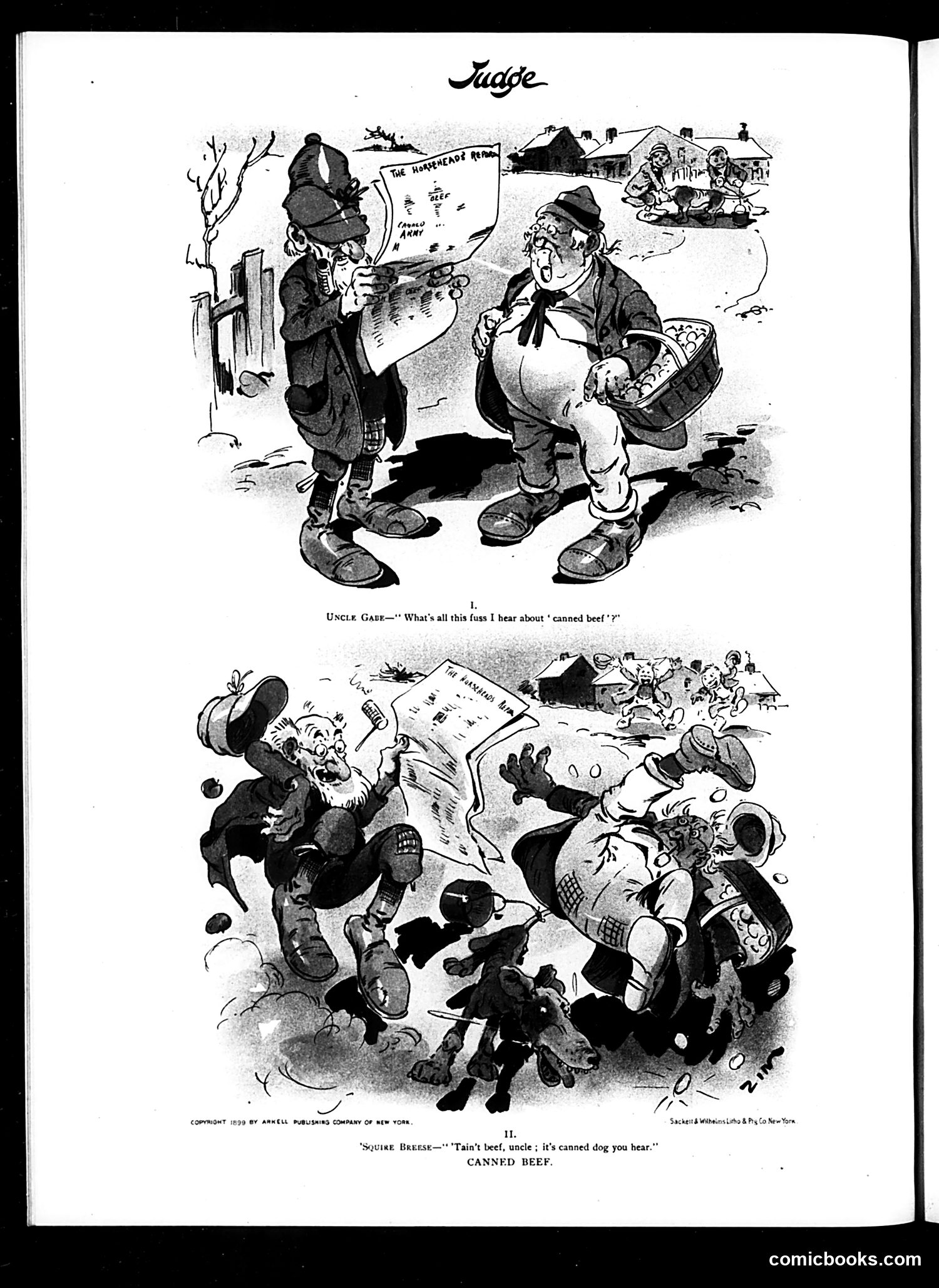
This 1899 Judge cartoon satirizes the Spanish-American War's canned beef scandal. The top panel shows Uncle Sam complaining about "canned beef" to a character labeled "Squire Breese" (likely referencing a War Department official). The bottom panel depicts soldiers violently rejecting the allegedly spoiled canned provisions, suggesting it's actually "canned dog." The joke plays on contemporary reports that American troops in Cuba received defective, contaminated canned beef from military suppliers—a major scandal that sparked congressional investigations. The cartoon ridicules both the poor quality of military provisions and the government's deception about what soldiers were actually eating. The exaggerated, grotesque imagery emphasizes soldiers' disgust and anger at this betrayal during wartime.