
A complete issue · 16 pages · 1899
Judge — February 18, 1899
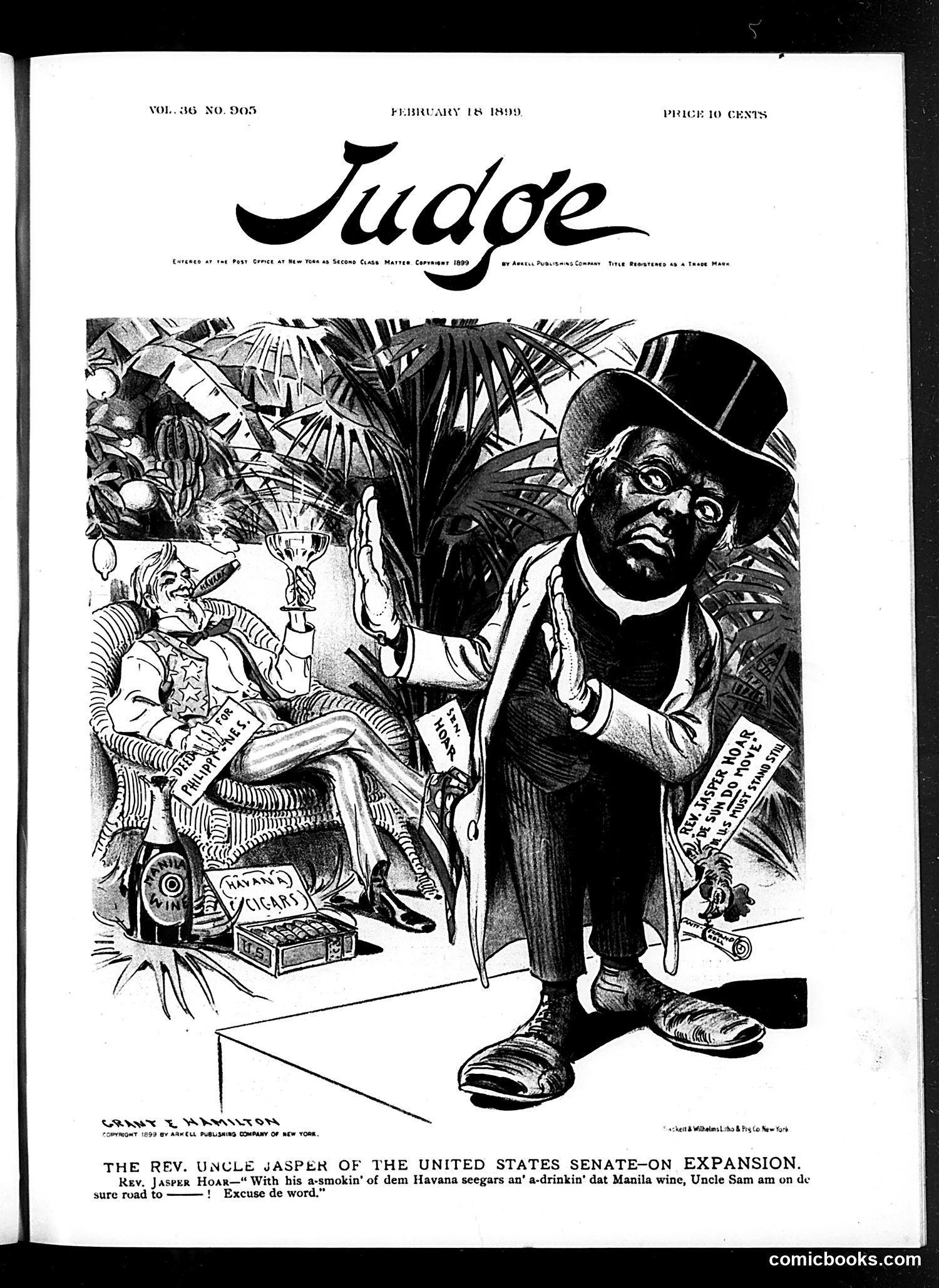
This cartoon satirizes **Senator Jasper Hoar's position on American expansionism**, specifically regarding colonial acquisitions like Hawaii and the Philippines following the Spanish-American War. The figure labeled "Rev. Uncle Jasper" (a caricature using racist imagery typical of 1899) represents Hoar as hypocritical. He smokes Havana cigars and drinks Manila wine—products from territories America was acquiring—while appearing to moralize against expansion. The cartoon's subtitle mocks his contradiction: he profits from colonial goods while publicly opposing imperialism ("Excuse de word"). The satire suggests that opponents of expansion were economically complicit in the very imperialism they claimed to oppose, unable to refuse the luxuries colonialism provided.
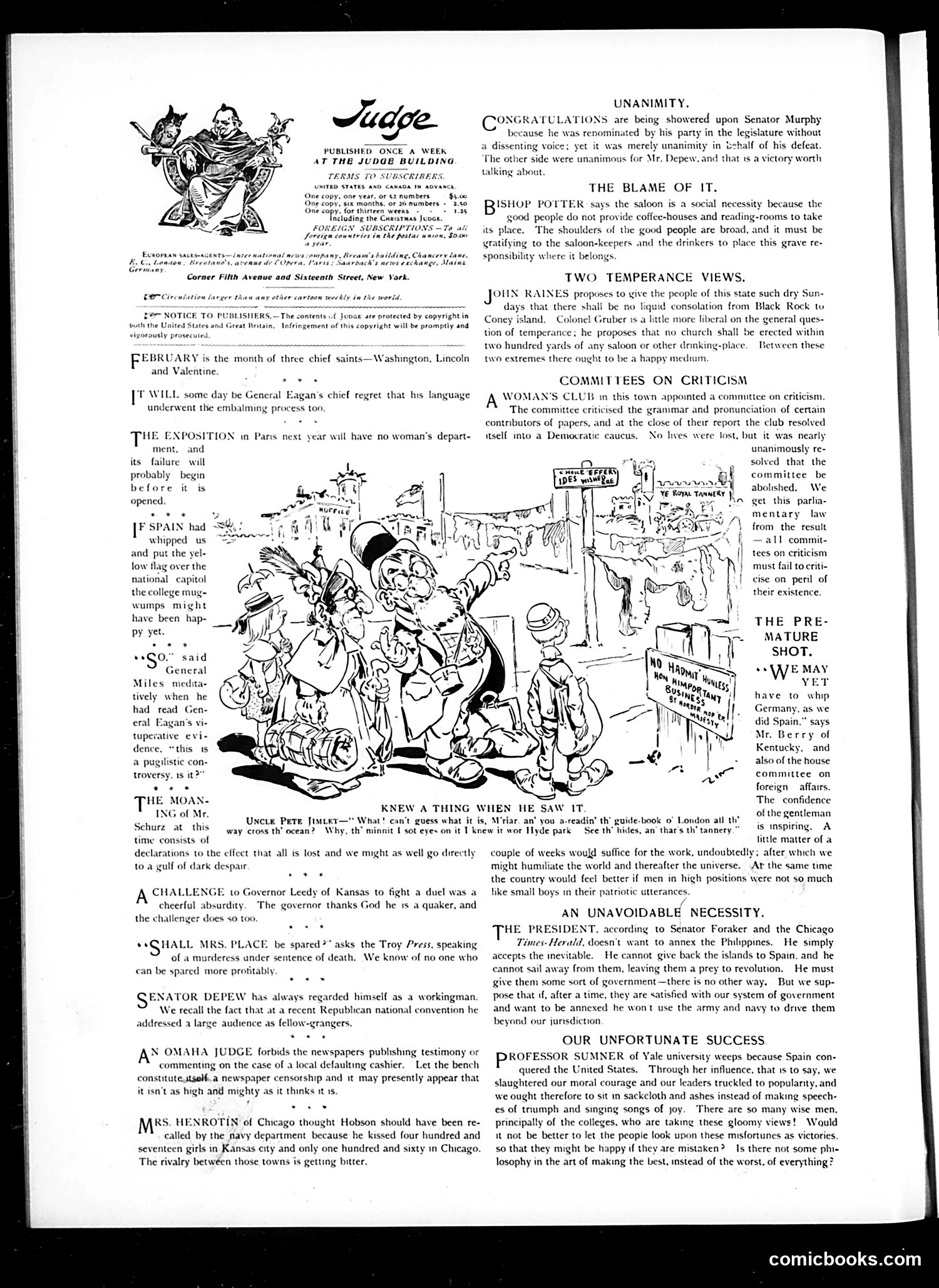
The cartoon depicts "Uncle Pete" (likely a political figure of the period) examining a guide book to Paris or London, apparently confused about directions. The caption suggests he "knew a thing when he saw it" — implying the character recognizes something but misunderstands it anyway. The surrounding text discusses various political matters: General Eagan's language problems, the Paris Exposition's lack of a women's department, and debates over temperance and saloon regulations. Without clearer identification of "Uncle Pete" and the specific historical moment, the cartoon's precise satirical target remains unclear, though it appears to mock political naiveté or poor judgment. The style and references suggest this is from the late 19th or early 20th century.
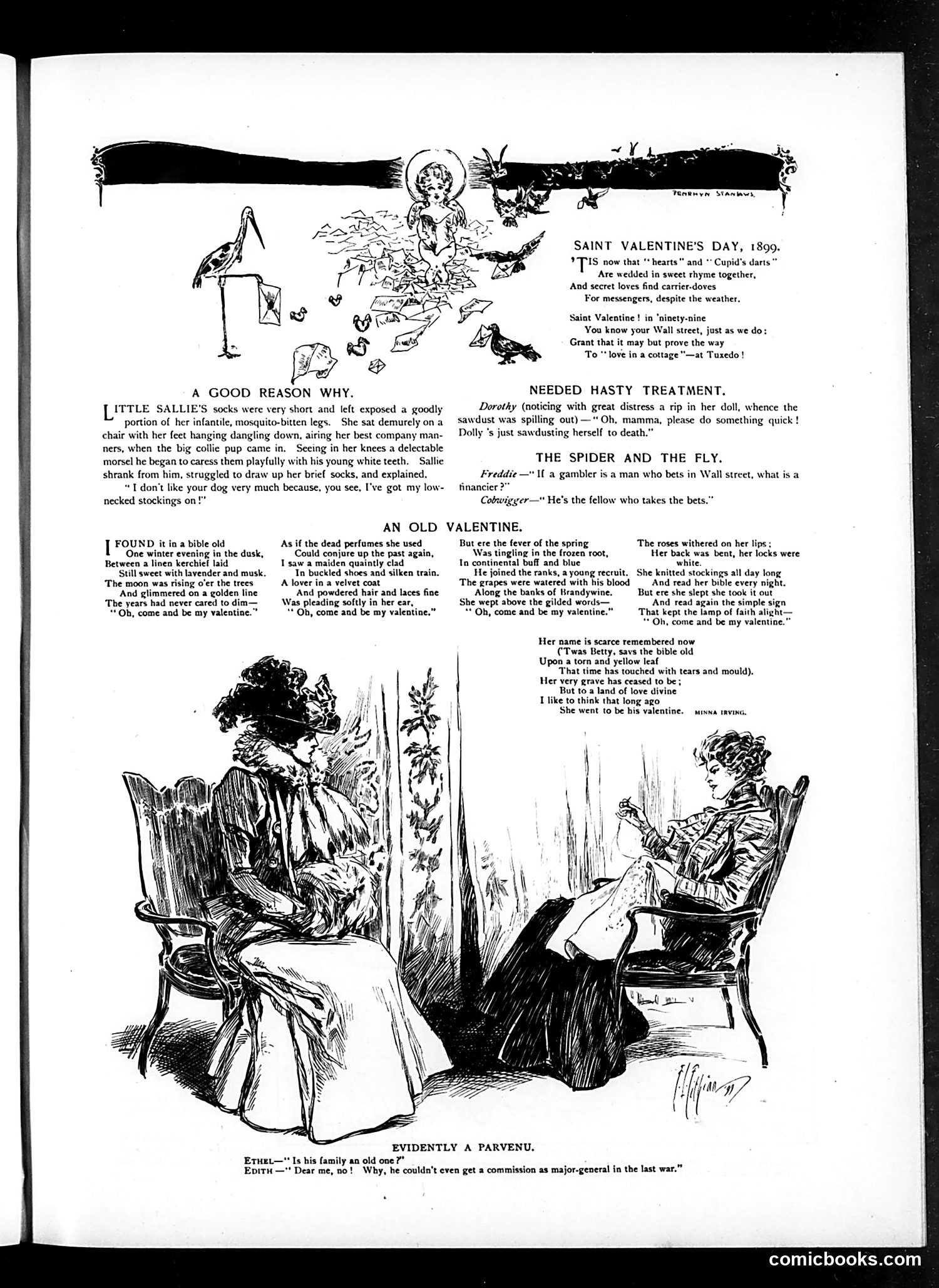
This St. Valentine's Day themed page contains several satirical pieces typical of 1890s humor: **"A Good Reason Why"** mocks a woman's mosquito-bitten legs, suggesting she wore short skirts—a scandalous fashion choice for the era. **"The Spider and the Fly"** uses a brief dialogue joke: when asked if a Wall Street gambler is a "financier," the response is "He's the fellow who takes the bets"—satirizing stock market speculation as mere gambling. **"An Old Valentine"** and **"Evidently a Parvenu"** appear to be romantic/domestic humor pieces typical of Valentine's Day content. The main illustration shows two women in period dress engaged in conversation, likely illustrating one of these satirical scenarios. The overall page combines romantic holiday sentiment with social commentary on contemporary fashion, finance, and class distinctions.
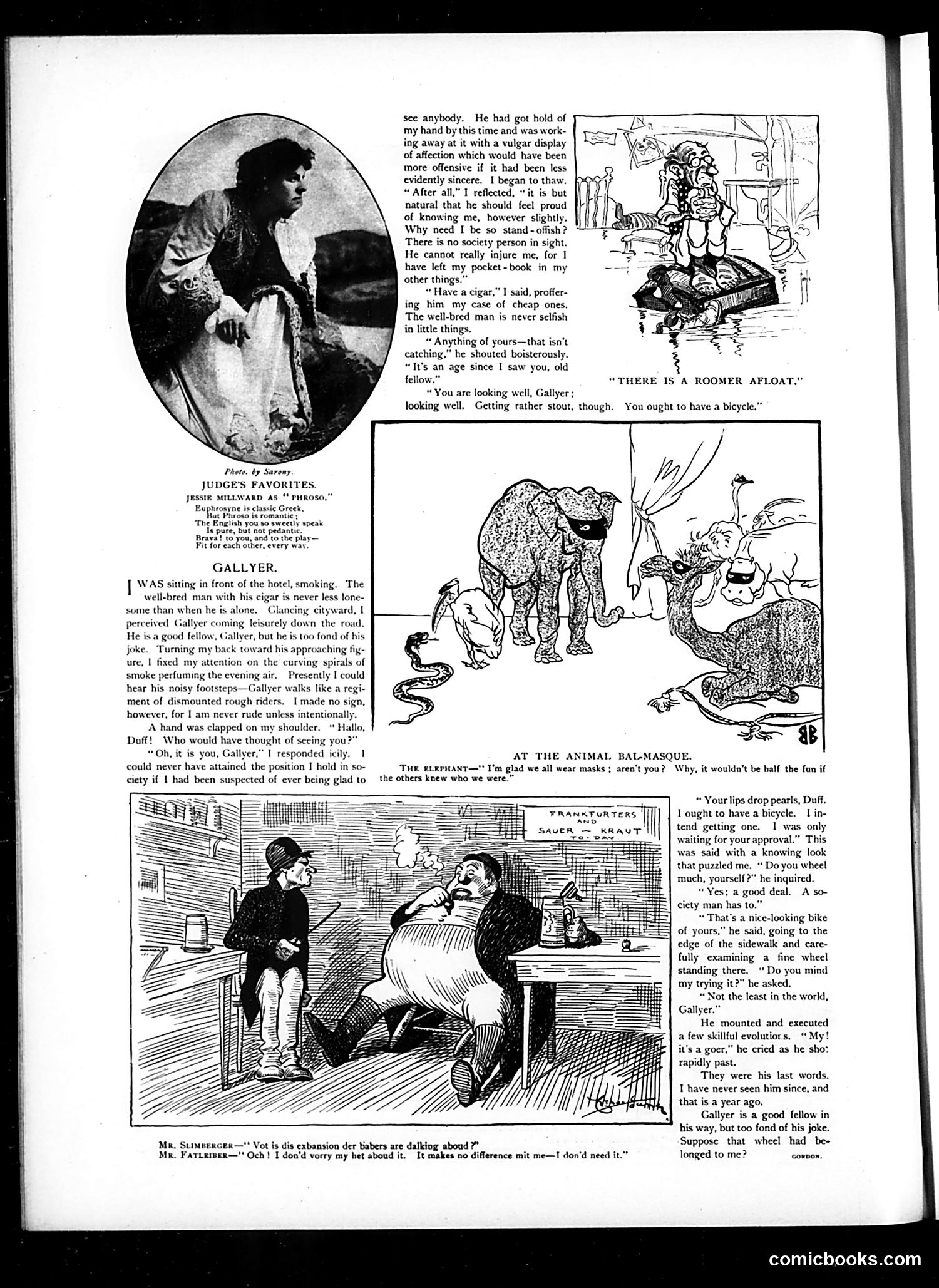
This page features a story titled "Judge's Favorites" about a character named Gallyer, a well-bred man with a cigar. The narrative describes Gallyer encountering an old acquaintance named Duff on the road. The accompanying illustrations satirize upper-class pretension and social climbing. The dialogue mocks Duff's attempts at self-improvement—he's acquired a bicycle (then a fashionable luxury item) and gained weight, which Gallyer observes with thinly veiled contempt. The humor targets the nouveau riche: Duff's obvious pride in his possessions contrasts with Gallyer's effortless, inherited sophistication. The final exchange about the bicycle wheel—where Duff anxiously seeks approval—emphasizes how insecure social climbers desperately crave validation from their betters. The satire reflects Gilded Age class anxieties about wealth, status, and belonging.
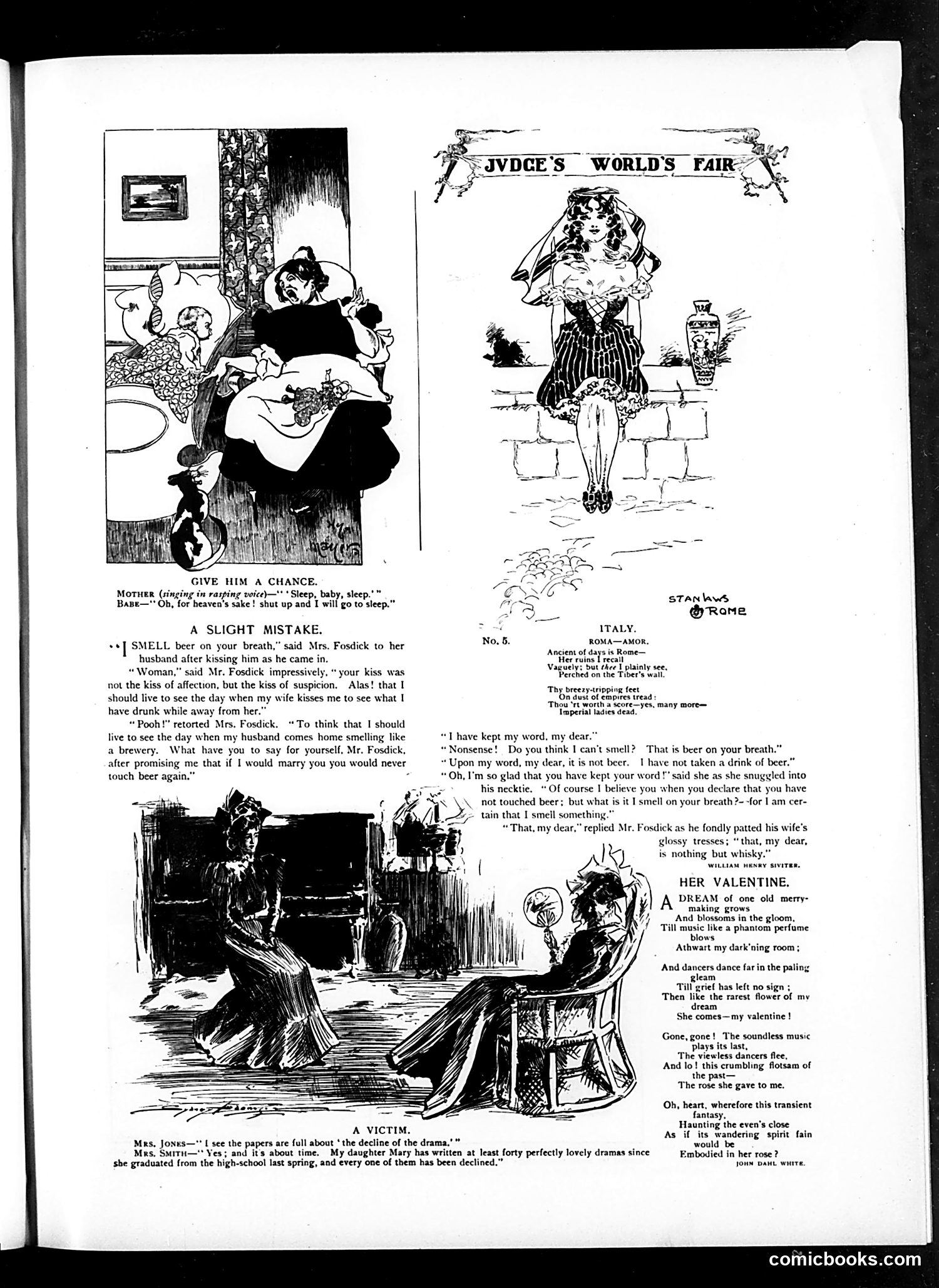
This page contains three satirical humor pieces typical of early 20th-century American magazine comedy: **"Give Him a Chance"**: A domestic joke where a mother sings a lullaby so badly that her baby begs her to stop—mocking sentimental parenting clichés. **"A Slight Mistake"**: A married couple's humorous dispute. The wife smells alcohol on her husband's breath; he denies drinking beer but admits it's whisky instead. The satire targets male deception and the absurdity of parsing excuses—he technically kept his promise not to touch beer while violating its spirit. **"A Victim"** (bottom): Two women discuss the "decline of drama." One boasts her daughter has written forty "perfectly lovely dramas" since high school, yet all were rejected. The satire mocks amateur writers' delusional confidence and the flood of mediocre submissions editors endured—a recurring Judge theme about aspiring (untalented) authors. The page reflects period concerns: domestic hypocrisy, marital tension, and cultural gatekeeping around artistic merit.
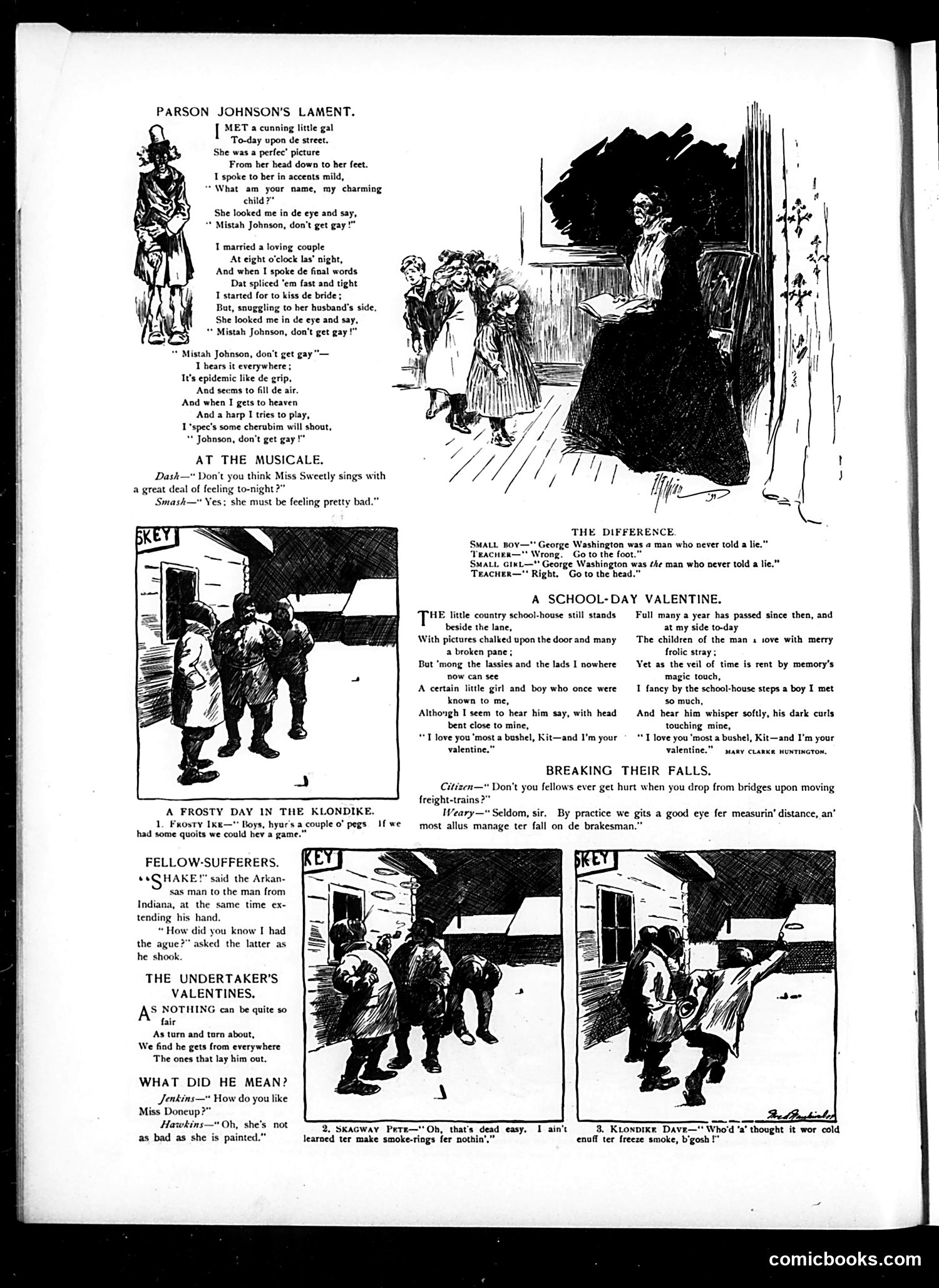
This page from *Judge* magazine contains several satirical pieces typical of late 19th/early 20th-century humor: **"Parson Johnson's Lament"** uses dialect humor (characteristic of the era) featuring a Black preacher repeatedly told "don't get gay" (meaning "don't be presumptuous")—a commentary on social boundaries of the time. **"The Difference"** satirizes rigid teaching: a student is wrong saying Washington "never told a lie," then right saying he was "the man who never told a lie"—identical statements treated differently, mocking pedantic instruction. **"The Undertaker's Valentines"** offers darkly witty wordplay: an undertaker receives valentines from people he'll eventually bury ("the ones that lay him out"). **"Breaking Their Falls"** jokes about hobos/tramps deliberately falling on train brakemen to break their falls—reflecting turn-of-century attitudes toward poor vagrant populations. The remaining pieces are sentimental verse and light domestic humor typical of the magazine's mixed content.
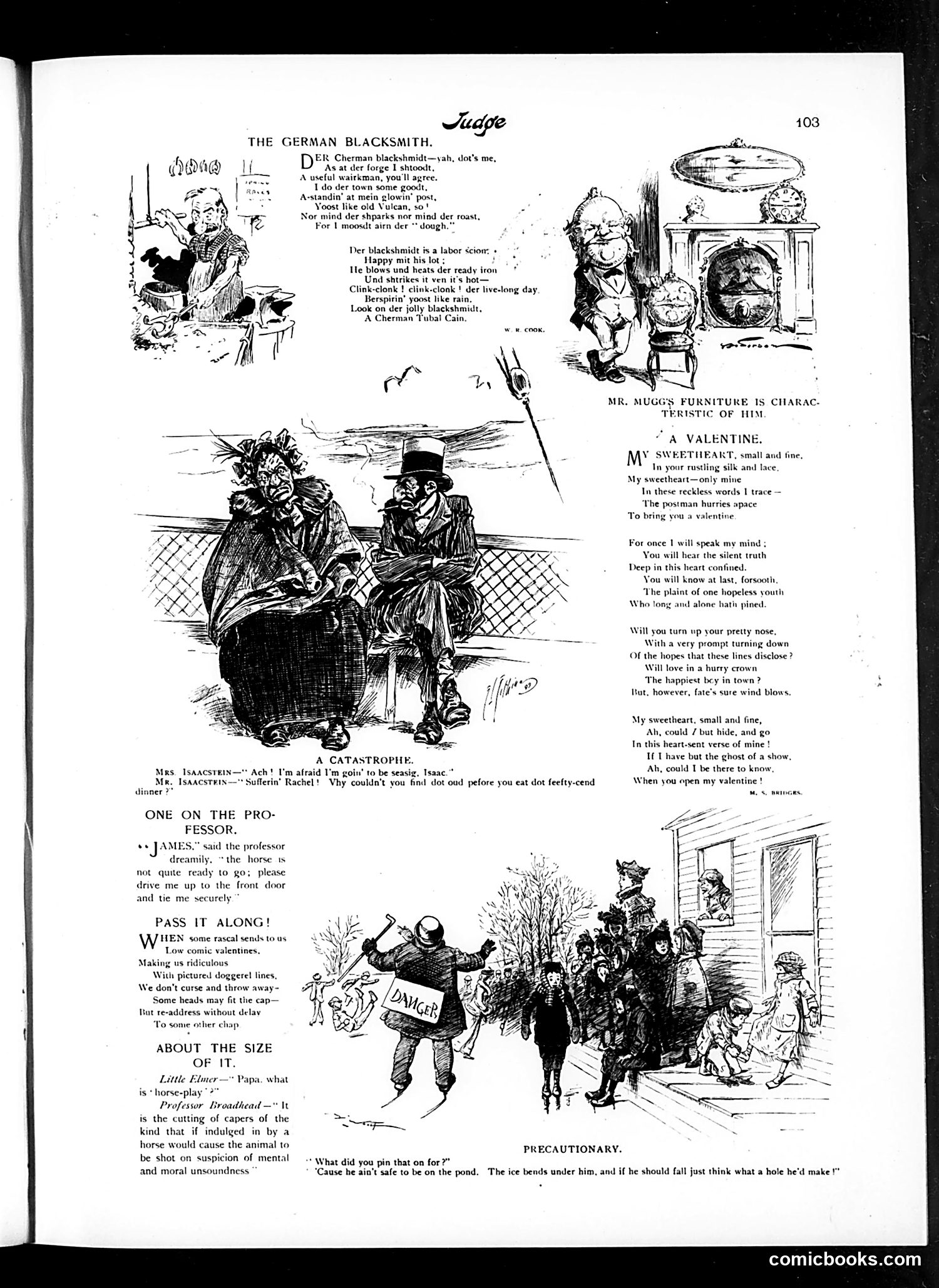
This page contains several unrelated satirical pieces typical of late 19th/early 20th-century humor: **"The German Blacksmith"** uses thick German-dialect verse to celebrate manual labor—a common stereotypical portrayal of German immigrants. The poem romanticizes the blacksmith's honest work with exaggerated accent humor ("Cherman," "shtoodt"). **"A Valentine"** is sentimental romantic poetry, likely satirizing overwrought Valentine's Day sentiments through excessive melodrama about unrequited love. **"A Catastrophe"** jokes about Jewish characters (Isaacstein, "Sufferin' Rachel") where a wife discovers seasickness only after eating an expensive dinner—playing on period stereotypes and marital comedy. **"One on the Professor"** contains a mild joke about a confused professor requesting to be tied to his front door. **"About the Size of It"** defines "horse-play" through the professor character, and a final panel jokes about a child's weight creating danger on thin ice. The page reflects period attitudes toward immigrants and ethnic caricature alongside conventional Victorian humor.
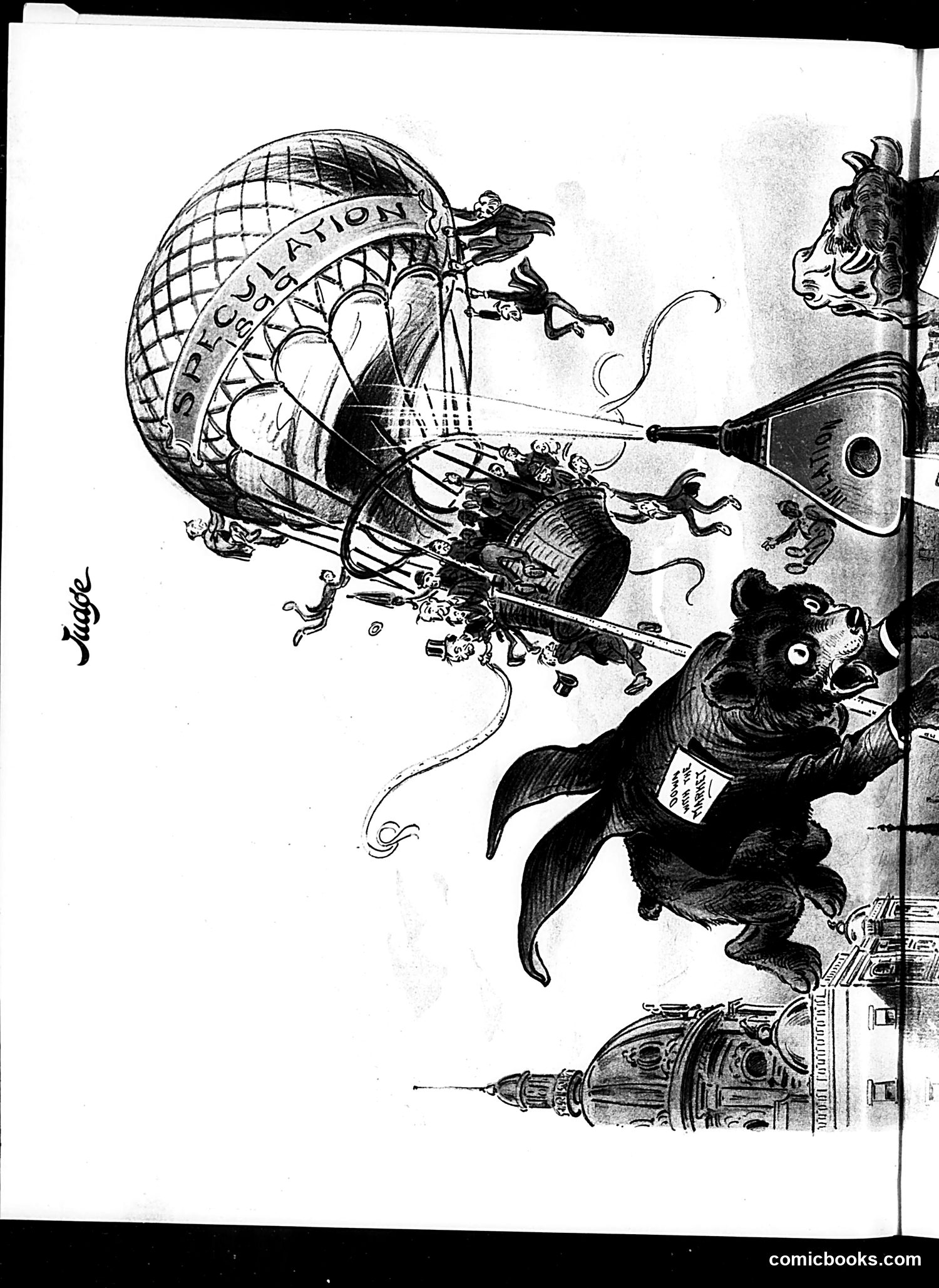
This appears to be a political cartoon from *Judge* magazine satirizing American imperialism and foreign intervention. The central image shows a large mechanical airship or balloon labeled "SPHERES OF INFLUENCE" with various figures operating or clinging to it. Below, a bear (likely representing Russia) watches alongside other figures, while architectural landmarks (possibly representing American cities) appear at the bottom right. The satire critiques America's aggressive expansion of economic and political control globally—the "spheres of influence" being the imperial territories nations claimed. The mechanical nature suggests these spheres are artificial constructs requiring constant effort to maintain. The bear's presence suggests anxieties about international competition, likely referencing Russian imperial ambitions during the late 19th/early 20th century.
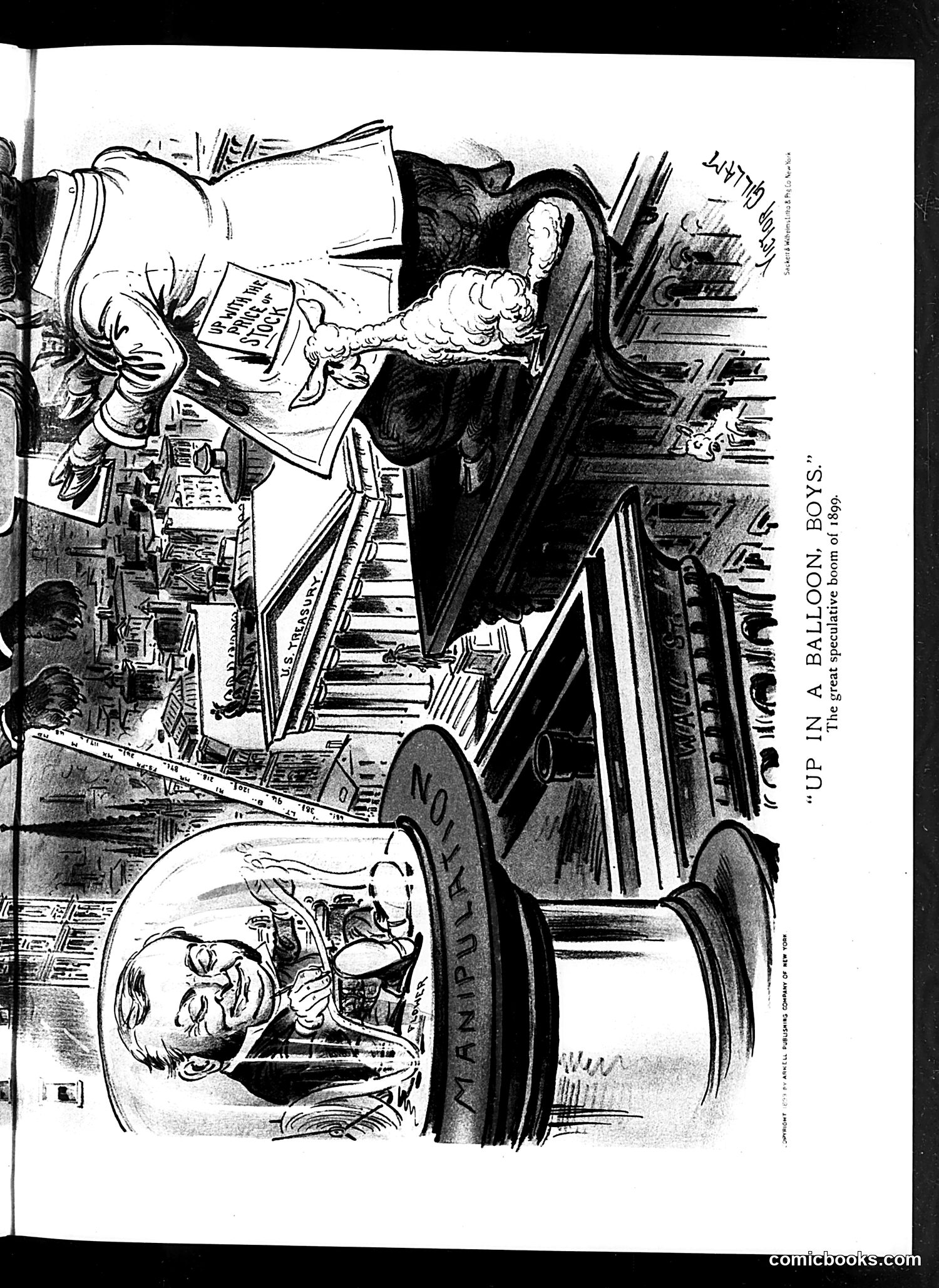
The OCR text is largely unreadable/reversed, making it difficult to definitively identify the specific cartoon's message. However, the image shows a political cartoon titled **"UP IN A BALLOON, BOYS"** with a subtitle mentioning "The race speculation born of 1896." The cartoon depicts a figure in formal dress (appearing to be a political candidate or leader) in a hot air balloon, with what appears to be a caricatured face below, likely representing economic speculation or political ambitions during the 1896 election cycle. The balloon imagery suggests inflated hopes or unsustainable political/economic aspirations rising dangerously high. The satire appears to critique the speculative fervor and unrealistic promises of the 1896 presidential race, mocking candidates' inflated rhetoric or economic schemes as destined to collapse.
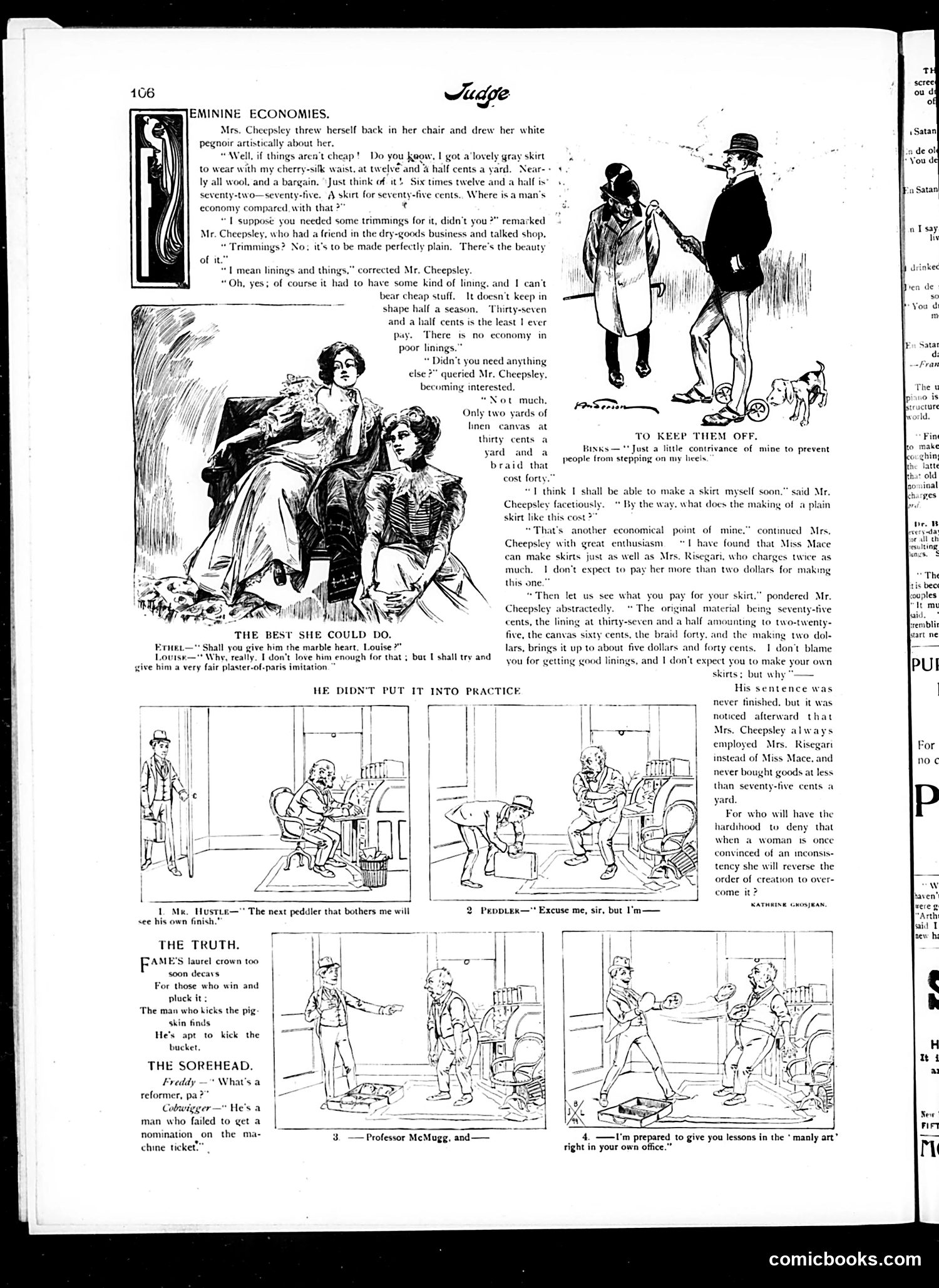
This page satirizes women's claimed economic expertise through Mrs. Cheepsley's self-deception. She boasts of purchasing a skirt cheaply (75 cents), but when her husband calculates the actual cost including lining (37½ cents), canvas (30 cents), braid, and tailoring ($2), the total reaches approximately $5.40—far more expensive than anticipated. The joke is the irony: Mrs. Cheepsley considers herself economical while actually overspending through hidden costs she initially overlooked. The final note suggests that once women recognize this inconsistency, they'll rationalize it rather than admit the mistake—a commentary on feminine logic and household financial management common to period humor. The additional cartoons ("He Didn't Put It Into Practice," "The Truth," "The Sorehead") appear unrelated satirical vignettes on other social topics.
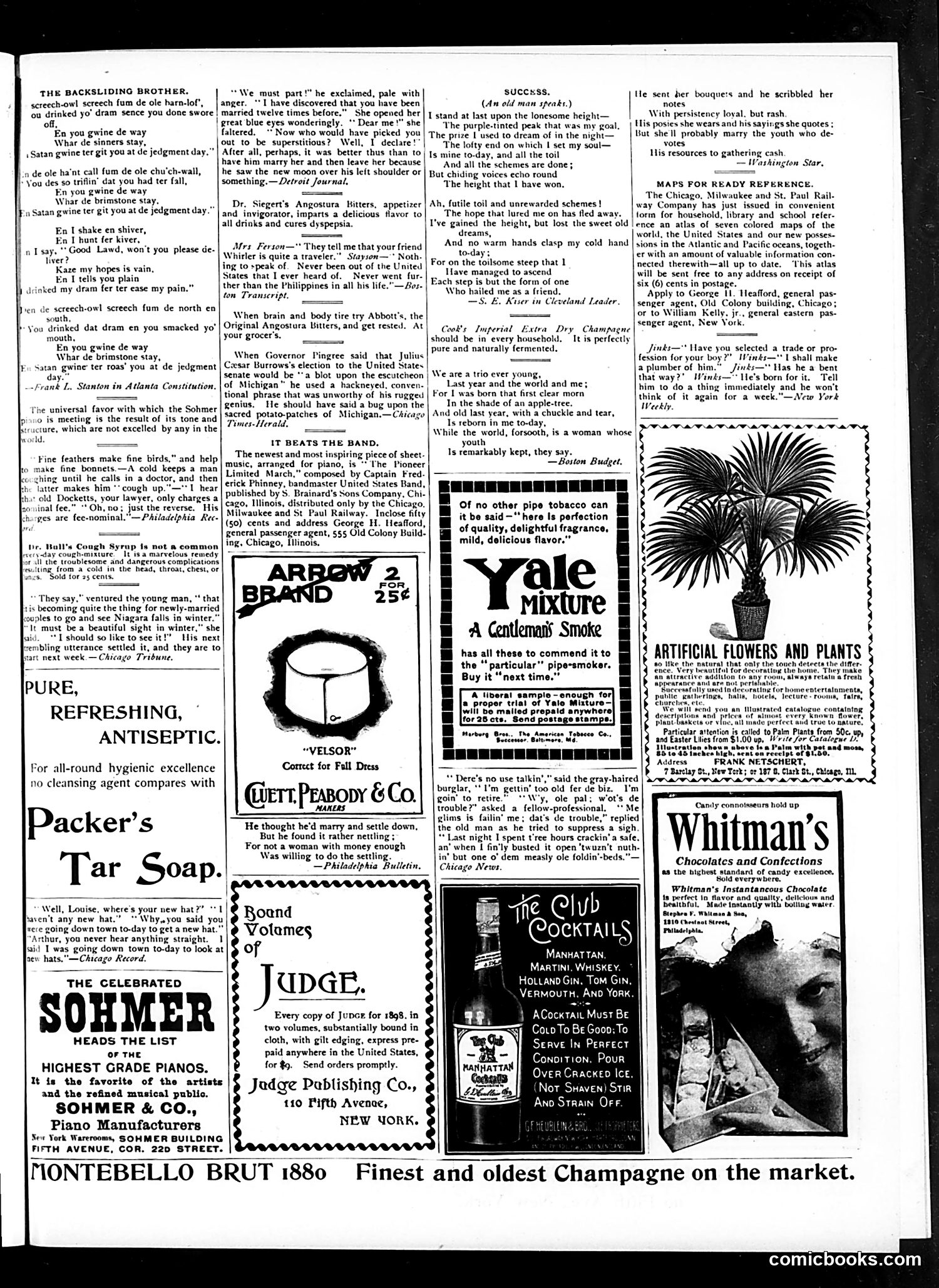
This page is primarily **advertisements and light satirical pieces** rather than political cartoons. The content includes: **Text Features:** - A dialectal poem "The Backsliding Brother" using African American vernacular, depicting moral redemption themes common to late-19th-century sentimental literature - Numerous short humorous anecdotes about marriage, hats, and social situations—typical of Judge's filler humor **Advertisements:** The page is dominated by period product ads (Packer's Tar Soap, Sohmer pianos, Yale tobacco mixture, Whitman's chocolates, etc.) and includes no discernible political cartoons. **Historical Context:** The dialect poem and jokes reflect Victorian-era attitudes toward race, gender, and morality. The overall tone suggests this is likely from the 1890s-1900s based on advertising styles and references. **Bottom Line:** This appears to be a standard interior page mixing advertisements with disposable humor rather than commentary on specific political events or figures. Modern readers would find the racial dialect jarring and the humor culturally dated.
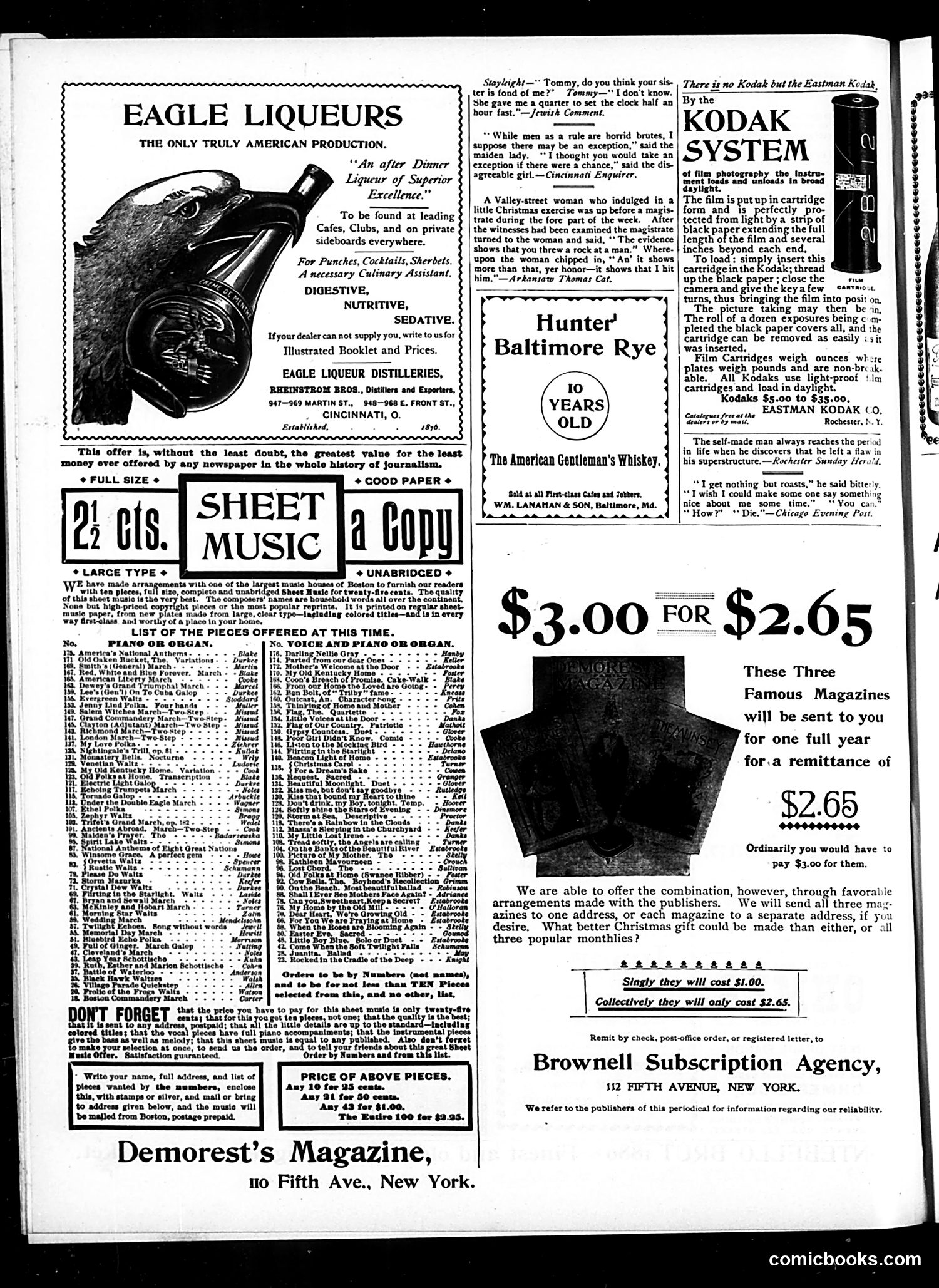
This page is primarily **advertising**, not a political cartoon. It contains multiple commercial advertisements typical of Judge magazine's revenue model: The main ads include Eagle Liqueurs (Cincinnati distillery), Sheet Music offerings (25 pieces for 25 cents from Demorest's Magazine), Hunter's Baltimore Rye whiskey, Kodak film systems, and a magazine subscription bundle ($2.65 for three publications). Interspersed are brief **humorous jokes** rather than political satire: one about a boy helping his sister manipulate a suitor by setting clocks forward for payment; another about a woman acknowledging men are "horrid brutes" with possible exceptions. The page reflects **turn-of-the-century American consumer culture**—promoting photography technology, spirits, sheet music, and print media to middle-class readers. There is no identifiable political commentary or caricature requiring historical context beyond understanding this as typical period advertising and light social humor.
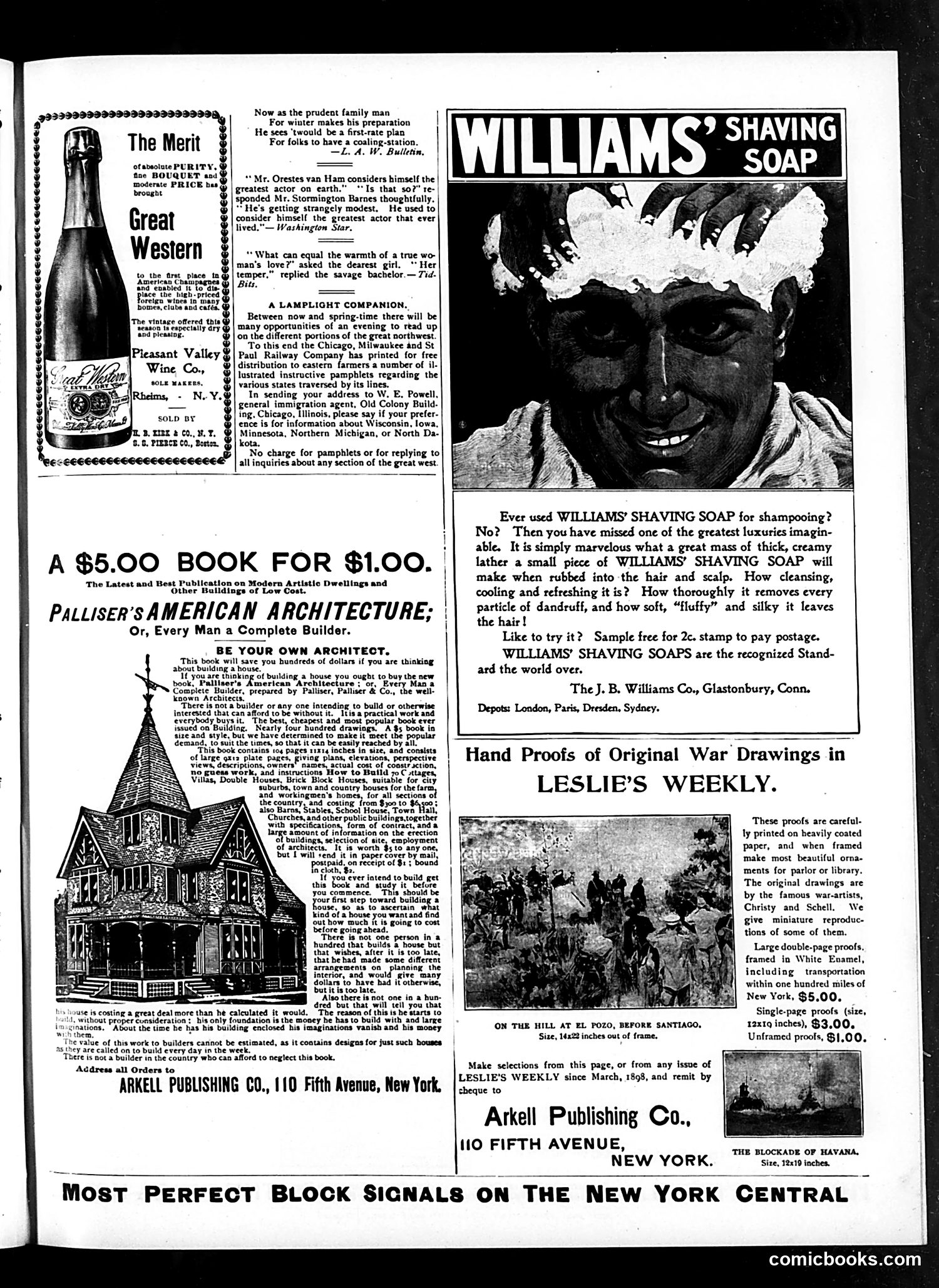
This page is primarily **advertising and announcements** rather than satirical cartoons. The small humorous items present are brief jokes typical of Judge's "Lighter Vein" section: - A quip about an actor named Orestes van Ham who, despite claiming to be "the greatest actor on earth," is actually becoming more modest than his previous boast of being the greatest actor "that ever lived"—satire of theatrical ego. - A joke about a woman asking what equals the warmth of true love; a "savage bachelor" cynically answers "her temper"—typical turn-of-the-century misogynistic humor. - A brief commentary on winter preparations and "coaling-stations" (coal storage for heating). The page is dominated by **commercial advertisements** for wine, architecture books, shaving soap, and war drawings from Leslie's Weekly. These ads occupy substantially more space than any editorial content, reflecting Judge's business model during this period.
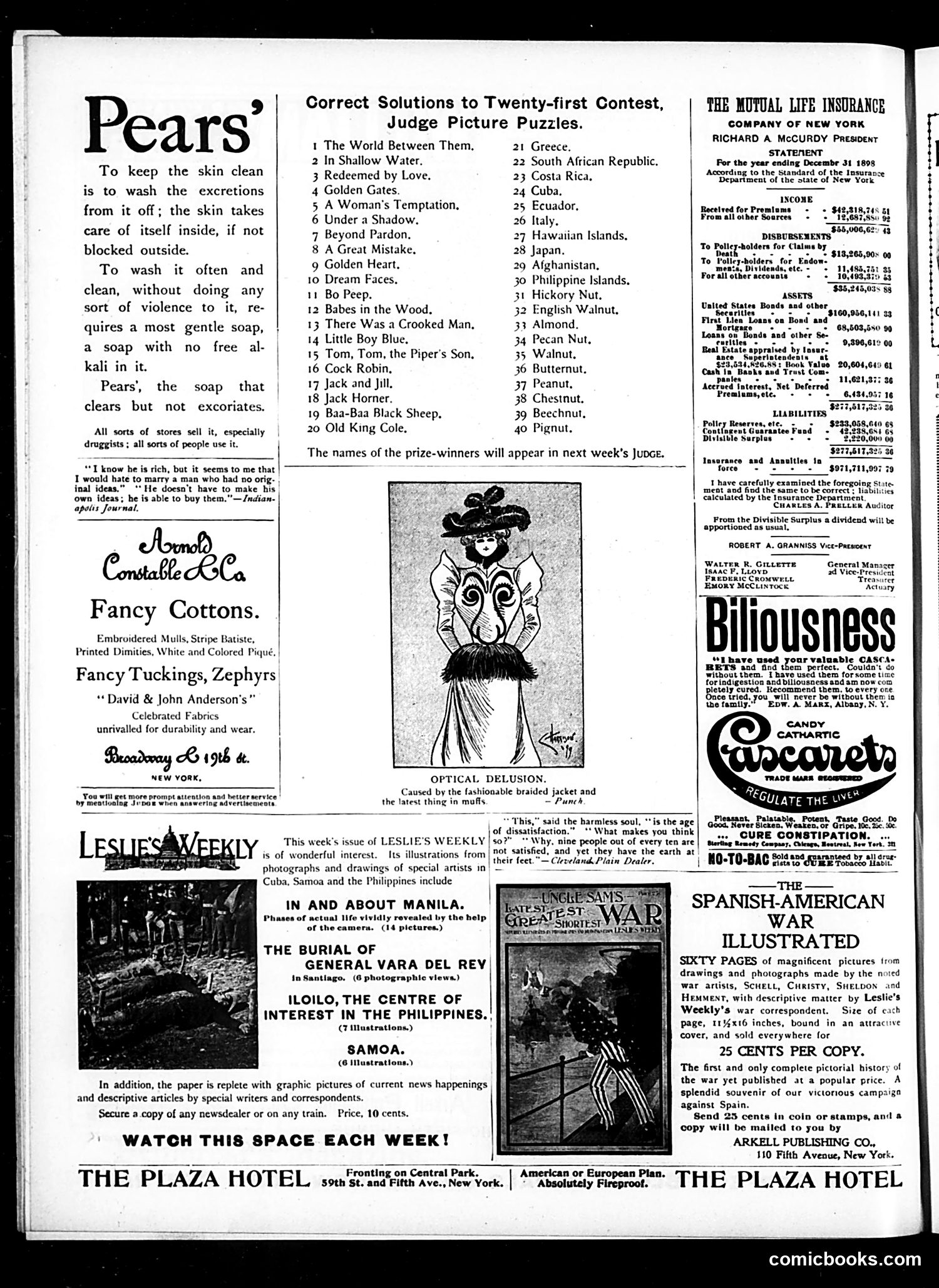
This single-panel cartoon satirizes the fashionable silhouette created by the "braided jacket" and elaborate muff (a fur hand-warmer) popular in 1898. The illustration shows a woman whose torso appears absurdly distorted—the combination of the structured, decorative jacket and the large muff positioned at her waist creates an optical illusion that makes her body look unnaturally shaped. The satire targets women's fashion constraints of the era, mocking how clothing designed to be fashionable actually distorts the wearer's natural form, creating a ridiculous visual effect. It's social commentary on the absurdity of following fashion trends without regard for how they actually look. The page also contains contest solutions and numerous period advertisements, making this primarily a content/advertising page rather than political satire.
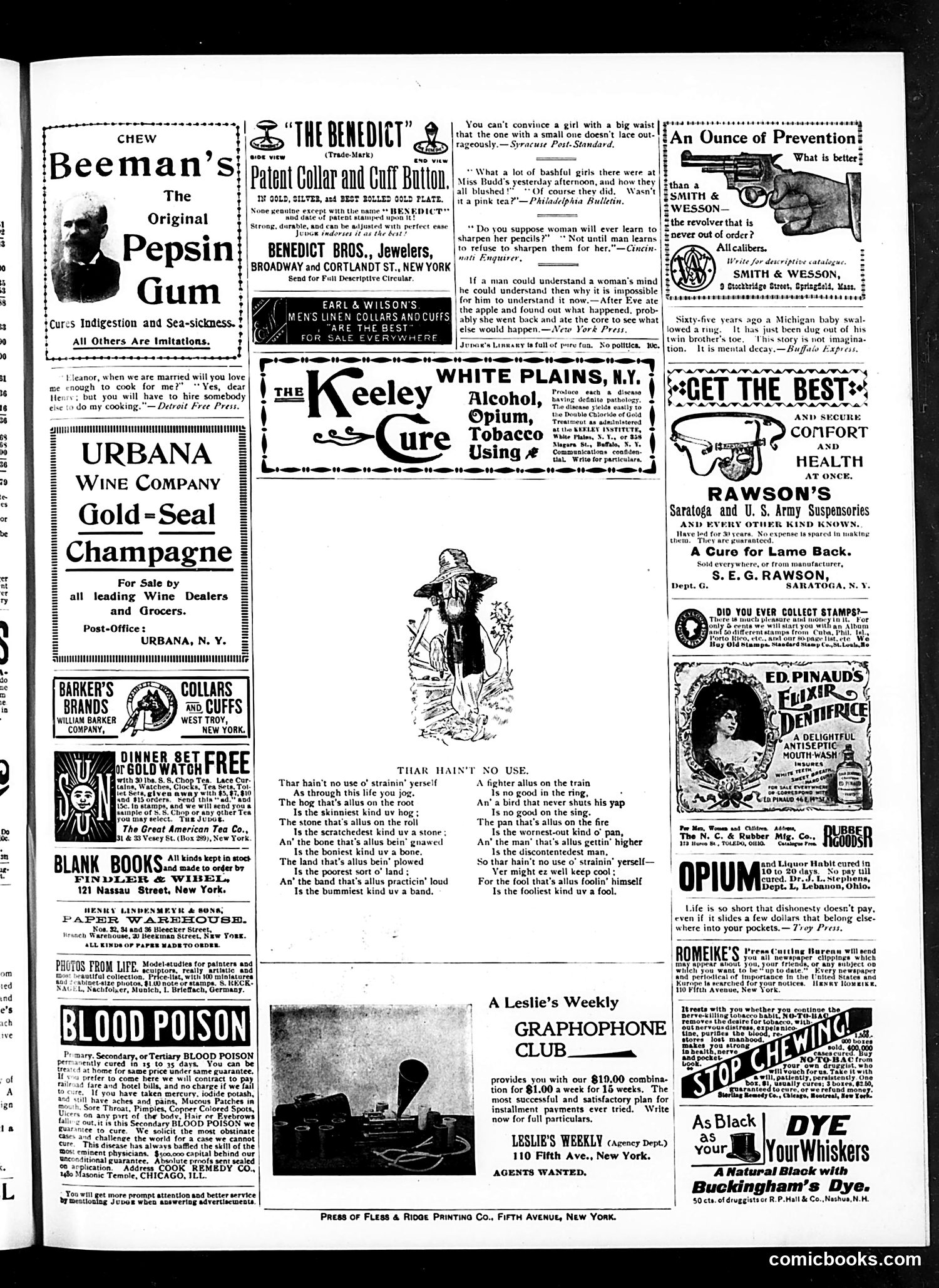
This page is primarily **advertising**, typical of Judge magazine's business model. The central cartoon titled "THAR HAIN'T NO USE" depicts a rustic, dialect-speaking character offering homespun philosophy comparing futile efforts (a hog always rooting, a stone always rolling, a band always practicing loudly) to human foolishness. The humor relies on rural vernacular and the tired trope of "folksy wisdom." The surrounding advertisements promote patent medicines and dubious products common to the era: Beeman's Pepsin Gum (for indigestion), the "Keeley Cure" (for alcohol and opium addiction), Rawson's Suspensories, Ed. Pinaud's Elixir (hair treatment), and "Stop Chewing" tobacco remedy. These reflect turn-of-century American credulity toward unregulated health claims. Small satirical quips scattered throughout mock gender relations—a running theme in Judge—with jokes about women sharpening pencils and bashful girls at "pink teas." The content overall represents period attitudes toward medicine, gender, and rural stereotypes.
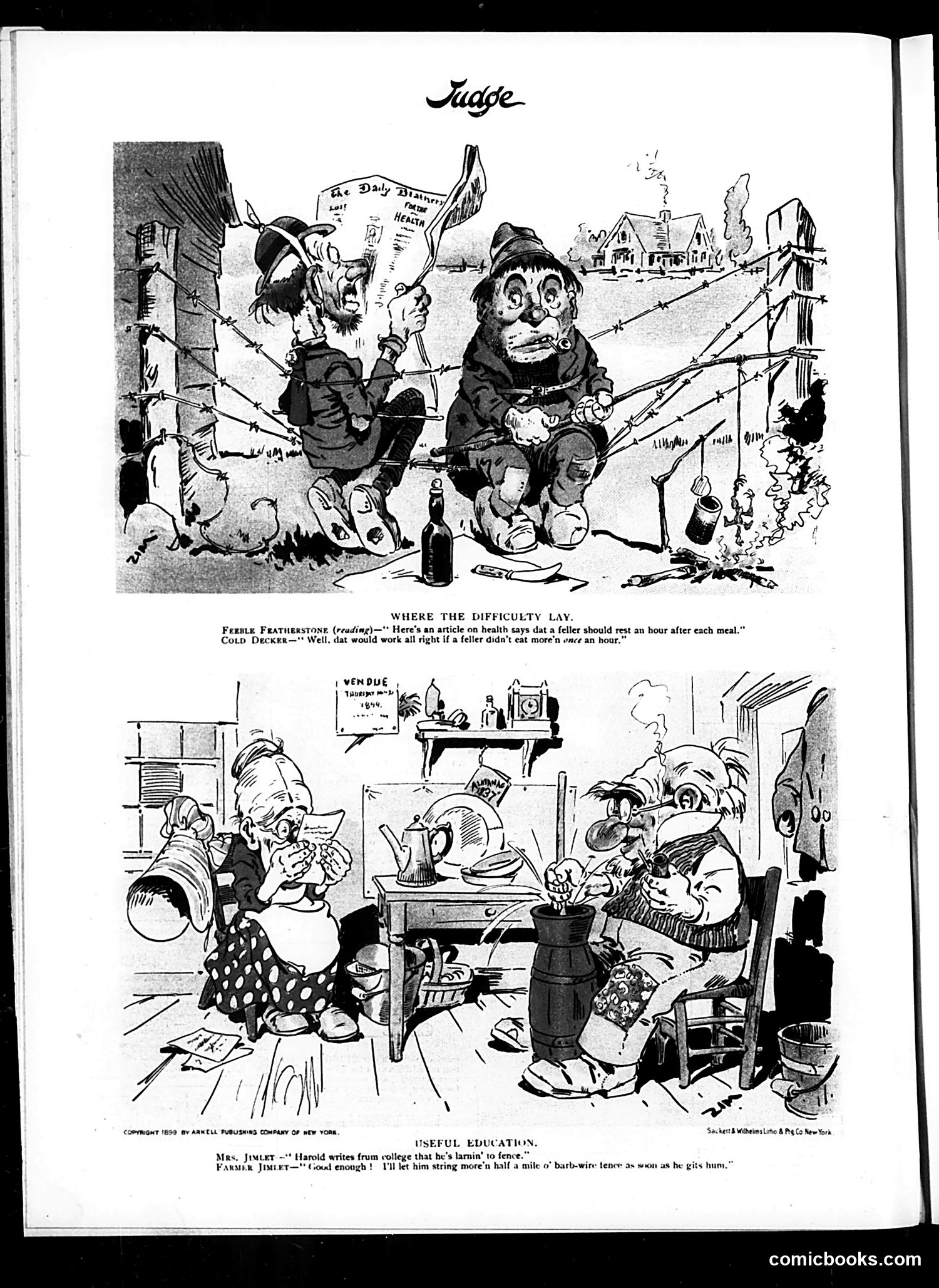
This page contains two satirical cartoons about domestic health and parenting advice. **Top cartoon ("Where the Difficulty Lay"):** Features caricatured figures—identified as Feenie Featherstone and Cold Decker—debating a newspaper health article. The joke satirizes conflicting expert advice: the article recommends eating at regular intervals, but specifies waiting an hour after each meal. The cartoon mocks the impractical nature of such contradictory guidance. **Bottom cartoon ("Useful Education"):** Shows Mrs. and Farmer Jimlet discussing their son Harold's letter from village school. Harold claims he's "learning to fence" (construct barriers), but his parents humorously interpret this as fencing stolen goods—a dark joke about rural education and criminality. Both cartoons target advice columns and working-class parenting concerns common in early 20th-century America.