
A complete issue · 16 pages · 1898
Judge — December 17, 1898
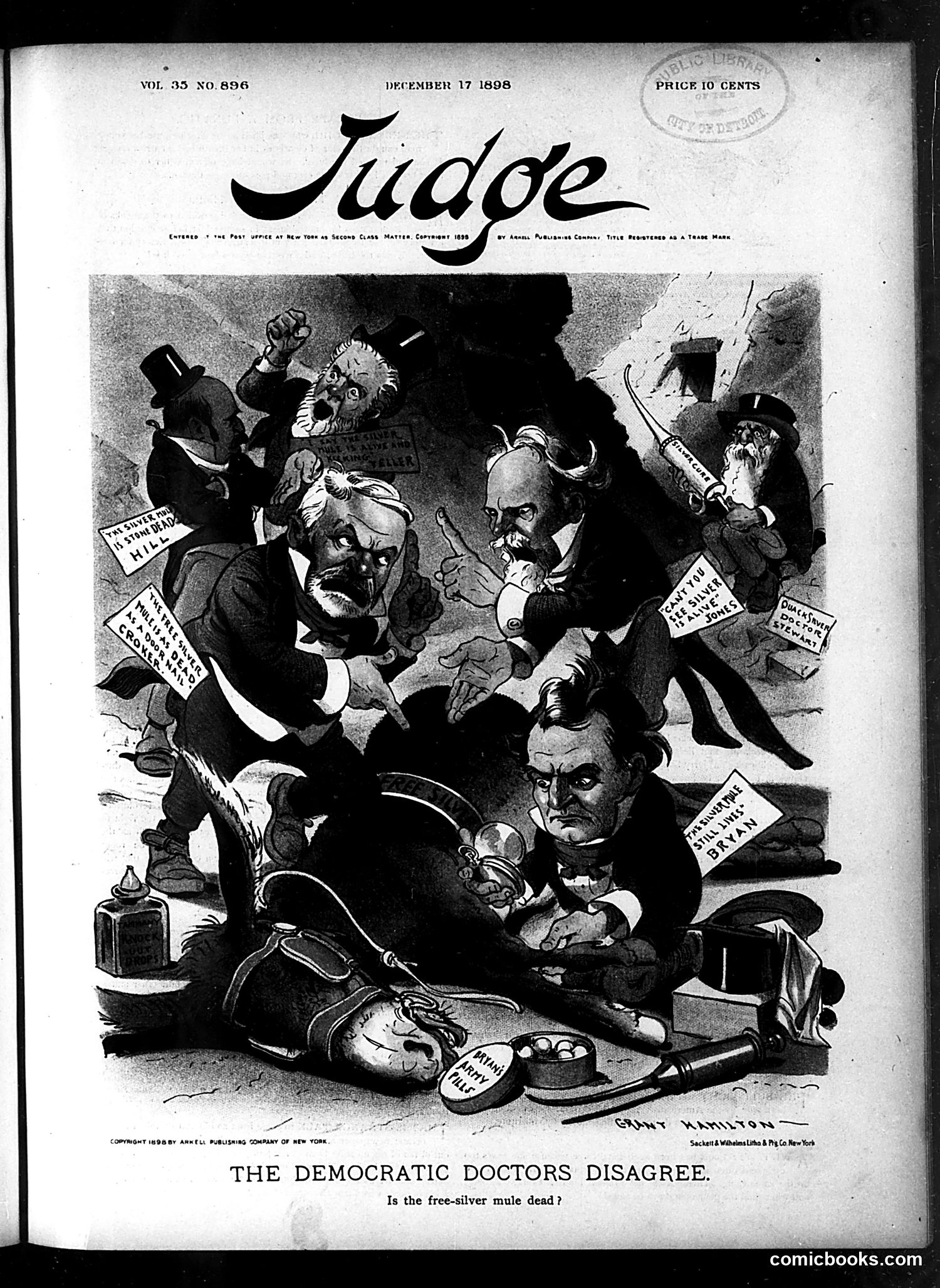
This December 1898 *Judge* cartoon satirizes internal conflict within the Democratic Party over free-silver currency policy. The illustration shows Democratic leaders as physicians quarreling over treating a patient (the "free-silver mule"—depicted as near death), using medical instruments as weapons. The competing "doctors" represent different Democratic factions debating monetary policy. The free-silver movement had deeply divided Democrats: some supported unlimited silver coinage as inflationary relief for debtors, while gold-standard Democrats opposed it. This schism weakened the party politically. The cartoon's title asks: "Is the free-silver mule dead?"—suggesting the divisive issue may have destroyed Democratic unity and electoral prospects. The chaotic scene of bickering physicians unable to agree on treatment illustrates how internal disagreement paralyzed the party's response to this crucial economic debate.
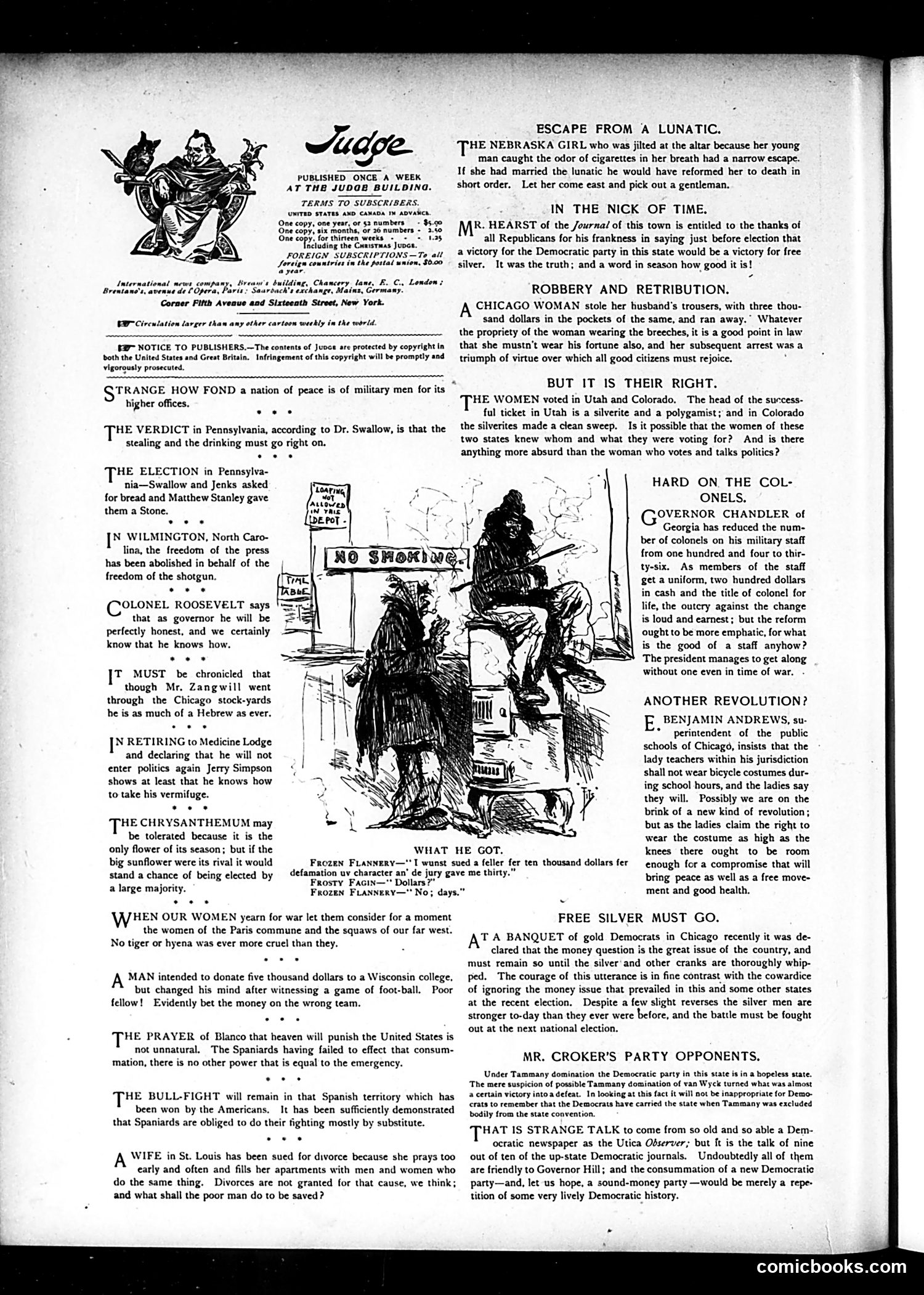
This page from Judge magazine contains several brief political commentaries rather than a single cartoon. The main illustrated piece shows a figure labeled "FROZEN FLANNERY" attempting to seduce or manipulate another figure, satirizing what appears to be a political corruption scheme involving "defamation of character" and bribery. The text commentaries address various political issues: women's voting rights in Utah and Colorado, Governor Chandler of Georgia's military staff expenses, Chicago school superintendent Benjamin Andrews' policies regarding female teachers wearing "bicycle costumes," and Democratic Party financial troubles regarding free silver currency. The overall tone is critical of political corruption, gender politics, and monetary policy debates of the era. Without specific dates visible, the reference to "free silver" suggests this is from the 1890s monetary debate period.
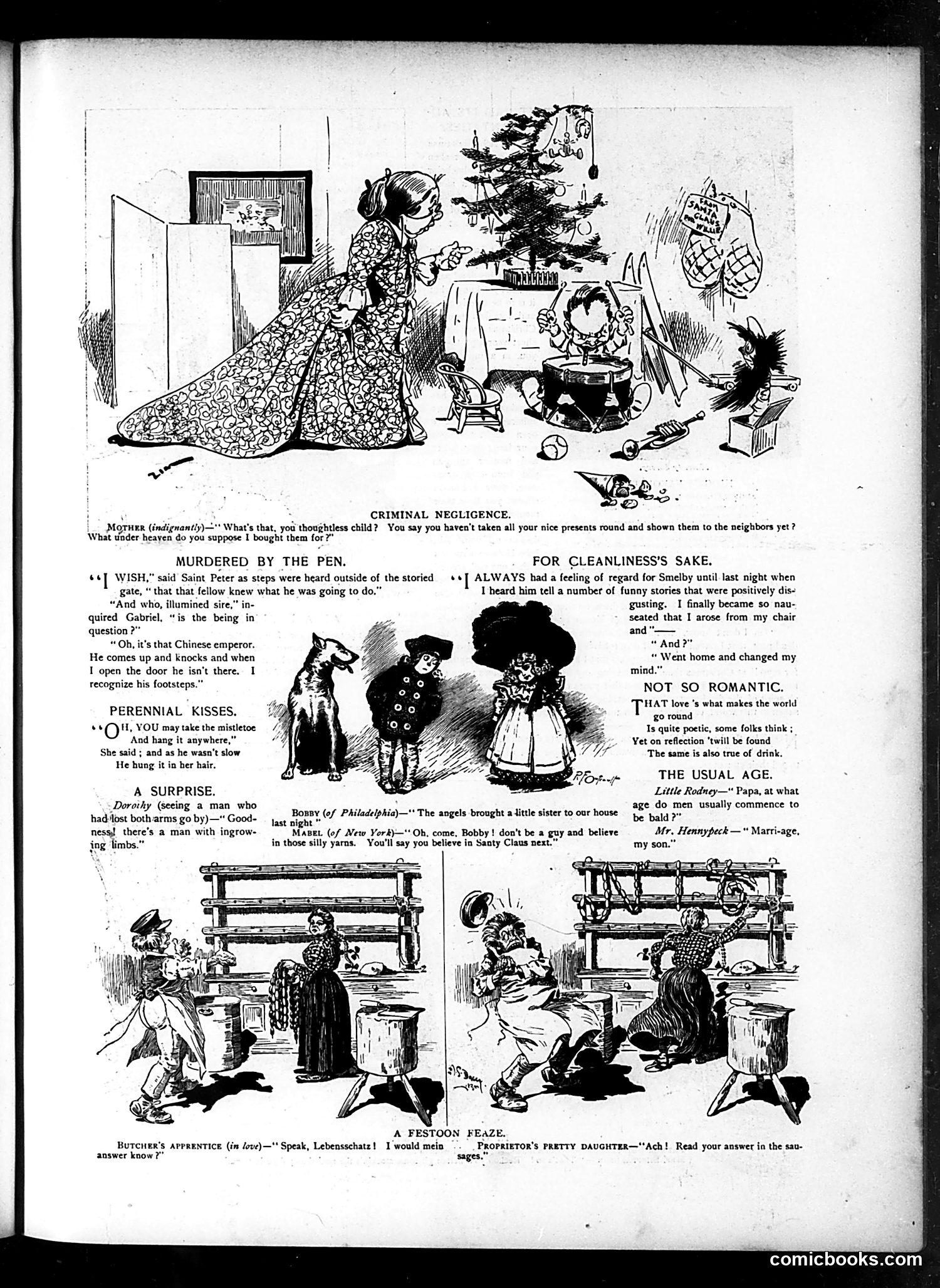
This page contains multiple comic vignettes satirizing domestic life and social behavior of the era: **"Criminal Negligence"** mocks a negligent mother who hasn't shown Christmas presents to neighbors, suggesting materialism and social one-upmanship among the wealthy. **"Murdered by the Pen"** appears to reference a story about a Chinese emperor, likely satirizing exotic or fantastical tales. **"Perennial Kisses"** jokes about mistletoe tradition and physical affection. **"A Festoon Feaze"** and related vignettes depict humorous domestic scenes, including what appears to be servant-class interactions and class-based humor common to Victorian-era satire. The overall theme emphasizes domestic absurdities, romantic notions, and social pretensions. The artwork style and subject matter are typical of late-19th-century American humor magazines targeting middle and upper-class readers.
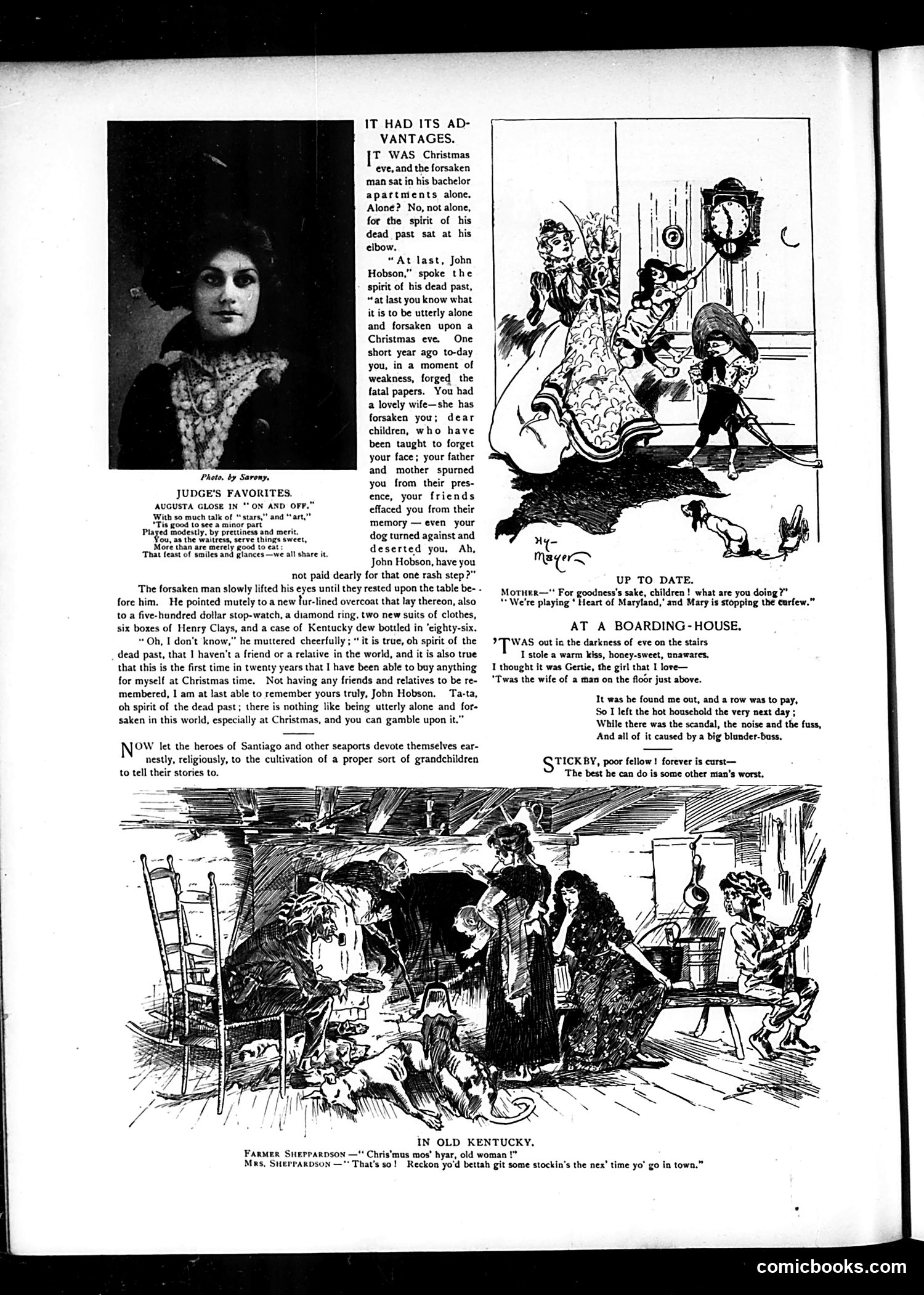
This page contains three distinct sections: 1. **"Judge's Favorites"** - A portrait photograph of Augusta Close in "On and Off," with promotional text for a theatrical performance. 2. **"Up to Date"** - A cartoon depicting a mother scolding children playing indoors, with period-appropriate dialogue about proper behavior. 3. **"In Old Kentucky"** - A sketch showing a rural domestic scene with farmer Sheppardson and Mrs. Sheppardson exchanging Christmas greetings. The humor appears to be in the rustic dialect and the farmer's suggestion to get livestock as a gift. The page mixes theatrical promotion with gentle domestic satire typical of early 20th-century Judge magazine—poking fun at social conventions and regional American speech patterns rather than engaging in sharp political commentary.
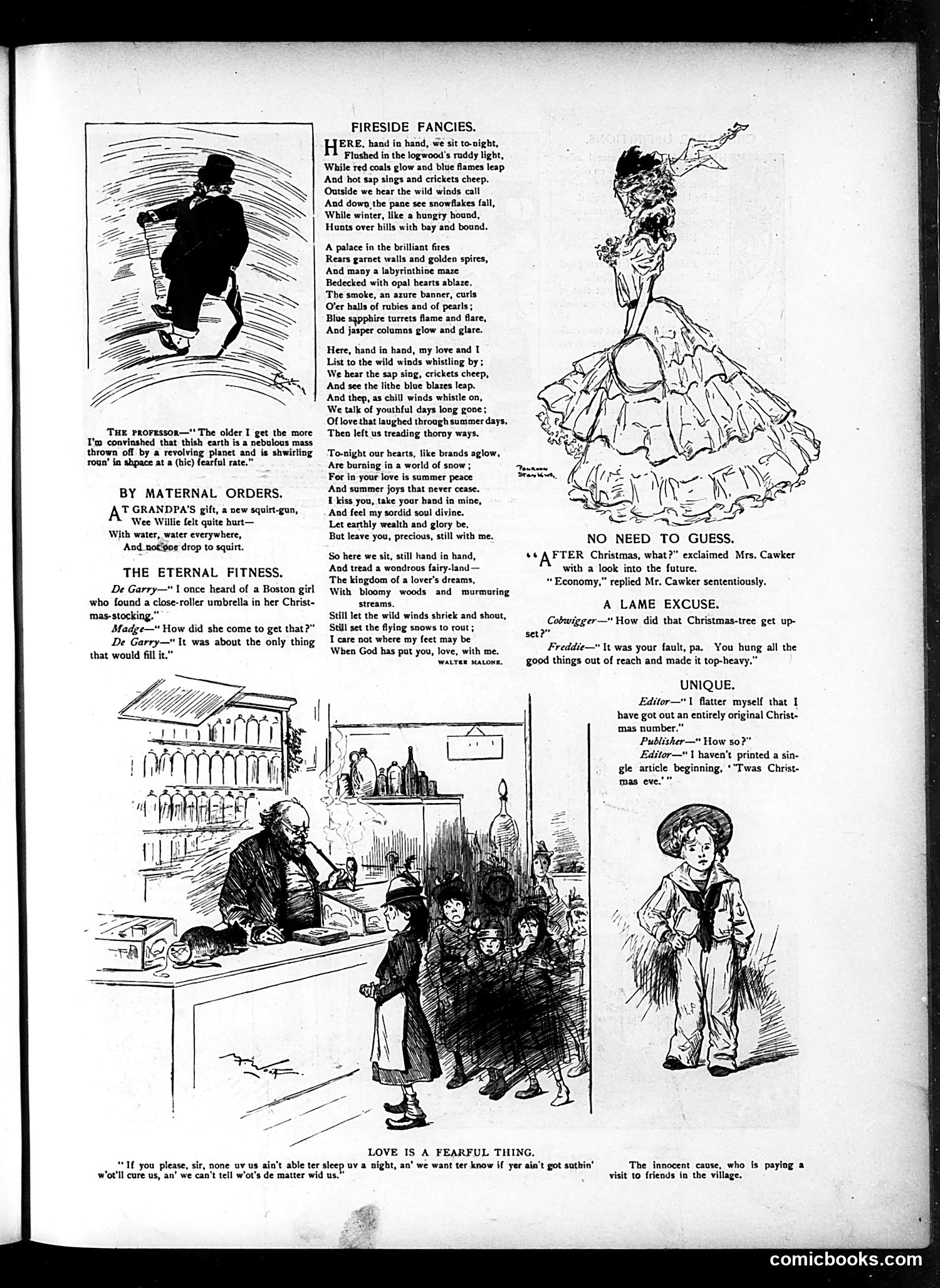
This page collects several distinct pieces typical of late 19th/early 20th-century satirical magazines: **"Fireside Fancies"** is a sentimental romantic poem about lovers by a winter fire—straightforward verse, not satirical. **The cartoon section** includes social humor rather than political satire: a drunk professor making pseudo-scientific claims about Earth's motion; a Boston girl receiving a closed umbrella as a useless Christmas gift (mocking impractical gifts); and children at a shopkeeper's counter, depicting holiday shopping culture. **The brief "jokes"** satirize Christmas excess and editorial pretension: Mr. Cawker's post-holiday "economy," a child blaming his father for hanging expensive gifts out of reach, and an editor boasting of an "original" Christmas issue while using hackneyed opening lines. **The bottom illustration** shows what appears to be poor villagers seeking sleep remedies, possibly commenting on social conditions or health quackery. Overall, this is light domestic and seasonal satire—no significant political content—typical of Judge's humor aimed at middle-class readers.
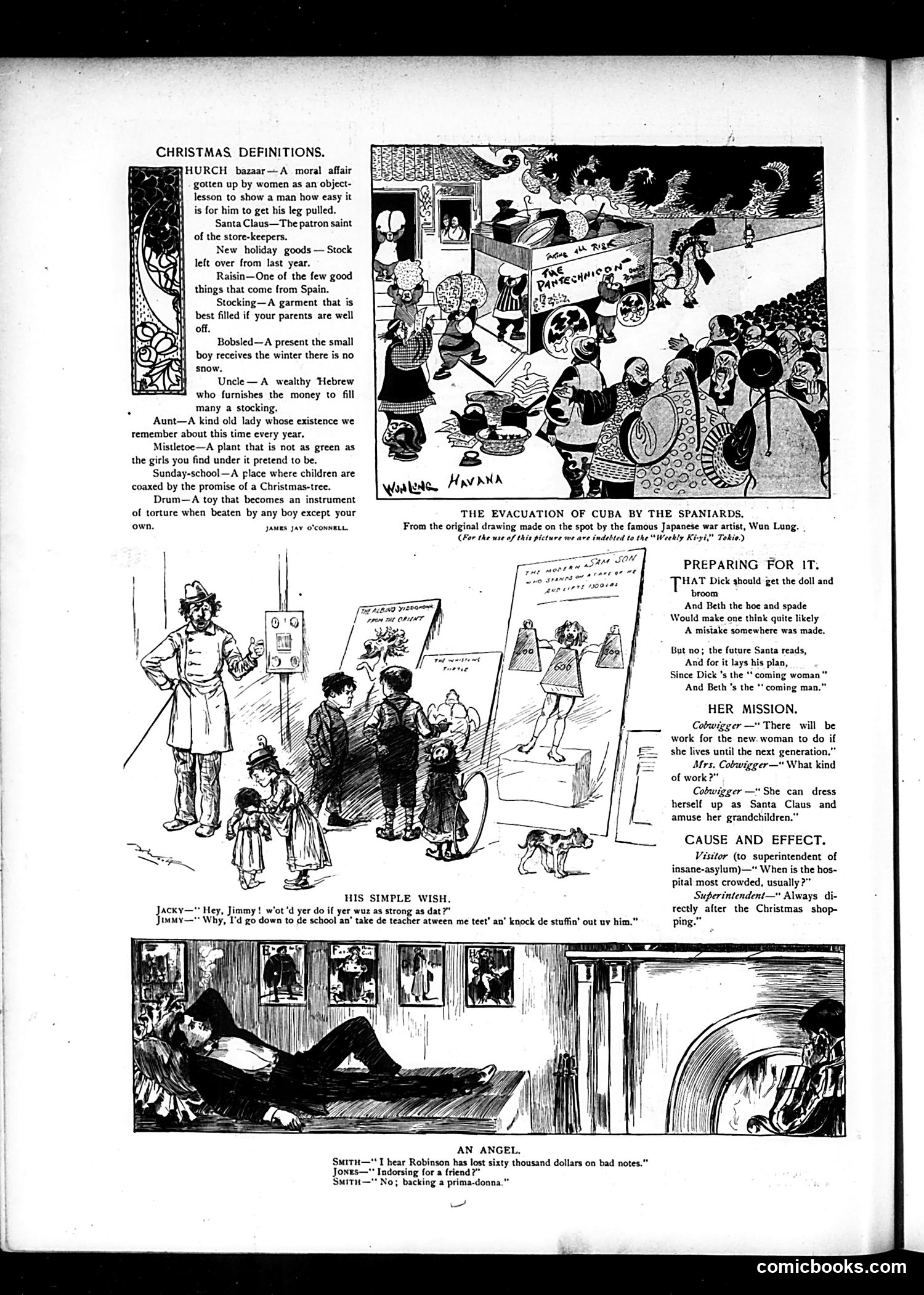
This page contains satirical Christmas-themed content typical of the era's social commentary. **"Christmas Definitions"** section offers cynical takes on holiday concepts: Church bazaars as schemes to fool men, Santa as a retailer's patron saint, and stockings best filled by wealthy parents. The humor targets commercialism and hypocrisy surrounding Christmas traditions. **"The Evacuation of Cuba by the Spaniards"** appears to reference the Spanish-American War period (late 1890s), when Spain was losing colonial control. The attribution to a "Japanese war artist" is likely satirical, mocking sensationalized war reporting. **"His Simple Wish"** depicts a working-class boy expressing violent fantasies about overpowering his teacher—dark humor about class resentment and education. **"Preparing for It"** jokes about gender role reversals: giving a boy domestic toys and a girl outdoor tools, predicting she'll become the "coming man" while he becomes the "coming woman"—satirizing emerging feminism. **"Her Mission"** and **"Cause and Effect"** offer mild social commentary on women's evolving roles and Christmas shopping's psychological toll, respectively.
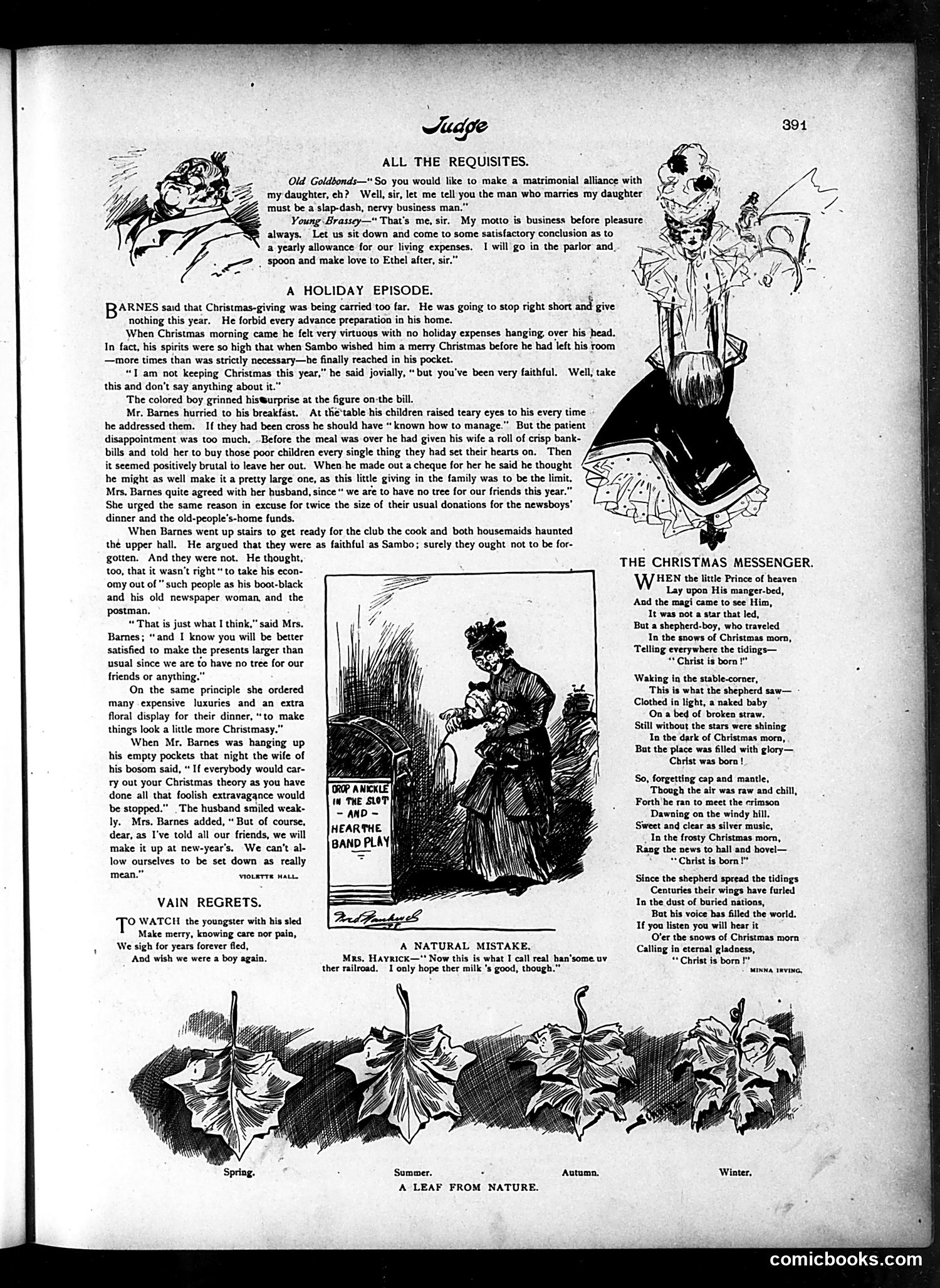
This page contains multiple satirical pieces typical of Judge's humor: **"All the Requisites"** (top left): A young suitor courting a wealthy daughter adopts calculated business language to win her father's approval, treating romance as a transaction. The satire targets the mercenary nature of upper-class marriages and the pretense of romance masking financial negotiation. **"A Holiday Episode"** (main story): Mr. Barnes, attempting to skip Christmas gift-giving on principle, ironically ends up spending far more than usual. His refusal to give to his family shames him into lavish spending; his wife then uses this to justify expensive purchases, ultimately defeating his economy. The satire mocks both miserliness and the self-deception people use to justify holiday excess. **"A Natural Mistake"** (small illustration): A rural woman mistakes a railroad for a farm feature—simple humor about rural ignorance. The page also includes a sentimental poem, "The Christmas Messenger," and a nature illustration. Overall, the issue critiques holiday consumerism, class pretension, and domestic hypocrisy through gentle, middle-class-focused satire.
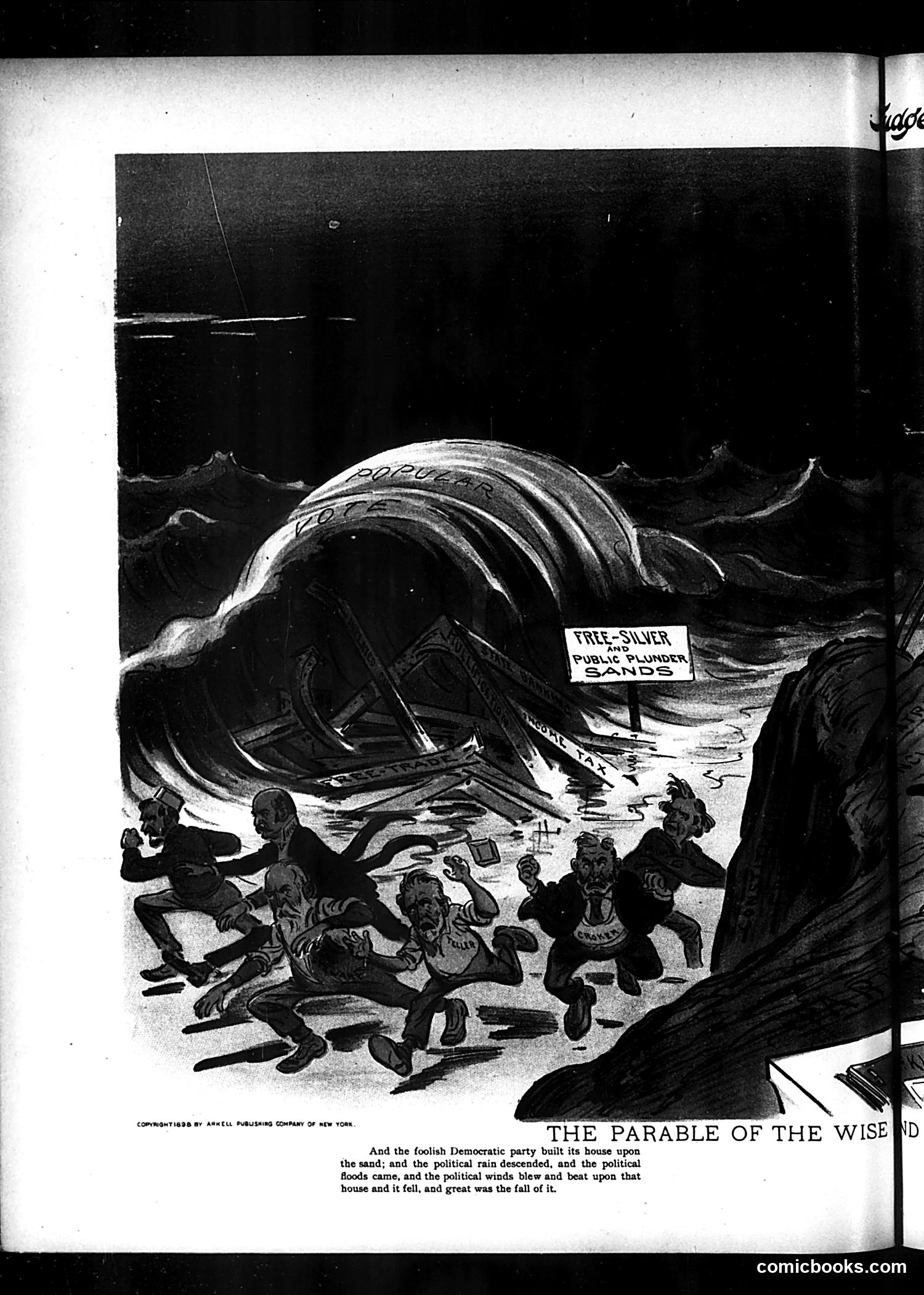
This is a political cartoon titled "The Parable of the Wise and [Foolish]," published by Judge (a Republican-leaning satirical magazine). The cartoon depicts the Democratic Party as foolish builders constructing a house on sand labeled "PUBLIC PLUNDER" and "SANDS." A massive wave labeled with text (appears to reference political consequences) threatens to destroy their structure. Small caricatured figures—representing Democratic politicians or supporters—scramble in panic below. The satire uses Biblical parable language (echoing Matthew 7:24-27) to mock Democrats for building their political platform on corruption ("public plunder") rather than solid principles. The inevitable collapse represents the political consequences they'll face. This reflects turn-of-century Republican attacks on Democratic governance and patronage systems, suggesting the party's foundation is fundamentally unstable and corrupt.
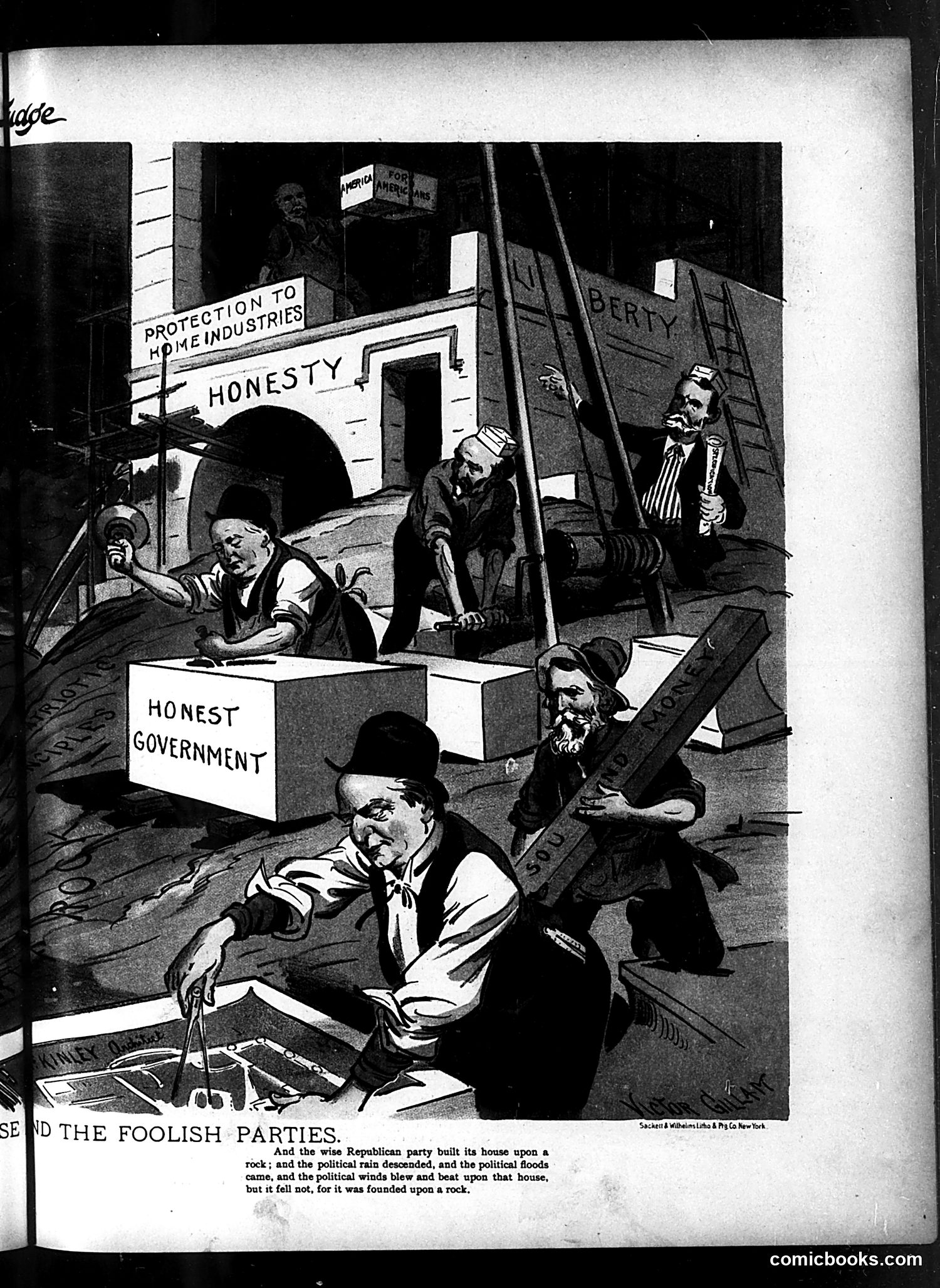
This cartoon uses Biblical parable imagery (the wise man building on rock vs. foolish man on sand) to satirize American political parties. The large structure labeled "Honest Government" appears partially constructed, while workers below represent different political factions. A banner reads "Protection to Home Industries," suggesting economic policy debate. The cartoon criticizes competing political parties—likely Democrats and Republicans—as unstable and foolish, contrasting them with the Republican Party, which the caption claims built its foundation on solid principles and will withstand political "storms." The caricatured workers and their various tools suggest different party platforms being thrown together haphazardly, emphasizing disorganization and infighting among the "foolish parties." The overall message: only the Republican Party has stable, principled governance; others will collapse under pressure.
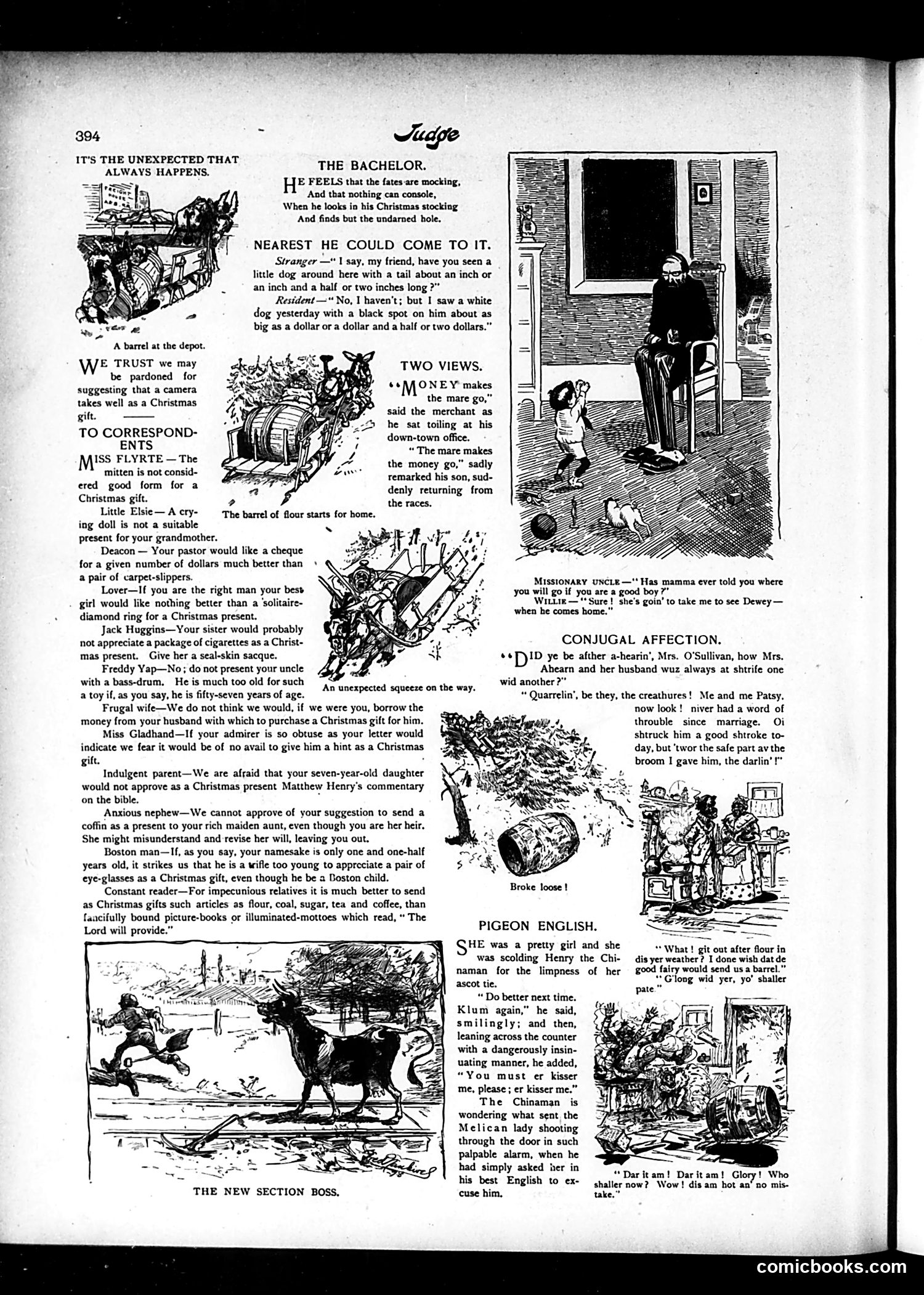
This page from Judge magazine contains several short humorous pieces targeting turn-of-the-century American life: **"The Bachelor"** satirizes unmarried men's Christmas disappointment—finding only a darned hole in stockings, mocking their domestic helplessness. **"Nearest He Could Come to It"** jokes about vague descriptions, with a stranger and resident giving absurdly imprecise measurements of a dog they've seen—poking fun at unreliable witnesses. **"Two Views"** presents opposing perspectives on money's purpose: a merchant sees it making "the mare go" (work), while his son, returning from the races, sadly agrees—satirizing gambling and financial irresponsibility. **"Conjugal Affection"** uses Irish dialect humor to contrast Mrs. O'Sullivan's marital violence (striking her husband with a broomstick) with another woman's claim of harmony—dark domestic comedy typical of the era. **"Pigeon English"** depicts a Chinese laundryman's broken English and inappropriate workplace flirtation with a customer, relying on period ethnic stereotypes for humor. The "Correspondents" section offers advice-column satire on unsuitable Christmas gifts.
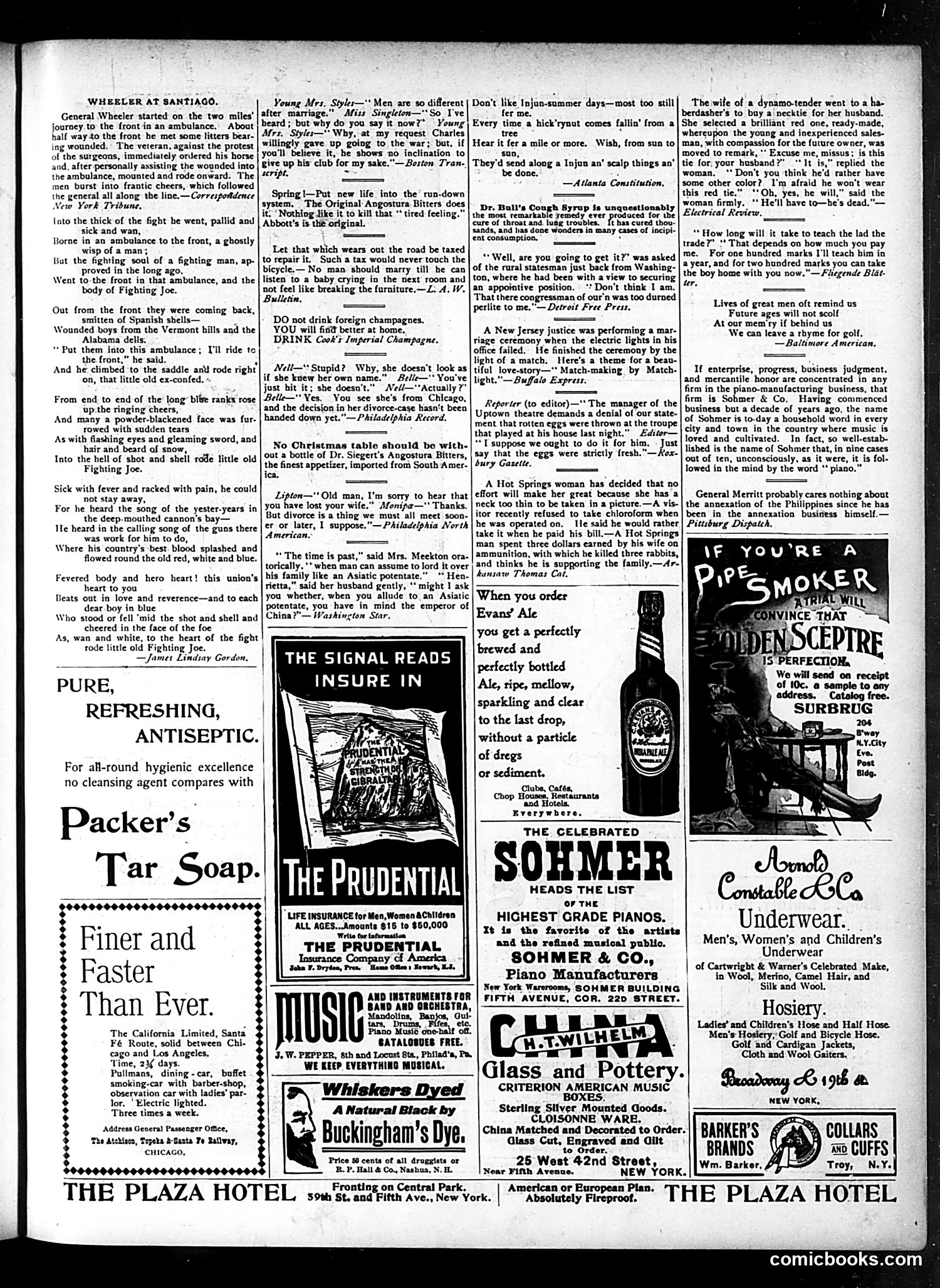
This page celebrates General "Fighting Joe" Wheeler, a Confederate veteran who served in the Spanish-American War (1898). The main poem praises Wheeler for riding to the front despite illness, stopping his ambulance to help wounded soldiers, then continuing forward himself. The narrative emphasizes his enduring fighting spirit—"the fighting soul of a fighting man"—as redemptive and admirable, even decades after the Civil War. The satire's point is subtle but significant: by lauding a former Confederate general as a patriotic American hero in a current war, *Judge* implicitly endorses national reconciliation. Wheeler's service symbolizes the reunification of North and South—Vermont and Alabama soldiers appear together, and a "little old ex-confed" becomes a national exemplar. This reflected contemporary political efforts to heal Civil War divisions through shared military purpose. The page also contains typical period advertisements and brief humor columns unrelated to Wheeler.
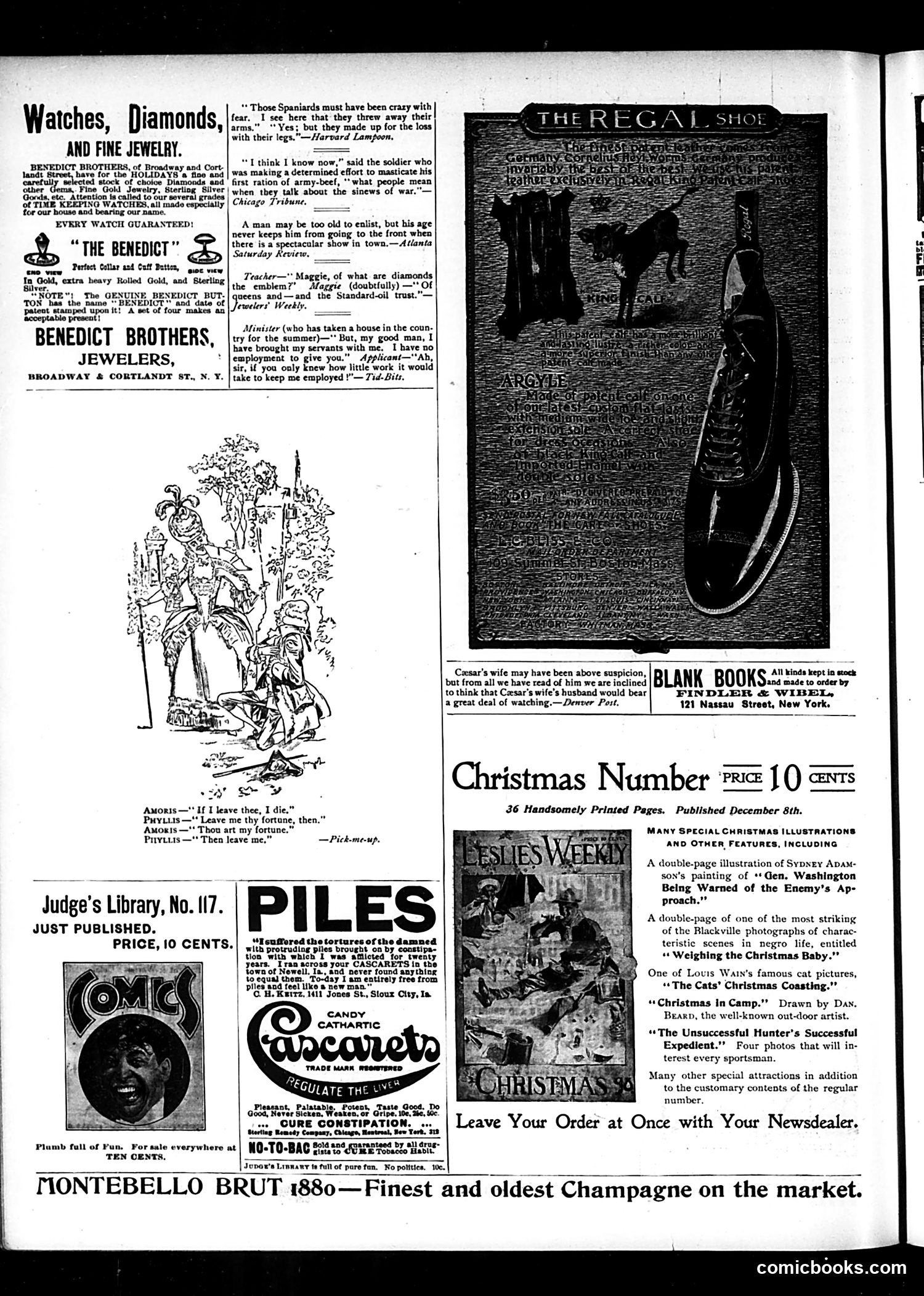
This page from Judge (a 19th-century American satirical magazine) is primarily **advertising and promotional material** rather than political cartoons. The content consists of: **Advertisements** for jewelry (Benedict Brothers watches and diamonds), patent medicines (Cascarets for constipation, No-To-Bac), blank books, and champagne. **Brief humorous quotations** on topics including: - Spanish soldiers and their legs (referencing the Spanish-American War) - Army rations being tough ("sinews of war") - A teacher asking what diamonds symbolize; a student answers "the Standard Oil trust" (mocking the monopoly) - A minister hiring unemployed workers **A small classical dialogue** between Amonis and Phyllis about love and fortune. **Promotion** for Judge's Christmas Number (10 cents, 36 pages), listing special illustrations including Civil War scenes and humorous "Blackville" photographs depicting African American life. The page reflects late-1890s consumer culture and period attitudes, with the Standard Oil reference being the only clear topical satire.
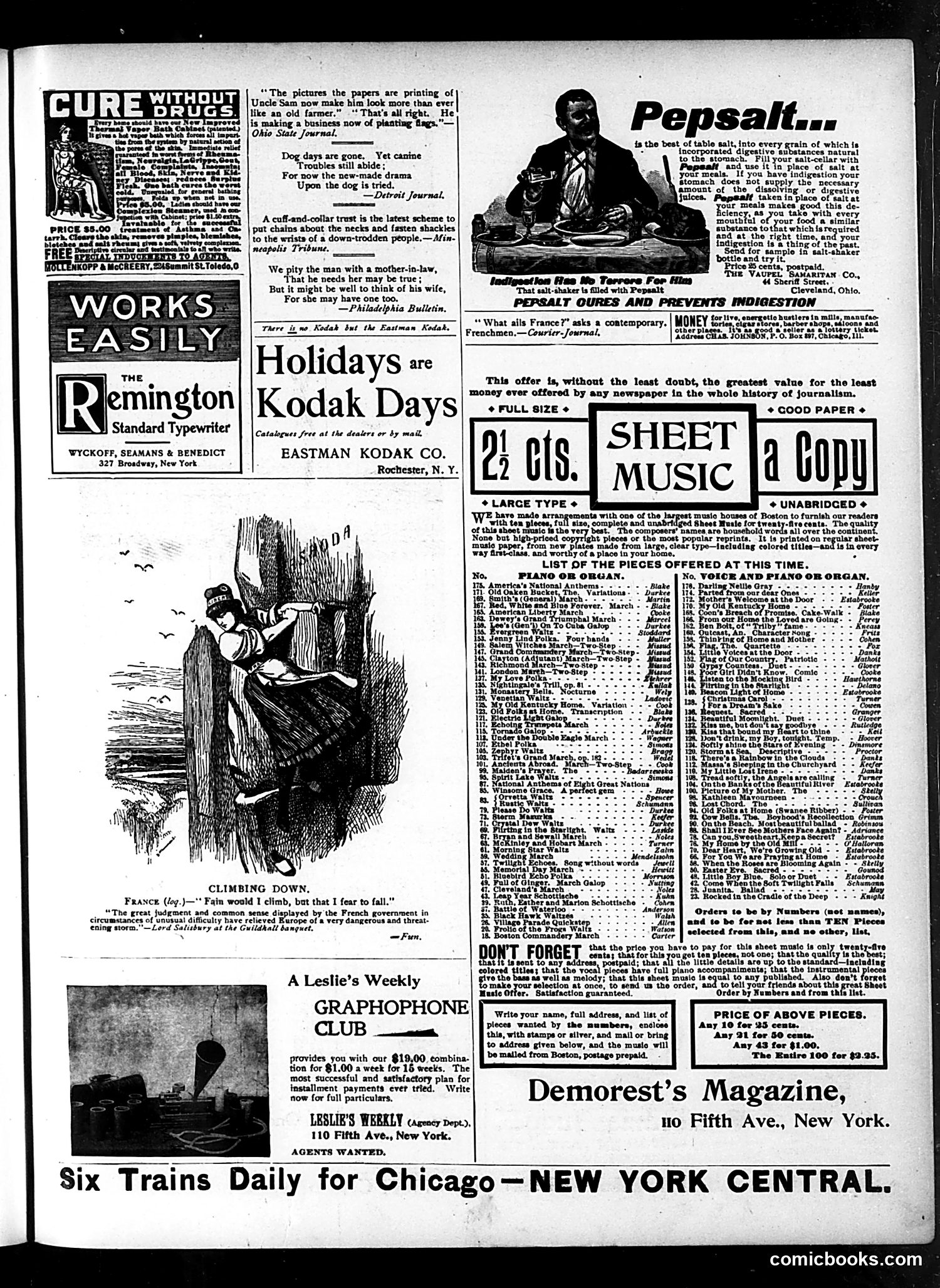
This page is primarily **advertising and miscellaneous content** rather than a focused political cartoon feature. The one identifiable political cartoon is **"Climbing Down,"** depicting France (represented as a figure on a log) retreating from an ambitious position. The caption quotes Lord Salisbury about "great judgment" amid "unusual difficulty" and "threatening storm"—likely referencing French colonial or diplomatic setbacks in the 1890s (unclear which specific event without dating context). The cartoon's message: France, despite its ambitions ("Fain would I climb"), must withdraw due to weakness or political pressure—a satirical commentary on French imperial overreach or diplomatic failure. The rest of the page consists of period advertisements (Remington typewriters, Kodak cameras, sheet music offers, graphophone clubs) and miscellaneous editorial humor about trusts, marriage, and dogs—typical Judge magazine filler content without specific political significance.
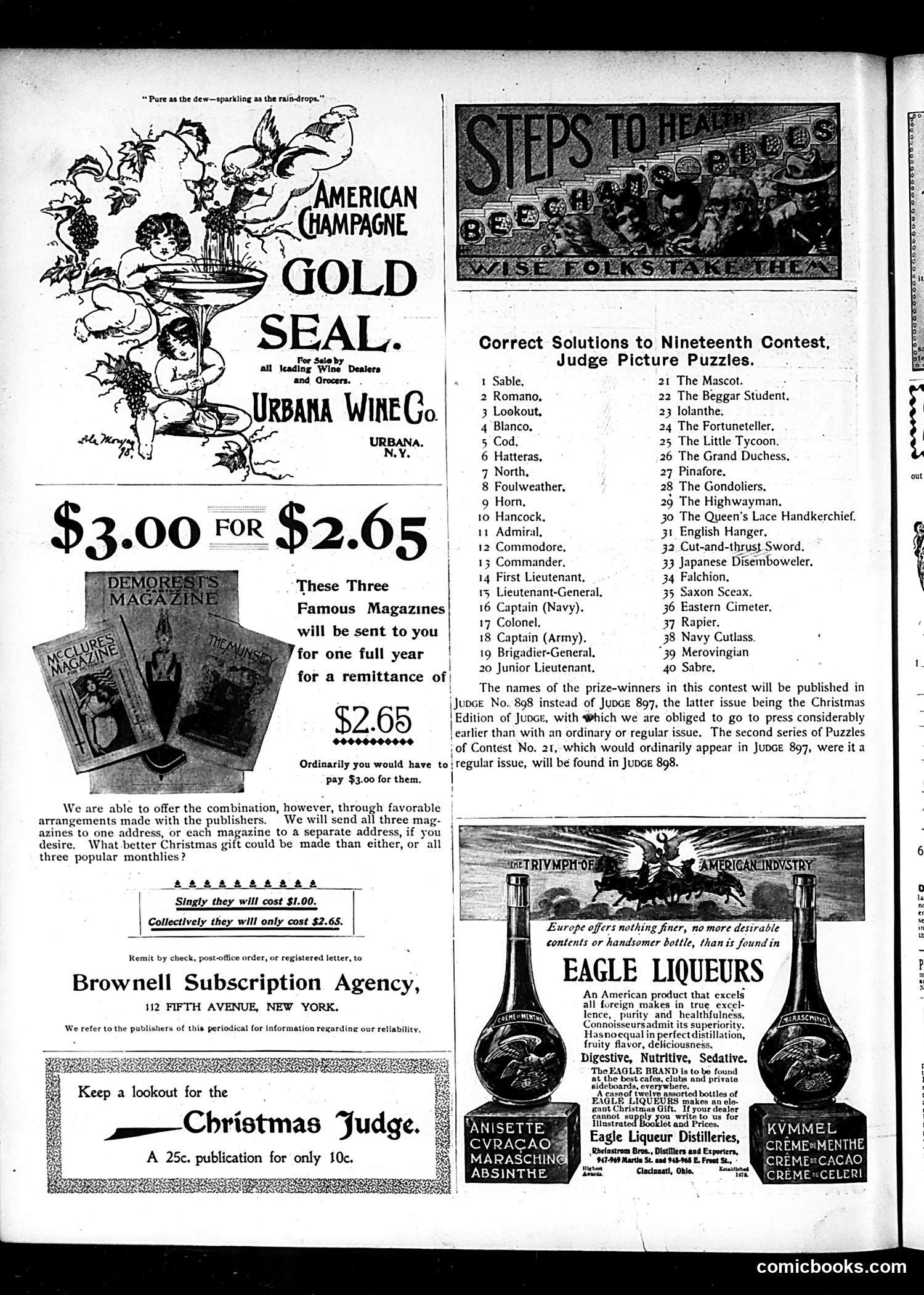
This page is primarily **advertising and contest results**, not political satire. The left side promotes a subscription bundle: three magazines (including *Judge* itself, *Demoreset's Magazine*, and one other) for $2.65 annually—a discounted rate presented as a Christmas gift option. The right side publishes solutions to *Judge*'s "Nineteenth Contest" of picture puzzles, listing 40 answers that appear to reference **military ranks and historical weapons/swords** (Sable, Romano, Admiral, Colonel, Rapier, Sabre, etc.). The text notes winners will be announced in *Judge* No. 898. Below that are two liqueur advertisements: **American Champagne Gold Seal** wine and **Eagle Liqueurs**, emphasizing their American manufacture as superior to foreign competitors—likely reflecting early 20th-century American commercial pride. There's also a small promotional notice for *Christmas Judge*, a 25-cent publication available for 10 cents. The page contains **no visible political cartoons or satire**—it's a practical, commercial page typical of magazine back matter from this era.
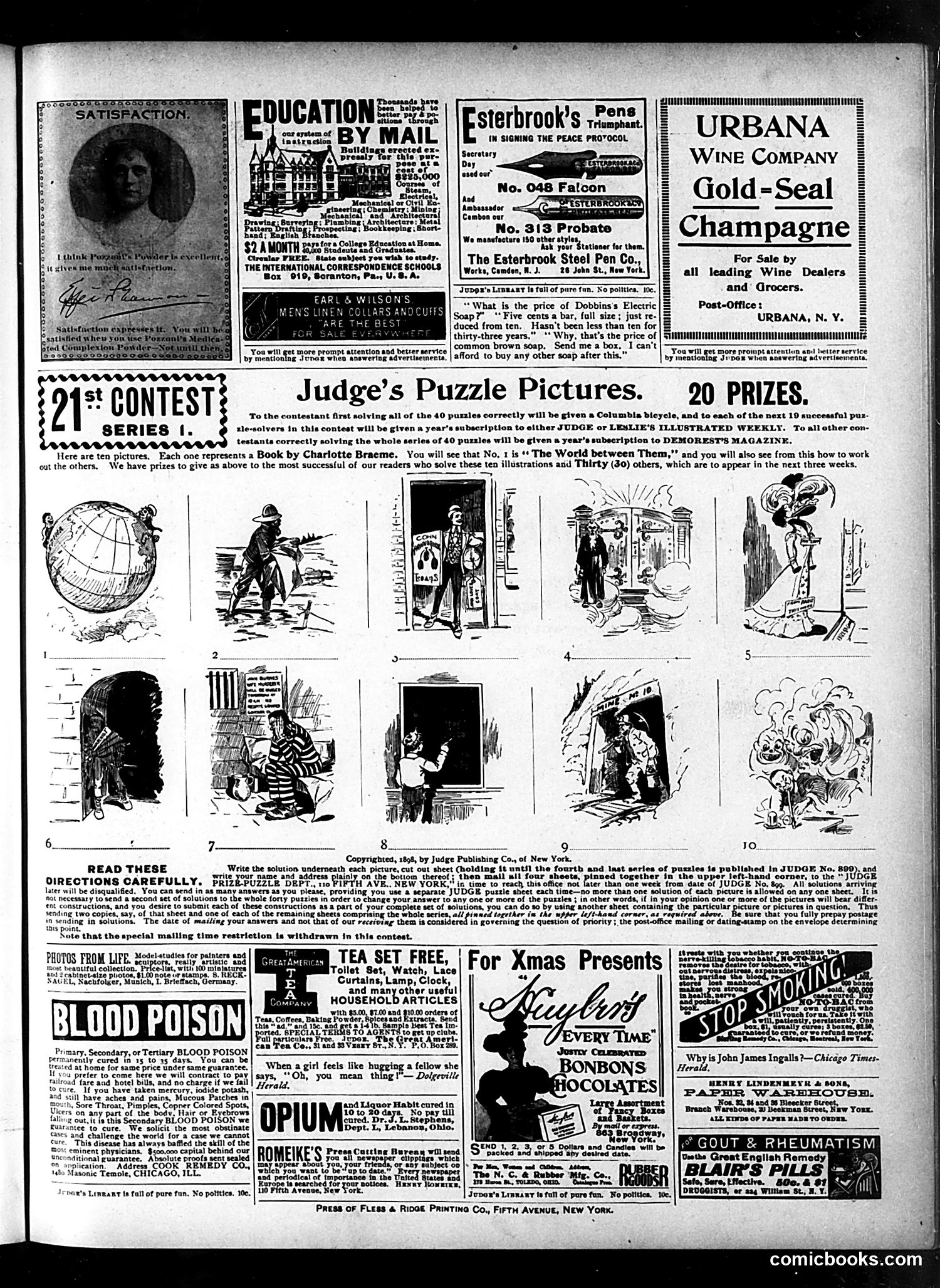
This page is primarily **advertising and contest material** rather than political satire. The dominant feature is a puzzle contest called "Judge's Puzzle Pictures" offering prizes including a Columbia bicycle and magazine subscriptions. The contest asks readers to identify ten book titles by Charlotte Braeme (a popular Victorian novelist) from illustrated images. The elaborate instructions emphasize careful submission procedures—solutions must be mailed within specific timeframes on separate sheets, pinned together in the upper left corner. Surrounding the puzzle are period advertisements: the International Correspondence Schools (mail-order education), Esterbrook Steel Pens, Urbana Wine Company champagne, and various patent medicines and products (blood poison treatments, opium remedies). The page reflects **late 19th-century consumer culture**—Judge magazine monetized reader engagement through contests while advertising self-improvement correspondence courses and commercial products to middle-class subscribers. The Charlotte Braeme books referenced were sentimental romance novels popular with female readers of the era.
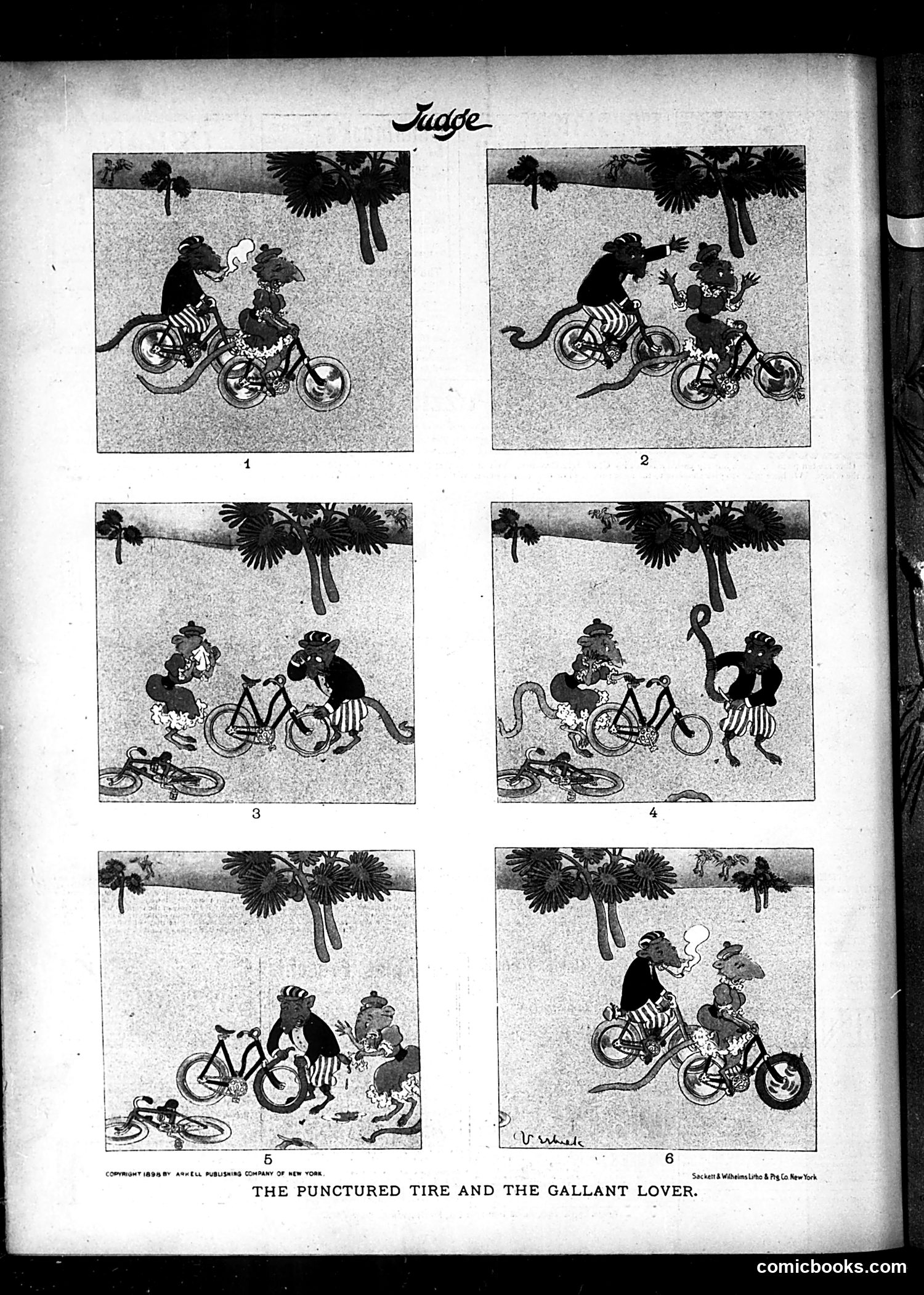
This six-panel comic strip satirizes the "gallant lover" trope popular in romantic literature. The narrative follows a couple on bicycles: panel 1 shows them riding together; panel 2 depicts the man gesturing dramatically toward the woman; panels 3-4 show them stopped, apparently discussing a mechanical problem; panel 5 shows the man sitting idle while the woman appears to work; panel 6 reveals the man smoking while the woman handles the bicycle repair. The satire mocks the contradiction between romantic idealization and practical reality—the "gallant" suitor performs chivalrous gestures but abandons his duties when actual work is required, leaving his companion to manage the mundane problem herself. It's a commentary on performative masculinity and gender expectations in the early bicycle era (late 1800s).