
A complete issue · 16 pages · 1898
Judge — November 12, 1898
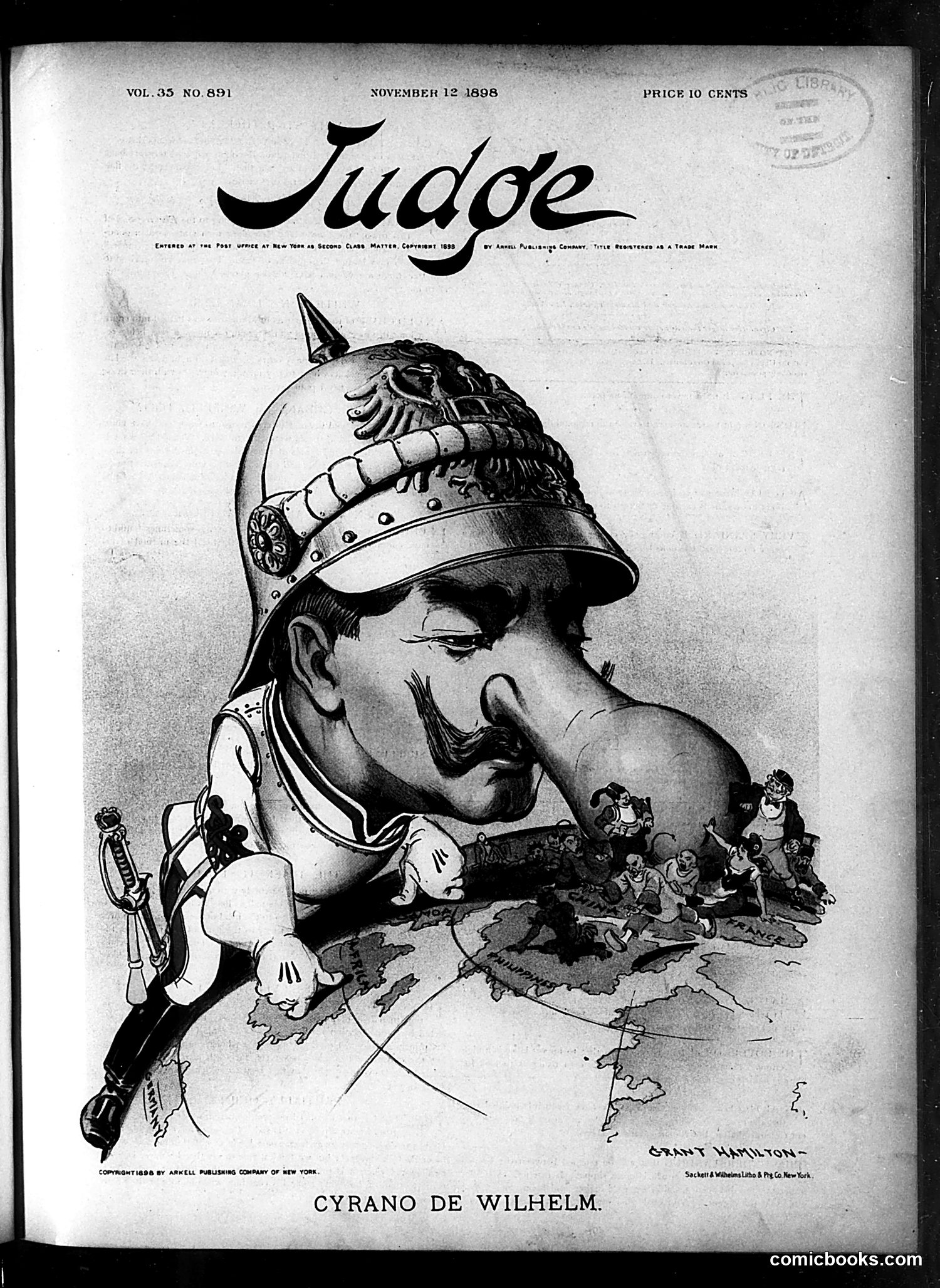
This is a caricature titled "Cyrano de Wilhelm," depicting a figure wearing a German military spiked helmet (Pickelhaube) with an exaggerated nose. The caricature appears to reference German Kaiser Wilhelm II through the "Cyrano" reference—invoking the famous literary character known for his prominent nose. The tiny figures on the ground below appear to represent military forces or conquered peoples, suggesting the cartoon satirizes German imperial ambitions or militarism during this period. The artwork is signed "Grant Hamilton," a prominent Judge cartoonist. This 1898 date places it during the Spanish-American War era and the height of European imperial competition, when Germany under Wilhelm II was increasingly assertive in international affairs. The satire likely mocks German pretensions to military dominance.
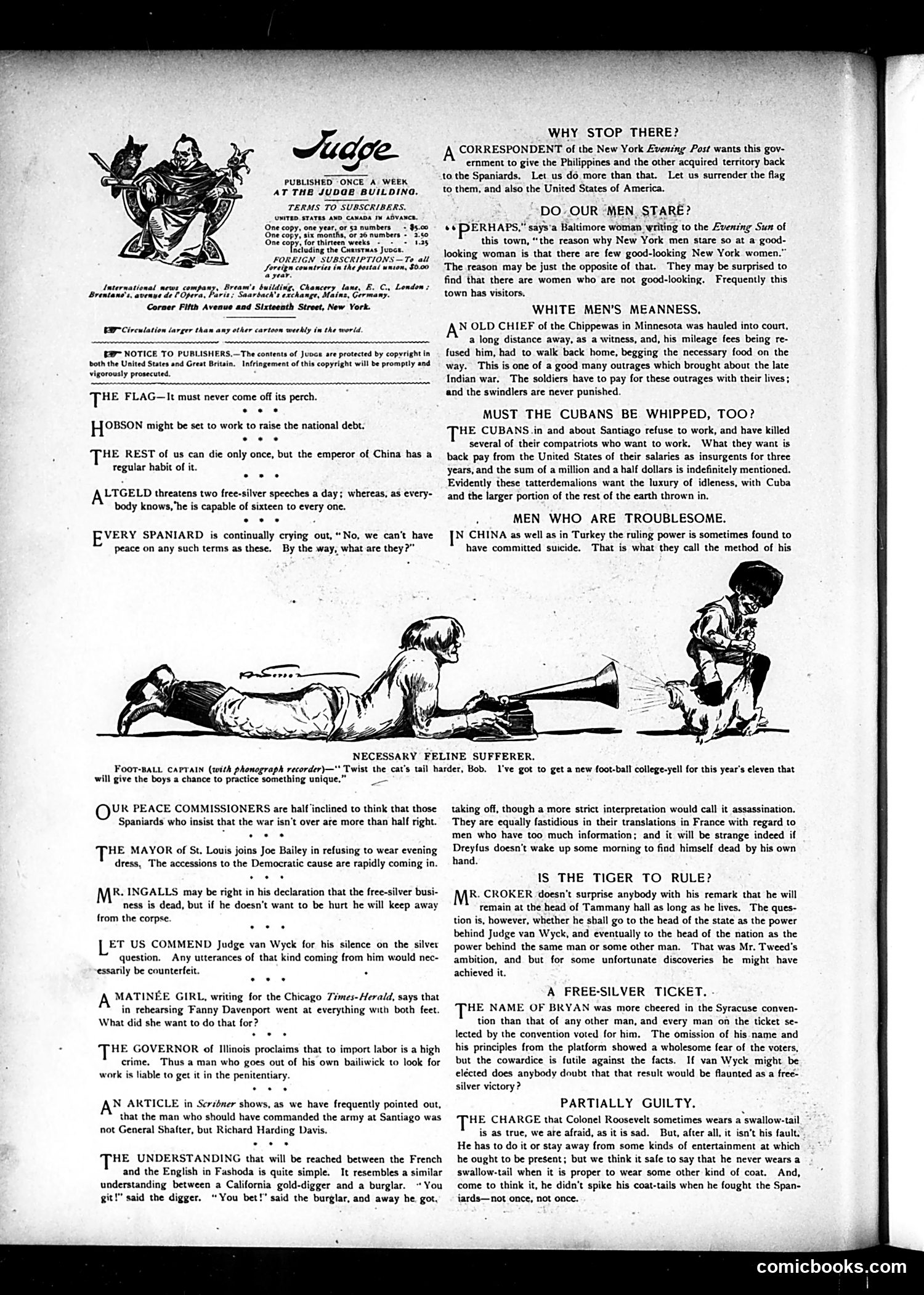
This page from the satirical magazine *Judge* contains multiple short political commentaries rather than a single unified cartoon. The illustrated section shows a football captain being told he needs a new "college-yell" for practice—a joke about competitive college sports traditions. The text sections mock various contemporary issues: Philippine colonial policy, gender relations in New York, Native American mistreatment, Cuban labor disputes, and Chinese/Turkish politics. One piece satirizes Mayor of St. Louis Joe Bailey for avoiding evening dress at Democratic events. Another criticizes Colonel Roosevelt for occasionally wearing a swallow-tail coat, questioning his consistency. The overall tone targets political hypocrisy and inconsistency across domestic and foreign policy issues of the era (appears to be early 1900s based on references to Philippines and Cuba). The satire assumes readers' familiarity with specific political figures and recent events.
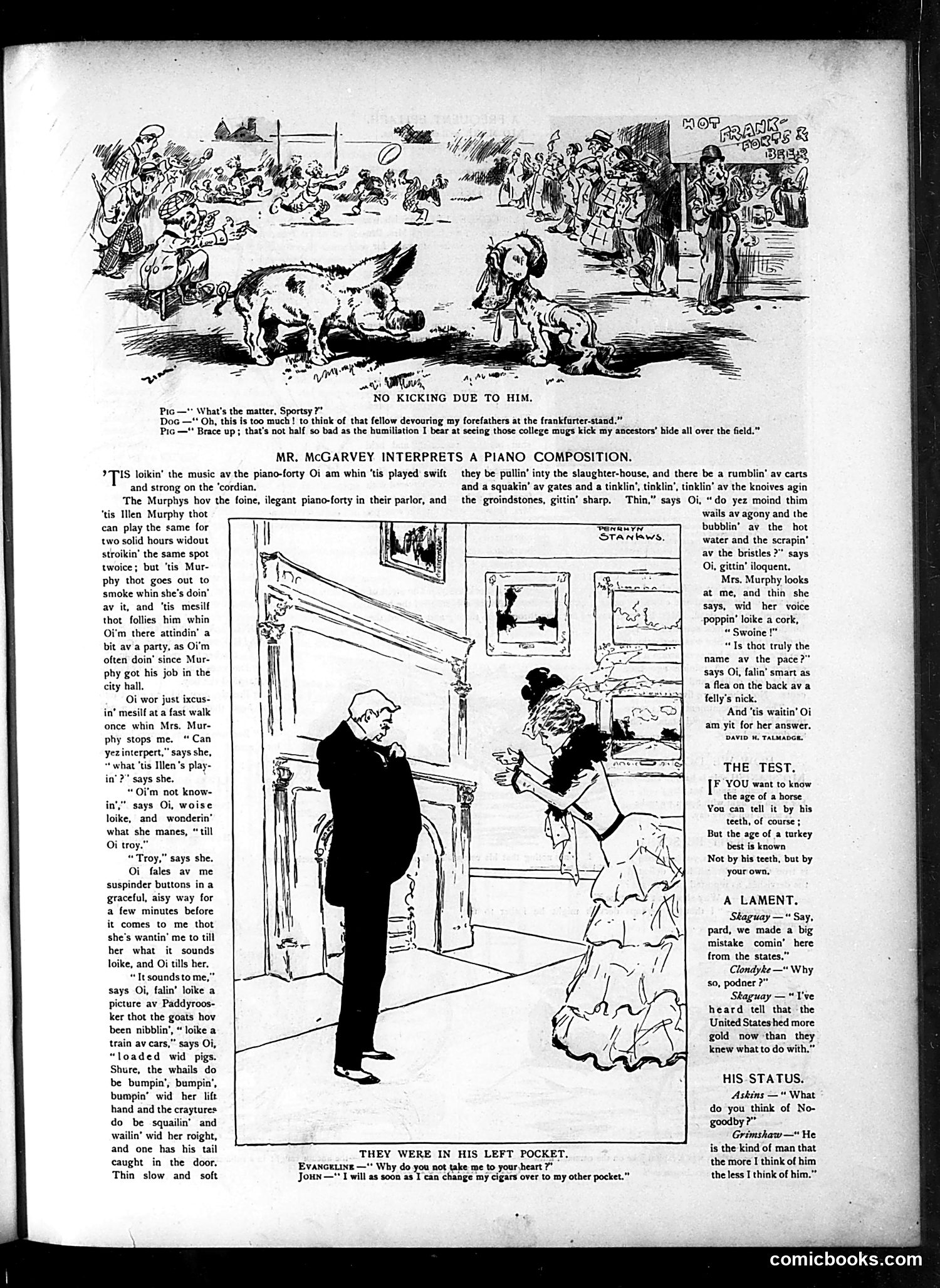
This page from *Judge* magazine contains humor sketches rather than political commentary. **Top cartoon** ("No Kicking Due to Him"): A dog is devoured by a pig at what appears to be a county fair, while spectators watch. The joke centers on a dog complaining that the pig receives no punishment despite kicking, while the dog itself faced humiliation for doing the same—satirizing arbitrary or unfair rule enforcement. **Middle section** ("Mr. McGarvey Interprets a Piano Composition"): An illustrated story where an Irishman (McGarvey) comically misinterprets classical music, imagining Irish-inflected violent and chaotic sounds rather than refined music. This plays on ethnic stereotyping common to the era. **Right column**: Short humor pieces on unrelated topics ("The Test," "A Lament," "His Status"). The page is primarily entertainment-focused rather than politically charged.
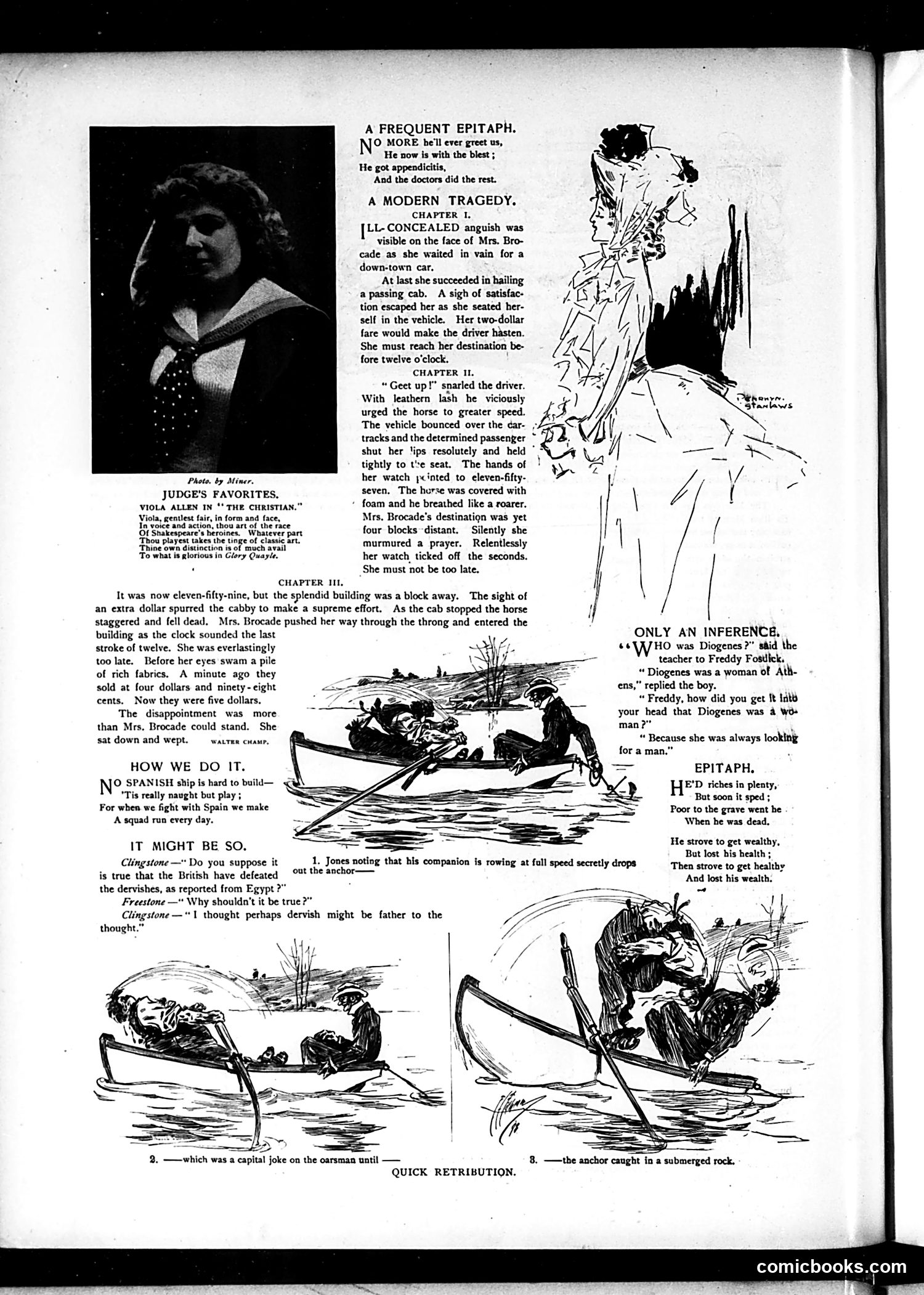
This page contains a serialized story titled "A Modern Tragedy" illustrated with dramatic ink drawings, alongside a photograph of actress Viola Allen in "The Christian." The narrative depicts Mrs. Brocade's frantic attempt to catch a downtown cab, arriving late to an appointment—a mundane urban inconvenience treated with mock-epic intensity typical of Judge's satirical humor. The accompanying poems and dialogue ("Only an Inference," "Epitaph," "How Do We Do It") use wordplay and irony to mock contemporary social pretensions and absurdities. The sketches of figures in boats appear to illustrate a separate humorous anecdote about oarsmen. The overall effect is light satirical commentary on modern urban life and social vanities, characteristic of Judge's early 20th-century humor aimed at middle-class readers.
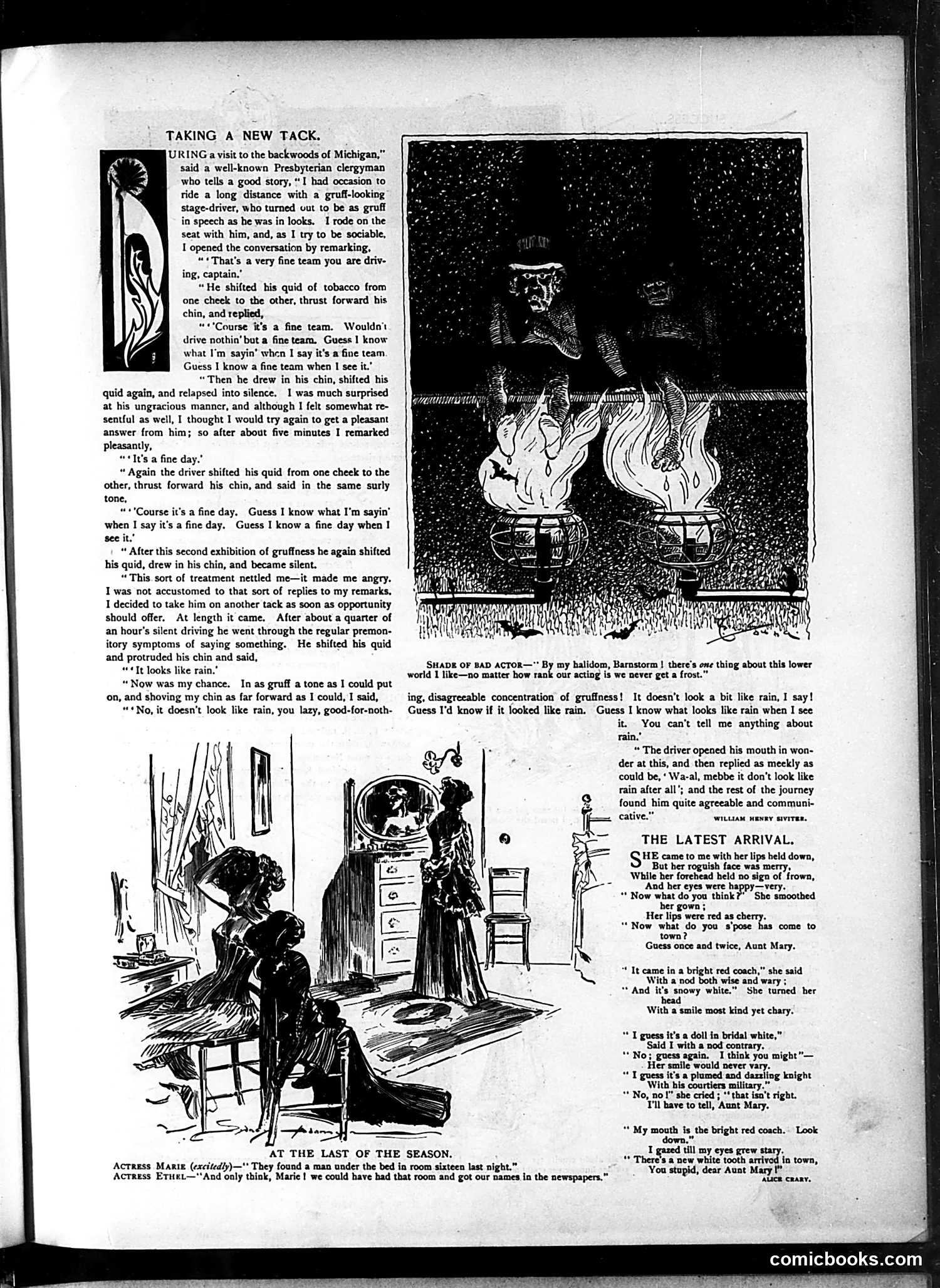
This page contains three distinct pieces of satirical content: **"Taking a New Tack"** is a humorous anecdote about a Presbyterian clergyman's encounter with a gruff stagecoach driver in Michigan. The satire mocks stubborn, defensive people who respond to any observation with identical defensive rejoinders ("Course it's a fine team/day"). The joke's resolution—that mirroring the driver's own gruff manner finally gets a civil response—suggests that people respond better to their own temperament than to politeness. It's gentle social satire about human nature rather than political commentary. **"At the Last of the Season"** features two brief theatrical jokes about actresses, appearing to mock theatrical life and romantic entanglements, though the specific references are unclear. **"The Latest Arrival"** is a playful poem-illustration where a young woman teases an older woman (Aunt Mary) with riddles, finally revealing her "arrival" is her own bright red lips and white teeth—a charming vanity joke typical of period humor. None appears politically charged; these are light domestic and social satires typical of Judge magazine's general entertainment content.
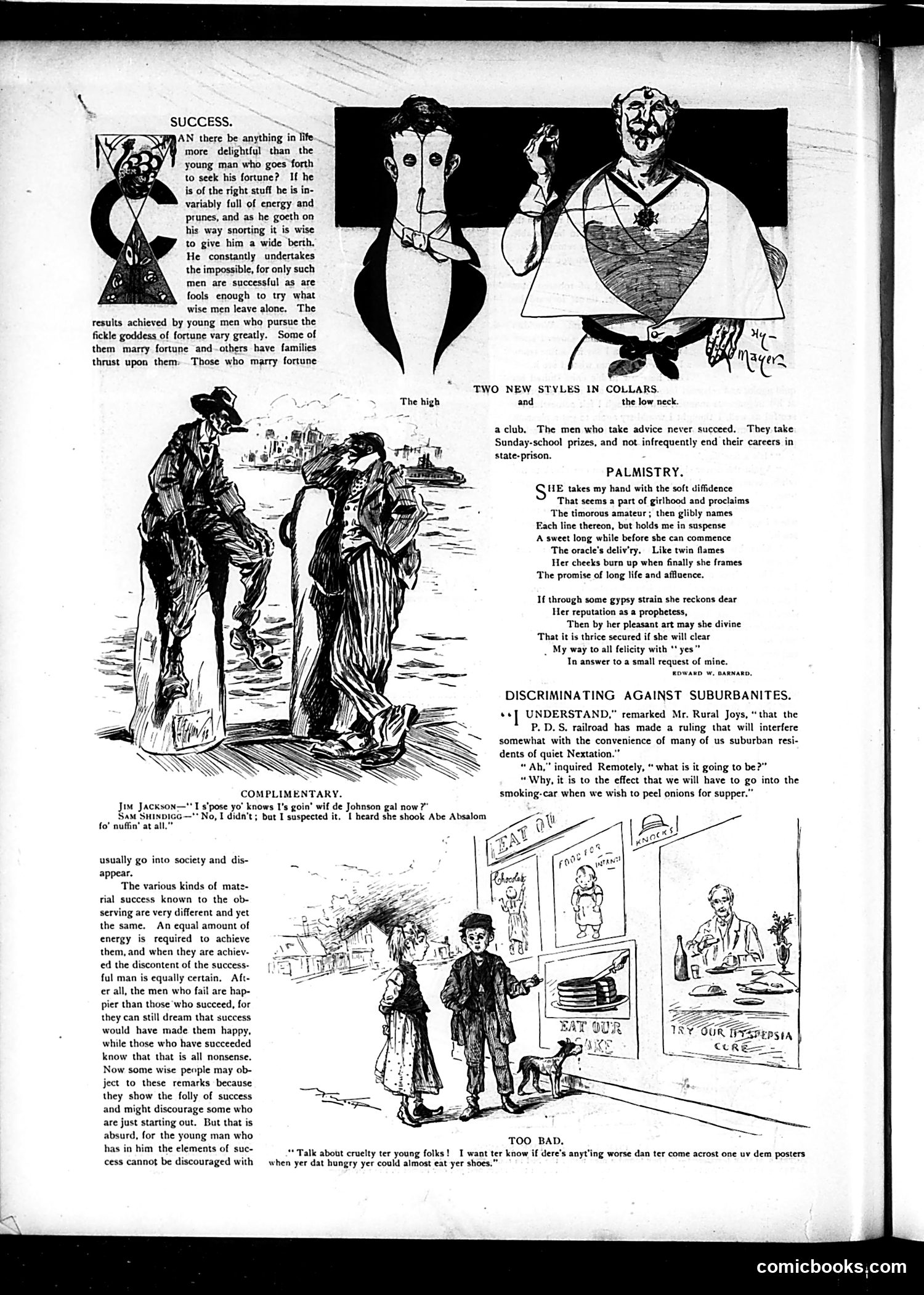
This page from *Judge* contains three distinct satirical pieces: **"SUCCESS"** mocks ambitious young men pursuing fortune, suggesting they're foolish optimists. The text ironically praises their determination while noting that successful men become disillusioned, whereas failures can at least dream—and importantly, men who take advice "end their careers in state-prison," a jab at corrupt businessmen. **"PALMISTRY"** is a poem satirizing fortune-tellers who use theatrical mystique to impress young women, positioning themselves as mysteriously knowledgeable while extracting romantic commitments. **"DISCRIMINATING AGAINST SUBURBANITES"** jokes about suburban commuters' inconvenience: a railroad rule prevents them from eating onions in regular cars, forcing them into smoking cars—trivial suburban discomforts. The bottom cartoon shows hunger-stricken people viewing restaurant window posters, mocking how advertising tempts the destitute. These pieces reflect early-20th-century urban anxieties: get-rich-quick schemes, gender dynamics, suburban expansion, and class disparities.
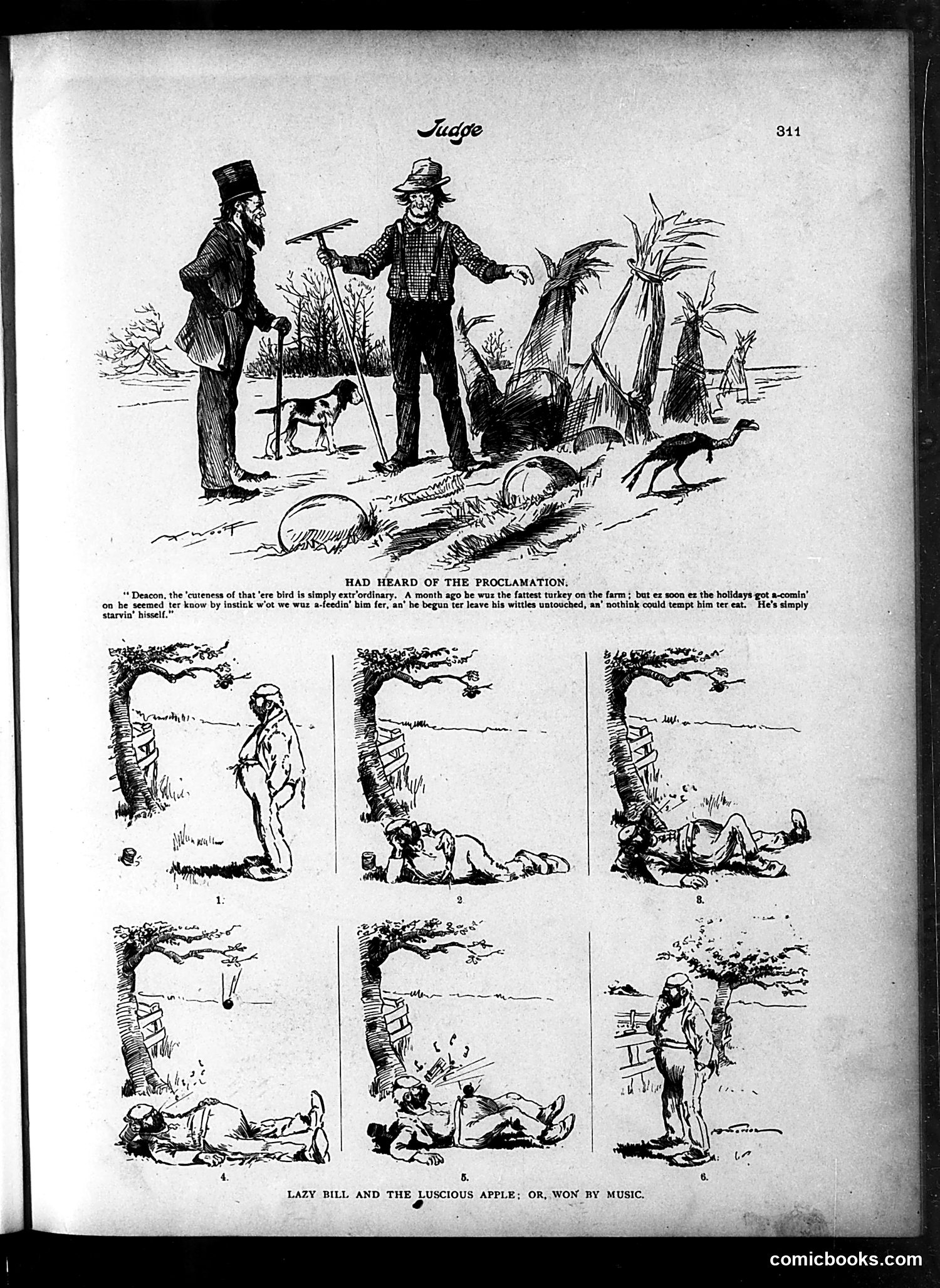
**Top Cartoon ("Had Heard of the Proclamation"):** This depicts a farmer and gentleman discussing a turkey that has stopped eating before the holidays. The joke plays on the turkey's supposed awareness of its fate—it "heard" (understands instinctively) that Thanksgiving is coming and refuses food in protest. The humor derives from attributing human reasoning to the animal, satirizing both rural superstition and the darker reality of holiday meat procurement. **Bottom Strip ("Lazy Bill and the Luscious Apple; or, Won by Music"):** A six-panel sequence showing a man asleep under a tree, presumably "Lazy Bill." The narrative appears to involve music or sound somehow displacing or affecting the sleeping figure, though the exact satirical target remains unclear without additional context about who "Lazy Bill" references. Both pieces employ rural/folk character stereotypes common to late-19th-century American humor magazines.
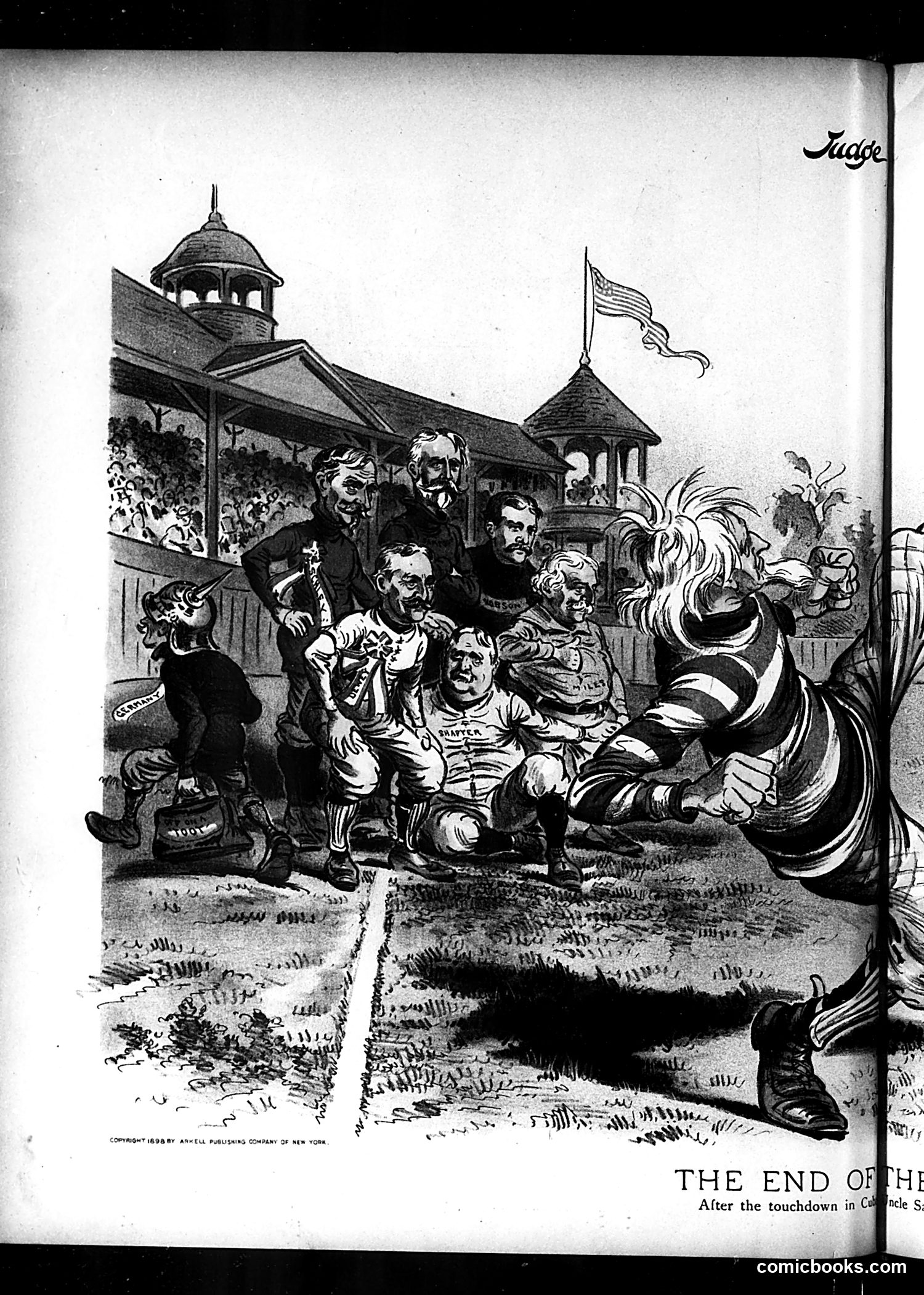
This Judge magazine cartoon appears to satirize political or military figures celebrating what's labeled "the touchdown in Coifnde S[...]" (text is partially cut off). The image shows exaggerated caricatured men in formal dress and military uniforms cheering enthusiastically around a central seated figure, suggesting a celebratory moment being mocked as excessive or misplaced. The architectural setting with an American flag suggests an official government or military venue. The cartoon's tone—using sports terminology ("touchdown")—suggests the satire mocks treating a serious political/military event as trivial entertainment or misplaced celebration. Without the complete text and full date visible, the specific historical event and figures targeted remain unclear, though the heavy-handed caricature style is typical of Judge's political satire from the early-to-mid 20th century.
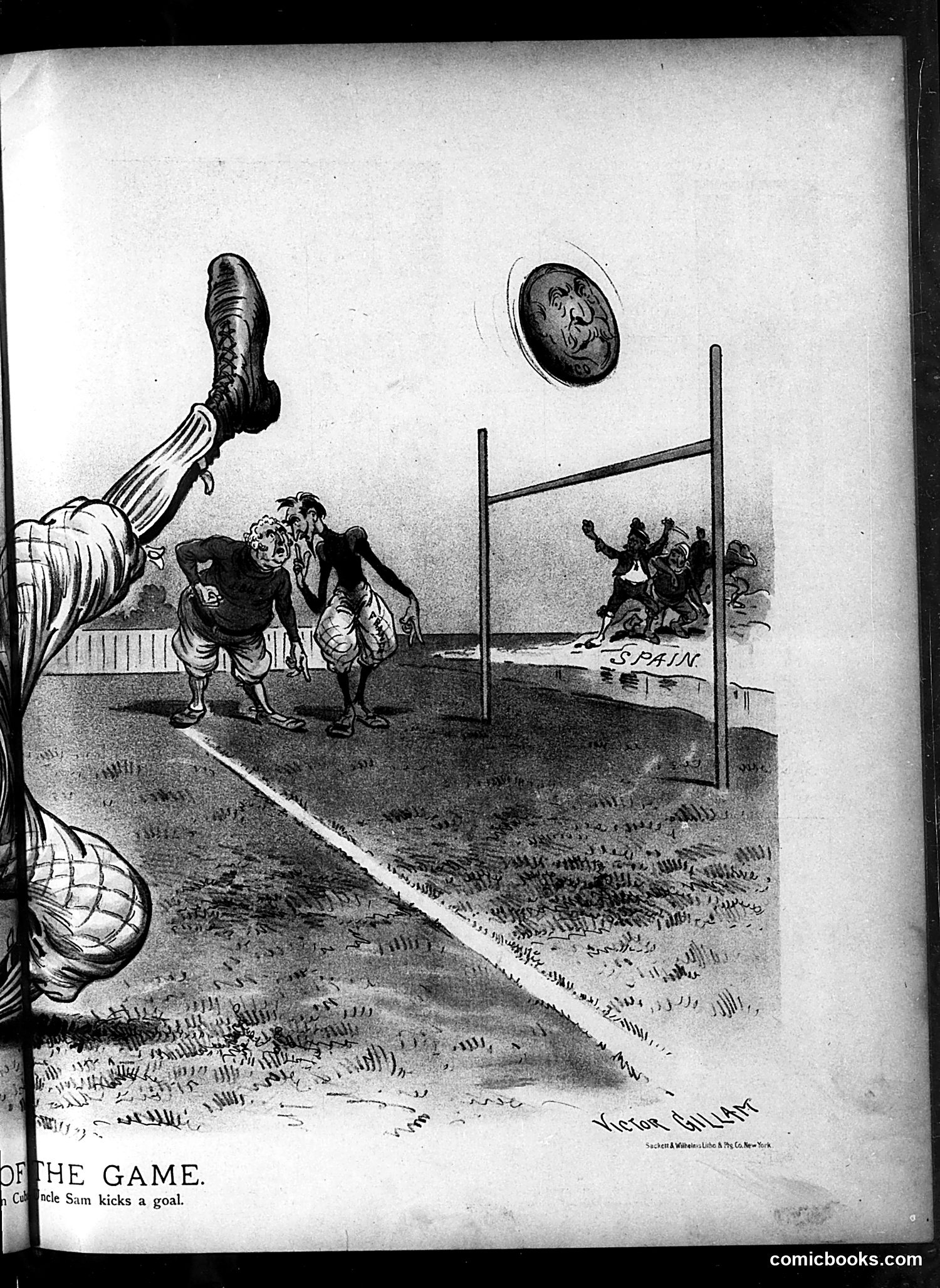
This cartoon depicts "Uncle Sam" (the large figure on the left, identifiable by his characteristic striped pants and boot) kicking a spherical object labeled with a face toward a goal post. The goal post is marked "SPAIN," and figures on the far side appear to be Spanish representatives or soldiers. The caption reads "Uncle Sam kicks a goal," making the satirical point transparent: this is about the United States defeating Spain in competition or conflict. Given Judge magazine's American audience and the cartoon's style, this likely references the Spanish-American War (1898) or related tensions. The "game" framing presents military/political confrontation as sport, mocking either American aggression or celebrating American superiority depending on the publication's stance. The caricatured faces suggest ethnic stereotyping common to the era.
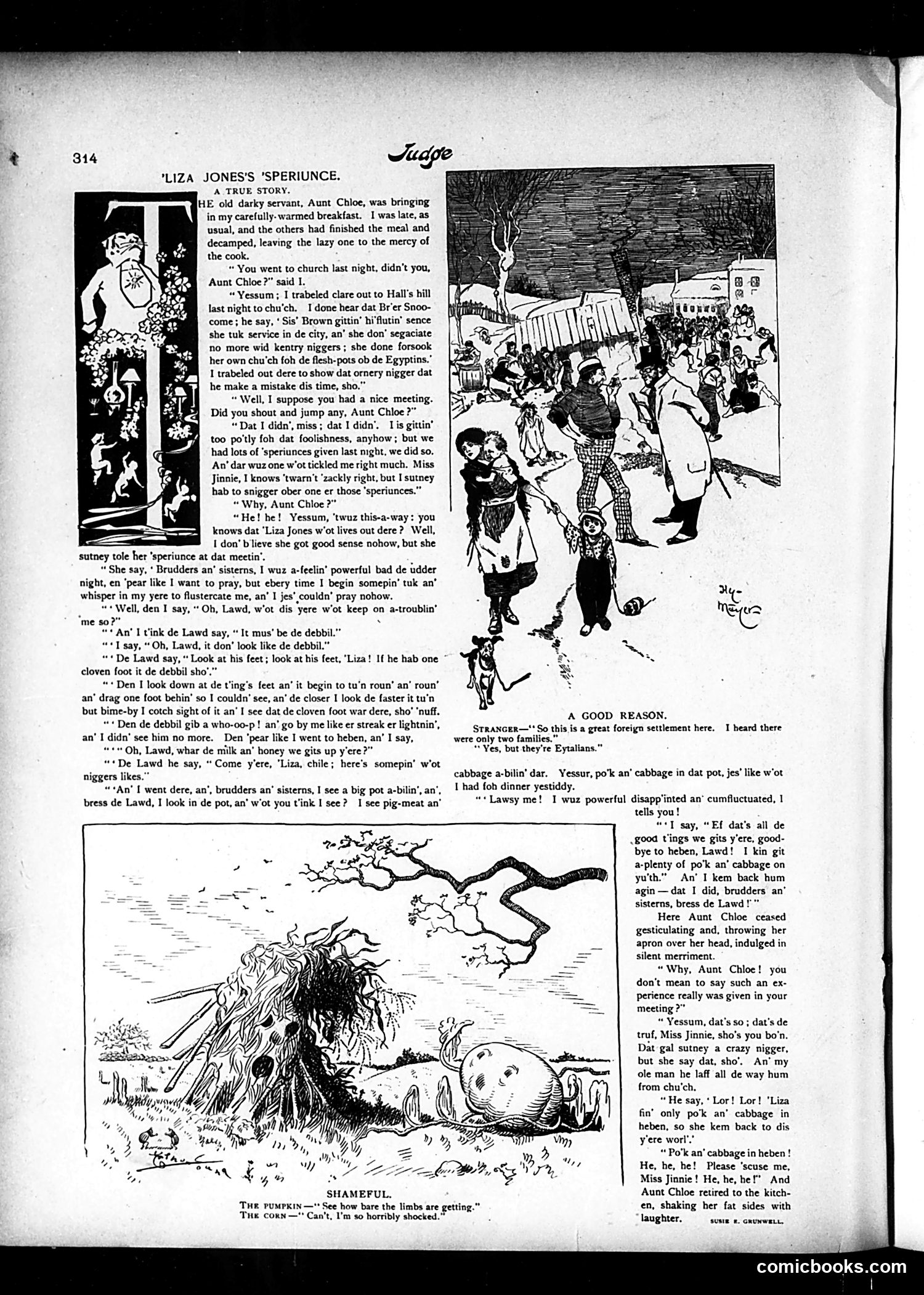
This is a racist dialect story presenting African American religious experience as comedic and foolish. The narrative frames a church testimony from a character named "Liza Jones" through the condescending perspective of a white employer and her Black servant, Aunt Chloe. The "joke" centers on Liza's account of a spiritual vision where she encounters the devil, recognizes him by his cloven hoof, and travels to heaven—only to be disappointed that heaven offers only pork and cabbage, the same humble food she eats on earth. She therefore returns home. The satire targets Black religious practice and spirituality as absurd superstition. The heavy, mocking dialect spelling and the implied intelligence of the characters reinforce racial stereotypes common to the era. The accompanying illustrations—a decorative ornamental panel and rural pastoral scene with a pumpkin and corn—provide visual context for the rural setting and poverty implied in the narrative. This represents typical late-19th/early-20th-century American satirical content that was openly derisive toward Black Americans.
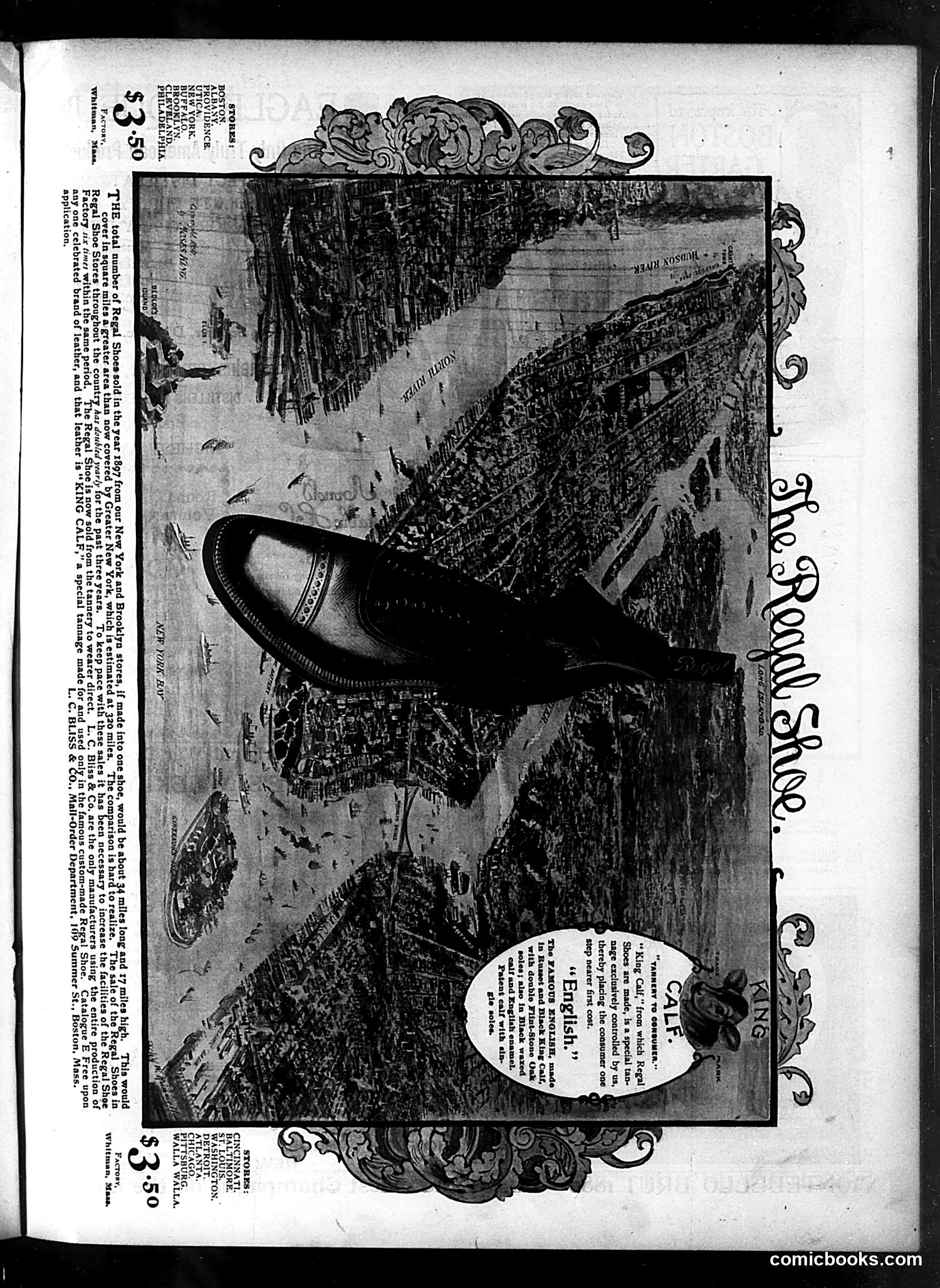
This page is primarily **advertising, not political satire**. The dominant content is a full-page advertisement for Regal Shoes manufactured by L.C. Bliss & Co. of Boston and Whitman, Massachusetts. The advertisement features: - A photograph of a black leather shoe (shown at center-right) - Marketing copy emphasizing direct factory-to-consumer sales and exclusive "King Calf" leather tannage - A boast about sales volume: if all shoes sold in 1897 were combined into one shoe, it would cover 34 miles—greater than Greater New York City's 320-mile area - Various shoe styles described ("English," patent calf, etc.) There is **no political cartoon or satire visible**. The page appears to be from Judge magazine's advertising section, using hyperbolic sales claims typical of late-19th-century advertisements rather than satirical commentary.
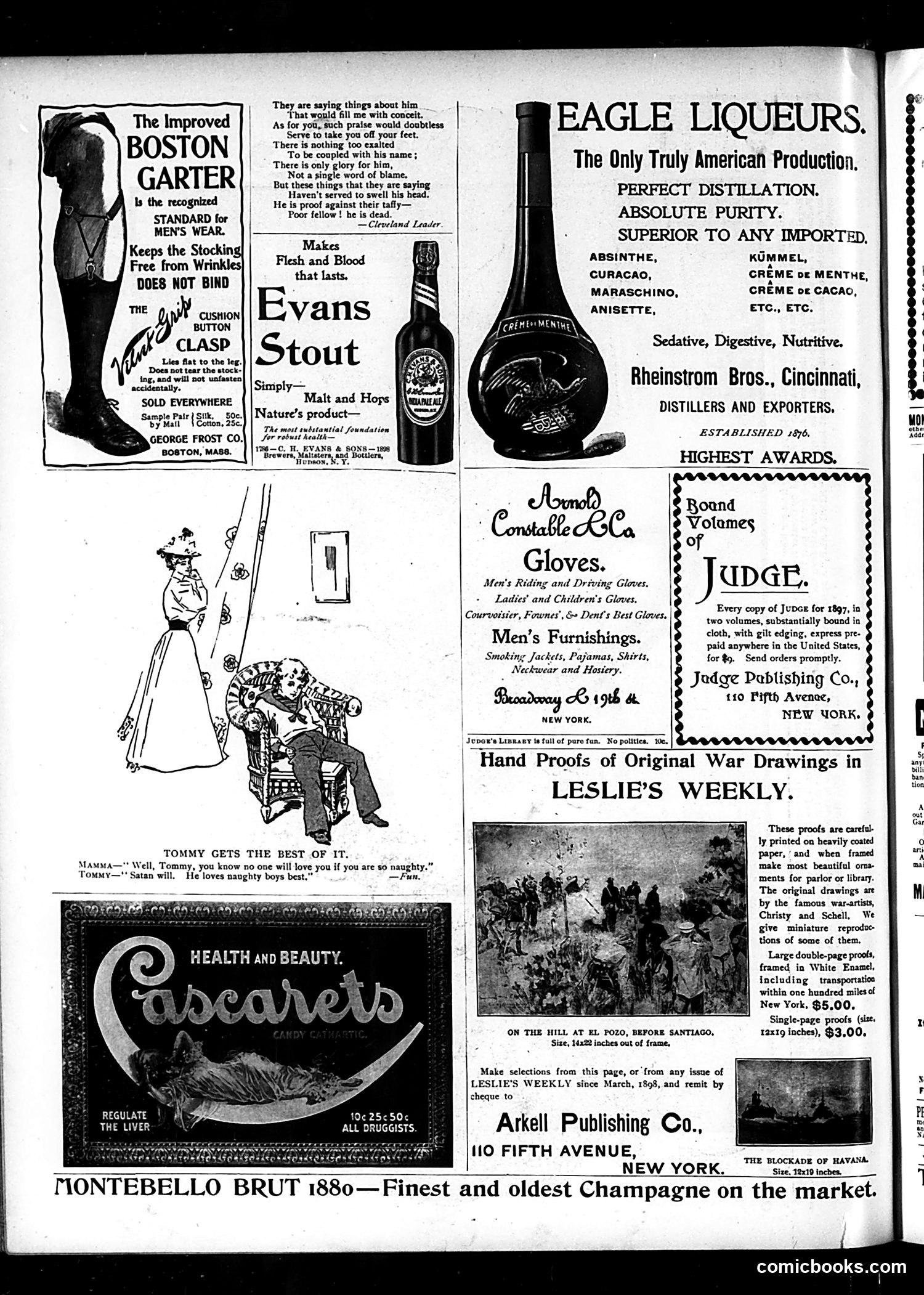
This page is primarily **advertising**, but the opening poem at top-left is the notable editorial content—a brief satirical verse mourning someone recently deceased. The poem's joke: a subject receives lavish posthumous praise ("nothing too exalted / To be coupled with his name"), yet the final line reveals the irony—"Poor fellow! he is dead." The satire suggests that excessive flattery often arrives only *after* death, when the person can no longer benefit. The attribution to the *Cleveland Leader* suggests this comments on a specific recent death, likely a public figure, though the image doesn't identify whom. The remainder is standard Judge-magazine advertisements: Boston Garters, Evans Stout beer, Eagle Liqueurs, gloves, men's furnishings, and a cartoon captioned "Tommy Gets the Best of It" (a cheeky child-humor piece). There's also promotion for Leslie's Weekly war drawings, referencing the Spanish-American War (El Pozo, Santiago references suggest 1898).
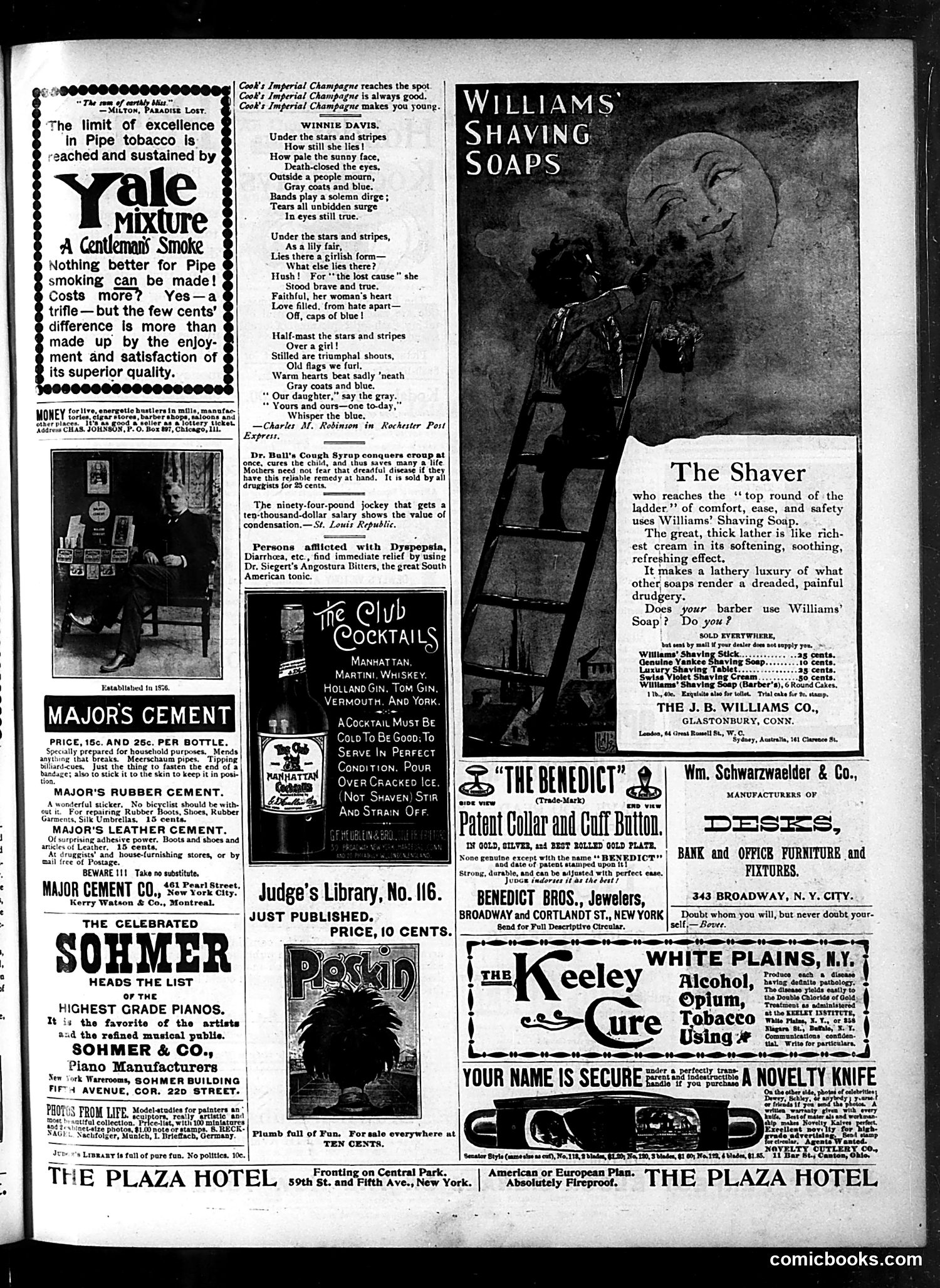
This page is primarily **advertising** from an early 1900s Judge magazine, with one notable poem. ## The Poem: "Winnie Davis" The only editorial content is a poem by Charles M. Robinson mourning **Winnie Davis**, daughter of Jefferson Davis (president of the Confederacy). She died in 1898. The poem is sentimental Civil War nostalgia—note the references to "Gray coats and blue" (Confederate and Union soldiers) and "the lost cause" (the Confederate cause). The poem's significance: it reflects how, by the 1890s-1900s, Northern and Southern Americans were reconciling after the Civil War. The poem emphasizes shared mourning across regional lines ("Yours and ours—one to-day"). ## Advertisements The rest is typical period advertising for **tobacco, cement, pianos, cough syrup, cocktails, and shaving soap**—nothing satirical. A small joke appears mid-page about a jockey's salary demonstrating the value of "condensation" (a pun on being small/light). **Bottom line**: This is a page that happened to include historical Civil War remembrance poetry alongside commercial advertising, reflecting American reconciliation themes of that era.
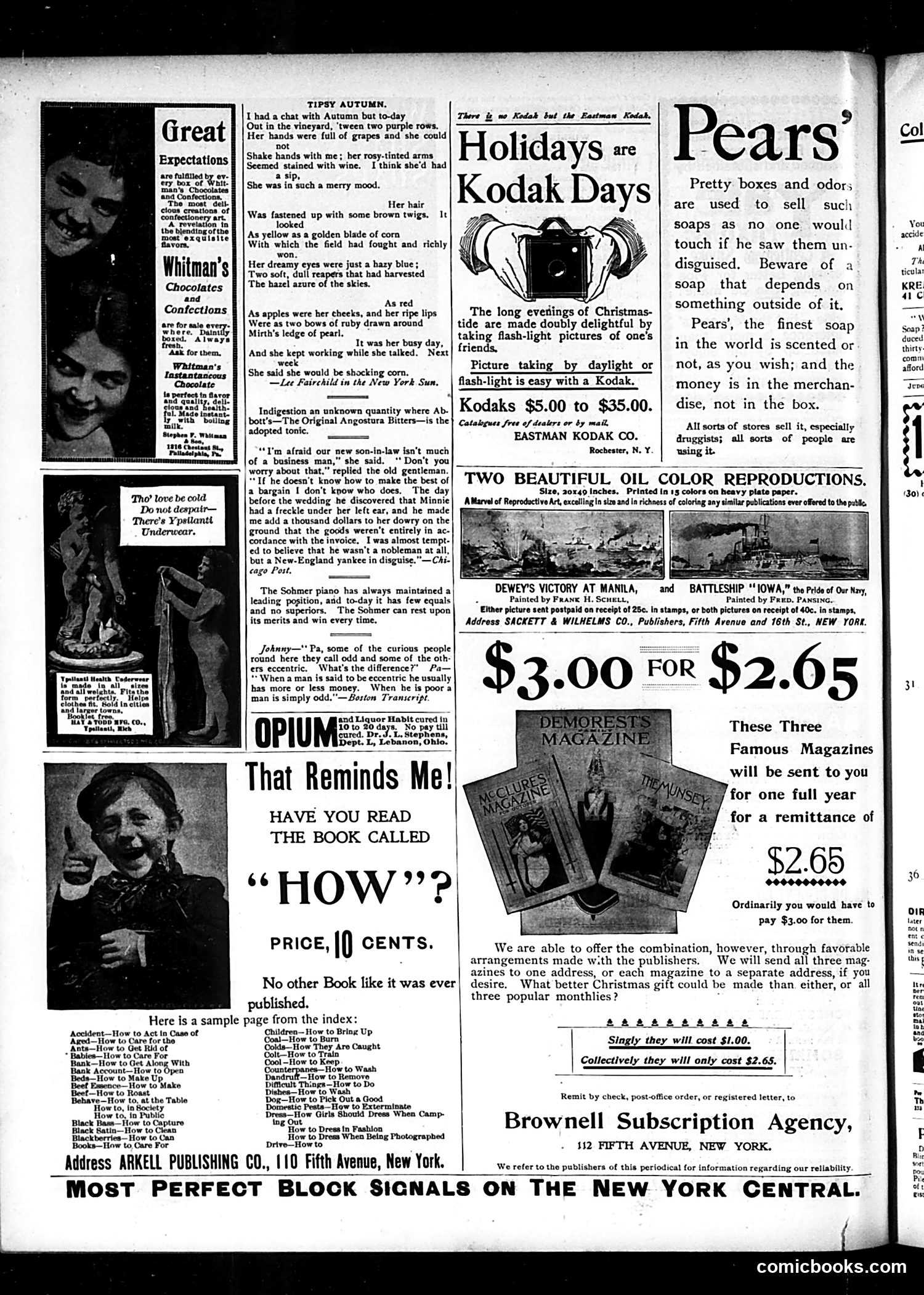
This page is **primarily advertising** with some light satirical/humorous filler content typical of Judge magazine. **Main Features:** - **"Tipsy Autumn"** poem: A romantic piece personifying autumn as a drunk woman—gentle satire on seasonal anthropomorphism and flowery Victorian poetry rather than political commentary. - **Humor snippets**: Brief jokes about a new son-in-law's shrewdness and definitions of "eccentric" vs. "odd" (the wealthy are eccentric; poor people are just odd)—mild class satire. - **Advertisements**: Whitman's Chocolates, Sohmer pianos, Kodak cameras, Pears' soap, Abbott's Bitters, and a self-help book called "How?" dominate the page. - **No political cartoons** or identifiable caricatures of public figures are present. This appears to be a **commercial-heavy issue** using light verse and mild humor to fill space between ads rather than deliver pointed political satire—Judge's typical function by this era.
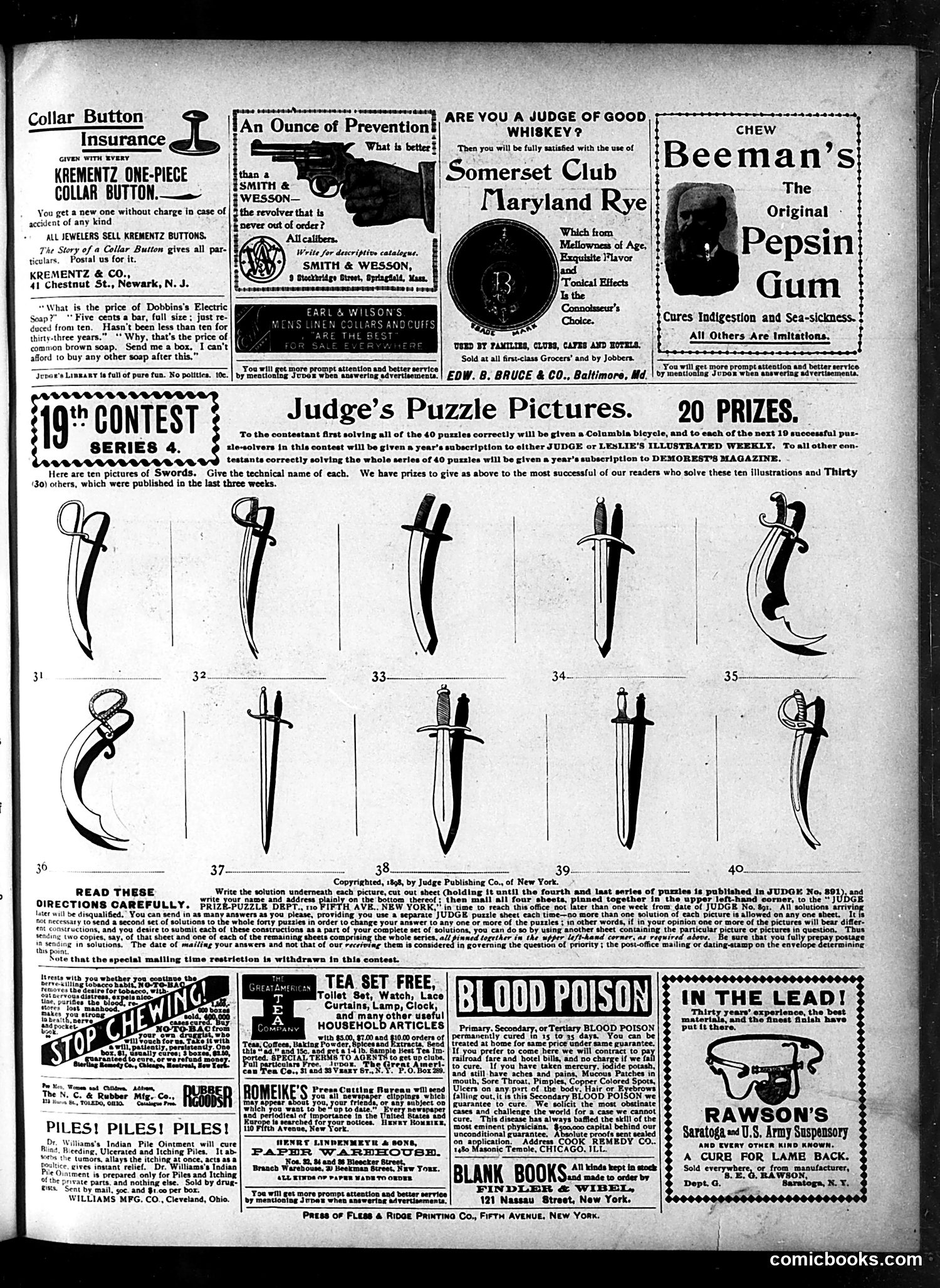
This page is primarily **advertising and a puzzle contest**, not political satire. The main feature is "Judge's Puzzle Pictures" (Series 4)—a contest where readers identify sword types from illustrated silhouettes. The prizes include a Columbia bicycle for first place and magazine subscriptions for others. The page is dominated by **patent medicine and consumer product advertisements** typical of 1890s publications: Krementz collar buttons, Smith & Wesson revolvers, Somerset Club Maryland Rye whiskey, Beeman's Pepsin Gum (claimed to cure indigestion), and various other products. There's also a "Stop Chemialog" ad and remedies for piles and blood poison. One small ad features dialogue about Dobbins's Electric Soap pricing—light consumer humor rather than political commentary. **This is not a satirical or political page.** It represents Judge functioning as a commercial publication carrying revenue-generating advertisements alongside entertainment content for a middle-class audience interested in consumer goods and puzzle competitions.
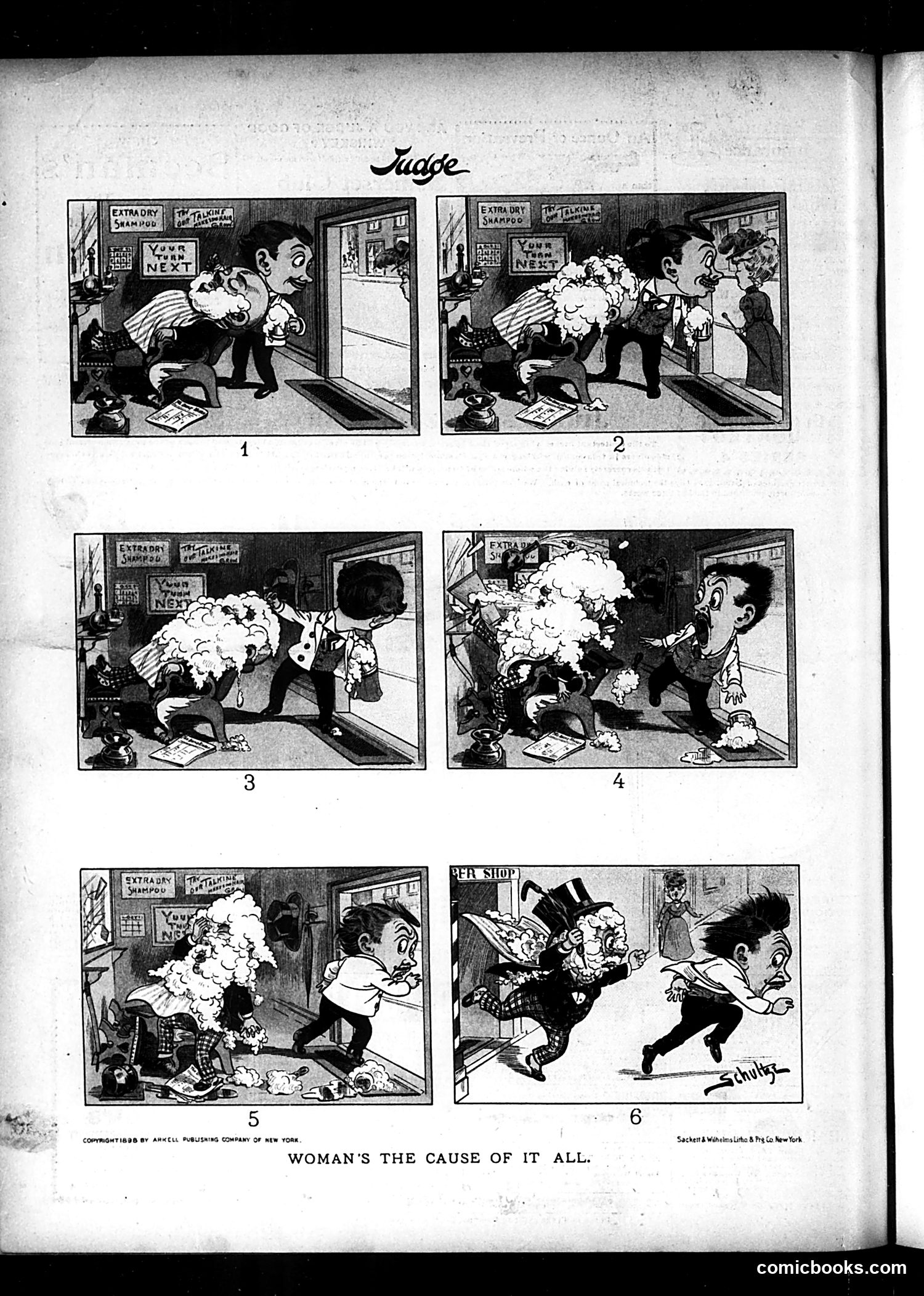
This six-panel comic strip by Judge satirizes domestic chaos through slapstick humor. The narrative follows a man visiting a barber shop who becomes entangled with a woman's elaborate feathered hat—a fashionable accessory of the era. The "joke" title blames women generally for the resulting mayhem: the hat creates escalating physical comedy (panels 1-5), culminating in the man fleeing frantically down the street in panel 6, chased by what appears to be the hat's owner or an angry figure. The satire reflects early 20th-century attitudes trivializing women's presence in public spaces and fashion as inherently disruptive. The exaggerated physicality and the concluding "blame women" caption represent a common comedic trope of the period that framed women's autonomy—here symbolized by her fashionable attire—as fundamentally chaotic and problematic.