
A complete issue · 16 pages · 1898
Judge — October 29, 1898
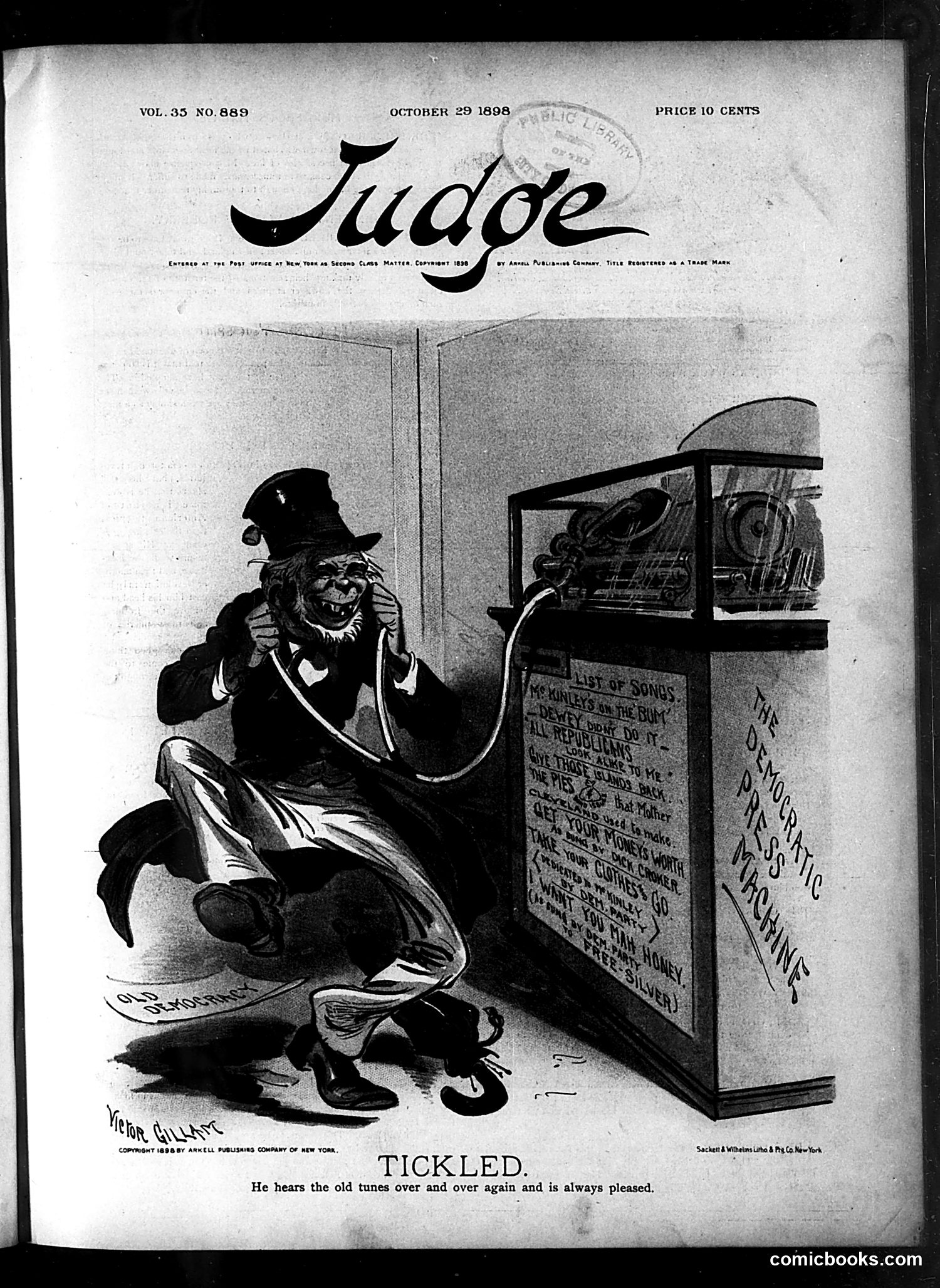
This cartoon by Victor Gillam depicts a figure (appearing to represent the common man or perhaps a specific political opponent) listening repeatedly to a phonograph or music device playing "old tunes." The caption states he "hears the old tunes over and over again and is always pleased." The satire likely mocks someone—possibly a political figure or the public generally—for being easily satisfied by repeated, familiar rhetoric or promises rather than demanding fresh ideas or solutions. The "list of songs" visible on the machine's side suggests these are well-worn political talking points being recycled. The cartoon critiques intellectual complacency or political manipulation through repetition during the 1898 election period.
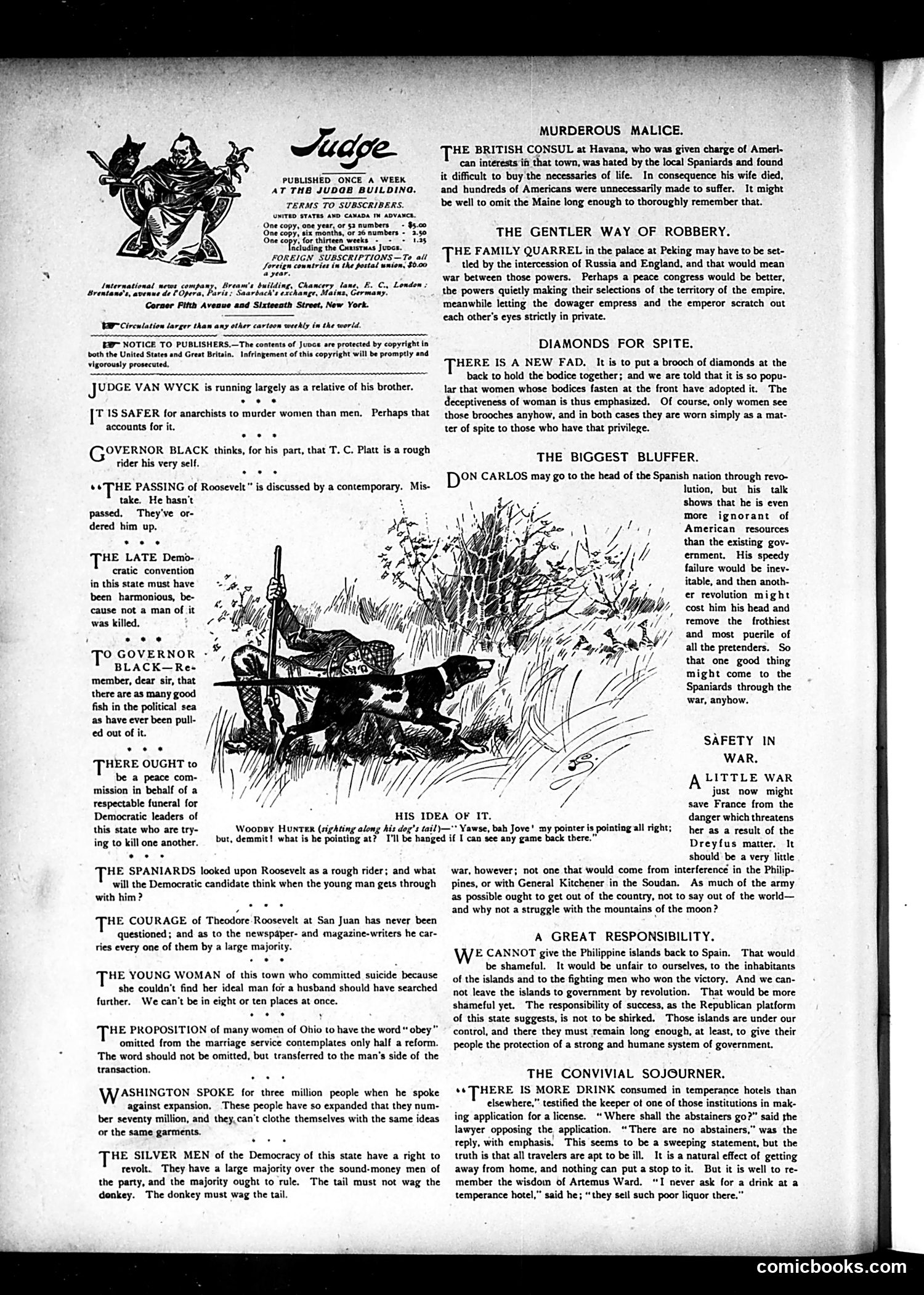
This page contains multiple brief political commentaries rather than a single cartoon. The main illustration shows a hunter in tall grass with the caption "His Idea of It," satirizing someone's hunting approach. The text pieces mock various political figures and issues of the era, including: - **Judge Van Wyck** (likely a local politician) criticized for being "a running bugbear" - **Governor Black** characterized as a "rough rider" - **Theodore Roosevelt's** passing, with commentary on Democratic leaders - **The Philippine question**, debating American responsibility for the islands - Commentary on Spanish governance and Democratic party politics The satire targets political hypocrisy, failed leadership, and debates over American imperial expansion. Without seeing specific dates or bylines clearly, the exact political moment remains somewhat unclear, though references suggest early 1900s American politics.
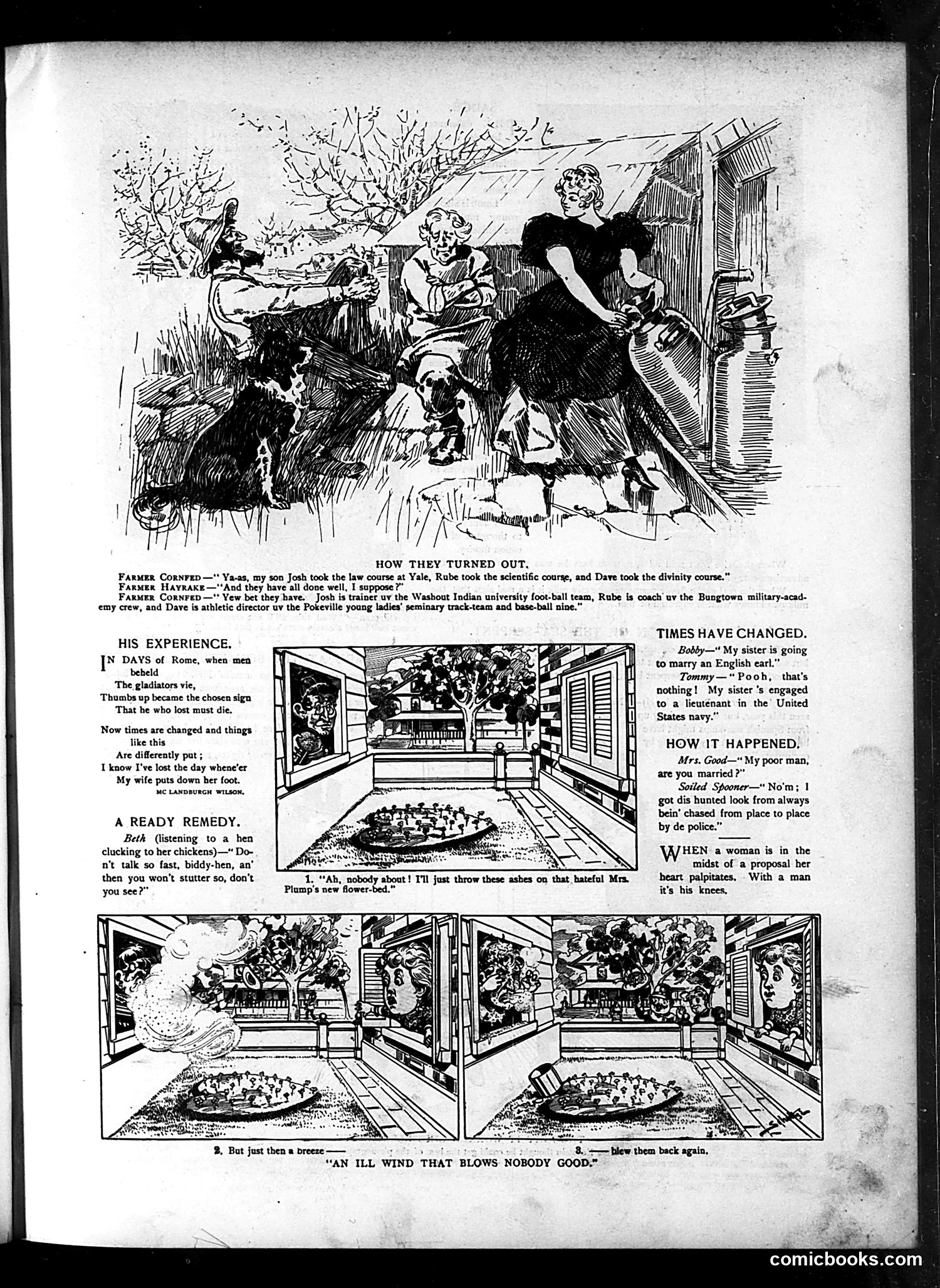
This page contains several unrelated short humor pieces typical of Judge magazine's format. The top cartoon depicts three men discussing their sons' career paths—one attended Yale law school, another trained for football at Washout Indian university, and the third became an athletic director. The joke plays on the apparent decline in professional ambition across generations. The remaining sections are brief comic anecdotes: "His Experience" mocks a man lamenting lost youth, "A Ready Remedy" offers domestic humor about a wife's complaints, and "Times Have Changed" jokes about a sister marrying a naval officer instead of pursuing more traditional paths. The illustrated panels showing "How It Happened" depict ash-blowing mishaps, the joke being about domestic frustrations and wind's interference. These are lighthearted domestic and social humor pieces without specific political commentary.
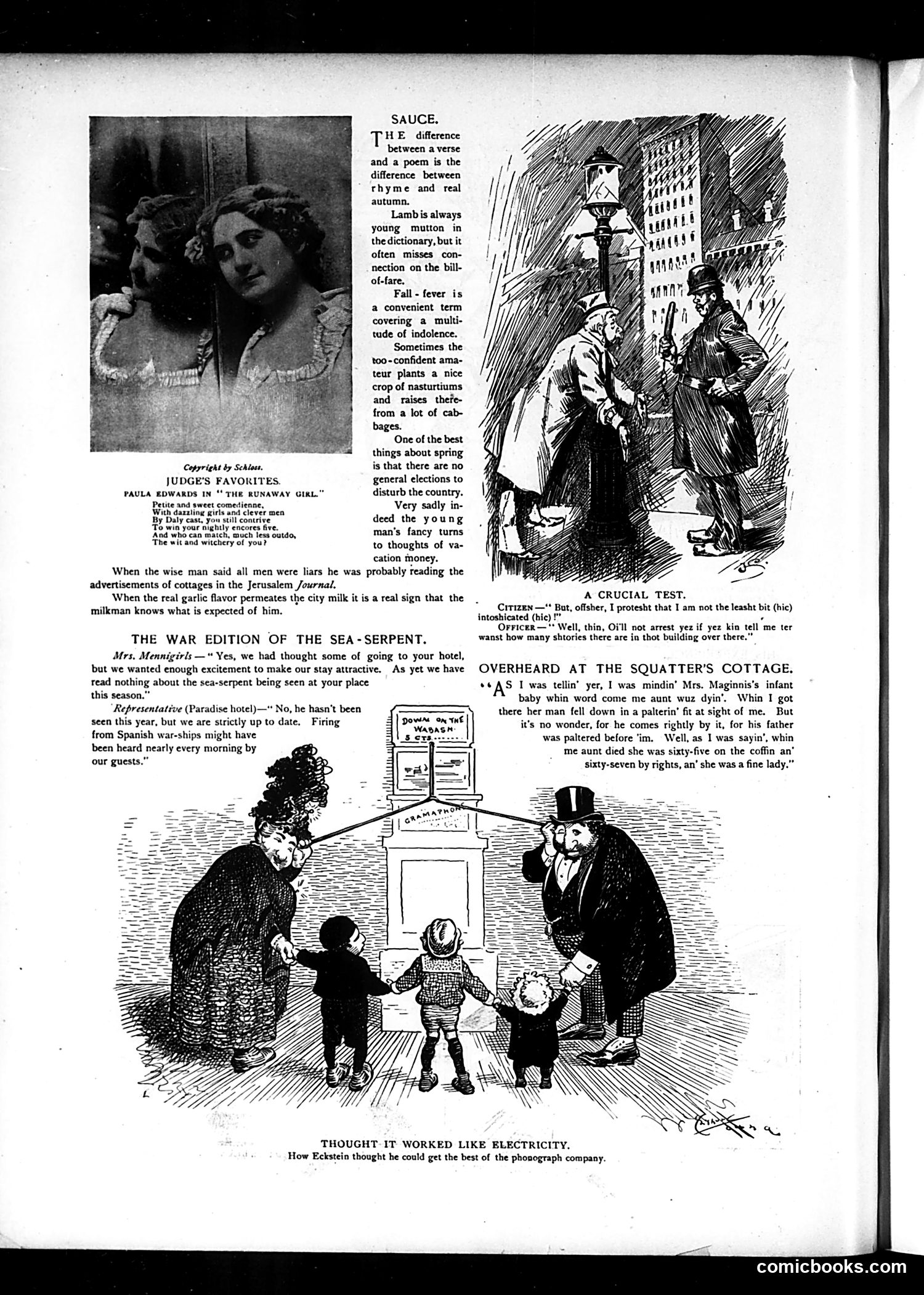
This page contains several satirical pieces and illustrations typical of Judge magazine's social commentary. The top section includes "Judge's Favorites," featuring Paula Edwards in "The Runaway Girl" - appearing to be theatrical advertisement or review. The main cartoon, "Overheard at the Squatter's Cottage," depicts a family at a cottage gateway with adults and children, illustrating working-class domestic life. The humor seems to rely on dialect and class-based observation. Another cartoon titled "Thought it Worked Like Electricity" makes a joke about Edison (likely Thomas Edison) and phonograph technology, suggesting a misunderstanding about how the device functioned. Various short humorous pieces discuss topics like "Fall-fever," seasonal observations, and "The War Edition of the Sea-Serpent" - satirizing newspaper sensationalism. The overall tone reflects late 19th or early 20th-century American satirical humor targeting class distinctions and contemporary technology.
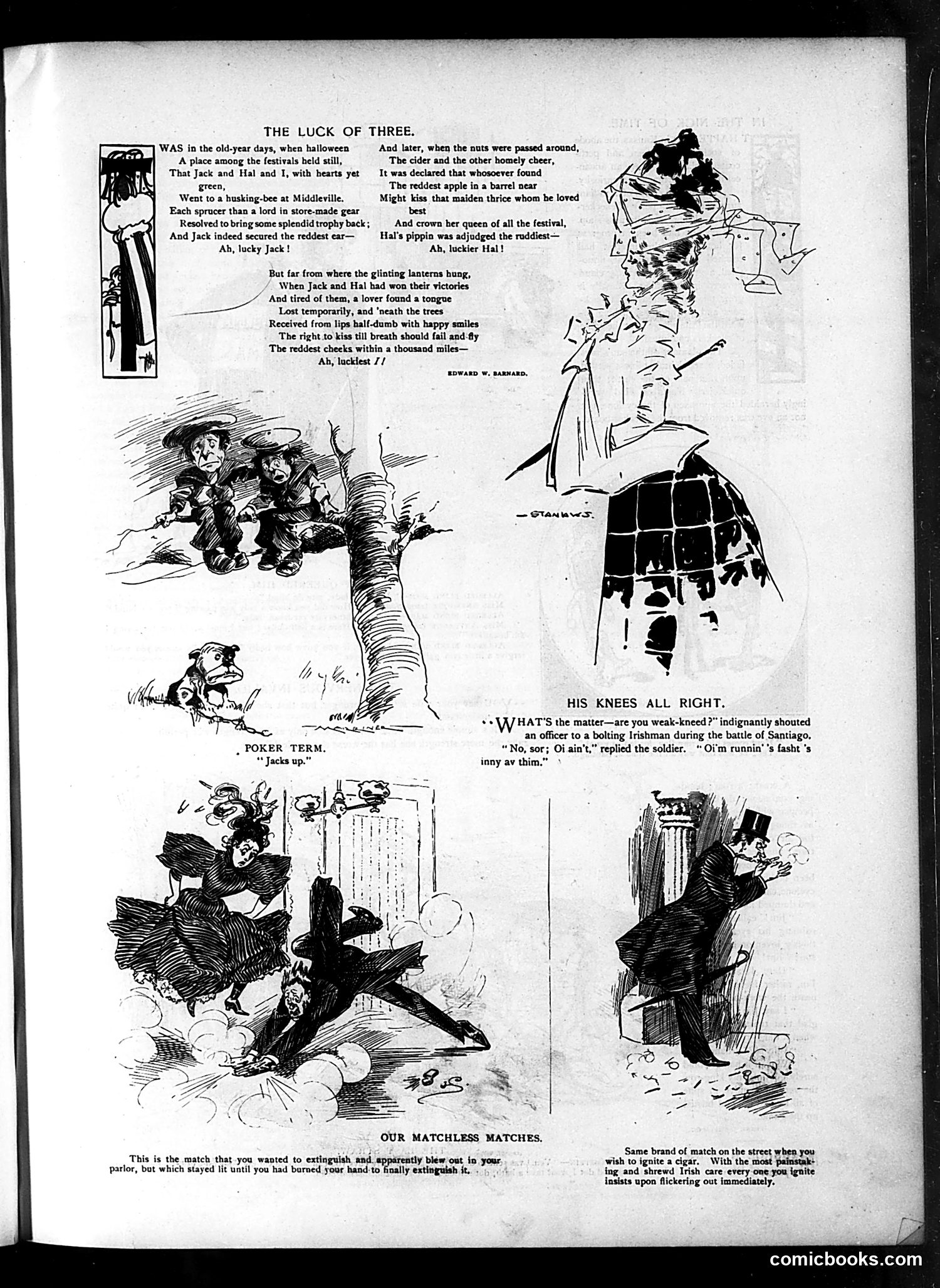
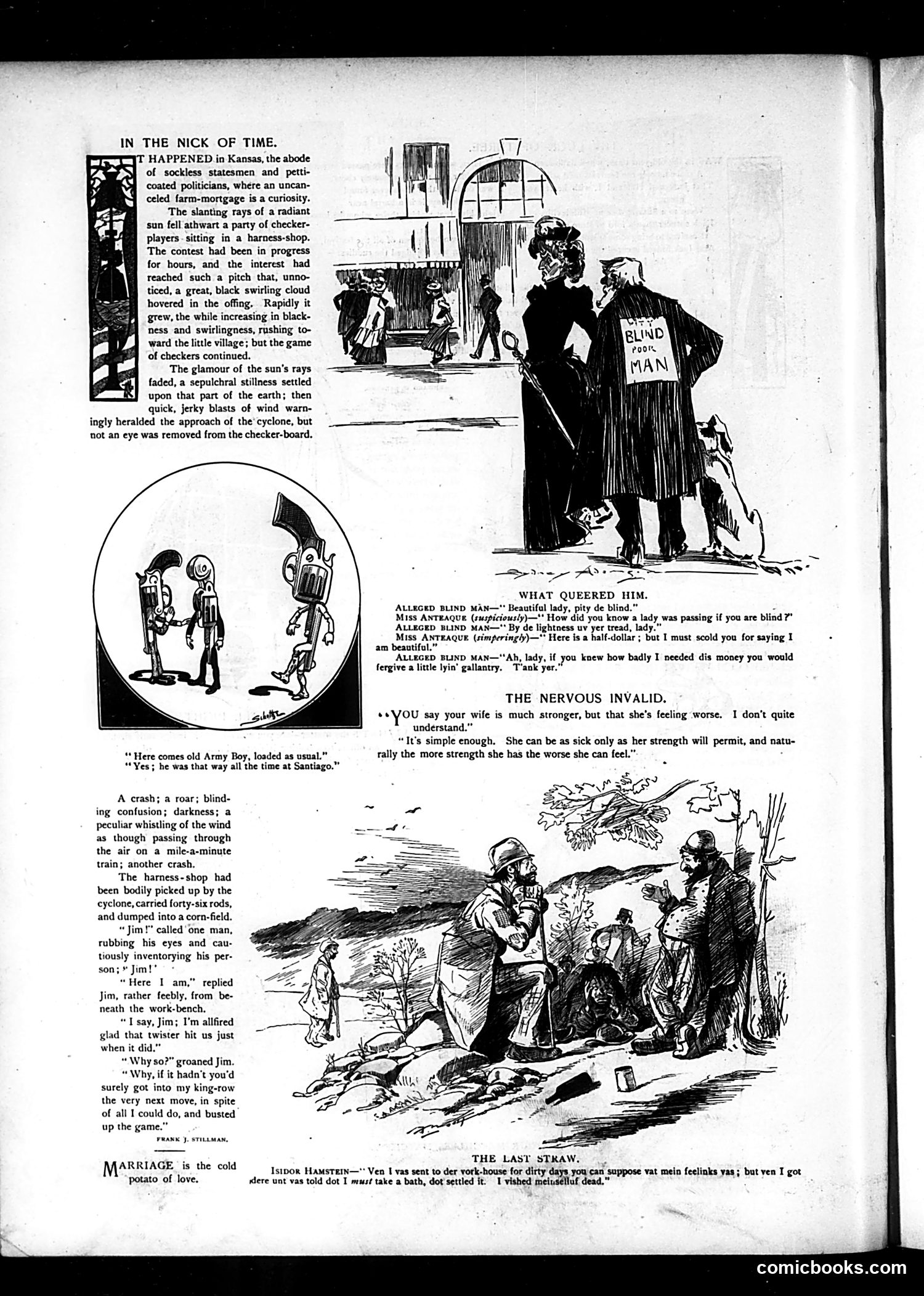
This page contains three satirical pieces: **"The Luck of Three"** (top): A sentimental poem about a husking-bee (corn-husking social event) where three young men compete for prizes. Jack wins the corn-husking contest, Hal wins the apple-finding contest, but the unnamed narrator wins the "real" prize—kissing the girl he loves in private. The satire mocks romantic sentimentality by suggesting true luck isn't in winning public contests but in genuine private affection. **"His Knees All Right"** (middle): A joke about the Spanish-American War (specifically the Battle of Santiago, 1898). An officer questions an Irish soldier's courage, but the soldier humorously clarifies he's running as fast as everyone else—a gentle ethnic joke playing on Irish dialect and battlefield panic. **"Our Matchless Matches"** (bottom): A consumer satire about defective matches—one brand won't light when you want it to, another won't extinguish. The humor targets poor product quality and consumer frustration with unreliable goods.
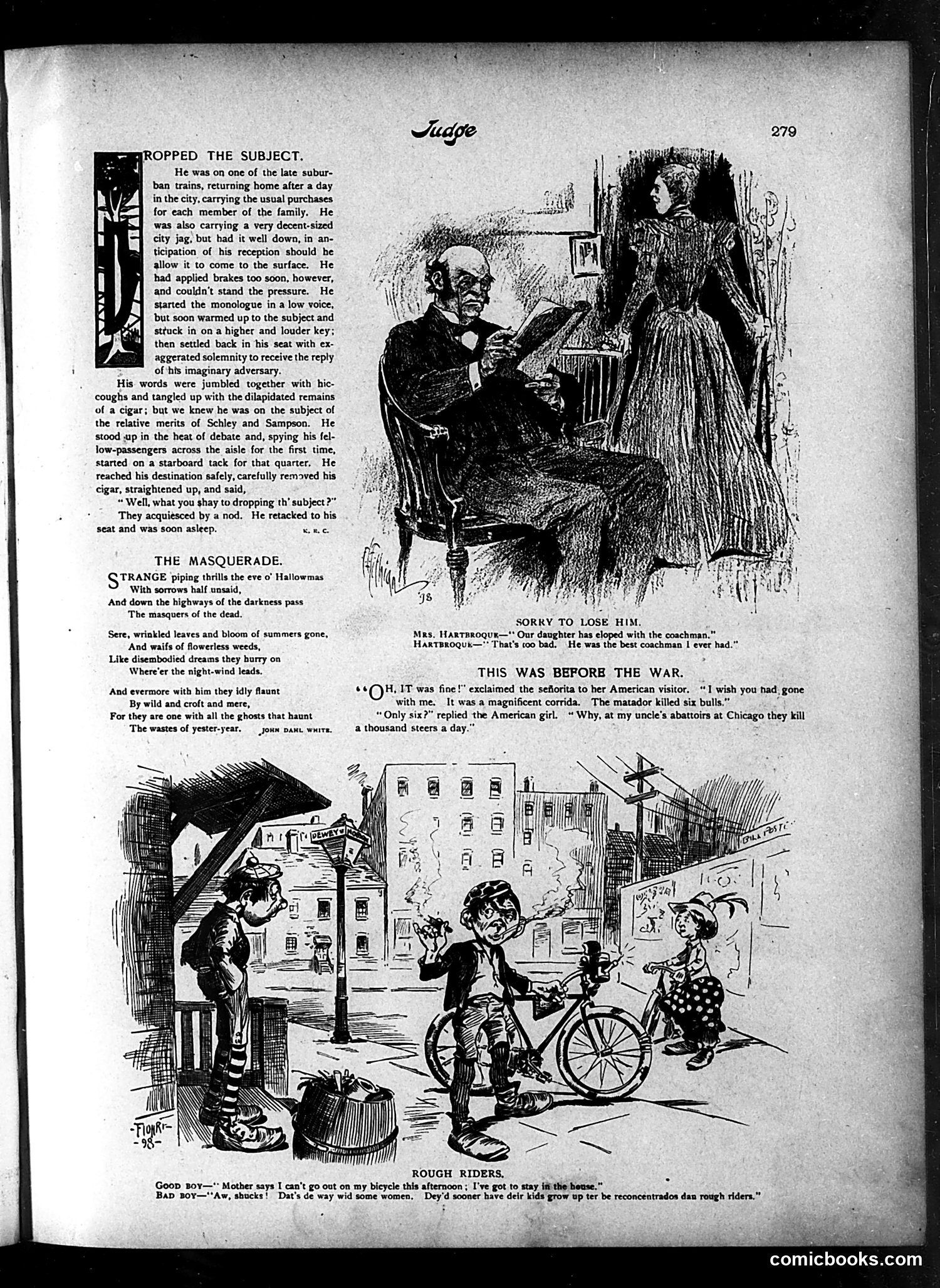
This page contains multiple satirical pieces typical of Judge's commentary on American life and politics circa early 1900s. The opening anecdote mocks a drunk commuter debating "the relative merits of Schley and Sampson"—likely referring to Admiral William Sampson and Commodore Winfield Schott's disputed credit for naval victories during the Spanish-American War (1898), a contentious contemporary political issue. "The Masquerade" is a poetic piece, seemingly about autumn/decay rather than political satire. The comic vignettes target gender relations and class pretensions: a wife denying her husband bicycle time; wealthy employers indifferent to servants' departures; and Americans boasting about industrial slaughter to Latin Americans. The final "Rough Riders" panel satirizes mothers preferring their sons become "reconcentrados" (Cuban concentration camp victims) over "rough riders" (possibly referencing Theodore Roosevelt's famous volunteer regiment)—dark humor about maternal values and American militarism.

This page appears to be from an 1898 Judge magazine issue. The main illustration shows an aerial perspective of a waterfront urban development—a cluster of multi-story buildings arranged along what appears to be a river or harbor, with manicured grounds and landscaping. The perspective is deliberately skewed, presenting the scene from an unusual bird's-eye angle that emphasizes the architectural planning. The partial caption "IS IT ONLY" suggests this is likely commentary on urban development or real estate schemes of the Gilded Age era. Without the complete text visible, the exact satirical target remains unclear—whether this mocks overly ambitious development plans, investor speculation, or a specific construction project. The artist's name appears to be credited at bottom, though partially obscured.
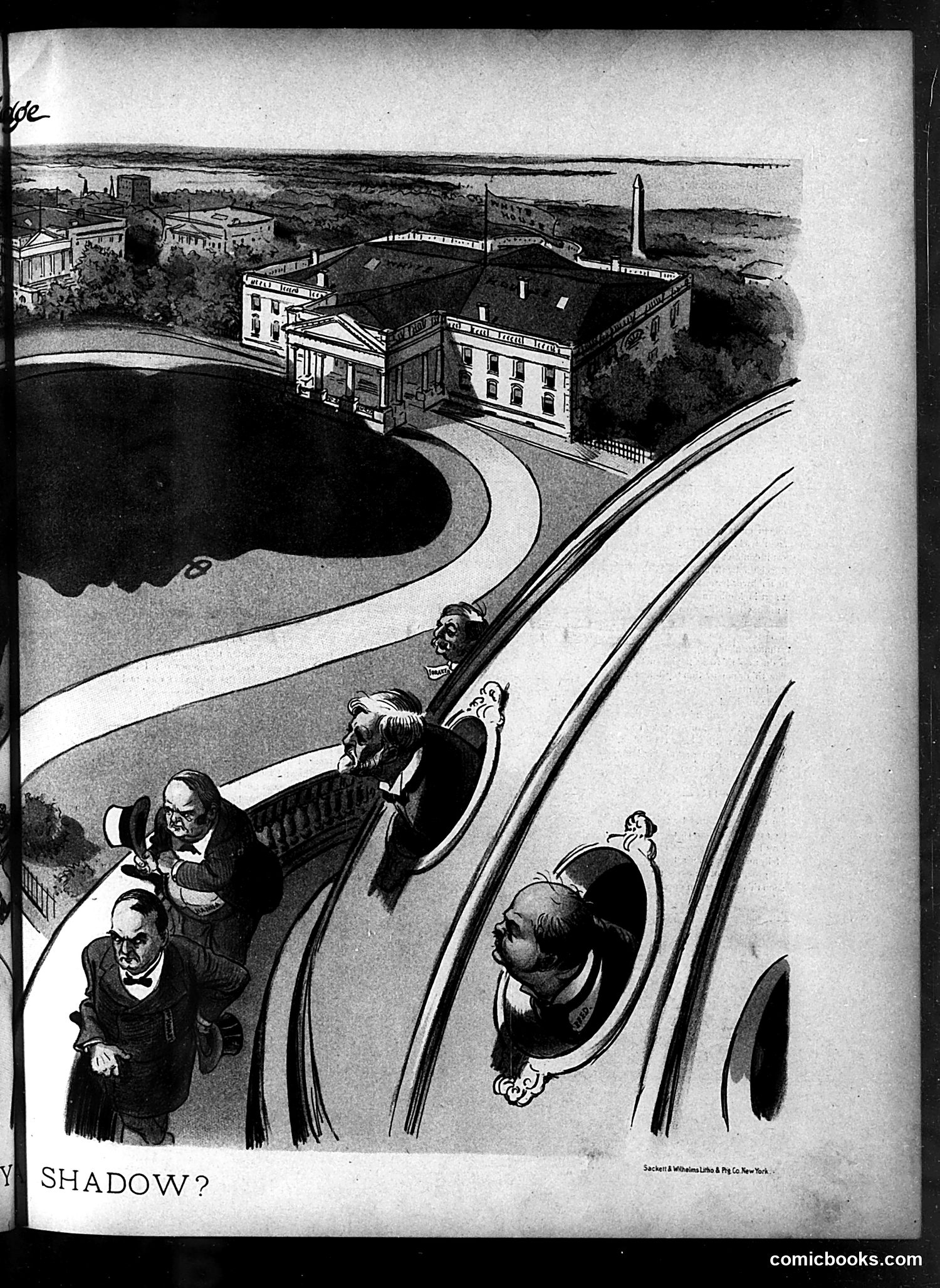
This Judge magazine cartoon depicts the White House viewed from above, with several caricatured figures casting long shadows across the grounds. The single-word caption "SHADOW?" poses a pointed question about hidden influence or power operating behind the scenes at the executive branch. The cartoon's perspective—looking down at the building with prominent shadows—suggests there are unseen forces or individuals controlling policy decisions. The exaggerated facial features of the figures indicate these are specific political personalities, though without additional context it's difficult to identify them precisely. The satire likely critiques backroom politics, suggesting that visible leadership masks the real decision-makers operating in the shadows—a common theme in early-20th-century political cartooning about corruption, special interests, or presidential advisors wielding excessive influence.
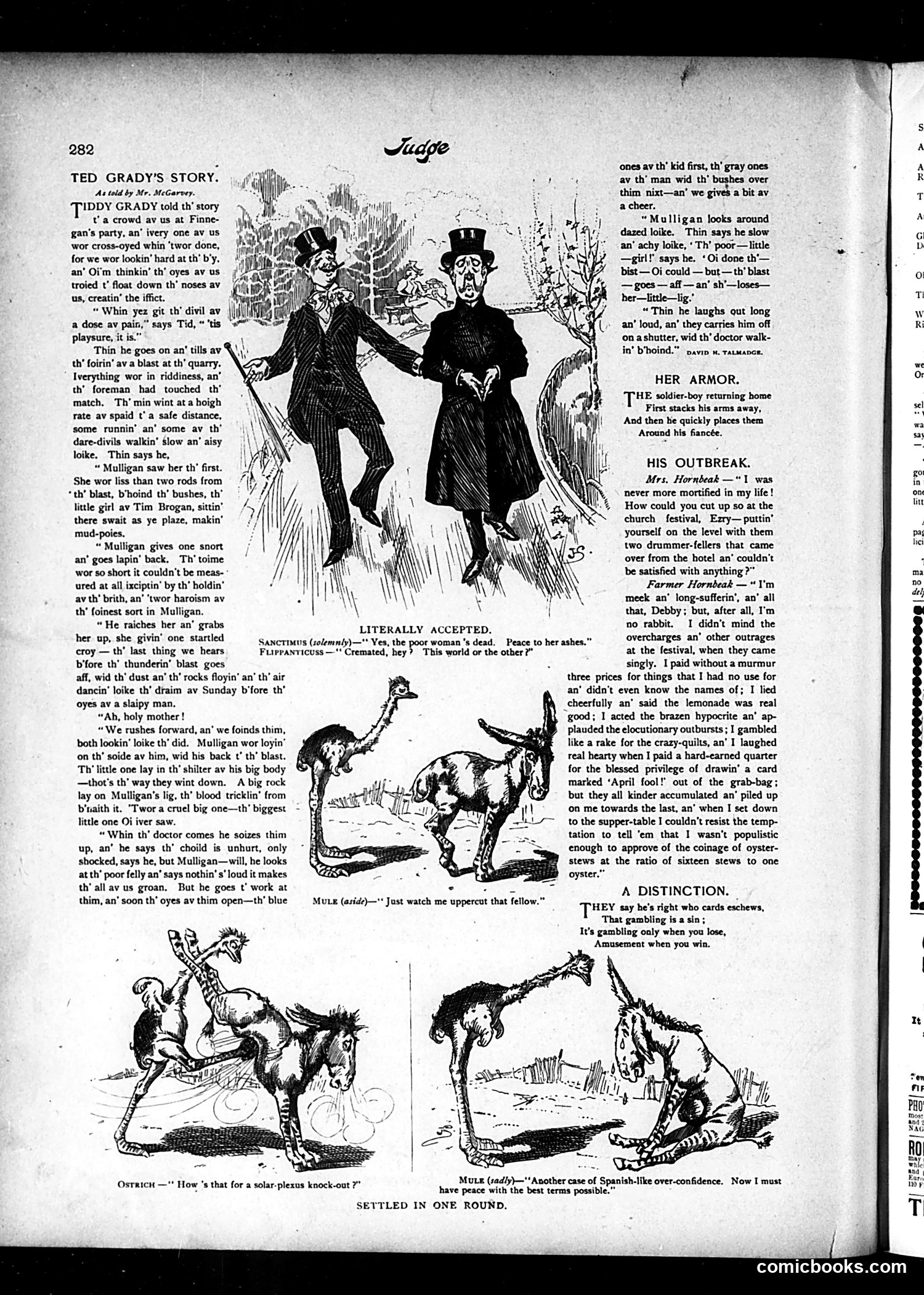
This page contains three distinct humorous pieces from the early 20th century: **"Ted Grady's Story"** (left): An Irish-dialect narrative about a quarry worker named Mulligan who shielded a child from a dynamite blast with his own body. The story celebrates working-class heroism and sacrifice, told in exaggerated Irish-American vernacular typical of the era's ethnic humor. **"Literally Accepted"** (center cartoon): Shows two men discussing a dead woman's cremation. One solemnly offers condolences while the other (labeled a mule) plans to "uppercut" him—satirizing either hypocrisy or the absurdity of formal sympathy rituals. **"His Outbreak"** (right): A farmer complains to his wife about being repeatedly overcharged and exploited at a church festival. He tolerates small indignities but finally "breaks out" when pushed too far—satirizing rural/working-class acceptance of petty swindles disguised as social obligations. The page emphasizes working-class dignity, ethnic identity, and resistance to exploitation—recurring Judge themes.
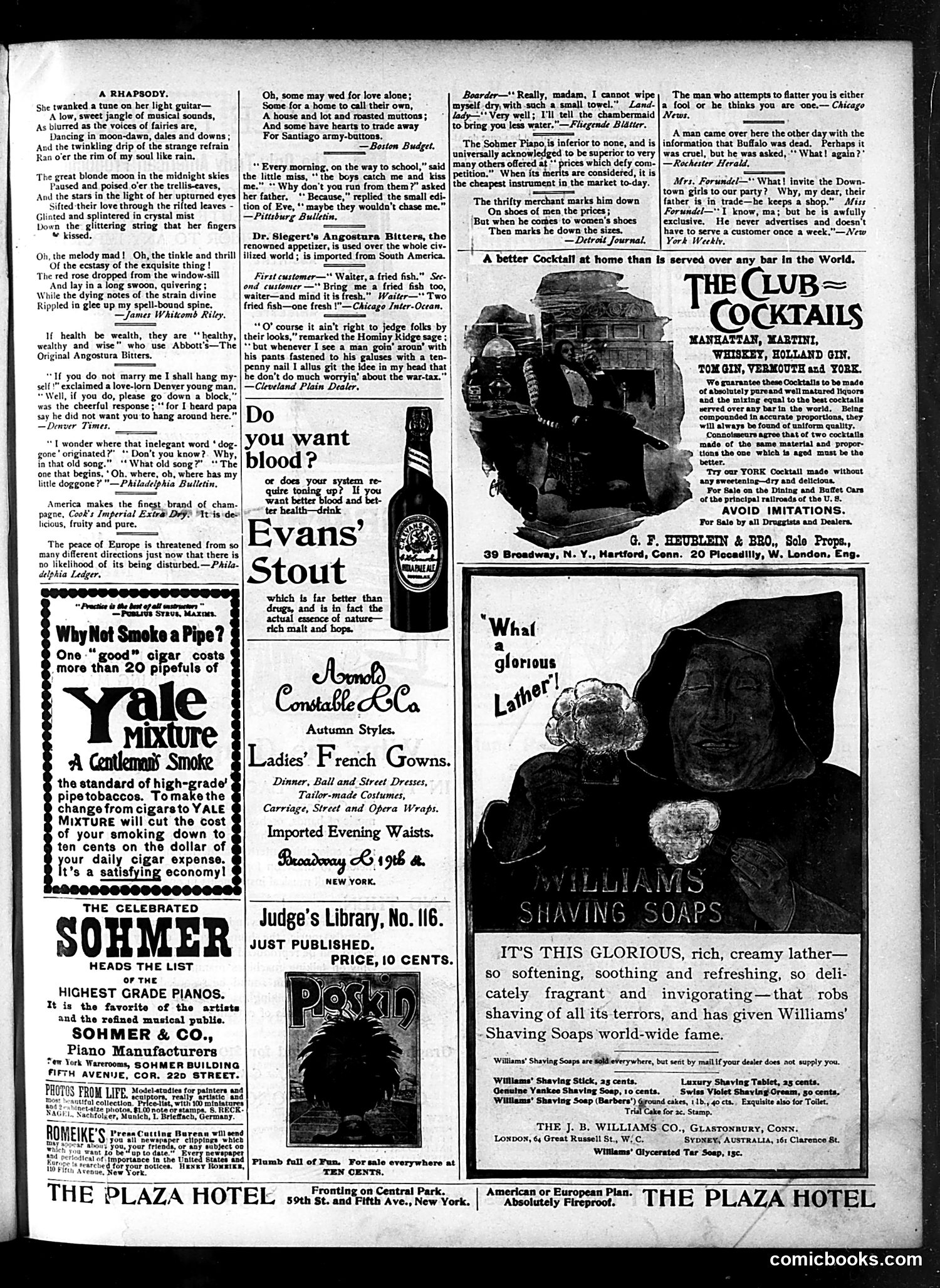
This page is primarily **advertising and light verse** rather than political satire. The dominant content includes: **Literary Content:** A romantic poem by James Whitcomb Riley about a woman playing guitar, accompanied by various humorous quips and jokes about courtship, marriage, and everyday situations. **Advertisements:** The page features multiple product ads (Evans' Stout beer, Yale pipe tobacco mixture, Sohmer pianos, Williams' Shaving Soaps, Arnold Constable clothing) typical of early 20th-century magazines. **Humor:** The jokes are gentle social commentary—a woman rejecting a suitor with wit, children's innocent observations about boys, and working-class humor about poverty and taxes. **Political/Social Context:** Minor references include Santiago army buttons (likely referencing the Spanish-American War era) and a passing joke about war taxes, suggesting this dates to an early 1900s period. The page lacks coherent political cartoons or sustained satire. It represents Judge's mixed format of poetry, advertising, and light domestic humor rather than sharp social criticism.
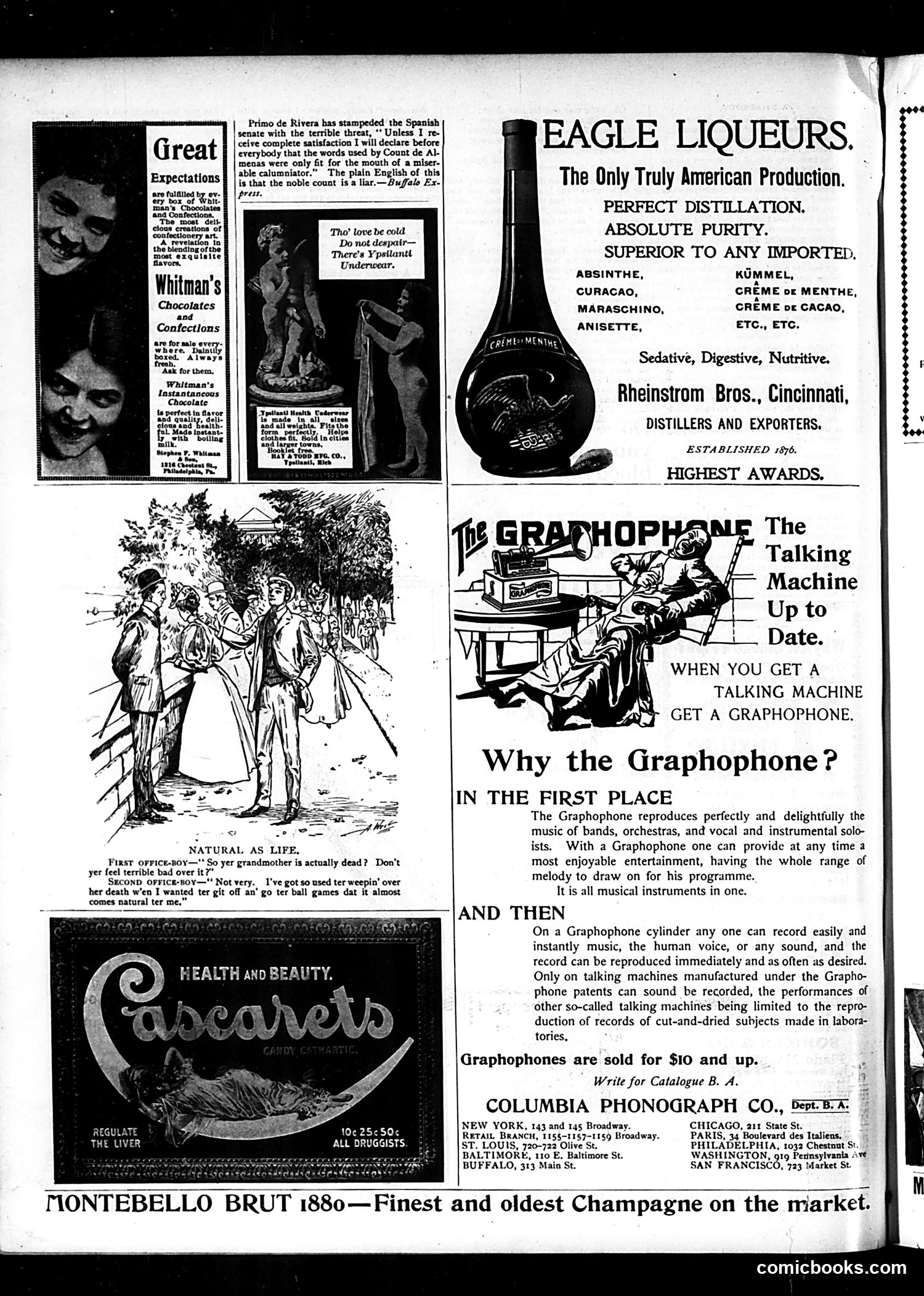
This page is primarily **advertising**, with one brief satirical item. The main cartoon shows two office boys discussing death with gallows humor—the second boy admits he's cried so often about his grandmother's death (to get time off for baseball games) that mourning feels natural now. The joke satirizes workplace malingering and insincere grief. The text item references **Primo de Rivera**, a Spanish political figure, threatening to publicly call Count de Almenas a "liar" unless given satisfaction—a veiled threat in diplomatic language that Judge finds absurd. The remaining content comprises period advertisements: Whitman's Chocolates, Eagle Liqueurs (Cincinnati-made spirits), Cabarets (health tonic), and notably, the **Columbia Phonograph Company's Graphophone**—competing with Edison's phonograph by claiming superior recording capabilities on cylinders. This was a genuine technological competition of the era. The Montebello Champagne advertisement anchors the page bottom.
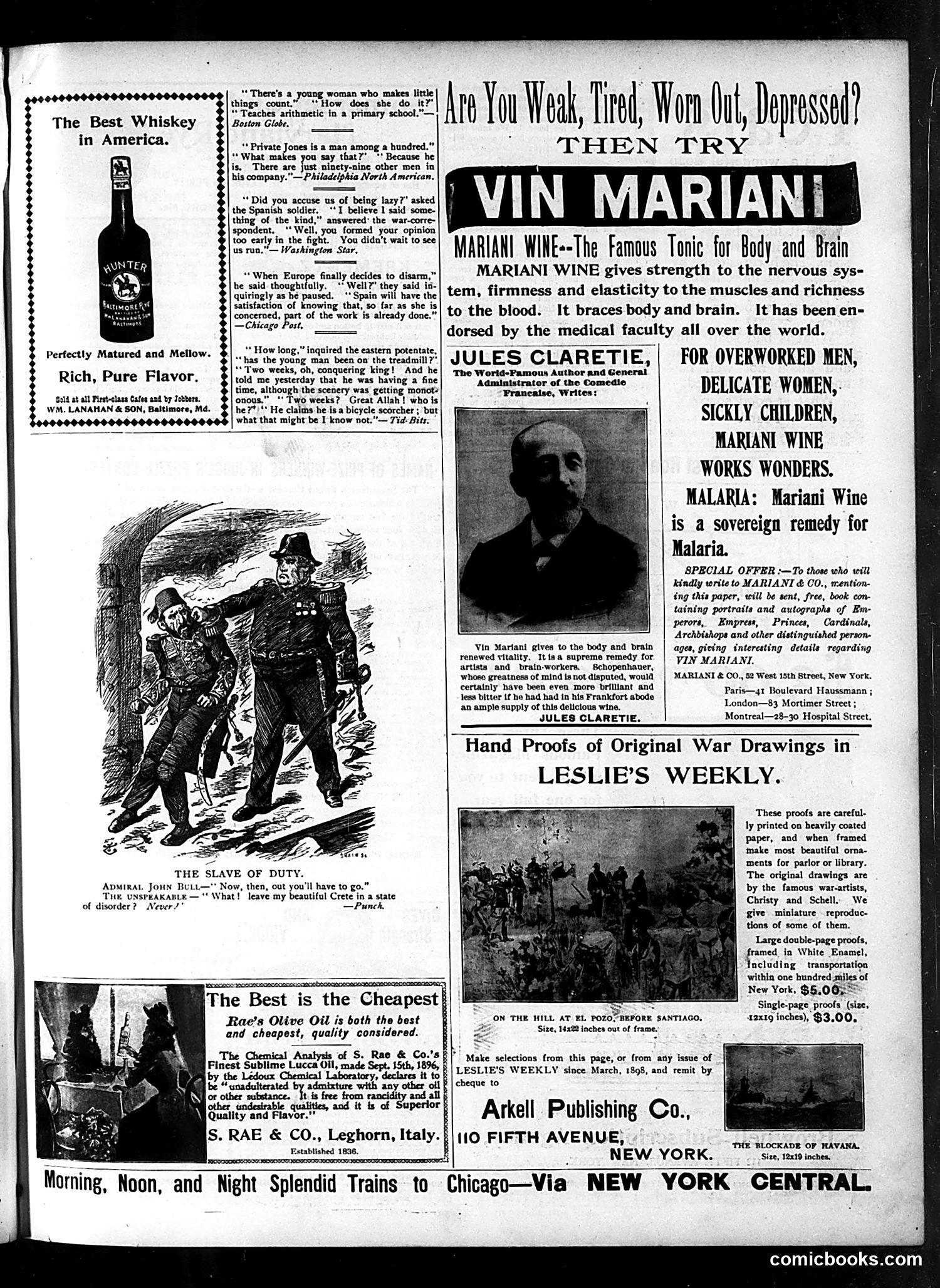
This page is primarily **advertisements and humor columns**, not political cartoons requiring historical context. The single cartoon, "The Slave of Duty," depicts **Admiral John Bull** (Britain personified) confronting **"The Unspeakable"** (the Ottoman Empire/Turkey), likely referencing the **Greco-Turkish conflict of the 1890s**, specifically turmoil in Crete. The joke plays on Britain's imperial obligations: Bull must expel the Turk from Crete, but the Turk protests he cannot leave because Crete is in disorder—a satirical comment on European powers' contradictory positions regarding Ottoman territories. The remaining content comprises period advertisements (whiskey, wine tonics, olive oil, Leslie's Weekly war drawings) typical of Judge's revenue model. These ads are notable for making dubious health claims—Mariani Wine allegedly cures malaria and strengthens the brain—reflecting pre-regulation patent medicine marketing common in the 1890s. The page also includes brief humor columns about soldiers and arithmetic teachers, unrelated to the political cartoon.
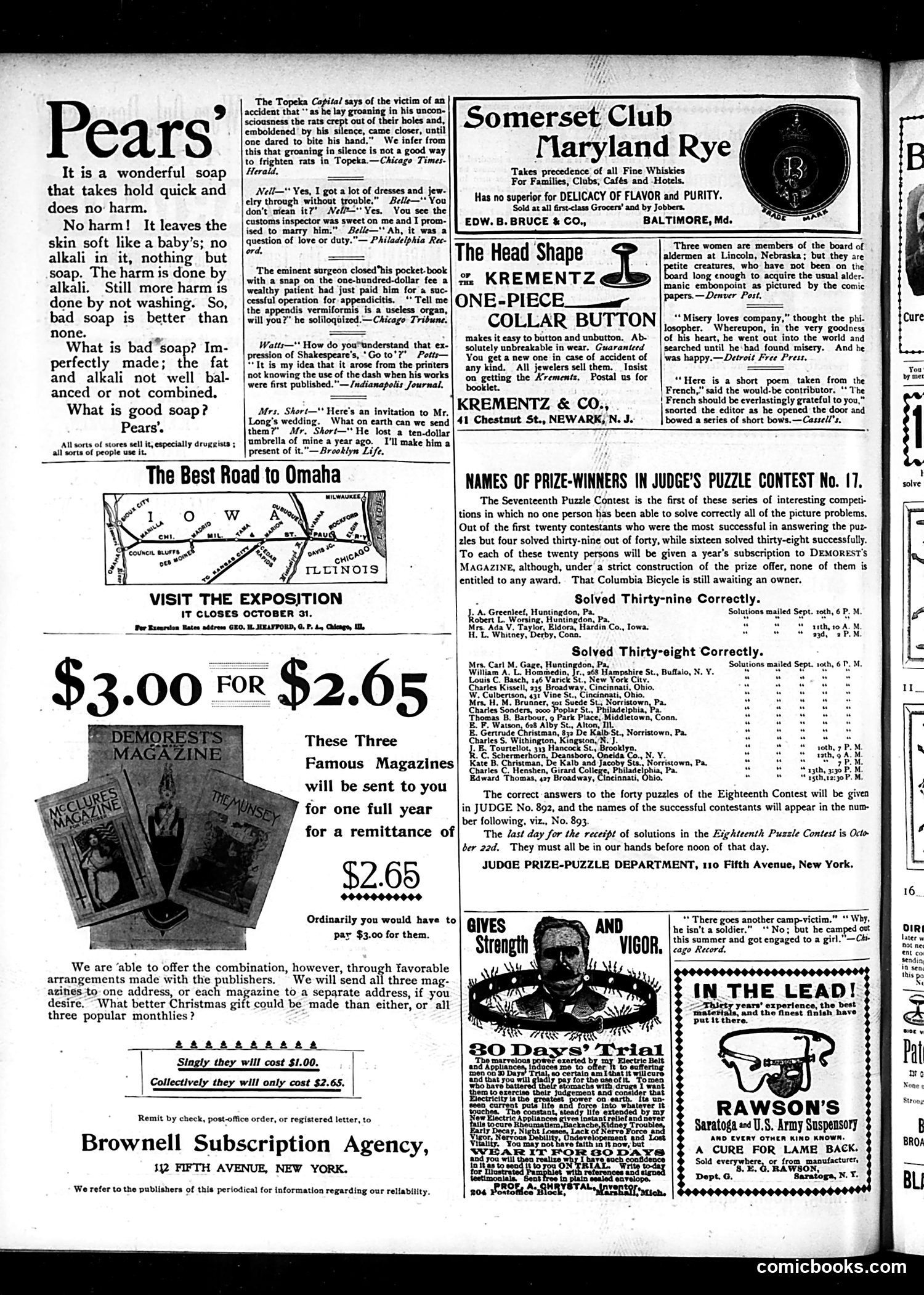
This page primarily consists of **advertisements and humorous short anecdotes** rather than political cartoons. The brief jokes satirize: 1. **Small-town journalism** (Topeka Capital): Mocks a Kansas newspaper's absurd rat story, suggesting the publication's credibility issues. 2. **Customs corruption**: A woman brags about smuggling jewelry by flirting with a customs inspector—satire of Gilded Age corruption and gender manipulation. 3. **Medical greed**: A surgeon celebrates a profitable appendix surgery, joking the organ is "useless"—satirizing doctors' financial incentives over patient welfare. 4. **Publishing incompetence**: A joke blames printers' ignorance for Shakespeare's confusing punctuation. 5. **Female aldermen in Nebraska**: A brief note about Lincoln's three female aldermen lacks the traditional "fat politician" stereotype—presented as novelty. The page is dominated by **product advertising** (Pears' soap, Krementz collar buttons, Somerset whiskey, magazine subscriptions, and patent medicines), typical of early 1900s Judge content. The humor is light, domestic, and aimed at middle-class readers.
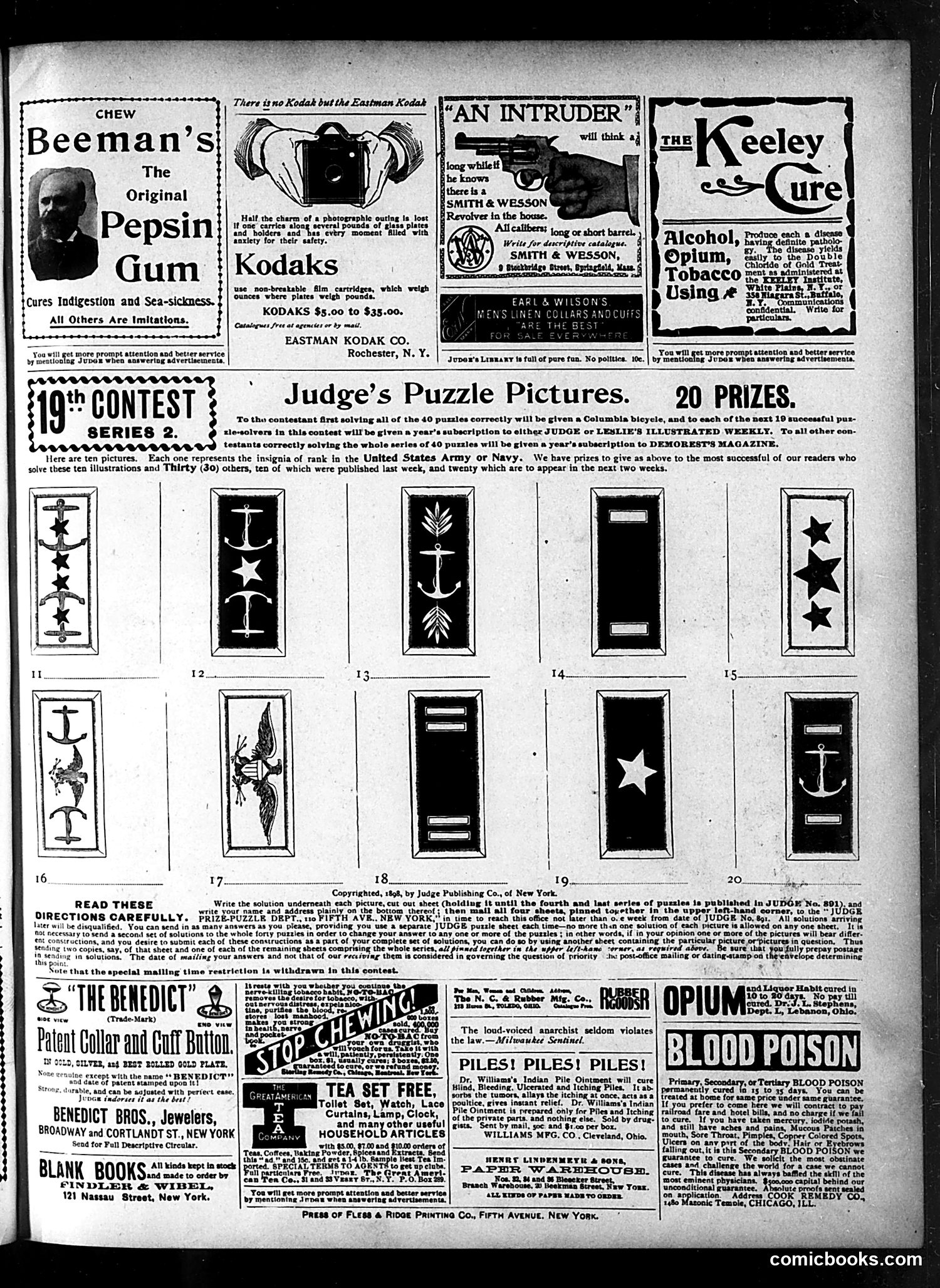
This page is primarily **advertising and a puzzle contest**, not political satire. The main content is Judge's "$10 Puzzle Contest Series 2," offering prizes including a Columbia bicycle and magazine subscriptions. Contestants must identify 40 military insignia (Army and Navy rank badges) shown as silhouettes—ten appear here, thirty more published separately. The surrounding advertisements promote contemporary products: Beeman's Pepsin Gum (claimed to cure indigestion), Kodak cameras, Smith & Wesson revolvers, The Keeley Cure (addiction treatment using alcohol and opium), and various patent medicines like "Blood Poison" treatment. The page reflects **late 19th-century consumer culture** and advertising practices—many of these products (particularly the dubious medical "cures") would be considered fraudulent or dangerous today. The puzzle contest itself was a common engagement strategy for magazines seeking reader participation and loyalty.
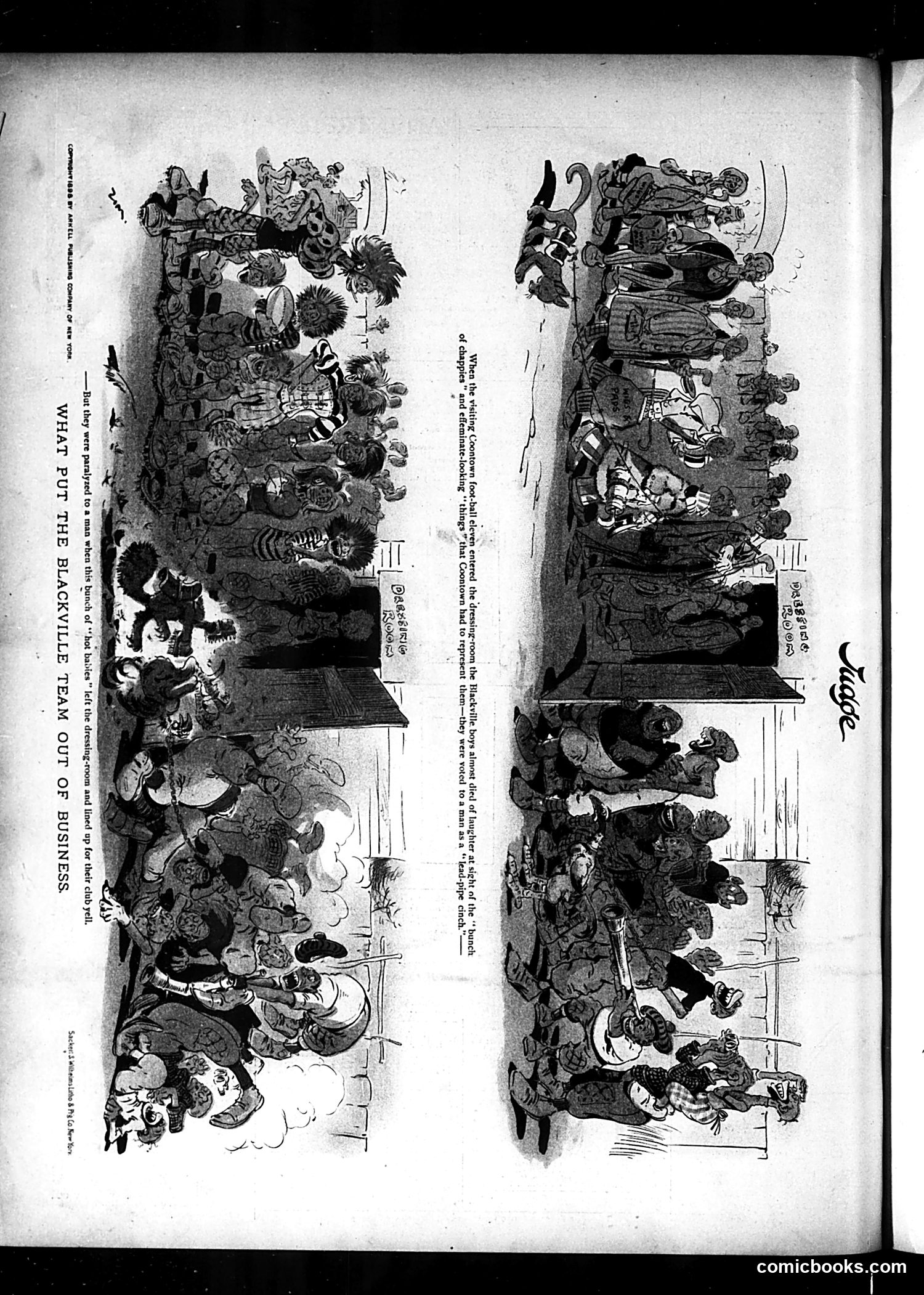
This two-panel cartoon depicts a racist narrative about a football game between two African American teams: "Blackville" and "Coontown." The left panel shows Blackville players mocking Coontown's arriving team as weak and effeminate. The right panel reveals the twist: Coontown's players are actually formidable athletes who intimidate Blackville, "putting them out of business." The satire relies on dehumanizing caricature and the slur-laden language typical of late-19th/early-20th-century minstrelsy-influenced humor. The joke hinges on subverting expectations—the underestimated team proves superior—but the entire premise treats African Americans as objects of ridicule. This reflects Judge magazine's racist editorial perspective of the era, where such content was considered acceptable entertainment for white audiences.