
A complete issue · 16 pages · 1898
Judge — October 1, 1898
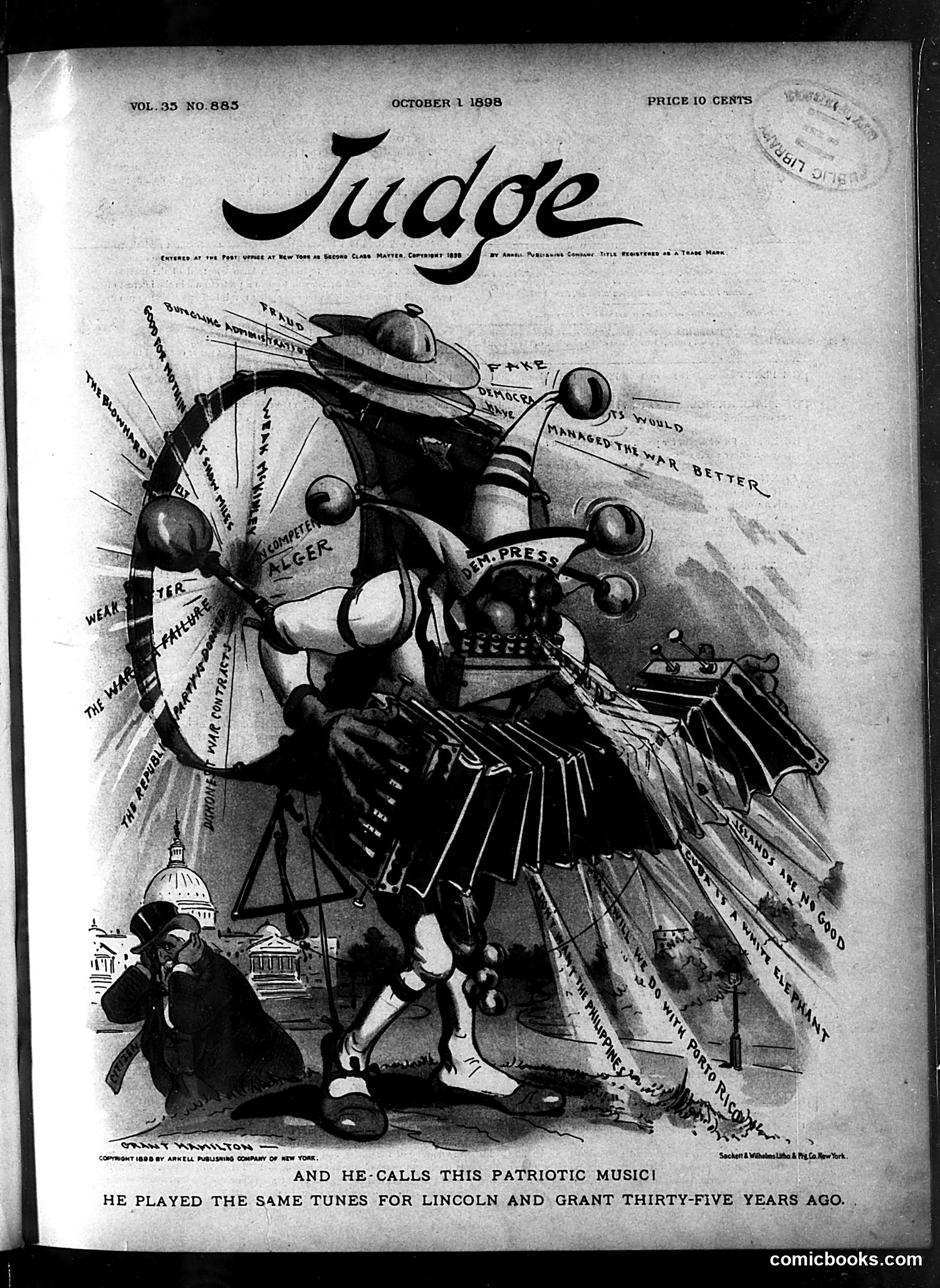
This political cartoon satirizes a musician (likely representing someone in power, possibly President McKinley or a political figure) who plays an accordion while conducting an orchestra of spherical "heads" labeled with various issues: "Fraud," "Weak Currency," "Alger" (Secretary of War Russell Alger), "Empress," and "Managed the War Better." The figure appears to be a military or political leader attempting to juggle competing scandals and criticisms from the Spanish-American War period. The caption notes he "played the same tunes for Lincoln and Grant thirty-five years ago," suggesting the figure represents continuity of corrupt or problematic leadership across administrations. The Capitol building visible below emphasizes this is American political commentary during the McKinley administration.
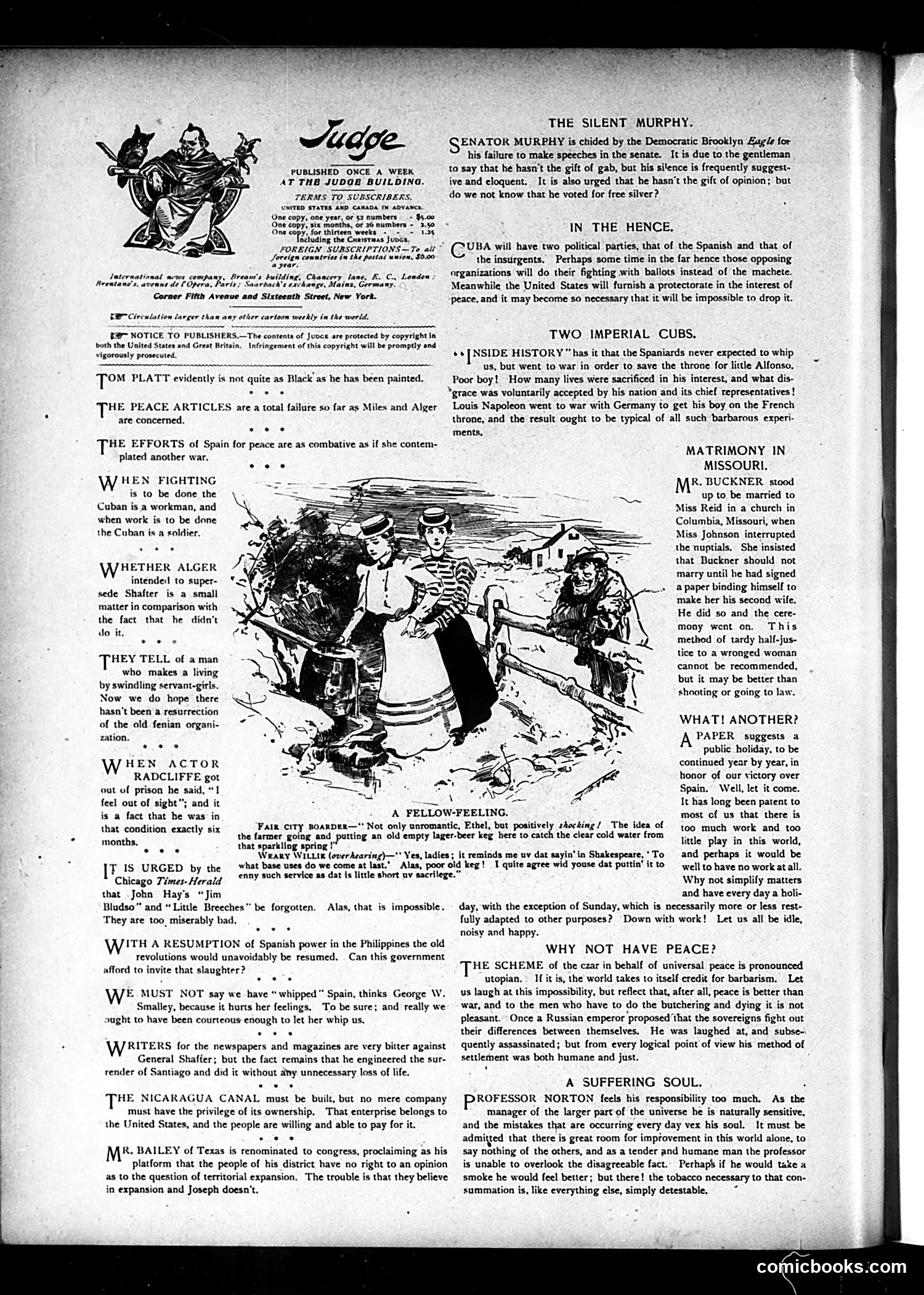
This page contains several brief satirical editorials rather than a single cartoon. The content addresses: **"The Silent Murphy"**: Criticizes Senator Murphy (Democratic, Brooklyn) for his silence in senate speeches, suggesting he lacks eloquence or strong opinions. **Cuba and Spain**: Comments on Cuban political factions and US involvement, referencing Spain's colonial interests and American protection of insurgents. **"Two Imperial Cubs"**: Appears to mock Spain's loss of power, comparing Spanish and insurgent forces in Cuba. **General commentary**: Includes jabs at political figures like Tom Platt, references to peace negotiations (Miles and Alger), and critiques of Spanish military efforts. The page reflects Judge's typical late-19th-century approach: brief, pointed political attacks on contemporary figures and foreign policy issues, particularly regarding American interventionism and Spanish colonial affairs.
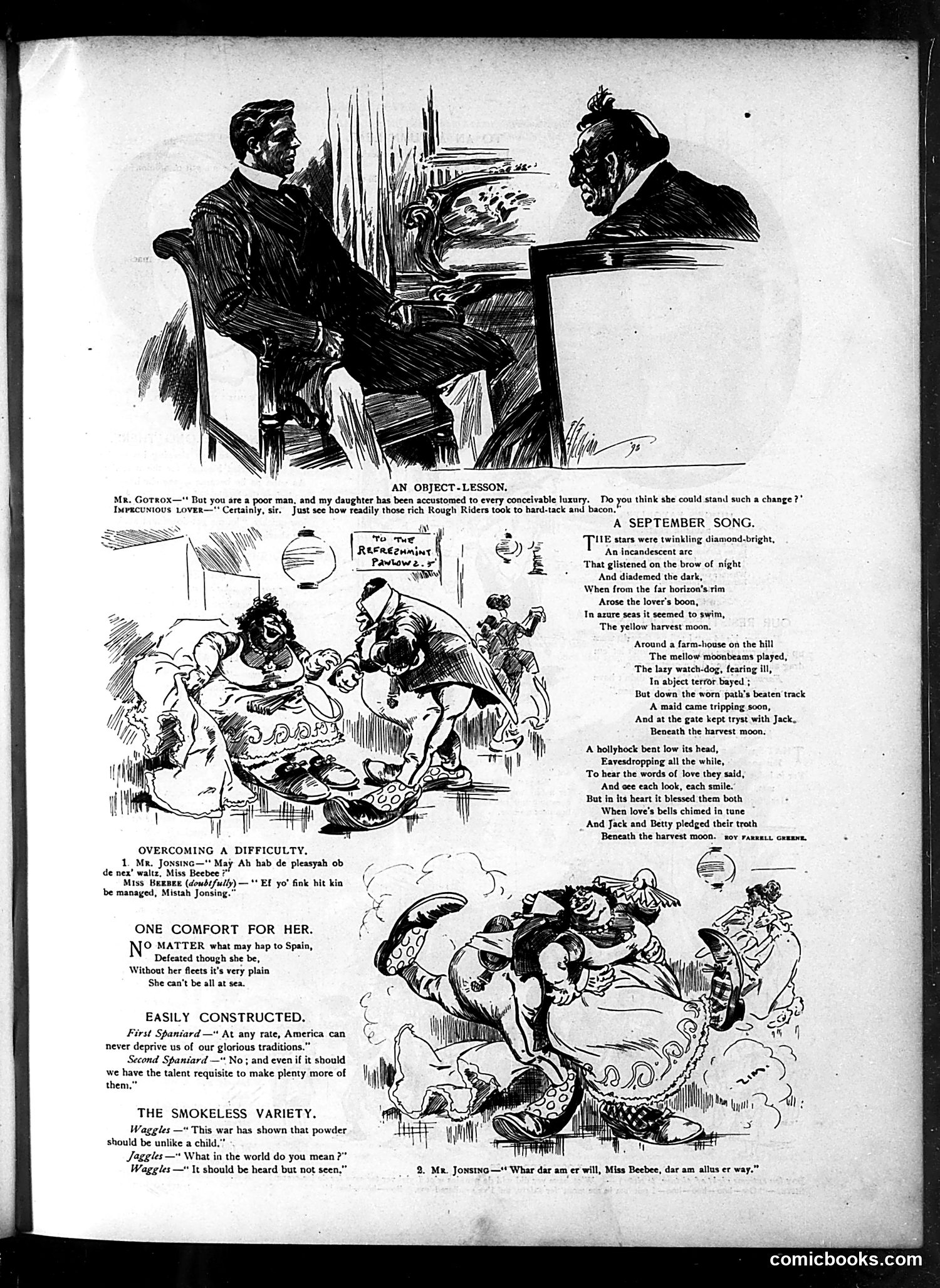
This page contains several satirical sketches and humorous verses rather than a unified political cartoon. **"An Object-Lesson"** (top) depicts a dialogue between a poor man and a wealthy "Rough Rider" about luxury. This likely references Theodore Roosevelt's Rough Riders, suggesting class commentary about wealth disparity. **"A September Song"** is a nostalgic rural poem with accompanying illustration of pastoral romance. **Lower sections** include brief comedic dialogues labeled "Overcoming a Difficulty," "One Comfort for Her," "Easily Constructed," and "The Smokeless Variety"—typical Judge humor pieces mixing wordplay with social observation. **"Ms. Johnso"** (bottom right) appears to reference an unidentified woman or character, though context is unclear without additional pages. The page represents Judge's typical format: mixing light verse, domestic humor, and subtle social satire rather than explicit political commentary.
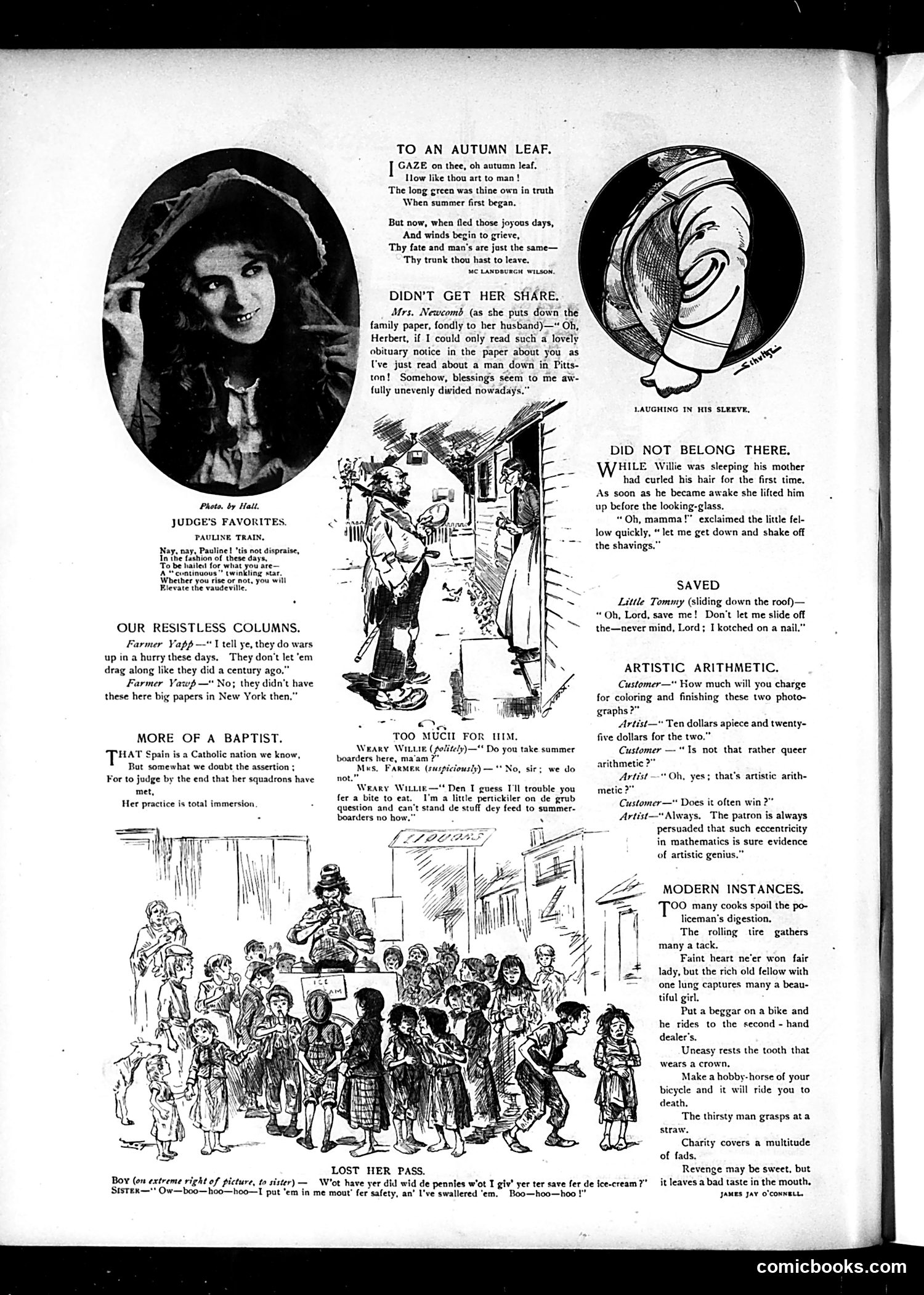
This page contains several unrelated satirical pieces and humorous anecdotes typical of Judge magazine's format. **"To an Autumn Leaf"** is a sentimental poem by Langfelder Willson. **"Didn't Get Her Share"** mocks Mrs. Newcomb's complaint about not receiving an obituary notice comparable to a man's. **"Did Not Belong There"** humorously describes a boy's first haircut experience. **"Lost Her Pass"** depicts a street scene with a boy offering ice cream, likely satirizing urban children's encounters. The remaining pieces—"Our Resistless Columns," "More of a Baptist," "Artistic Arithmetic," and "Modern Instances"—are brief comedic anecdotes about everyday situations: farming, religion, bargaining, and contemporary social observations. The page lacks overt political commentary, instead offering gentle social satire on domestic life and human nature typical of early 20th-century American humor magazines.
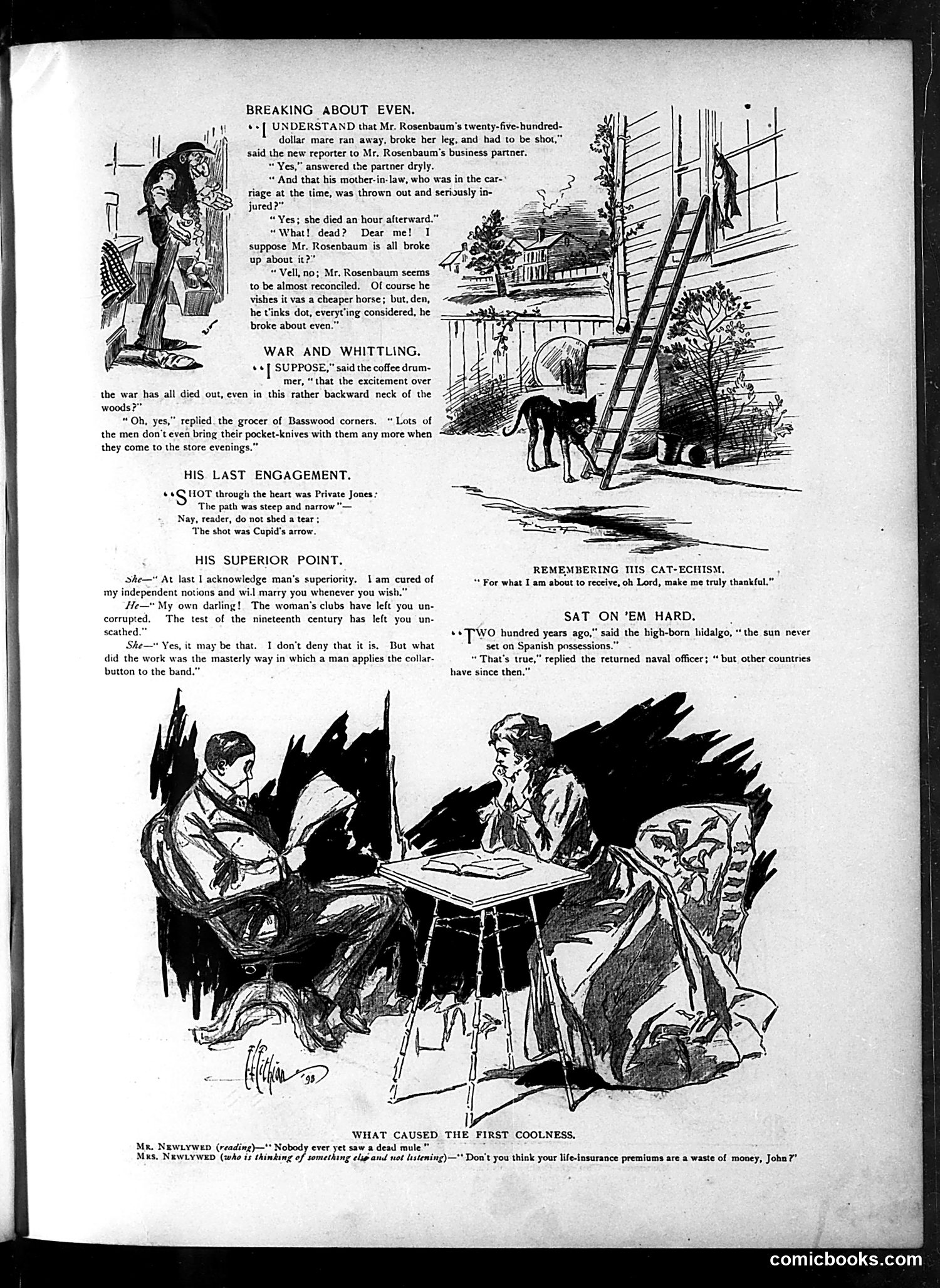
This page contains multiple brief satirical vignettes typical of Judge magazine's humor. **"Breaking About Even":** A dark joke about a man (Rosenbaum, likely a Jewish name suggesting ethnic humor common to the era) who loses his expensive horse and his mother-in-law dies in the same accident. The punchline—that he considers it "breaking even" because the horse was expensive but the mother-in-law's death is a benefit—relies on the anti-mother-in-law trope and plays on financial accounting language for grim comic effect. **"War and Whittling":** References post-war (likely Spanish-American War) rural America, where the excitement has faded so completely that even pocket-knife whittling—a pastime—has disappeared from store gatherings. **Other sections** include predictable humor about engagements, gender relations, and marriage miscommunication. The bottom cartoon satirizes newlyweds' disconnection. The overall page reflects turn-of-century American humor: ethnic stereotyping, anti-feminist jokes about women's independence, and domestic comedy centered on misunderstanding between spouses.
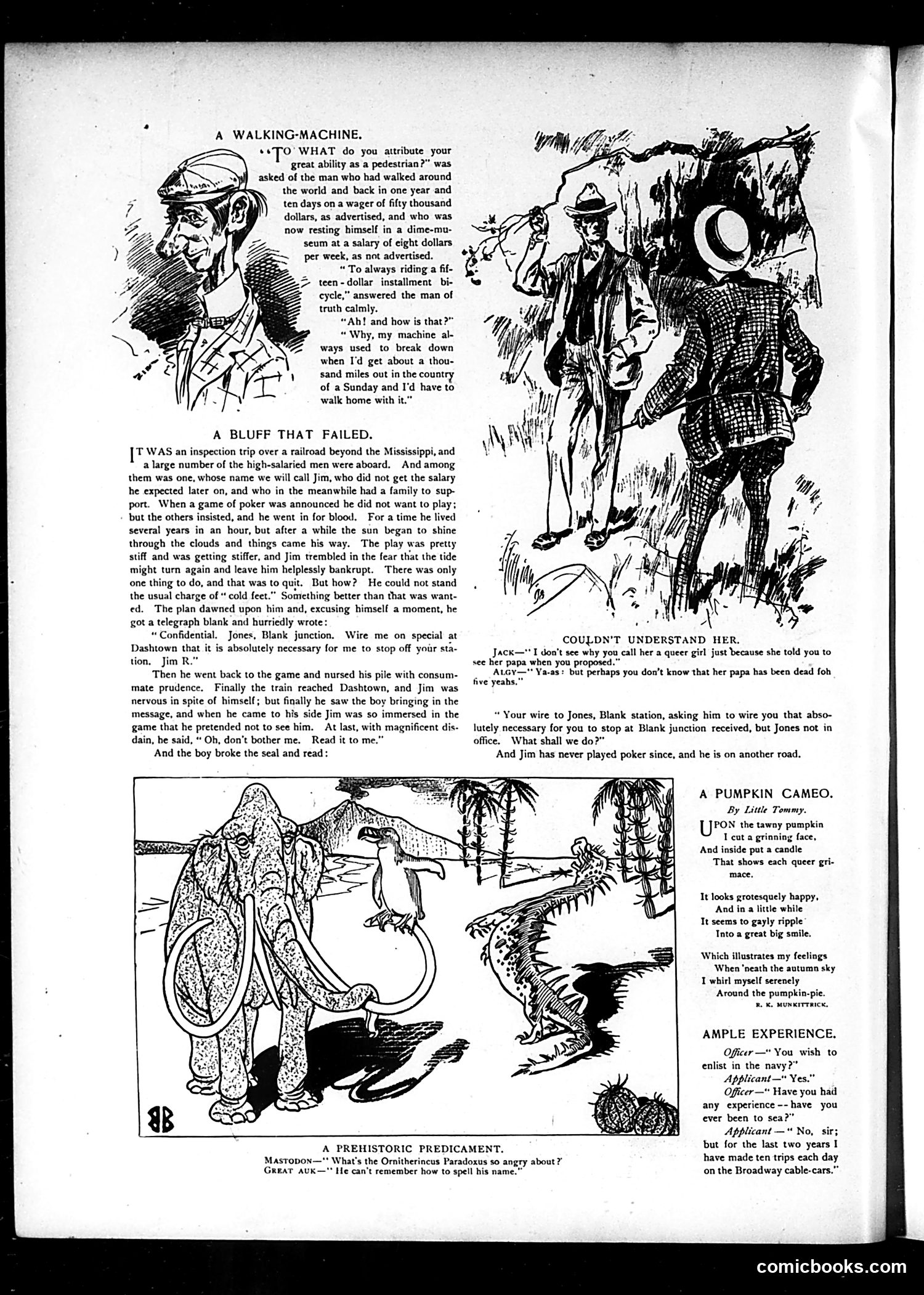
This page contains several brief satirical pieces typical of Judge's humor: **"A Walking Machine"**: A pedestrian who walked around the world claims his success came from repeatedly breaking down on a fifteen-dollar bicycle, forcing him to walk home with it. The joke mocks the absurdity of attributing skill to accidental circumstances. **"A Bluff That Failed"**: A railroad employee losing at poker fakes an urgent telegram to quit the game without losing face. The plan backfires when the telegraph office responds that his contact isn't available—exposing his deception and ending his poker career. This satirizes workplace gambling and failed schemes. **"Couldn't Understand Her"**: A brief joke where a woman tells her suitor to ask her deceased father's permission—the humor relies on the man not knowing her father is dead. **"A Pumpkin Cameo"** and **"Ample Experience"**: Light verse and a short joke about a navy applicant claiming Broadway cable-car experience qualifies him for naval service. The page also includes a crude cartoon about "Prehistoric Predicament" regarding spelling. These are typical Judge pieces: workplace satire, romantic misunderstandings, and absurdist humor.
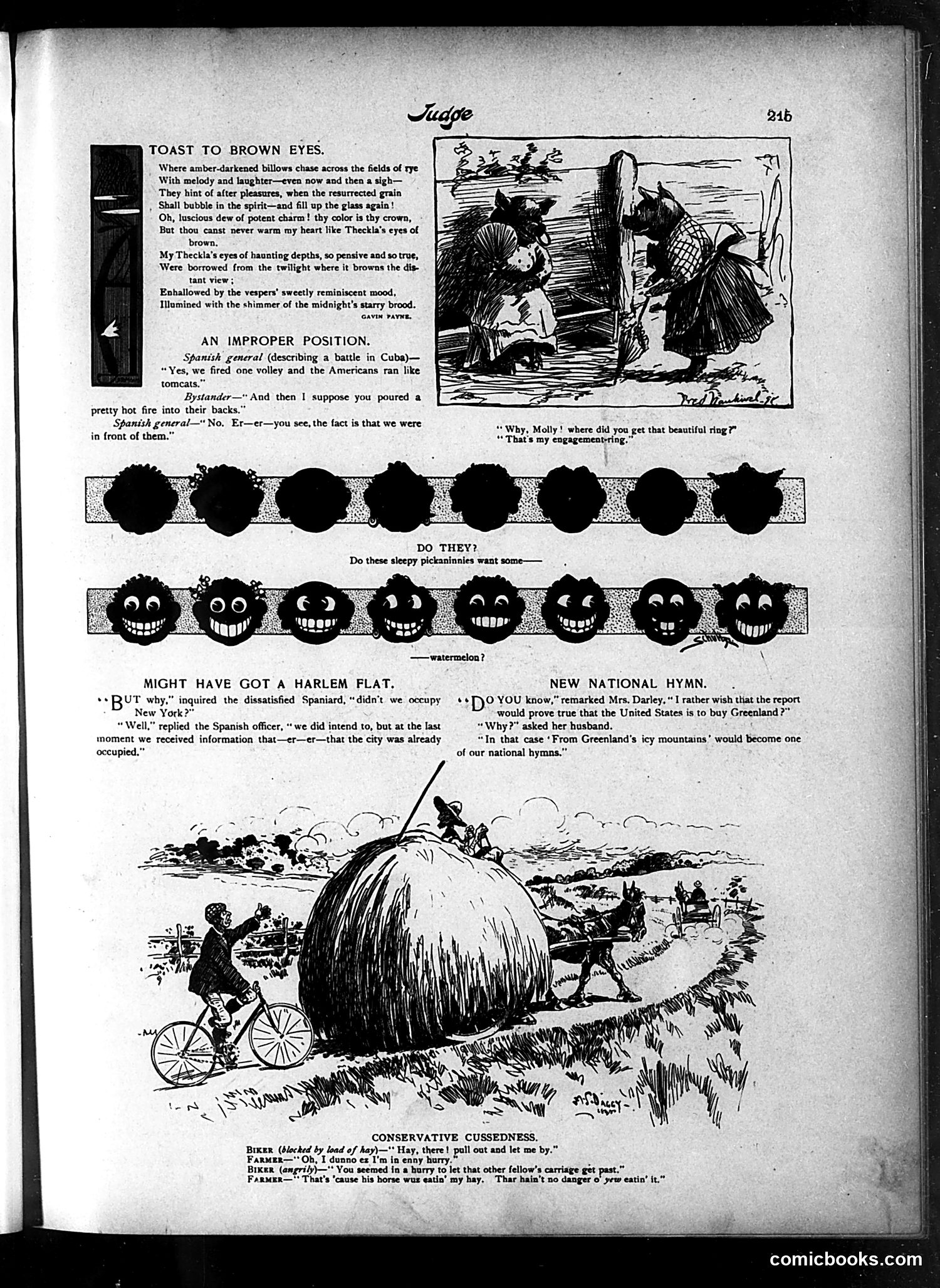
This page contains satirical commentary on the Spanish-American War (likely 1898). The "Improper Position" cartoon mocks Spanish military incompetence in Cuba—a Spanish general admits they couldn't occupy New York because it was "already occupied," and describes firing one volley before the Americans "ran like tomcats," when actually the Spanish were positioned in front of the Americans. The "Might Have Got a Harlem Flat" section continues this mockery, with a Spanish officer providing absurd excuses for military failures. "New National Hymn" jokes about potential U.S. territorial expansion to Greenland, punning on the hymn "From Greenland's Icy Mountains." The racist cartoon "Do They?" and other content reflects the period's casual ethnic stereotyping. "Conservative Cussedness" presents rural humor about a farmer's stubborn hypocrisy regarding blocking a road. The page primarily satirizes American military superiority over Spain and contemporary expansionist politics.
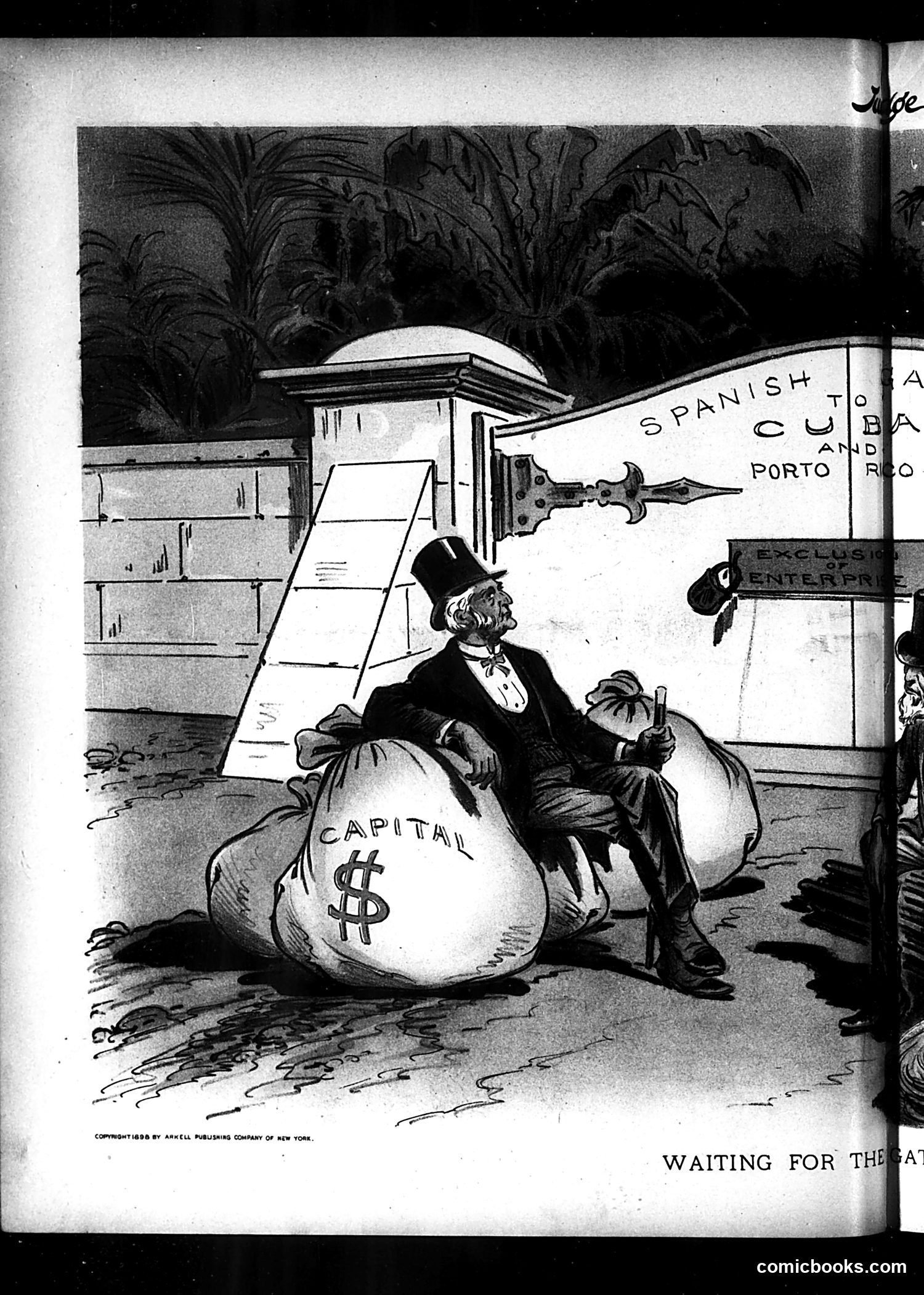
This Judge magazine cartoon satirizes American business interests waiting at a Spanish/Cuban port (visible signage shows "Spanish," "Cuba," "Porto Rico," "Enterprise"). A well-dressed capitalist sits atop a large moneybag marked "CAPITAL," smoking a cigar while waiting at what appears to be a colonial enterprise. The cartoon likely critiques American capitalist expansion into Spanish colonies during the late 1890s—presumably referencing the Spanish-American War period (1898) and U.S. imperial ambitions in Cuba and Puerto Rico. The joke's title "Waiting for the Fat" suggests capitalists eagerly anticipating profitable colonial ventures. The cartoon mocks how American business interests were poised to exploit newly-acquired or soon-to-be-acquired territories, treating colonialism as a commercial opportunity rather than a political/moral issue.
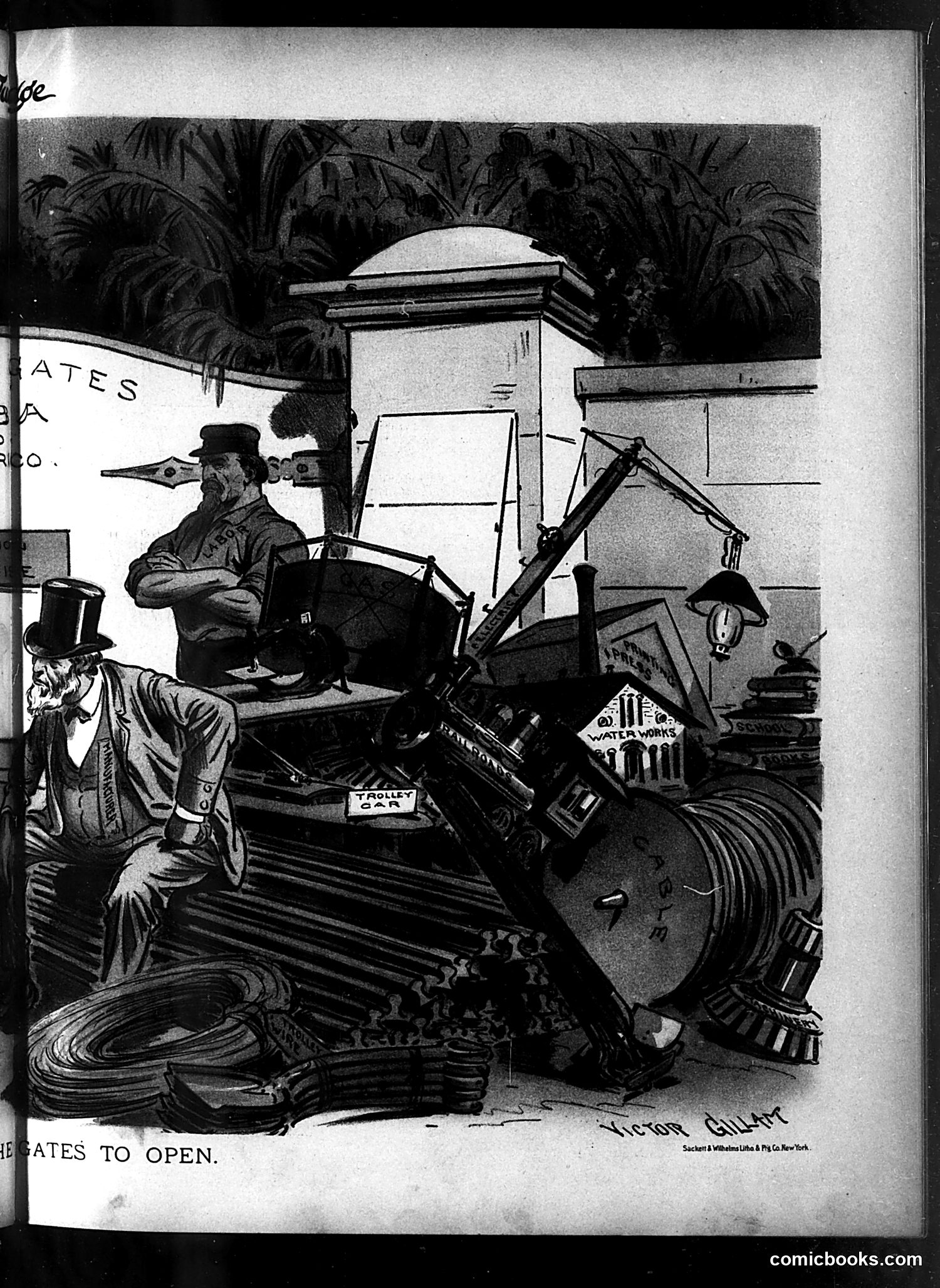
This satirical cartoon by Victor Gillam depicts industrial machinery and workers at what appears to be a water works or factory facility. The title "GATES TO OPEN" suggests commentary on opening infrastructure or access. The cartoon shows a well-dressed gentleman (left) observing workers operating large mechanical equipment labeled "TROLLEY CAR" and industrial apparatus. The tropical plants and architectural elements suggest a public utility or municipal project. The satire likely critiques either: the expansion of trolley car systems, municipal corruption in infrastructure projects, or labor conditions in industrial settings—common Judge magazine targets during the early 20th century. Without a specific date visible, the exact political reference remains unclear, though the imagery suggests commentary on urban modernization and industrial development.
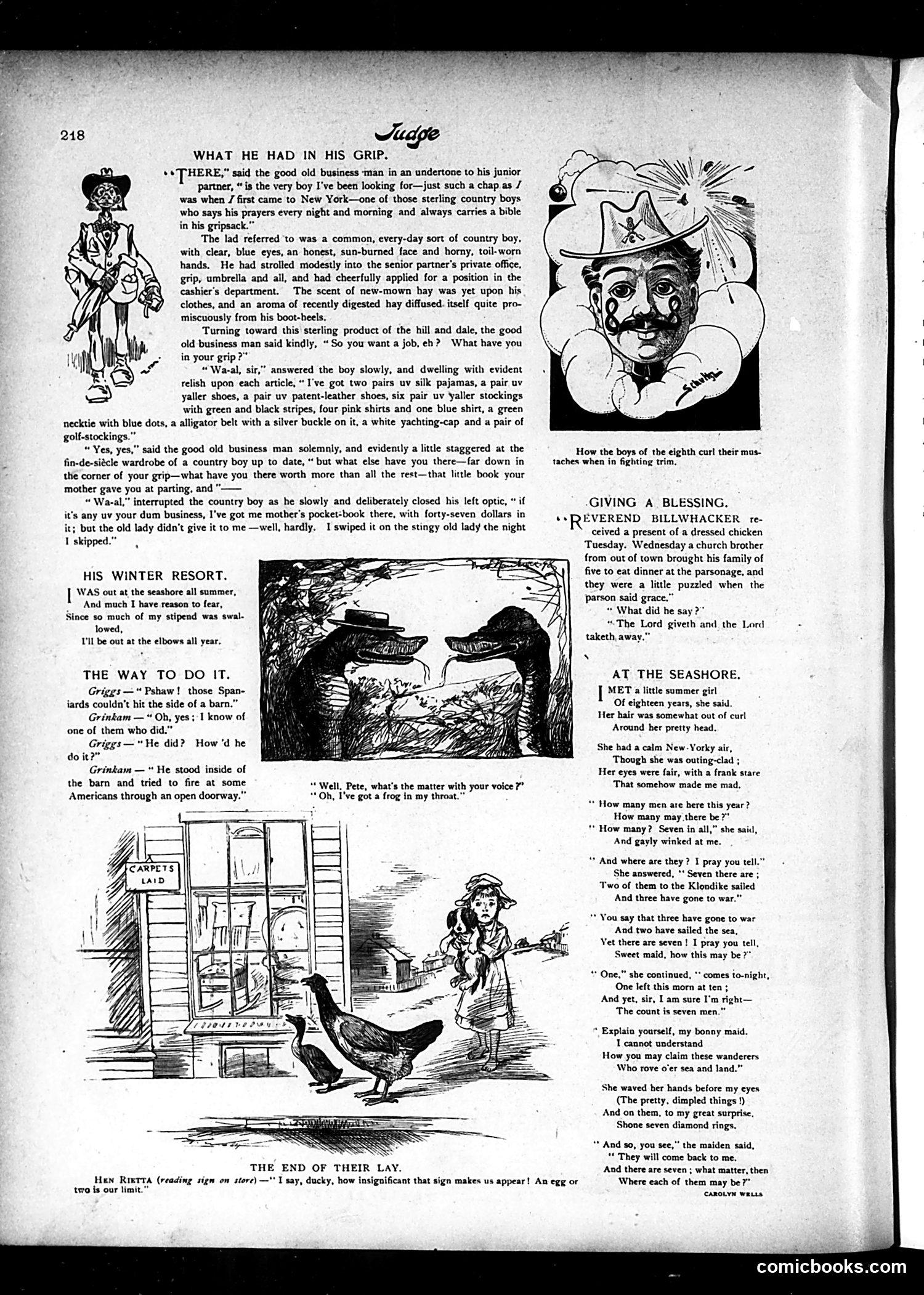
This page contains multiple satirical pieces typical of late 19th-century American humor: **"What He Had in His Grip"** mocks the contrast between rural innocence and urban sophistication. A country boy applying for a job lists expensive, fashionable clothing (silk pajamas, patent-leather shoes, yachting caps) rather than the Bible the senior businessman expects—then reveals he stole his mother's pocketbook to fund this wardrobe. The satire targets both the hypocrisy of businessmen who sentimentalize rural virtue while exploiting rural workers, and the corrupting influence of city materialism on honest country folk. **"The Way to Do It"** is a brief joke about American military incompetence during the Spanish-American War (appears to reference 1898), suggesting American soldiers couldn't hit Spanish soldiers unless they were already inside a barn. Other shorter pieces include jokes about fashionable grooming, coastal romance, and domestic situations. The overall tone reflects Judge's satirical approach to American social pretension and cultural anxieties of the era.
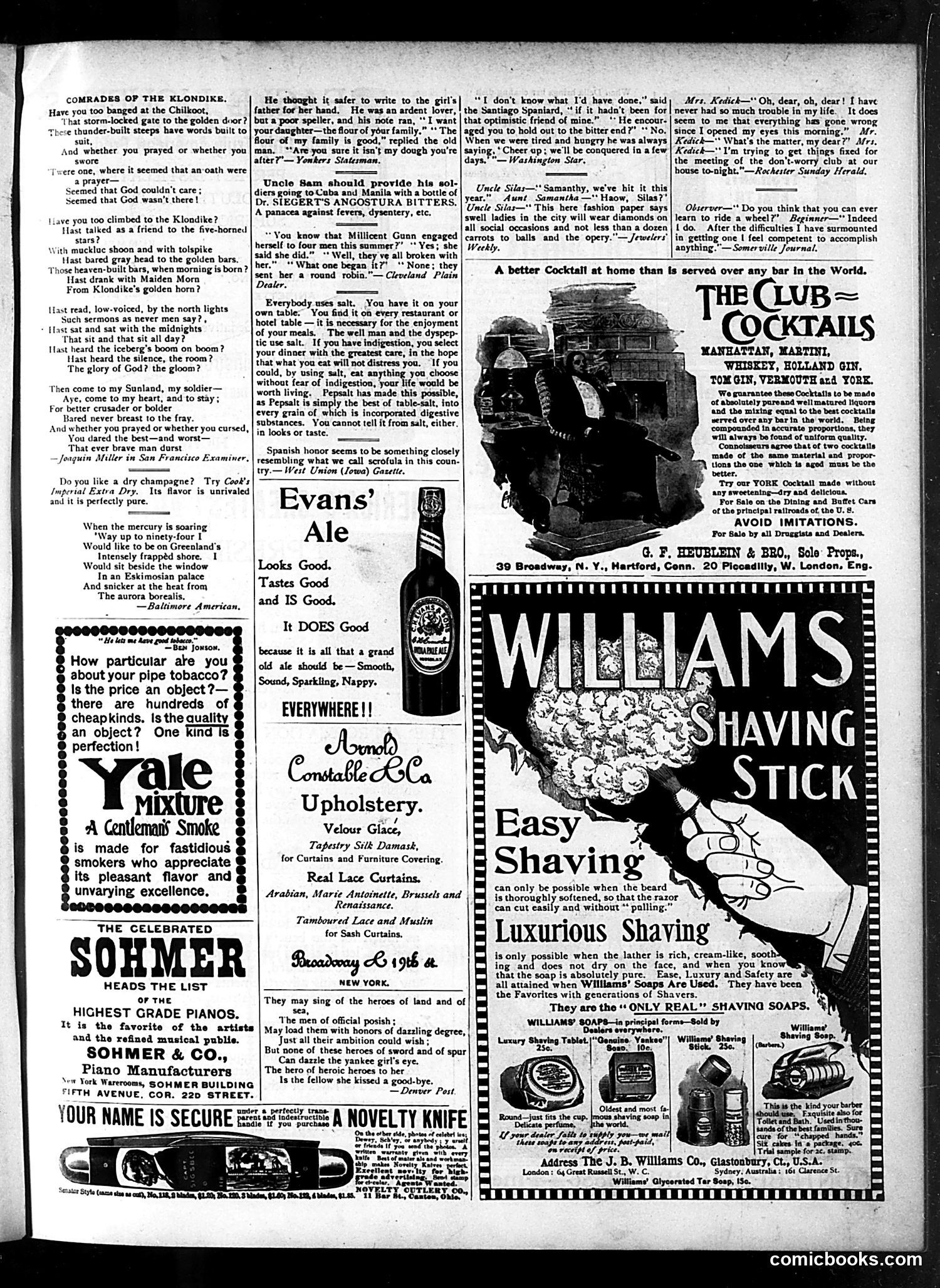
This page is primarily **advertising and light humor**, not political satire. The main content includes: **Poetry Section**: Joaquin Miller's verses celebrating Klondike Gold Rush prospectors—romantic odes to hardy miners who endured brutal conditions seeking fortune in Canada's frozen north (circa 1890s). **Humor Pieces**: Brief jokes, including one about a poor speller proposing marriage (confusing "flour" with "dough"), Spanish honor compared unfavorably to disease, and a woman engaged to multiple suitors. **Advertisements**: Multiple full-page ads for products like Evans' Ale, Williams Shaving Stick, Yale pipe tobacco, Sohmer pianos, and digestive salt (Pepsalt). **No identifiable political cartoons** appear on this page. The content reflects turn-of-the-century American consumer culture and celebrates frontier adventure mythology, but contains no apparent satire of political figures or contemporary events. The page functions as a typical mixed-content magazine issue balancing editorial material with revenue-generating advertisements.
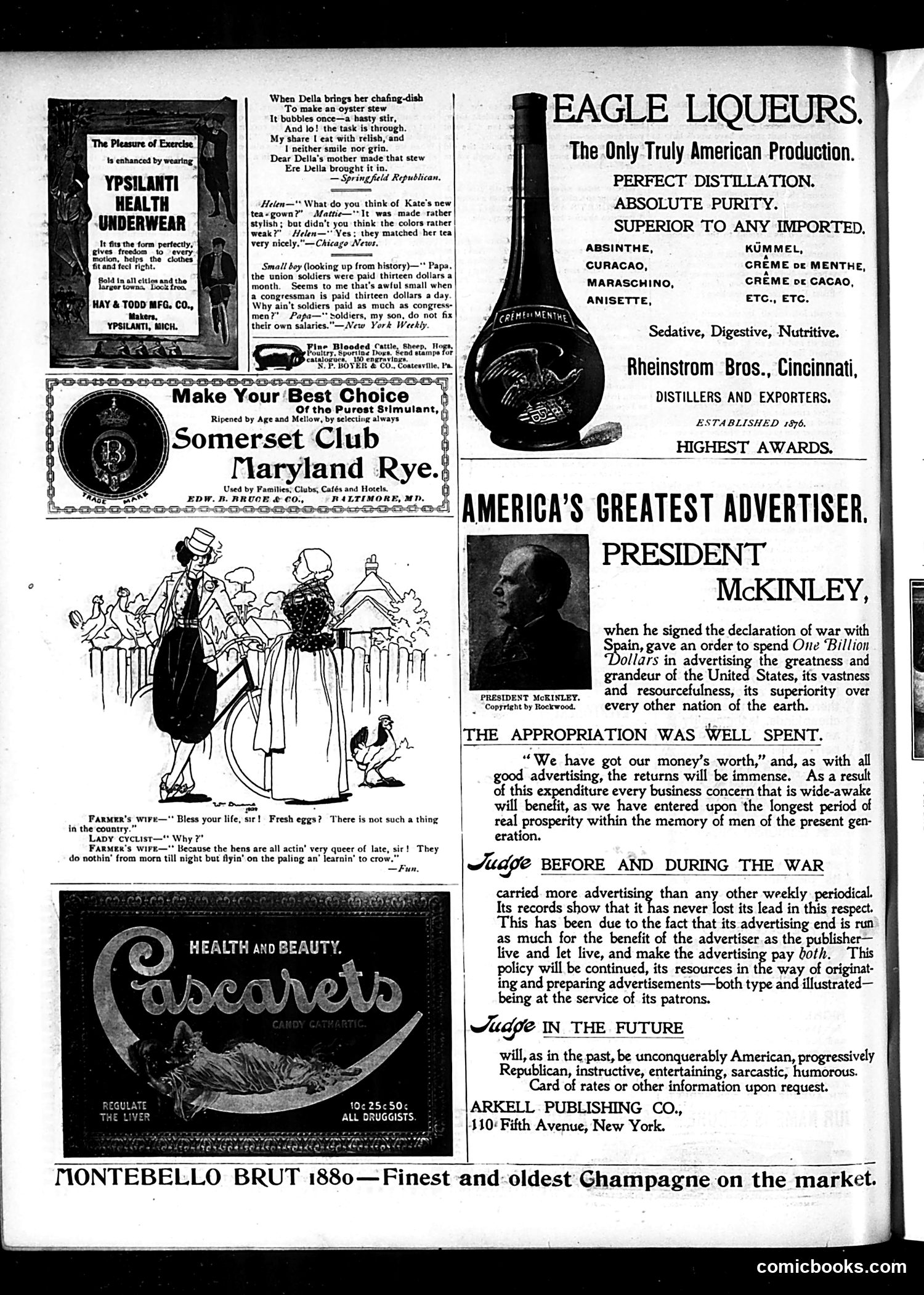
This page comprises mostly **advertisements and brief humorous verses** rather than political cartoons. The primary content includes: **Political Reference**: A large advertisement praising **President McKinley**, referencing his declaration of war with Spain (the Spanish-American War of 1898). The ad claims McKinley ordered **one billion dollars spent on advertising** American greatness, framing commercial advertising as patriotic propaganda benefiting all businesses. **Humorous Verses**: Several short, domestic jokes—a wife's mediocre oyster stew, a boy questioning soldier pay versus congressional salaries, and a farmer's wife noting hens acting oddly (presumably distracted by the new women's cycling craze). **Commercial Ads**: The remainder advertises underwear, liqueurs, champagne, and patent medicines—typical Judge content. The McKinley reference appears **celebratory rather than satirical**, positioning the magazine itself as a patriotic advertiser during wartime. The page reflects Judge's dual purpose: satire mixed with commercial promotion.
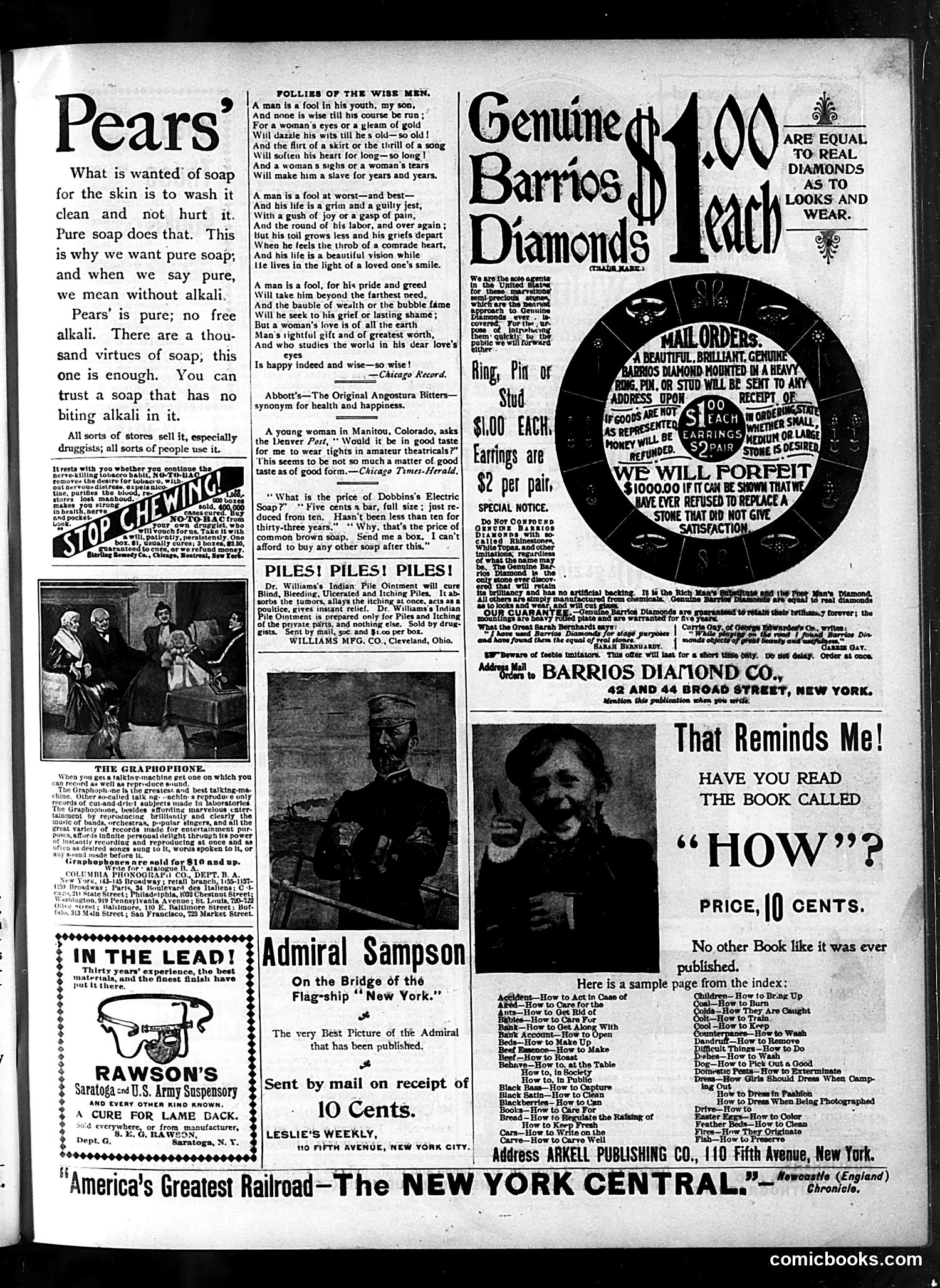
This is primarily a **commercial advertising page** rather than a satirical cartoon section. The content consists almost entirely of product advertisements from the late 1800s or early 1900s. The notable editorial content includes: **"Follies of the Wise Men"** — a sentimental poem about male foolishness, claiming men are naturally foolish in youth but redeemed through women's love and companionship. This reflects Victorian-era gender stereotypes about women as moral/emotional anchors. **Admiral Sampson portrait** — advertises a mail-order photograph of Admiral William Sampson, likely connected to the Spanish-American War (1898), capitalizing on contemporary military celebrity. The remainder consists of advertisements for: Pears' soap, medical treatments (piles ointment, suspensory devices), phonographs, Barrios Diamonds, and a how-to book. These ads reveal period consumer culture and medical quackery accepted at the time. The page demonstrates how Judge magazine subsidized satirical content through advertising revenue, not through genuine satirical commentary on this particular page.
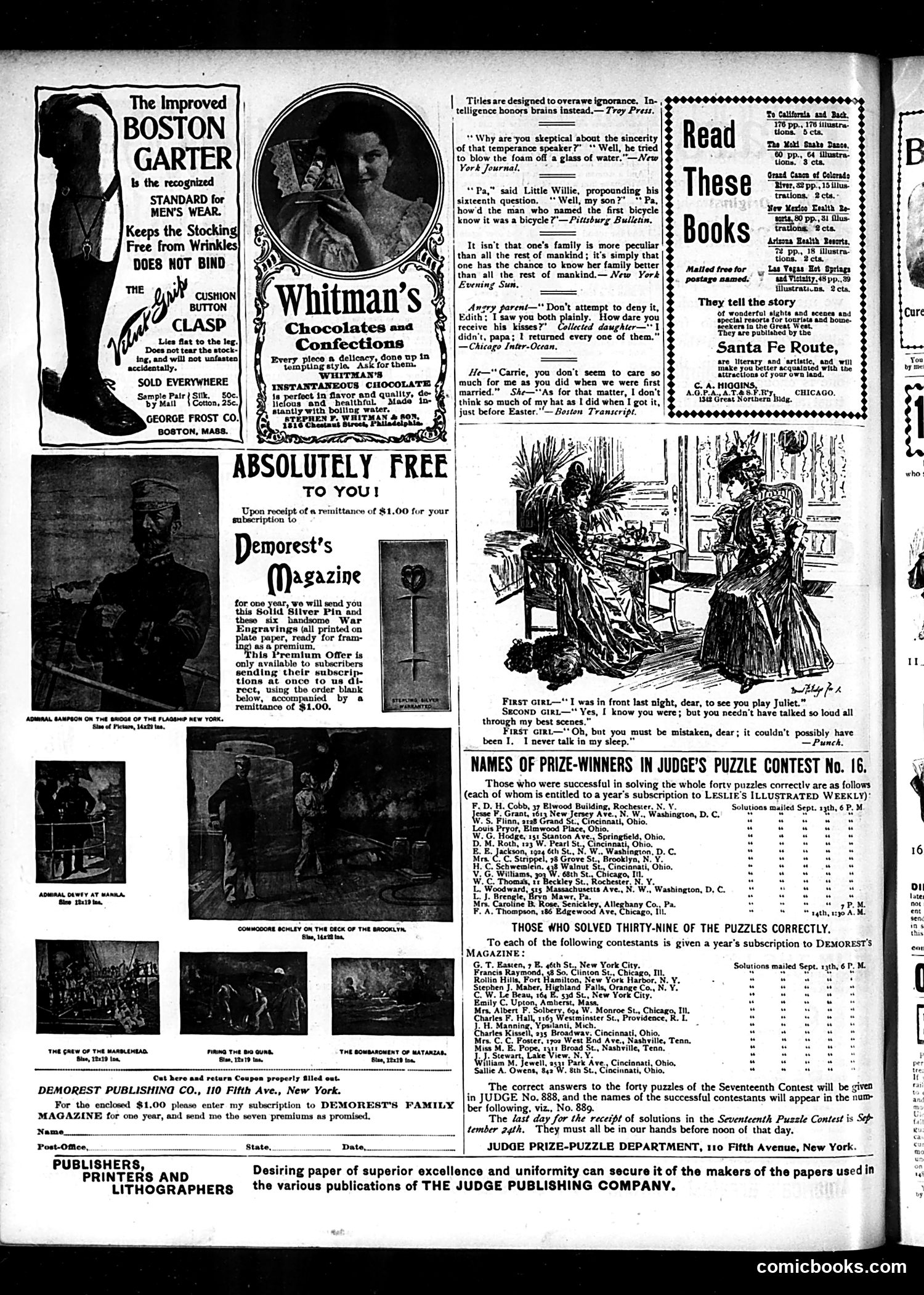
This page is primarily **advertising and promotional content** with some light humor pieces. The main items are: **Advertisements dominate**: Boston Garter hosiery, Whitman's chocolates, and Demorest's Magazine offer free premiums (engravings and a solid silver pin) with magazine subscriptions. These are standard period trade ads. **Historical illustrations** show Civil War naval scenes: Commodore Bemley on the USS Brooklyn and bombardment of Matamzas, Cuba—likely referencing the Spanish-American War era. **Humor section** contains brief jokes about: - A fraudulent temperance speaker blowing foam off water (satirizing hypocrisy) - A child's naive question about bicycles - Married couples' declining affection - A young woman denying she accepted kisses (wordplay about "receiving" them back) **Tourism promotions** advertise Santa Fe Route railroad destinations in the American Southwest. **Puzzle contest results** list prize winners from Judge's puzzle competition. The page reflects **early 1900s American consumer culture**, with advertising integrated throughout a family-oriented magazine mixing commerce, light satire, and entertainment.
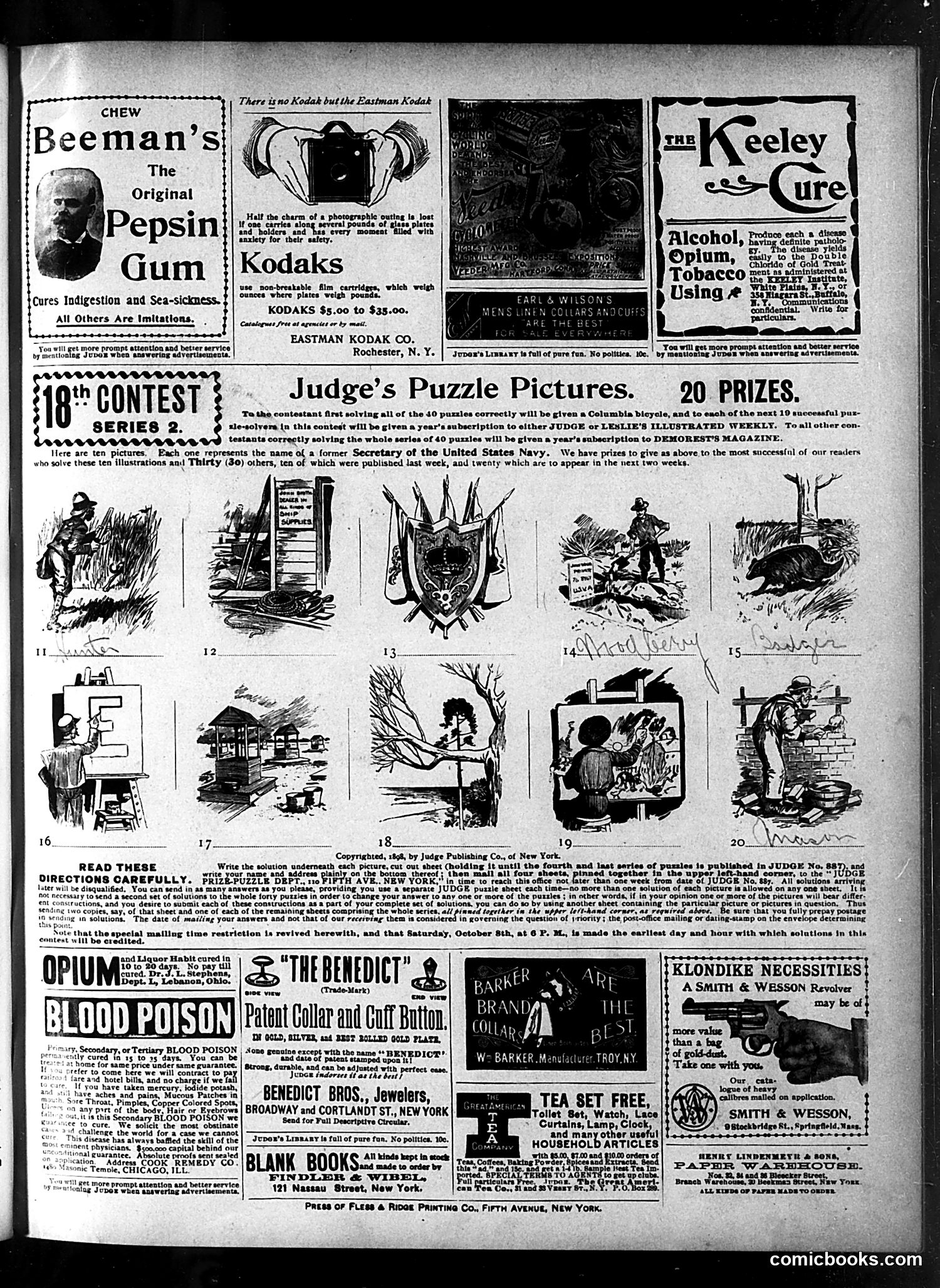
This page is primarily **advertising and contest material** rather than political satire. The dominant feature is Judge's "Puzzle Pictures" contest—a rebus puzzle competition where readers solve ten illustrations, each representing the name of a former U.S. Navy Secretary. Winners receive prizes including a Columbia bicycle and magazine subscriptions. The page is otherwise filled with period advertisements for consumer goods: Beeman's Pepsin Gum (claiming to cure indigestion), Eastman Kodak cameras, and various patent medicines including "The Benedict" (for treating blood poison/syphilis) and an "Opium" cure. The only satirical element appears minimal on this particular page. The advertisements themselves reflect the era's common marketing of dubious medical remedies—particularly evident in the venereal disease treatments—which modern readers would recognize as quackery, though contemporary audiences may have taken them seriously. This is a typical early-1900s magazine page mixing entertainment, commerce, and pseudo-medical promotion.
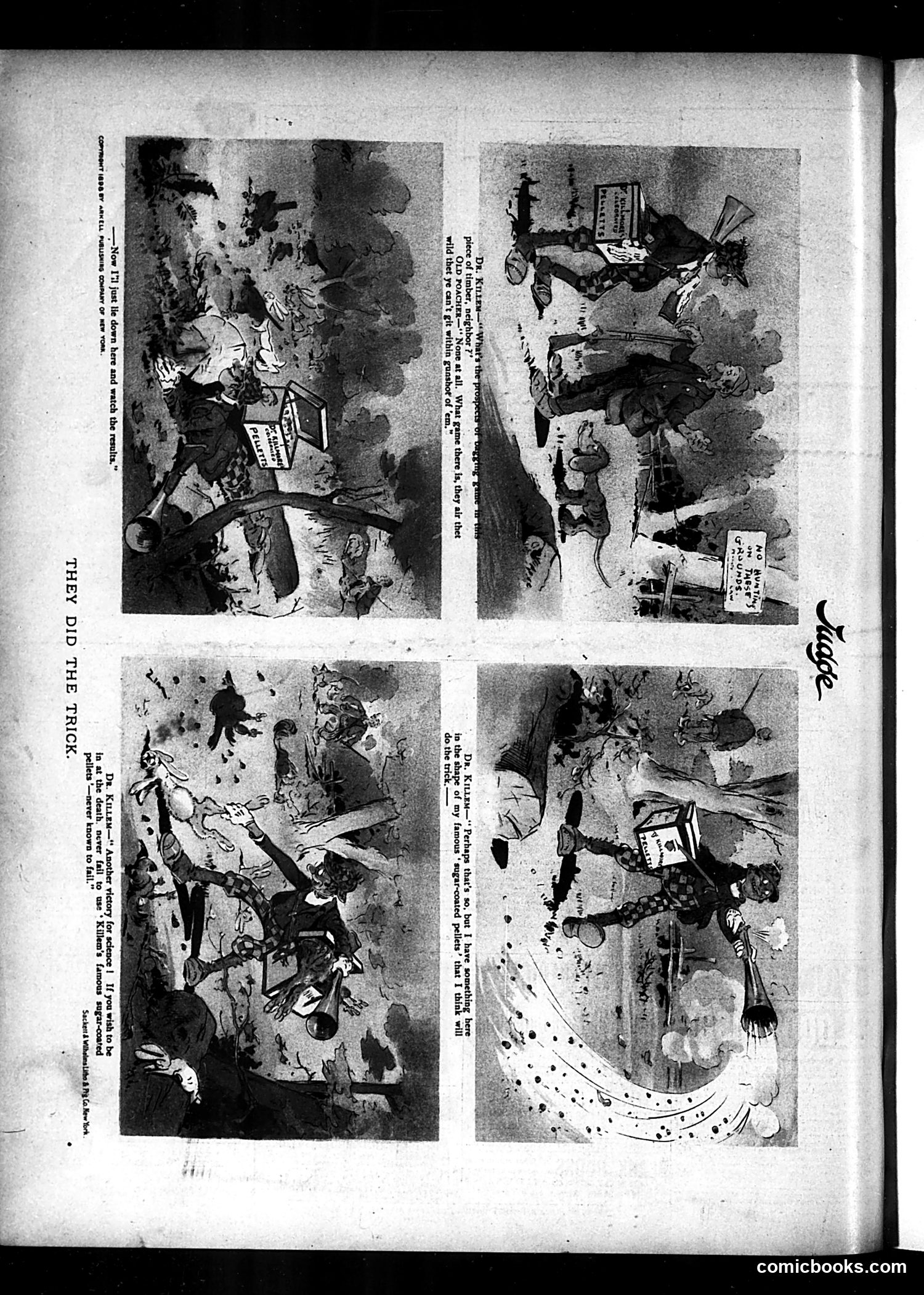
This appears to be a four-panel advertisement-style cartoon satirizing patent medicine marketing practices, circa 1898. The narrative features "Dr. Killem" (a play on words suggesting lethal effectiveness) promoting his "sugar-coated pellets" as a cure-all remedy. The satire mocks: 1. **False medical claims**: The doctor's grandiose promises that his product will solve any problem 2. **Deceptive marketing**: The "sugar-coated" language—literally and figuratively—disguising questionable treatments 3. **Patent medicine fraud**: A widespread 1890s problem where unregulated tonics and pills were sold with exaggerated testimonials 4. **Scientific pretense**: The doctor invokes "science" to legitimize dubious products The joke appears to involve an "Old Poacher" character and game, though the exact narrative is unclear from the fragmented OCR text. The repeated emphasis on the pellets "never known to fail" underscores Judge's skepticism toward contemporary medical charlatanry.