
A complete issue · 16 pages · 1898
Judge — June 4, 1898
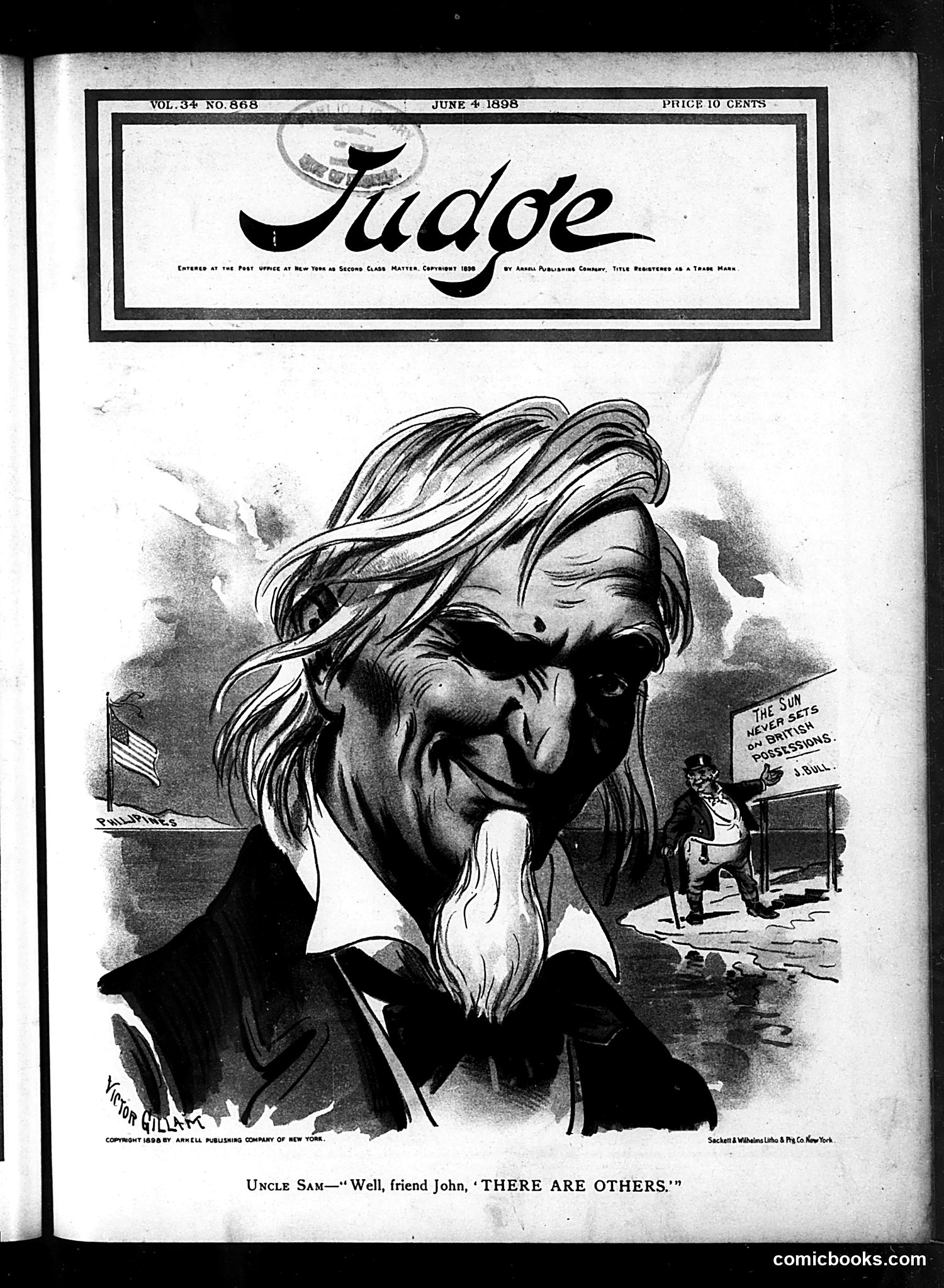
This is a caricature of Uncle Sam with an exaggerated long beard and stern expression. The caption reads: "Well, friend John, 'THERE ARE OTHERS.'" The small figure in the background holds a sign stating "THE SUN NEVER SETS ON BRITISH POSSESSIONS" — referencing Britain's extensive colonial empire. **The satire's meaning:** This appears to reference American imperial ambitions during the Spanish-American War (1898). Uncle Sam's comment "there are others" suggests America is joining Britain as a colonial power with far-flung possessions. The artist (Krank Gillam) is likely satirizing American expansion, contrasting Uncle Sam's previous isolationism with America's new imperial pretensions to rival Britain's global dominance.
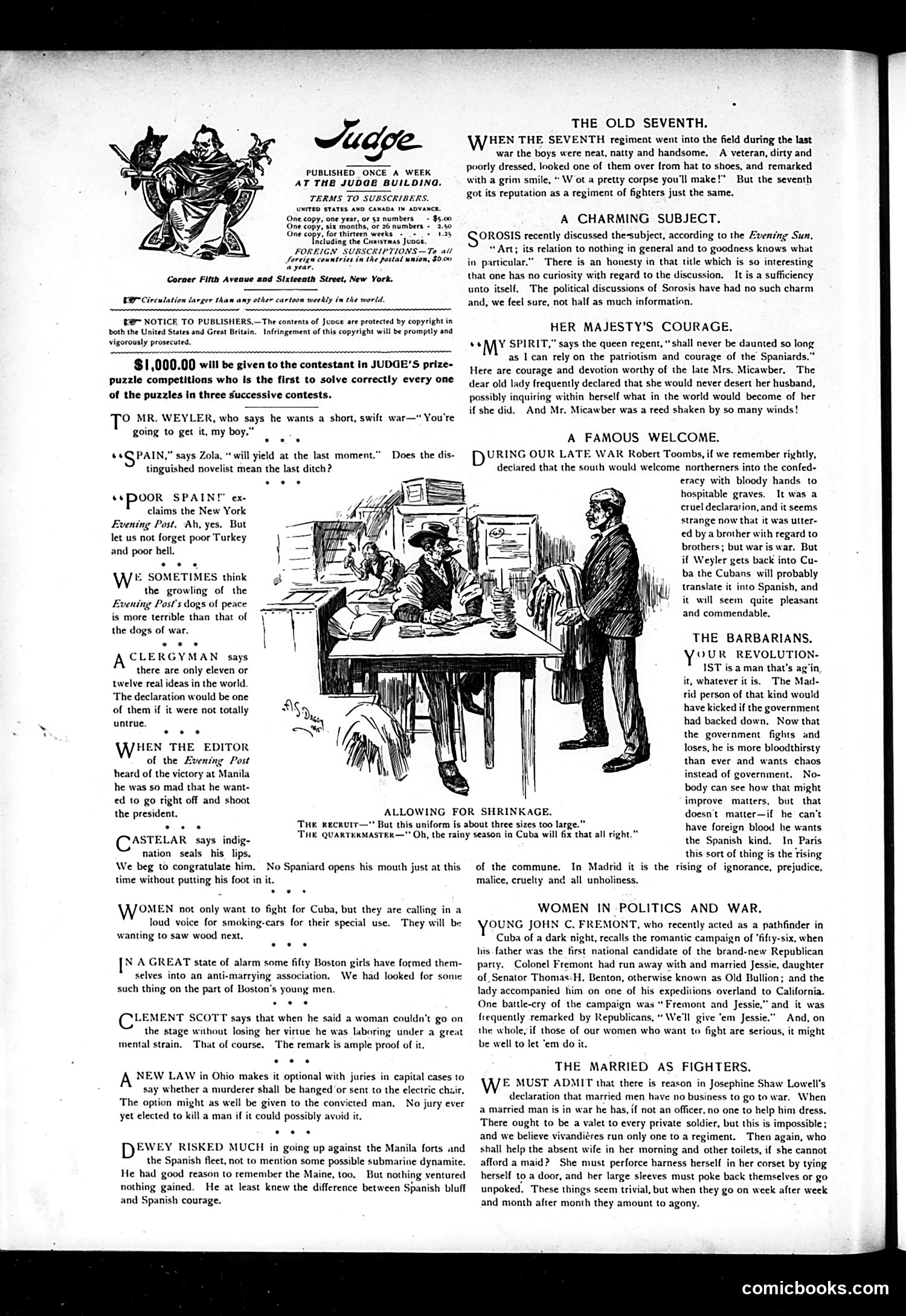
The central cartoon depicts a military recruitment scene titled "WILLING FOR SHIRKAGE." A uniformed recruiter sits at a desk interviewing a civilian, with the caption suggesting the recruit claims his uniform is "about three sizes too large" and asking if he can get "something that will fit all right." The satire mocks draft shirkers—men avoiding military service by claiming physical unfitness. The "shirkage" joke suggests these men willingly participated in deception to escape conscription. The surrounding text discusses women's roles in wartime, including women advocating for smoking cars and political participation. This appears to be from America's involvement in the Spanish-American War era (late 1890s), when debates raged about gender roles and military service obligations.
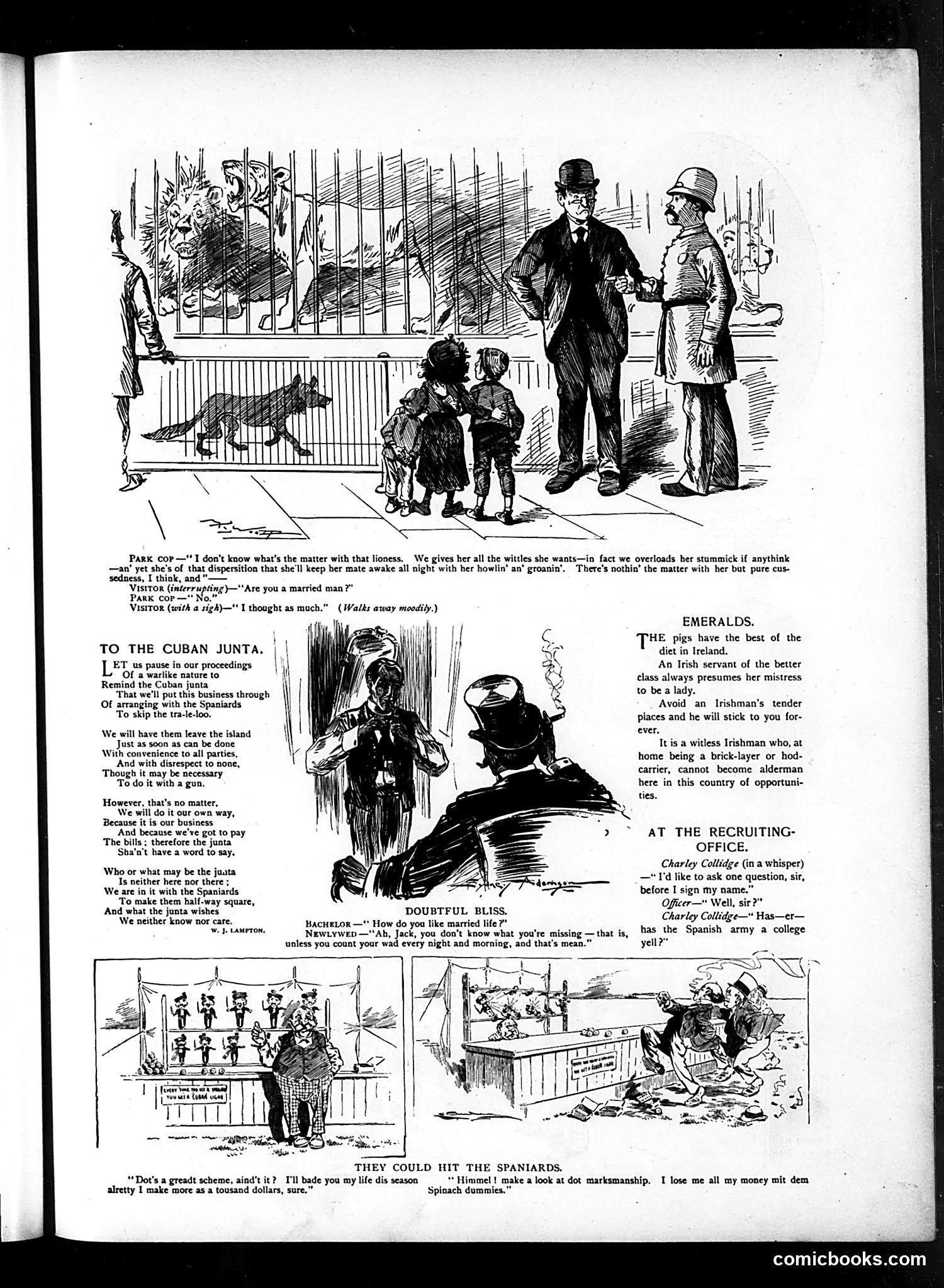
This page satirizes late 19th-century attitudes toward Ireland and Irish immigrants. **Top cartoon**: A zoo-like scene mocking Irish people visiting a zoo with lions. The joke plays on ethnic stereotypes about Irish appearance and behavior, with the visitor treating the Irish family as spectacle-worthy as the animals. **"To the Cuban Junta"**: A poem addressing Cuban independence fighters, expressing American sympathy for their anti-Spanish struggle while noting financial constraints ("the bills; therefore the junta / Sha't have a word to say"). **"Emeralds" section**: Satirical "advice" columns reinforcing Irish servant stereotypes, depicting Irish workers as unsuitable for advancement. **Lower cartoons**: Mock recruitment office dialogue and a scene titled "They Could Hit the Spaniards"—likely commentary on Irish-American soldiers' military prospects during the Spanish-American War period. The satire reflects pervasive anti-Irish prejudice common in American media of this era.
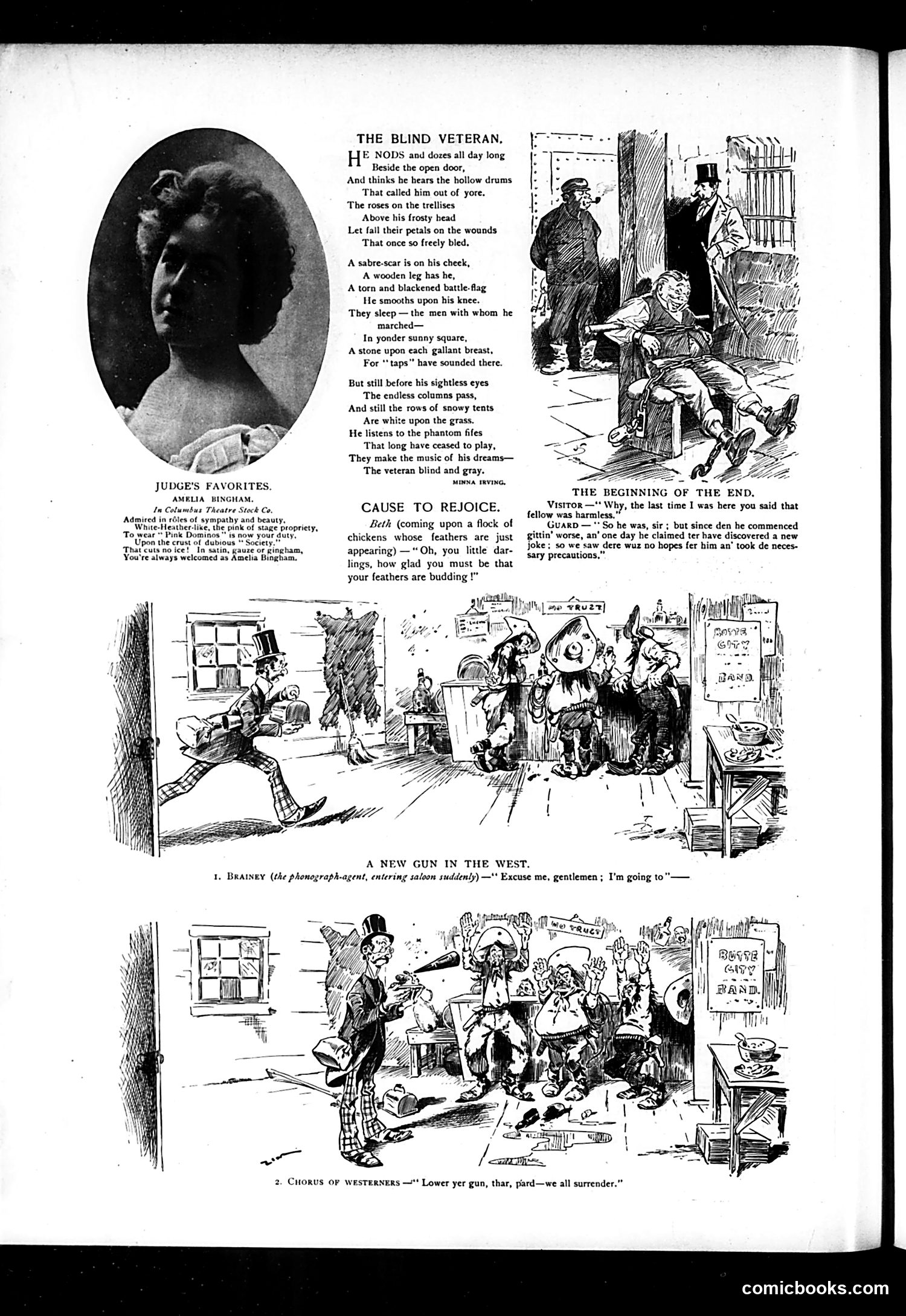
This page contains three distinct items: 1. **"The Blind Veteran"** - A sentimental poem by Minna Irving about a disabled war veteran, accompanied by a sympathetic photograph. It critiques society's neglect of injured soldiers. 2. **"Cause to Rejoice"** - A brief humorous piece about a man celebrating his chickens' molting feathers, joking that at least something is "budding." 3. **"A New Gun in the West"** - A two-panel Western cartoon where a photograph-agent named Brainey enters a saloon claiming he's "going to—" (suggesting violence), but is interrupted by the patrons who surrender preemptively, apparently mistaking him for an actual gunslinger rather than a mere photographer. The humor relies on mistaken identity and the romanticized Western gunslinger trope.
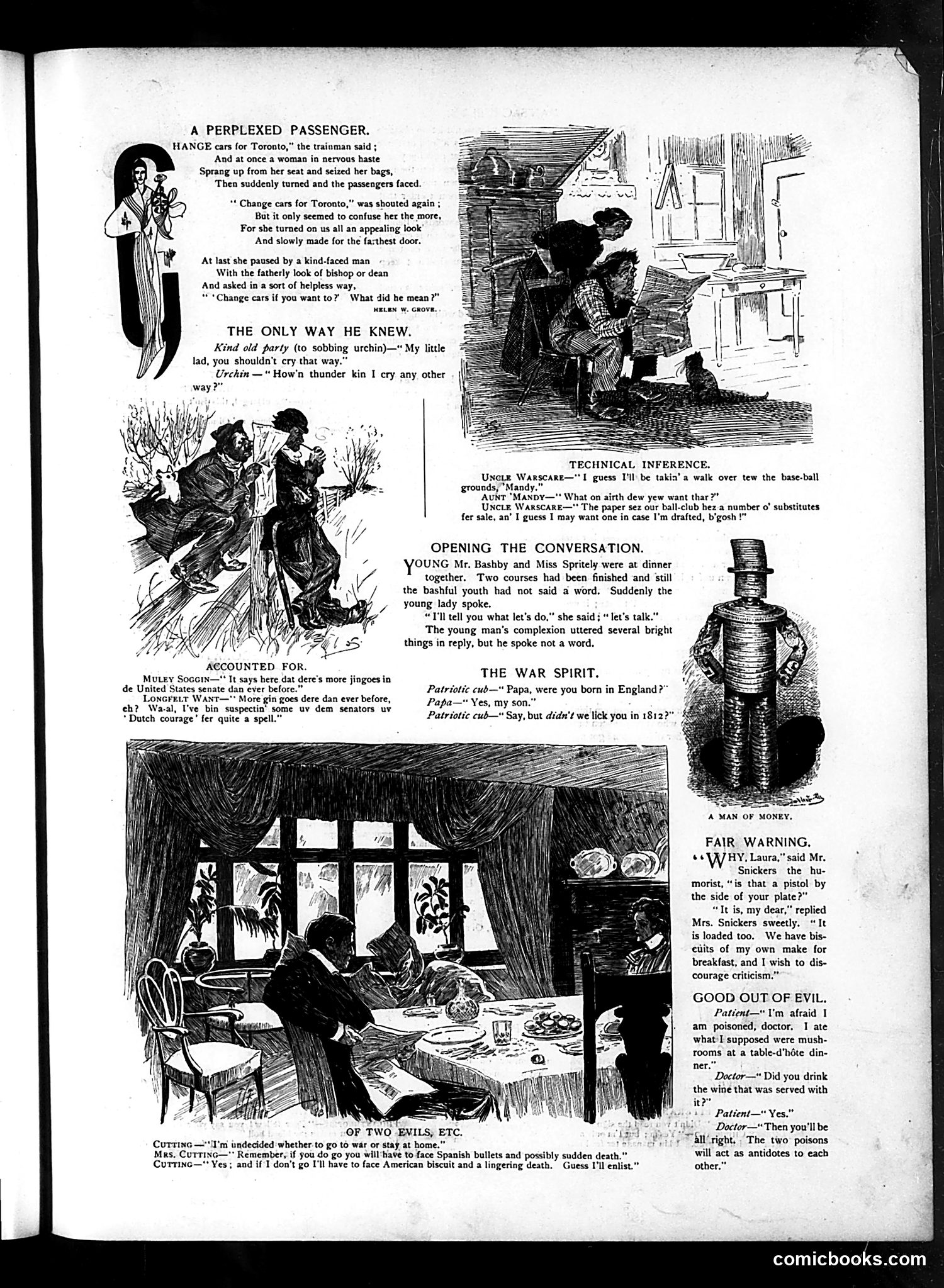
This page contains multiple short humorous sketches typical of early 20th-century American satirical humor: **"A Perplexed Passenger"** depicts a confused woman misunderstanding a train conductor's announcement to "change cars for Toronto," treating it as a command rather than information. **"The Only Way He Knew"** shows a child who cries in only one manner, illustrating absurdist humor about human limitations. **"Technical Inference"** features Uncle Warscare misreading a newspaper headline about baseball team "substitutes for sale," thinking it relates to military draft substitutes—reflecting anxiety about WWI conscription. **"The War Spirit"** satirizes patriotic fervor through a child asking his father if America defeated England in 1812, mocking jingoistic posturing. **"Of Two Evils"** presents dark humor about choosing between wartime military service (Spanish bullets) and staying home (wife's terrible biscuits), ending with resignation to enlist. The page reflects early WWI-era American concerns: military conscription, patriotic sentiment, and the domestic/military tensions of the period.
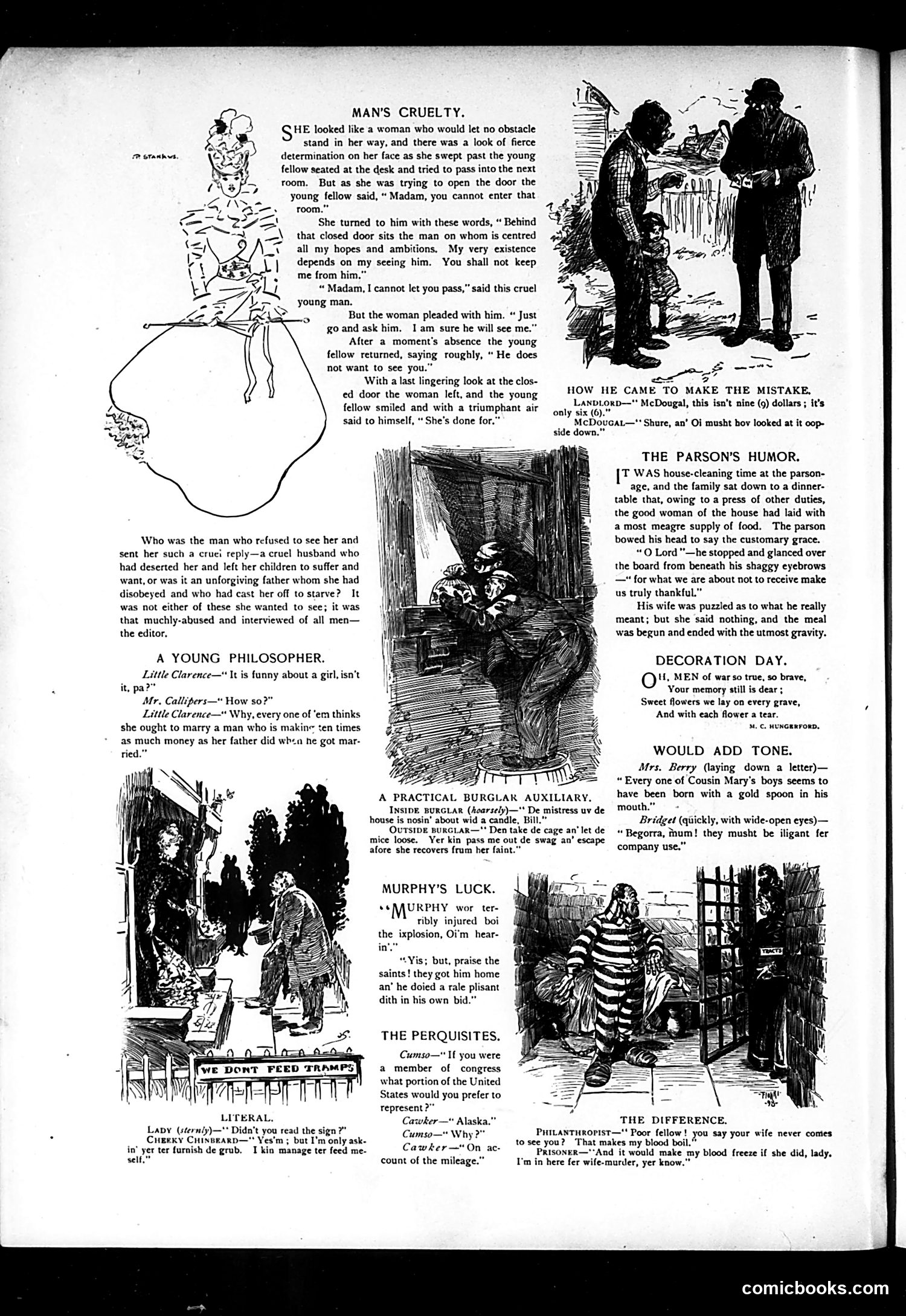
This appears to be a satirical humor page from an American magazine, circa early 1900s. The content includes several short comedic pieces: **"Man's Cruelty"** depicts a woman desperately trying to see an editor—satirizing the difficulty of gaining access to newspaper/magazine editors, who were notoriously gatekeeping figures. **"A Young Philosopher"** mocks materialistic attitudes about marriage, suggesting young women unrealistically expect to marry men earning ten times what their fathers made. **"Murphy's Luck"** uses Irish dialect humor (common in period satire) about surviving an industrial explosion. **"The Parson's Humor"** features a clergyman's dark joke about meager food at dinner, thanking God for what they're "about not to receive." Other brief items satirize congress members' greed (Alaska reference), burglary, landlord-tenant disputes, and class differences. The overall tone is cynical about American institutions—journalism, marriage economics, politics, labor, and religion—typical of Judge's satirical mission during the Gilded Age/Progressive Era.
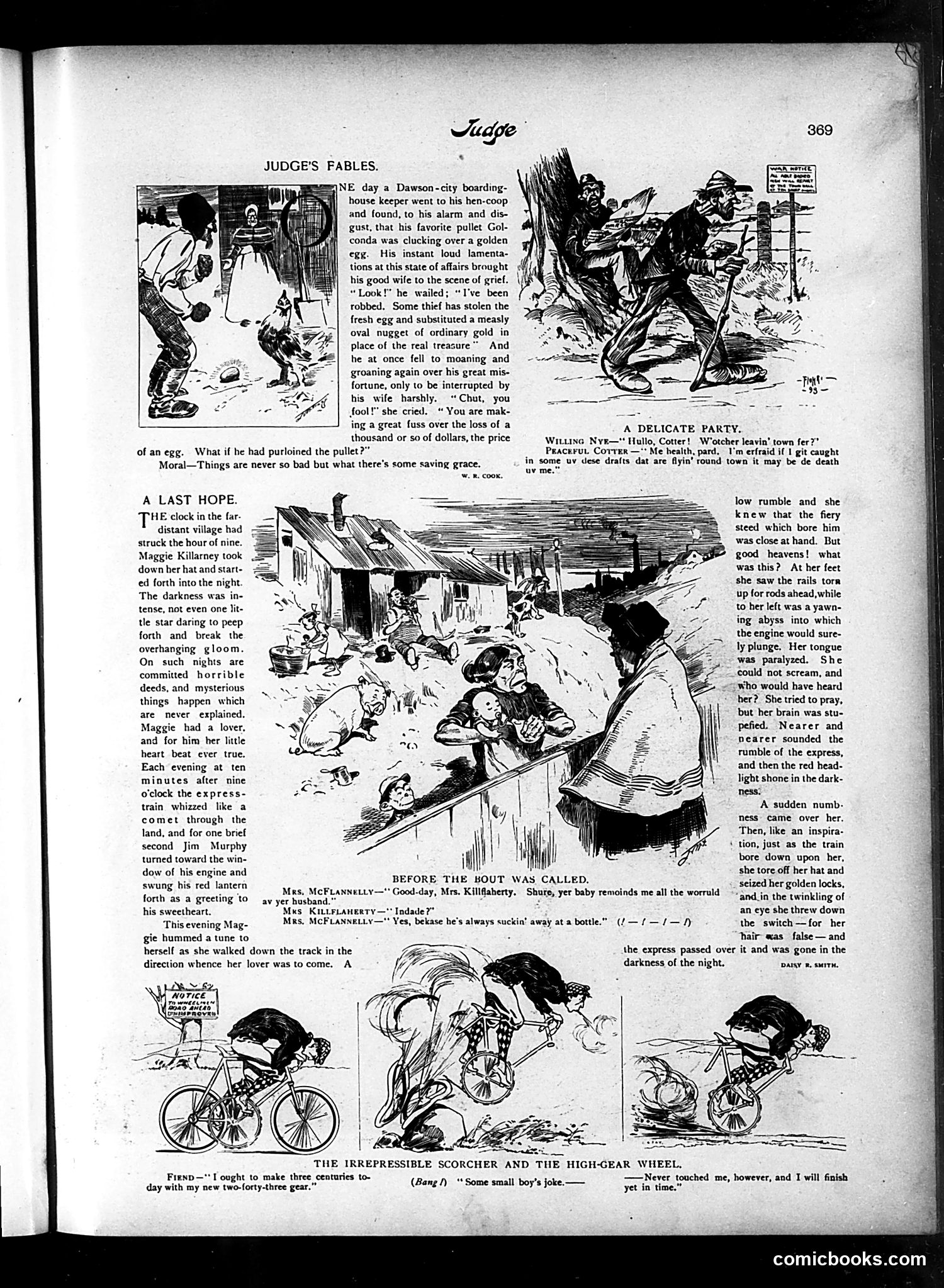
This page contains three separate satirical fables and comic strips typical of Judge magazine's format. **"The Golden Egg"** (top): A Dawson City boarding-house keeper discovers his hen laid a golden egg instead of a regular one and laments the loss of the "real treasure"—the food. His wife mocks his priorities, revealing the satire: people obsess over worthless valuables while overlooking genuine necessities. The moral emphasizes perspective. **"A Delicate Party"** (middle right): Two figures discuss leaving town to avoid contracting syphilis ("flying round town"), a contemporary health crisis. The humor targets moral hypocrisy and disease anxiety of the era. **"A Last Hope"** (bottom): A melodramatic railroad narrative where a woman uses her false hair to throw a switch, preventing a train disaster. The story parodies overwrought Victorian romance fiction while making light of women's fashionable but impractical hairpieces. **"The Irrepressible Scorcher and the High-Gear Wheel"** (bottom): Comic strips about cycling mishaps, likely satirizing the bicycle craze and amateur cyclists' incompetence. These are humorous fables with social commentary rather than political satire.
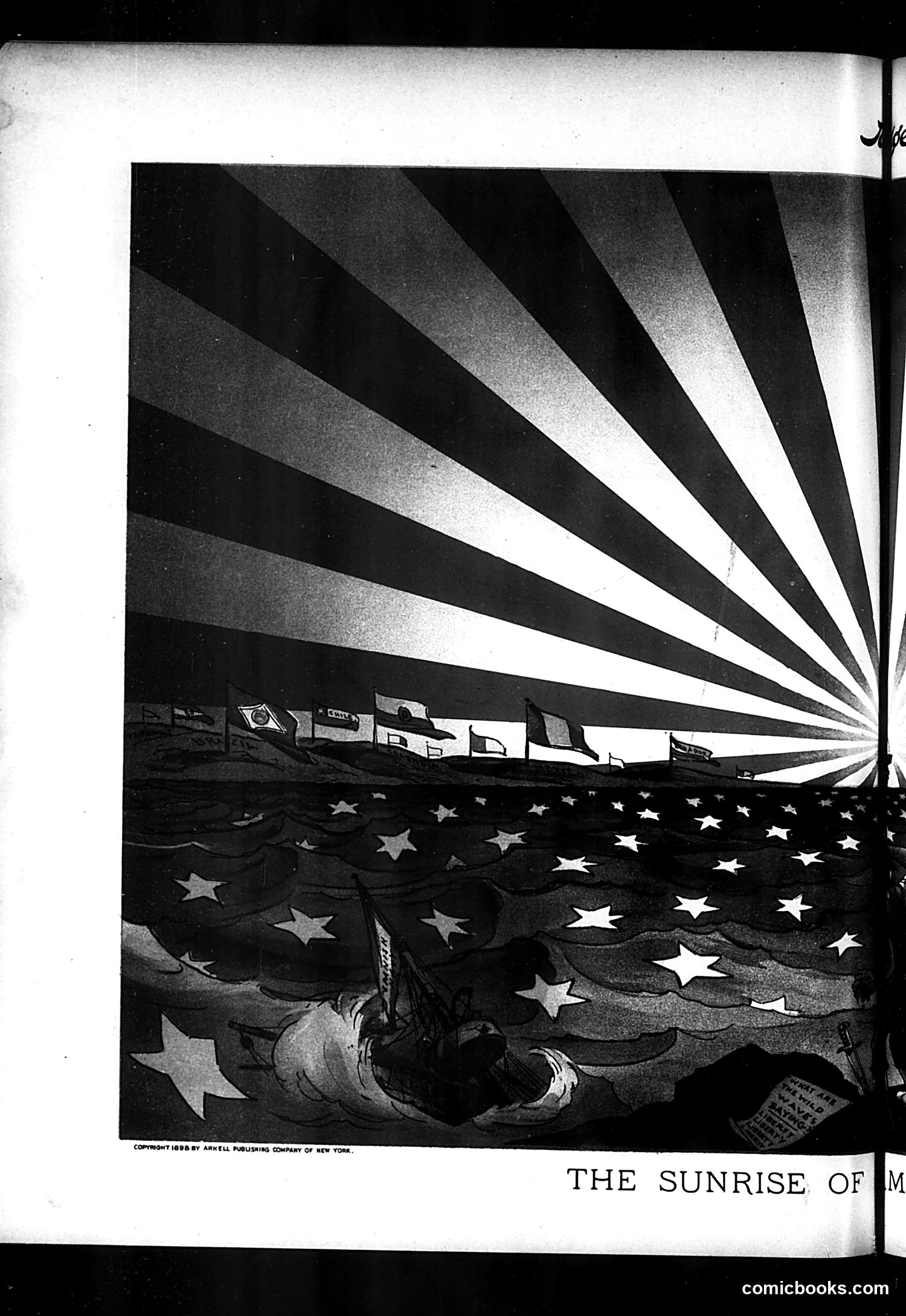
This 1898 *Judge* cartoon depicts an American flag with radiating sunburst stripes illuminating a landscape below. The image appears to be political allegory about American expansion or intervention—likely related to the Spanish-American War (1898) or American imperialism of that era. The dramatic lighting effect suggests dawn or awakening, with the flag's rays spreading outward like a rising sun. Small flags or structures visible in the middle distance possibly represent newly acquired or influenced territories. The incomplete title "The Sunrise of M[...]" suggests this celebrates American power or influence spreading to new regions (possibly the Philippines, Cuba, or other Spanish colonies acquired in 1898). The optimistic imagery frames American expansion as enlightenment or progress—a common imperialist justification of the period.
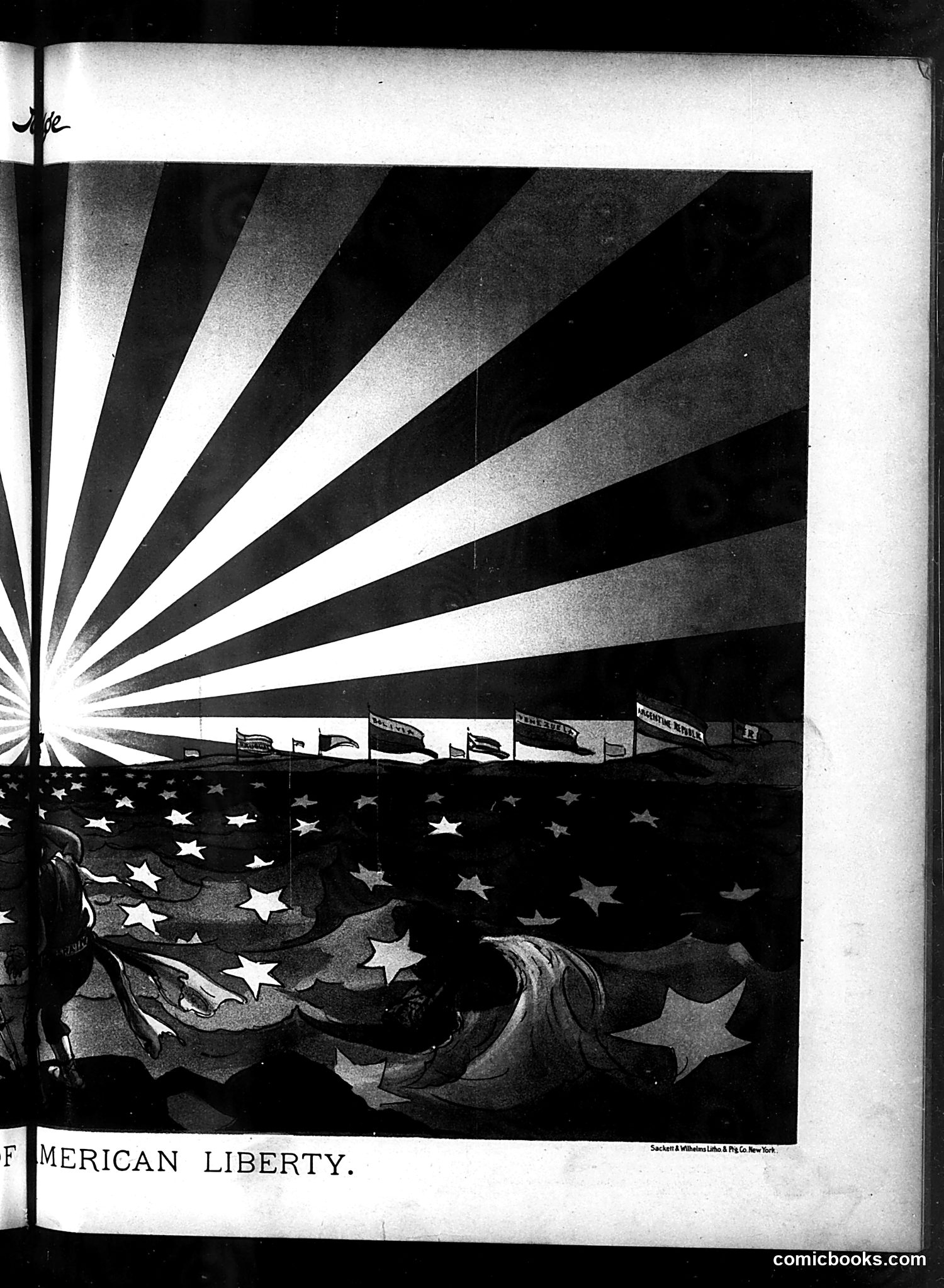
This appears to be a patriotic allegorical image from Judge magazine. The composition shows radiating light beams (suggesting divine illumination or hope) emanating from the left side, with what appears to be an American flag with stars in the lower portion. In the middle distance, small figures of what look like industrial or commercial vehicles/trucks are silhouetted against the bright rays. The overall message seems to celebrate American liberty and progress, likely through industrial or economic advancement. The dramatic lighting and symbolism suggest optimism about American achievement. Without a visible date or additional context, the specific historical moment this references remains unclear, though the style suggests early-to-mid 20th century.
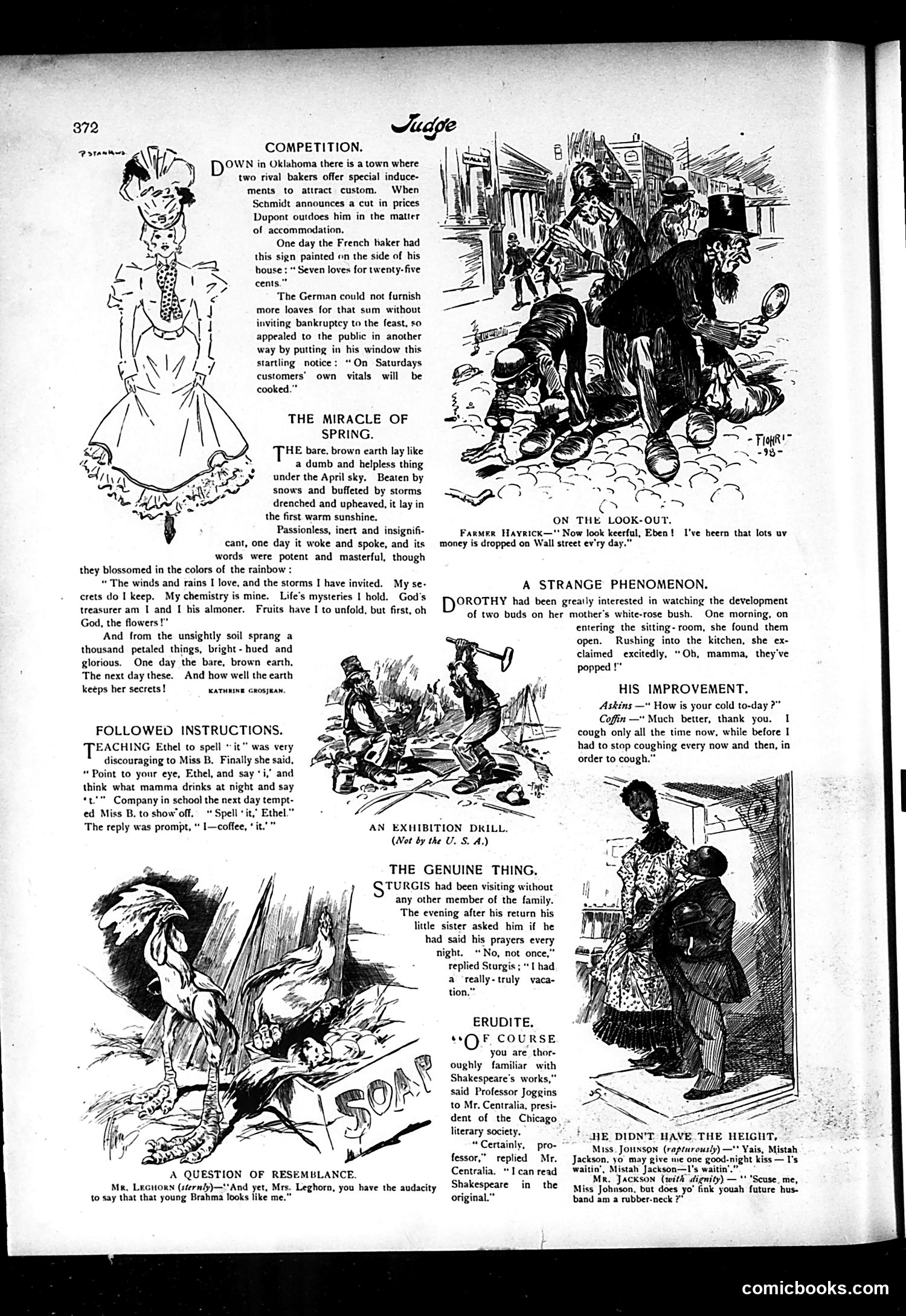
This page contains multiple brief humorous sketches typical of early 20th-century satirical magazines: **"Competition"** mocks small-town baker rivalry in Oklahoma, where a German baker's desperate advertising promise to cook customers' food on Saturdays satirizes absurd competitive desperation. **"The Miracle of Spring"** is sentimental poetry about earth's renewal, not satire. **"Followed Instructions"** jokes on a child's literal interpretation—taught to spell "it" using "i" (eye) + "t" (tea/drink), she answers "coffee," conflating her mother's nighttime beverage with the letter sound. **"A Strange Phenomenon"** is a mild joke about a child using "popped" for flowers opening. **"His Improvement"** uses ironic logic—a man claims improvement because he now coughs continuously rather than stopping to cough. **"The Genuine Thing"** presents a child's innocent honesty about skipping prayers during vacation. **"Erudite"** satirizes pretentious claims of literary knowledge. **"Me Didn't Have the Height"** appears to use racist dialect stereotyping common to the era, depicting an African American man refusing an excessive request.
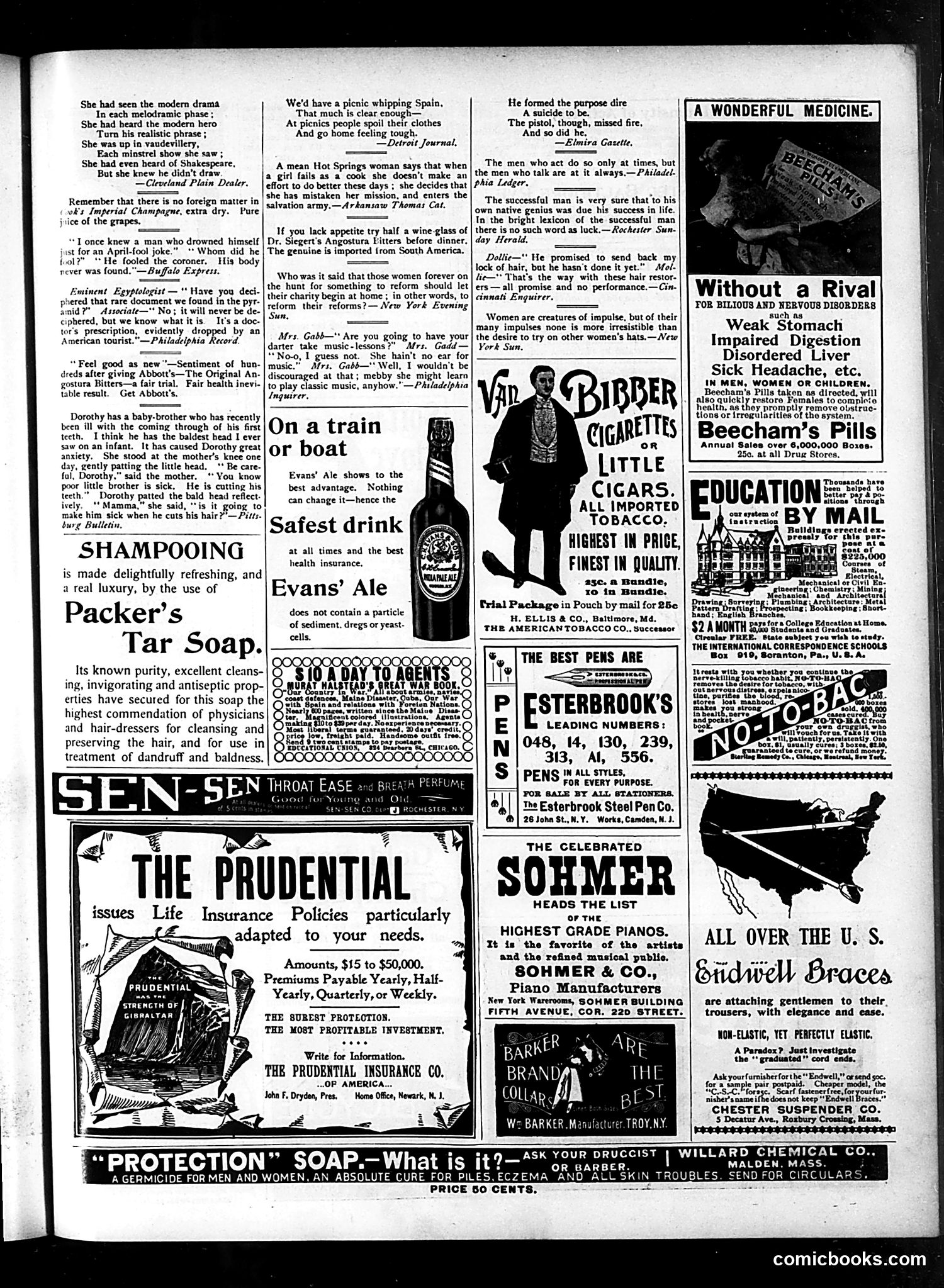
This is primarily an **advertising page** from Judge magazine with scattered satirical verses and jokes interspersed among product advertisements. The few cartoon/editorial elements present are brief satirical poems: 1. **"Modern Drama" (Cleveland Plain Dealer)**: Mocks a woman cultured in contemporary theater and vaudeville who dismisses Shakespeare—a joke about provincial taste and the era's preference for entertainment over classical literature. 2. **Spain reference (Detroit Journal)**: A pun on "picnic whipping Spain"—topical satire about American confidence in defeating Spain (likely referencing the Spanish-American War), deflated by a mundane joke about ruined clothes at actual picnics. 3. **Various one-liners**: Brief jokes about female reformers, cooking failures, and music lessons—typical period humor about gender roles. The page is dominated by patent medicine ads (Evans' Ale, Abbott's Bitters), insurance, soap, and education services—representative of Judge's revenue model. The satirical content is minimal and lighthearted rather than politically pointed.
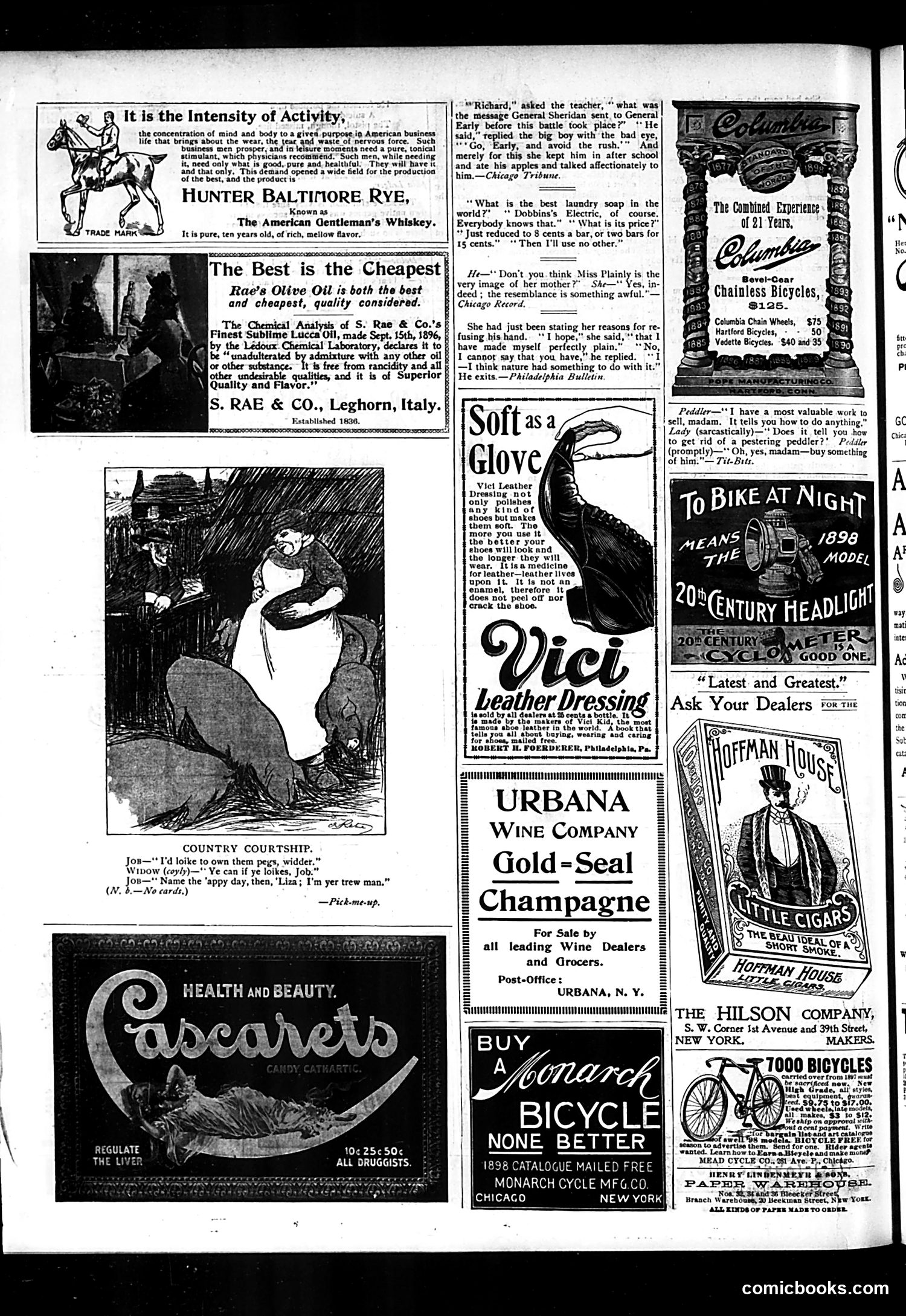
This is primarily an **advertising page** from an 1890s American satirical magazine, with minimal editorial content. The few actual jokes/cartoons include: **"Country Courtship"** — An Irish-dialect comic depicting working-class courtship, with the man proposing to the widow in exaggerated brogue ("I'd loike to own them pegs"). It's period humor playing on ethnic stereotypes common to the era. **Two brief dialogue jokes** about General Sheridan (a Civil War figure), laundry soap quality, and a young woman's plainness — typical light social humor of the 1890s. The page is otherwise dominated by **product advertisements**: Hunter Baltimore Rye whiskey, Rae's olive oil, Vici leather dressing, bicycles (Columbia, Monarch), champagne, cigars, and patent medicines like Cascarets. The whiskey ad notably appeals to "American business men" needing "tonical stimulant" — reflecting both the era's casual attitudes toward alcohol and class-conscious marketing. Overall, this represents typical Judge content: lightweight satire mixed with period advertising reflecting 1890s consumer culture.
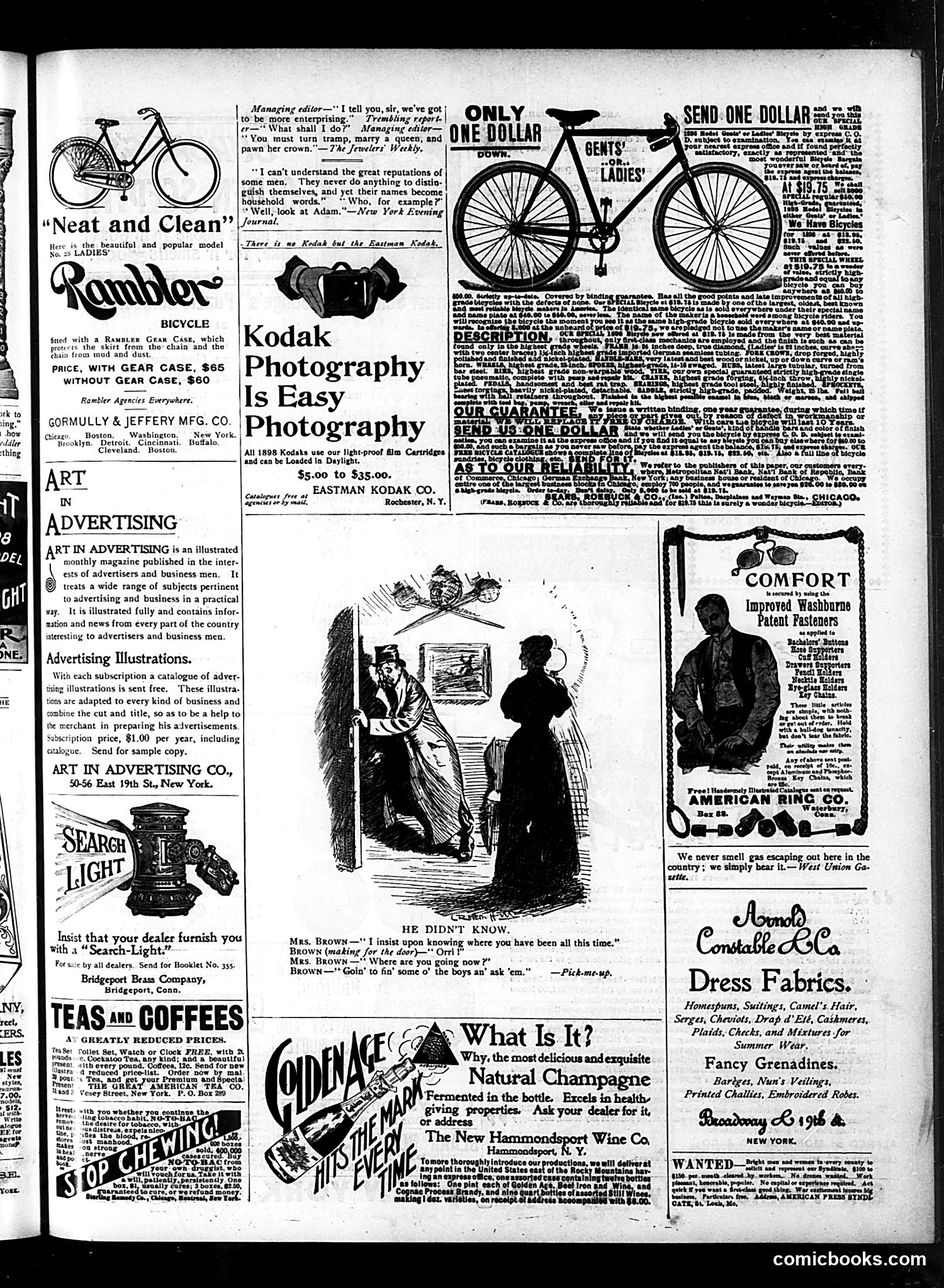
The central cartoon depicts a domestic quarrel: Mrs. Brown confronts her husband about his unexplained absence, demanding to know where he's been. Mr. Brown evasively replies "Oh!" and heads for the door, claiming he's going to "find some of the boys an' ask 'em." The joke relies on marital tension humor common to the era—a husband caught out by his wife, unable (or unwilling) to account for his whereabouts, and retreating into evasion rather than honesty. The title "HE DIDN'T KNOW" suggests either that he didn't know he was supposed to report his movements, or that he genuinely didn't anticipate his wife's confrontation. The cartoon satirizes typical gender dynamics of the period: the dutiful wife monitoring her husband's activities versus the husband's desire for independence and male companionship. The humor assumes readers would recognize this as a recognizable domestic scenario, with sympathies likely divided depending on the reader's perspective on marriage and accountability.
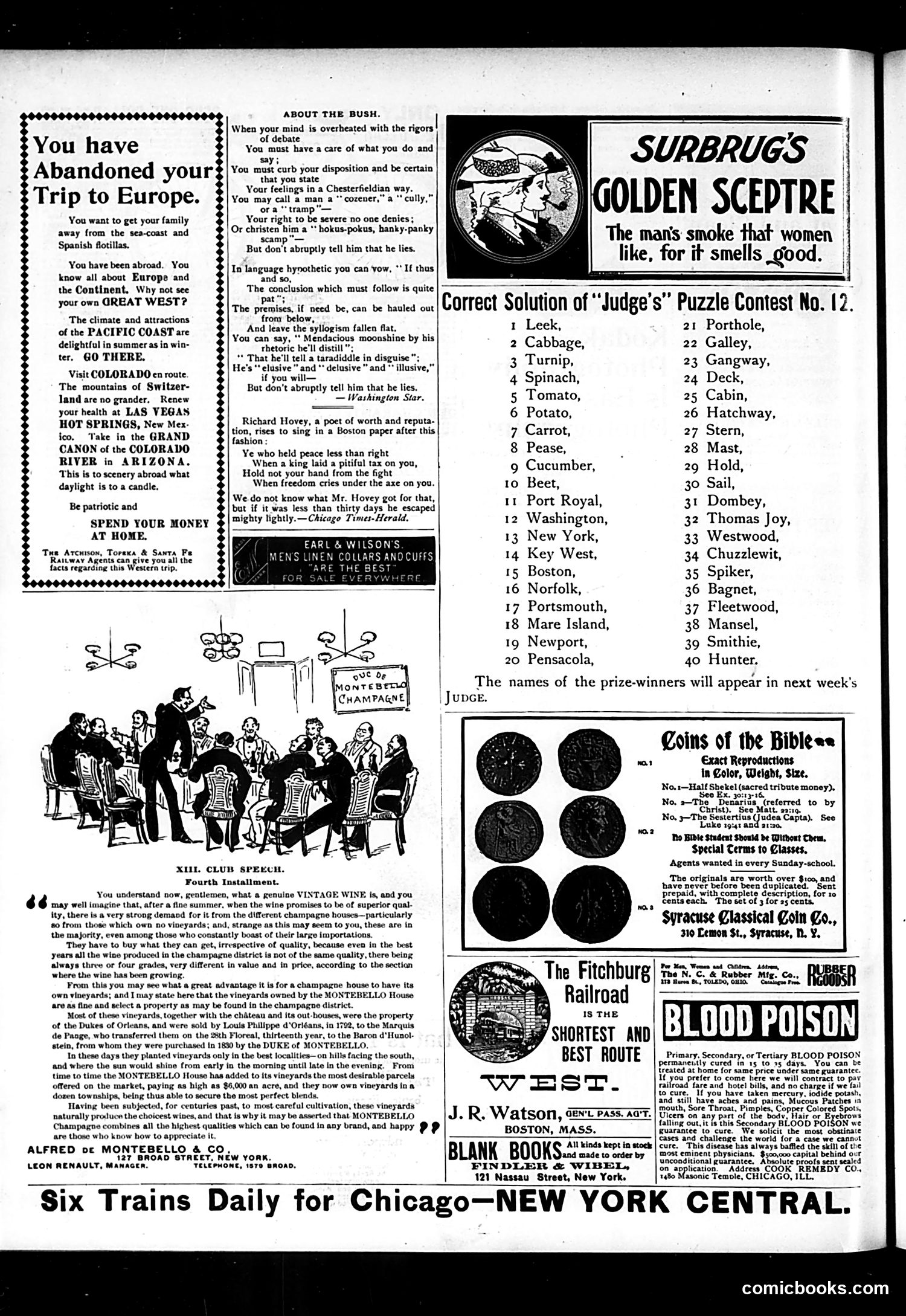
This page contains a moralistic essay titled "About the Bush," which advises readers on proper decorum during heated debates. The piece warns against losing one's temper, using vulgar language ("coroner," "cally," "tramp"), or being unnecessarily harsh to opponents—advocating instead for "Chesterfieldian" restraint (genteel behavior). It references Richard Hovey, a real poet who apparently wrote a patriotic piece about resisting tyranny in a Boston newspaper. The satire targets Americans who've abandoned travel to Europe, encouraging them instead to visit Colorado and the Pacific Coast as patriotic alternatives. A secondary joke mocks those who boast about imported champagne while lacking actual vineyards. The page is primarily **advertisements and puzzles**—including Surbrugh's Golden Sceptre cigars, railroad services, and a "Coins of the Bible" collectible series. The "Judge's" puzzle contest solutions are also featured.
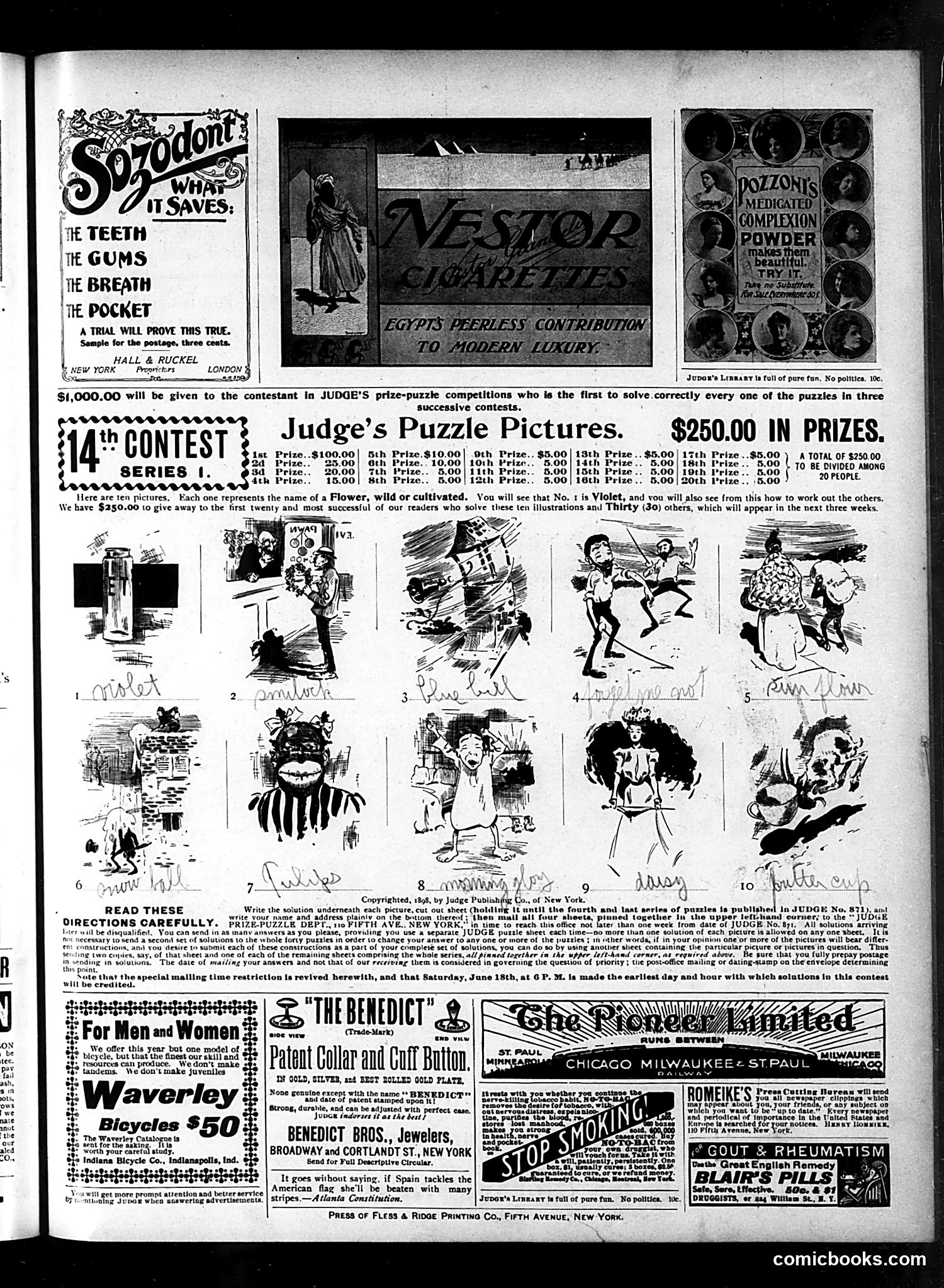
This page is primarily a **puzzle contest advertisement** rather than political satire. The central feature is Judge's "Puzzle Pictures" competition offering $250 in prizes to readers who identify ten flowers represented by abstract illustrations (numbered 1-10), with thirty more puzzles to follow in subsequent weeks. The contest rules are complex: contestants must solve all illustrations across four magazine issues, mail solutions pinned together by the deadline (June 18th), and can submit multiple entries. The page also contains **product advertisements** typical of 1890s magazines: Sozodont toothpaste (claiming to save teeth, gums, breath, and wallet), Waverley bicycles, Benedict patent collar and cuff buttons, and various patent medicines. The cartoon illustrations themselves appear to be visual puns or abstract representations meant as flower-naming puzzles rather than carrying political commentary. The overall page functions as entertainment and advertising rather than satirical journalism.
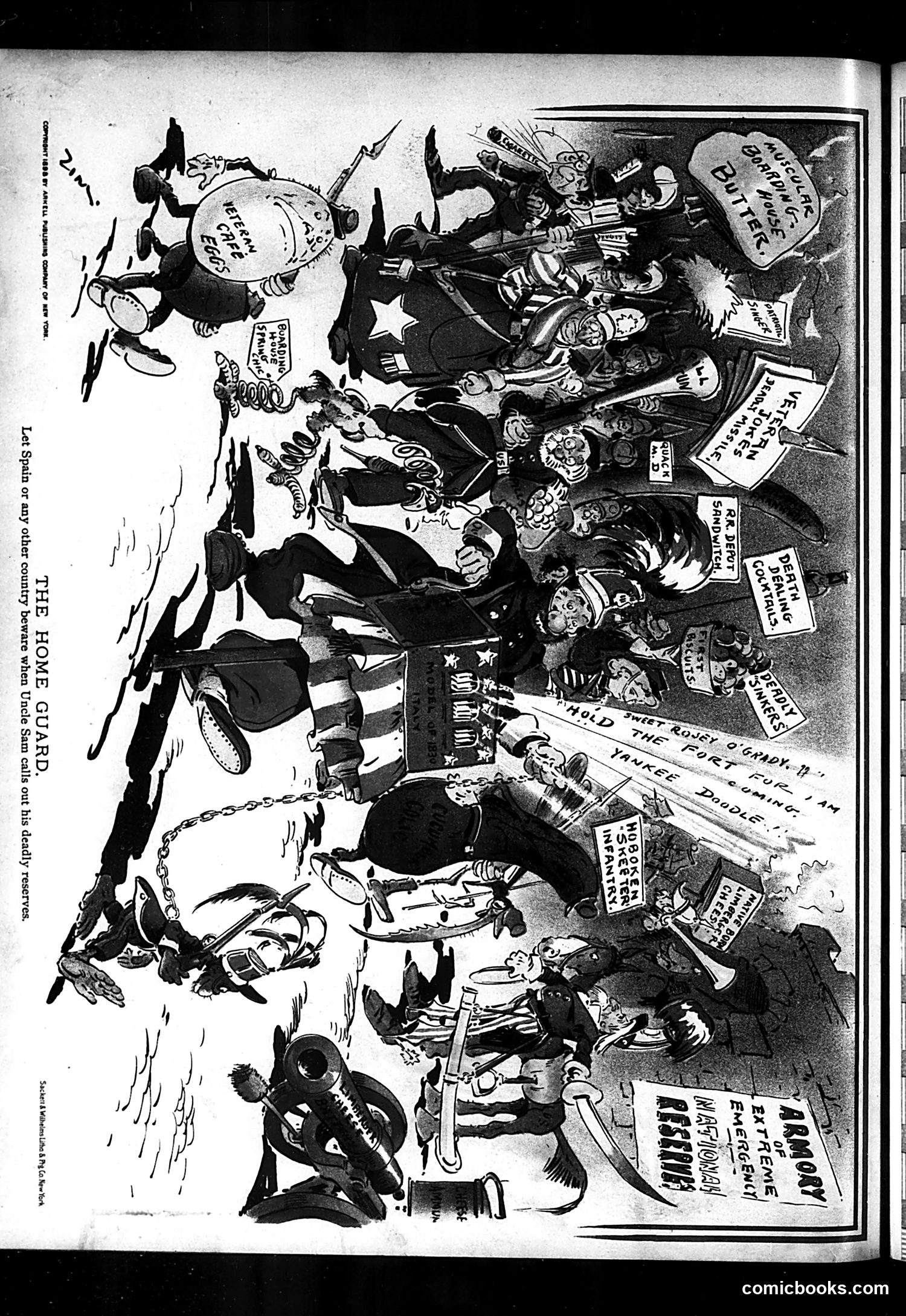
This political cartoon satirizes American military preparedness during the Spanish-American War (1898). The image depicts Uncle Sam mobilizing an absurd "home guard" of exaggerated civilian characters—rotund politicians, businessmen, and various stereotyped figures armed with makeshift weapons and ridiculous implements. The satire mocks the notion that America's "deadly reserves" consist of untrained, overweight civilians rather than professional soldiers. The caption's boastful warning to Spain is ironic: the cartoon suggests these bumbling, unfit civilians represent America's actual reserve military force. It critiques both American military readiness and the politicians/businessmen of the era, portraying them as comically unprepared for actual warfare despite wartime rhetoric. The humor derives from the gap between patriotic bluster and the reality of who would actually fight.