
A complete issue · 16 pages · 1898
Judge — May 28, 1898
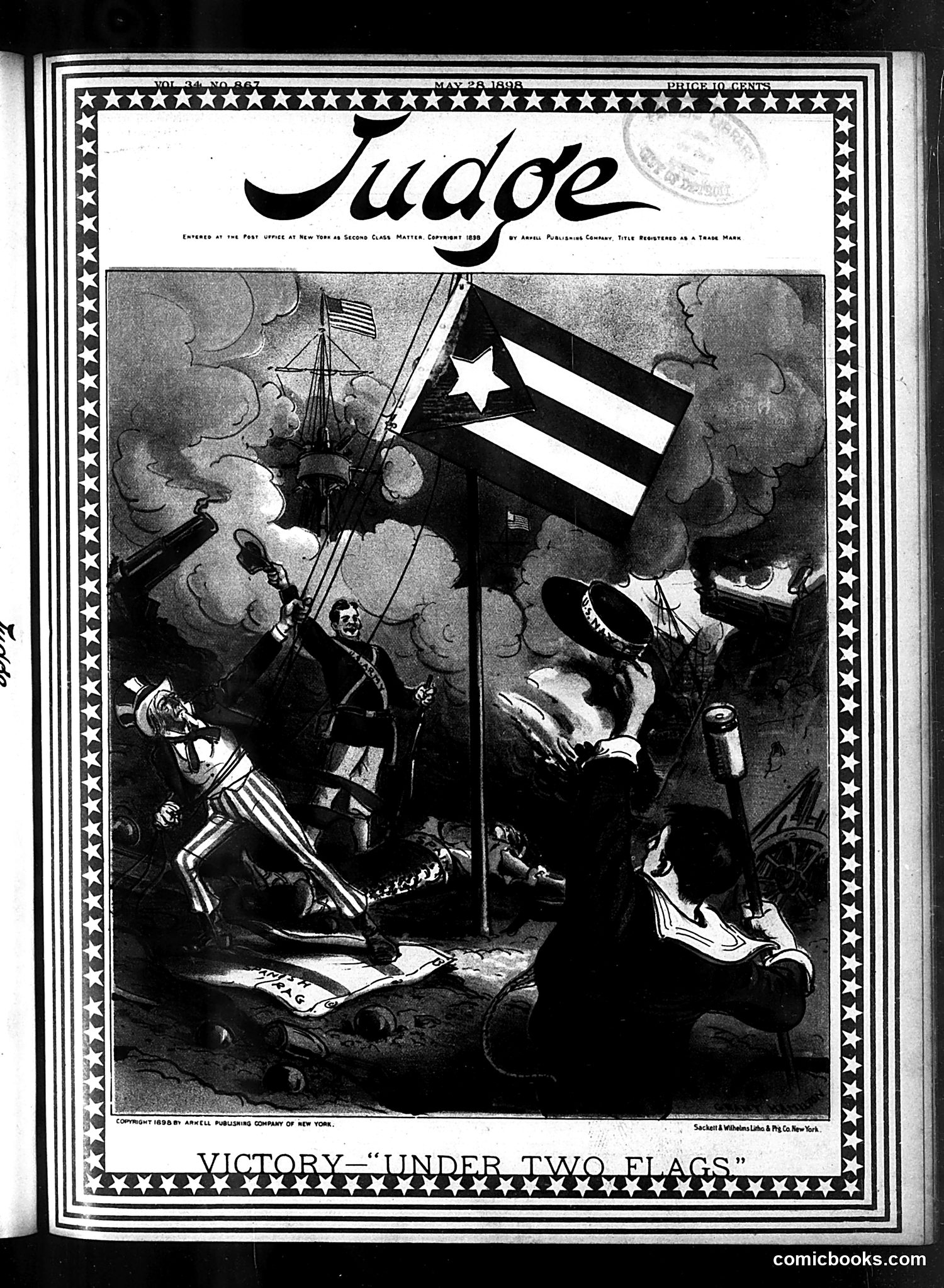
This Judge magazine cover satirizes American-Cuban military cooperation, likely from the Spanish-American War era (1898). The cartoon depicts armed figures beneath both the American flag and what appears to be the Cuban independence flag, suggesting joint military action. The title's irony suggests the satire: while nominally fighting for Cuban independence, the cartoon implies American military interests dominate the partnership. The ship in background and military figures in elaborate uniforms reinforce the martial theme. The specific figures are unclear from the image alone, but the composition critiques how American military intervention—ostensibly supporting Cuban liberation—actually served American imperial ambitions in the Caribbean.
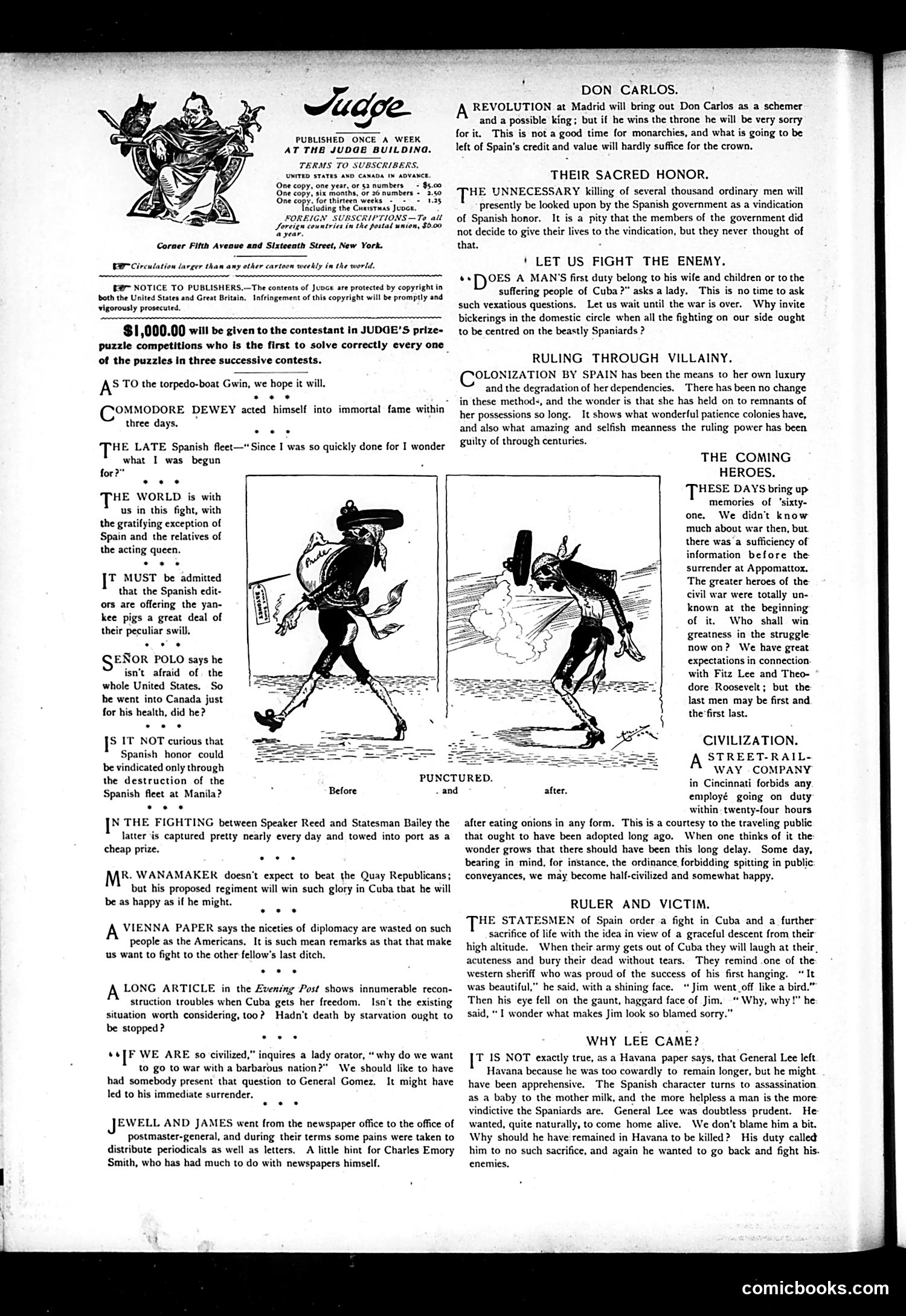
This page satirizes the Spanish-American War (1898). The central cartoon titled "PUNCTURED" shows a Spanish soldier being defeated—the "before" image depicts him confidently striking a pose, while "after" shows him knocked backward, illustrating Spain's military defeat. The surrounding editorial commentary mocks Spanish colonialism ("RULING THROUGH VILLAINY"), questions why America fights "barbarous" Spain, and discusses General Lee's absence from Cuba. References to Commodore Dewey and the Spanish fleet suggest the naval victories that defined this conflict. The satirical tone celebrates American military superiority while criticizing Spain's colonial rule. The cartoon's slapstick violence was typical of Judge's visual humor, making serious geopolitical themes digestible through exaggerated caricature.
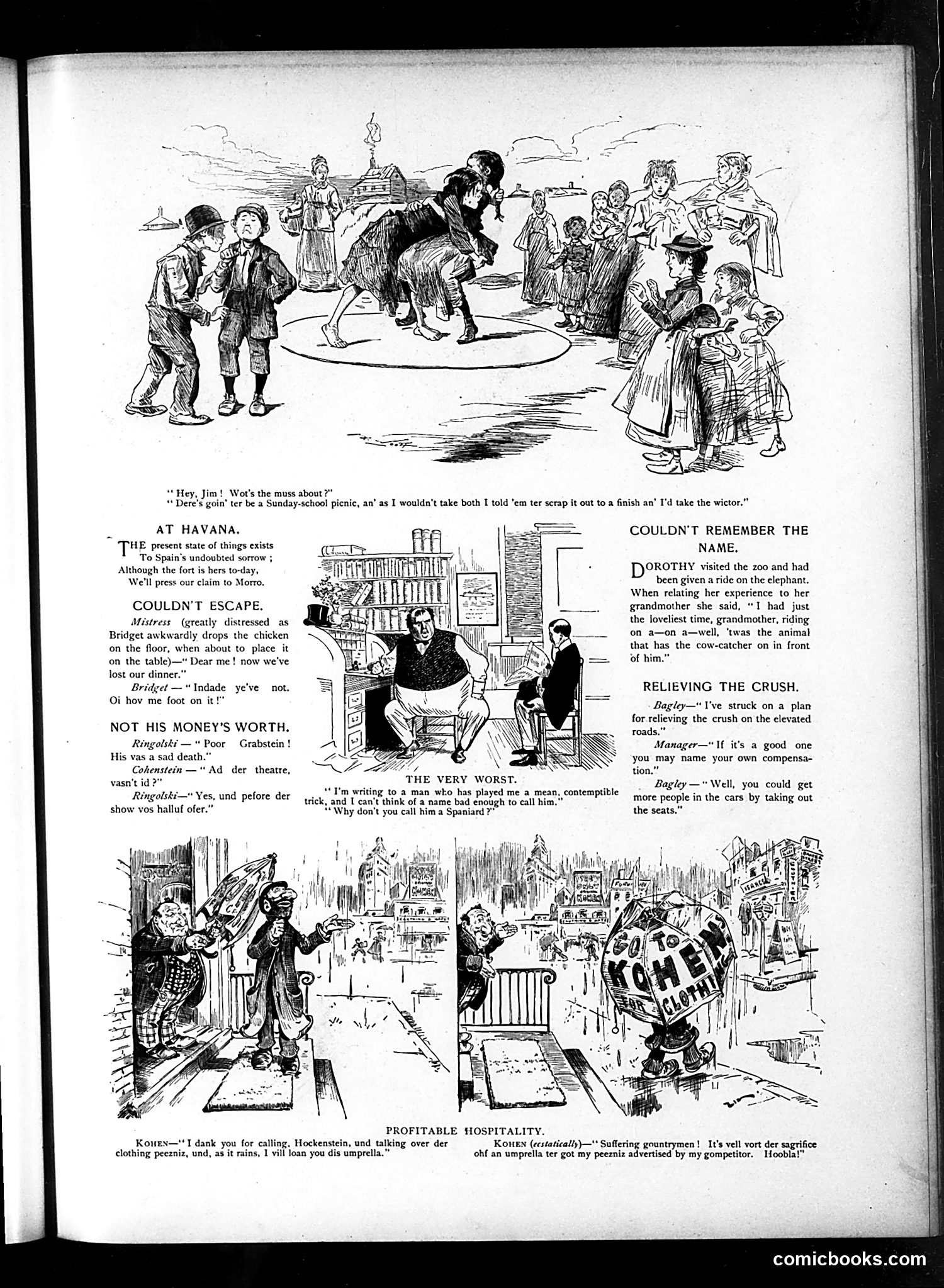
This page contains multiple unrelated satirical sketches and jokes typical of Judge's format. **Top illustration**: Children's game scene with caption about a "Sunday-school picnic" and someone taking "the wictor" (victor/winner)—appears to be gentle humor about childhood competition. **Middle section**: Several brief comedic sketches including: - "At Havana" and "Couldn't Escape"—likely references to Cuban affairs, possibly related to the Spanish-American War era - "Couldn't Remember the Name"—Dorothy's zoo elephant ride anecdote - "The Very Worst"—a man complaining about being called a "Spaniard" **Bottom cartoons**: "Profitable Hospitality" shows Kohen (a Jewish character stereotype) offering umbrella-lending to a man in rain, with competitive humor about "clothing peemis" (appearing to mock German/Yiddish-accented English). The page reflects period ethnic stereotyping common in early 1900s American humor magazines.
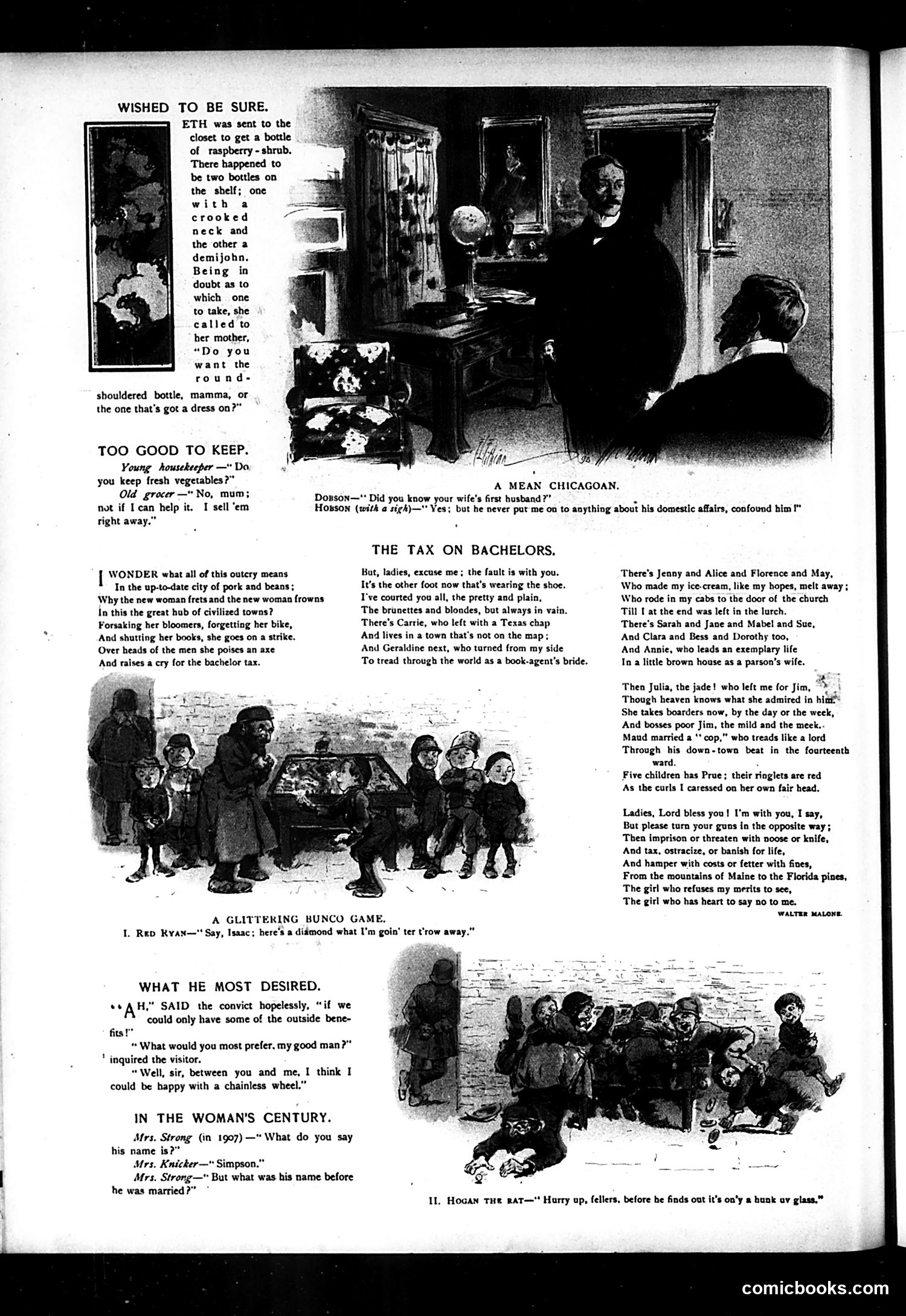
This page contains several satirical pieces and illustrations typical of early 20th-century humor magazines: **"A Mean Chicagoan"** depicts a domestic scene where a husband denies knowing his wife's first husband, claiming he "never put me on to anything about his domestic affairs." The satire mocks how men avoid discussing women's prior relationships. **"The Tax on Bachelors"** is a poem lamenting women's independence, listing named women who've left husbands or rejected suitors. It satirizes anxieties about women's newfound freedoms and marriage refusals—likely reflecting early feminist movements. **"A Glittering Bunco Game"** and other brief comic sketches mock working-class characters and con artists through dialect humor common to the era. The overall tone reflects upper-class satirical attitudes toward marriage, gender roles, and lower-class life typical of Judge's demographic.
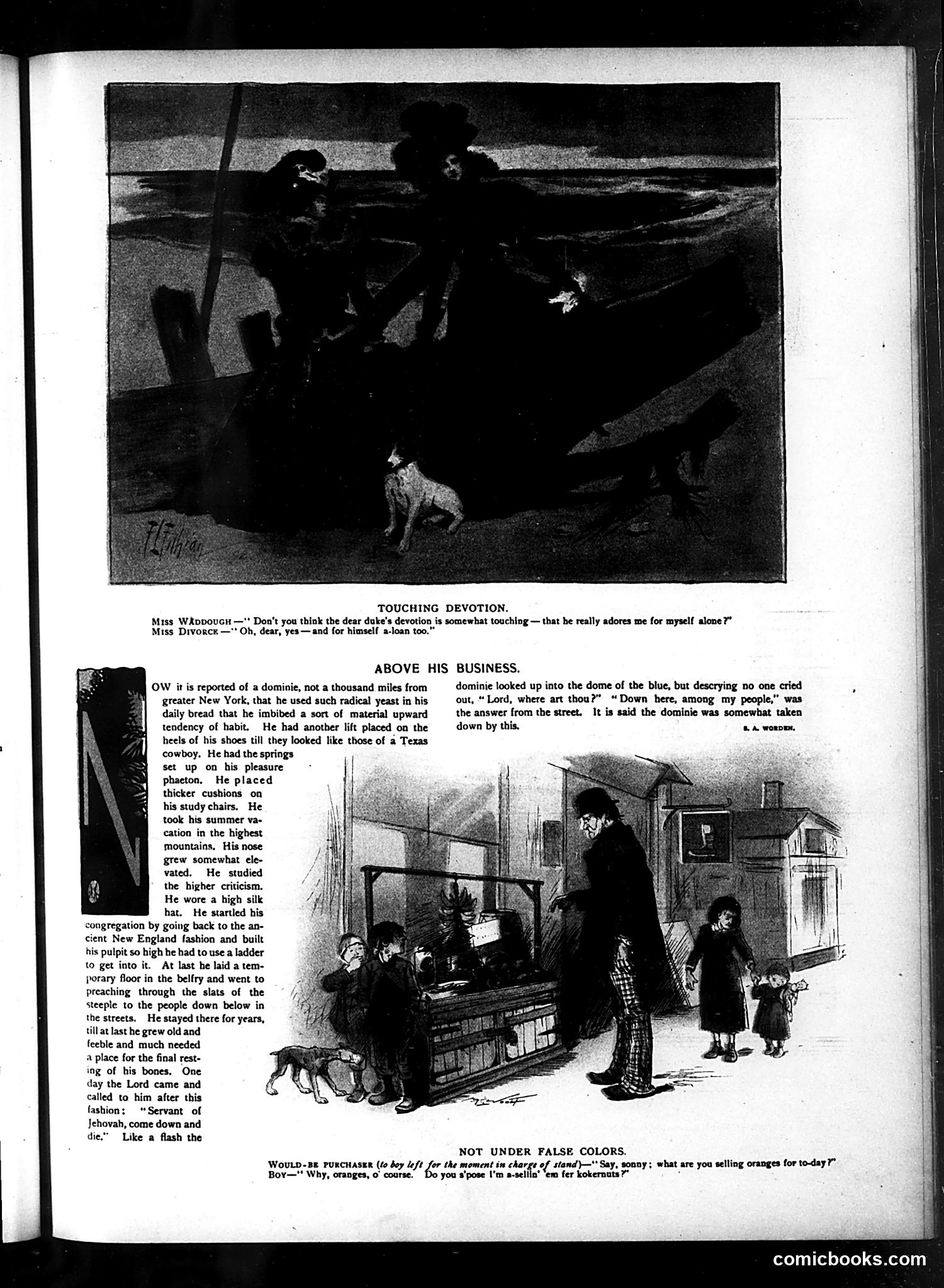
This page contains three satirical pieces mocking social pretension and hypocrisy: **"Touching Devotion"** jokes about a wealthy woman's romantic delusions. Miss Widdough believes a duke adores her "for myself alone," but Miss Divorce cynically quips he loves her "for himself a-loan too"—implying he's after her money, not her person. **"Above His Business"** ridicules a vain clergyman's obsession with elevating himself literally and socially. He raises his heels, pulpit, and even preaches from the steeple. The punchline: God humbles him by calling from street-level among "my people," forcing the minister "down." **"Not Under False Colors"** presents a boy honestly selling oranges as oranges, not misrepresenting them. The humor lies in the woman's surprised assumption that a street vendor might deceive her about his wares. All three pieces satirize affectation, pretense, and the gap between self-image and reality—common Judge themes critiquing Victorian-era social climbing.
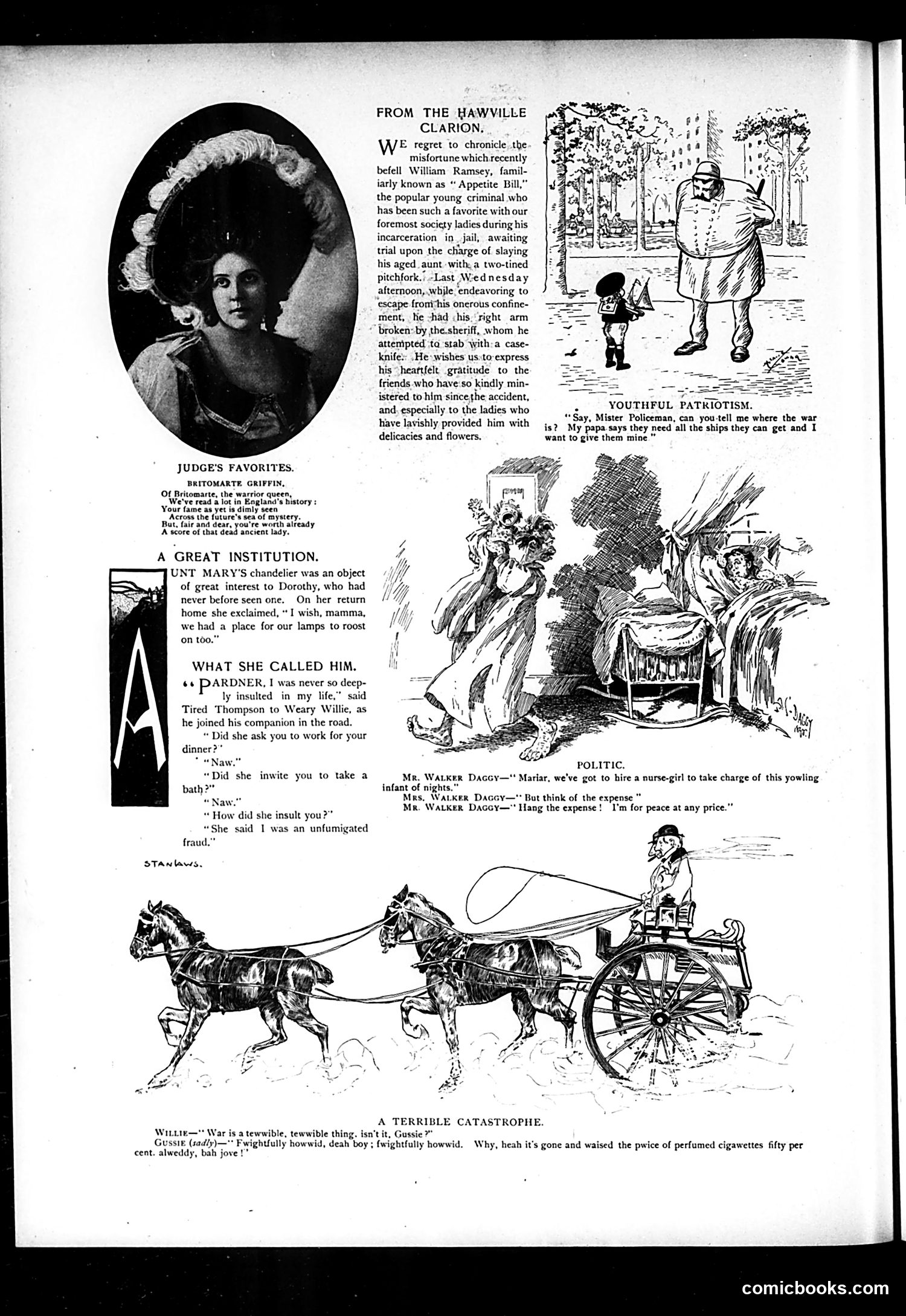
This page contains multiple satirical pieces mocking various social types: **"From the Hawville Clarion"** satirizes society's fascination with criminals. It mocks wealthy women who romanticize a jailed murderer ("Appetite Bill") and shower him with attention and gifts—treating his crimes as entertainment rather than serious moral failures. **"Youthful Patriotism"** depicts a child offering his toy ships to the war effort, satirizing overwrought patriotic sentiment and the gap between children's understanding and adult propaganda. **"What She Called Him"** and **"Politic"** are brief humor pieces playing on class pretensions and absurd domestic priorities (prioritizing "peace" over financial concerns). **"A Terrible Catastrophe"** uses affected upper-class speech patterns to mock the wealthy obsessing over trivialities—here, a price increase on luxury cigars being treated as a genuine disaster. The overall theme: Judge ridicules American hypocrisy—romanticizing criminals, hollow patriotism, and the privileged class's disconnection from reality.
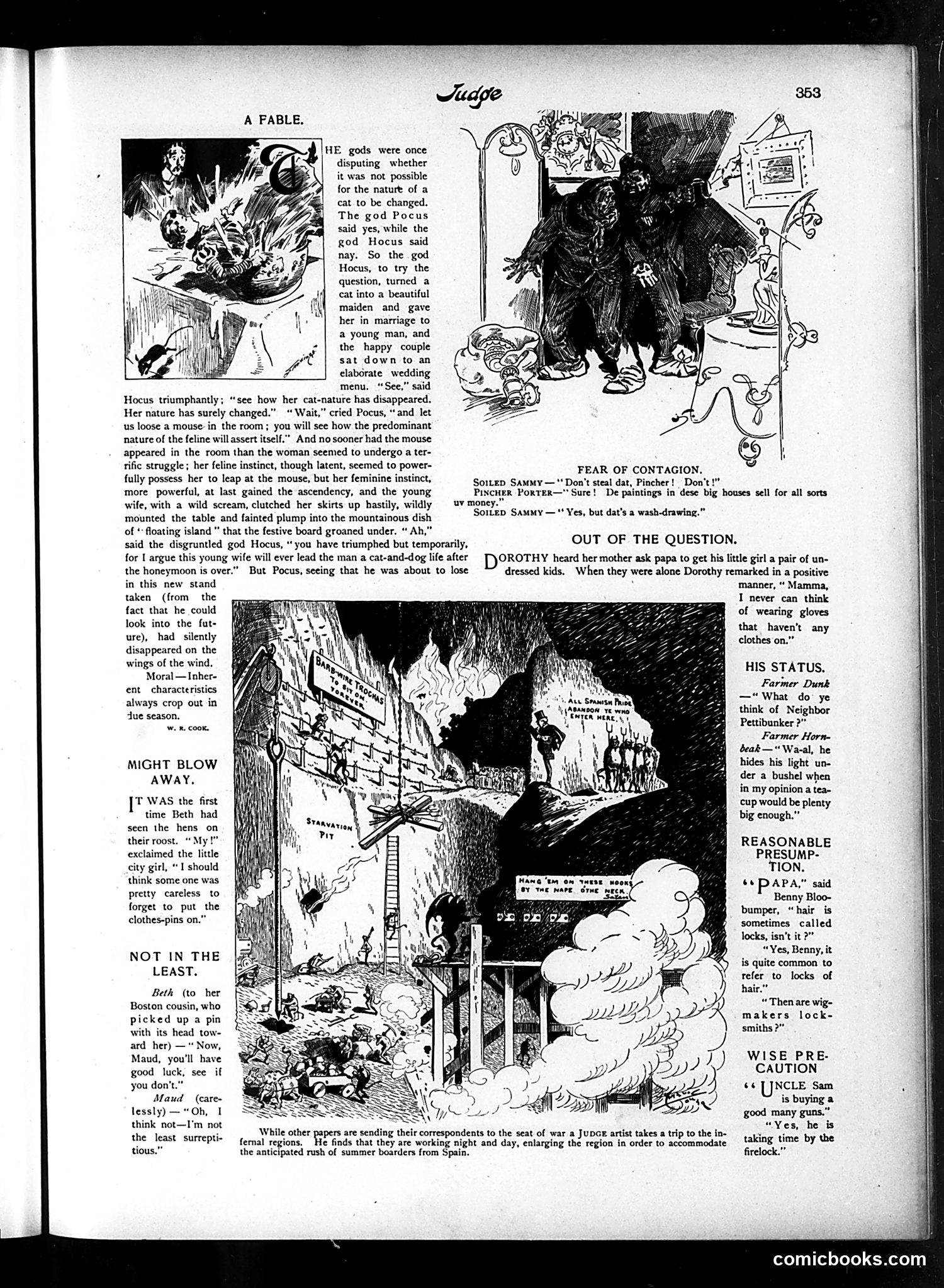
This page contains multiple short humorous pieces typical of Judge magazine's satirical format: **"A Fable"** (top): A moral tale about inherent nature. Two gods debate whether a cat transformed into a beautiful woman has changed her essential nature. When a mouse appears, her feline instinct nearly overwhelms her feminine instinct—she almost pounces but restrains herself, ultimately fainting. The moral warns that inherited characteristics always resurface, suggesting people cannot fundamentally change their nature. **Other brief jokes** scattered throughout address mundane domestic and social situations—ungloved hands, farm neighbors, chickens on roosts—with simple punchlines. **The bottom cartoon** references contemporary events: Judge's artist travels to Spain to sketch military preparations while other war correspondents cover the front lines. This likely alludes to Spanish-American War tensions (1898 era), with satirical commentary on summer tourism following potential conflict. These pieces reflect Judge's characteristic blend of fables with moral lessons and topical satire aimed at middle-class readers.
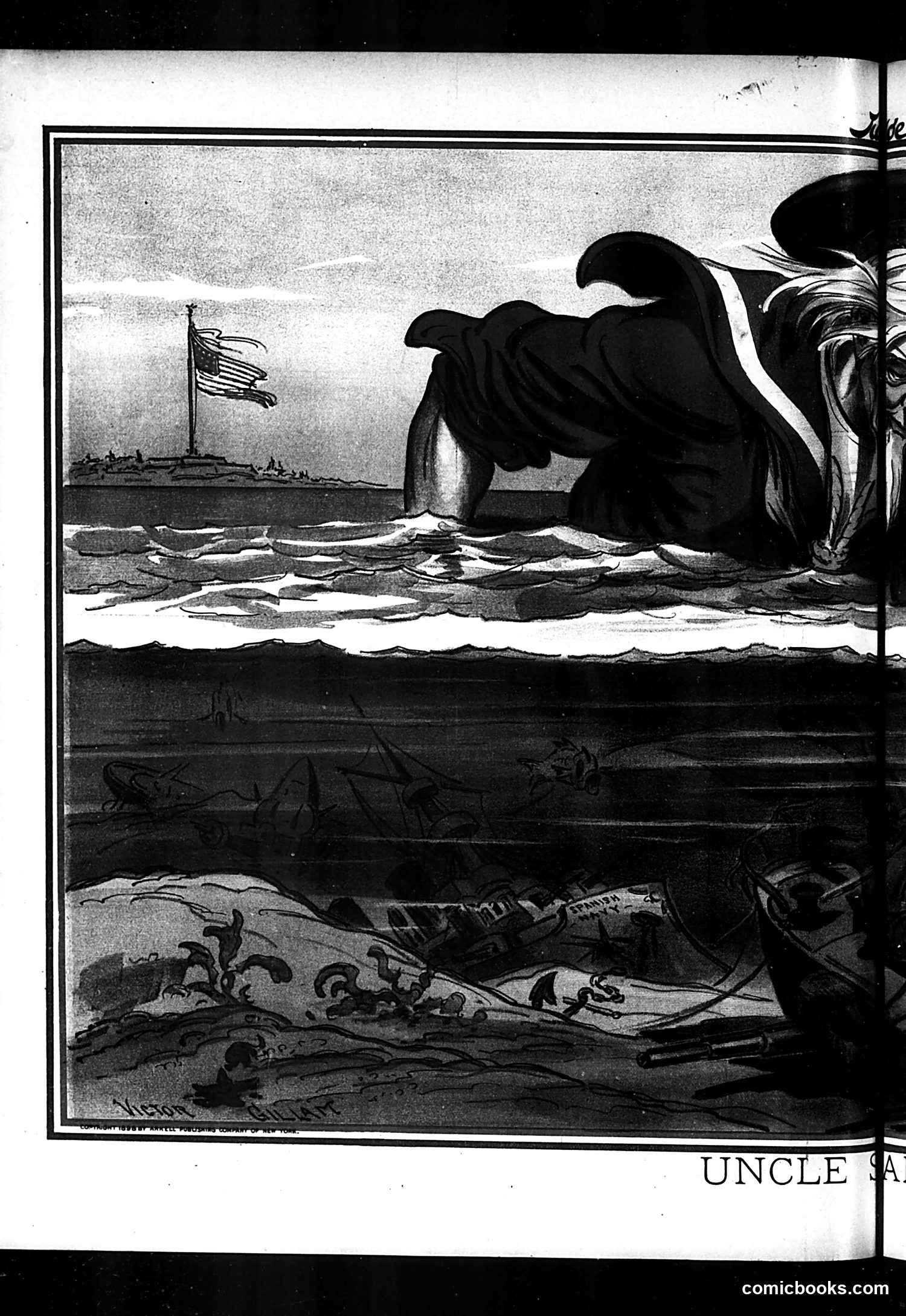
This appears to be a political cartoon from *Judge* magazine depicting **Uncle Sam** (the personified United States, identifiable by his characteristic clothing and posture) gazing across water toward a warship flying the American flag. The lower panels show an underwater scene with what appears to be wreckage, debris, and possibly sunken vessels on the ocean floor. The cartoon likely comments on **American naval power and military action**, possibly referencing a specific naval incident, conflict, or military intervention. The contrast between Uncle Sam observing from shore and the underwater destruction suggests satire about the consequences of American military engagement or expansion. Without the full page context or publication date visible, the specific historical event remains unclear, though the imagery suggests commentary on American imperialism or naval warfare from the late 19th or early 20th century.
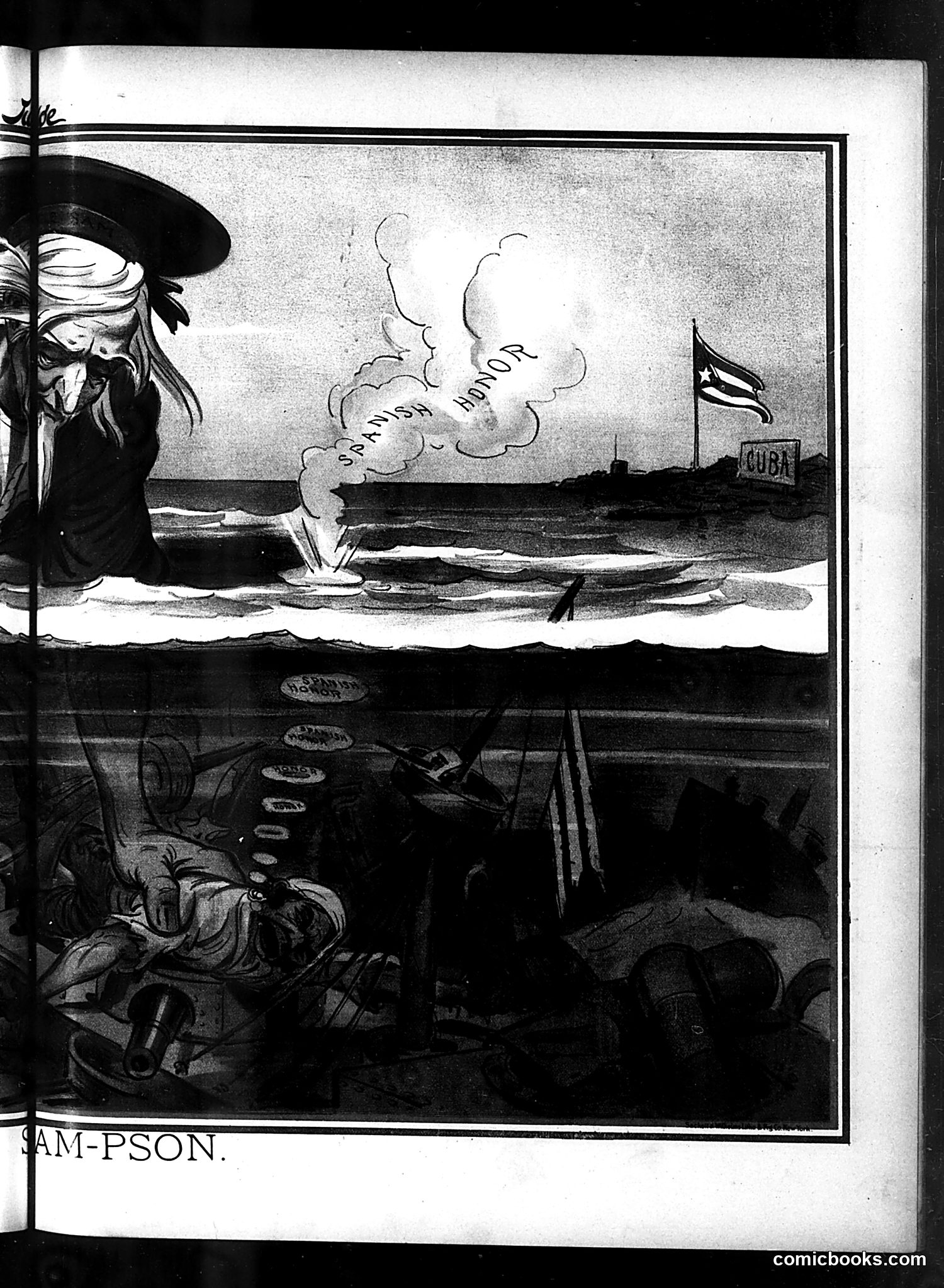
This appears to be a Judge magazine political cartoon depicting the Spanish-American War era, with "CUBA" visible on a flag in the background. The upper panel shows a grotesque caricatured figure (likely representing Spain or a Spanish leader) observing explosions labeled "SPANISH HONOR" rising from Cuban waters. The lower panel depicts the underwater destruction beneath—soldiers or casualties amid wreckage and warfare. The satire contrasts Spain's claimed "honor" with the brutal reality of conflict in Cuba. The juxtaposition suggests that Spanish pride is literally built on bloodshed and destruction. This reflects American anti-Spanish sentiment during the Cuban independence struggle and Spanish-American War period, presenting Spanish involvement in Cuba as destructive rather than honorable.
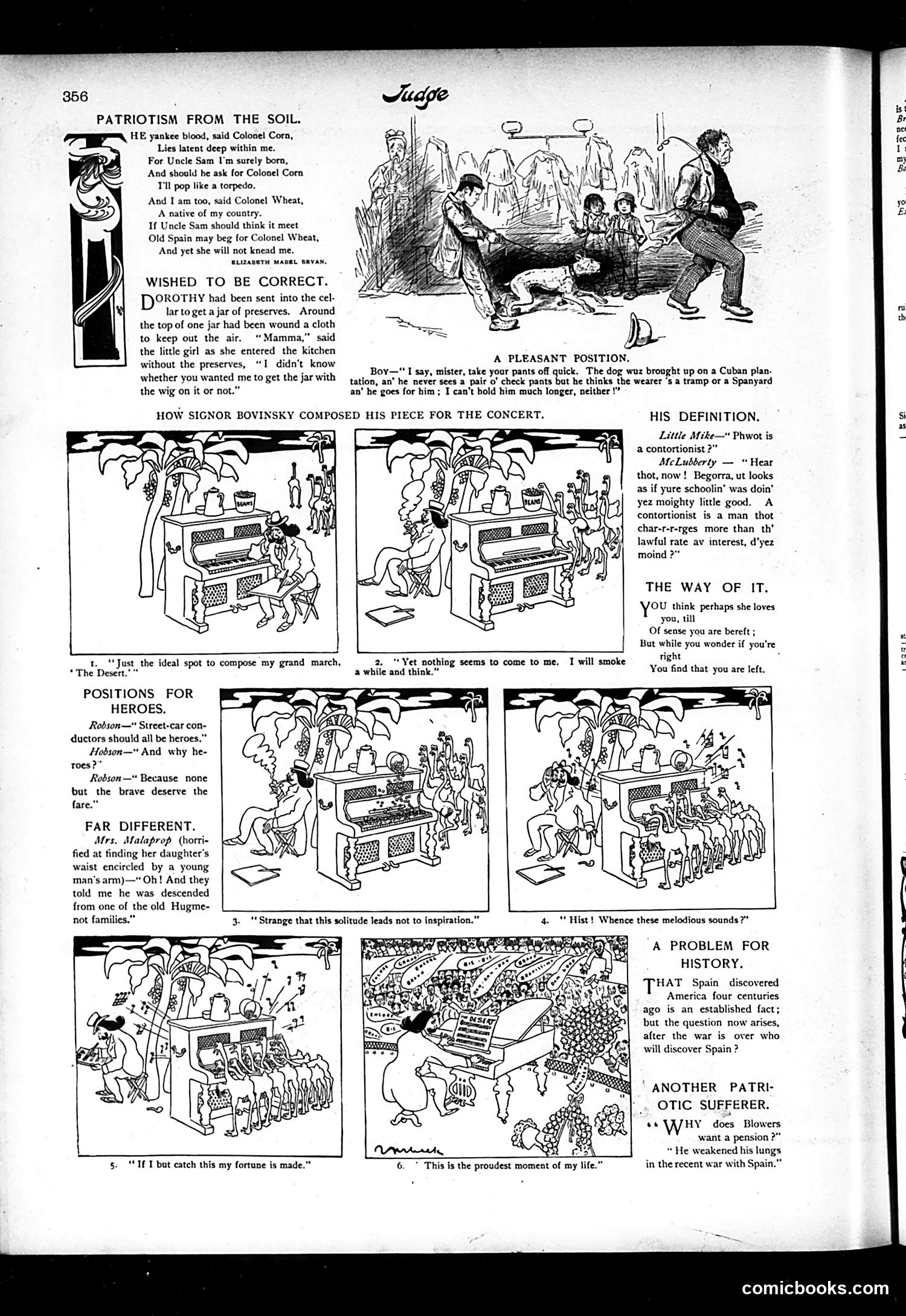
This page from Judge contains satirical humor reflecting post-Spanish-American War (1898) America: **"Patriotism from the Soil"** mocks agricultural personification—Colonel Corn and Colonel Wheat boast patriotic fervor for fighting Spain, using puns ("pop like a torpedo," "will not knead me"). **"A Pleasant Position"** jokes about a dog trained on Cuban plantations that attacks anyone wearing checked pants, mistaking them for Spanish soldiers or tramps—satirizing the recent Cuban conflict. **The Bovinsky concert cartoons** satirize a struggling composer trying to create a grand march while distracted by daily life and poverty. **"A Problem for History"** is cutting satire: Spain discovered America centuries ago; now after defeating Spain in war, the joke asks who will "discover" Spain—implying America's new imperial dominance and Spain's reduced status. **"Patriotic Sufferer"** mocks pension-seekers claiming war injuries from the brief, relatively bloodless conflict, suggesting opportunistic claims. The page broadly celebrates American military victory while satirizing excess patriotism and Spanish decline.
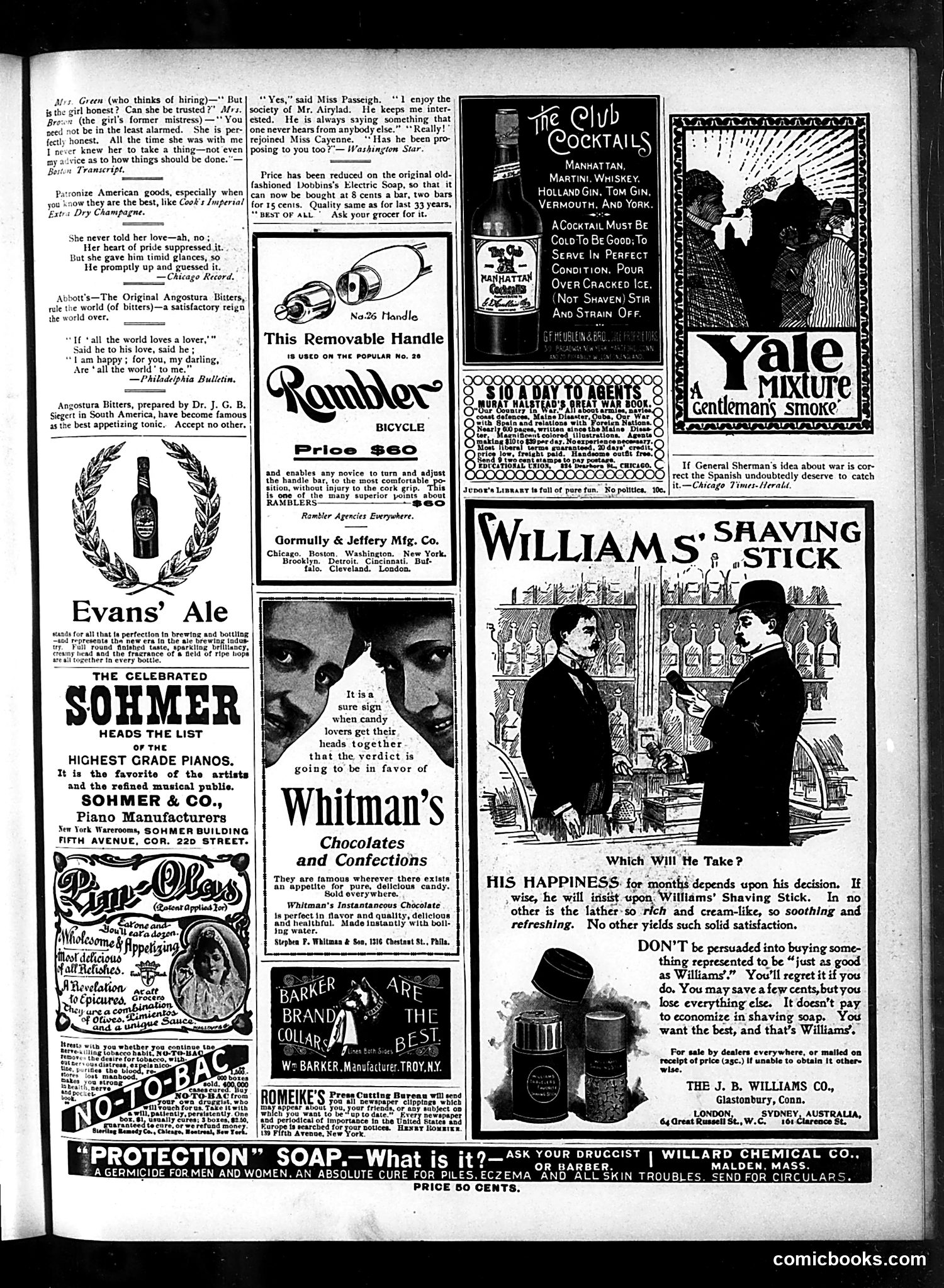
This page is primarily **advertisements** interspersed with brief comedic snippets typical of Judge magazine's format. The main cartoon worth noting is **"Which Will He Take?"** featuring Williams' Shaving Stick. It shows a man at a barbershop counter deciding between products—a visual pun on life choices. The satire is gentle: the ad claims his happiness depends on choosing Williams' product, humorously overstating the stakes of a consumer decision. This reflects early 1900s advertising's earnest, hyperbolic claims about everyday goods. Other content includes: - Brief jokes about courtship and hiring servants - Product endorsements for champagne, ale, pianos, bicycles, chocolates, and soap - A snippet about a woman who enjoys an "airy" suitor The page reflects **Gilded Age consumer culture** where Judge mixed humor with advertising. The jokes are mild domestic comedy; the satire targets social pretension rather than politics. Most references (product names, brand claims) are period-specific and obscure today without historical context.
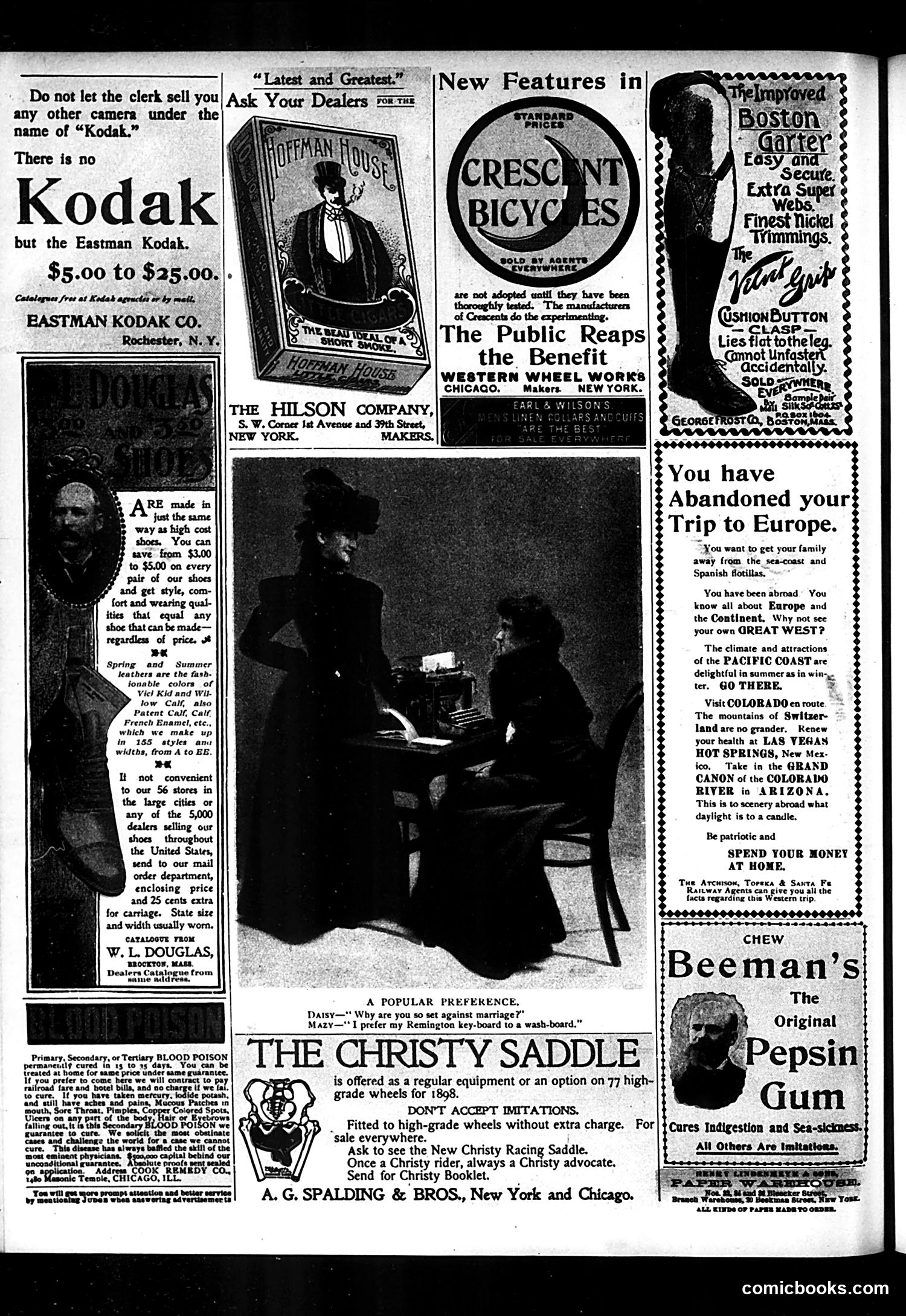
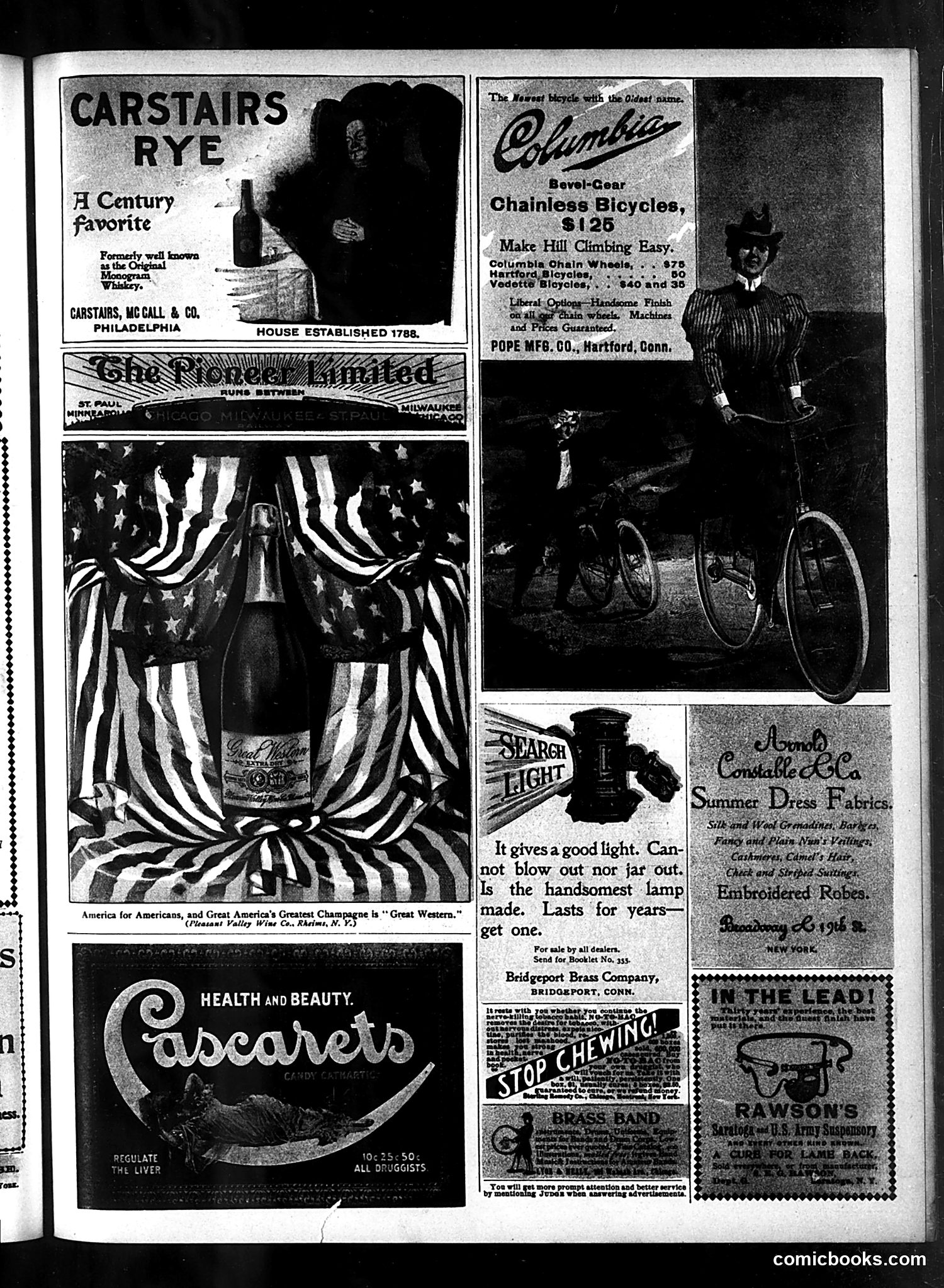
This is primarily an **advertising page**, not a political cartoon. It features various commercial advertisements typical of early 20th-century American magazines: - **Carstairs Rye** whiskey (Philadelphia distiller, established 1788) - **Columbia bicycles** with chainless design - **Great Western champagne** with patriotic imagery (American flags and eagles) - **Starch Light** brand lamps - **Arnold Condable & Co.** summer dress fabrics - **Rawson's** suspenders - **Cabarets candy** for liver health - Various other products (brass goods, chewing gum) The page's only quasi-satirical element is the "Great Western" champagne ad, which patriotically claims American champagne as "Great America's Greatest" — likely poking mild fun at American pride and product nationalism during an era of growing consumer advertising. Otherwise, this reflects Judge's business model: mixing satirical content with lucrative advertisements to support publication.
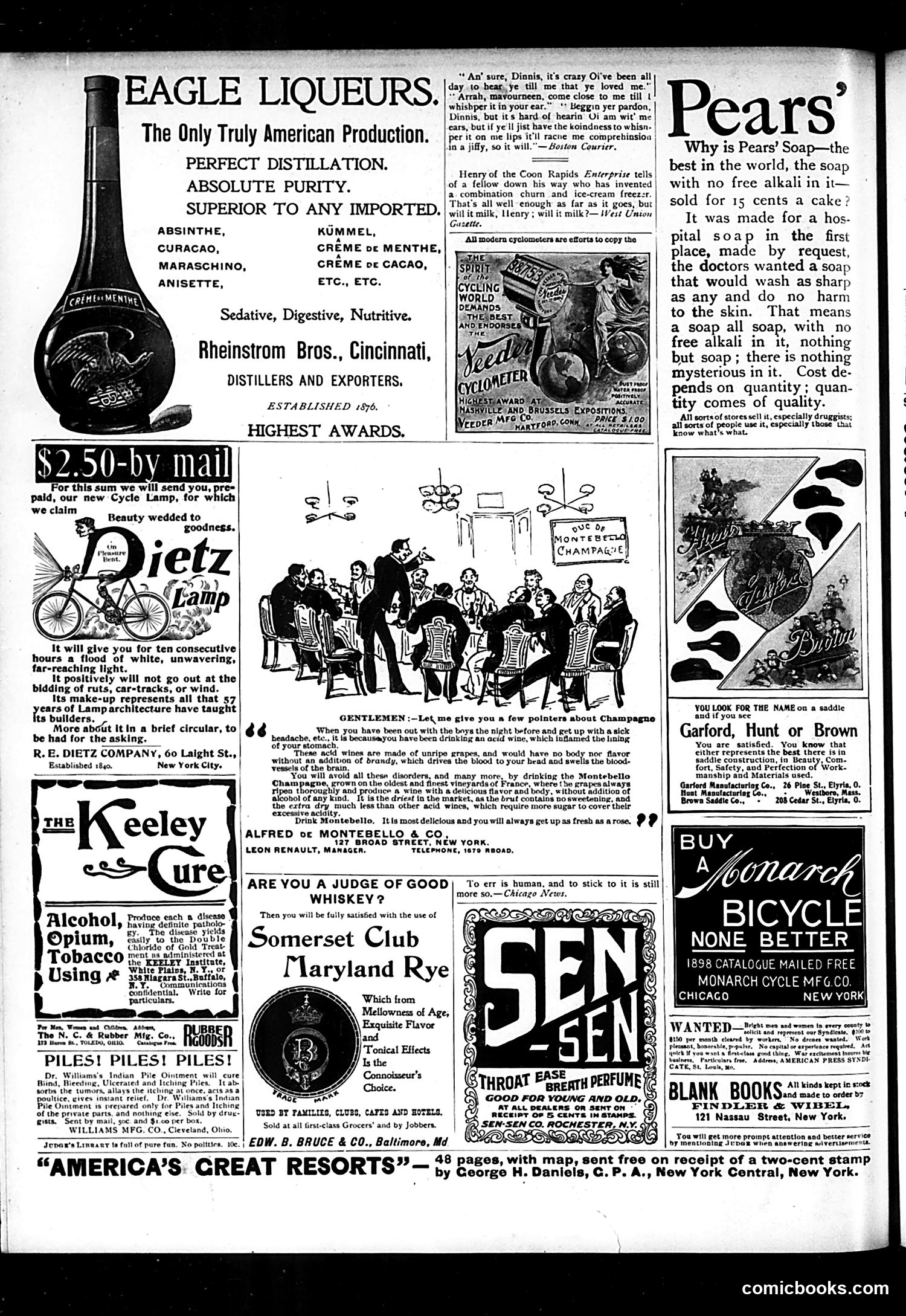
This page is primarily **advertisements** with one small cartoon and anecdotes. The main satirical content is minimal. The cartoon depicts **gentlemen discussing champagne**, with text explaining that acid wines from unripe grapes cause hangovers, requiring brandy additives. The solution: drink Montebello Champagne from France's finest vineyards, which contains no added sweetening and won't produce morning-after illness. This is **product-based satire**—using pseudo-scientific "health" claims (common in the era) to mock both inferior wines and gullible consumers. The page also includes Irish dialect humor ("An' sure, Dinnis...") mocking immigrant speech patterns—typical of Judge's era stereotyping. Most content consists of period advertisements for liqueurs, bicycles, soap, and patent medicines (including dubious remedies like "Dr. Williams's Indian Pile Ointment"), reflecting how Judge monetized its pages.
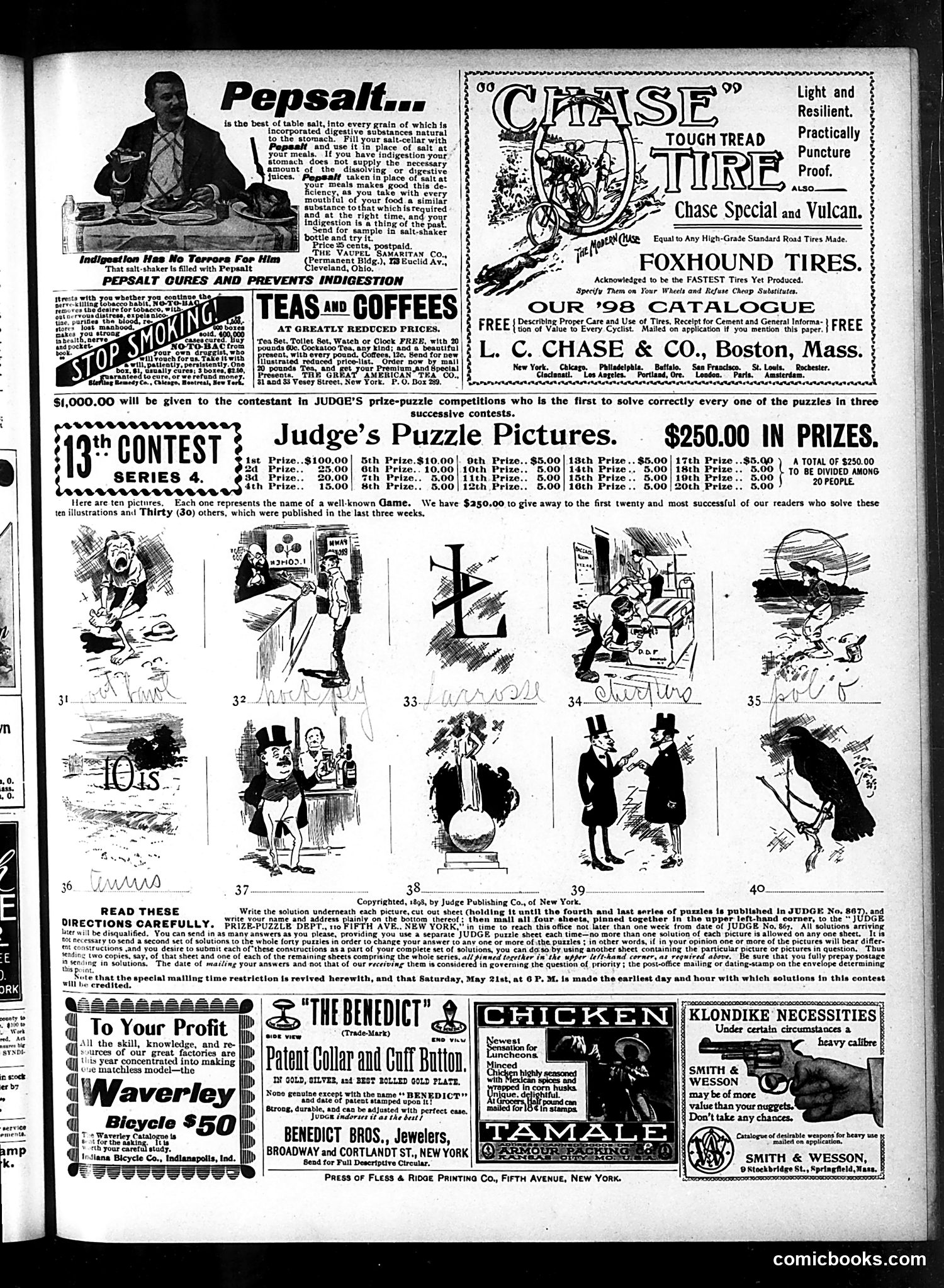
This is primarily an **advertising and puzzle-contest page** from Judge magazine (circa 1898, based on copyright notice). The content is mostly commercial rather than satirical. The page features: **Main Content:** A puzzle contest offering $250 in prizes. Readers must identify ten "well-known Games" from cartoon illustrations (images 31-40 are visible). Examples include what appears to be cricket, billiards, and other period sports/pastimes. The contest rules require solving all puzzles across four successive Judge issues. **Advertisements:** The page is dominated by period product ads—Pepsalt (digestive salt claiming to cure indigestion), Chase Foxhound Tires, Waverley bicycles, Benedict Bros. jewelry, and Tamale cooking products. These reflect 1890s consumer concerns and patent-medicine marketing. **No apparent political satire** is present on this page—it's a standard magazine revenue model combining reader engagement (puzzles) with advertising. The "Pepsalt cures indigestion" ad exemplifies the era's dubious health claims.
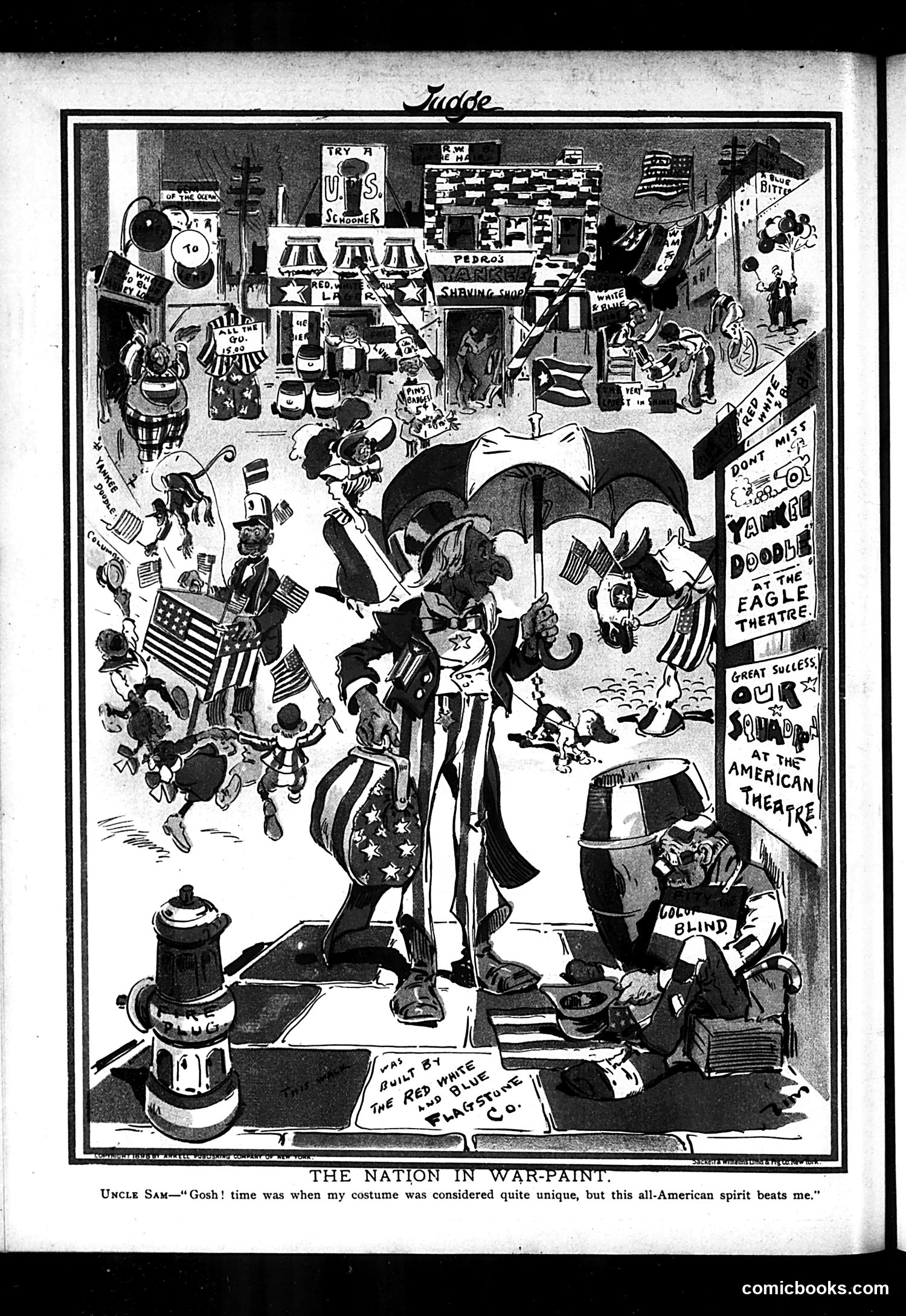
This satirical cartoon depicts Uncle Sam (personifying the United States) surrounded by patriotic Americans wearing various flag-themed costumes and war paint, celebrating American spirit during wartime. Uncle Sam's quoted caption expresses bemused surprise that civilians' enthusiastic patriotic displays now exceed even his iconic costume's distinctiveness. The cartoon satirizes how ordinary Americans have embraced visible patriotic expression—wearing stars, stripes, and flag imagery—with such fervor that the traditional symbol of America itself feels outdone. The background shows storefronts and theaters advertising patriotic entertainment ("Yankee Doodle," "Squab"), suggesting commercialized patriotism permeates daily American life during the war effort. The satire gently mocks both the earnestness of home-front patriotism and its commercialization, while acknowledging the genuine "all-American spirit" driving these displays.