
A complete issue · 16 pages · 1898
Judge — May 7, 1898
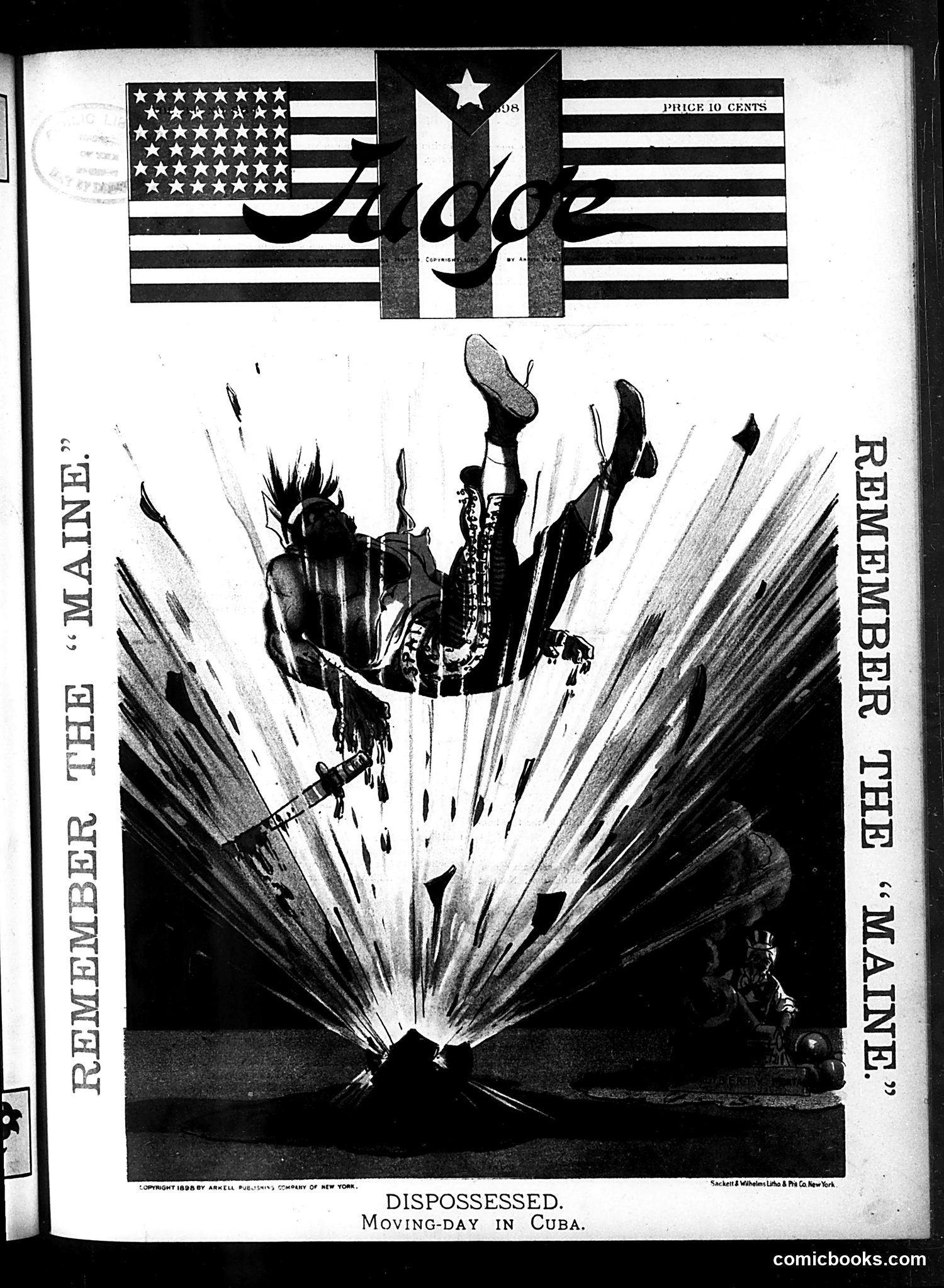
This Judge magazine cover depicts an Indigenous figure being violently expelled from Cuban soil, labeled "DISPOSSESSED. Moving-day in Cuba." The cartoon satirizes American intervention in Cuba, likely following the Spanish-American War (1898). The figure—caricatured with stereotypical Native American imagery including feathered headdress and raised legs in an exaggerated falling pose—represents Cuba's original inhabitants. The explosion and violent ejection suggest that American expansionism is displacing Cuba's people, much as American settlers displaced Native Americans. The satire appears to criticize U.S. imperialism by drawing a parallel between historical American dispossession of Indigenous peoples and current American actions in Cuba, suggesting America repeats its colonial patterns abroad.
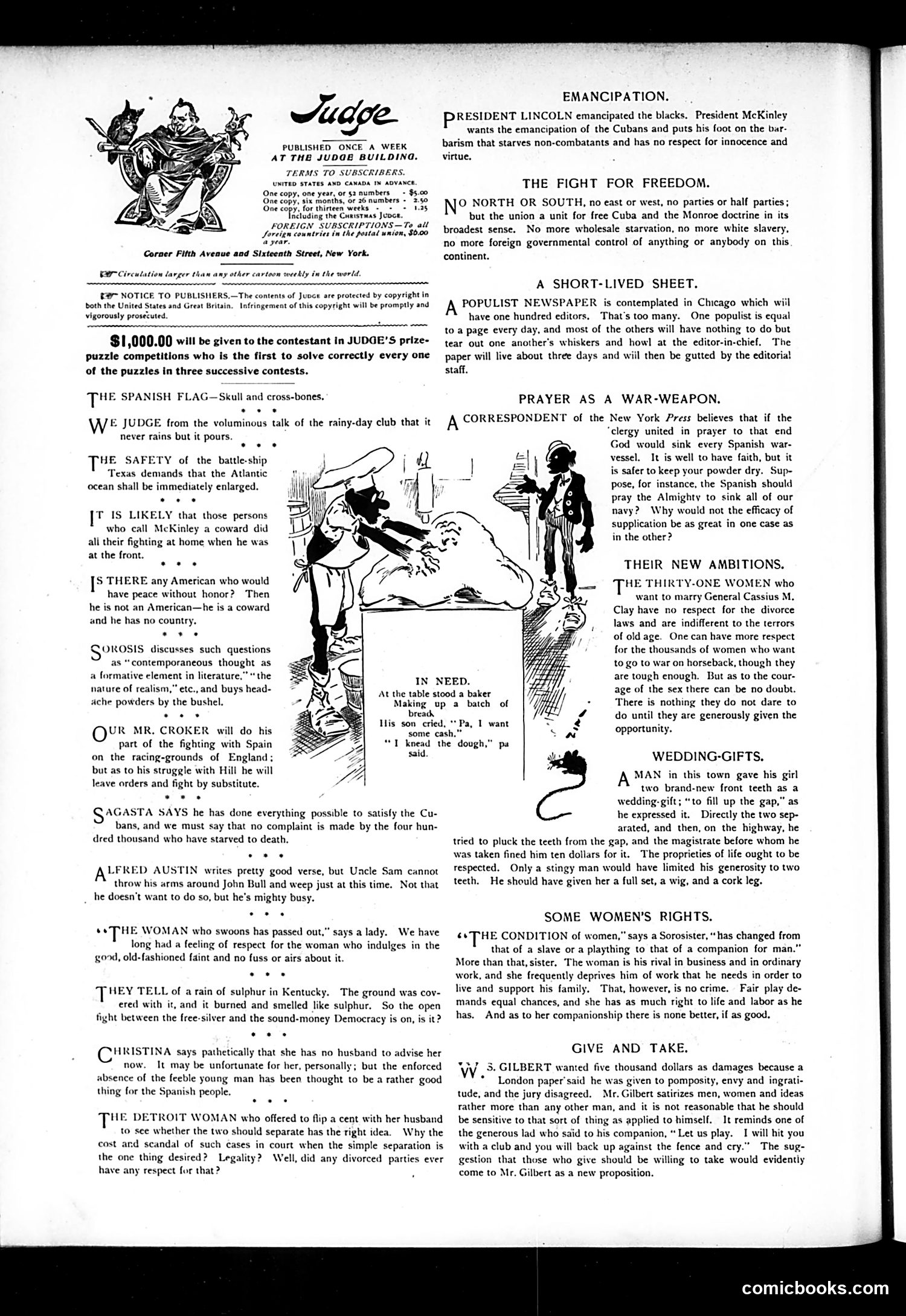
This page from Judge contains multiple brief satirical commentary pieces and one illustrated segment titled "IN NEED," showing a figure at a table with bread, asking for cash. The political content centers on **Civil War-era issues**: emancipation (Lincoln's policies), the treatment of soldiers, and women's roles in wartime. Several pieces mock contemporary debates—questioning prayer's military efficacy against Spain, criticizing women who want to marry General Cassius Clay despite his disregard for divorce laws, and satirizing a man who gave false teeth as wedding gifts. The illustrations are crude caricatures typical of 19th-century satirical journalism. Most pieces appear designed to ridicule both political figures and social types (cowardly Americans, materialistic women, hypocritical clergy). Without specific bylines or dates visible, the exact targets remain somewhat unclear, though the content reflects post-Civil War American social anxieties.
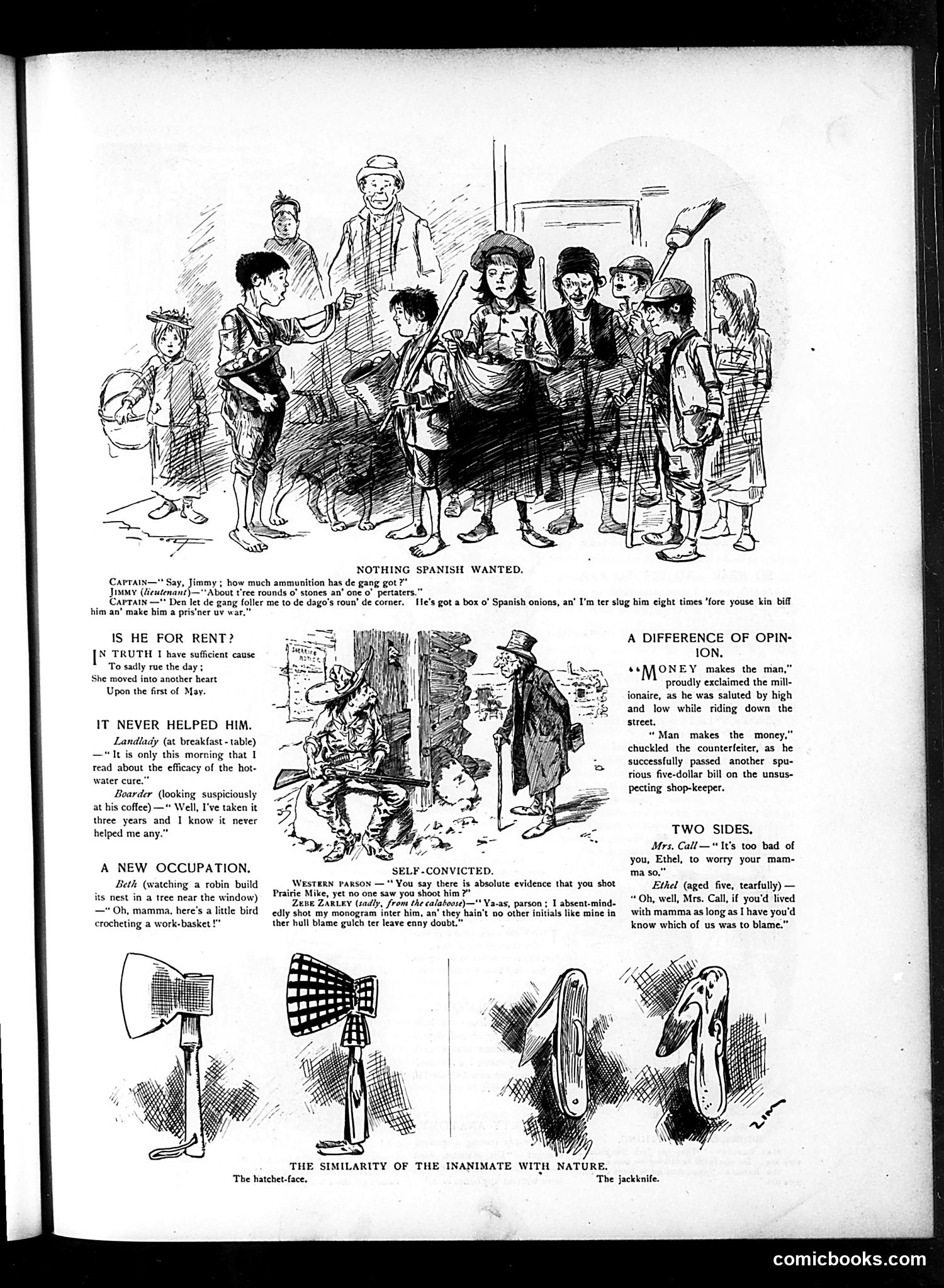
This page contains several distinct satirical pieces: **"Nothing Spanish Wanted"** (top): A street scene where a Captain questions Jimmy about ammunition for a gang. Jimmy references "Spanish onions" and a "box o' Spanish onions," making a pun—likely referencing the Spanish-American War or anti-Spanish sentiment of the period. The joke plays on conflating Spanish imports with warfare. **Multiple short humor pieces** address domestic social issues: "Is He for Rent?" concerns landlord-tenant relationships; "A New Occupation" and others mock working-class struggles and economic anxieties. **"A Difference of Opinion"** satirizes counterfeiting and financial crime. **Bottom section**: "The Similarity of the Inanimate with Nature" compares household tools (hatchet-face, jackknife) to human features—visual puns common in period humor magazines. The overall page reflects early 20th-century urban American concerns: immigration, poverty, crime, and class tensions.
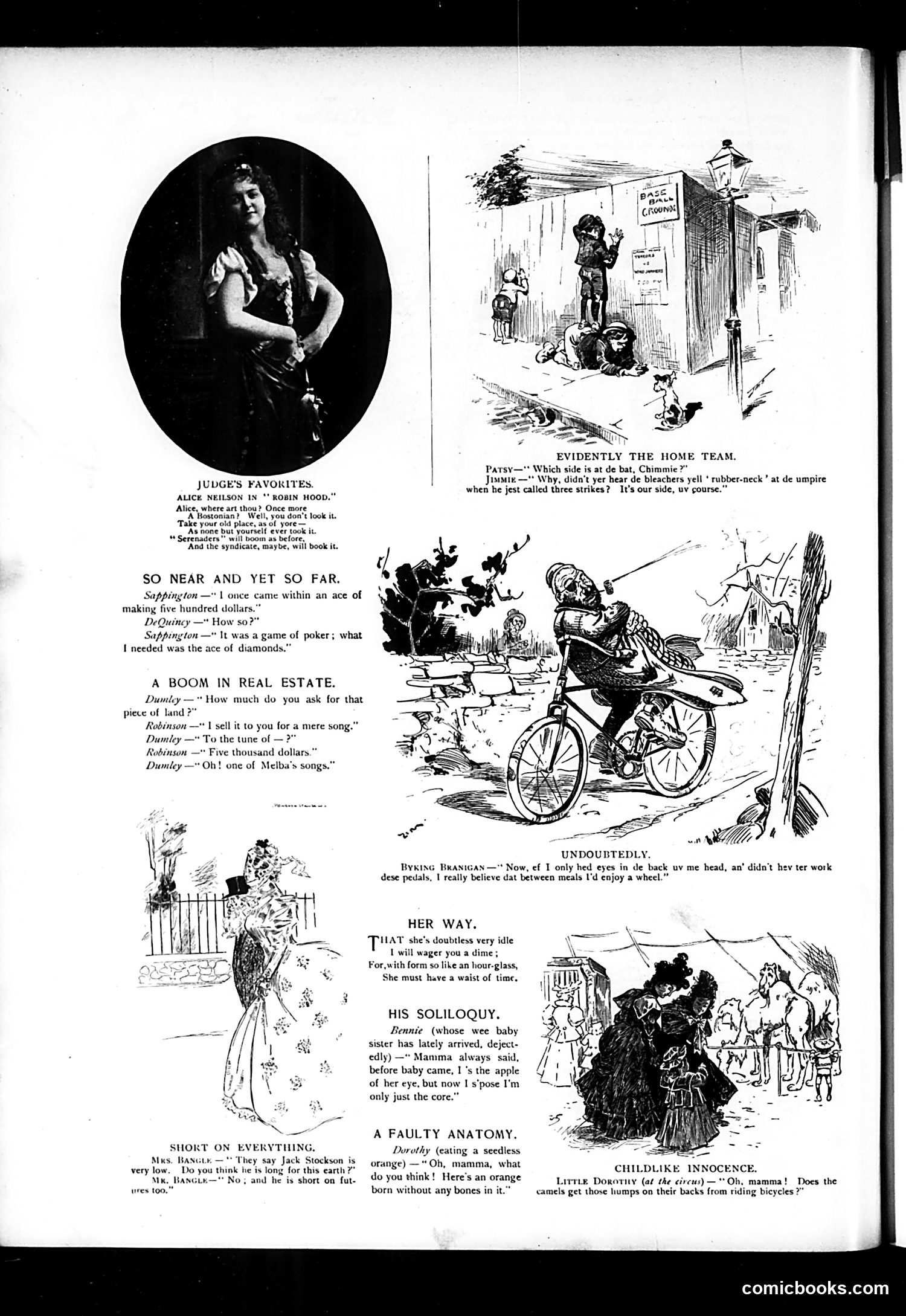
This page contains humorous short dialogues and accompanying illustrations, mostly domestic comedy rather than political satire. The sketches include: **"Judge's Favorites"**: References Alice Nelson in "Robin Hood" and other theatrical productions, suggesting this was entertainment-focused content. **Domestic humor**: Multiple sections feature comedy about marriage, real estate dealings, and family life—typical Judge magazine fare satirizing middle-class American society. **"Childlike Innocence"**: A circus-related joke about children and camels. The page primarily offers light social satire targeting everyday situations: marital miscommunications, financial transactions, and parenting moments. There's no apparent political content. This represents Judge's core function: providing genteel humor for readers through wordplay and illustrations of recognizable social scenarios rather than topical political commentary.
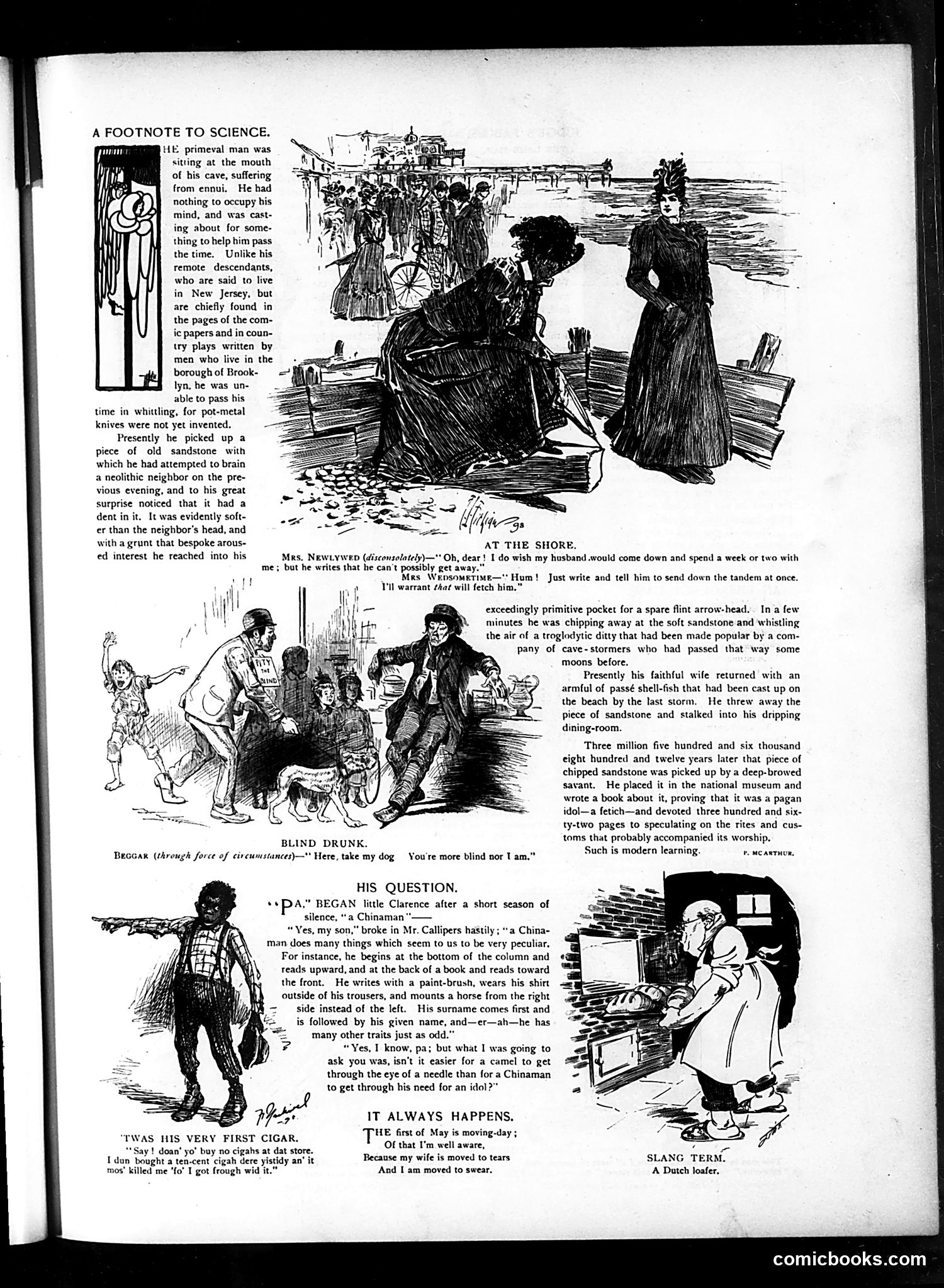
This page contains multiple satirical cartoons mocking contemporary society and "modern learning": **"A Footnote to Science"** ridicules academic overinterpretation. A prehistoric man casually carves a sandstone artifact, which his wife later discards. Millennia later, scholars treat it as a sacred pagan idol, writing lengthy treatises on its religious significance. The satire: modern intellectuals impose grand meaning onto trivial objects, demonstrating that "learning" is often baseless speculation. **"At the Shore"** jokes about marital dynamics—a wife suggests her absent husband will rush back if she mentions a "tandem" (bicycle), implying infidelity keeps him away. **"His Question"** presents a boy asking his father about Chinese customs, then delivers a punchline: "isn't it easier for a camel to get through the eye of a needle than for a Chinaman to get through his need for an idol?" This stereotypes Chinese people as idol-worshippers while mocking Mr. Callipers's pedantic explanation of cultural differences. The remaining sketches are brief humor pieces with less significant satirical content. Overall, the page emphasizes intellectual pomposity and ethnic stereotyping typical of early 20th-century American satire.
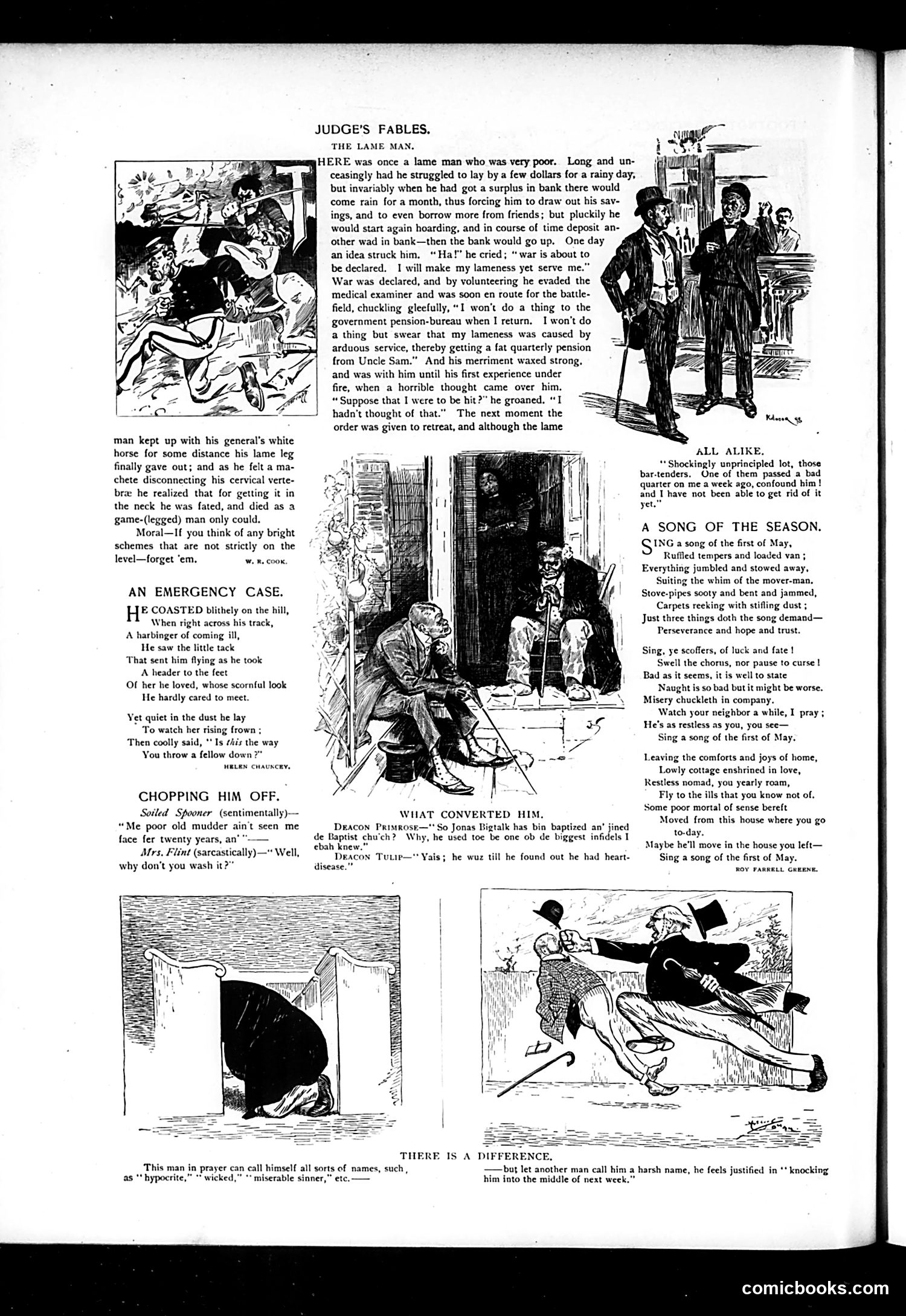
This page contains several satirical pieces typical of Judge's social commentary: **"The Lame Man"** fable mocks pension fraud schemes. A poor man plans to fake a war injury for government disability payments, but dies genuinely wounded in battle—ironic punishment for dishonest intent. The moral warns against crooked schemes. **"All Alike"** presents a brief hypocrisy joke: a bartender complains about receiving counterfeit money, unaware he himself passed it on—suggesting widespread dishonesty across social classes. **"An Emergency Case"** is a romantic comedy verse about a bicycle accident interrupting a suitor's visit to his beloved. **"Chopping Him Off"** shows sentimental dialogue where a poor man laments not seeing his mother in twenty years; a woman cuts him off sarcastically, suggesting his neglect doesn't warrant sympathy. **"What Converted Him"** mocks religious conversion, implying Jonas Bigtalk only joined church after learning he had heart disease—converting through fear rather than genuine faith. **"There Is a Difference"** critiques hypocrisy: a man can curse himself in prayer but feels justified "knocking" another into next week.
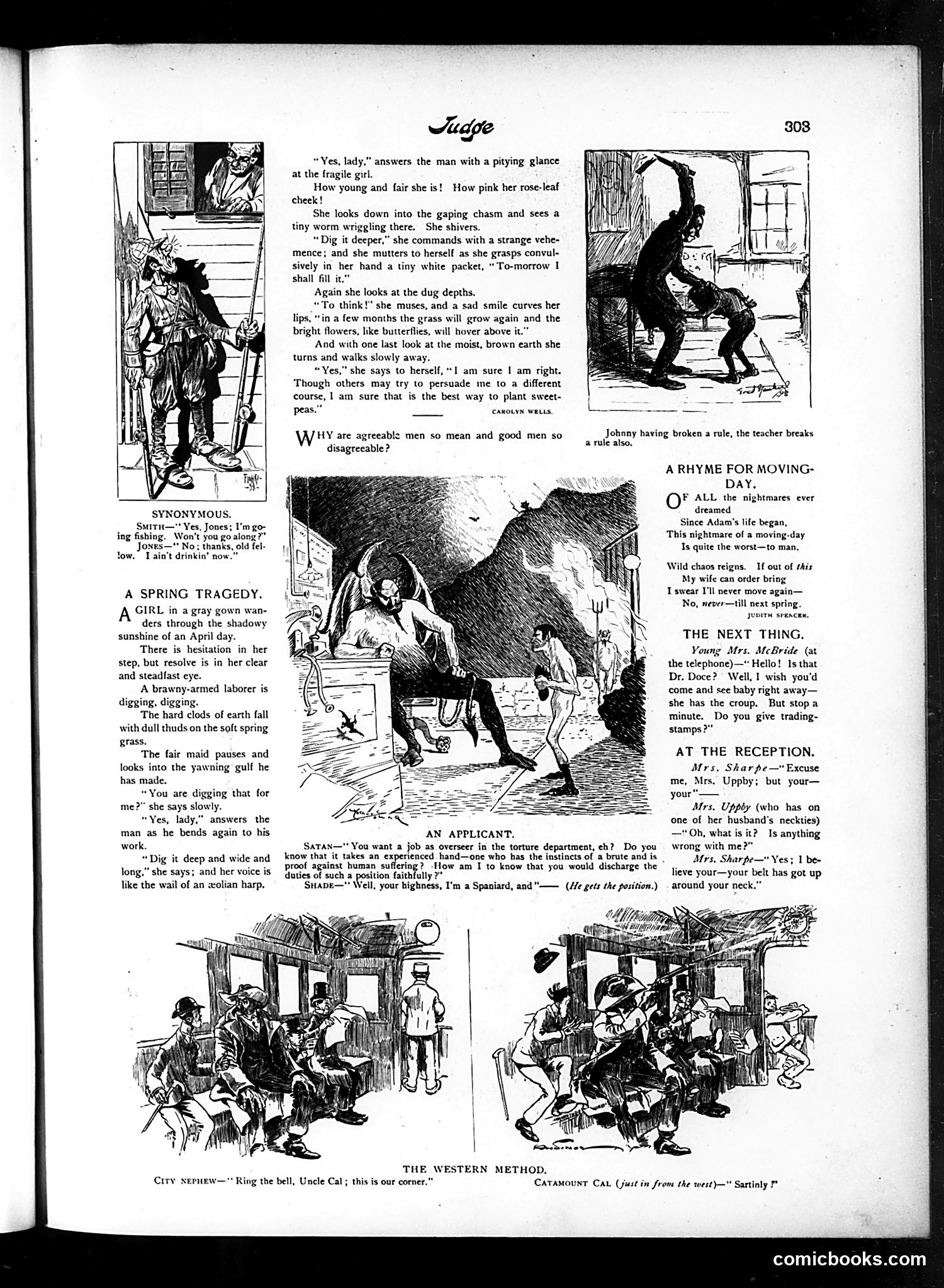
This page contains several satirical pieces typical of early 20th-century humor: **"A Spring Tragedy"** (by Carolyn Wells): A darkly ironic story. A young woman asks a laborer to dig a grave-like pit, appearing suicidal—but the twist reveals she's actually planning to plant sweet peas. The satire mocks melodramatic sentimentality and women's seemingly trivial concerns. **"Synonymous"**: A brief joke equating "going fishing" with "drinking," satirizing men's pretexts for avoiding sobriety pledges. **Other pieces** include gentle domestic humor about moving day frustrations, a phone call about baby's croup and trading stamps (mocking consumerism), and a woman wearing her husband's necktie to a reception. **"An Applicant"**: A darker piece where Satan interviews a Spanish applicant for torturer, suggesting ethnic stereotypes about Spanish cruelty—reflecting period prejudices. The page blends sentimental parody, domestic comedy, and sharper social commentary typical of Judge's satirical voice.
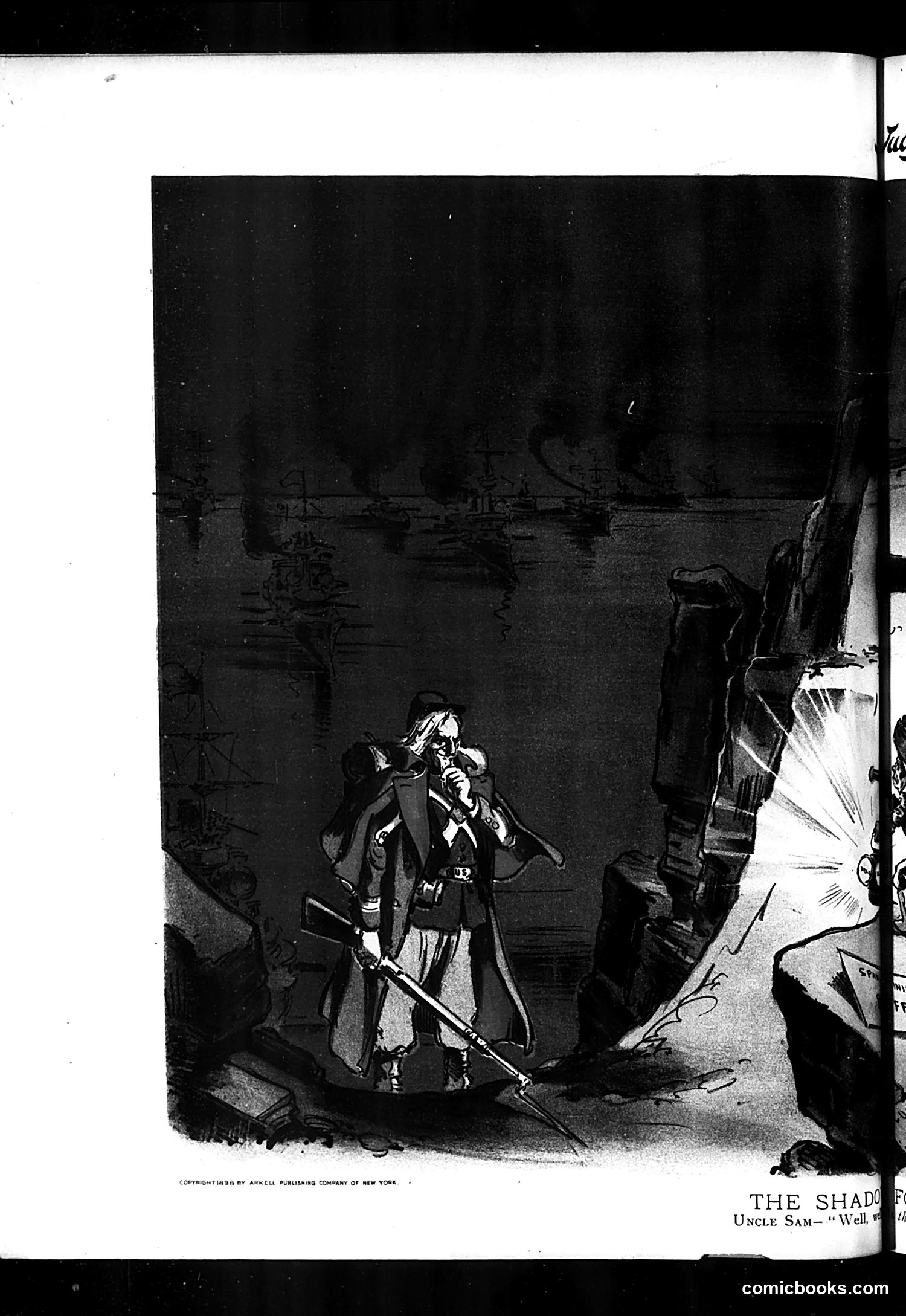
This appears to be a political cartoon titled "The Shadow," featuring Uncle Sam as the central figure. The incomplete OCR text suggests Uncle Sam is speaking, though his full statement is cut off ("Well..."). The composition shows Uncle Sam in a dramatic pose against a dark background, with what appears to be shadowy or ominous figures looming behind him. The artistic technique—strong contrast between light and dark—suggests the cartoon is commenting on hidden threats or concerns facing America (represented by Uncle Sam). Without the complete text or clearer historical context visible in the image, I cannot definitively identify what specific political situation or threat this references. The theatrical staging suggests anxiety about something unseen or dangerous lurking in America's future, typical of Judge magazine's satirical commentary on contemporary political concerns.
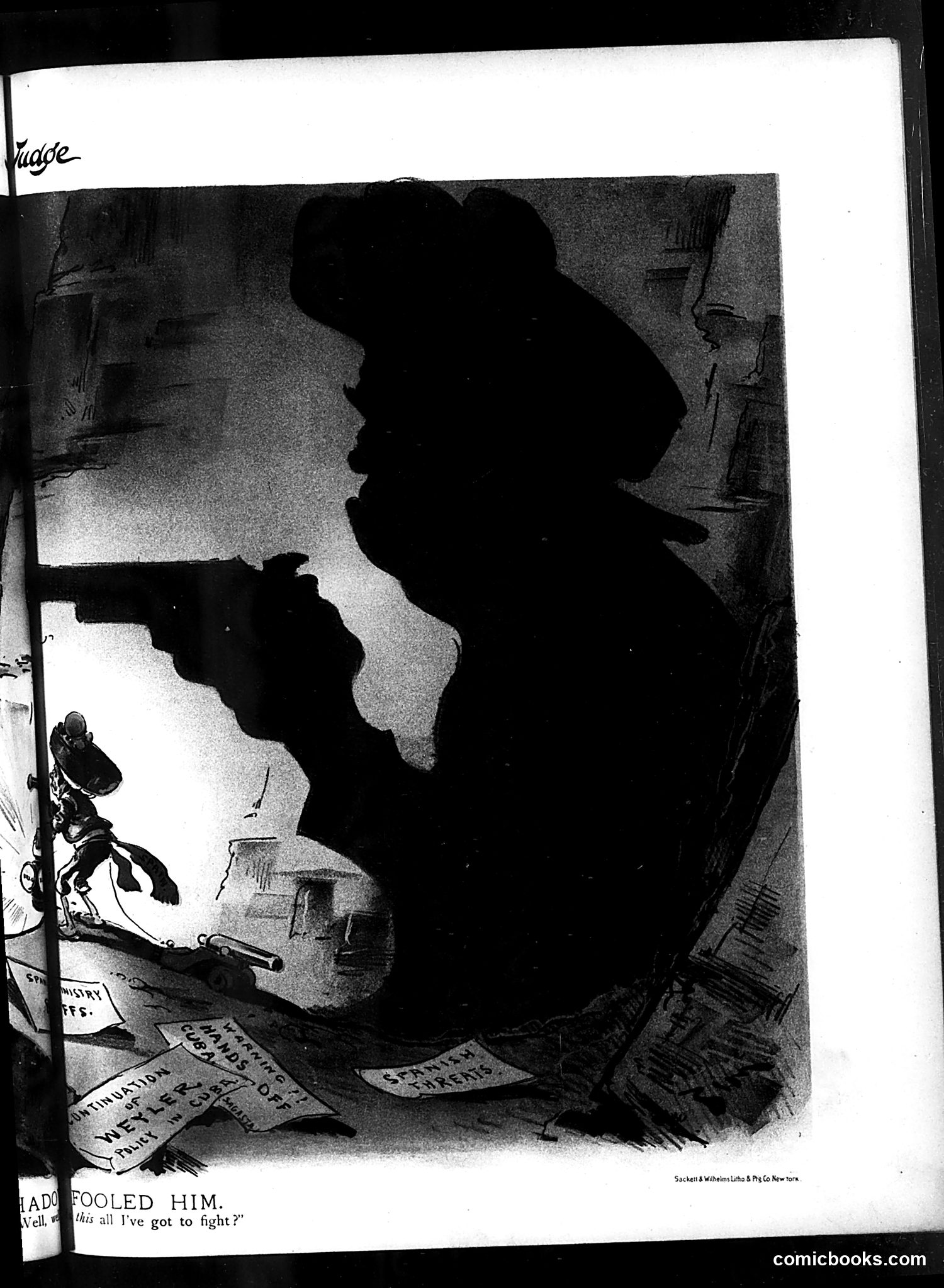
This appears to be a wartime-era satirical cartoon from *Judge* magazine, showing a silhouetted figure (likely representing an American soldier or citizen) confronting what looks like a German military figure, based on the Prussian-style helmet visible in profile. The caption "A Dub Fooled Him" with the quote "Vell, this all I've got to fight?" suggests the satire mocks an enemy commander's underestimation of American military capability or resolve. The "dub" (fool) appears to be the German figure, deceived about American strength. The scattered papers at the bottom likely reference military or governmental documents, though specific text is unclear. This is typical WWI-era American propaganda-tinged humor, mocking enemy miscalculation.
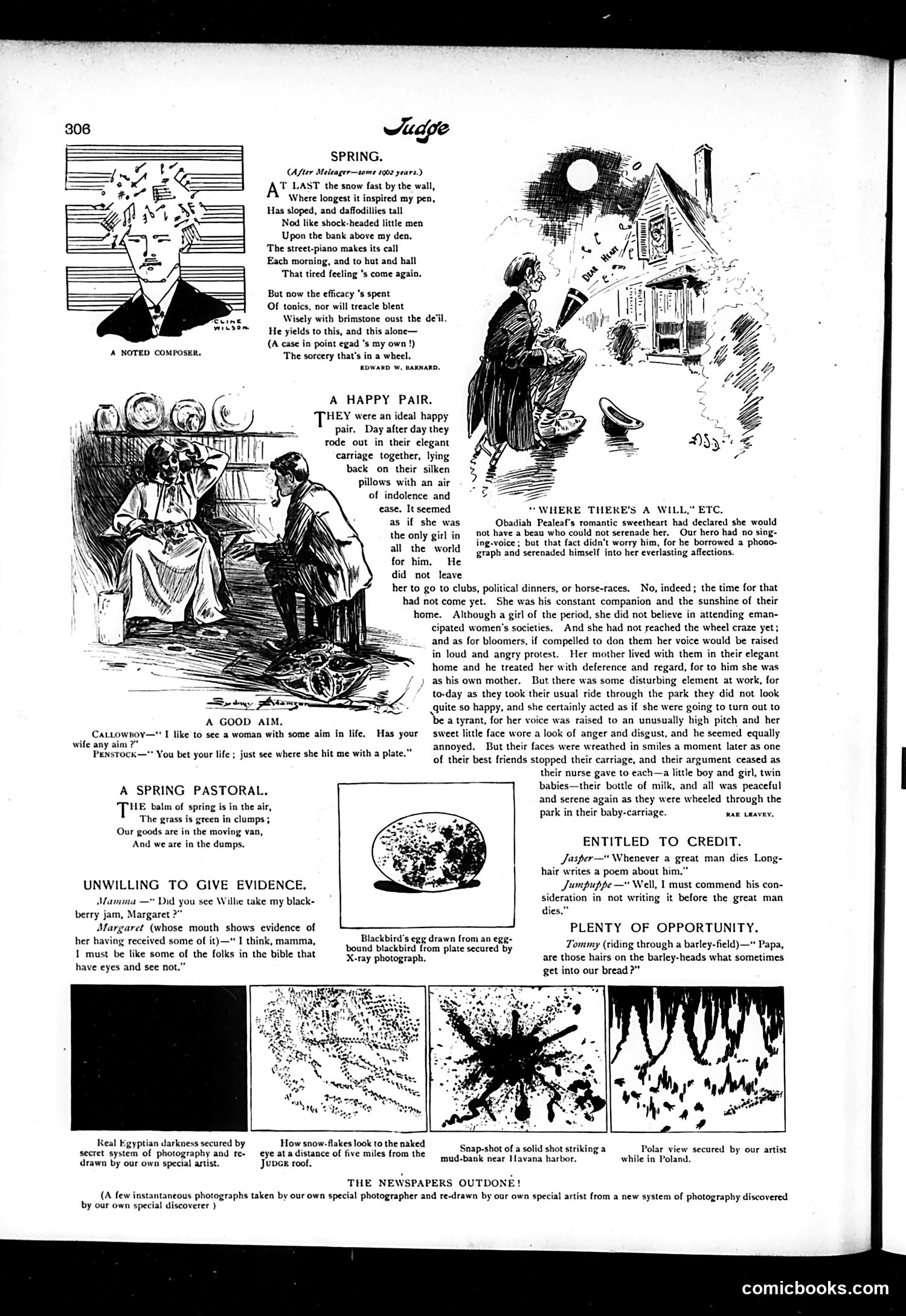
This is primarily a humor and literary page from Judge magazine, containing several short pieces: **Main Content:** - "Spring" by Edward W. Barnard: A poem about seasonal renewal and its psychological effects - "A Happy Pair": A satirical domestic sketch about an apparently ideal couple whose marriage briefly shows strain during a carriage ride, resolved when friends present them with twin babies—suggesting children are the ultimate marital solution - "A Good Aim": A brief joke about a wife's accuracy in throwing plates - "A Spring Pastoral": A humorous poem about moving house - "Unwilling to Give Evidence" and other short quips: Domestic humor involving wives and property **Social Commentary:** The pieces mock Victorian domesticity, particularly women's roles (noting the wife hasn't adopted "bloomers" or joined women's societies), marital tensions, and period anxieties. The humor is genteel rather than biting. **Bottom Section:** Technical photography demonstrations claiming to show special photographic innovations—likely advertising Judge's technical prowess or a related publication. The page reflects Edwardian-era attitudes toward marriage, gender roles, and domestic life.
This is an editorial essay defending cigarettes against public hysteria, not a cartoon. The author argues that cigarettes have been simultaneously treated as a joke and as a deadly menace—a paradox. The piece adopts the persona of a "jester" (referencing the cap-and-bells metaphor) to seriously debunk exaggerated health claims. It cites scientific analyses and expert testimony—chemists, a psychiatric hospital superintendent, coroners, and university professors—who found no evidence that cigarettes contain dangerous adulterants (opium, arsenic, hashish) or cause insanity or death. The essay mocks sensational newspaper headlines ("Crazed by 'Coffin-nails'") as baseless. It emphasizes that cigarettes contain only mild tobacco in pure paper wrappers. The author positions this defense within a "respectable, intelligent community" framework, using logic and evidence against what it characterizes as unfounded public fear.
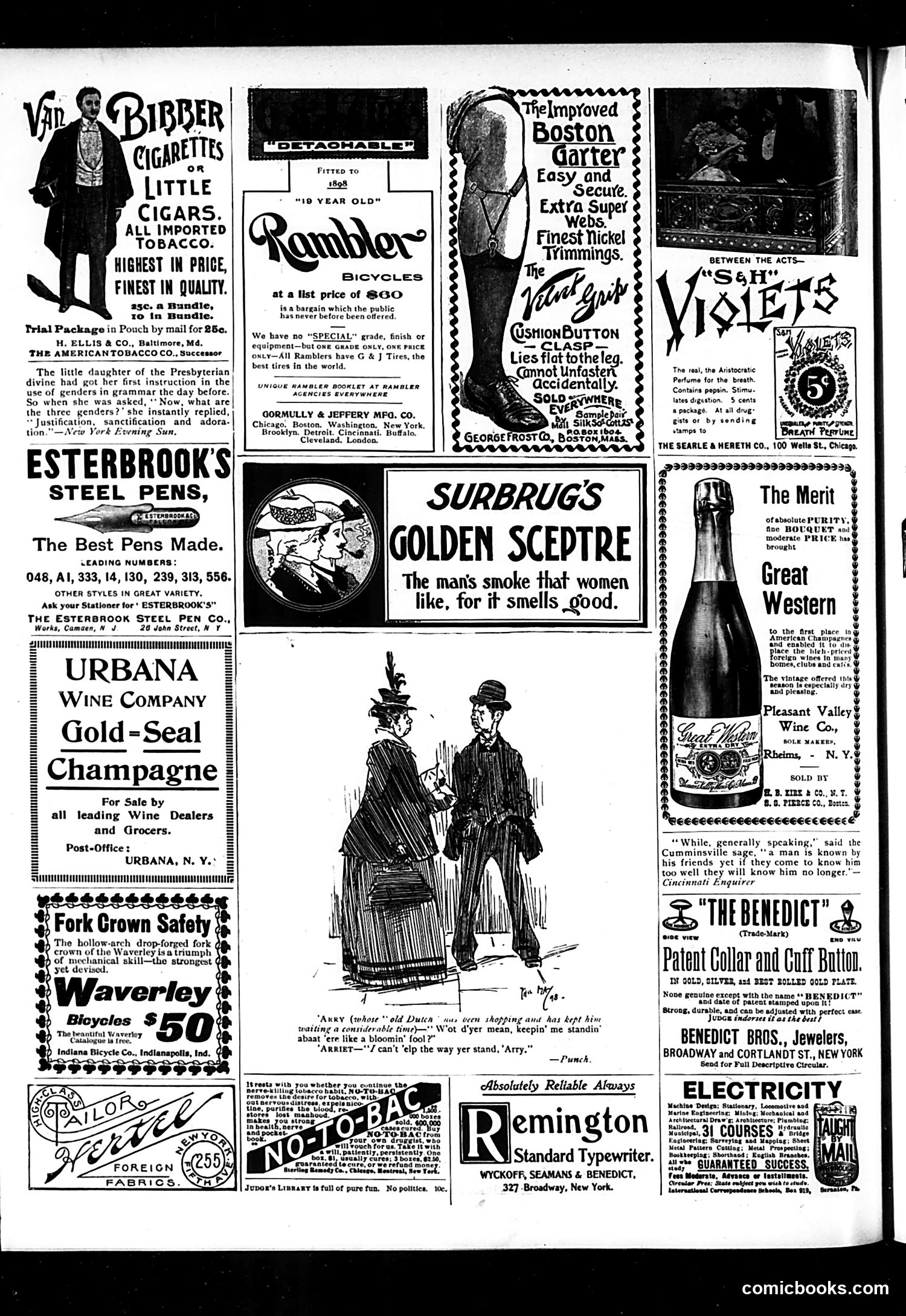
This is primarily a **vintage advertisement page** from Judge magazine, circa 1898, featuring products from the Gilded Age: cigarettes, bicycles, champagne, typewriters, and patent medicines. The only notable **cartoon** is a small Punch reprinting showing two working-class figures ("Arry" and "Arrriet") — he's impatient while she shops. The humor relies on period-specific class dynamics and British working-class dialect ("W'ot dyer mean"). A **text joke** about a Presbyterian minister's daughter confusing "gender" grammar instruction with actual biological sex appears in the upper left, typical of era humor based on innocence and prudishness. Otherwise, the page is dominated by **product advertising** emphasizing quality, price, and masculine/feminine appeals — champagne for elite wine drinkers, bicycles ($50, expensive for the time), "Golden Sceptre" cigars marketed as "a man's smoke that women like," and typewriters. The ads reveal period attitudes: women as consumers of luxury goods, mechanical innovation as progress, and social class distinctions clearly marked.
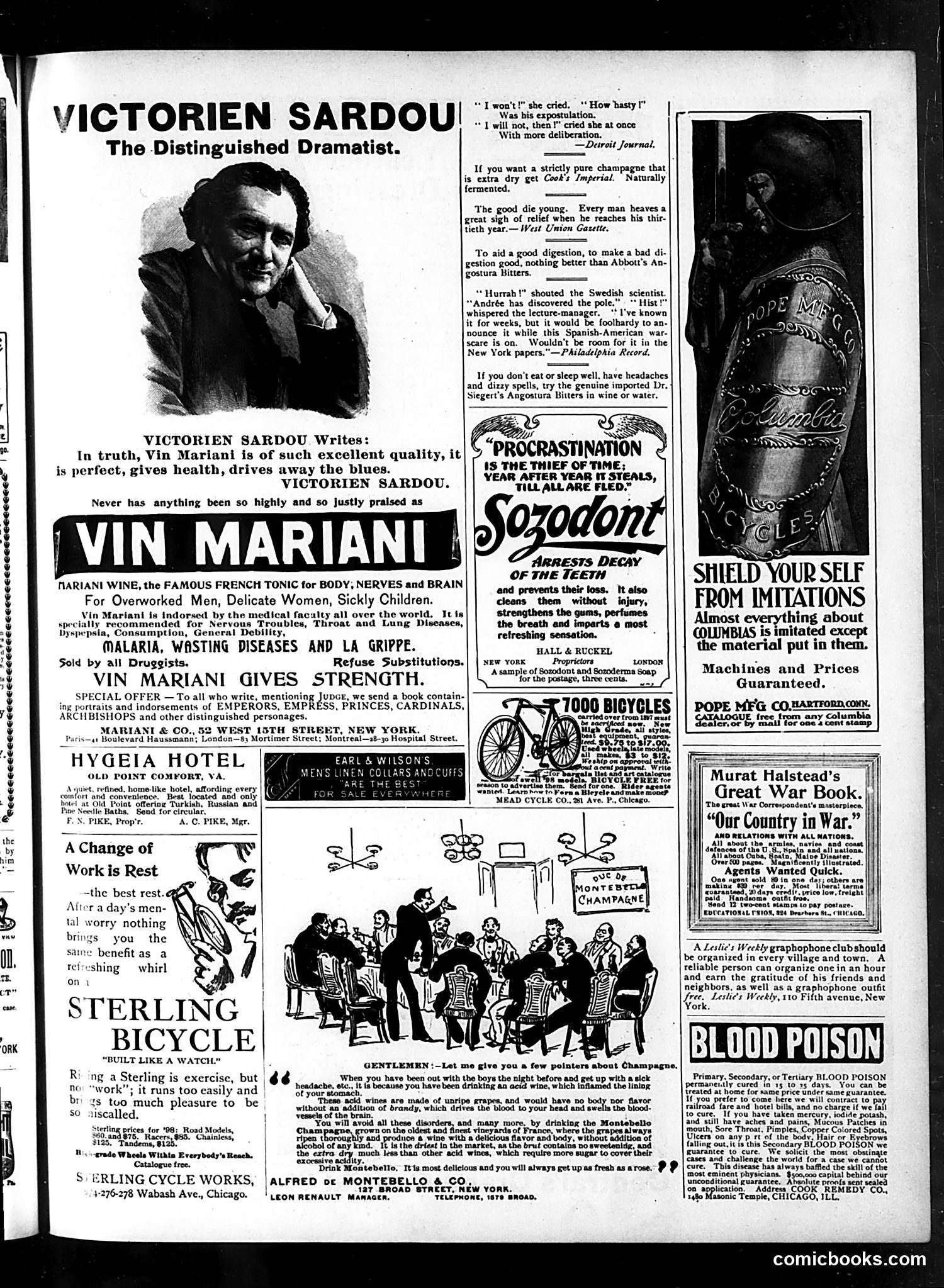
This Judge magazine page is primarily **a collection of advertisements**, not political satire. The centerpiece is a celebrity endorsement: French dramatist Victorien Sardou (a real, famous 19th-century playwright) praising **Vin Mariani**, a wine-based tonic marketed as a cure-all for nervous exhaustion, consumption, malaria, and general debility. The satire is subtle: Sardou's quote—"it is perfect, gives health, drives away the blues"—appears designed to mock the absurd medical claims of patent medicines popular in this era. The page includes scattered humorous snippets (a woman refusing her suitor "with more deliberation," a scientist's discovery suppressed for war news) alongside ads for bicycles, champagne, toothpaste, and treatments for blood poison. The implicit joke: these dubious "remedies" promise miraculous results with zero scientific basis, yet celebrities and supposed "medical faculty" endorsements lend false credibility. The champagne ad even satirizes hangovers' actual cause while promoting their own product. **Context**: This reflects the unregulated patent-medicine boom of the 1890s-1900s, before FDA regulation.
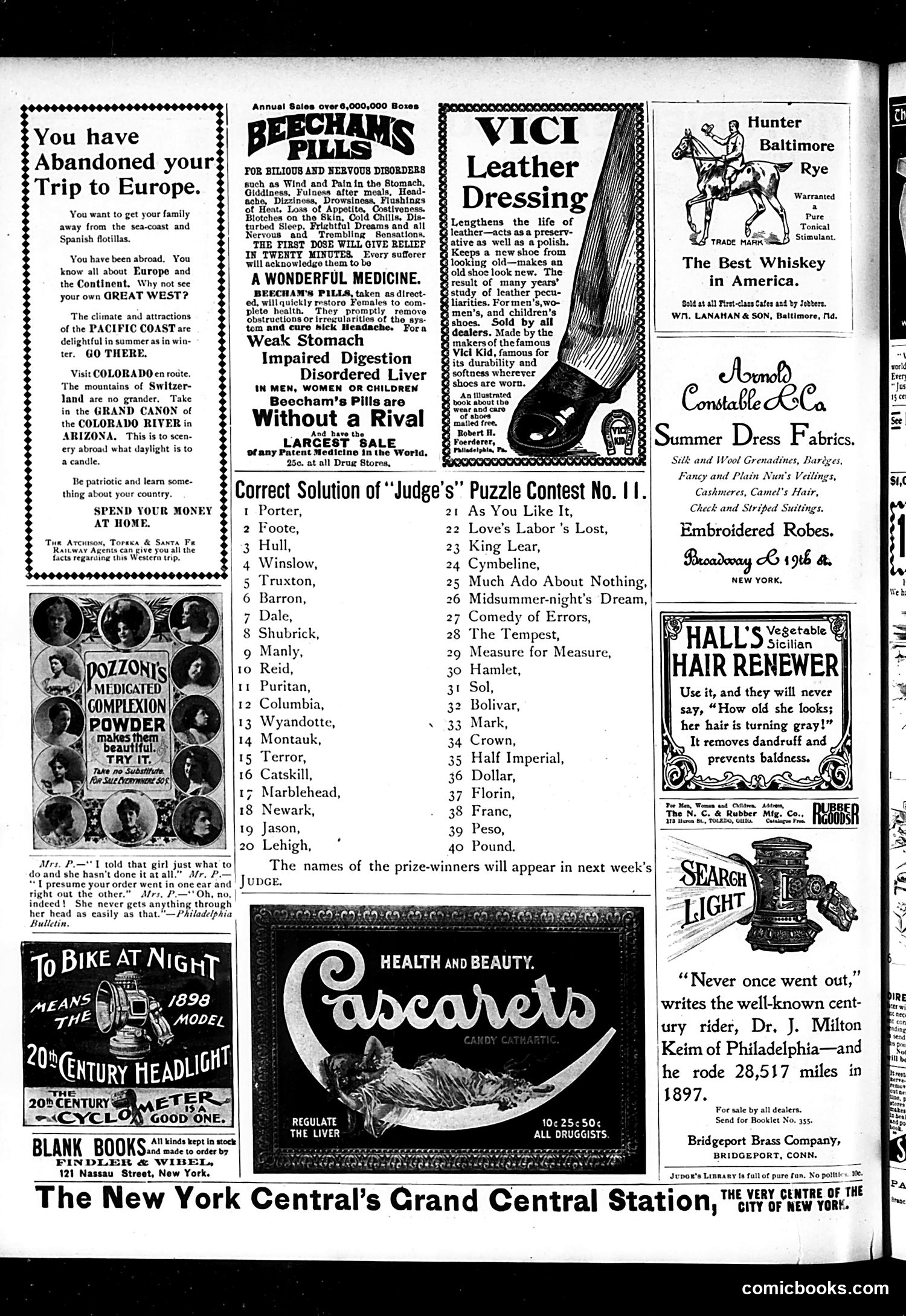
This page is primarily **advertisements and puzzle content** rather than political satire or editorial cartoons. The main advertorial content is a **tourism ad** encouraging Americans to visit the American West instead of Europe—likely referencing anxieties about the Spanish-American War (the text mentions "sea-coast and Spanish flotillas"). It promotes the Atchison, Topeka & Santa Fe Railway, positioning domestic travel as patriotic. The centerpiece is a **puzzle contest solution** listing Shakespeare play titles and currency denominations, with no visible satirical intent. The remaining content consists of **period product advertisements**: Beecham's Pills (patent medicine), Vici Leather Dressing, Hunter Whiskey, Hall's Hair Renewer, a bicycle headlight, and other consumer goods. These ads are typical of late-1890s magazines and reflect contemporary consumer culture—patent medicines claiming miraculous cures, hair treatments, and luxury goods aimed at middle-class readers. **No significant political cartoon or satirical commentary is present on this page.**
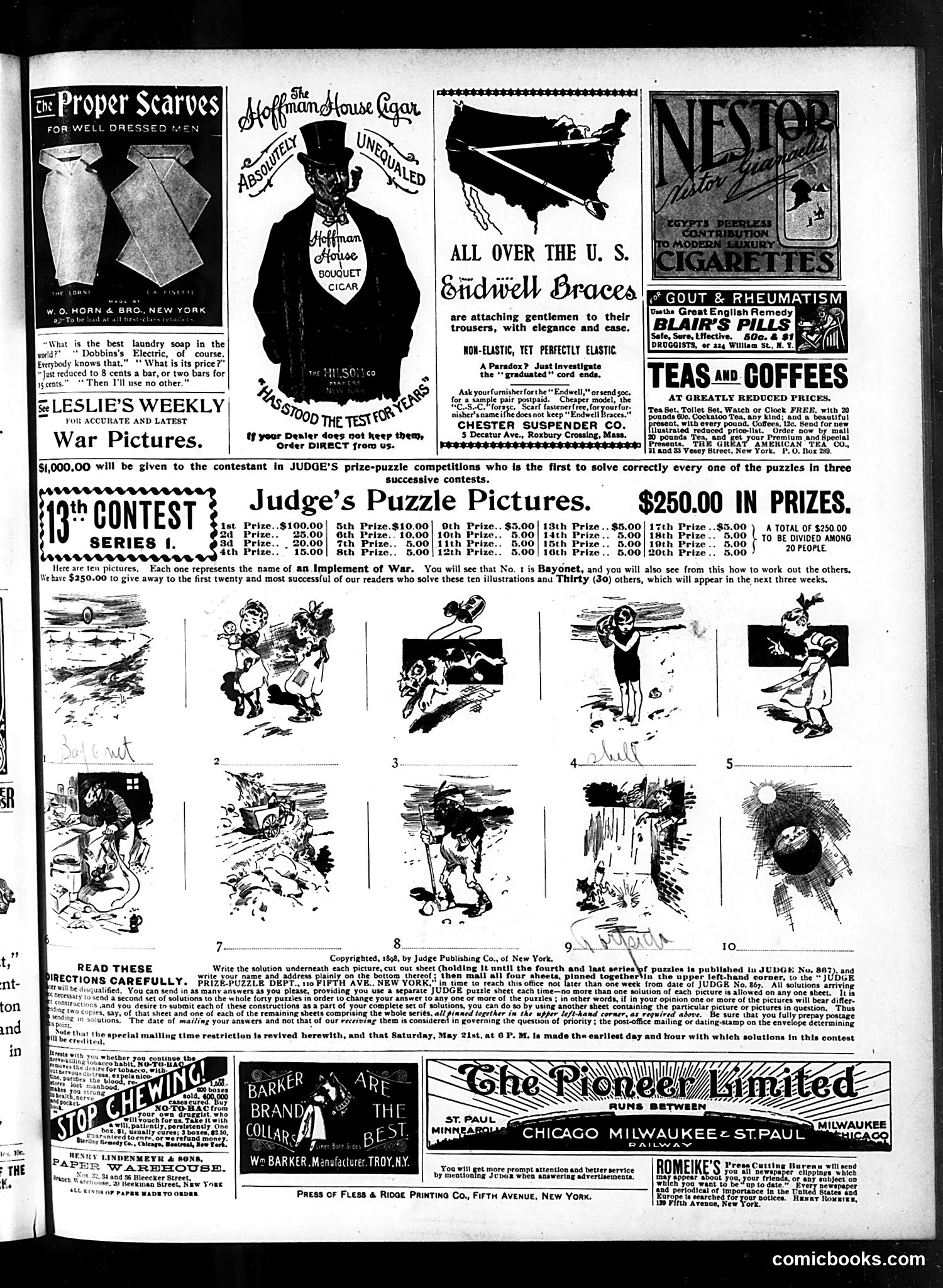
This page is primarily **advertising and a puzzle contest**, not political satire. The dominant feature is "Judge's Puzzle Pictures," a $250 prize competition (1898, based on copyright). Readers must identify ten illustrated "Implements of War"—the first is labeled "Bayonet," with nine others to solve. The contest offered substantial prize money ($100 first prize) across multiple rounds over three weeks. The surrounding advertisements are typical period product placements: laundry soap, suspenders, cigars, tea and coffee, and patent medicines (notably "Gout & Rheumatism Pills"). The page's header includes a caricatured figure for "Hoffman House Again" cigars—a large-nosed man in formal wear—but this appears to be product branding rather than political commentary. **No clear political satire or commentary is visible**. This is a commercial, entertainment-focused page from Judge's advertising sections.
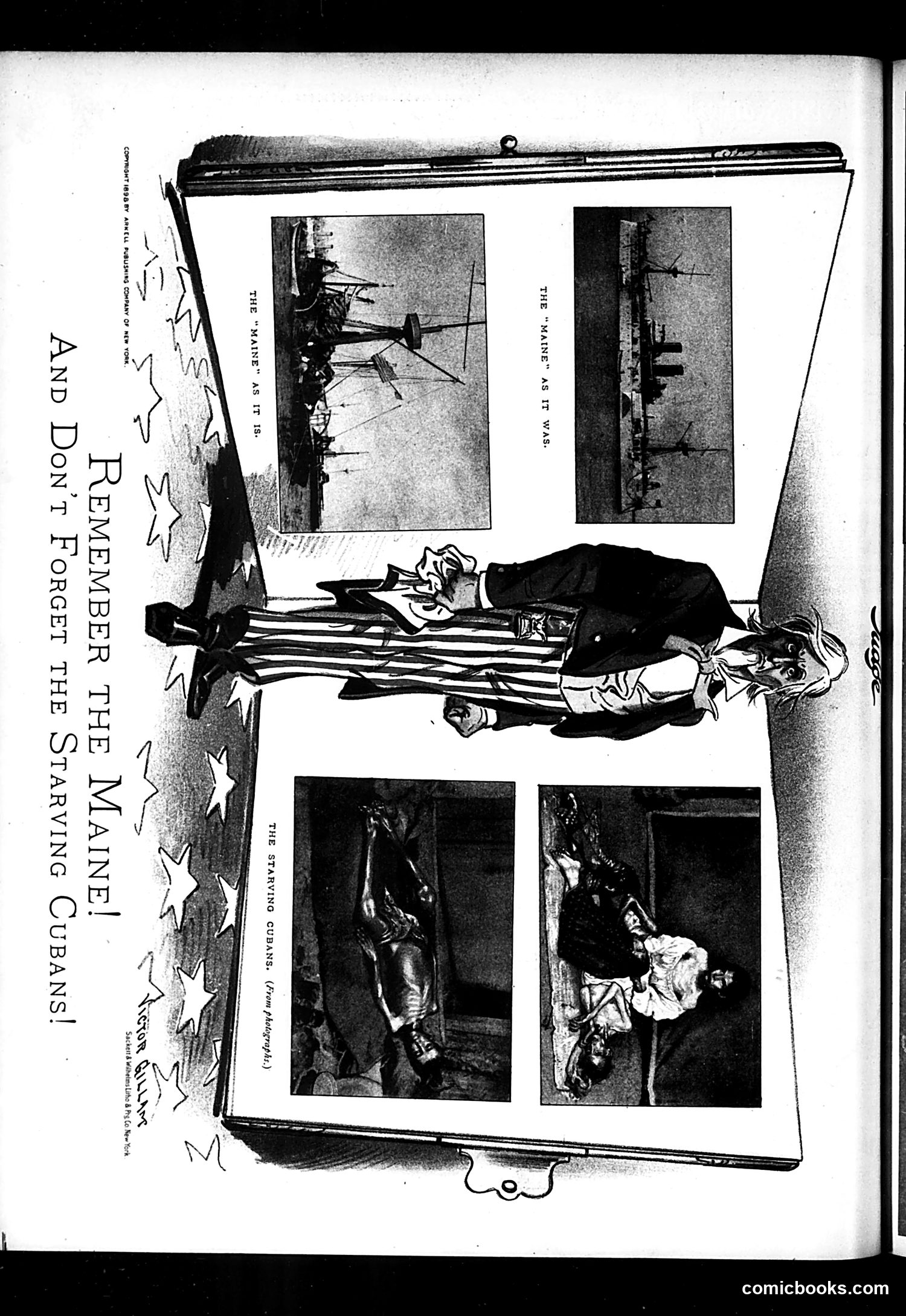
This Judge magazine page references the USS Maine explosion of February 1898, which precipitated the Spanish-American War. The top text "Remember the Maine!" was a war rallying cry used to mobilize American support against Spain. The central figure appears to be Uncle Sam (the striped-pants character), flanked by four photographs. The cartoon juxtaposes the Maine disaster with the stated concern for "starving Cubans"—the humanitarian justification for American intervention in Cuba's war for independence from Spain. The satire likely critiques American foreign policy: questioning whether intervention was genuinely motivated by humanitarian concern for Cuban suffering, or primarily driven by nationalist fervor over the Maine. The placement of these competing appeals suggests irony about the true motivations behind American military action.