
A complete issue · 18 pages · 1898
Judge — April 9, 1898
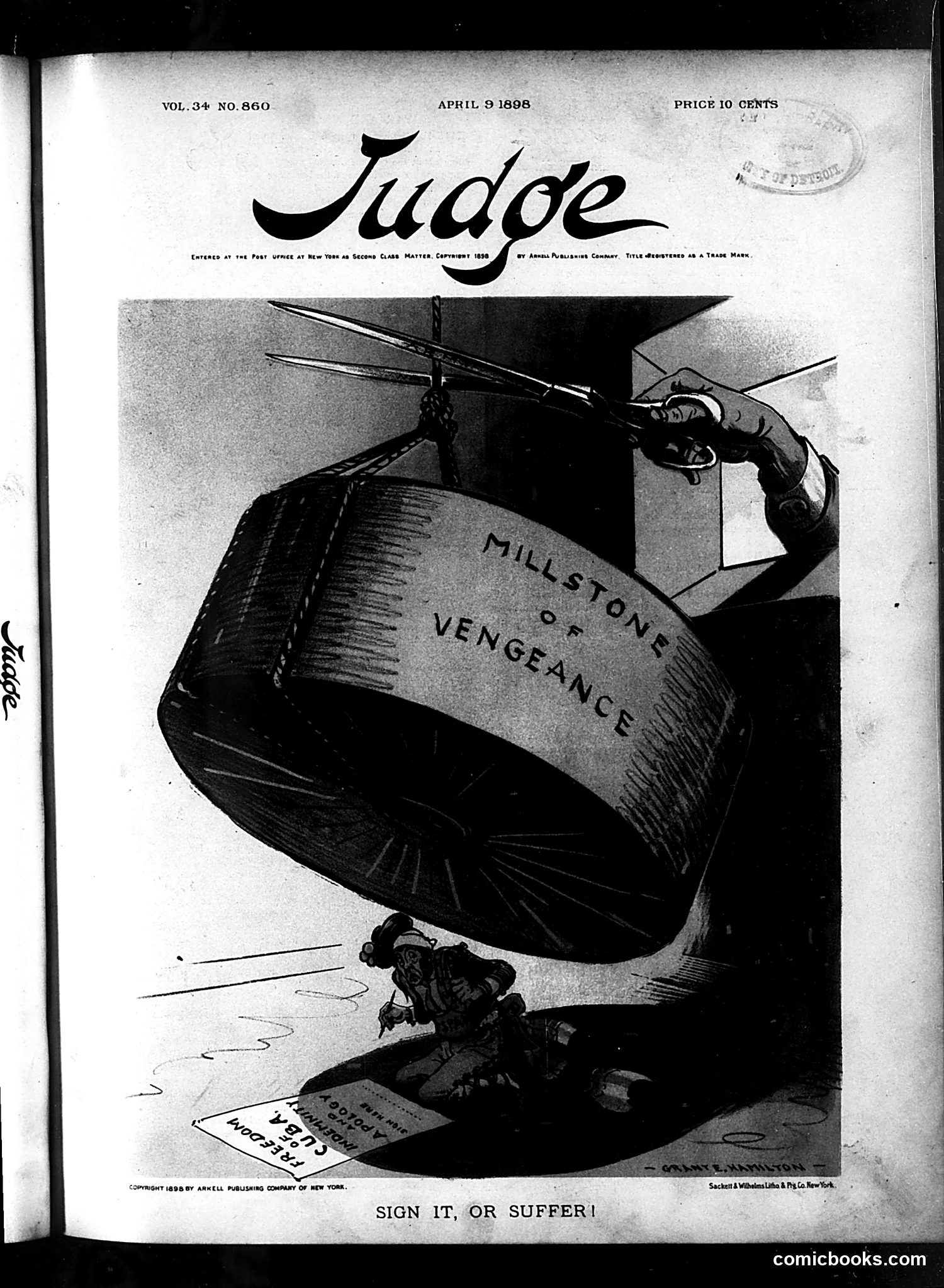
This political cartoon depicts a massive millstone labeled "Millstone of Vengeance" suspended above a cowering figure. The bottom text reads "Sign It, or Suffer!" The image appears to reference the Spanish-American War period (April 1898). The millstone represents military consequences or retribution threatening a figure below—likely representing either Spain or an American political opponent resisting war measures. The threatening tone ("or suffer") suggests coercion regarding a significant decision, probably the declaration of war or related legislation. The cartoon's message critiques either warmongering pressure on reluctant parties or foreign threats facing America. Without clearer identification of the threatened figure, the specific target remains somewhat unclear, though the contemporary context points to Spanish-American War tensions.
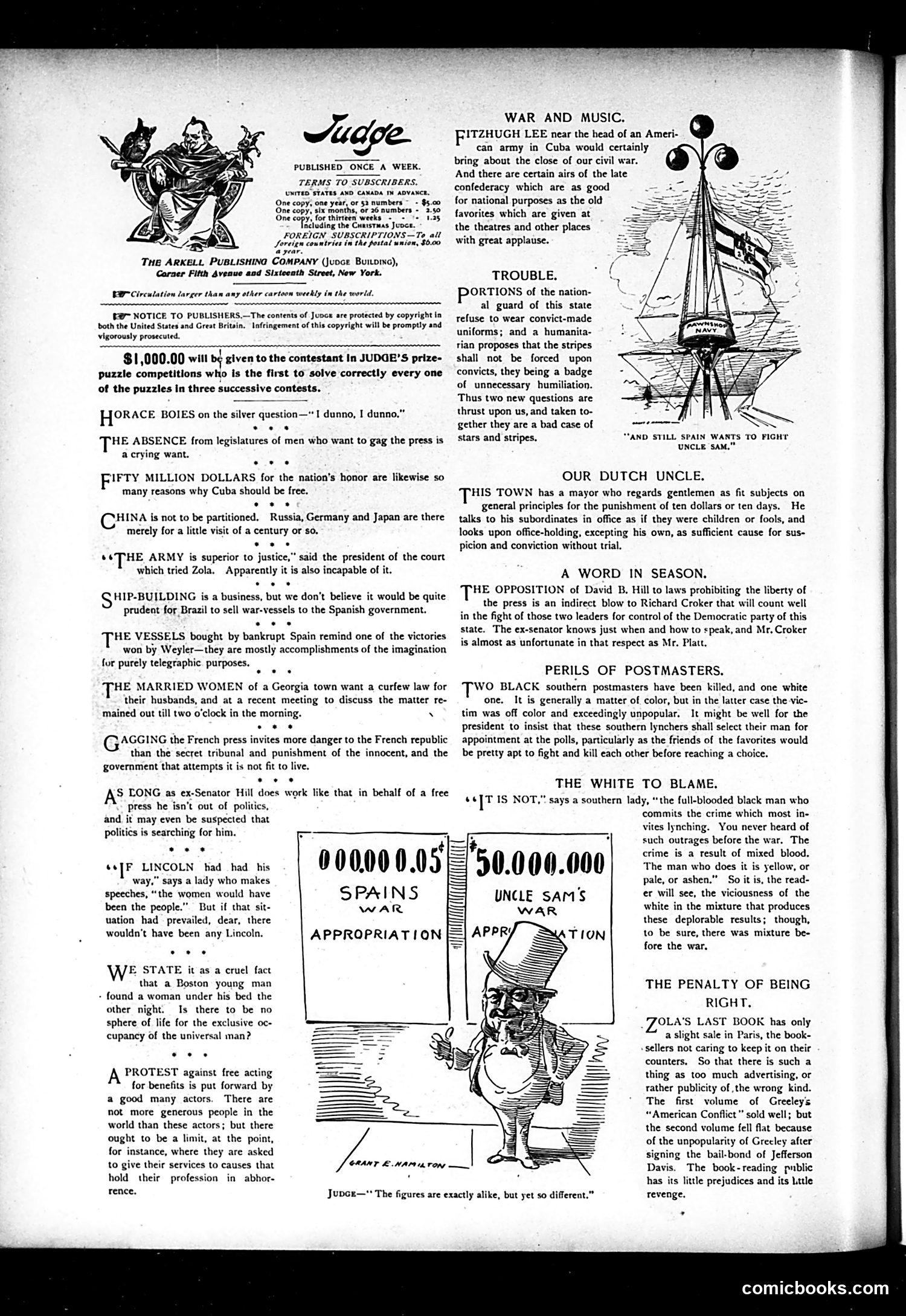
The central cartoon depicts **Uncle Sam** (identified by his distinctive tall hat) holding two pieces of paper labeled "Spain's War Appropriation" (0.05) and "Uncle Sam's War Appropriation" (50,000,000). The accompanying caption reads: "The figures are exactly alike, but yet so different." This satirizes the **Spanish-American War era** (likely 1898), comparing Spain's minimal military budget against America's massive $50 million appropriation. The cartoon mocks the disproportionate military spending, suggesting American military ambitions vastly exceeded Spain's capabilities. The artist is **Barry E. Hamilton**. The surrounding editorial content addresses related wartime issues: military uniforms, convict labor disputes, and post-war reconstruction debates—all contemporary concerns of the Spanish-American conflict period.
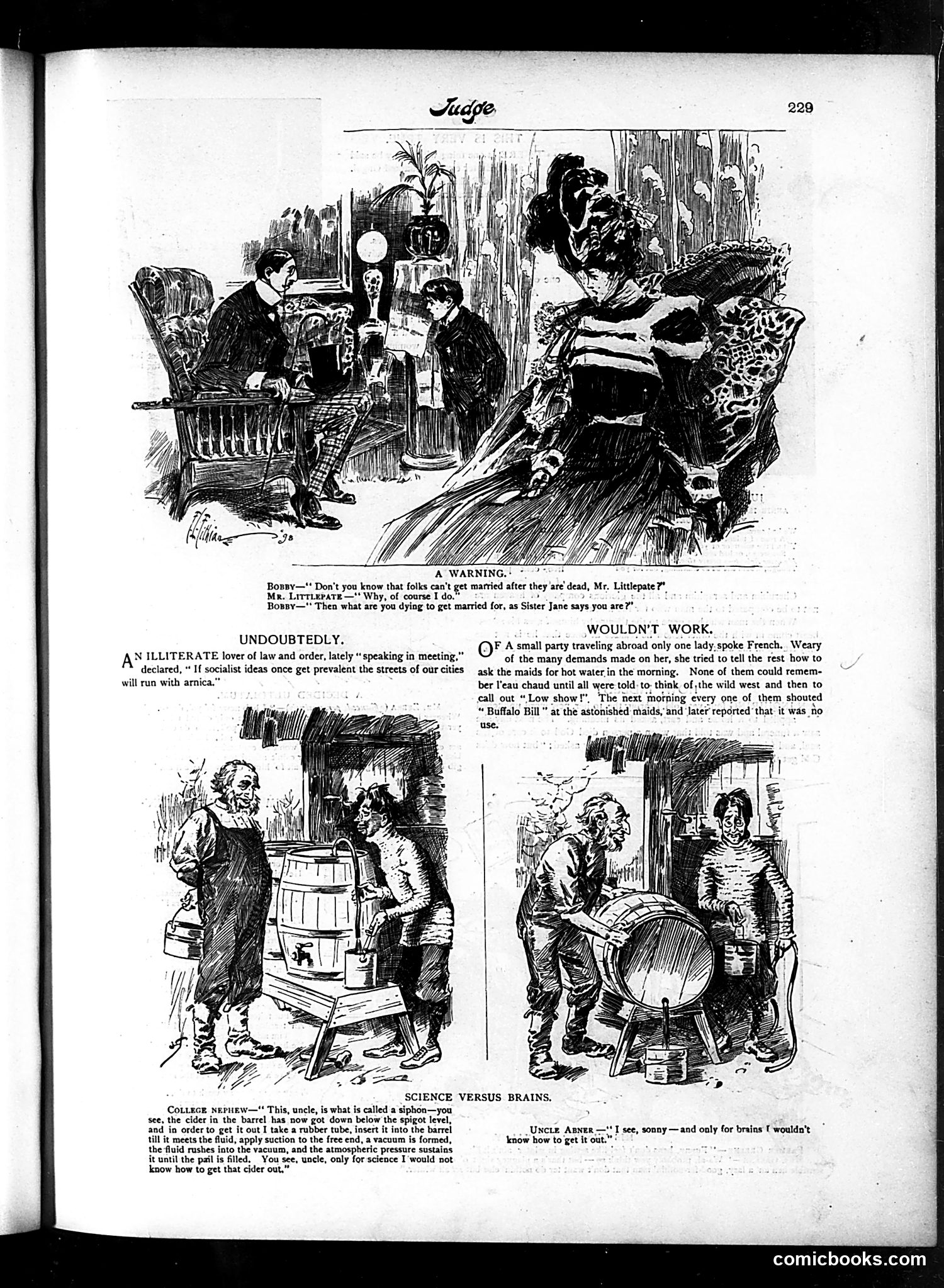
This page contains three separate satirical pieces: **"A Warning"** (top): Shows a domestic scene where a man warns about marrying after death, with a woman (appearing to be "Sister Jane") commenting on marriage prospects. **"Undoubtedly"** (middle-left): A brief text joke about an "illiterate lover of law and order" claiming legal ideas could prevent urban crime. **"Wouldn't Work"** (middle-right): Satirizes a French-speaking travel party whose demands for hot water frustrate maids, leading to absurd morning chaos and the phrase "Buffalo Bill" becoming a puzzling household command. **"Science Versus Brains"** (bottom): Shows an uncle explaining siphon mechanics to a nephew using a barrel, contrasting scientific knowledge with practical intelligence—the uncle admits he'd need brains (not science) to actually operate it. The humor relies on period domestic situations and class-based stereotypes typical of early 20th-century American satire.
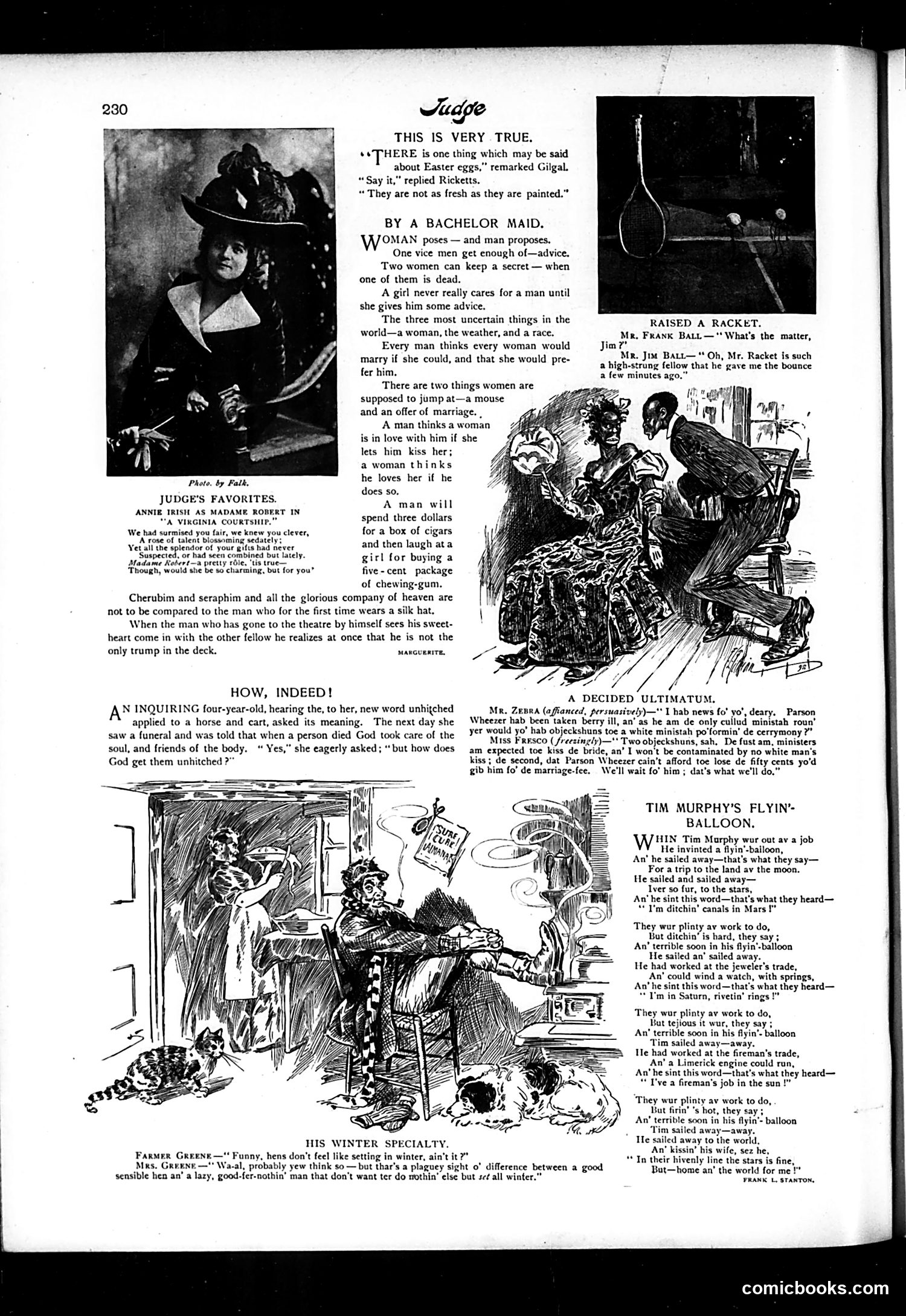
This page contains several humorous pieces satirizing early 20th-century social customs and gender relations: **"This Is Very True"** mocks conventional wisdom about women and relationships through cynical observations ("A girl never really cares for a man until she gives him some advice"). **"Raised a Racket"** depicts a domestic dispute over a bounced check, satirizing financial tension in marriage. **"How, Indeed!"** shows a child asking innocent theological questions about death and God, using childish logic for comic effect. **"His Winter Specialty"** presents farmer banter about livestock breeding, typical rural humor. **"Tim Murphy's Flyin'-Balloon"** is a poem about working-class trades and occupations. The cartoons generally satirize domestic life, class differences, and social expectations through exaggerated character types and situations common to early Judge magazine humor.
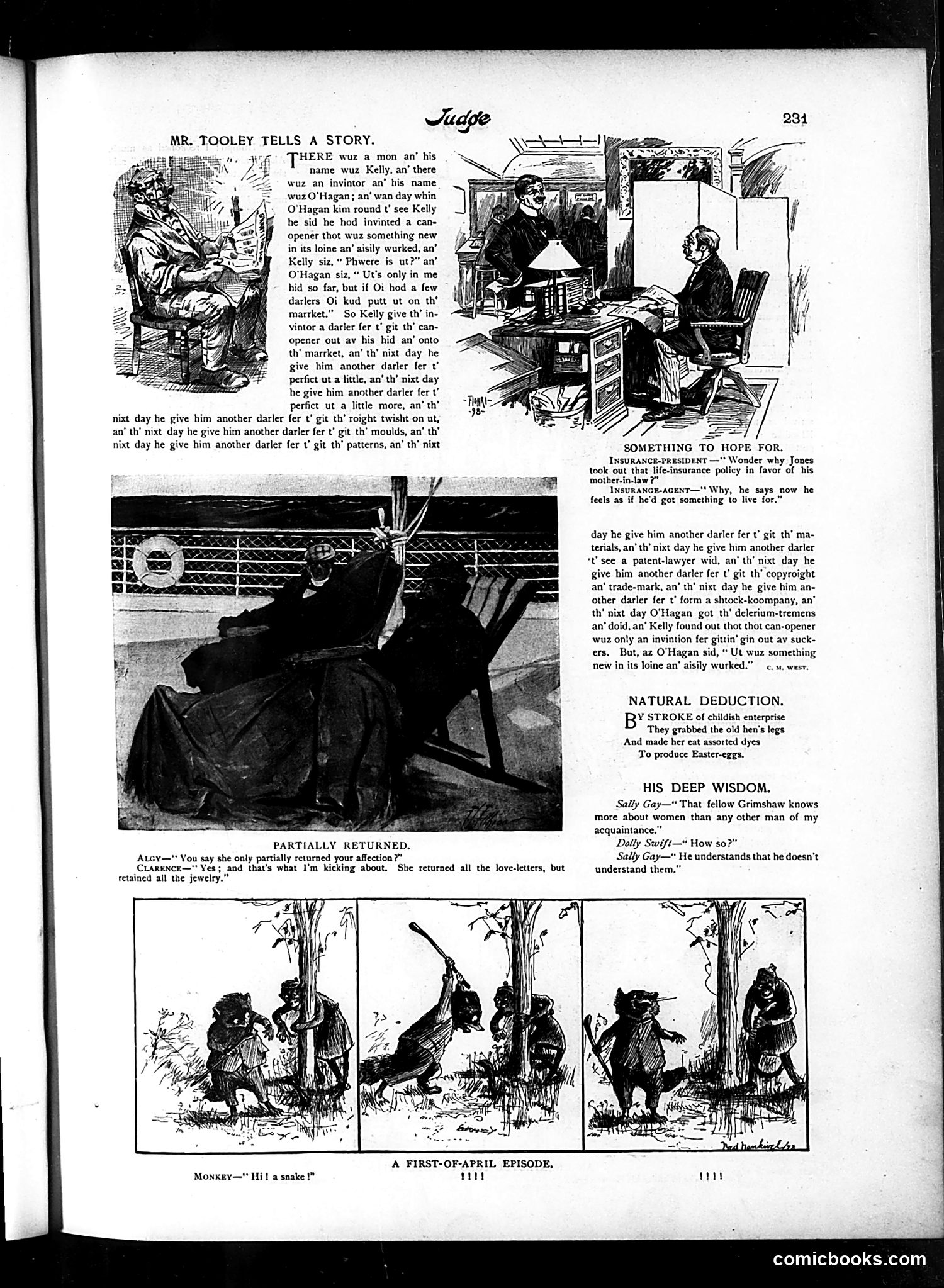
This page contains multiple satirical pieces targeting financial schemes and social follies: **"Mr. Tooley Tells a Story"** (main feature): A cautionary tale in Irish-dialect vernacular about an inventor (O'Hagan) pitching a can-opener to an investor (Kelly). The joke exposes a con: Kelly keeps funding the project through endless "improvements"—patent lawyers, stock companies, copyrights—until the inventor dies of alcoholism. The punchline reveals the can-opener was merely a scheme to extract money from gullible investors. This satirizes both dubious "invention" schemes and investor gullibility during the industrial era. **Secondary jokes** mock life insurance (a man insures himself to his mother-in-law as motivation to live), Easter commercialism (dyeing hens' legs), and masculine pretension about understanding women. **"A First-of-April Episode"** (bottom): A monkey's April Fools' prank with a fake snake, accompanying the page's theme of deception and foolishness. The overall message critiques financial fraud, speculative investment, and human credulity.
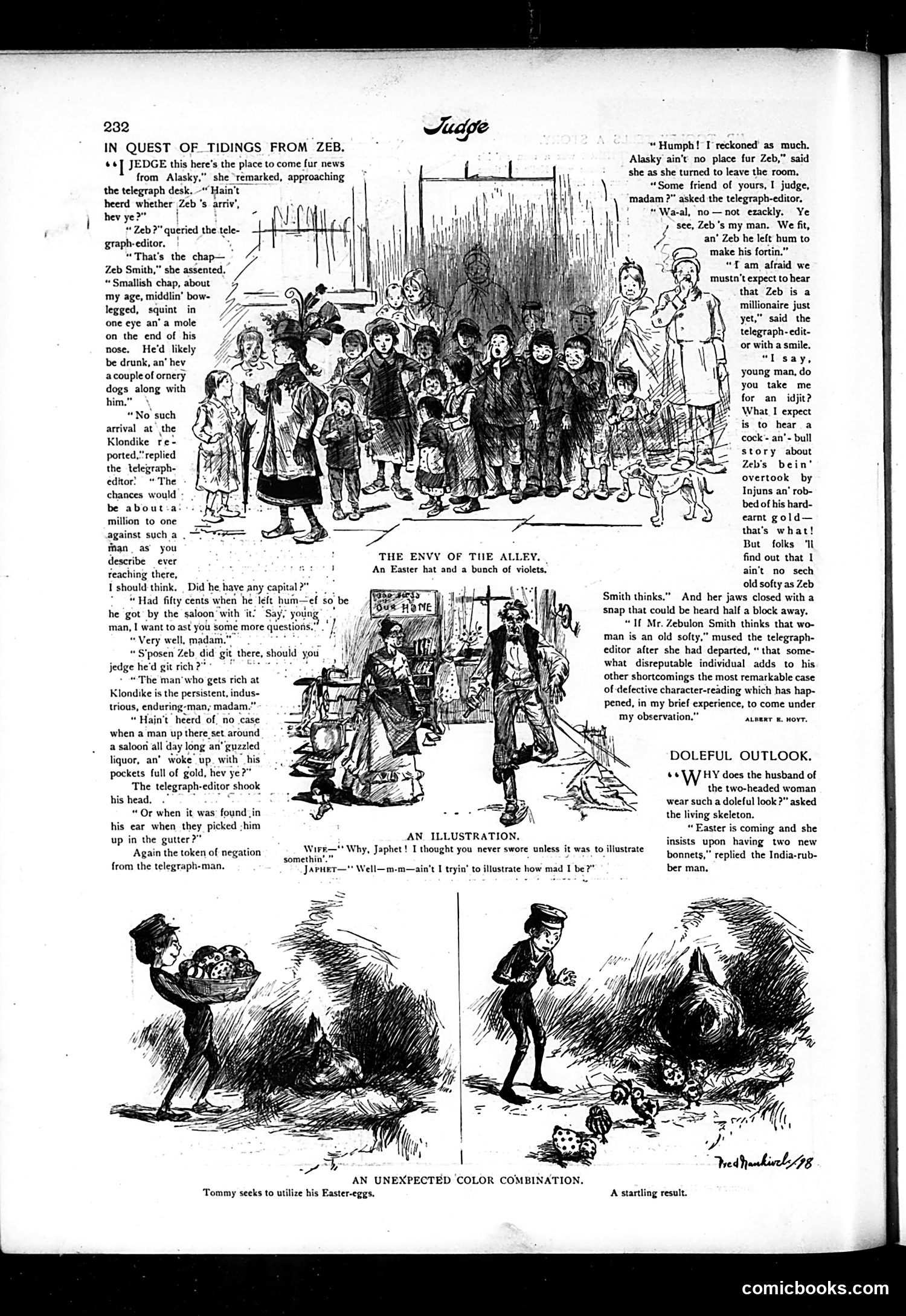
This page contains three separate humorous pieces satirizing turn-of-the-century American life: **"In Quest of Tidings from Zeb"** depicts a working-class wife at a telegraph office inquiring about her husband Zeb, who left for the Klondike Gold Rush with minimal prospects. The joke plays on her naive optimism—she expects him to either strike it rich *or* return with a fabricated tale of misadventure, yet doubts both outcomes. The telegraph-editor's sardonic observations about character judgment mock both the woman's credulity and the absurdity of gold-rush fever. **"The Envy of the Alley"** shows a street scene where poorer children covet a well-dressed girl's Easter bonnet and violets—status symbols marking class difference. **"An Unexpected Color Combination"** and the bottom cartoons depict a boy (Tommy) experimenting with Easter eggs, played for physical comedy. These pieces mock working-class aspirations, desperation during the gold rush, class consciousness, and domestic absurdities—all characteristic Judge magazine fare targeting middle-class readers with gentle ridicule of social pretension and foolishness.
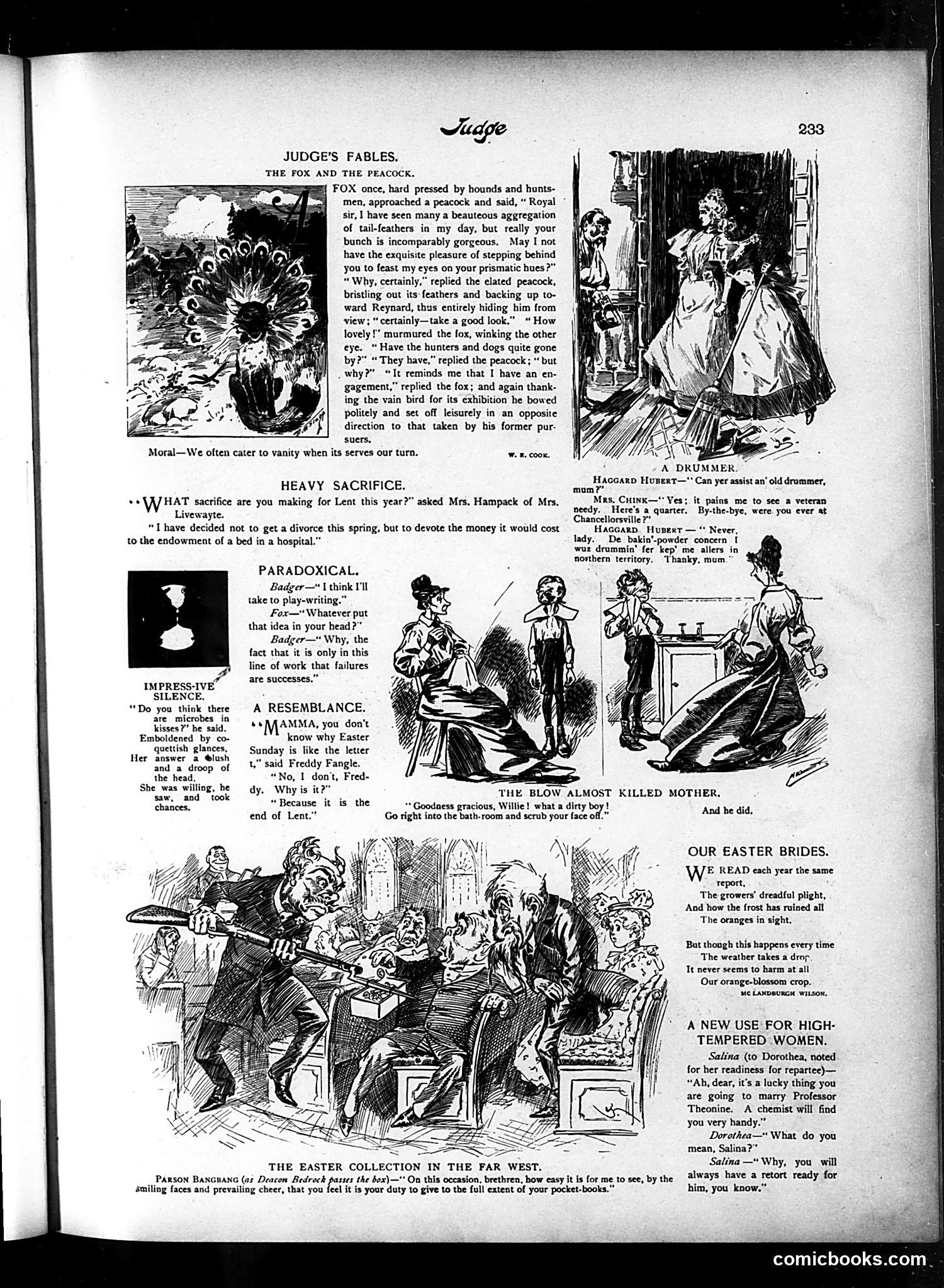
This page contains multiple satirical pieces typical of Judge's humor circa early 1900s: **"The Fox and the Peacock"** is a fable about vanity: a hunted fox flatters a peacock's tail feathers, using the vain bird as cover from pursuers, then escapes. The moral criticizes people who exploit others' narcissism for personal gain. **Other brief jokes** include: a woman sacrificing a potential divorce for charity (religious hypocrisy humor); a paradox about playwrights succeeding through failure; Easter seasonal gags about frost destroying oranges but not wedding flowers; and a "high-tempered woman" joke implying hot-headed wives are chemically useful. **"Easter Collection in the Far West"** satirizes rural generosity, with a pastor noting congregants' cheerful donations suggest they can afford more. The humor targets vanity, religious pretense, gender stereotypes (particularly women's temperaments), and rural/frontier stereotypes. Most jokes rely on wordplay and ironic observations rather than specific political references—they're social commentary presented as timeless fables and domestic anecdotes.
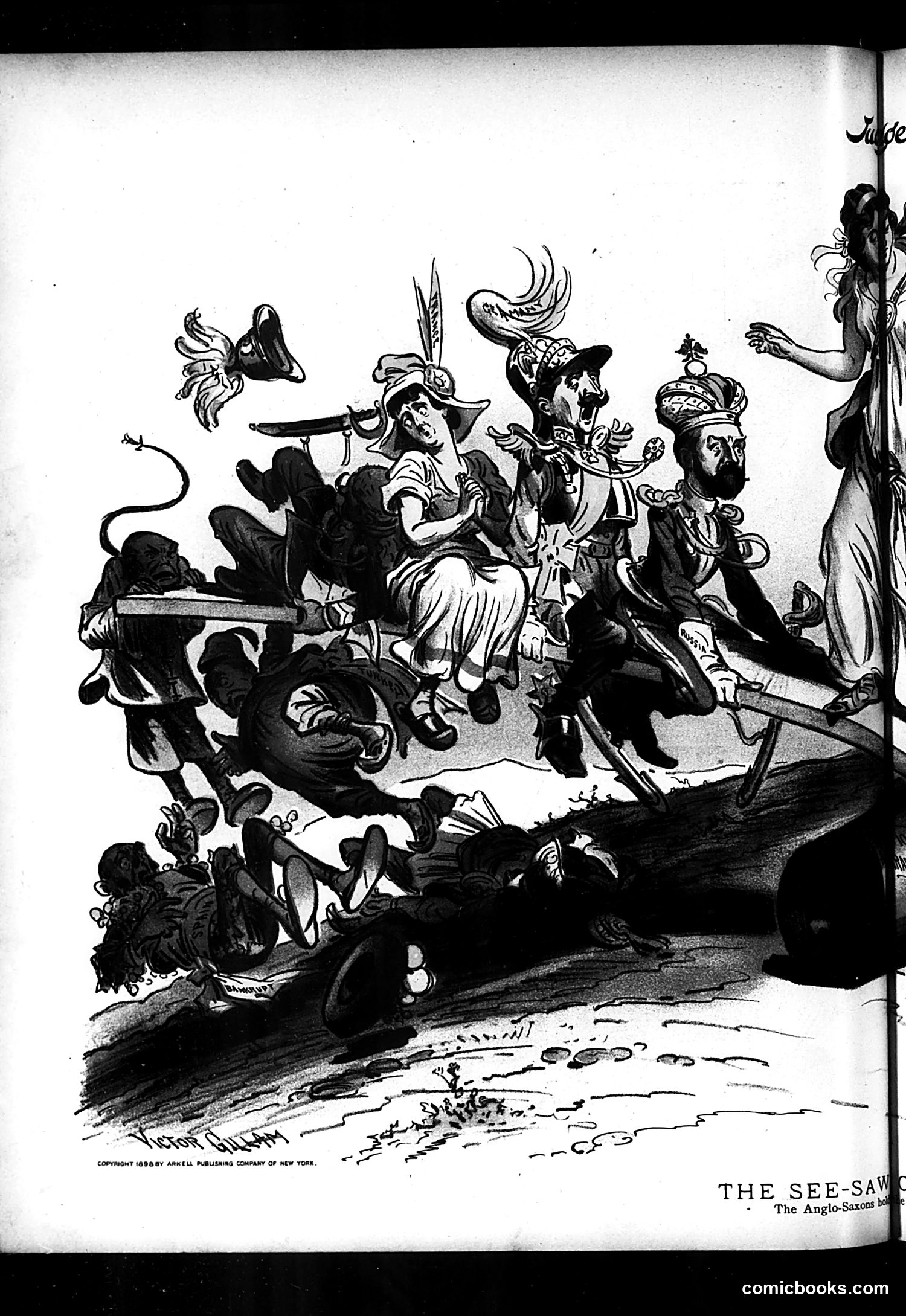
This political cartoon satirizes Anglo-Saxon imperial powers, likely British and American, depicted as figures on a seesaw. The exaggerated caricatures—some wearing military dress and crowns—appear to represent political or military leaders engaged in a precarious balancing act. The chaotic composition, with figures in awkward positions and what seem to be weapons or imperial regalia, suggests instability in Anglo-Saxon dominance or colonial ambitions. The title's wordplay on "see-saw" implies these powers are in volatile competition or mutual dependency rather than stable control. The grotesque style is typical of *Judge* magazine's satirical approach to critiquing imperial overreach and geopolitical tensions. Without a visible date, the specific historical moment remains unclear, though the imagery suggests commentary on early-20th-century imperial rivalries.
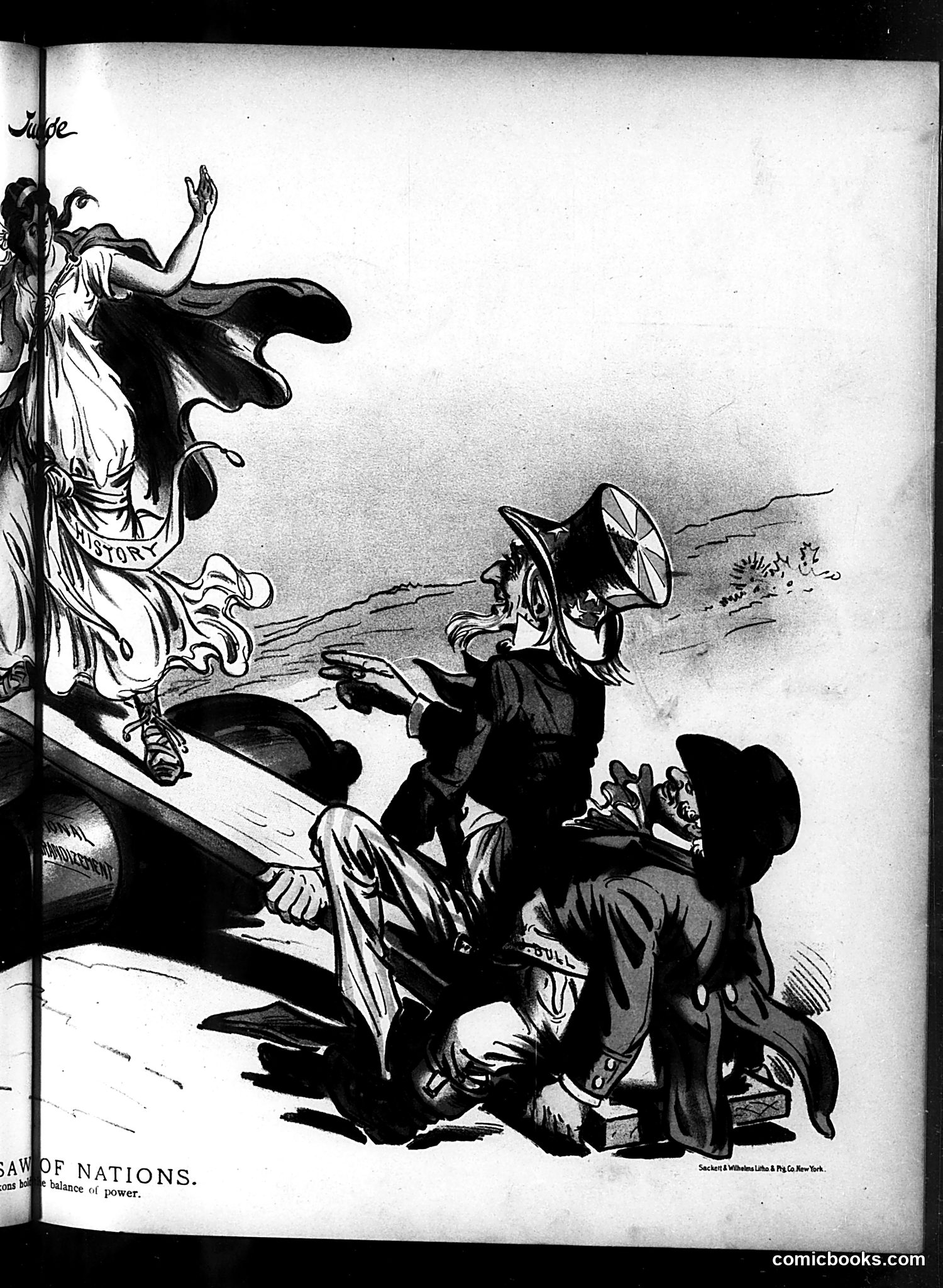
This political cartoon depicts **Lady Justice** (allegorical figure, left) observing three figures below who appear to be national representatives or politicians engaged in a precarious balancing act. One figure holds what looks like a **megaphone or trumpet**, suggesting propaganda or loud political rhetoric. The composition emphasizes instability—the figures seem to be struggling to maintain equilibrium while Lady Justice watches from above. The title "The Balance of Nations" and reference to "balance of power" suggests this critiques **international diplomacy or geopolitical tensions**, likely from the early-to-mid 20th century given Judge magazine's era. The cartoon satirizes how nations maintain fragile power equilibrium through rhetoric and negotiation, with the implication that this balance is precarious and easily disrupted. The specific historical context remains unclear without additional dating.
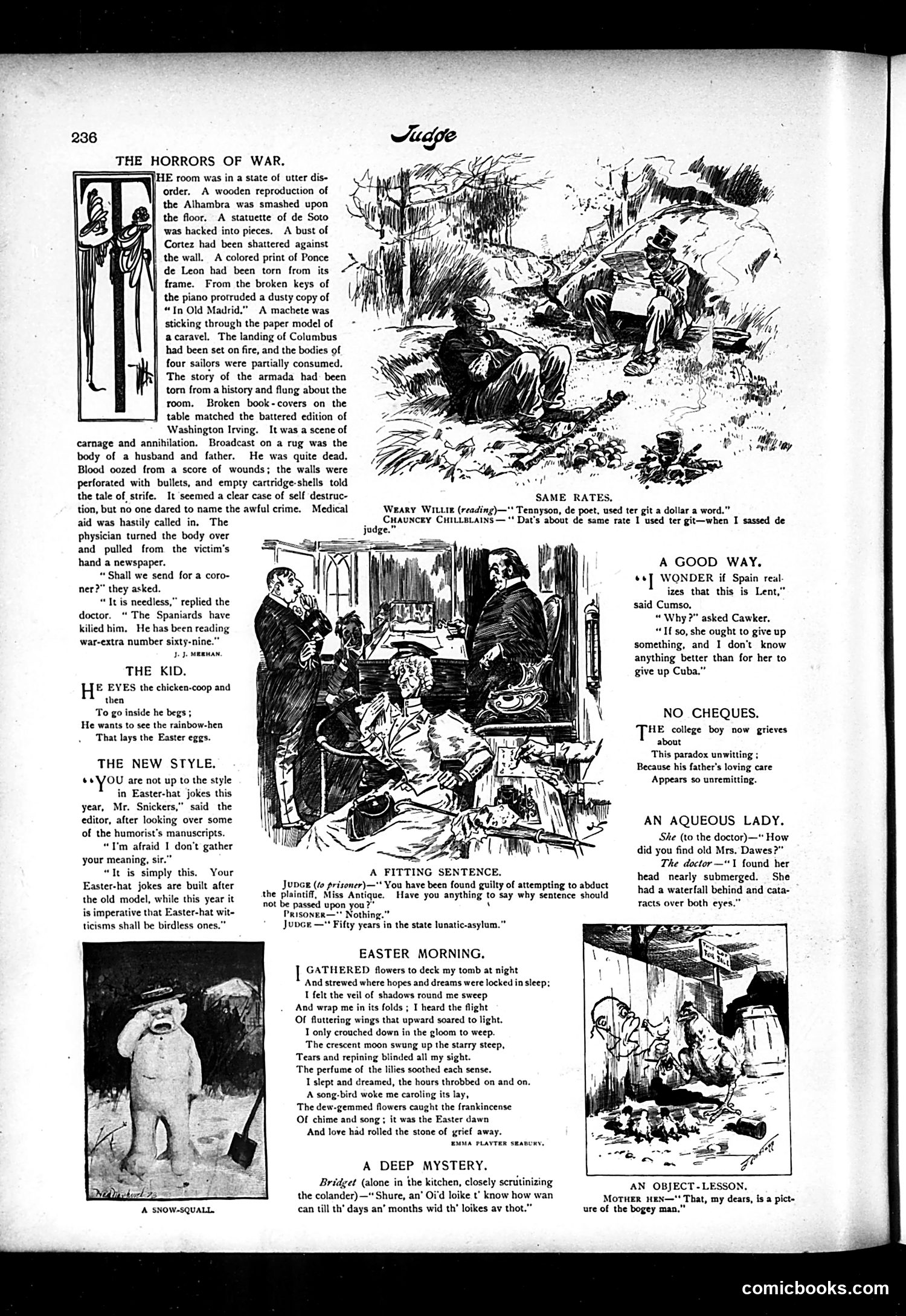
This page from *Judge* contains satirical commentary on the Spanish-American War (likely 1898), mixed with unrelated humor pieces. **"The Horrors of War"** is the dominant political cartoon. It depicts a destroyed room filled with Spanish colonial artifacts—models of the Alhambra, statues of conquistadors, books about Spanish history—all smashed to pieces. A dead body lies in the wreckage. The satire mocks American jingoism: the "horrors" aren't actual war casualties but the destruction of Spanish cultural symbols, suggesting Americans' obsessive focus on destroying Spanish heritage rather than addressing real human suffering. The dark joke criticizes the war's propagandistic framing. **"A Good Way"** directly references Cuba: a character suggests Spain should "give up Cuba" for Lent, sarcastically implying Americans view the conflict as a moral crusade rather than imperial conquest. **Other pieces** are unrelated Easter humor and light social satire about fashion and college life—typical filler material for the magazine. The page reflects *Judge's* contemporary skepticism toward the war's righteousness, using visual and verbal irony to critique American imperial ambitions.
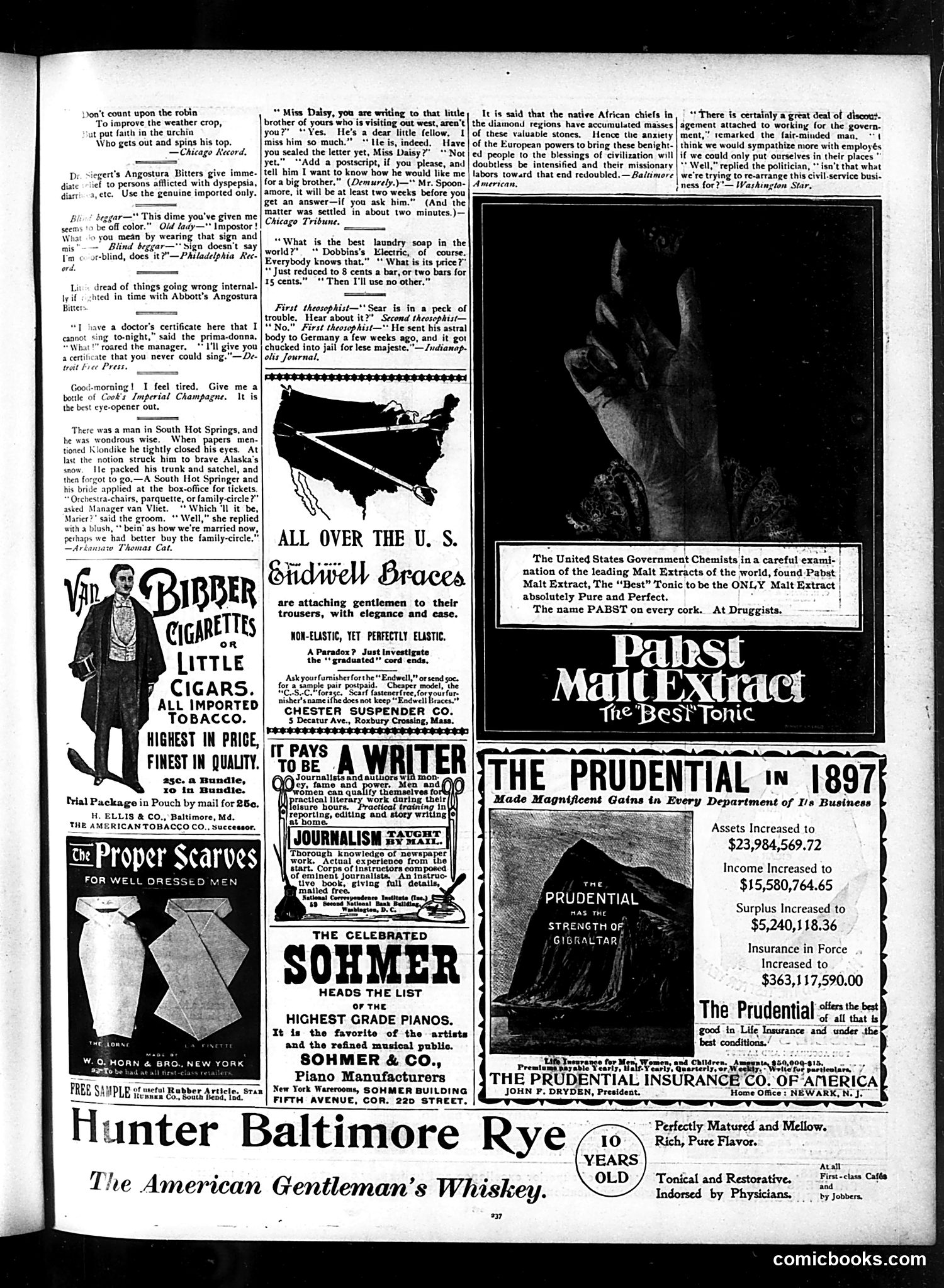
This page is primarily **advertisements and humor snippets** rather than a coherent cartoon. The content includes: **Advertising dominates**, featuring products like Van Bibber Cigarettes, Hunter Baltimore Rye whiskey, Pabst Malt Extract, and piano manufacturers—typical of 1890s Judge magazine layout. **Short humor items** scattered throughout mock various targets: a blind beggar's deception, a prima donna's excuses, a Klondike gold-rush coward, and newlyweds choosing "family-circle" seating. **One substantive commentary** appears discussing African chiefs accumulating diamonds and European powers exploiting them under the guise of "civilization"—a contemporary critique of colonial imperialism and its justifications. **The Prudential Insurance advertisement** occupies significant space with financial statistics. Overall, this reflects Judge's format: satirical social humor mixed with period advertisements, rather than focused political cartooning. The scattered jokes target pretension, hypocrisy, and romantic absurdity typical of 1890s American society.
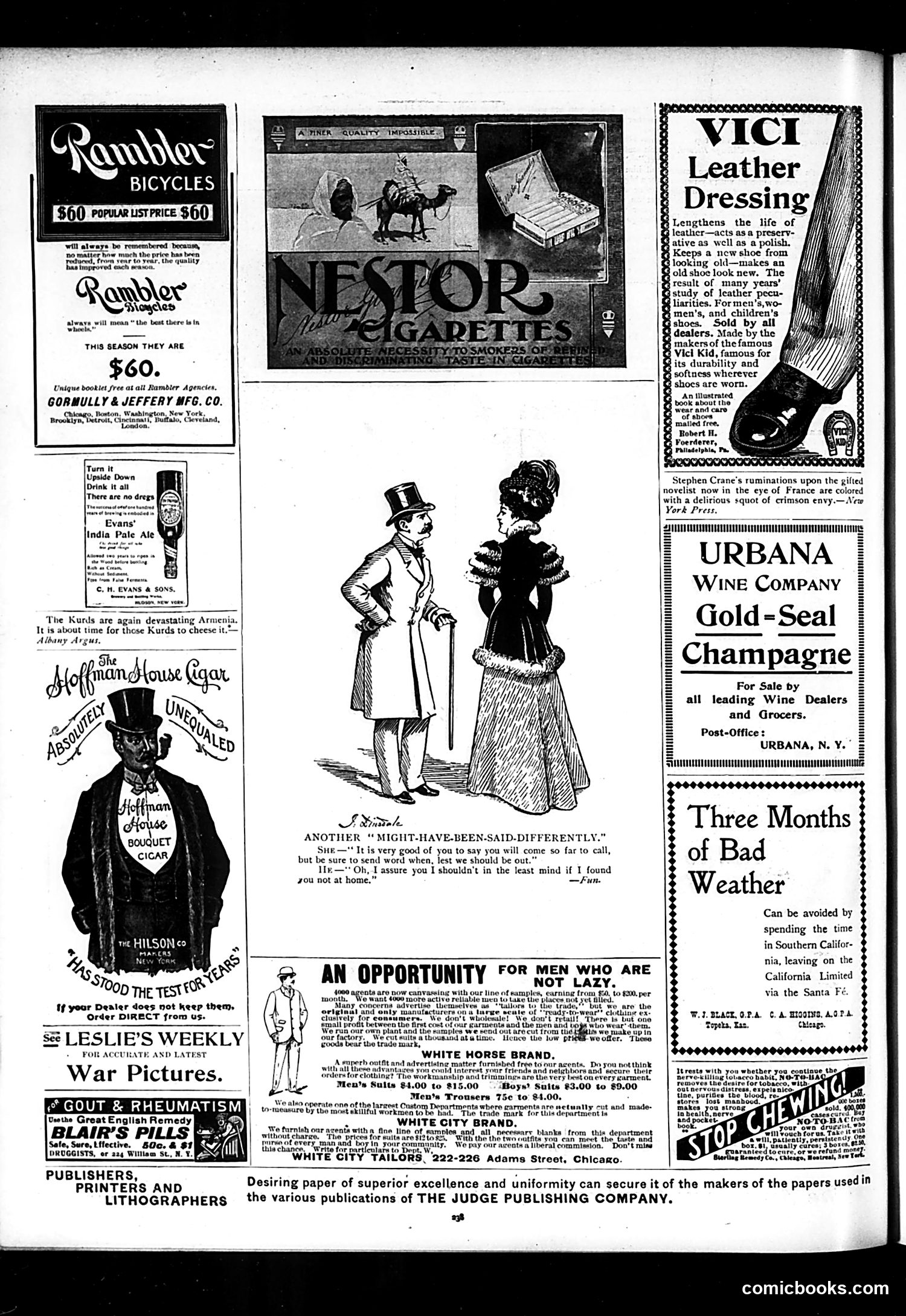
This is primarily an **advertising page** from Judge magazine, with one small cartoon illustration. ## The Cartoon The central illustration titled "Another 'Might-Have-Been-Said-Differently'" shows a gentleman and woman in conversation. The joke satirizes **awkward social etiquette**: She invites him to call, asking him to send word first so they're home. He responds he wouldn't mind if they *weren't* home—a tactless comment implying her company isn't essential to him. The humor lies in his unintentional rudeness masquerading as casualness. ## Context for Modern Readers This reflects Victorian-era **calling customs**, when formal visits by eligible gentlemen to ladies' homes were ritualized social events. The cartoon mocks someone violating these delicate social conventions through poor word choice—a common Judge theme about miscommunication and social awkwardness among the middle and upper classes. The page is otherwise filled with period advertisements for bicycles, cigars, champagne, tailoring services, and patent medicines—typical Judge content of this era.
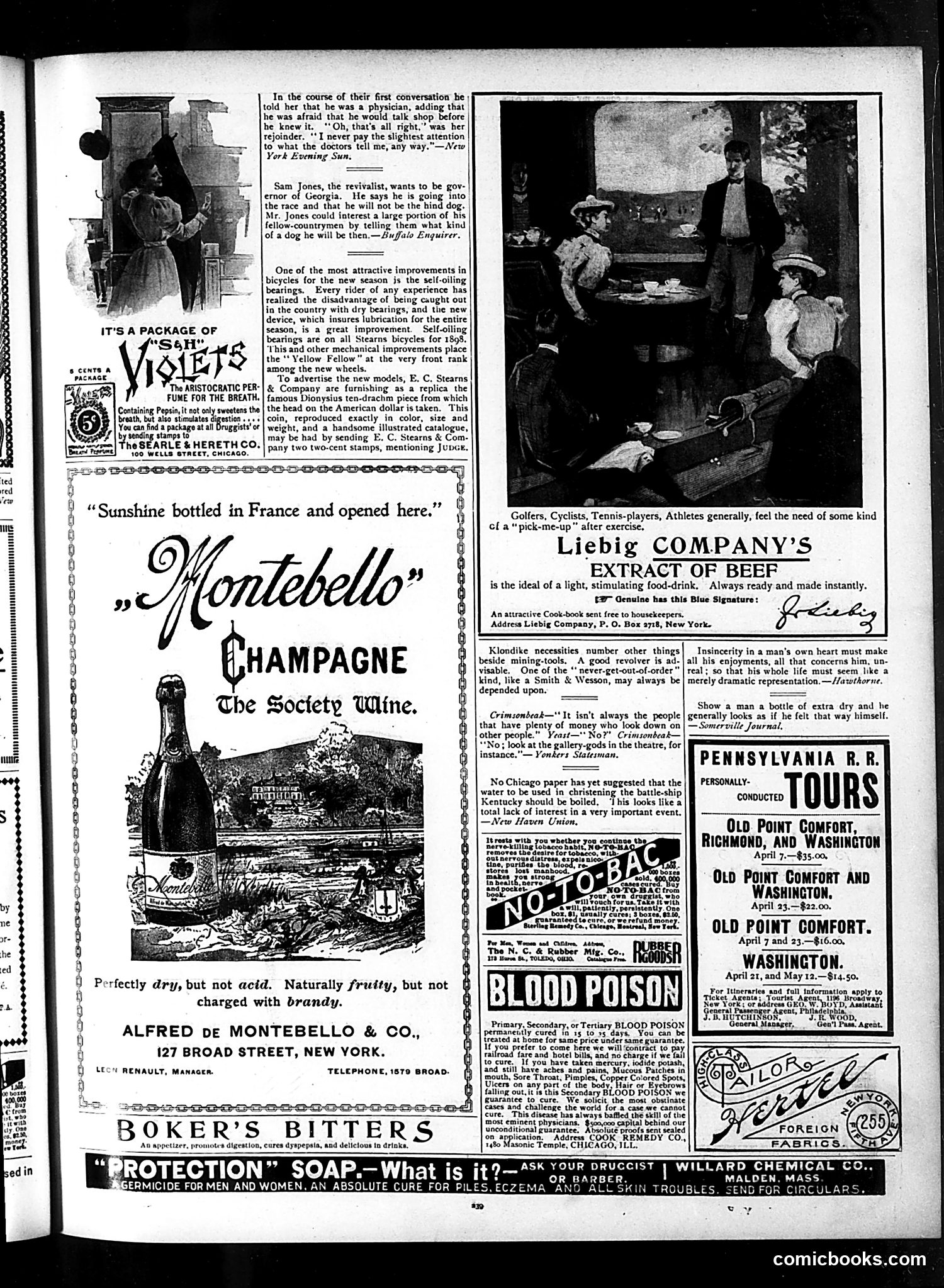
This page is primarily **advertisements and brief humorous anecdotes** rather than political cartoons. The main content includes: **Humorous snippets** (top section): Short jokes from newspapers about a woman ignoring doctors' advice, evangelist Sam Jones's gubernatorial ambitions in Georgia, and bicycle improvements. **Advertisements dominate** the lower half: champagne, extract of beef, soap, bitters, and Pennsylvania Railroad tours. **Key joke about Sam Jones**: Jones was a real revival preacher who apparently expressed interest in Georgia politics. The satire mocks his ambition by suggesting readers would be interested to learn "what kind of dog he will be"—a dig at his previous statement about not being "the hind dog" in the race, implying question about his actual integrity or position. The page reflects 1890s American concerns: bicycles as emerging technology, patent medicines as everyday products, and religious figures entering politics. Most content is commercial rather than satirical.
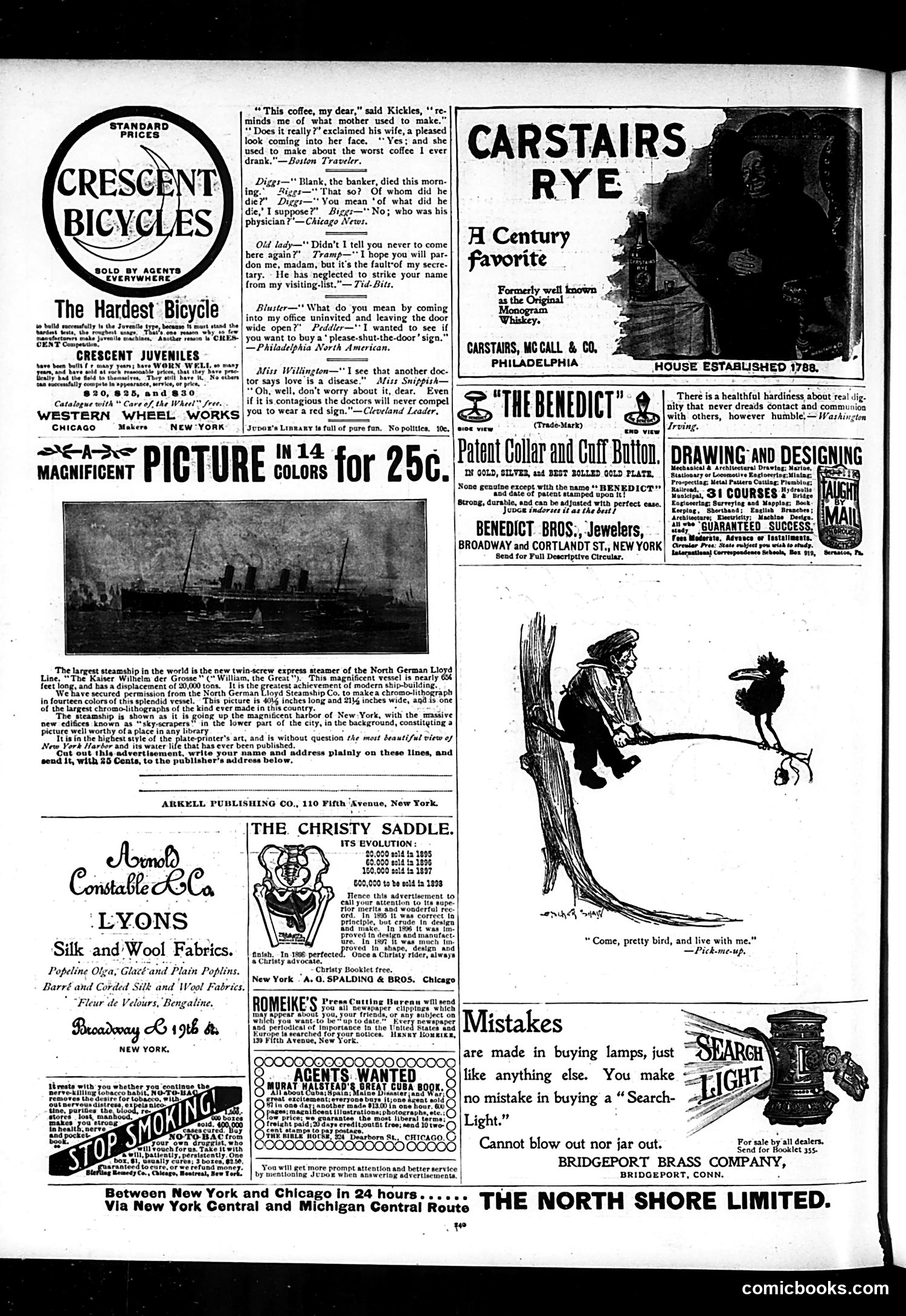
This page is primarily **advertising**, with several brief humorous anecdotes typical of Judge magazine's format. The main visual feature is a chromolithograph advertisement for a picture of the *Kaiser Wilhelm der Grosse*, a German Lloyd steamship—described as "the largest steamship in the world." The ad promotes a 40x21½-inch color reproduction for 25 cents, emphasizing modern ship-building achievement and New York Harbor scenery. The text snippets are jokes about mundane domestic situations: a husband's insulting coffee comparison, a banker's death, a tramp's organizational excuse, and a doctor's pun about love as disease. These reflect typical *Judge* humor—light satirical observations on everyday life rather than political commentary. Other advertisements include bicycles (Crescent brand), fabric goods, saddles, and lamps. The *North Shore Limited* train service appears at the bottom. There is **no political cartoon or significant satire** on this particular page—it's a standard advertising and humor section from the magazine.
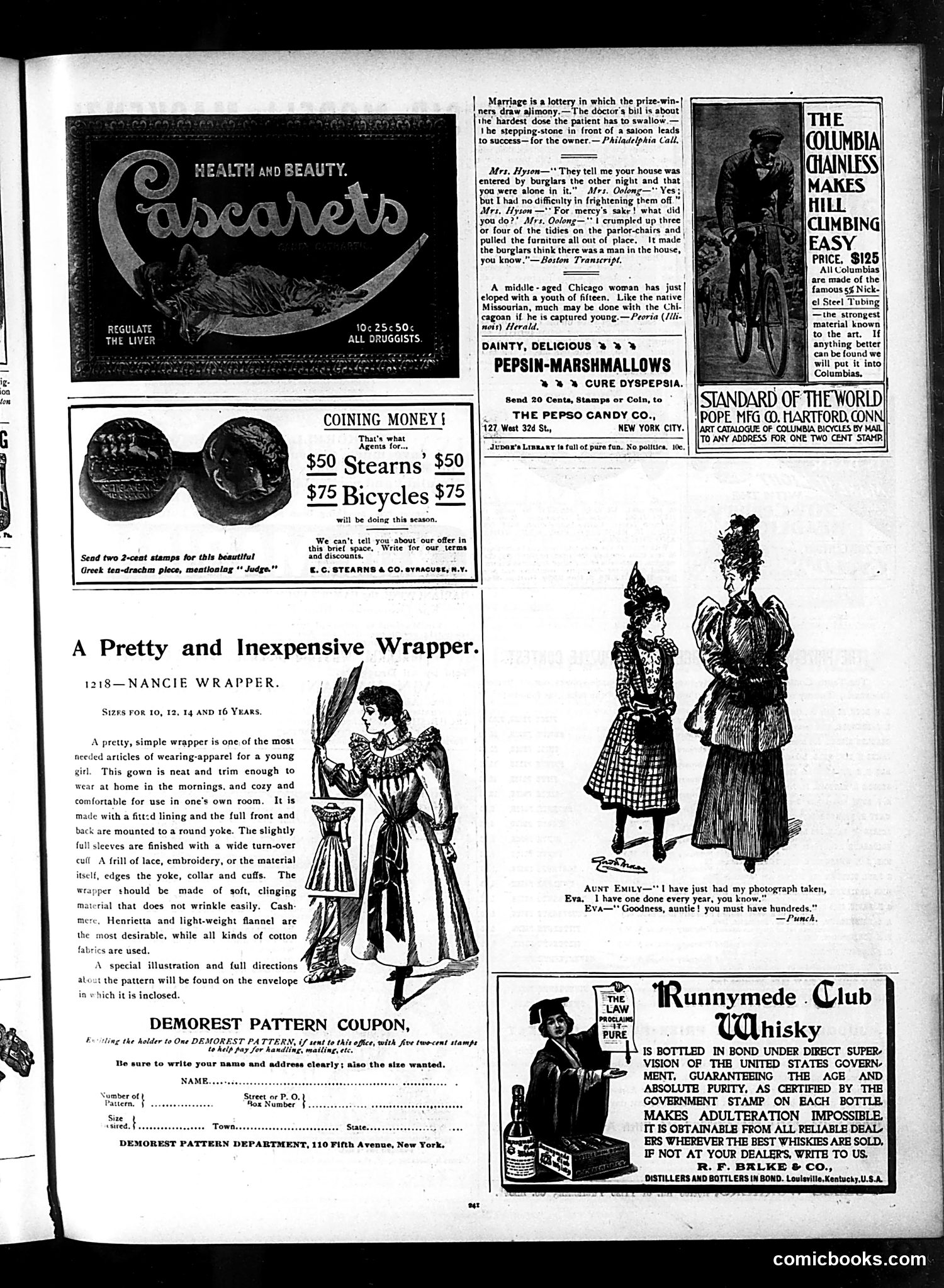
This page is primarily **advertising and fashion content** rather than political satire. The main editorial elements are brief humor snippets: **The humor pieces** include short jokes about marriage, burglary, and a Chicago woman eloping with a teenager—typical turn-of-the-century domestic comedy with no clear political reference. **The substantive content** consists of: - Patent medicine ads (Cascaret's liver regulator, Pepsin-Marshmallows for dyspepsia) - Bicycle sales promotions (Stearns bicycles) - A Denorest sewing pattern for a "wrapper" (loose house dress) for girls - Whisky and candy advertisements **The fashion illustration** shows a simple wrapper garment marketed as inexpensive and practical for young girls' home wear. There is **no discernible political cartoon or satire** on this page—it represents typical Judge magazine commercial content from the early 1900s, mixing light humor with advertisements for products, bicycles, and fashion patterns aimed at middle-class readers.
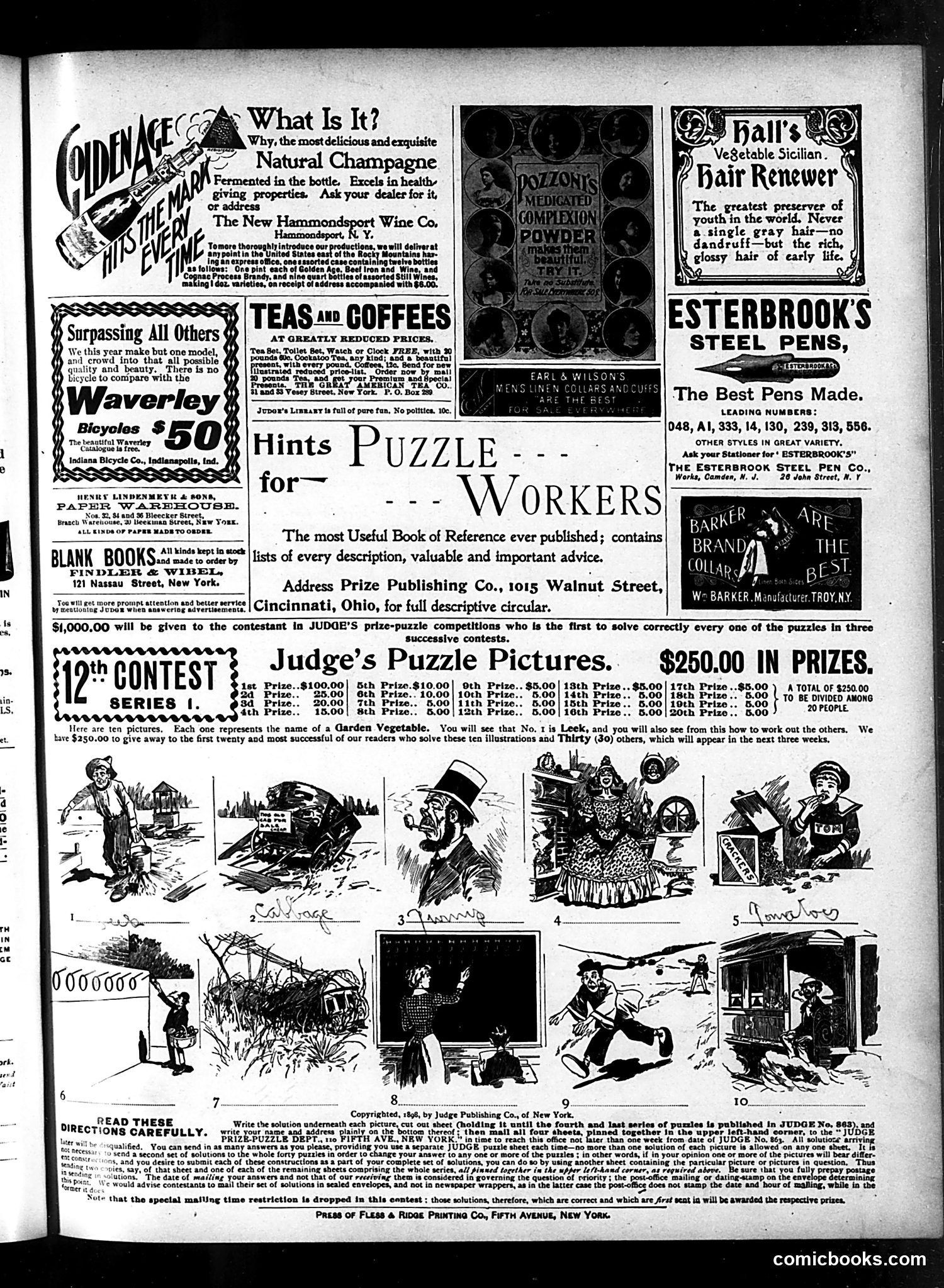
This is primarily a **puzzle and advertising page**, not a political cartoon page. The main content is Judge's "Puzzle Pictures" contest—a visual riddle competition where readers identify garden vegetables represented by symbolic illustrations (image 1 shows a "Leek," for example). The contest offers $250 in prizes across multiple rounds. The page is dominated by **period product advertisements** (hair renewers, bicycles, steel pens, teas, blank books) typical of 1898 publications, interspersed with contest rules and instructions. The ten puzzle illustrations themselves are **not satirical**—they're visual puns requiring contestants to recognize vegetable names from clever drawings. For instance, picture 3 appears to show a man in a top hat (likely representing "Turnip" through a pun), and picture 5 shows someone harvesting or planting. This represents Judge's **commercial entertainment model**: combining light puzzles and contests with advertising to generate reader engagement and participation fees.
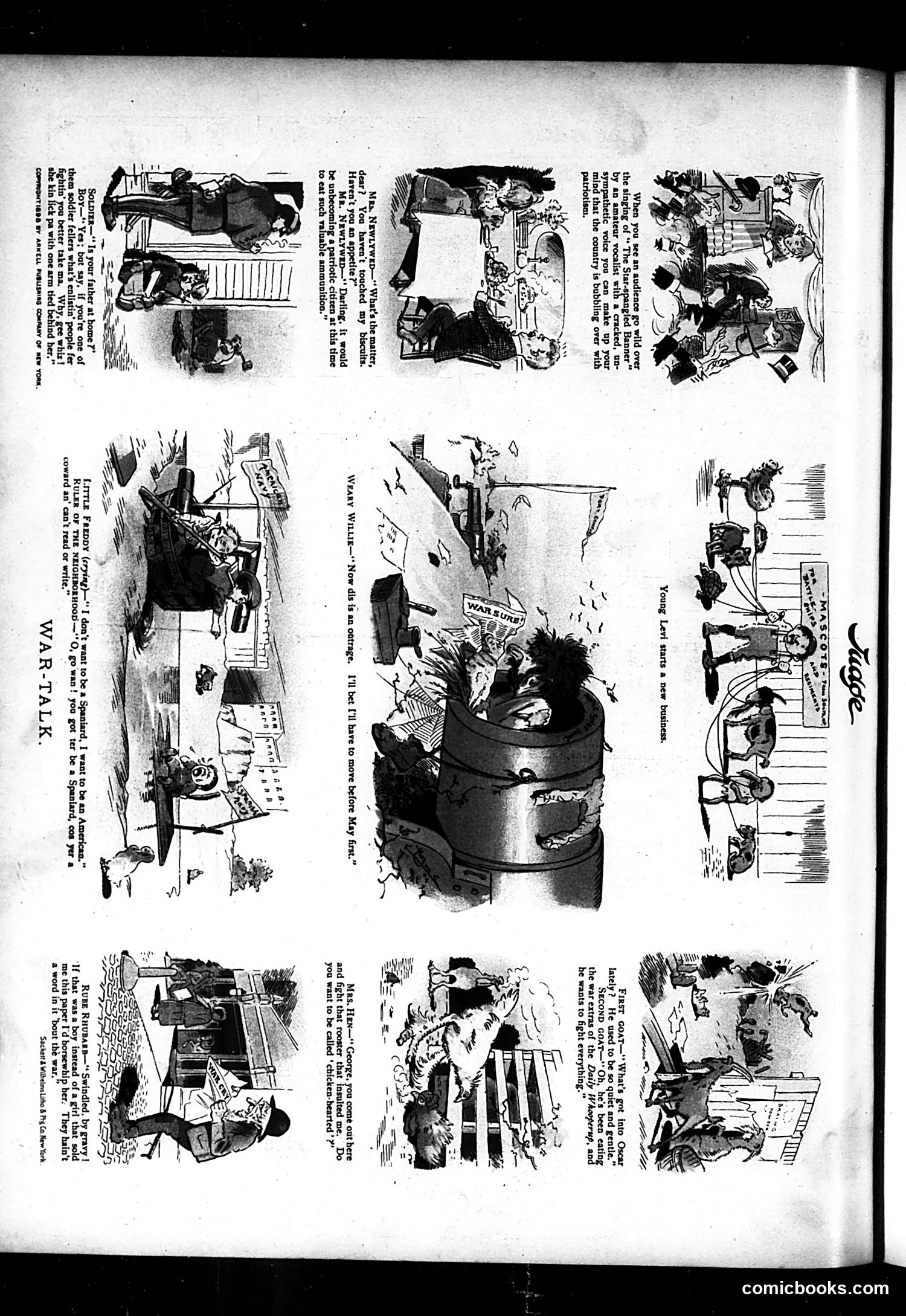
This page satirizes American war fever, likely from the Spanish-American War era (1898). The cartoons mock excessive patriotism: **"War-Talk"** depicts ordinary citizens adopting aggressive, militaristic behavior. A goat eating "war extras" becomes combative; a newlywed husband refuses his wife's biscuits, claiming patriotism forbids appearing "chicken-hearted." **Other panels** ridicule patriotic posturing: an amateur singer's terrible rendition of "The Star-Spangled Banner" draws wild applause simply because it's patriotic; a soldier recruiter targets a boy's mother as a fighter; neighborhood children argue over ethnic identity during wartime. **"Rude Rubbard"** complains a newspaper seller swindled him—a girl sold him a paper with no war coverage, threatening violence. The satire's point: Americans have become irrationally obsessed with war, abandoning reason, hospitality, and common sense in favor of blind patriotism. Judge critiques how jingoism corrupts normal behavior and judgment.