
A complete issue · 16 pages · 1898
Judge — April 2, 1898
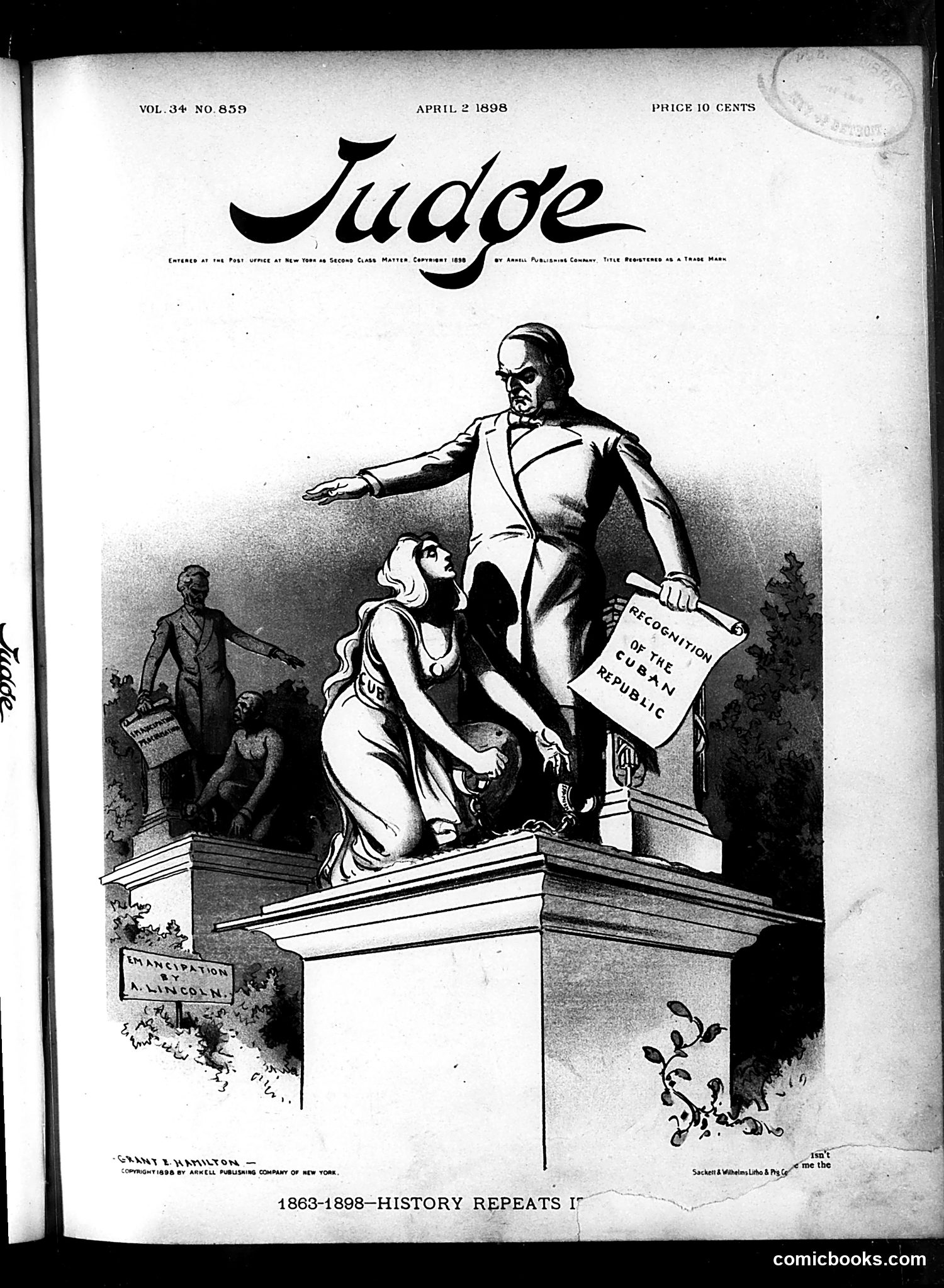
This satirical cartoon comments on the **Cuban War of Independence** and American intervention. The central figure appears to be a political leader (likely President McKinley, given the 1898 date) gesturing toward "Recognition of the Cuban Republic"—a document held by an allegorical female figure representing America or Liberty. The caption "1863-1898—HISTORY REPEATS IT" references the parallel between the **Cuban struggle** and America's own **Civil War** (1861-1865), suggesting history is repeating itself as America considers supporting Cuban independence from Spain. A secondary statue on the left shows a figure labeled "Inauguration of A. Lincoln," reinforcing the historical comparison about liberty and national independence. The cartoon satirizes America's delayed recognition of Cuba's independence movement.
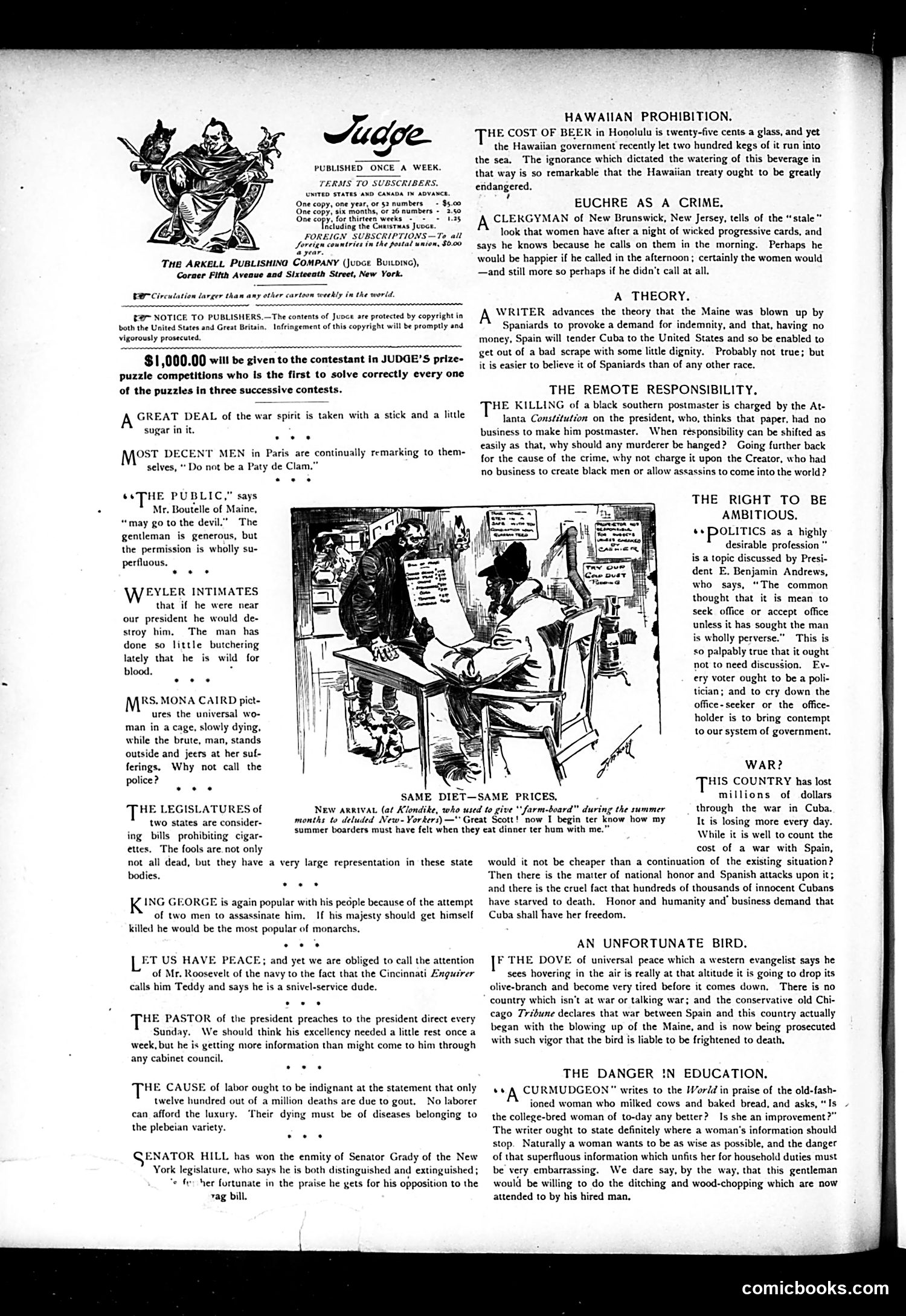
The central illustration depicts an office scene with two figures at a desk, likely satirizing workplace or political corruption. Given the surrounding text sections titled "The Right to Be Ambitious" and "Same Diet—Same Prices," the cartoon appears to comment on hypocrisy or dishonesty in professional/political settings. The page contains multiple satirical short pieces criticizing various figures and policies: Hawaiian beer prohibition, clerical misconduct, Spanish-American relations regarding Cuba, and educational standards for women. These brief commentaries suggest Judge was addressing contemporary early-1900s political scandals and social debates. The cartoon's exact targets remain unclear from the image alone, but the overall page reflects Judge's role as a venue for lampooning government inefficiency, moral inconsistency, and public figures' contradictions.
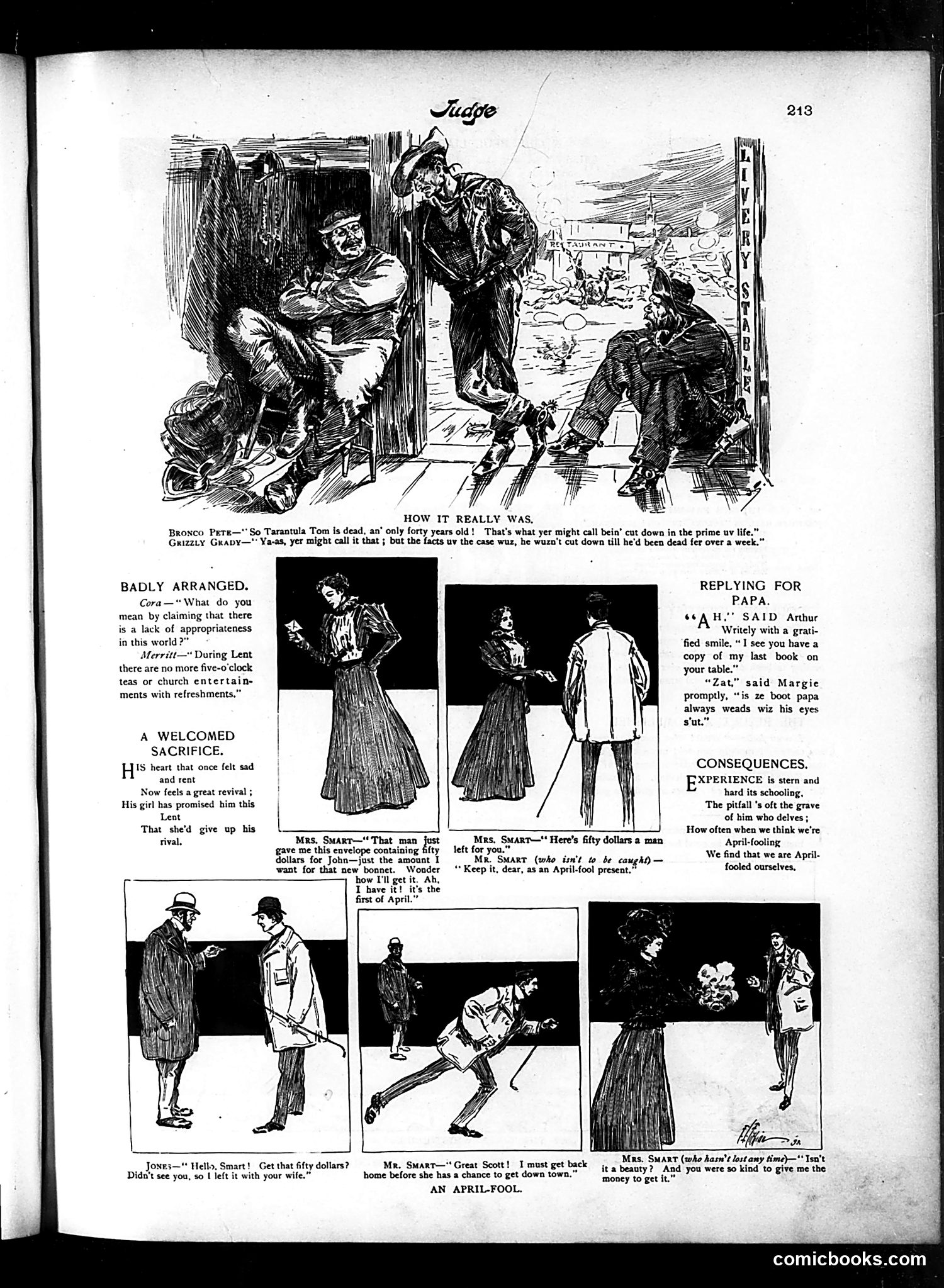
This page contains several April Fools' Day-themed comic strips and jokes, a recurring tradition in Judge magazine. The strips depict various pranks and deceptions typical of April 1st humor. "How It Really Was" shows characters discussing Tarantula Tom's death, contrasting claimed versus actual facts—a commentary on exaggerated storytelling. The other segments ("Badly Arranged," "A Welcomed Sacrifice," "Replying for Papa," "Consequences") showcase classic April Fools' pranks: false marriage proposals, elaborate money schemes, and envelope gags intended to fool recipients. The humor relies on period-specific tropes: gender role expectations, financial anxiety, and social embarrassment. No specific political figures appear to be referenced; instead, this page illustrates broad social satire through everyday domestic and romantic scenarios designed to amuse Judge's readers with relatable, if cynical, observational humor.
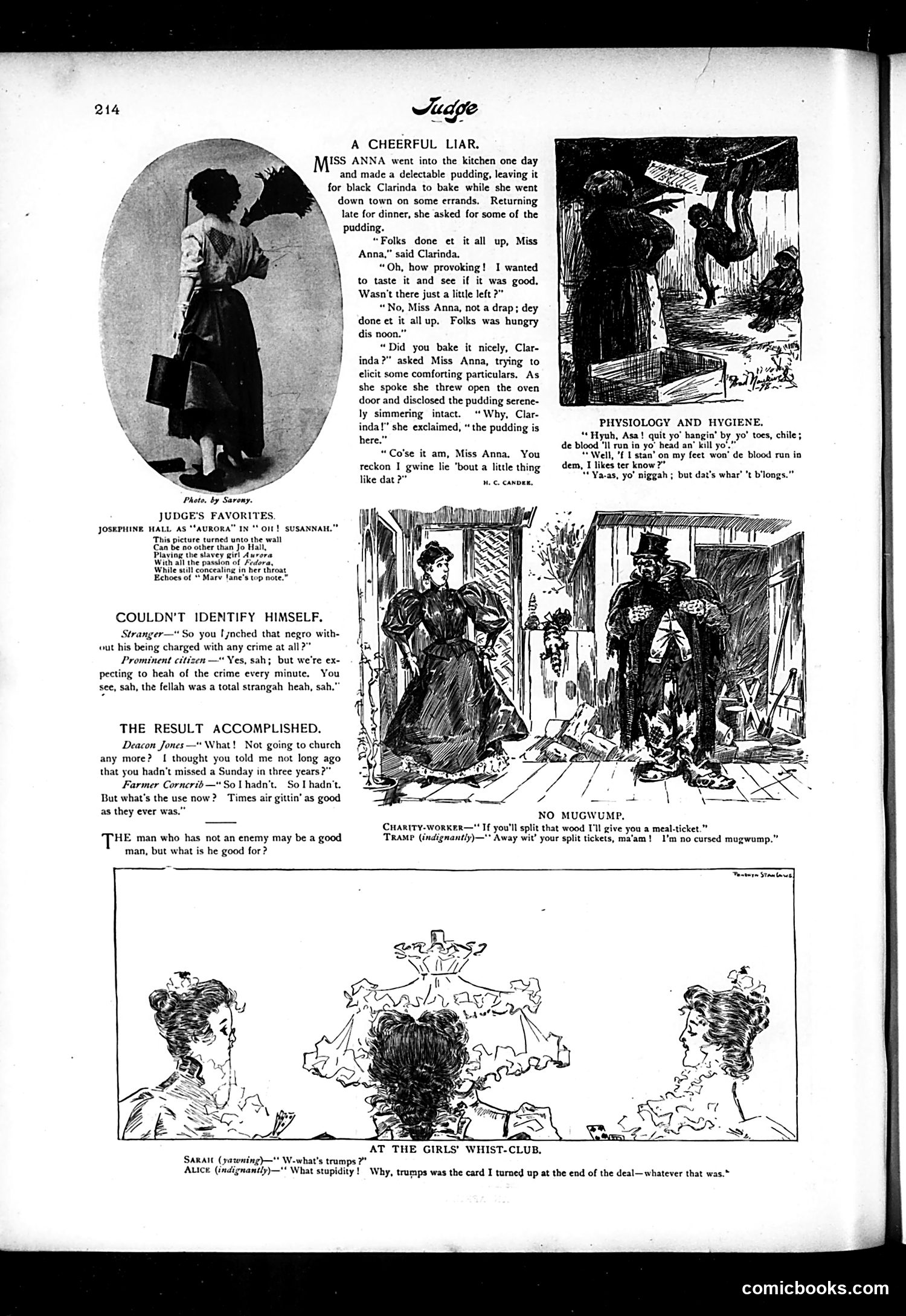
This page contains several unrelated humor sketches and stories typical of Judge's satirical format: **"A Cheerful Liar"** features domestic humor about Miss Anna's pudding—a servant or employee caught in a small lie about food preparation, representing working-class deception. **"Judge's Favorites"** quotes Josephine in a poem about passion and heartbreak. **"Couldn't Identify Himself"** satirizes bureaucratic absurdity: a man charged with crime cannot prove his identity to authorities who expect him at every minute—commentary on administrative incompetence. **"The Result Accomplished"** presents a brief farming anecdote about religious observance. **"At the Girls' Whist-Club"** shows women playing cards with mild social satire about card games and conversation. The page lacks overt political content, instead offering domestic and social humor targeting middle and working-class American life and social institutions.
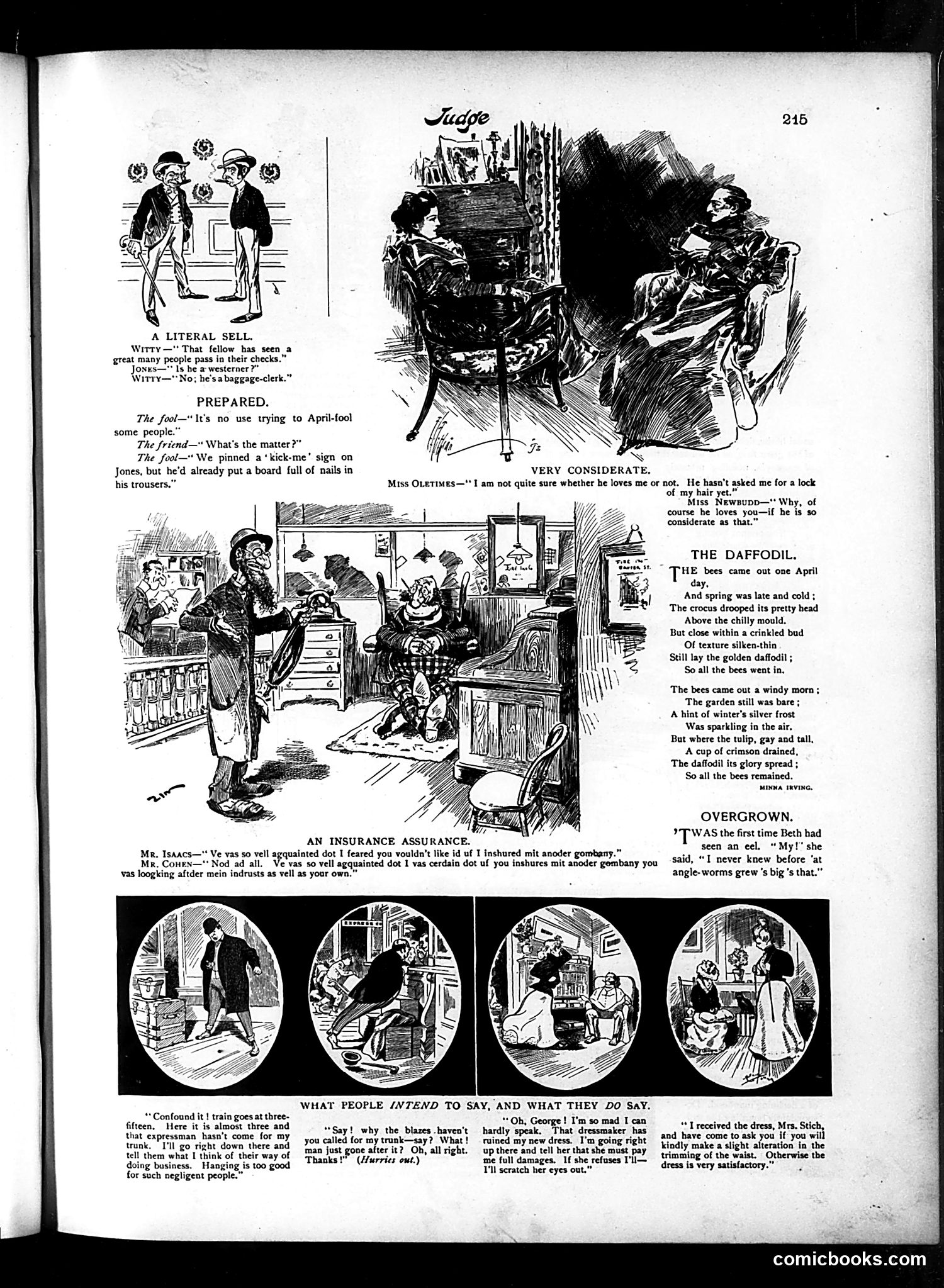
This page contains several brief humorous sketches typical of Judge's satirical style: **"A Literal Sell"** jokes about a baggage clerk being called a "con man" who "passes people their checks"—a pun on financial and railroad terminology. **"Prepared"** and other short gags play on April Fool's pranks and romantic misunderstandings (whether a suitor truly loves based on requesting a lock of hair). **"The Daffodil"** is a sentimental poem by Minka Irving about spring flowers and bees, unrelated to satire. **"What People Intend to Say"** is the page's sharpest satire: four paired illustrations show the gap between what people *claim* they'll say versus what they *actually* say. Examples include a man promising to help a woman with a dress alteration but then angrily blaming the dressmaker, and someone insisting they'll calmly discuss a missed train pickup but instead erupting in fury. The satire mocks human hypocrisy and emotional dishonesty in everyday situations.
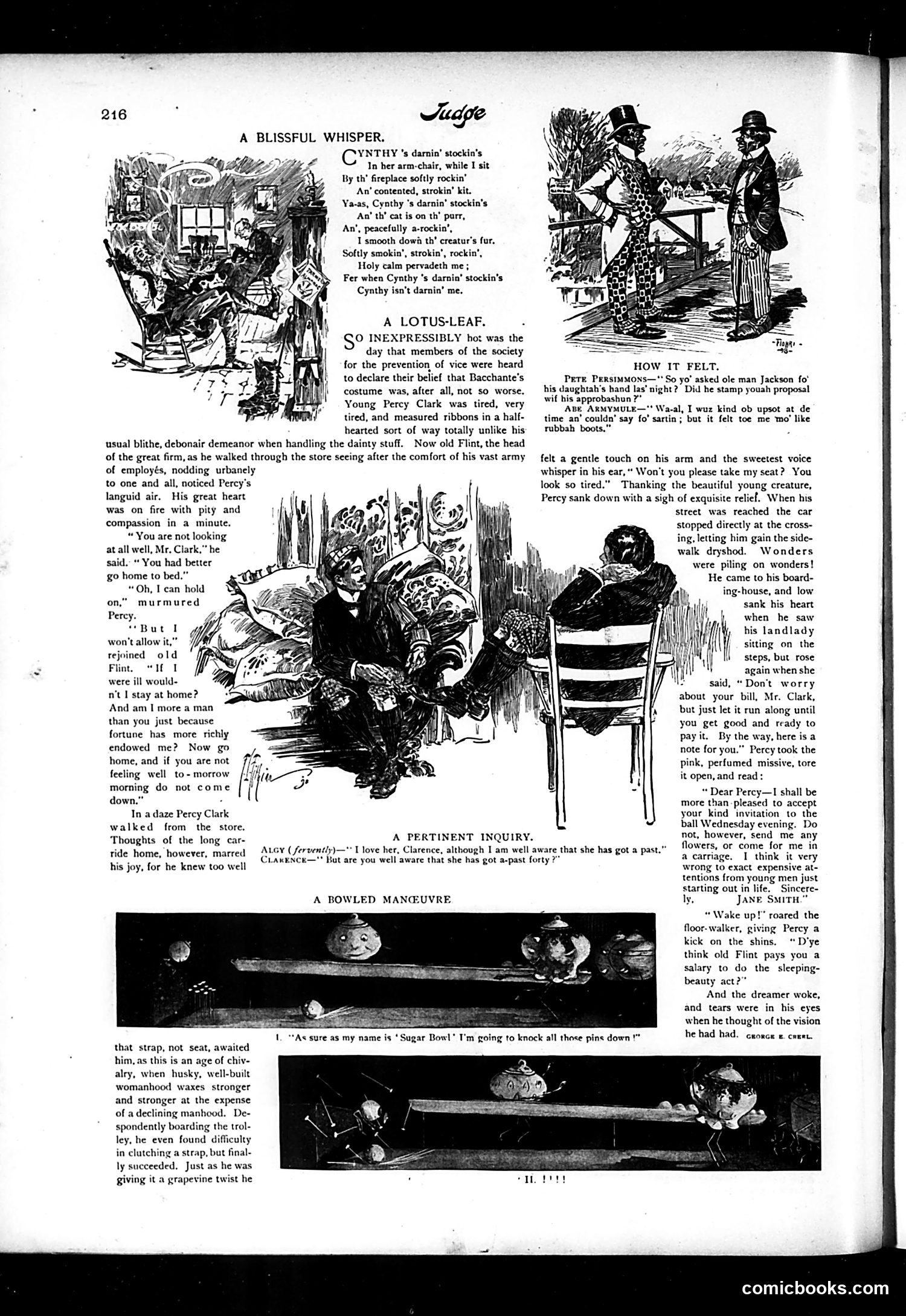
This page contains three satirical pieces reflecting late 19th/early 20th-century social attitudes: **"A Blissful Whisper"** depicts domestic contentment—a man relaxing while his wife mends, framed as ideal peace because she's occupied (the humor: he's relieved she's *not* complaining). **"How It Felt"** presents a fantasy where a tired store clerk (Percy Clark) experiences unexpected kindness: a woman offers her seat, his landlady forgives rent, and a young woman accepts his ball invitation without demanding expensive courtship rituals. The punchline: it's a dream; a floor-walker kicks him awake. The satire mocks both working-class hardship and "New Woman" expectations around courtship spending. **"A Bowled Maneuuvre"** (bowling photos) and **"A Pertinent Inquiry"** appear to be separate brief items about courtship/romantic anxieties. The page satirizes class relations, gender dynamics, and the tension between traditional masculinity (providers/protectors) and emerging women's independence. The tone is gentle mockery rather than harsh critique.
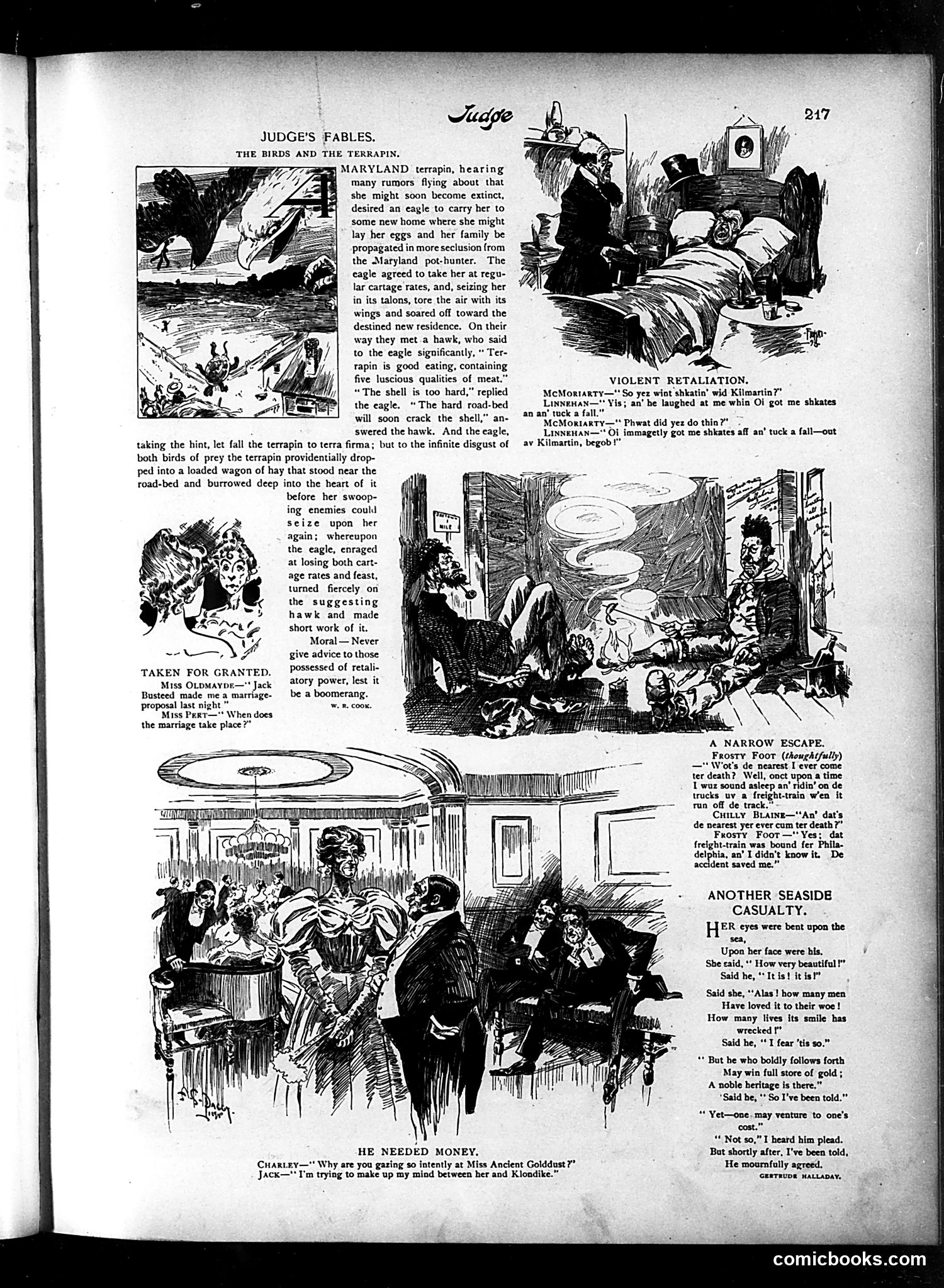
This page contains **four unrelated satirical pieces** typical of Judge's format: 1. **"The Birds and the Terrapin"** — A fable about a terrapin seeking relocation, an eagle offering transport, and a hawk suggesting the terrapin is good eating. The moral warns against giving advice to those with retaliatory power, as the eagle turns on the hawk. This appears to be political allegory about consequences of manipulation, though the specific reference is unclear. 2. **"Violent Retaliation"** — An Irish-dialect joke about McMoriarty and Linwenan quarreling over ice-skating and laughter. Purely comedic. 3. **"Taken for Granted"** — A brief relationship joke about assumed marriage timing. 4. **"A Narrow Escape" and "Another Seaside Casualty"** — Light romantic/travel humor pieces. The page is primarily **light satire and humor** rather than political commentary. The largest piece mixes Aesop-style fable with unstated contemporary allegory, but lacks clear identifying details for modern readers to determine specific figures or events referenced.
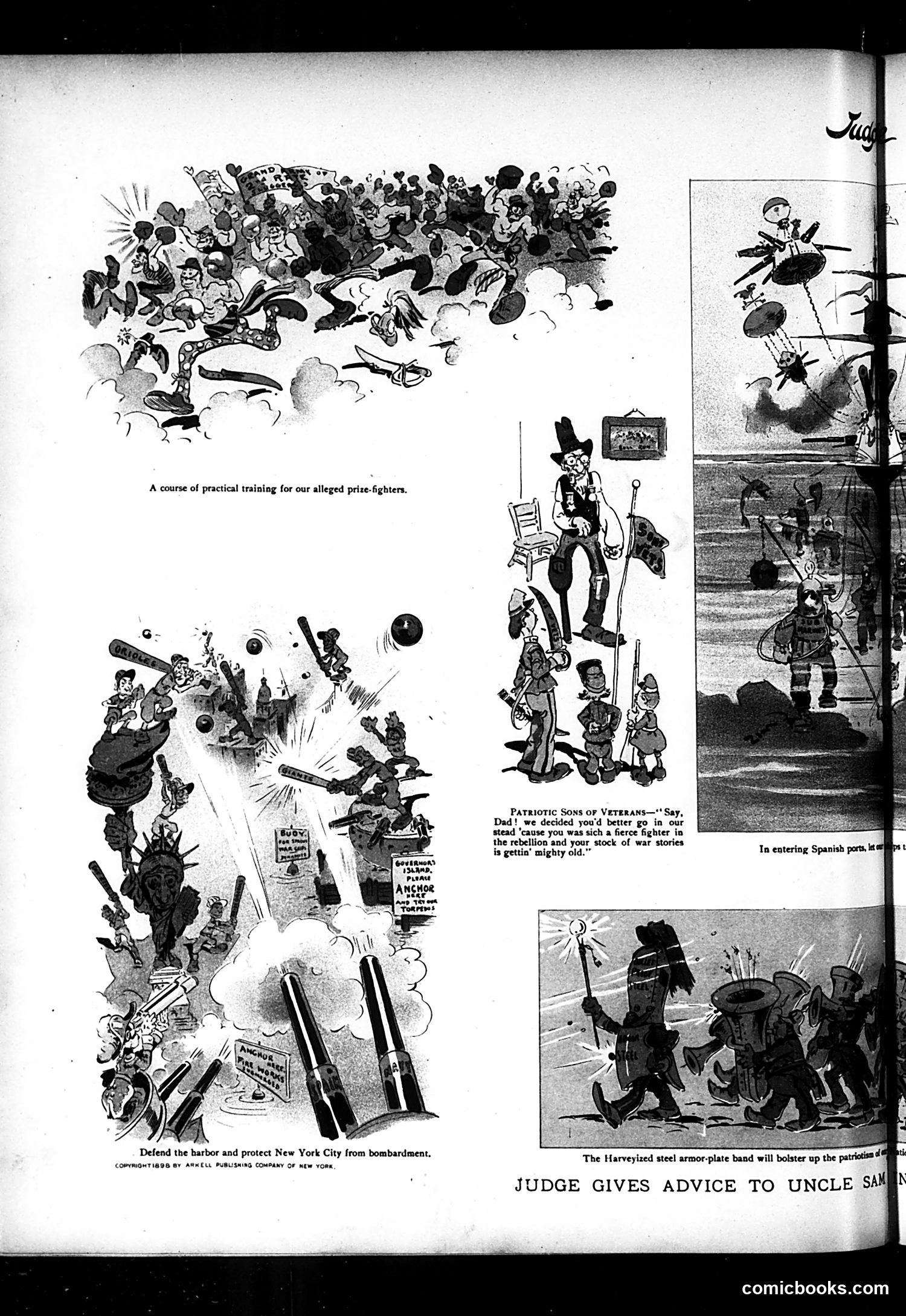
This Judge magazine page contains World War I-era satire mocking American military preparedness and patriotism. The top cartoon shows young men ("Patriotic Sons of Veterans") persuading their elderly father—a Civil War veteran—to fight in their place, claiming his war stories are "gettin' mighty old." The satire targets draft-age men avoiding service by deferring to older generations. The bottom section references "Spanish ports" and steel armor-plating, likely satirizing debates over naval defense and American intervention concerns during the early 1910s. The central image depicts Uncle Sam receiving advice about defending New York Harbor from bombardment, suggesting anxieties about coastal vulnerability and the need for stronger military defenses. Overall, Judge critiques American youth for shirking military duty while glorifying old soldiers, and questions national preparedness against potential threats—themes consistent with pre-WWI American political discourse.
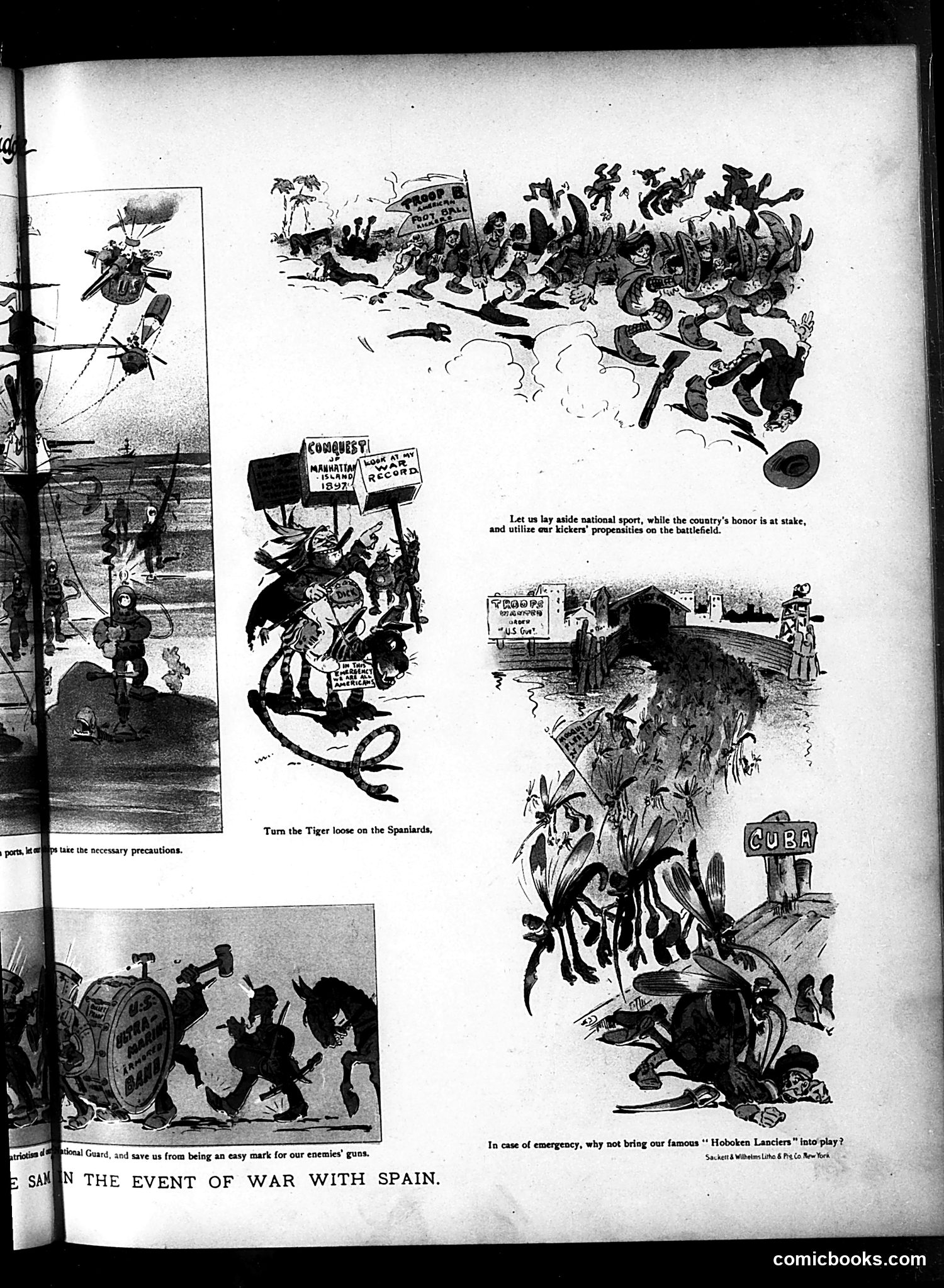
This page satirizes American military preparedness during the Spanish-American War era (1898). The cartoons humorously propose using American sports figures and athletic teams as weapons: **"Turn the Tiger loose on the Spaniards"** references Princeton University's athletic teams (the Tigers), suggesting deploying college sports players as combatants. **"Hoboken Lanciers"** appears to reference a local athletic club or sports organization from Hoboken, New Jersey, jokingly proposed as emergency military reinforcements. The central panel mocks military readiness with overcomplicated weaponry and chaotic preparation. **The satire's point**: American sports culture and athletic prowess are humorously offered as substitutes for actual military strength—poking fun at both national confidence in American superiority and anxiety about Spain's actual military capabilities. The jokes suggest America's sports obsession might replace serious war preparation.
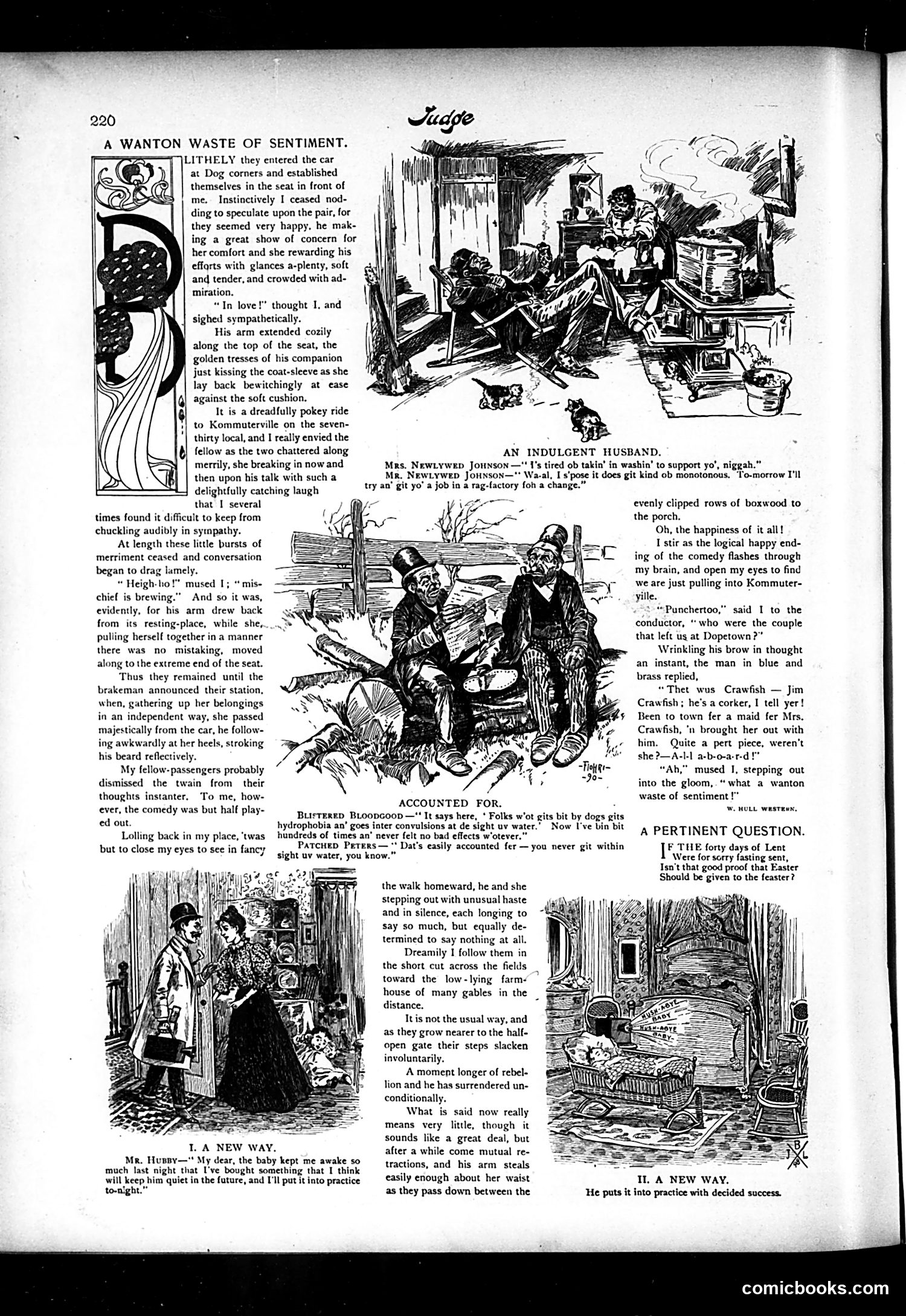
This page contains multiple satirical sketches typical of late 19th/early 20th-century American humor: **"A Wanton Waste of Sentiment"**: The main story follows a narrator observing an affectionate young couple on a train to "Kommuterville." The couple appears deeply in love until they reach their station, then suddenly become cold and silent. The narrator later learns the woman was a hired maid—revealing the "affection" was performative. The satire mocks both romantic sentimentality and social pretense. **"An Indulgent Husband"**: A dialect-heavy sketch using racist caricature depicting an African American couple discussing domestic economics and employment—typical of the period's offensive comedy conventions. **Additional sketches** ("Accounted For," "A Pertinent Question," "A New Way") use brief comedic scenarios about domestic life and animal behavior. The page reflects Judge's characteristic blend of social observation, class commentary, and the casual racial stereotyping endemic to period American humor—elements modern readers must recognize as historical artifacts of their time.
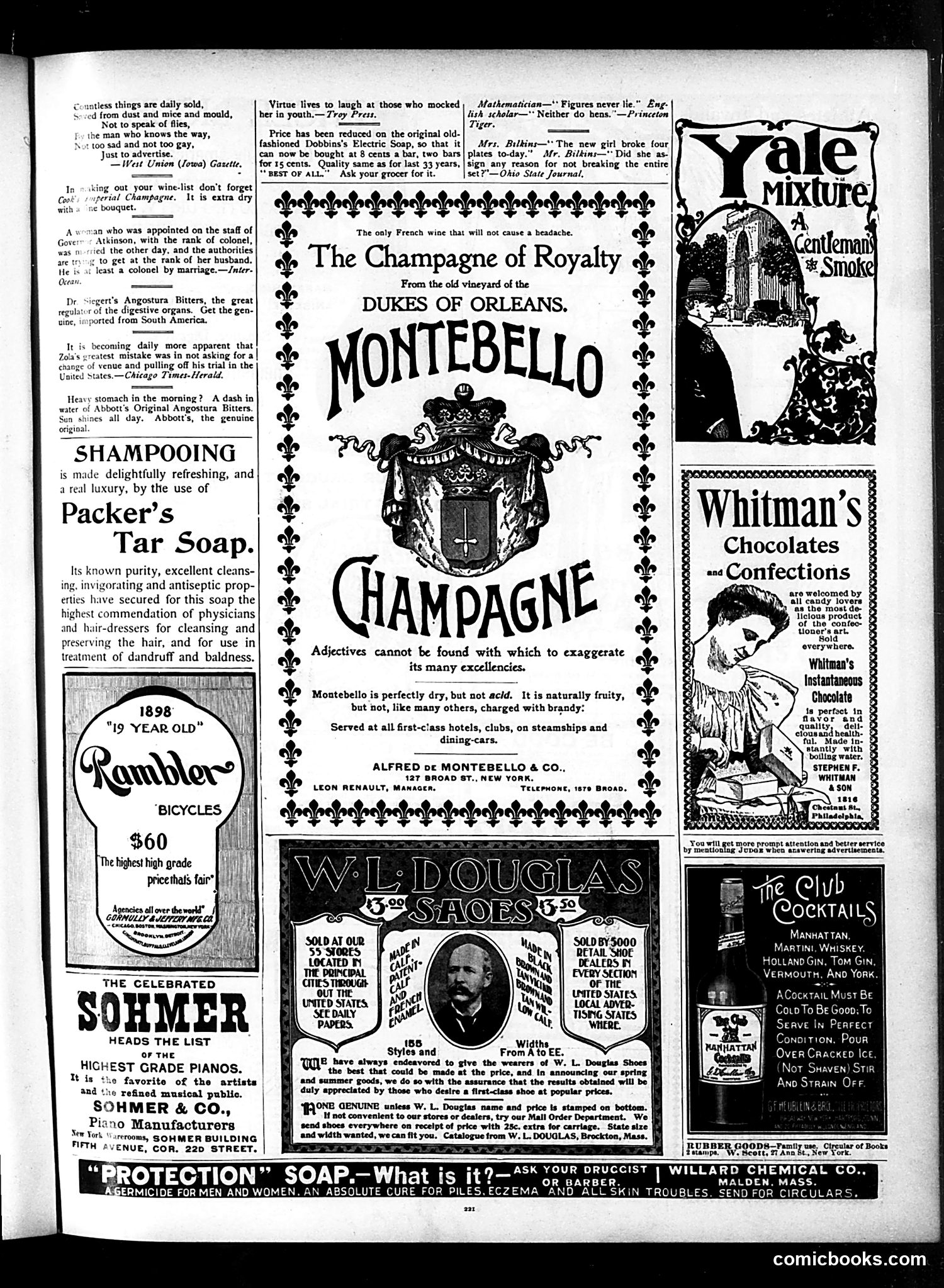
This page is primarily **advertising**, typical of Judge magazine's revenue model. The satirical content is minimal and consists of brief, disconnected quips: **Visible Satire:** - A reference to Émile Zola's trial (likely the Dreyfus Affair context), joking that Zola's "greatest mistake was in not asking for a change of venue" to the United States, implying American courts were more favorable or less competent. - Light wordplay about mathematicians and scholars ("Figures never lie" vs. "Neither do hens"). - Domestic humor about a maid breaking dishes. **Dominant Content:** The page is overwhelmingly filled with product advertisements—Montebello Champagne, Packer's Tar Soap, Whitman's Chocolates, W.L. Douglas Shoes, Sohmer pianos, and various patent medicines (Angostura Bitters, etc.). These ads reflect late-19th-century consumer culture and advertising conventions, including exaggerated claims about products' benefits. The satirical commentary is incidental to the commercial focus, illustrating how Judge balanced humor with profitable advertising space.
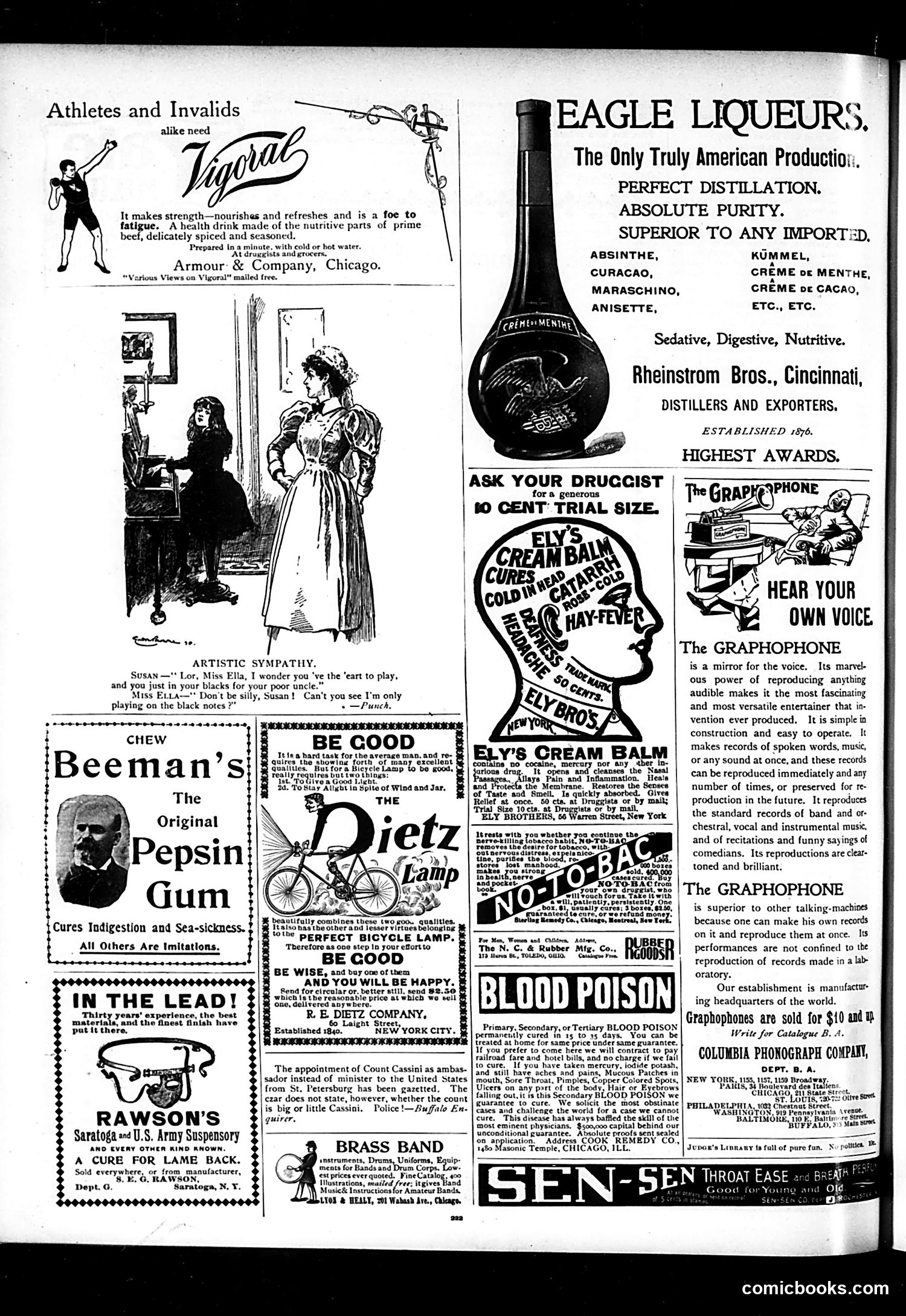
This single-panel cartoon satirizes the sentimentality and linguistic absurdity of Victorian mourning etiquette. A woman named Susan expresses shock that her employer, Miss Ella, is playing piano while wearing black mourning clothes for a deceased uncle. Miss Ella's response—that she's "only playing on the black notes"—is a pun exploiting the double meaning of "black." She uses a technicality to justify her behavior: since she's only touching black piano keys, she's technically not violating mourning restrictions. The satire targets the rigid, often nonsensical social conventions of the era, where even grief had arbitrary rules. The joke ridicules how the upper classes could exploit language to circumvent propriety while maintaining respectful appearances. *Punch* magazine's credit suggests this parodies similar humor about the absurd constraints of Victorian society.
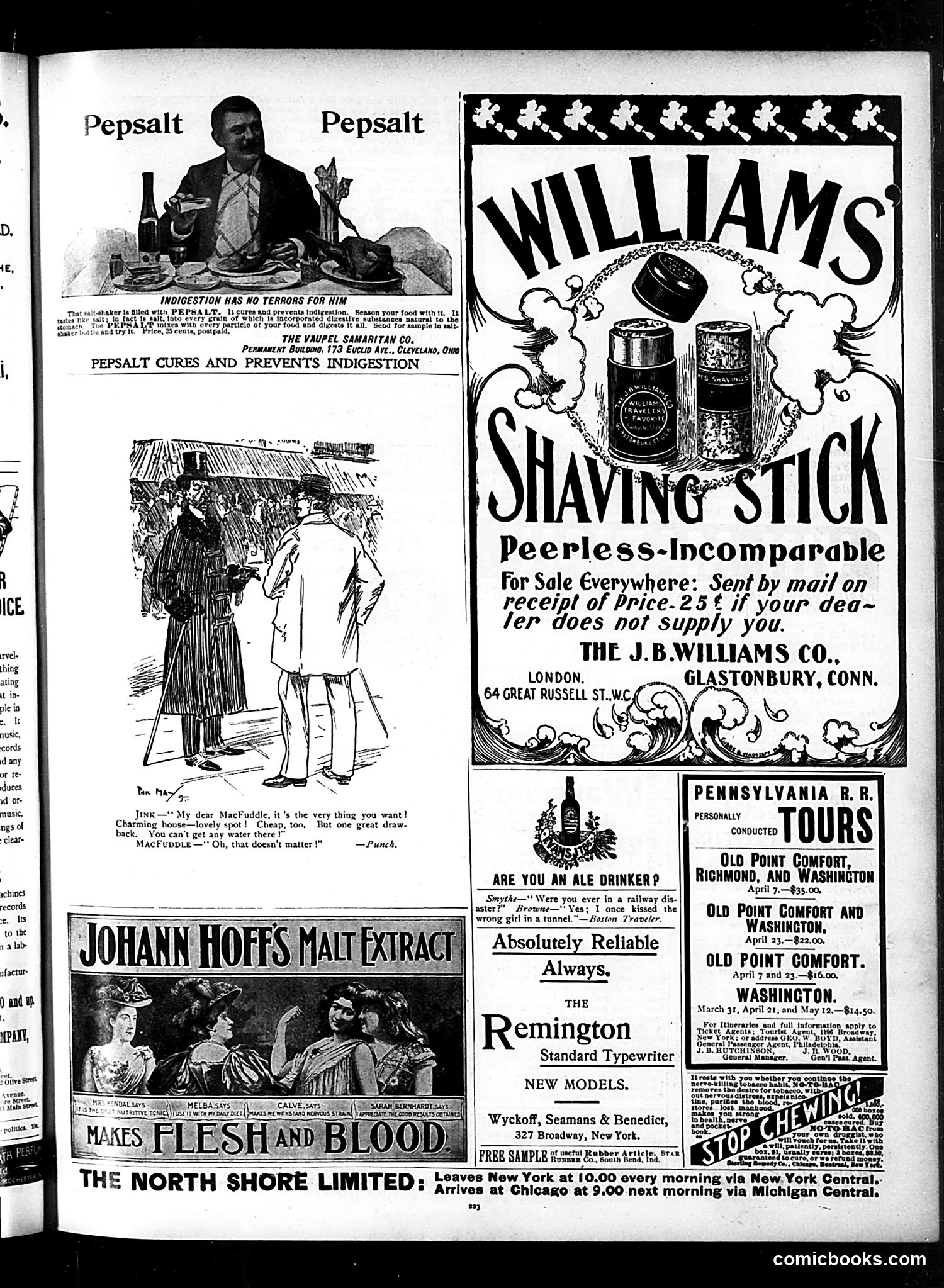
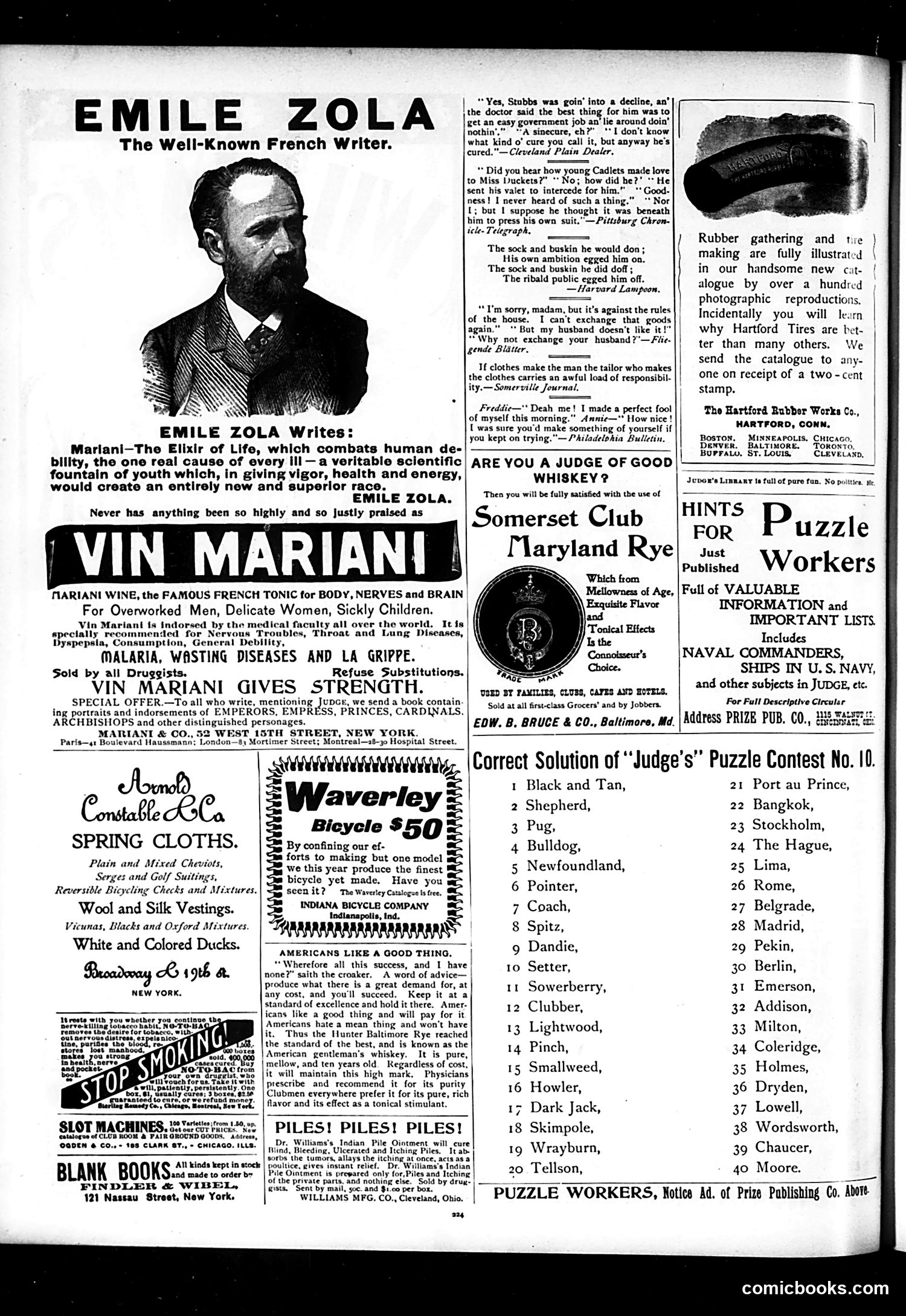
This page is primarily **advertising**, featuring a prominent endorsement by French writer Emile Zola for "Vin Mariani," a patent medicine/wine tonic. The satire is subtle but present: Judge presents Zola—a serious literary figure known for naturalistic novels—endorsing a dubious medicinal product with grandiose claims about combating "human debility" and creating a "superior race." The humor lies in the contrast between Zola's intellectual reputation and his hawking of an unproven tonic. By the early 1900s, such patent medicines were notorious for making extravagant health claims while containing questionable ingredients. The page also includes advertisements for bicycles, whiskey, clothing, and various remedies—typical Judge content mixing legitimate ads with satirical commentary on consumer culture and commercial excess. The scattered comic quips (Cleveland Plain Dealer, Pittsburgh Chronicle-Telegraph excerpts) are unrelated fillers, not central satire.
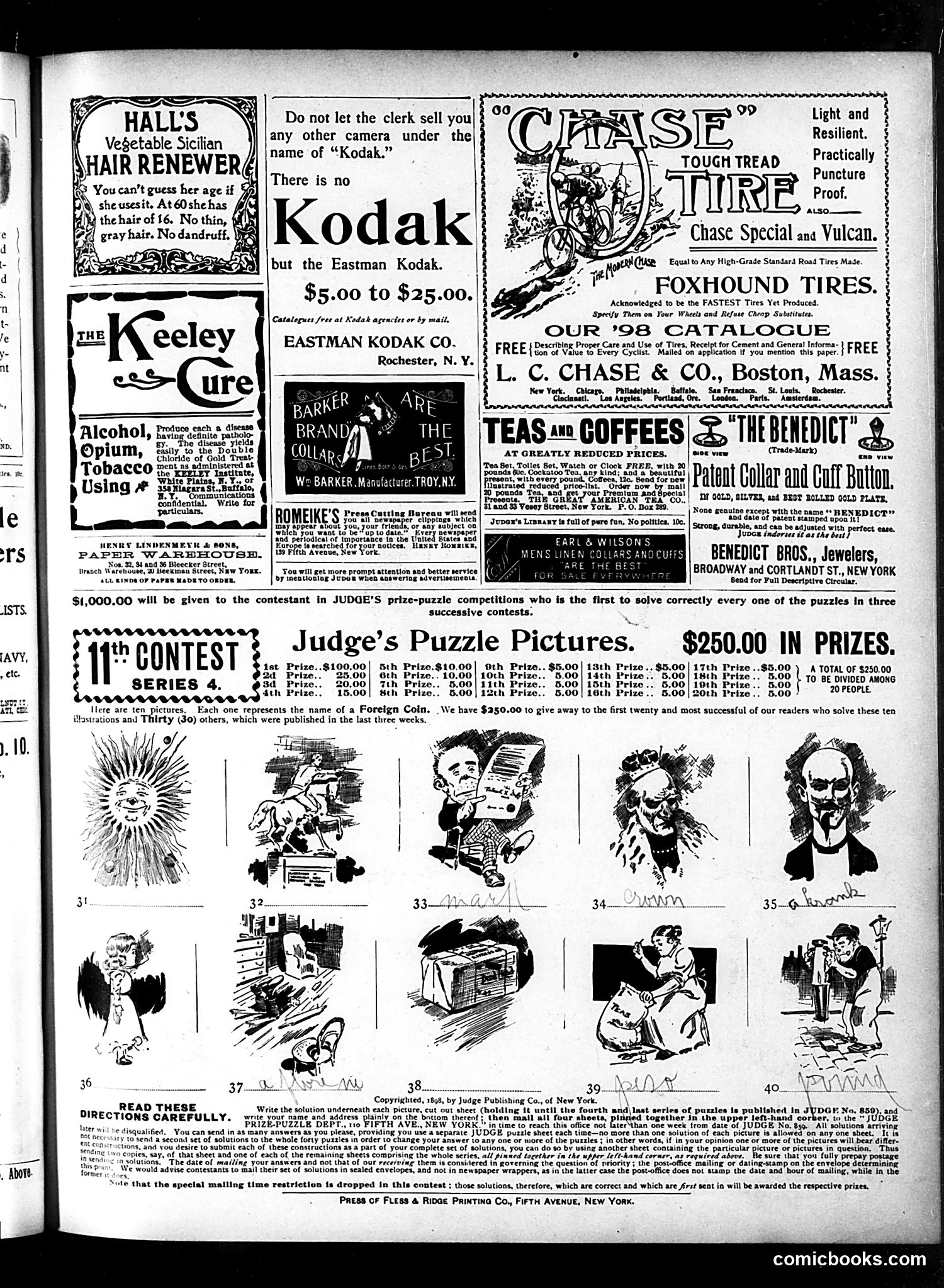
This page is primarily a **commercial advertisement section** with a puzzle contest overlay. The main content is Judge's "Puzzle Pictures" competition—readers must identify ten foreign coins from caricatured illustrations and mail in solutions for cash prizes ($250 total). The surrounding ads reflect late-1890s consumer products: hair dye, cameras (with a warning against counterfeit "Kodak" brands), bicycle tires, tea, jewelry, and patent medicines (alcohol and opium remedies). The Keeley Cure advertisement references a contemporary addiction-treatment facility, common in this era. The page contains **no significant political satire**—it's primarily a revenue-generating puzzle contest with vintage commercial advertisements. The illustrated coin caricatures (images 31-40) are generic character types rather than specific political figures or commentary. This represents Judge's business model: mixing satirical content with profitable contests and paid advertising.
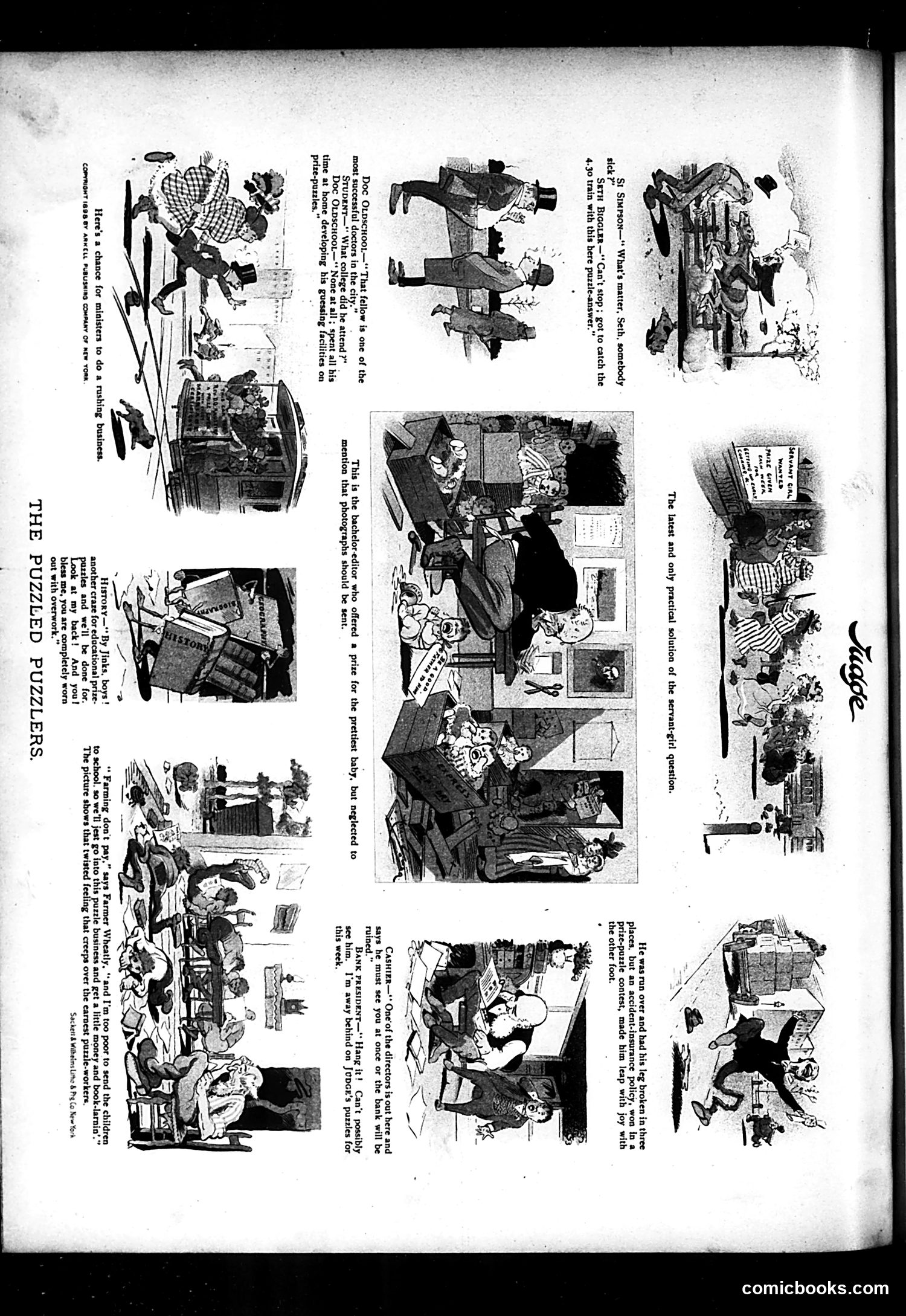
This page satirizes the obsessive craze around puzzle-contests that swept America in the late 19th/early 20th century. The cartoons mock how people became dangerously distracted by puzzle-solving competitions. The jokes include: a man so focused on delivering a puzzle-answer that he ignores a bank crisis; a farmer abandoning education to pursue puzzle prizes; and a man who breaks his leg in an accident but celebrates because his accident-insurance policy (won from a puzzle contest) compensates him. The central image depicts the "twisted feeling" puzzle-workers experienced—showing contorted, obsessed figures hunched over puzzles. The satire critiques how these contests exploited working-class people's hopes for easy money, diverting them from responsible work and priorities like farming or banking. Judge presents puzzle-mania as a social disease causing distraction and poor judgment among ordinary Americans.