
A complete issue · 16 pages · 1898
Judge — February 26, 1898
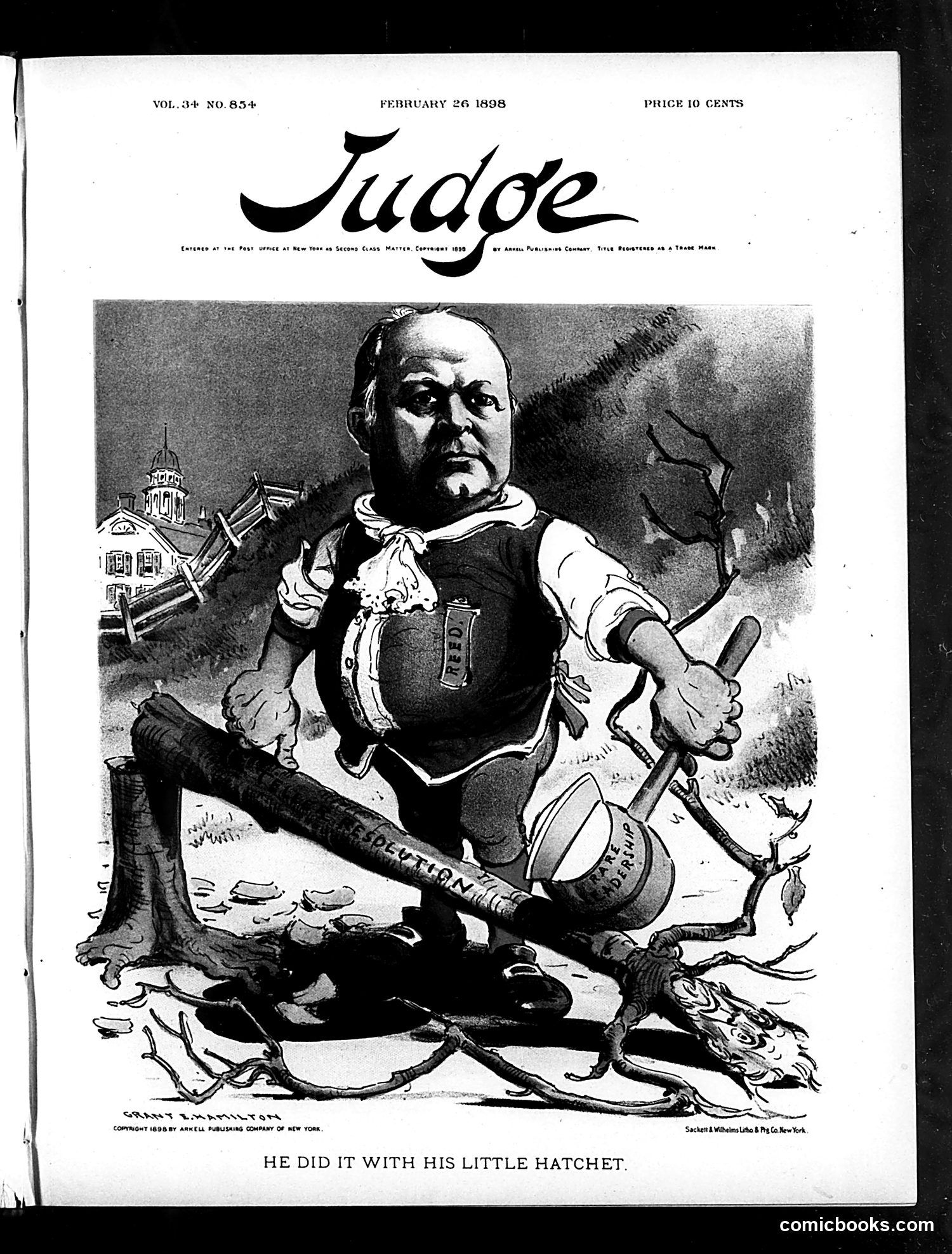
This political cartoon satirizes a prominent figure depicted as a rotund man wielding a hatchet amid destruction. The caption reads "HE DID IT WITH HIS LITTLE HATCHET"—a reference to the George Washington/cherry tree legend about honesty. The imagery suggests the subject is being mocked for claiming responsibility for destruction or controversial actions, ironically invoking the Washington myth. The chaos shown (fallen trees, damaged building) and the figure's aggressive posture indicate the cartoonist is critiquing someone who boasts about destructive policies or decisions. Without the figure's identity clearly labeled, the specific political event or controversy remains unclear from the image alone, though the 1898 date suggests it relates to late-19th-century American politics.
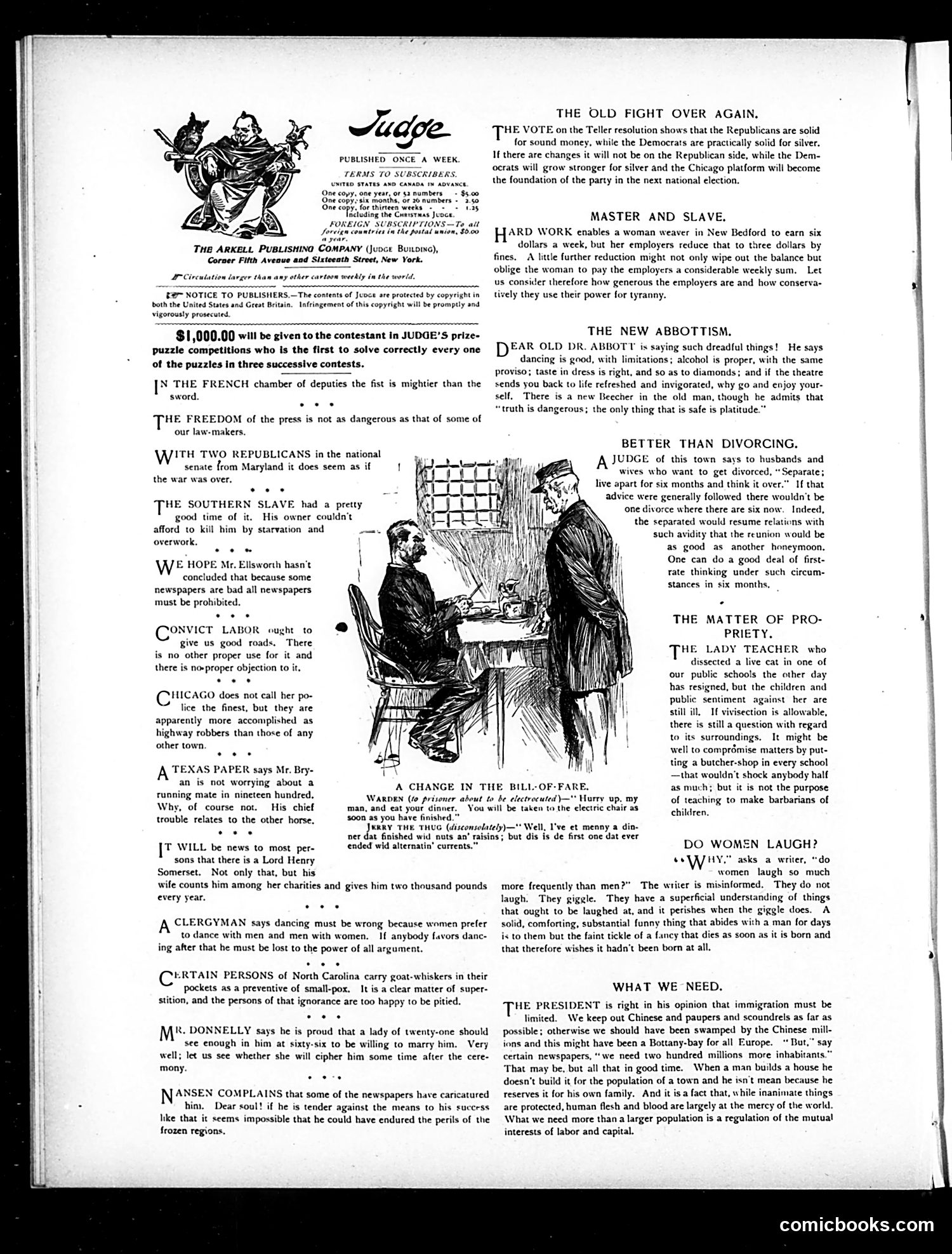
The page features several short satirical pieces typical of Judge's political humor. The main cartoon depicts two men at a table, likely illustrating "A Change in the Bill-of-Fare," though the specific political reference is unclear without additional context. The text pieces mock contemporary issues: "Master and Slave" critiques employers underpaying female weavers; "The New Abbottism" satirizes someone named Abbott's contradictory positions on alcohol, taste, and morality; "Better Than Divorcing" mocks judicial advice to separate couples; and "Do Women Laugh?" debates female humor. The commentary addresses labor exploitation, hypocrisy in social attitudes, and gender dynamics—all recurring Judge themes. The exact political figures and specific events referenced remain unclear without additional historical context.
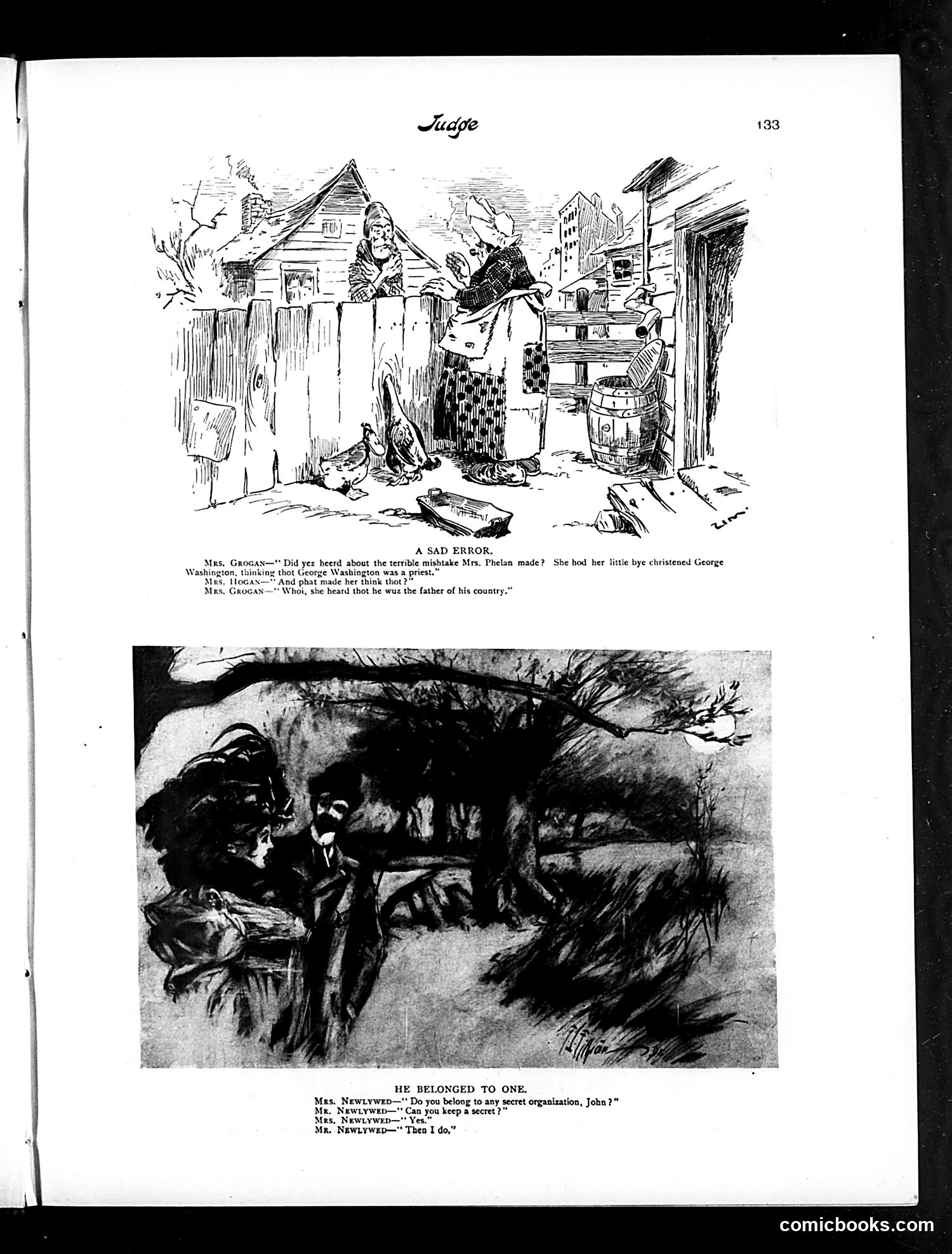
**Top cartoon "A Sad Error":** Shows Mrs. Grogan telling Mrs. Phalen that she mistakenly named her son George Washington, believing "not George Washington was a priest" instead of recognizing him as the nation's founding father. The joke satirizes Irish immigrant working-class women's ignorance of American history and civic figures—a common prejudicial stereotype in late 19th/early 20th century American humor. **Bottom cartoon "He Belonged to One":** Depicts Mrs. Newlywed asking her husband if he belongs to "any secret organization" and whether he keeps secrets. His response—"Yes" and "Then I do"—suggests wives' suspicions about men's fraternal lodge memberships (Masons, Odd Fellows, etc.), mocking domestic anxiety about male secret societies.
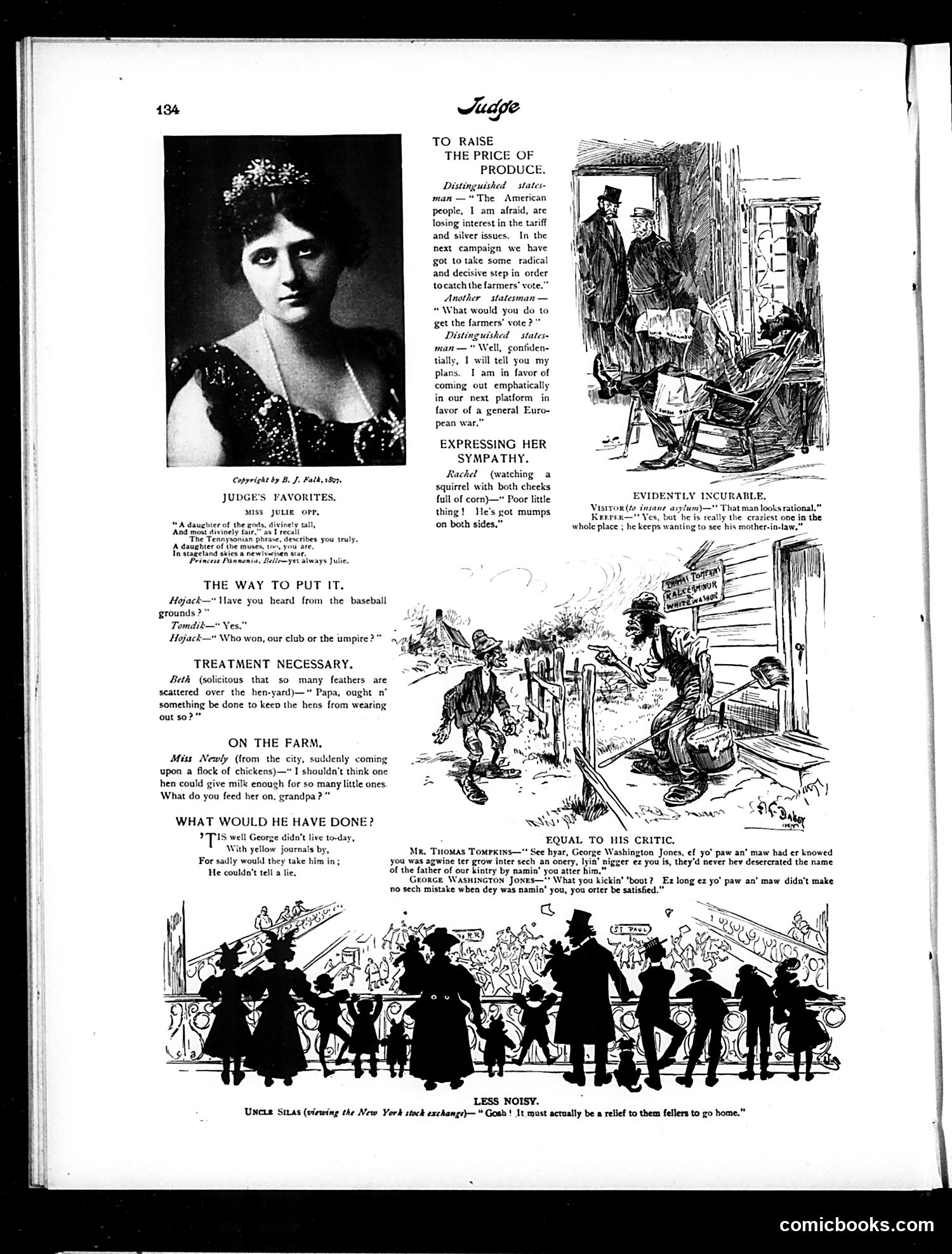
This page contains several satirical political cartoons and jokes from an early 20th-century issue of Judge magazine. The main content includes: 1. **"To Raise the Price of Produce"** - A dialogue mocking politicians' promises to farmers, suggesting they're willing to support a "European war" to win agricultural votes—satire on opportunistic campaign rhetoric. 2. **"Evidently Incurable"** and **"On the Farm"** - Social humor about urban versus rural life and agricultural naiveté. 3. **"Equal to His Critic"** - A cartoon about the George Washington Jones surname creating confusion and mockery. 4. **Bottom cartoon** - Depicts a crowded stock exchange or financial venue with Uncle Silas commenting on the noise, satirizing the chaos of Wall Street or financial markets. The page mixes political satire with general humor typical of Judge's social commentary style.
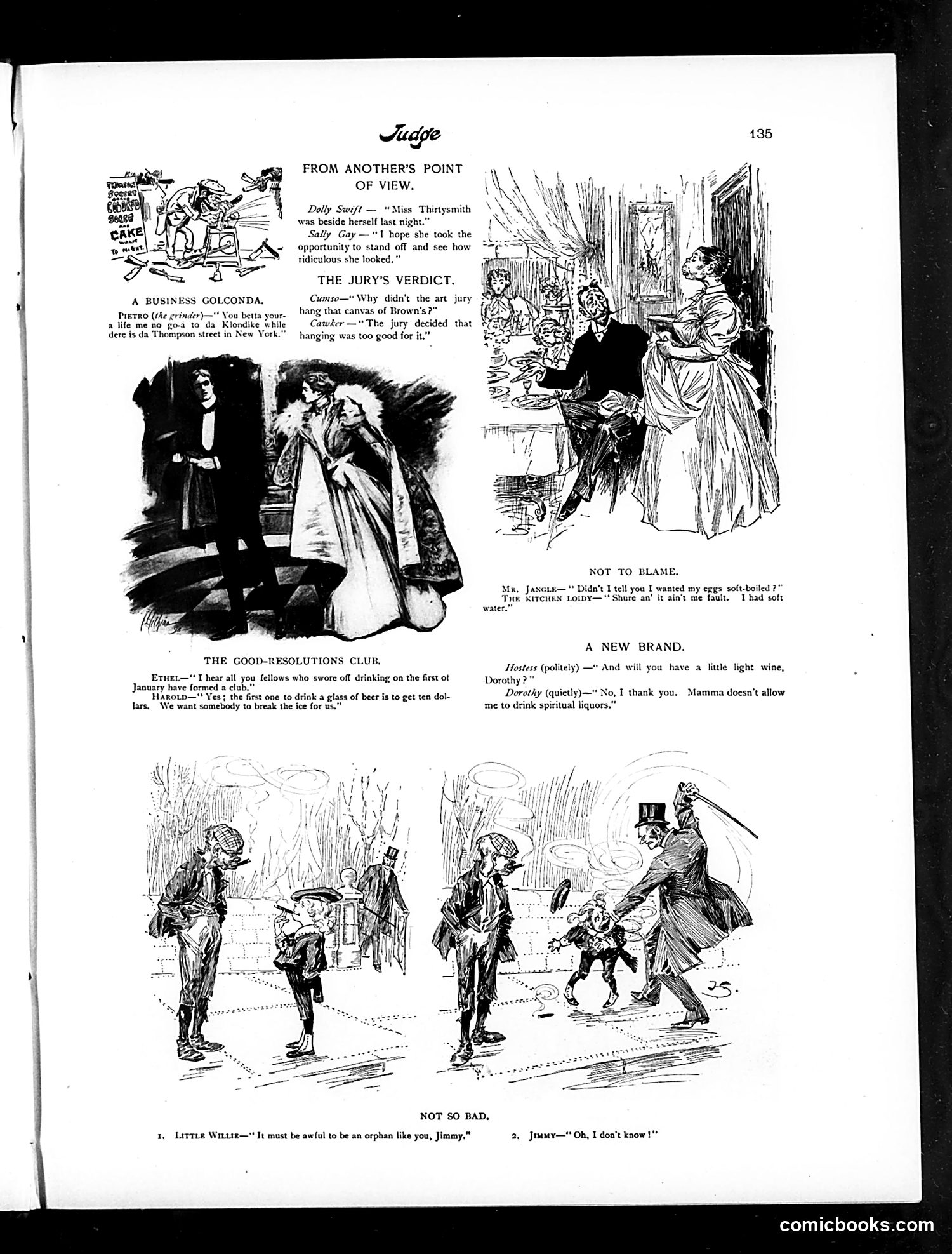
This page contains several brief satirical vignettes typical of Judge's social humor circa early 1900s: **"From Another's Point of View"**: Mocks vanity—women discussing Miss Thirtysmith's embarrassing behavior, suggesting she should literally observe herself to see how ridiculous she appears. **"The Jury's Verdict"**: Art world satire. A jury rejected a painting by "Brown," with one juror quipping the canvas was so bad that even hanging (displaying) it was too good punishment—a dark joke implying it deserved destruction. **"A Business Golconda"**: Pietro, an Italian street organ-grinder, tells a friend the real fortune isn't in the Klondike gold rush but on Thompson Street in New York—where wealthy clients pay for his services. **"The Good-Resolutions Club"**: Men who swore off drinking January 1st formed a club where whoever breaks and drinks beer first pays ten dollars—darkly comic commentary on failed New Year's resolutions. **"Not So Bad"**: A child orphan says being parentless isn't terrible, subverting expected pathos with unexpected cheerfulness—gallows humor about childhood hardship.
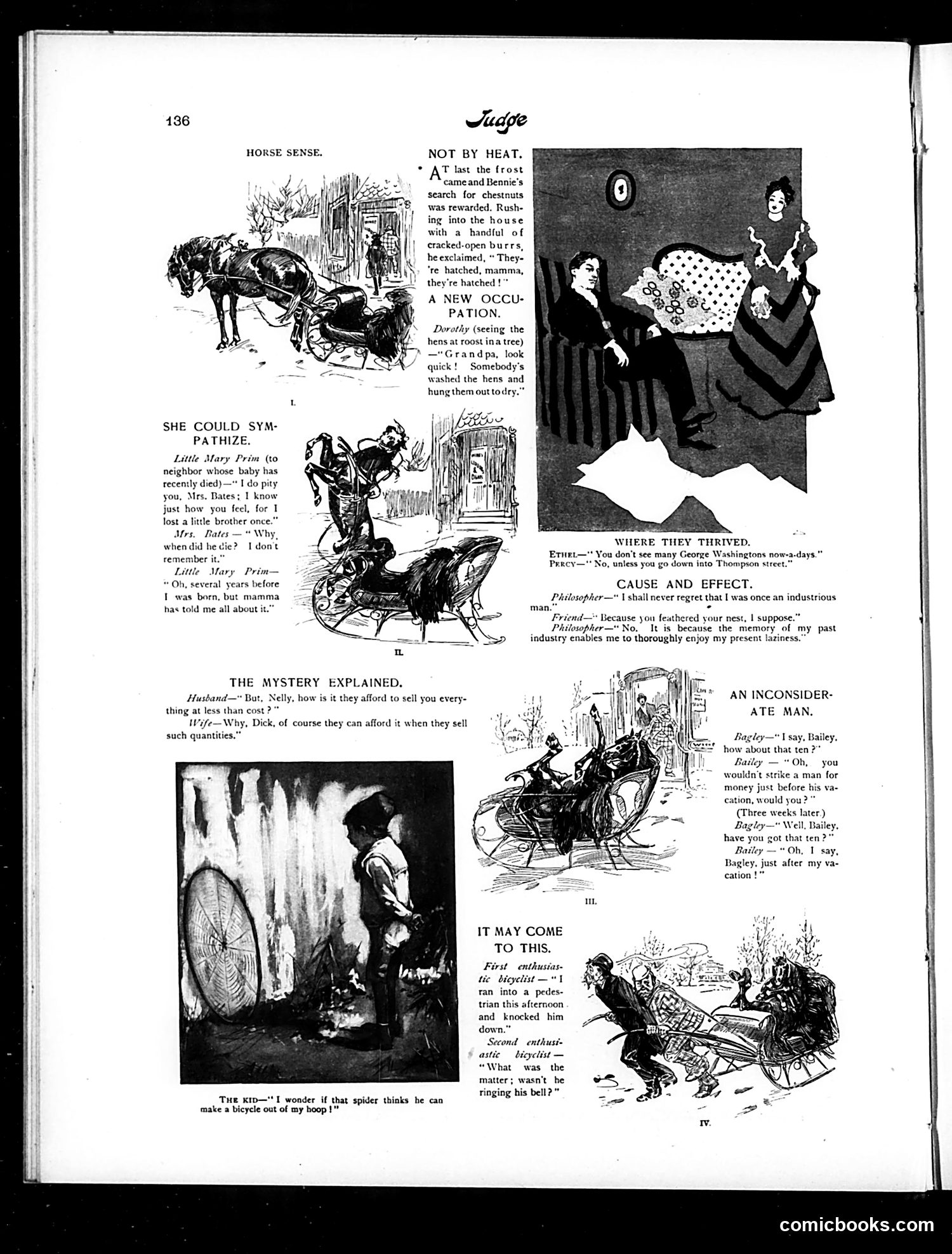
This page contains multiple humorous vignettes typical of Judge's satirical style. The cartoons mock everyday American life and human nature: **"Horse Sense"** and **"A New Occupation"** are gentle jokes about children's innocent misunderstandings—confusing chestnuts with hatched eggs, hens hung to dry like laundry. **"She Could Sympathize"** satirizes false empathy: a neighbor expresses pity for a woman's loss, claiming to understand because she lost a brother—but admits she can't even remember when he died, revealing her sympathy is performative rather than genuine. **"The Mystery Explained"** pokes fun at consumer economics: a husband questions how stores sell everything below cost; the wife naively assumes it's simply because they sell in large quantities. **"Where They Thrived"** appears to reference George Washington, suggesting certain types flourish only in less respectable neighborhoods ("Thompson street"). **"Cause and Effect"** ironically examines laziness justified by past industriousness. **"An Inconsiderate Man"** shows someone dodging a loan repayment by claiming post-vacation timing. The page reflects Judge's focus on satire of middle-class manners, petty dishonesty, and human folly rather than political commentary.
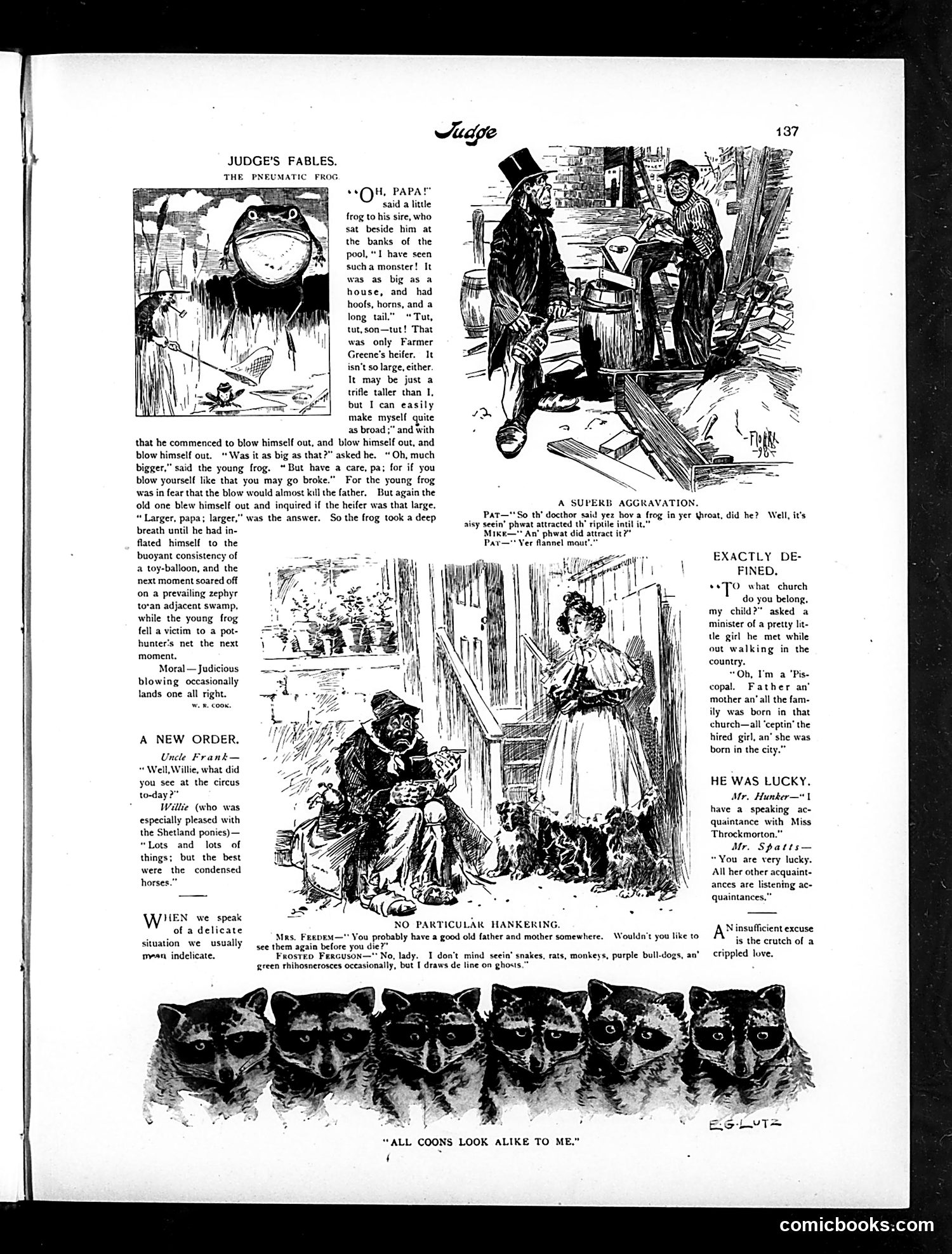
This page from *Judge* contains several satirical pieces typical of the magazine's humor: **"The Pneumatic Frog"** (top left): A moral fable mocking competitive boasting and self-inflation. A young frog exaggerates what he's seen; his father tries to one-up him by literally inflating himself like a balloon until he floats away. The satire targets human vanity and one-upmanship—people who constantly try to prove they're bigger/better than others, often with ridiculous results. **Other brief comedic sketches** populate the page, mostly playing on wordplay and social observations: a minister questioning a girl's church affiliation, a man's lucky acquaintance with a woman, and various other period humor involving class and propriety. **The bottom illustration** labeled "All Coons Look Alike to Me" appears to reference a popular song of that era, though the image shows raccoons rather than racist caricature—the title itself reflects period attitudes. The page is primarily **humorous fables and light social satire** rather than overtly political commentary, typical of *Judge*'s general-audience approach to American quirks and follies.
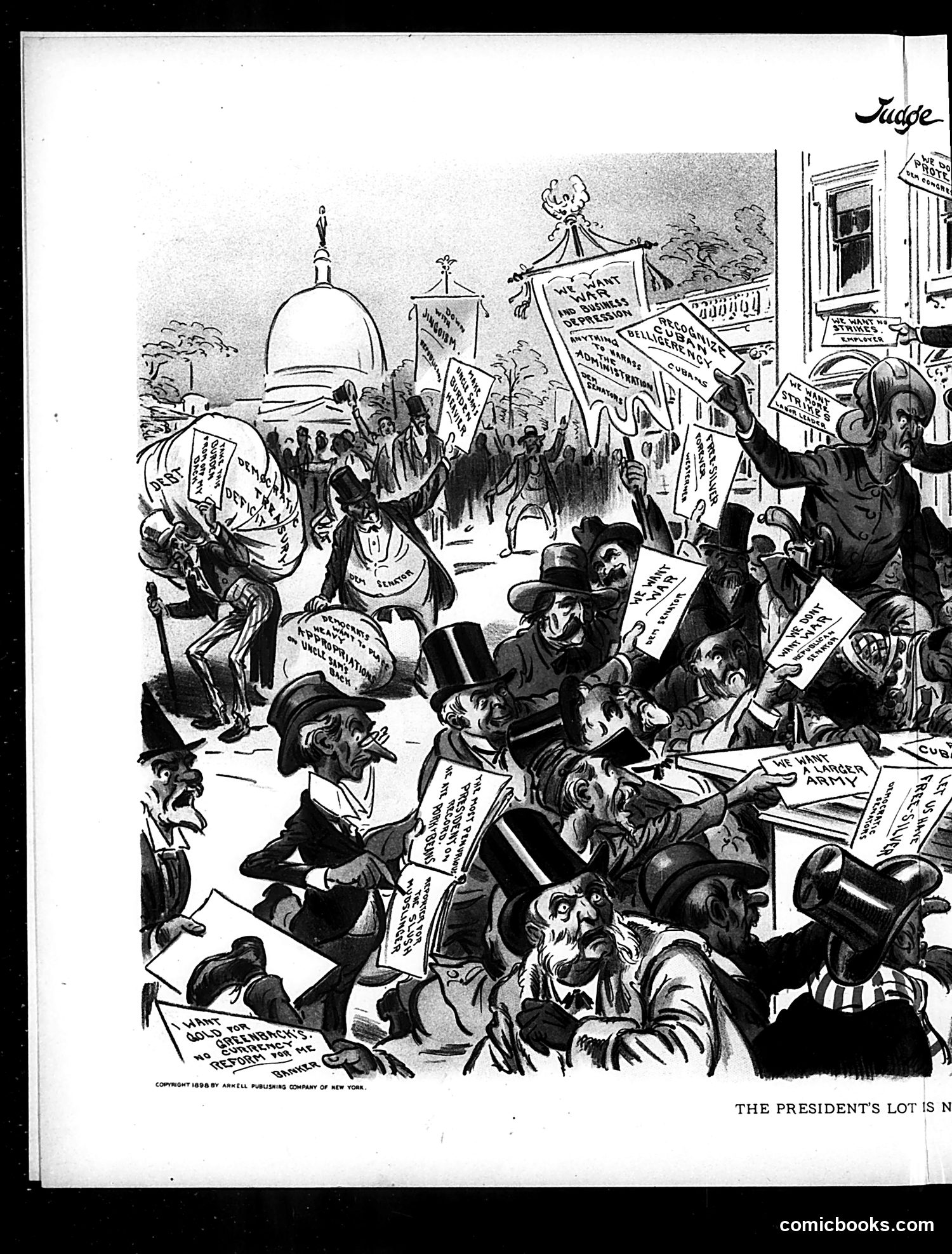
This appears to be a satirical Judge magazine cartoon depicting a chaotic political protest or demonstration outside what looks like government buildings (note the Capitol dome visible in the background). The cartoon shows a large crowd of figures carrying protest signs and banners—the text on these signs is too small to read clearly in this image, but they appear to reference political grievances or demands. The style and composition suggest this is criticizing either widespread political agitation, populist movements, or labor unrest during the late 19th or early 20th century. The title "THE PRESIDENT'S LOT IS N[OT]..." (text cut off) suggests commentary on presidential difficulties dealing with public pressure or demands. Without clearer sign text or dating information, the specific political event being satirized remains unclear.
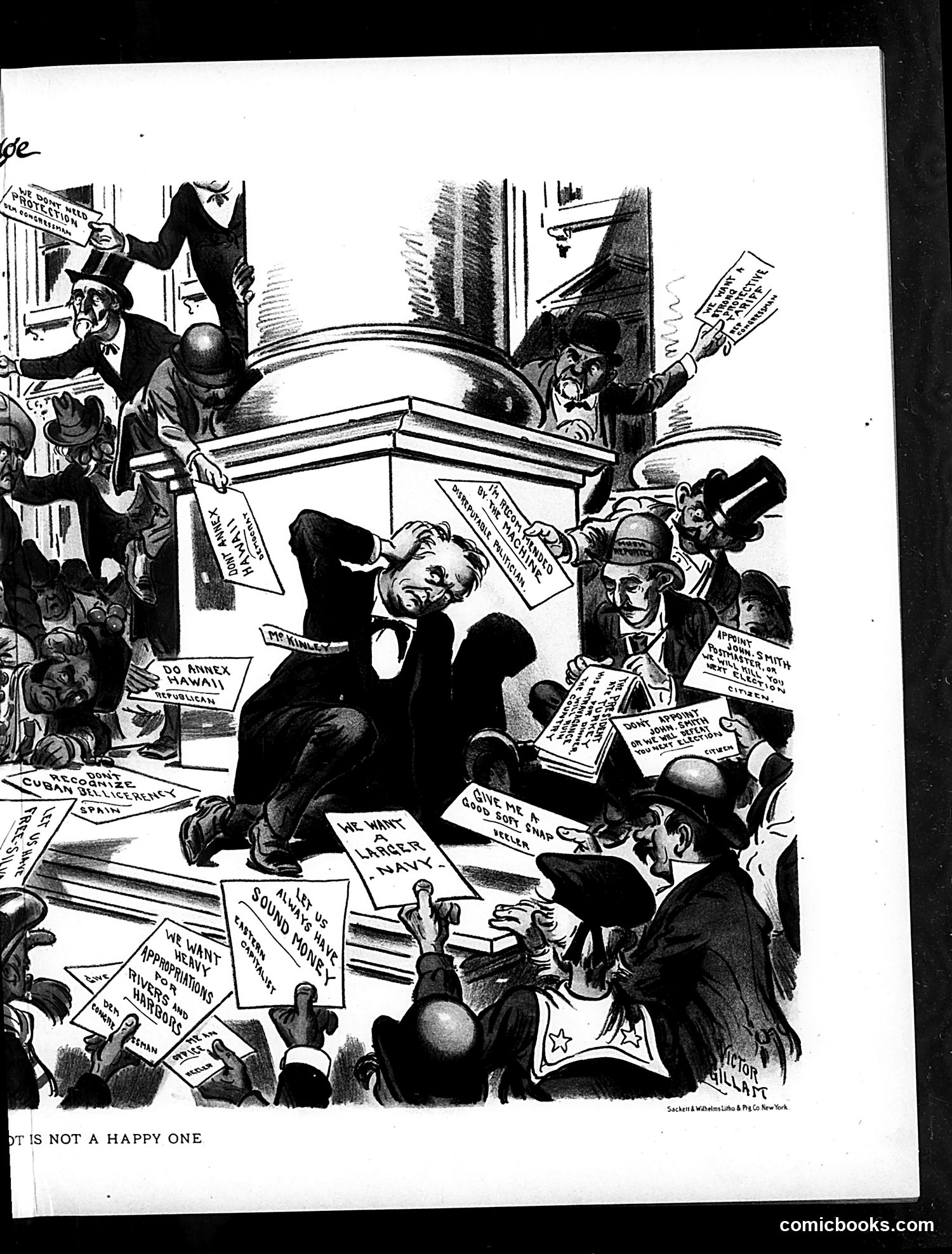
This satirical cartoon depicts a central figure (appearing distressed or overwhelmed) surrounded by aggressive crowds and placards making various demands. Visible signs reference "Hawaii," "Cuba," "appropriations," and other territorial/political matters, suggesting competing American imperial interests of the late 19th or early 20th century. The title "**[It] Is Not a Happy One**" indicates the central figure—likely a U.S. political leader or Uncle Sam representation—is besieged by conflicting pressure groups and political factions demanding attention to different colonial possessions and financial appropriations. The cartoon satirizes the chaos of American expansionism and domestic politics, showing how simultaneous imperial ambitions, competing business interests, and political pressure created an untenable situation for leadership. The crowded, frantic composition emphasizes the overwhelming nature of these competing demands.
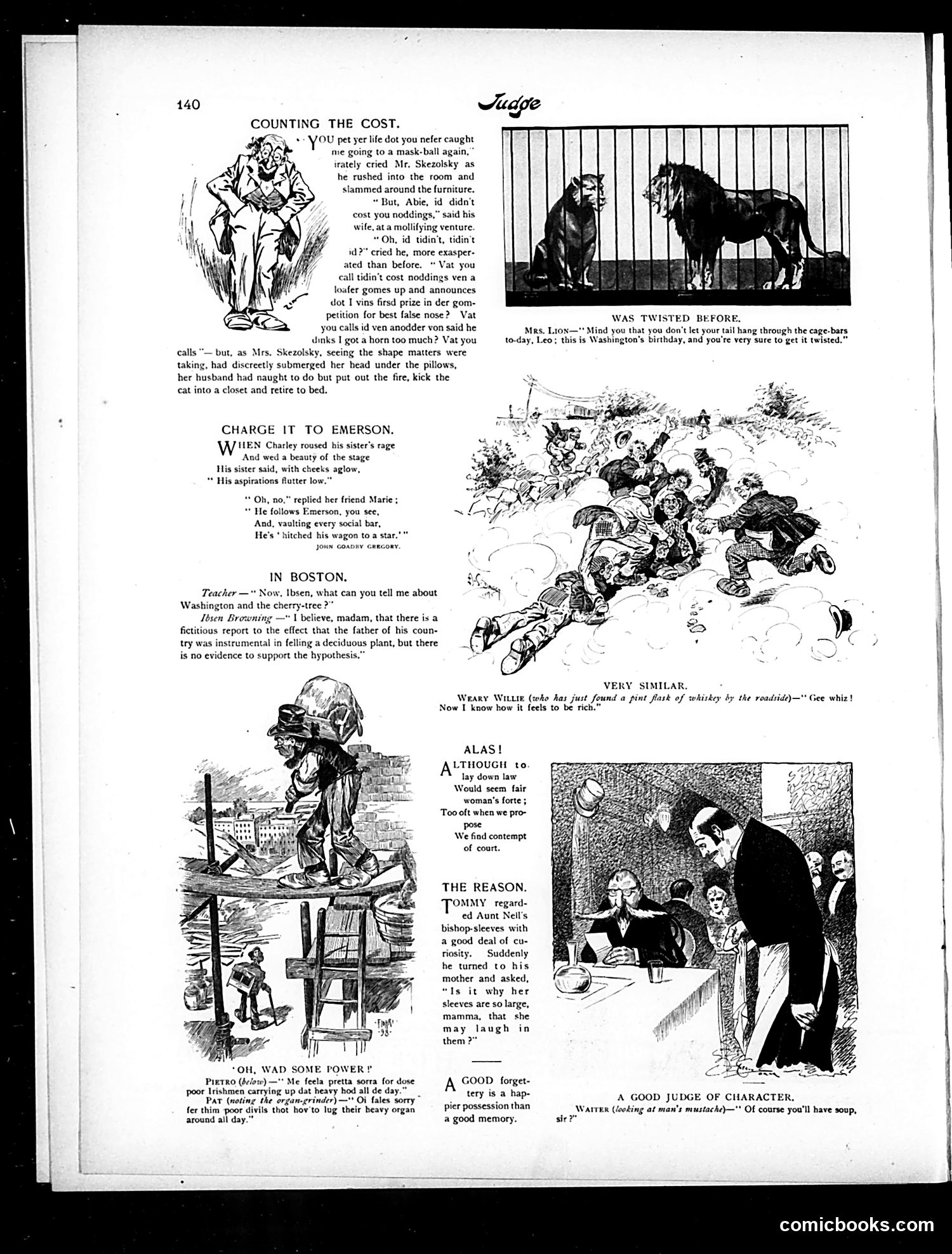
This page contains multiple unrelated satirical vignettes typical of Judge's format: **"Counting the Cost"**: A Jewish immigrant character (indicated by dialect spelling) complains to his wife about a masquerade ball's hidden social costs—public embarrassment from being mocked for his false nose and physical appearance by other attendees. The satire targets how social events can humiliate rather than entertain. **"Charge It to Emerson"**: A play on Ralph Waldo Emerson's famous quote about "hitching your wagon to a star." A man marrying an actress of lower social standing is reframed as philosophically ambitious rather than foolish. **"In Boston"**: A student named Ibsen (referencing playwright Henrik Ibsen) pedantically questions the historical accuracy of the Washington cherry-tree legend, satirizing overly intellectual Boston culture. **Other sketches** include brief jokes about finding whiskey ("feeling rich"), a child's naive question about large bishop sleeves, immigrants' sympathies for laborers, and a pun about judges and mustaches. The page reflects turn-of-century American humor: ethnic stereotypes, class commentary, and intellectual pretension.
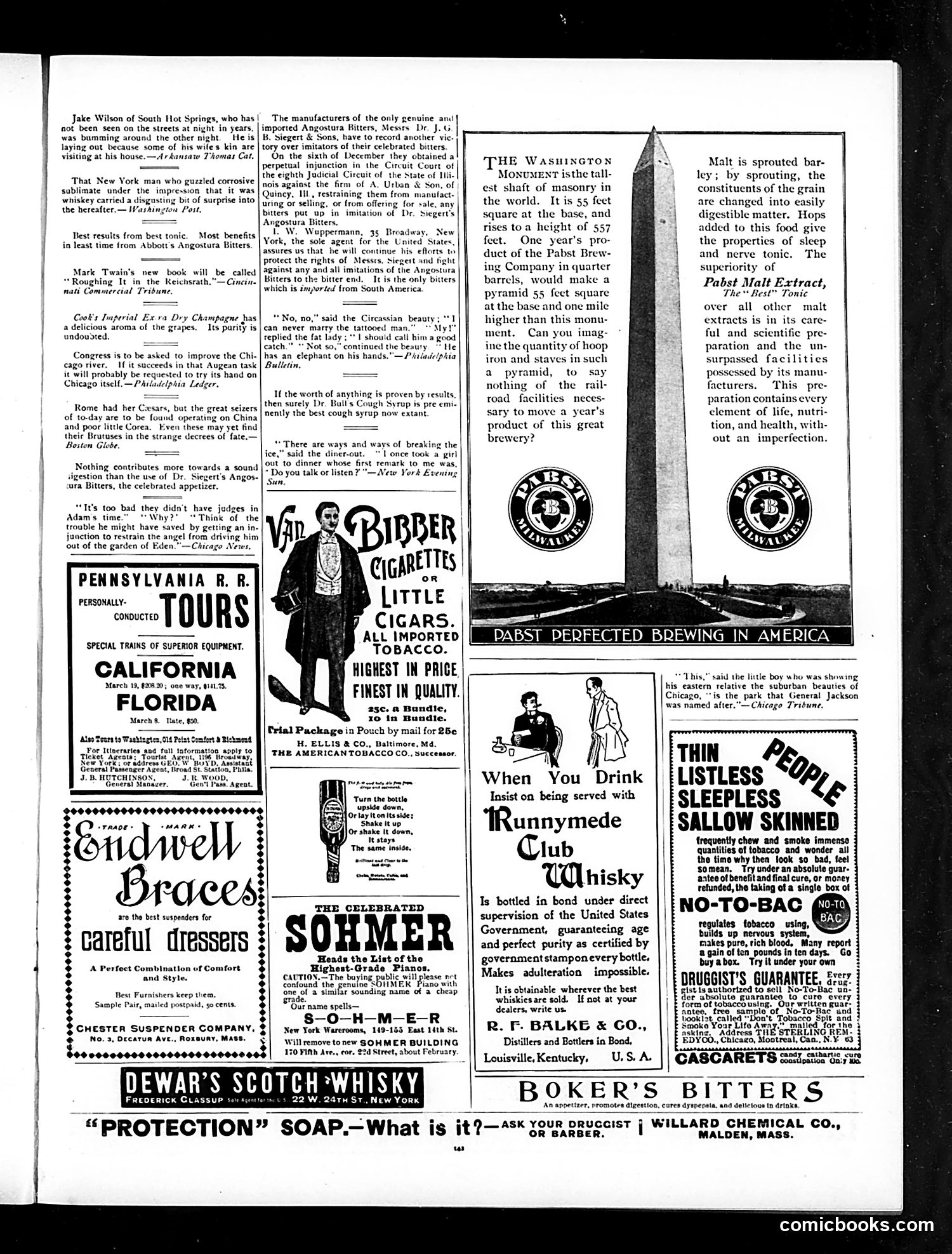
This page is primarily **advertising**, with minimal editorial content. The satirical elements are brief social commentary items scattered among ads. The main jokes target: 1. **Jake Wilson anecdote** – A man avoiding his wife's visiting relatives by staying indoors; light domestic humor. 2. **The "corrosive sublimate" item** – Dark humor about a New Yorker who mistakenly drank poison thinking it was whiskey, with fatal results. 3. **Mark Twain reference** – A pun on his book title "Roughing It," calling it "Roughing It in the Reichsrath" (Austrian parliament) – unclear without more context. The page is dominated by **patent medicine advertisements** (Angostura Bitters, Pabst Malt Extract, No-To-Bac) and travel ads typical of the era. These ads reflect turn-of-century American consumer culture and the prevalence of unregulated medicinal products marketed with grand health claims. The satire here is mild; the page functions primarily as a commercial vehicle for contemporary products.
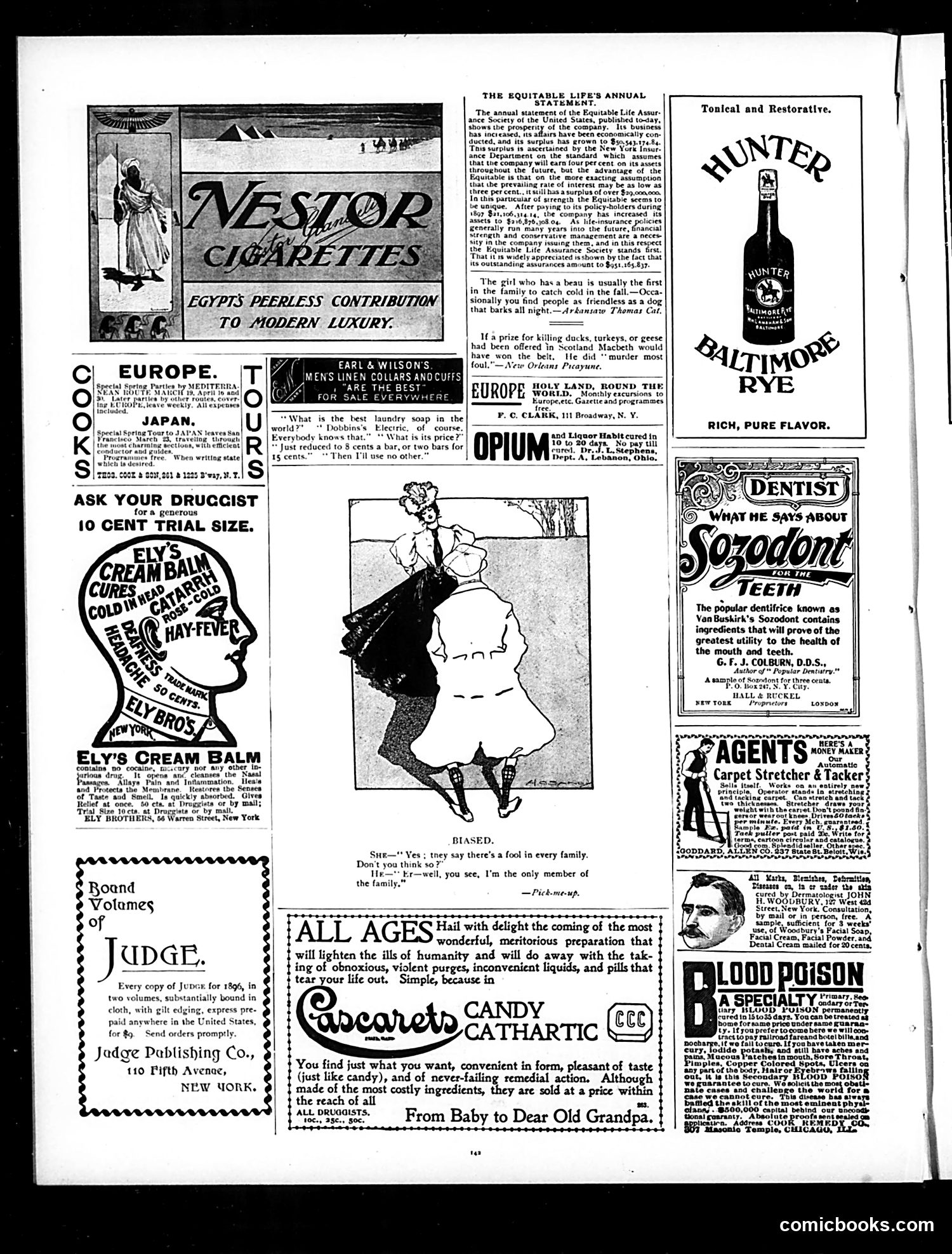
This page is primarily **advertising**, typical of late 19th-century magazines. The main cartoon depicts a woman in fashionable dress posing next to a large snowman, captioned "BIASED" with dialogue about family fools—a mild domestic joke with no apparent political content. The advertisements reveal period concerns: patent medicines (Ely's Cream Balm for nasal congestion, Sozodont toothpaste), the Equitable Life insurance company's financial report, and consumer goods. One notable ad features cigarettes labeled "Nestor" as "Egypt's peerless contribution to modern luxury"—reflecting the era's exoticism and lack of health warnings about tobacco. The humor is genteel and commercial rather than satirical. The "Europe" travel advertisements and insurance promotions target affluent readers. Overall, this page documents early advertising practices and consumer culture rather than political commentary.
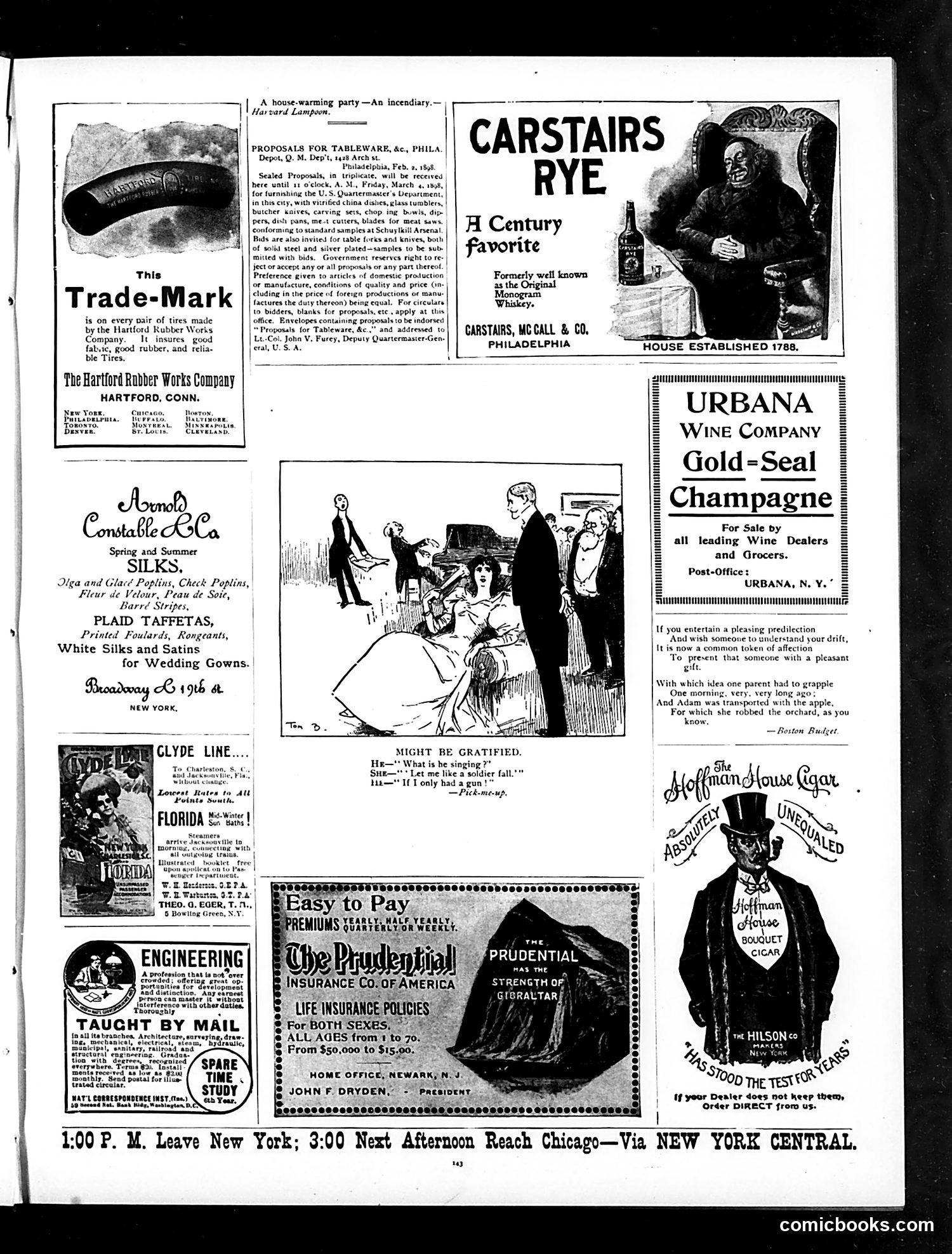
This page is primarily **advertising**, typical of Judge magazine's revenue model. The central cartoon—titled "Might Be Gratified"—depicts a social scene where a man sings "Let me like a soldier fall," prompting someone to quip "If I only had a gun!" This is mild social satire about tedious amateur singing at gatherings, a common Victorian complaint. The page also includes a small literary joke referencing Adam and Eve (the apple/forbidden fruit), playing on classical allusions readers would recognize. Most of the page comprises commercial advertisements for rubber tires, champagne, cigars, life insurance, railroad travel, silk goods, and educational correspondence courses—reflecting Gilded Age consumer culture. A U.S. Army quartermaster procurement notice appears as well, advertising bids for military tableware. The satirical content is minimal; this is essentially a revenue-generating advertising page with light humor inserted between products.
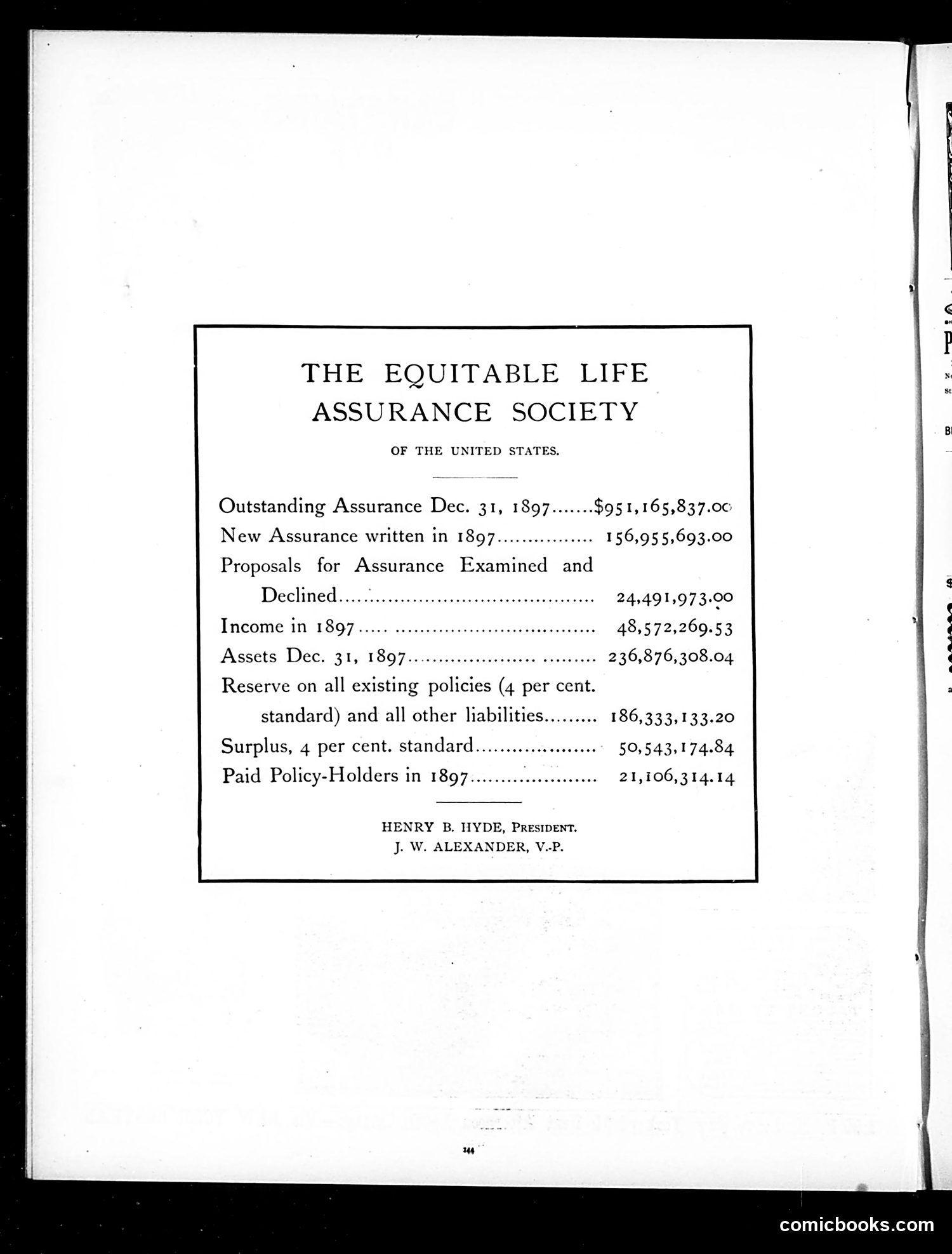
This page is **not a cartoon or satire**—it's a straightforward **advertisement/corporate announcement** for the Equitable Life Assurance Society, printed in Judge magazine in 1897. The text presents financial statistics showcasing the company's scale and success: nearly $951 million in outstanding assurance, $48+ million in annual income, and $236+ million in assets. It lists Henry B. Hyde (President) and J. W. Alexander (Vice President) as leadership. For modern readers: This is essentially a **financial boast**—a corporation publicizing its impressive numbers in a prestigious satirical magazine to build investor and customer confidence during the Gilded Age. Insurance companies were major players in American finance by the 1890s. The inclusion in Judge suggests either paid advertising or editorial coverage treating corporate success as newsworthy. There is no satire or joke here; it's corporate self-promotion.
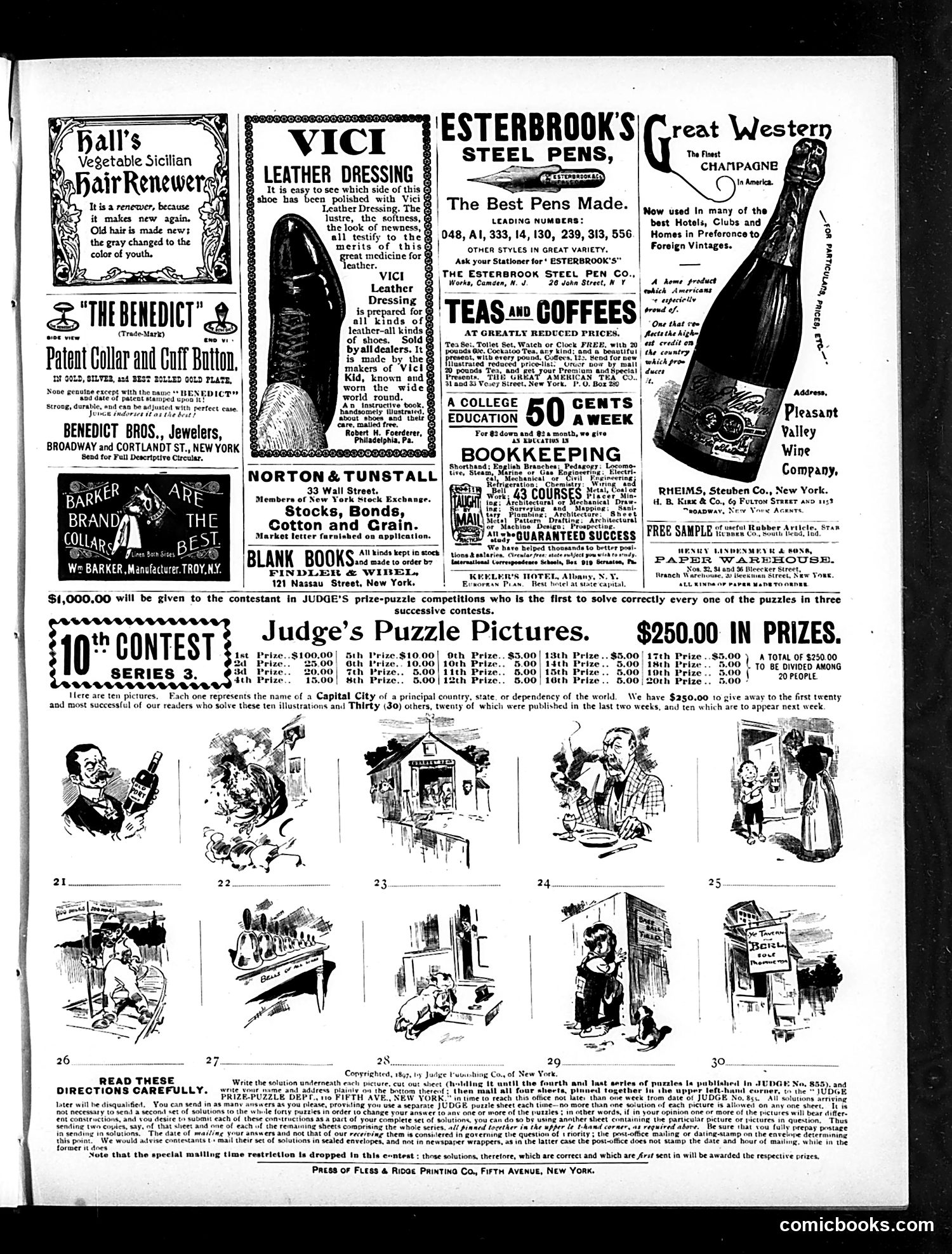
This page is primarily **advertising and a puzzle contest**, not political satire. The bulk consists of commercial advertisements for period products (steel pens, hair renewers, leather dressing, collars, champagne, tea, bookkeeping courses) typical of early 20th-century magazines. The main content is Judge's "10th Contest Series 3"—a **$250 puzzle competition** where readers solve ten illustrated visual riddles to win prizes totaling $250. The page displays five of the thirty puzzle images (numbered 21-25 visible), showing domestic and everyday scenes that readers must identify or interpret to match a mystery answer related to "a Capital City of principal country, state, or city of the world." The detailed contest rules explain that multiple entries are permitted, solutions must be submitted on official Judge sheets, and the postmark date determines priority. This was a common engagement strategy for magazines in this era—drawing subscribers and encouraging repeat purchases while building reader loyalty.
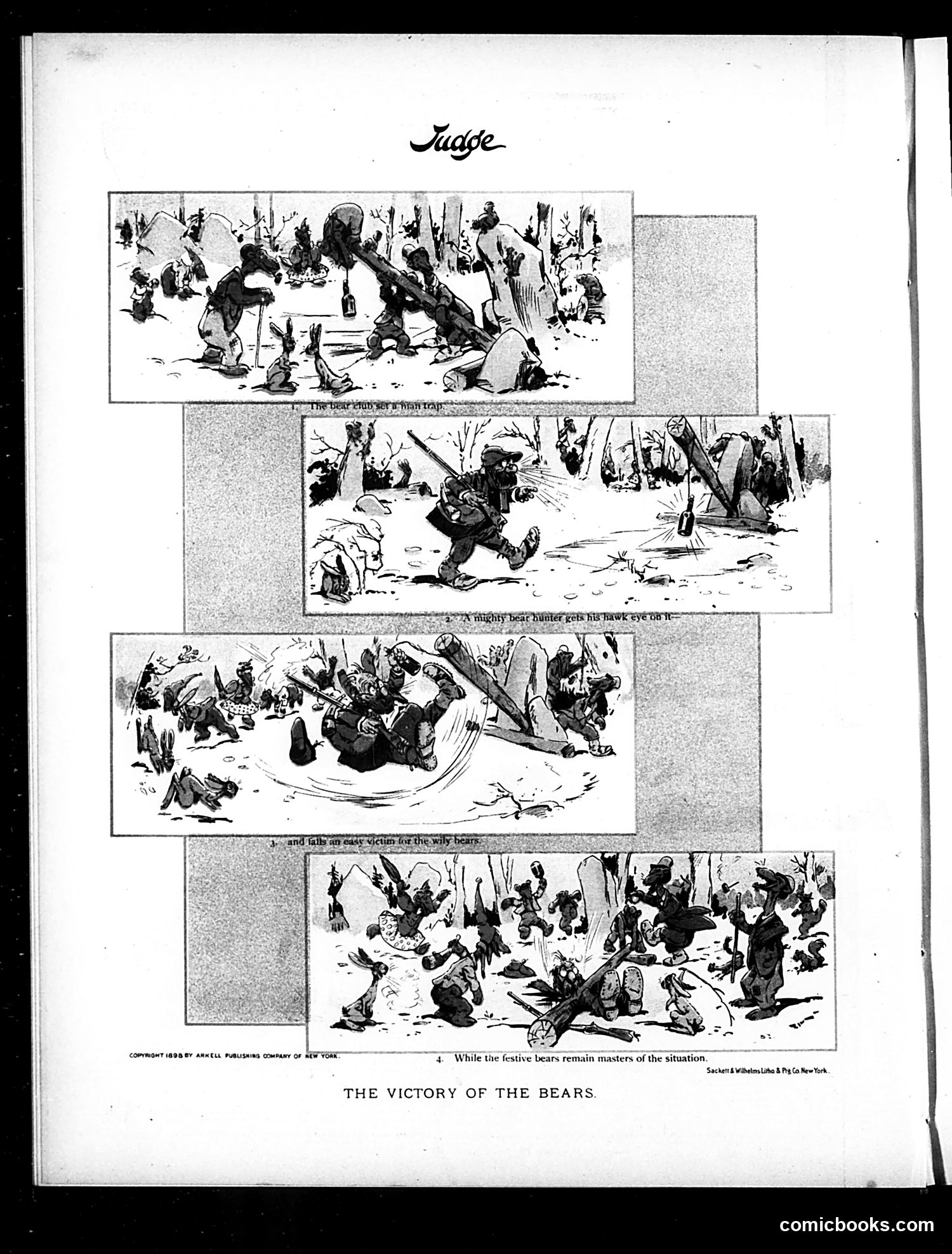
This is a four-panel satirical comic titled "The Victory of the Bears," depicting bears as anthropomorphic characters engaged in conflict with smaller figures (likely representing hunters or humans). The bears progressively gain the upper hand across panels: setting a trap, attacking a hunter, subduing multiple opponents, and finally dominating the scene while "remain masters of the situation." "Bears" in financial satire of this era typically represented stock market pessimists betting on price declines. This comic likely satirizes a period when bearish investors dominated market conditions, causing losses for bulls (optimists). The violent imagery humorously exaggerates market warfare between these investment factions. The work is credited to Sackett & Wilhelms lithographers in New York.