
Judge, 1898-02-26 · page 6 of 16
Judge — February 26, 1898 — page 6: what you’re looking at
What you’re looking at
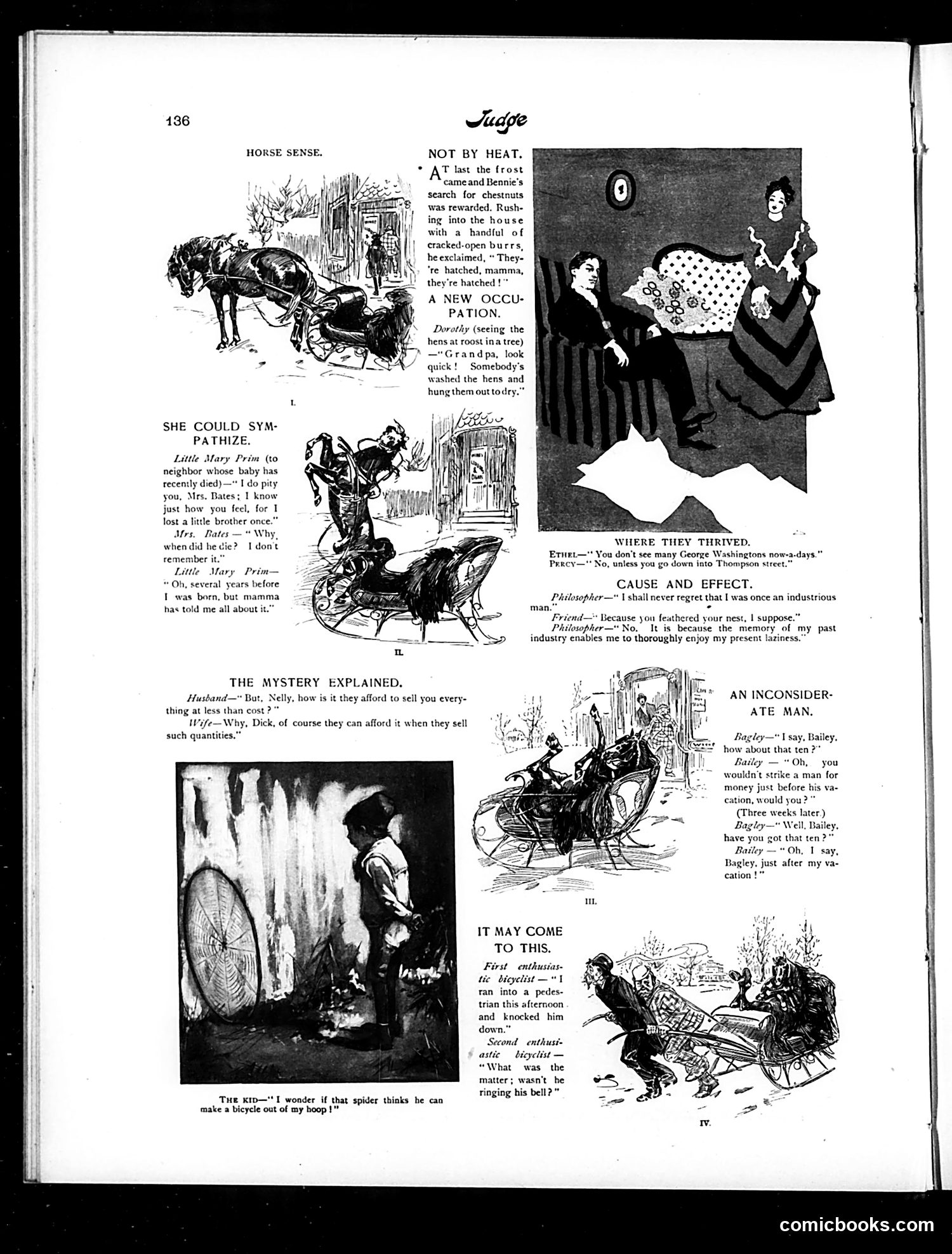
This page contains multiple humorous vignettes typical of Judge's satirical style. The cartoons mock everyday American life and human nature: **"Horse Sense"** and **"A New Occupation"** are gentle jokes about children's innocent misunderstandings—confusing chestnuts with hatched eggs, hens hung to dry like laundry. **"She Could Sympathize"** satirizes false empathy: a neighbor expresses pity for a woman's loss, claiming to understand because she lost a brother—but admits she can't even remember when he died, revealing her sympathy is performative rather than genuine. **"The Mystery Explained"** pokes fun at consumer economics: a husband questions how stores sell everything below cost; the wife naively assumes it's simply because they sell in large quantities. **"Where They Thrived"** appears to reference George Washington, suggesting certain types flourish only in less respectable neighborhoods ("Thompson street"). **"Cause and Effect"** ironically examines laziness justified by past industriousness. **"An Inconsiderate Man"** shows someone dodging a loan repayment by claiming post-vacation timing. The page reflects Judge's focus on satire of middle-class manners, petty dishonesty, and human folly rather than political commentary.
📄 Transcribed text from this page (OCR, searchable)
Machine-transcribed from the original scan — historical spelling and the odd misread are preserved.
HORSE SENSE. NOT BY HEAT, + AT last the frost cameand Bennie’s search for chestnuts was rewarded, Rush- ing into the house with a handful of cracked-open burrs, he exclaimed, “ They ‘re hatched, mamma, they're hatched !* A NEW OCCU- PATION. Dorothy (seeing the hens at roost ina tree) —"Grandpa, look quick! Somebody's washed the hens and hung them out todry.” SHE COULD SYM- PATHIZE. Little Mary Prim (to neighbor whose baby has recently died)—" I do pity you, Mrs. Bates; I know just how you feel, for I lost a little brother once.” = Mrs, Bates —* Why. } . oe ~ when did hedie? I dont - . WHERE THEY THRIVED. We et—"* You don't see many George Washingtons now-a-days.” remember it. ; te unless you go down into Thompson street.” Little Mary Prim— “Oh, several years before The Up CAUSE AND EFFECT. 1 was born, but mamma < lia Philosopher —" | shall never regret that I was once an industrious has told me all about it.” > y > i man.” ° Friend—* Because you feathered your nest, | suppose.” Philosopher—" No. It is because the memory of my past industry enables me to thoroughly enjoy my present lazine: THE MYSTERY EXPLAINED. I Husband — Bot, Nelly, how is it they afford to sell you every- heue E AN INCONSIDER- thing at less than cost?" qed ATE MAN. Vhy, Dick, of course they can afford it when they sell : | Bagley—"\ say, Bailey, how about that ten >" Bailey — “Oh, you wouldn't strike a man for money just before his va- cation, would you (Three weeks later) Bagley—" Weil, Bailey. have you got that ten? Bailey —* Ob, 1 say, Bagley, just after my va- cation !" IT MAY COME TO THIS, First enthusias- tic bicyclist — ran into a pedes- trian this afternoon and knocked him dow Second enthusé- astic bicyclist — “What was the matter; wasn't he Tue xto—"' 1 wonder if that spider thinks he can Hagiog his belle make a bicycle out of my boop !"* comicbooks.com