
A complete issue · 16 pages · 1898
Judge — January 22, 1898
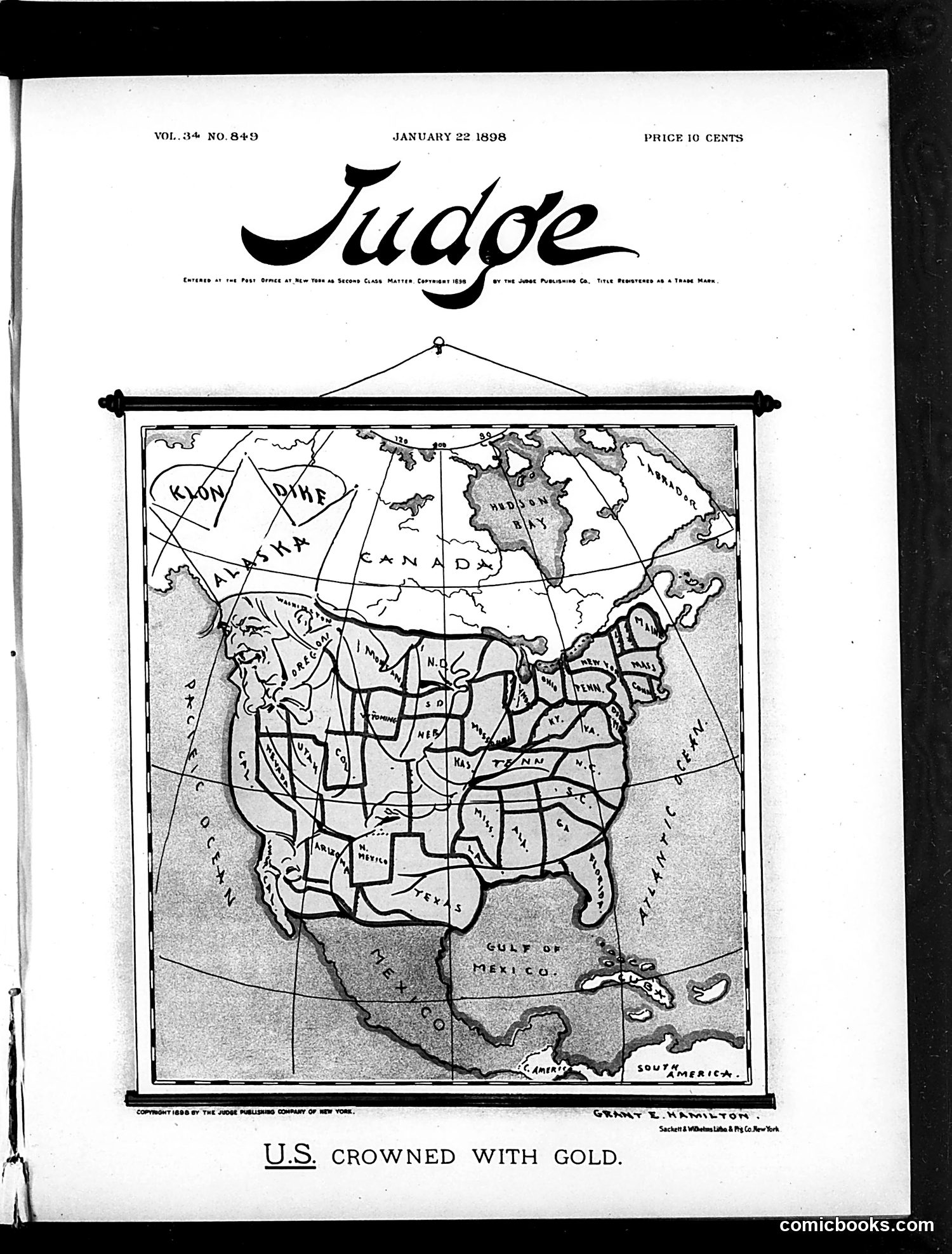
This satirical map shows the continental United States overlaid with what appears to be a crown design. The title "U.S. Crowned with Gold" likely references the gold rush and American expansion during the 1890s. The map emphasizes territorial growth and economic prosperity, with state boundaries marked and shaded regions suggesting newly acquired or economically significant areas. The crown imagery suggests triumphalism about American power and wealth. This appeared during the Spanish-American War era (1898), when American imperialism and territorial expansion were major political topics. The cartoon appears to celebrate American dominance and golden prosperity, though the crown might also carry ironic undertones about American imperial ambitions depending on Judge magazine's satirical stance at that moment.
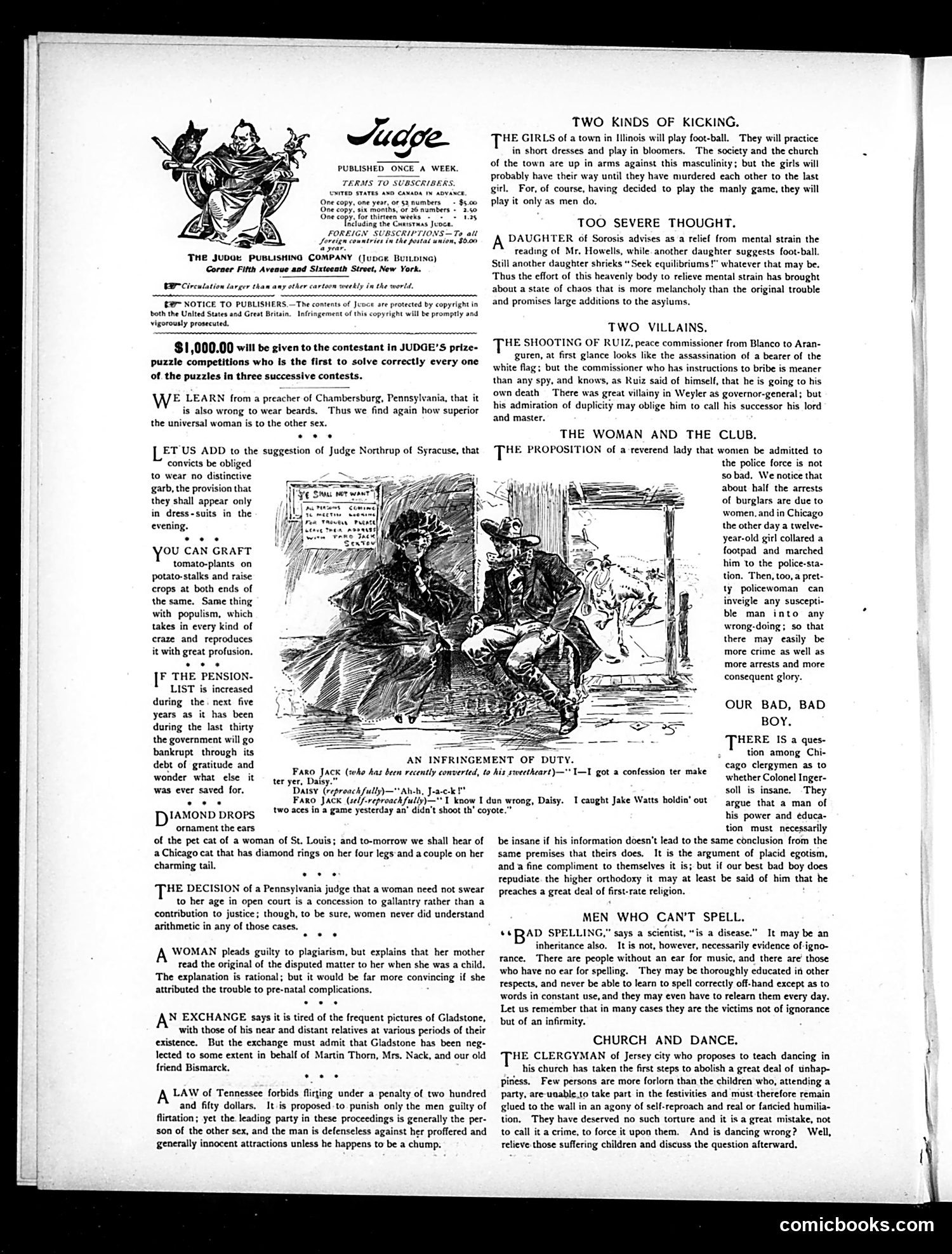
The main cartoon depicts two figures—labeled "Faro Jack" and "Daisy"—in what appears to be a confrontation. The caption reads: "I got a confession to make for two sets in a game yesterday an' didn't shoot th' coyote." This satirizes police corruption and negligent law enforcement. "Faro Jack" (a gambling reference suggesting a criminal character) admits to covering up wrongdoing—apparently failing to report or arrest someone ("shoot th' coyote"). The cartoon mocks officers who ignore crimes in exchange for favors or bribes, a common Gilded Age concern. The surrounding editorial text reinforces this theme, discussing women joining police forces and questioning whether uneducated men in power can properly enforce laws. The satire targets institutional corruption and the inadequacy of contemporary law enforcement.
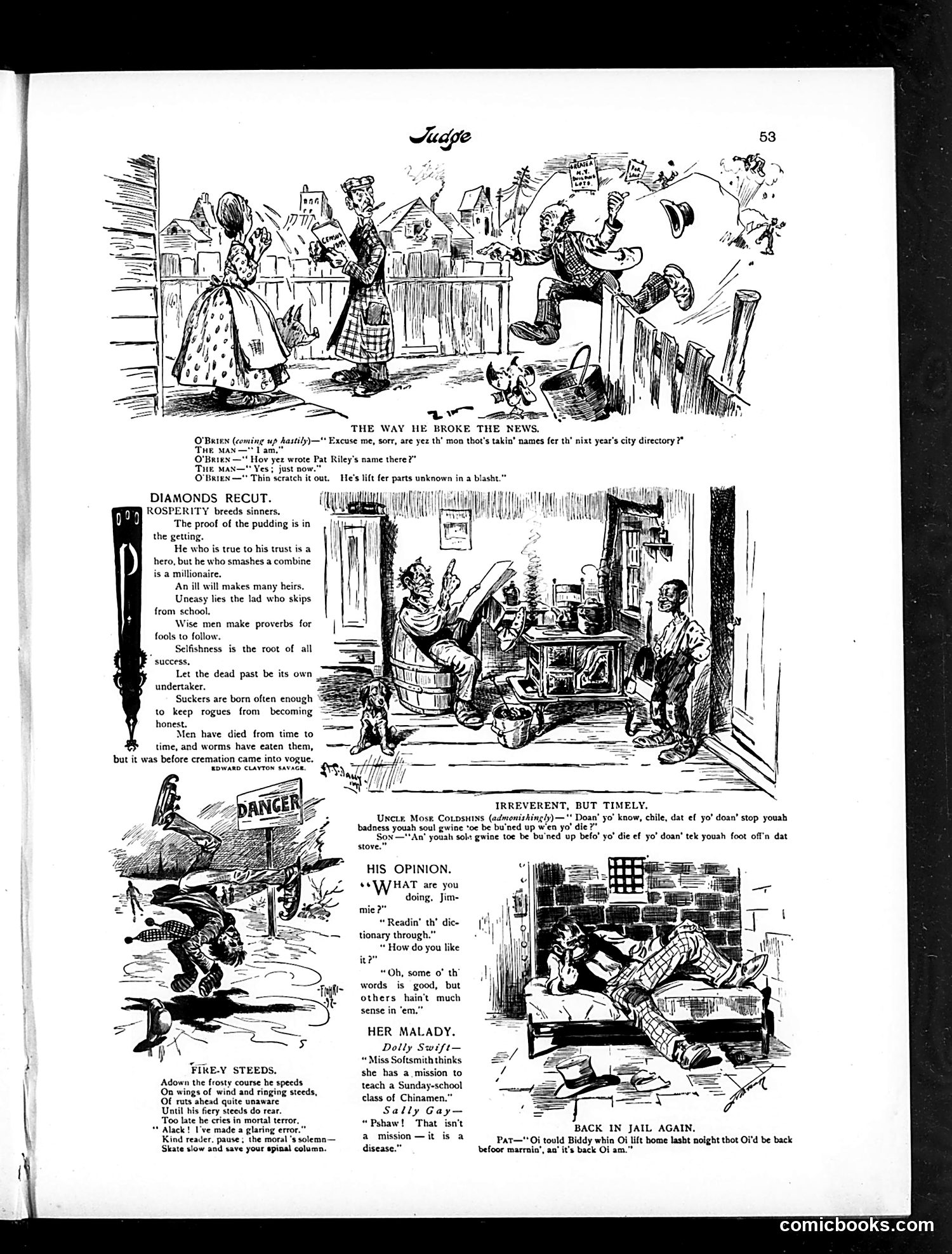
This page contains several standalone satirical pieces rather than unified political cartoons. **"The Way He Broke the News"** (top) mocks a man informing his wife of financial disaster—likely a stock market loss or business failure—by literally throwing objects and acting wildly instead of delivering the news calmly. **"Diamonds Breed Prosperity"** (left column) is a moralistic poem criticizing materialism and selfishness, using diamonds as a symbol of greed. The remaining sections—"Fiery Steeds," "His Opinion," "Her Malady," and "Back in Jail Again"—are brief humorous anecdotes about various social types: an overly ambitious writer, a pretentious man, a woman with misguided missionary zeal, and a repeat offender. These represent common Judge targets: pretension, foolishness, and moral hypocrisy.
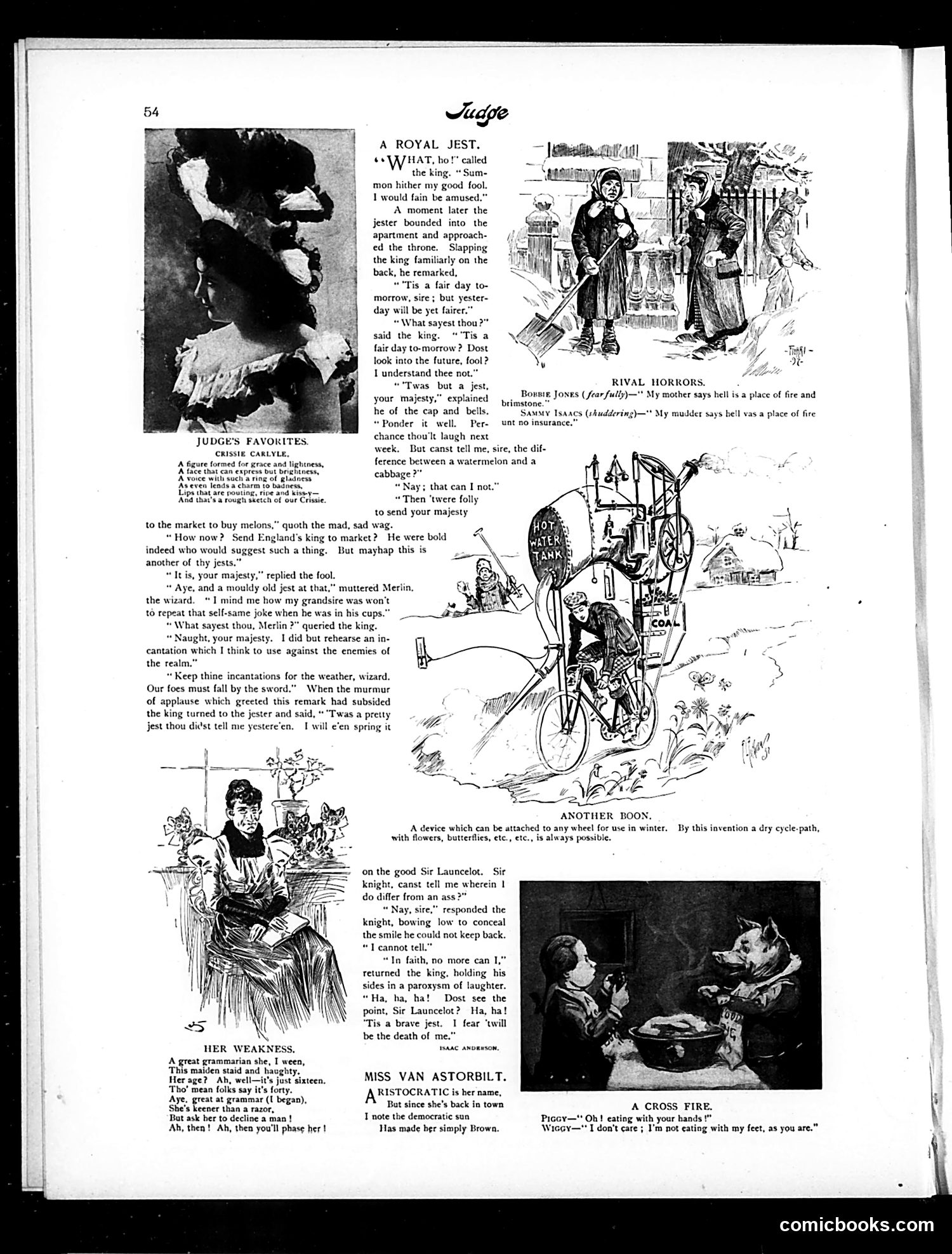
This page contains several humorous sketches and poems rather than unified political cartoons. The content includes: **"A Royal Jest"** – A dialogue between a king and court jester about weather predictions and sending messengers to market, satirizing royal foolishness through wordplay. **"Judge's Favorites"** – A poem about Cassie Carlyle praising her grammatical skills and appearance. **"Rival Horrors"** and **"Another Boon"** – Sketches depicting working-class life, with characters discussing domestic complaints and practical inventions (like a cycle-path device). **"Her Weakness"** and **"Miss Van Astorbilt"** – Character sketches satirizing female vanity and aristocratic pretension. **"A Cross Fire"** – A brief dialogue about domestic quarrels. The page primarily offers light social satire targeting Victorian-era character types—foolish nobility, vain women, working-class struggles—through humor rather than sharp political critique.
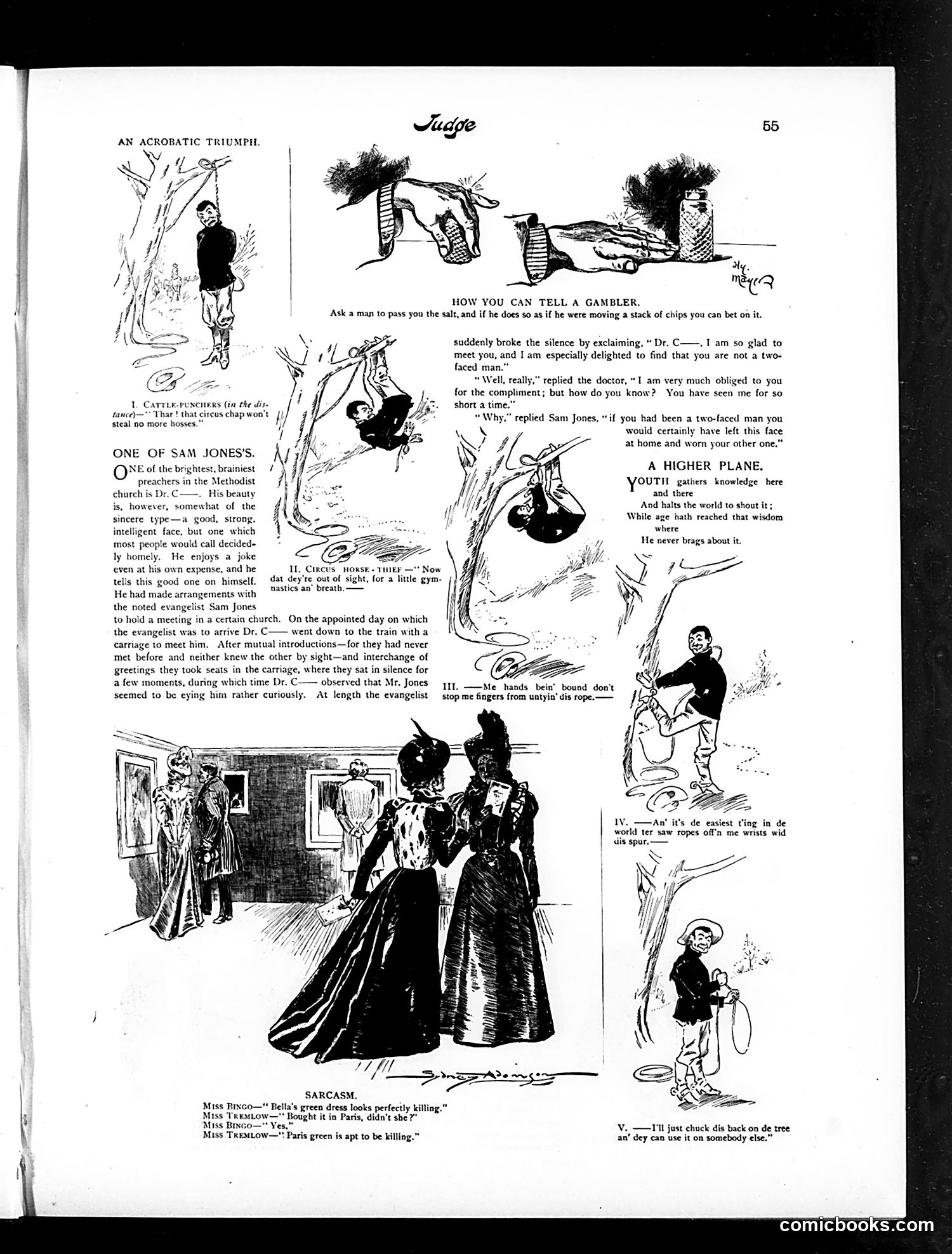
This page contains three distinct humor pieces: **"One of Sam Jones's"** is an anecdote about Methodist preacher Dr. C— and famous evangelist Sam Jones. The joke plays on Dr. C—'s admitted homely appearance: when Jones compliments him for not being "two-faced," the doctor asks how he knows after such brief acquaintance. Jones's punchline: if you were two-faced, you'd have left the ugly one at home. It's gentle, self-deprecating humor about physical appearance. **"How You Can Tell a Gambler"** is a brief behavioral observation: gamblers unconsciously handle salt shakers like poker chips, betraying their habits through gestures. **"A Higher Plane"** is a short poem contrasting youth's boastfulness with age's quiet wisdom—no specific satire, just general moralizing. The remaining sketches appear to be circus/acrobatic act illustrations with minimal captions, plus a "Sarcasm" section about dress colors and Paris green (a toxic pesticide), creating an unrelated pun. The page reflects Judge's typical mix of anecdotes, wordplay, and light social observation rather than hard political satire.
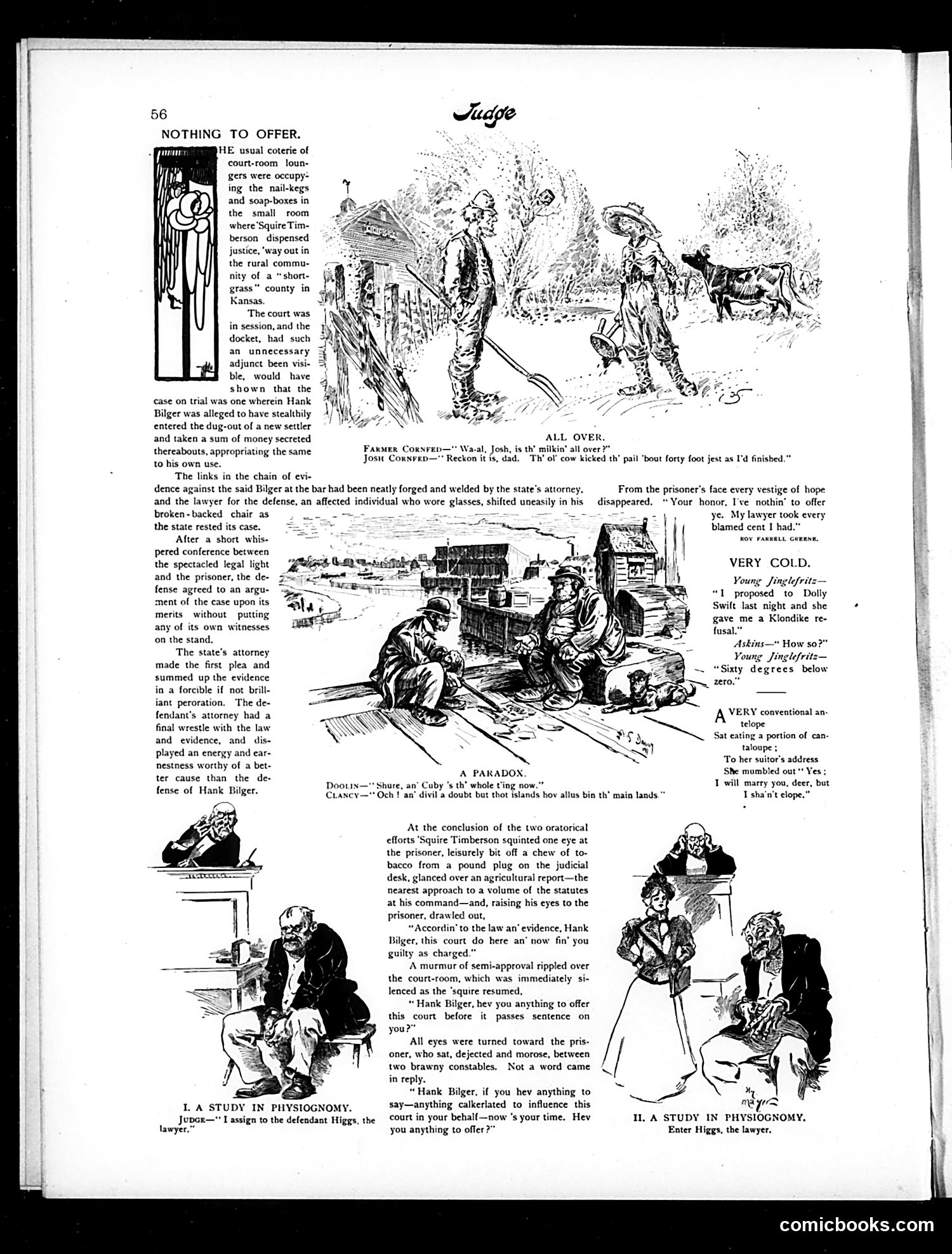
This page satirizes rural Kansas justice and legal incompetence through the story of Hank Bilger's trial for theft. The main narrative mocks the casual, amateurish nature of frontier courts: "Squire Timberson" presides while chewing tobacco and consulting an agricultural report instead of law books. The defendant's lawyer—an ineffectual, bespectacled figure—offers no defense, essentially surrendering the case. The satire's target is clear: the title "Nothing to Offer" refers both to the prisoner's poverty (he tells the court his lawyer took all his money) and the lawyer's complete lack of legal strategy. The rural setting, with its loitering "court-room loungers" and improvised justice system, represents Judge magazine's critique of backwoods American jurisprudence as corrupt, farcical, and incompetent. The page margins contain unrelated humorous anecdotes about courtship and physiognomy, typical of the magazine's miscellaneous content.
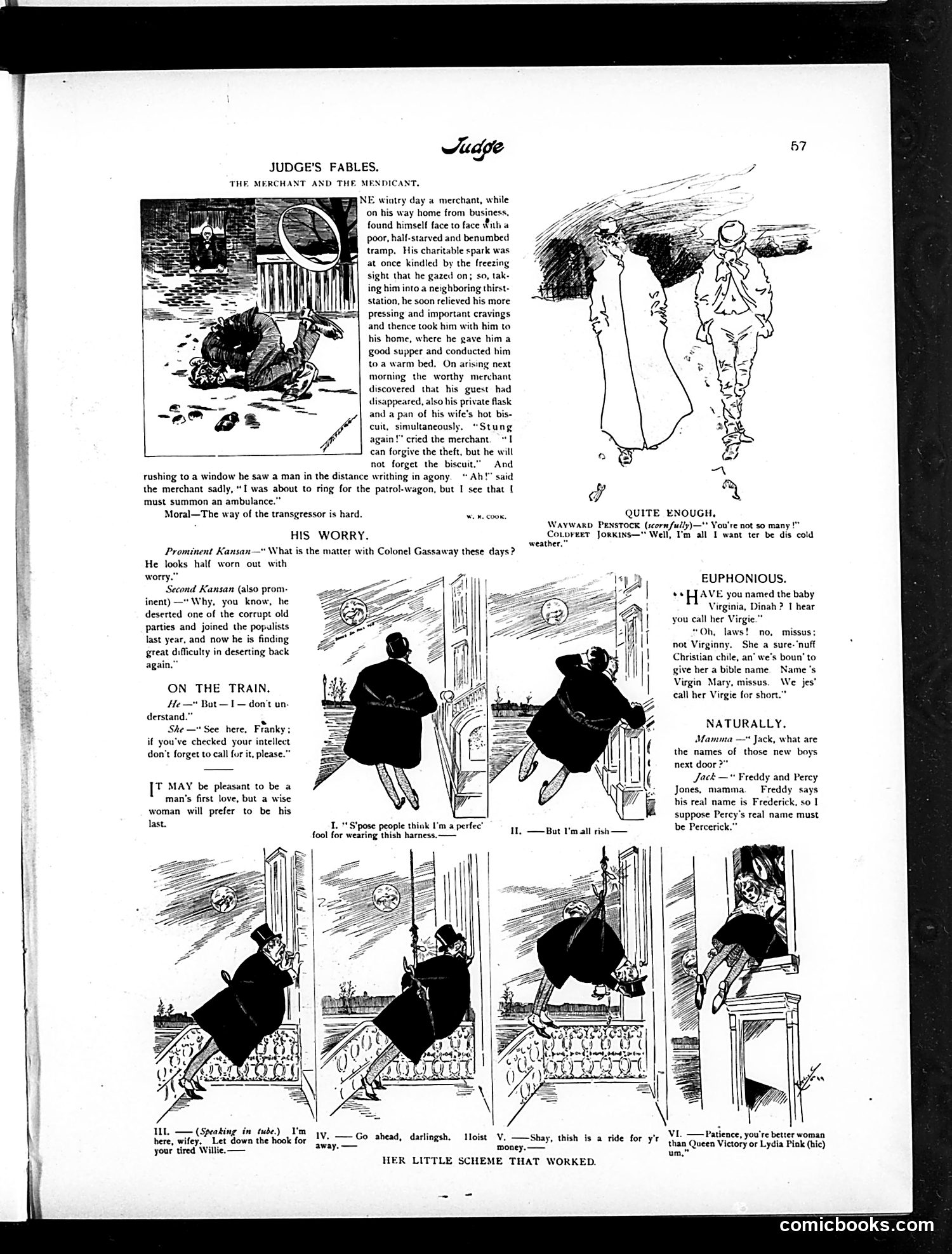
This page contains several short humor pieces typical of Judge magazine's satirical format: **"The Merchant and the Mendicant"** (top left): A moral fable mocking charitable impulses. A merchant helps a freezing beggar, brings him home—only to have the vagrant steal his wife's flask and biscuits. The merchant's exasperated reaction ("I can forgive the theft, but he will not forget the biscuit") satirizes the futility of helping the undeserving poor, reflecting late 19th/early 20th-century class anxieties about charity. **"His Worry"** references a Colonel Gassaway from Kansas struggling with political party loyalty—likely satirizing Populist Party members who'd switched allegiances, a topical concern of the era. The remaining pieces are light domestic humor: train-car banter between couples, naming conventions (humorous Southern dialect regarding "Virgie" and "Percerick"), and marital observations. These reflect period attitudes toward gender relations and regional humor stereotypes rather than specific political events.
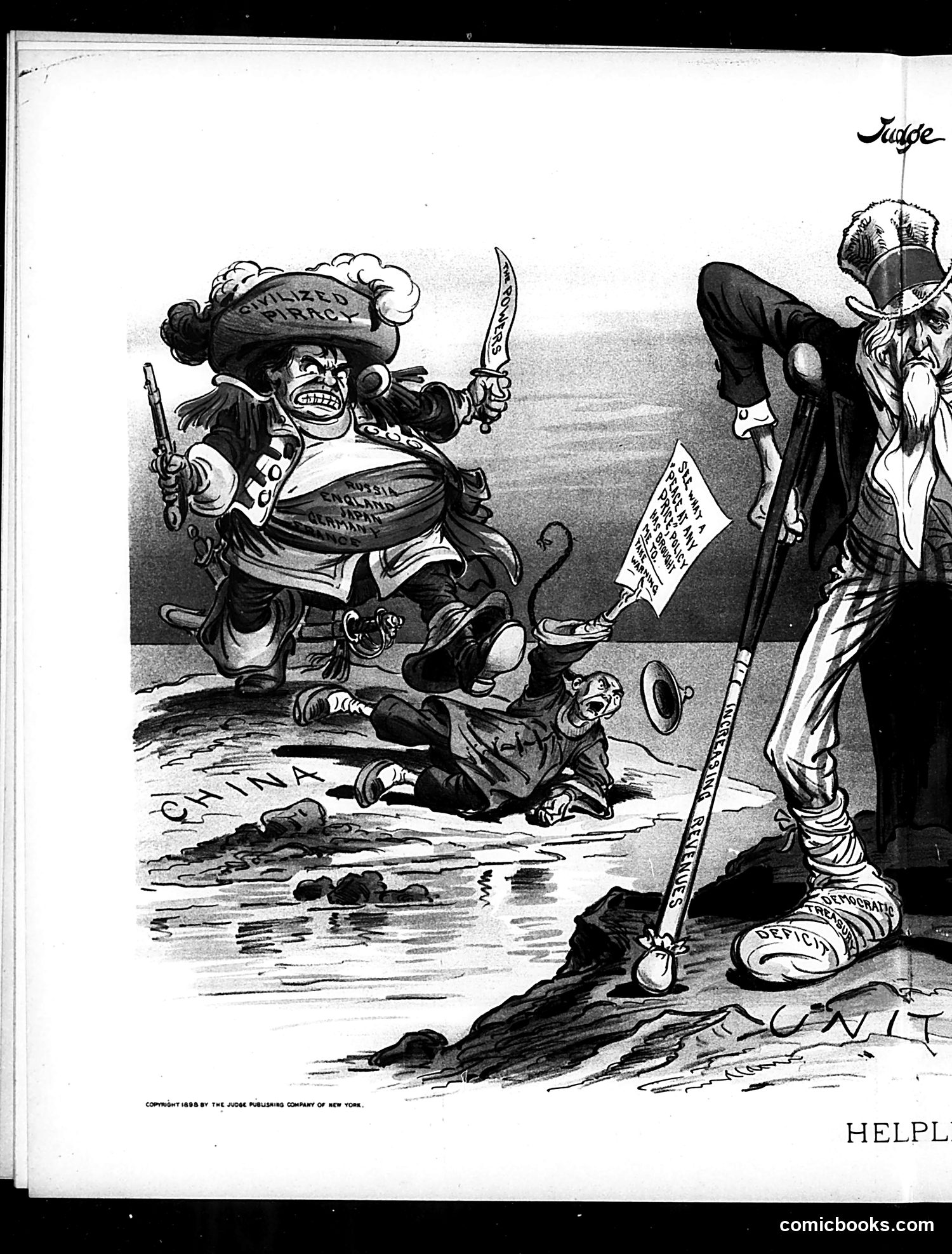
This Judge magazine cartoon depicts a caricatured figure labeled "CHINA" being attacked by a menacing character wearing a "MILITARIZED PARTITION" sash and wielding a sword. The aggressor appears to represent imperial militarism or invasion. On the right stands another figure (possibly representing Western powers or a specific nation) observing the violence. The cartoon satirizes foreign intervention in China, likely referencing early 20th-century imperialism or Japanese militarism. The drowning or defeated "CHINA" figure emphasizes the nation's vulnerability to external powers. Text fragments suggest themes of "DEFICIT" and international exploitation. The satire critiques how major powers exploited or partitioned China during this era of gunboat diplomacy and colonial expansion. The word "HELP!" reinforces China's desperate situation amid foreign predation.
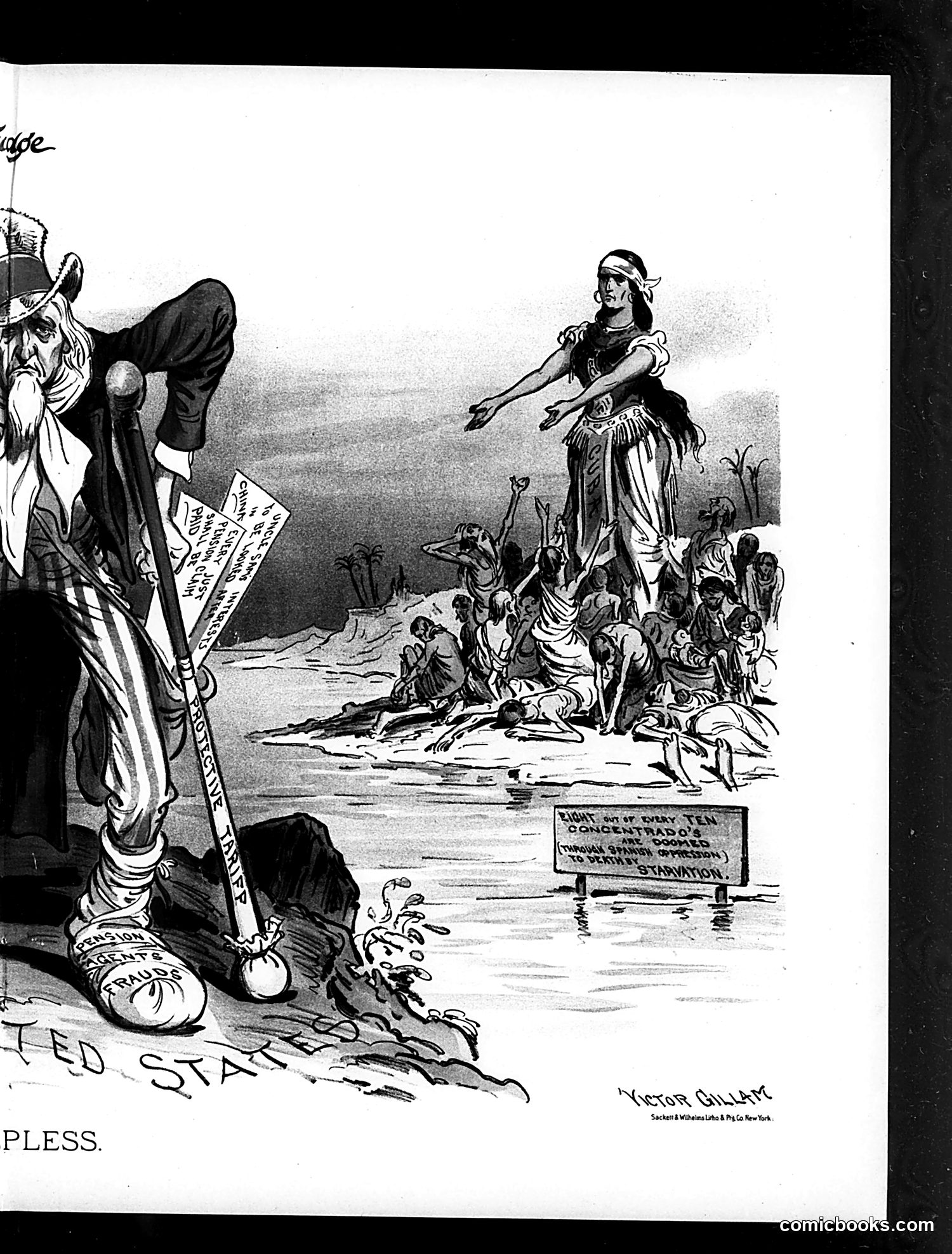
This **Judge** magazine cartoon by Victor Gillam depicts Uncle Sam (left, wearing stars-and-stripes) observing a chaotic scene across water. A female figure stands elevated above a crowd of people in distress, gesturing dramatically. A sign reads "RIGHT OF EVERY TEN COLONIZED PEOPLE TO SELF DETERMINATION" (partially legible). The cartoon appears to satirize American imperial or interventionist foreign policy. Uncle Sam "holds the gun" while observing colonial populations demanding self-determination—likely critiquing the gap between stated American ideals of freedom and actual imperial practices. The drowning/desperate figures suggest colonized peoples' suffering under such policies. Without a specific date visible, the exact historical context remains unclear, though this aligns with early 20th-century debates over American colonialism.
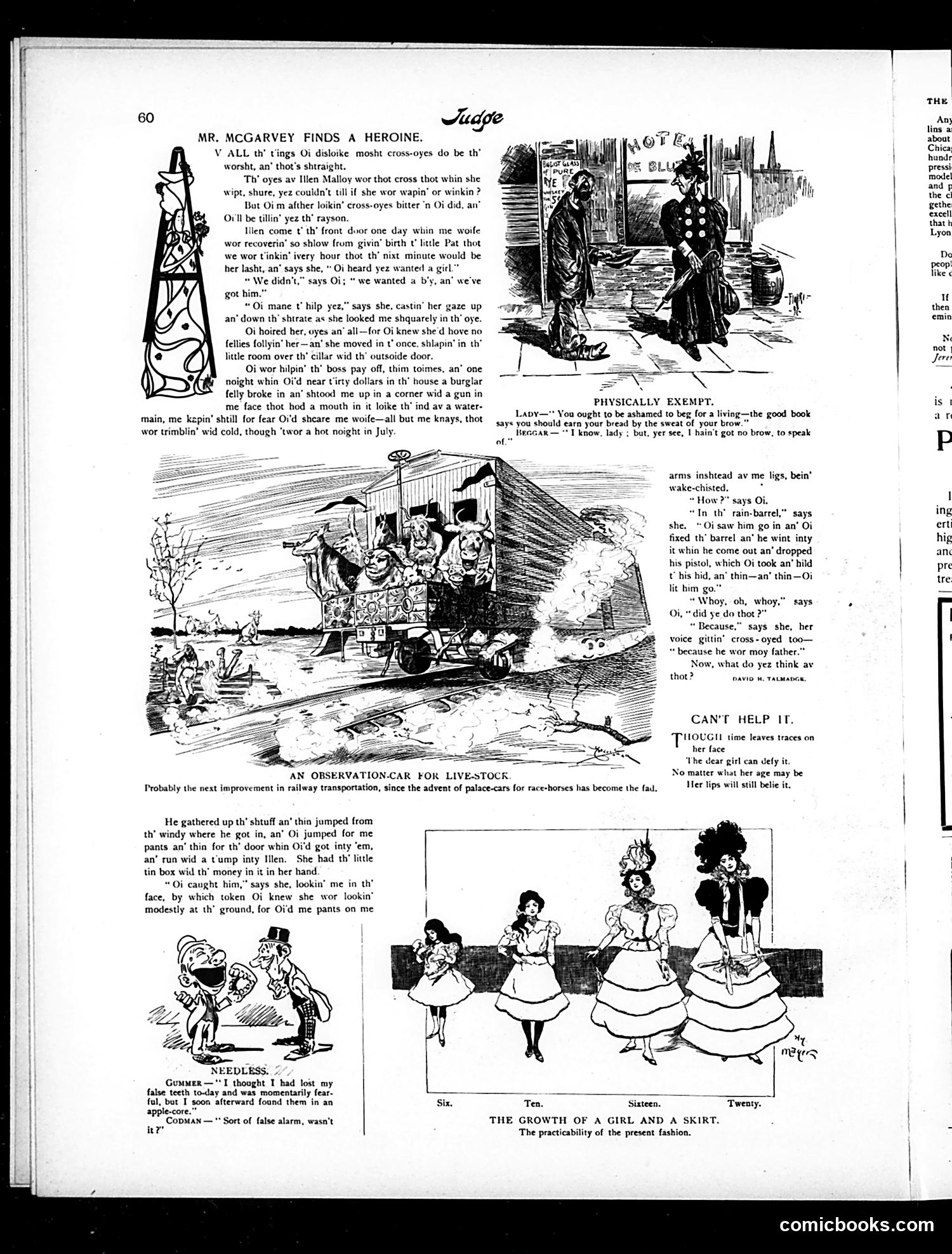
This page contains three distinct satirical pieces: **"Mr. McGarvey Finds a Heroine"** is a dialect humor story (common in Judge) featuring an Irish immigrant narrator. When a burglar invades his home while his wife recovers from childbirth, his cross-eyed housemaid Ellen Malloy heroically disarms the intruder by trapping him in a rain barrel. The humor derives from her cross-eyed appearance—traditionally a comedic trait in period satire—contrasted with her unexpected courage. The twist ending reveals the burglar was her father, commenting darkly on poverty and crime. **"An Observation-Car for Live-Stock"** is a single-panel cartoon satirizing the wealthy's obsession with luxury railway cars, sarcastically suggesting livestock deserve similar palatial accommodations—a critique of conspicuous consumption. **"The Growth of a Girl and a Skirt"** is a fashion satire showing how women's skirts expanded dramatically as girls matured, ridiculing contemporary fashion's impracticality through visual progression from childhood to adulthood. All three pieces reflect Judge's characteristic blend of class commentary, physical comedy, and fashion criticism.
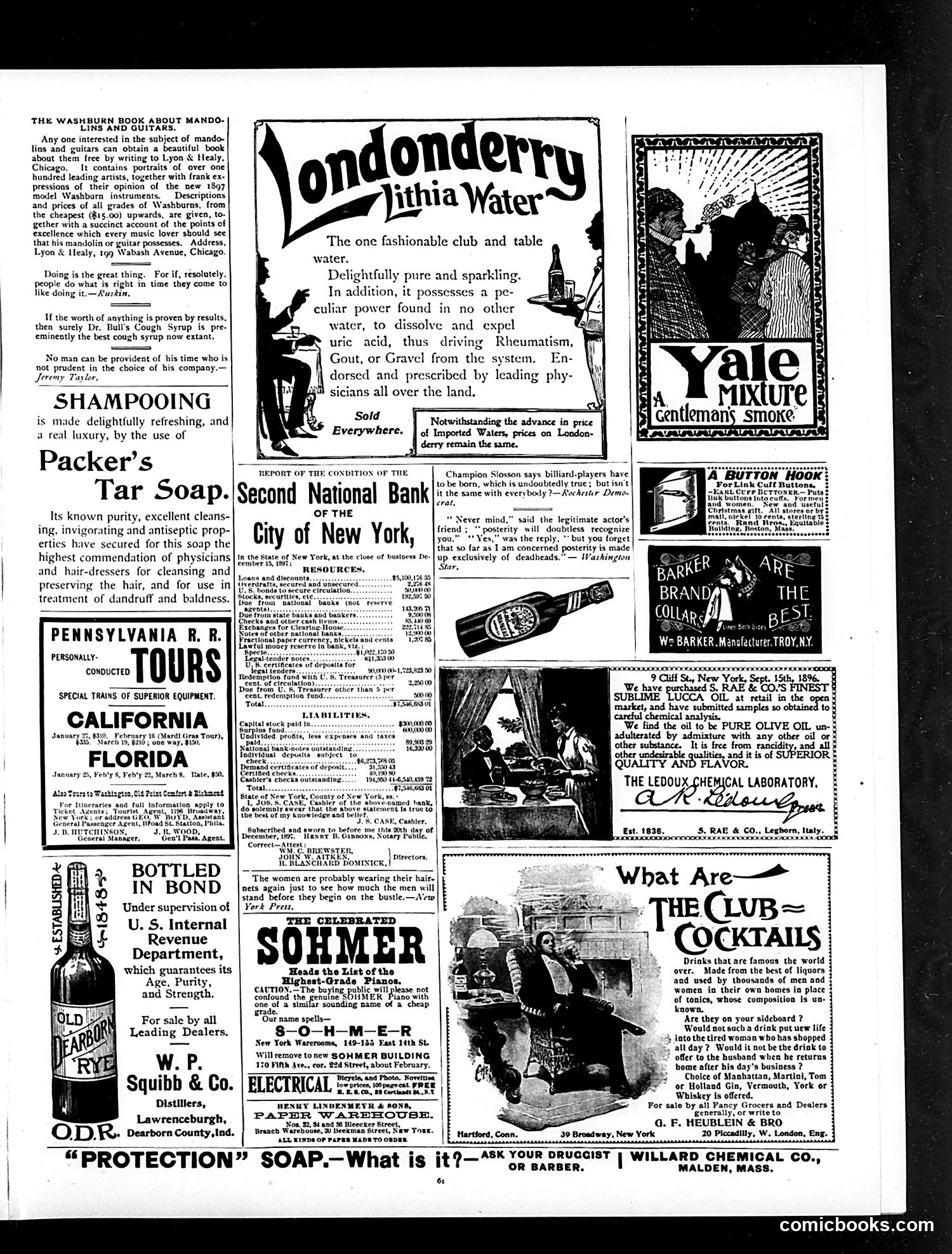
This page is primarily **advertisements and notices** rather than editorial content or political cartoons. The main items include: 1. **Londonderry Lithia Water ad**: Promotes imported Irish water as a fashionable beverage with medicinal properties, claiming to dissolve uric acid and cure gout and rheumatism. 2. **Yale Mixture tobacco ad**: Gentlemen's smoking product 3. **Banking/financial content**: Second National Bank financial report showing assets and liabilities 4. **Sommer beer ad**: German import beer with purity claims 5. **"The Club Cocktails" ad**: Describes cocktails as "famous the world over," marketed to wealthy men seeking convenience at home 6. **Travel ads**: Pennsylvania Railroad tours to California and Florida 7. **Tar soap and other commercial products** There are minor humorous notices (like the billiards joke), but no discernible political cartoons or satire. This appears to be a typical Judge magazine advertising section from 1896, reflecting the consumer culture and leisure interests of upper-class Americans of that era.
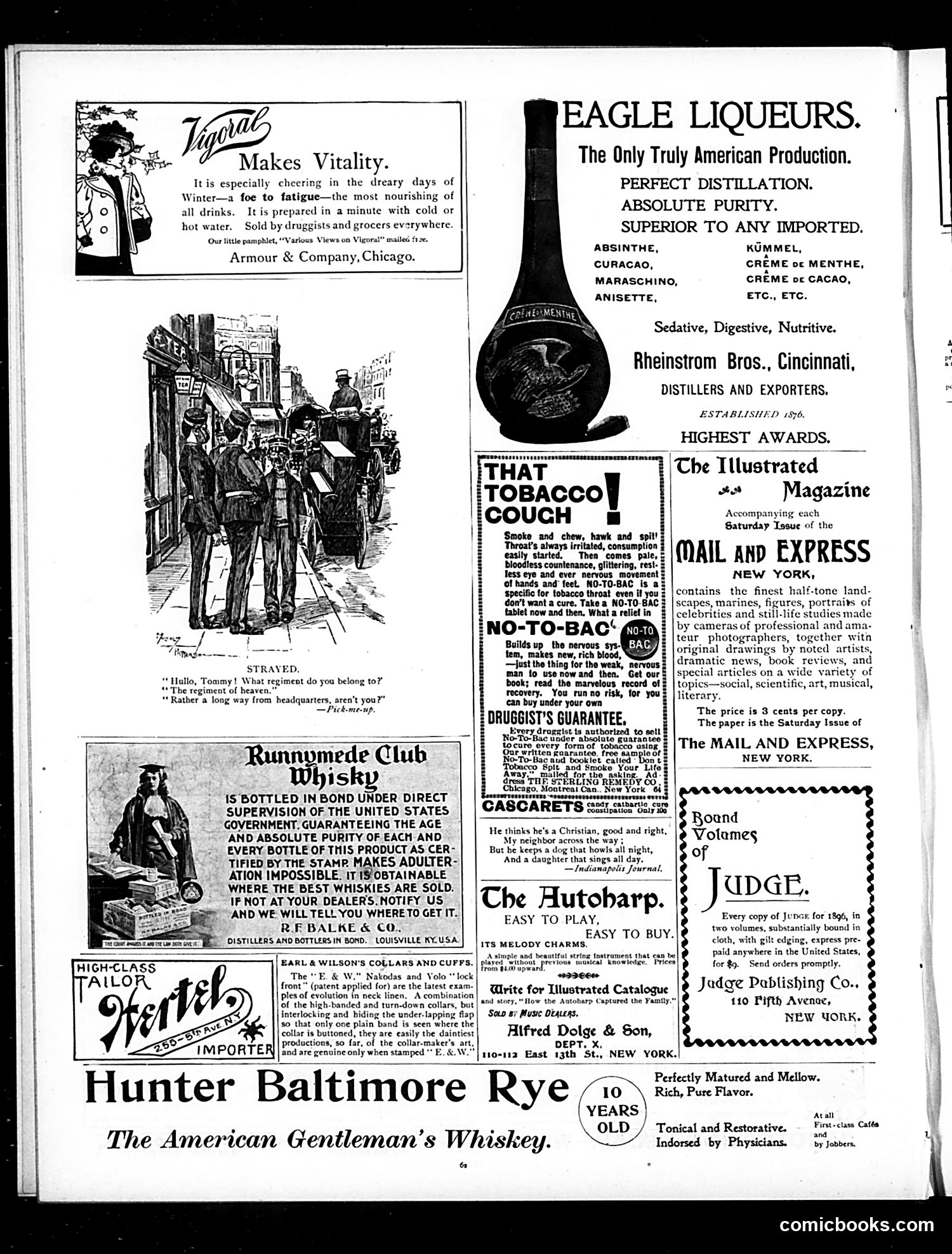
This page is primarily **advertising**, with one small humorous cartoon embedded among liquor, patent medicine, and consumer product ads typical of Judge magazine in the 1890s. The lone **cartoon** depicts a street encounter between two figures—labeled in dialogue as "Tommy" and an unnamed soldier. When asked what regiment Tommy belongs to, he replies "the regiment of heaven," prompting the soldier's dry response that it's "rather a long way from headquarters." The joke satirizes **religious hypocrisy or naïveté**: Tommy's claim to spiritual allegiance is met with worldly skepticism—the soldier's retort that heaven is far removed from practical military affairs, implicitly mocking pious declarations disconnected from real-world duty. It's a mild jab at Victorian religiosity. The page otherwise showcases period patent medicines (No-To-Bac tobacco cure), liqueurs claiming "perfect distillation," tailored goods, and Judge's own magazine promotion—all characteristic of late-19th-century American commercial culture.
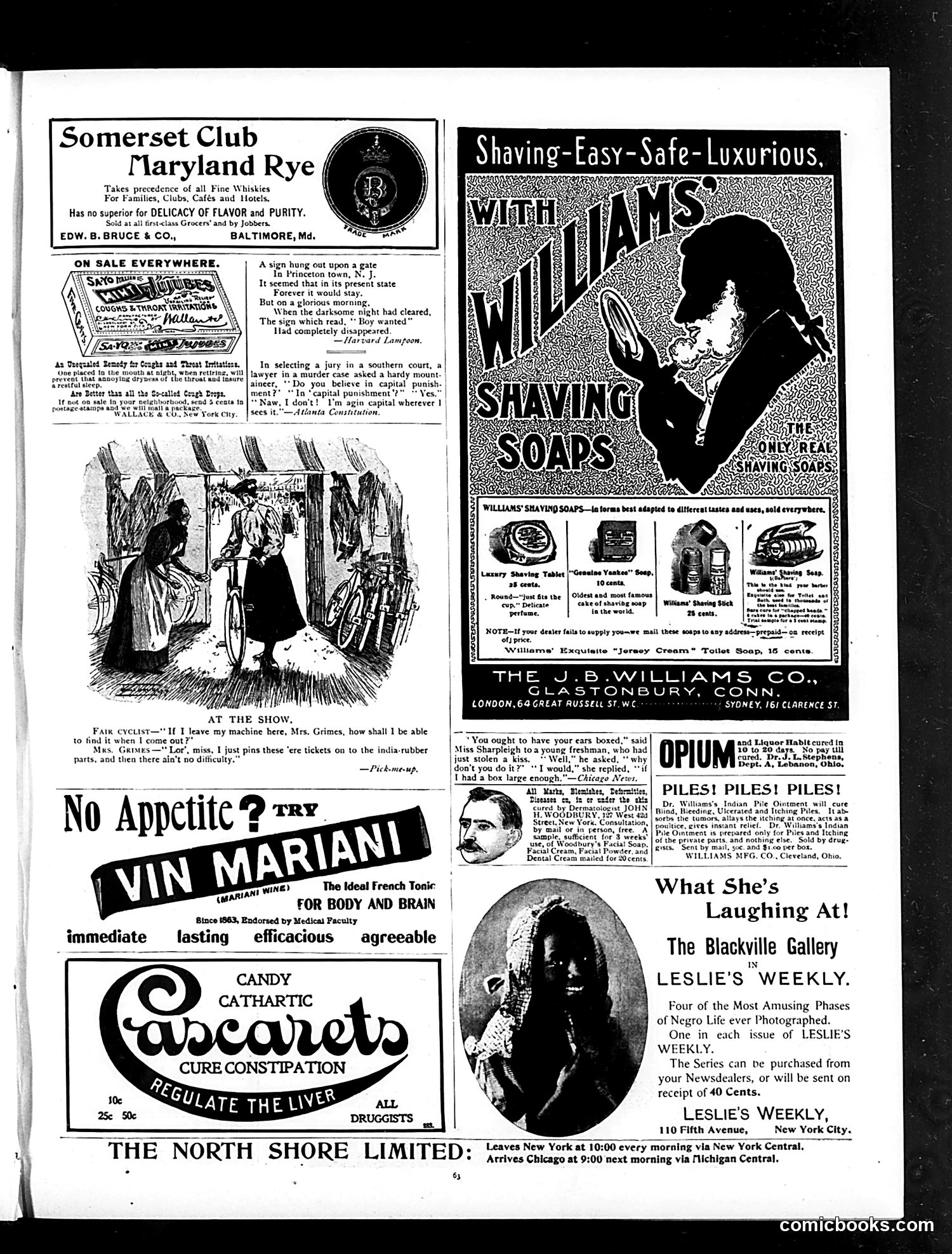
This page is primarily **advertisements and humor pieces**, not political satire requiring historical context. The cartoons present light social humor: 1. **"At the Sign"**: A Princeton joke about a "Boy Wanted" sign disappearing—likely suggesting someone was hired or the sign was stolen. 2. **"The Jury Selection"**: A courtroom joke where a Southern lawyer asks a witness about capital punishment; the witness supports it for criminals but opposes it "wherever" else—the humor is in the vague, contradictory response. 3. **"Fair Cyclist"**: A woman jokes about labeling bicycle parts like luggage to identify her machine. The page is dominated by **product advertisements**: Somerset Club Maryland Rye whiskey, Williams' Shaving Soaps, Cascaret laxatives, and Vin Mariani tonic. Notably, there's an ad for "The Blackville Gallery" in **Leslie's Weekly** featuring "amusing phases of Negro Life"—this reflects the period's casual racial stereotyping in mainstream publications, presenting Black subjects as comedy. The content reflects early 1900s advertising and humor conventions rather than serious political commentary.
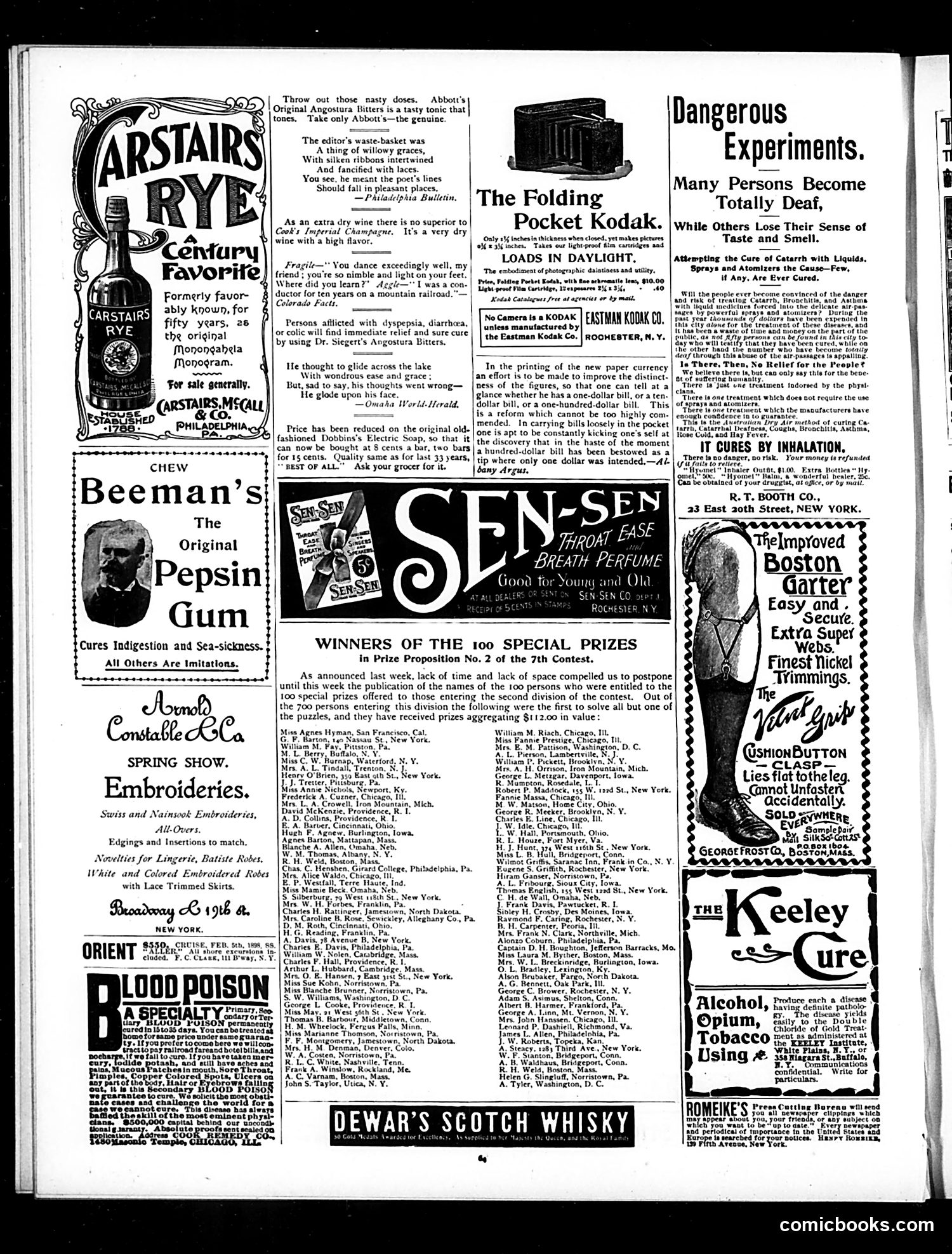
This page is primarily advertisements and minor satirical pieces typical of *Judge* magazine. The visual content is commercial: ads for whiskey, medicinal bitters, cameras, gum, and women's clothing. The few satirical pieces include brief jokes—one about a man dancing well because he was a railroad conductor (punning on "conductor"), another mocking someone who "glided" across a lake on his face (slapstick humor). There's also gentle satire about Treasury Department efforts to make currency denominations visually distinct, joking that people carelessly tip hundred-dollar bills thinking them ones. The page reflects turn-of-the-century concerns: digestive remedies, transportation (railroads), photography as an emerging hobby, and practical irritations of handling cash. The overall content emphasizes commercial leisure and consumer products rather than political satire.
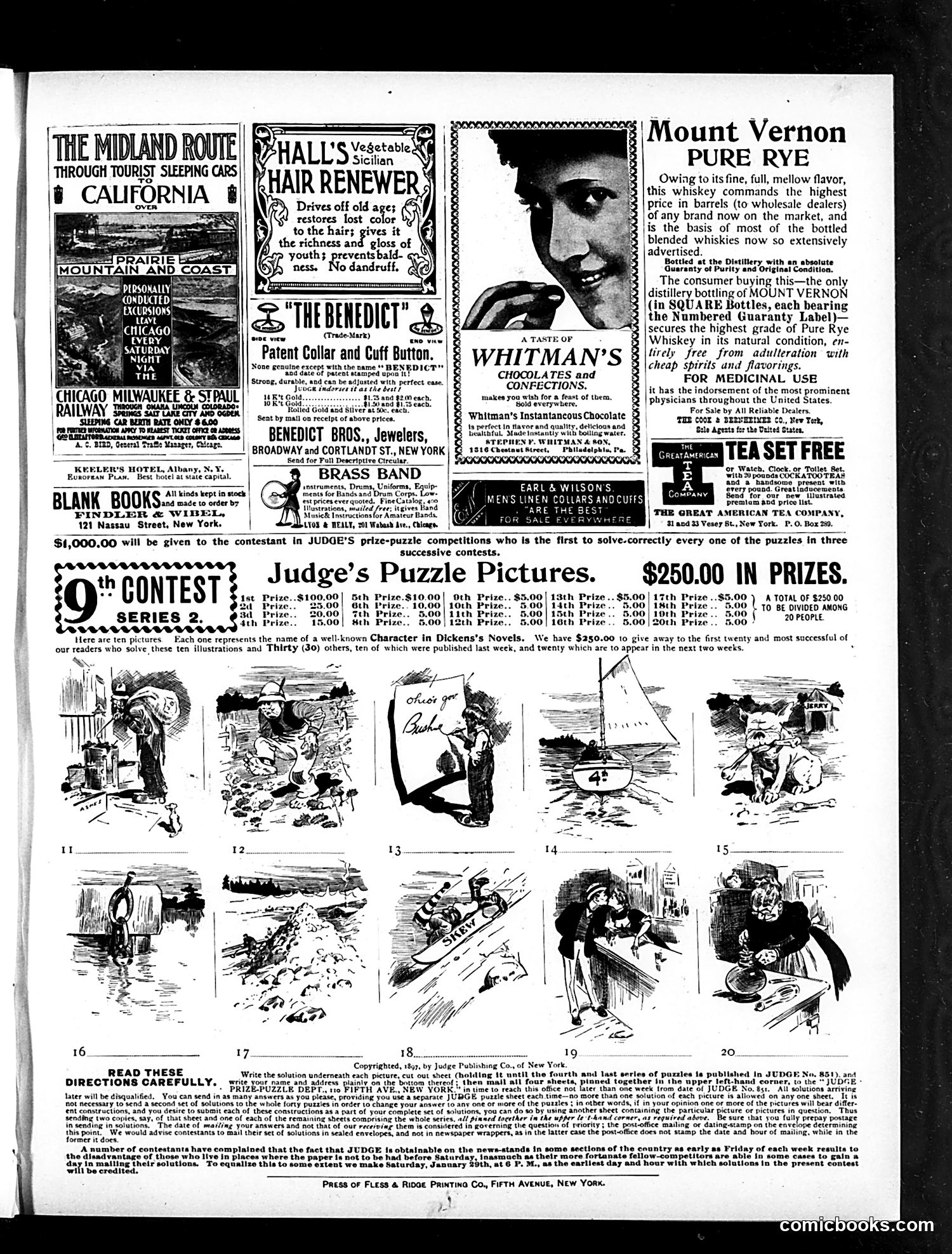
This page is primarily **advertising and a puzzle contest**, not political satire. The main content is "Judge's Puzzle Pictures"—an illustrated puzzle competition offering $250 in prizes to readers who identify characters from Charles Dickens novels hidden in sketches (numbered 11-20 visible here). The surrounding advertisements are typical period products: hair renewal treatments, whiskey, chocolates, jewelry, brass band instruments, and tea. These ads reflect late 19th-century consumer culture and patent medicines. **No political cartoon or satire is evident** on this page. The puzzle illustrations themselves depict generic Victorian scenes (sailing, working people, domestic moments) intended to represent Dickens characters, but without labels or context, they're generic genre scenes rather than satirical commentary. The page demonstrates how Judge monetized content through reader competitions and advertising rather than commentary on contemporary politics.
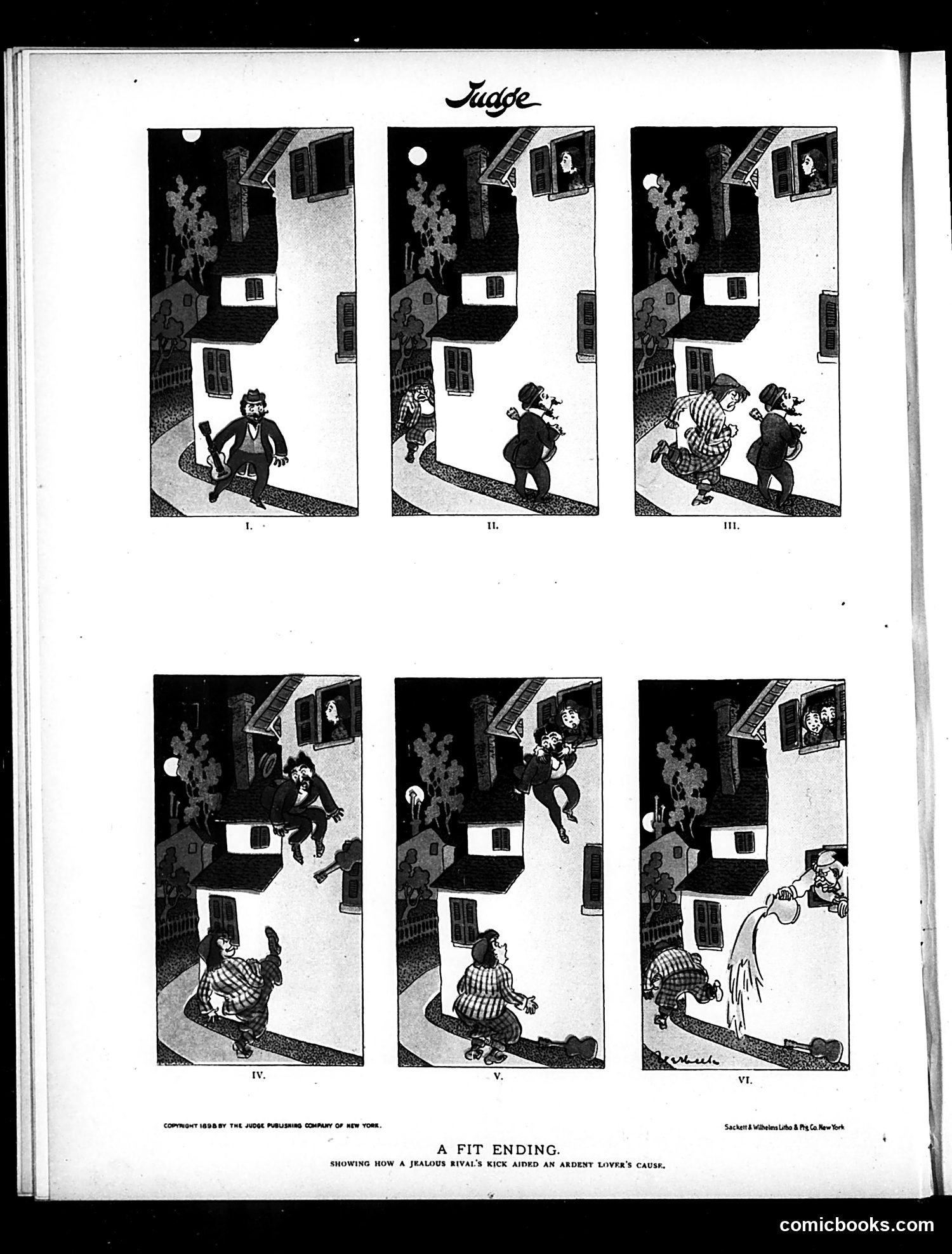
This six-panel satirical sequence depicts a romantic comedy of errors set in a European street at night. A man pursuing a woman is kicked by a jealous rival (panel IV). The kick propels him upward, allowing him to reach a window where his beloved appears (panels V-VI). The satire mocks romantic melodrama: the rival's violent interference accidentally achieves what the lover couldn't accomplish himself—reuniting the couple. The humor relies on physical comedy and the ironic notion that destructive jealousy inadvertently becomes Cupid's instrument. This reflects Judge magazine's typical late-19th/early-20th-century comedic style, using exaggerated situations to mock both romantic entanglements and masculine competitiveness. The title suggests fate rewards persistence, however accidental.