
A complete issue · 16 pages · 1898
Judge — January 15, 1898
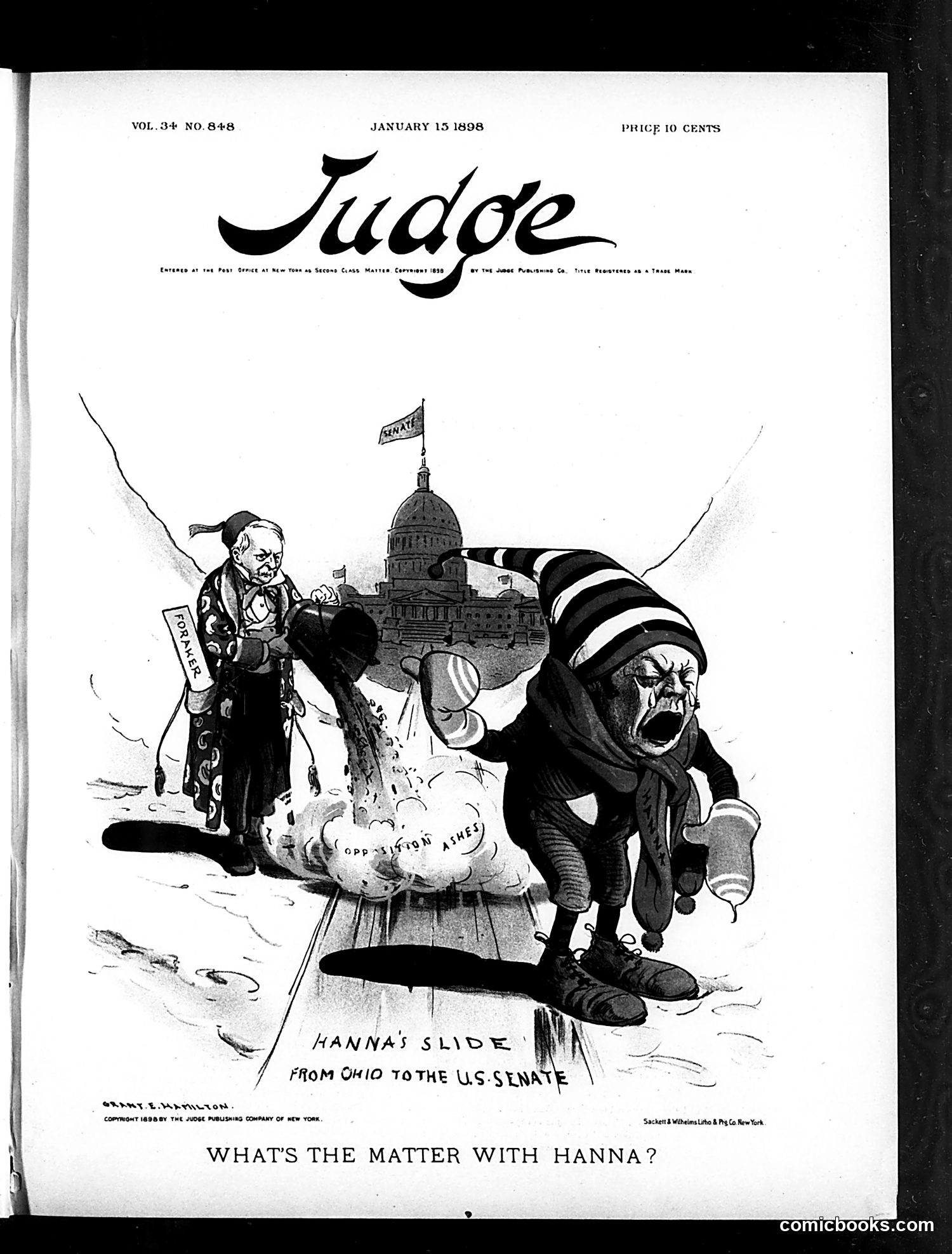
This political cartoon satirizes Mark Hanna's controversial move from Ohio politics to the U.S. Senate. The title "Hanna's Slide from Ohio to the U.S. Senate" depicts Hanna (the figure on the right, skiing/sliding downward) as literally descending from Ohio toward Washington, D.C., visible in the background with the Capitol dome. The figure on the left appears to be a political opponent or observer. The cartoon suggests Hanna's Senate ambitions represent a degradation or questionable "slide" rather than an honorable ascension. This reflects contemporary criticism of Hanna, the wealthy Ohio industrialist and Republican political operative, whom critics viewed as using money and influence to manipulate politics. The sledding imagery emphasizes the illegitimate or undignified nature of his political advancement.
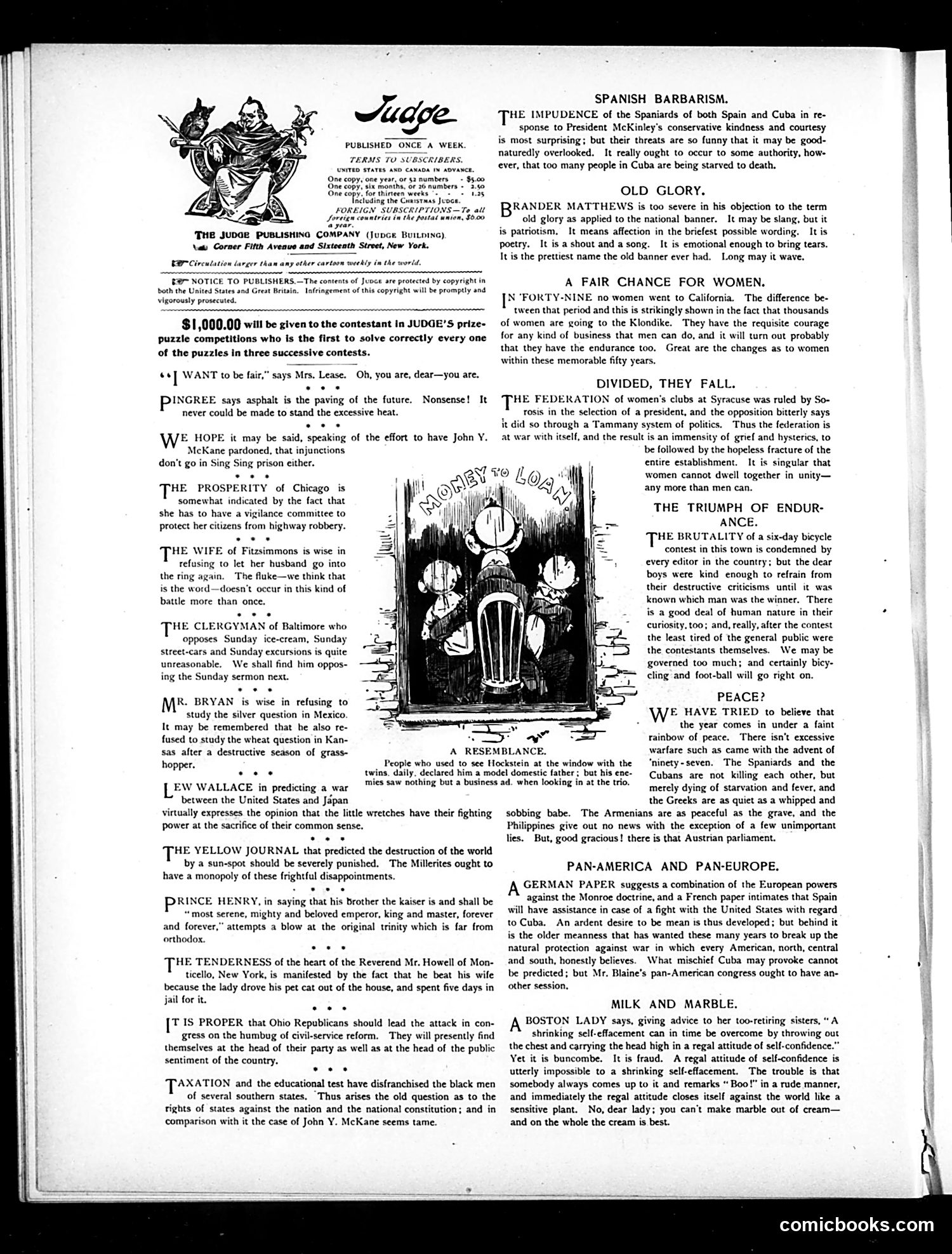
The central cartoon shows "A RESEMBLANCE," depicting women labeled "WOMEN'S LOAD" carrying heavy burdens on their heads—a visual metaphor for women's societal pressures. The accompanying text discusses women's limited opportunities in Cuba, noting that "forty-nine no women went to Cuba" during a specific period, highlighting discrimination and danger. The page contains multiple editorial commentary pieces addressing political issues of the era, including Spanish-American relations, women's rights, and domestic policy. While specific dates aren't evident, references to Cuba, McKinley (likely President William McKinley), and women's suffrage suggest this is from the early 1900s. The overall tone satirizes both gender discrimination and international politics, typical of Judge's progressive editorial stance during this Progressive Era period.
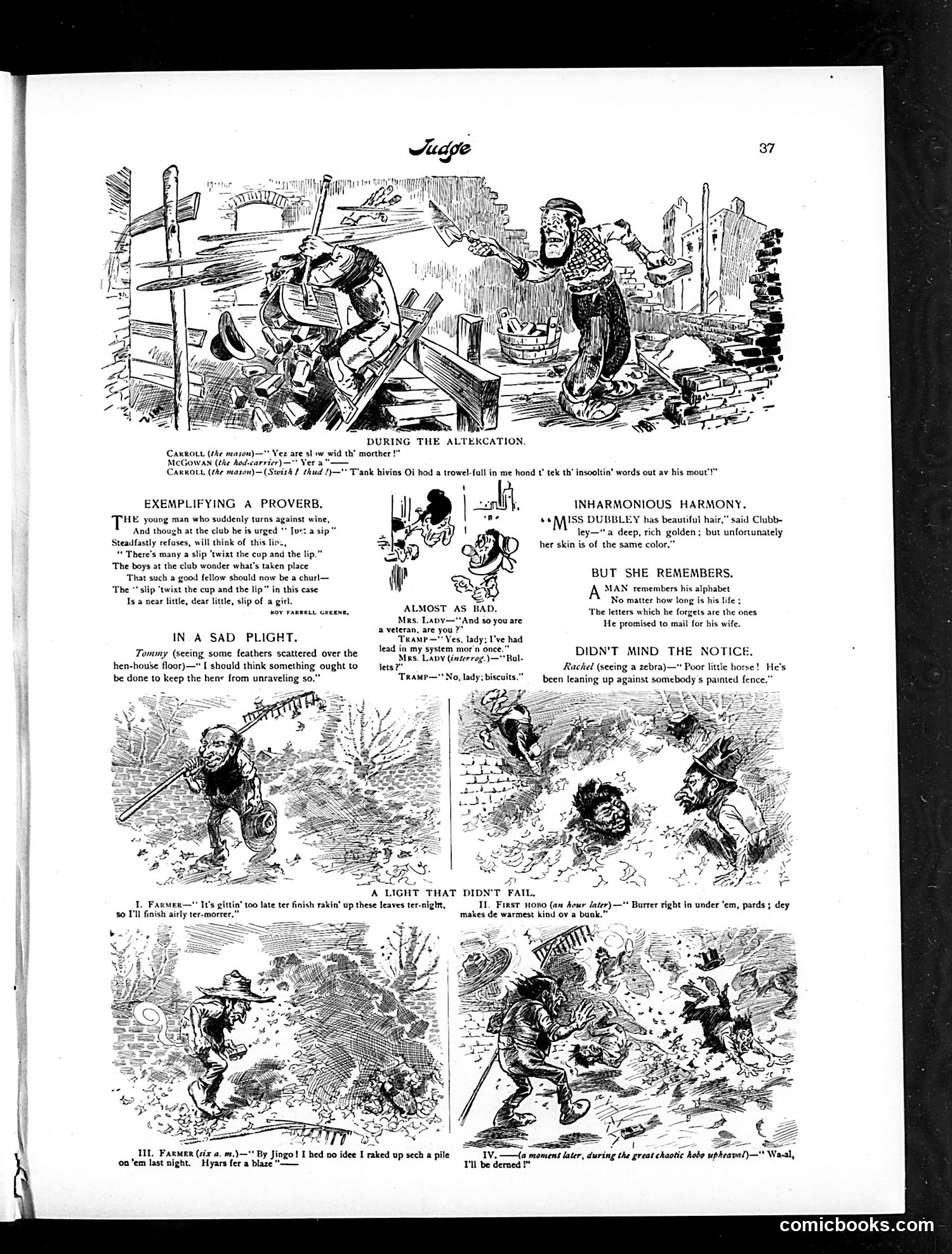
This page contains several short humorous sketches and poems rather than unified political cartoons. The content appears to be satirical domestic humor typical of Judge's social commentary: **"During the Altercation"** depicts a domestic dispute where a wife corrects her husband's language. **"Exemplifying a Proverb"** illustrates the saying about "slip 'twixt cup and lip" through a mishap with feathers. **"In a Sad Plight"** shows a man trying to preserve feathers from scattering. Other sketches include "Inharmonious Harmony" (mocking a woman's appearance), "Almost a Bad" (about a veteran), and "Didn't Mind the Notice" (about a horse being teased). The bottom panels, numbered I-IV, tell a sequential story about farmers and hay-related mishaps, with dialect humor. The satire targets working-class domestic life and rural incompetence rather than specific political figures or events.
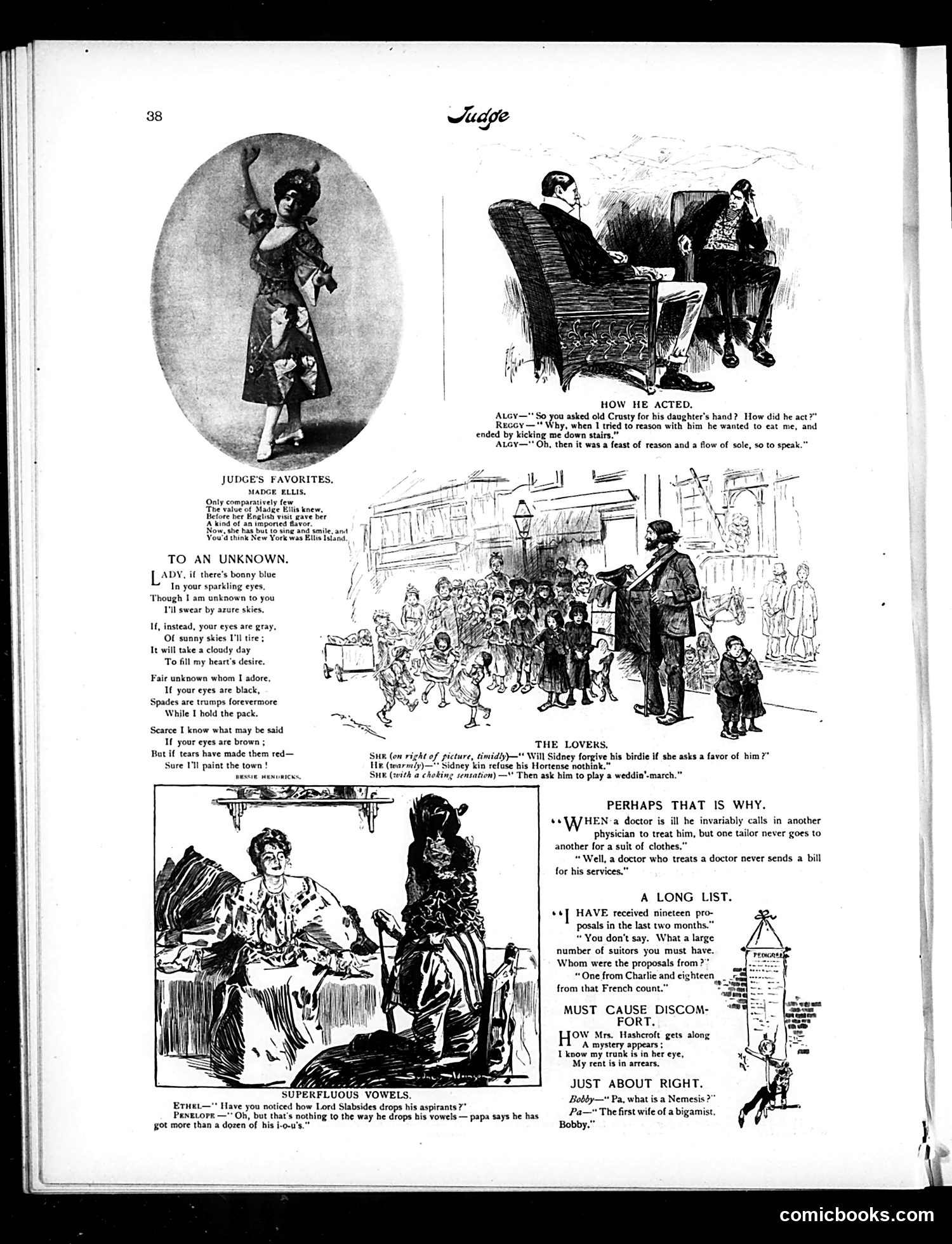
This page contains multiple satirical sketches and humorous pieces typical of Judge's format: **"Judge's Favorites"** and **"To an Unknown"** are poems celebrating actress Maggie Edna King and expressing romantic admiration for an unknown woman with blue eyes. **"How He Acted"** mocks a man's poor reasoning skills through dialogue about his daughter's hand in marriage. **"The Lovers"** appears to satirize romantic courtship conventions and marriage proposals. **"Superfluous Vowels"** jokes about excessive vowel usage in speech—Lord Nabob's affected "a's" are mocked. **"Perhaps That Is Why,"** **"A Long List,"** **"Must Cause Discomfort,"** and **"Just About Right"** are brief humor pieces about doctors, proposals, mystery, and definitions respectively. The page primarily features light social satire aimed at middle-class romance, speech affectations, and professional conduct rather than political commentary.
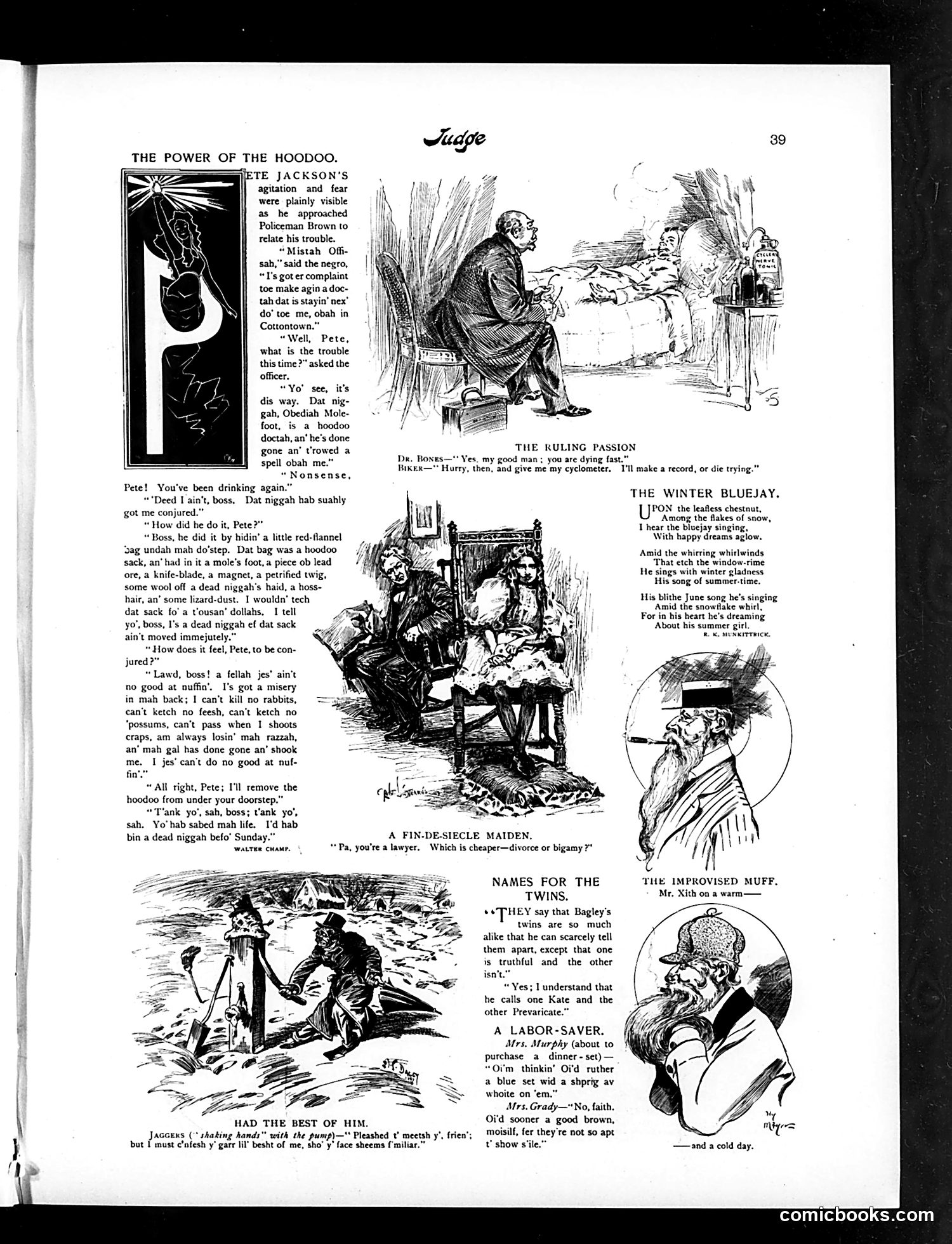
This page satirizes African American folklore and superstition through stereotyped dialect humor typical of the era. The main cartoon depicts "Pete Jackson" (drawn in caricature) complaining to a white policeman about being "conjured" by a hoodoo doctor neighbor. Pete attributes his misfortunes—lost fights, failed hunting, romantic rejection—to a magical charm hidden under his doorstep, which the policeman dismissively agrees to remove. The satire ridicules both Black superstitious beliefs and the condescension of white authority figures who treat the complaint as harmless delusion. Supporting cartoons mock Irish immigrant women's domestic concerns and include a joke about a woman choosing between divorce and bigamy. The page reflects late-19th/early-20th century attitudes: reinforcing racial stereotypes through exaggerated dialect while presenting superstition as inherent to Black culture, thereby justifying paternalistic attitudes.
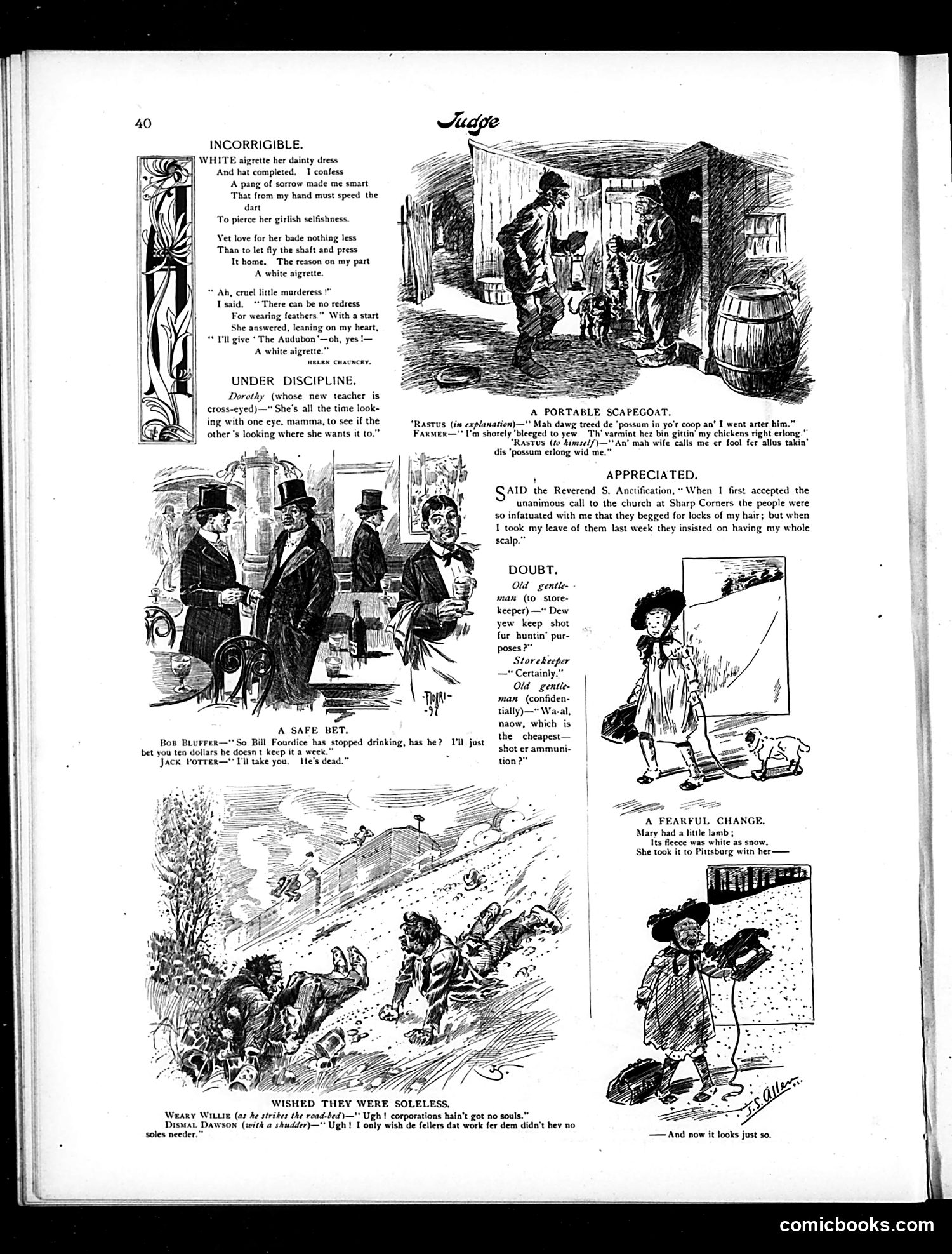
This page contains several brief satirical sketches typical of Judge's humor: **"Incorrigible"** mocks women's fashion obsession with bird feathers (aigrettes), presenting a young woman who shoots birds for fashion accessories, then donates to Audubon to assuage guilt. **"Under Discipline"** is a mild joke about a cross-eyed teacher whose wandering eye confuses her students about where she's actually looking. **"A Safe Bet"** involves a wager about someone staying sober (likely referencing Prohibition era concerns). **"Wished They Were Soleless"** satirizes workers complaining that corporations "have no souls"—the joke being workers wish the *people* working for corporations were equally soulless. **"A Portable Scapegoat"** uses racial stereotypes, depicting a Black man (Rastus) conveniently blamed for crop damage caused by his dog. **"Fearful Change"** jokes that Pittsburgh's pollution has turned white lamb's fleece black. The page reflects early 20th-century class anxieties, environmental concerns about feather trade, labor issues, and relies heavily on ethnic caricature humor typical of the era.
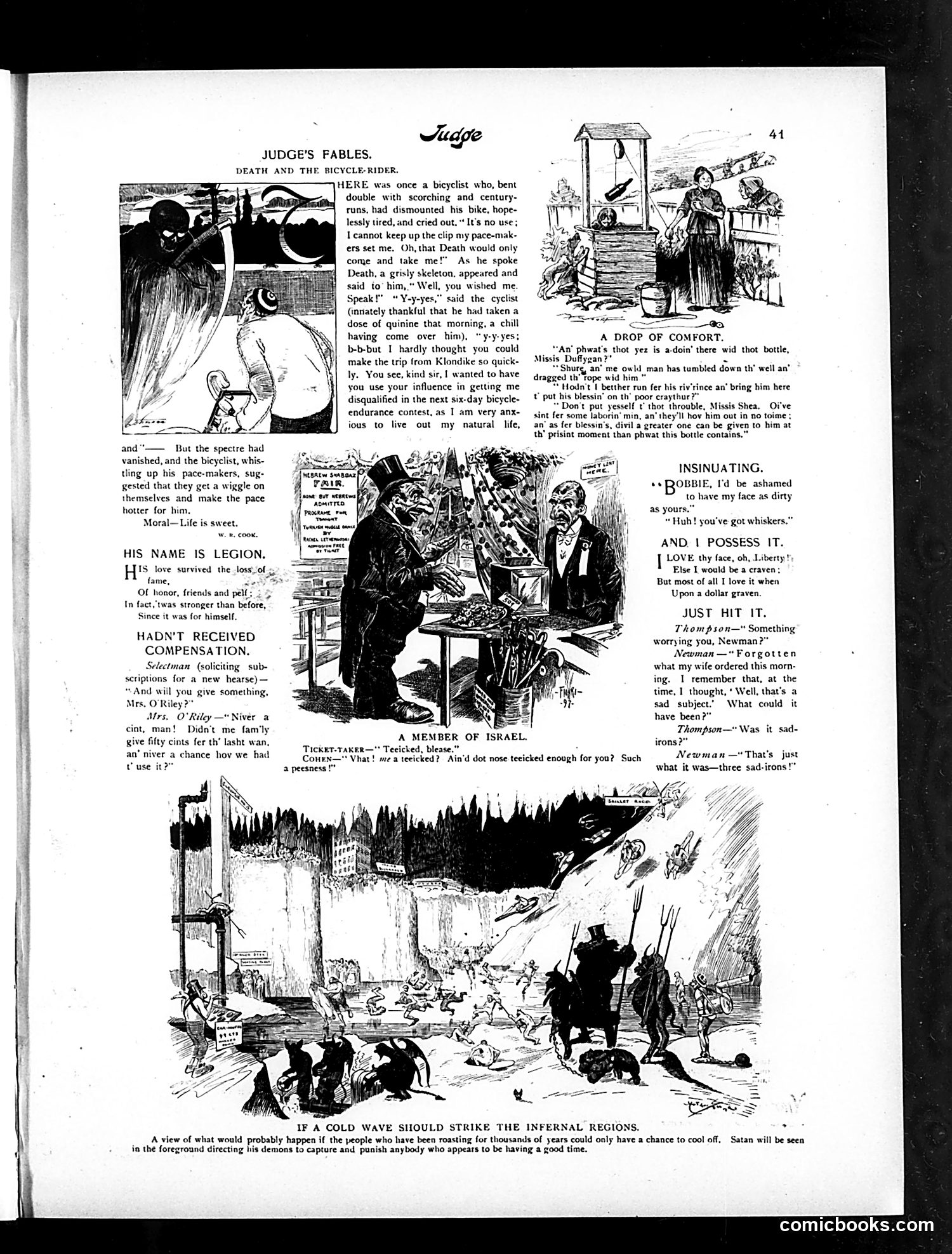
This page contains several satirical pieces mocking contemporary concerns and social types: **"Death and the Bicycle-Rider"** ridicules the dangerous cycling craze of the 1890s, where exhausted riders pushed themselves to extremes in competitive endurance races. The joke: the cyclist wishes for death from exhaustion, then begs off when Death actually appears—satirizing both the sport's recklessness and human cowardice. **"Hadn't Received Compensation"** mocks Irish-American working-class parsimony, with Mrs. O'Riley refusing to contribute to a new hearse because her family already paid for the last one—dark humor about poverty and reluctant charity. **"A Member of Israel"** uses an ethnic caricature (Yiddish dialect) in a brief joke about being "tricked" or swindled—reflecting period stereotypes. **"If a Cold Wave Should Strike the Infernal Regions"** is straightforward theological satire: even Hell's residents would suffer if Satan prevents them from enjoying relief. The remaining pieces are brief quips about domestic life and miscommunication. Overall, the page reflects 1890s concerns: dangerous new technologies, immigrant communities, and working-class life.
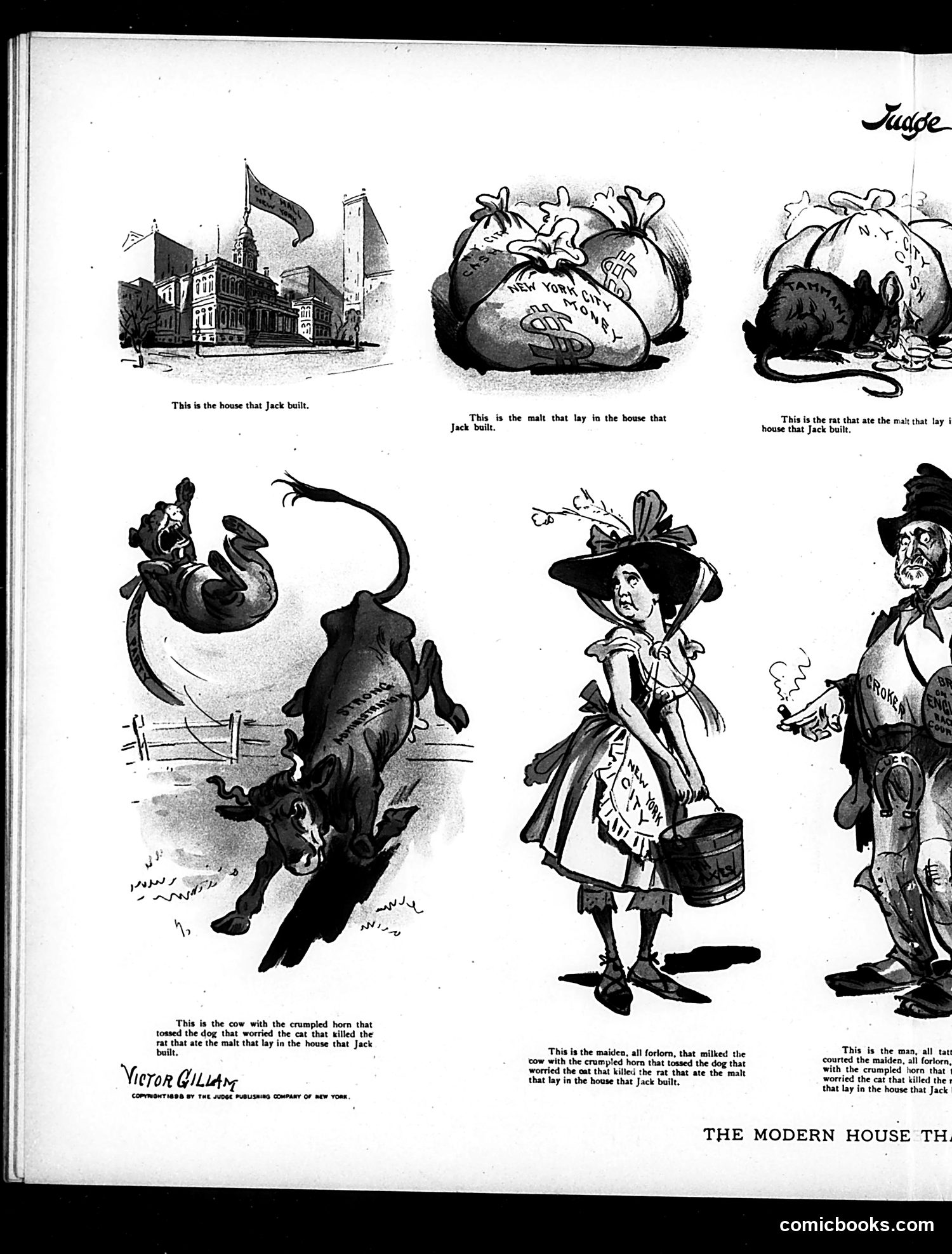
This page adapts the classic nursery rhyme "The House That Jack Built" into political satire. Victor Gillam illustrates each cumulative verse with increasingly chaotic scenes showing New York's urban problems and corruption. The cartoon criticizes urban corruption and social decay through the familiar rhyme structure. Each illustration—from the building (representing City Hall or municipal government) through moneybags, rats, cows, and various urban characters—represents layers of institutional corruption and mismanagement that compound each other. The "maiden, all forlorn" and "man" depicted appear to represent common citizens victimized by this corrupt system. The title suggests this is satirizing modern municipal governance, likely from the Gilded Age when urban political machines were notorious for graft and inefficiency. The satire's point: like the nursery rhyme's chain reaction, urban corruption interconnects—one problem causes another in an endless, worsening cycle.
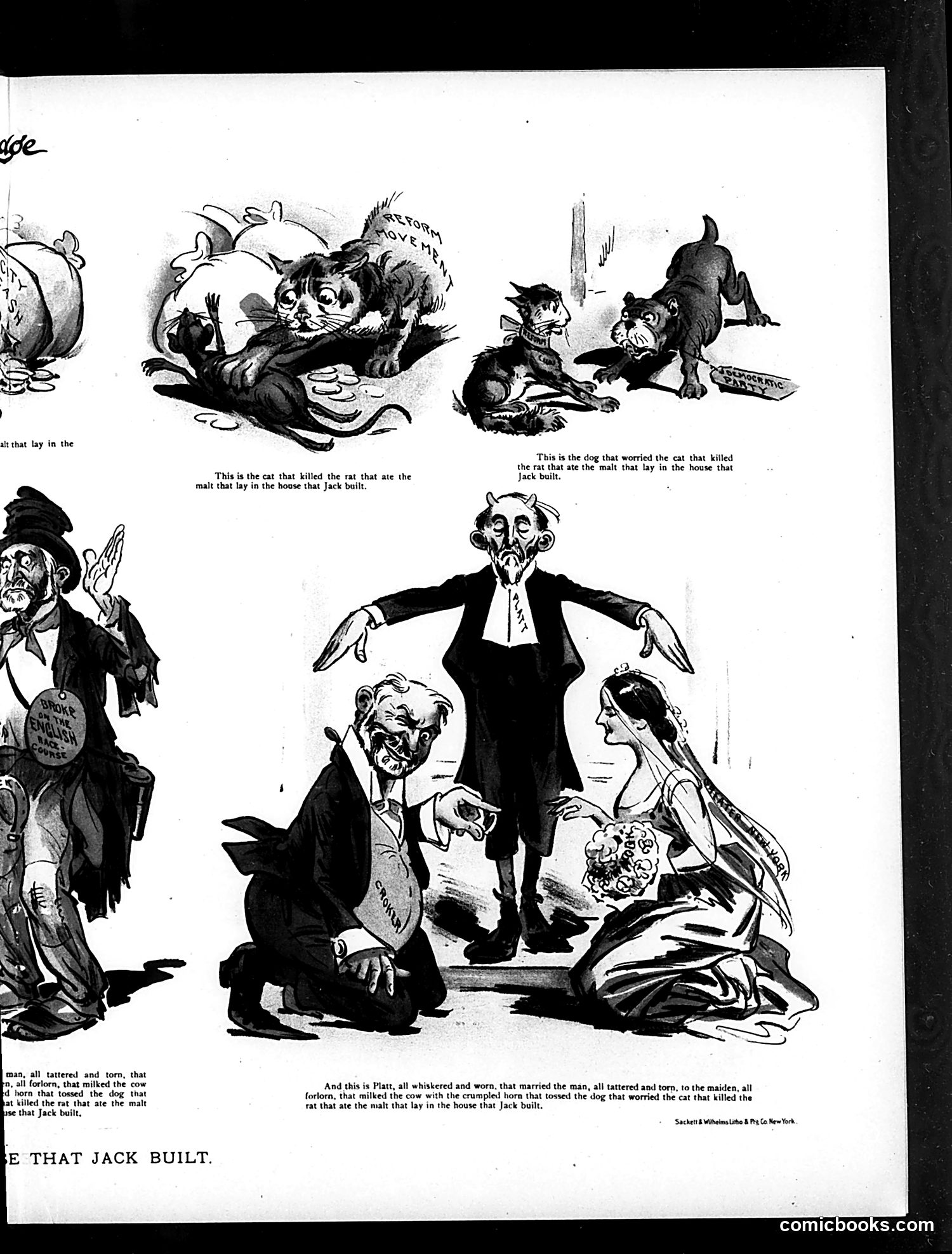
This page adapts the nursery rhyme "The House That Jack Built" as political satire. The illustrated narrative chain—dog, cat, rat, malt, house—appears to reference a contemporary political figure named **Platt** (likely Thomas C. Platt, prominent New York Republican politician of the late 1800s). The satire works by substituting political actors into the cumulative nursery rhyme structure. The bottom panel shows a man and woman (likely representing political figures or concepts) kneeling before a central authority figure with arms outstretched—suggesting Platt as a controlling political power who orchestrates various political machinations and consequences. The repetitive text emphasizes how each political action triggers cascading effects, mocking the interconnected web of political influence and blame-shifting. The grotesque caricatures are typical of Judge magazine's style when attacking political opponents.
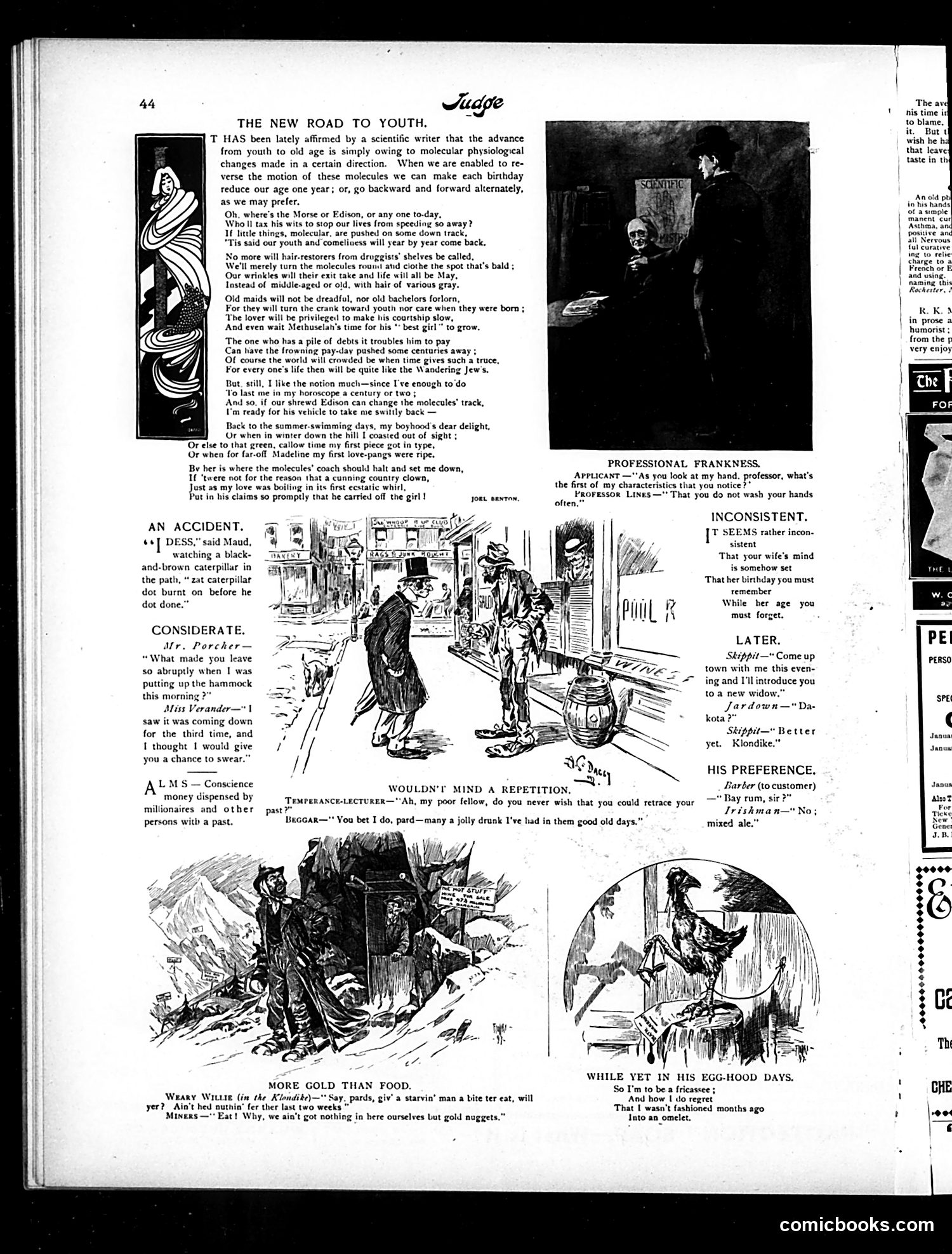
This page contains several satirical short jokes and cartoons typical of late 19th-century American humor. **"The New Road to Youth"** is a humorous poem mocking scientific claims about reversing aging through molecular manipulation—likely referencing contemporary pseudoscience. It satirizes the public's gullibility about rejuvenation schemes. **"An Accident"** presents a brief domestic joke where a woman allows a man to swear after he repeatedly fails to hang a hammock, presented as "considerate." **"Professional Frankness"** jokes about a palm reader noticing an applicant's dirty hands rather than character traits. **"Inconsistent"** and **"His Preference"** are short quips about marital contradictions and male preferences for widows. **"Wouldn't Mind a Repetition"** depicts a temperance lecturer and drunk exchanging views on past excess. The cartoons use typical period caricature styles. The overall tone reflects Judge's formula: domestic humor, gentle mockery of fads and social pretension, and puns on contemporary concerns about science, relationships, and propriety.
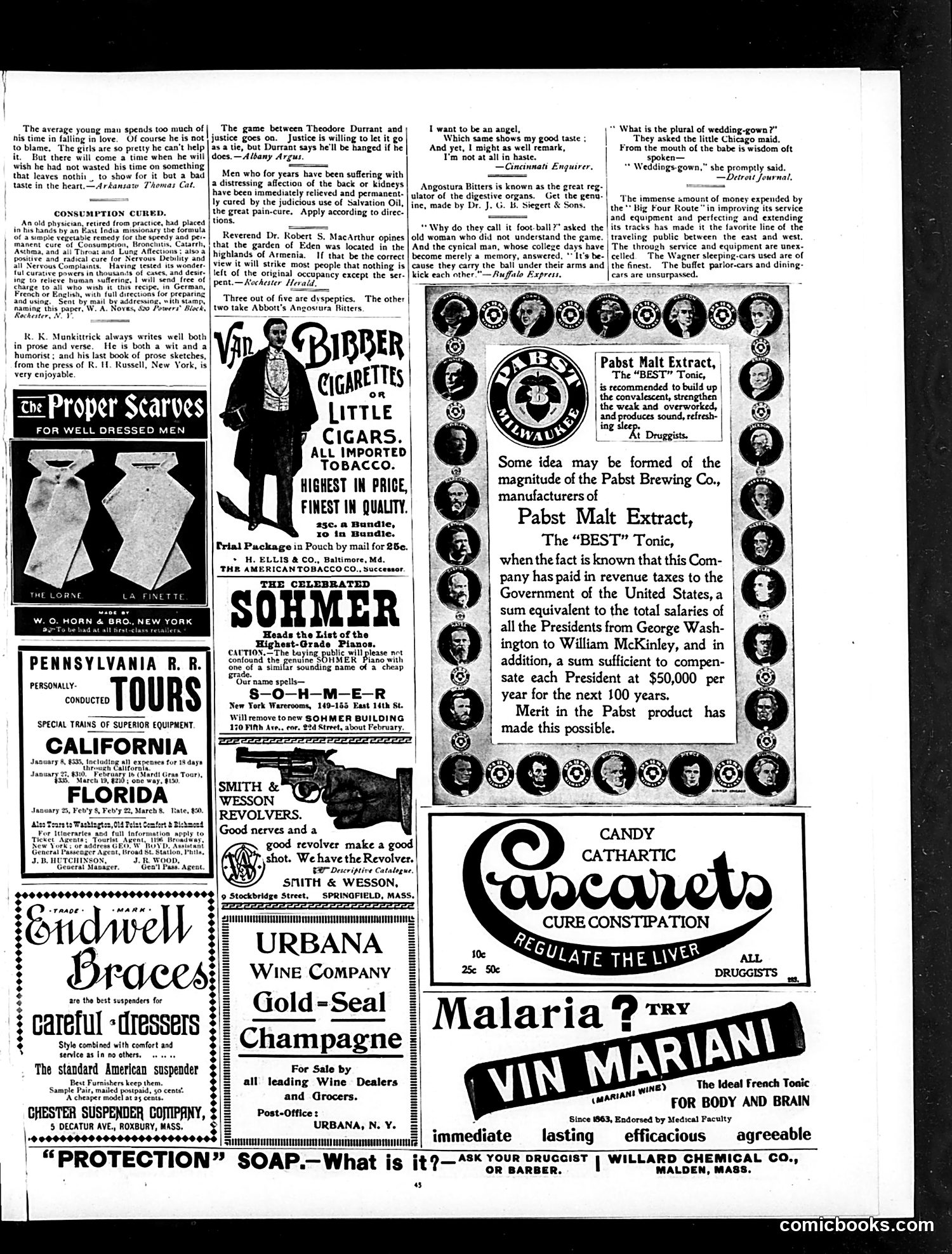
This page is primarily **advertising** with brief satirical text snippets scattered throughout. There are no major cartoons requiring political analysis. The visible satirical content includes short humorous quotes on typical Judge magazine themes: a young man wasting time on romance ("nothing to show for it but a bad taste"), a cynical college graduate explaining that football involves "carry the ball under their arms and kick each other," and wordplay about wedding gowns ("Weddings-gown" plural). The main content consists of period advertisements for cigarettes (W. Dibber brand), soap, suspenders, wine, patent medicines (Vin Mariani for "body and brain," Cascarets laxatives), and railroad tours—typical of 1890s mass-market magazines. One ad mentions **Theodore Durrant**, likely the prominent murder case of the era, used flippantly for attention. The page reflects Judge's standard format: light social satire mixed with commercial messaging, targeting middle-class male readers with products promising health, status, and convenience.
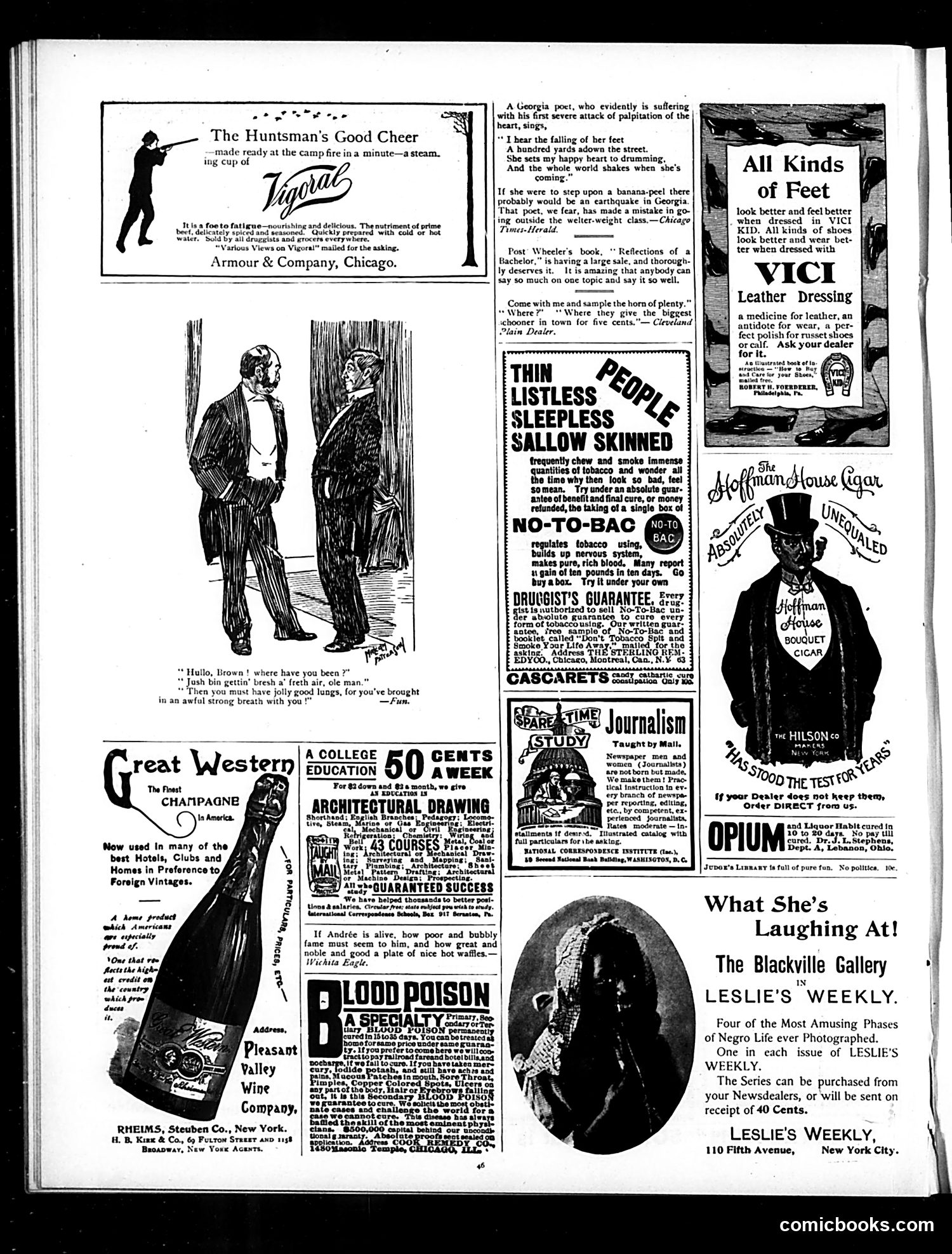
This page is primarily **advertising** with a few short humor pieces interspersed. The main satirical content includes: **"The Huntsman's Good Cheer"** (top): A Vigoral soup advertisement disguised as editorial content—typical of the era's blurred advertising practices. **Georgia Poet Joke**: Mocks an unnamed Georgia poet whose overwrought love poetry claims a woman's footsteps cause earthquakes. The joke: he's exaggerating wildly and needs to "stay in his weight class" (avoid romance outside his league). **"Reflections of a Bachelor"**: Brief quip about a popular book selling well despite repetitive content. **Two Brief Dialogue Jokes**: Genteel humor about fresh air and cheap beer. The remainder is **product advertising**: NO-TO-BAC (tobacco cessation), Vigoral, wine, architectural drawing courses, shoes, cigars, journalism courses, and patent medicines including opium treatments and "blood poison" cures—reflecting the era's unregulated patent medicine industry. **Notable**: The page includes racist imagery advertising "The Blackville Gallery" in Leslie's Weekly, reflecting the period's casual racial stereotyping in mainstream publications.
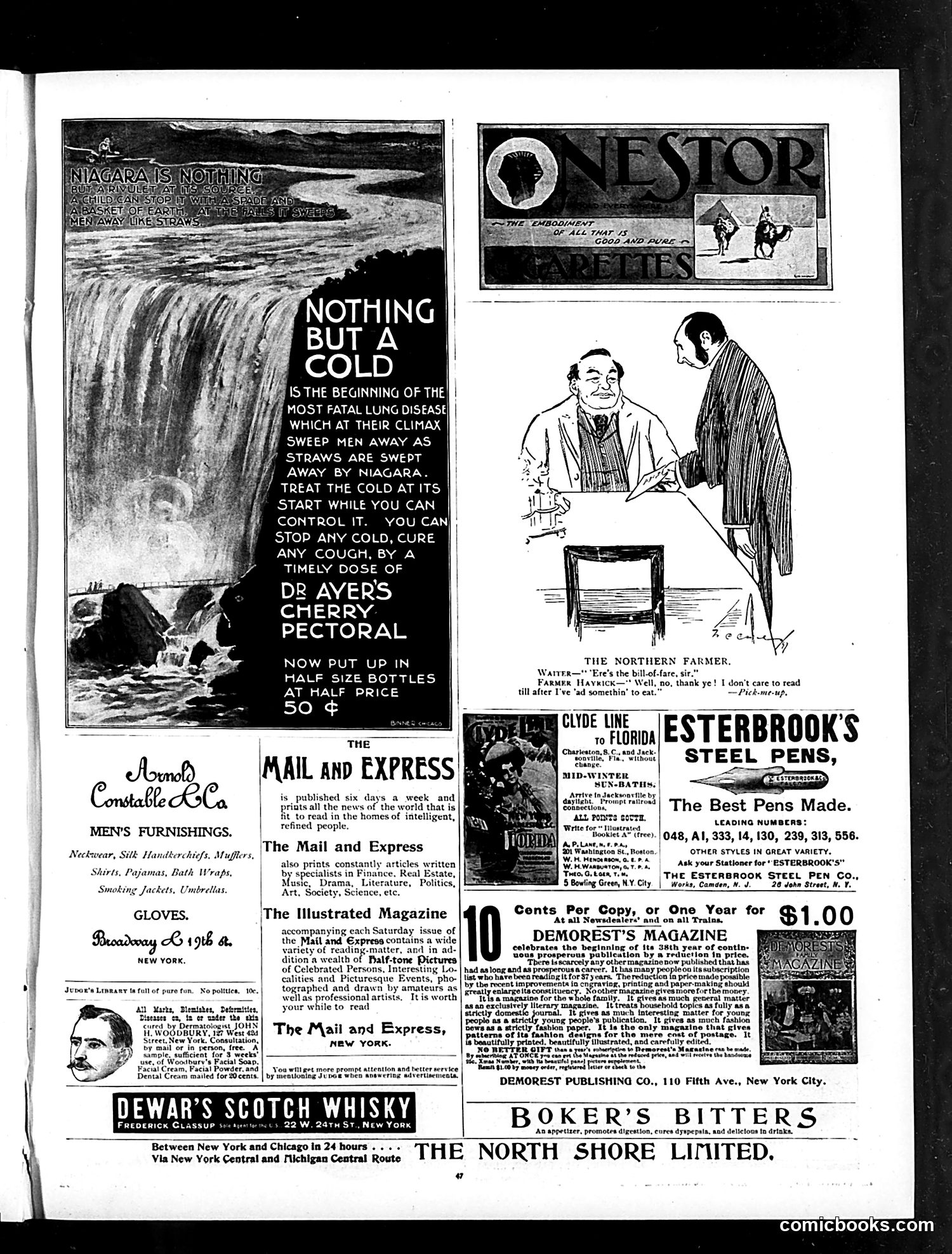
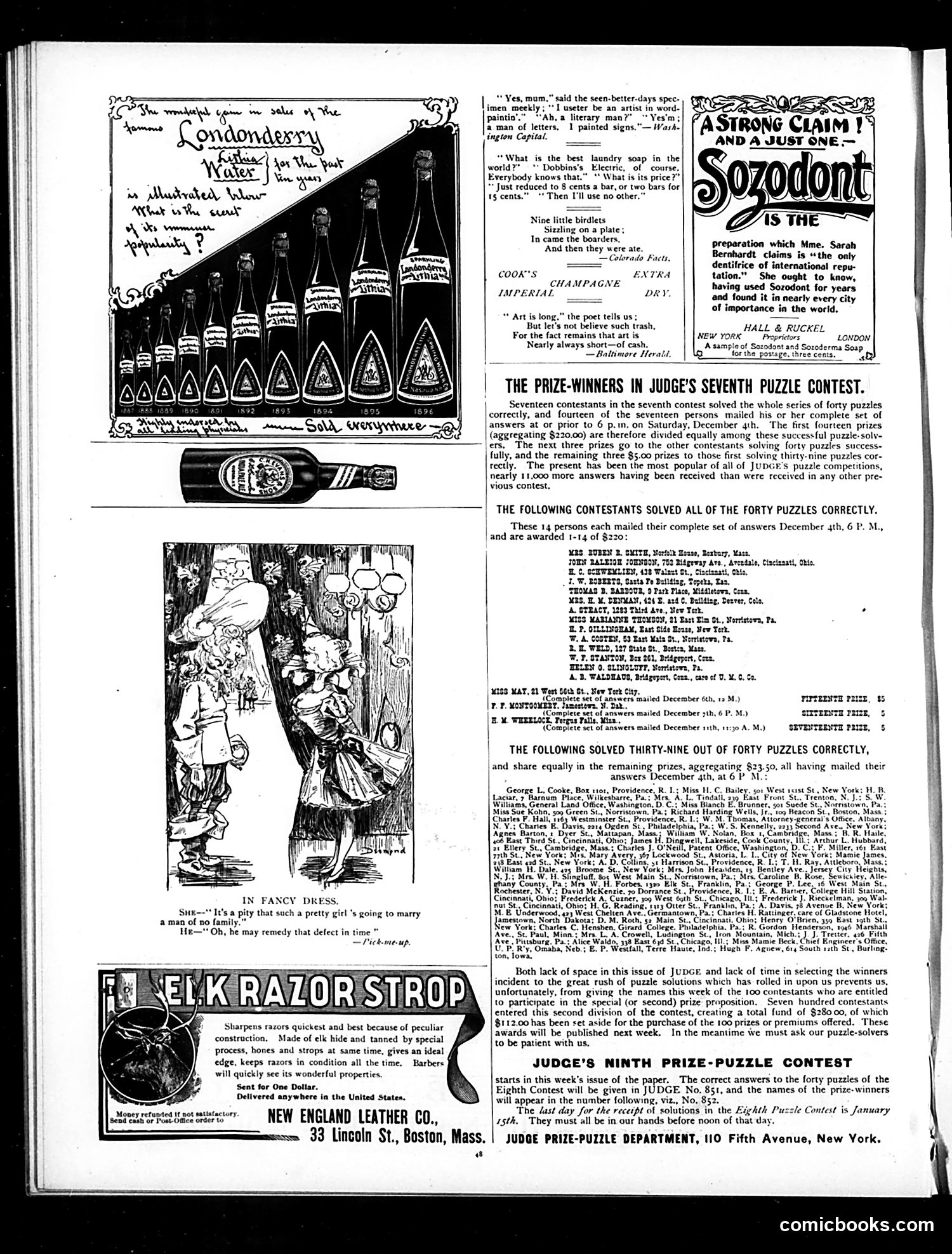
This page is primarily **advertising and puzzle contest results**, not political satire. The main content announces winners of Judge's seventh puzzle contest. Fourteen contestants solved all forty puzzles correctly and share $220 in prizes equally; three others solved thirty-nine puzzles and share $23.50. Nearly 11,000 puzzle answers were submitted—reportedly more than any previous contest. The page includes **unrelated advertisements and jokes**: - A Sozodont toothpaste ad claiming Sarah Bernhardt endorses it - A Dobbins laundry soap advertisement - Separate comic jokes (one about a failed artist, another about nine birds on a plate) - An ELK razor strop advertisement There is **no political satire or caricature** visible here—this is a typical turn-of-the-century magazine page mixing editorial content, advertisements, and light humor to fill space.
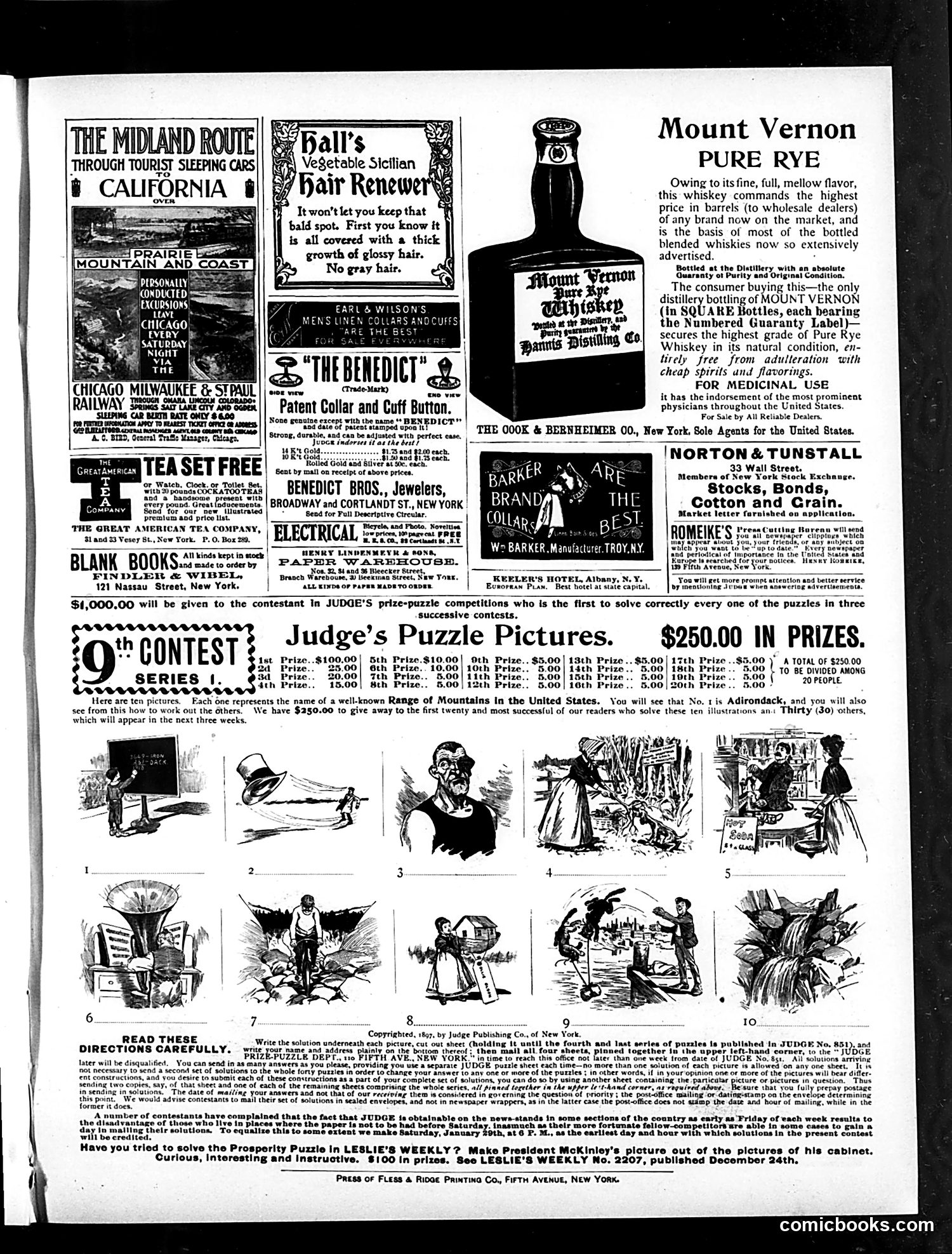
This is primarily an **advertising page** from Judge magazine, with a puzzle contest as secondary content. **Main Content:** The page features numerous period product advertisements (hair renewal, jewelry, whiskey, tea sets, hotels, stock brokers) typical of early 20th-century magazines. The Mount Vernon Pure Rye whiskey ad is prominent, emphasizing its medicinal uses—a common marketing angle during this era when alcohol was marketed for health benefits. **The Puzzle Contest:** Below the ads is "Judge's Puzzle Pictures," a reader participation contest offering $250 in prizes. Contestants must identify ten illustrations (numbered 1-10), with the instructions stating one picture represents "a well-known Range of Mountains in the United States." Winners are those who solve all puzzles correctly across three successive weeks. **Historical Context:** This reflects Judge's business model: generating reader engagement through contests while maximizing ad revenue. The emphasis on medicinal whiskey and patent hair remedies reflects turn-of-the-century consumer culture and less-regulated product marketing. The page contains **no political satire or caricature**—it's a commercial product showcase typical of the era.
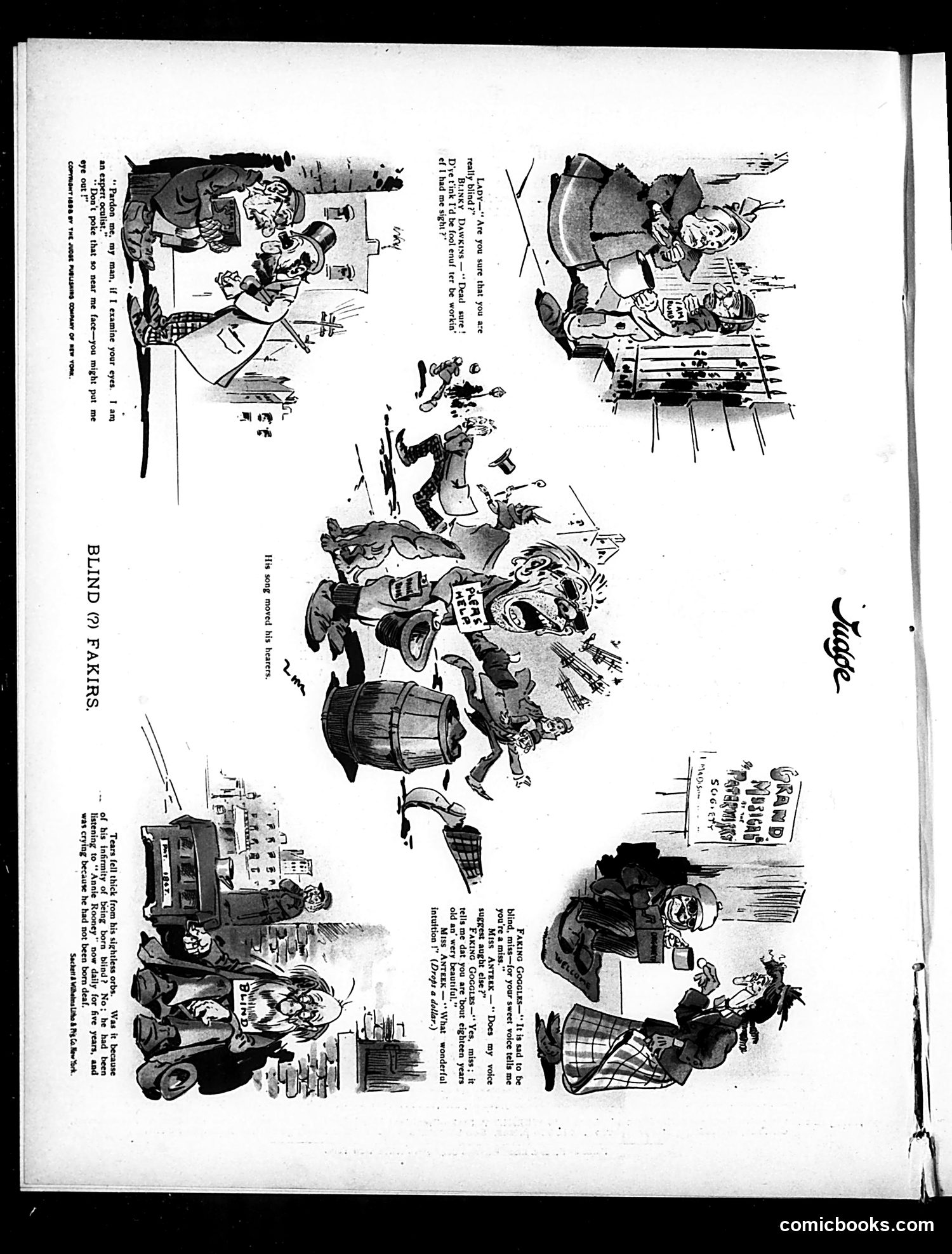
This 1898 cartoon exposes street con artists posing as blind beggars. A fake blind man ("Faxine Gooctes") manipulates a woman by claiming her voice reveals she's young and beautiful, extracting a dollar tip. The satire targets his transparent scam: he claims blindness prevents him from seeing, yet describes her appearance with suspicious accuracy. The text reveals he's actually "an expert oculist" (eye doctor) pretending disability to earn sympathy money. The title's question mark emphasizes the skepticism—these aren't genuinely blind but fraudsters exploiting public charity. This reflects genuine Progressive-era concerns about urban con artists and street beggars who feigned disabilities. The cartoon ridicules both the fake beggar's transparent deception and, implicitly, the gullible woman who rewards obvious lies with payment.