
A complete issue · 16 pages · 1897
Judge — July 3, 1897
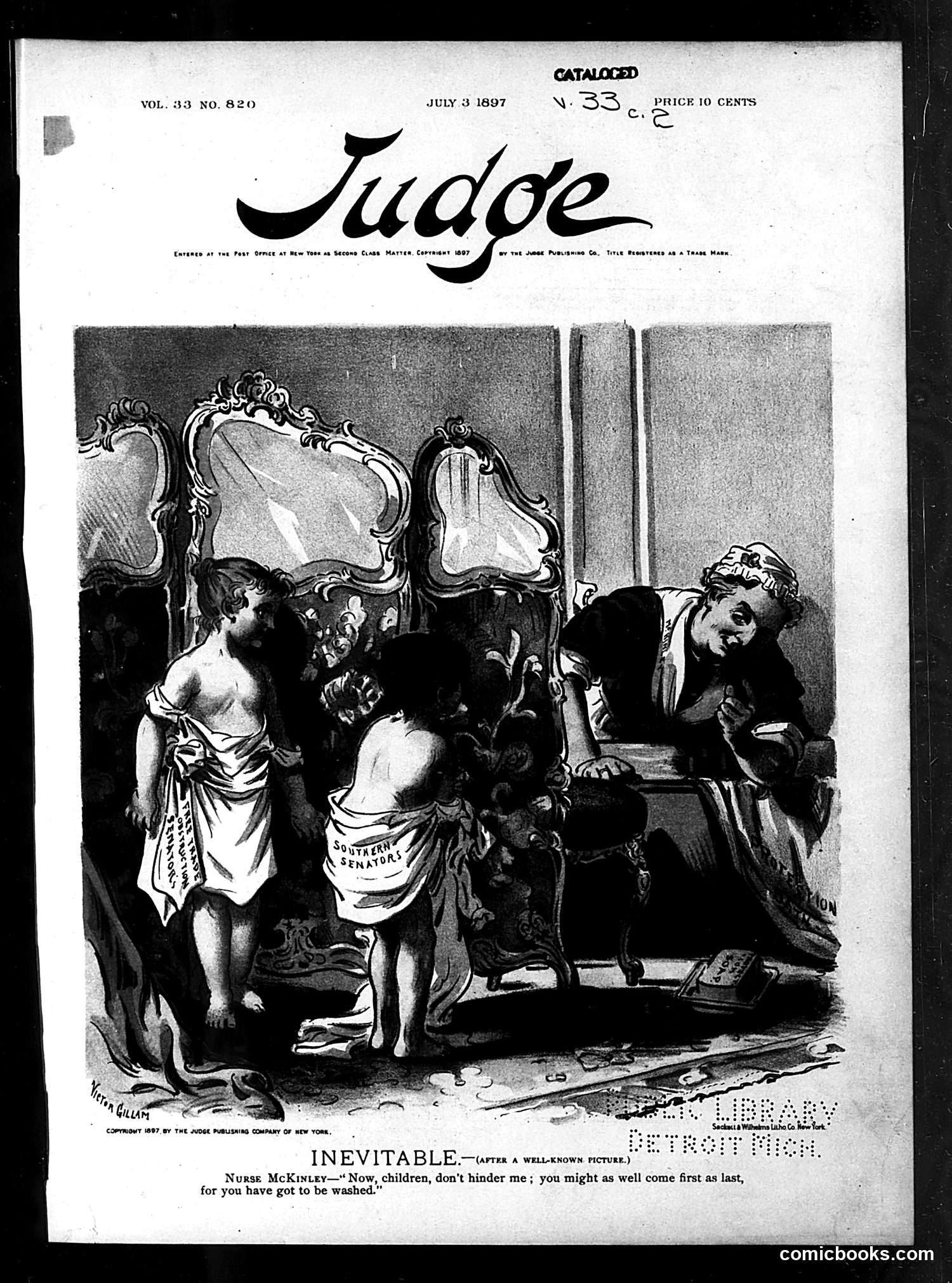
This political cartoon satirizes the inevitable consequences of neglect. The title "(After a Well-Known Picture)" references a famous artistic work being parodied here. The scene depicts "Nurse McKinley" (President William McKinley) with children representing various political interests or territories. The nurse's quote—"Now, children, don't hinder me; you might as well come first as last, for you have got to be washed"—suggests McKinley must eventually deal with pressing issues he's trying to avoid or delay. The cartoon likely critiques McKinley's administration for postponing necessary political action, implying that avoidance only delays inevitable confrontation with these problems. The allegorical children represent competing demands or unresolved matters requiring presidential attention.
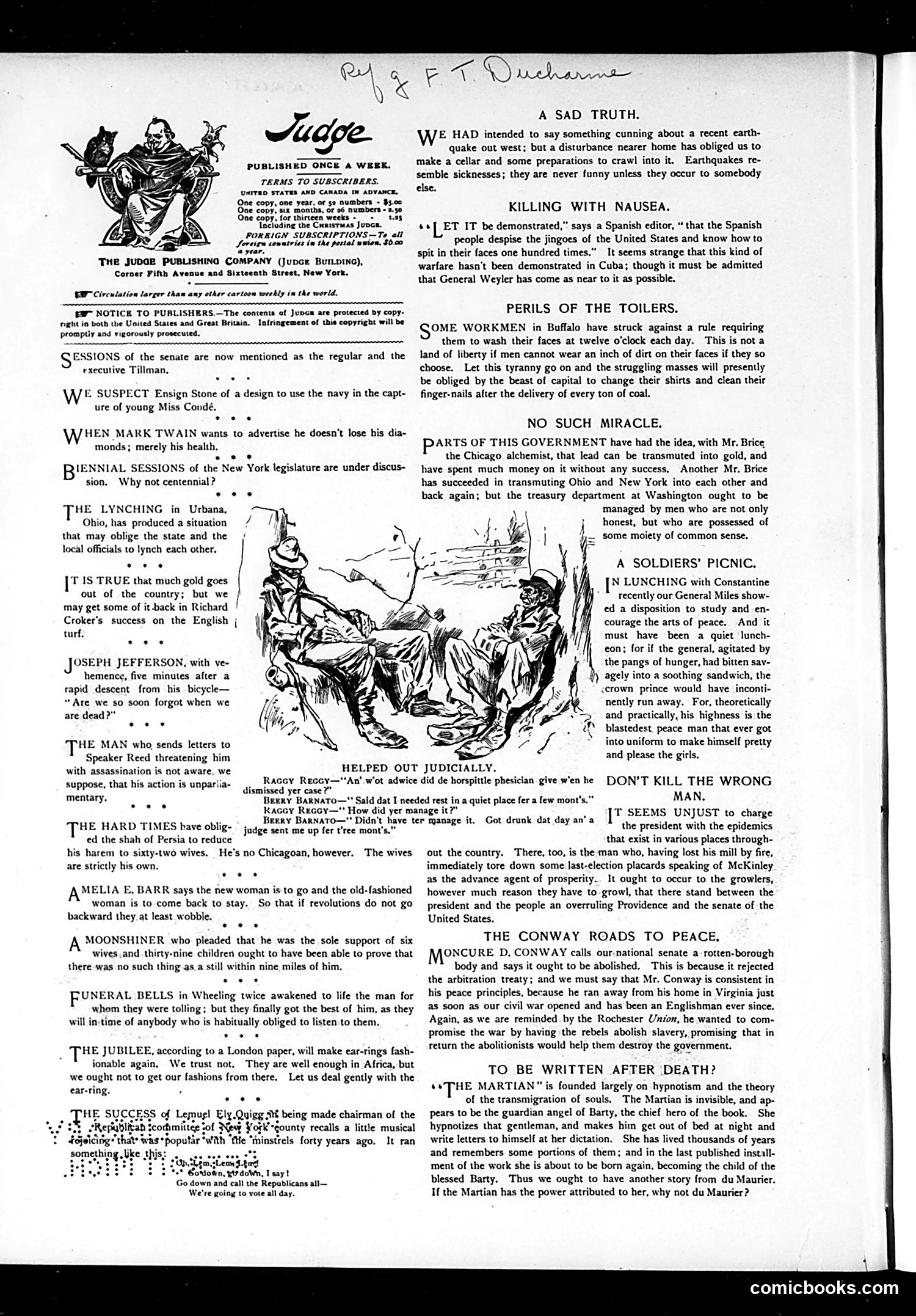
This page contains political commentary and brief satirical items rather than a single cartoon. The main illustration depicts soldiers having a picnic, accompanying text about General Miles studying "the arts of peace." Key items reference: - **Mark Twain** advertising his health (satirizing celebrity endorsements) - **New York legislature sessions** (mocking political inaction) - **A lynching in Urbana, Ohio** (criticizing official failure to prevent mob violence) - **Joseph Jefferson** (an actor, joke unclear without more context) - **Speaker Reed** (likely Thomas Reed, House Speaker, threatened with assassination) - **The Shah of Persia** reducing his harem (satirizing foreign politics) The page's overall tone critiques governmental incompetence, social violence, and political corruption of the era (appears to be 1890s-early 1900s based on references and style).
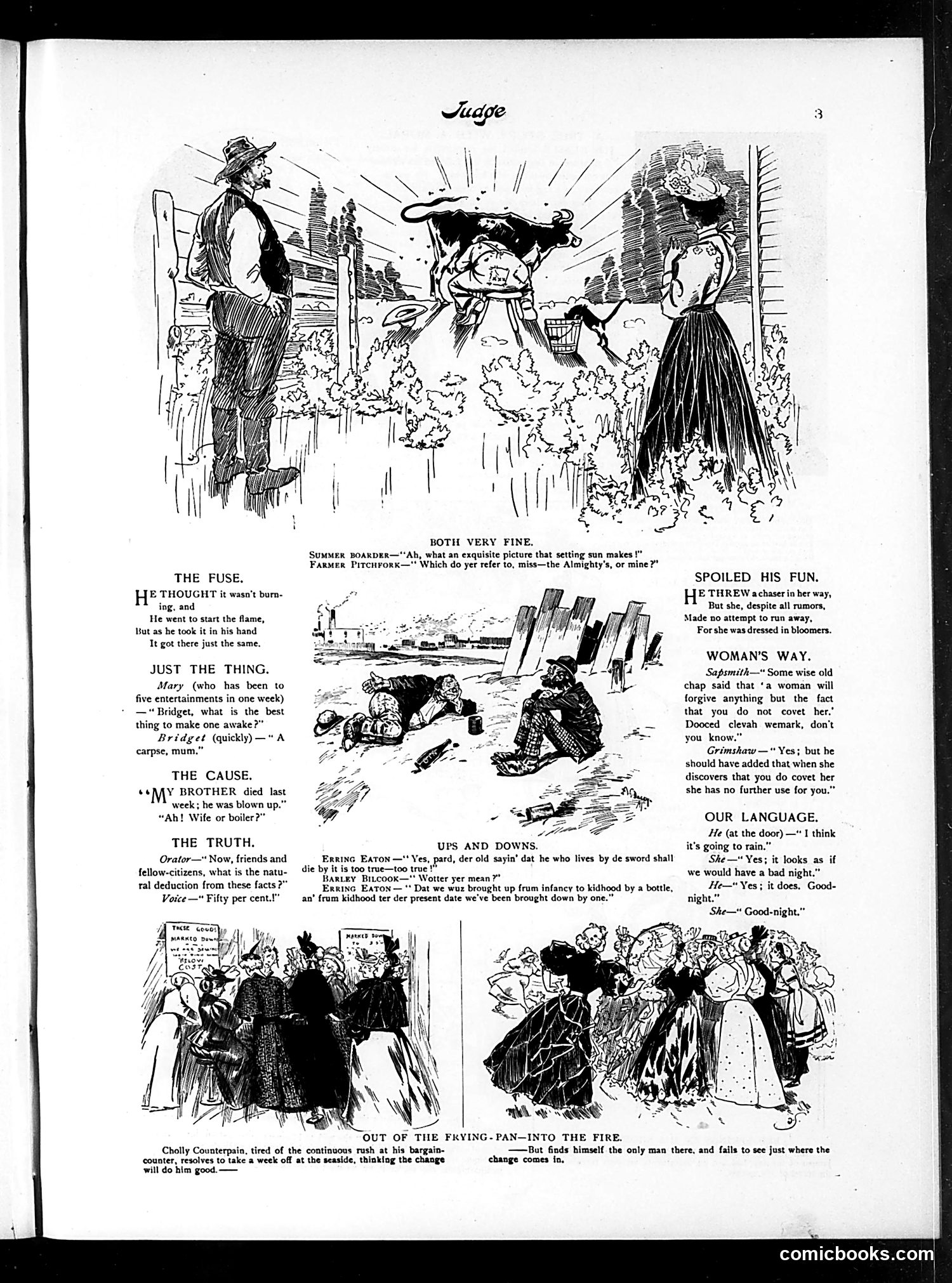
This page contains several satirical sketches with brief comedic captions typical of Judge's humor. The top cartoon "Both Very Fine" depicts a summer boarder and farmer discussing a cow, with wordplay about "requisite pictures" and religious references ("the Almighty's"). The remaining sketches employ Victorian-era domestic humor: "The Fuse" jokes about starting a fire, "Just the Thing" features a carpse, and "Woman's Way" satirizes female behavior and forgiveness. "Our Language" pokes fun at romantic dialogue between couples. The bottom cartoon "Out of the Frying-Pan—Into the Fire" references Counterstain's bargain-hunting at a seaside resort, using the proverbial expression to suggest poor life choices. Overall, the page reflects late 19th/early 20th-century American social commentary focusing on class differences, gender roles, and everyday domestic absurdities rather than partisan politics.
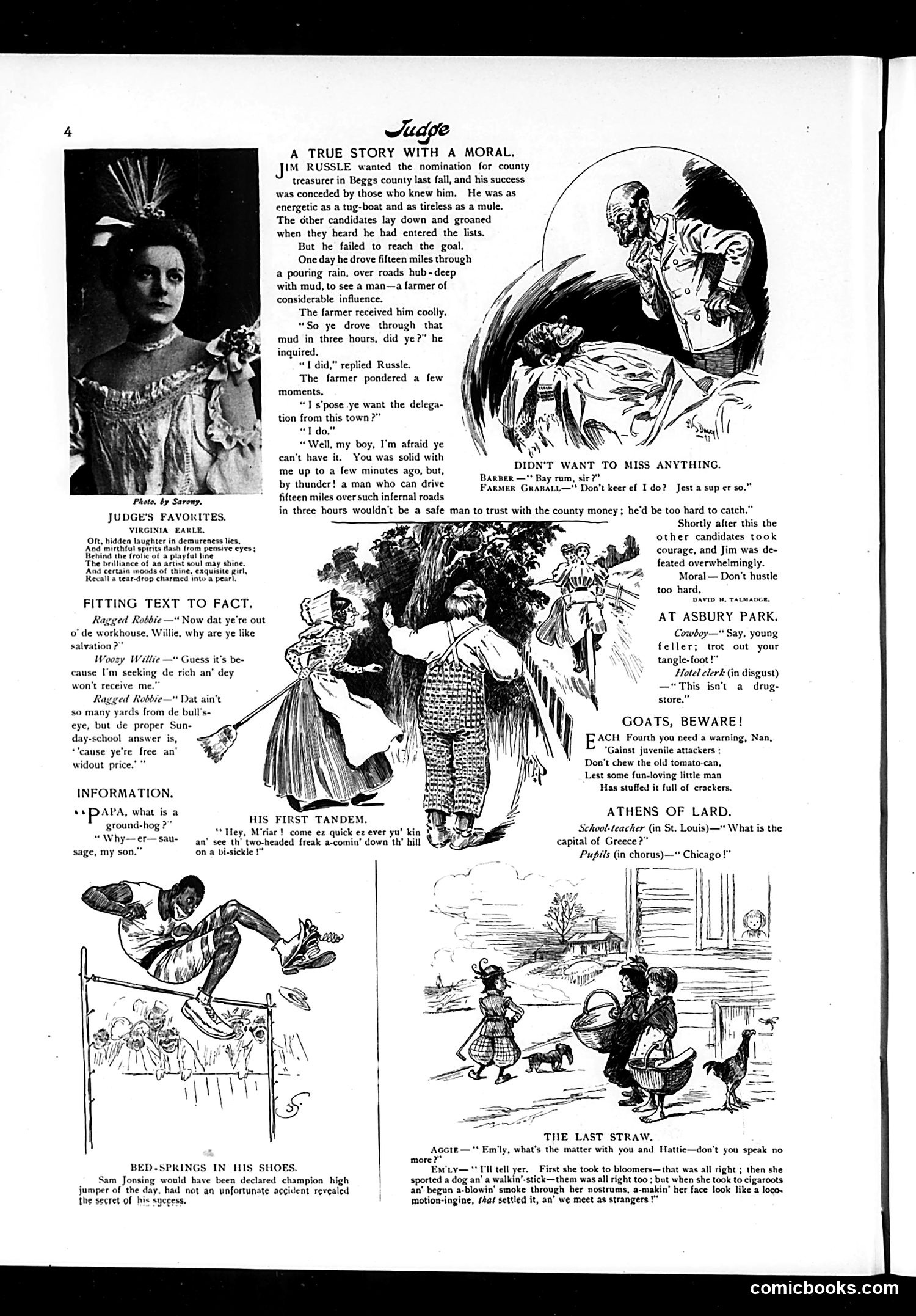
This page from Judge contains several moral tales and jokes typical of late 19th-century American satire: **"A True Story with a Moral"** (main feature): Jim Russle loses a county treasurer nomination despite tireless campaigning. A farmer refuses to support him *because* he drove 15 miles through mud in three hours—proving he's too energetic and efficient to be trusted with public money. The satire mocks both rural suspicion of go-getters and the corruption of local politics, where diligence is actually a liability. **Other items** include light social humor: a cowboy asking a hotel clerk for "tangle-foot" (slang for whiskey) at a non-saloon establishment; a joke about St. Louis calling Chicago the "capital of Greece"; and domestic squabbles about women adopting bloomers, dogs, and cigarettes. The cartoons use exaggerated rural dialect and working-class characters to poke fun at American social pretensions and political incompetence during the Gilded Age.
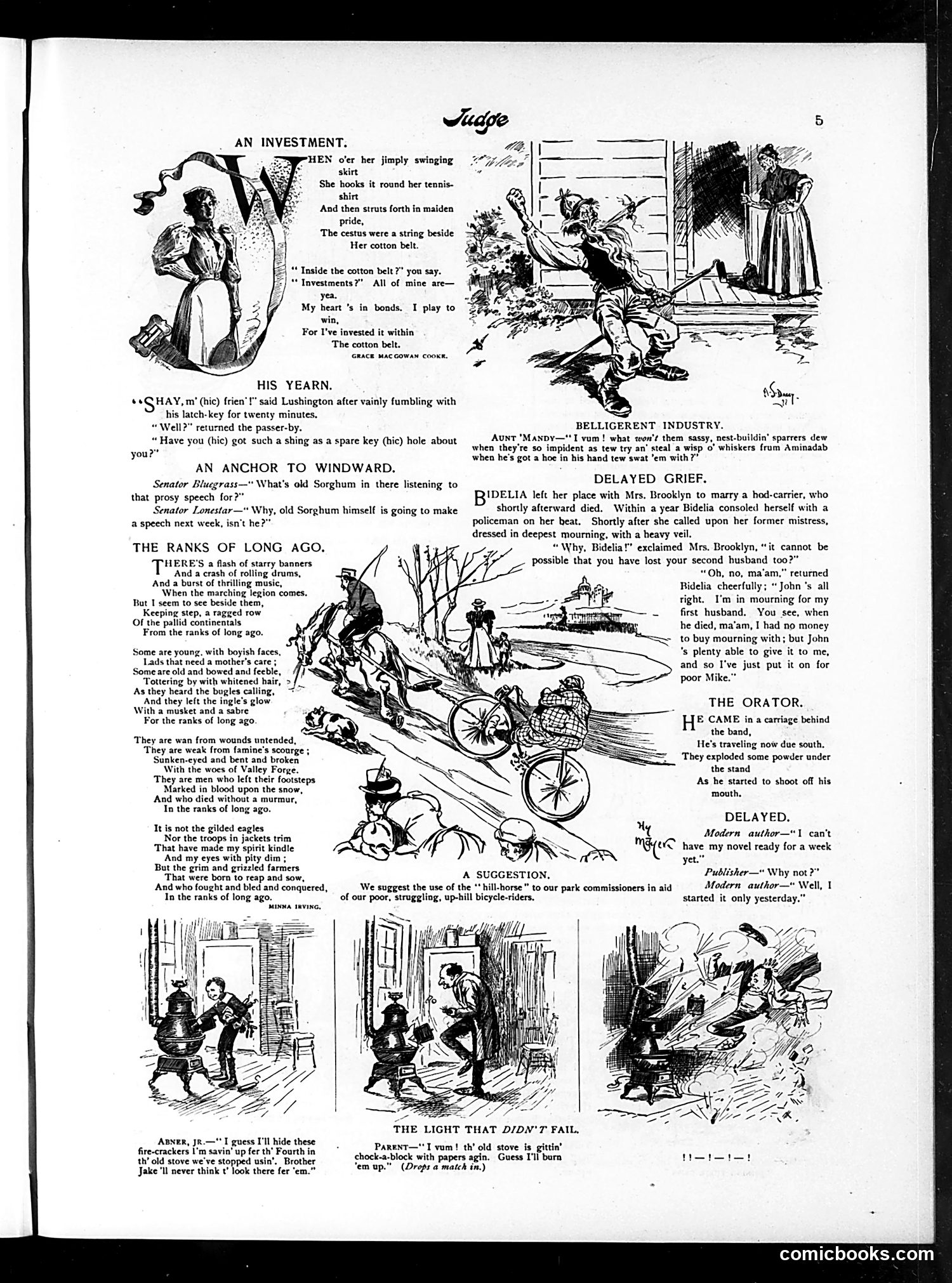
This page contains multiple short satirical pieces typical of late 19th/early 20th-century American humor: **"An Investment"** and **"His Yearn"** are light romantic/comic verses and drunk-man jokes with minimal political content. **"The Ranks of Long Ago"** is the substantive piece—a sentimental poem honoring Civil War veterans (likely Union Army, referencing Valley Forge and the Continental Army). It contrasts decorated generals with poor, wounded enlisted men who sacrificed without recognition. This reflects post-Civil War debate about veteran pensions and public memory. **"Delayed Grief"** satirizes working-class women's economic precarity: a widow remarries quickly not for love but because only her new husband's income allows her to afford mourning clothes for the first husband. **"The Orator,"** "A Suggestion," and the fire-cracker dialogue are brief, apolitical comic sketches about minor social absurdities. The page reflects Judge's mix of gentle social satire with sentimental nationalism, typical of 1890s-1900s American humor magazines.
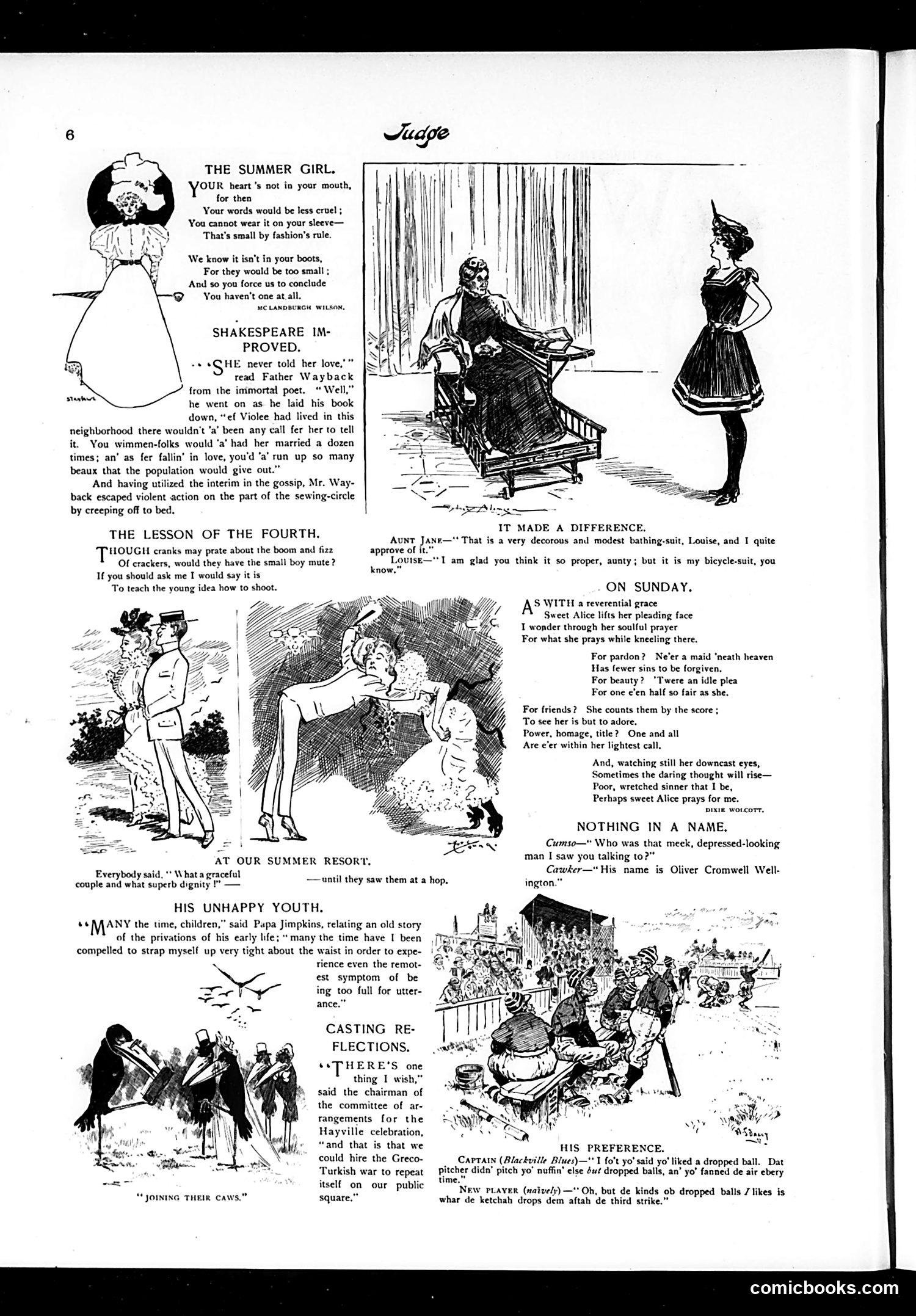
This page contains multiple satirical pieces typical of late 19th/early 20th-century American humor: **"The Summer Girl"** mocks fashionable young women for their emotional coldness, using the conceit that their hearts must be absent since they can't be worn visibly. **"Shakespeare Improved"** presents a rural character (Father Wayback) reinterpreting Shakespeare's line about concealed love, suggesting country girls would never keep romance secret—they'd be married off immediately by gossiping women. **"It Made a Difference"** plays on Aunt Jane's misunderstanding: she praises Louise's "modest bathing suit," not realizing it's actually a bicycle suit, reflecting contemporary anxiety about athletic wear and changing female fashion. **"On Sunday"** presents the narrator wondering what sweet Alice prays for, concluding she must pray for sinners like himself—sentimental Victorian verse about feminine purity. **"Nothing in a Name"** is a brief joke about Oliver Cromwell Wellington—an ordinary man with a grandiose historical name. The remaining pieces cover summer resort observations and baseball humor. Overall, the page emphasizes typical Judge satirical targets: female fashion, rural characters, courtship conventions, and genteel sentimentality.
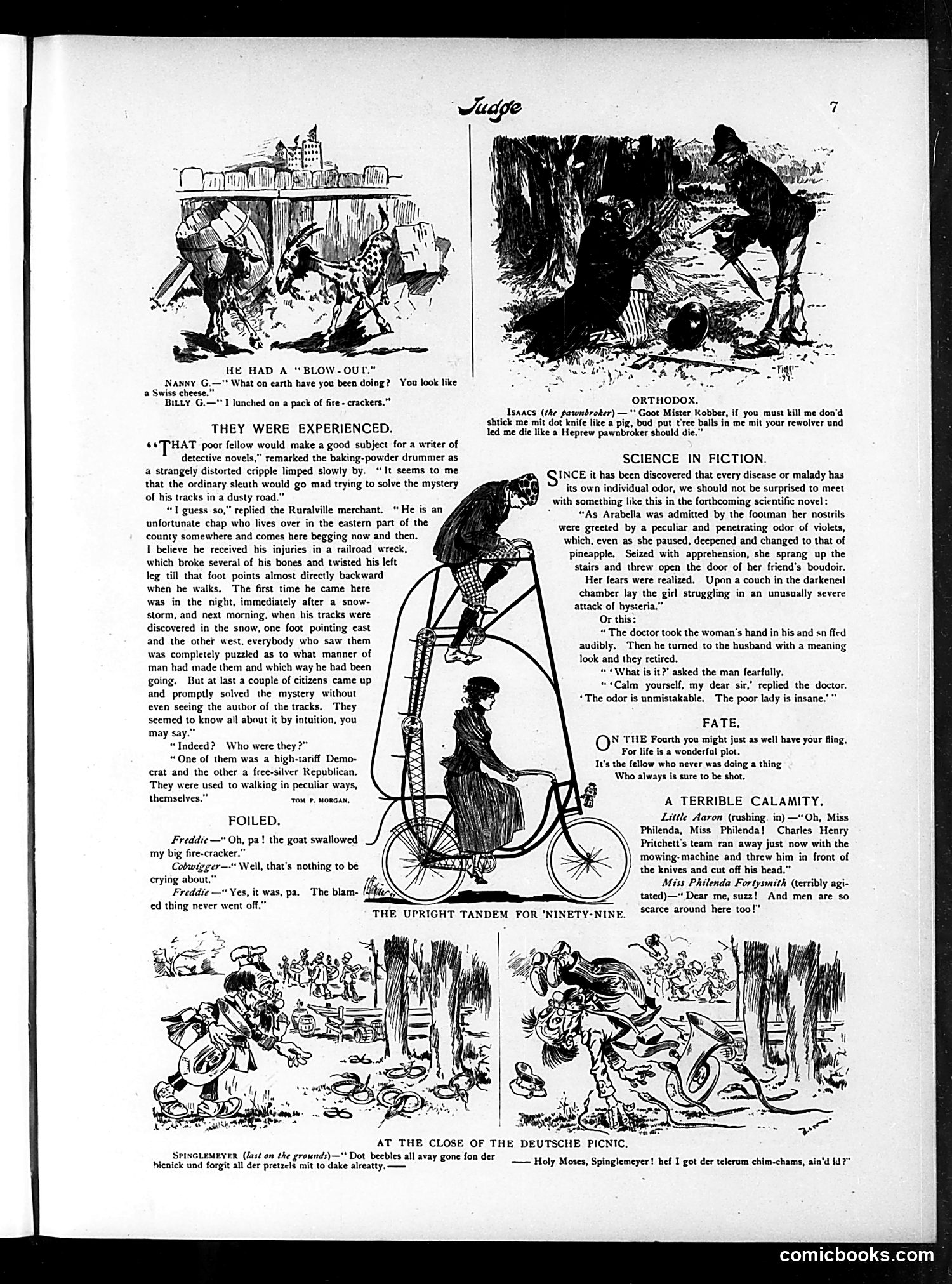
This page contains multiple short satirical pieces typical of late-19th-century American humor: **"They Were Experienced"** mocks political tribalism: two citizens—a protectionist Democrat and free-silver Republican—immediately deduce a crippled man's direction from his backward-pointing footprints *because both groups naturally walk in contradictory ways*. The joke satirizes how partisan ideology distorts perception. **"Orthodox"** uses ethnic stereotyping (Yiddish-accented pawnbroker) for dark humor about death preferences, reflecting period attitudes. **"Science in Fiction"** parodies contemporary pseudo-scientific medical claims about diseases having distinctive odors, imagining absurdly overwrought fictional applications. The remaining pieces are gentler comic vignettes about firecrackers, tandem bicycles, and ethnic German dialect humor ("Deutsche Picnic"). The page represents Judge's mix of political satire and lighthearted social commentary aimed at middle-class readers, heavily relying on ethnic caricature and partisan mockery now considered offensive.
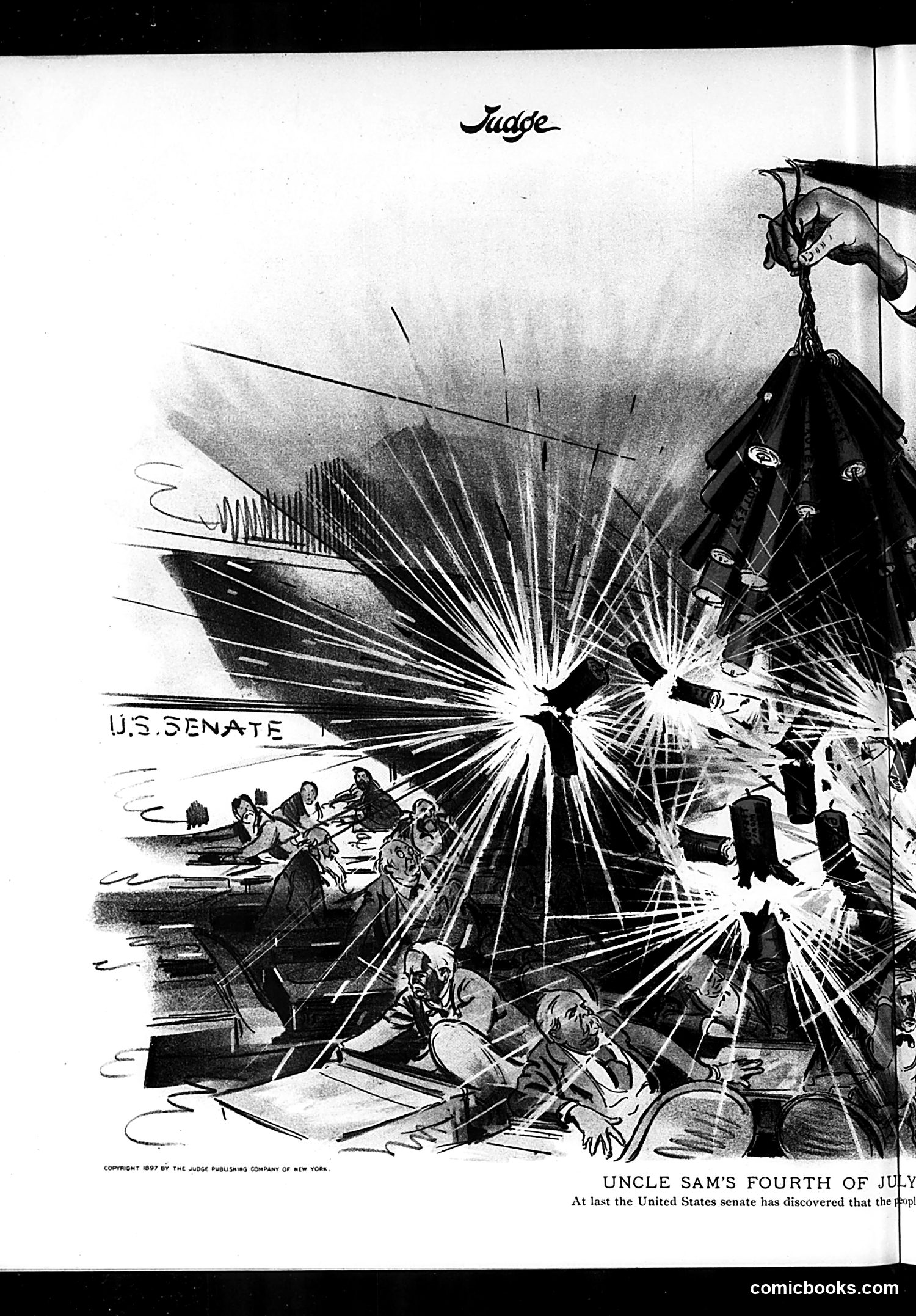
This Judge magazine cartoon satirizes the U.S. Senate during what appears to be an Independence Day celebration. The image shows Uncle Sam (the personification of America, visible in the upper right holding a large bomb or explosive device) literally exploding fireworks over senators seated in the chamber below. The satirical point appears to be that the Senate has "discovered" something shocking enough to cause upheaval—likely a scandal or controversial revelation. The explosive imagery suggests the Senate's reaction is dramatic and disruptive, turning their Fourth of July into chaos rather than celebration. The text cuts off mid-sentence ("the fFop!"), making the specific target unclear, but the cartoon criticizes Senate conduct during a patriotic moment, suggesting institutional dysfunction or hypocrisy undermining American ideals.
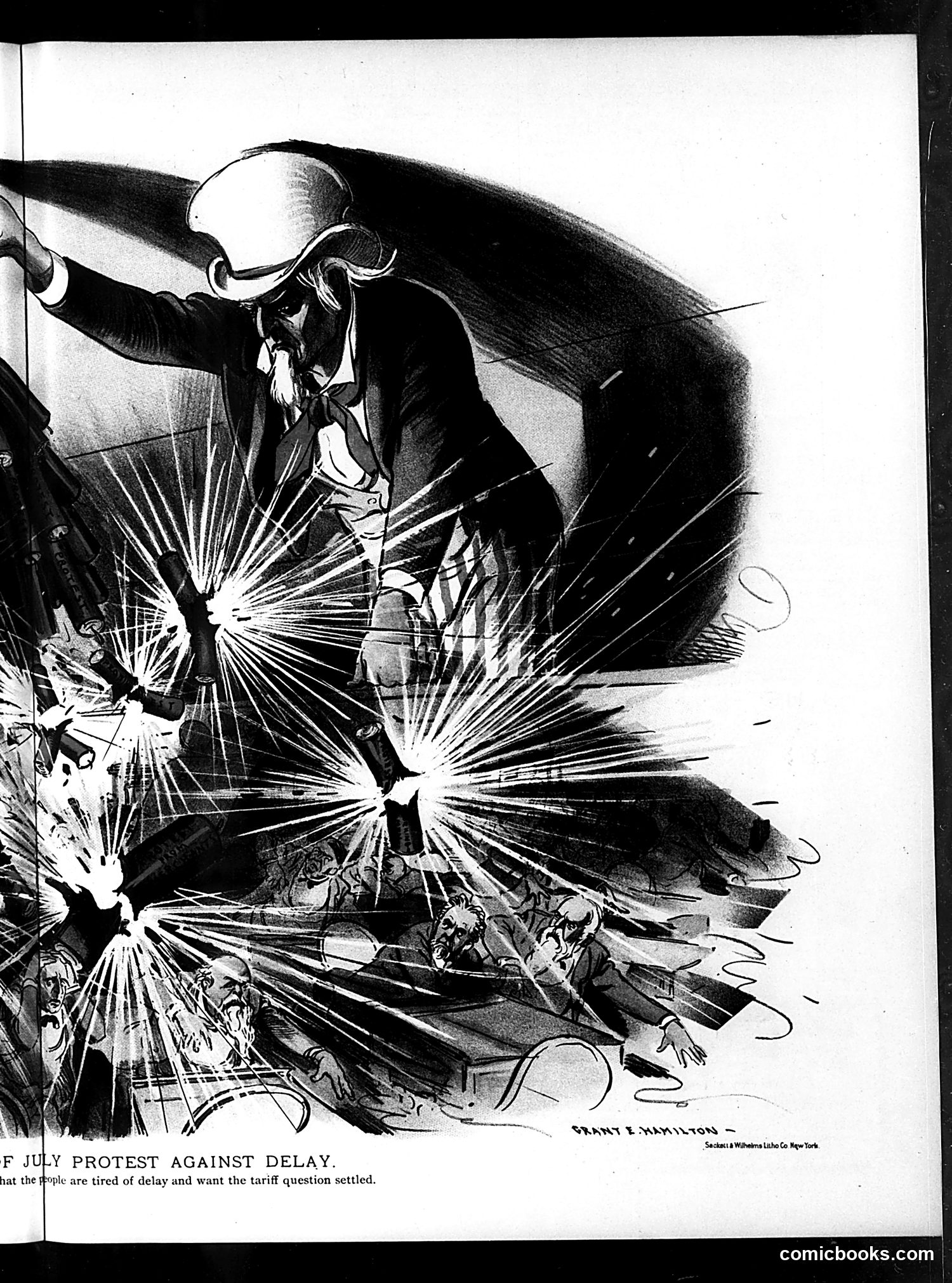
This cartoon by Grant Hamilton depicts a tall figure (likely representing the U.S. government or Congress) being struck by multiple explosive bursts labeled as "July Protest Against Delay." The explosions suggest popular outrage erupting from below. The caption states that "the people are tired of delay and want the tariff question settled." This references the contentious tariff debate of the early 1900s—a major political issue dividing Americans over trade policy. The cartoon satirizes government inaction by showing public frustration literally bombarding officials. The dynamic composition of radiating lines emphasizes the intensity and urgency of public demand for resolution on this economic question. The bearded figures below appear to represent angry citizens or workers demanding action.
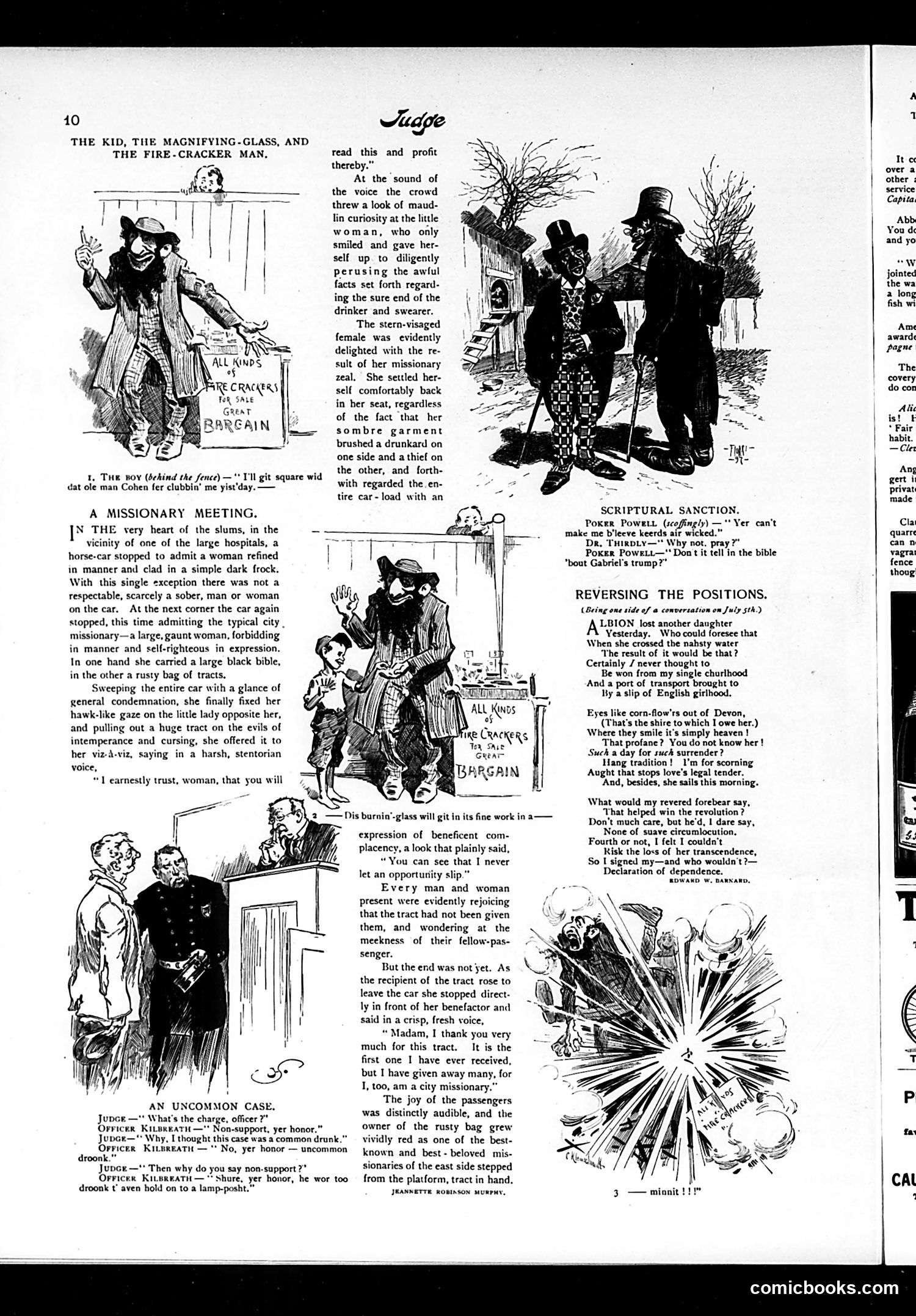
This page contains several satirical cartoons critiquing religious hypocrisy and social attitudes of the era. **"A Missionary Meeting"** depicts a stern, self-righteous female missionary distributing temperance tracts on a streetcar to disreputable passengers (drunks, thieves). The satire targets her smug moral superiority and condescending evangelicalism—she distributes tracts while physically recoiling from the very people she claims to help. The passengers' indifference underscores the ineffectiveness of such performative charity. **"An Uncommon Case"** satirizes a judge and officer discussing a "non-support" case, suggesting legal absurdities in domestic disputes. **"Reversing the Positions"** is a poem about class anxieties—an English gentleman lamenting his daughter marrying across class lines, ultimately accepting it for love, mocking both aristocratic pretension and romantic idealism. The overall theme: hypocrisy, self-righteousness, and the gap between moral posturing and actual human decency in Victorian-era society.
This is primarily a **page of advertisements and brief satirical quips**, typical of Judge magazine's format. Rather than a coherent political cartoon, it collects short humorous observations on contemporary life. The notable items include: **Social commentary**: A quip about clergymen marrying for money (implying financial opportunism within the clergy); a joke about long-distance telephone costs suggesting the Senate should use them (satirizing Senate inefficiency); and commentary on a religious controversy—"Claud Fales Wright and Mrs. Tingley" quarreling, referencing an apparent scandal in theosophical circles. **Period details**: References to bicycles (hugely popular in the 1890s), champagne quality, and business cynicism (a man avoiding financial discussion until "the tariff has been settled"). The satire is genteel and observational rather than overtly political—targeting clerical hypocrisy, domestic tensions, and bureaucratic waste rather than specific political figures or events. The advertisements (pianos, bicycles, bitters) dominate the layout.
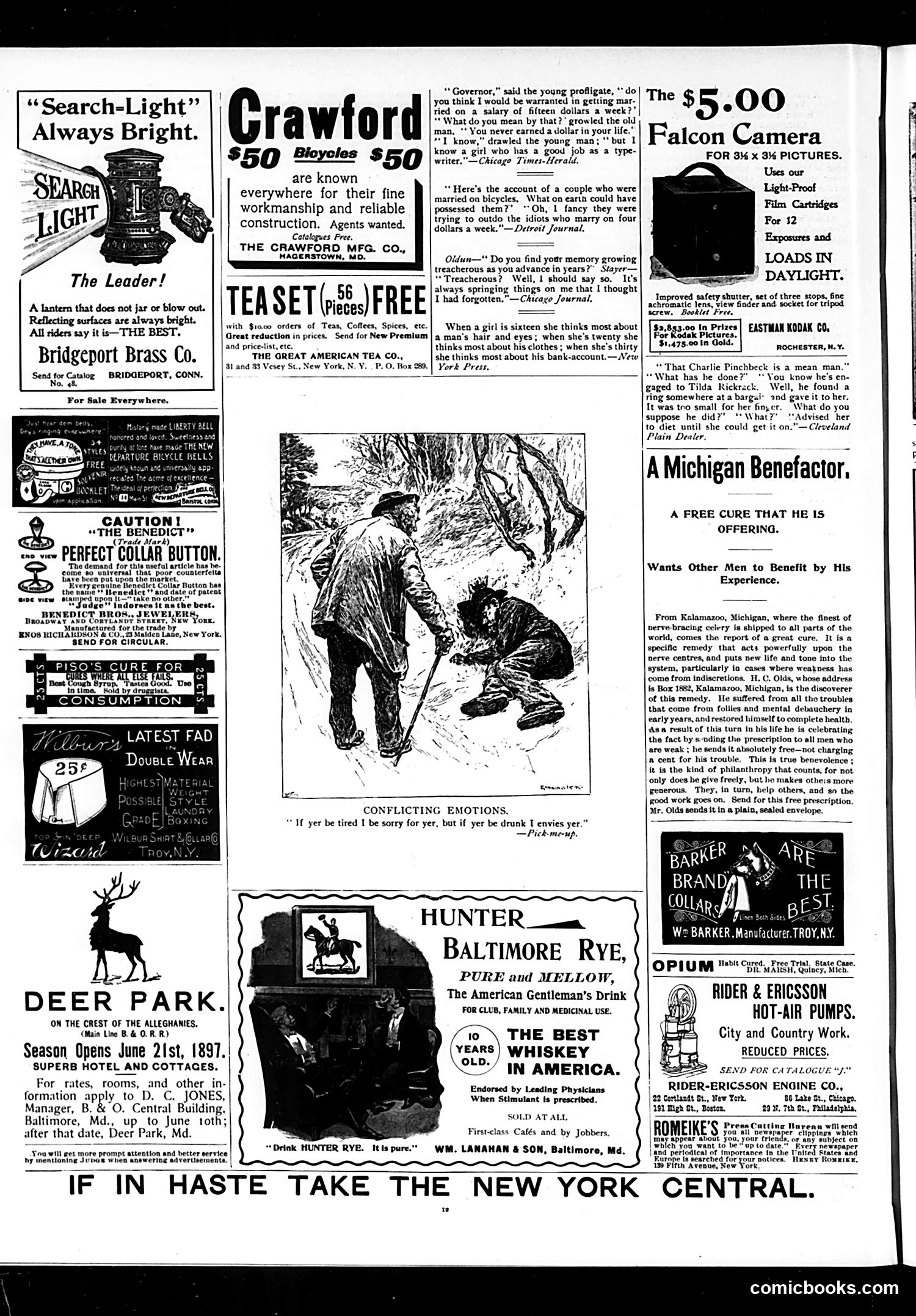
This is primarily an **advertising page** from *Judge* magazine (circa 1897), with minimal satirical content. The page contains commercial advertisements for bicycles, cameras, whiskey, lanterns, and various other products typical of late Victorian America. The **one cartoon** visible depicts a rural figure in what appears to be a moment of emotional conflict—the caption "Conflicting Emotions" jokes that the speaker both pitied someone for exhaustion but envies them for drunkenness. This represents *Judge's* typical working-class humor of the period, finding comic contradiction in competing impulses. Scattered among ads are brief **humorous anecdotes** mocking emerging social trends: young men marrying on meager wages, couples marrying on bicycles (suggesting newfangled frivolity), and changing female priorities with age (from attraction to practicality). These jokes reflect genteel anxiety about modern courtship and women's economic independence. The page reflects *Judge's* dual function as both satirical publication and advertising vehicle for affluent readers.
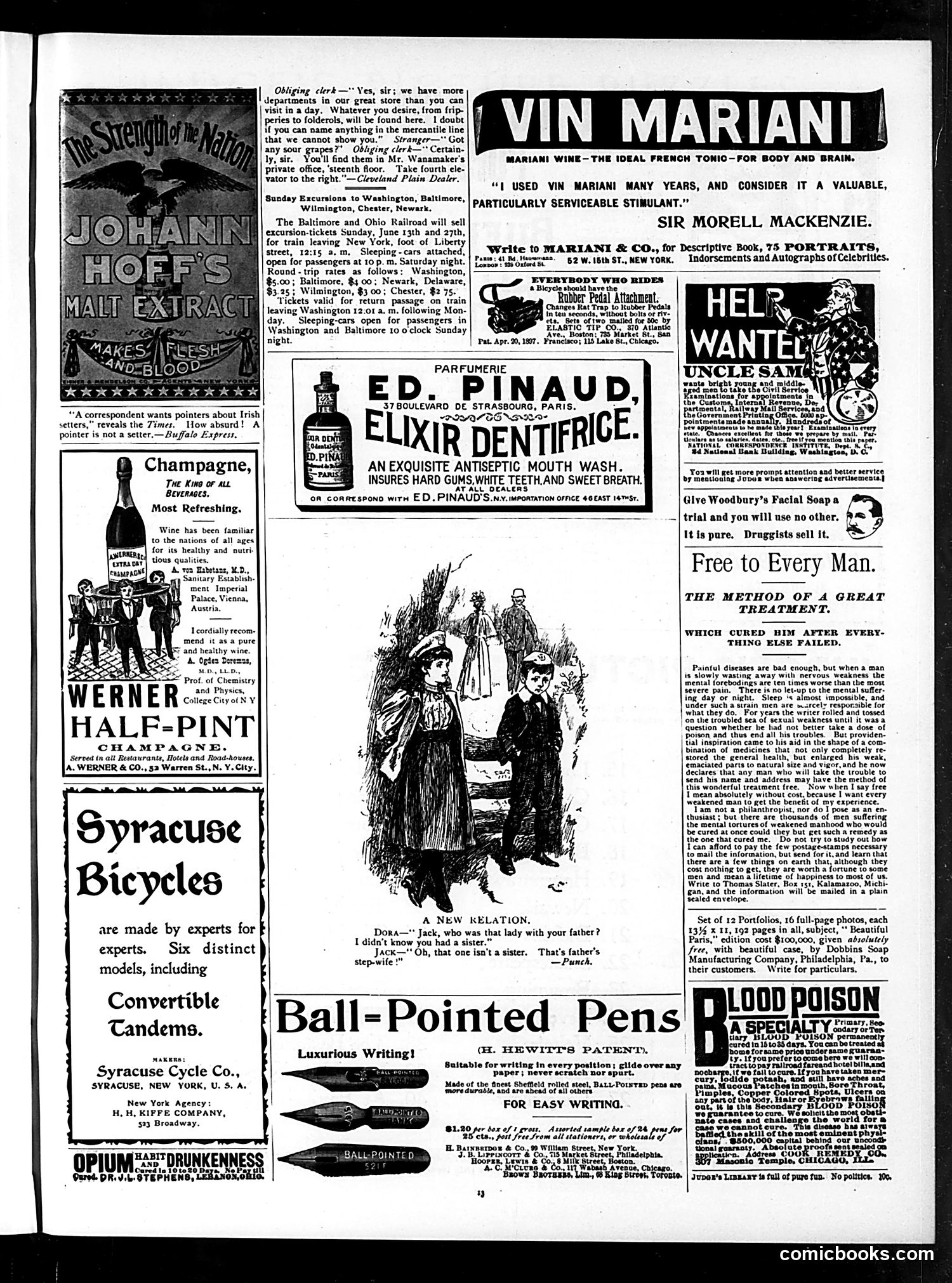
This page is primarily **advertising**, typical of Judge's revenue model. The satirical content is minimal: **The One Cartoon**: "A New Relation" depicts a social joke about a man's "step-wife"—a mistress or unmarried female companion—being mistaken for his sister. The humor relies on Victorian-era embarrassment about non-marital relationships and the difficulty of explaining such arrangements in polite society. **The Satire**: A brief text item mocks a newspaper advice column asking about "Irish setters," noting absurdly that "a pointer is not a setter"—likely a double entendre about dog breeds that also plays on confusion or incompetence. **The Ads**: Dominates the page—Champagne, bicycles, dental products, wine tonics, pens, and dubious medical treatments ("Blood Poison" cure, nervous weakness treatments). These reflect late 19th/early 20th-century advertising patterns, including pseudoscientific health claims now recognized as quackery. The page demonstrates how Judge funded itself while occasionally inserting light social satire.
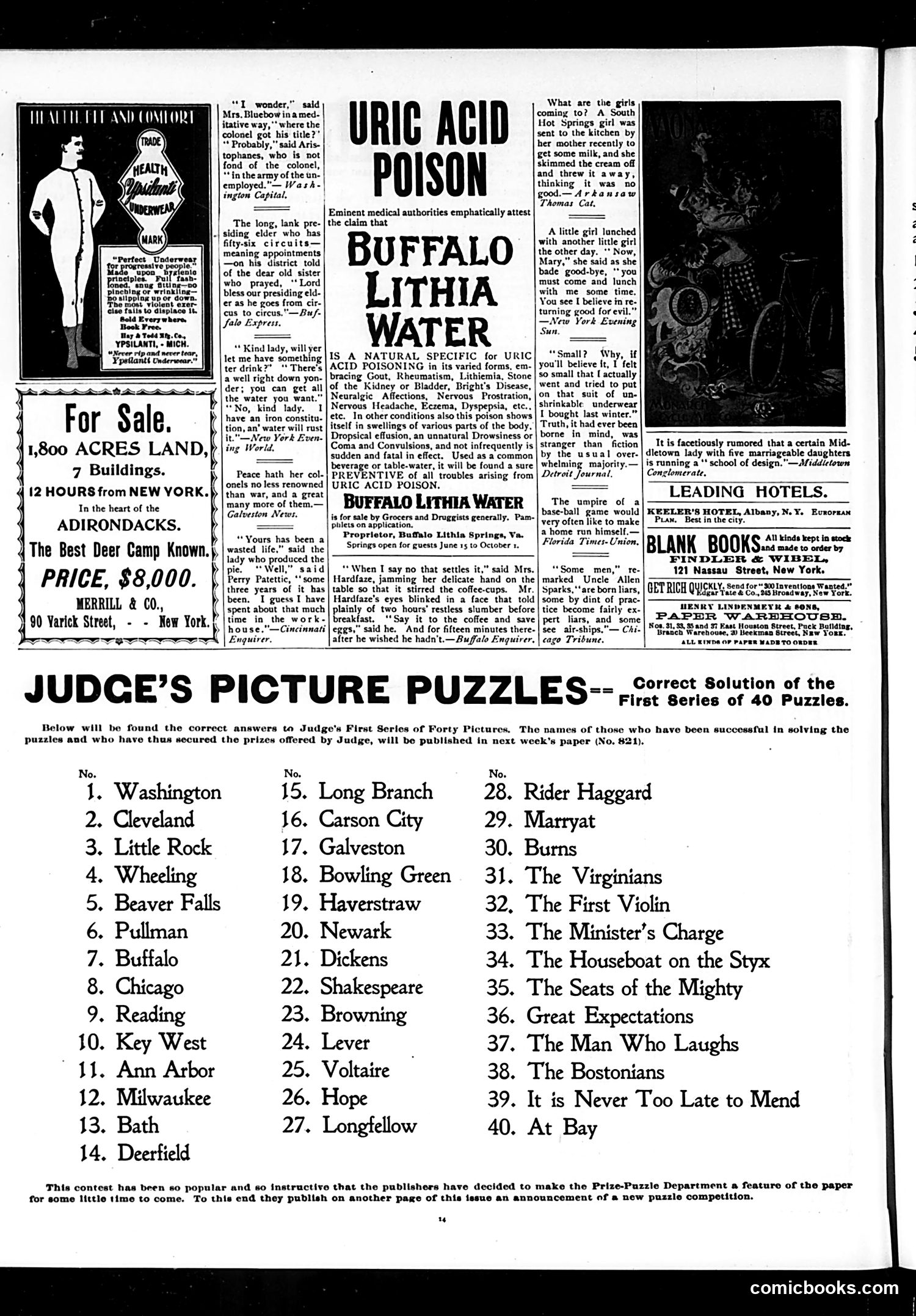
This page is primarily **advertising and miscellaneous content** rather than political cartoons. The main elements are: **Top Left:** A small comic strip about "Chalice and Comfort"—brief humorous anecdotes about colonels, preachers, and rural life, typical of Judge's humor section. **Center:** A large advertisement for **Buffalo Lithia Water**, claiming it cures gout, rheumatism, and kidney ailments caused by "uric acid poisoning." This represents turn-of-the-century patent medicine marketing—making grand medical claims without scientific basis (a practice satirized elsewhere in Judge). **Right side:** More brief humorous observations about girls, baseball umpires, and men. **Bottom:** Solutions to "Judge's Picture Puzzles," a puzzle contest feature. **The satire:** The humor is gentle, domestic, and sentimental rather than politically biting—jokes about absent-minded wives, foolish husbands, and rural simplicity. The patent medicine ad exemplifies the quackery Judge's editorials often mocked, though this is paid advertising.
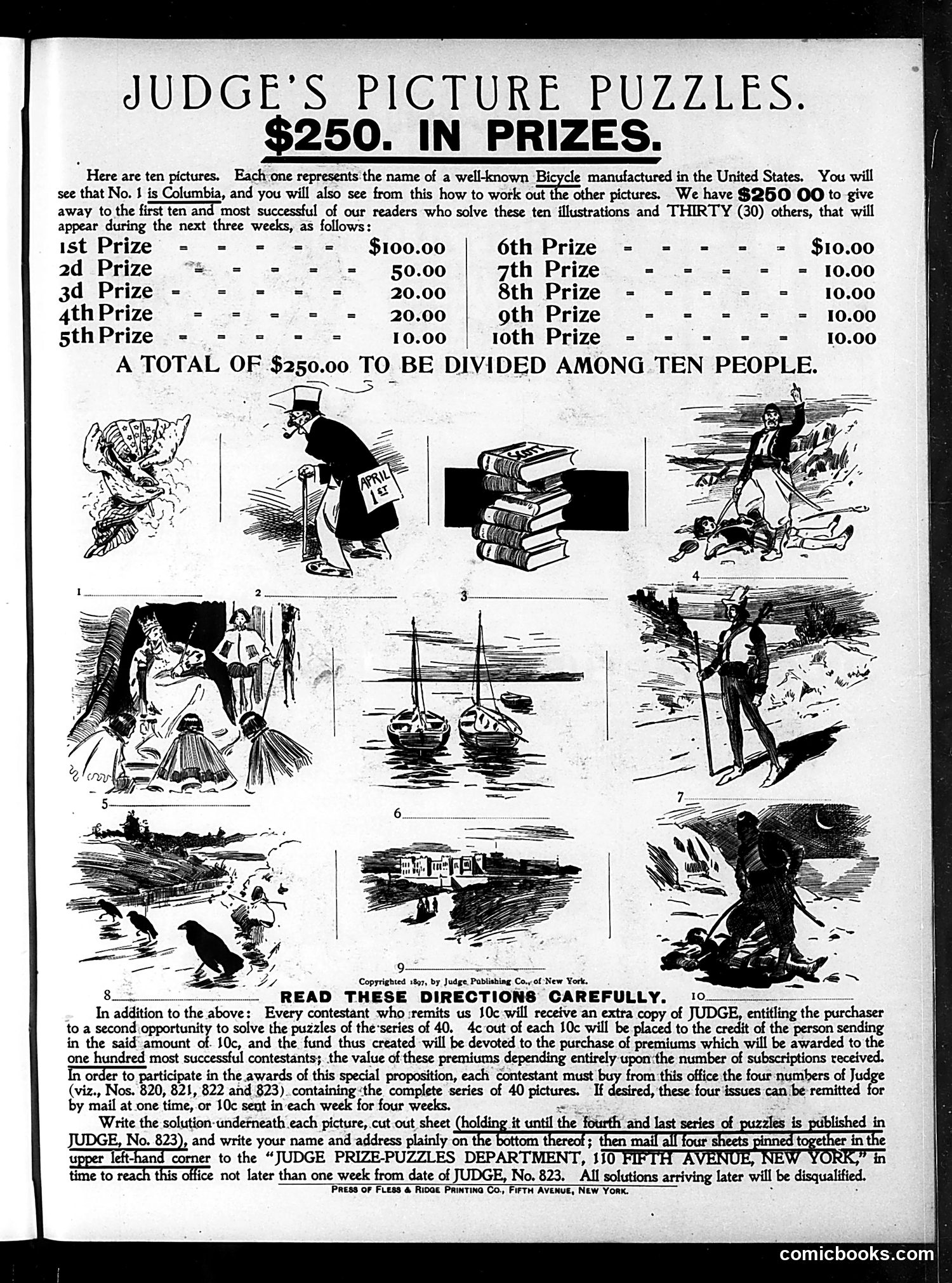
This is primarily **advertising content**, not political satire. Judge magazine is running a puzzle contest where readers identify ten bicycle brand names from cryptic illustrations. The first example shows No. 1 is "Columbia" (a major American bicycle manufacturer of the era). The contest offers $250 in prizes to incentivize readership and engagement. Contestants pay 10 cents to enter and receive bonus Judge copies; their small payments fund additional premiums for top solvers. The ten numbered illustrations appear abstract or allegorical—depicting scenes of people, water, buildings, and figures—each encoding a different bicycle brand name through visual pun or metaphor. Modern readers would struggle to recognize most brands without historical knowledge of 1890s cycling manufacturers. This reflects the bicycle craze of the 1890s: bicycles were wildly popular consumer goods, making them ideal puzzle subjects for a mass-circulation magazine seeking to boost circulation through interactive contests.
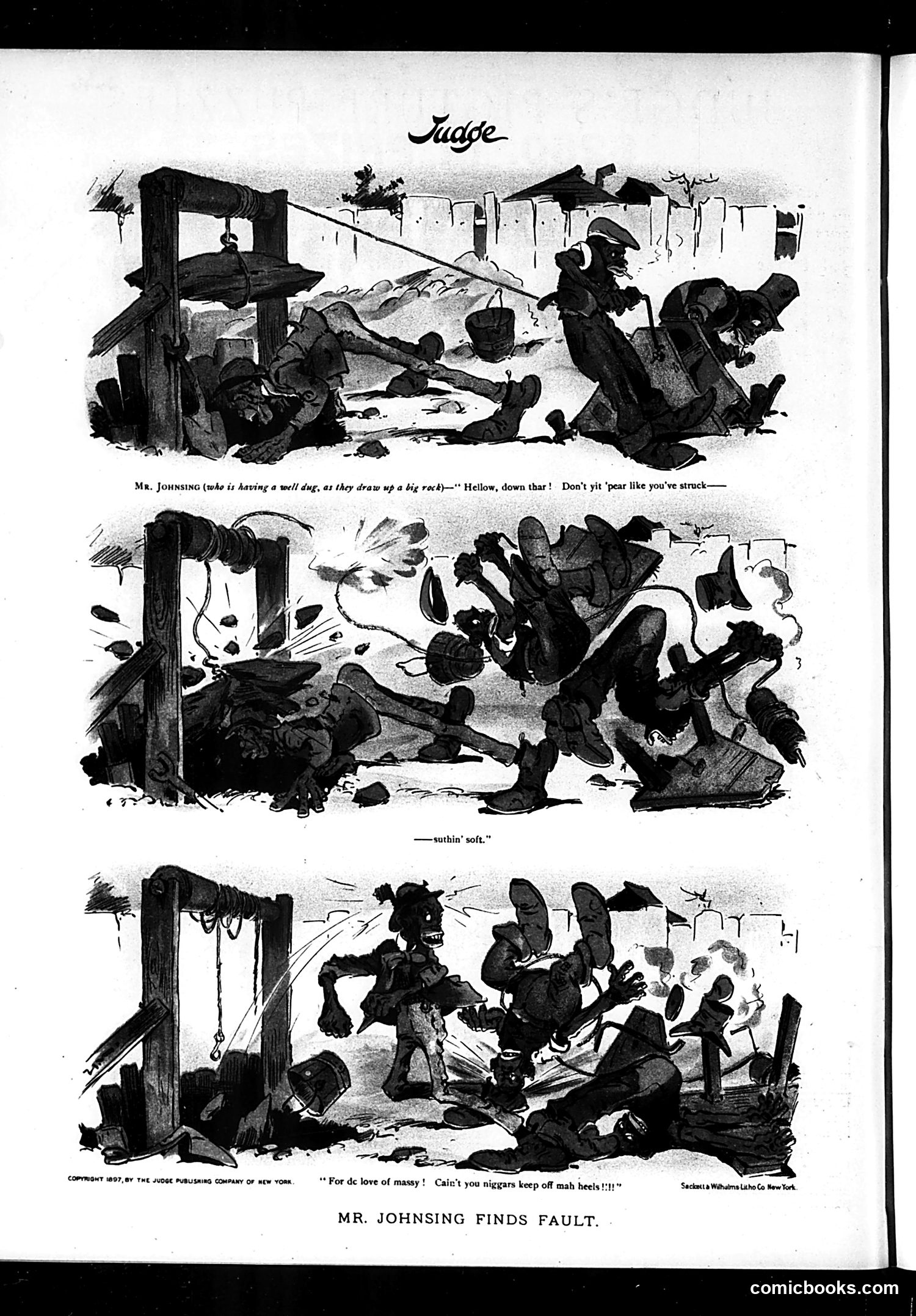
This three-panel cartoon depicts a well-digging scene with racist caricature and dialect. Mr. Johnsing, apparently a white overseer, supervises Black workers digging a well. The humor relies on racist stereotypes: exaggerated features, eye-rolling expressions, and heavy dialect portraying Black workers as clumsy and incompetent. The "joke" centers on workers struggling with a large rock while Johnsing complains they're stepping on his heels, then celebrating when they finally dislodge it—the implication being the workers are incompetent and bothersome. This reflects late 19th-century Judge magazine's casual racism. The caricatures, dialect, and condescending tone toward Black laborers were typical of period satirical humor, though deeply offensive by modern standards. The cartoon mocks workers rather than critiquing actual labor exploitation or racial injustice.