
A complete issue · 20 pages · 1897
Judge — April 24, 1897
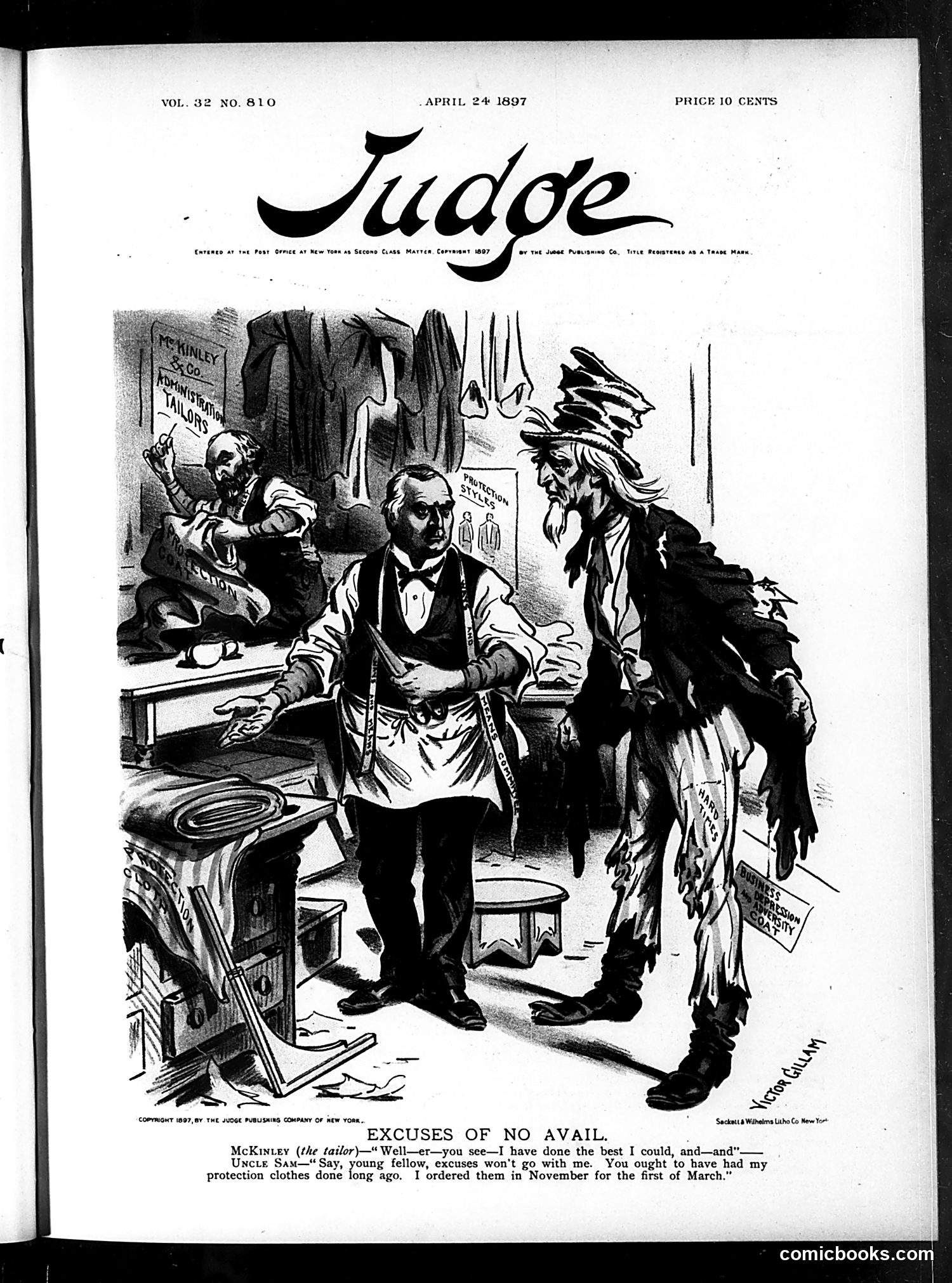
This cartoon satirizes **McKinley** (the tailor), likely President William McKinley, who is being confronted by **Uncle Sam** (right) and another figure. McKinley claims he's done his best with protective clothing orders placed in November "for the first of March," but the garments remain undelivered. The satire appears to criticize McKinley's handling of **tariff policy** and trade protection—core Republican positions of the era. Uncle Sam is demanding results, suggesting McKinley's promises about protecting American industry through tariffs have produced only excuses and delays rather than tangible benefits. The "tailor" metaphor represents his failure to "fit" the nation's economic needs adequately.
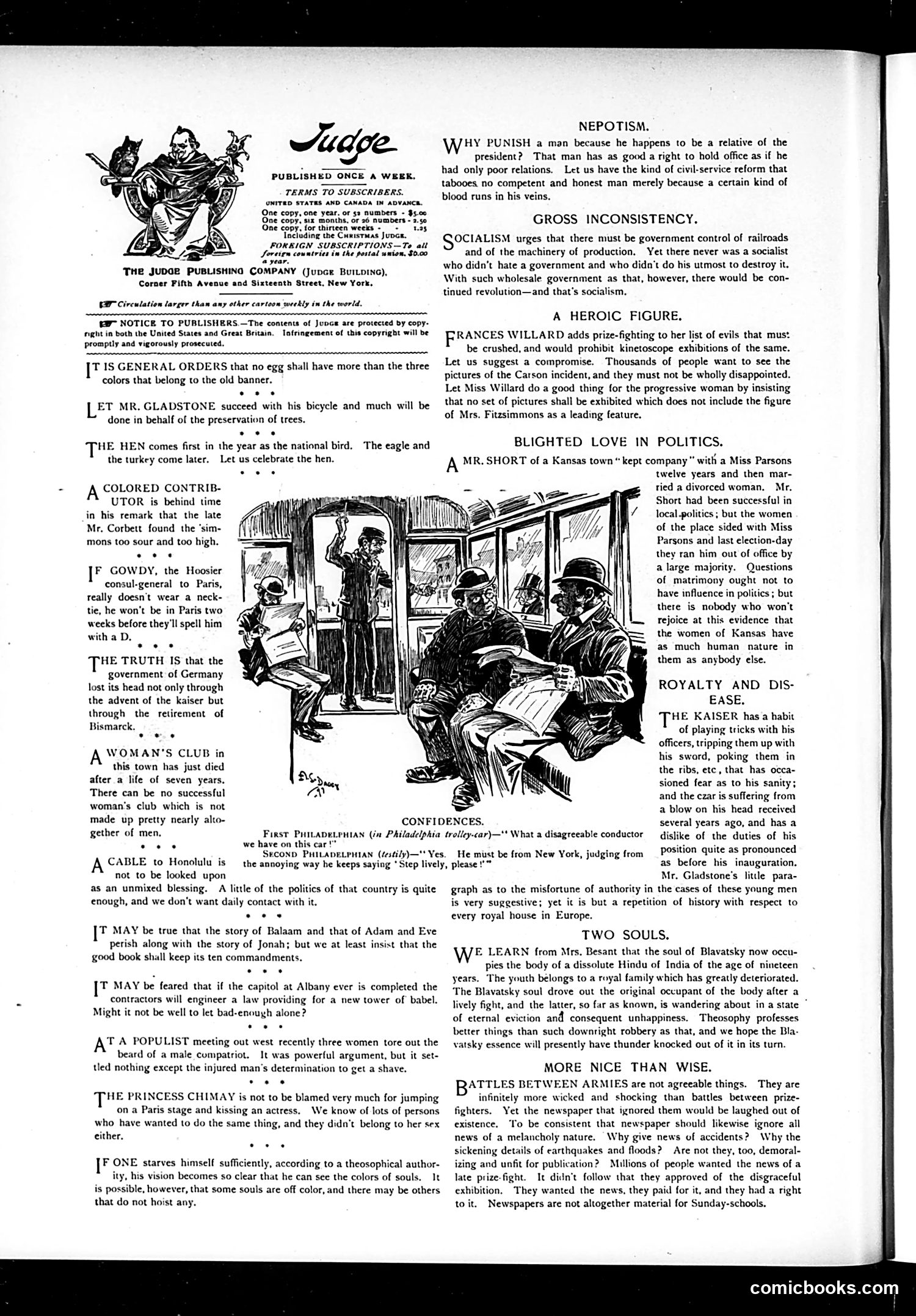
This cartoon depicts a humorous exchange between two men on a streetcar, likely from the late 19th or early 20th century. The caption identifies them as "First Philadelphian" and "Second Philadelphian," with dialogue about a disagreeable conductor and someone from New York. The satire plays on regional stereotypes—contrasting Philadelphia and New York character types. The joke appears to mock both the rudeness of public transportation workers and the pretentious judgments made about people based on their origin city. The broader page contains editorial commentary on contemporary political issues including civil service reform, socialism, and women's influence in politics, typical of Judge magazine's satirical approach to American social and political matters.
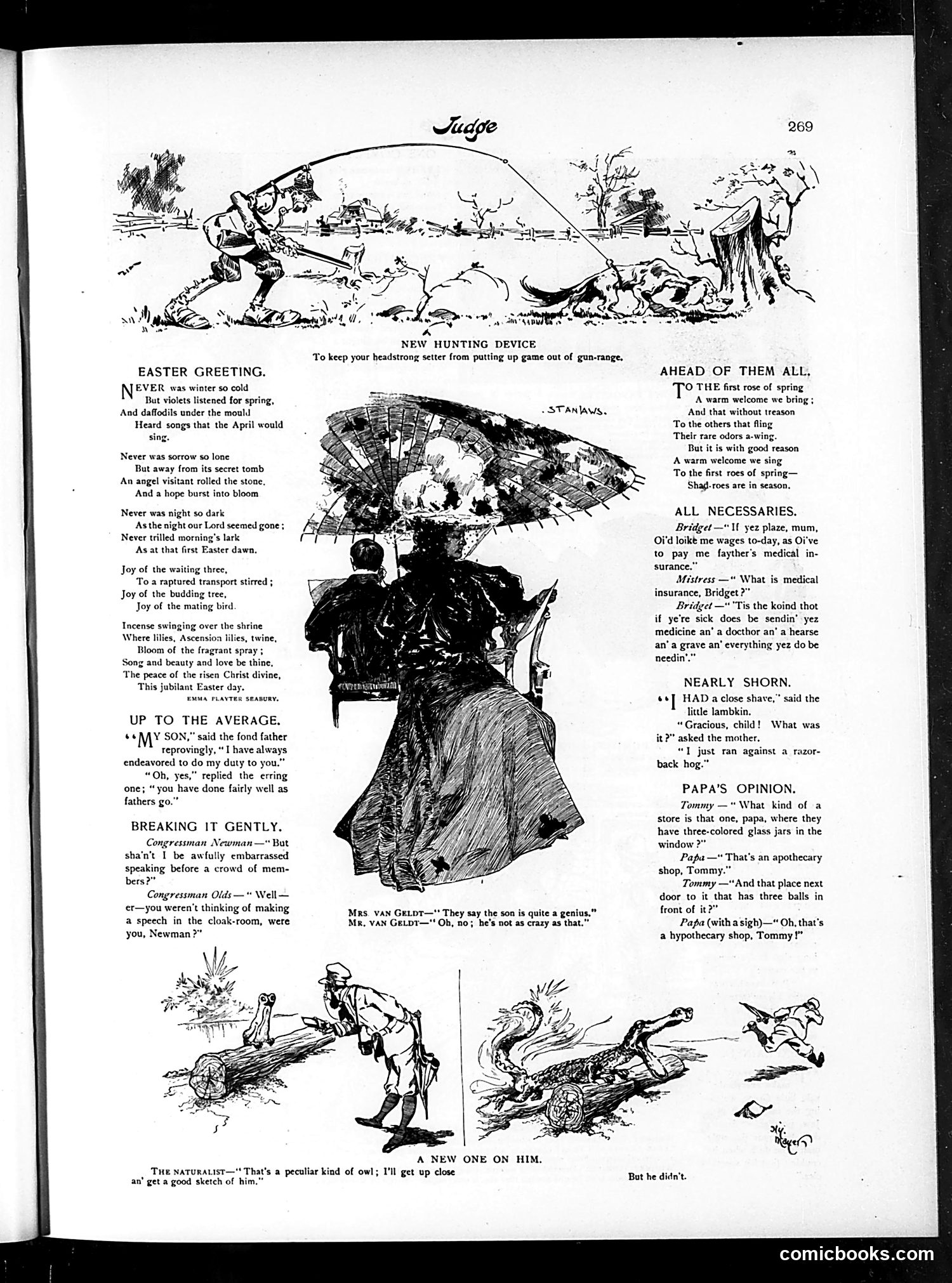
This page contains various humorous sketches and dialogues typical of Judge's satirical format. The centerpiece features a large illustration of a woman with an umbrella—likely depicting spring weather or the "Easter Greeting" theme referenced in the poetry. The text includes domestic comedy sketches: "Up to the Average" depicts a father-son conversation about parenting; "Breaking It Gently" features Congressmen discussing political embarrassment; "All Necessaries" is a dialogue about medical insurance; and "Nearly Shorn" jokes about a child's haircut. "Papa's Opinion" satirizes commercial establishments through wordplay about apothecaries and pharmacies. The bottom illustrations show hunting and outdoor scenes, including "A New One on Him" about a naturalist attempting to sketch an owl. The humor is gentle, domestic, and relies on puns and situational comedy rather than sharp political critique.
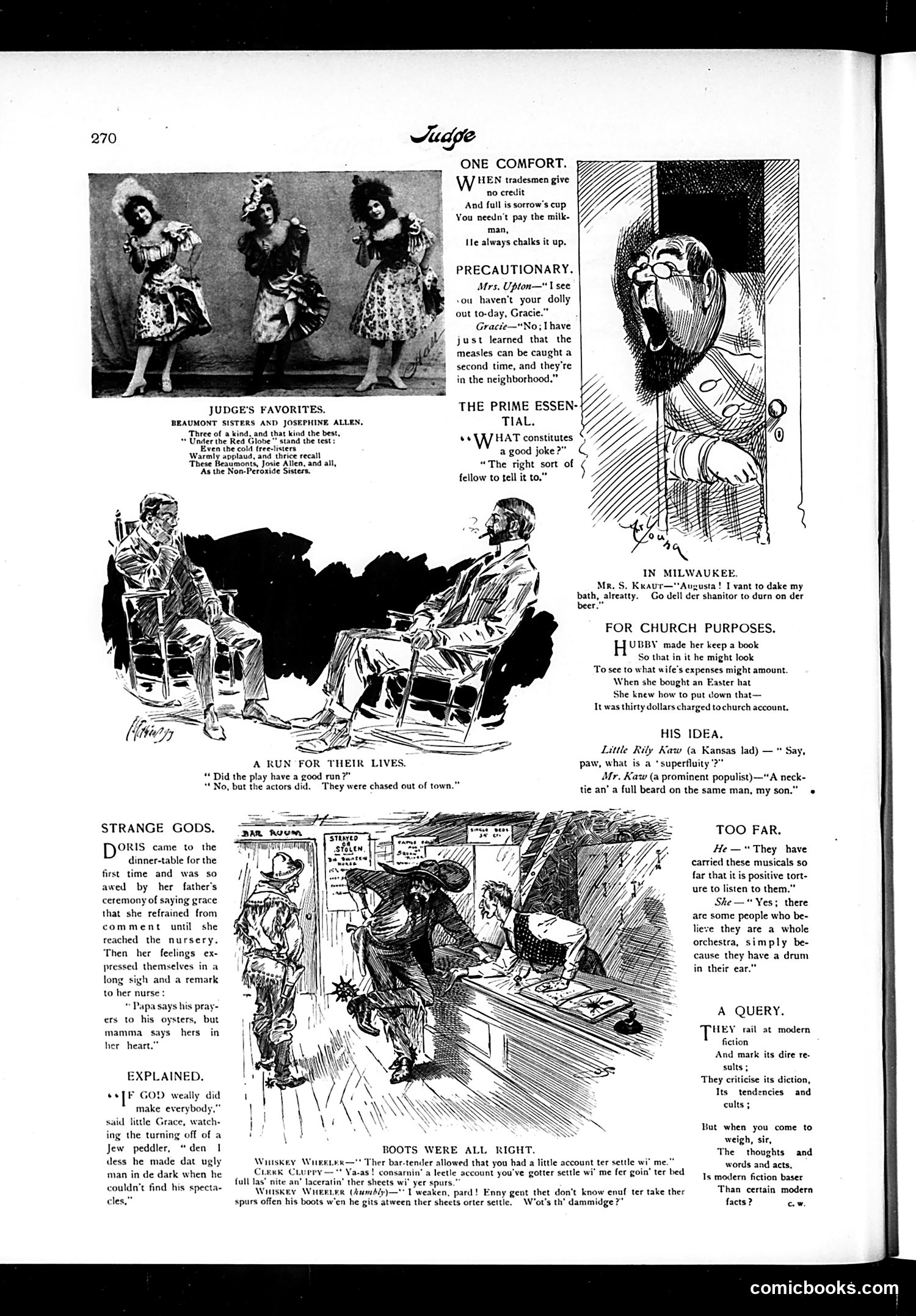
This page contains multiple brief satirical pieces typical of Judge's humor circa early 1900s: **"One Comfort"** jokes about credit—tradesmen won't extend it, but milkmen will "chalk it up" (record debt on a slate). **"Precautionary"** mocks parental anxiety: a mother keeps her daughter indoors, having just learned measles can strike twice. **"Judge's Favorites"** celebrates three actresses (Beaumont Sisters and Josephine Allen) performing at the Red Globe theater. **"A Run for Their Lives"** uses wordplay: actors were "chased out of town"—literally fleeing, not enjoying a successful theatrical run. **"Strange Gods"** satirizes religious hypocrisy: a child observes her father says grace over oysters but her mother "says hers in her heart," implying the mother is more genuinely pious. **"In Milwaukee"** uses ethnic dialect humor (German accent) for a husband's domestic complaint. Other pieces mock Easter hat expenses disguised as church donations, populist pretension, and musical performances. The cartoons employ period stereotypes and simple domestic/social observational humor typical of early Judge satire.
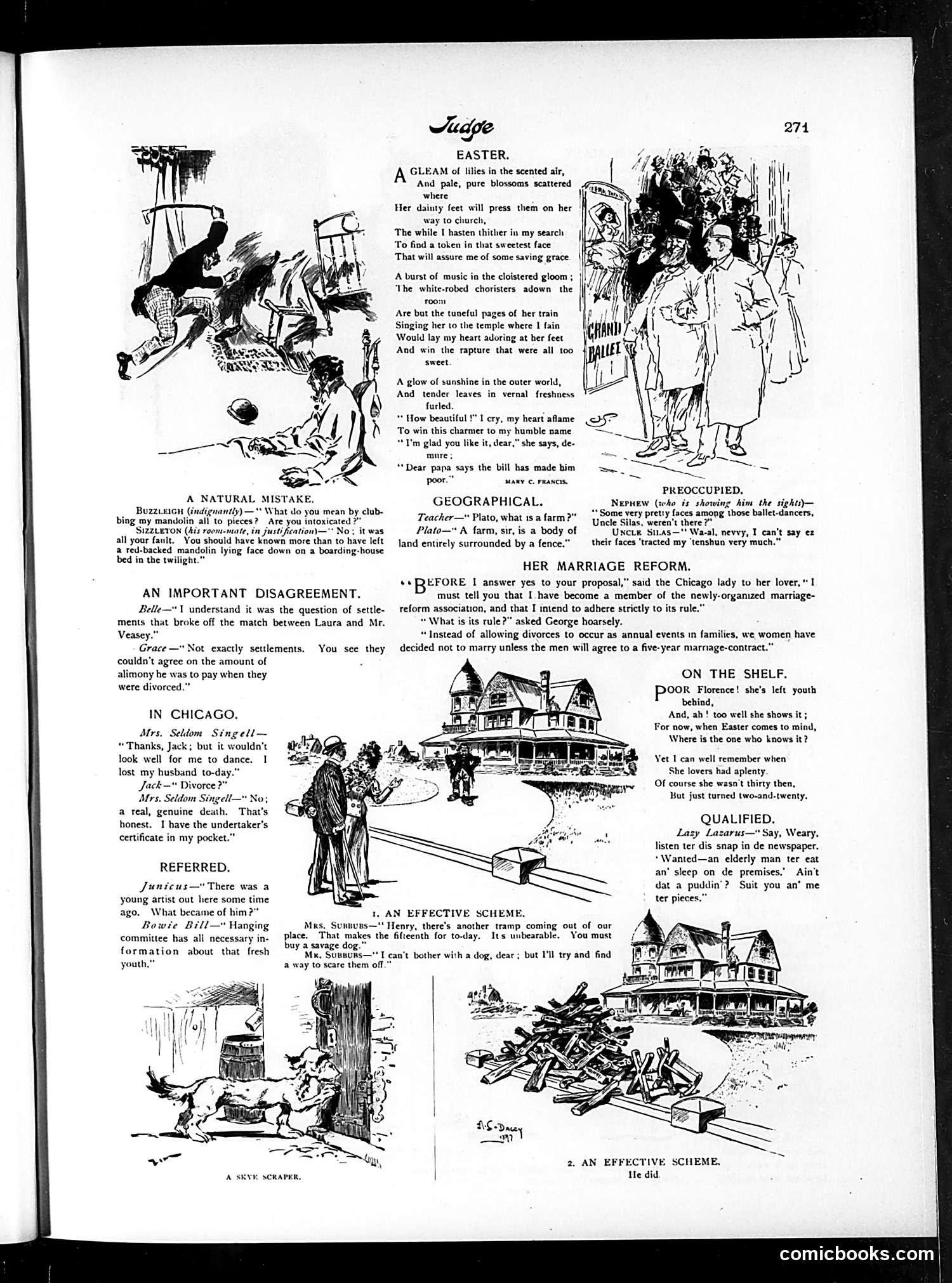
This page from *Judge* magazine contains multiple satirical items mocking early 1900s American social issues: **"Easter"** — A sentimental poem about romantic longing, followed by the punchline that the woman's father is poor, deflating the suitor's romantic idealism with economic reality. **"Her Marriage Reform"** — Satirizes women's marriage-reform activism by depicting a Chicago woman demanding her fiancé sign a five-year marriage contract, mocking both women's rights advocates and the era's high divorce rates as something to be contractually managed rather than prevented through commitment. **"On the Shelf"** — Mocks aging unmarried women, suggesting a woman past her "marriageable" years (mid-twenties) is worthless romantically. **"An Effective Scheme"** — Two panels joke about impoverished tramps seeking handouts; the "scheme" involves scaring them away with a dog, then apparently something worse works instead. The page reflects period attitudes: skepticism toward women's reform movements, anxiety about marriage stability, classist dismissal of poor people, and shallow treatment of female value tied to youth and marriageability.
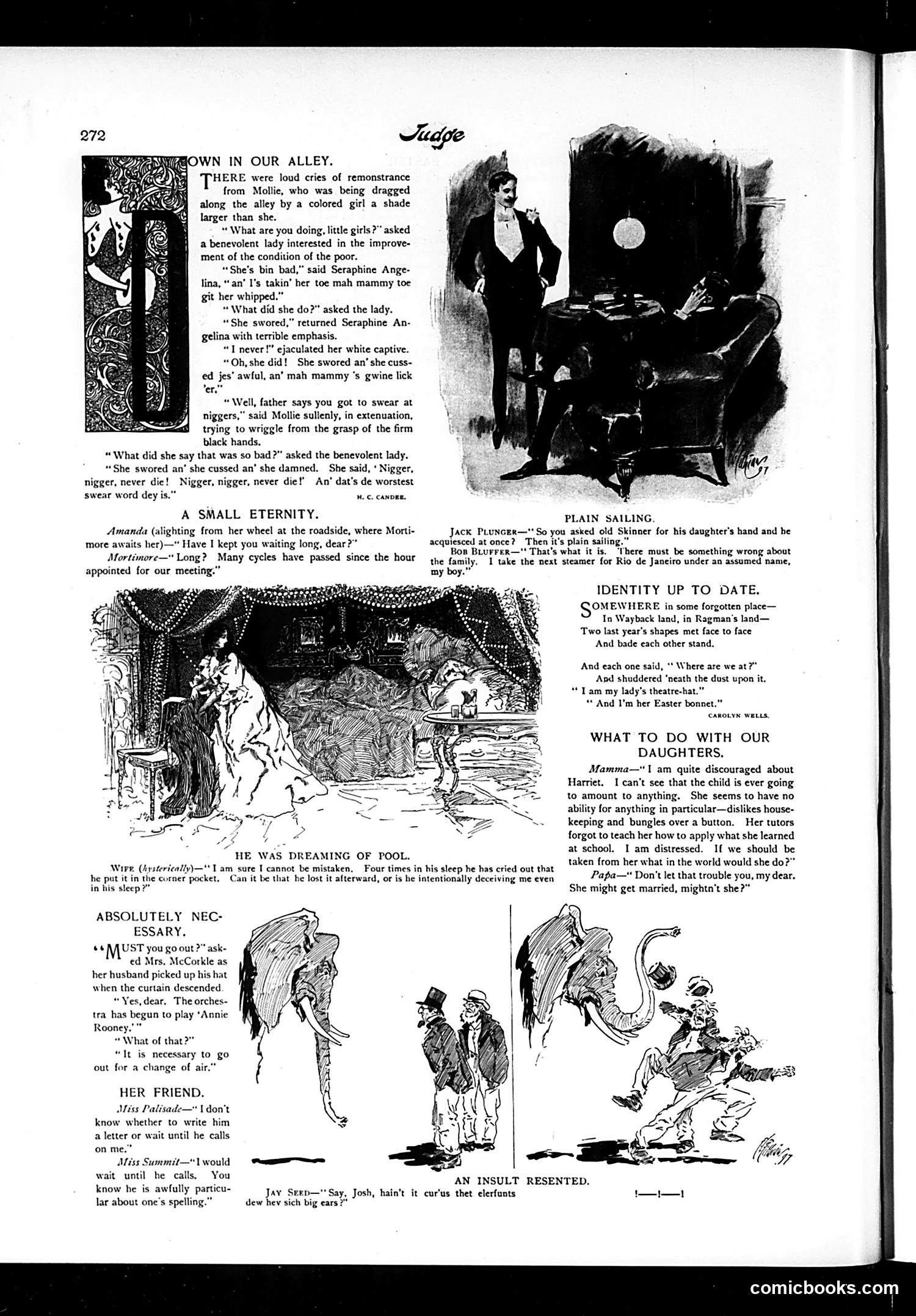
This page contains several satirical sketches typical of early 20th-century American humor, reflecting period attitudes and social dynamics: **"Down in Our Alley"**: A crude racial satire depicting a Black girl dragging a white girl to punishment. The humor relies on racist dialect and stereotypes, with the "joke" turning on the white child's casual use of racial slurs being presented as shocking language worthy of whipping—inverting moral logic for comedic effect. **Other sketches** address domestic and courtship themes: a couple's romantic encounter, a husband escaping home to hear "Annie Rooney" (popular song), and discussions about daughters' prospects (with the punchline that marriage is their only option). **"Identity Up to Date"**: A poem where discarded women's fashion items—a theater hat and Easter bonnet—humorously "recognize" each other as their former identities. The overall tone reflects Judge's satirical approach to social commentary, though the racial content is deeply offensive by modern standards, representing casual prejudice normalized in the era.
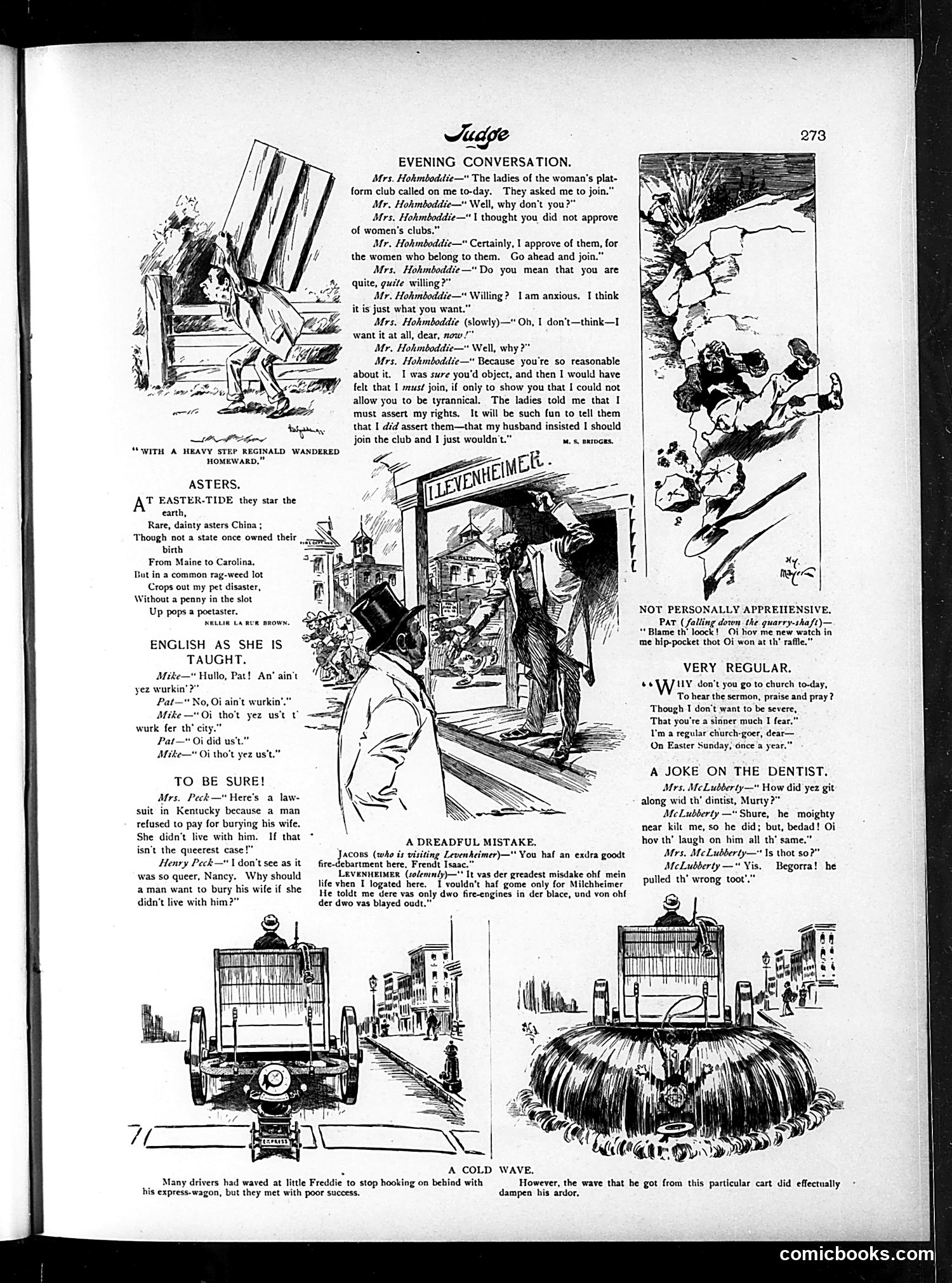
This page contains multiple satirical pieces typical of early 20th-century humor: **"Evening Conversation"**: Satirizes women's clubs and marital dynamics. Mr. Hohmboddie approves of women's clubs (to get his wife out of the house), but Mrs. Hohmboddie loses interest once he agrees—she wanted to join *against* his objections to assert her independence. The joke mocks both nagging wives and the women's club movement itself. **"English As She Is Taught"**: Irish immigrant characters (Mike and Pat) mangle English grammar ("Oi tho't yez us't"), a common stereotype in period humor targeting immigrant populations. **Other pieces**: Include light humor about asters (flowers), church attendance, dentist visits, and a child hanging onto wagons. "A Dreadful Mistake" features German-accented characters discussing fire departments, using ethnic caricature typical of the era. The page reflects early 1900s attitudes toward women's suffrage, immigrants, and working-class life, mixing gentle domestic comedy with period stereotypes.
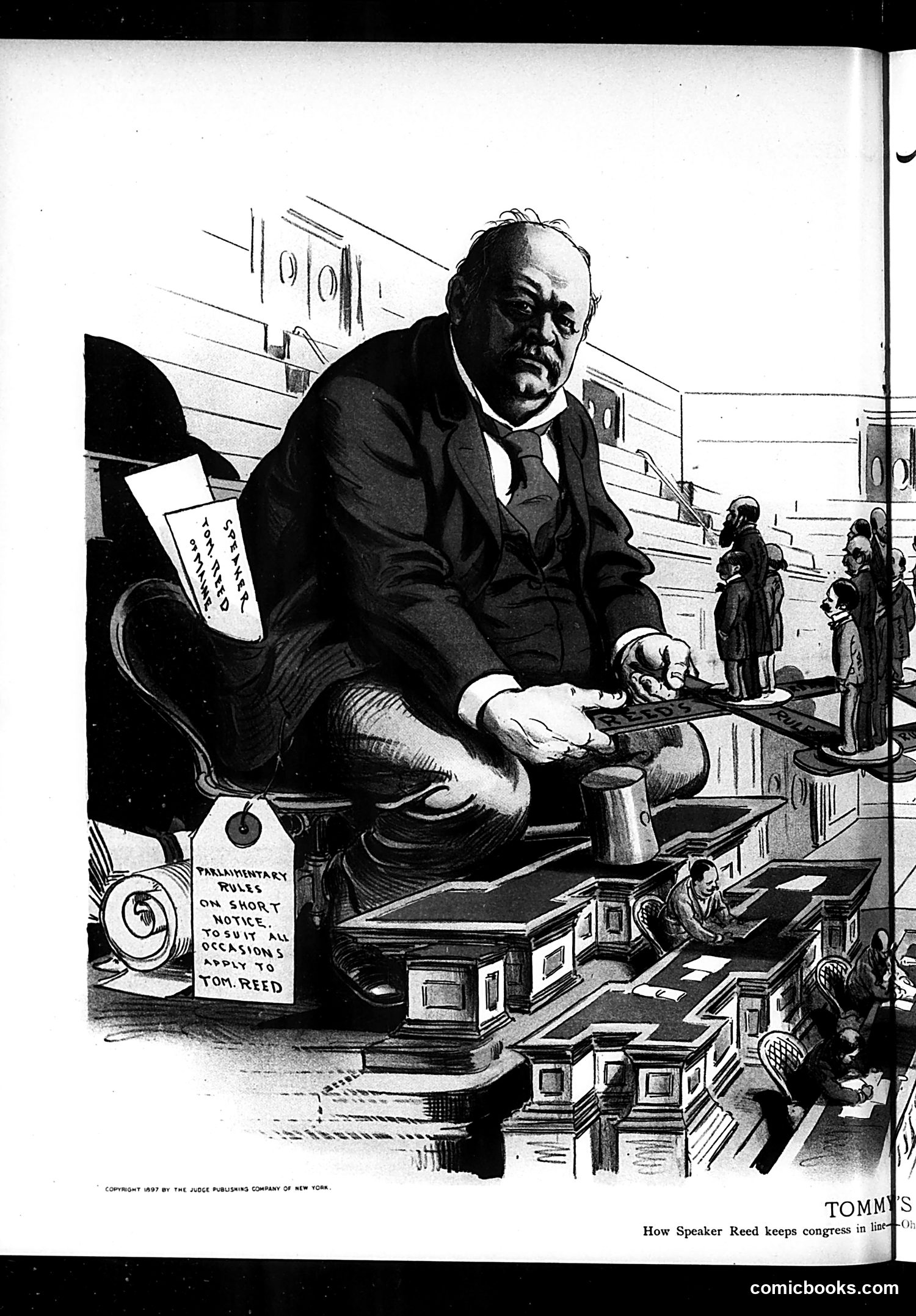
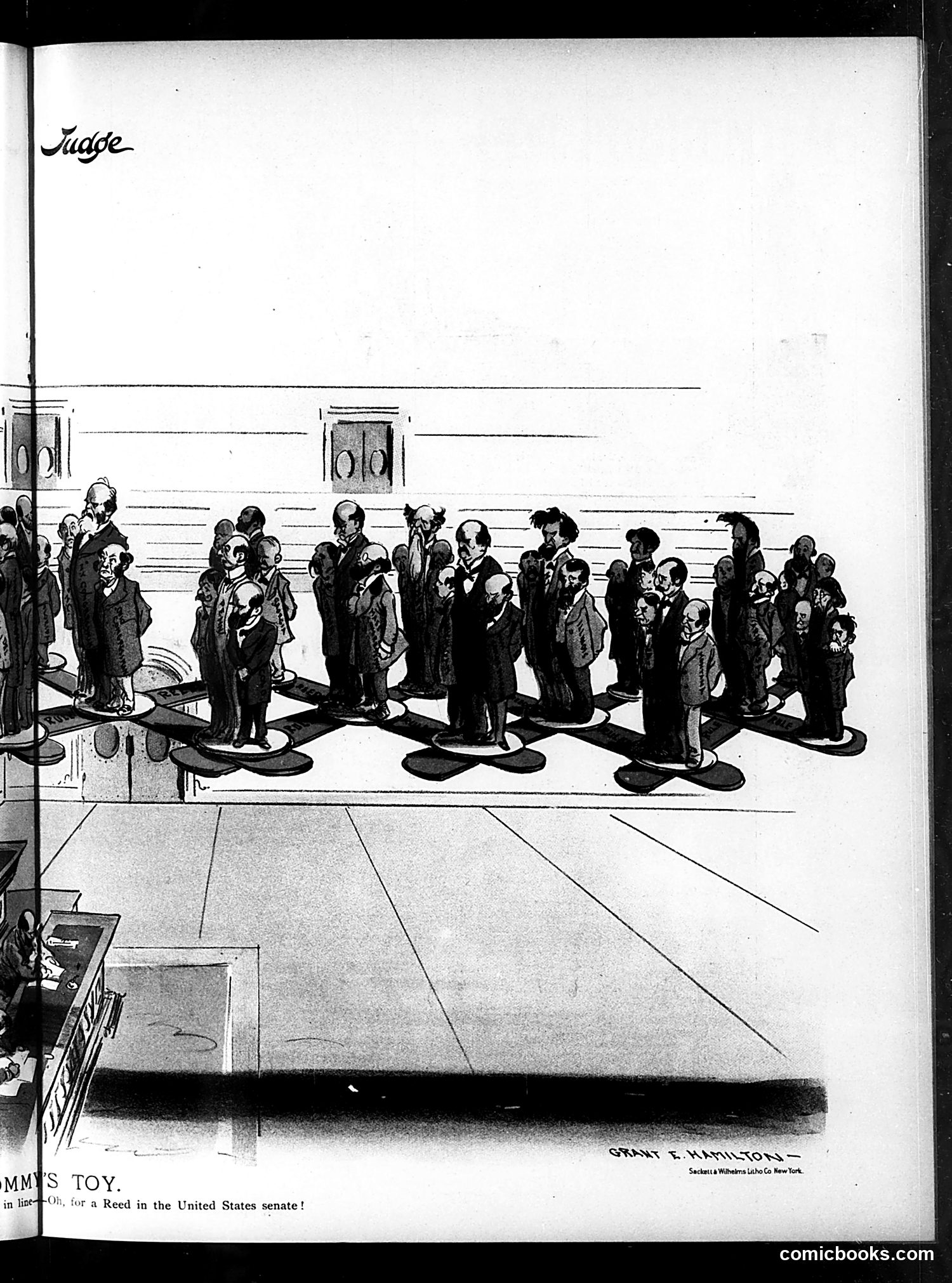
This **Judge** magazine cartoon depicts a courtroom scene where numerous figures stand before a judge's bench. The visible text references "a Reed in the United States senate!" suggesting the cartoon concerns Senator James A. Reed (likely from Missouri, a prominent early 20th-century senator). The artistic style and composition suggest this satirizes political corruption or judicial proceedings involving Reed. The crowded arrangement of formally-dressed figures implies multiple parties or interests involved in whatever scandal or controversy the cartoon addresses. However, without clearer identifying labels on individual figures or the cartoon's date, the specific political context remains unclear. The satirical point likely concerns Reed's Senate activities or judicial accountability, but precise details about the referenced events cannot be determined from the visible elements alone.
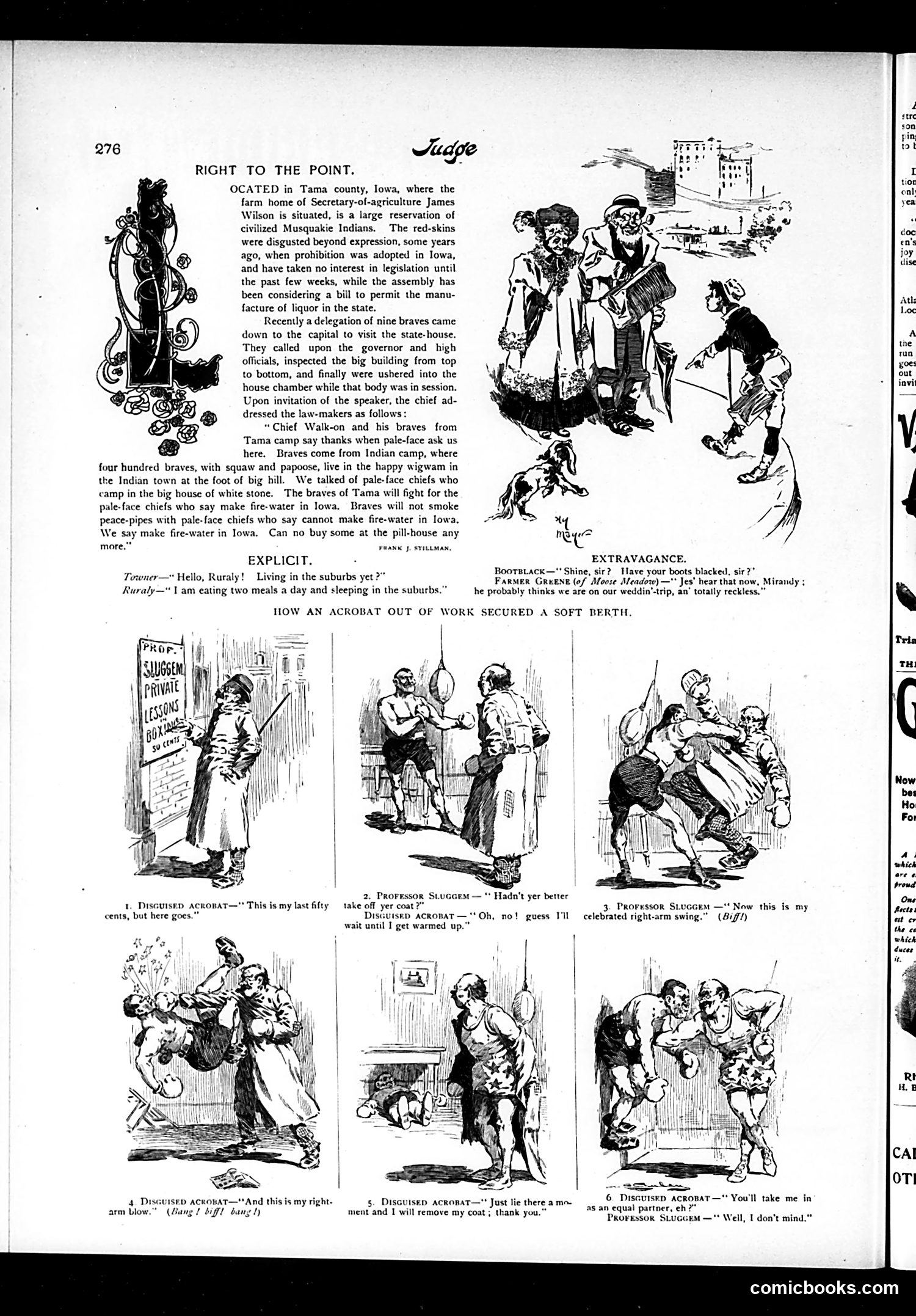
This page contains two separate satirical pieces: **"Right to the Point"** (top): A story-cartoon about Native Americans from Iowa's Tama County. Secretary of Agriculture James Wilson's farm sits near a Musquakie reservation. When Iowa adopted prohibition, the tribe lost interest in state affairs—until a liquor-manufacturing bill emerged. A delegation of nine braves visits the state capitol to testify before legislators, essentially threatening to withhold political support unless alcohol production is legalized in Iowa. The satire mocks both the Native Americans (stereotyped speech) and Iowa politicians (willing to reverse prohibition for tribal votes). **"How an Acrobat Out of Work Secured a Soft Berth"** (bottom): A six-panel comic sequence showing a desperate acrobat convincing a "Professor Sluggem" to hire him. The acrobat demonstrates increasingly violent "tricks" (punching, swinging) on the professor, who eventually agrees to employ him as an equal partner—essentially getting paid to be beaten up. Both pieces use physical comedy and social commentary typical of Judge's satirical approach.
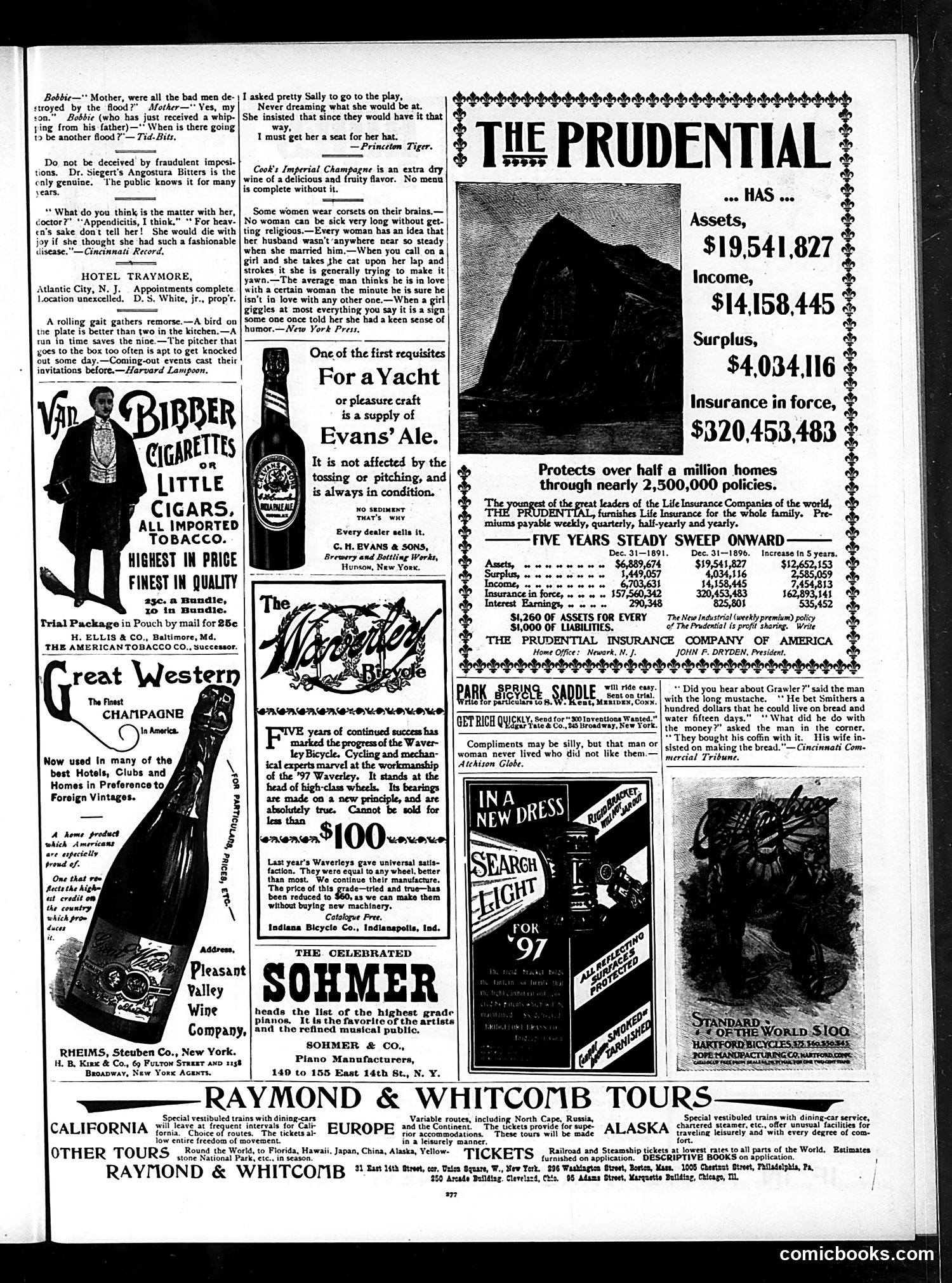
This page is primarily **advertising and filler content**, typical of Judge magazine's revenue model. The notable satirical content includes: **The Opening Cartoon**: A child asks his mother when "another flood" will come—a dark joke referencing the Biblical flood that destroyed "bad men." The child has just been whipped by his father, implying he considers his parent "bad" and wants divine punishment to remove him. This is cynical humor about parental discipline and childhood resentment. **Scattered Witticisms**: Brief one-liners mock women's fashion obsessions (corsets on brains), religious hypocrisy, and courtship rituals—typical early 1890s social satire targeting gender roles and romantic conventions. **The Princeton Tiger Joke**: Mocks a woman's vanity—she demands a theater seat for her hat, not herself. The remainder is **paid advertising** for cigarettes, champagne, bicycles, pianos, life insurance, and travel tours—reflecting the magazine's commercial interests rather than editorial satire.
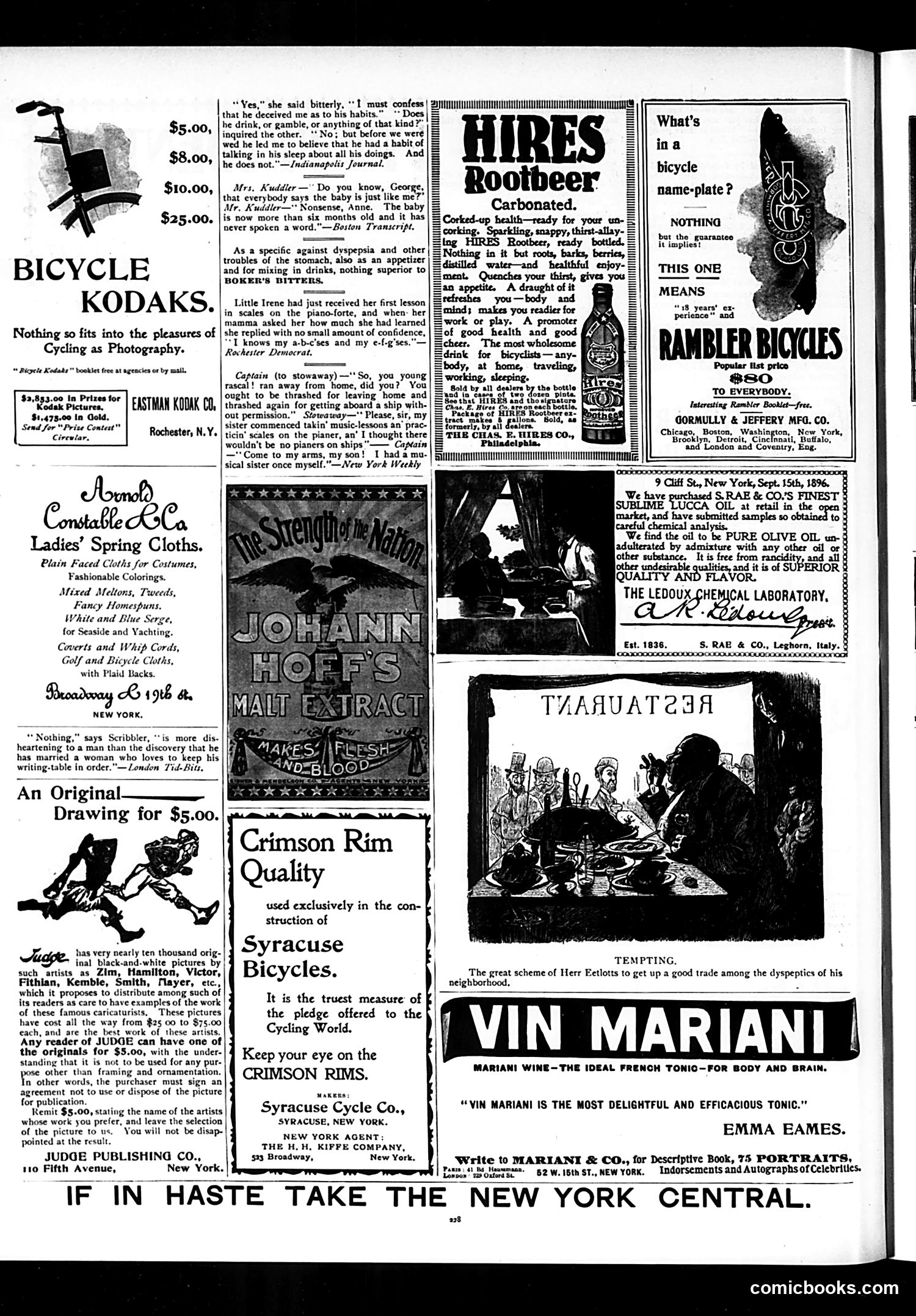
This page is primarily **advertisements and short humor pieces** typical of Judge magazine's format. The main cartoon appears to be **"Tempting"**—a silhouette scene showing a man at a dining table with bottles, captioned: "The great scheme of Herr Eetlotts to get up a good trade among the dyspeptics of his neighborhood." This satirizes a merchant cynically profiting from customers' digestive problems by selling them rich food or drink they can't properly digest—a dark joke about exploiting the ill. The page otherwise features period product ads (bicycles, Kodaks, Hires Rootbeer, Vin Mariani tonic wine) and multiple brief comic anecdotes about marriage, children learning piano, stowaways, and a woman who organizes her husband's desk—all genteel Victorian humor reflecting contemporary domestic life. The "Crimson Rim Quality" bicycle and "Judge Publishing" drawing contest ads occupy significant space, indicating these were revenue-generating content merged with entertainment.
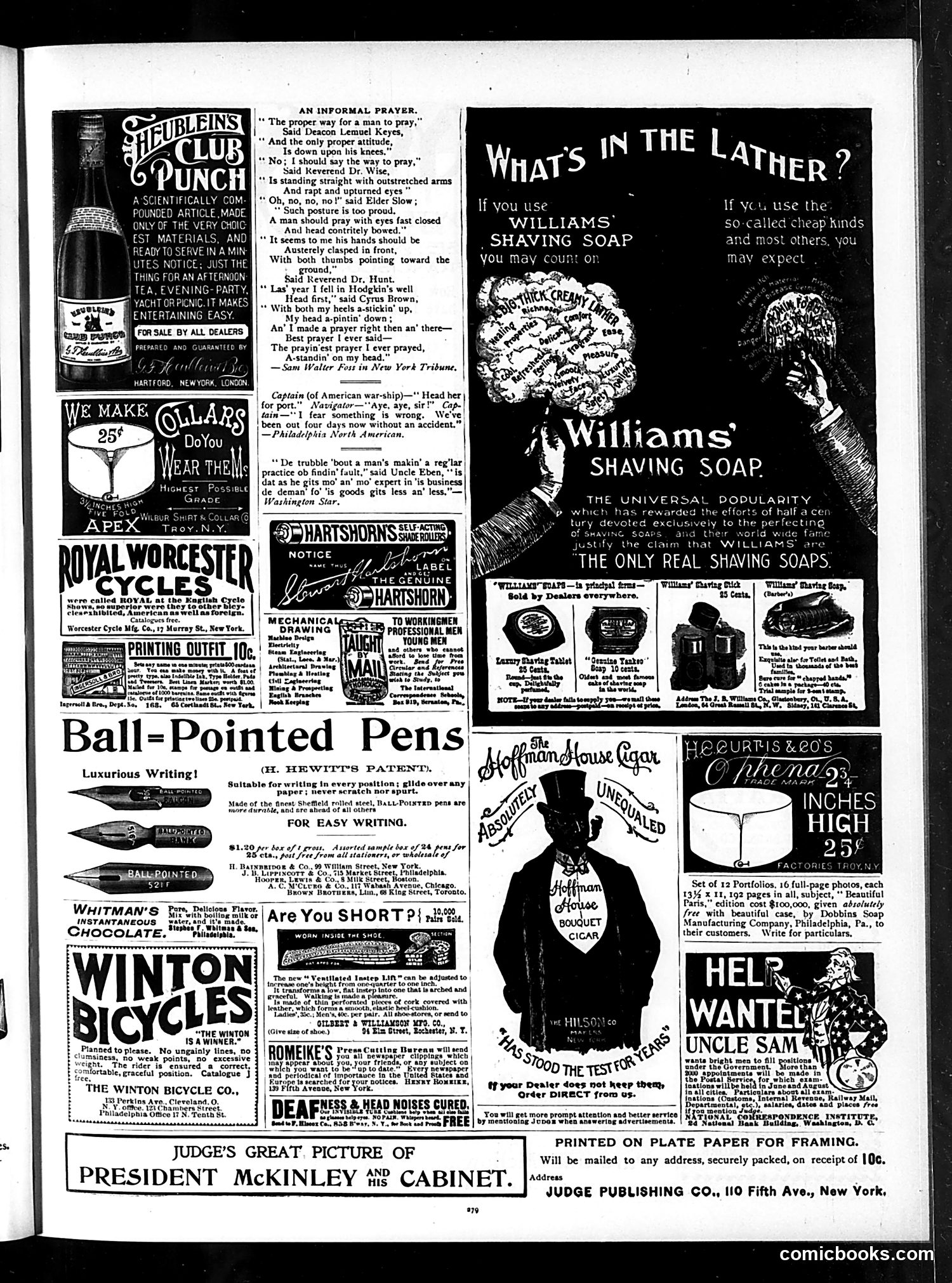
This page is primarily **advertising**, typical of late 19th/early 20th-century American magazines. The substantive content includes: **"An Informal Prayer"** — A humorous poem by Sam Walter Foss depicting rural characters (Deacon Keyes, Elder Slow, Reverend Dr. Hunt, Cyrus Brown) debating the "proper" prayer posture. The joke builds to Brown's punchline: he prayed most earnestly while stuck head-first in a well—suggesting genuine crisis produces sincere prayer, not ceremonial posturing. This satirizes religious hypocrisy and excessive concern with proper form over genuine faith. **Remaining content** consists of period advertisements for Williams' Shaving Soap, ball-pointed pens, Winton bicycles, and various other products, plus brief humorous one-liners mocking naval incompetence and African American dialect stereotypes (common in the era, reflecting the magazine's casual racism). The page demonstrates Judge's mix of social satire with commercial advertising that subsidized publication.
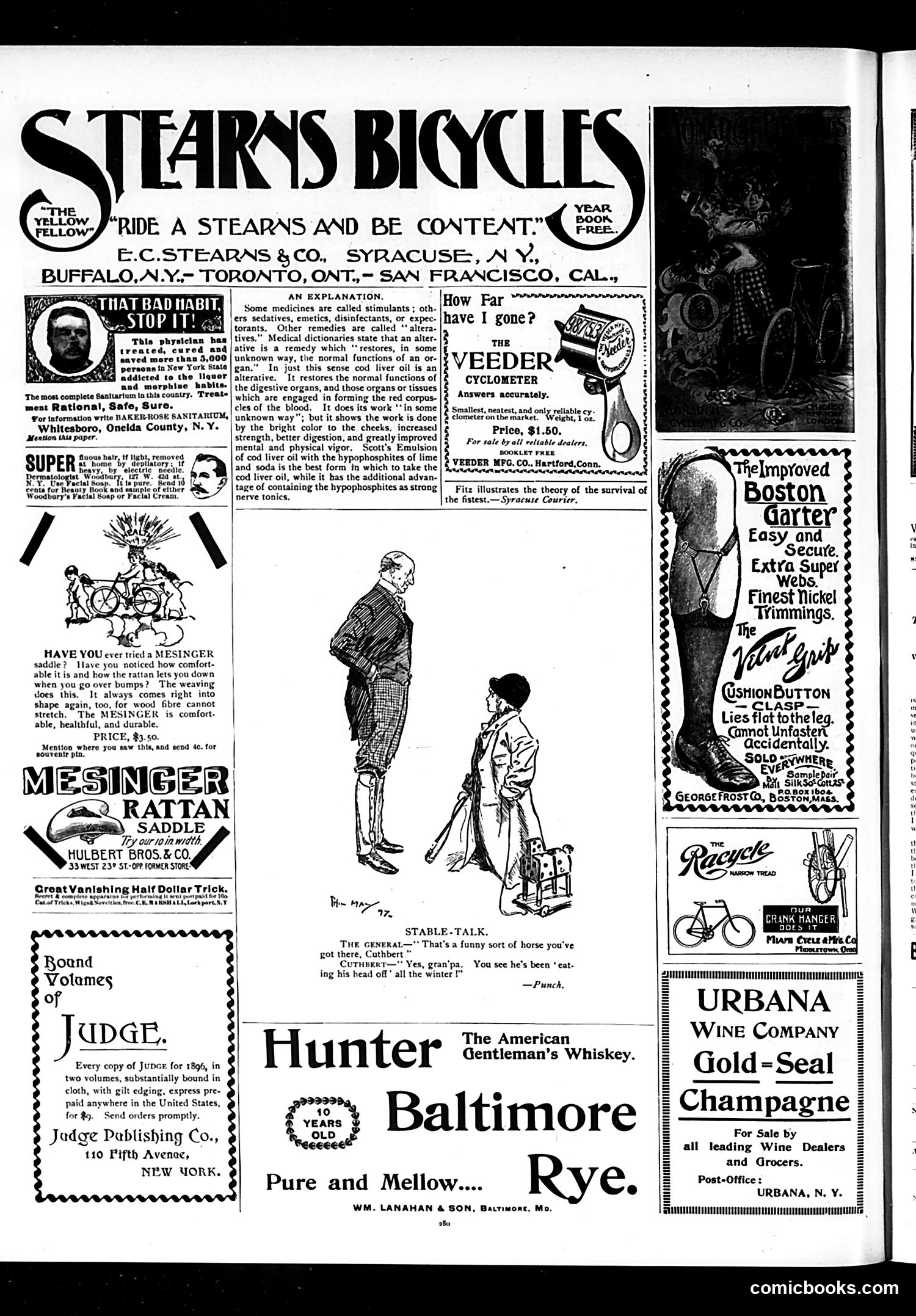
This is primarily an **advertising page** from Judge magazine (circa 1896, based on the "Year Book Free" notation and publication references). The page contains minimal editorial content. The one notable cartoon is titled **"Stable-Talk,"** a brief joke illustrated by Fitz. It depicts a general and a young boy discussing a horse. The general remarks the horse is "a funny sort of horse you've got there," and the boy explains it's been "eating his head off all the winter"—a visual pun showing the horse has literally consumed its own head. The humor relies on misunderstanding figurative language as literal fact, a common joke format of the era. The remainder consists of **advertisements for bicycles** (Stearns, Veeder cyclometer, Boston Garter), **patent medicines** (Scott's Emulsion cod liver oil, sanitarium services), **saddles**, **whiskey**, and **champagne**—reflecting late-19th-century consumer goods and the advertising that sustained humor magazines.
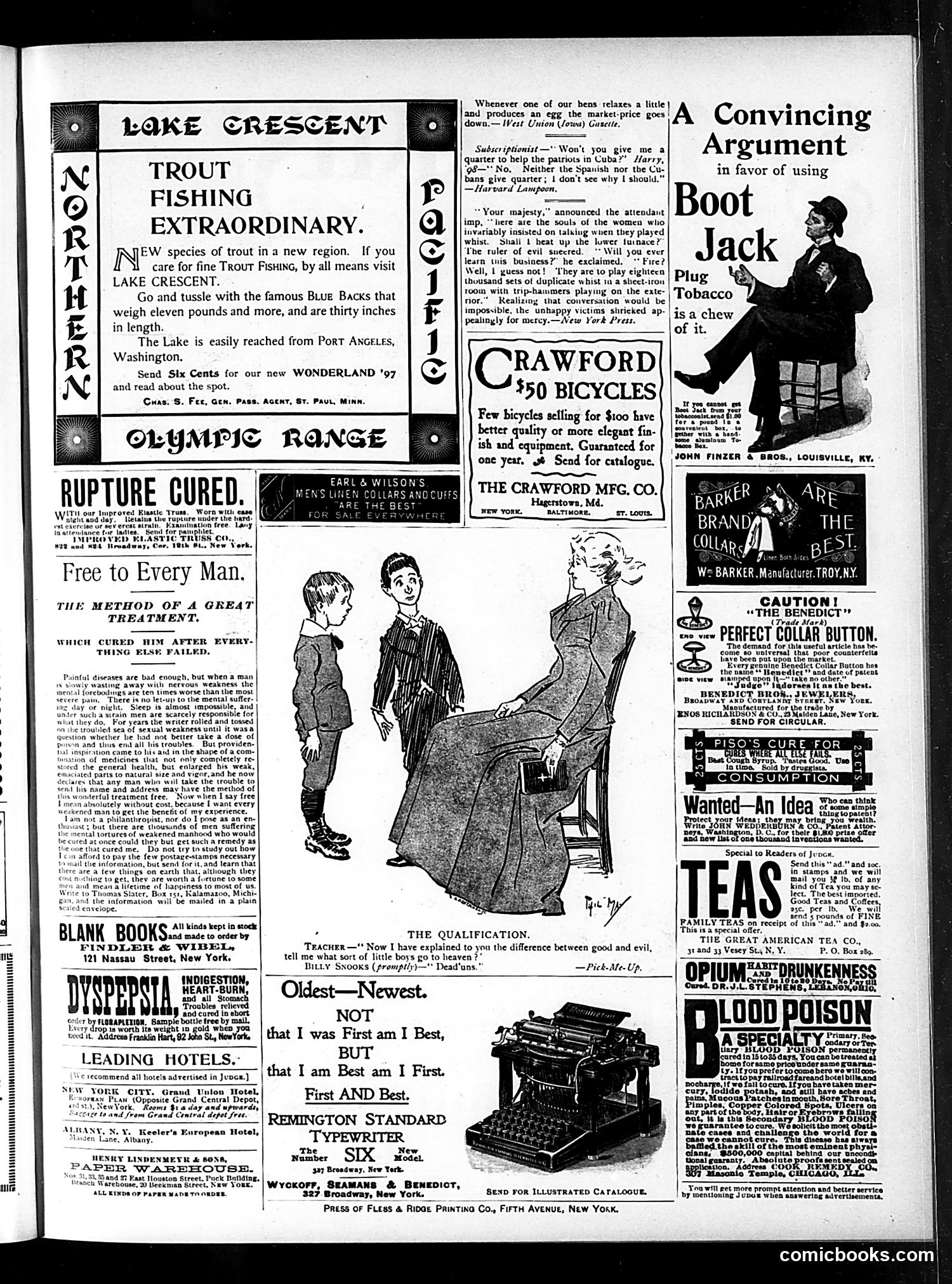
This cartoon depicts a classroom scene where a teacher questions a young student about the difference between good and evil, asking what kind of souls go to heaven. The student's answer—shown in the caption—is cynical and dark: he claims the souls of women who "invariably insisted on talking when they played whist" (a card game) are sent to hell, where they'll be tortured by having to play eighteen thousand games of duplicate whist while trip-hammers pound outside, making conversation impossible. The satire mocks both the student's irreverent attitude toward religious instruction and, more pointedly, the contemporary frustration with talkative women, particularly during card games—a common social complaint of the era. The "joke" relies on 1890s gender stereotypes about women's chattiness being so unbearable it constitutes a form of torture.
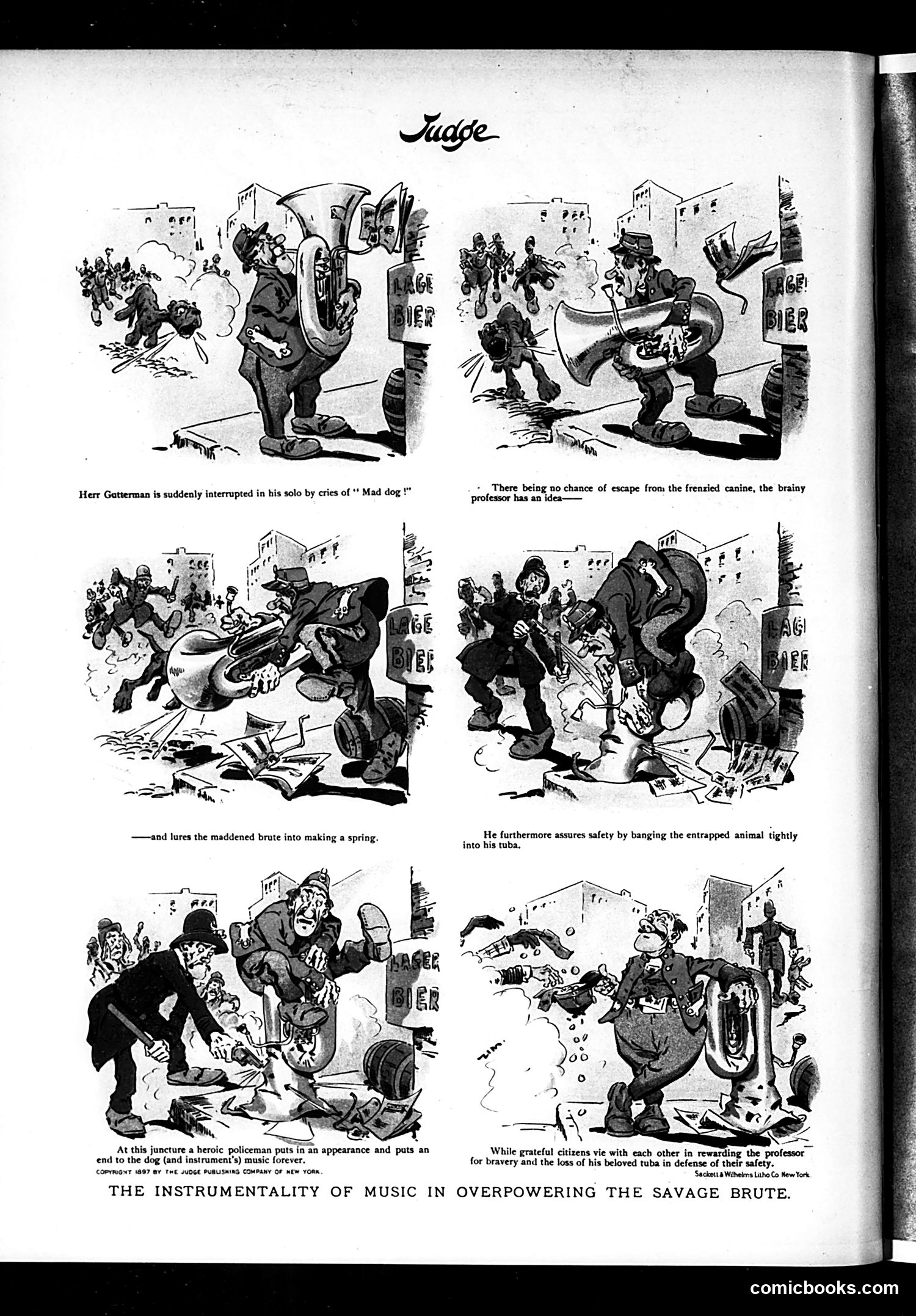
This 1897 *Judge* satirical comic strip depicts "Herr Gatterman," a German musician performing a solo with a tuba. A mad dog interrupts him, but rather than flee, the professor cleverly uses his instrument as a weapon—luring the dog into attacking, then trapping and silencing it by forcing the animal into his tuba. The satire appears to mock German culture and musical pretension through exaggerated characterization (the "Herr" title, the improbable scenario). The pun in the title plays on "music" as a tool to overcome danger, though the actual "solution" is absurdly violent and destructive (the tuba is destroyed). The final panel shows citizens rewarding the professor despite his instrument's loss, perhaps mocking both German pomposity and public gullibility. The humor relies on period stereotypes about Germans and the incongruity of using a musical instrument as a practical weapon.
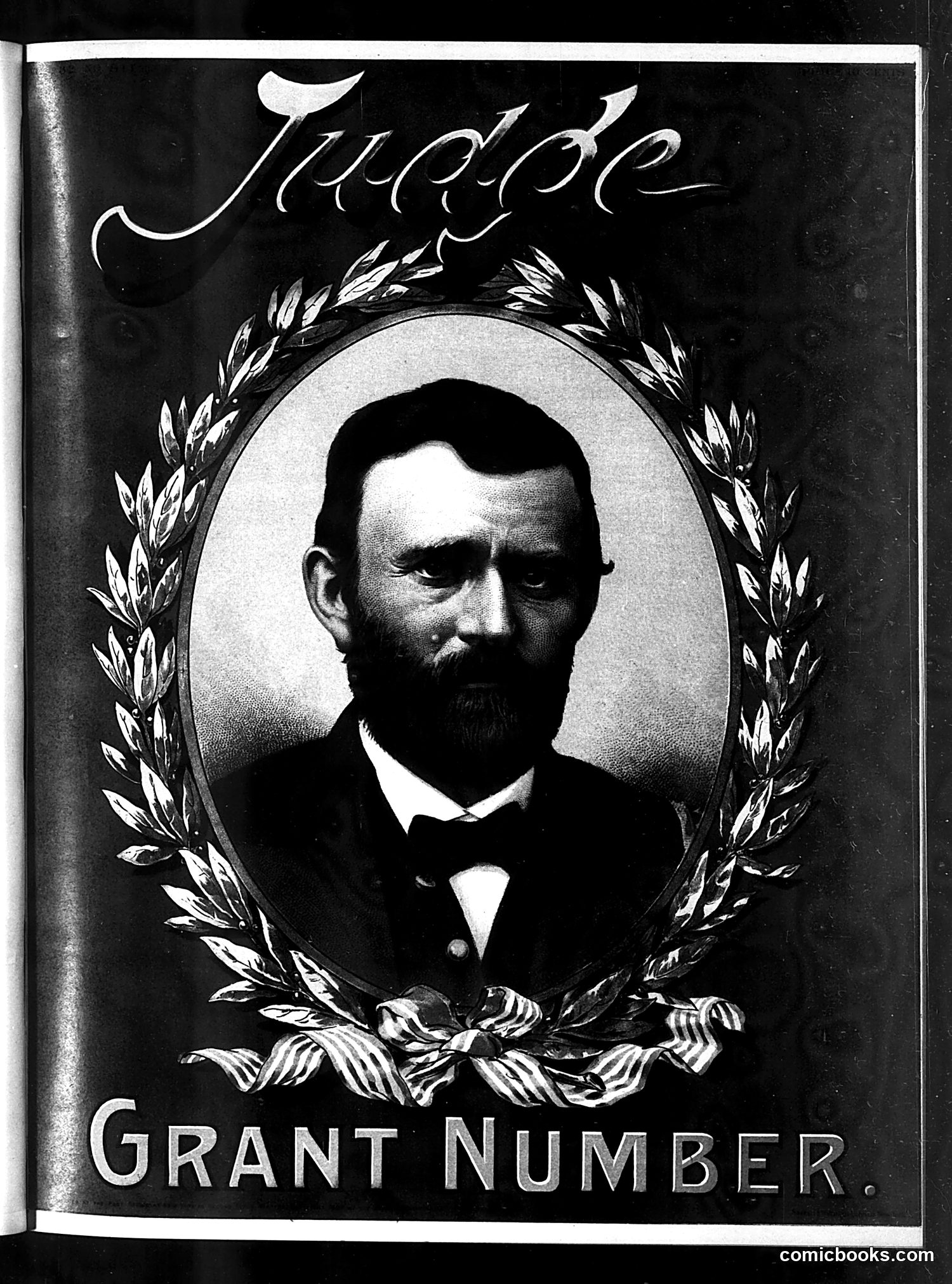
This appears to be a commemorative title page from Judge magazine featuring a formal portrait of a bearded man in late 19th-century dress, framed by laurel wreaths and a decorative ribbon bow. The text identifies him as "Grant Number." Given the styling and historical context of Judge (a major American satirical publication), this likely references **Ulysses S. Grant**, the Civil War general and former U.S. President. The "number" designation and formal treatment suggest this was a special commemorative or anniversary issue—possibly marking Grant's death (1885) or a significant political event during his presidency or later life. The ornate framing treatment—with laurels traditionally symbolizing honor and achievement—presents an ostensibly respectful portrait, though Judge's satirical nature means the homage may be ironic or backhanded depending on the surrounding content we cannot see.
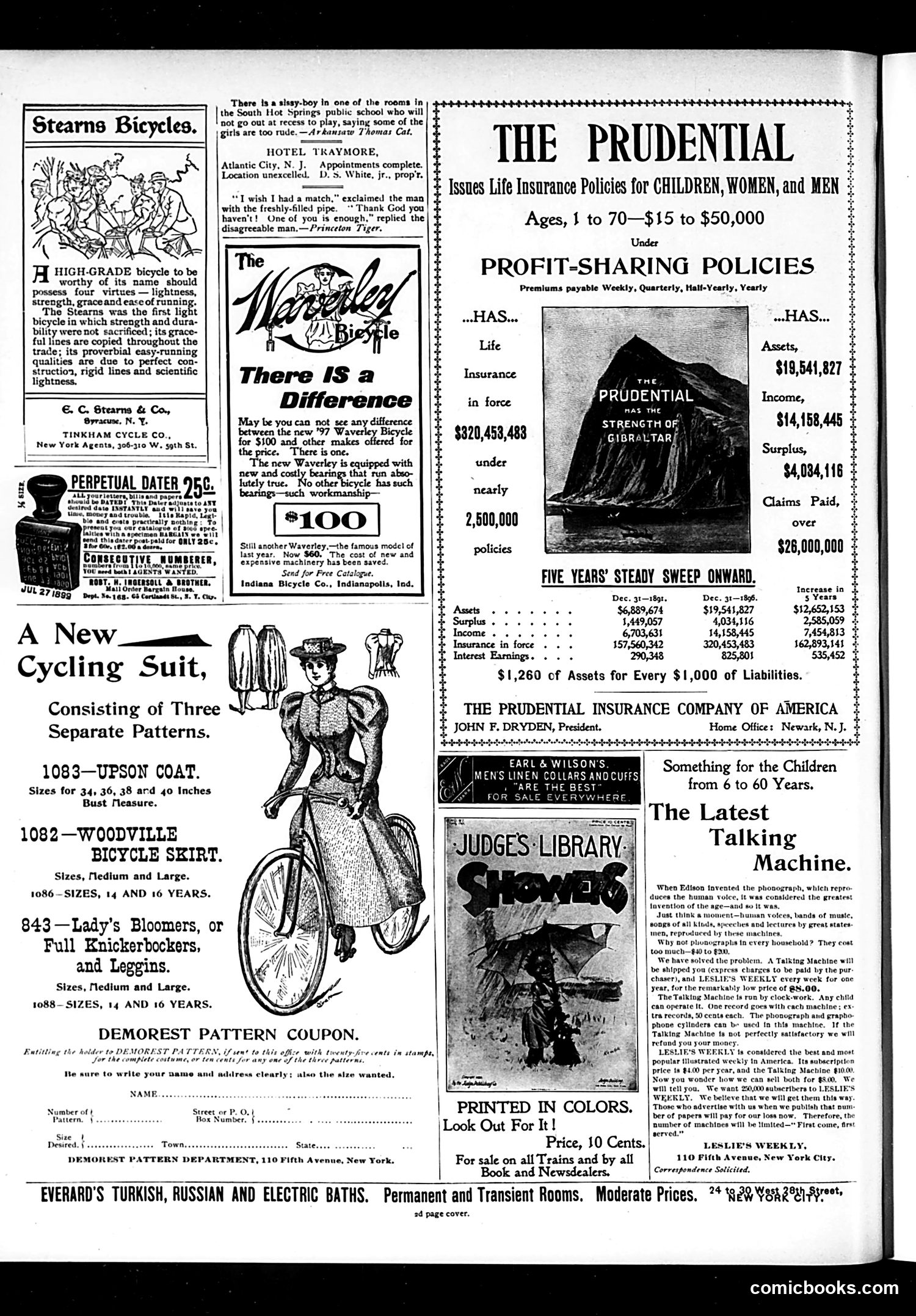
This page is primarily **advertising and fashion content** from Judge magazine, circa 1890s. The small satirical item at top—about a "sissy-boy" at school avoiding girls at recess—reflects period attitudes mocking perceived masculinity failures. The joke assumes readers will find it amusing that a boy fears "rude" girls. The second joke (pipe-smoking) is mild wordplay with no political content. The **bulk of the page** comprises advertisements: Stearns Bicycles (emphasizing engineering superiority), Prudential Insurance (showcasing assets and growth statistics), cycling clothing patterns (notably including "bloomers" for women—then-controversial reform wear), and Edison's phonograph marketed as affordable installment purchase ($8/week). The "New Cycling Suit" advertisement is historically significant—women's cycling clothing was genuinely controversial in the 1890s, with bloomers representing radical dress reform that challenged Victorian propriety. Overall, this is a **commercial page** reflecting consumer culture and attitudes of the Gilded Age, with minimal actual satire.
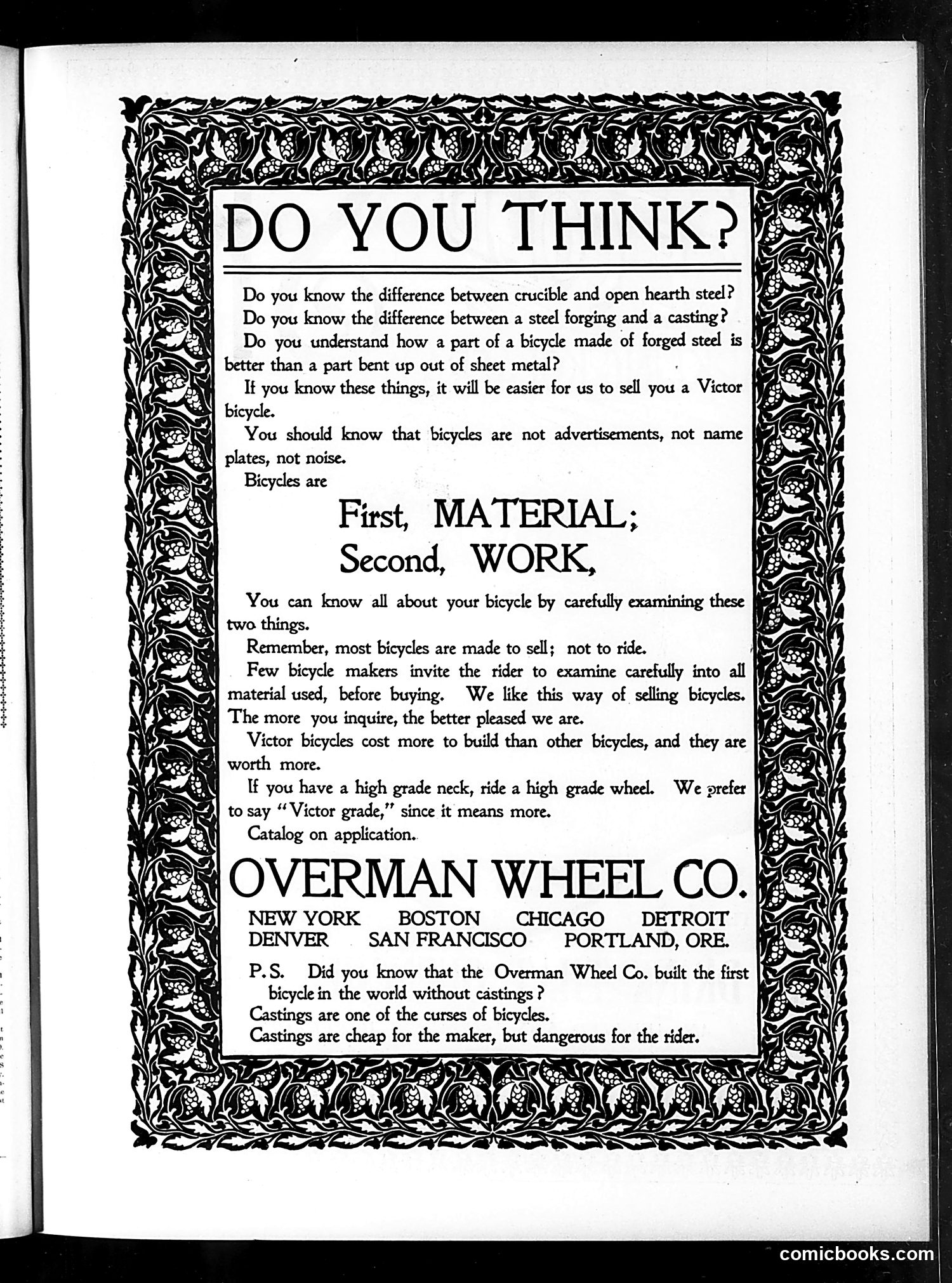
This is primarily a **product advertisement** rather than a satirical cartoon. The Overman Wheel Company uses rhetorical questioning to appeal to educated, discerning consumers of the bicycle era (likely 1890s-early 1900s). The ad's satire is **indirect and self-aware**: it mocks typical bicycle marketing by claiming Victor bicycles reject flashy advertising ("not advertisements, not name plates, not noise"). Instead, it emphasizes material quality and craftsmanship—specifically forged steel over cheaper casting methods. The pitch is **class-conscious and somewhat condescending**: "If you have a high grade neck, ride a high grade wheel" suggests that owning a Victor bicycle signals refined taste and social standing. The phrase "Victor grade" becomes synonymous with superiority. The postscript criticizing "castings" as "cheap for the maker, but dangerous for the rider" positions Victor as the ethical choice, implying competitors prioritize profit over safety—a common early-20th-century manufacturing criticism.
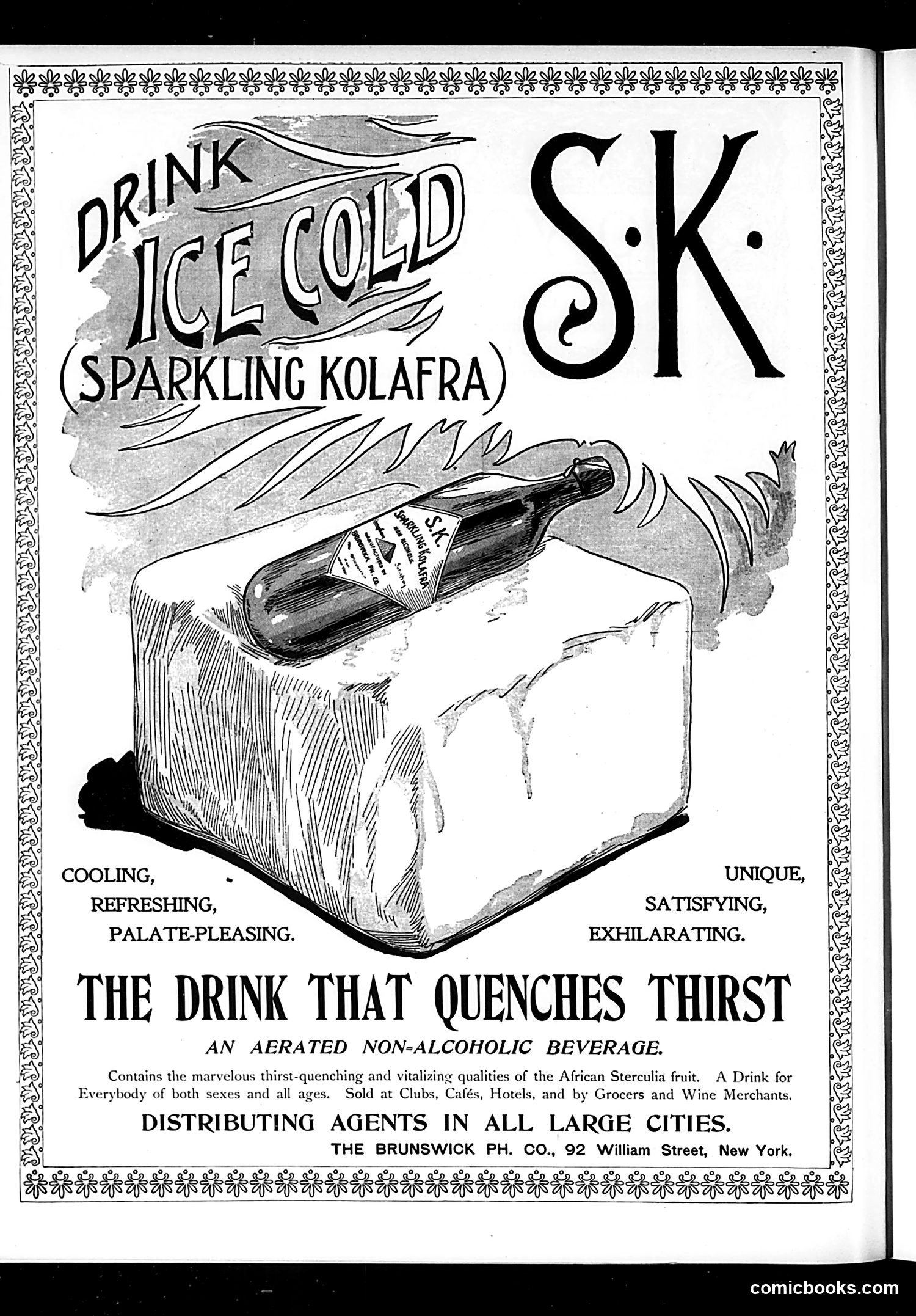
This page is a **product advertisement**, not political satire. It promotes "S.K." (Sparkling Kolafra), a non-alcoholic sparkling beverage made from African Sterculia fruit. The ad emphasizes it as a thirst-quenching drink for "everybody of both sexes and all ages," sold through clubs, cafés, hotels, and grocers. The illustration shows a bottle chilling in ice. The descriptive language—"cooling, refreshing, palate-pleasing" and "unique, satisfying, exhilarating"—typifies early 20th-century advertising hyperbole. The distributor was The Brunswick Ph. Co. in New York. This reflects the era's marketing of exotic fruit-based beverages as fashionable modern refreshments.