
A complete issue · 16 pages · 1897
Judge — February 27, 1897
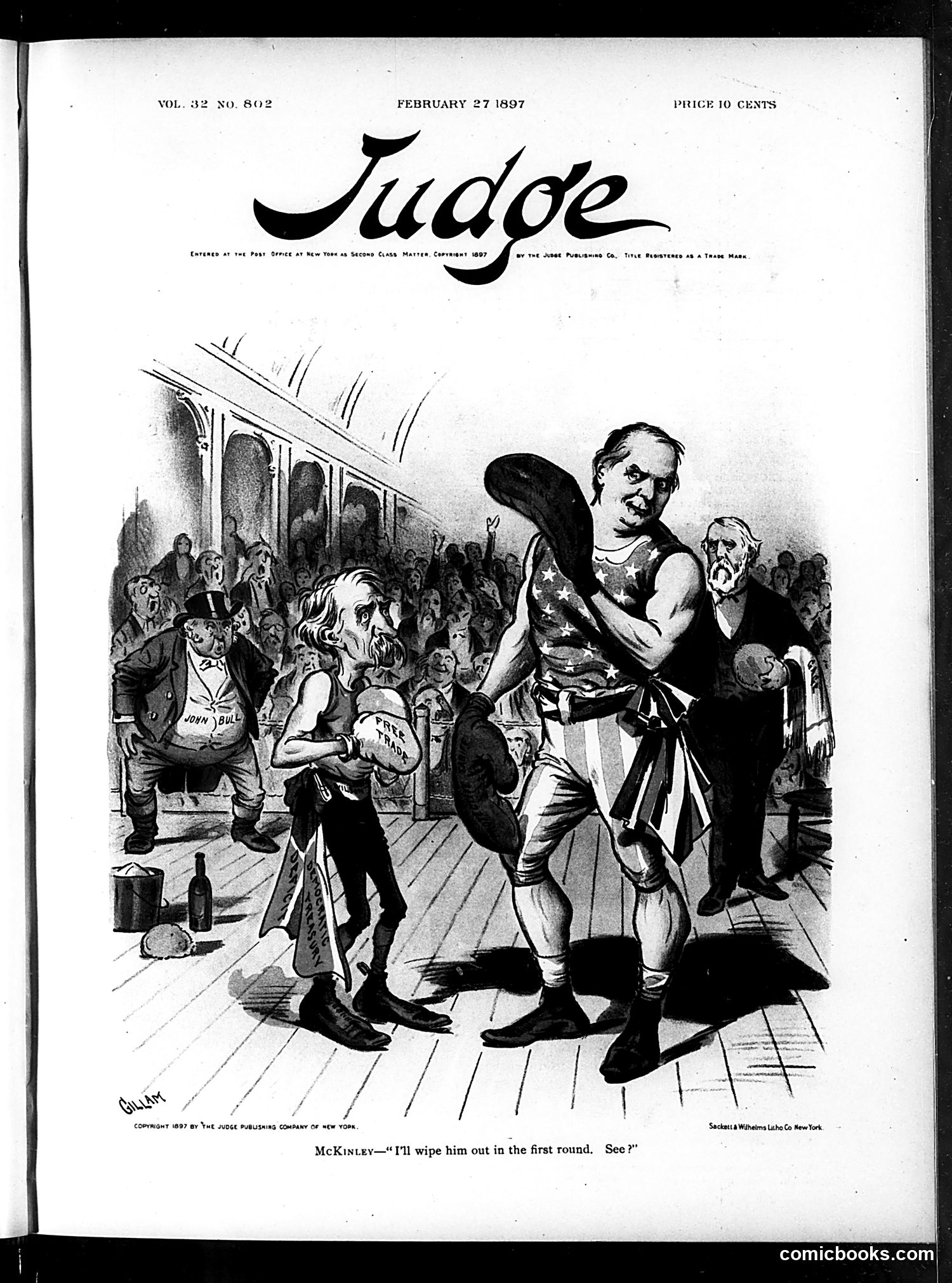
This cartoon depicts **William McKinley** (identified in the caption) as a boxer in a ring, declaring he'll "wipe him out in the first round." The caricatured figure represents McKinley's aggressive political stance, likely referencing international conflict or domestic policy confrontation circa 1897—possibly relating to the Spanish-American War tensions that erupted that year or labor disputes. The crowd's reaction suggests public opinion is divided or skeptical about McKinley's confidence. The satirical point appears to be mocking McKinley's boastful rhetoric versus his actual ability to deliver on such bold claims. The theatrical boxing setting emphasizes the performative nature of political posturing.
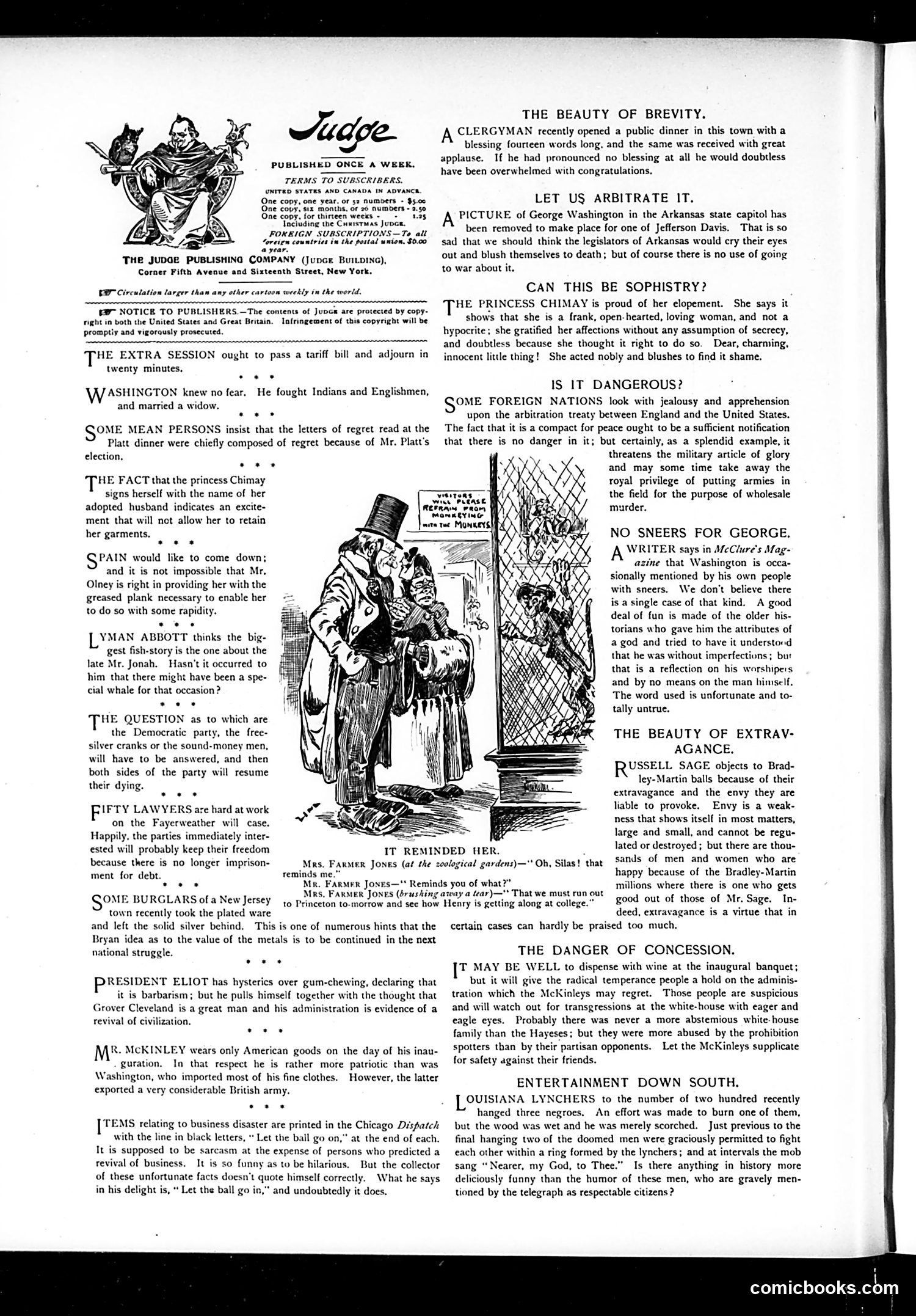
This page contains political commentary and satirical articles rather than a single cartoon. Key topics include: **Princess Chimay**: An article mocks a woman's claim that eloping shows she's "frank, open-hearted, loving" rather than hypocritical. The satire questions her moral judgment. **Washington arbitration**: Commentary on removing George Washington's picture from Arkansas's capitol to make room for Jefferson Davis, with editors arguing this is pointless controversy. **Foreign arbitration**: An article warns that arbitration treaties between nations could dangerously limit military power, potentially enabling "wholesale murder." **Southern lynching**: A dark final item sarcastically praises Louisiana lynchers, noting the "wet wood" prevented efficient execution—crude commentary on a genuine atrocity. The page reflects late-19th-century Judge's mix of society gossip, political debate, and deeply troubling racial attitudes.
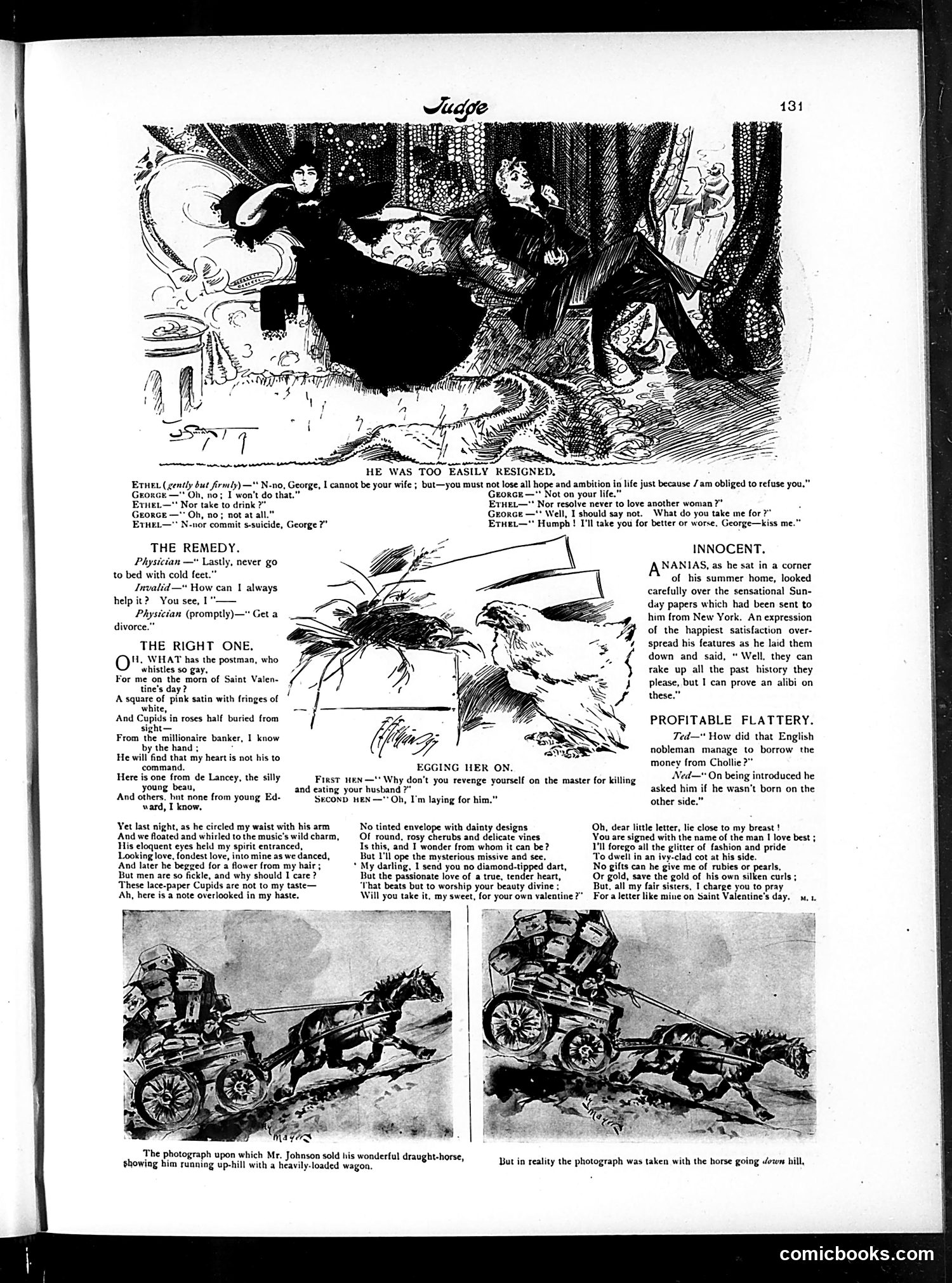
This page contains several satirical short pieces and illustrations typical of Judge magazine's humor. **Top cartoon "He Was Too Easily Resigned"** depicts a domestic dispute where George threatens to leave his wife Ethel. The satire mocks a husband's weak resolve—he claims he won't lose "hope and ambition in life" by staying married, yet immediately capitulates when Ethel manipulates him emotionally. This reflects late 19th/early 20th century gender dynamics, satirizing both male bravado and female domestic power. The remaining sections—"The Remedy," "The Right One," "Egging Her On," "Innocent," and "Profitable Flattery"—are brief comedic sketches about courtship, marriage, and romantic deception, typical of Judge's focus on middle-class social interactions and romantic follies. The photographs below show a horse-drawn wagon—likely part of an advertisement or separate story.
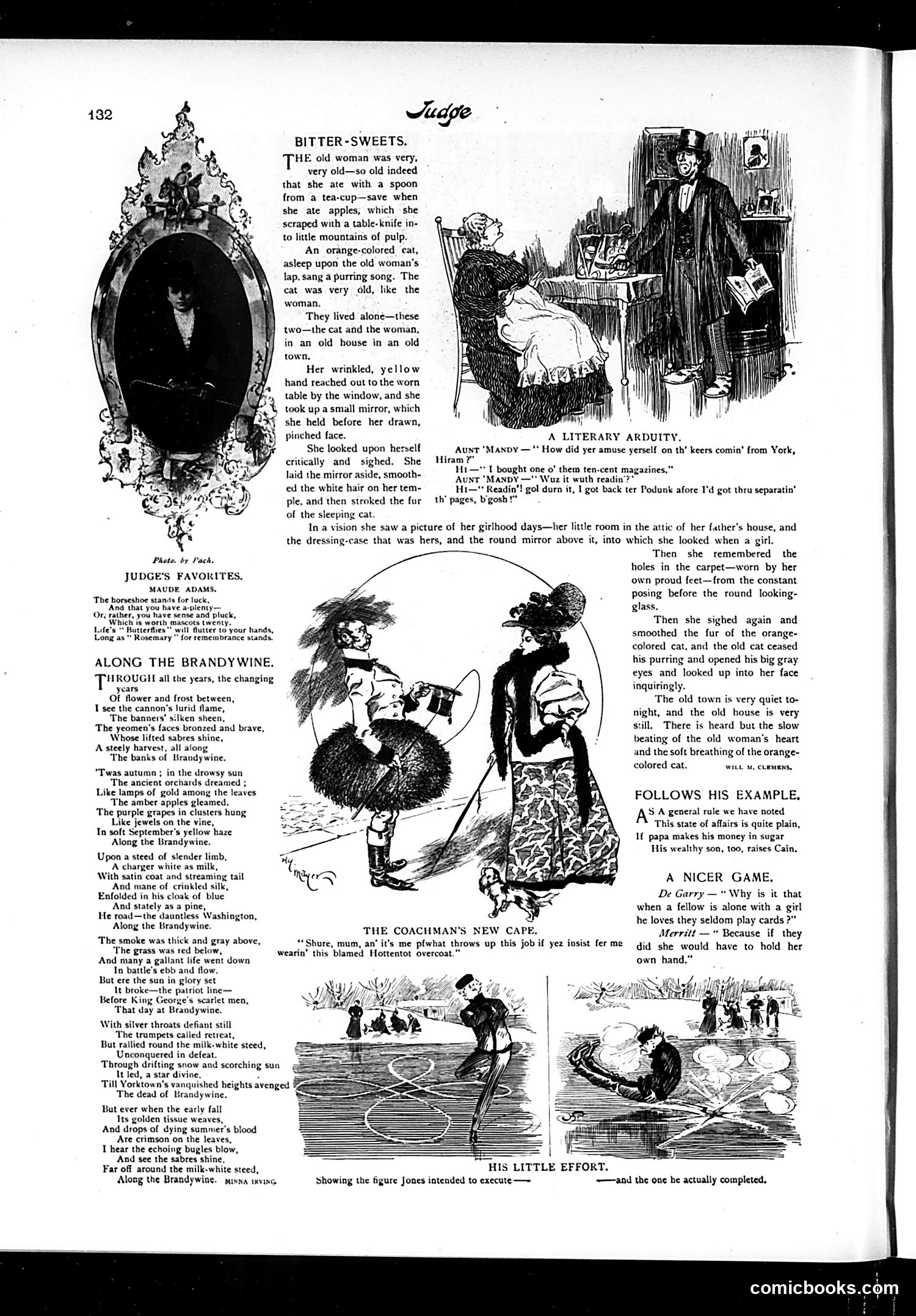
This page contains several distinct pieces of satirical content: **"Bitter-Sweets"** presents a sentimental sketch of an elderly woman living alone with her cat, reflecting on her youth. It's domestic pathos rather than sharp satire. **"Along the Brandywine"** is a patriotic poem celebrating Washington and the Revolutionary War Battle of Brandywine—nostalgic Americana, not satire. **"A Literary Ardulty"** satirizes cheap mass-market magazines. The joke: "Aunt Mandy" bought a ten-cent magazine while traveling, but couldn't even finish separating its pages before reaching her destination. It mocks both the low quality of pulp publications and their flimsy construction. **"The Coachman's New Cape"** and other brief items appear to be humorous anecdotes. **"Judge's Favorites"** includes a tribute to actress Maude Adams, featuring her portrait. The page is primarily *cultural and domestic* satire—targeting sentimental nostalgia, pulp literature, and class-conscious humor—rather than political commentary.
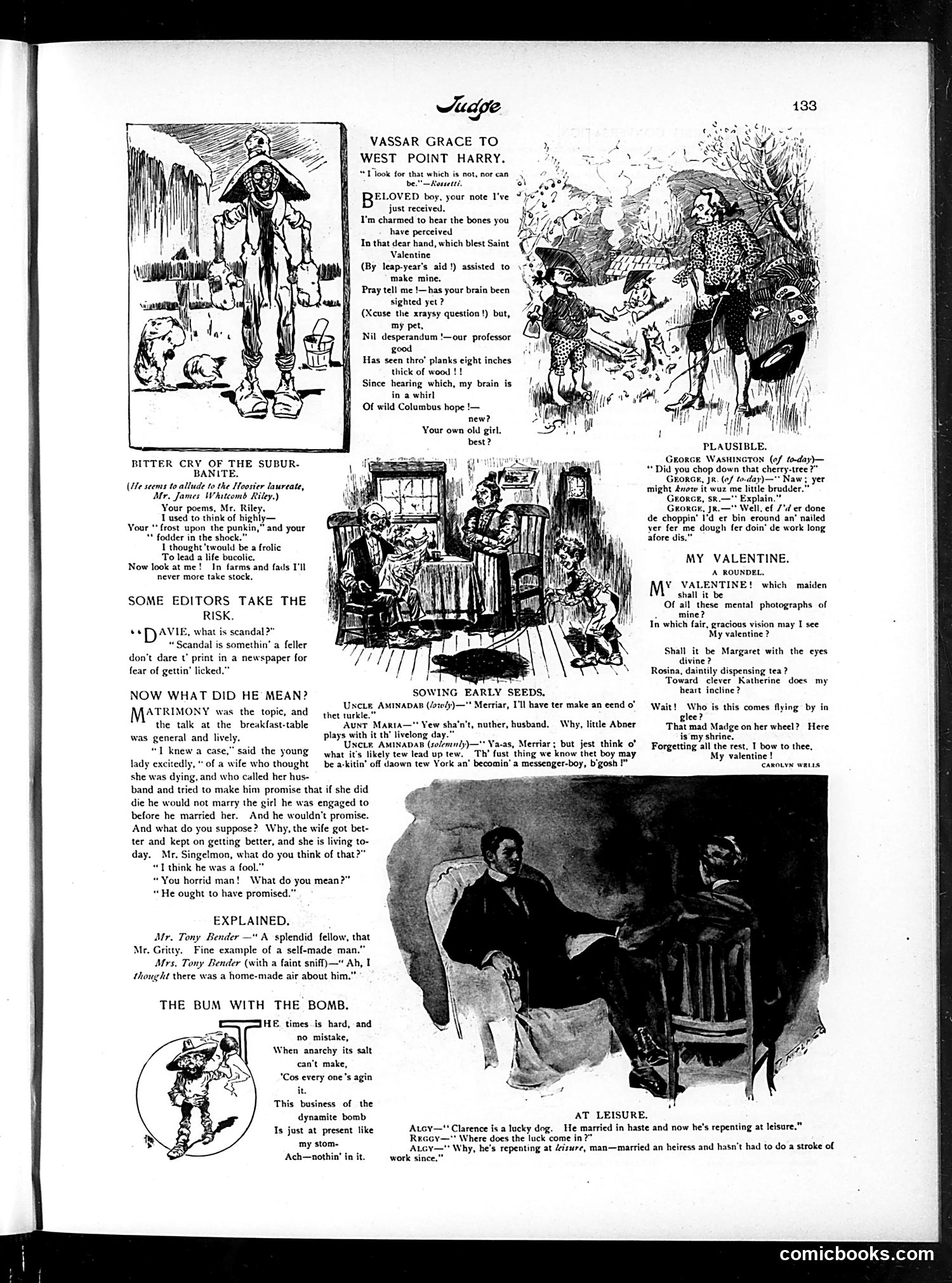
This page contains several satirical sketches typical of Judge magazine's humor: **"Bitter Cry of the Suburbanite"** mocks the romanticization of rural life. A reader admits he admired James Whitcomb Riley's pastoral poetry ("frost on the punkin") and tried living rurally, only to find it miserable—the satire targets both overly sentimental literature and naive urbanites. **"Vassar Grace to West Point Harry"** is a romantic exchange between a Vassar college woman and a West Point cadet, playing on contemporary debates about education and gender—she references X-rays (new technology) and makes oblique romantic gestures. **"Now What Did He Mean?"** presents a domestic anecdote where a husband refuses to promise not to marry his ex-fiancée if his wife dies, then she recovers. The punchline criticizes male selfishness—he should have simply made the promise to comfort her. **"Plausible"** offers a cynical reimagining of the young George Washington's cherry-tree legend, where modern children use excuses and negotiate payment rather than show moral virtue. The remaining pieces are lighter Valentine's Day verses and domestic humor about marriage and courtship.
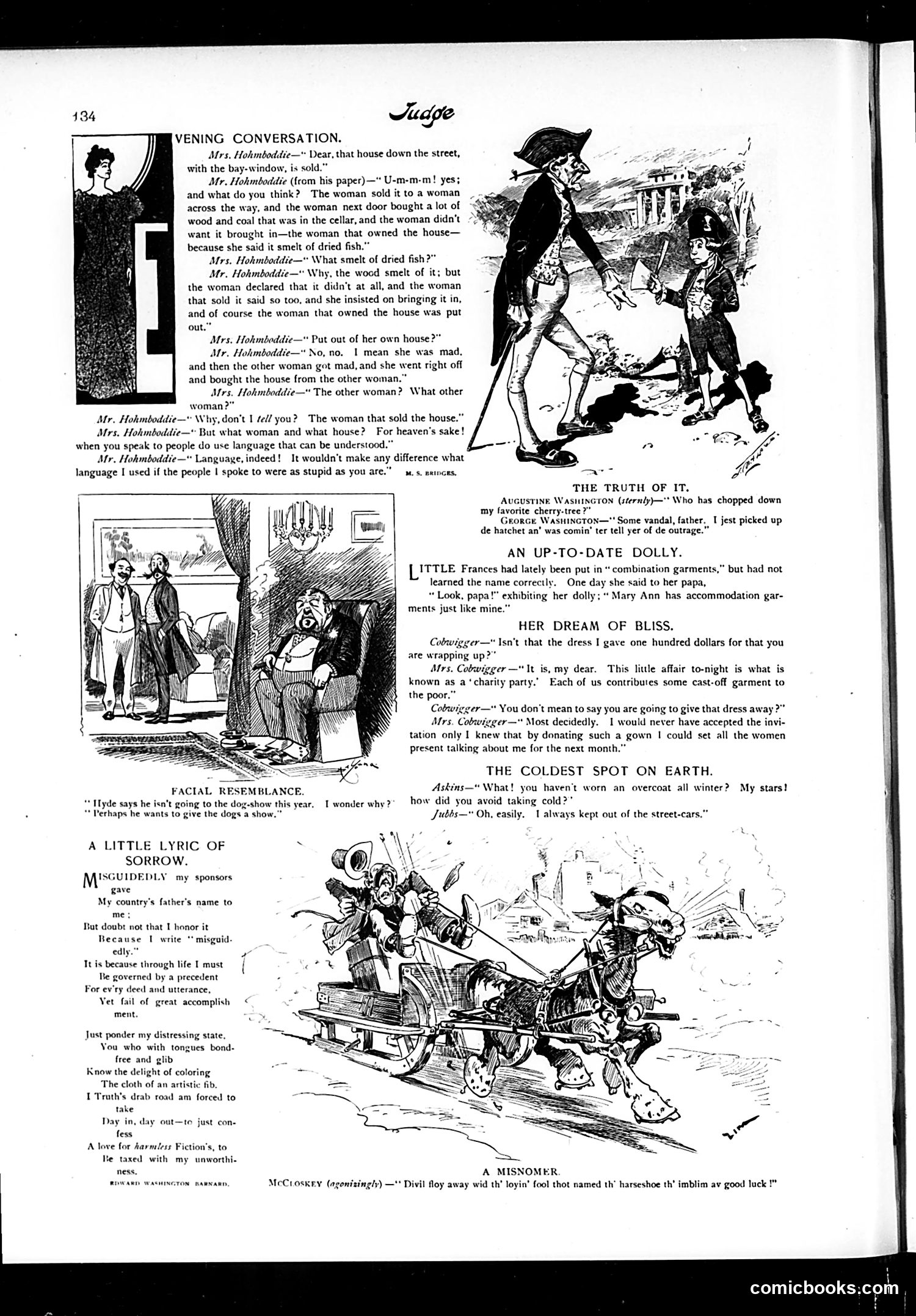
This page from the satirical magazine *Judge* contains multiple short humorous pieces typical of early 20th-century American humor: **"Evening Conversation"** mocks upper-middle-class domesticity through a confusing anecdote about neighbors, fish-smelling wood, and house sales. The joke satirizes both the wife's inability to follow her husband's rambling story and his condescending dismissal of her as "stupid"—poking fun at marital communication and gender dynamics. **Other sketches** include brief comedic vignettes: a George Washington cherry-tree anecdote with dialect humor, a child's malapropism about "accommodation garments," and a wealthy woman's cynical charity donation meant only to impress others. "The Coldest Spot on Earth" jokes about avoiding streetcars to stay warm. **"A Little Lyric of Sorrow"** is a poem lamenting being named after Washington yet forced to tell the truth, satirizing those constrained by principles. The final piece mocks Irish dialect, with a man cursing whoever named horseshoes symbols of good luck. The humor relies on dated conventions: marital mockery, class stereotypes, ethnic caricature, and domestic situations now considered patronizing.
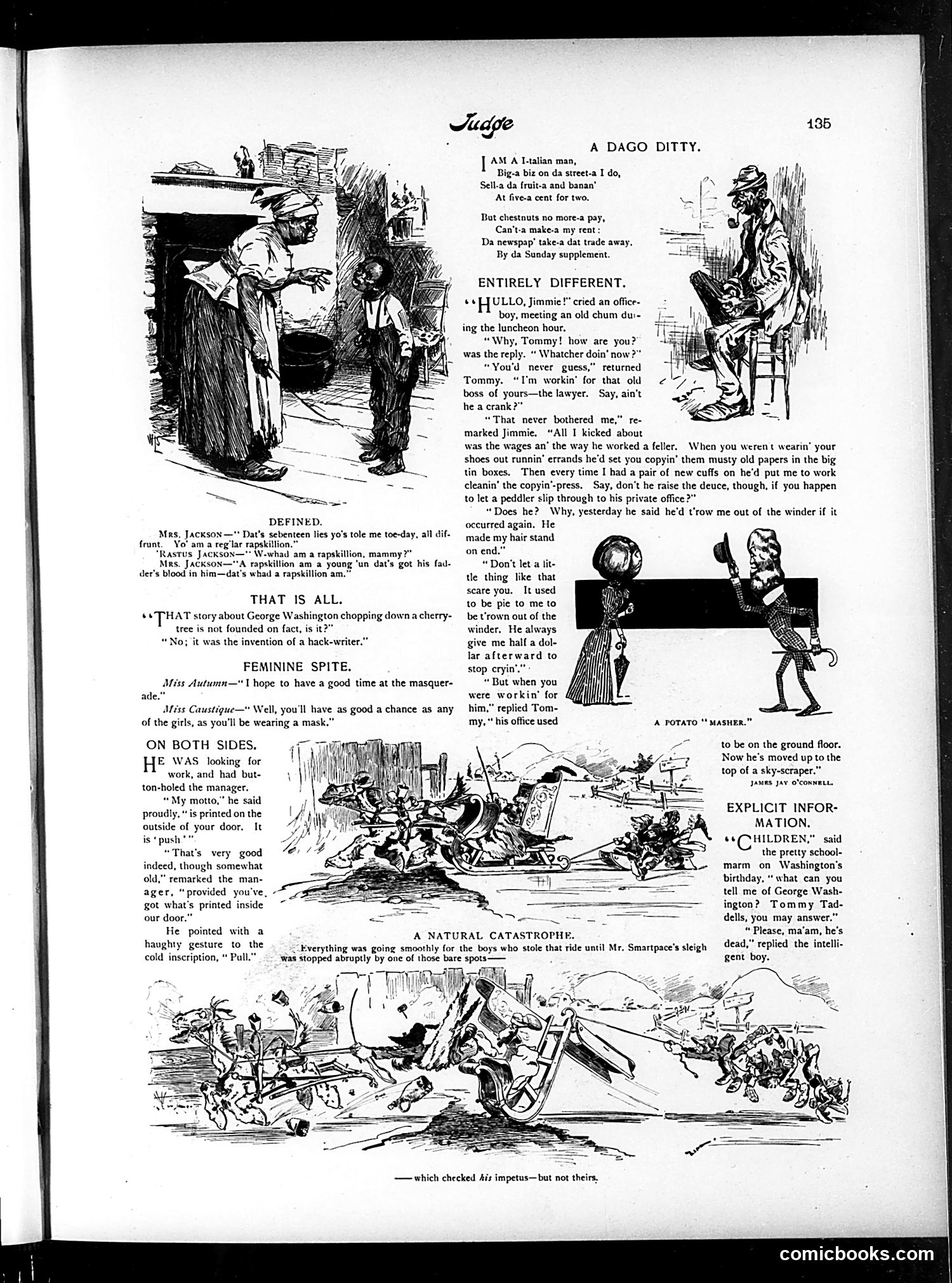
This page contains multiple satirical sketches typical of Judge's humor circa early 1900s: **"A Dago Ditty"** stereotypes Italian street vendors, depicting an immigrant fruit seller lamenting lost chestnut sales to newspaper Sunday supplements—a commentary on changing commerce and immigrant economic struggles, rendered through offensive ethnic dialect. **"Entirely Different"** contrasts two office boys' experiences with a cranky lawyer boss, joking about the indignity of being thrown from windows—acceptable punishment in lower offices but more dramatic when the boss moves to a skyscraper. **"That Is All"** mocks the apocryphal George Washington cherry-tree story as a "hack-writer's" invention rather than historical fact. Other sketches employ mild workplace humor and gender-based jokes ("Feminine Spite," "On Both Sides"). The final cartoon shows a sleigh accident, captioned about lost "impetus." The content reflects period attitudes: ethnic stereotyping, class-based humor, and slapstick comedy aimed at working-class audiences. Most references remain historically transparent, though the casual racism now reads as jarring.
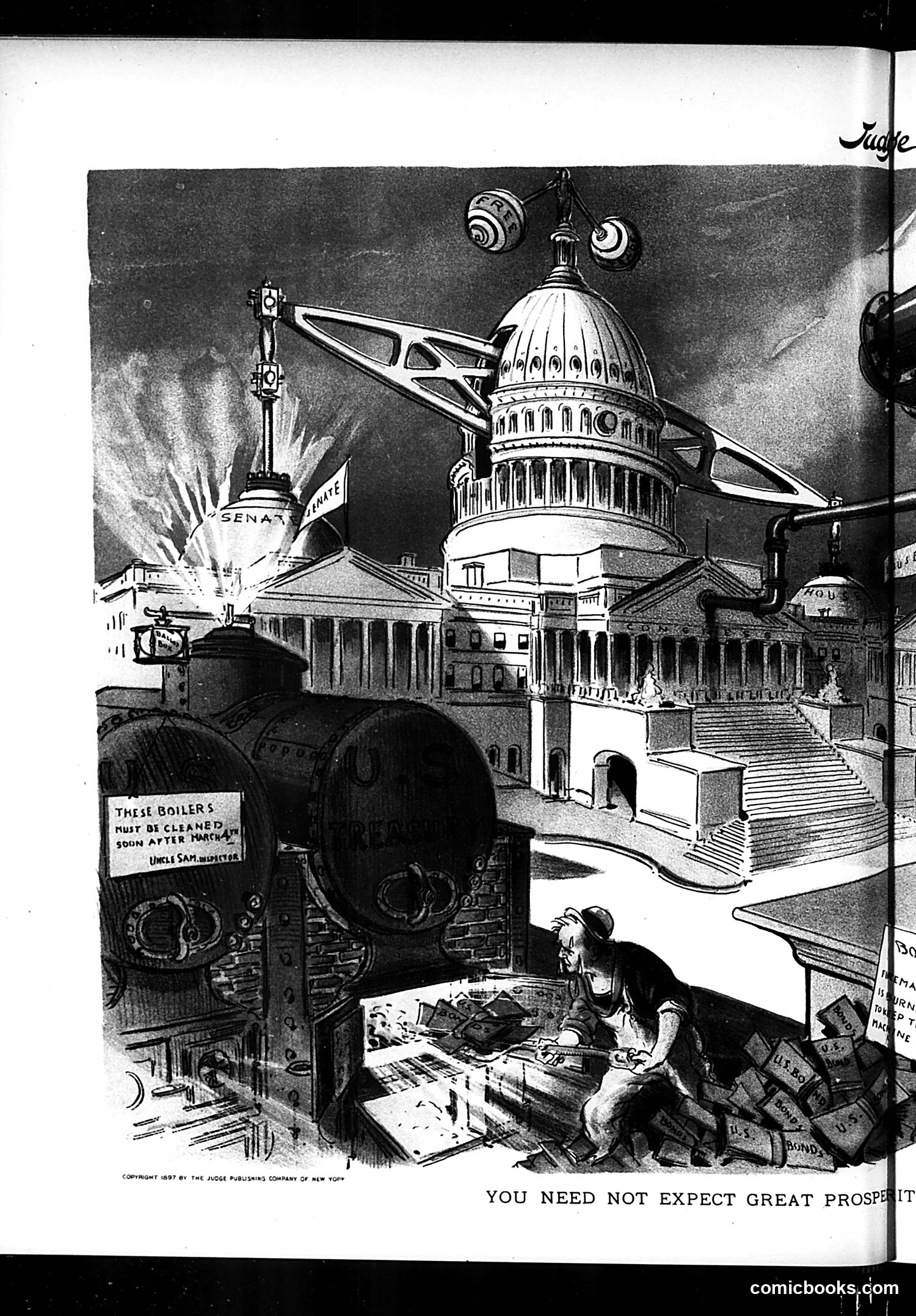
This Judge magazine cartoon satirizes political corruption in the U.S. Senate. The Capitol building dominates the background, while in the foreground, industrial boilers labeled "Senate" sit neglected with a warning sign: "These boilers must be cleaned soon after tonight." The boiler imagery suggests the Senate's "machinery" is dirty and dysfunctional, requiring urgent cleaning—a metaphor for rooting out corruption. The figure examining the boilers appears to be a common laborer or inspector, representing the working public observing governmental failure. The caption "YOU NEED NOT EXPECT GREAT PROSPERITY" delivers the bitter punchline: with a corrupt, malfunctioning Senate, citizens shouldn't anticipate economic improvement. The cartoon criticizes Senate ineffectiveness and corruption as impediments to national prosperity.
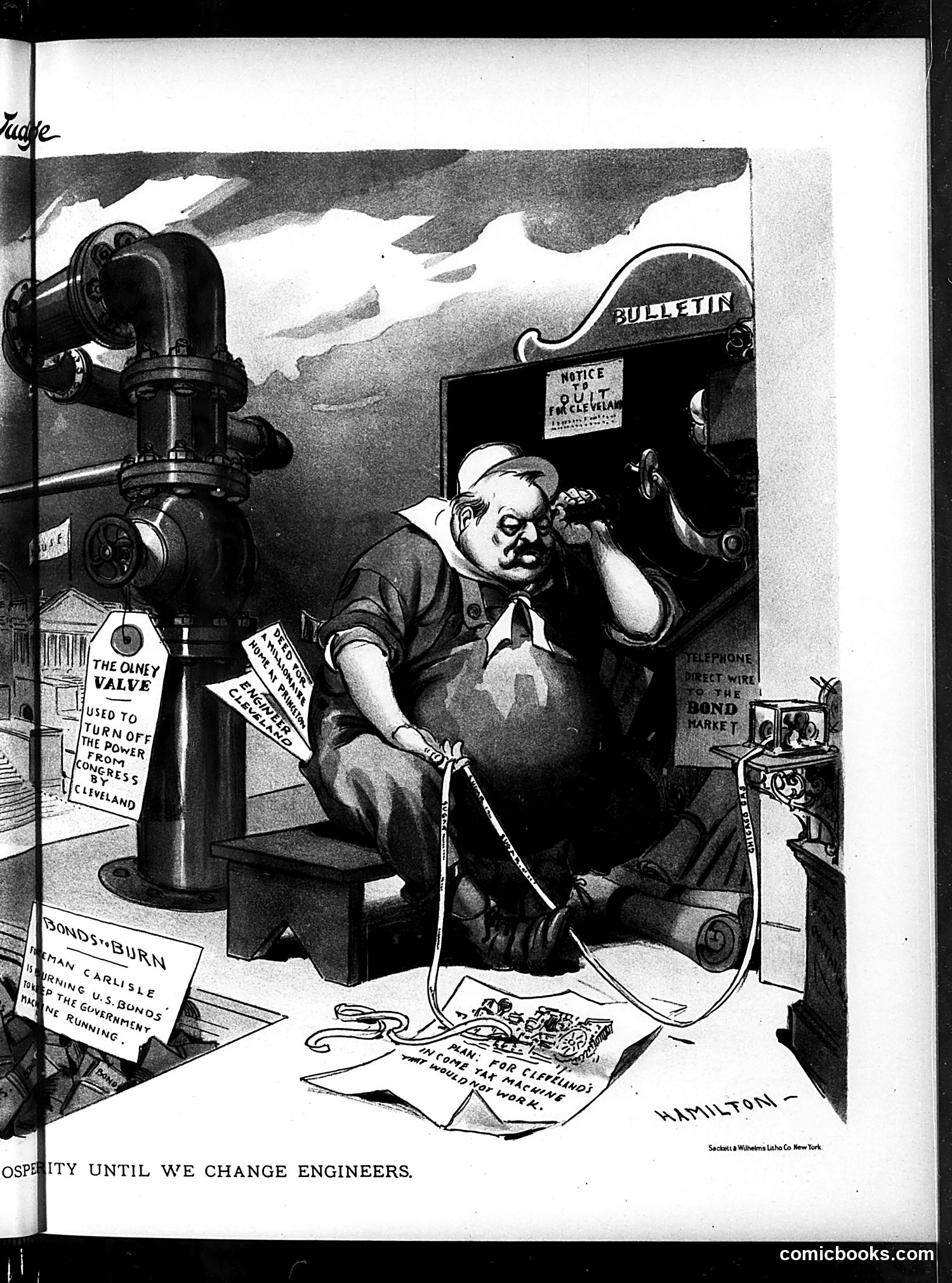
This political cartoon by Hamilton depicts an operator at a "Bulletin" station (appearing to be a news or communications center) who is deliberately causing problems. The caption reads "Ospelity Until We Change Engineers," suggesting criticism of current leadership. The cartoon references several historical issues: "The Only Valve Used to Turn Off the Power from Congress to Cleveland" (critiquing President Cleveland's policies), "Bonds Burn" (financial instability), and notices about "Clothing" and "Bond Market" suggesting economic concerns. The caricatured figure appears to represent either a political operator or engineer sabotaging systems intentionally. The satire criticizes mismanagement and suggests that changing leadership ("engineers") is necessary to restore proper functioning of government or economic systems. The exact political context and specific figures referenced are unclear without additional dating information.
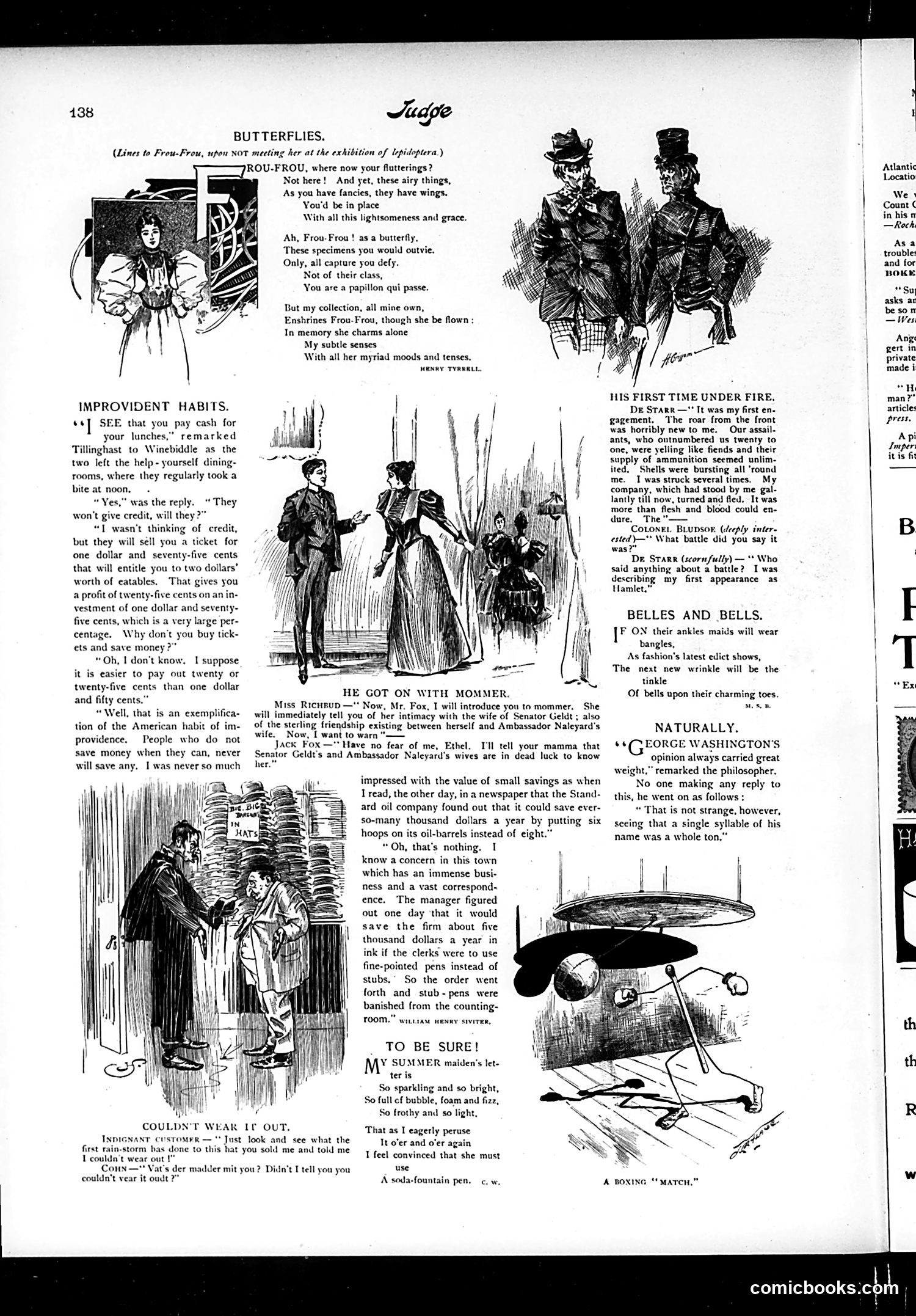
This page contains several unrelated humorous pieces typical of early 20th-century satirical magazines: **"Butterflies"** is a romantic poem addressing "Frou-Frou," likely a socialite or performer, comparing her to a butterfly at a lepidoptera exhibition—suggesting she's beautiful but fleeting and elusive. **"Improvident Habits"** satirizes American financial carelessness: two men discuss how people waste money by not buying discounted meal tickets, illustrated by anecdotes about Standard Oil and office efficiency savings. **"He Got On With Mommer"** mocks social climbers: a character boasts about knowing the wives of a Senator and Ambassador, while his acquaintance sarcastically endorses the claims. **"A Boxing Match"** shows an umbrella as a weapon—wordplay on "match." **Other pieces** include complaints about hat durability, commentary on soda-fountain pens, and a military anecdote. The humor relies on puns, exaggeration, and observations of contemporary social pretension and consumer behavior.
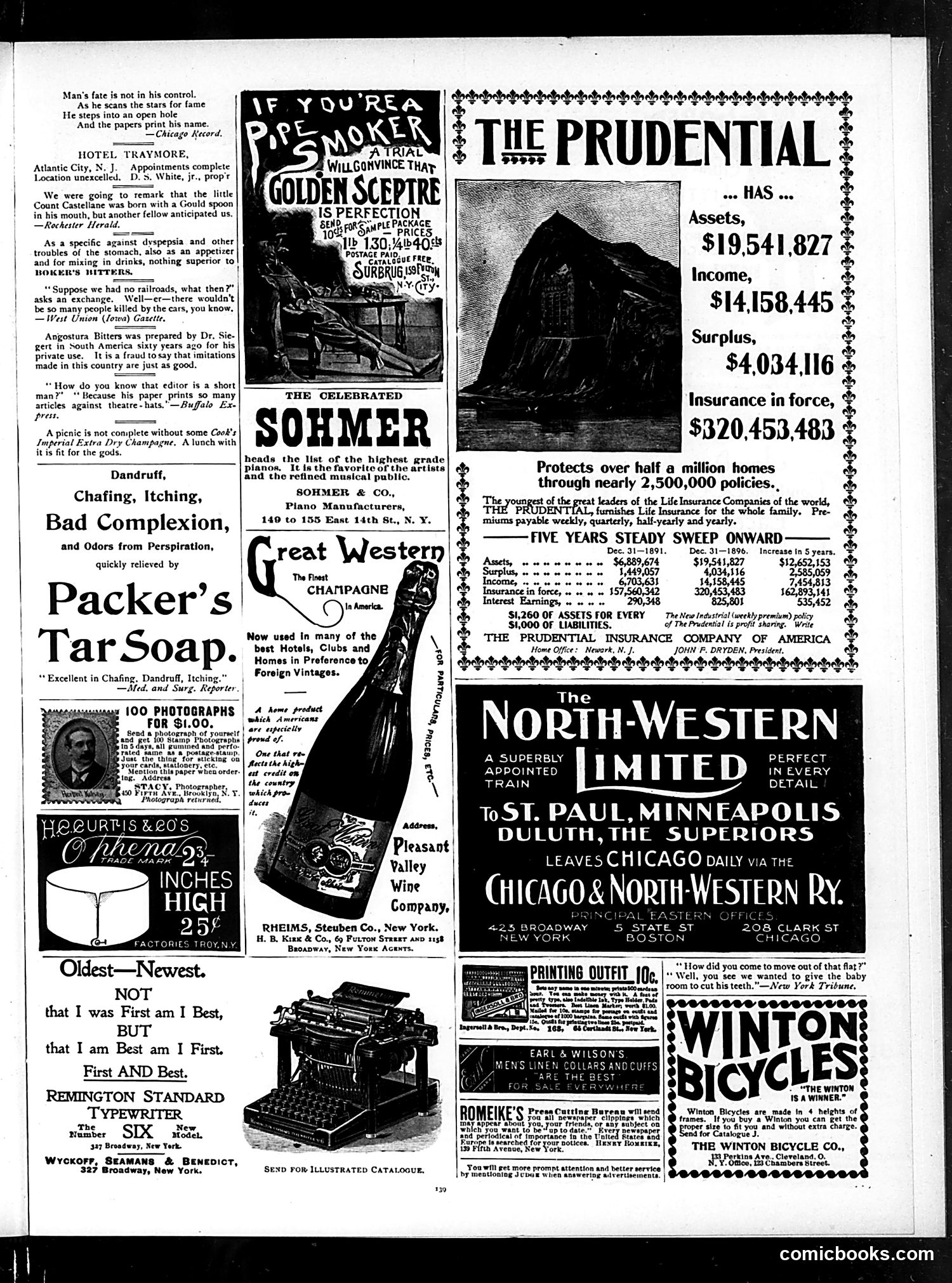
This is primarily an **advertising page** from Judge magazine, circa 1890s, with minimal editorial content. The few satirical items present are brief, traditional quips rather than visual cartoons: **Visible Satire:** - Short jokes mocking contemporary figures (Count Castellane, a wealthy European marrying into American money) and editorial pretension - Wordplay about railroad accidents and editorial short-sightedness **Advertisements dominate**, promoting:** - Luxury goods (champagne, pianos, life insurance) - Patent medicines (Packer's Tar Soap, Angostura Bitters) with health claims - Business services (typewriters, printing equipment, bicycles) **Historical Context:** The Prudential Insurance ad showcases financial growth statistics—typical of Gilded Age corporate self-promotion. Products like "Broker's Bitters" reflect the era's unregulated patent medicine market. The page reflects 1890s consumer culture and advertising's growing prominence in magazines. The content lacks substantive political satire—mainly filler between advertisements.
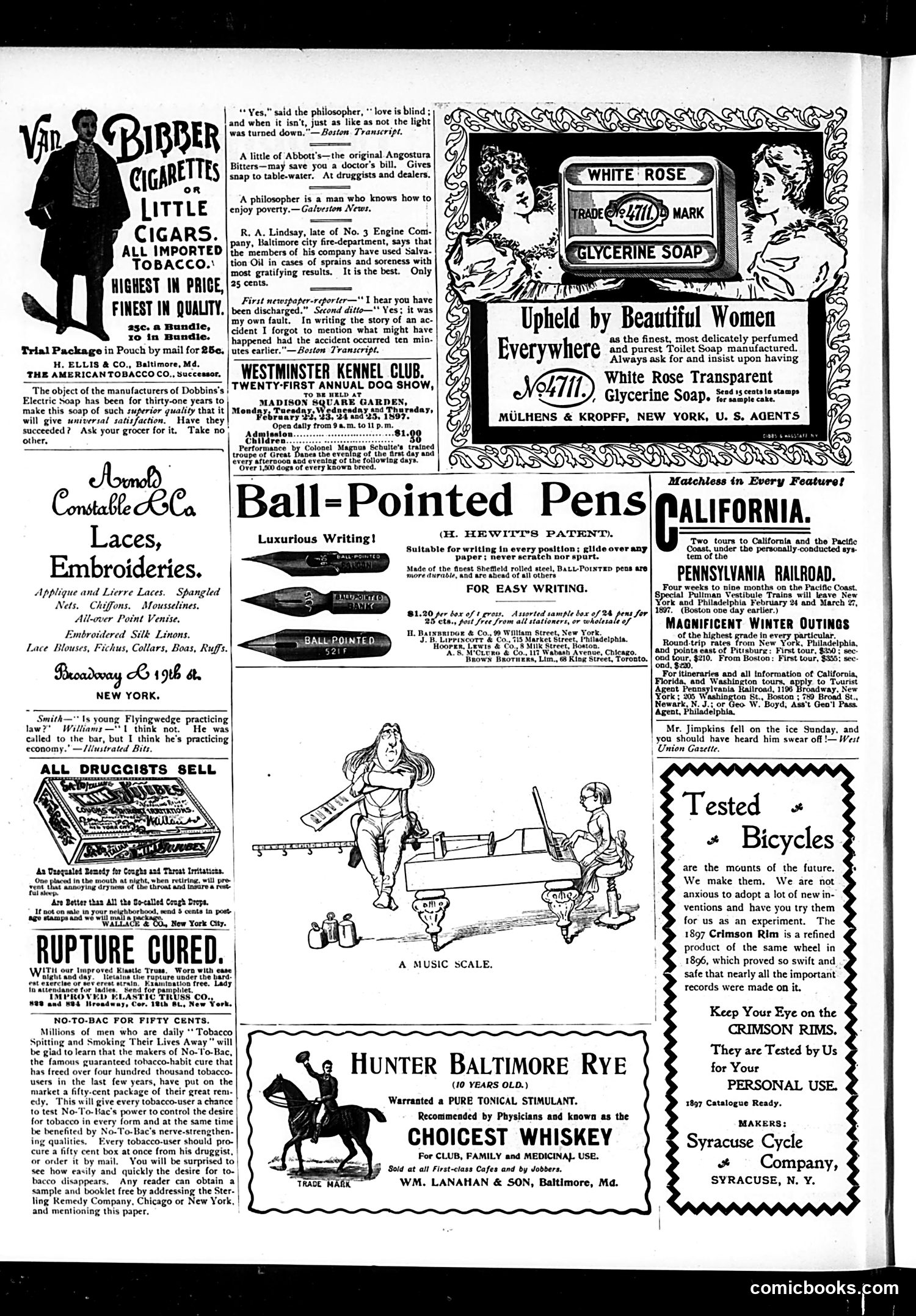
This page is primarily **advertising with minimal editorial content**. The few comic snippets present are brief, generic jokes typical of the era—a philosopher's quip about love being blind, a reporter's self-deprecating humor about forgetting story details. The page showcases late-19th-century product advertisements: tobacco products (Van Bibber cigarettes, Hunter Baltimore Rye whiskey), soaps (White Rose glycerine soap), patent medicines (Sal-Rheumatism Oil), pens, and bicycles. One notable illustration shows a "Music Scale"—apparently a novelty item or children's toy—with figures climbing or interacting with a staff of musical notes. **There is no significant political or social satire on this page.** The content reflects the commercial nature of Judge magazine, which supported itself through extensive advertising. The jokes are mild domesticities rather than pointed commentary. This appears to be a typical interior page from the 1890s, prioritizing revenue over editorial content.
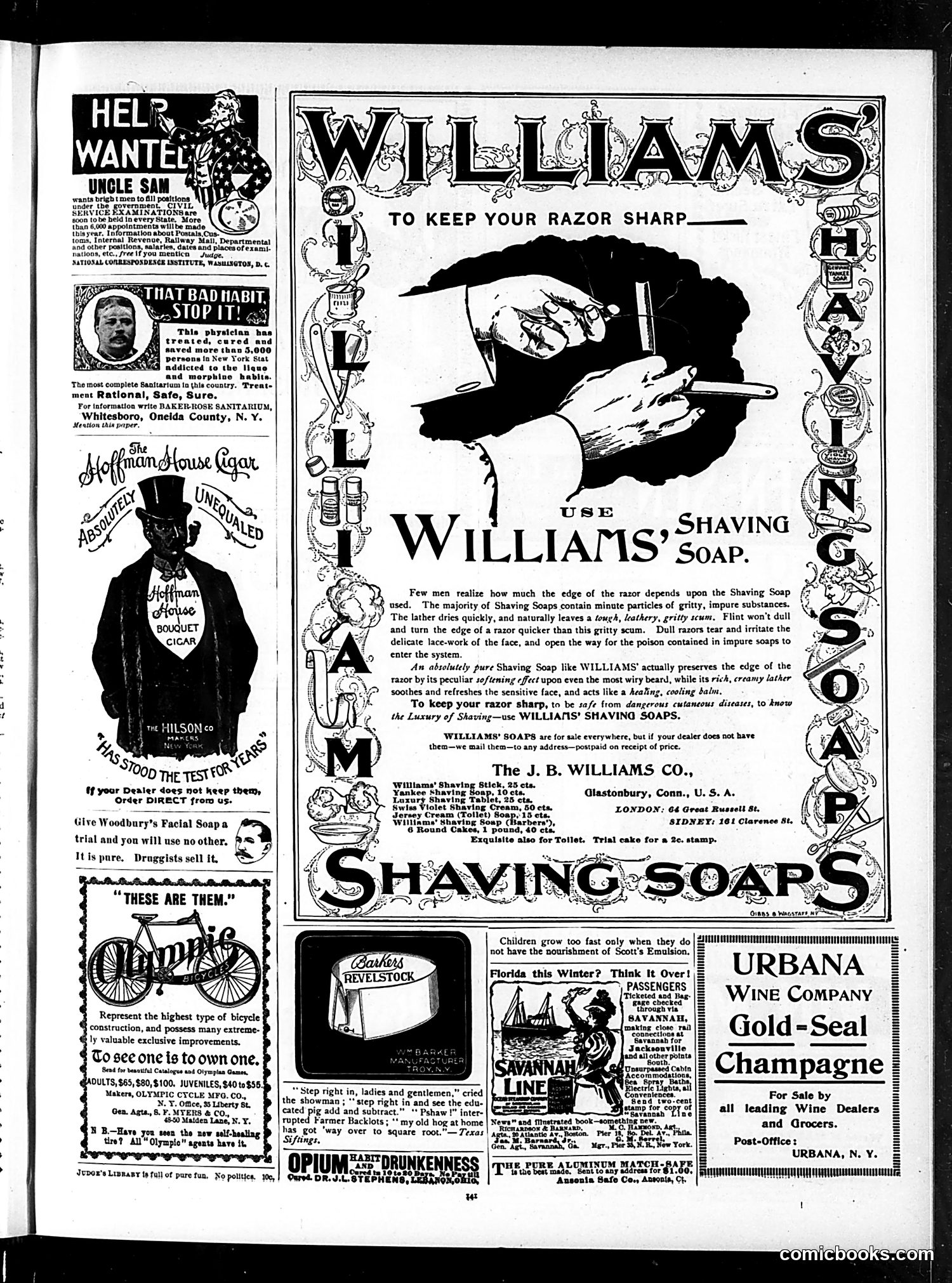
This page is primarily **advertisements and recruitment notices**, not political satire. The dominant content is a large ad for Williams' Shaving Soap (center), which pitches the product as preserving razors through its pure formula and avoiding irritation. The left side contains a **"Help Wanted" recruitment notice** from the National Correspondence Institute, offering postal and government jobs, plus ads for patent medicines (Baker-Rose Sanitarium for alcoholism treatment) and other consumer products (Hoffman House Cigars, Woodbury's Facial Soap). Bottom sections advertise bicycles (Olympic brand), Urbana Wine Company champagne, and Scott's Emulsion (likely a nutritional supplement). A small cartoon appears between ads showing someone praising a shoeshine, but it's incidental to the page's primary commercial function rather than satirical commentary. The page reflects **early 1900s advertising conventions** for a general-interest humor magazine that relied heavily on paid advertisements to fund publication.
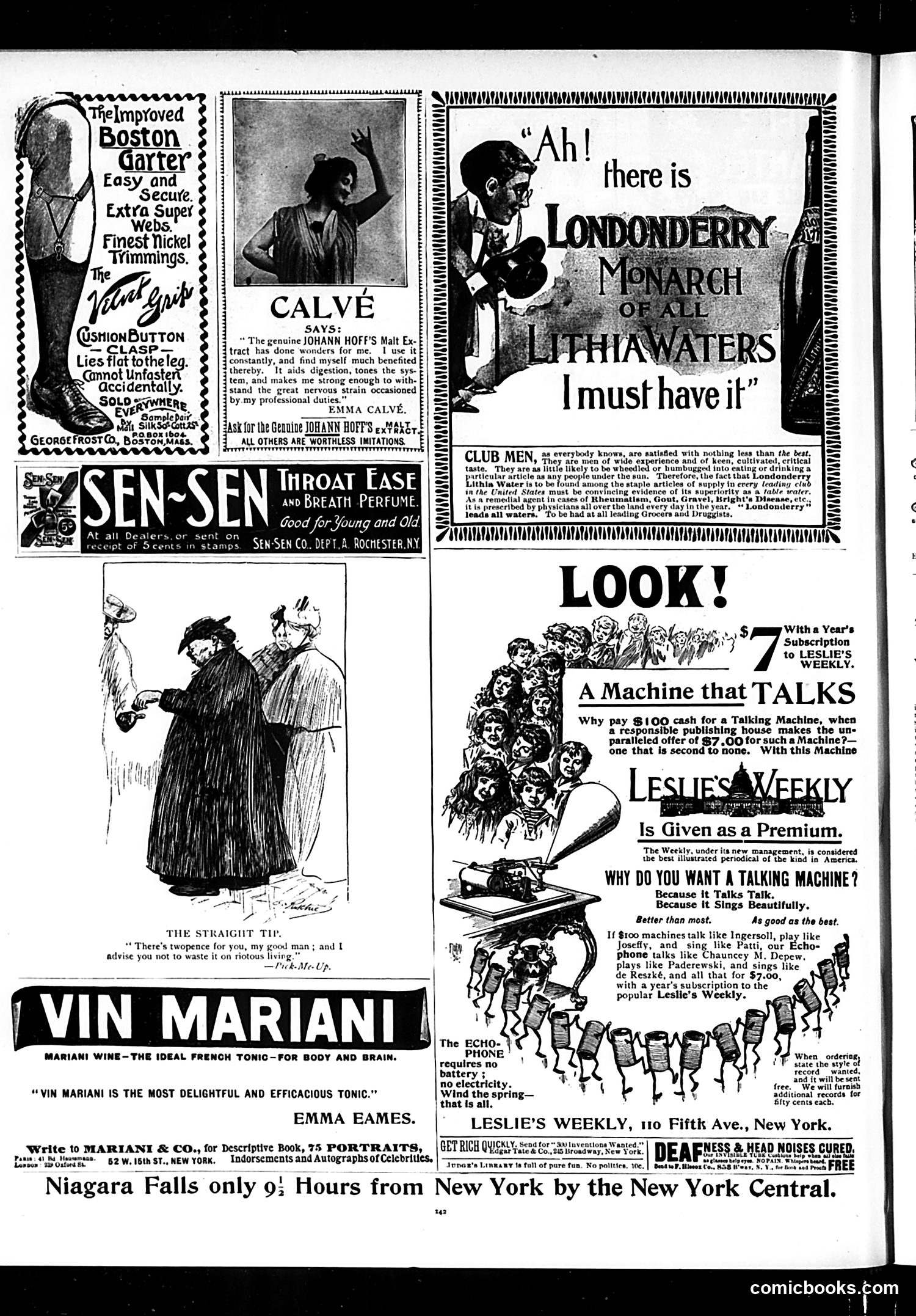
This page is primarily **advertisements and promotional material** rather than political satire, though it reflects early 1900s consumer culture. **Key content:** The largest ad promotes **Londonderry Mineral Water** to "club men," emphasizing exclusivity and medical authority—physicians prescribe it for rheumatism and gout. This appeals to wealthy, discerning men. A cartoon titled **"The Straight Tip"** shows working-class figures; the caption suggests wasteful spending on "riotous living," offering middle-class moral advice about financial prudence. **Leslie's Weekly** advertises a talking machine (phonograph) as a subscription premium—positioning the magazine as offering superior value to competitors. Other ads include Vin Mariani (a French tonic wine), Sen-Sen breath lozenges, and various patent medicines typical of the era. **The satire is mild**: the implicit joke is that wealthy club members are particular consumers, while working-class people need lectures about financial responsibility. The ads collectively reflect period anxieties about class distinction and consumer goods as status markers.
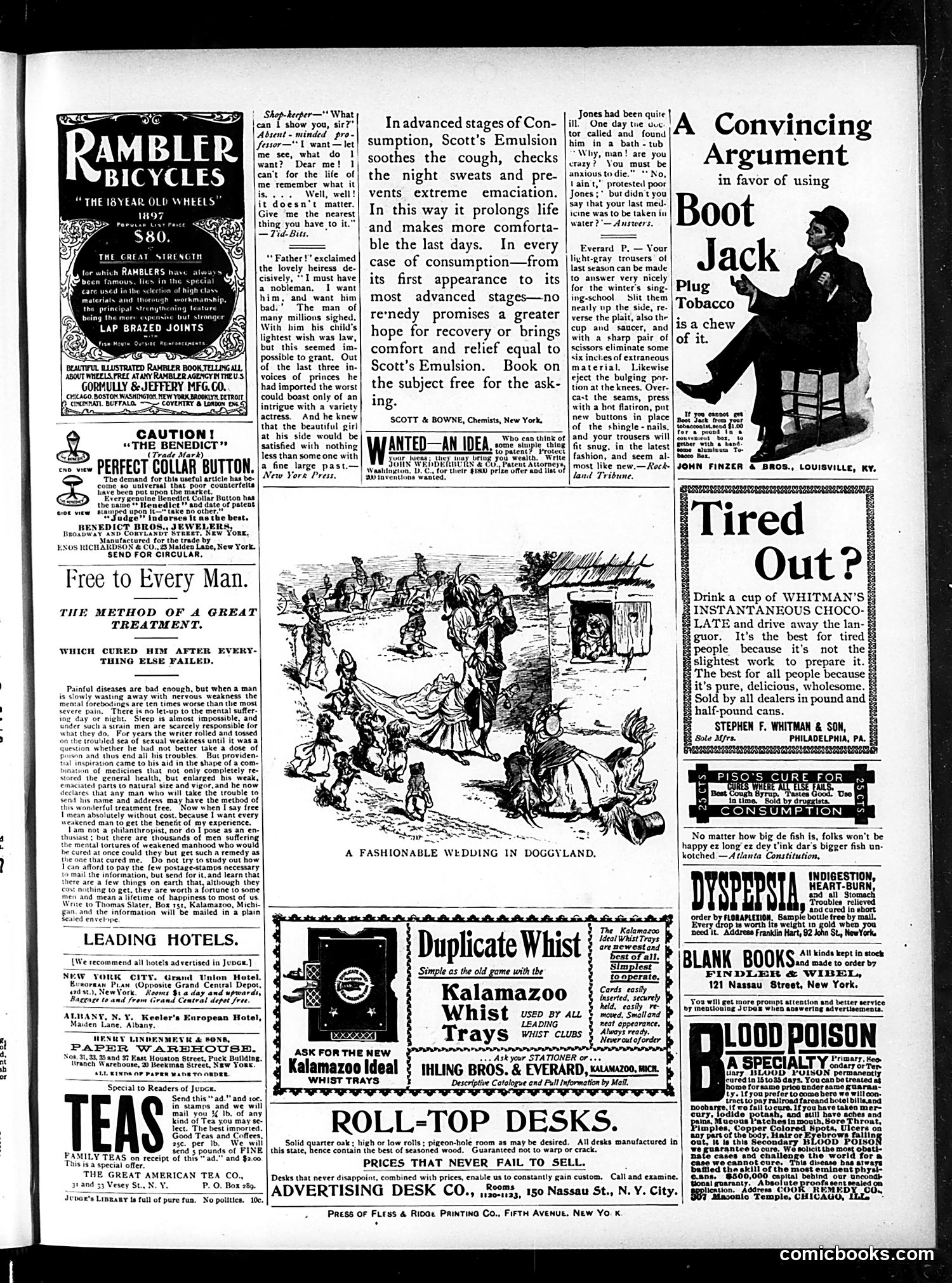
This page is primarily **advertising**, with one small cartoon titled "A Fashionable Wedding in Doggyland" (a humorous sketch of dogs at a wedding). The main content consists of period patent medicine and product advertisements typical of early 20th-century Judge magazine. Key ads include: - **Scott's Emulsion** (cod liver oil for tuberculosis/consumption) - **Rambler Bicycles** - **Whitman's Chocolate** for fatigue - **Piso's Cure** for cough/consumption - Various remedies for "nervous weakness" and "blood poison" The "Convincing Argument" section humorously suggests using a **Boot Jack** (shoe removal tool) to alter worn trousers—a practical household tip disguised as satire on fashion. The small cartoon showing dogs in human situations reflects Judge's typical anthropomorphic humor. Overall, this is a commercial page showcasing the dubious patent medicines and everyday products that filled satirical magazines of this era.
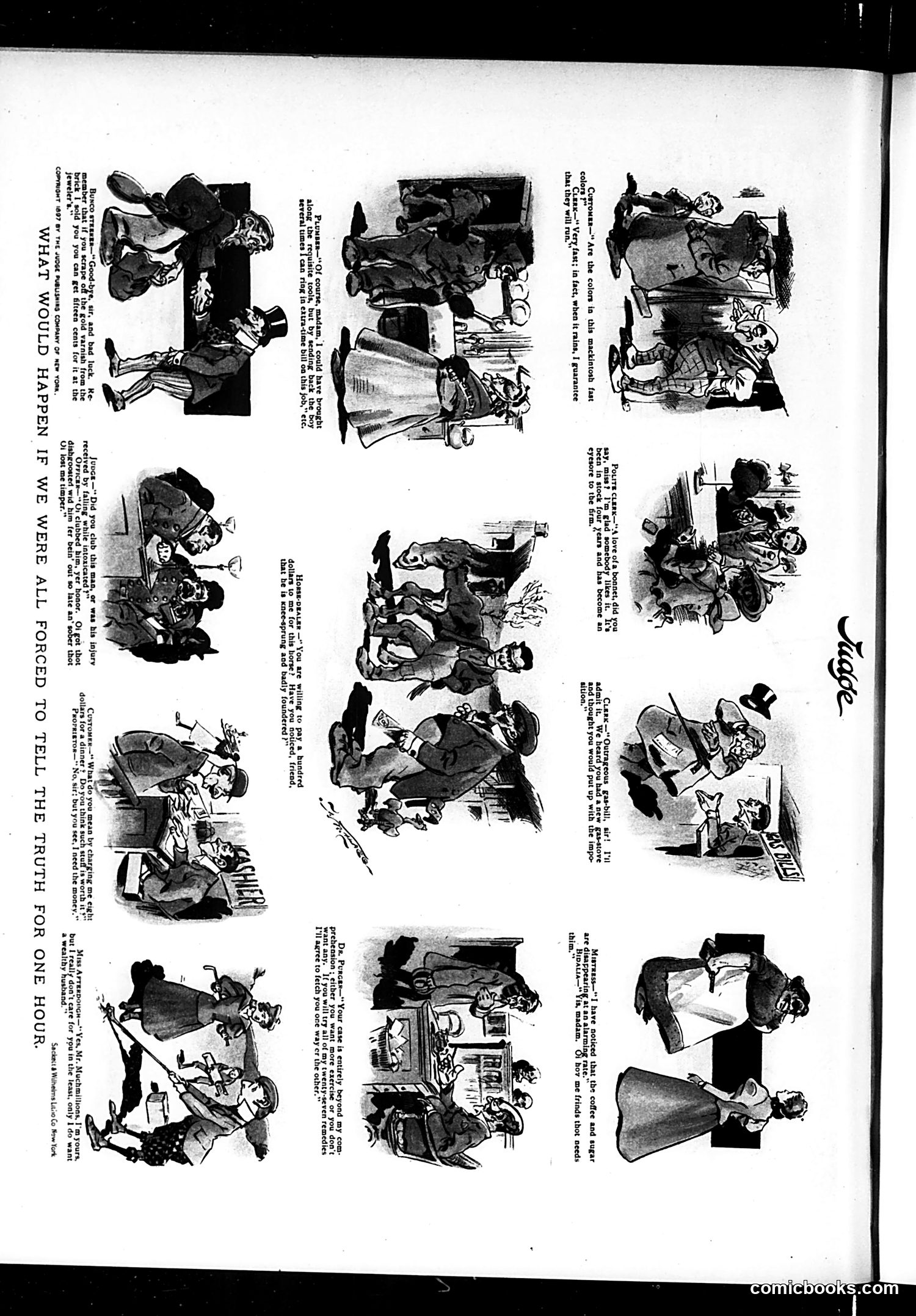
This page presents a series of comic vignettes imagining the chaos of mandatory honesty. Each cartoon depicts a familiar social or commercial transaction where someone finally speaks the uncomfortable truth: - A shopkeeper admits a bonnet has been unsold for four years - A tailor confesses raincoat dyes run badly - A gas company acknowledges an outrageous bill - A plumber admits to padding work hours with fake "extra-time" charges - A doctor cynically admits uncertainty about treatment - A horse dealer reveals an animal's lameness and injuries The satire targets Victorian-era commercial dishonesty and social hypocrisy—the expectation that polite society demands deception in everyday transactions. The humor lies in imagining how different institutions would collapse if customers and service providers spoke candidly about inflated prices, shoddy goods, and deliberate fraud. It's a critique of widespread business corruption normalized as standard practice.