
A complete issue · 16 pages · 1897
Judge — February 13, 1897
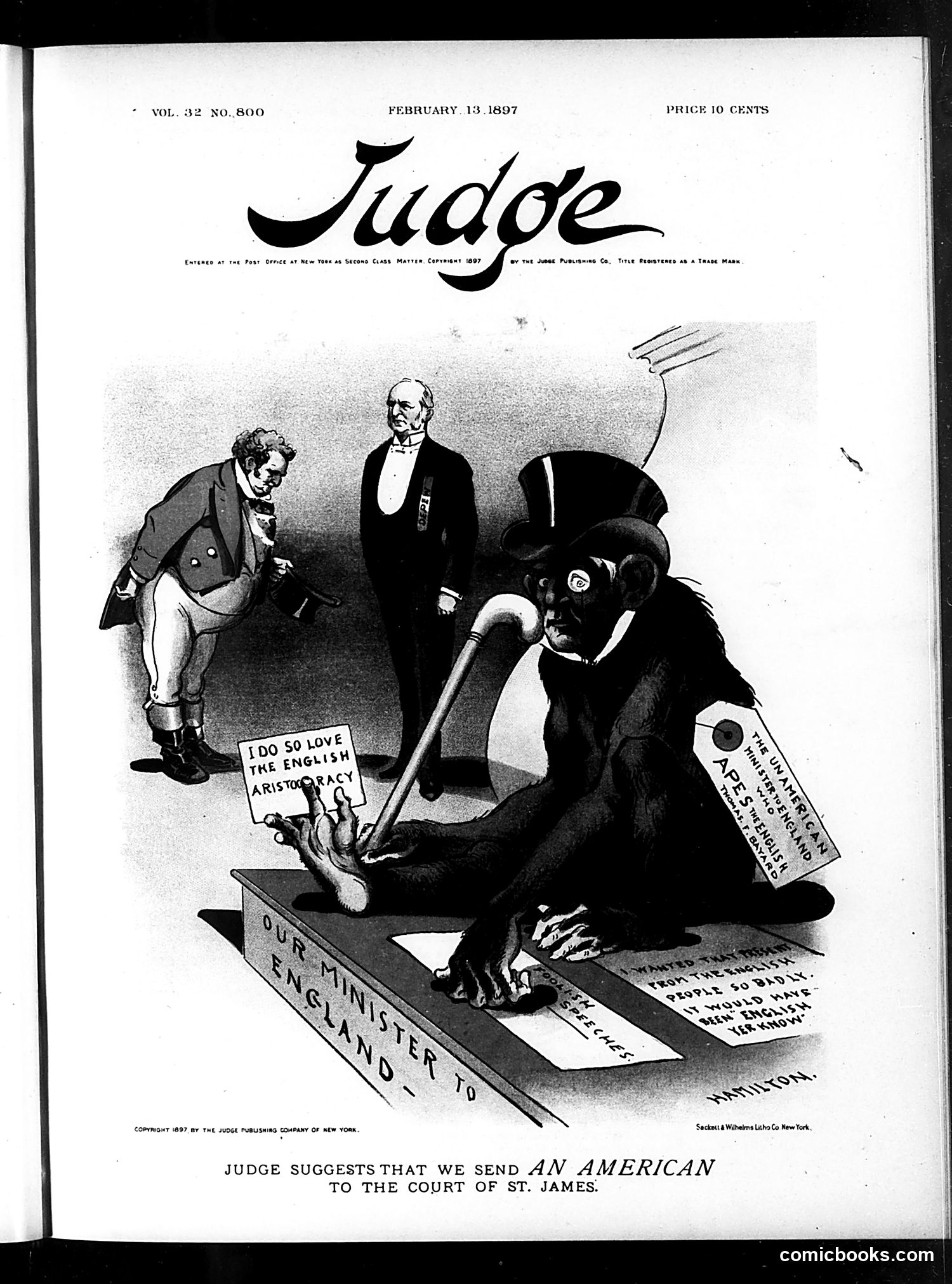
This cartoon satirizes American attitudes toward British aristocracy. A caricatured monkey (labeled "OUR MINISTER TO ENGLAND") sits at a desk signing documents, while two well-dressed English gentlemen observe. The monkey wears a sign reading "I DO SO LOVE THE ENGLISH ARISTOCRACY." The satire targets an American diplomat who appears obsequiously eager to please British nobility. The caption—"JUDGE SUGGESTS THAT WE SEND AN AMERICAN TO THE COURT OF ST. JAMES"—uses irony: the cartoon argues America's representative behaves like a monkey mimicking refined behavior rather than asserting American dignity and independence. This reflects late-19th-century tensions between American and British relations, mocking American diplomats perceived as insufficiently assertive toward British interests.
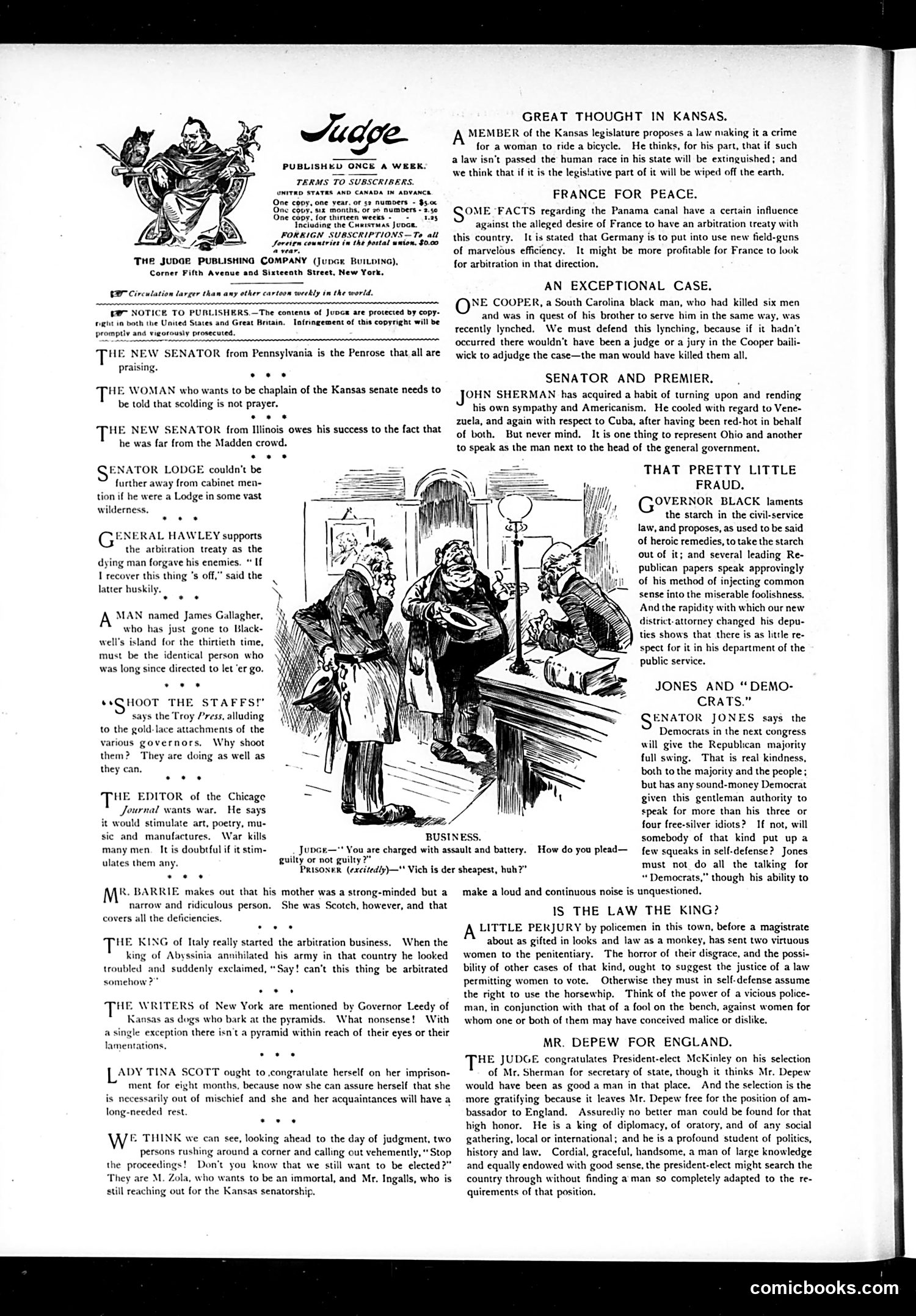
The central cartoon depicts a courtroom scene where a judge presides over a case of "assault and battery." A prisoner stands before the bench while what appears to be a well-dressed defendant (possibly representing a person of wealth or status) sits comfortably nearby. The satire suggests **class-based justice**: the caption "Business" implies this is routine, ordinary court procedure—but the visual contrast suggests the wealthy or powerful receive preferential treatment while ordinary people face prosecution. The comfortable positioning of one party versus the prisoner's stance underscores this inequality. Without additional context about the specific historical moment, the cartoon appears to critique how the legal system treats wealthy versus poor defendants differently, presenting systematic injustice as merely "business as usual" in the courts.
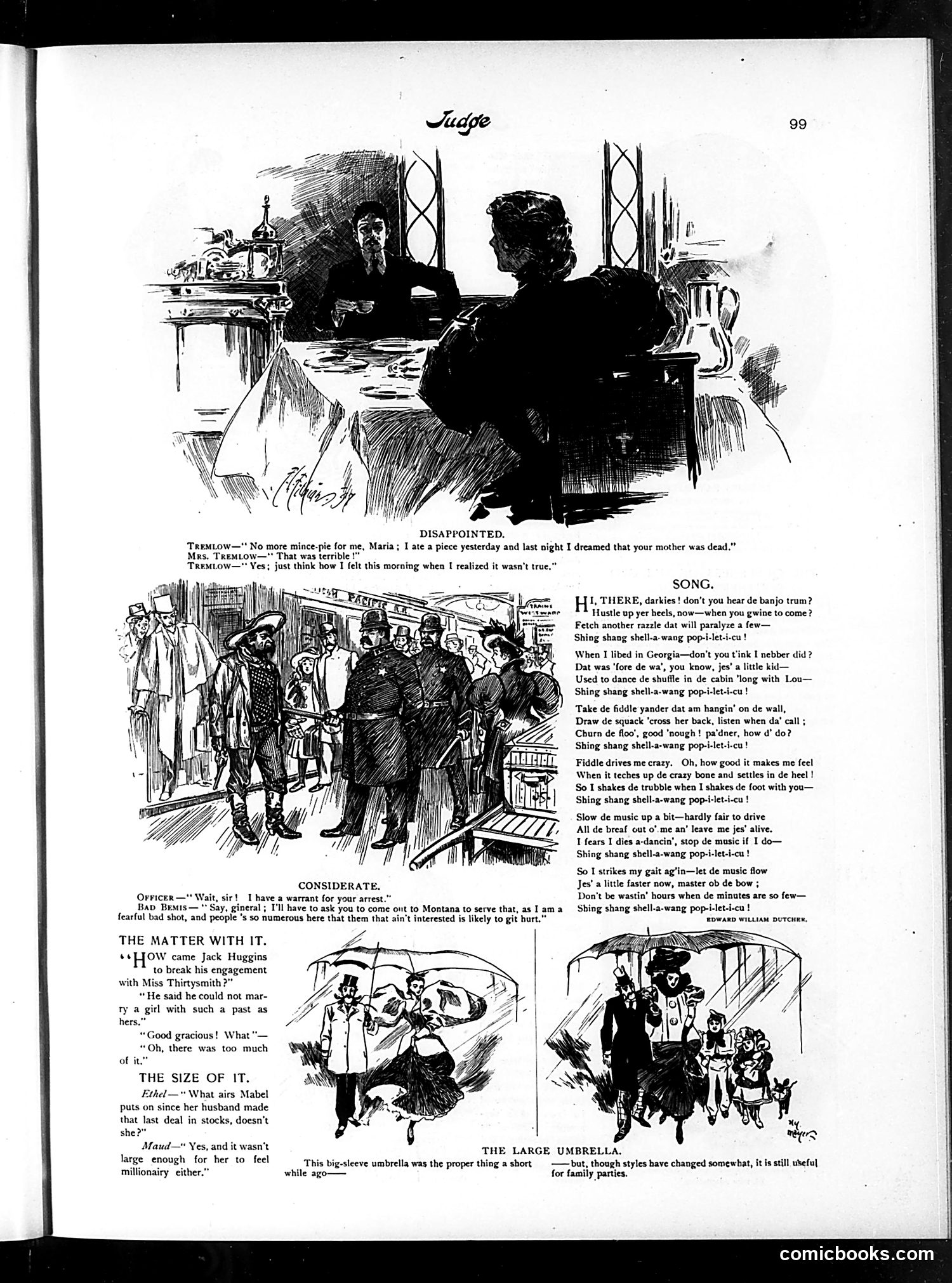
This page contains several separate humor pieces rather than unified political commentary: **"Disappointed"** (top): A domestic scene where a man tells his wife he dreamed her mother died, then admits he was mistaken upon waking—a joke about unwanted in-laws. **"Song"** (right): Lyrics celebrating banjo music and Southern nostalgia, likely from an earlier era, referencing Georgia and cabin life with African American musical traditions. **Remaining sketches** ("Considerate," "The Matter With It," "The Size of It," "The Large Umbrella"): Brief comic anecdotes about everyday situations—a warrant arrest, broken engagements, stock investments, and practical domestic items. These appear to be general-audience humor rather than political satire, typical of Judge's lighter content pages mixed among more topical material.
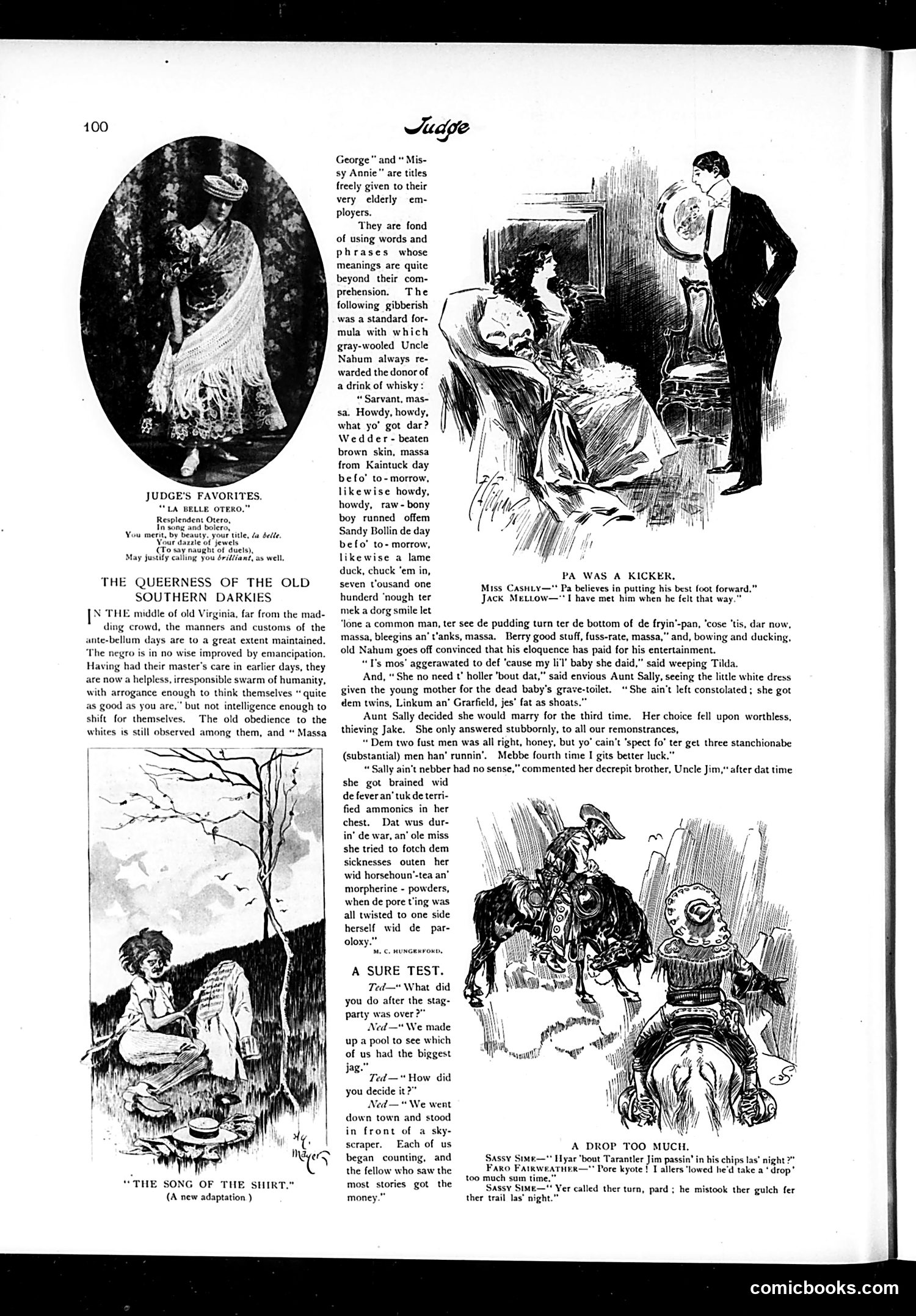
This page from *Judge* contains several satirical pieces reflecting late-19th/early-20th-century attitudes: **"The Queerness of the Old Southern Darkies"** presents a lengthy racist sketch depicting formerly enslaved Black people in post-emancipation Virginia through exaggerated dialect and stereotypes. The piece portrays them as intellectually inferior, dependent, and incapable of self-sufficiency—a common white supremacist argument of the era justifying continued subjugation. The accompanying illustrations and anecdotes (Uncle Nahum, Aunt Sally, Uncle Jim) reinforce these caricatures through mangled speech patterns presented as comic. The other brief jokes—"Pa Was a Kicker," "A Sure Test," "A Drop Too Much"—are unrelated social humor typical of the magazine's satirical content. **Context**: This reflects *Judge's* casual racism consistent with mainstream American publications of this period, where minstrelsy-influenced Black caricature remained socially acceptable and profitable entertainment for white audiences.
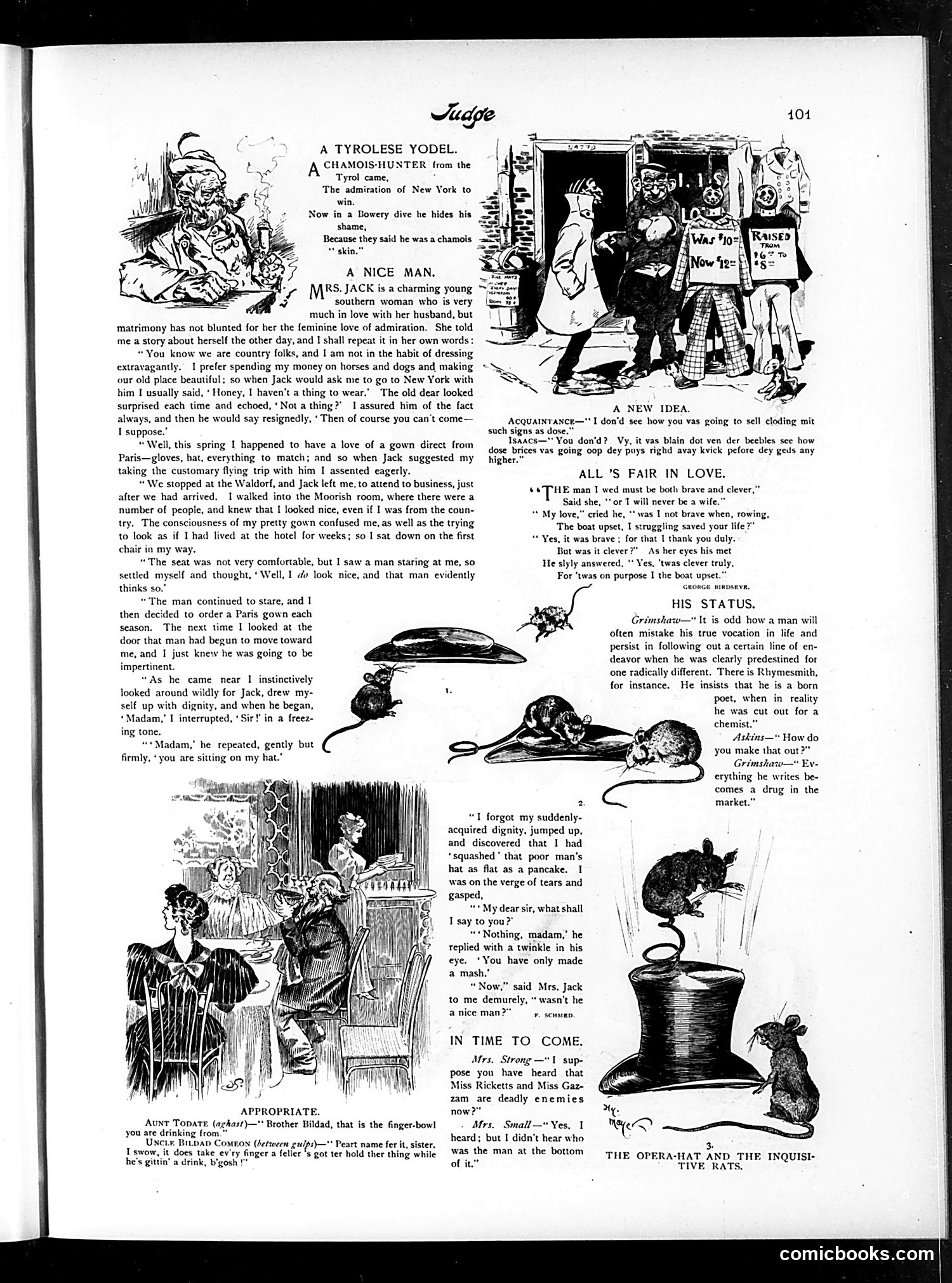
This page contains several short humorous pieces typical of early 20th-century American satire: **"A Tyrolese Yodel"** mocks a European performer who came to New York seeking fame but ended up in a Bowery dive after being called a "chamois skin"—apparently a racial or ethnic slur playing on his origin. **"A Nice Man"** tells of a Southern woman whose elegant Paris gown at the Waldorf Hotel impresses a man staring at her—until he politely reveals she's sitting on his hat. The humor relies on her embarrassment after misinterpreting his attention as admiration. **"All's Fair in Love"** is a brief poem about a bride who discovers her husband deliberately capsized their boat to appear brave—clever strategy, she admits. The remaining pieces are brief comedic vignettes about class differences and misunderstandings, including ethnic humor featuring German-accented characters discussing clothing sales, and rural characters unfamiliar with proper etiquette. The overall tone reflects period attitudes toward immigrants, class distinctions, and gender roles.
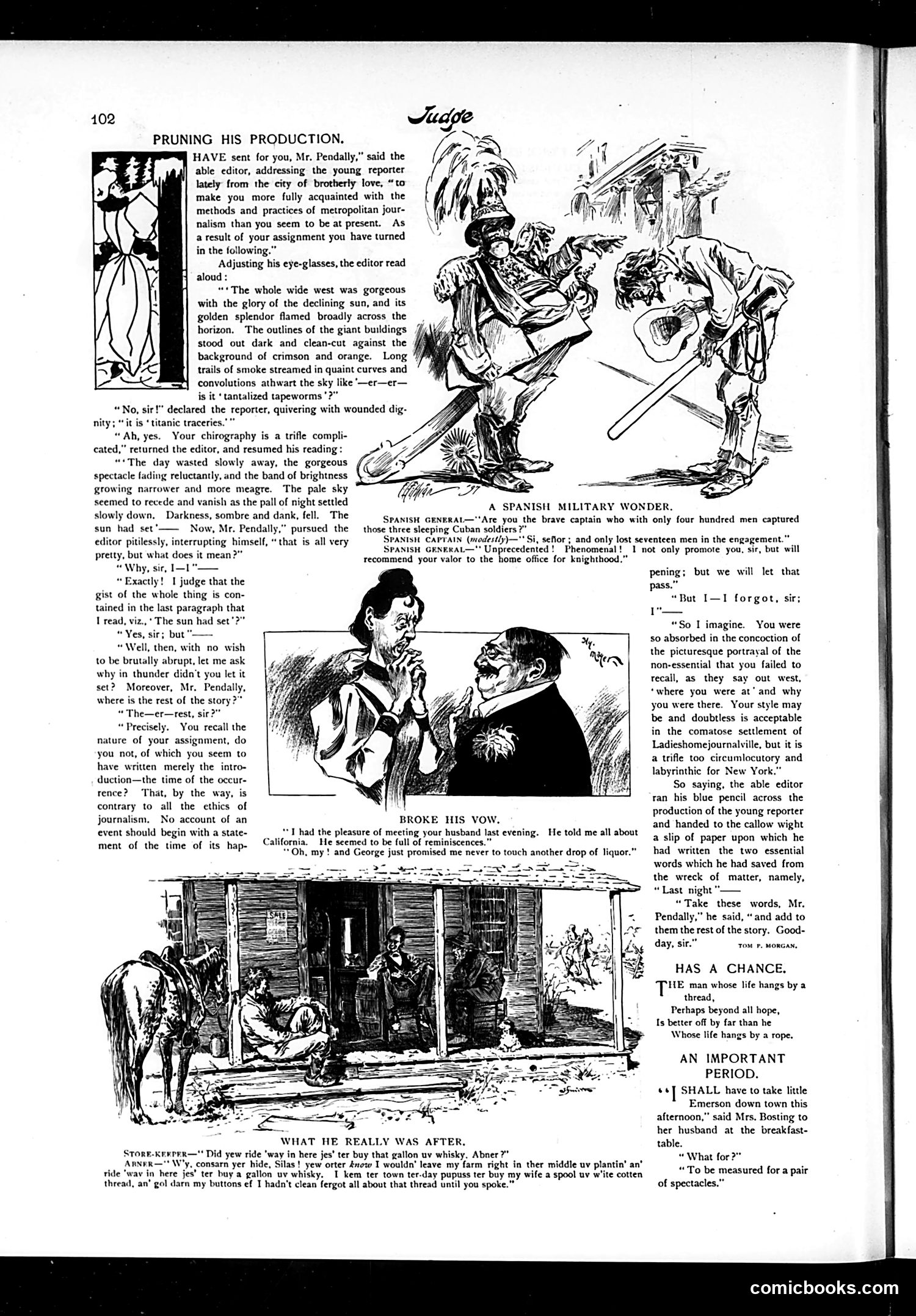
This page satirizes journalistic excess through an editor critiquing a young reporter from Philadelphia. The main cartoon shows the editor mocking the reporter's flowery, overwrought prose—pages of purple description about a sunset ("golden splendor," "tantalized tapeworms") that obscures rather than conveys the actual news. The joke: the reporter buried the story's essential facts under ornate language typical of 19th-century literary journalism. The editor represents professional metropolitan newspaper standards, demanding clarity and relevance. The reporter embodies undisciplined writing—confusing decoration with substance. Additional cartoons on the page include a Spanish military anecdote (likely referencing Spanish-American War coverage) and domestic humor pieces unrelated to the main satire. The satire critiques a real tension in journalism: balancing artistic language with informational clarity—a debate that remains relevant today.
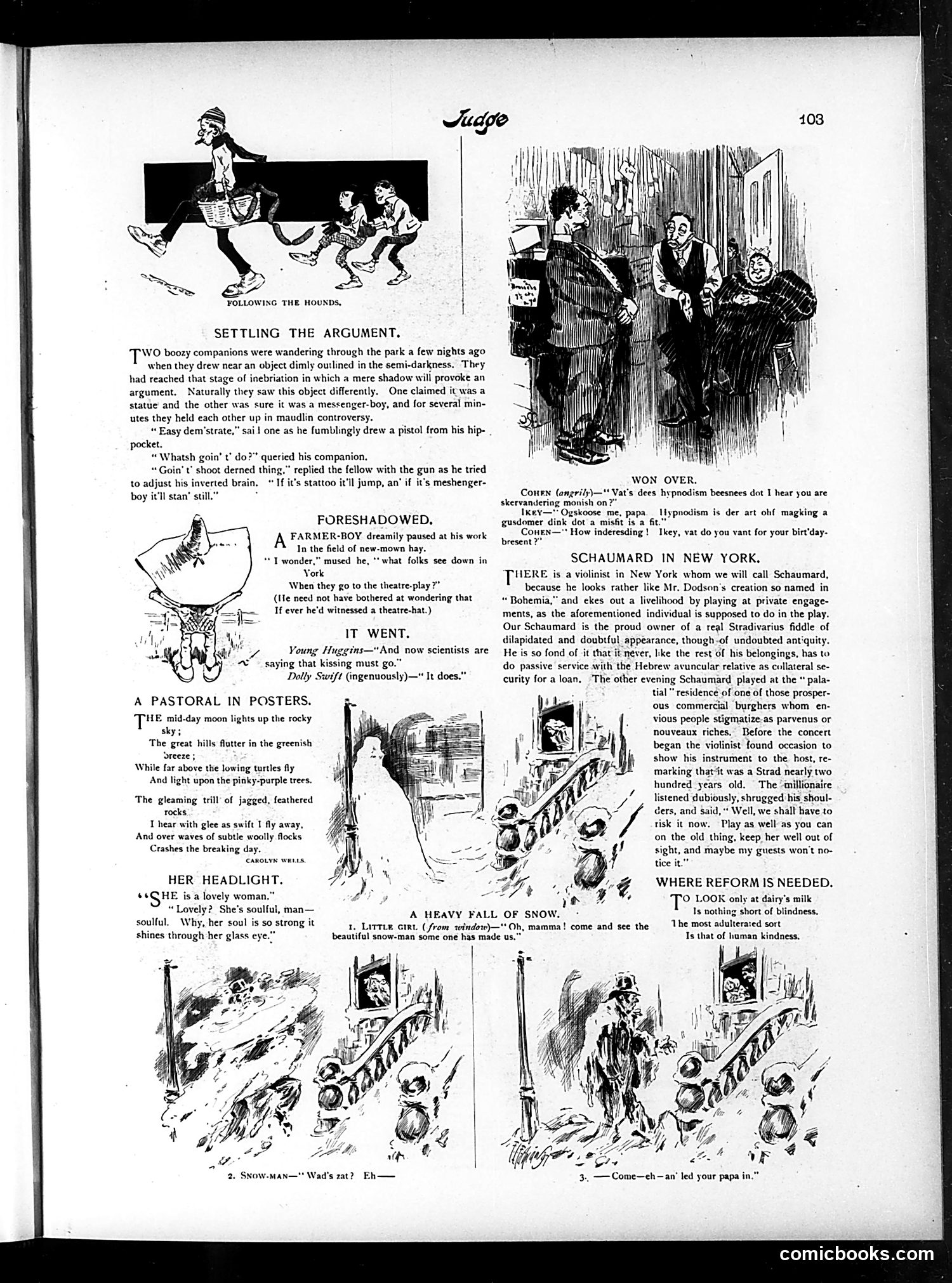
This page contains multiple short satirical pieces typical of Judge magazine's humor: **"Settling the Argument"** mocks drunkenness through two inebriated men who debate whether a dark object is a statue or messenger boy, then absurdly attempt to "test" it with a pistol. **"Schaumard in New York"** references a character from Murger's *Bohemia*, satirizing a struggling violinist who owns a valuable old Stradivarius violin. The joke: a wealthy nouveau riche host is dismissively skeptical of its age and value, essentially treating a priceless instrument carelessly—mocking both the host's philistinism and nouveau riche attitudes toward art and antiquity. **"Where Reform Is Needed"** offers a brief social commentary contrasting pure dairy milk (straightforward) with "human kindness" (adulterated/fake)—suggesting widespread insincerity in human relations. Other items are lighter puns and observational humor about theater-goers, kissing scientists, and absurdist poetry. The page demonstrates Judge's mix of social satire and gentle comedic sketches targeting American urban life and bourgeois pretensions.
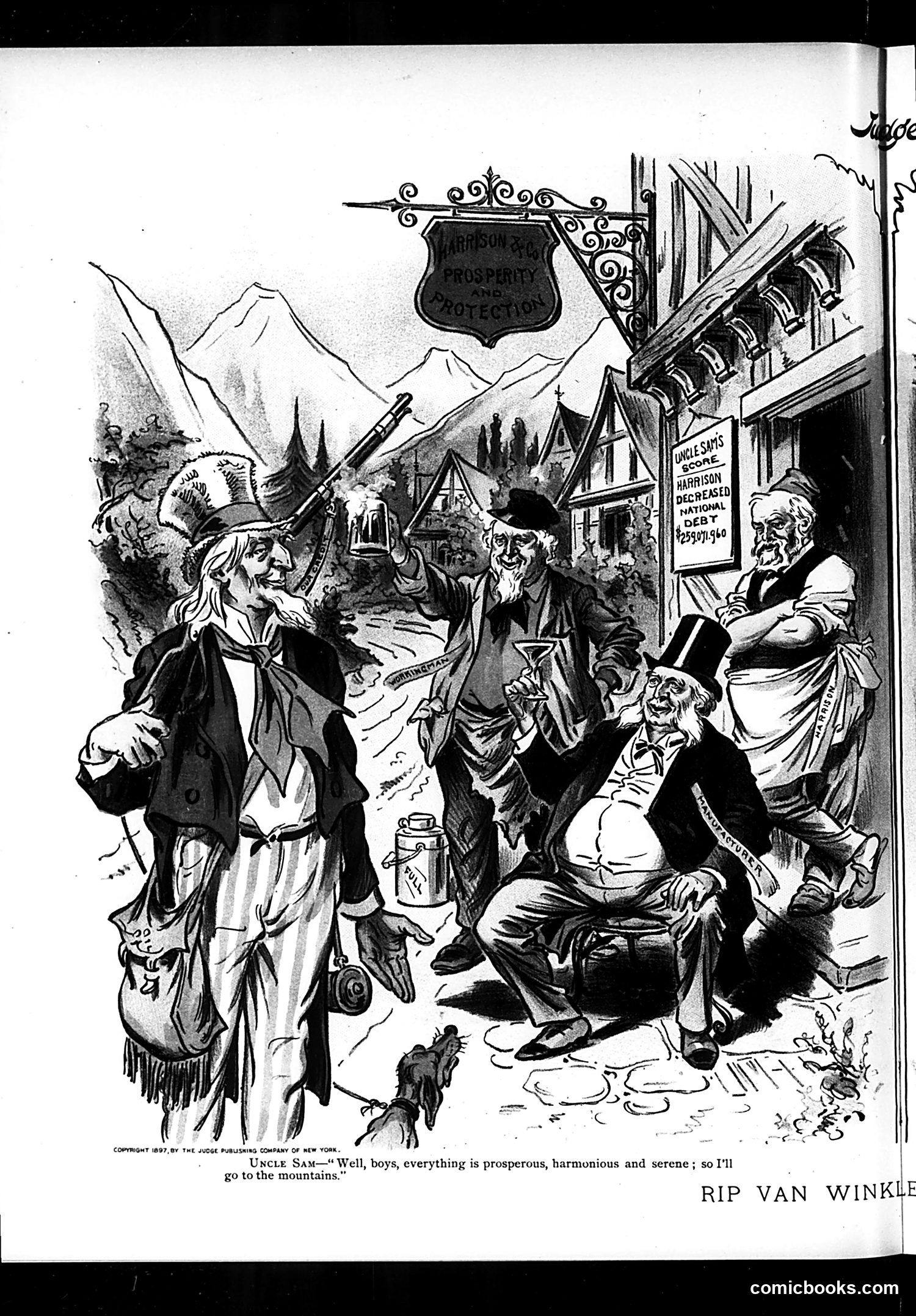
This Judge cartoon satirizes Uncle Sam's naive optimism about America's condition. The title references Washington Irving's "Rip Van Winkle," the man who slept through major historical events. Uncle Sam declares everything "prosperous, harmonious and serene" before departing to the mountains—suggesting he's about to become oblivious like Rip Van Winkle. Meanwhile, the surrounding figures appear to represent various social or economic troubles: a sign visible mentions "Harrison" and "National Debt," indicating financial crisis. The caricatured men around him look distressed or scheming. The cartoon's point: Uncle Sam is willfully ignoring serious problems (likely economic turmoil from the Harrison administration era), choosing escapism rather than leadership. By evoking Rip Van Winkle, the cartoonist warns that such negligence allows crises to worsen unchecked.
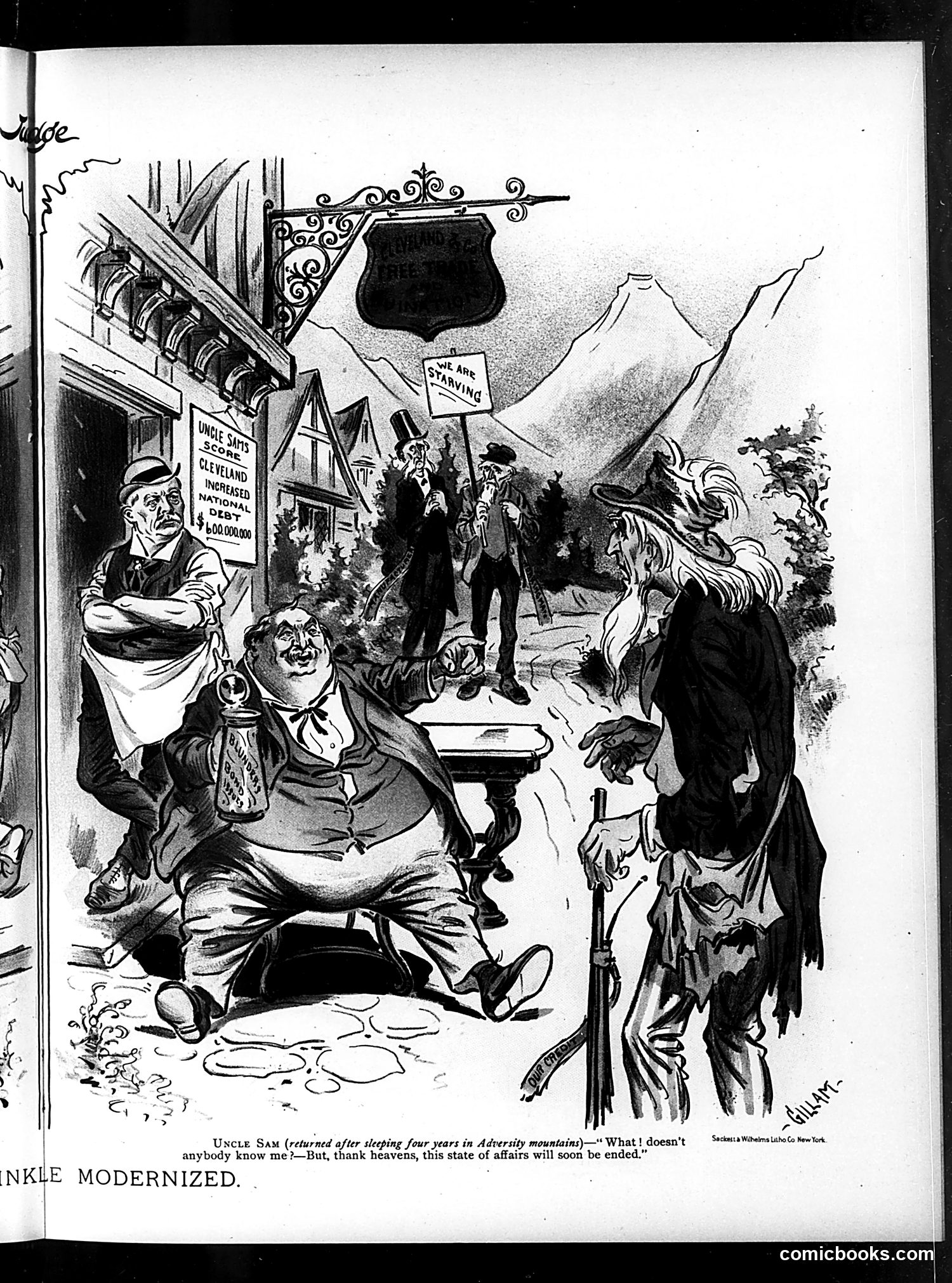
This cartoon depicts Uncle Sam awakening from a four-year sleep "in Adversity mountains," suggesting economic hardship or depression. He appears disheveled and unrecognized, lamenting that nobody knows him anymore. The signs visible reference business failures ("Uncle Sam Cleveland Incinerator Debt $300,000.00") and urban decay. The well-dressed figures in the background represent the wealthy or business class, seemingly indifferent to Uncle Sam's plight. The satire critiques how economic adversity has diminished American prosperity and national pride. Uncle Sam's optimistic closing—"this state of affairs will soon be ended"—likely reflects contemporary hopes for economic recovery, though whether sincere or ironic is unclear from the image alone. The cartoon's title suggests modernization has failed the nation during this difficult period.
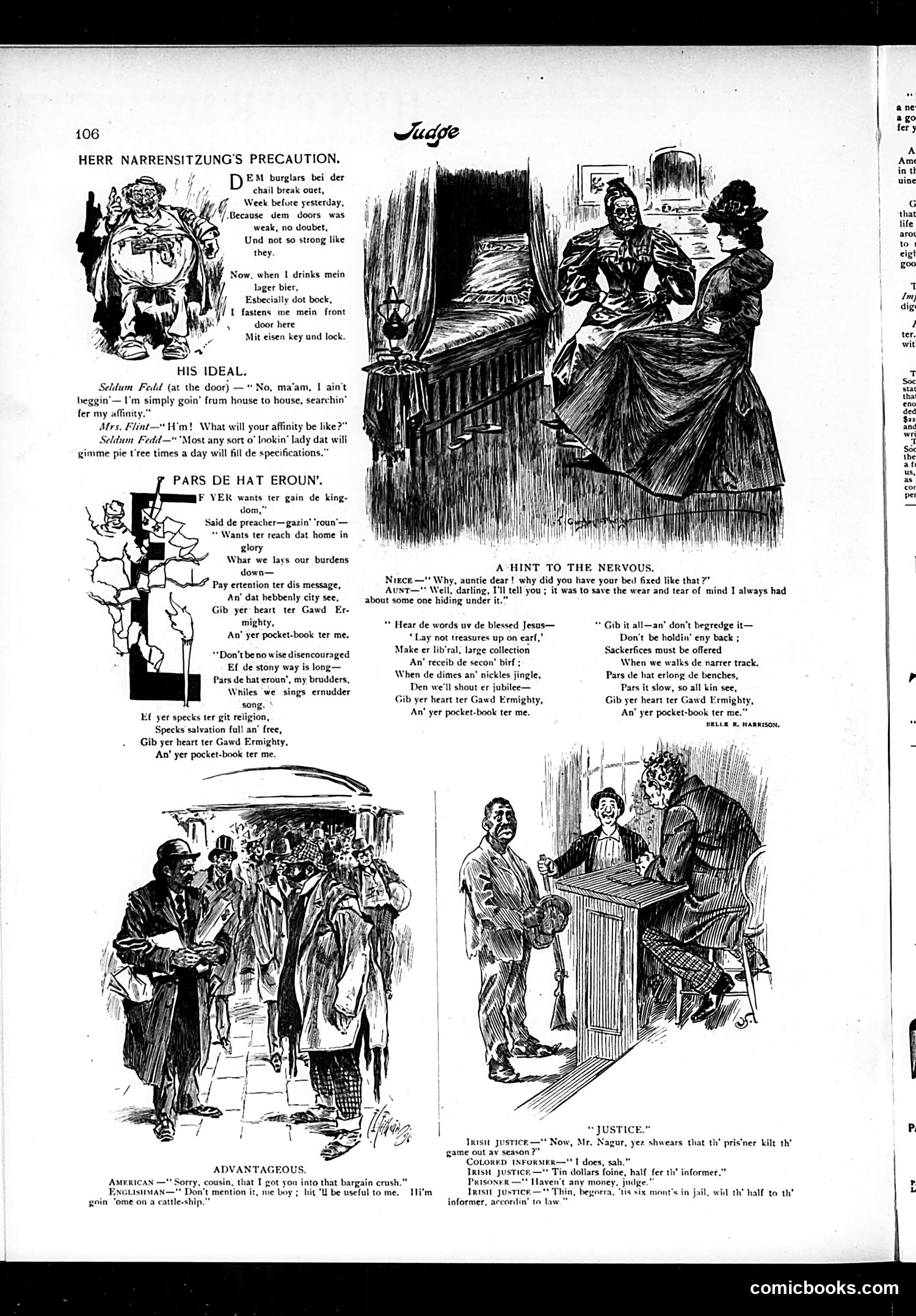
This Judge page contains several distinct satirical pieces mocking different social groups: **"Herr Narrensitzung's Precaution"** ridicules German immigrants through dialect humor—a man with a thick accent describes over-securing his front door with an "iron key and lock" after hearing of a burglary, suggesting comical paranoia. **"Pars De Hat Eroun'"** satirizes corrupt Black preachers who sermonize about spiritual devotion while openly requesting donations ("Gib yer heart ter Gawd...An' yer pocket-book ter me"). The dialect speech reflects period racist stereotyping. **"Justice"** mocks both Irish and Black legal systems, depicting bribery and corruption where judges and informers profit from prisoners. **"His Ideal"** presents a vagrant seeking an "affinity"—a woman providing meals—as his life goal, mocking working-class aspirations. These pieces reflect Judge's consistent use of ethnic and racial caricature for satirical effect, targeting immigrants, African Americans, and the poor as sources of humor and social criticism.
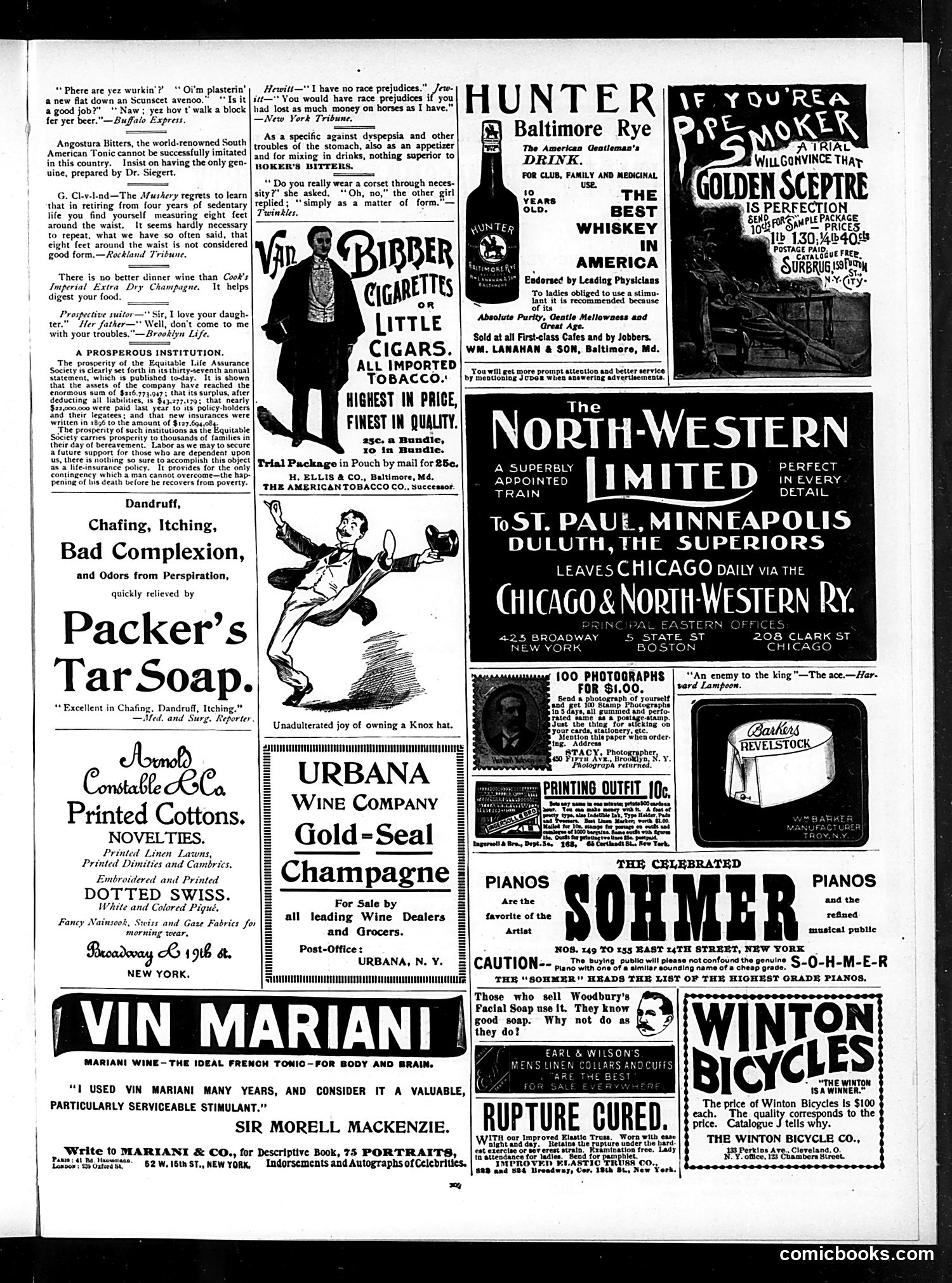
This is primarily an **advertising page** from Judge magazine, with minimal editorial content. The few visible cartoons/jokes include: **Political cartoon**: A brief reference to President Cleveland, joking that after four years of "sedentary life," he's gained weight—measuring "eight feet around the waist." The satire targets his post-presidency physical appearance. **Social humor**: Small captioned jokes mock contemporary life—Irish laborers complaining about construction work conditions, courting etiquette, and women's fashion (corsets worn "as a matter of form" rather than necessity). **Context**: These reflect early 1900s American concerns: immigration/dialect humor, class anxieties, gender conventions, and political personalities. The page is dominated by period advertisements for whiskey, champagne, bicycles, pianos, soap, and other consumer goods—typical Judge content where advertising subsidized satirical commentary. The ads themselves reflect era-specific products and medical claims (bitters as digestive aids, for instance).
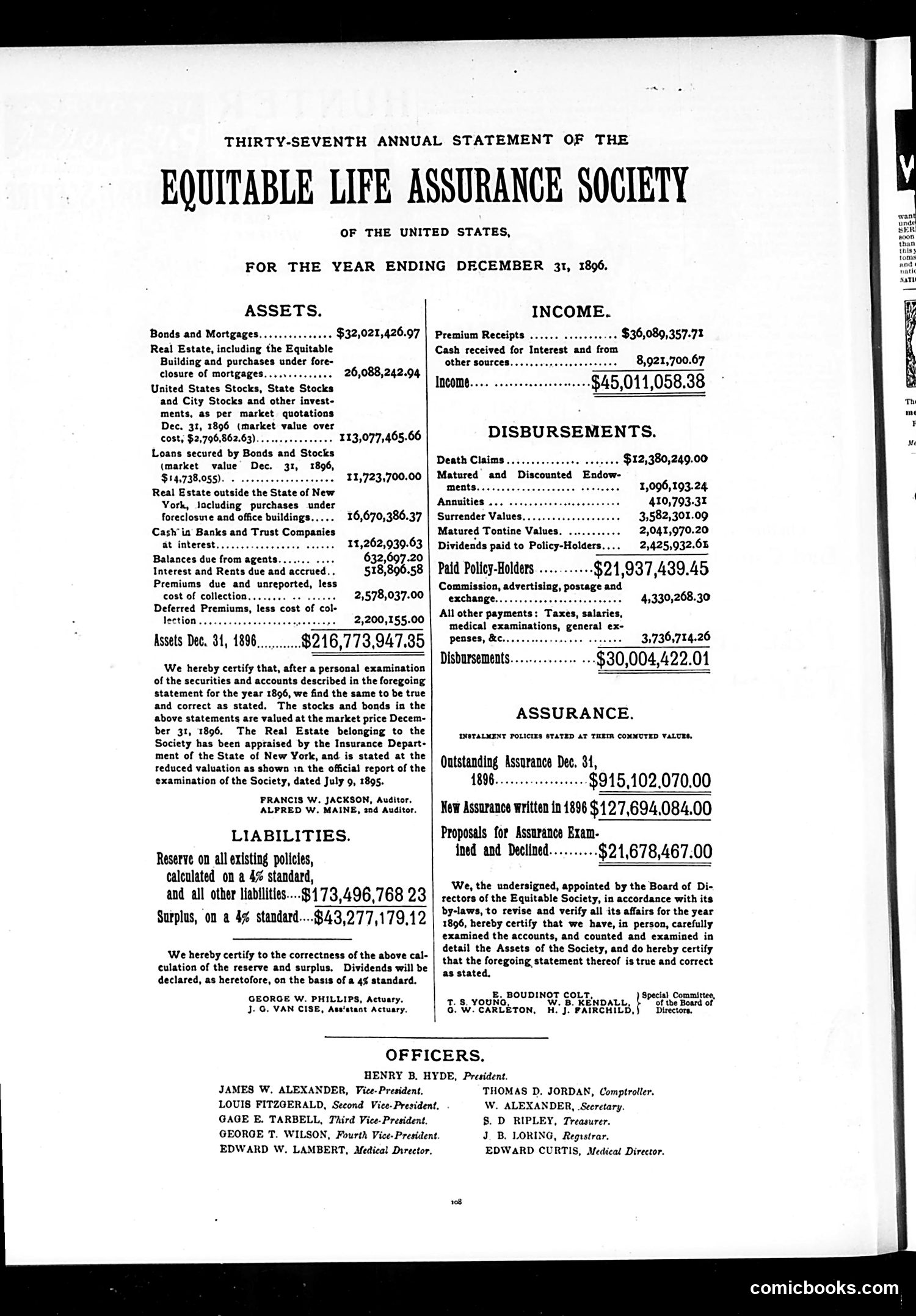
This page is not a cartoon but rather a financial statement—specifically, the **Thirty-Seventh Annual Report of the Equitable Life Assurance Society for 1896**. The document is a straightforward accounting of the insurance company's assets (~$216 million), income, disbursements, and liabilities, signed by auditors and officers including President Henry B. Hyde. It details policy reserves, death claims paid, and new assurance written that year. This appears in *Judge* likely because the magazine published important business documents of public interest, or as advertising paid by the company. There is no satirical cartoon or political content visible on this page—it is purely a corporate financial disclosure document from the Gilded Age era.
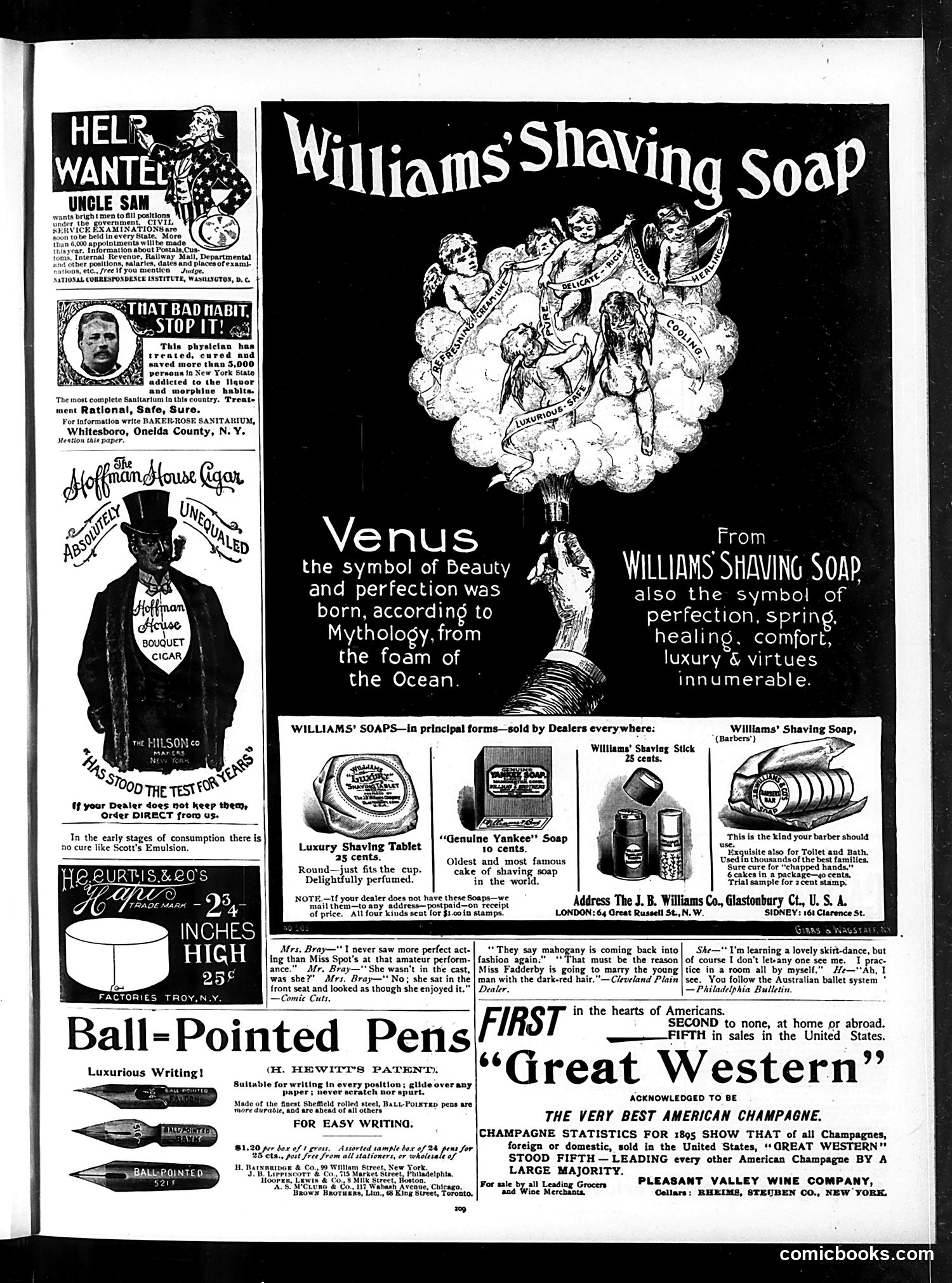
This page is primarily **advertising**, not political satire. It contains multiple product advertisements typical of late-19th-century magazines: **Key advertisements include:** - **Williams' Shaving Soap** (prominent, center): Uses Venus imagery to market shaving products - **Ball-Pointed Pens**: Marketed as durable writing instruments - **Baker-Rose Sanitarium**: Treats alcohol and morphine addiction - **"Great Western" Champagne**: Claims statistical superiority among American champagnes **Notable elements:** - A small **Uncle Sam recruitment ad** (top left) mentions civil service exams - Brief **comic captions** about amateur theater performances and dance lessons appear between ads—typical Judge humor but unrelated to larger satire - The **Venus imagery** in the shaving soap ad uses classical mythology for upscale product positioning **For modern readers:** This reflects how 19th-century magazines mixed editorial content with dense advertising. The ads reveal period concerns (addiction treatment, masculine grooming) and marketing strategies (celebrity endorsement, classical allusions, statistical claims).
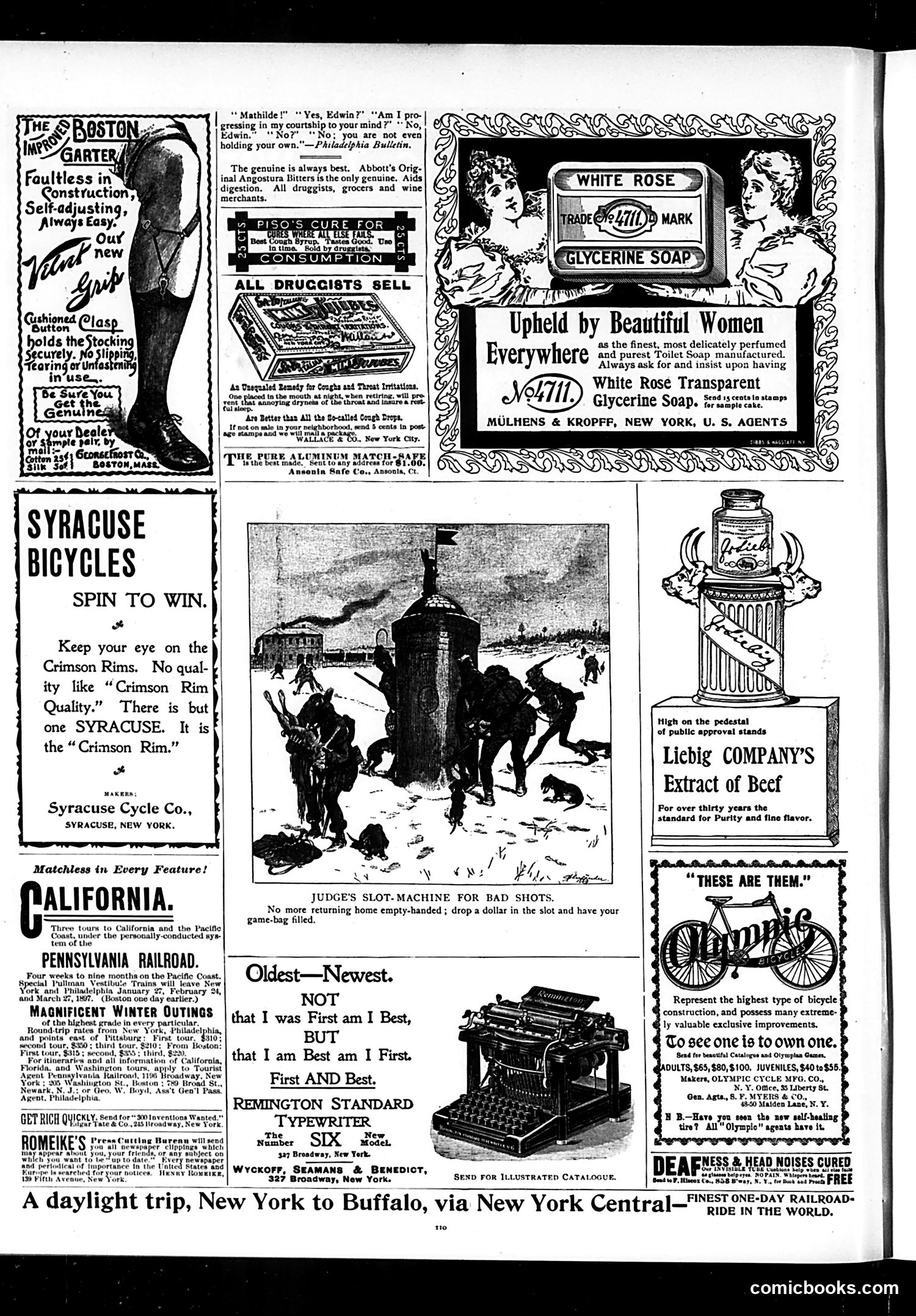
This page is primarily **advertising**, with one small cartoon at the top. The cartoon shows a couple's conversation: "Mathilde" asks Edwin if he's making progress in courting her. She replies he's "not even holding your own"—a pun suggesting his courtship is failing, literally and figuratively. The rest of the page consists of period product advertisements typical of early 1900s Judge magazine: patent medicines (Abbott's Angostura Bitters for digestion), hygiene products (White Rose Glycerine Soap), bicycles (Syracuse and Olympic brands), typewriters (Remington), beef extract (Liebig's), and railroad travel packages. Notable is the cartoon titled "Judge's Slot-Machine for Bad Shots"—a satirical illustration showing a winter scene where hunters deposit money in a slot machine to receive game; it mocks both gambling and poor hunting skills. The ads reflect contemporary consumer culture and Judge's affluent readership interested in leisure activities, travel, and new technologies.
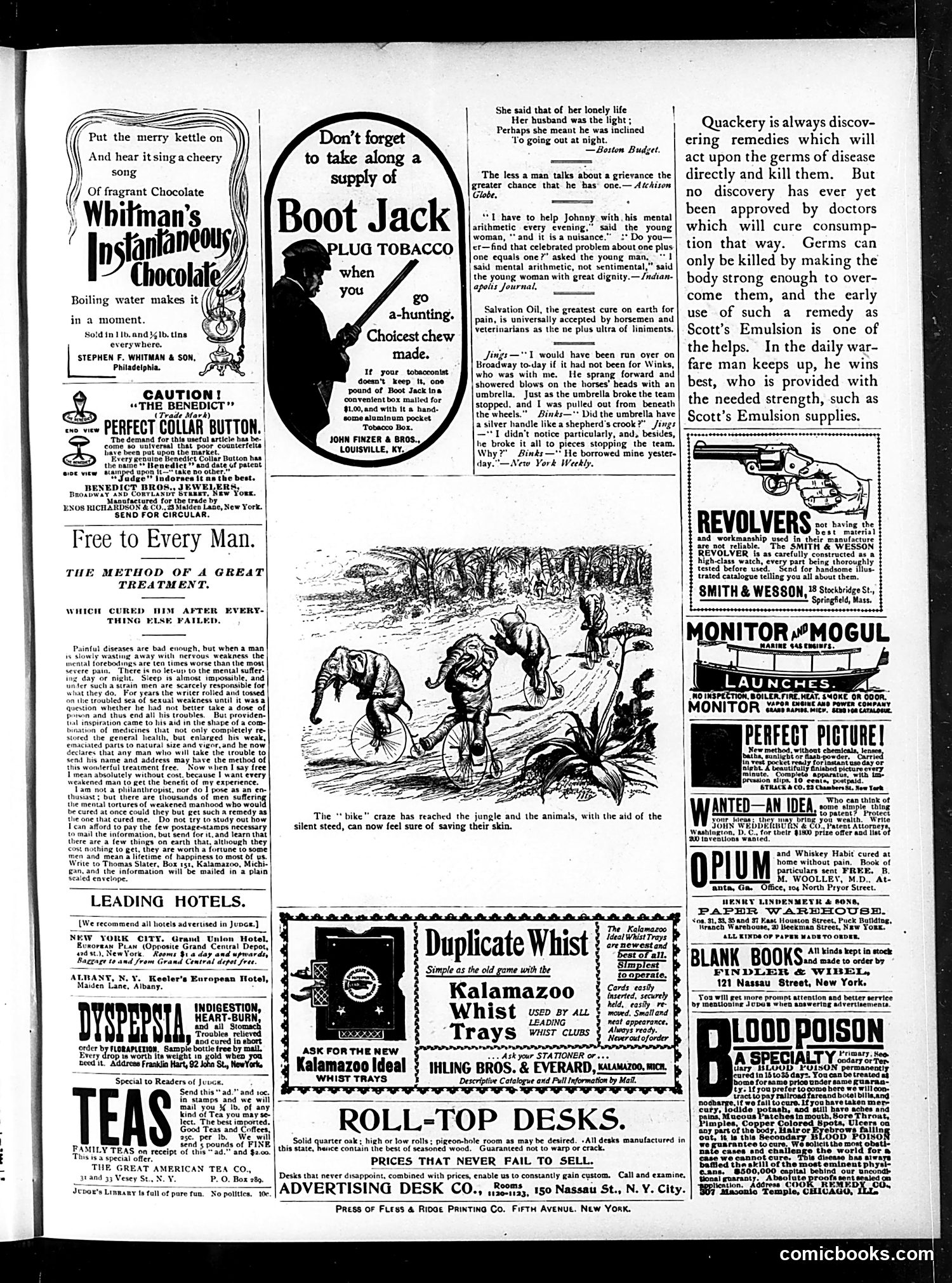
This is primarily an **advertising page** from Judge magazine, not a political cartoon. The page contains various product advertisements (chocolate, collar buttons, hotels, tobacco, tea) interspersed with small humorous items. The notable content includes: **Two brief joke snippets** with social commentary: - A quip about a wife whose husband is "the light" of her lonely life—but he's always going out at night (suggesting infidelity or neglect) - A comment that men who complain least about grievances often have the worst ones **A longer medical advertisement** promoting a "free" treatment for male "sexual weakness" and "nervous exhaustion"—typical of era advertisements exploiting male insecurity with pseudoscientific claims. **The central illustration** shows a bicycle accident with the caption about a "bike" craze reaching the jungle. This references the 1890s bicycle mania sweeping America. The page reflects late-19th-century concerns: anxieties about male potency, emerging technology (bicycles), and satirical jabs at everyday marital tensions.
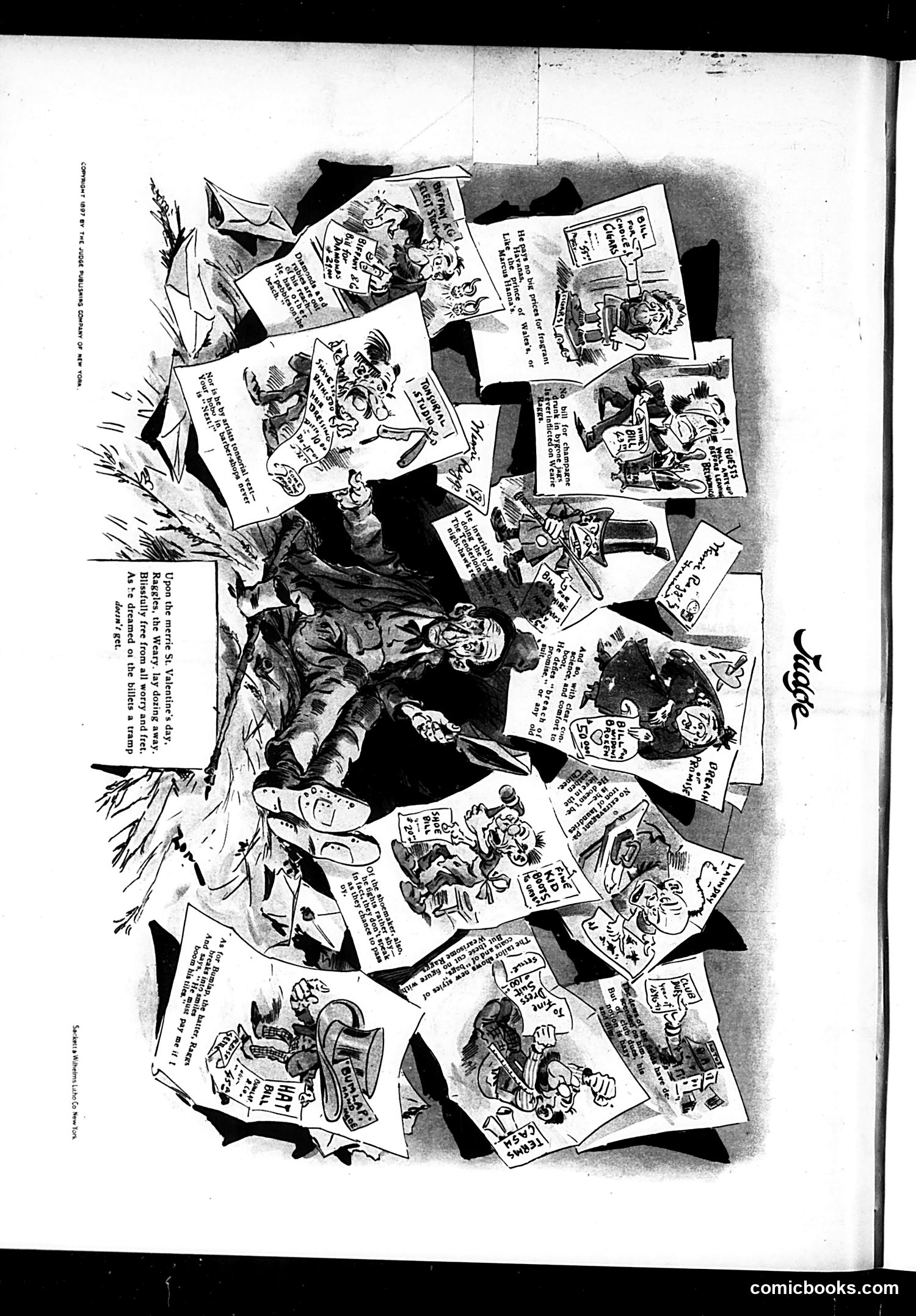
This appears to be a satirical cartoon from *Judge* magazine showing a central figure (likely a political or social figure) surrounded by scattered papers or pamphlets. The composition suggests chaos or bombardment of information/criticism. The OCR text is largely illegible, making specific identification difficult. However, the visual structure—a person overwhelmed by flying documents—typically satirizes a public figure being attacked by press, scandals, or competing political messages. The signature and lithographer credit (Sackett & Wilhelms) indicate professional publication. Without clearer text or visible identifying features, I cannot definitively name the subject or specify the exact political event referenced. The cartoon's point appears critical of the figure's circumstances or public reception, but the specific satire remains unclear from this reproduction.