
A complete issue · 16 pages · 1896
Judge — October 3, 1896
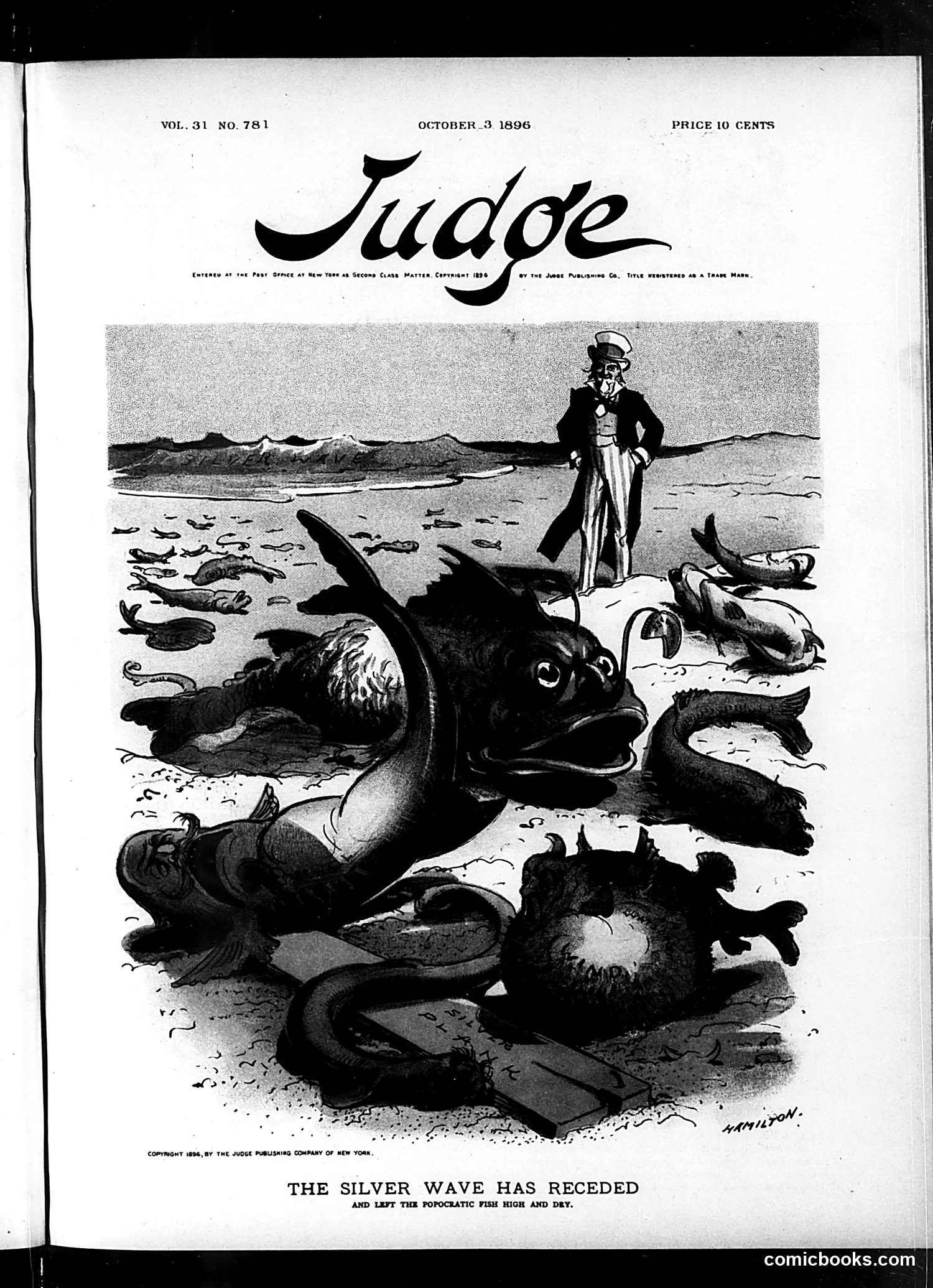
This political cartoon satirizes the collapse of the "free silver" movement in American politics. Uncle Sam (identifiable by his characteristic costume and top hat) stands surveying a beach littered with dead fish and marine creatures. The caption "THE SILVER WAVE HAS RECEDED AND LEFT THE PISCATORIAL FISH HIGH AND DRY" uses maritime metaphor to mock the silver issue's defeat. The "silver wave" refers to the populist push for unlimited silver coinage, championed by William Jennings Bryan in the 1896 presidential campaign. The cartoon suggests this political movement has retreated, leaving its supporters stranded like beached fish. The dead fish represent those who backed the silver cause, now abandoned and defunct.
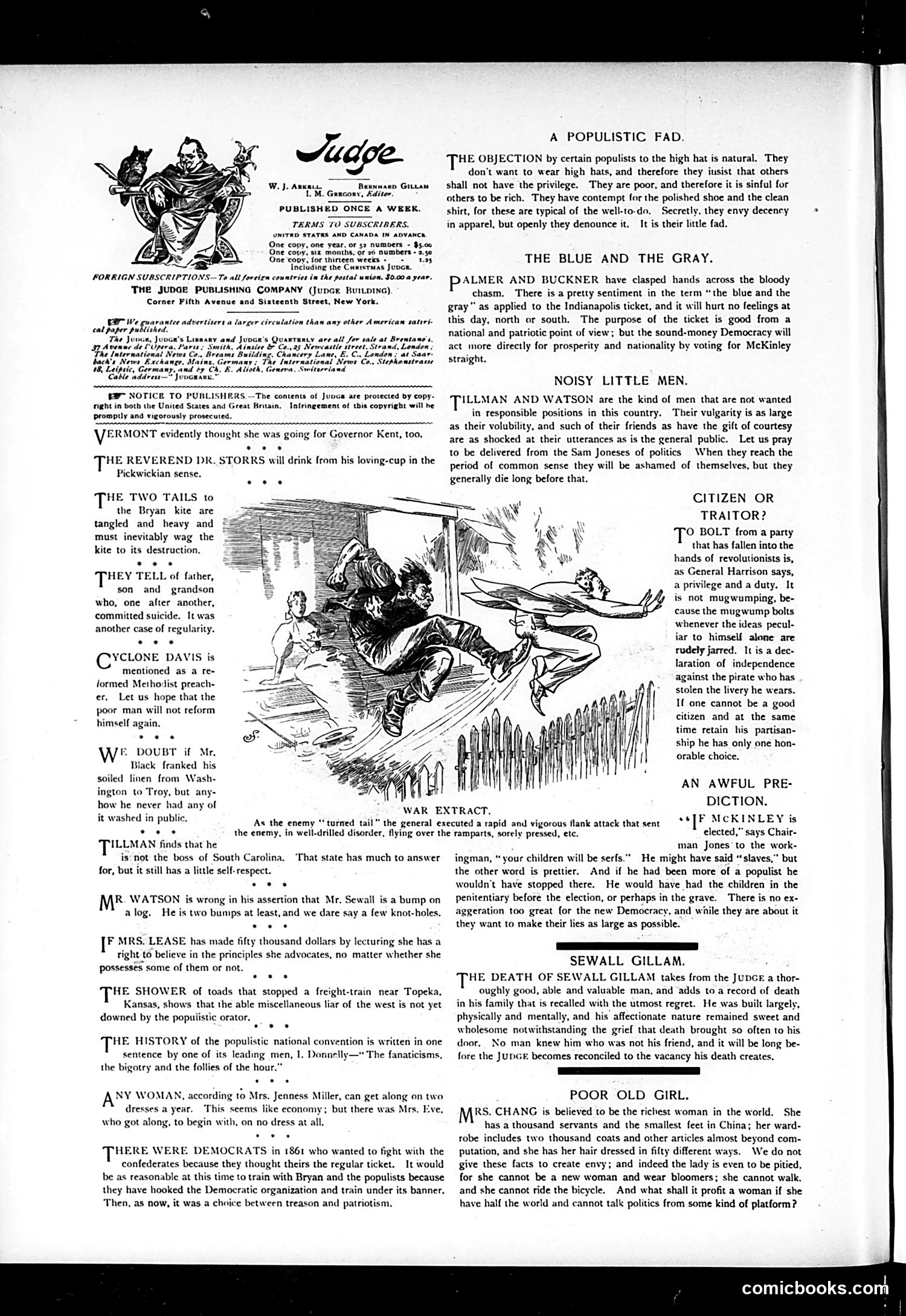
This page contains political commentary and short satirical pieces typical of Judge magazine's format. The main cartoon (center) depicts what appears to be a military or political conflict scenario with figures in combat or flight. The text pieces critique various political figures and movements of the era: - "A Populistic Fad" mocks populist objections to wealth inequality - "The Blue and the Gray" references Palmer and Buckner's political positioning - "Noisy Little Men" attacks Tillman and Watson as unsuitable for office - "Citizen or Traitor?" questions whether bolting from a political party constitutes patriotism The commentary suggests this addresses late 19th-century American political divisions, likely involving populism, Democratic party splits, and debates over political loyalty—though specific election references aren't entirely clear from this excerpt alone.
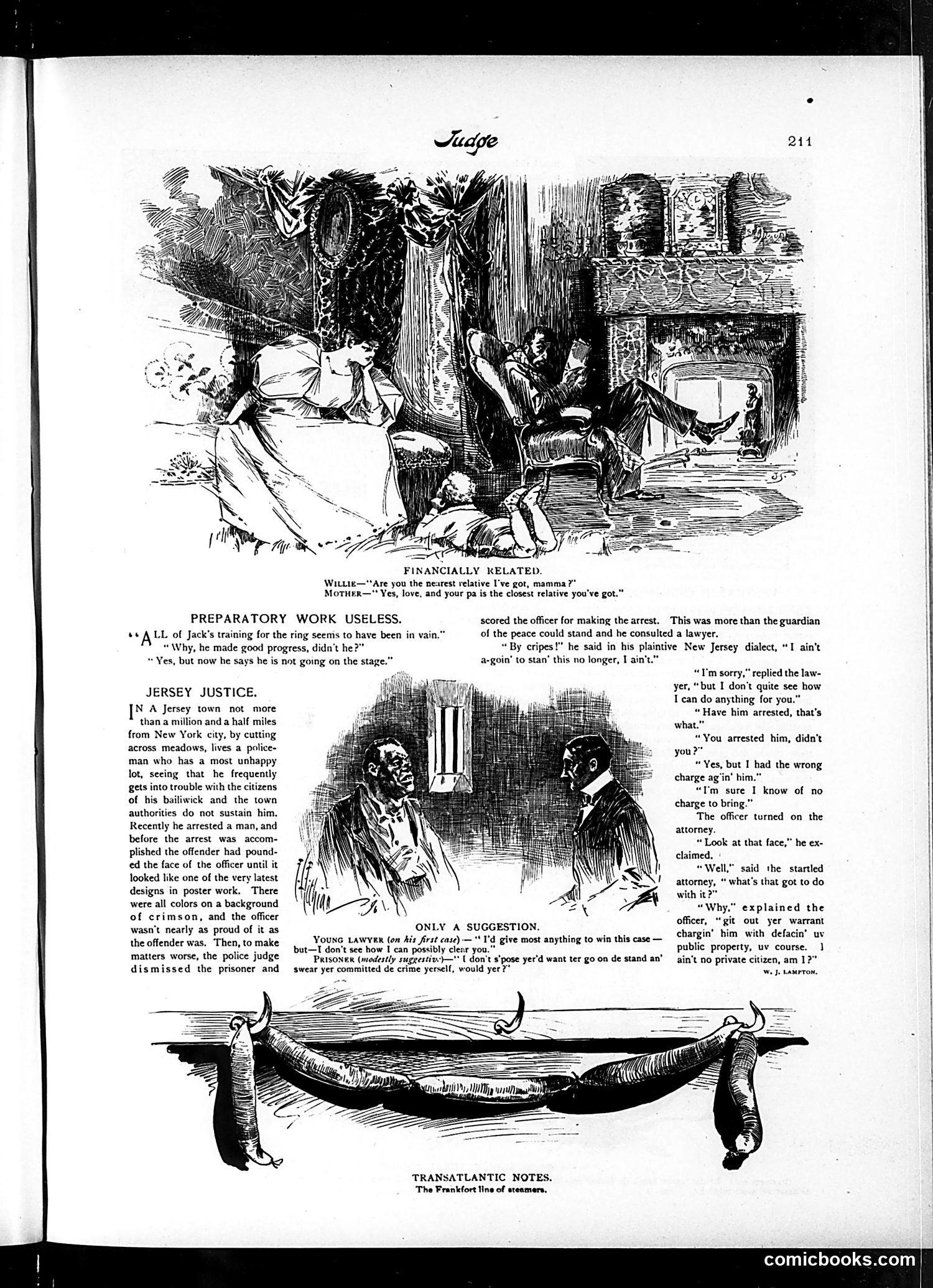
This page contains three satirical pieces about American law and justice: 1. **"Financially Related"** (top): A domestic scene where a mother tells her son Willie that his poor relative is "the closest relative you've got"—a joke about poverty and family obligation. 2. **"Jersey Justice"** (center): Satirizes New Jersey's judicial system, describing a police officer who arrests people without proper charges. The piece mocks how authorities dismiss cases and mistreat citizens, with an officer admitting he arrested someone on the wrong charge but refusing to release him. 3. **"Only a Suggestion"** (bottom): A young lawyer offers a prisoner advice to confess to crimes he didn't commit to avoid worse treatment—dark satire on coercive legal practices. The overall theme criticizes corruption and incompetence in American law enforcement and courts.
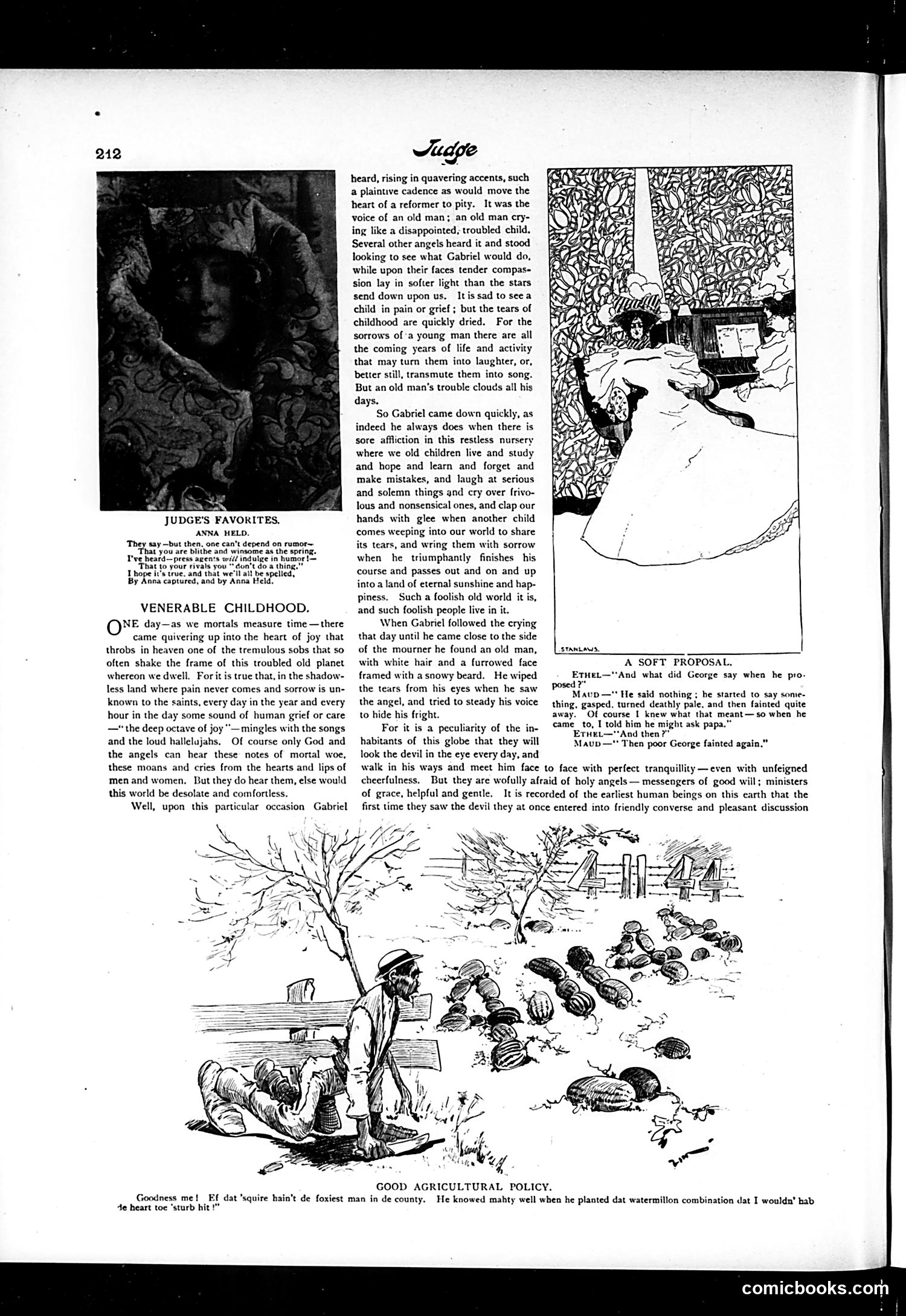
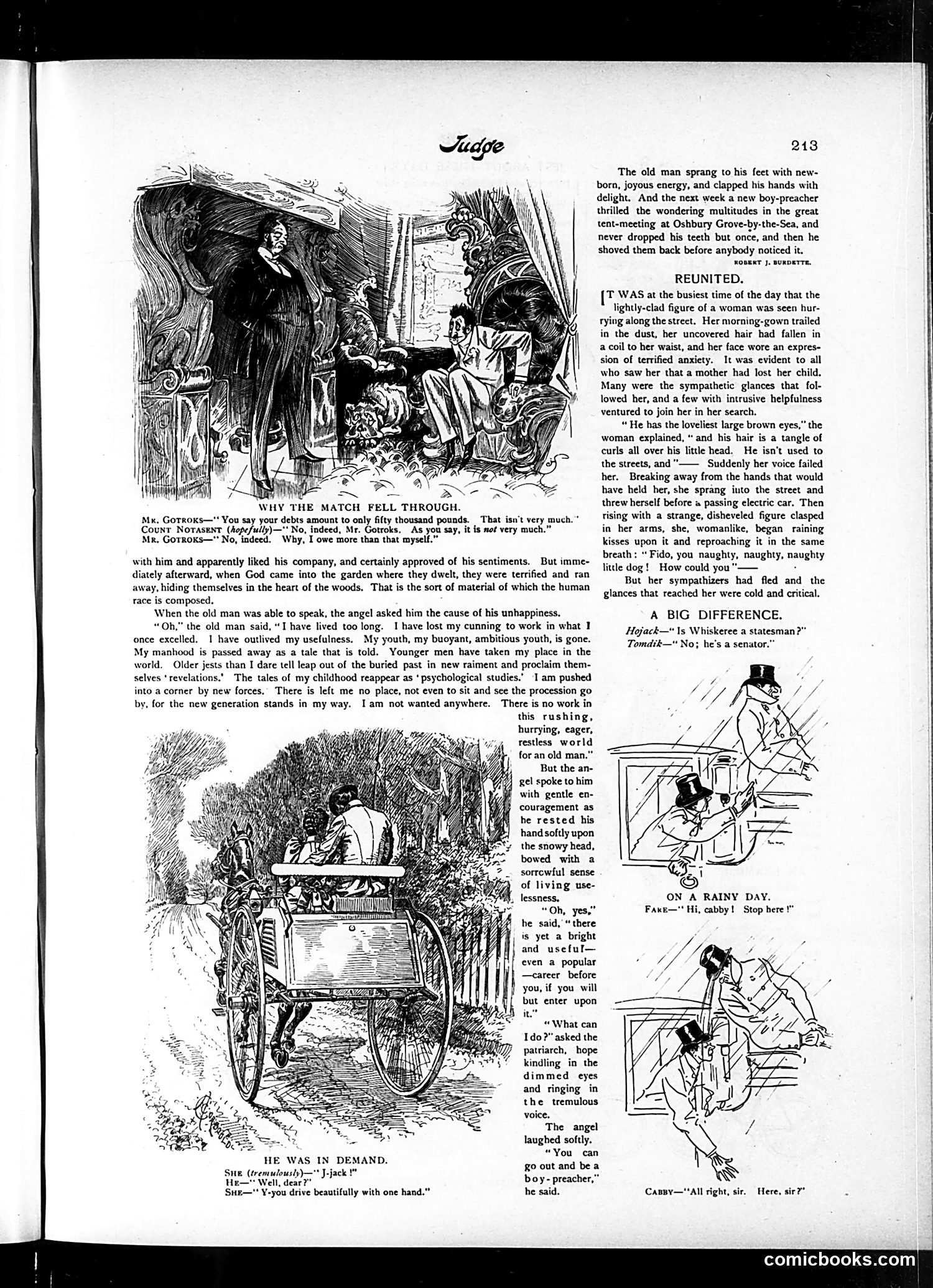
This page contains three satirical pieces: **"Why the Match Fell Through"** depicts a wealthy man rejecting a potential suitor (Count Novasent) based on debt—only to reveal he himself owes more money. The joke mocks the absurd logic of the wealthy class in marriage negotiations. **A longer story** about an old man visited by an angel, who suggests he become a "boy-preacher"—apparently a young, charismatic evangelist. The satire targets both aging men desperate for relevance and the proliferation of youthful tent-meeting preachers popular in that era. **"Reunited"** satirizes sentimental newspaper stories. A woman frantically searching for her "lost child" turns out to be chasing her dog, Fido. The sudden shift from pathos to bathos—and the critical glances she receives upon this revelation—mocks both melodramatic journalism and public moral judgment. **"A Big Difference"** is a brief joke distinguishing between a "statesman" and a "senator," implying senators lack intellectual substance compared to true statesmen.
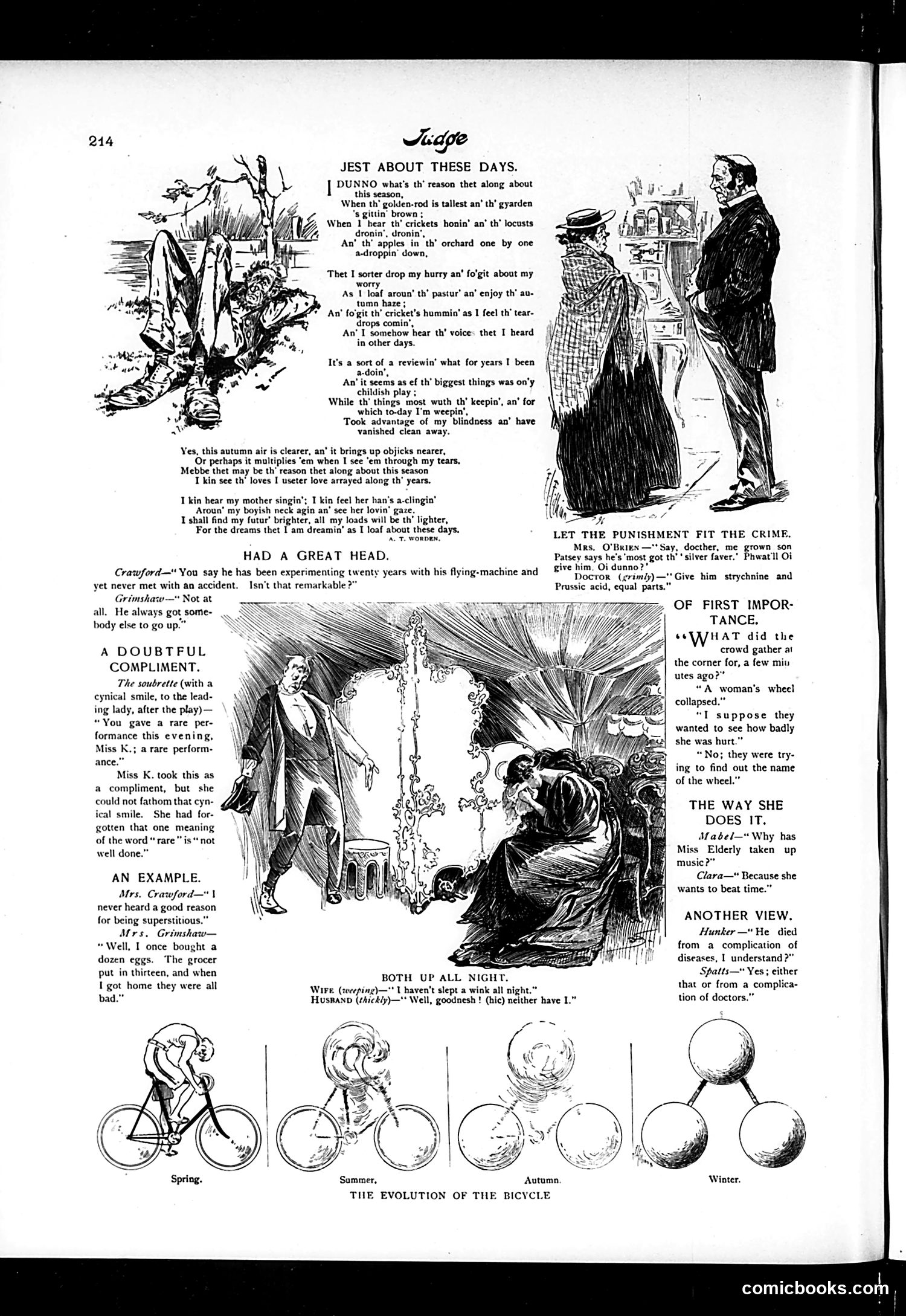
This page from *Judge* magazine contains several short satirical pieces typical of late 19th/early 20th-century American humor: **"Jest About These Days"** is a sentimental poem about autumn nostalgia—not political satire, but rather reflective humor about aging and memory. **The short jokes** mock everyday situations: a soubrette's backhanded compliment using "rare" (meaning undercooked); a woman's superstition about eggs; a sleepless couple; Irish immigrant Mrs. O'Brien seeking medical advice for her son's fever (using stage-Irish dialect); and various puns about bicycles and music lessons. **"The Evolution of the Bicycle"** at page bottom shows bicycles progressively rounder across seasons—visual humor suggesting bicycles become "fatter" or more spherical, likely mocking bicycle design trends or riders' changing physiques. The humor is largely domestic and sentimental rather than political. The Irish dialect joke reflects period attitudes toward immigrants. Overall, it represents *Judge*'s mix of family-friendly puns, visual gags, and gentle social observation rather than hard-hitting satire.
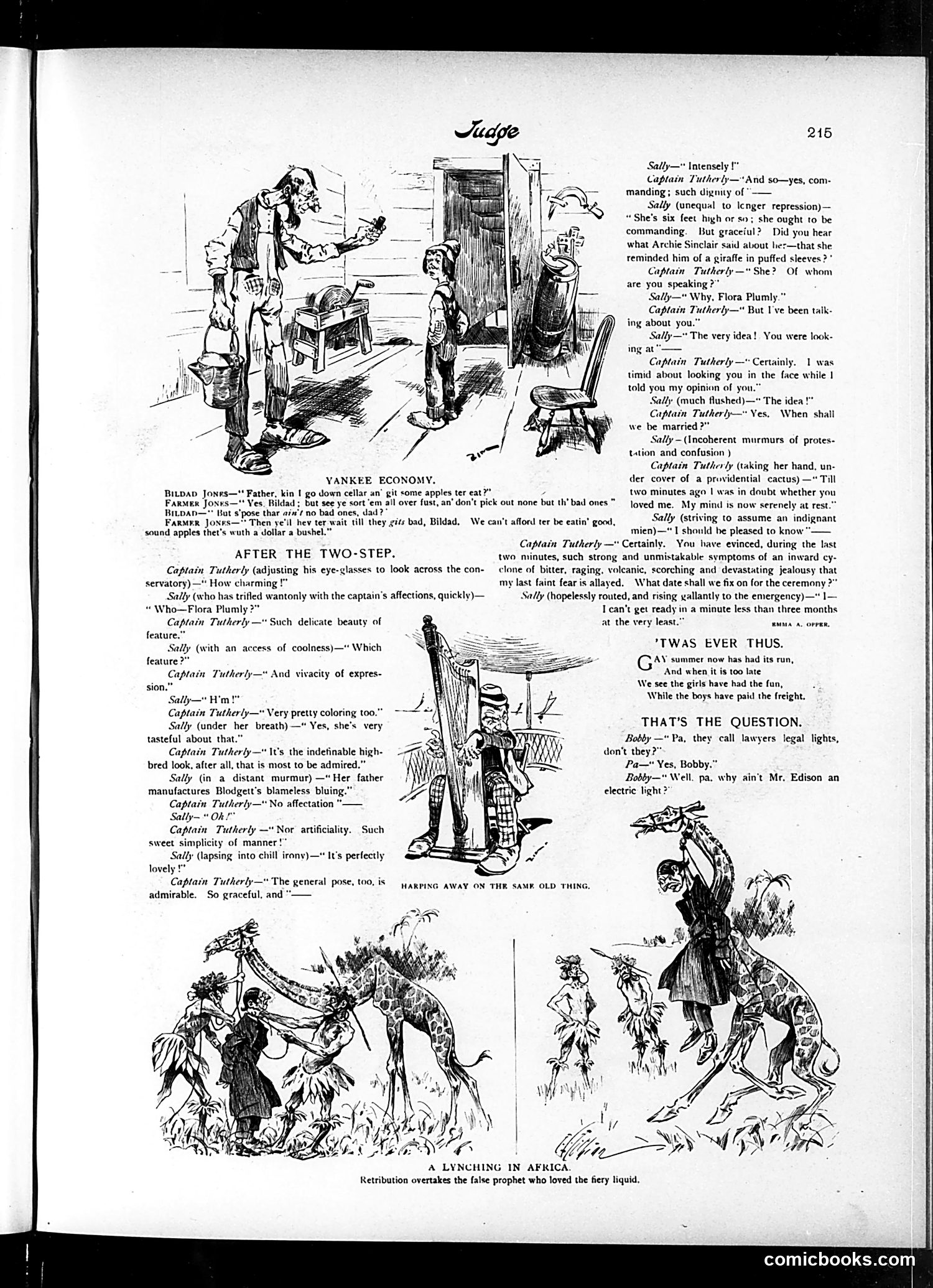
This page contains three satirical pieces typical of late-19th-century American humor: **"Yankee Economy"** mocks rural parsimony. A farmer refuses to let his son eat good apples, insisting he wait until they spoil—because sound apples are worth money. The joke targets excessive penny-pinching that defeats common sense. **"After the Two-Step"** is a romantic comedy where Captain Tutherly compliments Sally's beauty, but she's jealous because he's actually been admiring Flora Plumly. His flowery praise suddenly reveals he was complimenting *Sally* all along—a satisfying reversal that wins her over. The humor plays on romantic miscommunication and female jealousy. **"That's the Question"** is a children's joke pun: if lawyers are called "legal lights," why isn't Edison (the famous inventor) an "electric light"? **"A Lynching in Africa"** depicts violent retribution against a fraudulent prophet, presented as dark humor about justice in colonial Africa. The illustrations are typical Judge cartoons: detailed pen-and-ink drawings with witty dialogue emphasizing class differences, social pretension, and romantic entanglement.
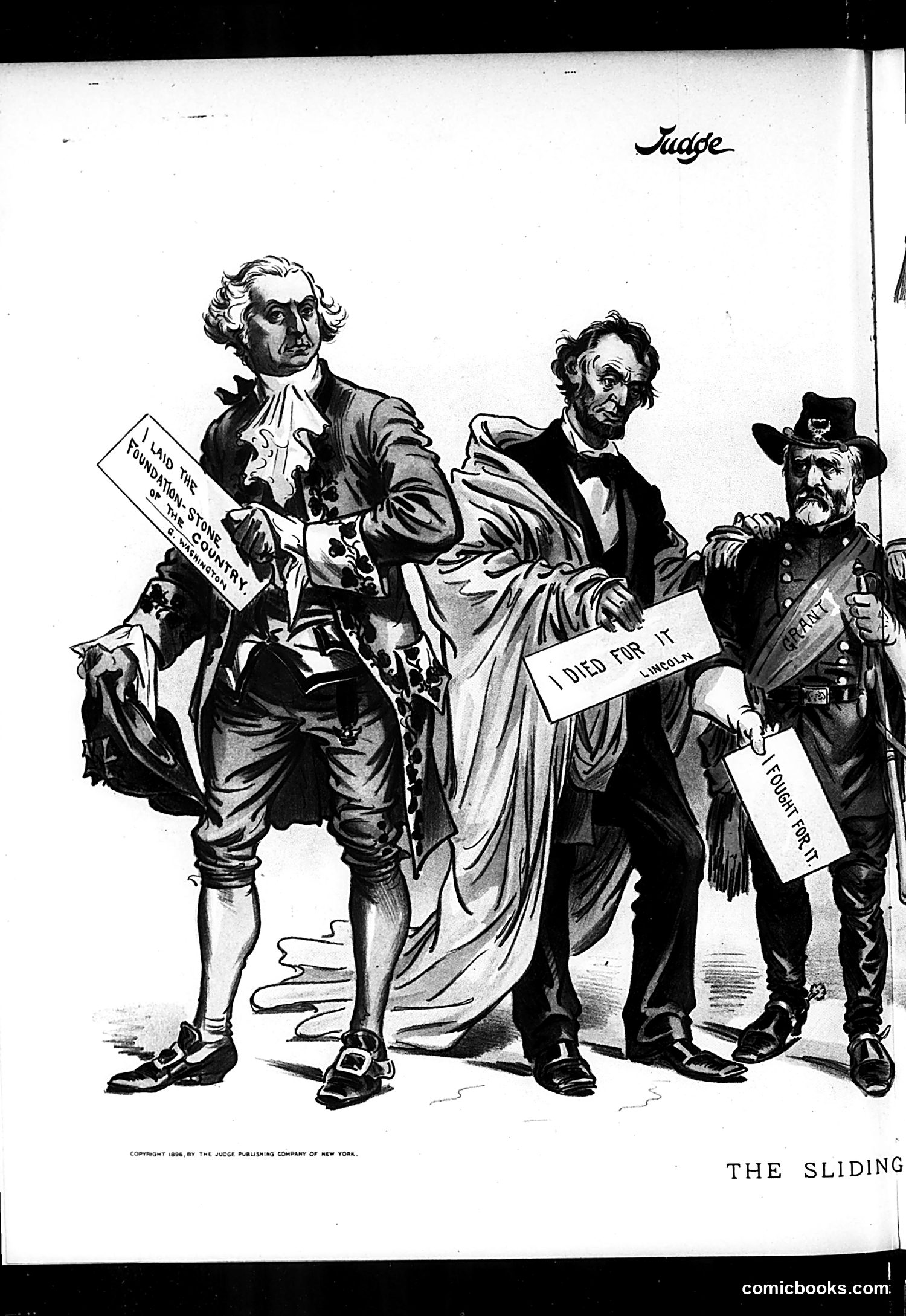
This cartoon depicts four historical figures arranged to suggest a "sliding scale" or decline. From left to right appears to be: a Revolutionary-era figure holding a "Foundation Stone" document; a 19th-century statesman; Abraham Lincoln (labeled "I DIED FOR LINCOLN"); and a military officer labeled "I FOUGHT FOR IT." The satire critiques the erosion of American ideals from the nation's founding through the cartoonist's present day. Each figure represents progressively later historical periods, suggesting that principles established by the founders have deteriorated or been compromised over time. The labels emphasize sacrifice—foundation-building, death, and military service—implying these efforts have been undermined or wasted by subsequent generations or political developments. The exact date and specific political context remain unclear without additional publication information.
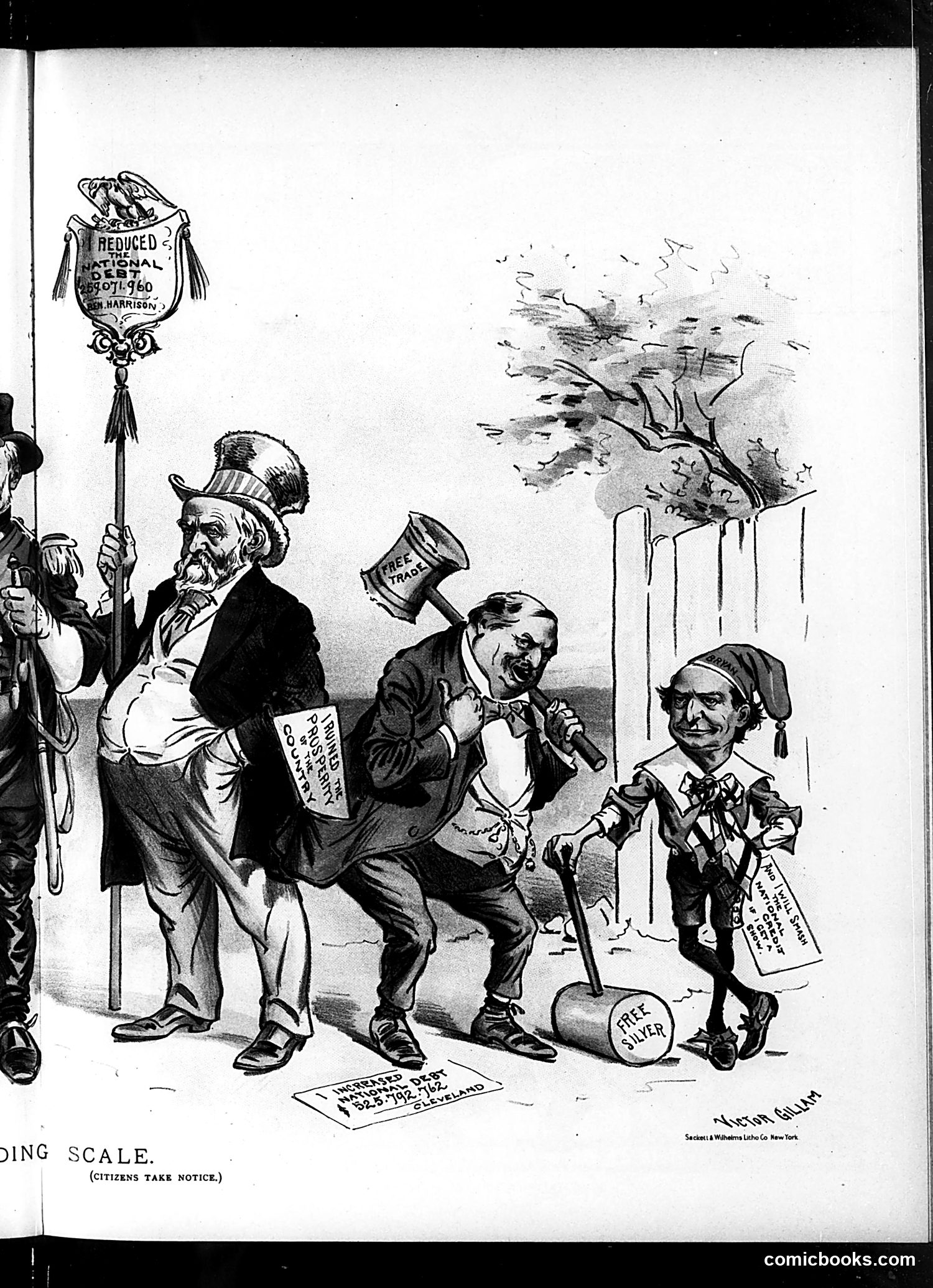
This satirical cartoon depicts figures chopping down a tree labeled "FREE SILVER" while standing on a log marked "FREE SILVER." The title "REDUCING SCALE" suggests ironic commentary on currency policy. The composition shows what appears to be political figures of different sizes (possibly representing different political factions or parties) destroying the very thing they claim to support. The figure on the left holds a staff bearing a "REDUCED" national debt seal, suggesting fiscal conservatism. The satire likely critiques the free silver debate of the 1890s—a major political division over currency policy. The joke appears to be that politicians claiming to support free silver are actually undermining it, or that the policy itself is self-destructive. The "Citizens Take Notice" caption emphasizes this is meant as a warning to the electorate about political hypocrisy regarding monetary policy.
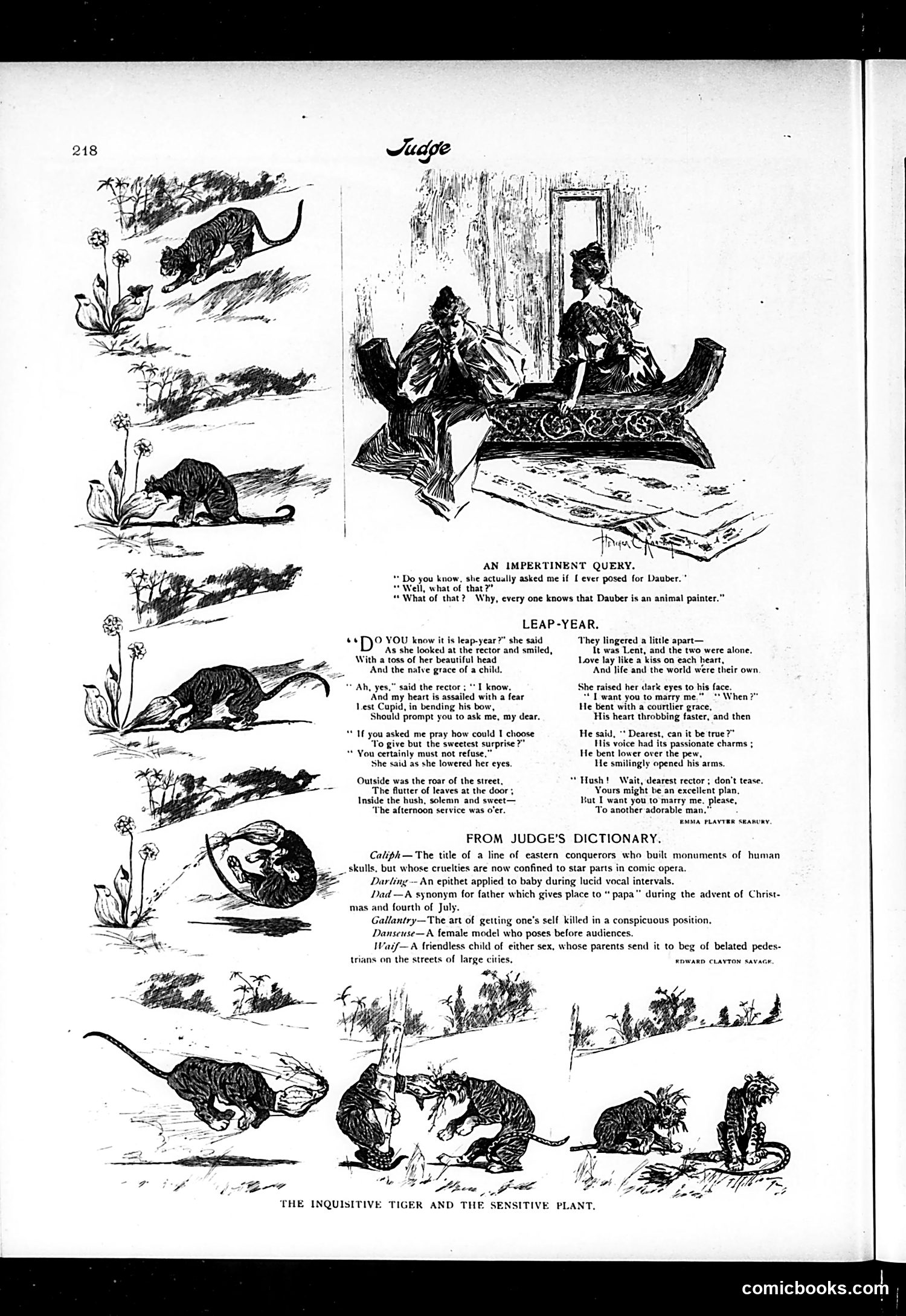
This page contains three distinct satirical pieces: **"An Impertinent Query"** mocks social pretension—a woman boasts that an artist asked her to pose, but the joke reveals "Dauber" is known only as an "animal painter," suggesting she's being compared to an animal. **"Leap-Year"** presents a romantic comedy about a woman using leap-year tradition (when women propose) to propose to a rector. The twist: she wants him to marry *her* to another man—satirizing both romantic absurdity and perhaps critiquing women's limited agency, even in leap-year role reversals. **"From Judge's Dictionary"** offers mock definitions of terms like "Caliph," "Darling," and "Waif," delivering social commentary through exaggerated definitions—for instance, a "Waif" is defined as a friendless child sent to beg by negligent parents, criticizing urban poverty and parental abandonment. The bottom illustration shows "The Inquisitive Tiger and the Sensitive Plant"—likely a fable or character commentary, though specifics are unclear. The page demonstrates Judge's characteristic blend of romantic comedy, class satire, and social criticism through humor.
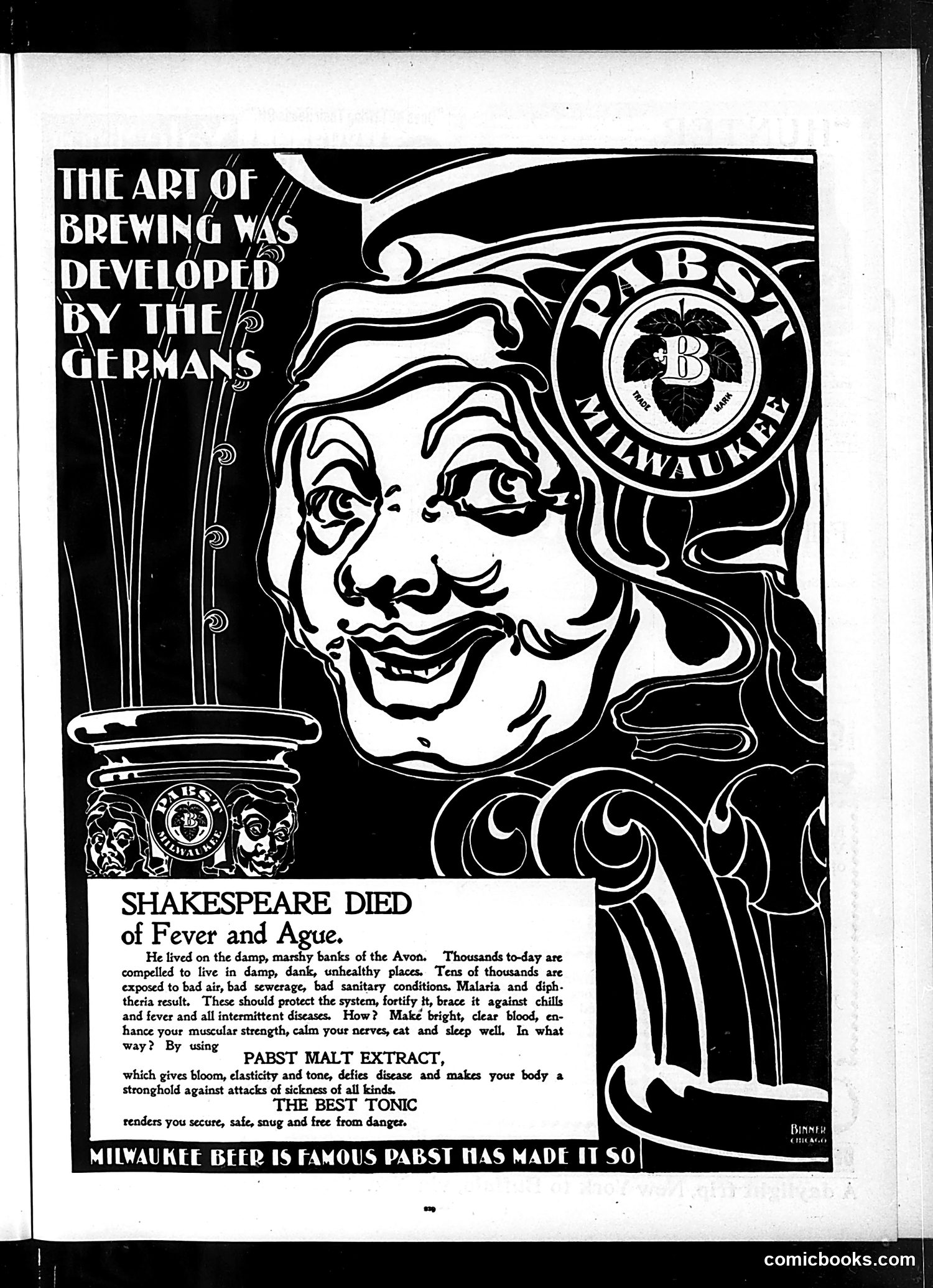
This is a **Pabst Malt Extract advertisement**, not political satire. It uses Shakespeare's death from "fever and ague" (malaria-like illness) as a hook to sell a health tonic. The caricatured face appears to represent a stereotypical German brewer—appropriate since Pabst was a German-American brewery. The ad claims that poor sanitation causes diseases like malaria and diphtheria, then positions Pabst Malt Extract as preventative medicine that "fortifies" the body. This reflects early 20th-century patent medicine marketing, exploiting public health fears to sell tonics. The historical irony: Shakespeare's actual Avon riverside location likely had nothing to do with his death, yet the ad weaponizes his name for commercial gain. The "famous Pabst has made it so" tagline emphasizes the brewery's reputation as guarantee of quality.
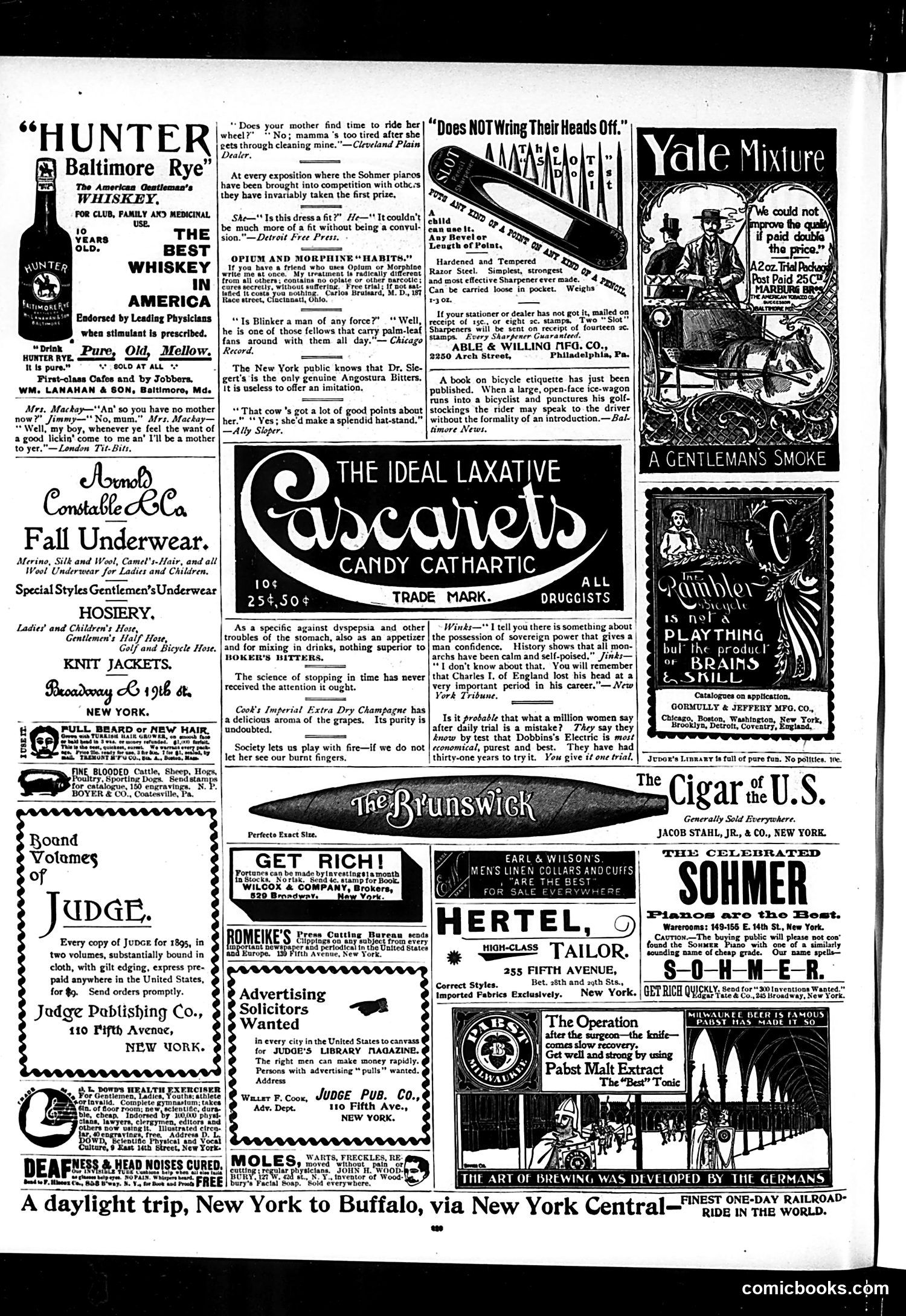
This page from *Judge* magazine is primarily **advertising**, not political satire. It contains various product advertisements typical of the 1890s era, including: - **Alcoholic beverages** (Hunter Baltimore Rye whiskey, champagne, bitters) - **Patent medicines** (treatments for opium/morphine habits, laxatives) - **Consumer goods** (underwear, razors, cleaning products, pianos) - **Publishing** (Judge Publishing Co., books) The small comic vignettes scattered throughout are brief, humor-focused anecdotes rather than political commentary—jokes about a boy without a mother, a cow as a hat-stand, and bicycle etiquette. **No prominent political figures or satire appear here.** The page reflects how *Judge* funded itself through advertising while filling space with light humor. The advertisements themselves reveal period attitudes: opium addiction treatments and "electrical" laundry solutions marketed as miracle cures are particularly notable to modern readers as evidence of pre-regulation consumer culture.
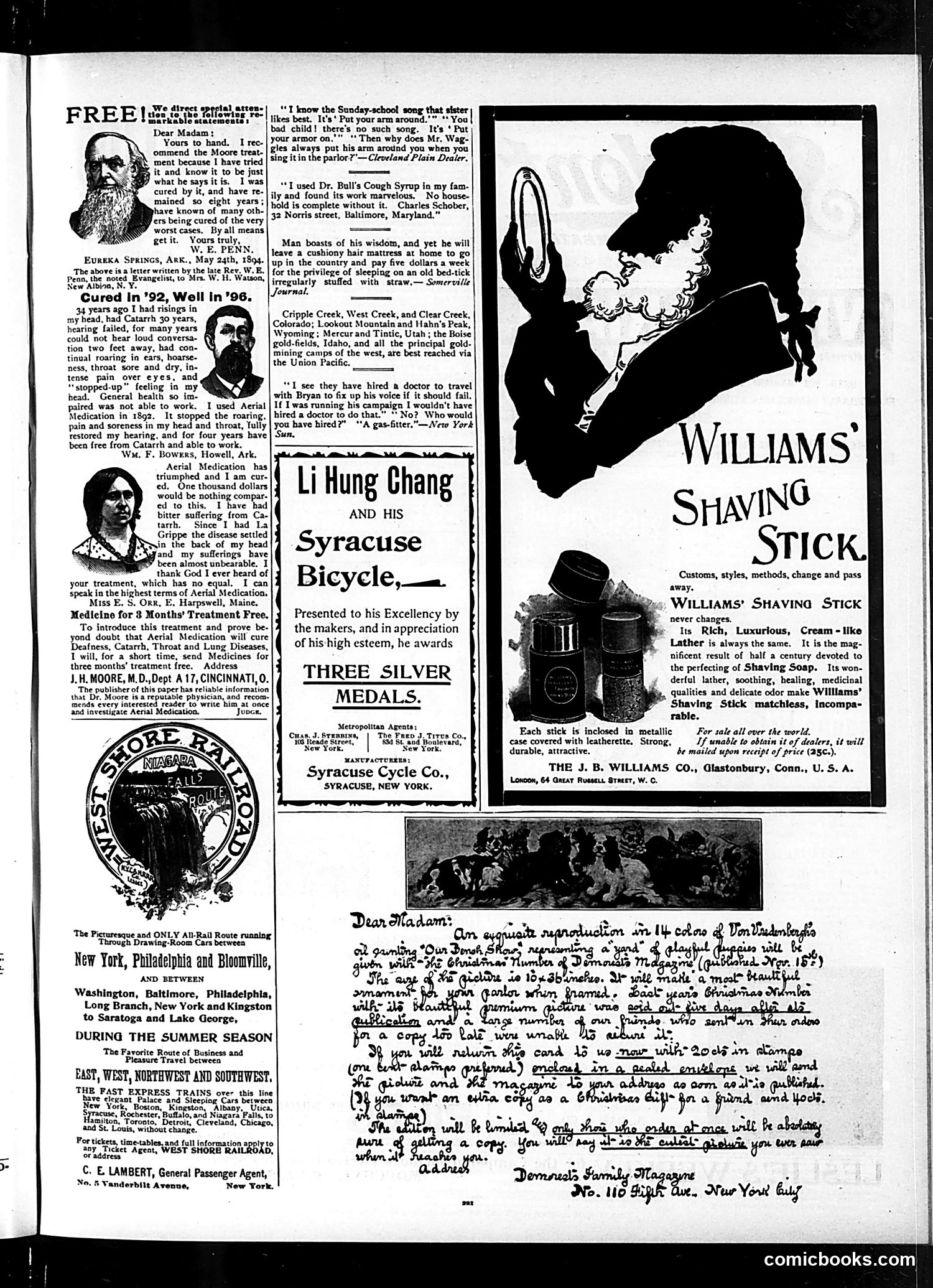
This page is primarily **advertising and product testimonials**, not political satire. The content includes: **Medical/Patent Medicine Ads:** - Multiple testimonials for "Aerial Medication" (a quack cure-all for deafness, catarrh, throat diseases) - Dr. Bull's Cough Syrup testimonials - These represent the era's unregulated patent medicine market **Product Advertisement:** - Williams' Shaving Stick (prominent right side) — a legitimate grooming product **Two Brief Jokes/Cartoons:** 1. A Sunday school innuendo joke about a song ("Put Your Armor On") and physical contact in the parlor 2. A political joke about William Jennings Bryan's 1896 presidential campaign, suggesting he needed a "gas-fitter" (someone to fix his speaking voice), not a doctor The page reflects late-1890s Judge magazine's mix of advertising revenue and light humor. The Bryan reference dates this to the 1896 election cycle.
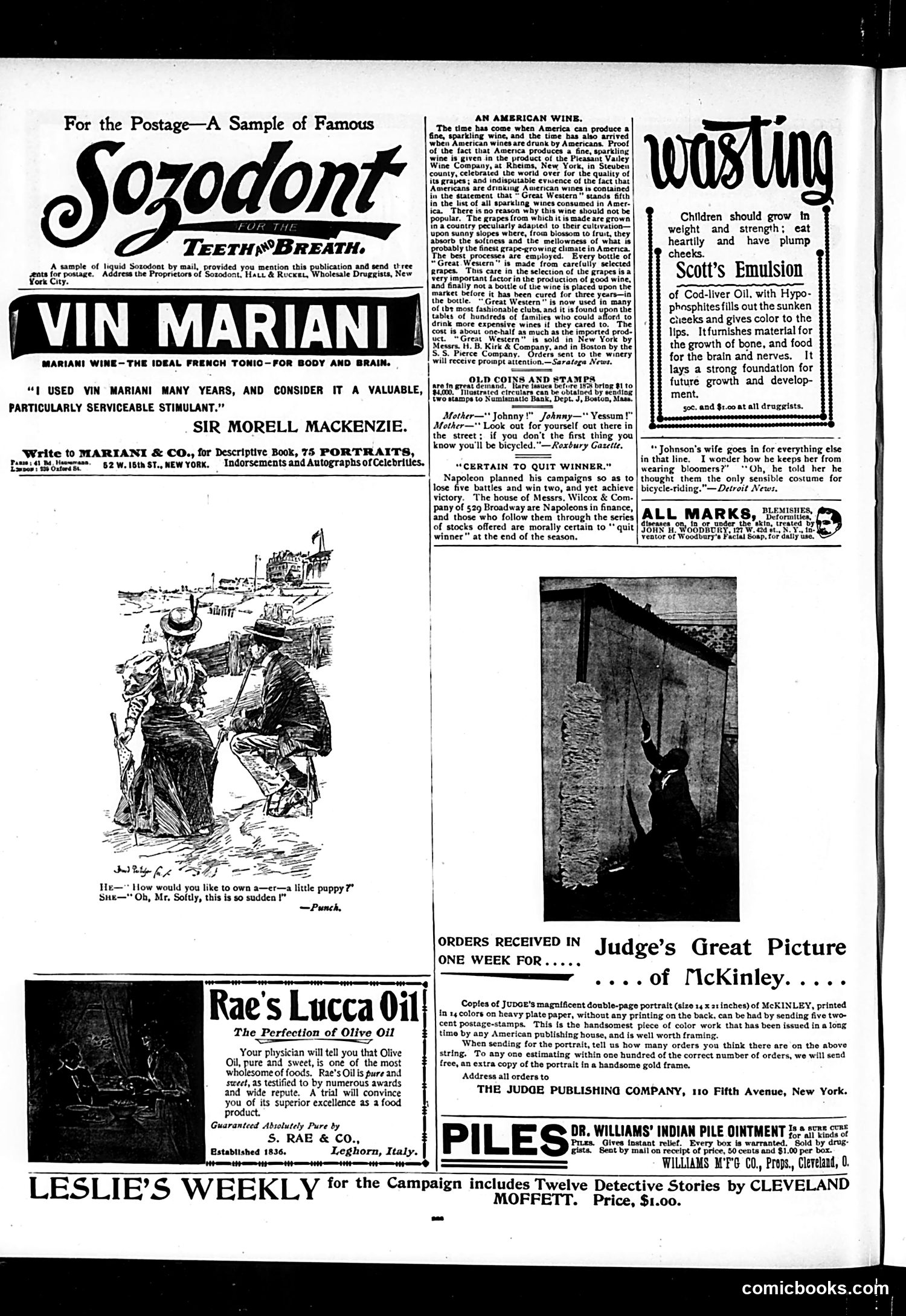
This page is primarily **advertisements and light humor** rather than political satire. Key content: **The Cartoon**: A small sketch labeled "Punch" shows a man proposing to a woman by offering to buy her a puppy—a gentle romantic jest about sudden proposals. **Main Advertisements**: The page heavily promotes patent medicines and consumer goods typical of the era—Sozodont toothpaste, Vin Mariani (wine tonic), Rae's Lucca Oil, Scott's Emulsion (cod-liver oil), and Dr. Williams' Indian Pile Ointment. These reflect late-19th century advertising practices when such products made unregulated health claims. **Social References**: One joke mocks women's adoption of bicycles and bloomers (practical cycling clothing), with a husband discouraging his wife by calling them "sensible"—satirizing Victorian attitudes toward women's independence and athletic pursuits. **The "Great Western" wine section** promotes American-made wine as equal to imports—reflecting growing American industrial pride. Overall, this is a **consumer-focused magazine page** mixing light humor with aggressive marketing of dubious health products.
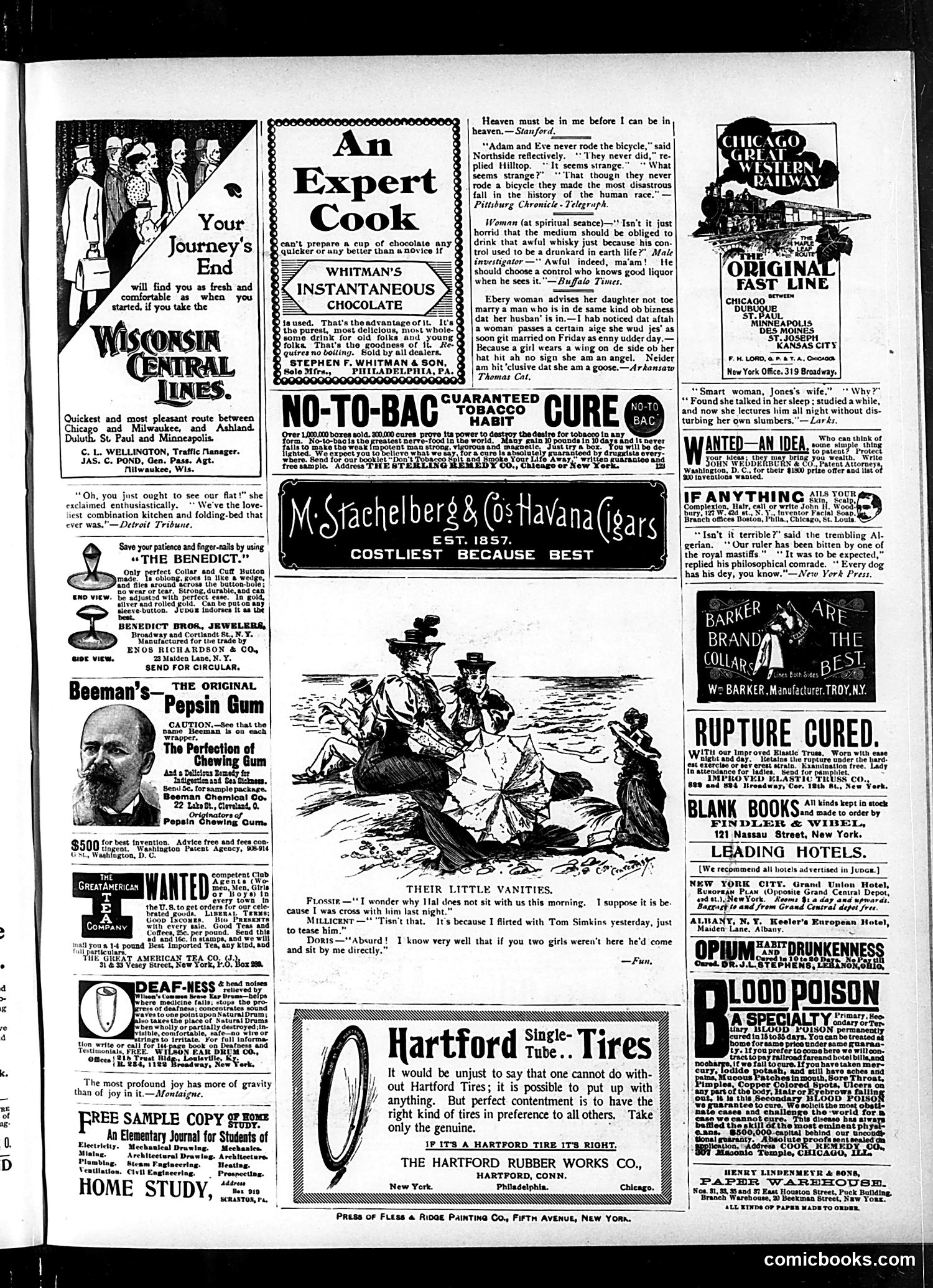
This page from *Judge* magazine is primarily **advertising**, with small humorous anecdotes interspersed between product promotions. The central cartoon, titled "Their Little Vanities," depicts three fashionably dressed women riding bicycles, illustrating a brief dialogue joke about female vanity. The surrounding text contains satirical social commentary typical of the era. Notable examples include: - A quip about "Adam and Eve never rode the bicycle" — commenting on the novelty and controversy of women cycling - Racial dialect humor (characteristic of early-1900s publications) mocking various human behaviors - References to séances and spiritualism (popular but often viewed as fraudulent) The advertisements promote period products: corset buttons, Whitman's instant chocolate, Beeman's chewing gum, and Hartford Tires. The page reflects early 20th-century attitudes toward women's changing social roles (particularly cycling), skepticism toward spiritualism, and the magazine's reliance on ethnic stereotypes for comedy. The humor assumes audiences familiar with these contemporary fads and social anxieties.
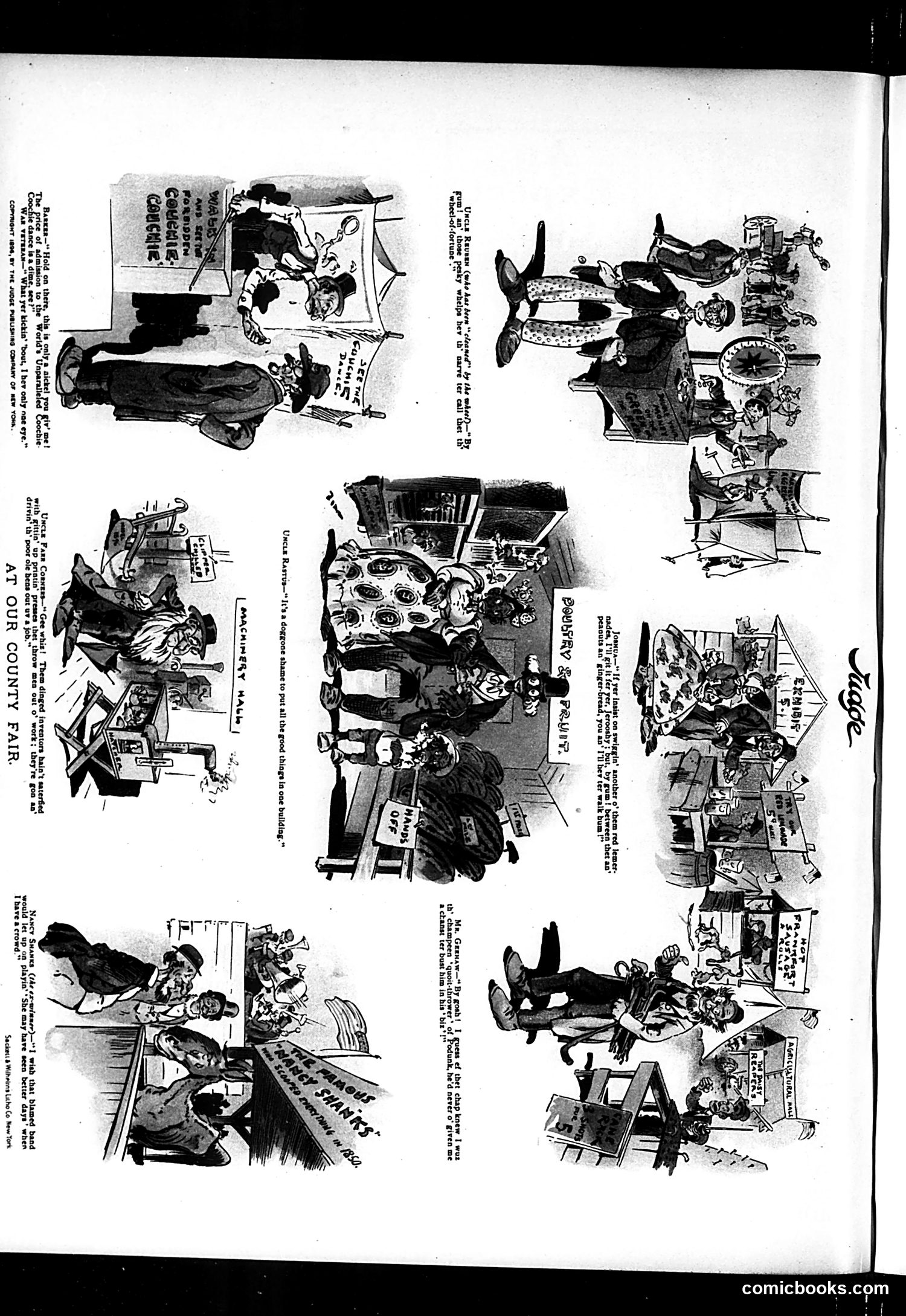
This page contains multiple satirical comic strips set at a county fair, depicting rural American types and their complaints during what appears to be the early 20th century. The cartoons mock working-class and rural anxieties through exaggerated dialect and character stereotypes. One strip shows "Uncle" figures complaining about expenses—lemonade, bread, and admission costs—suggesting economic hardship. Another references "those pesky inventors" and labor displacement, implying anxiety about industrialization eliminating jobs. The humor relies on rustic speech patterns and caricature to satirize rural characters' bewilderment at modern commerce and technology. The fair setting frames these as "backward" country folk struggling to understand or afford urban/industrial society. The overall message appears critical of rural Americans' economic vulnerability and skepticism toward progress, using ridicule typical of Judge magazine's urban, educated audience perspective toward rural America.