
Judge, 1896-10-03 · page 3 of 16
Judge — October 3, 1896 — page 3: what you’re looking at
What you’re looking at
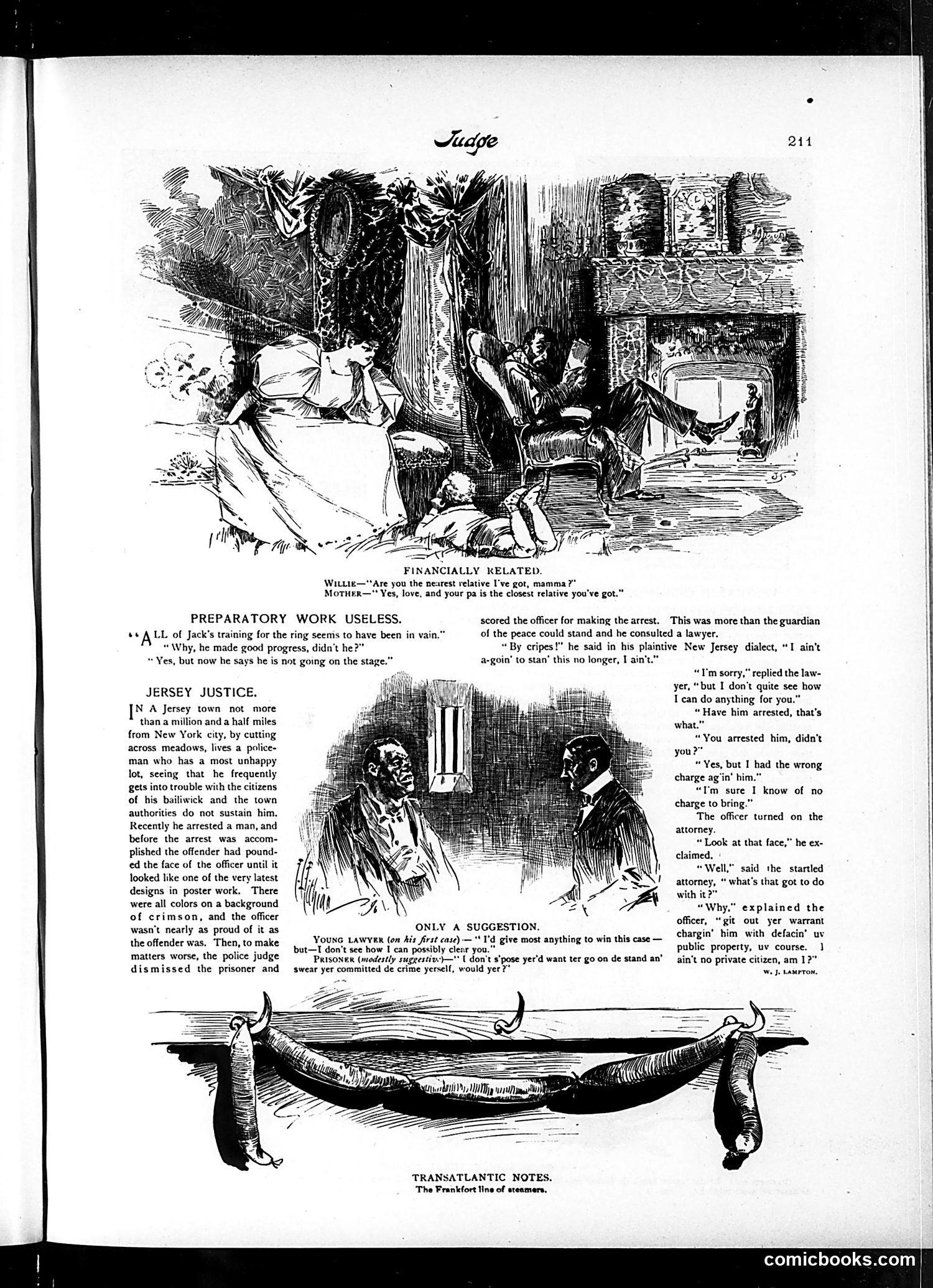
This page contains three satirical pieces about American law and justice: 1. **"Financially Related"** (top): A domestic scene where a mother tells her son Willie that his poor relative is "the closest relative you've got"—a joke about poverty and family obligation. 2. **"Jersey Justice"** (center): Satirizes New Jersey's judicial system, describing a police officer who arrests people without proper charges. The piece mocks how authorities dismiss cases and mistreat citizens, with an officer admitting he arrested someone on the wrong charge but refusing to release him. 3. **"Only a Suggestion"** (bottom): A young lawyer offers a prisoner advice to confess to crimes he didn't commit to avoid worse treatment—dark satire on coercive legal practices. The overall theme criticizes corruption and incompetence in American law enforcement and courts.
📄 Transcribed text from this page (OCR, searchable)
Machine-transcribed from the original scan — historical spelling and the odd misread are preserved.
PREPARATORY WORK USELESS. ++ ALL of Jack's training for the ring seemis to have been in vain.” Witiie—"*Are you the nearest relative I've got, mamma?” MotHeR—"* Yes, love, and your pa is the closest relative you've got.” Why, he made good progress, didn’t he?” * Yes, but now he says he is not going on the stage.” JERSEY JUSTICE. JN A Jersey town not more than a million anda half miles from New York city, by cutting across meadows, lives a police- man who has a most unhappy lot, seeing that he frequently gets into trouble with the citizens of his bailiwick and the town authorities do not sustain him. Recently he arrested a man, and before the arrest was accom- plished the offender had pound- ed the face of the officer until it looked like one of the very latest designs in poster work. There were all colors on a background of crimson, and the officer wasn’t nearly as proud of it as the offender was. Then, to make matters worse, the police judge dismissed the prisoner and YouNG LAWYER (on his first case) — “I'd give most anything to win this case — FINANCIALLY KELATED. scored the officer for making the arrest. This was more than the guardian of the peace could stand and he consulted a lawyer. “By cripes!” he said in his plaintive New Jersey dialect, “I ain't a-goin’ to stan’ this no longer, I ain't.” ONLY A SUGGESTION. but—I don’t see how I can possibly clear you." Prisoner (modestly suggestive) — swear yer committed de crime yerself, would yer?” don't s'pose yer’d want ter go on de stand an’ “I'm sorry," replied the law- yer, “but I don’t quite see how I can do anything for you.” “ Have him arrested, that’s what.” “You arrested him, didn’t you?” “Yes, but I had the wrong charge ag‘in’ him.” “I'm sure I know of no charge to bring.” The officer turned on the attorney. “Look at that face," he ex- claimed. “Well,” said the startled attorney, “ what's that got to do with it? “Why,” explained the officer, “git out yer warrant chargin’ him with defacin’ uv public property, uv course. 1 ain't no private citizen, am 1?” Ws J LAMITON. a — fog): —— * TOL a TRANSATLANTIC NOTES, ‘The Frankfort line of steamers, comicbooks.com |