
A complete issue · 16 pages · 1896
Judge — July 11, 1896
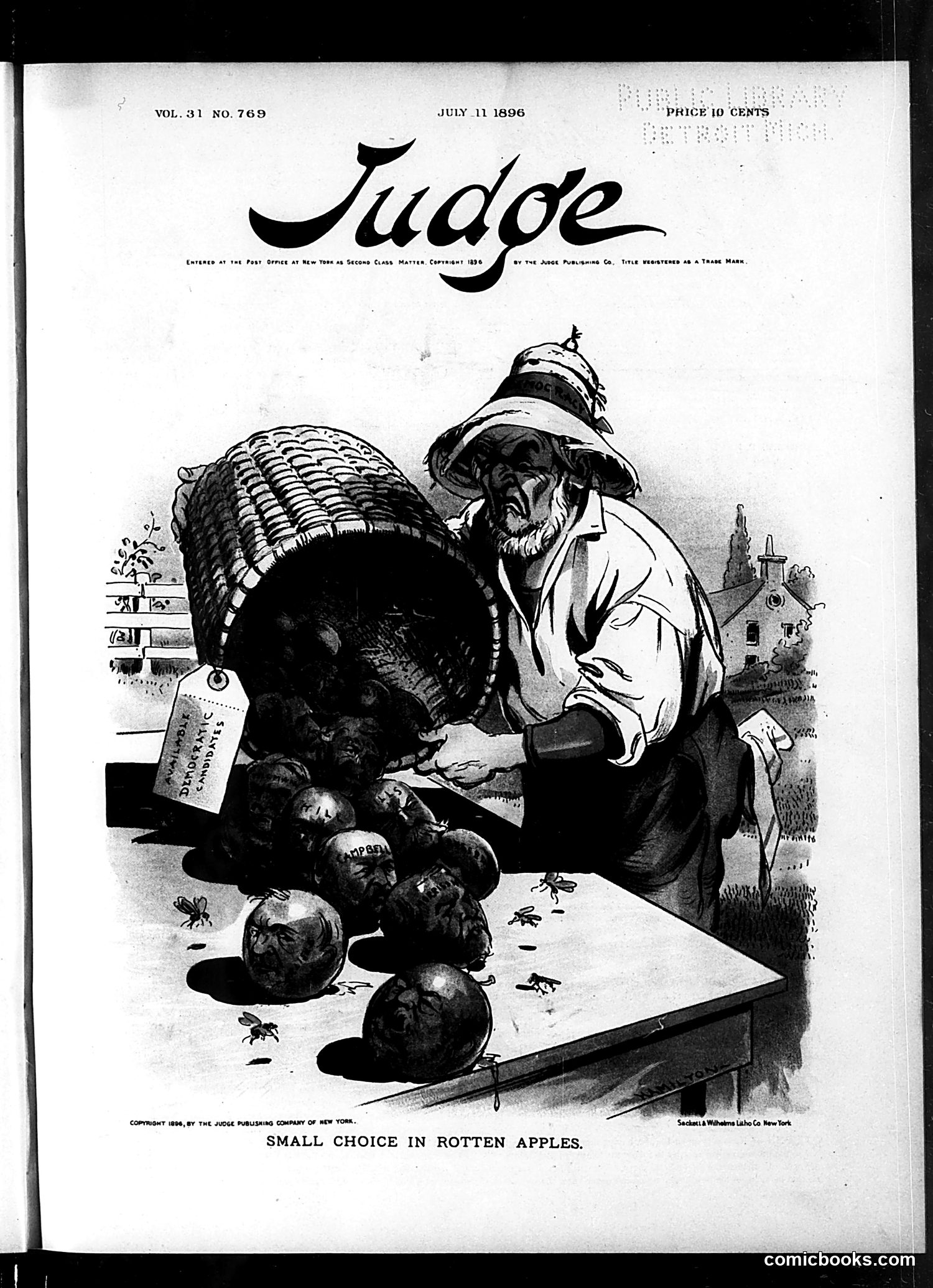
This political cartoon satirizes the 1896 U.S. presidential election choices. An old farmer, labeled with what appears to be a voter's tag, examines rotten apples spilling from a basket. The apples likely represent the major candidates or platforms available to voters that year—specifically the competing visions of William McKinley (Republican) and William Jennings Bryan (Democrat/Populist), whose campaigns centered on currency policy and economic direction. The "rotten apples" metaphor suggests both major candidates were equally undesirable or corrupt options. The rural farmer figure emphasizes how ordinary working Americans felt trapped between unsatisfactory political choices, unable to find a genuinely appealing candidate regardless of their selection.
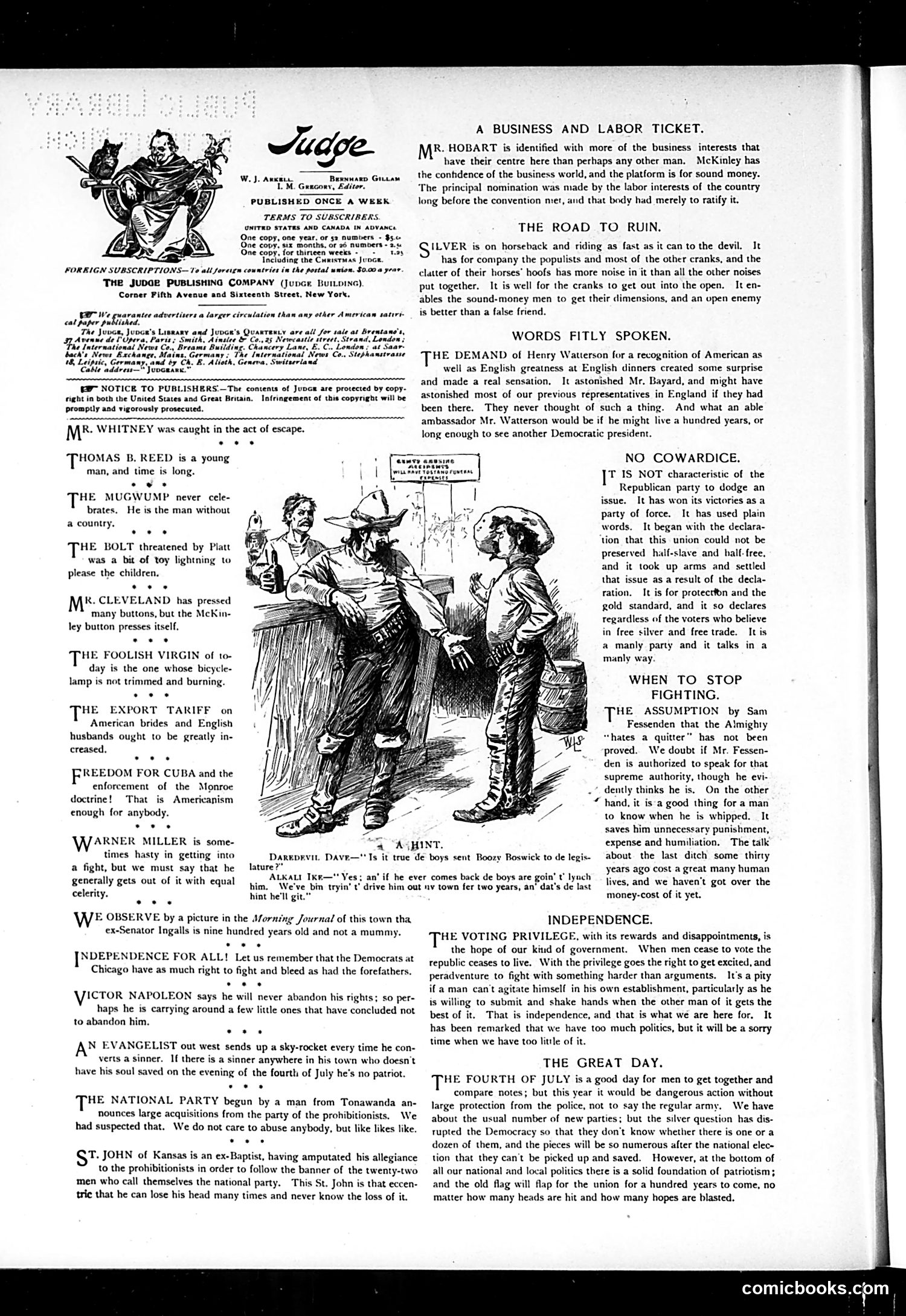
This Judge magazine cartoon satirizes political corruption and bribery during the Gilded Age. The central image depicts a well-dressed man (labeled "Darkdevil Dave") apparently offering money to two younger men labeled "Alkali Ike" and another figure, with the caption "A Hint—'Is it true de boys sent Roogy Roswick to de legislatures?'" The cartoon mocks how politicians and wealthy interests used bribery to secure legislative votes, particularly regarding labor and business issues. The "hint" involves passing money—a transparent reference to vote-buying and political favoritism. The working-class characters' dialectal speech emphasizes the class divide between wealthy manipulators and common voters. This reflects Progressive Era concerns about political machines and corruption influencing American democracy.
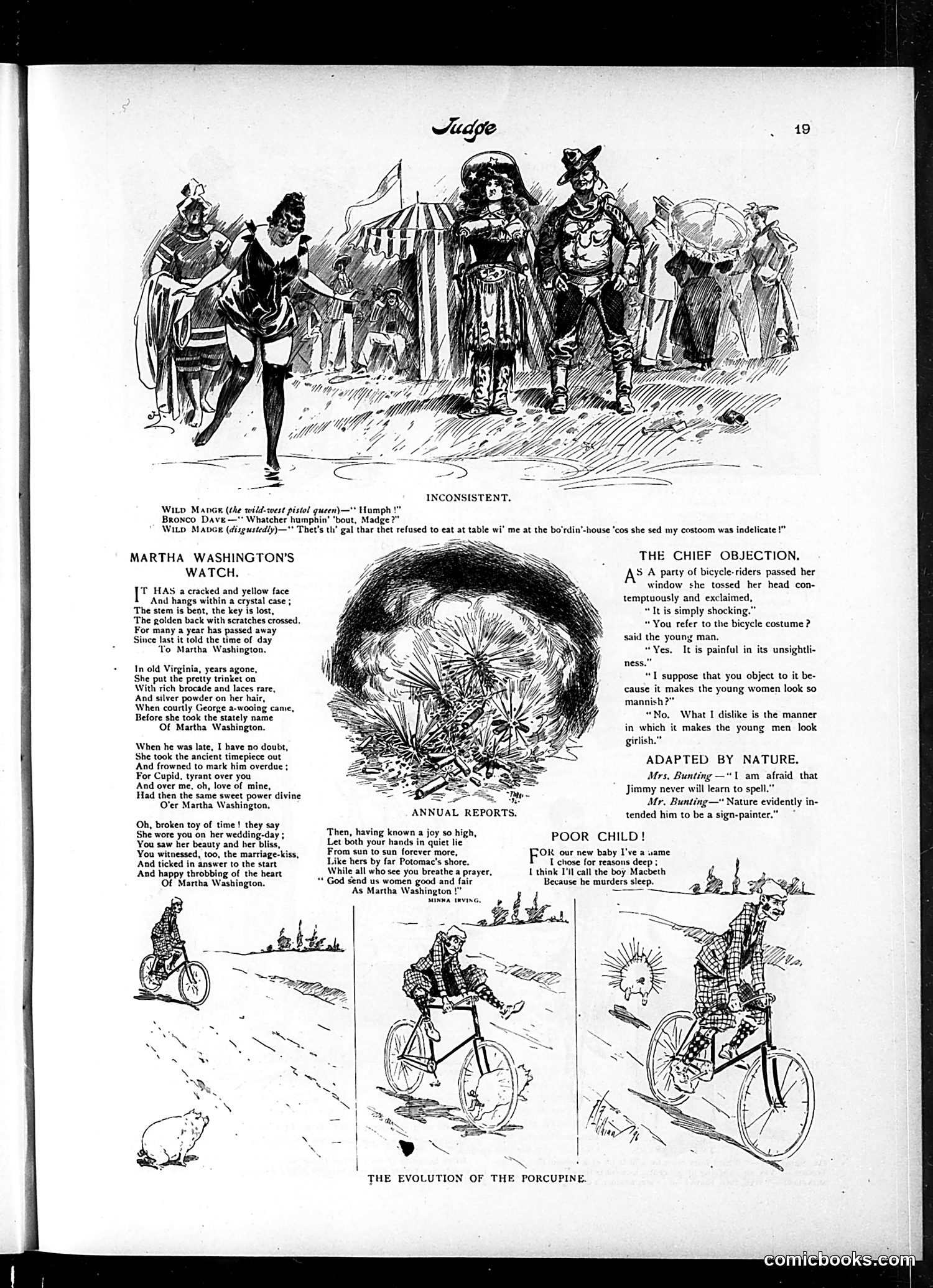
**Top Cartoon ("Inconsistent"):** Shows Wild Marge (appears to be a character) in military/formal dress contradicting herself about eating at a boarding house versus claiming her custom was "delicate." The satire targets hypocrisy about social standards. **"Martha Washington's Watch":** A sentimental poem about a cherished heirloom watch, likely reflecting nostalgia for American historical figures and domestic virtue—common Judge themes. **"The Objection" and "Adapted by Nature":** Brief comic exchanges mocking young women's bicycle costumes as unfeminine and making young men look "girlish," and joking about a boy's inability to spell. **"The Evolution of the Porcupine":** Three sequential drawings show a porcupine apparently learning to ride a bicycle, satirizing the bicycle craze's absurdity or celebrating technological progress humorously. The page reflects 1890s concerns: social propriety, women's changing fashion, and cycling's cultural novelty.
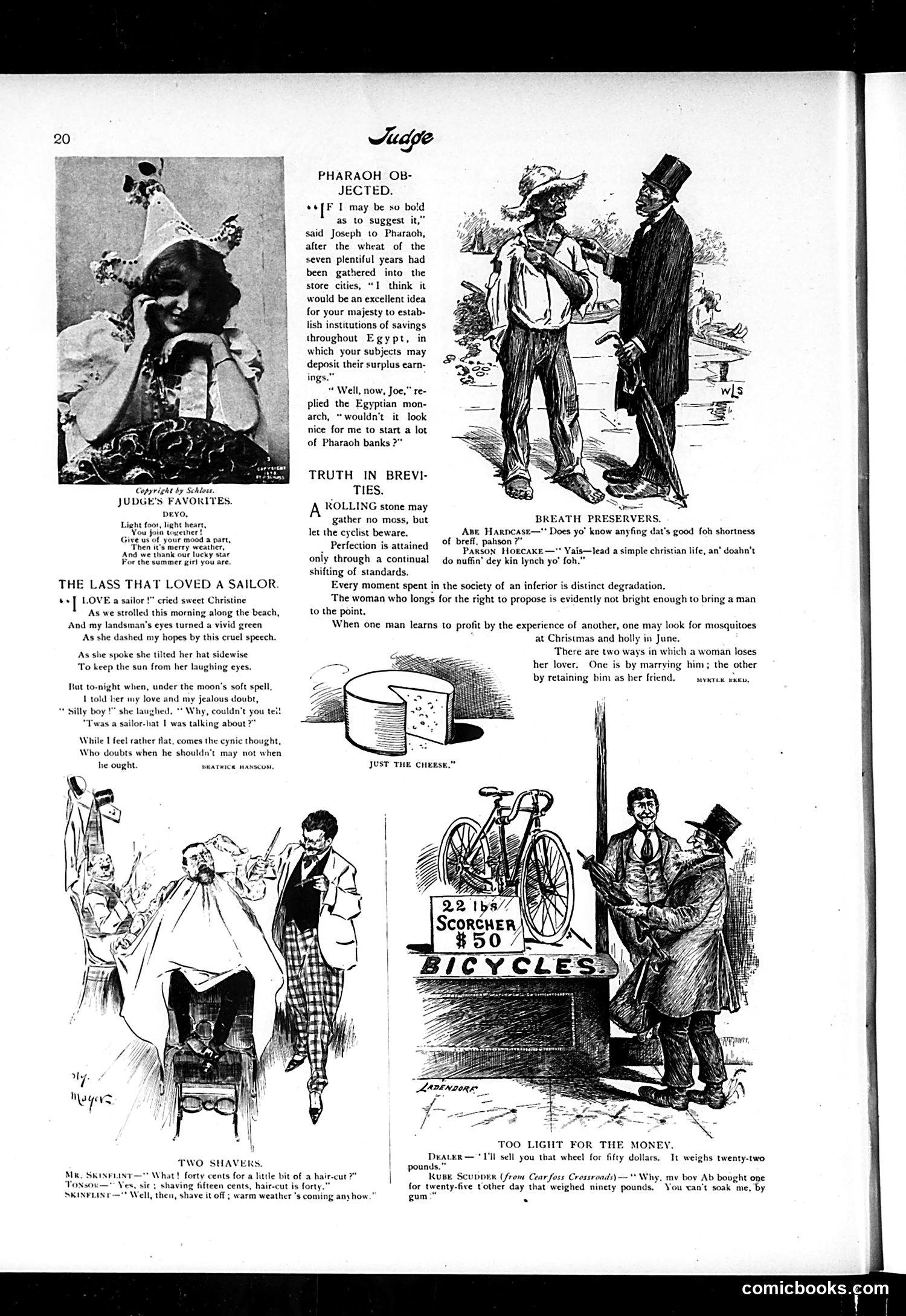
This page contains several satirical pieces typical of Judge's humor circa early 1900s: **"The Lass That Loved a Sailor"** mocks romantic misunderstandings—a man jealously assumes a woman's preference for sailors, only to learn she was complimenting the woman's hat, not the sailor himself. **"Pharaoh Objected"** is a historical satire anachronistically applying modern banking to ancient Egypt. Joseph suggests Pharaoh establish savings institutions; Pharaoh objects to calling them "Pharaoh banks" (likely mocking contemporary "bank" terminology or branding). **"Two Shavers"** depicts a haggling customer disputing a barber's price, with the barber suggesting he simply shave the customer's head—contemporary commentary on male grooming costs. **"Too Light for the Money"** advertises bicycles through dialogue mocking a dealer's claim; a customer references buying a heavier bike cheaper elsewhere. The scattered aphorisms ("Truth in Brevities," "Breath Preservers") offer social commentary on standards, women's suffrage, and racial stereotypes (the latter using period offensive dialect).
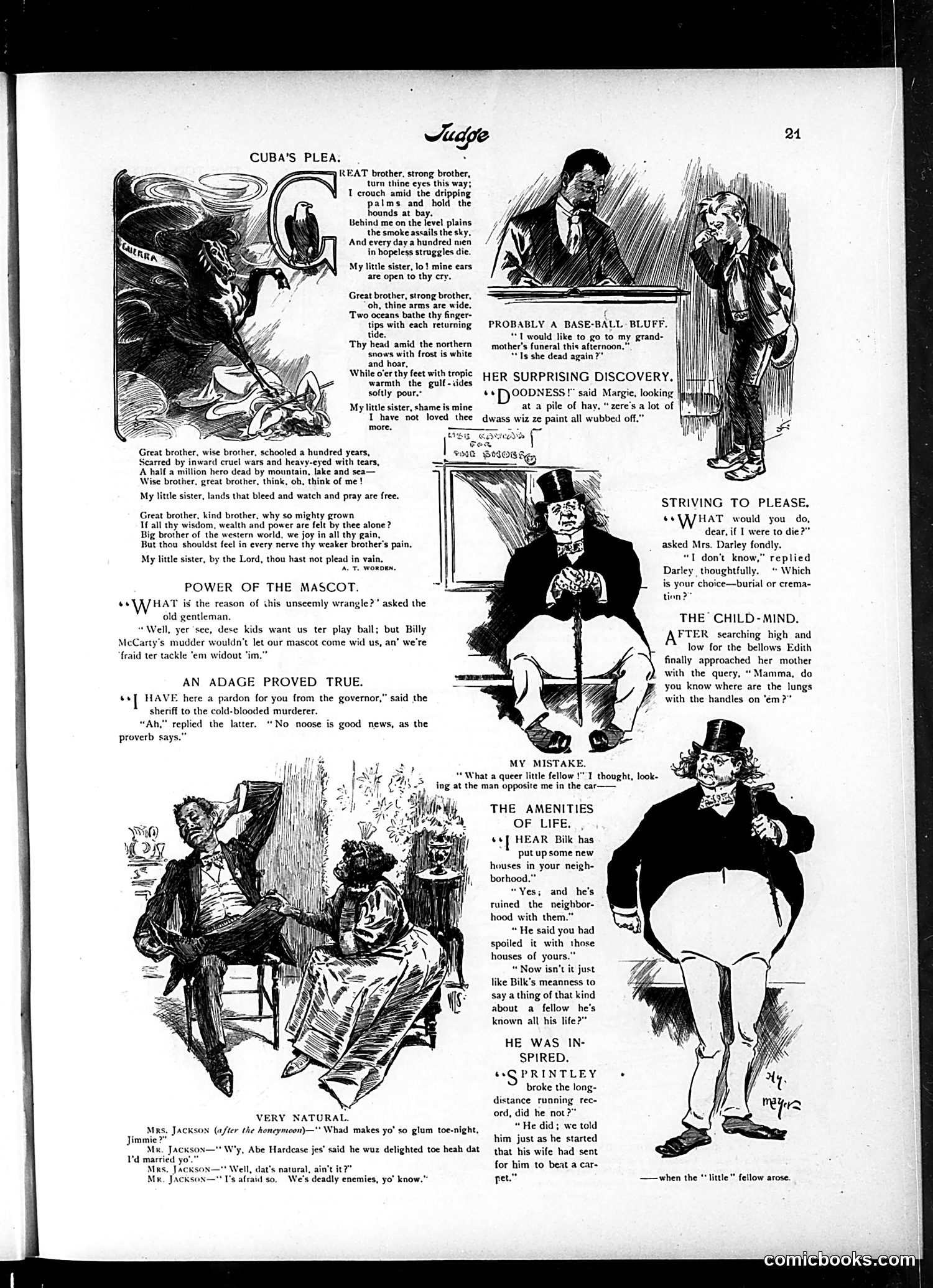
This page from *Judge* magazine contains several short satirical pieces reflecting late 19th/early 20th-century American humor: **"Cuba's Plea"** (top left): A poignant poem where Cuba, personified as a suffering "little sister," appeals to the United States ("Great brother") for military intervention against Spanish colonial oppression. This references the Spanish-American War era (1898), when American public opinion increasingly favored supporting Cuban independence. The remaining content consists of brief joke vignettes typical of *Judge*'s humor: children's logic, marital banter, puns on "no noose is good news," and ethnic dialect humor (the "Mrs. Jackson" piece uses exaggerated African American vernacular, common but now-offensive comedic convention of the era). **The satire's point**: Cuba's eloquent, emotional plea contrasts sharply with the trivial, lighthearted jokes filling the rest of the page—perhaps subtly critiquing American indifference to serious geopolitical suffering, or simply juxtaposing high and low comedy as *Judge* typically did.
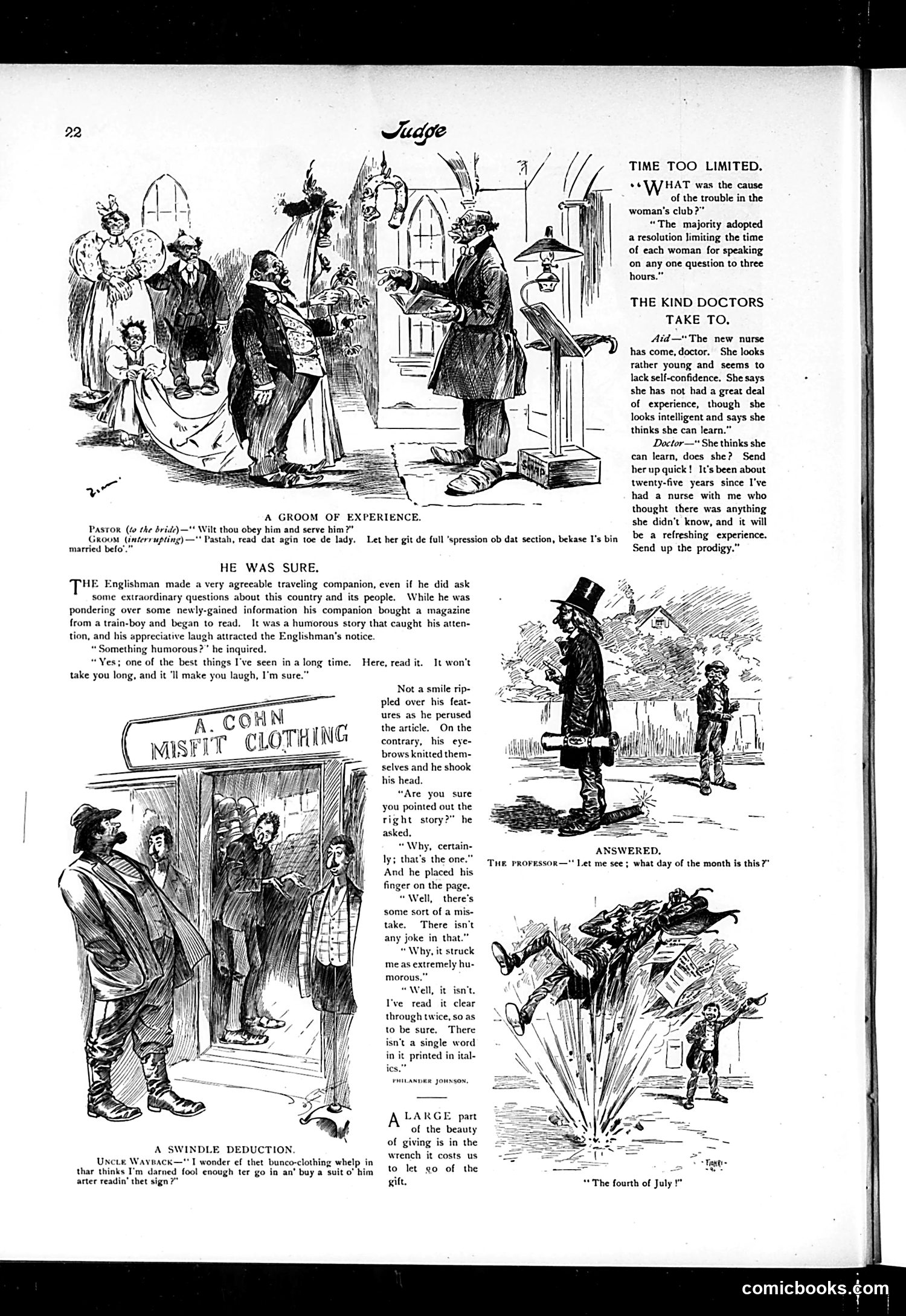
This page contains multiple satirical cartoons targeting American social customs and character types circa early 20th century: **"Time Too Limited"** mocks women's clubs, suggesting women talk excessively—a resolution limiting speakers to three hours implies women typically monopolize discussion. **"The Kind Doctors Take To"** satirizes doctors who prefer inexperienced nurses, implying they value obedience over competence. The doctor's eagerness to hire an untrained nurse suggests exploitation. **"A Groom of Experience"** jokes about wedding vows, with a Black character (depicted in period dialect) asking the pastor to clarify the "obey" clause for the bride—implying women resist marital submission. **"He Was Sure"** ridicules English literalism. An Englishman reads a supposedly funny story but finds nothing amusing because there's no italicized text—suggesting he's pedantically clueless about humor. **"A Misfit Clothing"** and other fragments appear to be advertisements or minor sketches. The page reflects period stereotypes: women as garrulous, working-class men as shrewd, foreigners as absurdly literal, and racial caricatures as comedic.
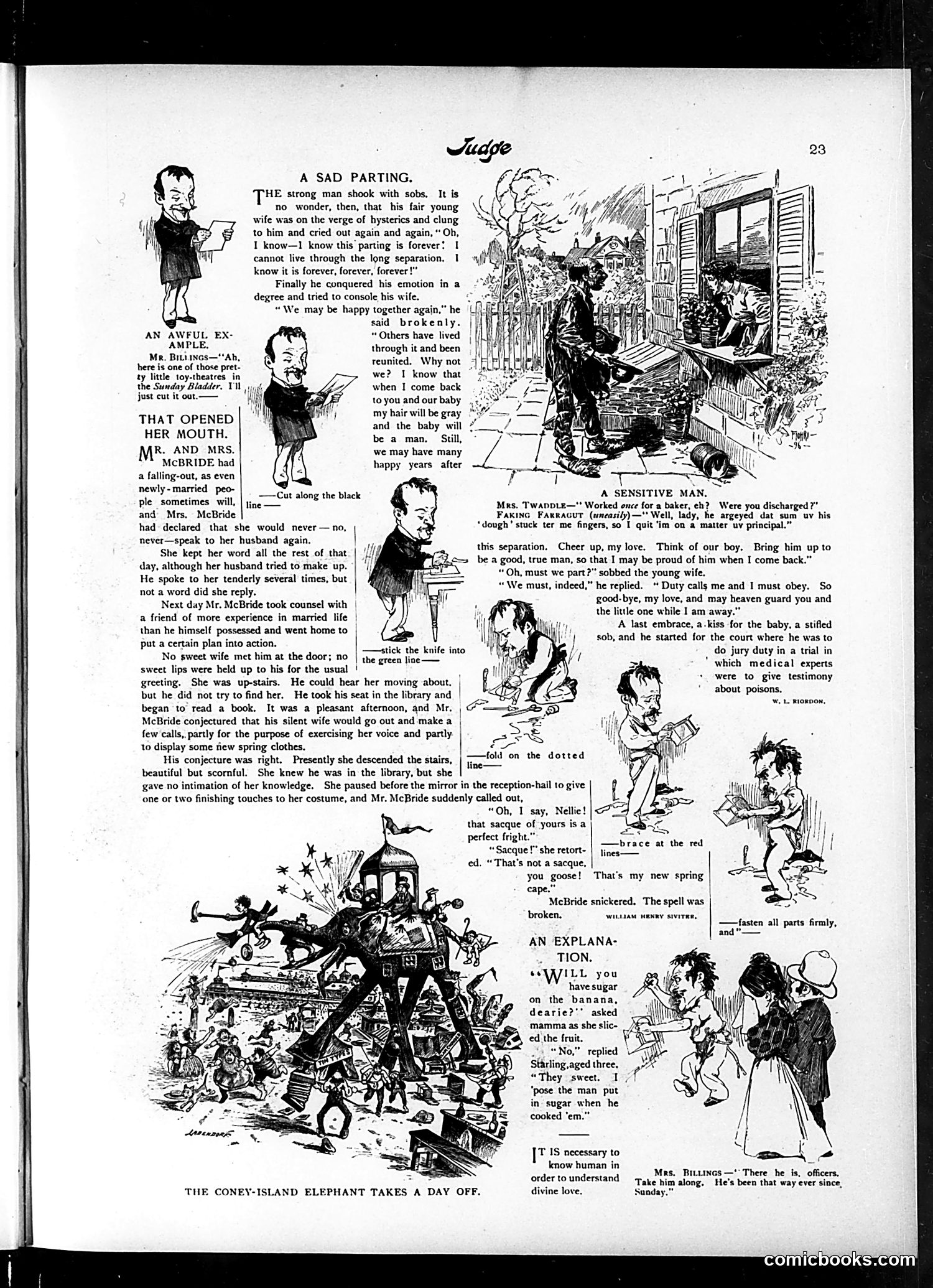
This page contains several satirical domestic humor pieces typical of early 20th-century American magazines: **"A Sad Parting"** depicts a theatrical husband tearfully announcing jury duty (not military service). The satire targets marital melodrama—the wife's hysterical response contrasts absurdly with the mundane cause. The resolution mocks this: when he criticizes her outfit, her normal irritation breaks the spell, suggesting genuine domesticity trumps performative emotion. **"A Sensitive Man"** shows a baker's employee claiming he quit rather than admit to petty theft, spinning it as a "matter of principal"—satirizing working-class rationalization and wounded pride. **"An Explanation"** jokes about a child's innocent misunderstanding of sugar on fruit, misattributing sweetness to cooking rather than added sugar. The page also includes "The Coney-Island Elephant Takes a Day Off," a whimsical illustration (caption only visible). These pieces employ humor about domestic relations, class pretension, and childhood naiveté—standard Judge fare aimed at middle-class readers.
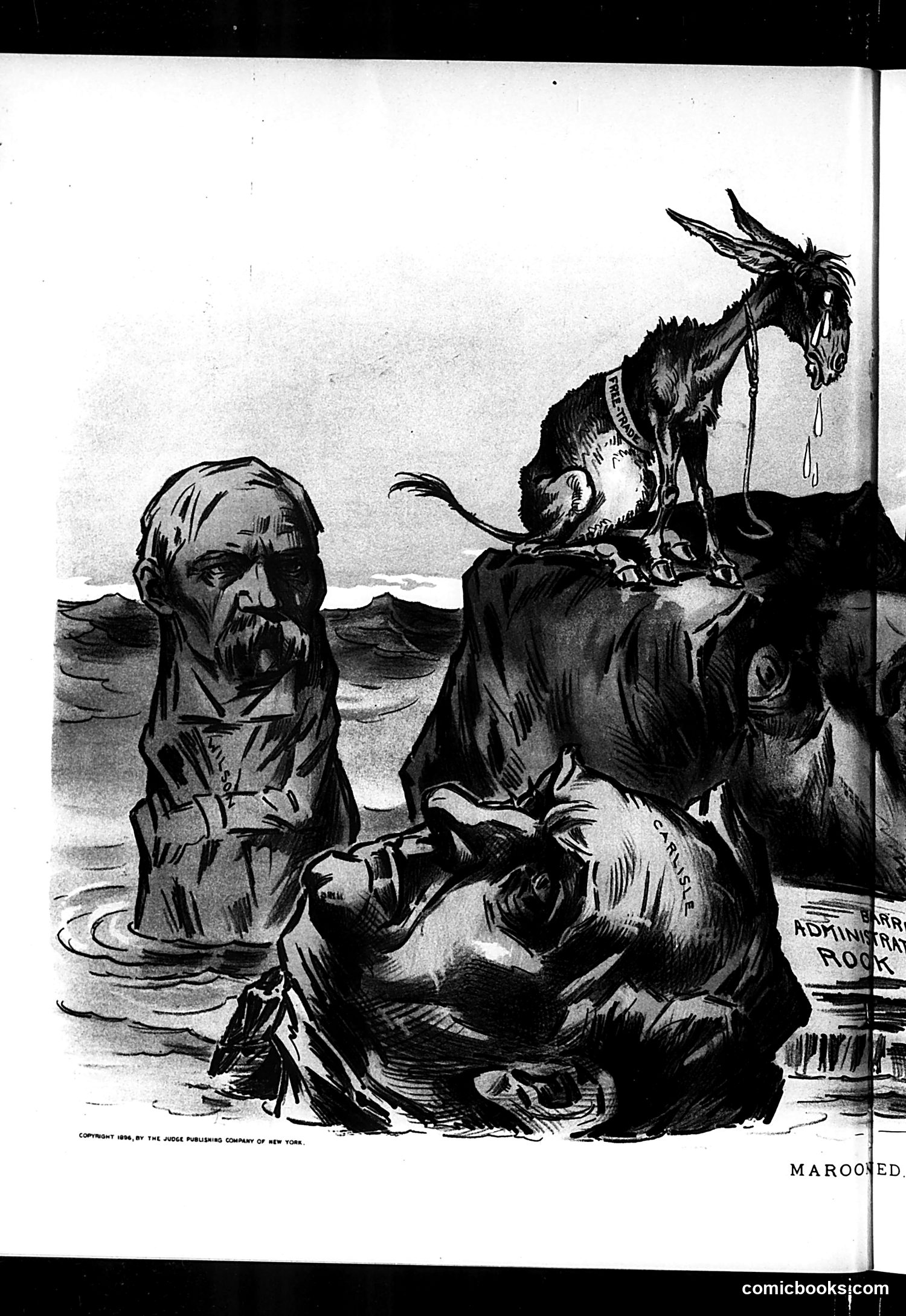
This political cartoon depicts a figure stranded in harsh desert conditions alongside a malnourished donkey. The barren landscape and visual desperation suggest abandonment or being left in an untenable situation. The title "Marooned" reinforces this theme of isolation and helplessness. While the specific political target isn't entirely clear from the visible text, Judge magazine's satirical purpose suggests this critiques a contemporary politician or policy deemed foolish or abandoned by their party. The donkey—often symbolic of the Democratic Party in American political cartoons—may indicate this targets Democratic leadership or policy. The artwork's emphasis on suffering and desolation emphasizes the cartoonist's view that the subject has been left in an impossible, ridiculous position.
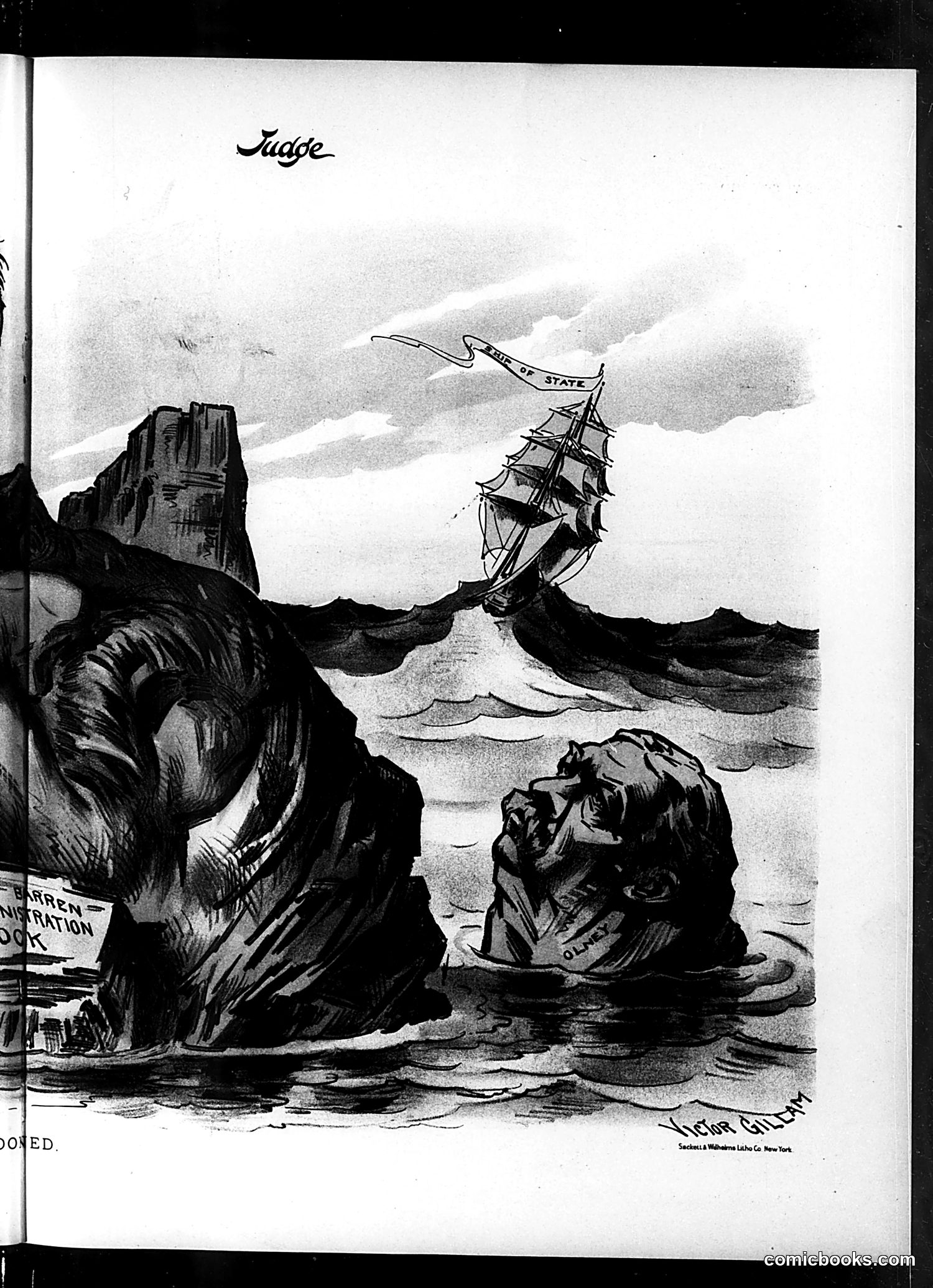
This Judge magazine cartoon depicts a sailing ship labeled "STATE" navigating treacherous waters between two large rocky outcrops. The ship appears to be piloted by a figure while two larger, darker shapes loom in the foreground—likely representing threats or obstacles to state governance. The cartoon's message appears critical of state leadership during turbulent times. The rocky formations and rough seas symbolize political/social dangers the state must navigate. Without visible dates or clearer labels, the specific historical crisis referenced remains unclear, though the imagery suggests concerns about state stability or leadership during a period of conflict or uncertainty. The artist's signature appears to be "Victor Gillam," a prominent Judge cartoonist of the early 20th century.
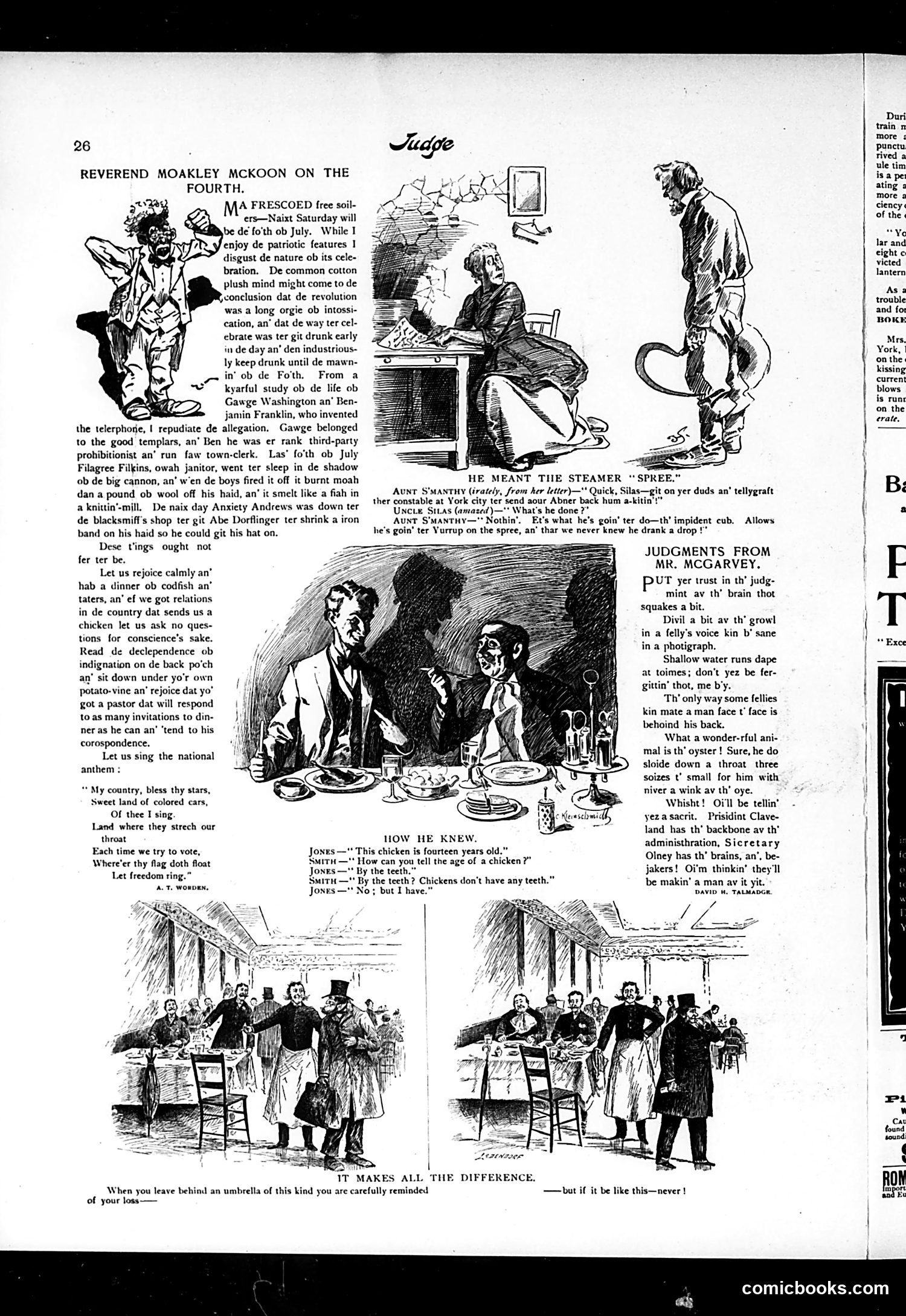
This page from Judge contains multiple satirical pieces mocking American life and politics circa the 1890s. **"Reverend Moakley McKoon on the Fourth"** features a Black preacher (rendered in offensive dialect) sermonizing against drunken Fourth of July celebrations. The satire targets both working-class Independence Day revelry and likely mocks temperance advocates by having the preacher—identified as a prohibitionist—paradoxically promote sobriety while speaking in exaggerated vernacular. **"He Meant the Steamer Spree"** depicts rural characters misunderstanding a young man's plan to visit Europe ("go on the spree") as a drinking bender, playing on class and education gaps. **"Judgments from Mr. McGarvey"** collects brief witticisms from an Irish character, including a political jab at President Cleveland's administration, suggesting Secretary Olney provides the real leadership. **"All the Difference"** uses umbrella-loss jokes to satirize social pretension and forgetfulness. The page reflects late-19th-century Judge humor: heavy reliance on ethnic/racial stereotypes, class mockery, and light political commentary.
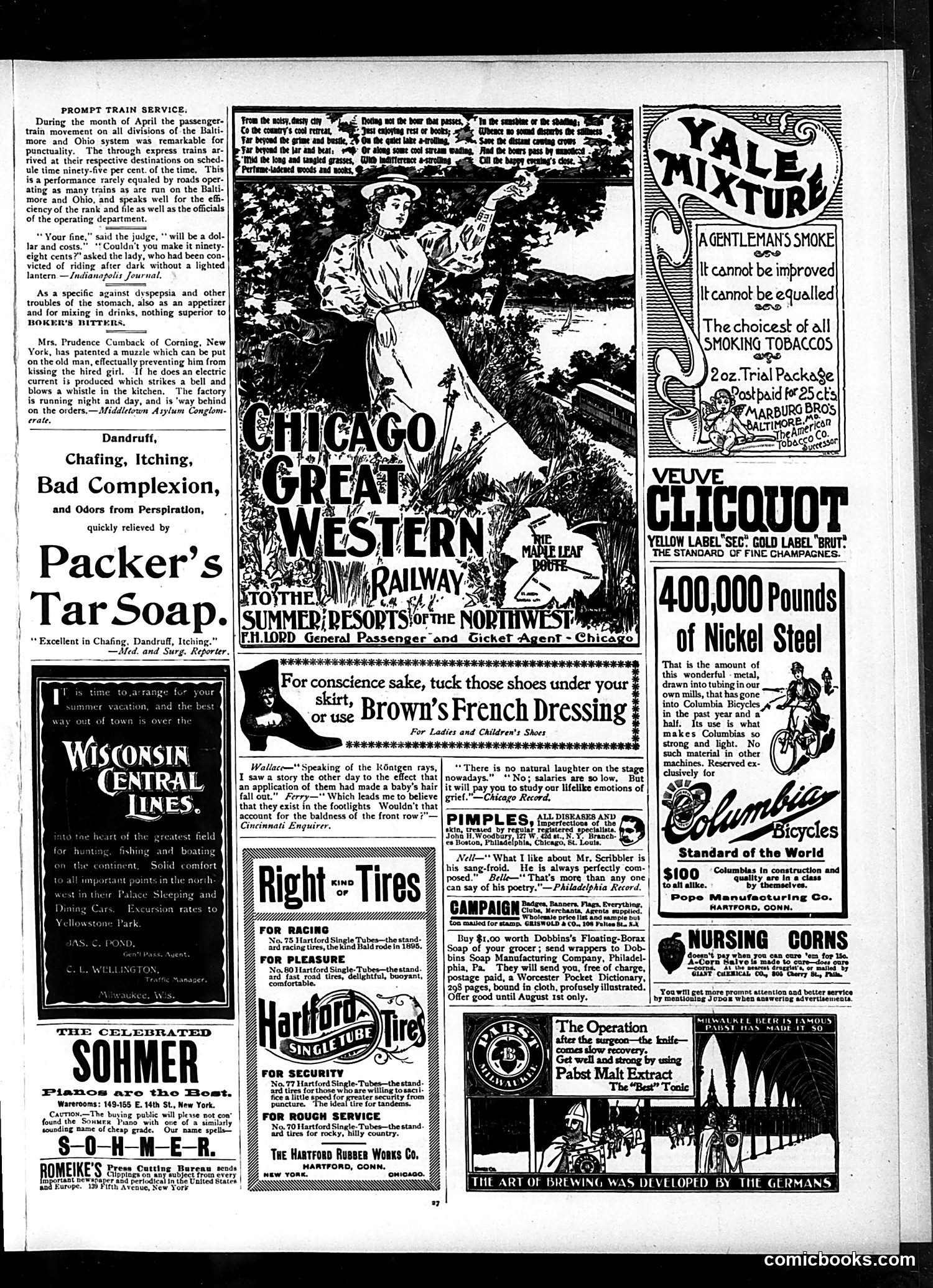
This is primarily an **advertising page** from Judge magazine, with minimal editorial content. The page consists almost entirely of product advertisements typical of the early 1900s. The few editorial jokes scattered between ads are brief quips: one about a woman fined for riding without a lantern asking for a price reduction, another about X-rays causing baldness in theaters (a topical reference to newly-discovered Röntgen rays), and theater/poetry witticisms. The advertisements reveal period concerns: patent medicines (Boker's Bitters for dyspepsia), personal hygiene products (Packer's Tar Soap for dandruff and "bad complexion"), and new technologies (Hartford bicycle tires, Columbia bicycles). One ad absurdly promotes a muzzle device to prevent hired girls from being kissed—satirizing domestic anxieties of the era. The page reflects consumer culture of the Industrial Age, not political satire. No significant cartoons or political commentary appear.
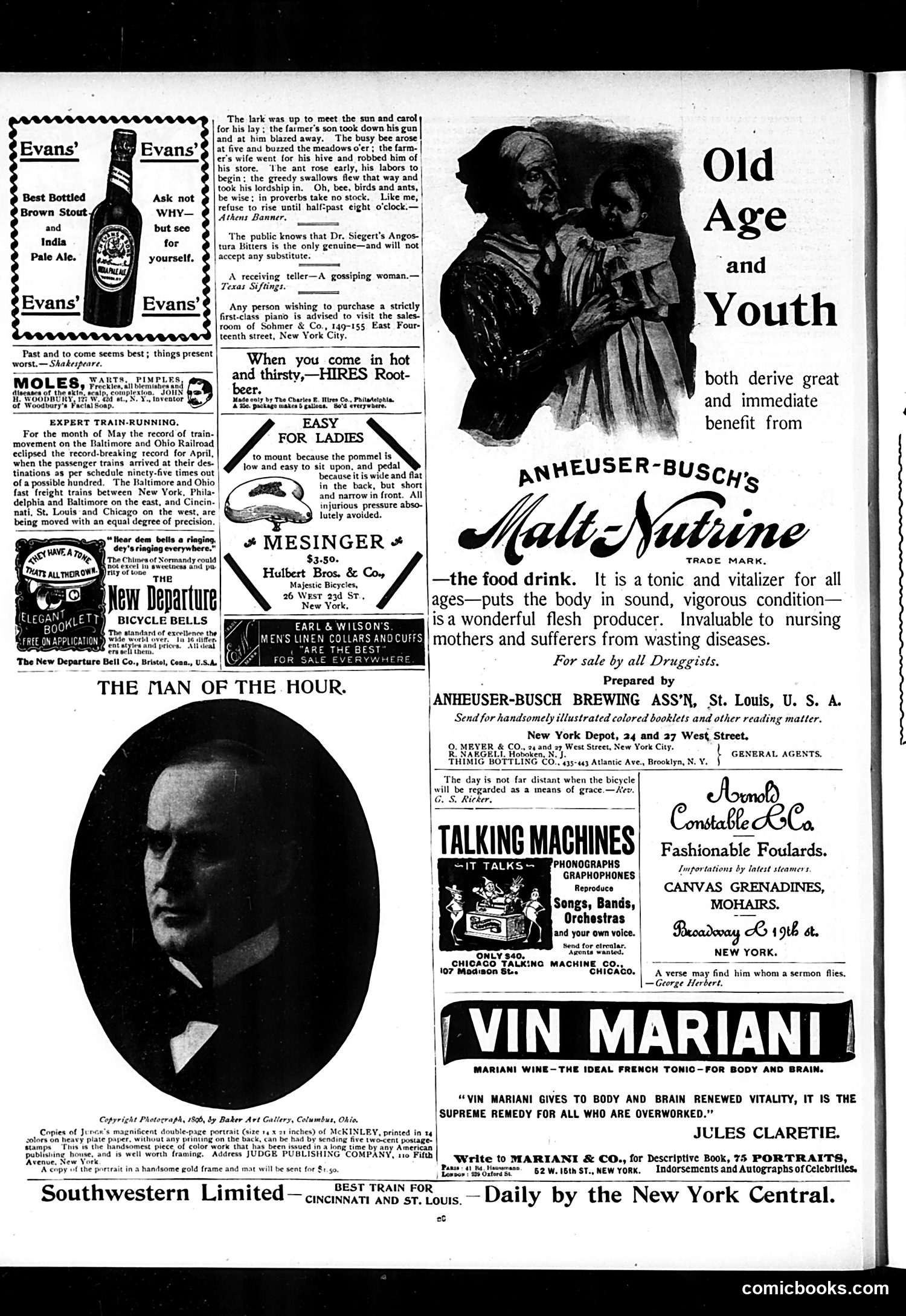
This is primarily an **advertising page** from an early 1900s issue of Judge magazine, with minimal editorial content. The page features numerous patent medicine and product advertisements typical of the era, including: - **Anheuser-Busch's Malt Nutrine**: A "food drink" marketed as a tonic for "all ages," claiming to build vigor and help nursing mothers—reflecting the pre-FDA era when such health claims were unregulated - **Vin Mariani**: A French wine tonic advertised for "body and brain," endorsed by Jules Claretie - **Hires Root Beer**: Positioned as refreshment for the thirsty - Various other products (bicycle bells, pianos, talking machines) The only non-advertisement content appears to be brief literary quotes and jokes (about lazy people, gossiping women, trains). **Historical context**: This page exemplifies how magazines financed themselves through patent medicines and tonics—many containing alcohol or unproven ingredients—before modern consumer protection laws. The advertisements reveal contemporary anxieties about health, vitality, and overwork that marketing exploited.
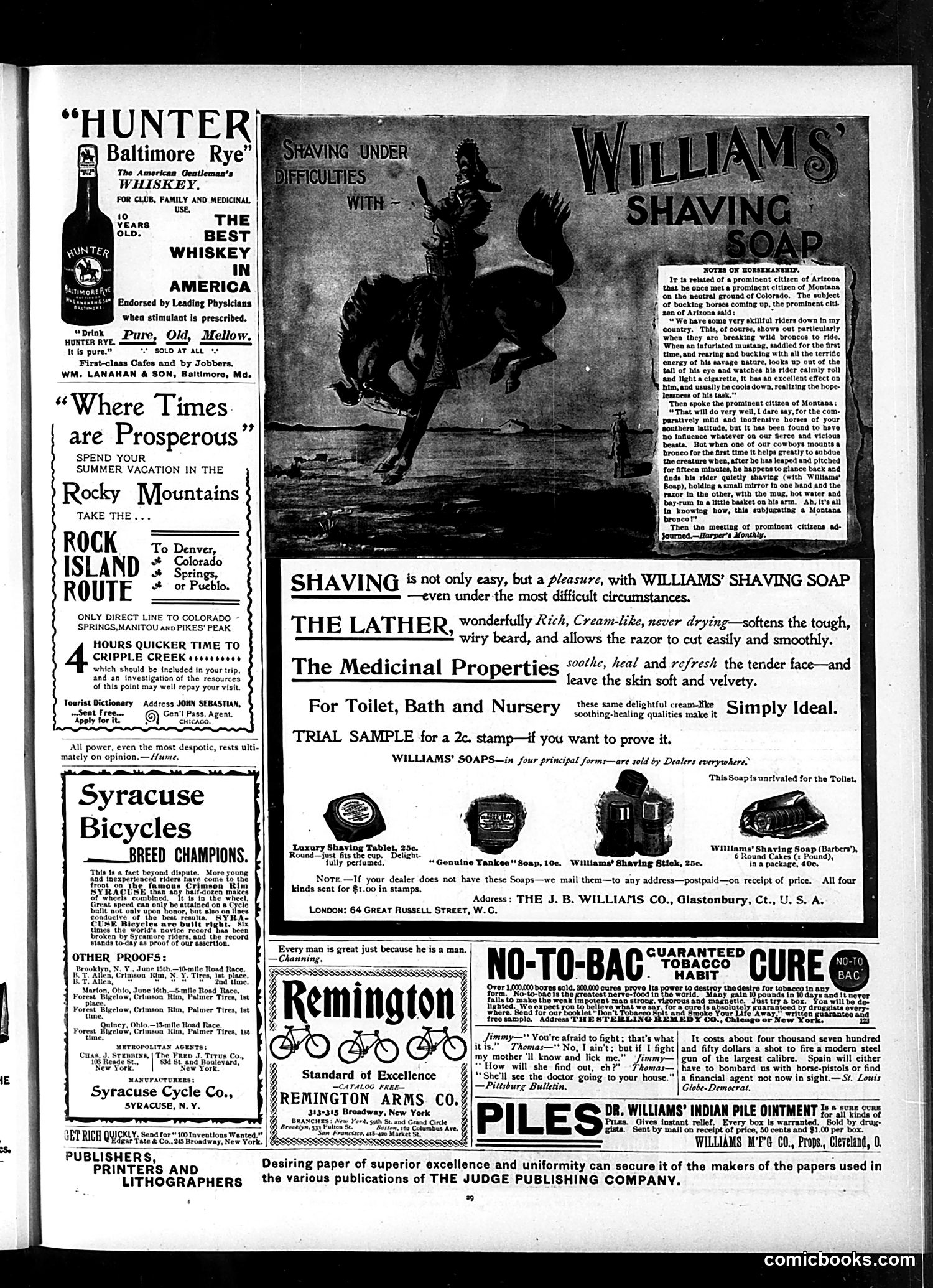
This is primarily an **advertising page**, not a satirical cartoon page. It contains multiple product advertisements typical of early 1900s Judge magazine. The main content is a **Williams' Shaving Soap advertisement** featuring a humorous anecdote about Western horse-breaking. The joke compares Arizona and Montana cowboys' abilities to break wild horses. An Arizona cattleman claims that calmly smoking while riding an untamed bronco impresses the animal into submission. A Montanan counters that Montana's fiercer horses only calm down when the rider shaves *during the ride* using Williams' Soap—suggesting Montana horses are so wild they require extreme nonchalance to subdue them. The satire is **regional boasting**—a mild, tongue-in-cheek competition between Western territories about whose horses are more savage, used to humorously advertise the soap's quality under difficult conditions. The page also includes ads for Hunter Baltimore Rye whiskey, Rock Island railroad travel, Syracuse bicycles, and Remington bicycles—typical period advertisements.
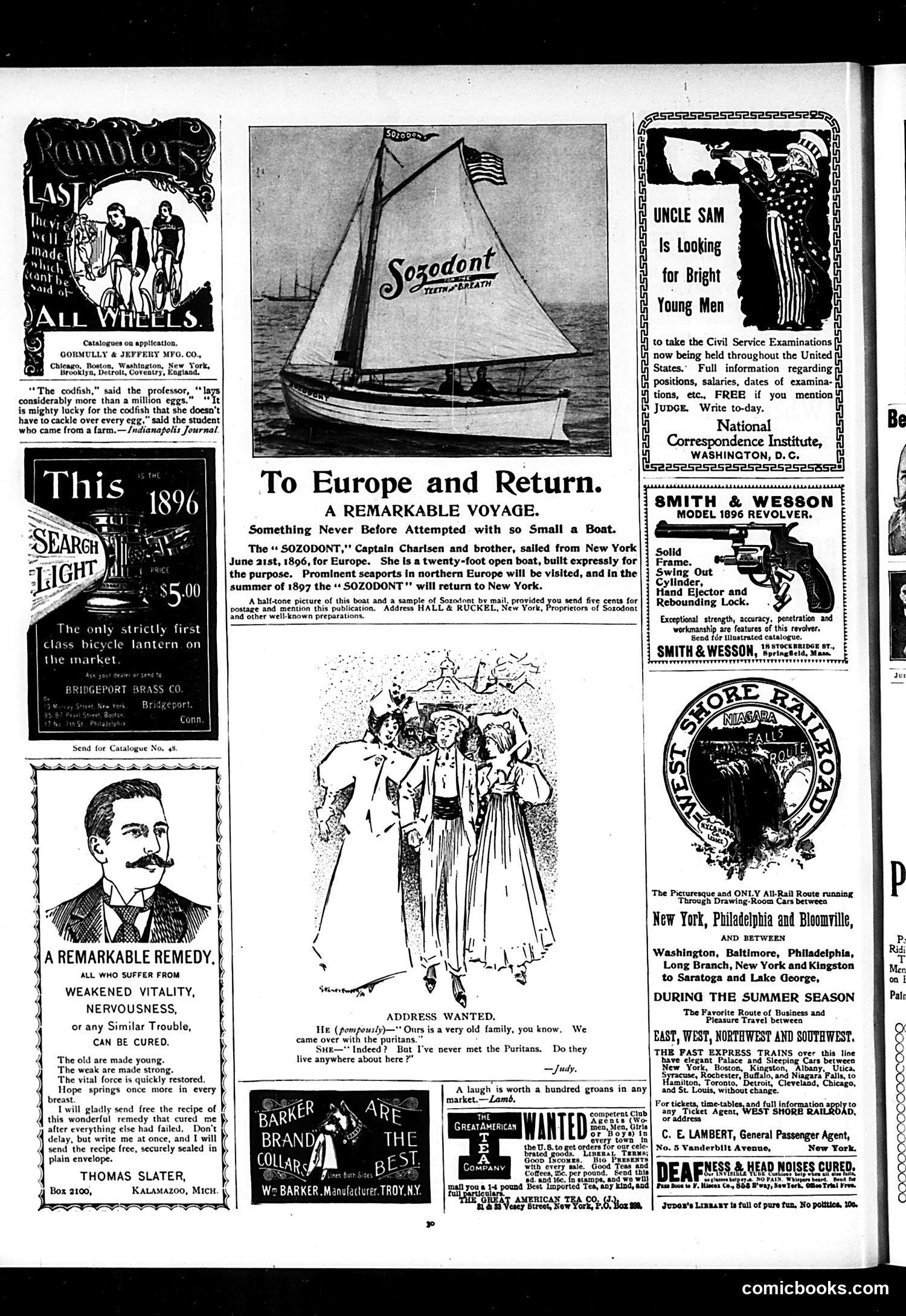
This is primarily an **advertising page** with one satirical cartoon and joke content mixed throughout. The main cartoon depicts a social comedy: a pompous man claims his family arrived "with the Puritans" (implying great antiquity and prestige), but the woman responds she's never met the Puritans or knows where they live—deflating his pretension by treating his boast literally rather than understanding its social-climbing intent. The page is dominated by late-1890s advertisements: a Sozodont toothpaste company advertises an attention-grabbing stunt (a 20-foot sailboat voyage), Smith & Wesson promotes the Model 1896 revolver, and railroad companies advertise routes. There's also a quack-remedy ad promising to cure "weakened vitality" and "nervousness"—typical of the era's dubious medical claims. The Uncle Sam recruitment ad for civil service exams reflects government expansion during this period. The humor is light social satire targeting pretentiousness and naive literalism rather than political commentary.
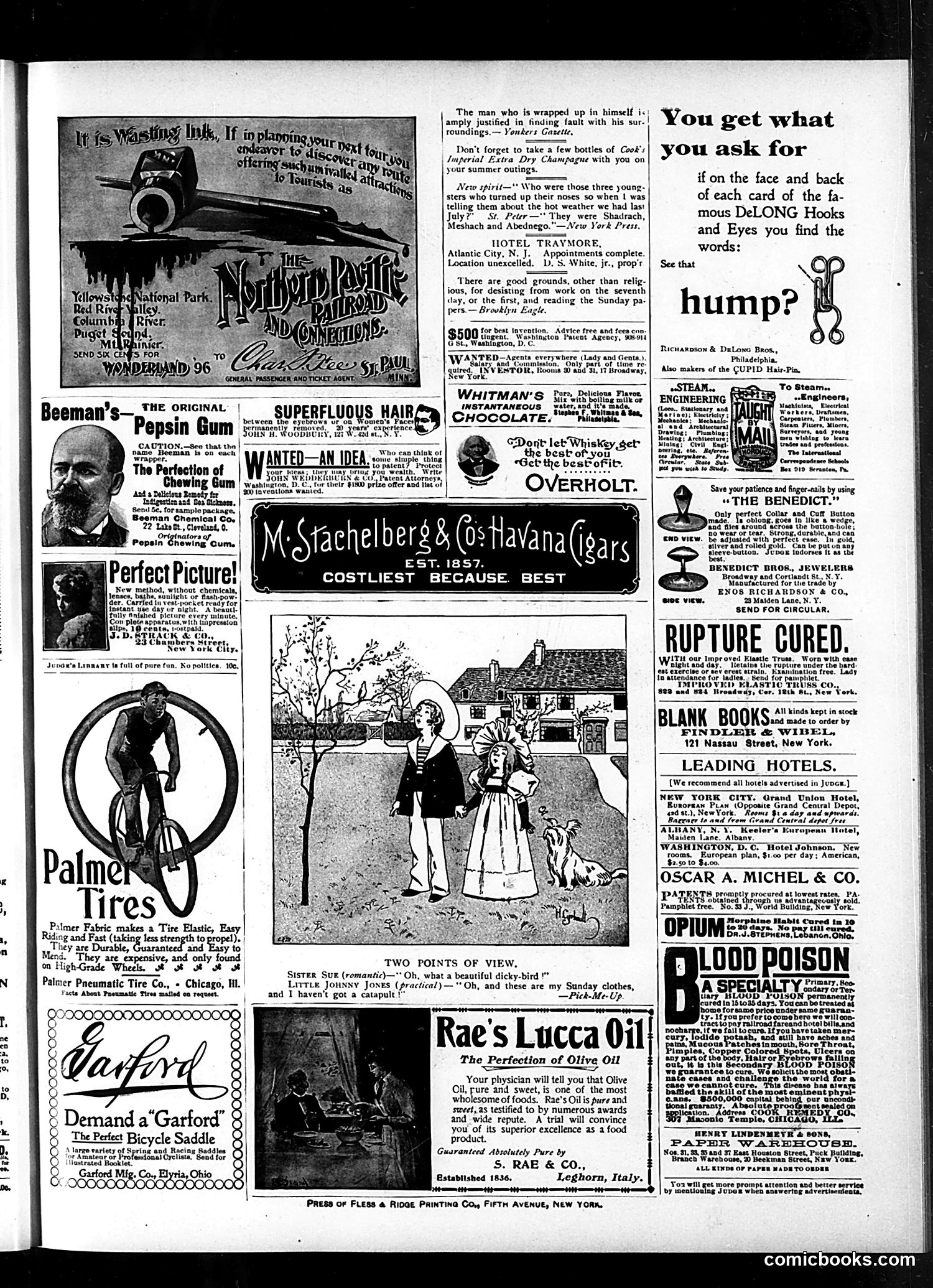
This page is primarily **advertising**, with minimal political satire. The few editorial jokes are light commentary rather than pointed satire: **The jokes present:** - A Biblical reference comparing three youths who rejected hot-weather complaints to Shadrach, Meshach, and Abednego (who refused to bow to idolatry), suggesting stubbornness - A domestic humor cartoon titled "Two Points of View" contrasting a romantic sister's admiration of a bird with her practical brother's focus on his Sunday clothes and lack of a toy catapult—gentle gender-stereotype humor **The bulk of the page** comprises advertisements for products like Pepsin gum, Palmer tires, Havana cigars, patent medicines (including products for "blood poison" and opium), and hotel listings. **Context for modern readers:** This reflects late 19th-century magazine economics—advertising subsidized publication. The medical ads particularly reflect an era before FDA regulation, when patent medicines made often-unproven claims about curative powers. The page contains no significant political satire or caricature of public figures.
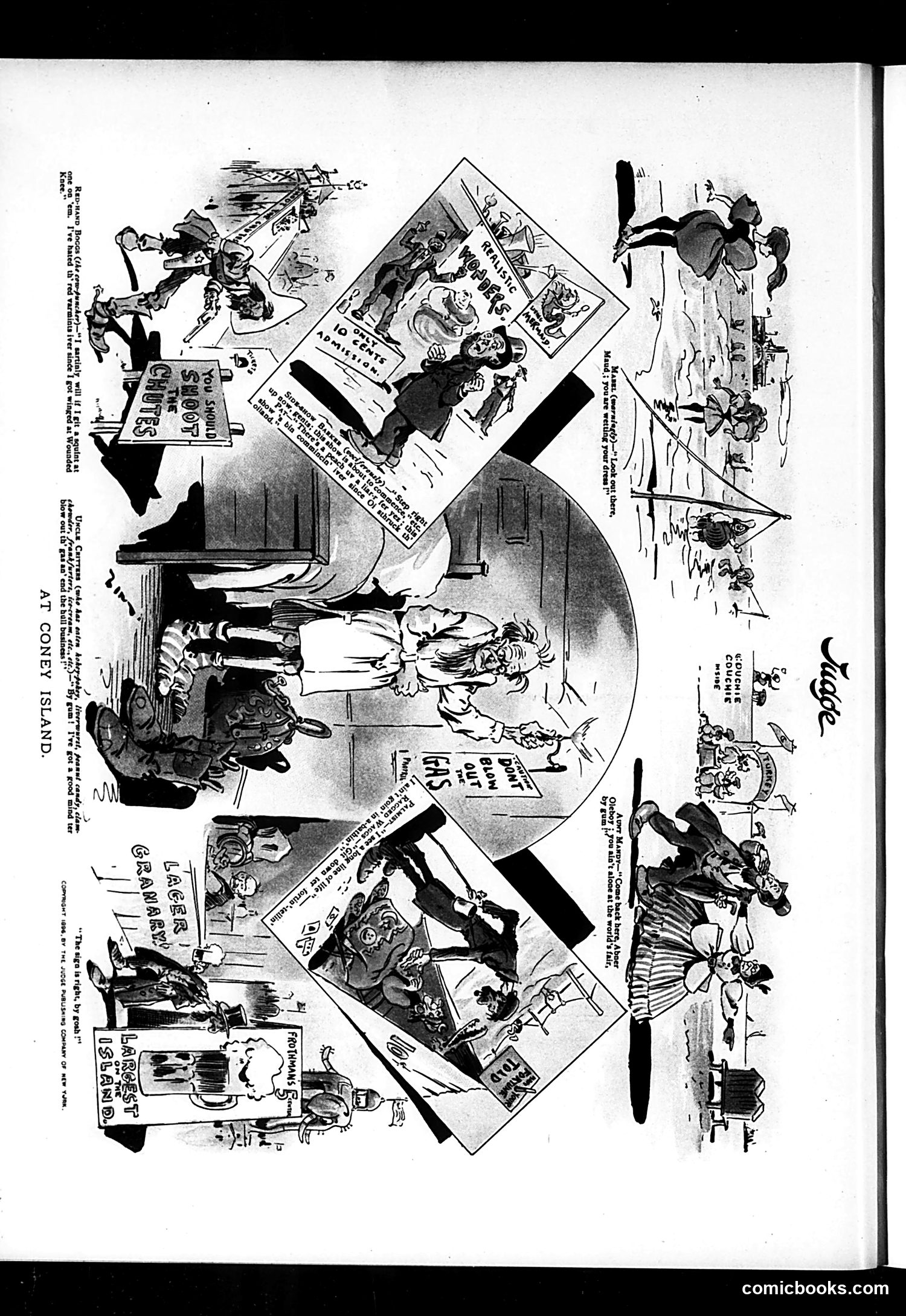
This appears to be a humorous Judge magazine page satirizing Coney Island amusement park culture. The central large illustration shows a woman at what seems to be an entertainment venue, surrounded by smaller comic panels depicting various Coney Island attractions and activities. The OCR text references "Wounded Knee" and "red varaint" (likely "red varmint"), suggesting a Native American caricature or stereotype—common in early 20th-century American humor. The dialogue mentions hot dogs and frankfurters, referencing Coney Island's famous food vendors. The satire appears to target both the gaudy commercialism of the amusement park and period-typical ethnic/racial stereotyping in popular entertainment. Without clearer visibility of all figures and dates, specifics remain uncertain, but this represents Judge's satirical approach to American popular culture and social attitudes of its era.