
Judge, 1896-07-11 · page 2 of 16
Judge — July 11, 1896 — page 2: what you’re looking at
What you’re looking at
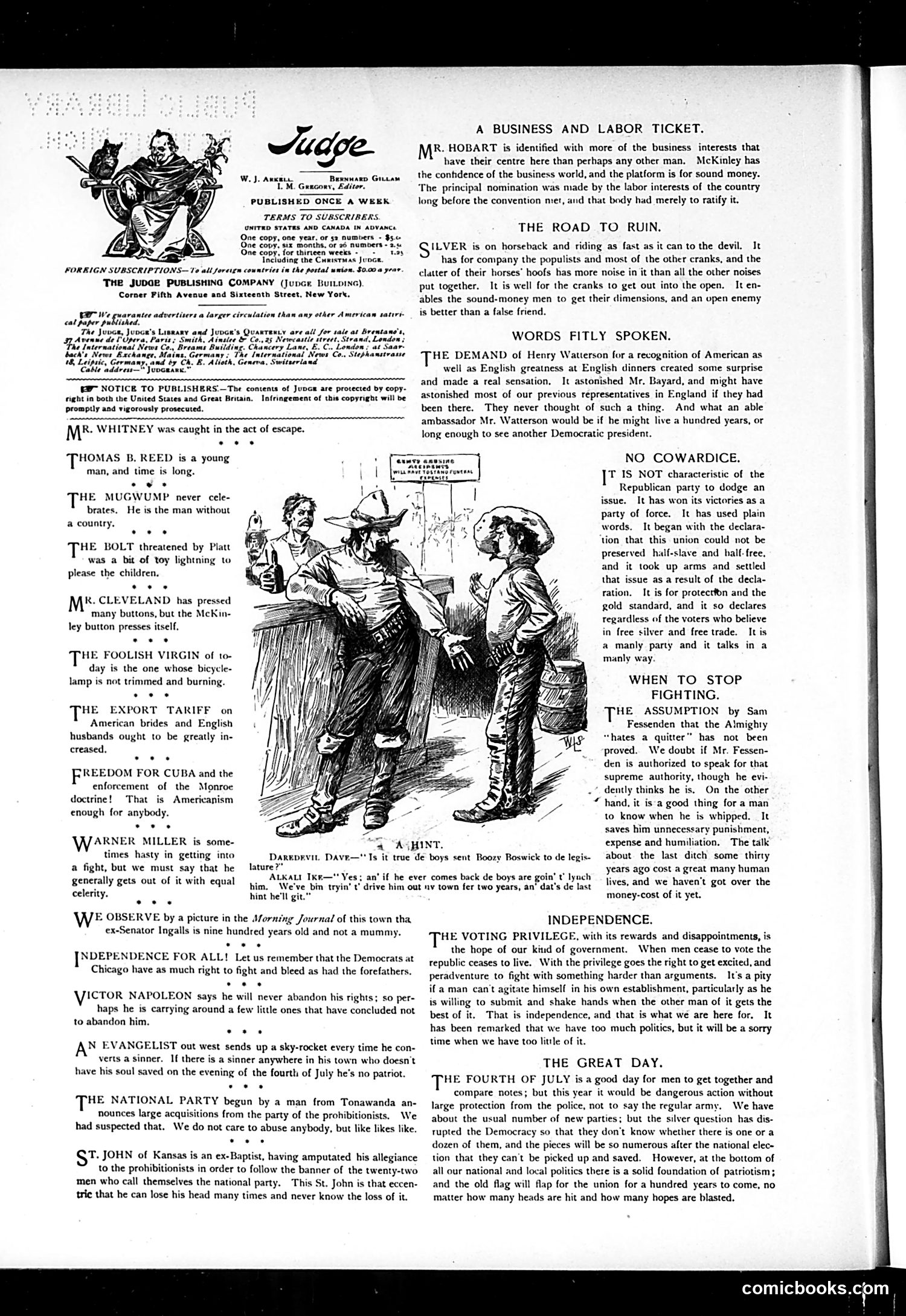
This Judge magazine cartoon satirizes political corruption and bribery during the Gilded Age. The central image depicts a well-dressed man (labeled "Darkdevil Dave") apparently offering money to two younger men labeled "Alkali Ike" and another figure, with the caption "A Hint—'Is it true de boys sent Roogy Roswick to de legislatures?'" The cartoon mocks how politicians and wealthy interests used bribery to secure legislative votes, particularly regarding labor and business issues. The "hint" involves passing money—a transparent reference to vote-buying and political favoritism. The working-class characters' dialectal speech emphasizes the class divide between wealthy manipulators and common voters. This reflects Progressive Era concerns about political machines and corruption influencing American democracy.
📄 Transcribed text from this page (OCR, searchable)
Machine-transcribed from the original scan — historical spelling and the odd misread are preserved.
wudge. W. J. Amumts. Bexwwarp Giitan 1. M. Guncony, Editor. PUBLISHED ONCE A WEEK TERMS TO SUBSCRIBERS. ONTTRD STATES AND CANADA IN ADVANCE or Including the Cumistmas J PORBIGN SUBSCRIPTIONS—1 all foreign countries in the portal umion. $0.00. yrar. ‘THE JUDGE PUBLISHING COMPANY (Jupcr BuILprNa). Corner Fifth Avenue and Sixteenth Street, New York, CB We guarantee advertisers a larger circulation than any other American satiri- cal paper published, The Juvce, Juoca’s Lineany and Juvoe’s Avense de Si rhe Intermati bach's News Exchange, Mains, Germany: T 18, Leipsic, Germany, and ty Ch. B. Alisth. Geneva, Cable address—" Juoce: wrenny are all for sale at Brentane’ y London (27 NOTICE TO PUBLISHERS.—The contents of Jupcs are protected by copy- fight in both the United States and Great Britain. Infringement of this copyright will be promptly and vigorously prosecuted. MB: WHITNEY was caught in the act of escape. THOMAS B.R is a young man, and time is long. owe THE MUGWUMP never cele- brates. He is the man without a country. THE BOLT threatened by Platt was a bit of toy lightning to please the children, eee K. CLEVELAND has pressed many buttons, but the McKin- ley button presses itself. cee THE FOOLISH VIRGIN of to- day is the one whose bicycle- lamp is not trimmed and burning. THE EXPORT TARIFF on American brides and English husbands ought to be greatly in- creased. FREEDOM FOR CUBA and the enforcement of the Monroe doctrine! That is Americanism enough for anybody. WARNER MILLER is some- times hasty in getting into Darepevit. Dave: a fight, but we must say that he lature?" generally gets out of it with equal celerity. him. hint he'll eee WE OBSERVE by a picture in the Aforning Journal of this town tha ex-Senator Ingalls is nine hundred years old and not a mummy. [NDEPE ‘DENCE FOR ALL! Let us remember that the Democrats at Chicago have as much right to fight and bleed as had the forefathers. VICTOR NAPOLEON says he will never abandon his rights; so per- haps he is carrying around a few little ones that have concluded not to abandon him. ray AN EVANGELIST out west sends up a sky-rocket every time he con- verts a sinner. If there is a sinner anywhere in his town who doesn’t have his soul saved on the evening of the fourth of July he’s no patriot. THE NATIONAL PARTY begun by a man from Tonawanda an- nounces large acquisitions from the party of the prohibitionists, We had suspected that. We do not care to abuse anybody, but like likes like. GT. JOHN of Kansas is an ex-Baptist, having amputated his allegiance to the prohibitionists in order to follow the banner of the twenty-two men who call themselves the national party. This St. John is that eccen- tric that he can lose his head many times and never know the loss of it. “A ASBINT. : "Is it true de boys sent Boozy Boswick to de legis: about the last ditch some thirty ALKALI Ikr—"' Yes; an’ if he ever comes back de boys are goin’ ' lynch aie OU z We've bin tryin’ t” drive him out nv town fer two years, an’ dat's de last lives. and we haven't got over the A BUSINESS AND LABOR TICKET. R. HOBART is identified with more of the business interests that have their centre here than perhaps any other man. McKinley has the confidence of the business world, and the platform is for sound money. ‘The principal nomination was made by the labor interests of the country long before the convention met, and that body had merely to ratify it, THE ROAD TO RUIN. SIEVER is on horseback and riding as fast as it can to the devil. It has for company the populists and most of the other cranks, and the clatter of their horses’ hoofs has more noise in it than all the other noises put together, It is well for the cranks to get out into the open. It en- ables the sound-money men to get their dimensions, and an open enemy is better than a false friend. WORDS FITLY SPOKEN. HE DEMAND of Henry Watterson for a recognition of American as well as English greatness at English dinners created some surprise and made a real sensation, It astonished Mr. Bayard, and might have astonished most of our previous representatives in England if they had been there. They never thought of such a thing. And what an able ambassador Mr. Watterson would be if he might live a hundred years, or long enough to see another Democratic president. sine NO COWARDICE. ]T 1S NOT characteristic of the Republican party to dodge an issue. It has won its victories as a party of force. It has used plain words. It began with the declara- tion that this union could not be preserved half-slave and balf-free, and it took up arms and settled that issue as a result of the decla- ration. It is for protectfon and the gold standard, and it so declares regardless of the voters who believe in free silver and free trade. It is a manly party and it talks in a manly way. WHEN TO STOP FIGHTING. THE ASSUMPTION by Sam Fessenden that the Almighty “hates a quitter” has not been proved. We doubt if Mr. Fessen- den is authorized to speak for that supreme authority, though he evi- dently thinks he is. On the other hand, it is'a good thing for a man to know when he is whipped. It saves him unnecessary punishment, expense and humiliation, The talk s years ago cost a great many human money-cost of it yet. INDEPENDENCE. THE VOTING PRIVILEGE, with its rewards and disappointments, is the hope of our kind of government. When men cease to vote the republic ceases to live. With the privilege goes the right to get excited, and peradventure to fight with something harder than arguments. It’s a pity if a man can't ate himself in his own establishment, particularly as he is willing to submit and shake hands when the other man of it gets the best of it. That is independence, and that is what we are here for. It has been remarked that we have too much politics, but it will be a sorry time when we have too little of it. THE GREAT DAY. THE FOURTH OF JULY is a good day for men to get together and compare notes; but this year it would be dangerous action without large protection from the police, not to say the regular army. We have about the usual number of new parties; but the silver question has dis- rupted the Democracy so that they don’t know whether there is one or a dozen of them, and the pieces will be so numerous after the national elec- tion that they can’t be picked up and saved. However, at the bottom of all our national and local politics there is a solid foundation of patriotism; and the old flag will flap for the union for a hundred years to come, no matter how many heads are hit and how many hopes are blasted. comicbooks.com ’