
A complete issue · 17 pages · 1896
Judge — June 27, 1896
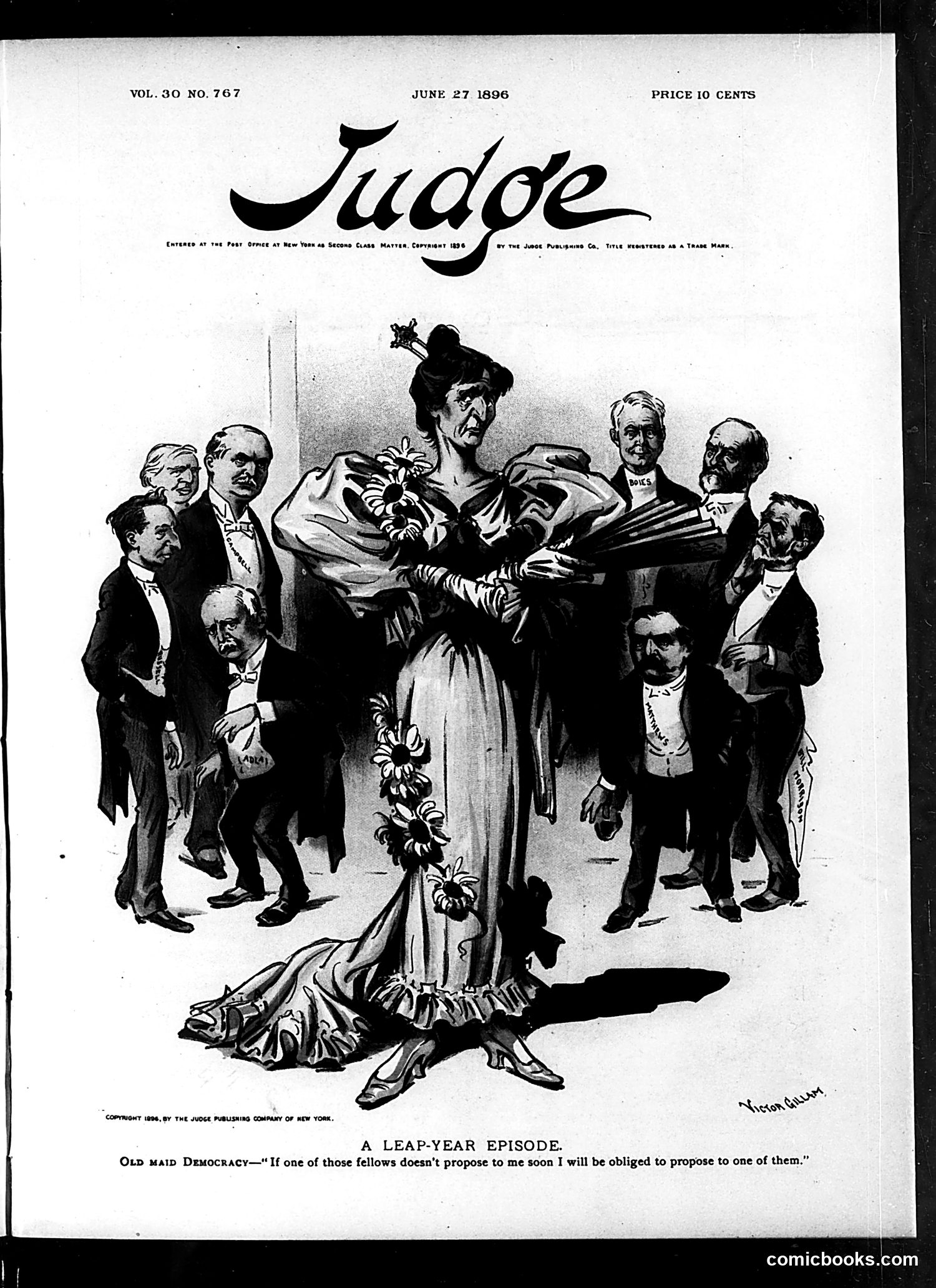
This satirical cartoon depicts a woman (representing "Old Maid Democracy") surrounded by male politicians, with the caption: "If one of those fellows doesn't propose to me soon I will be obliged to propose to one of them." The joke references leap-year tradition, when women are permitted to propose marriage to men. Here, it's applied politically: the female personification of the Democratic Party is threatening to take the initiative if the male politicians around her don't commit their support. The cartoon likely satirizes the 1896 election cycle, when Democratic leadership faced internal divisions and uncertainty about their direction and candidates. The "leap-year" framing suggests desperation—the Party must act decisively or lose control of its own fate.
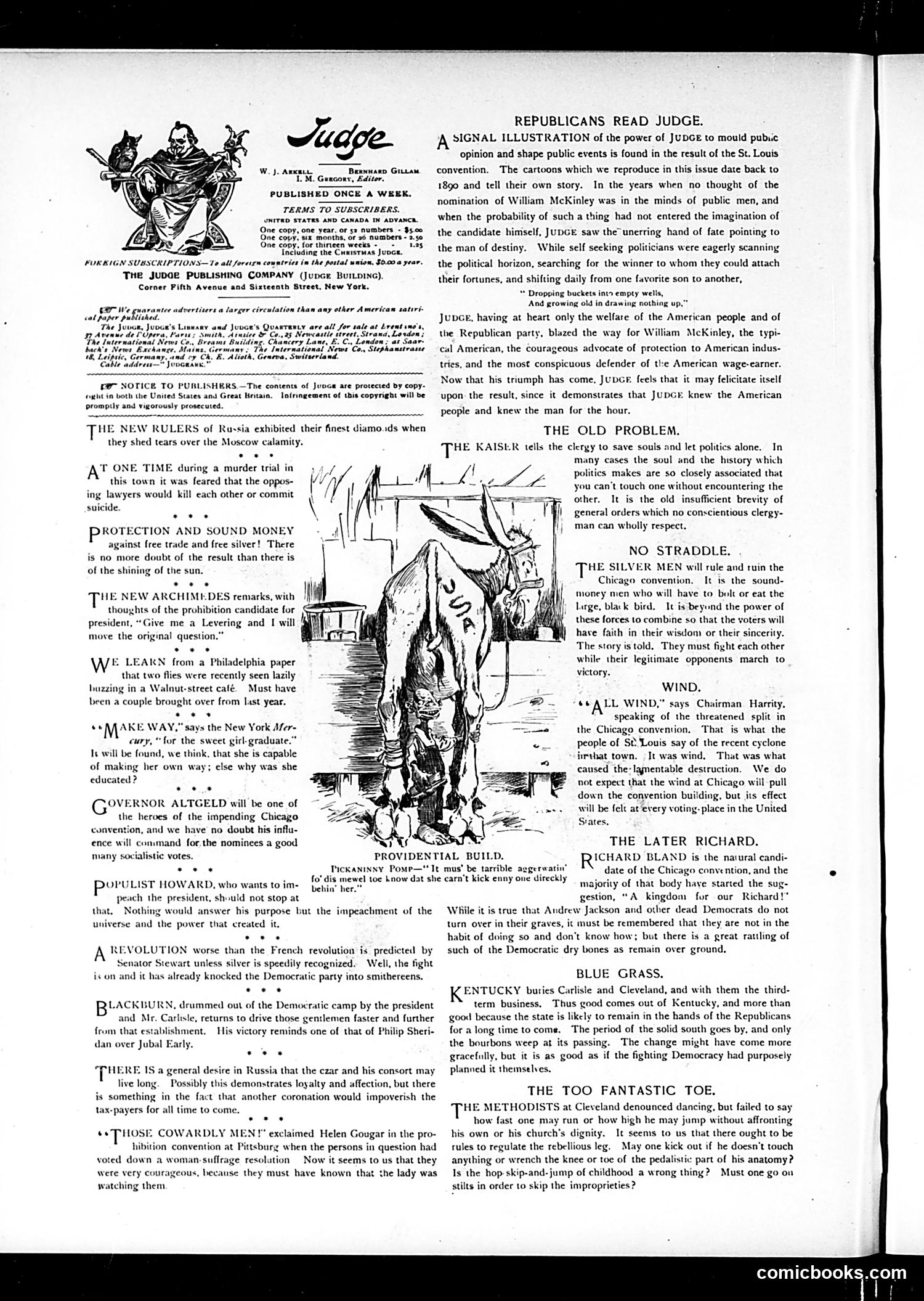
This page celebrates Judge magazine's influence on Republican thought during the 1892 convention period. The central cartoon depicts a donkey (the Democratic symbol) labeled "PROVIDENTIAL BUILD," collapsing under the weight of various Democratic failures and scandals. The surrounding commentary mocks Democratic vulnerabilities—particularly around the tariff issue, currency policy ("Silver Men"), and internal party divisions. References to William McKinley's nomination suggest Republicans confidence in his protectionist platform as superior to Democratic positions. The satire argues that Judge's editorial power has exposed Democratic weaknesses to the American public, thereby serving Republican interests. The overall tone is triumphalist, positioning the magazine as instrumental to Republican political success during this election cycle.
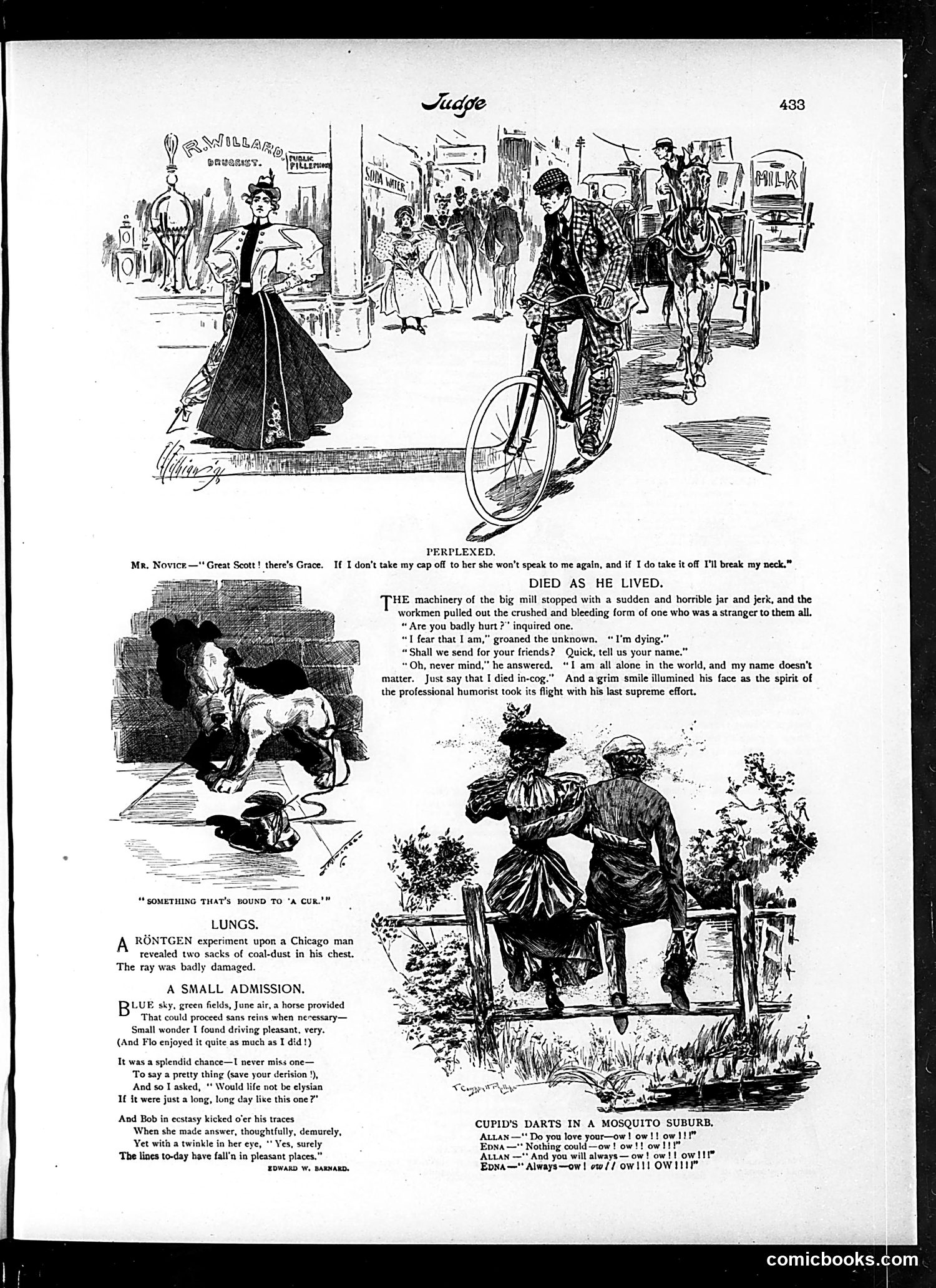
This page contains several satirical illustrations and humorous pieces typical of Judge magazine's social comedy. **Top cartoon "Perplexed":** A woman on a street confronts a man on a bicycle, delivering an ultimatum about his hat. The joke relies on period-specific fashion etiquette—apparently removing one's hat to a woman was a social obligation, and the man's failure to do so is grounds for relationship drama. The satire mocks both Victorian social conventions and bicycle culture (bicycles were relatively new and associated with modern, sometimes rule-breaking behavior). **Lower content** includes humorous short pieces titled "Died as He Lived," "Lungs," and "Cupid's Darts in a Mosquito Suburb"—typical light satirical pieces poking fun at everyday situations and human nature rather than political targets. The overall page emphasizes social manners and courtship comedy rather than political satire.
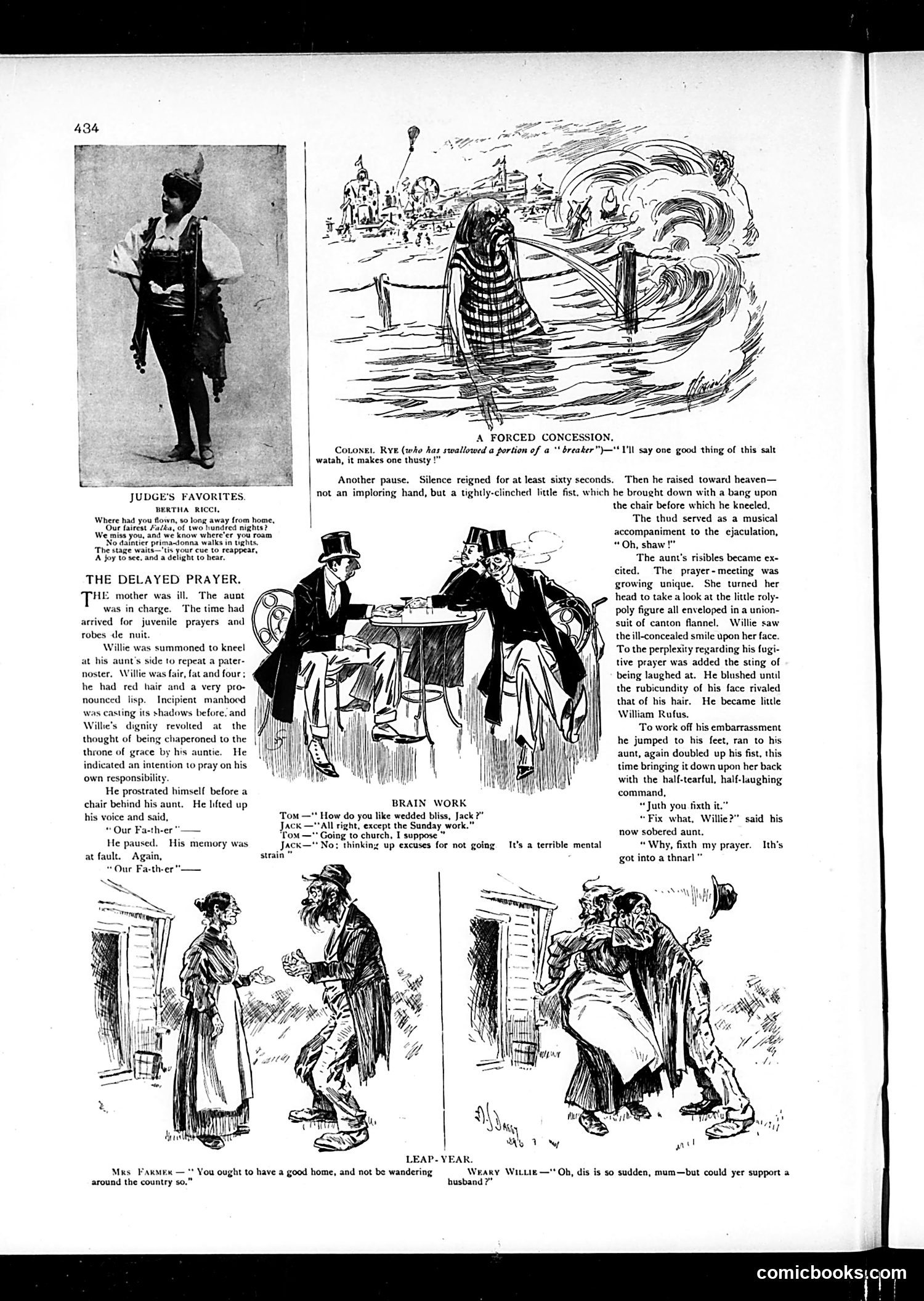
This page from *Judge* magazine contains three satirical pieces: **"The Delayed Prayer"** is a humorous domestic story about a young, lisping boy (Willie) embarrassed to pray with his aunt present. When he forgets the words to "Our Father," his frustrated outburst ("Oh, shaw!") and subsequent tantrum—punching the chair, then his aunt—satirize childhood dignity and the absurdity of forced piety. The joke hinges on his lisp and the contrast between expected reverence and actual childish behavior. **"Brain Work"** is a brief comic dialogue mocking married men who fabricate excuses (pretending church attendance requires "thinking up excuses") to avoid their wives' expectations. **"Leap-Year"** shows a woman proposing to a poor man, satirizing the social convention that allowed women to propose during leap years, and critiquing economic desperation in romance. The page also features a photograph of performer Bertha Ricci and an illustration labeled "A Forced Concession" about drinking salt water—likely topical humor now obscure.
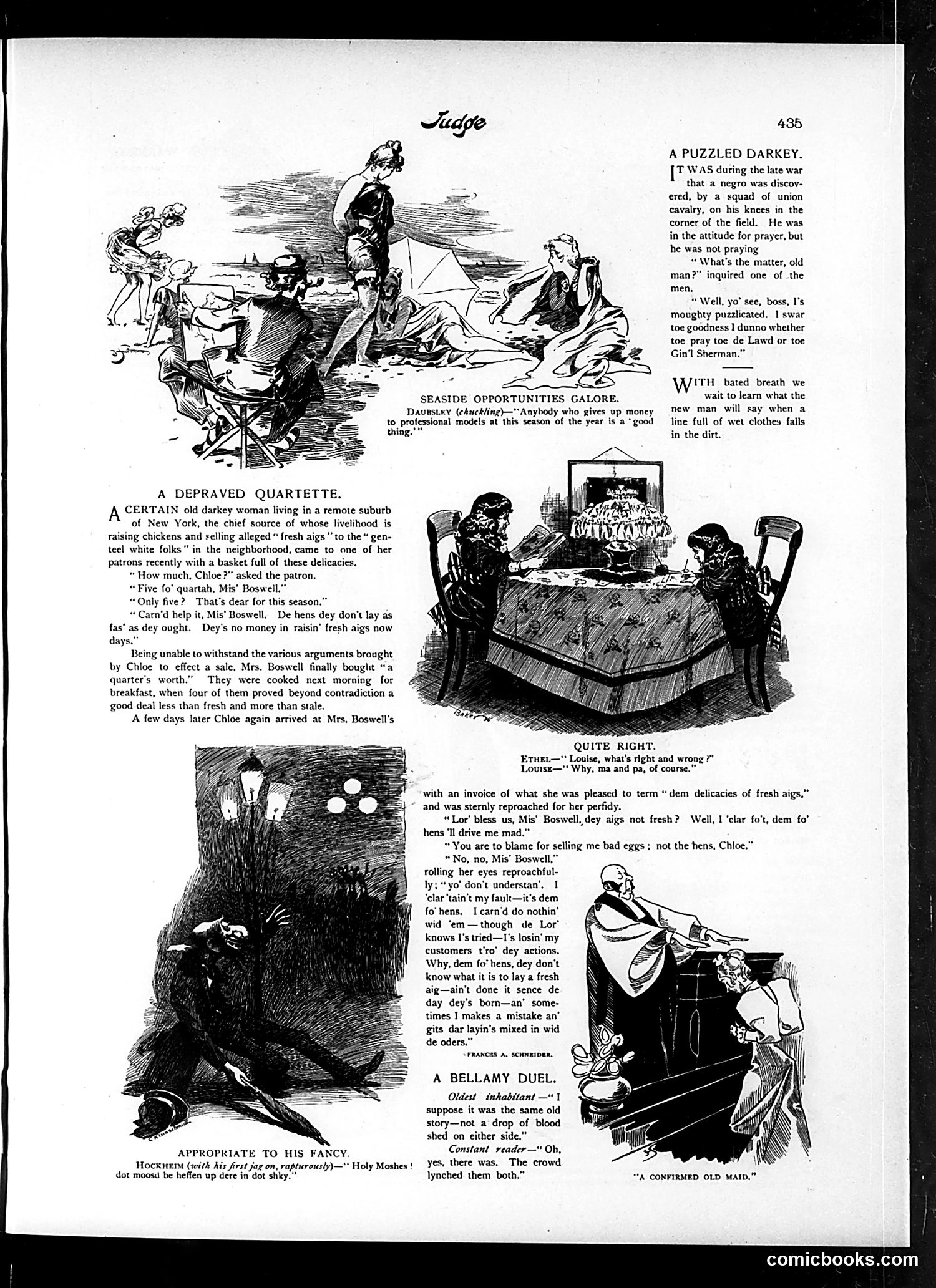
This page contains several satirical sketches typical of late 19th-century American humor, though offensive by modern standards. **"A Puzzled Darkey"** depicts a enslaved Black man during the Civil War uncertain whether to pray to God or General Sherman, mocking his confusion about whom to trust for liberation. The humor relies on racist dialect and stereotypes. **"A Depraved Quartette"** features an exchange between a white woman (Mrs. Boswell) and her Black servant Chloe, who sells her spoiled eggs and makes excuses in stereotypical dialect. The satire targets both the dishonest vendor and the absurdity of her explanations. **"A Bellamy Duel"** references a lynching, treating the murder of two people as darkly comedic ("not a drop of blood shed"). The remaining sketches are brief, society-focused anecdotes unrelated to political events. The page reflects period attitudes: crude racial caricature presented as entertainment, with dialect spelling used to demean Black speakers and perpetuate stereotypes.
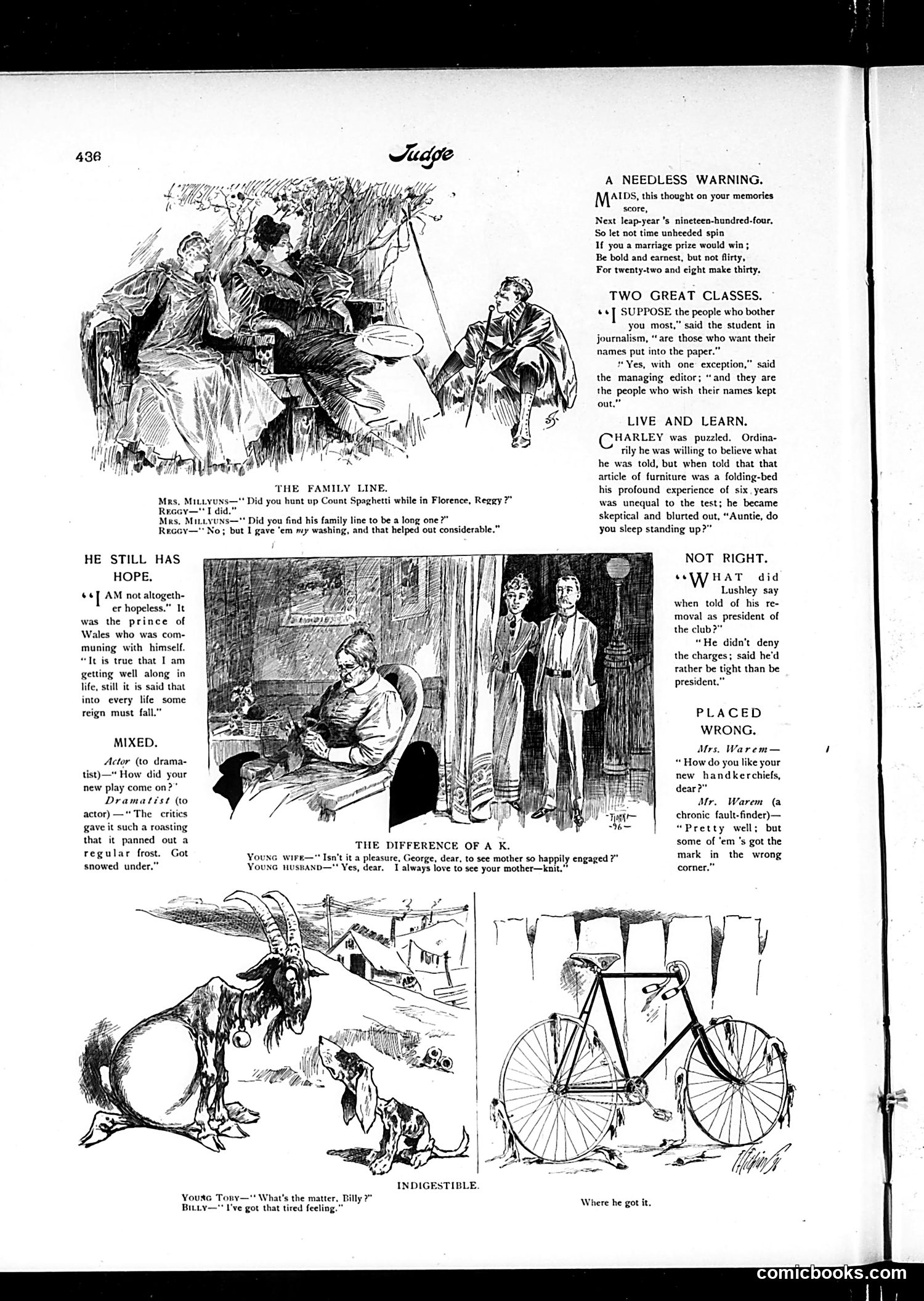
This page from *Judge* contains multiple short humor pieces typical of the magazine's satirical format: **"The Family Line"** mocks social pretension—a character claims to have found an Italian count's "family line" by giving the servant his laundry, suggesting aristocratic lineage is worthless. **"The Difference of a K"** plays on homophonic humor: a wife says seeing her mother "so happily engaged" is a pleasure; the husband says he loves to see her "knit"—the similar sounds create the joke. **"Two Great Classes"** satirizes newspaper culture, contrasting people desperate for publicity with those desperate to avoid it. **"A Needless Warning"** is a math joke about leap-year marriage proposals, with intentionally bad arithmetic (22+8≠30). **Other pieces** include jokes about theatrical failures, indigestion, and a fault-finding husband. The cartoons are largely self-contained gags rather than political commentary—typical of *Judge*'s mix of social observation and wordplay humor aimed at middle-class readers.
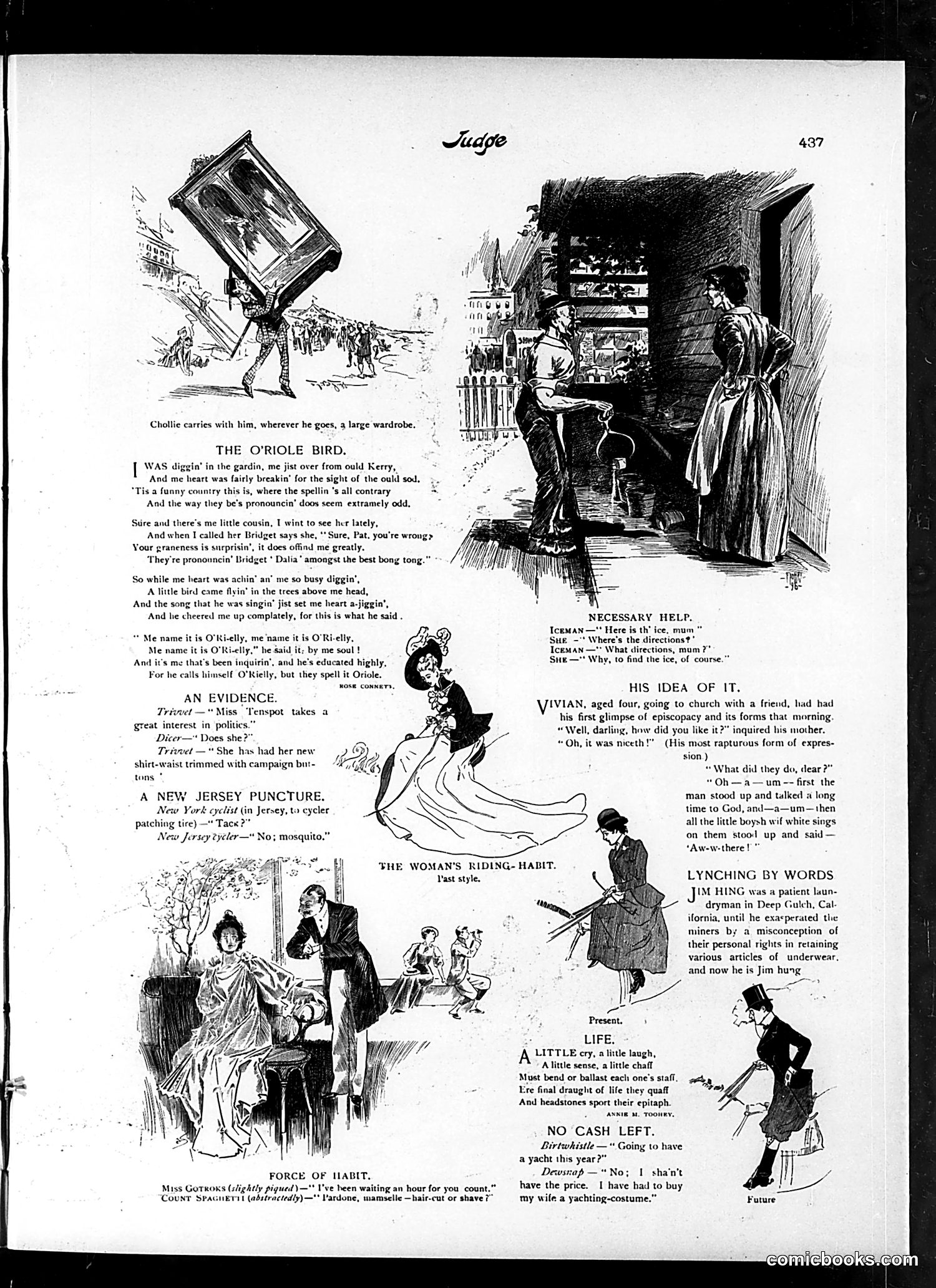
This page from Judge (a major American satirical magazine) contains several unrelated comic sketches and humorous verse typical of the publication's format. **"The O'Riole Bird"** is the featured piece—a dialect poem about an Irish immigrant ("Pat") homesick for Ireland who encounters a bird. The joke hinges on pronunciation: Americans say "Oriole" but Pat calls it "O'Rielly," conflating the bird's name with Irish naming conventions. It satirizes Irish-American speech patterns and the peculiarities of English pronunciation. **Other sketches** include brief jokes about: a woman's political interest shown only through campaign-button fashion trim; a New Jersey cyclist blaming mosquitoes rather than mechanical failure for tire damage; a Count mistaking an ice delivery for a barbershop visit; and a child's confusion about church services (confusing hymns with gibberish). **"Lynching by Words"** plays on the term "Jim hung"—a laundyman named Jim is socially ostracized (verbally "lynched") for keeping miners' underwear, misunderstanding property rights. The humor is primarily observational, class-based, and ethnic in nature, typical of early 1900s American magazine satire.
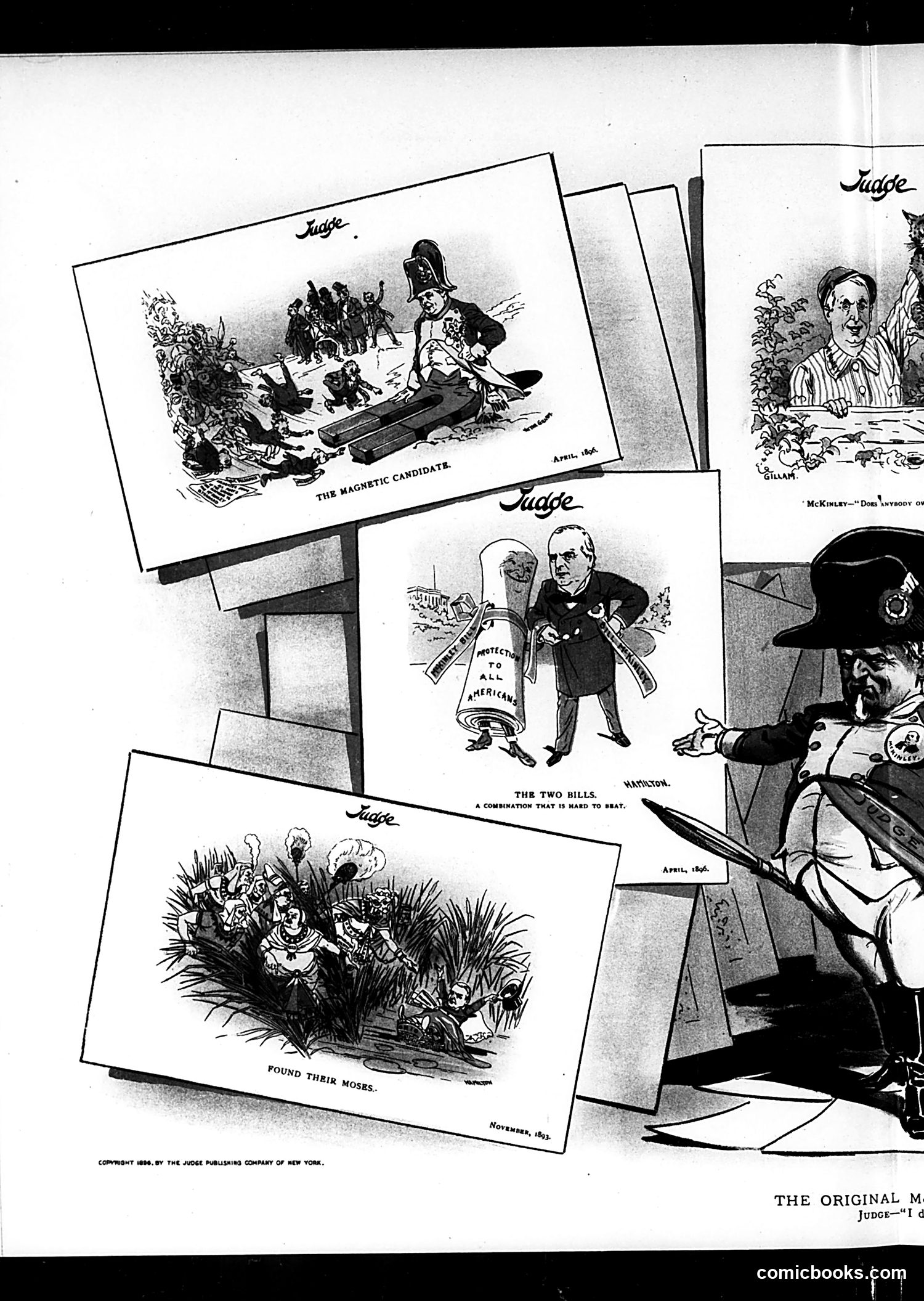
This page displays three satirical cartoons from Judge's April 1896 issue, all signed by the artist "Judge." **"The Magnetic Candidate"** (top) shows a figure attracting various groups—likely satirizing a politician's broad appeal or opportunistic coalition-building. **"The Two Bills"** (center) depicts two men embracing a large barrel labeled "PROTECTION TO ALL AMERICANS"—appearing to mock a political alliance around protective tariff legislation, described as "a combination that is hard to beat." **"Found Their Noses"** (bottom) shows figures in water/reeds, the meaning unclear from the visible image. The cartoons employ Judge's characteristic satirical style, using exaggeration and visual metaphor to critique late-19th-century American politics, likely involving tariff debates and political maneuvering common to that election year.
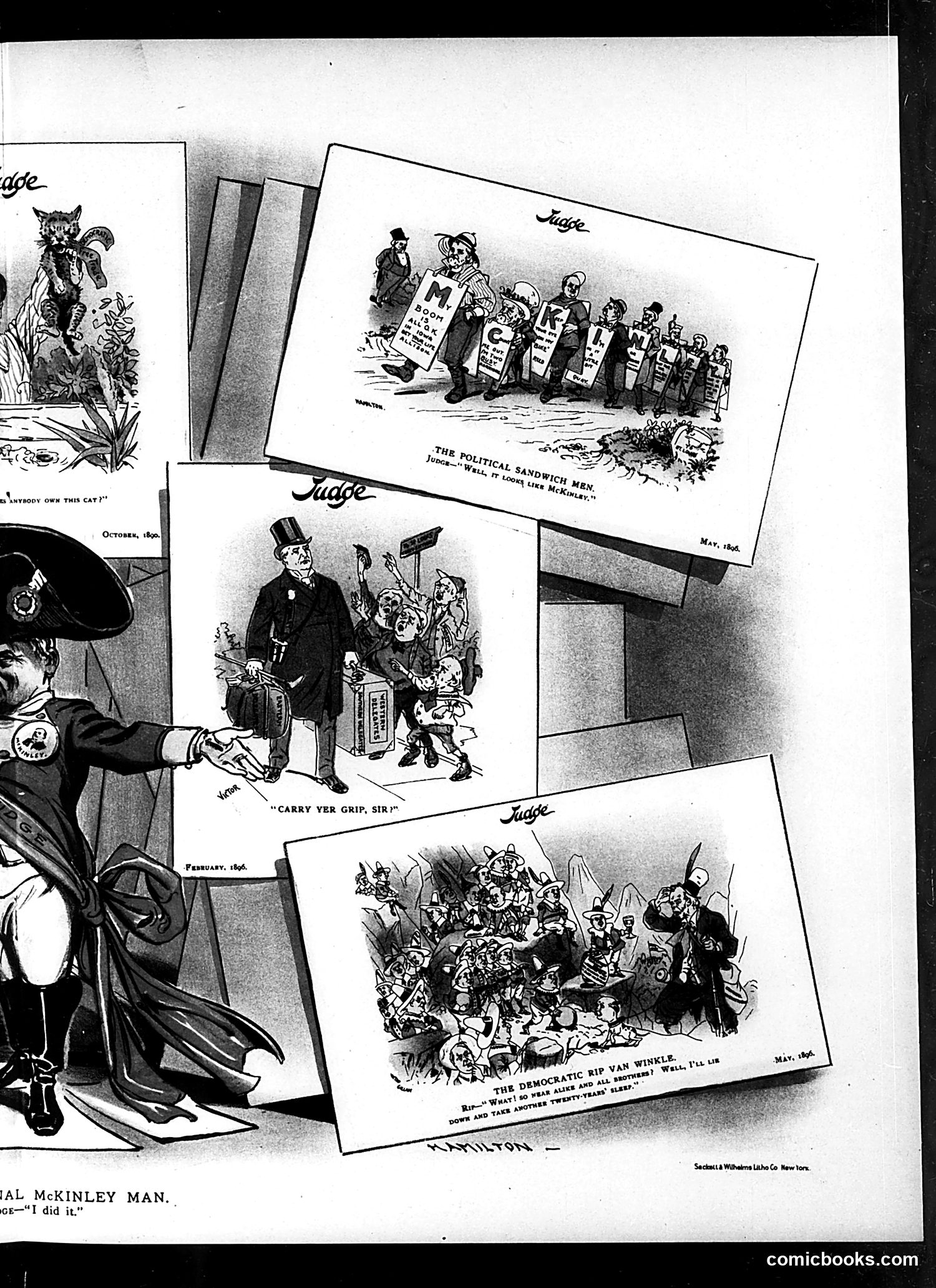
This Judge magazine page from 1896 contains political cartoons satirizing William McKinley and his supporters during the 1896 presidential election. The cartoons mock McKinley's association with protective tariffs and Republican policies. One cartoon titled "The Political Sandwich Men" depicts supporters carrying sandwich boards with McKinley's name, suggesting they mindlessly promote him. Another, "Carry Yer Grip, Sir," shows McKinley as a porter handling baggage labeled with policy positions. The bottom cartoon appears to reference Democratic criticisms of Republican economic policies. The overall satire suggests McKinley's campaign relied on blind party loyalty rather than substantive argument, and that his policies burdened ordinary citizens.
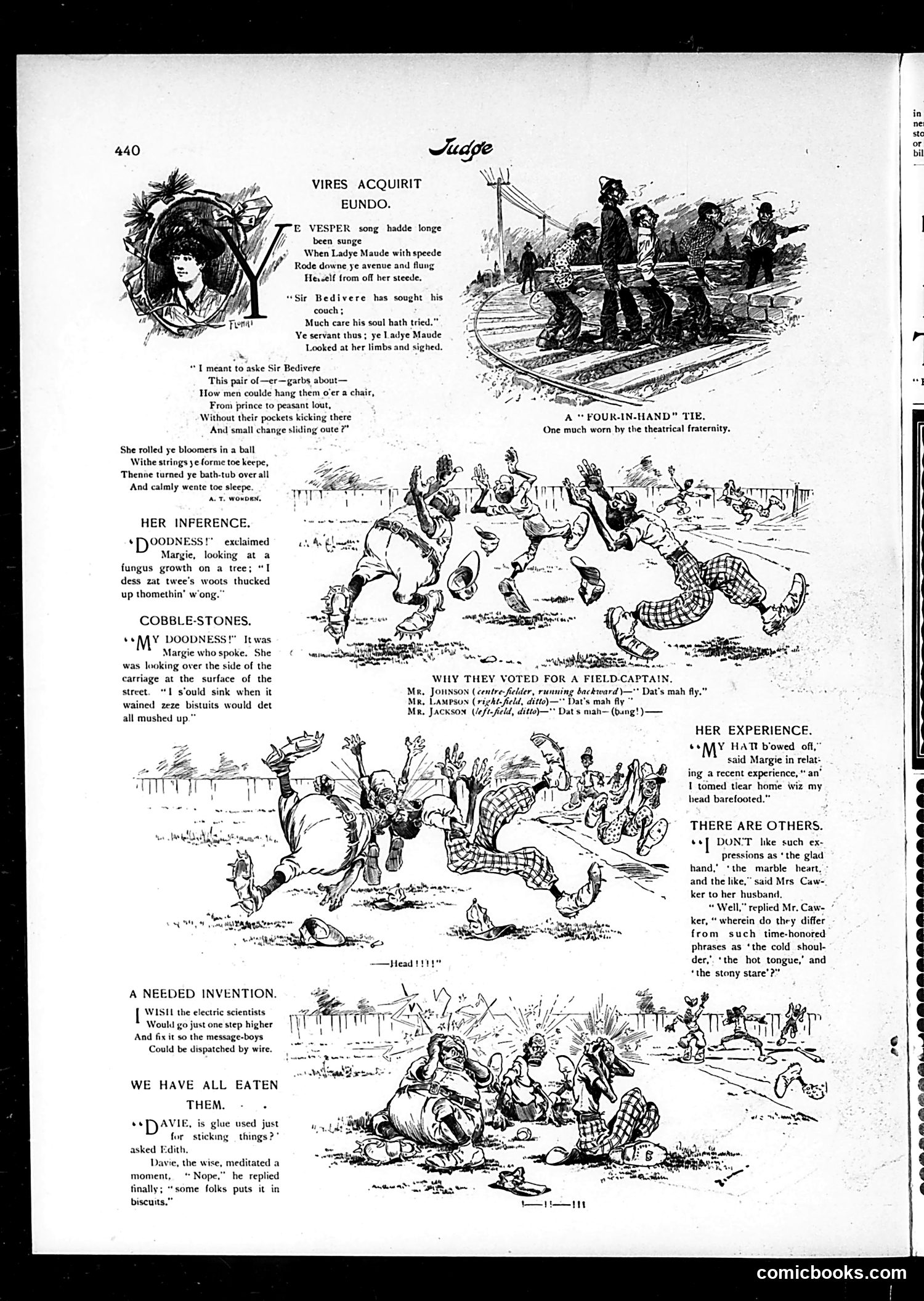
This page from *Judge* magazine contains several short humorous pieces mocking contemporary speech and social customs, likely from the early 1900s. The main pieces include parodies of affected or malapropistic dialogue from working-class characters named "Margie" and "Davie," who mangle English expressions ("biowed" for "blew," "barefooted" for "bareheaded"). These mock immigrant or lower-class speech patterns common in period humor. A section titled "Why They Voted for a Field-Captain" shows baseball players arguing over a fly ball—satirizing workplace disputes or democratic voting absurdities. Another piece ridicules Mrs. Cawker's objection to modern slang ("glad hand," "marble heart") while her husband points out old phrases are equally clichéd—commentary on pretentious social standards. The final joke conflates glue with poorly-made biscuits, suggesting bad food quality. The decorative illustrations and archaic language parody ("Ye Vesper song") add comedic flavor. Overall, the page targets lower-class dialect humor and social pretension typical of period American satire.
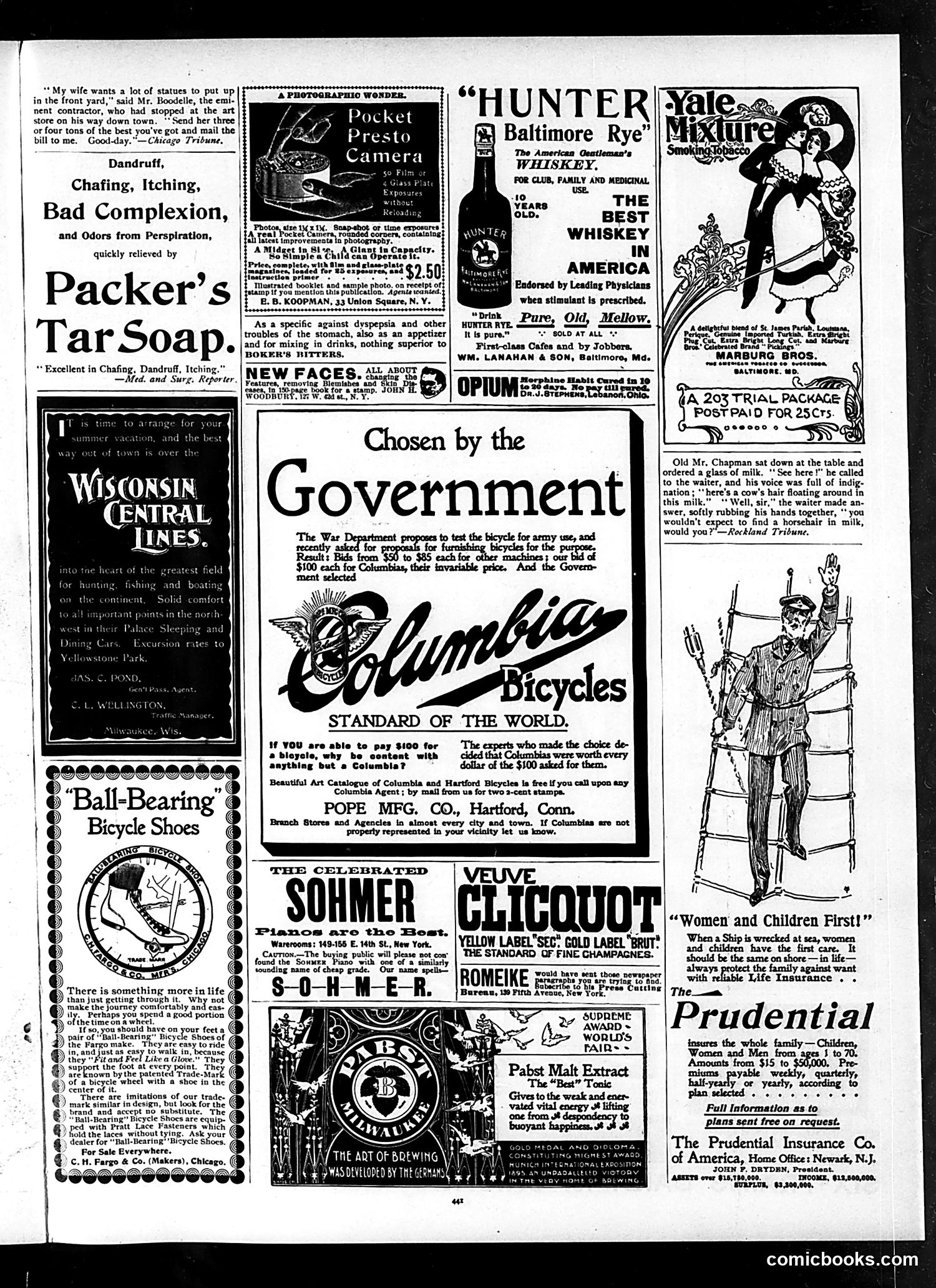
This is primarily an **advertising page** from *Judge* magazine, not a political cartoon. The page contains commercial advertisements for products like bicycles (Columbia), whiskey (Hunter Baltimore Rye), pianos (Sohmer), champagne (Veuve Clicquot), and insurance (Prudential). One notable element is a **brief humorous anecdote** (not a cartoon) about Mr. Chapman finding a cow's hair in his milk, to which the waiter cleverly responds he wouldn't expect a horse's hair. This represents typical early-1900s bar-room style humor. The **only satirical content** appears to be the "Chosen by the Government" section about Columbia bicycles, referencing what appears to be a government procurement decision. This implies marketing legitimacy through official endorsement—a common early advertising strategy. The page reflects the era's advertising practices: heavy use of testimonials, medicinal claims (opium cures, bitters for digestion), and appeals to gentility and status.
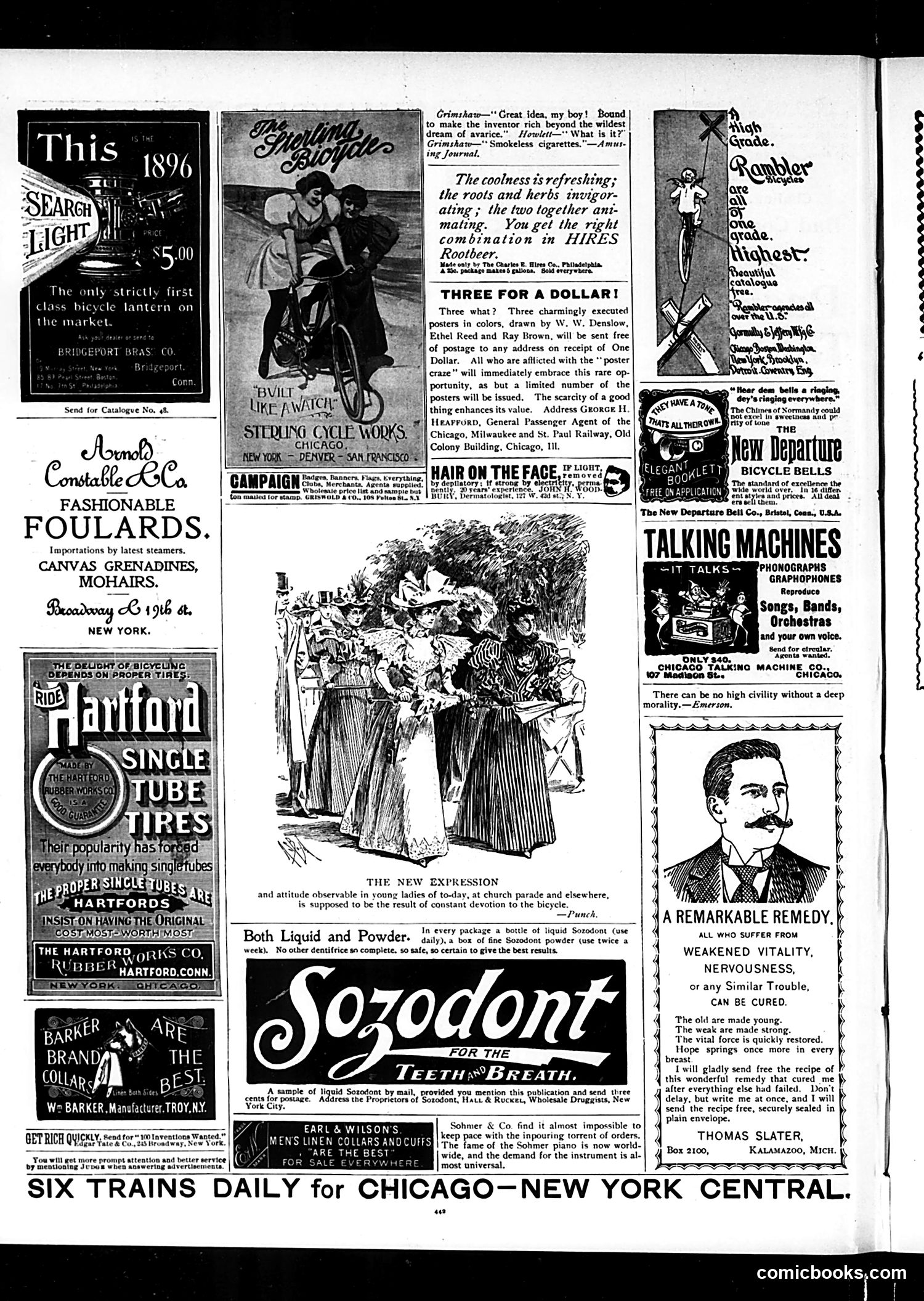
This page is primarily **advertising**, typical of late-19th-century magazines. The content includes product pitches for bicycles, rootbeer, tires, dental products, collars, pianos, and patent medicines. The only notable satirical content is a small cartoon captioned "The New Expression," showing young women on bicycles with a commentary on their posture and attitude. The accompanying text, attributed to *Punch* magazine, sarcastically suggests that young women's "new" demeanor results from "constant devotion to the bicycle"—a popular Victorian-era concern that bicycling made women less proper or feminine. There's also a humorous exchange about "smokeless cigarettes" presented as a get-rich invention. The "Remarkable Remedy" advertisement for weakened vitality and nervousness is typical of dubious patent-medicine marketing from this era, promising youth restoration through an undisclosed formula. The page reflects 1890s consumer culture and anxieties about modern technology's social effects.
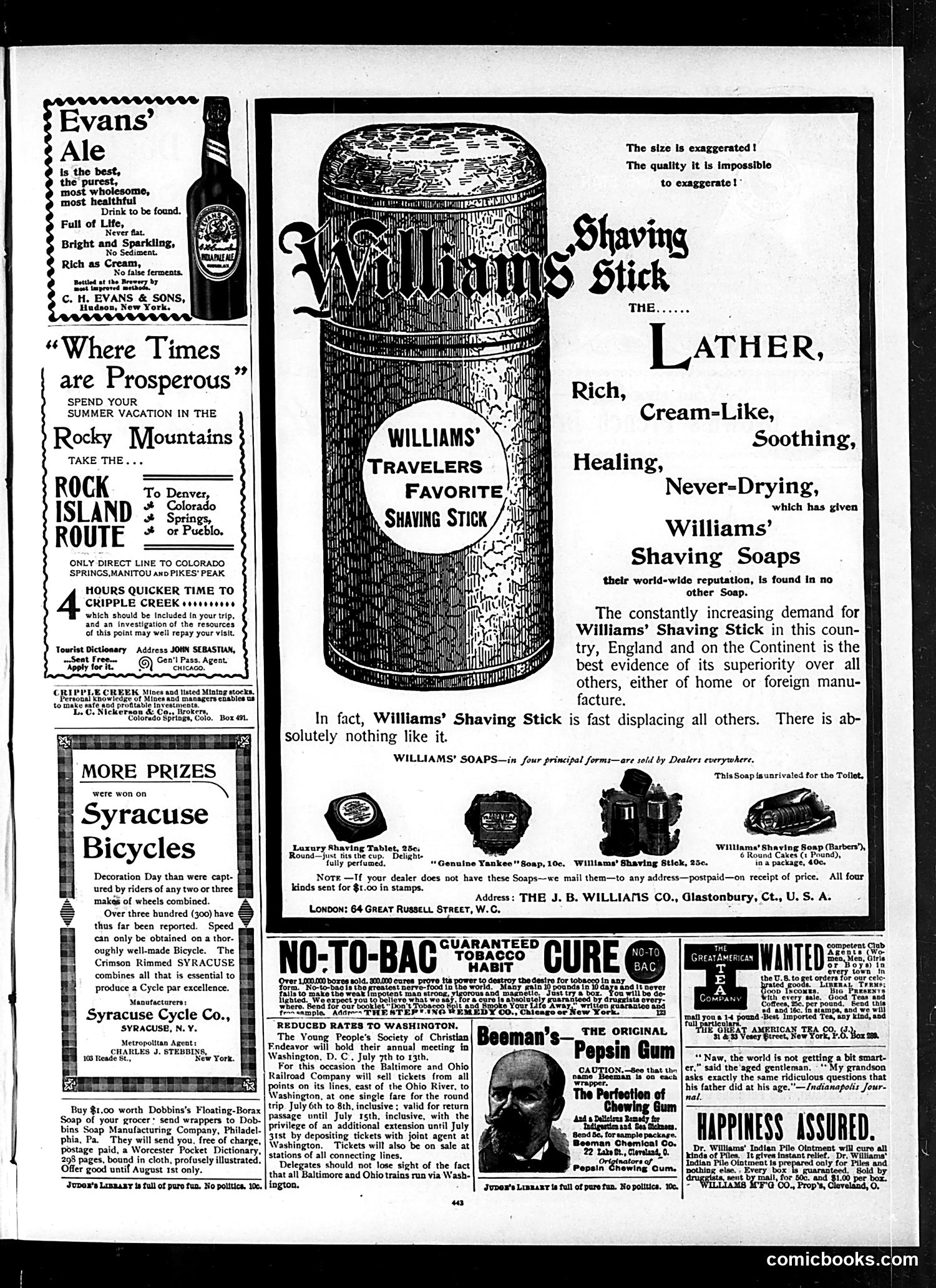
This is primarily a **commercial advertising page** rather than political satire. It contains multiple product advertisements typical of early-20th-century American magazines: **Main content**: A large advertisement for **Williams' Shaving Stick**, emphasizing its superiority over competitors through claims of cream-like, soothing, and healing properties. The ad stresses its "world-wide reputation" and that it's "fast displacing all others." **Supporting advertisements** include: - Evans' Ale (beverage) - Rock Island Route railroad (Colorado vacations) - Syracuse Bicycles - Dobbins' Floating-Borax Soap - No-To-Bac (tobacco cessation product) - Beeman's Pepsin Gum - Baltimore & Ohio Railroad (Washington, D.C. fares) **No political satire is evident**. The page serves Judge's primary function as a vehicle for profitable advertising, wrapped around the magazine's editorial content elsewhere. The claims are typical consumer-marketing hyperbole of the era.
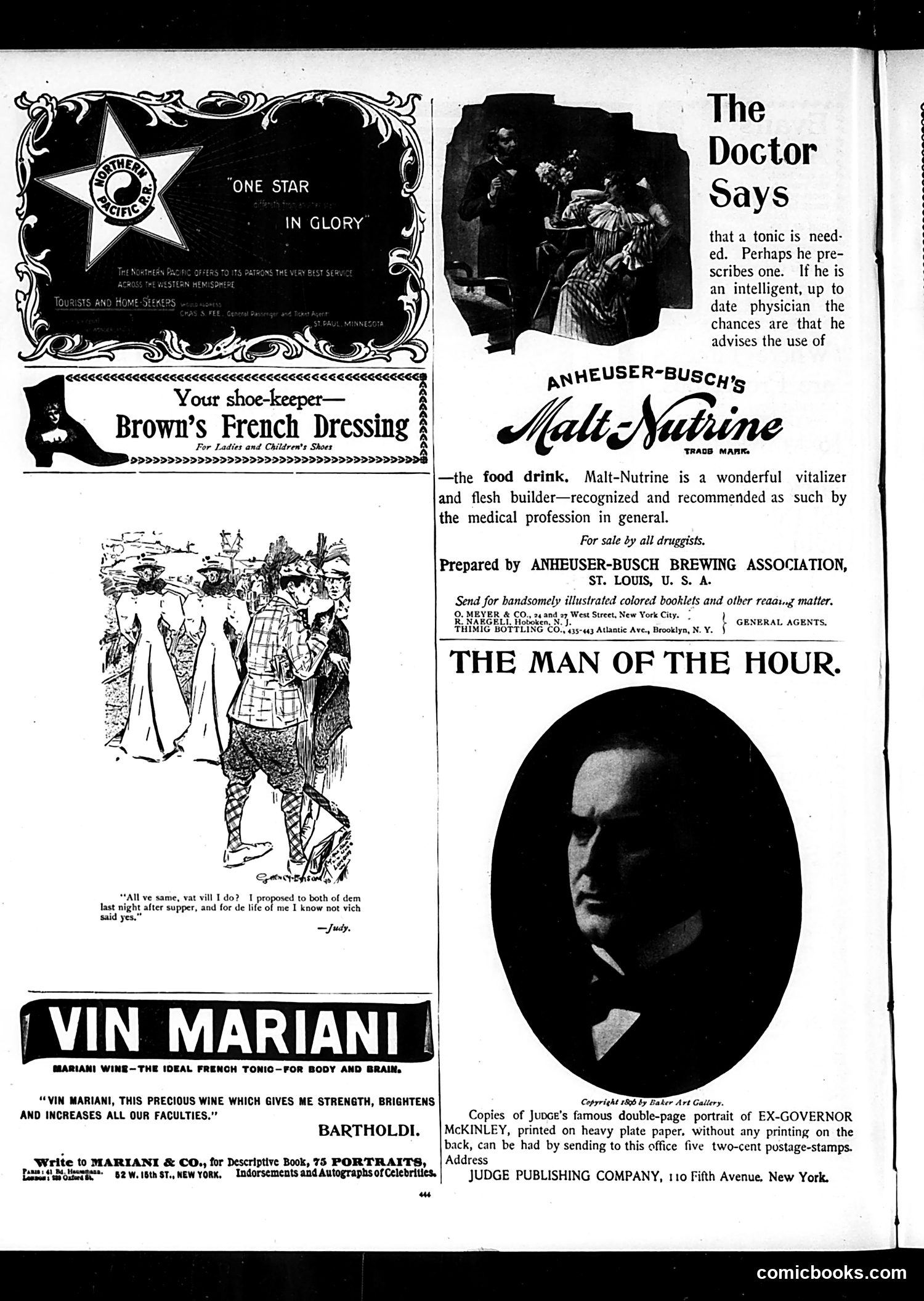
This page is primarily **advertising**, not editorial satire. It contains: 1. **"One Star in Glory"** — a film advertisement (top left) 2. **Brown's French Dressing** — shoe polish ad 3. **A cartoon joke** (center-left) by "Judy" featuring a man with a German accent ("vat vill I do?") who proposed to two women after supper and can't remember which accepted. The humor relies on ethnic stereotyping and marital confusion tropes common to early 20th-century comedy. 4. **Vin Mariani** — wine tonic advertisement, attributed to Bartholdi (likely sculptor Frédéric Auguste Bartholdi) 5. **Malt-Nutrine** — Anheuser-Busch beverage advertised as a medicinal "food drink" and "flesh builder" 6. **"The Man of the Hour"** — a portrait of Ex-Governor McKinley available for purchase The page reflects early 1900s advertising practices mixing product endorsements with celebrity testimonials and medical claims now recognized as dubious.
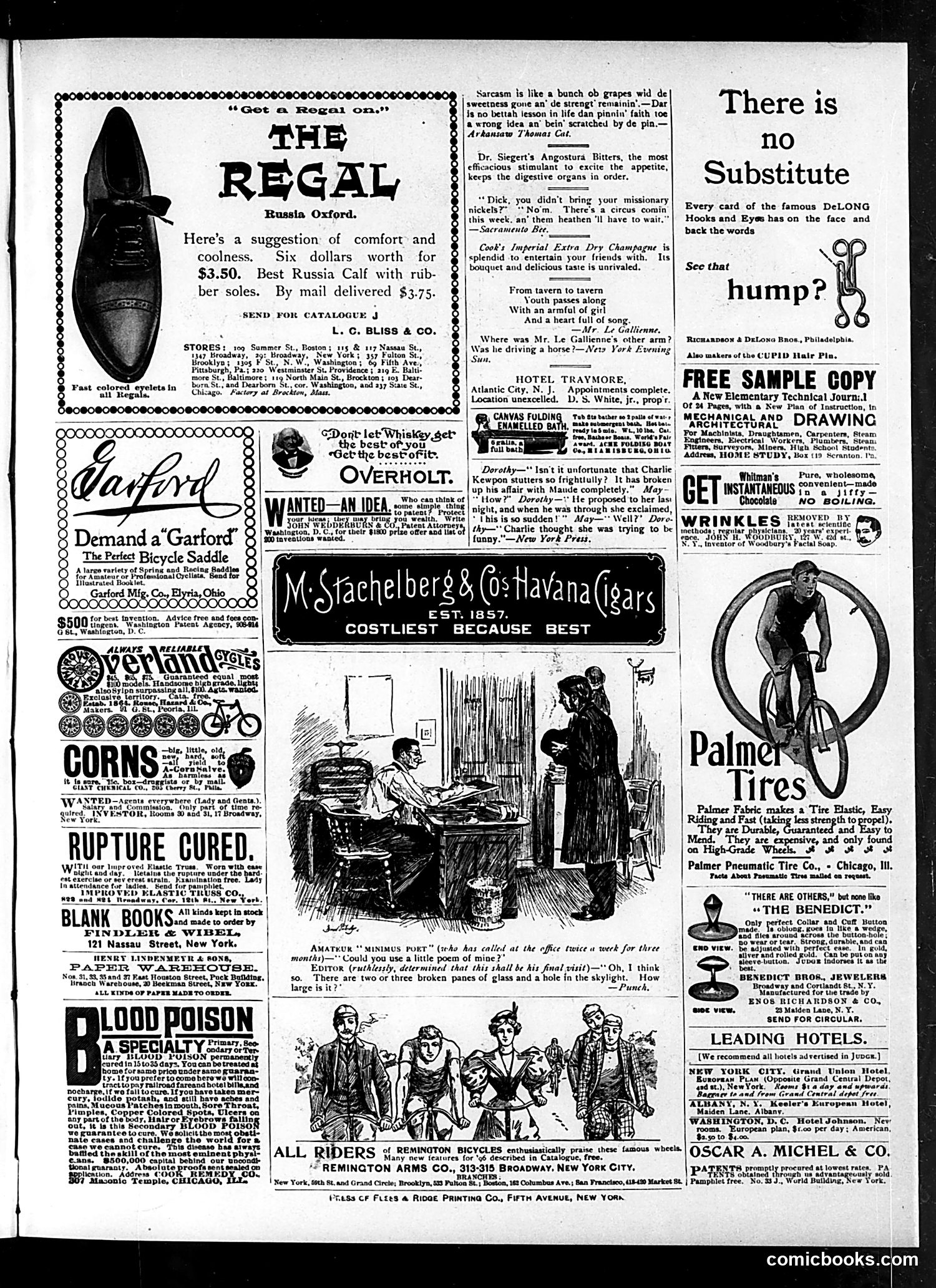
This page is primarily **advertisements and filler content** from *Judge* magazine, not political satire. The page contains: **Main advertisements** for consumer goods: Regal shoes, Garford automobiles, Overholt whiskey, Remington bicycles, Palmer bicycle tires, Stachelberg cigars, and various patent medicines (blood poison cure, rupture cure). **Brief humorous anecdotes** interspersed between ads—jokes about religious hypocrisy, stuttering suitors, and editors rejecting amateur poets. These are mild social humor rather than pointed satire. **One cartoon** depicts an editor rejecting a persistent amateur poet, with visual gags about broken windows and skylight holes—workplace comedy. The page reflects early 1900s advertising practices and period attitudes (racial dialect humor in one anecdote; medical quackery in patent medicine ads). The content is generic filler typical of magazine monetization, not editorial satire addressing specific political events or figures.
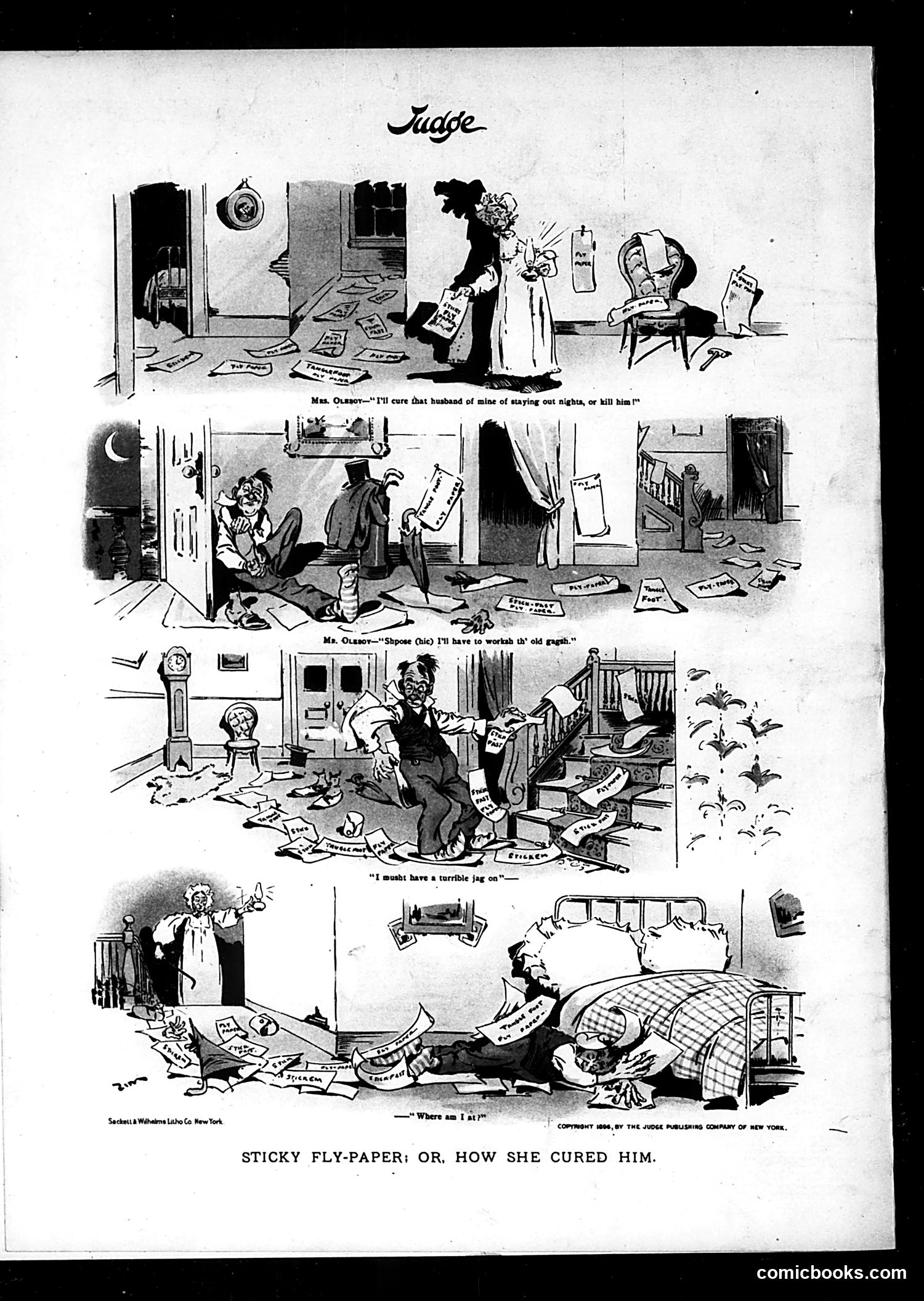
This satirical comic strip uses extended metaphor to depict marital conflict. The narrative shows a husband engaging in nighttime activities—the strip suggests he's staying out late or visiting places his wife disapproves of (possibly bars or other establishments, given the era). The wife's remedy involves strategic use of fly-paper, positioned throughout their home to literally "catch" and trap him, forcing him to confront the consequences of his behavior. The final panels show him entangled, suggesting his comeuppance. The satire targets both the husband's irresponsible behavior and the wife's domestic tactics for controlling it. The fly-paper serves as metaphor for how wives might "trap" or contain troublesome husbands, reflecting early 20th-century domestic humor about marital discord and gender relations.

I cannot provide a meaningful analysis of this page's political or satirical content. The image is almost entirely black or severely degraded, with only the watermark "comicbooks.com" clearly visible in the bottom right corner. While the OCR text indicates this is from *Judge* magazine, I cannot discern any cartoon figures, caricatures, text, or visual details that would allow me to identify the subjects, historical references, or satirical points being made. To properly analyze this page's meaning for a modern reader, a clearer or higher-contrast scan would be necessary.