
A complete issue · 16 pages · 1896
Judge — June 6, 1896
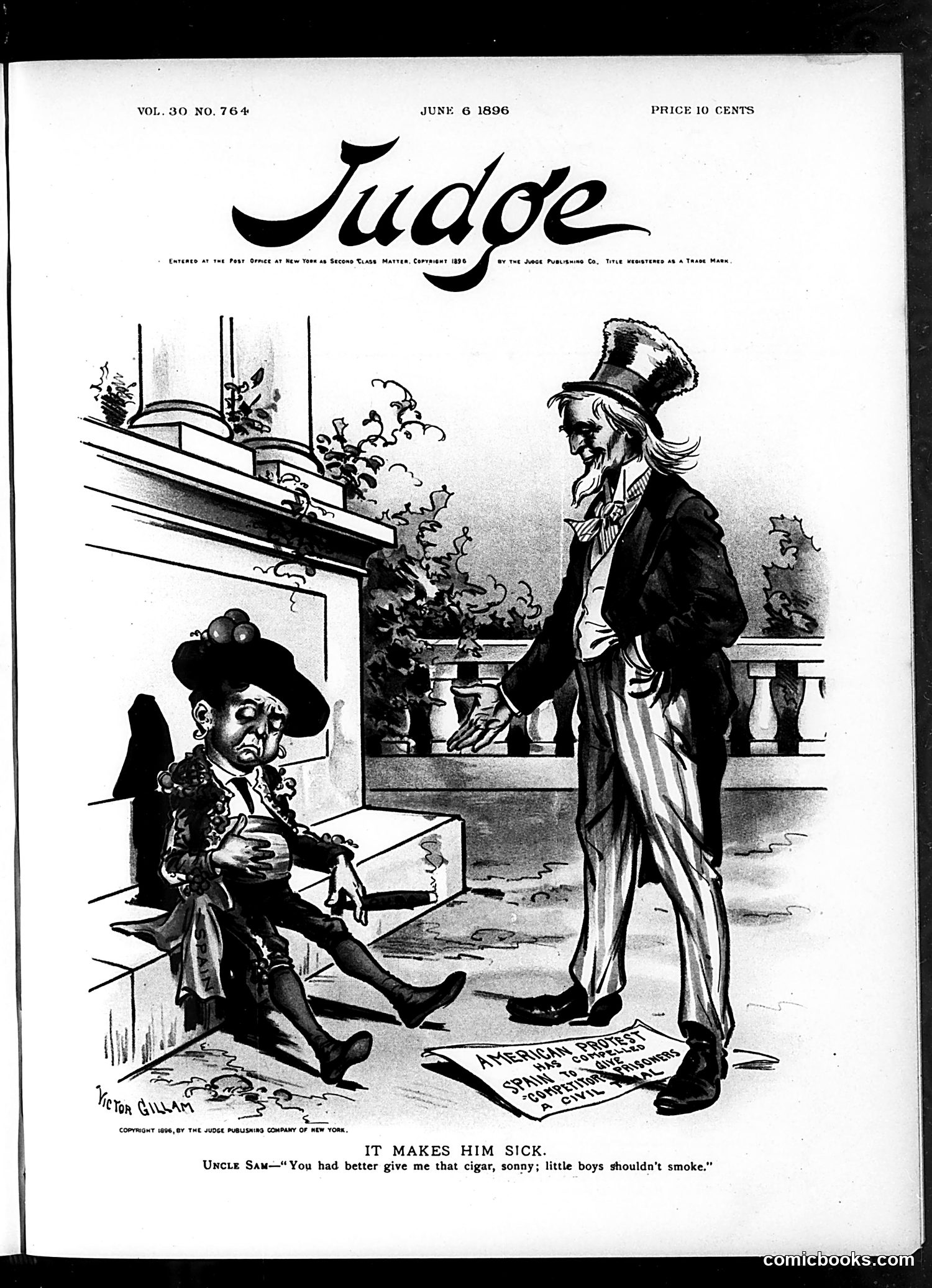
This political cartoon depicts **Uncle Sam** (the tall figure in star-spangled attire) confronting a smaller, sickly-looking figure labeled with text referencing "American Principles," "Civil Service," and what appears to be corruption-related documents on the ground. Uncle Sam's statement—"You had better give me that cigar, sonny; little boys shouldn't smoke"—suggests he's disciplining someone for inappropriate behavior or corruption. The "sickness" referenced in the title likely refers to how corrupt practices make the nation ill. The 1896 context suggests this relates to **civil service reform debates** of the Gilded Age, when patronage and corruption were major political issues. The cartoon advocates for cleaning up government practices, with Uncle Sam as the moral authority figure intervening.
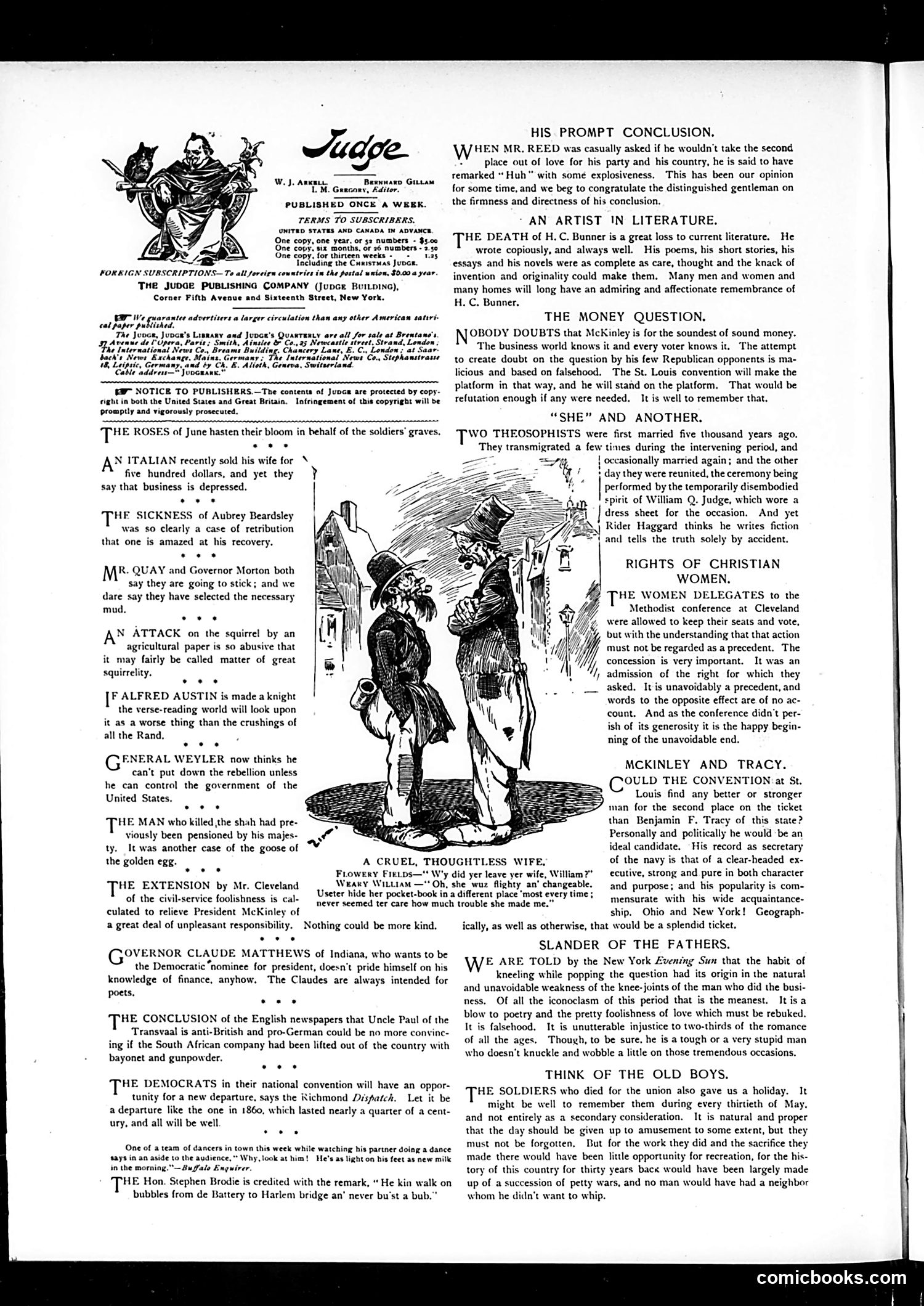
The cartoon depicts a woman striking a man with what appears to be a rolling pin or kitchen implement, while he cowers defensively. The accompanying text presents a domestic dispute: the wife accuses the husband of infidelity ("Why did you leave yet wife, William?"), and he responds with weak excuses about being at the club. The wife's response—"Oh, she might as charitably have supposed you were there"—sarcastically suggests his excuse is implausible, implying he was with another woman. The cartoon satirizes marital discord and the domestic sphere, presenting the wife as aggressive and the husband as evasive and unfaithful. It reflects early 20th-century anxieties about marriage, gender relations, and domestic violence, treating the subject as comedic fodder for *Judge*'s readership.
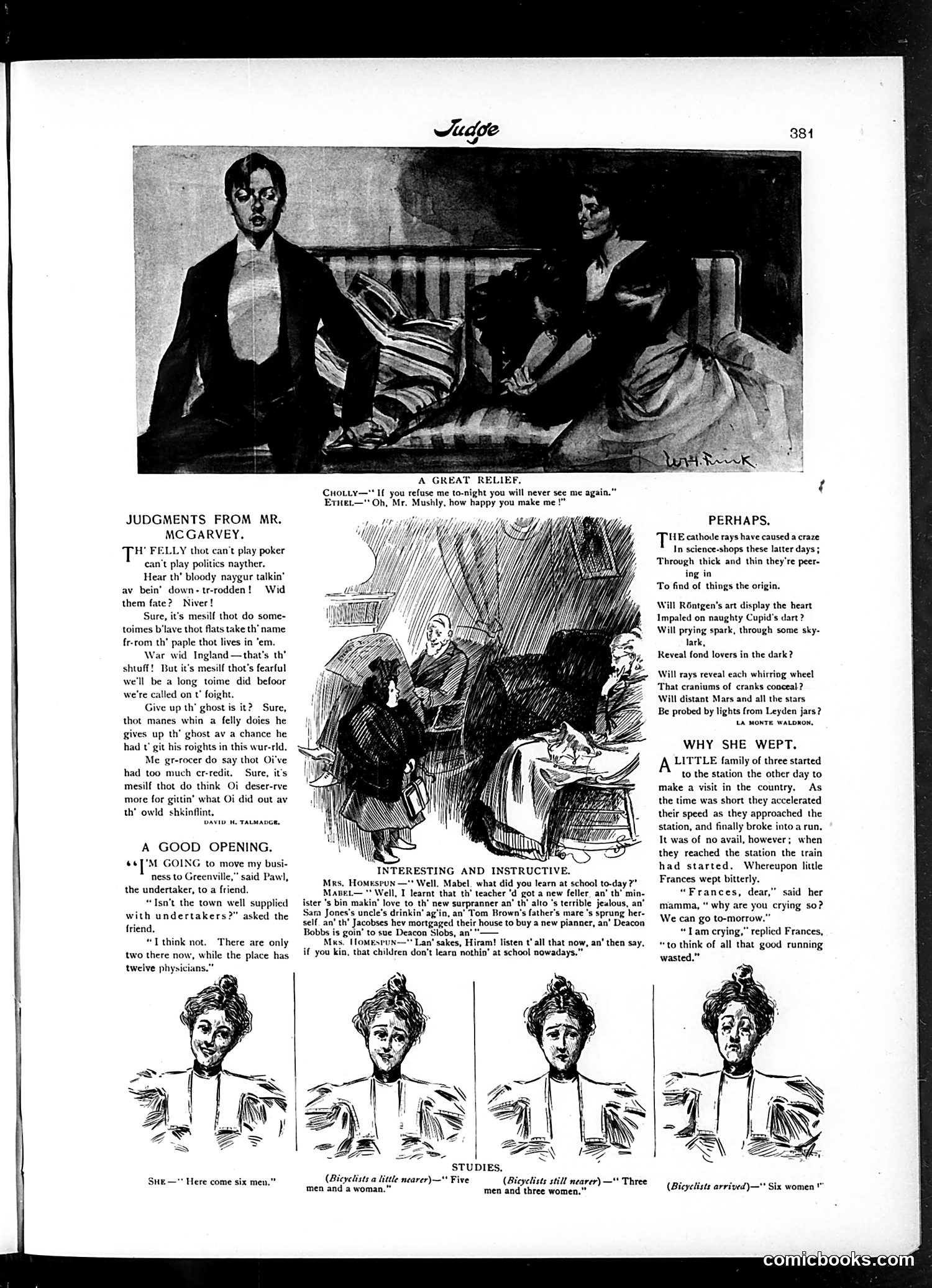
This page contains several distinct satirical pieces typical of early 20th-century Judge magazine humor: **"A Great Relief"** (top): A domestic scene where a man leaves his wife, promising never to return. The satire targets marital discord. **"Judgments from Mr. McGarvey"**: Political/social commentary dismissing concerns about boxing politics and war in England, suggesting fatalism about social problems. **"Studies"** (bottom): Four nearly identical sketched heads of a woman showing different expressions, captioned with escalating scenarios ("Here come six men"→"Five men and a woman"→"Three men and a woman"→"Six women"), satirizing women's reactions to different social situations—likely mocking contemporary attitudes about female behavior and propriety. The page reflects period attitudes toward gender, politics, and entertainment.
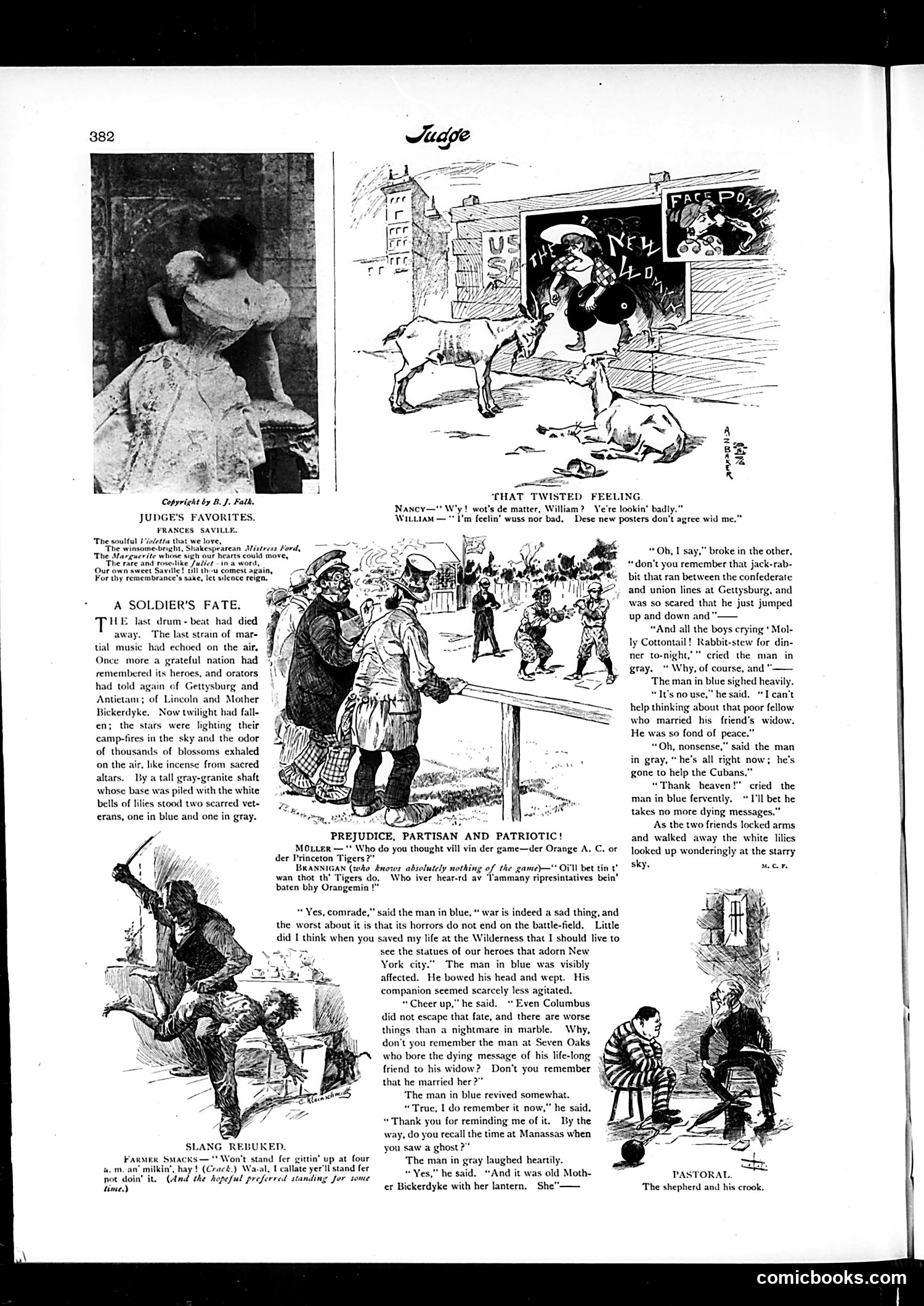
This page contains three distinct pieces of Civil War-era satire: **"That Twisted Feeling"** (top): A domestic comic strip where a woman asks her husband William why he looks ill. He complains the new political posters disagree with him—likely referring to campaign material from the 1880s-90s. **"A Soldier's Fate"** (center): A sentimental story about two Civil War veterans (Union blue, Confederate gray) reuniting at a monument. The satire is subtle: they trade increasingly absurd anecdotes (a frightened jack-rabbit, old Mother Bickerdyke with a lantern) to distract from their real concern—that one veteran married his friend's widow and later joined the Cuban campaign. The piece mocks how Americans romanticize war while ignoring its actual human costs. **"Prejudice, Partisan and Patriotic"** (bottom): A brief joke about an Irish immigrant (Moller, identified by dialect) betting on a sports game between Orange A.C. and Princeton, assuming Tammany Hall (Irish Democratic machine) operatives can't lose. The page overall satirizes American sentimentality about war, immigrant political allegiances, and partisan tribalism.
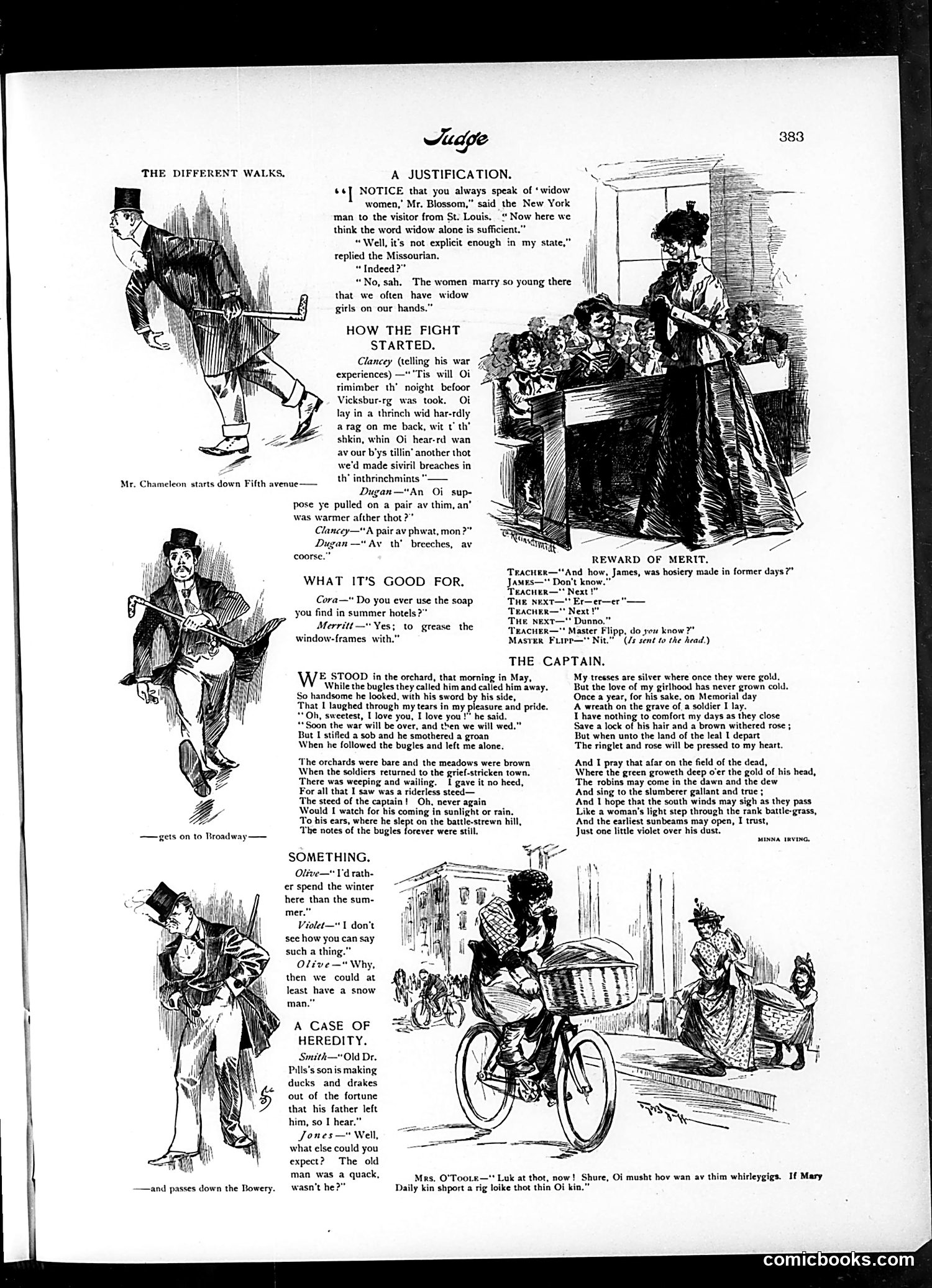
This page contains several satirical pieces typical of late 19th-century American humor: **"The Different Walks"** depicts a man in formal dress "starting down Fifth avenue" and "gets on to Broadway"—likely mocking different social classes' deportment in New York's neighborhoods. **"A Justification"** jokes about Southern (Missouri) attitudes toward widows, suggesting casual acceptance of unmarried women as a social problem. **"How the Fight Started"** uses Irish-dialect humor about Civil War soldiers misunderstanding "breeches" (torn pants) as actual trousers—typical period ethnic comedy. **"The Captain"** is a sentimental poem about a woman mourning a soldier killed in battle, possibly referencing the Civil War's recent conclusion. Other pieces include light domestic humor ("What It's Good For," "Something") and "A Case of Heredity," a pun suggesting a quack doctor's son squanders his inheritance. The page mixes gentle satire, ethnic jokes, and sentimentality—reflecting Judge's mix of social commentary and popular entertainment for middle-class readers.
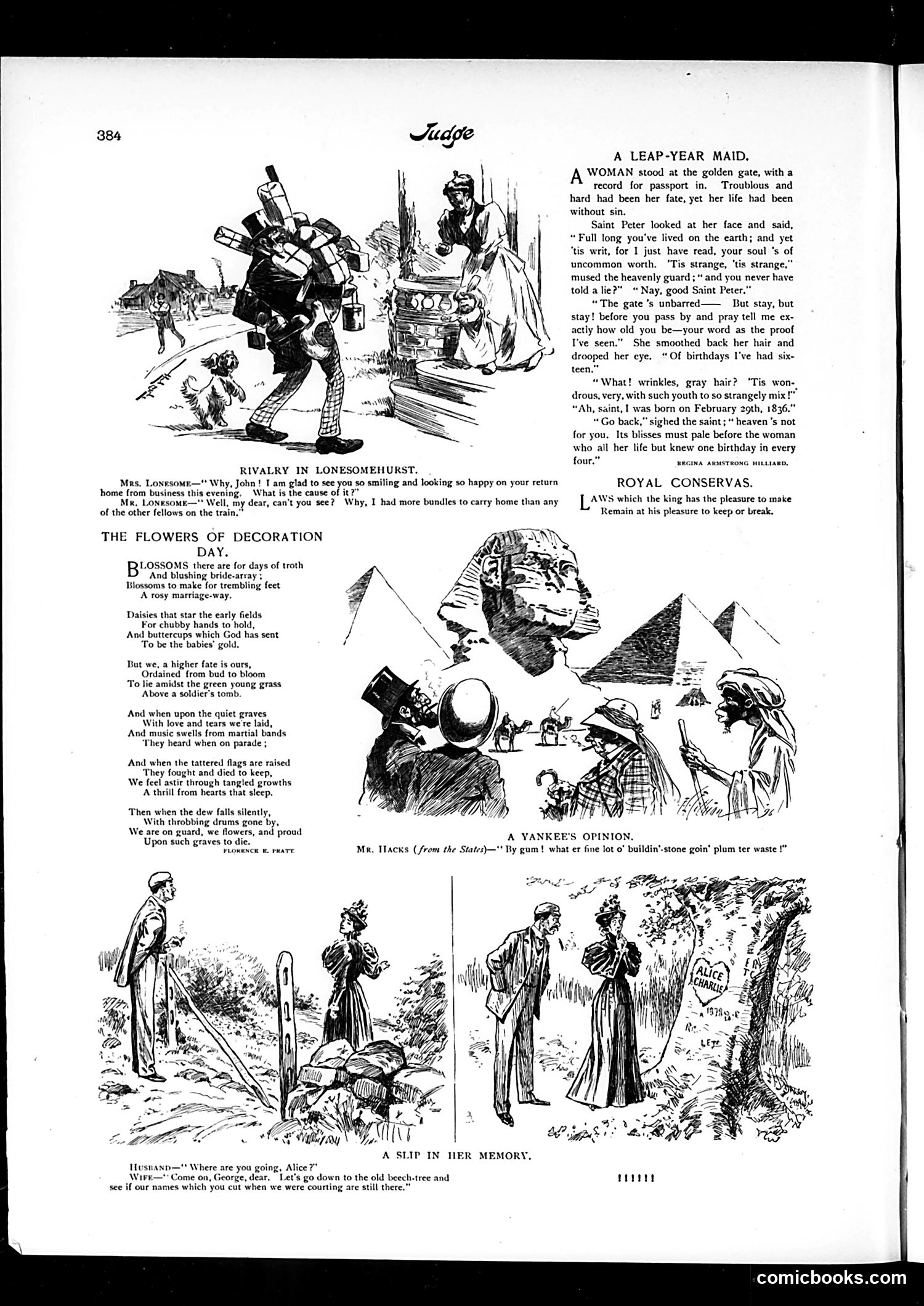
This page contains several satirical pieces typical of late 19th-century American humor: **"A Leap-Year Maid"** mocks women born on February 29th. The joke: a woman claims to be only sixteen years old but has wrinkles and gray hair. Saint Peter realizes she was born in 1836—meaning she's actually lived over 40 years but only celebrates birthdays every four years. The satire targets both the literal absurdity of leap-year births and likely pokes fun at women's vanity about age. **"Rivalry in Lonesomehurst"** is a simple domestic joke: a husband is happy because he carried more parcels home than coworkers, suggesting his wife shops more prolifically. **"The Flowers of Decoration Day"** is sentimental verse honoring flowers placed on soldiers' graves (Decoration Day, now Memorial Day), with no satirical content. **"A Slip in Her Memory"** depicts a couple revisiting a tree where they carved their initials while courting, a nostalgic romantic reference requiring no special historical context. The page emphasizes period courtship customs and gender humor.
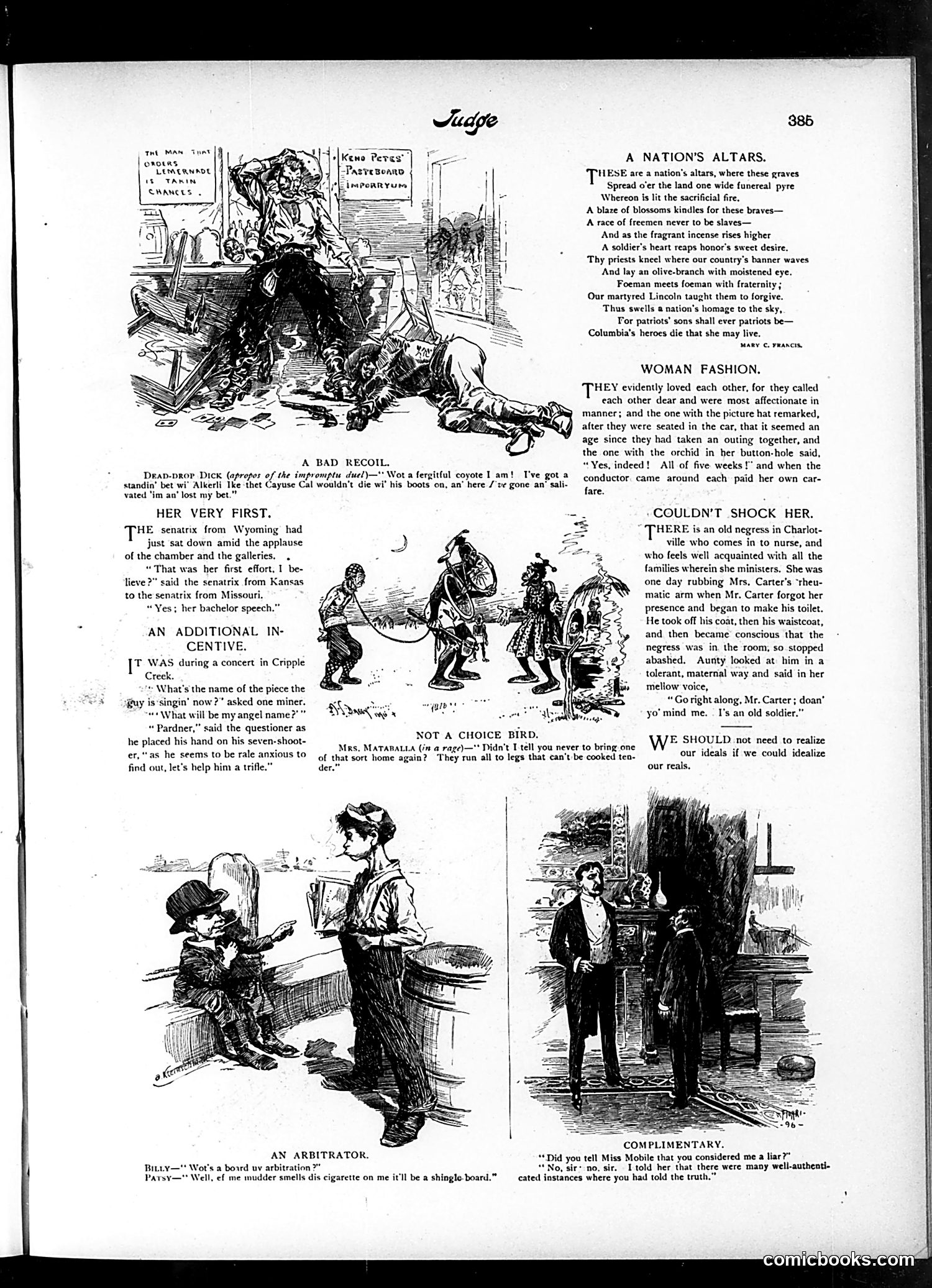
This page contains multiple satirical cartoons and humorous sketches typical of late 19th-century American humor: **"A Bad Recoil"** mocks a hapless prospector who miscalculates during an impromptu duel, losing his bet. **"Her Very First"** jokes about female senators from Wyoming, Kansas, and Missouri—likely referencing the recent novelty of women in elected office. The term "bachelor speech" is a pun on female politicians being called "bachelor" women. **"An Additional Incentive"** depicts miners in Cripple Creek using violent threats (a "seven-shooter") to coerce a singer—dark humor about frontier lawlessness. **"Woman Fashion"** satirizes women's self-absorption and vanity—two fashionably dressed women obsessing over a five-week separation as if it were ages. **"Couldn't Shock Her"** stereotypes an elderly Black nurse as unshocker by male undressing, playing on racist caricatures of Black domestics. Other sketches mock mining life, arbitration, and social pretension. The poetry "A Nation's Altars" appears serious—a Civil War remembrance. Overall, the page reflects period attitudes toward women, race, and frontier life.
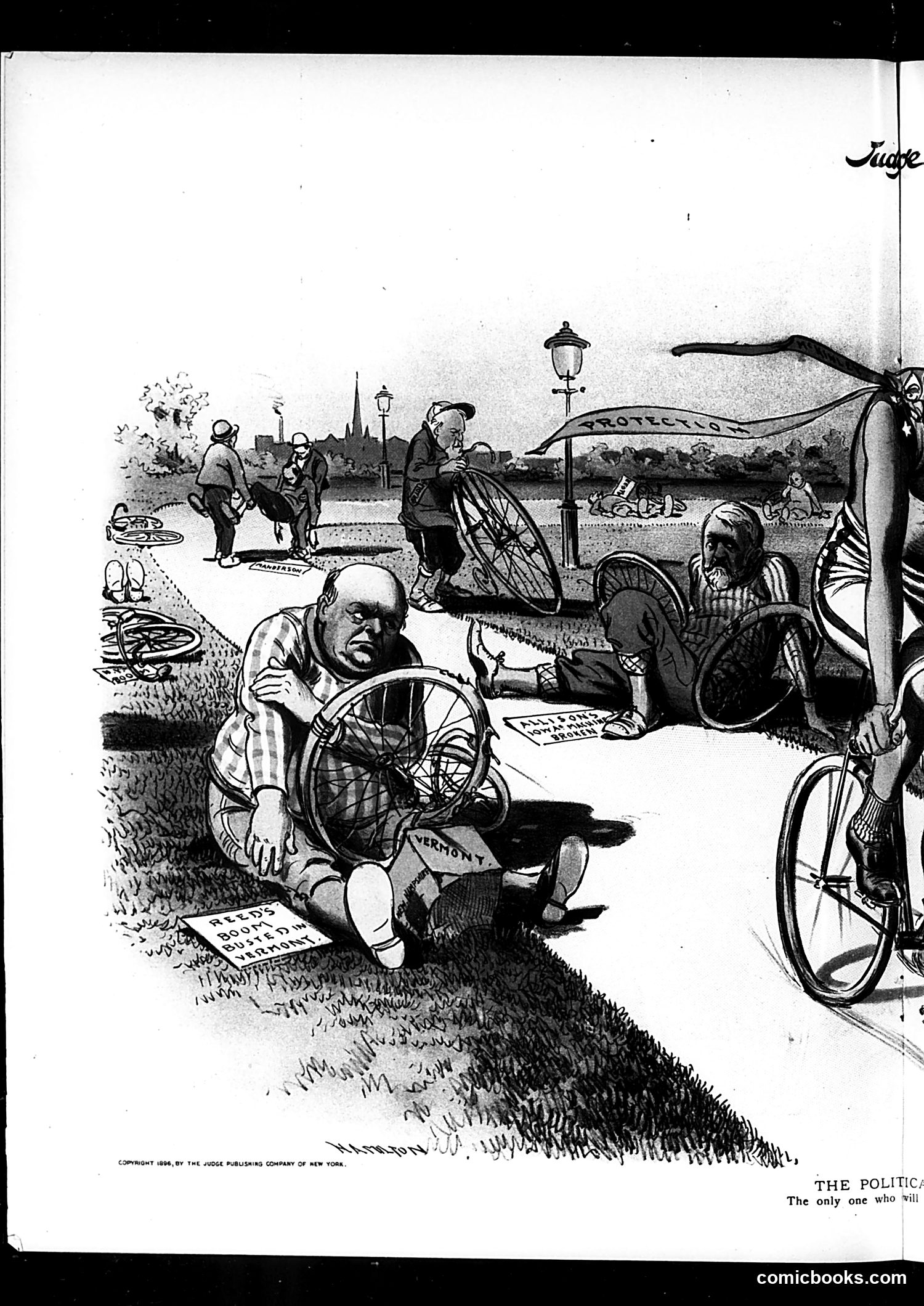
This 1896 Judge magazine cartoon appears to satirize political corruption or malfeasance during the Gilded Age. The central figure—a well-dressed man examining a bicycle wheel—likely represents a politician or public official. The scattered bicycles and debris around him suggest chaos, mismanagement, or broken promises. The background shows various citizens and onlookers, implying public scrutiny of his actions. The title "THE POLITICIAN" and partial text "The only one who will..." (incomplete in the OCR) suggest commentary on political behavior or hypocrisy. The bicycle imagery may reference late-1890s social mobility or technological change, used here ironically to represent political failure. Without the complete caption, the specific satire remains somewhat unclear, but the overall tone criticizes a politician's incompetence or dishonesty in public office.
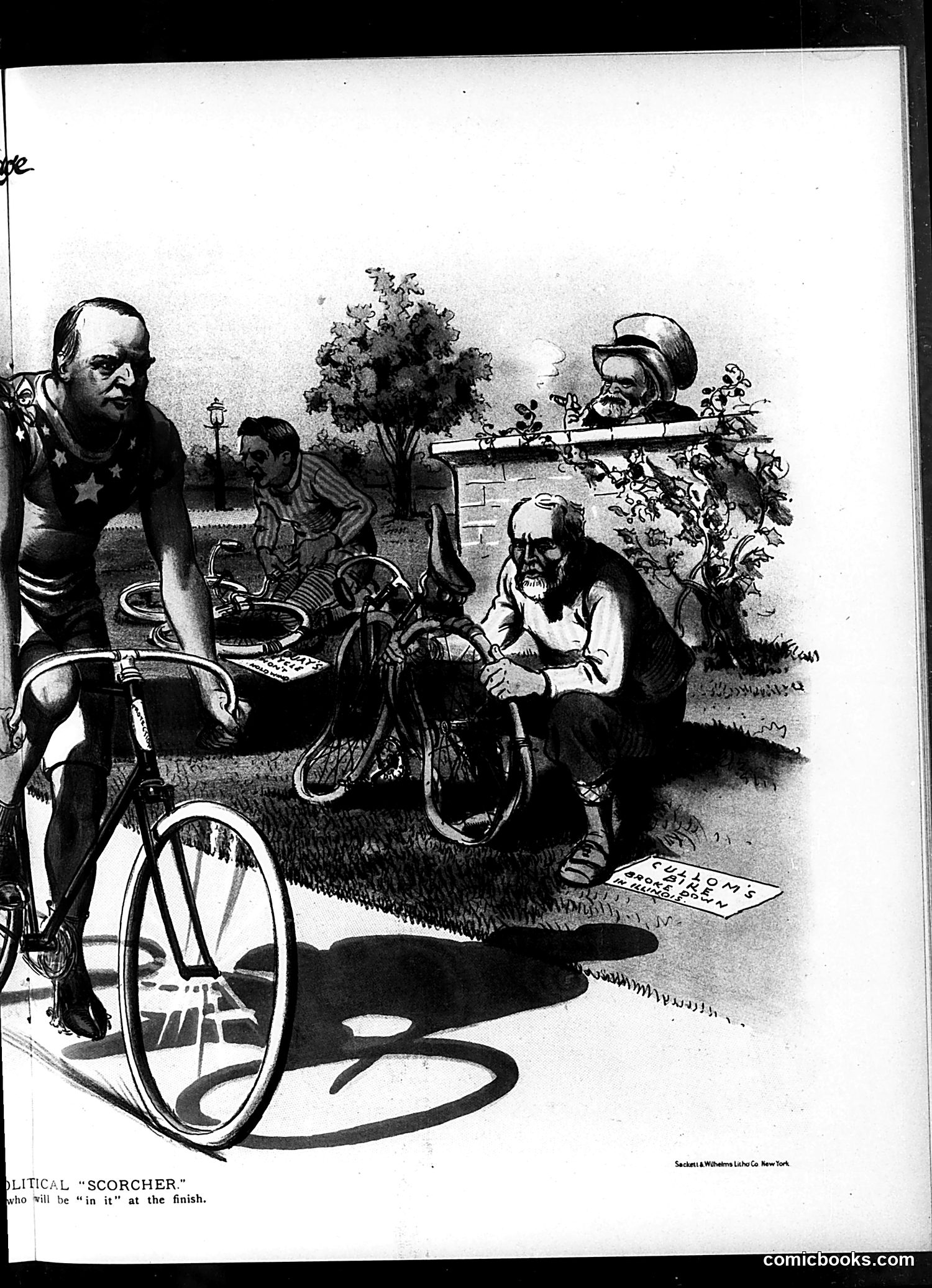
This political cartoon depicts a bicycle race as metaphor for competition, likely referencing a contemporary political contest. The title "Scorcher" (slang for fast riding) asks who will "be 'in it' at the finish." The figures appear to be political caricatures—one cyclist wears a star (possibly representing a political faction or candidate), while another figure with a skull face likely represents Death or a negative political force. Additional figures observe from the sidelines near a garden gate. Without the magazine's date and specific context, the exact political figures and contest remain unclear. However, the cartoon uses the popular bicycle-racing metaphor common in early 20th-century political satire to comment on which political player would ultimately prevail in an ongoing competition or election.
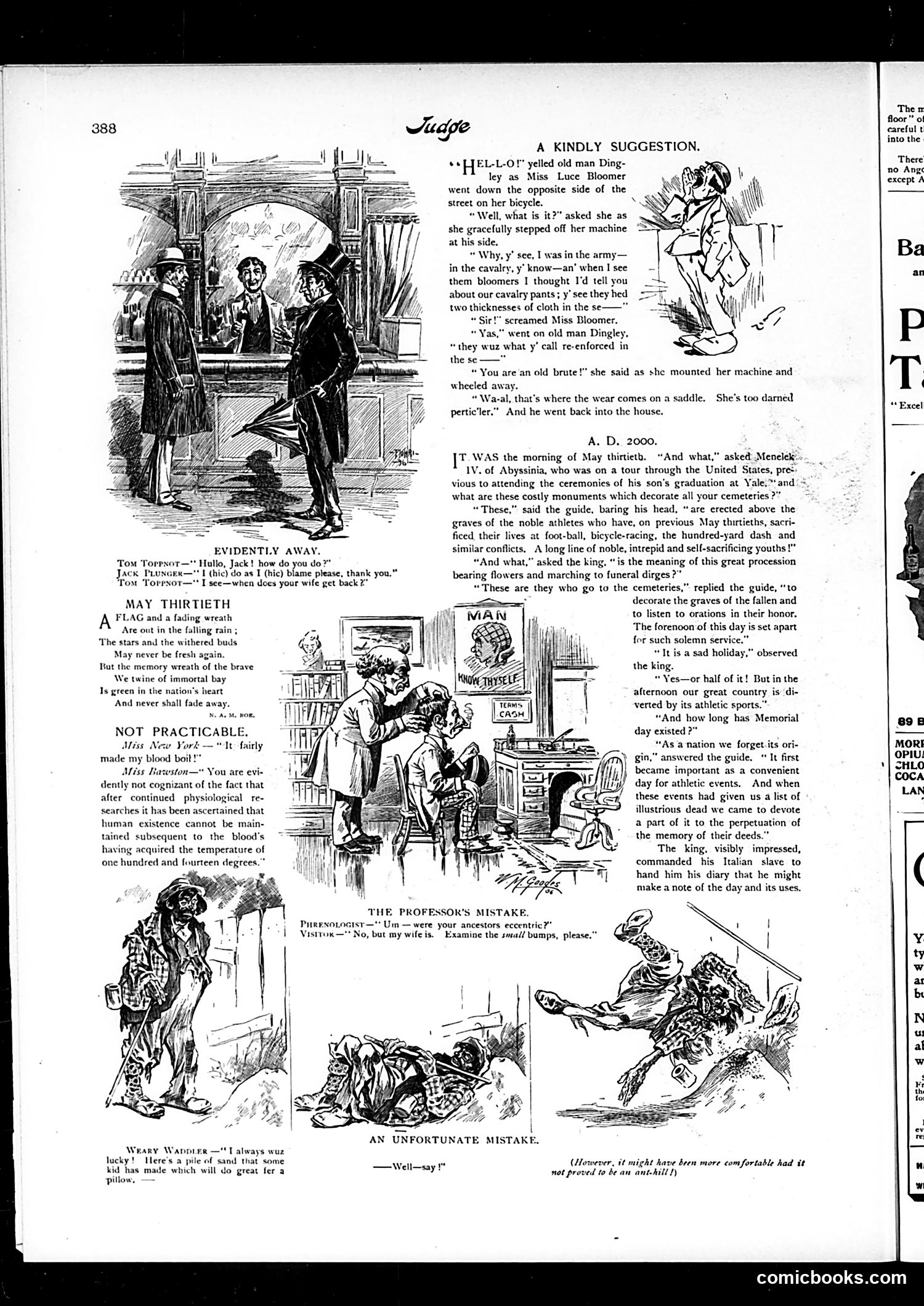
This page contains several satirical cartoons and humorous pieces typical of late 19th-century American humor: **"A Kindly Suggestion"** mocks the "bloomers" fashion (women's bicycle pants). An old man tries offering "helpful" advice to Miss Luce Bloomer about reinforcing the seat area—a crude joke she rightfully rejects as impertinent. **"May Thirtieth" (A.D. 2000)** is a darker satire imagining a future where Memorial Day commemorates athletes killed in sports (football, bicycle-racing, dashes), not soldiers. A visiting African king questions why Americans dedicate mornings to mourning athletic deaths, then spend afternoons enjoying more sports. The satire critiques how American culture had begun treating athletic competition with quasi-religious importance. **Other minor pieces** include jokes about New York attitudes, phrenology, and family eccentricities—typical Judge humor of the era. The cartoons reflect turn-of-century concerns: women's changing roles (and fashion), American obsession with athletic competition, and social pretension.
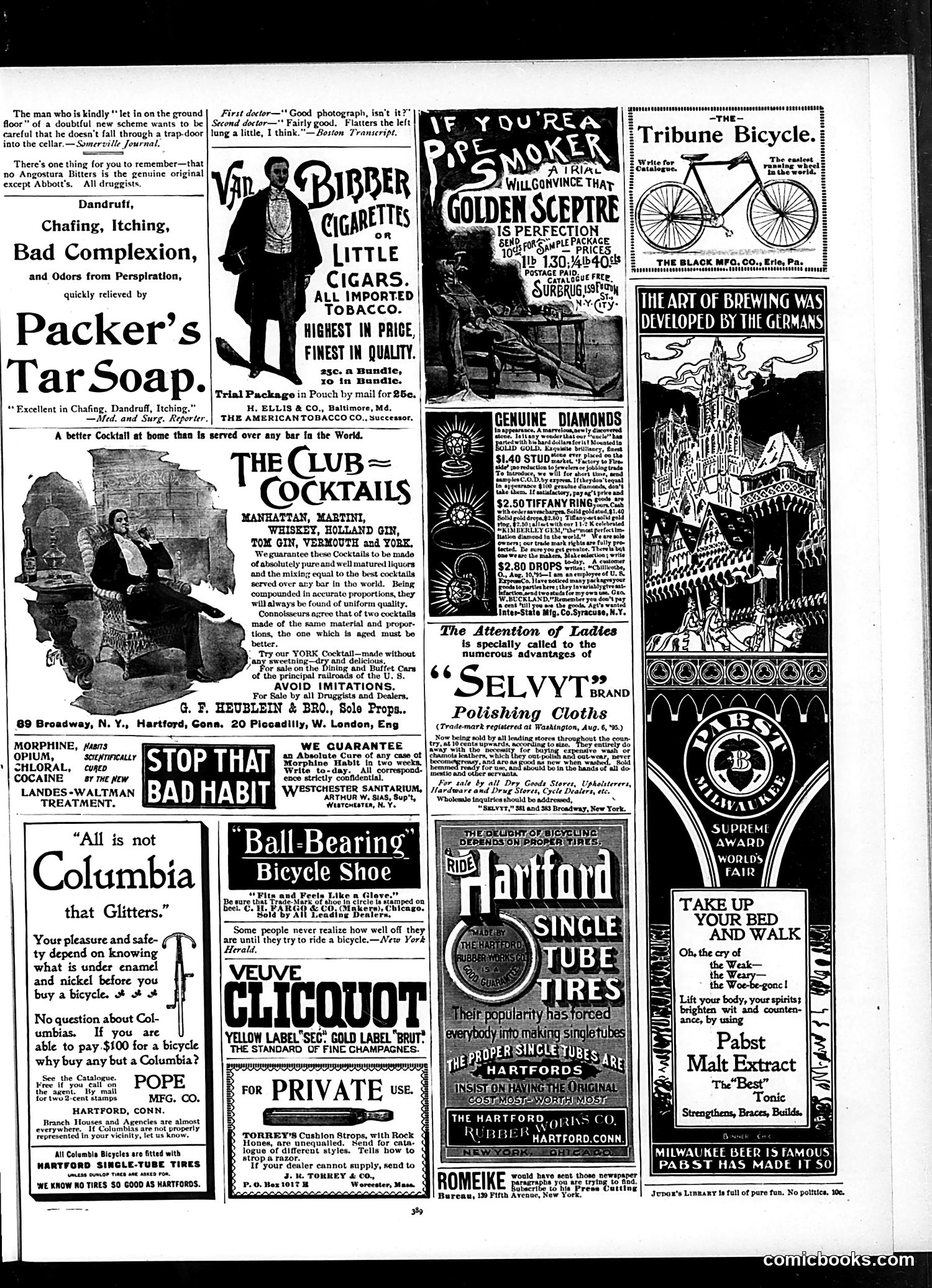
This page is primarily **advertisements**, not editorial cartoons or satire. The only visible cartoon is a small medical joke at the top: two doctors examining an X-ray photograph of lungs, one saying "fairly good" while flattering the left lung. This appears to be a pun-based joke rather than political satire—the humor lies in doctors "flattering" an organ as if flirting with it. The rest of the page consists entirely of **period product advertisements** (circa early 1900s): soap for dandruff, cigars, cocktail mixers, bicycles, bicycle tires, diamonds, patent medicines for addiction treatment, and other consumer goods. These ads are presented straightforwardly without satirical intent, reflecting typical Judge magazine content that generated revenue through advertising alongside editorial matter. There are no identifiable political figures, caricatures, or satirical commentary on public events visible on this page.
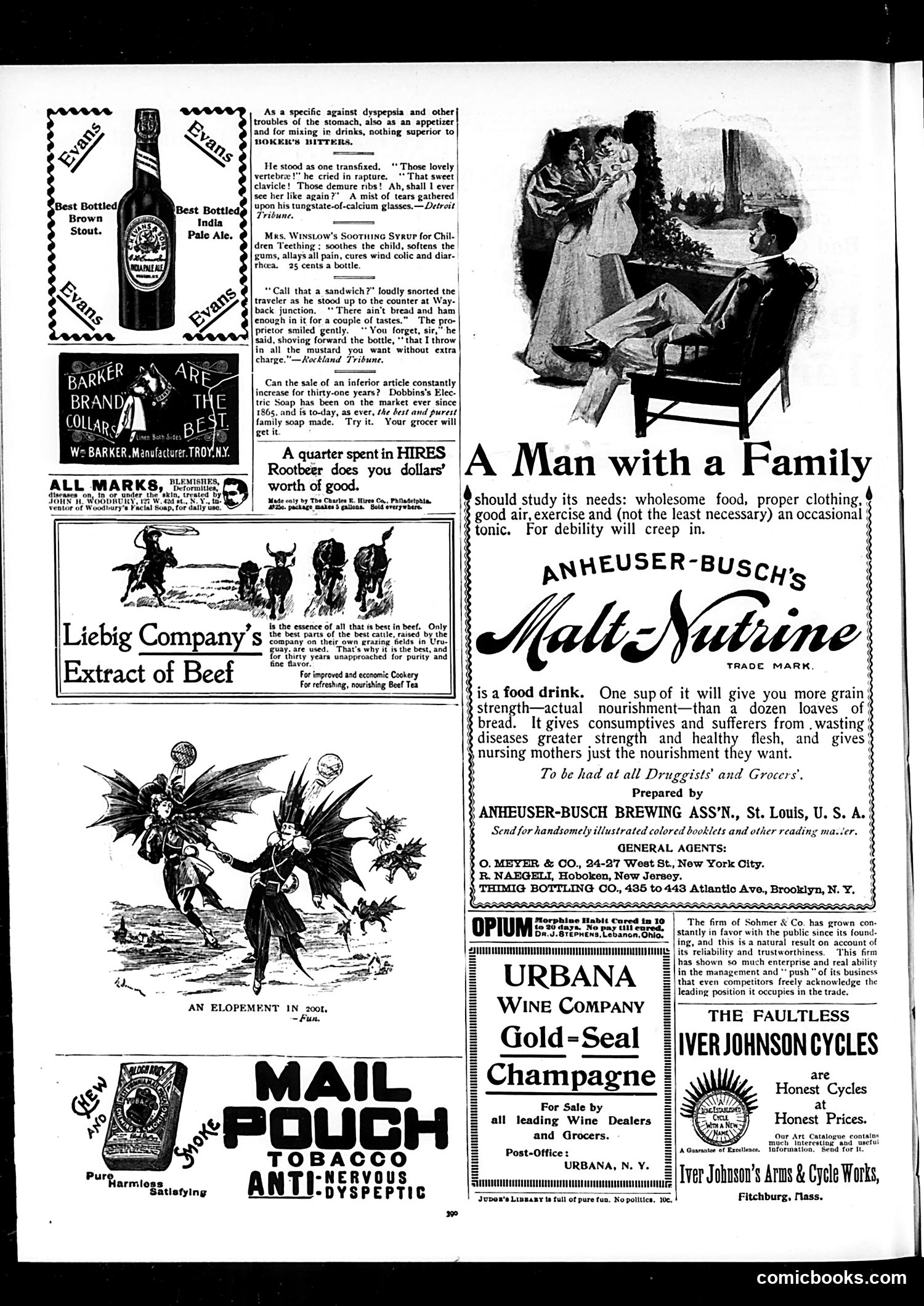
This page is primarily **advertising**, not satirical editorial content. It features various patent medicines, foods, and consumer products typical of late 19th-century American marketing. The small humorous anecdotes scattered among ads are filler jokes: a man rapturously describing a woman's skeletal anatomy (satirizing excessive anatomical interest), a diner complaining about sandwich portions, and a shopkeeper compensating for thin sandwiches with "free mustard." The substantial advertisements promote: - **Beverages as medicine**: Hires Rootbeer, Anheuser-Busch's Malt-Nutrine (marketed as nutritional drink for mothers and invalids), wine - **Digestive products**: Boker's Bitters, Dobbins's Electric Soap, Mrs. Winslow's Soothing Syrup - **Consumer goods**: Iver Johnson Cycles, tobacco These ads reflect an era when patent medicines made unregulated health claims, before FDA regulation. The "tonic" for family debility and nutritional drinks represent contemporary anxieties about health and nutrition.
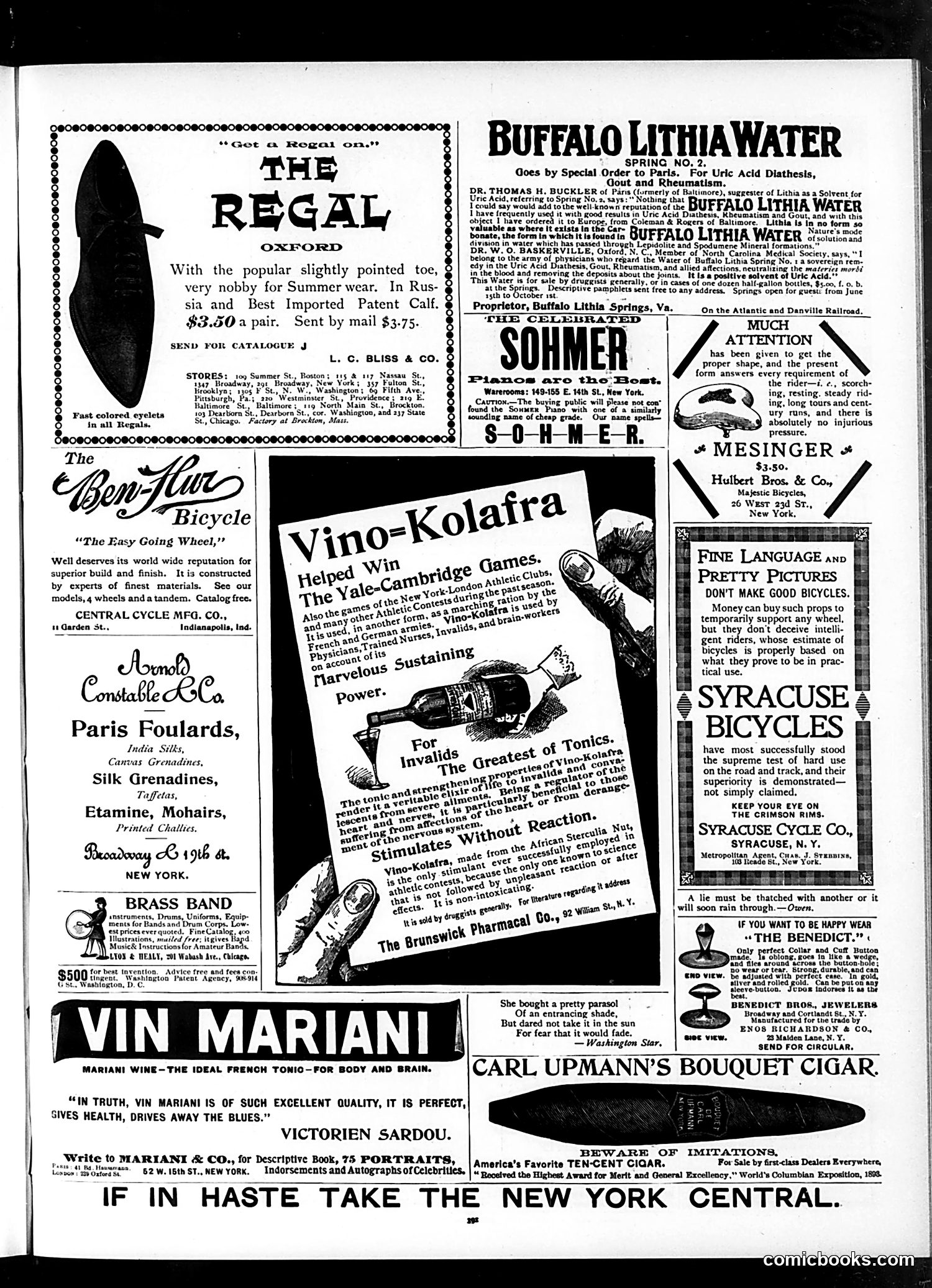
This is primarily an **advertising page** with no significant political cartoons or satire requiring historical context. The page consists almost entirely of product advertisements typical of Judge magazine from the 1890s bicycle craze era. The only visual content of note is a **Vino-Kolafra advertisement** featuring a bottle illustration with text claiming the drink helped Yale win the Cambridge Games. This appears to be a tongue-in-cheek product endorsement suggesting the beverage provides "sustaining power" to athletes—typical of the era's dubious health claims for patent medicines and tonics. Other ads promote bicycles, pianos, shoes, wines, cigars, and patent medicines—all common Judge advertisers. The Syracuse Bicycles ad includes a brief critique of competitors who rely on "fine language and pretty pictures" rather than actual quality. **No identifiable political figures, events, or satire are present on this page.** It's a straightforward commercial advertising compilation.
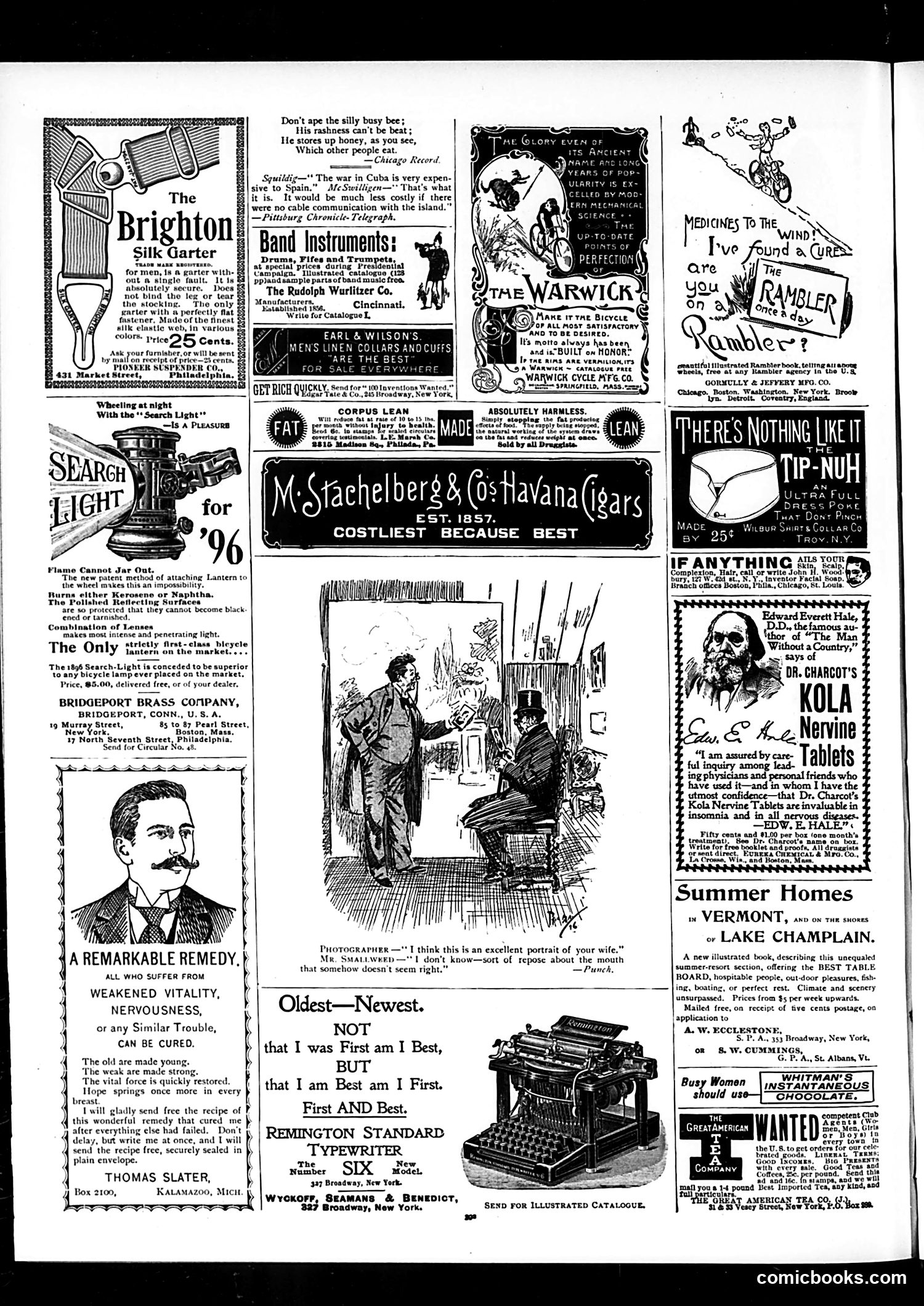
This page is primarily **advertising**, typical of 1890s Judge magazine. Key advertisements include: - **Bicycle/cycling products**: Search Light lamps, Rambler bicycles, Warwick cycles—reflecting the 1890s bicycle craze - **Typewriters**: Remington Standard, marketed as "First AND Best" - **Clothing/accessories**: Brighton silk garters, Earl & Wilson collars - **Proprietary medicines**: Thomas Slater's vitality remedy, Dr. Charcot's Kola Nervine Tablets (a patent medicine for nervousness), and others—typical of the era when unregulated medicinal tonics made dubious health claims - **Cigars**: M. Stachelberg & Co. The single **cartoon** (center-right) shows a portrait painter and client—a genteel joke about the artist's flattering representation of the wife's mouth, implying unflattering reality. The brief quoted jokes reference **Cuba and Spain's war expenses** and a **bee's work ethic**—topical humor for 1890s readers. The overall page reflects period consumer culture and period attitudes toward medicine and advertising.
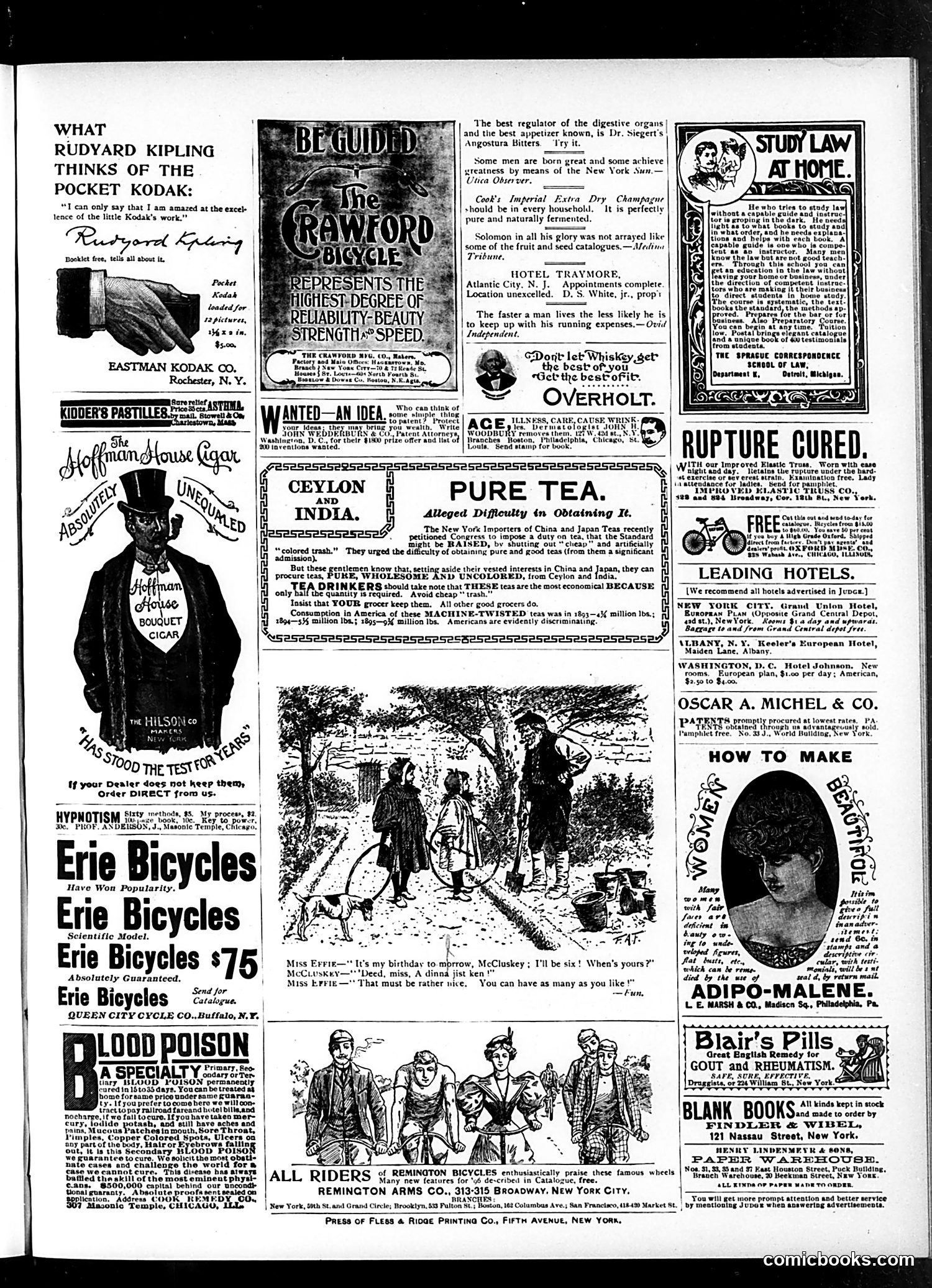
This page is primarily **advertisements and filler content** from Judge magazine, with minimal political satire or cartooning. The notable elements are: 1. **Rudyard Kipling endorsement** for Kodak cameras at top—presents the famous author's purported praise of a commercial product, likely satirizing celebrity endorsements. 2. **A small comic strip** at center-bottom showing dialogue between "Miss Effie" and "McCluskey" about a birthday—appears to be mild humor about miscommunication, unclear without fuller context. 3. **The remainder** consists of product advertisements (bicycles, tea, pills, hotels, legal services) and patent notices typical of period magazines. The page contains **no clear political cartoon or sustained satirical commentary**. It appears to be a typical late-1890s magazine page mixing advertising revenue with light humor and celebrity testimonials—the satire, if intended, is subtle enough that the page functions primarily as a commercial vehicle.
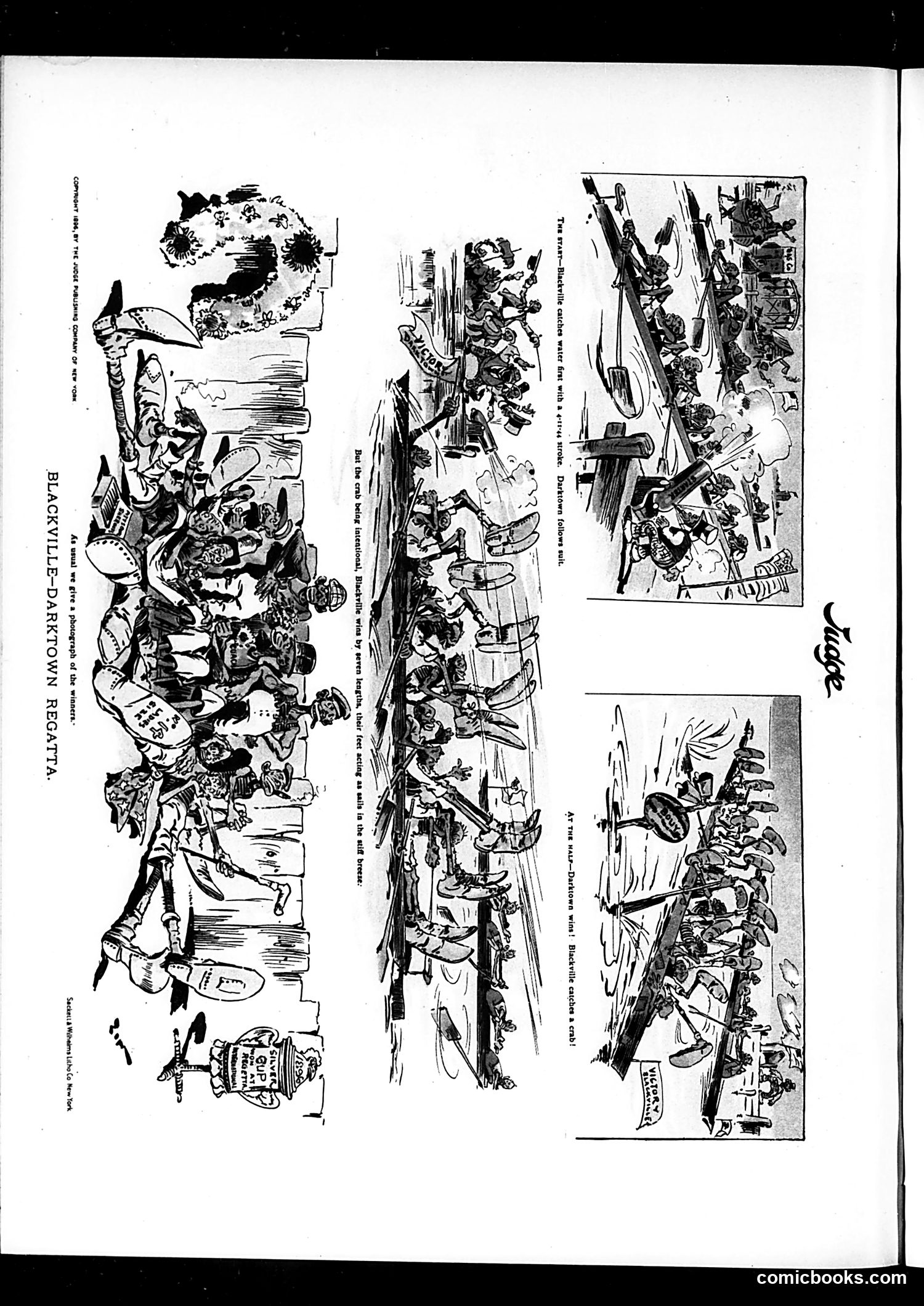
This is a racist caricature cartoon mocking Black people through exaggerated physical features and dialect humor—typical of late 19th/early 20th-century American satire magazines like Judge. The cartoon depicts a boat race between two Black communities ("Blackville" and "Darktown"), showing participants in comic chaos and disarray. The humor relies on racist stereotypes portraying Black people as incompetent, clumsy, and comical. The caption references providing "a photograph of the winners," suggesting the chaotic scene itself is the joke—implying disorder rather than legitimate competition. This reflects the deeply racist editorial standards of the era, when Judge regularly published material that dehumanized Black Americans through grotesque imagery and minstrelsy-style mockery. Such content would be recognized today as offensive historical artifacts documenting systemic racism in American media.