
Judge, 1896-06-06 · page 4 of 16
Judge — June 6, 1896 — page 4: what you’re looking at
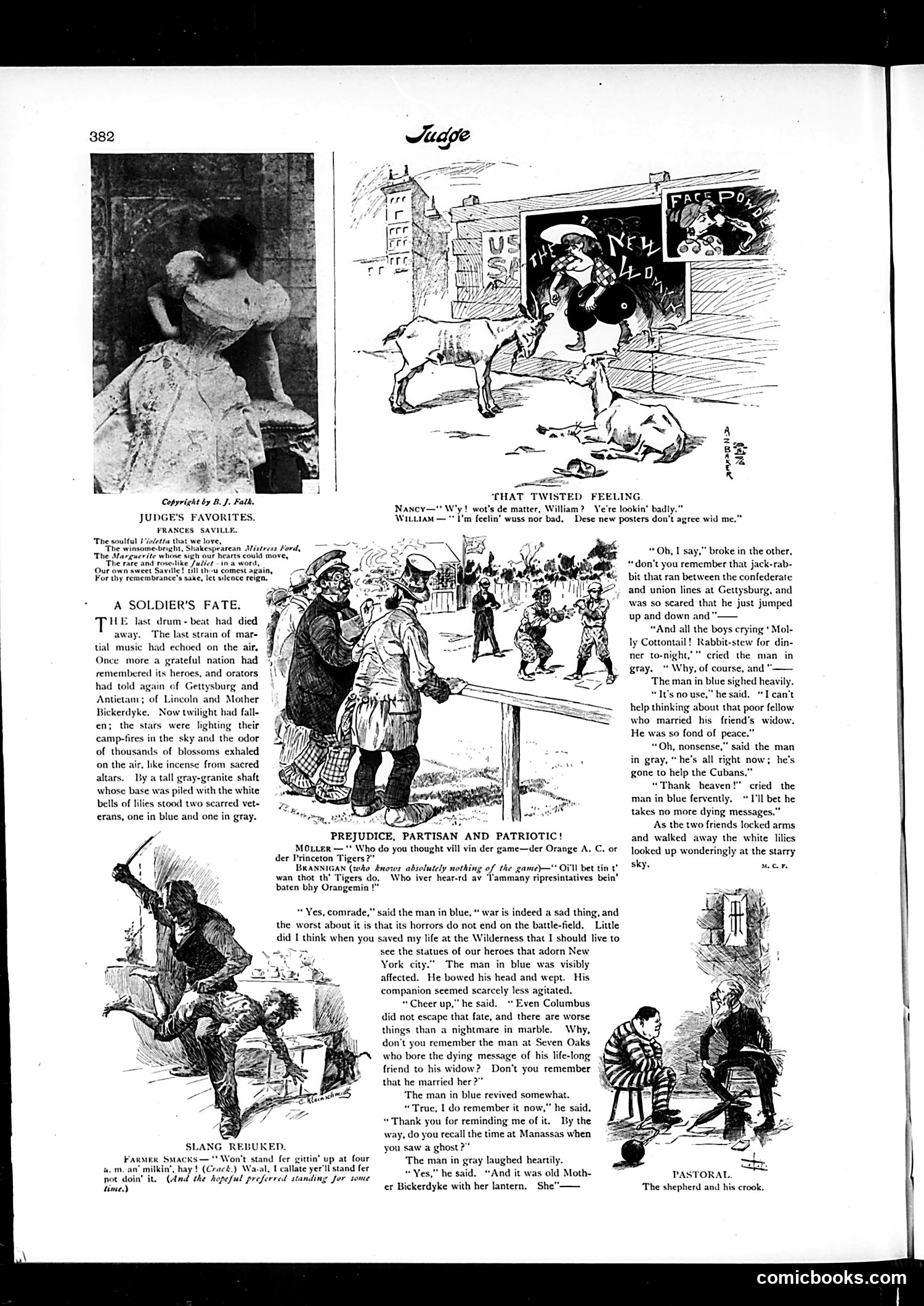
What you’re looking at
This page contains three distinct pieces of Civil War-era satire: **"That Twisted Feeling"** (top): A domestic comic strip where a woman asks her husband William why he looks ill. He complains the new political posters disagree with him—likely referring to campaign material from the 1880s-90s. **"A Soldier's Fate"** (center): A sentimental story about two Civil War veterans (Union blue, Confederate gray) reuniting at a monument. The satire is subtle: they trade increasingly absurd anecdotes (a frightened jack-rabbit, old Mother Bickerdyke with a lantern) to distract from their real concern—that one veteran married his friend's widow and later joined the Cuban campaign. The piece mocks how Americans romanticize war while ignoring its actual human costs. **"Prejudice, Partisan and Patriotic"** (bottom): A brief joke about an Irish immigrant (Moller, identified by dialect) betting on a sports game between Orange A.C. and Princeton, assuming Tammany Hall (Irish Democratic machine) operatives can't lose. The page overall satirizes American sentimentality about war, immigrant political allegiances, and partisan tribalism.
📄 Transcribed text from this page (OCR, searchable)
Machine-transcribed from the original scan — historical spelling and the odd misread are preserved.
Copyright by BJ. Fath. HAT TWISTED FE ING yur PAVORIT! Nancy—" W'y! wot's de matter, William? Ye're lookin’ badly.” FRANCES SAVILLE. ‘The soulful Hioletta that we love, ht, Sh Our own sweet Saville! till thou comest again, For thy remembrance’s sake, let silence reign. A SOLDIER'S FATE. T! E last drum - beat had died away. The last strain of mar- tial music had echoed on the air, Once more a grateful nation had remembered its heroes, and orators had told again of Gettysburg and Antietam; of Lincola and Mother Bickerdyke. Now twilight had fall- en; the stars were lighting their camp-fi the sky and the odor of thousands of blossoms exhaled on the air, like incense from sacred altars. By a tall gray-granite shaft whose base was piled with the white bells of lilies stood two scarred vet- erans, one in blue and one in gray. PREJUDICE, PARTISAN AND PATRIOTIC! MOLLER — * Who do you thought vill vin der game—der Orange A. C. or der Princeton Tigers?” ‘who knows absolutely nothing of the game)—"* Oi'll bet tint wan thot th’ Tigers do, Who iver hear-rd av ‘Tammany ripresintatives bein’ baten bhy Orangemin ! “ Yes, comrade,” said the man in blue, “ war is indeed a sad thing, and the worst about it is that its horrors do not end on the battle-field, Little did I think when you saved my life at the Wilderness that I should live to see the statues of our heroes that adorn New York ci The man in blue was visibly affected. He bowed his head and wept. His. companion seemed scarcely less ag “Cheer up,” he said.“ Even Columbus did not escape that fate, and there are worse things than a nightmare in marble. Why, don’t you remember the man at Seven Oaks who bore the dying message of his life-long friend to his widow? Don’t you remember that he married her?” The man in blue revived somewhat. “ True, I do remember it now,” he said. “Thank you for reminding me of it. By the way, do you recall the time at Manassas when you saw a ghost ?* Famex Saacks Won't id fer gittin’ up at four ‘The man in gray laughed heartily. ta. m. an’ milkin’, hay ! (Crack.) Wa-al, U callate yer'll stand fer Oi “Yes,” he said. “And it was old Moth- ot doin’ it, (And the hopeful preferred standing Jor some y Be a sold Bee gee We at ec depelal prefers e er Bickerdyke with her lantern. She" WILLIAM — “I'm feelin’ wuss nor bad, Dese new posters don’t agree wid me.” “Ob, I say,” broke in the other, “don’t you remember that jack-rab- bit that ran between the confederate and union lines at Gettysburg, and was so scared that he just jumped up and down and "— “And all the boys crying‘ Mol- ly Cottontail! Rabbit-stew for din- ner to-night,’ cried the man in gray.“ Why, of course, and "— The man in blue sighed heat “It’s no use,” he said. “I can't help thinking about that poor fellow who married his friend’s widow. He was so fond of peace.” “Oh, nonsense,” said the man in gray, “he’s all right now ; he's gone to help the Cuban: “Thank heaven!" cried the man in blue fervently. “I'll bet he takes no more dying messages.” As the two friends locked arms and walked away the white lilies looked up wonderingly at the starry sky. PASTORAL ‘The shepherd and his crook. comicbooks.com