
A complete issue · 16 pages · 1896
Judge — April 11, 1896
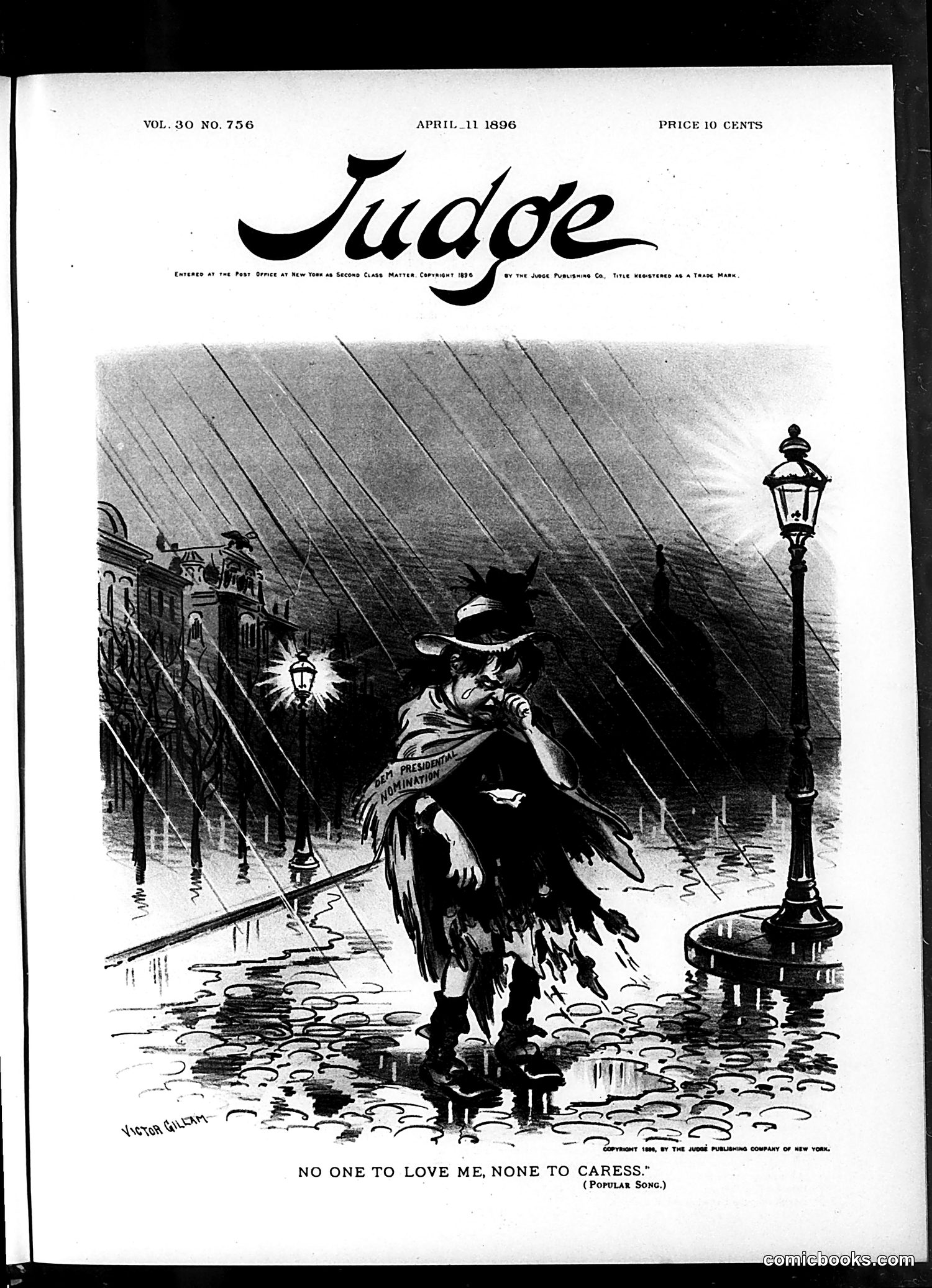
This is a Judge magazine cover from April 11, 1896, featuring a cartoon titled "No One to Love Me, None to Caress" (a popular song lyric). The illustration depicts a ragged, bedraggled figure labeled "PRESIDENTIAL CANDIDATE" standing alone in heavy rain on a wet street. The figure appears dejected and abandoned, suggesting a political candidate who has lost public support or whose campaign has failed. The cartoon likely comments on the 1896 presidential race, mocking an unsuccessful candidate's isolation and irrelevance. The pathetic presentation—soaked, lonely, under stormy conditions—emphasizes the candidate's fall from grace or lack of viable support. The reference to an unpopular song reinforces the tone of rejection and abandonment.
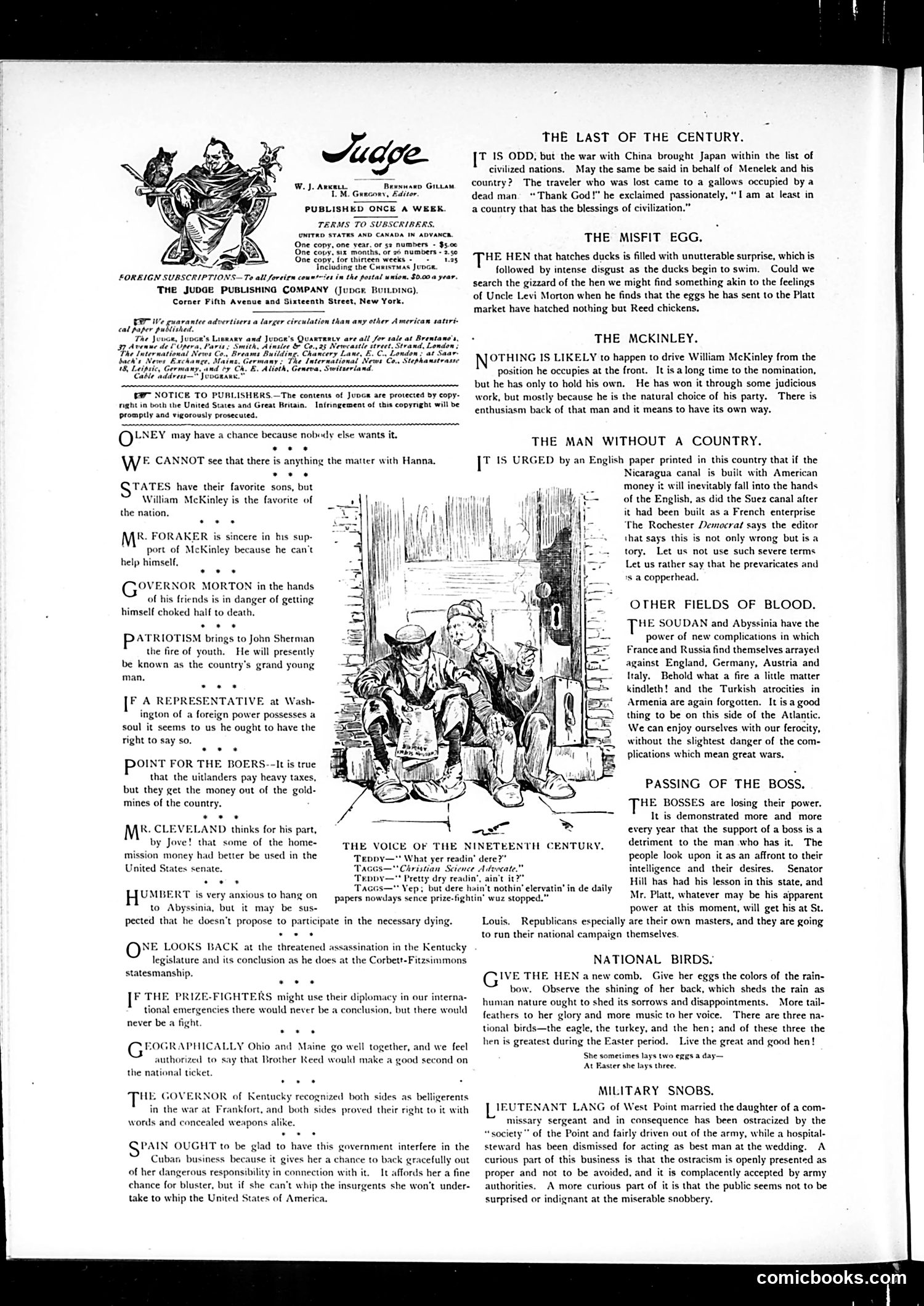
This cartoon satirizes newspaper sensationalism and poor journalism. The central image shows a figure (likely representing a cheap tabloid or "yellow press" publication) speaking bombastically from a platform, with exaggerated speech about "pretty dry readin'" and fabricated stories. The caption quotes dialogue mocking typical newspaper headlines and breathless reporting styles of the era. The satire targets how newspapers of the 1890s manufactured excitement and drama, prioritizing sensational stories over accurate reporting. The surrounding editorial items on this Judge page continue criticizing contemporary politics, foreign policy, and social issues—typical of the magazine's satirical approach. The overall message critiques the unreliability and manipulative nature of popular press during the late 19th century.
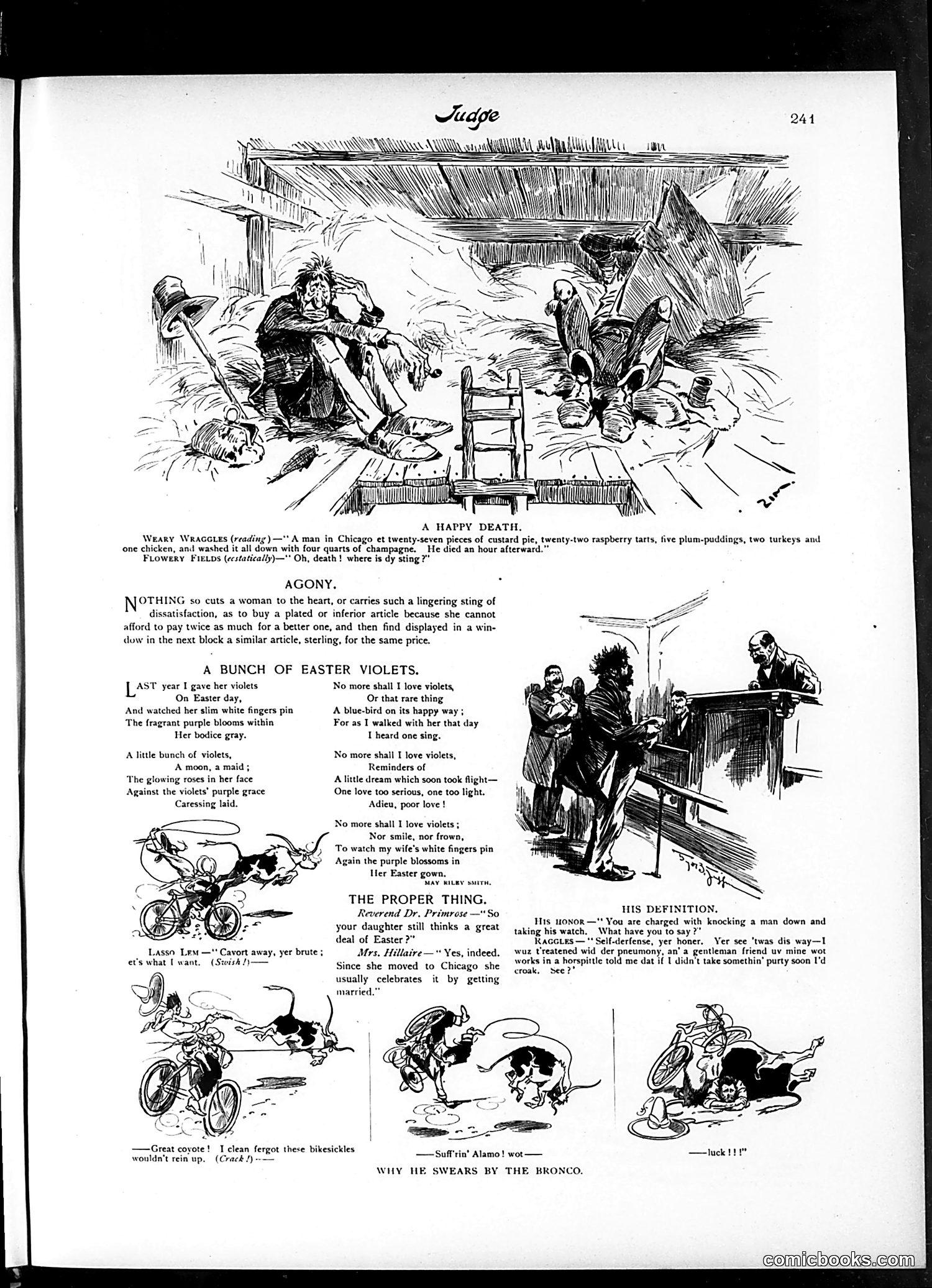
This page contains several unrelated satirical pieces typical of Judge's humor style: **Top cartoon ("A Happy Death"):** Shows a man who died after consuming enormous quantities of food (custard pies, raspberry tarts, puddings, turkeys, etc.) in Chicago. The joke relies on grotesque exaggeration—death by gluttony presented as darkly comic. **Middle section:** Contains poetry and prose pieces, including "A Bunch of Easter Violets" (sentimental verse) and "The Proper Thing" (a brief dialog about celebrating Easter in Chicago). **Bottom cartoons:** Feature bicycling mishaps and physical comedy involving people and dogs. One references "the bronco," suggesting wild behavior. The humor is primarily visual slapstick and wordplay rather than political commentary. These pieces represent Judge's typical early 20th-century satirical magazine format mixing literary humor with comic illustrations.
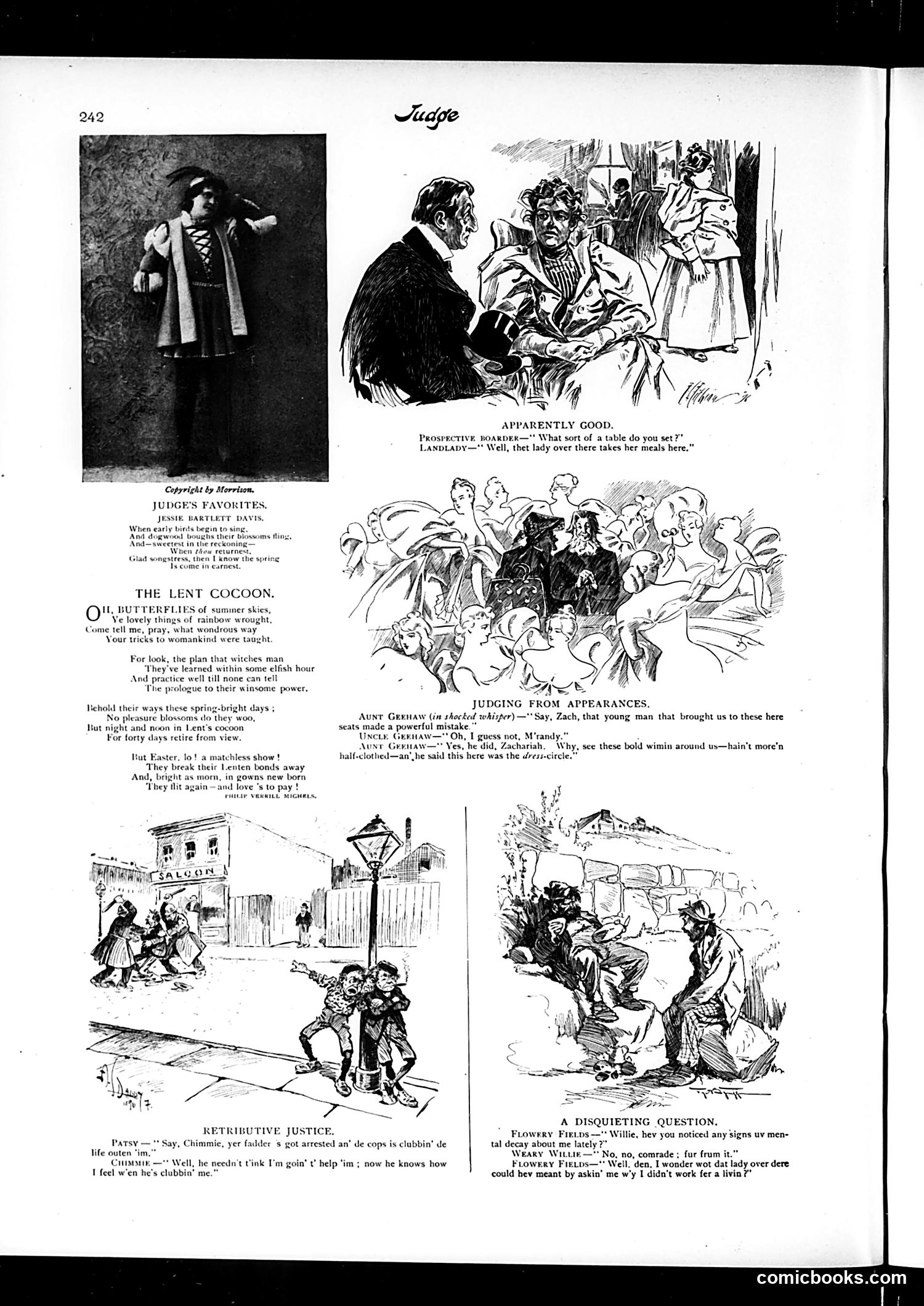
This page contains several satirical cartoons reflecting late-19th/early-20th-century American social attitudes: **"Apparently Good"** mocks class pretension: a prospective boarder asks about the establishment's quality, and is assured by pointing to scantily-clad women dining there—implying the "respectable" clientele actually consists of sex workers. **"Judging from Appearances"** uses rural dialect characters (Aunt Gertrude and Zach) to satirize their naïveté: they're shocked that a well-dressed young man brought them to what they assume is the "dress-circle" (theater seating), but the half-clothed women present suggest it's actually a burlesque or similar venue. **"Retributive Justice"** and **"A Disquieting Question"** employ working-class/immigrant dialect to joke about poverty and labor: characters discuss police brutality, arrests, and whether anyone should help criminals—reflecting anxieties about urban crime and class conflict of the era. The humor relies on stereotypes about class, appearance, and immigrant speech patterns typical of Judge's audience.
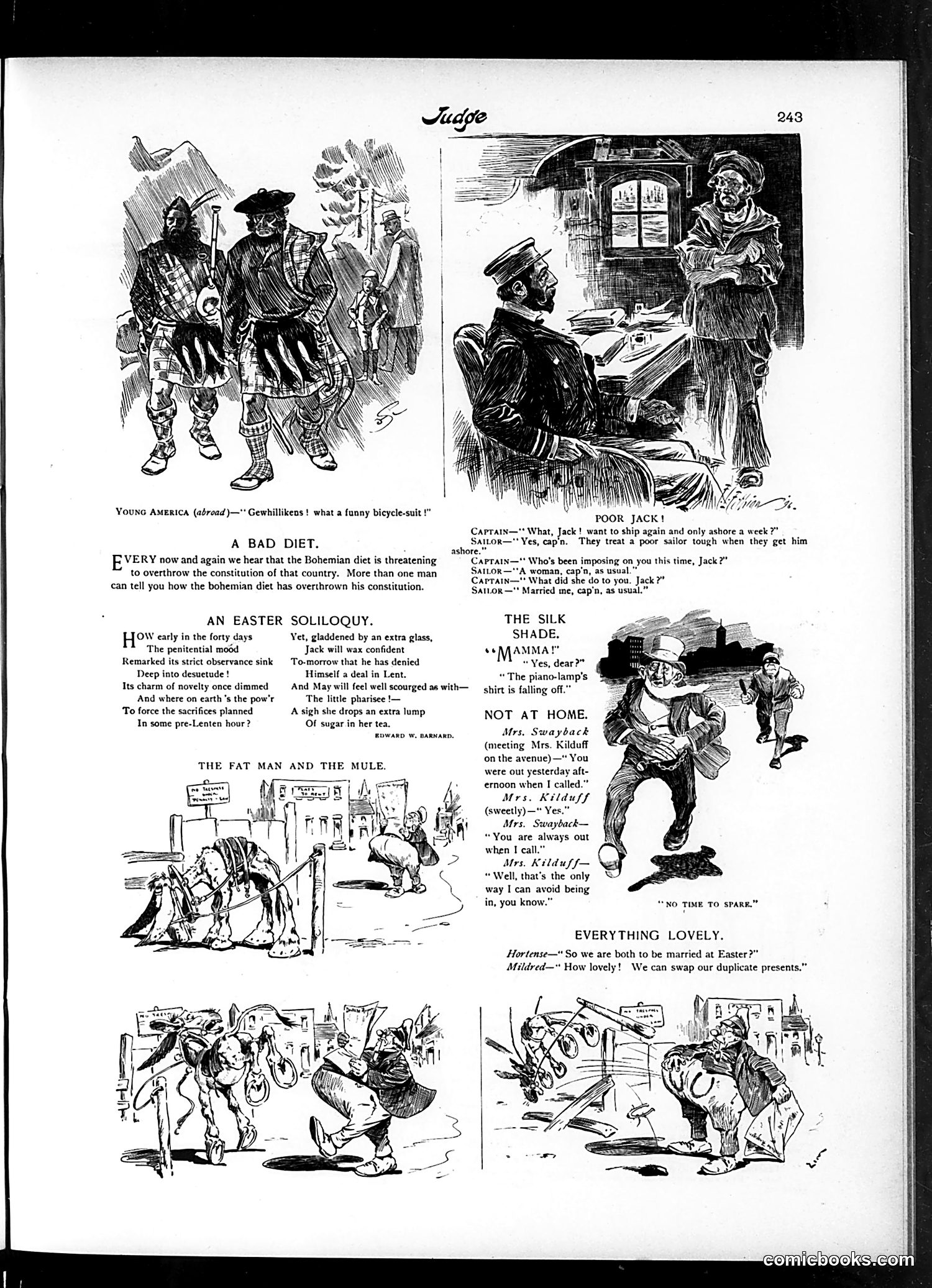
This page contains multiple satirical sketches mocking everyday social hypocrisy and domestic frustrations: **"Young America (Abroad)"** ridicules American tourists abroad for their ignorance, mocking their unfamiliarity with European fashion. **"A Bad Diet"** and **"An Easter Soliloquy"** target religious insincerity—people who fail at Lenten self-denial, with "Jack" abandoning his sacrifices and the "little pharisee" adding sugar to tea despite Lenten promises. **"Poor Jack"** presents dark marital humor: a sailor prefers harsh treatment at sea to being married ashore, suggesting marriage is worse than naval hardship. **"The Silk Shade"** and **"Not at Home"** mock domestic life: a wife complains about her lamp's state, and Mrs. Kilduff admits she's deliberately "always out" to avoid Mrs. Swayback's visits. **"Everything Lovely"** satirizes materialism in marriage—two women excited to swap duplicate wedding presents rather than celebrate matrimony itself. The cartoons collectively ridicule Victorian-era domesticity, religious pretense, and marital discord with gentle, class-conscious humor typical of Judge's audience.
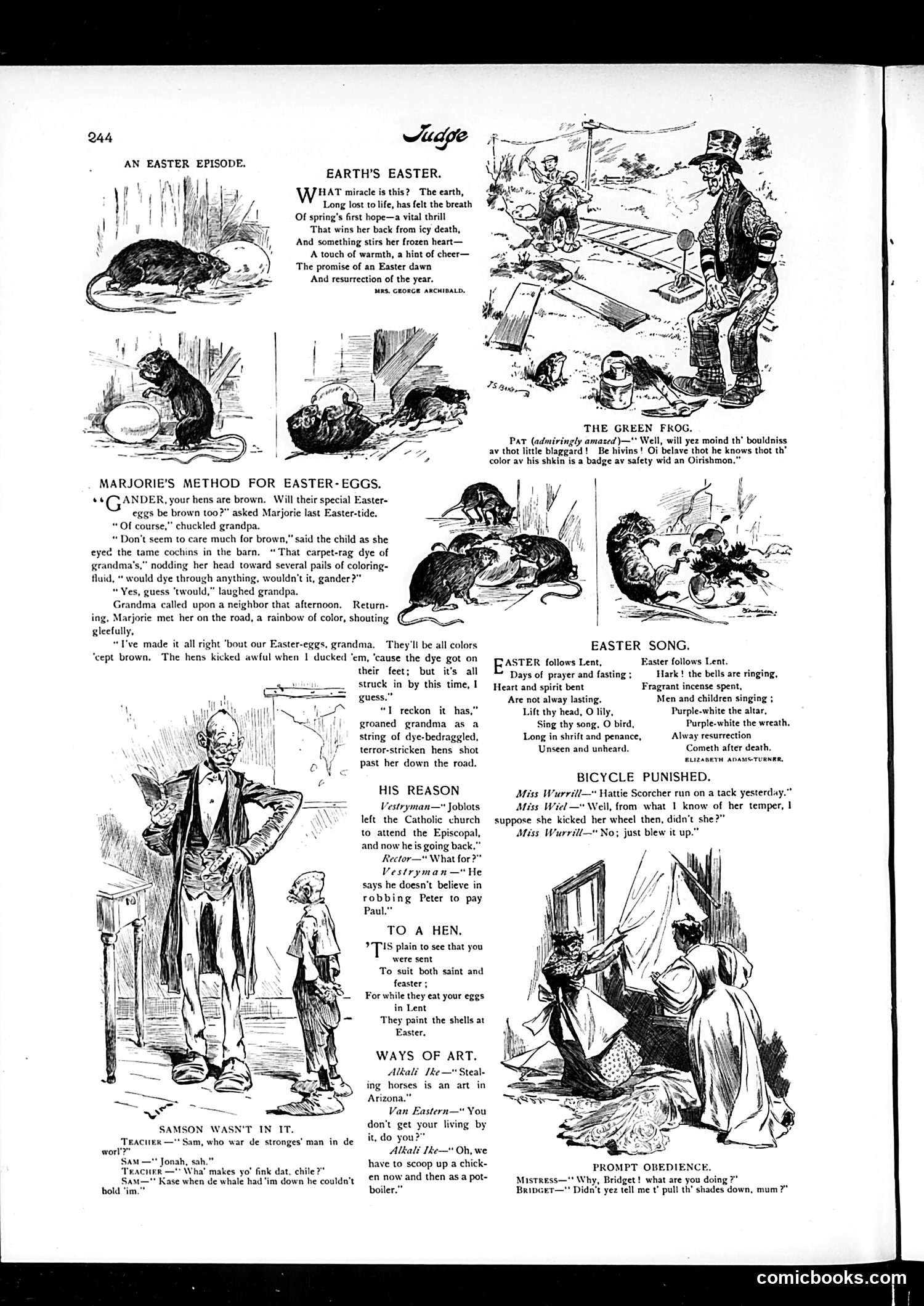
This is primarily an **Easter-themed humor page** from Judge (circa early 1900s) containing several unrelated comic vignettes and verse. **Main content includes:** - **"Marjorie's Method for Easter-Eggs"**: A children's story where a girl dyes her grandmother's brown hens with carpet dye to create colorful eggs, comically dyeing the hens themselves in the process. - **Irish dialect humor** ("The Green Frog"): A stereotypical Irish character admires a frog's safety coloring—typical period ethnic caricature comedy. - **"His Reason"**: A Vestryman explains a man switched from Catholic to Episcopal church because the Catholic church "robs Peter to pay Paul"—likely referencing papal authority or church taxation practices. - **Minor jokes**: Including a bicycle mishap, wordplay about hens and Easter traditions, and a servant misinterpreting orders. **The overall tone** is lighthearted domestic and religious humor typical of early 1900s American satirical magazines, with period-specific stereotypes and whimsy.
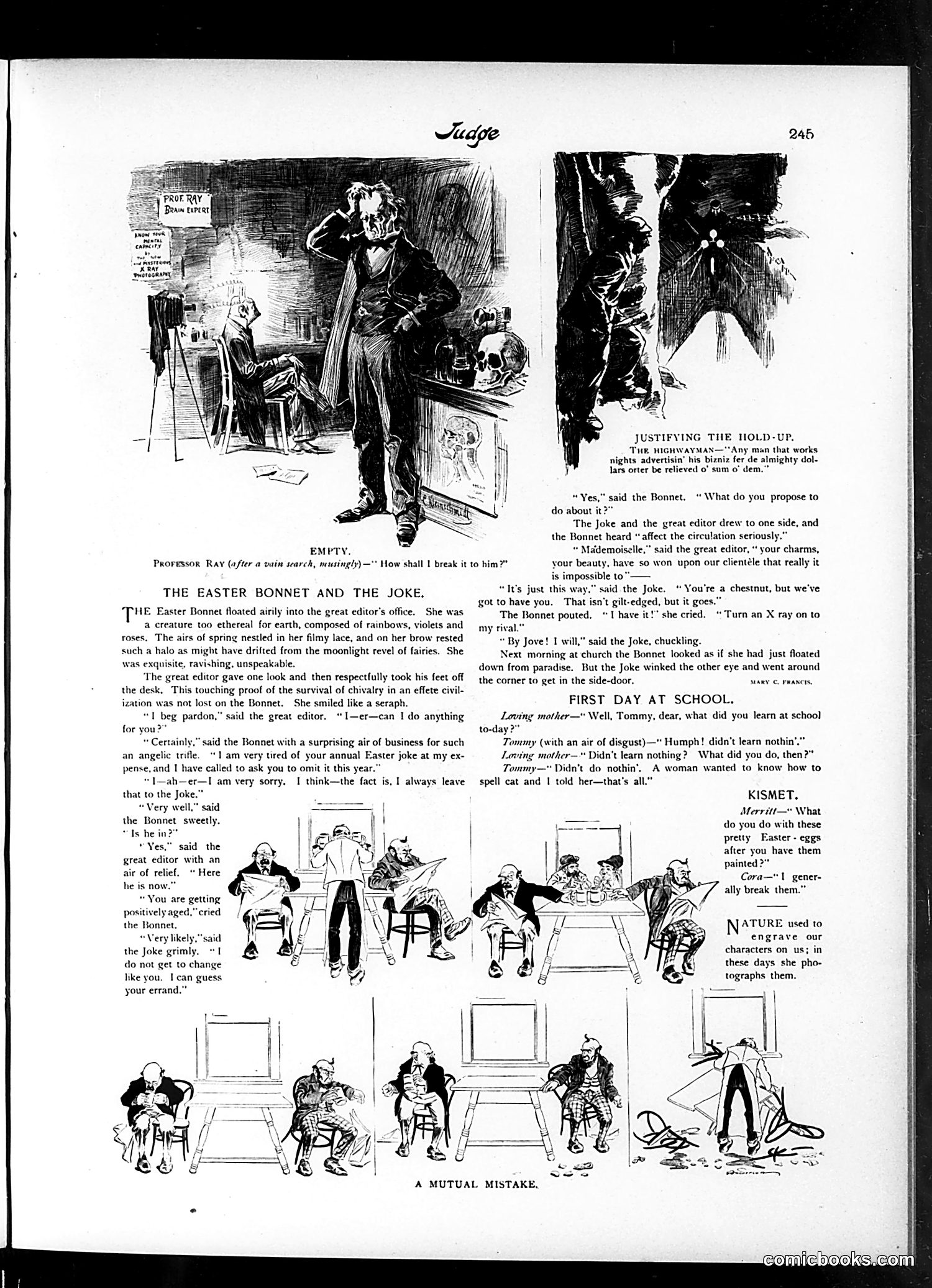
This page contains several satirical pieces typical of early 20th-century Judge magazine humor: **"The Easter Bonnet and the Joke"** is the main feature—a dialogue where an elaborately decorated Easter bonnet (personified) visits the magazine's editor to complain about their annual Easter joke mocking her. She appeals to "The Joke" itself, a character representing the magazine's humor tradition. The satire mocks both the vanity of fashionable women obsessed with Easter bonnets and the magazine's own repetitive comedic formulas. **Supporting pieces** include "Justifying the Hold-Up" (about highway robbery and advertising), "First Day at School" (a child's humorous misunderstanding), "Kismet" (about painted Easter eggs), and "A Mutual Mistake" (unclear without fuller context). The overall theme celebrates Easter fashions while gently satirizing both society's obsession with them and Judge's own reliance on predictable annual jokes.
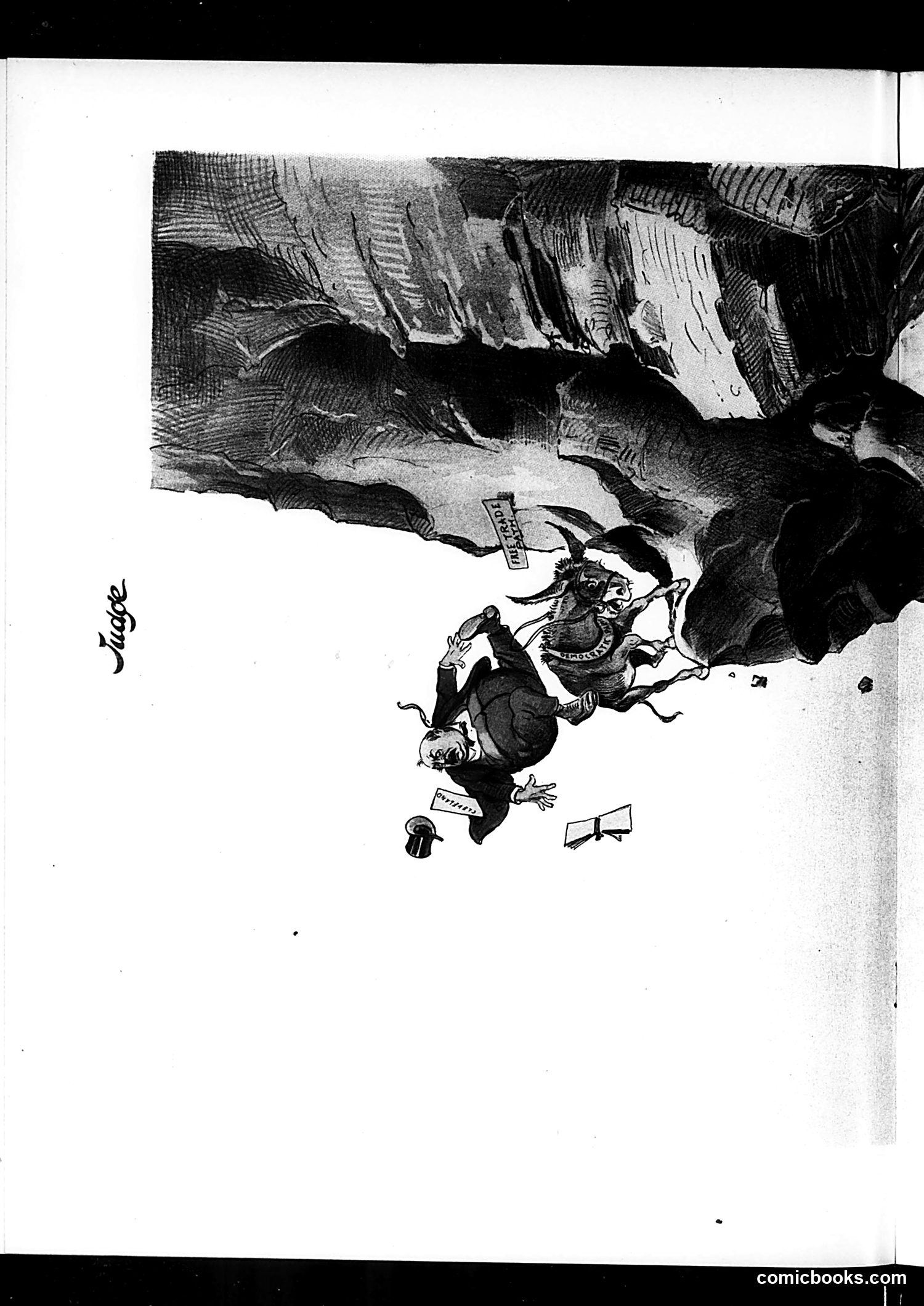
This page appears to be rotated 90 degrees, making it difficult to read clearly. The OCR text consists only of scattered characters and symbols—no readable words or coherent content. The image shows what appears to be a political cartoon in black and white with detailed cross-hatching. It depicts several figures in period clothing in what seems to be a dramatic scene, but without legible text or clear context from the page, I cannot definitively identify the specific political figures, historical event, or satirical point being made. To provide an accurate analysis, I would need either: a clearer image orientation, readable OCR text, or a date/publication context for this Judge issue.
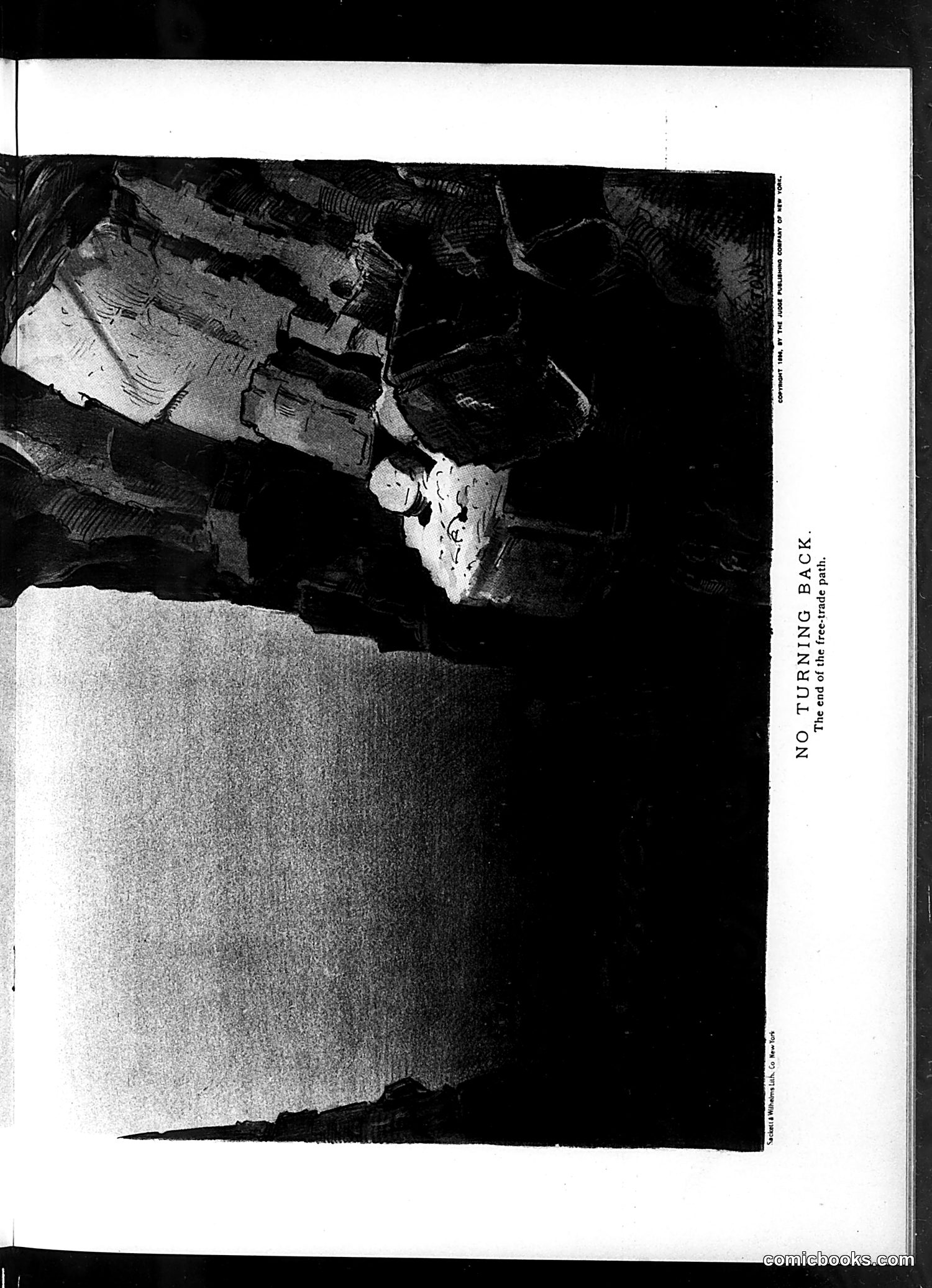
The image quality is too degraded for reliable identification of specific figures or cartoon details. The OCR text is largely corrupted and unreadable, appearing to be reversed or heavily distorted. What I can discern: The title appears to reference "NO TURNING BACK" and mentions "The end of the reserve path," suggesting a political commentary about irreversible decisions or policy directions. This appears to be from Judge magazine's satirical tradition of political commentary. However, without clearer text or imagery, I cannot confidently identify which political figures are caricatured, what specific historical event is referenced, or what the precise satirical point was intended to be. A higher-quality image would be necessary for accurate analysis.
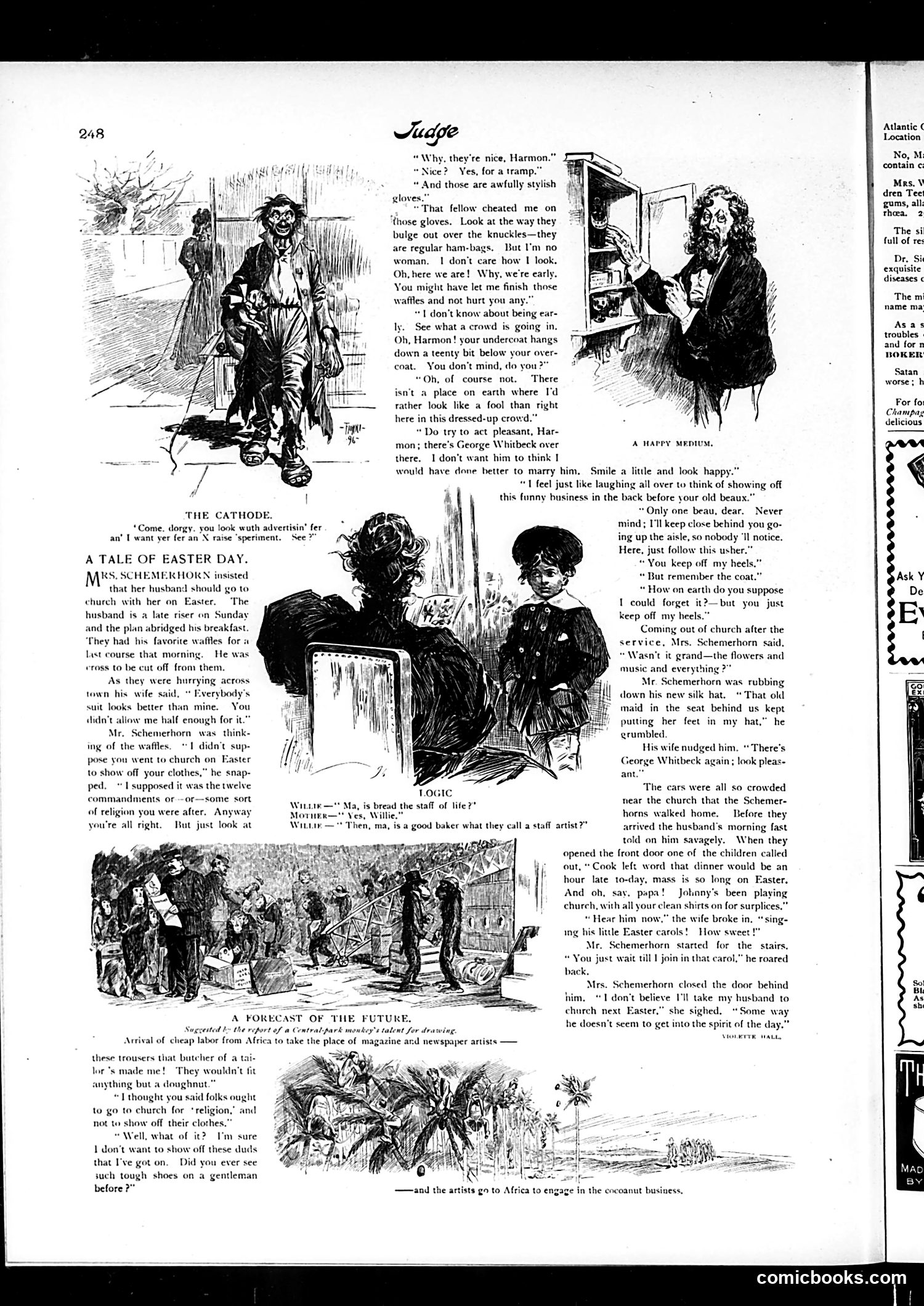
This three-panel domestic comedy satirizes the hypocrisy and social pretense surrounding Easter church attendance in genteel society. Mr. Schemerhorn resents being dragged to Easter services, missing his waffles and viewing the outing as performative vanity rather than genuine religious observance. His wife frets constantly about appearance—her clothes, his undercoat, his shoes—contradicting her claim that church is about "religion," not showing off. The satire's point: affluent urbanites treat Easter as a fashion parade where social status matters more than spirituality. Mr. Schemerhorn's grumbling—about a woman putting her feet in his hat, hungry children playing church with his clean shirts—emphasizes the gap between pious pretense and domestic reality. The joke is that after enduring this charade of respectability, he's ready to lose his temper at home. Judge mocks the shallow materialism masquerading as Christian devotion.
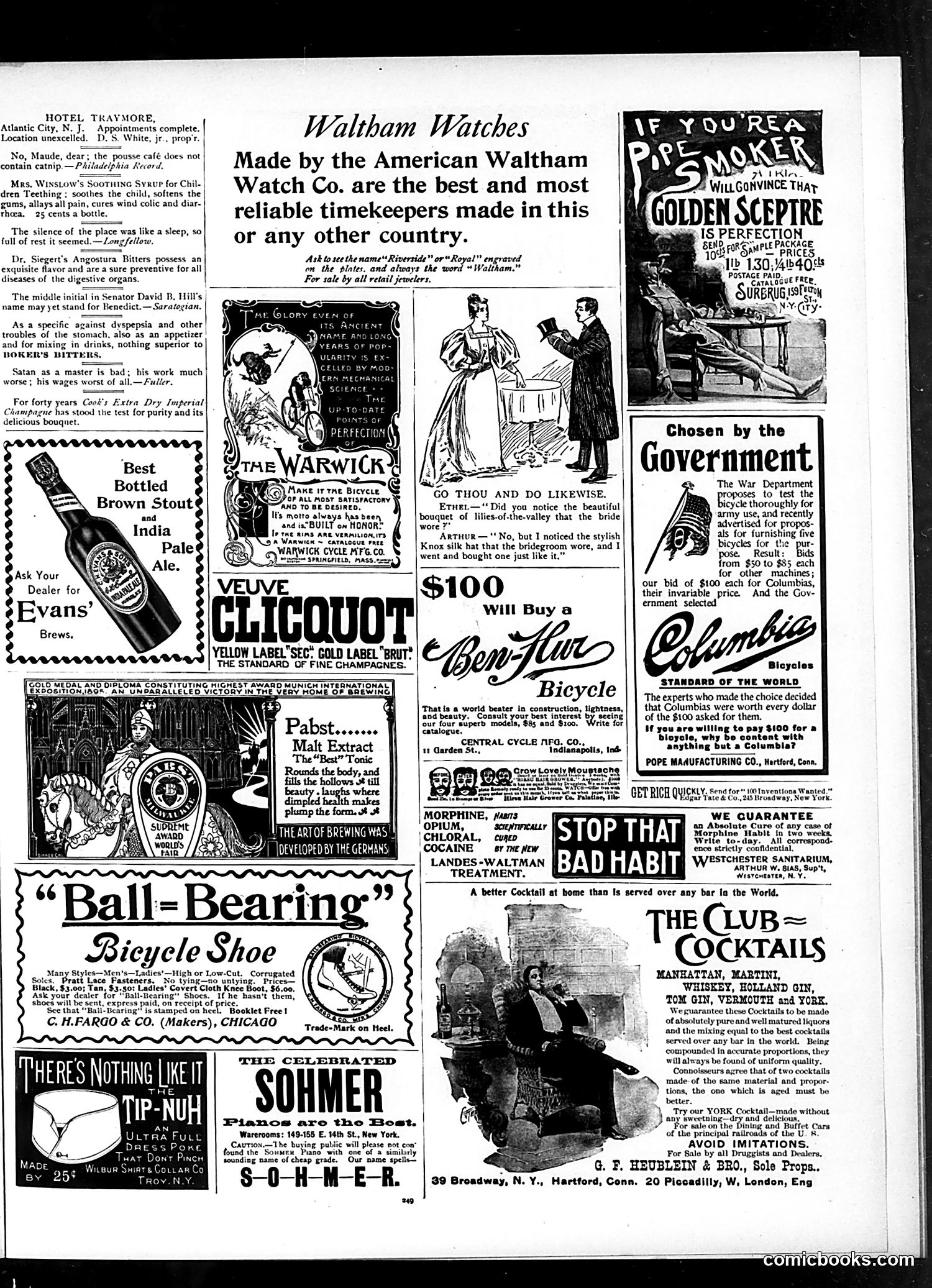
This is primarily an **advertising page** from Judge magazine, not a political cartoon. It contains various commercial advertisements for products like watches, bicycles, champagne, and pianos. The only notable satirical content is a brief **social joke** labeled "GO THOU AND DO LIKEWISE," where a character admires a bride's bouquet of lilies-of-the-valley, but his friend Arthur admits he actually noticed—and then copied—the groom's stylish Knox silk hat instead. The humor mocks consumerism and male materialism: rather than appreciating romantic florals, the men are focused on fashionable hats and immediately rush to buy the same brand. The page also includes a **government procurement story** about the War Department selecting Columbia bicycles at $100 each over cheaper competitors ($50-$85), framed as validation of quality—essentially a paid endorsement disguised as news. The remaining content is straightforward period advertising with no satirical intent.
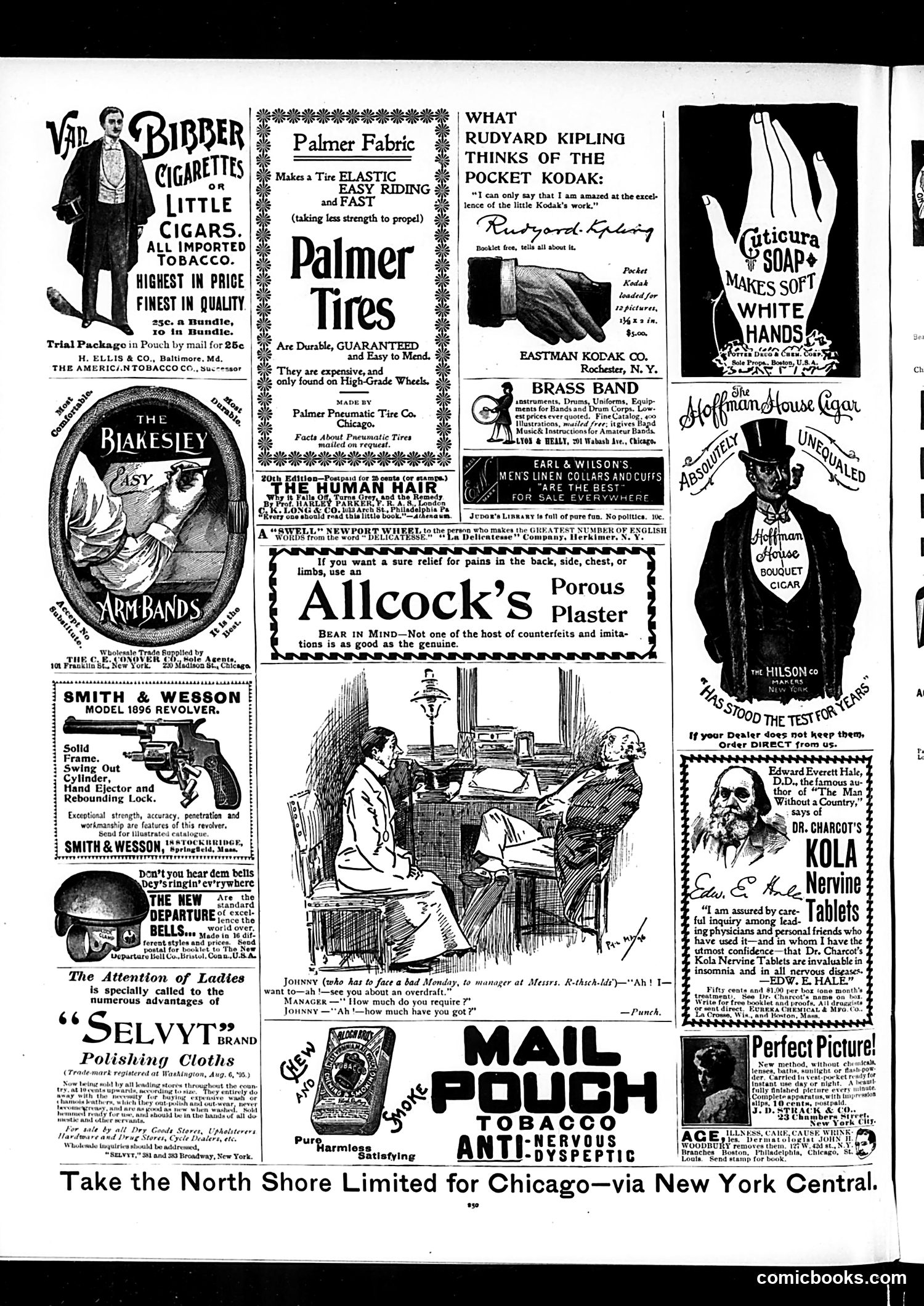
This is primarily a **classified advertisement page** from *Judge* magazine, not a political cartoon page. It showcases early 1900s consumer products: cigarettes, tires, revolvers, cameras, patent medicines, and collars. The single **cartoon** appears mid-page: a manager confronts an employee (labeled "Johnny") seeking an overdraft. The joke, attributed to *Punch*, is a mild class satire—the working-class employee, facing Monday's bills, can only offer his employer whatever cash he personally possesses, inverting the expected power dynamic. It satirizes the desperation of working people living paycheck-to-paycheck. Notable is the endorsement from **Rudyard Kipling** for the Pocket Kodak camera, lending celebrity prestige to mass-market photography technology. The page reflects the era's aggressive marketing of new industrial products (pneumatic tires, revolvers, cameras) to the middle class alongside dubious patent medicines like "Dr. Charcot's Kola Nervine Tablets."
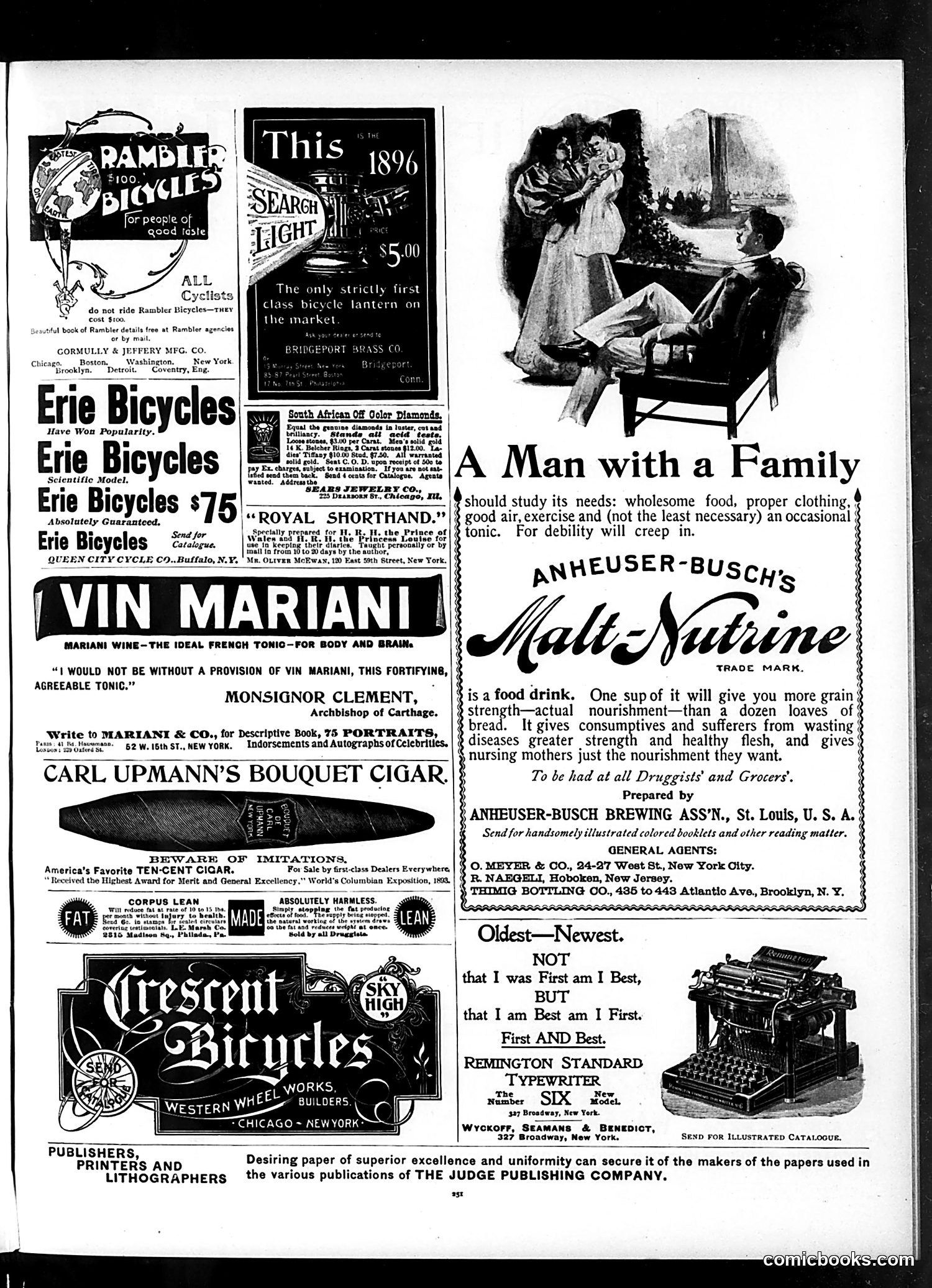
This is primarily an **advertising page** from Judge magazine, circa 1896, with no significant political cartoons or satirical content. The page consists almost entirely of product advertisements typical of the Gilded Age, including: - **Bicycles** (Rambler, Erie, Crescent)—reflecting the 1890s cycling craze - **Wine and tonics** (Vin Mariani, Anheuser-Busch's Malt Nutrine)—marketed as health remedies - **Cigars and writing instruments** The only illustrative content with narrative is a small illustration accompanying the Anheuser-Busch ad showing a man relaxing with family, captioned "A Man with a Family"—using domestic contentment to sell malt beverage as a tonic for "debility." These ads reflect period attitudes: tonics/patent medicines sold as cure-alls, bicycles as modern leisure, and alcohol marketed as nutritional medicine. The page demonstrates advertising practices before modern FDA regulations on health claims.
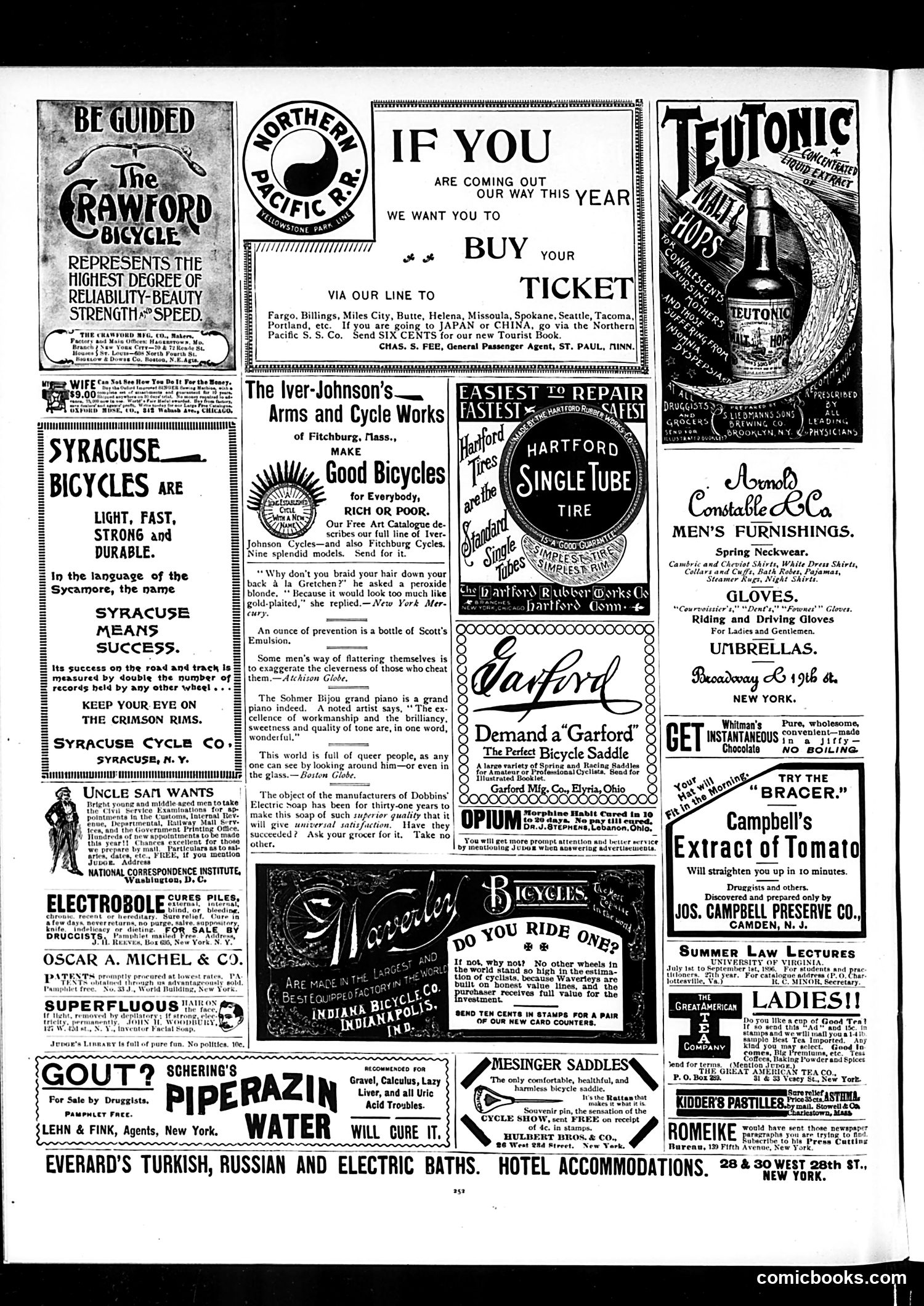
This is primarily **an advertising page**, not political satire. It displays circa-1900s-era commercial advertisements for bicycles, patent medicines, and consumer goods. The page reflects the **bicycle craze** of the 1890s-early 1900s, with multiple manufacturers (Crawford, Syracuse, Iver-Johnson, Garford) competing aggressively. Bicycles were then cutting-edge technology and status symbols. Notable ads include **dubious health products**: "Piperazin Water" claims to cure gout; "Schering's Piperazin Water" promises to cure acid troubles. These represent the era's **unregulated patent medicine industry**, before FDA oversight, when makers made extravagant, unproven medical claims. The page also advertises **travel services** (Northern Pacific Railroad promoting Japan/China tourism) and typical period goods (saddles, tomato extract as a tonic). There is **no discernible political cartoon or satire** on this page—it's a commercial product listing reflecting American consumer culture and commercial claims of the Edwardian era.
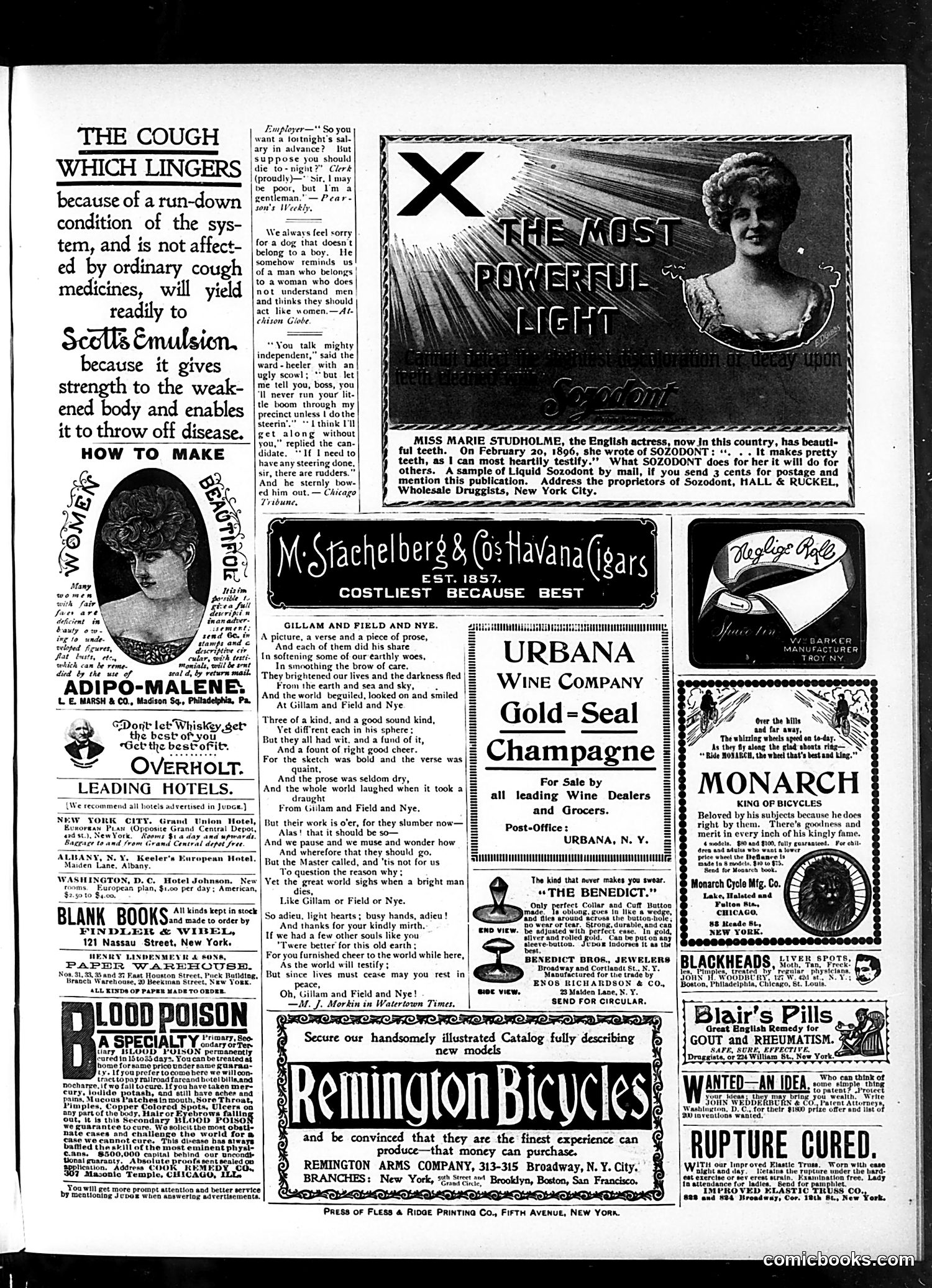
This page is primarily **advertising**, with one notable **memorial poem** rather than political satire. The main text feature is a tribute poem to three deceased figures: **Gillam, Field, and Nye**—apparently cartoonists or humorists who contributed to *Judge* magazine. The poem praises their wit and contributions to public entertainment, lamenting their deaths with lines like "the great world sighs when a bright man / Like Gillam or Field or Nye" passes away. The remainder consists of period advertisements for patent medicines (Scott's Emulsion for coughs, Adipo-Malene for obesity), hotels, bicycles, champagne, and notably "Blood Poison" treatments—reflecting common early 1900s medical marketing practices. There are brief humorous snippets scattered throughout (an employer-clerk exchange about salary advances; observations about dogs and men), but these are filler quotes rather than satirical cartoons. **No clear political commentary appears on this page.**
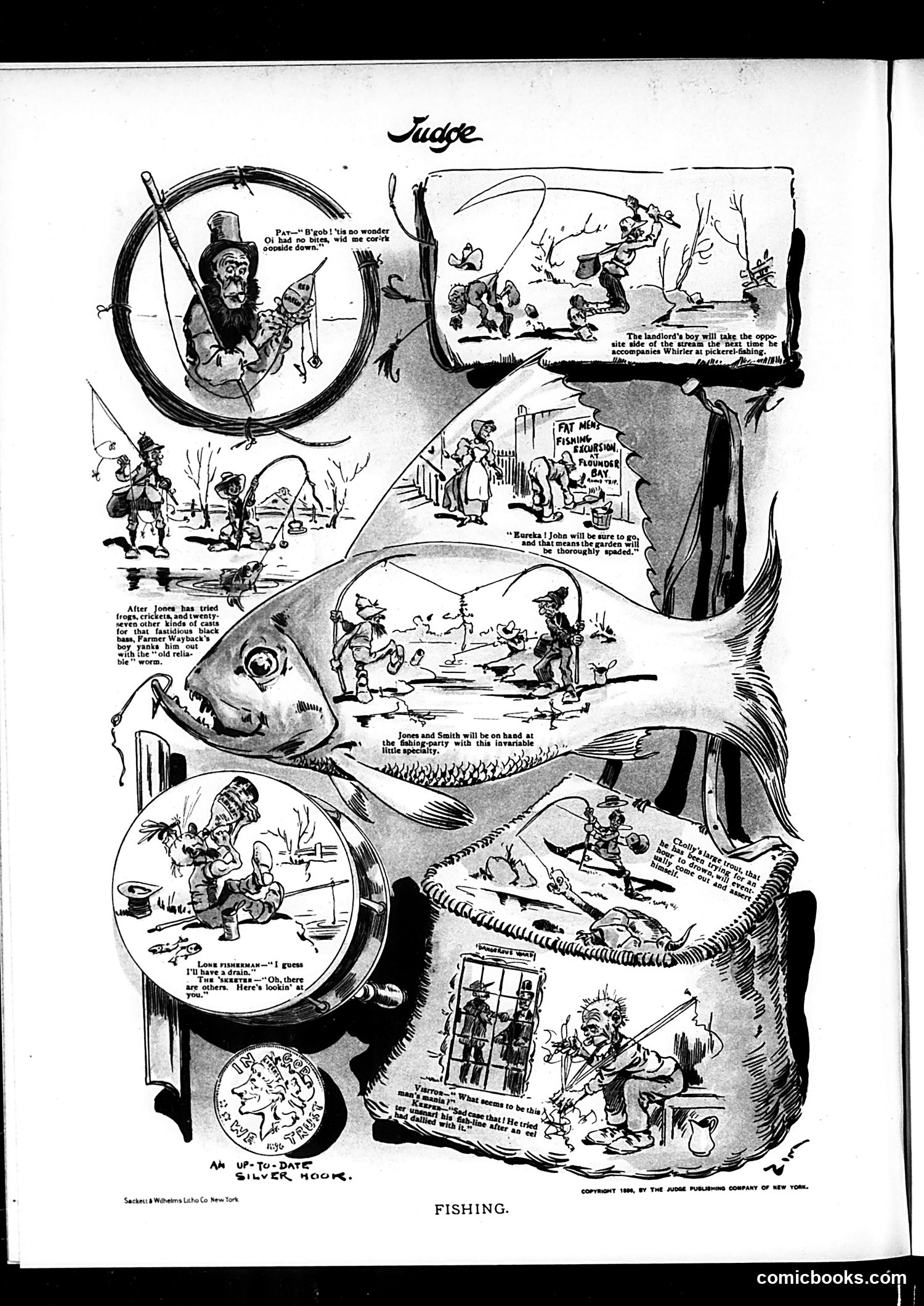
This satirical page mocks various fishing mishaps and ineffective techniques popular among turn-of-the-century sportsmen. The central joke involves contrasting modern, "up-to-date" fishing methods with the humble earthworm—which consistently outperforms elaborate approaches. The vignettes show characters trying fancy baits (frogs, crickets) and newfangled equipment while failing to catch anything. An Irish character complains his "cormorant" (likely a fishing bird or device) yields no bites. Other scenes depict well-dressed fishermen at formal fishing parties, garden-spade incidents, and a "landlord's boy" having better success—all satirizing the pretentiousness of wealthy sportsmen who overcomplicate simple pursuits. The title "An Up-to-Date Silver Hook" suggests irony: despite modern equipment and social status, working-class simplicity (the worm) proves superior. This reflects broader Gilded Age satire mocking the upper class's ineffectual attempts to master activities requiring practical knowledge rather than wealth.