
A complete issue · 20 pages · 1895
Judge — October 26, 1895
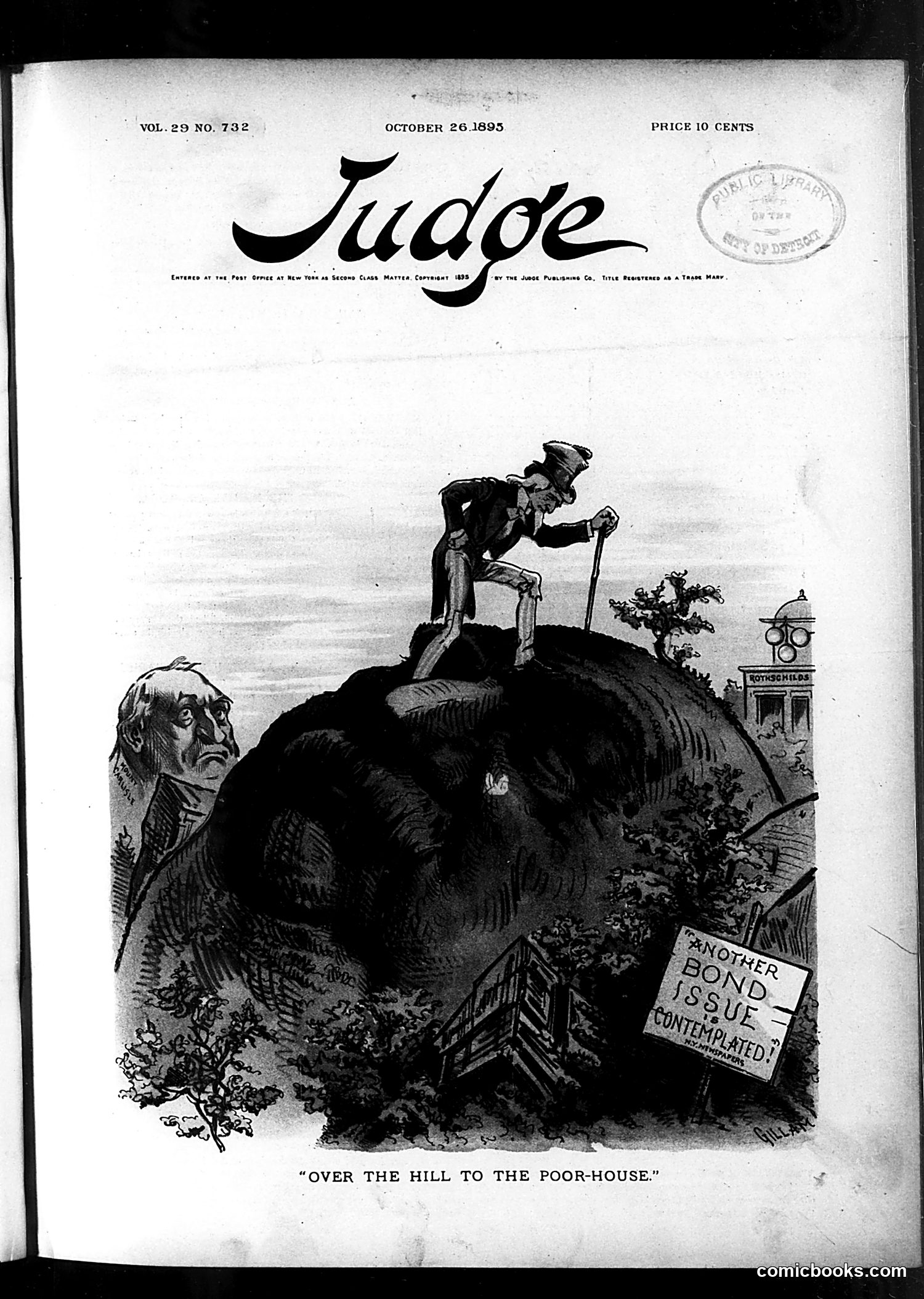
This October 1893 *Judge* cartoon satirizes debates over poverty relief and institutional care. A skeletal Death figure (left) oversees an elderly man being transported "over the hill" — a period phrase meaning toward the poor-house (workhouse). The man rides atop a large sphere labeled "Another Bond Issue Contemplated," suggesting the cartoon critiques government spending on poor relief. The sign reading "Rothschild's" (visible right) may reference banking or financial institutions. The overall satire appears to mock either excessive government expenditure on poorhouses or the futility of relief systems — implying that institutional care merely delays the inevitable fate of the destitute. The skeleton emphasizes death as the ultimate destination for the poor.
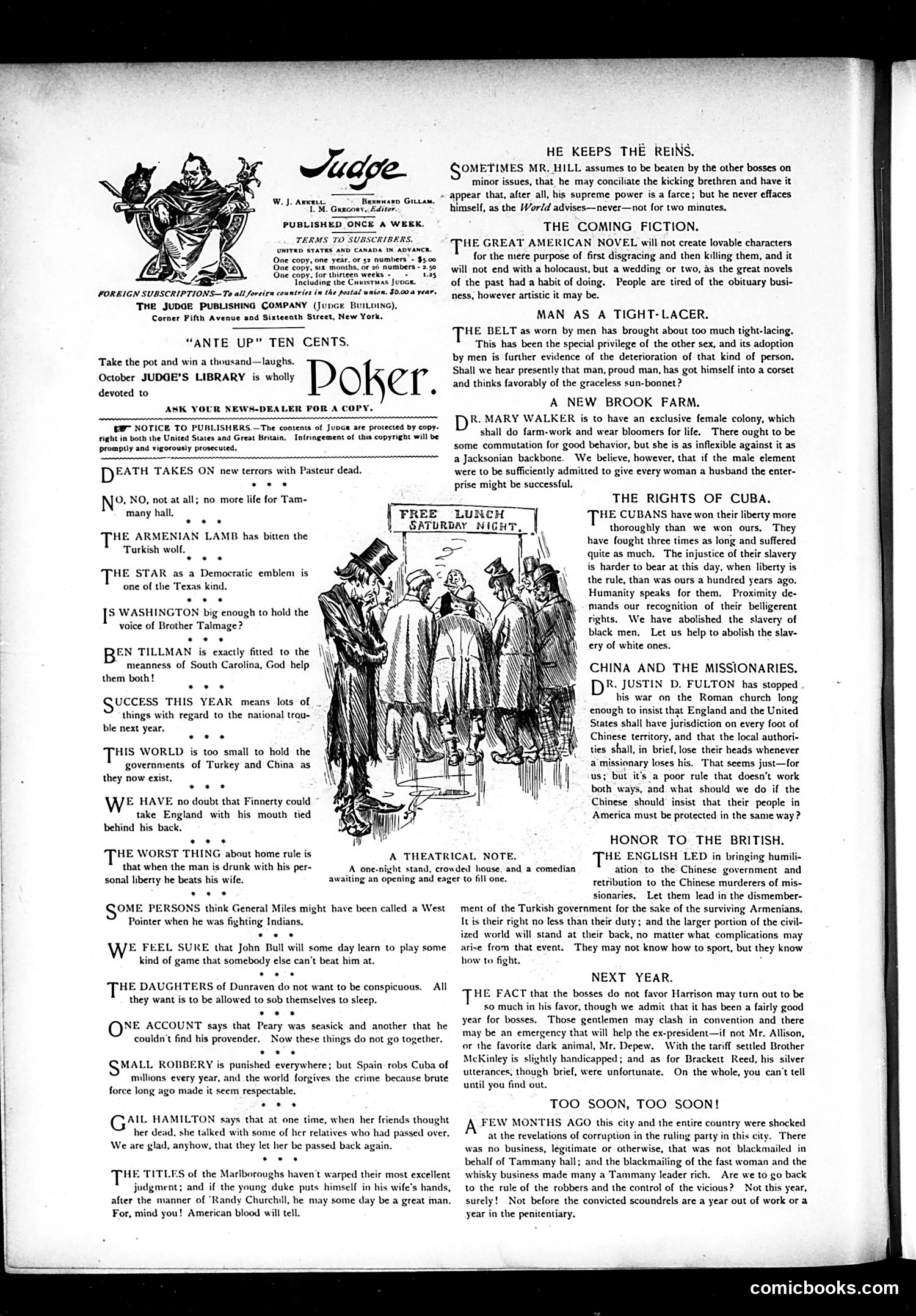
This page contains several brief political commentary items rather than a single cartoon. The main illustration shows a crowded scene labeled "FREE LUNCH SATURDAY NIGHT," depicting what appears to be a charitable or political gathering. The text items reference contemporary issues: Cuban independence ("The Rights of Cuba"), British military actions in China during the Boxer Rebellion era ("Honor to the British"), and American missionary involvement abroad ("China and the Missionaries"). There are also domestic jabs at political figures like Ben Tillman and references to urban corruption. The overall tone reflects Judge's late-19th century satirical stance on American foreign policy, imperialism, and domestic political hypocrisy. Without specific dateline information visible, the precise year and some contextual details remain unclear, though the references suggest the 1900-1901 period.
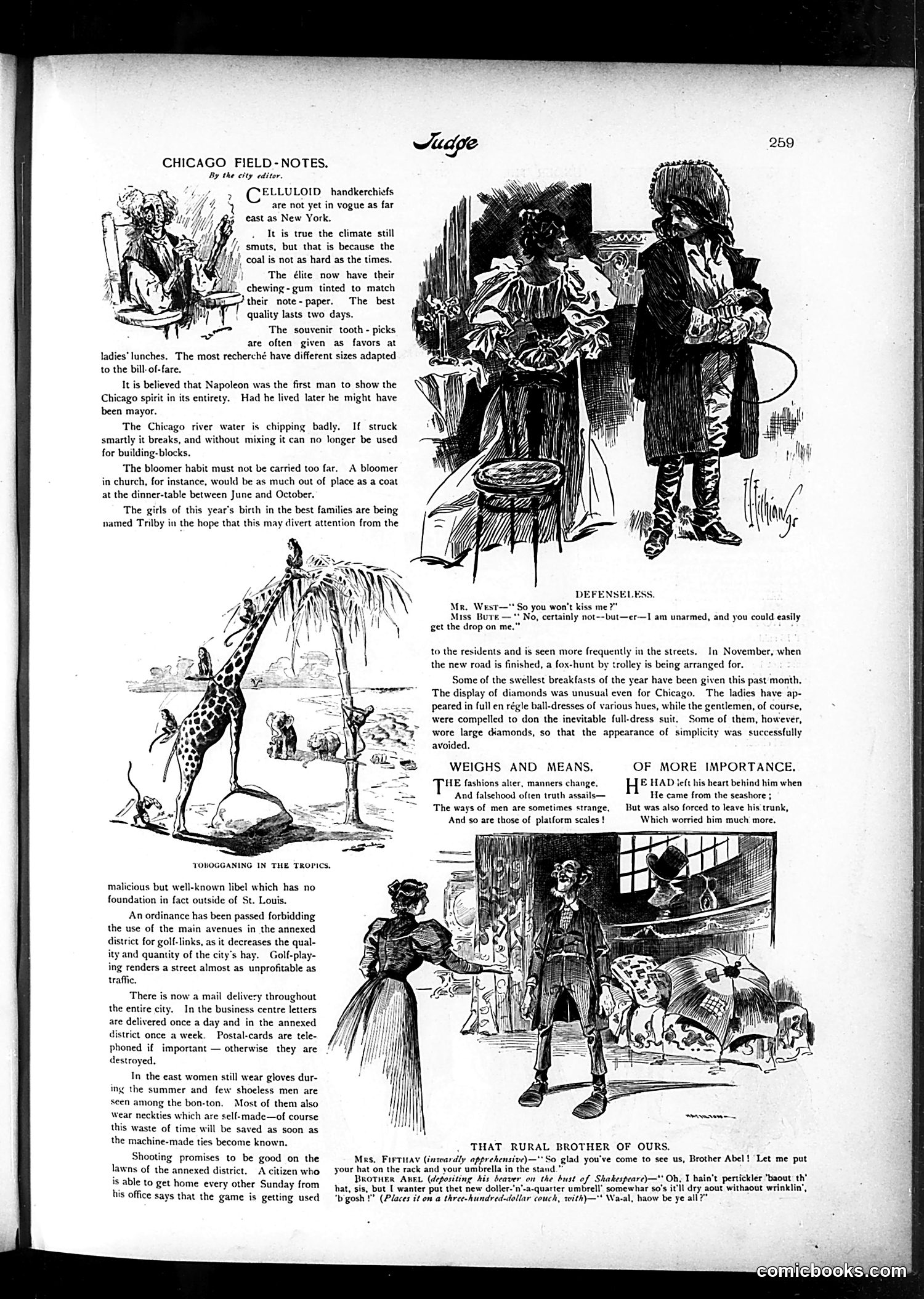
This satirical page comments on Chicago society and customs circa early 1900s. The main cartoon "Defenseless" depicts a romantic encounter, likely mocking courtship conventions—the woman claims to be "unmarried" to avoid scandal while inviting the man's advances. The "Tobogganing in the Tropics" illustration satirizes the contrast between Chicago's harsh climate and exotic leisure pursuits among the wealthy. "Weights and Means" and "Of More Importance" mock class pretensions—one section humorously suggests platform scales lie as much as wealthy people do, while another depicts someone stealing from a servant, commenting on moral hypocrisy among the elite. The final cartoon "That Rival of Ours" appears to be domestic comedy involving servants and umbrellas, likely satirizing household management and class dynamics in Gilded Age Chicago.
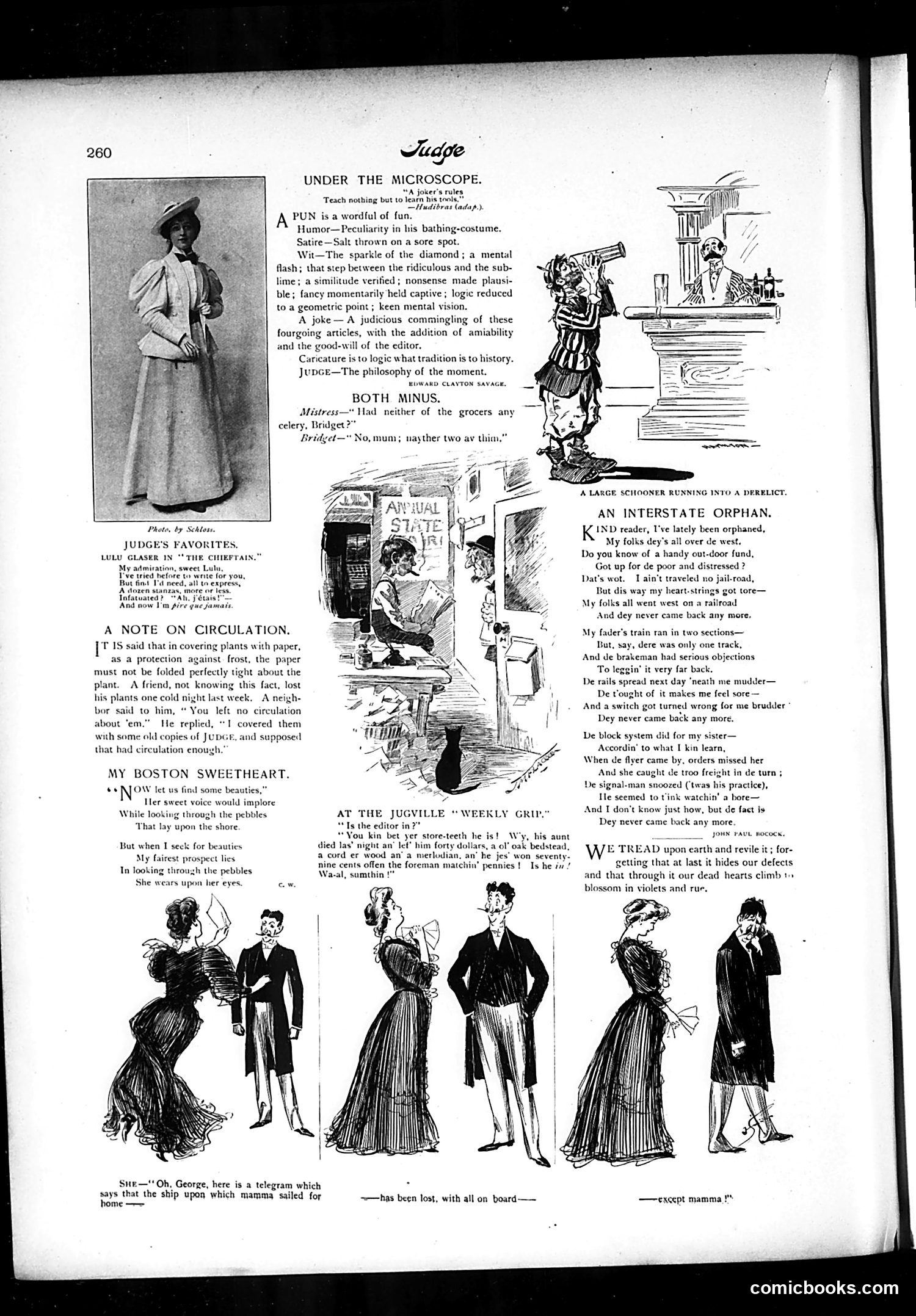
This page from the satirical magazine *Judge* contains several distinct pieces of humor targeting American society circa early 1900s: **"Under the Microscope"** offers definitional humor—playful distinctions between puns, humor, satire, and wit, ending with the joke that *Judge* itself has "circulation enough" despite being old newspapers (implying the magazine's content is recycled or stale). **"Both Minus"** is a simple domestic joke about a maid and mistress—likely Irish immigrant humor common to the era. **"An Interstate Orphan"** is darker satire about railroad accidents killing working-class families, presented through dialect verse. The orphan's parents and siblings died in separate rail disasters, highlighting the industrial era's human toll and lack of social safety nets. **"My Boston Sweetheart"** is sentimental romantic verse. The bottom illustrations appear to depict social situations—possibly courtship or class interactions—typical of *Judge*'s commentary on American manners and morality. Overall, the page mixes light domestic humor with critique of industrial dangers and social inequality.
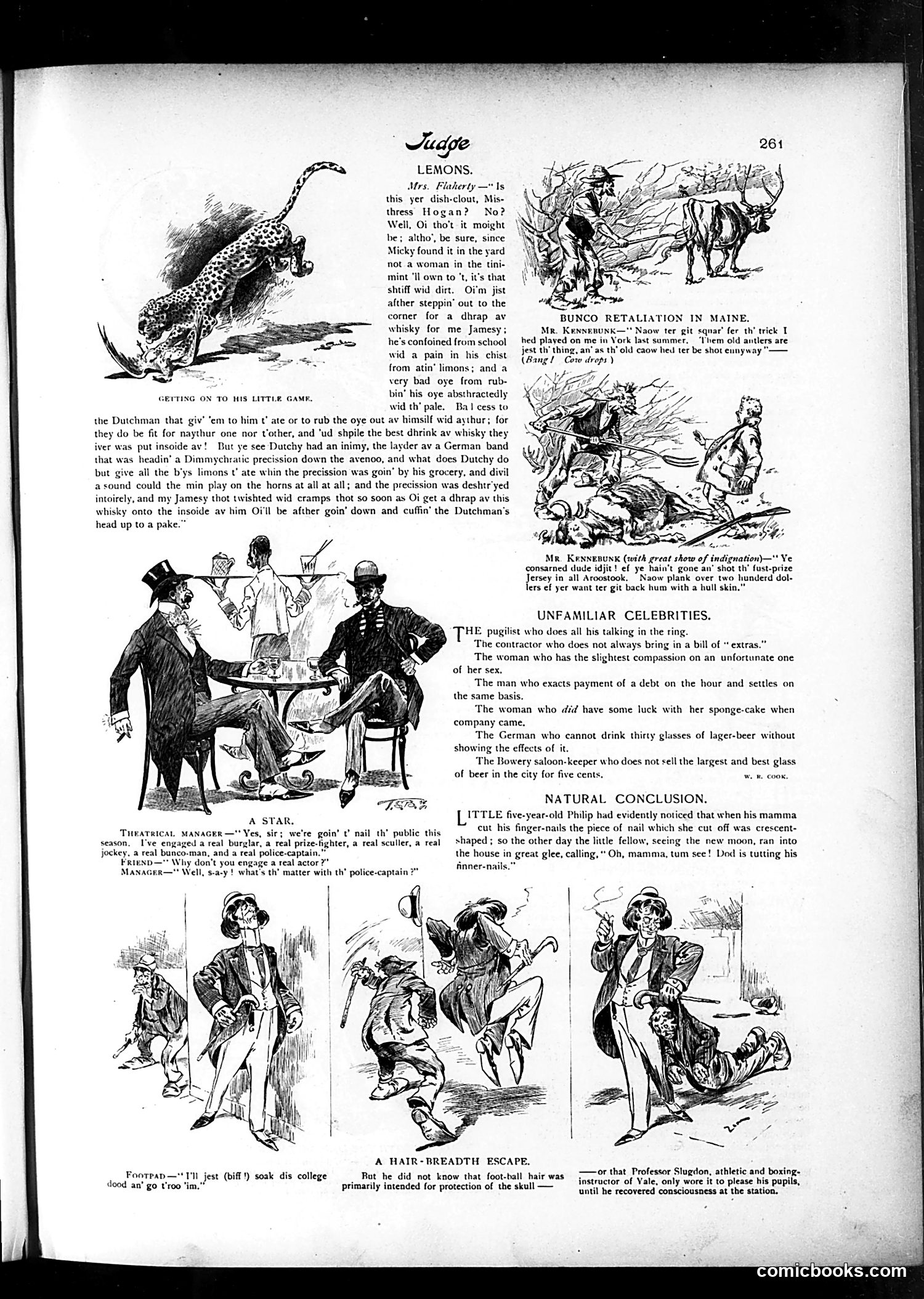
This page contains several satirical pieces typical of late-19th-century American humor: **"Lemons"** depicts Irish immigrant characters in dialect discussing how a Dutch grocer distributed lemons to a German band marching in a Democratic parade, causing the musicians to play poorly due to the fruit's effect on their mouths—sabotaging the political procession. **"Bunco Retaliation in Maine"** shows rural New England revenge: after being tricked in York, a man shoots prize livestock to retaliate against the perpetrator. **"Unfamiliar Celebrities"** is a satirical list of impossible or ironic figures—like a compassionate society woman or a German who can't hold his beer—mocking contemporary stereotypes and human nature. **"Natural Conclusion"** is a children's joke: young Philip mistakes a crescent moon for a fingernail God has cut. **"A Hair-Breadth Escape"** depicts a football player narrowly avoiding injury; the humor suggests protective headgear was worn reluctantly. The page reflects period attitudes toward immigrants, rural life, class, and gender through exaggerated dialect and stereotypes.
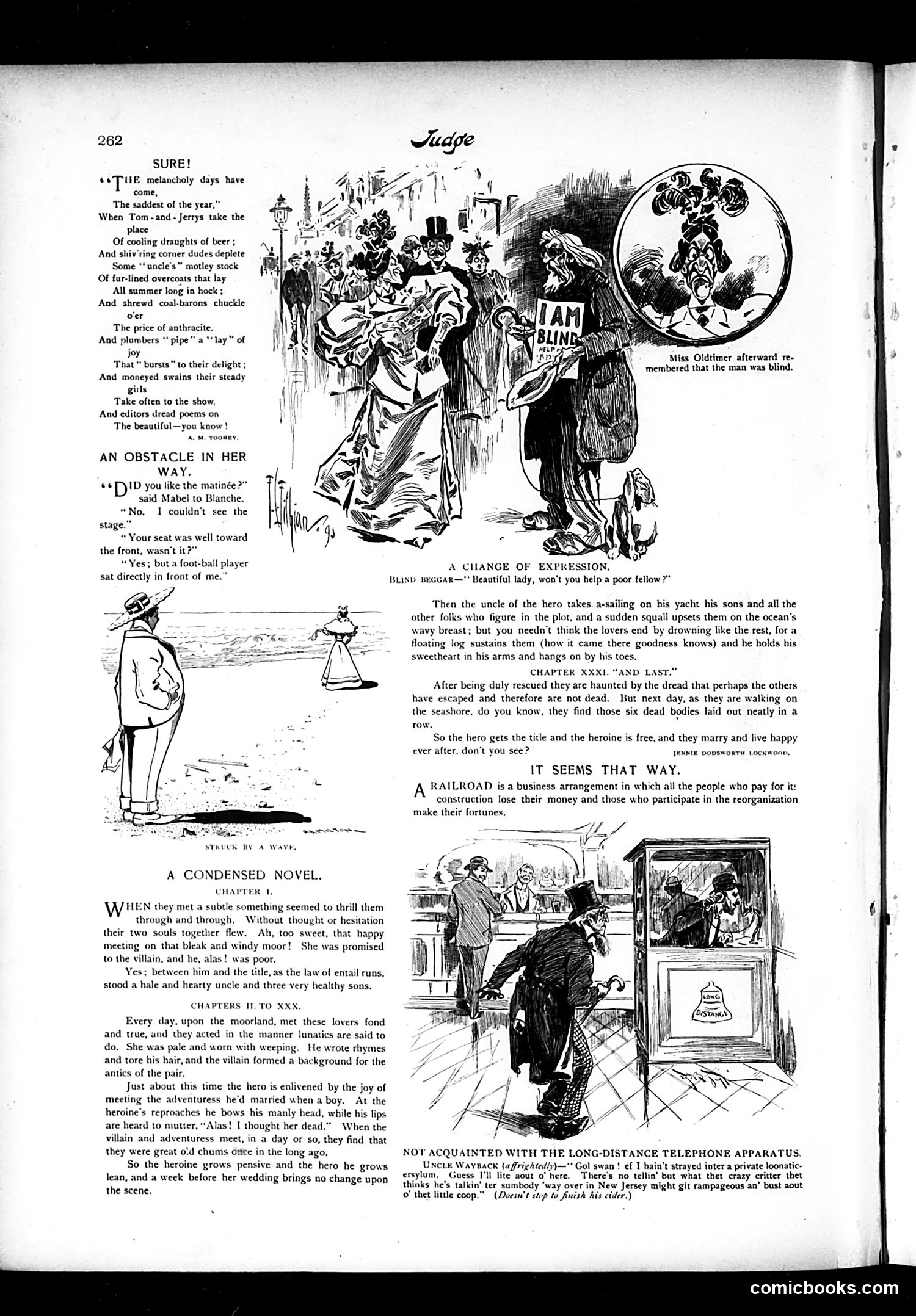
This page contains satirical humor typical of early 20th-century American magazines. The main content includes: **"An Obstacle in Her Way"** mocks social etiquette: a woman complains she couldn't see the theater matinée because a football player blocked her view—the joke being she didn't notice the man was blind, revealing her superficiality. **"A Condensed Novel"** parodies Victorian melodrama tropes: poor hero loves wealthy heroine promised to a villain; an uncle and his sons conveniently die in a shipwreck; the couple marries happily. It's absurdist satire of predictable romantic plotting. **"It Seems That Way"** offers cynical commentary on railroad reorganization schemes—a reference to actual Gilded Age financial corruption where investors lost money while speculators profited during railroad bankruptcies and restructurings. **"Not Acquainted with the Long-Distance Telephone"** jokes about an elderly man startled by telephone technology, mistaking a nearby conversation for madness—poking fun at technological ignorance among older generations. The illustrations throughout use exaggerated caricature typical of the era.
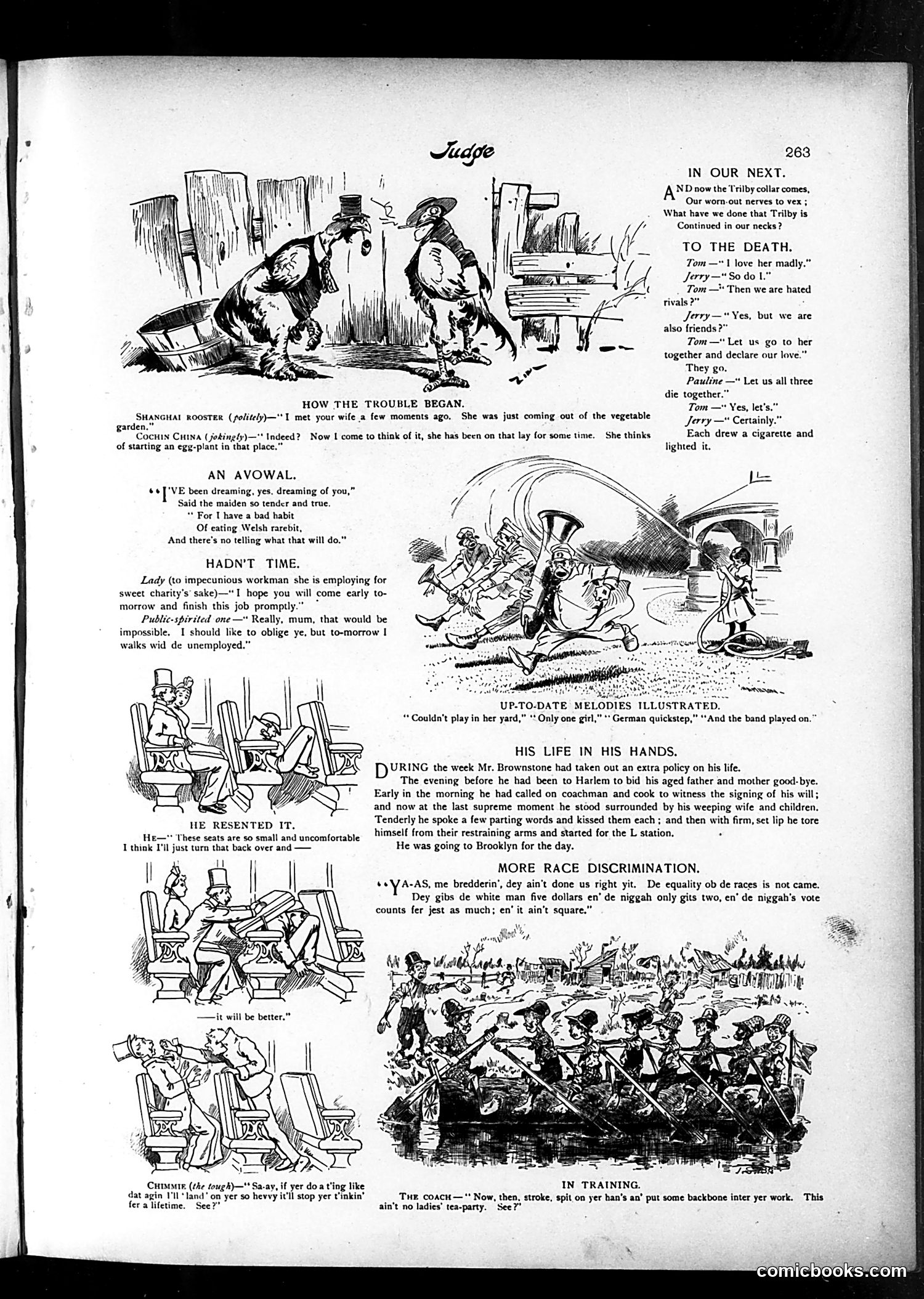
This page contains multiple brief satirical sketches typical of early Judge magazine: **"How the Trouble Began"** mocks cross-cultural misunderstandings through roosters (likely representing Chinese and Shanghai characters), with innuendo about infidelity and vegetable gardens. **"To the Death"** satirizes melodramatic romantic triangles, where rivals casually declare love then smoke cigarettes—deflating the genre's supposed passion. **"His Life in His Hands"** jokes about middle-class anxiety: a man takes out extra life insurance, bids emotional farewells to family, and makes his will—only to go to Brooklyn for the day. It mocks overblown risk-aversion. **"More Race Discrimination"** uses offensive dialect to present a racial complaint: Black Americans receive unequal pay ($2 vs. $5) yet their votes count equally—framed as absurdly unjust. This reflects the magazine's often problematic racial attitudes. **"In Training"** depicts a rowing coach's harsh language toward athletes, emphasizing working-class masculinity and toughness. The sketches employ caricature, exaggeration, and period-specific dialect humor typical of the era.
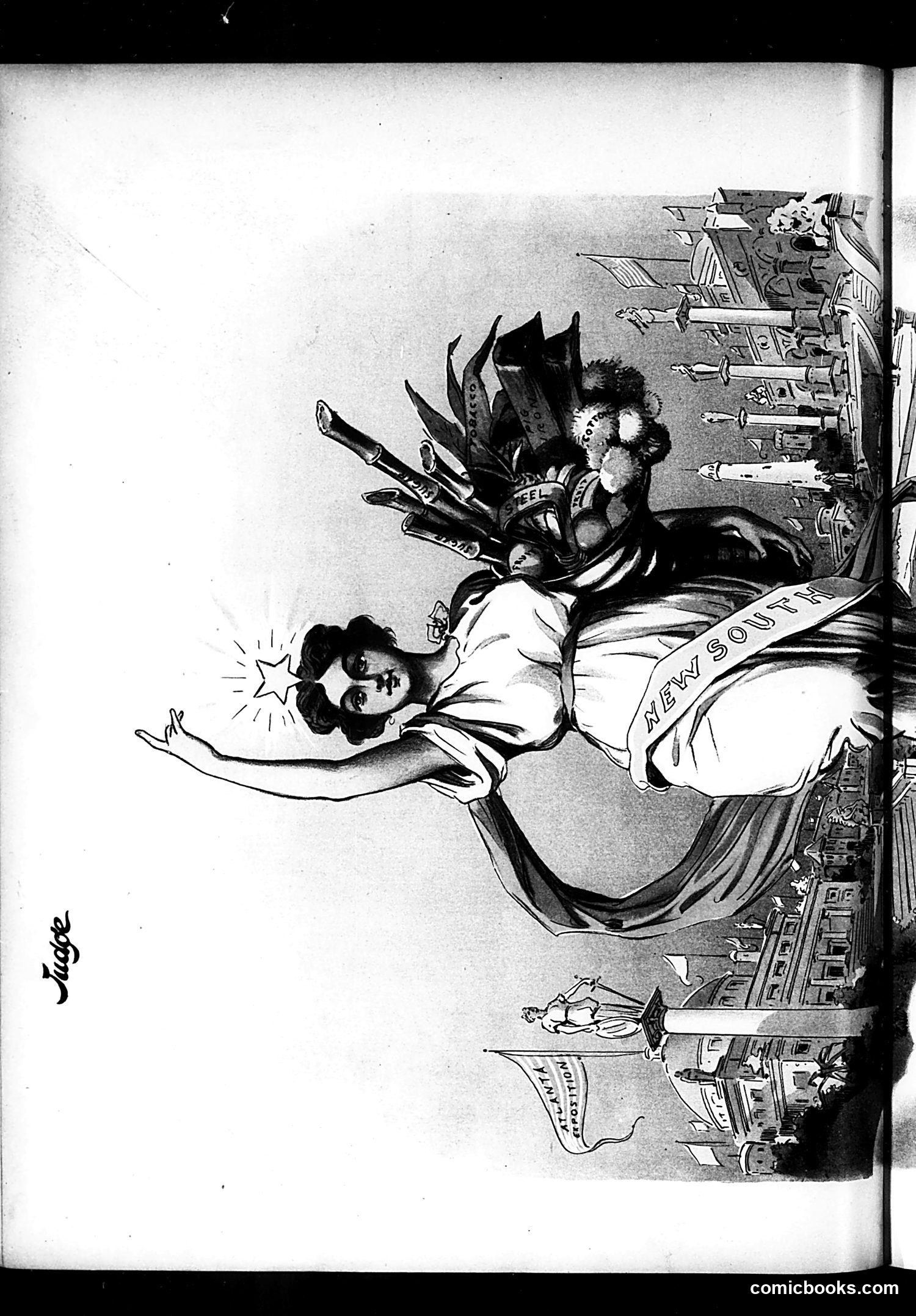
This appears to be a satirical cartoon from *Judge* magazine, though the OCR text provides minimal detail. The image shows a figure labeled "NEW SPORT" lying on what appears to be a bed or couch, reaching toward a star. The figure wears elaborate feathered headwear and flowing garments, with an ornate interior setting visible in the background, including what seems to be classical architecture. Without clearer text or date information, the specific political or social target remains unclear. The "new sport" reference and luxurious setting suggest satire of either a leisure activity, social trend, or perhaps commentary on wealth and fashion among the upper classes. The cartoonist's signature appears in the lower left, but is not legible enough to identify with certainty.
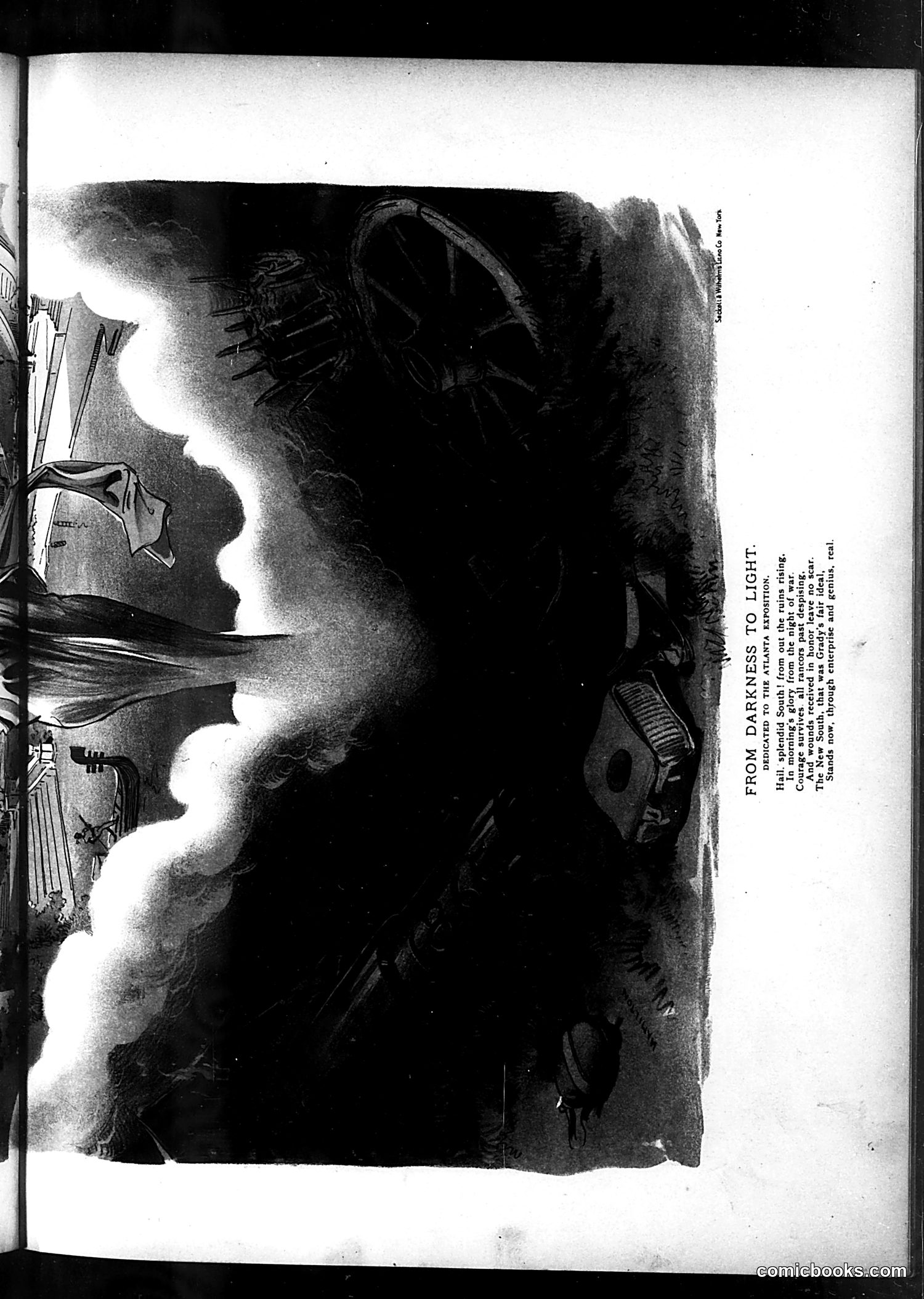
I cannot reliably read the OCR text on this page—it appears severely corrupted or inverted. The image itself, though grainy, shows what appears to be a dramatic nighttime scene with horses, a carriage or wagon, and figures in silhouette, titled "FROM DARKNESS TO LIGHT." Without legible text identifying the specific political figures or events referenced, I cannot accurately explain the satire's meaning. The title suggests a narrative about emerging from darkness into enlightenment or progress, likely commenting on a contemporary political situation, but I cannot identify which figures or events are being caricatured or what the joke intended. The page appears to be from an early Judge magazine, but the corrupted text prevents proper historical interpretation.
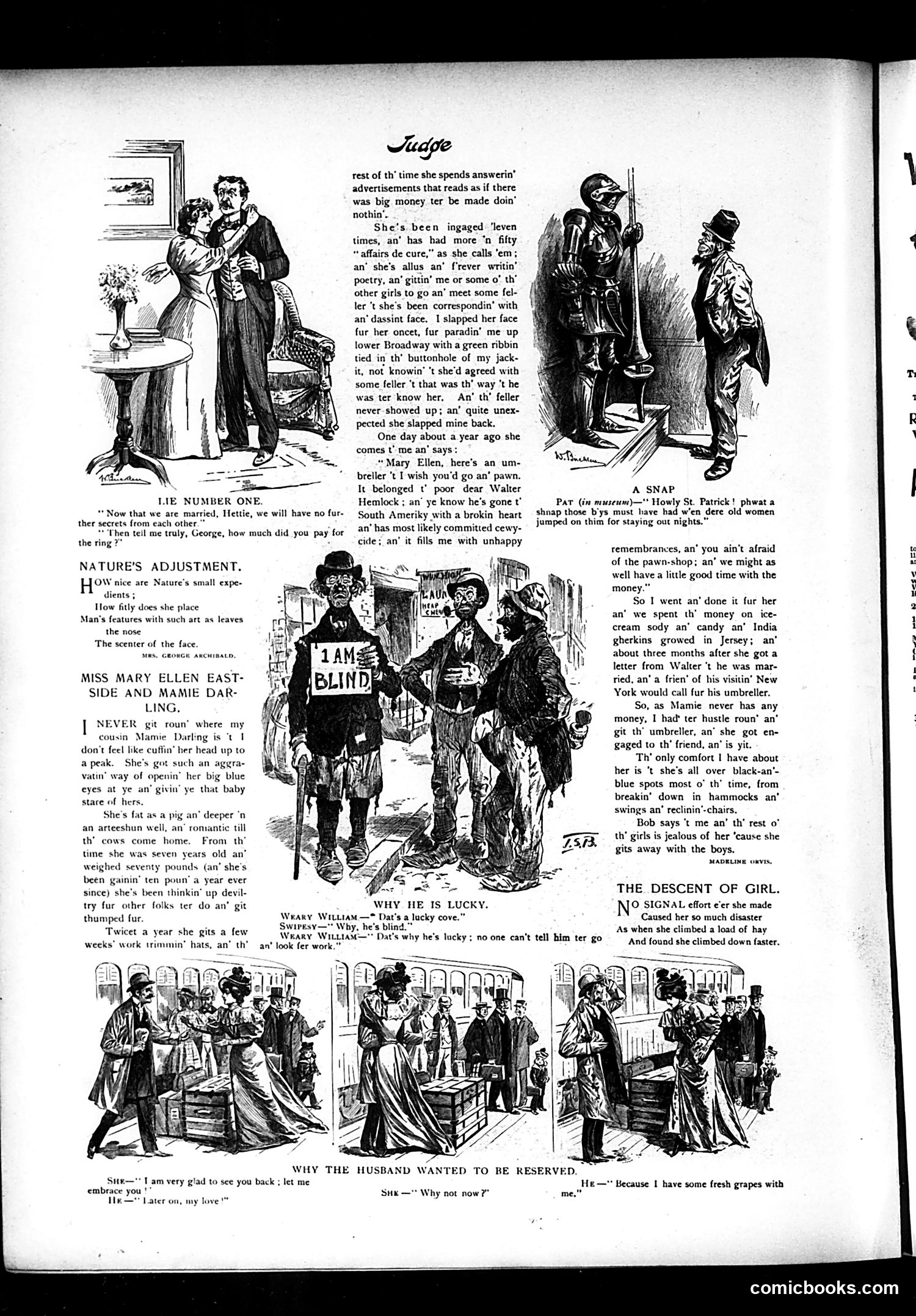
This page contains several humorous sketches satirizing courtship, class, and gender relations in late 19th-century America. **"Judge" (top)**: A newlywed husband demands marital honesty, then balks when asked the ring's cost—mocking male hypocrisy about financial transparency. **"Nature's Adjustment" and related stories**: Dialect-heavy narratives about working-class women, particularly "Mamie Darling," a romantic, impulsive poor woman who engages in frivolous schemes (pawning a man's umbrella for ice cream money) and gets repeatedly injured. The humor stereotypes working-class girls as foolish and accident-prone. **"Why He Is Lucky"**: A blind beggar is "lucky" because nobody tells him to find work—dark humor about unemployment and disability. **"Why the Husband Wanted to Be Reserved"**: Three vignettes showing a husband avoiding his wife's company at a market, with the punchline that he has fresh grapes (implying infidelity or escape). The overall tone reflects period prejudices: working-class women are portrayed as dimwitted, accident-prone, and morally flexible, while the satire punches down rather than at power structures.
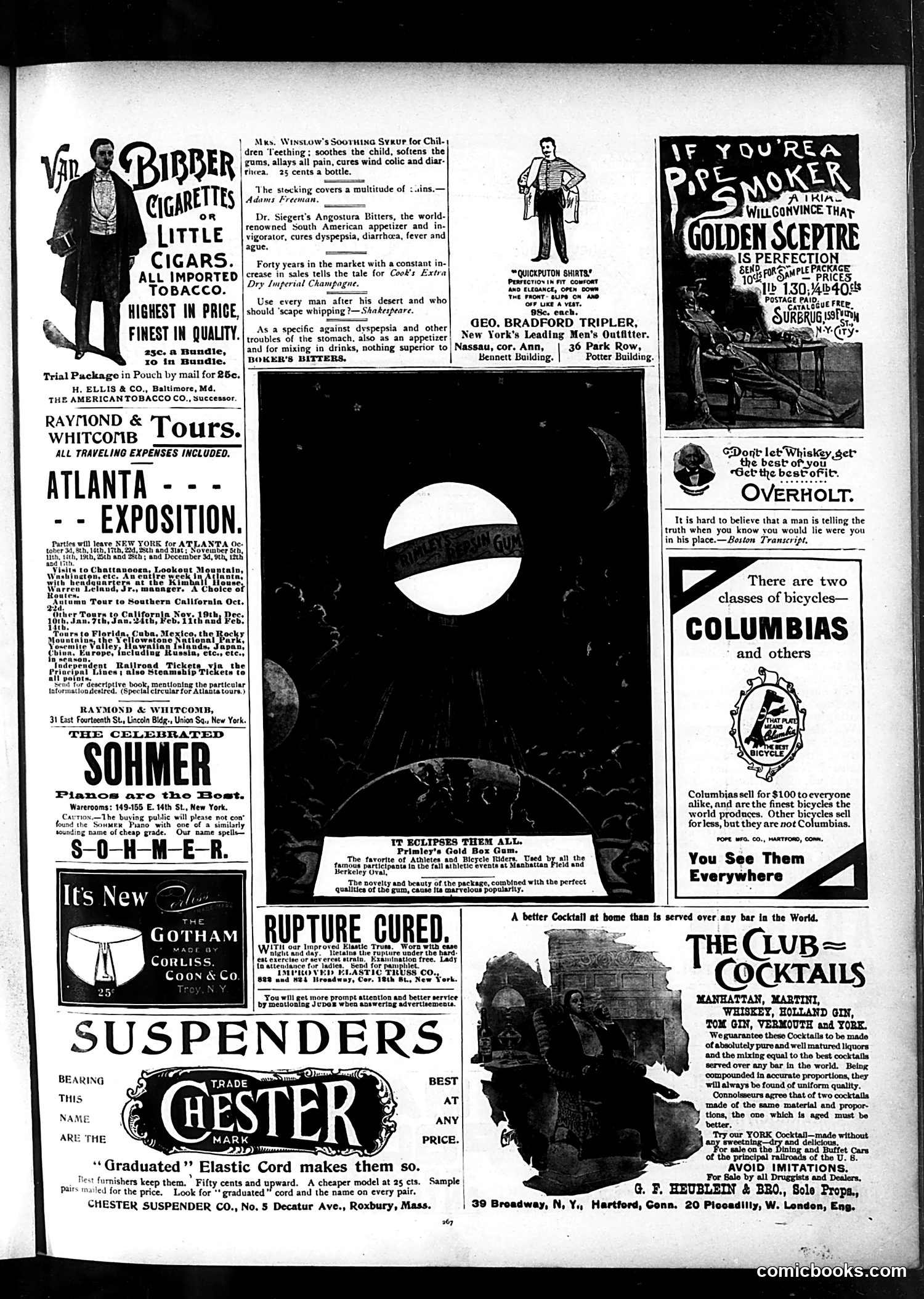
This is primarily an **advertising page** with minimal editorial content. The notable visual element is a large **solar eclipse illustration** in the center, labeled "TO ECLIPSE THEM ALL," which serves as a header for an advertisement promoting a product (likely related to the eclipse phenomenon's contemporary popularity). The page reflects late-19th-century consumer culture, featuring ads for: - Tobacco products (Vail & Bibber cigarettes) - Patent medicines (Mrs. Winslow's Soothing Syrup, bitters) - Travel tours to the Atlanta Exposition - Pianos, bicycles (Columbias brand) - Suspenders and men's clothing - Cocktail mixers The eclipse reference suggests this page dates to a period of significant astronomical interest in America. The "Quickbutton Shirts" advertisement and repeated emphasis on ready-made men's clothing reflect growing mass manufacturing. There is **no clear political satire** on this page—it's essentially a commercial publication serving as both magazine and advertisement platform, typical of 19th-century periodicals.
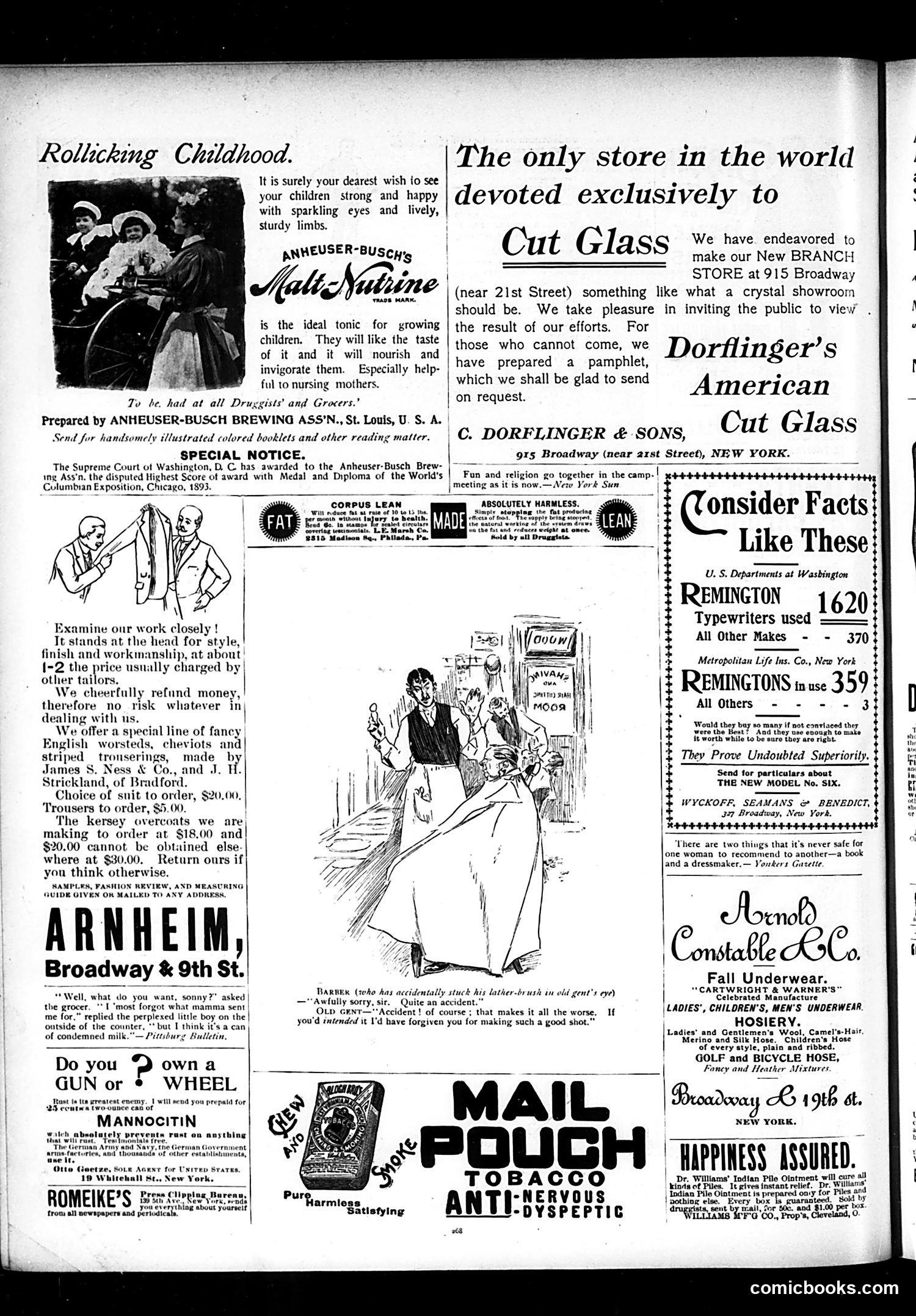
This page is primarily **advertising** with a small satirical cartoon. Here's the notable content: **Main Cartoon**: A barber has accidentally stabbed his elderly customer's eye with a lather brush. The old man quips that it's worse that it was accidental—if intentional, he'd forgive it as "a good shot," because it would show skill rather than clumsiness. This is a dark-humor joke playing on masculine pride and the barber's incompetence. **Advertisements** dominate the page, including: - Anheuser-Busch's "Malt Nutrine" tonic marketed for growing children (a product endorsement no modern advertiser would attempt) - Dorflinger's cut glass store - Clothing from Arnheim - Remington typewriters (with statistics claiming superiority) - Tobacco and various patent medicines The advertising reflects early 1900s consumer culture, with products and marketing claims that would be shocking or illegal today (promoting beer as child nutrition, etc.).
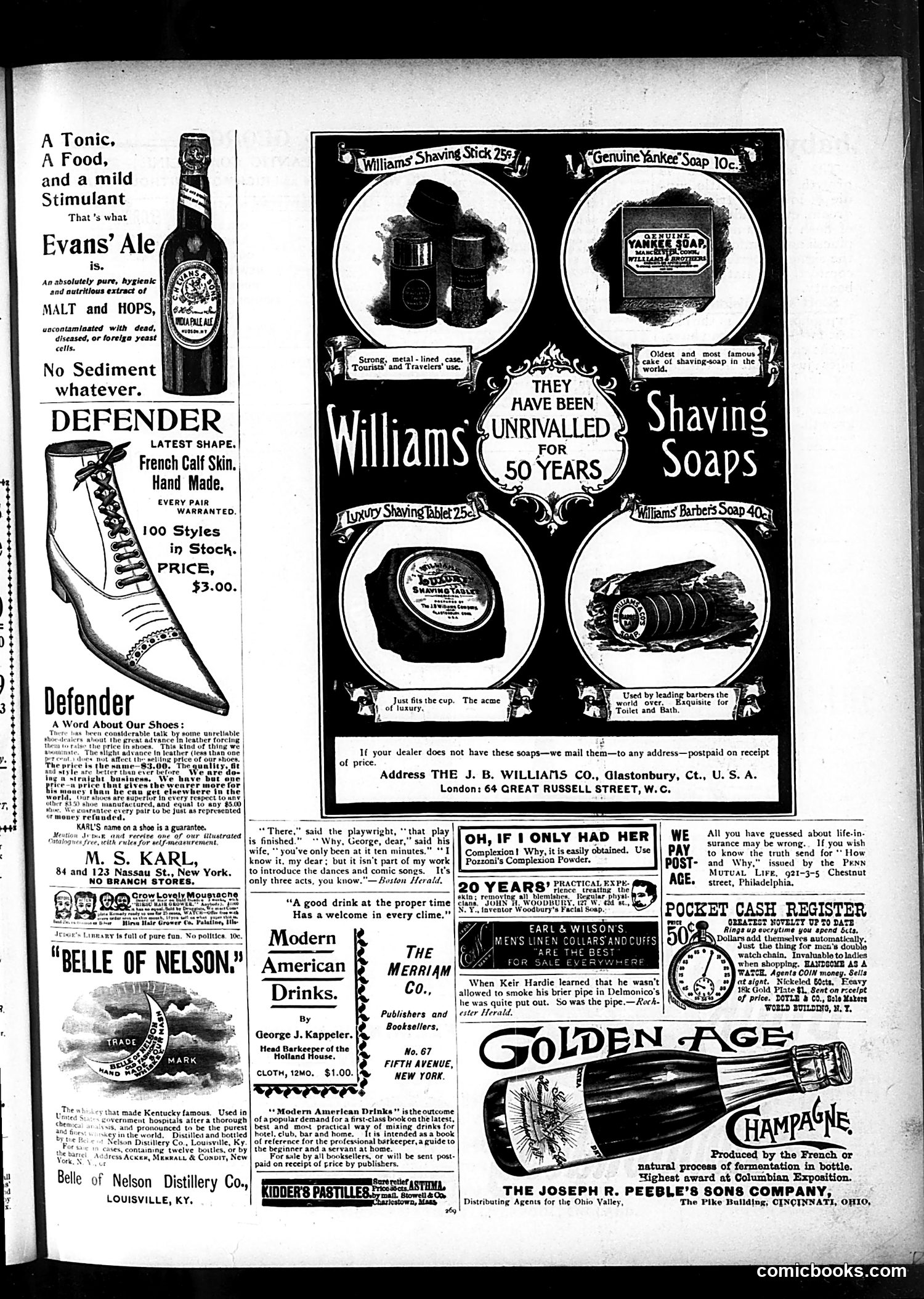
This is primarily an **advertising page** from Judge magazine, not a political cartoon page. The layout contains numerous product advertisements typical of late 19th/early 20th-century publications. ## Notable Content: **Main Advertisement**: Williams Shaving Soaps dominates the center, claiming to be "unrivalled for 50 years" with product images and testimonials. **Other Ads Include**: Evans' Ale (tonic/food), Defender shoes, Modern American Drinks (bartender's guide), Belle of Nelson whiskey, and various other products (soap, cuffs, cash registers). **Embedded Humor**: Small text snippets include period jokes, such as one referencing **Keir Hardie** (a British Labour politician) being upset about pipe-smoking restrictions at Delmonico's restaurant. ## For Modern Readers: This page reflects advertising practices emphasizing purity, health claims, and celebrity/authority endorsements—common marketing tactics then. The Keir Hardie reference assumes readers recognize this contemporary political figure. Otherwise, this is essentially a classified ads section rather than satirical content.
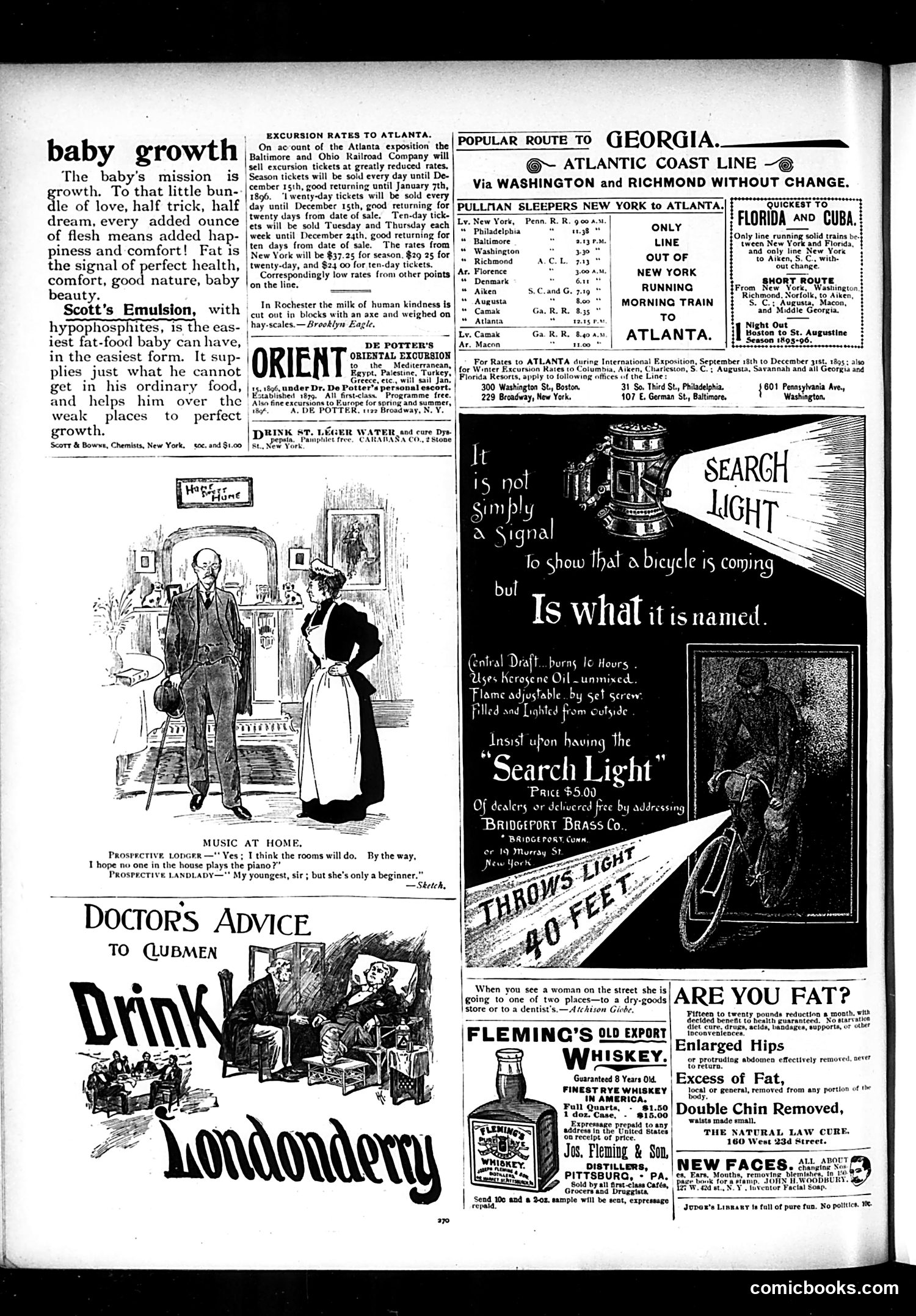
This page is primarily **advertising** from Judge magazine (circa 1895-96), with one notable satirical cartoon. The main cartoon—"Music at Home"—satirizes a common Victorian social problem: landlords and tenants negotiating housing. A prospective lodger hopefully asks if anyone plays piano (implying he wants to avoid noise). The landlady reassures him her youngest daughter plays—"but she's only a beginner," a joke suggesting beginners are the worst, making his concern moot. The satire mocks both the awkward social negotiations of renting and the ubiquitous, often mediocre piano-playing that characterized middle-class Victorian homes. The rest of the page contains advertisements for baby formula (Scott's Emulsion), railroad excursion rates to Atlanta, bicycle searchlights, weight-loss treatments, and whiskey. The "Doctor's Advice to Clubmen: Drink Londonderry" advertises Irish whiskey as medicinal—reflecting the era's casual promotion of alcohol as health tonic.
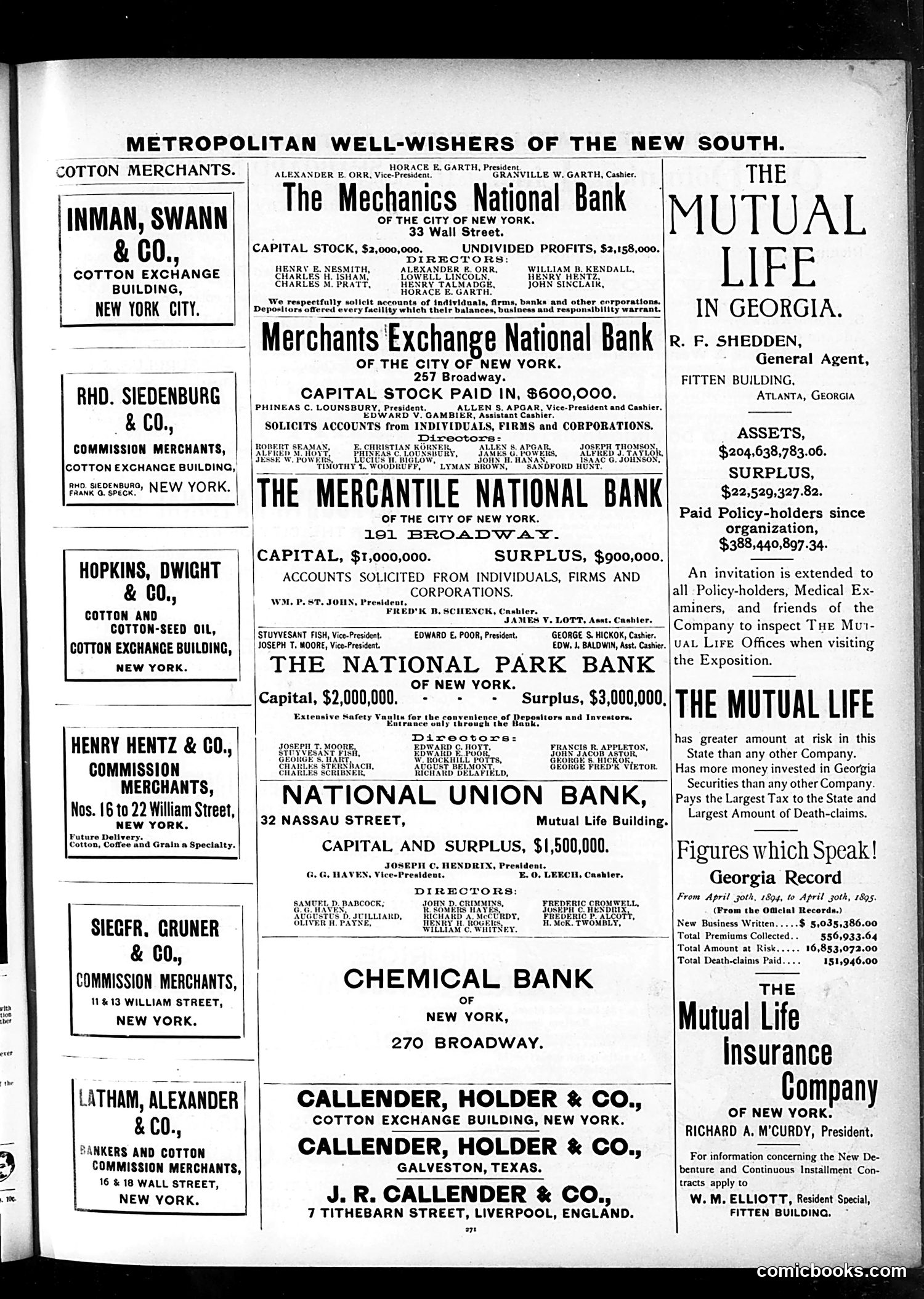
This appears to be a business directory/advertisement page rather than a satirical cartoon page. It features listings for numerous New York cotton merchants, banks, and financial institutions from what appears to be the late 1800s, along with prominent advertising for Mutual Life Insurance Company of New York. The only potentially notable content is the "Figures which Speak!" section highlighting Georgia's insurance records, emphasizing Mutual Life's financial dominance in that state. However, this reads as straightforward business promotion rather than satire. There are no visible political cartoons, caricatures, or satirical commentary on this page. It is primarily a commercial directory showcasing financial institutions and insurance services of the era.
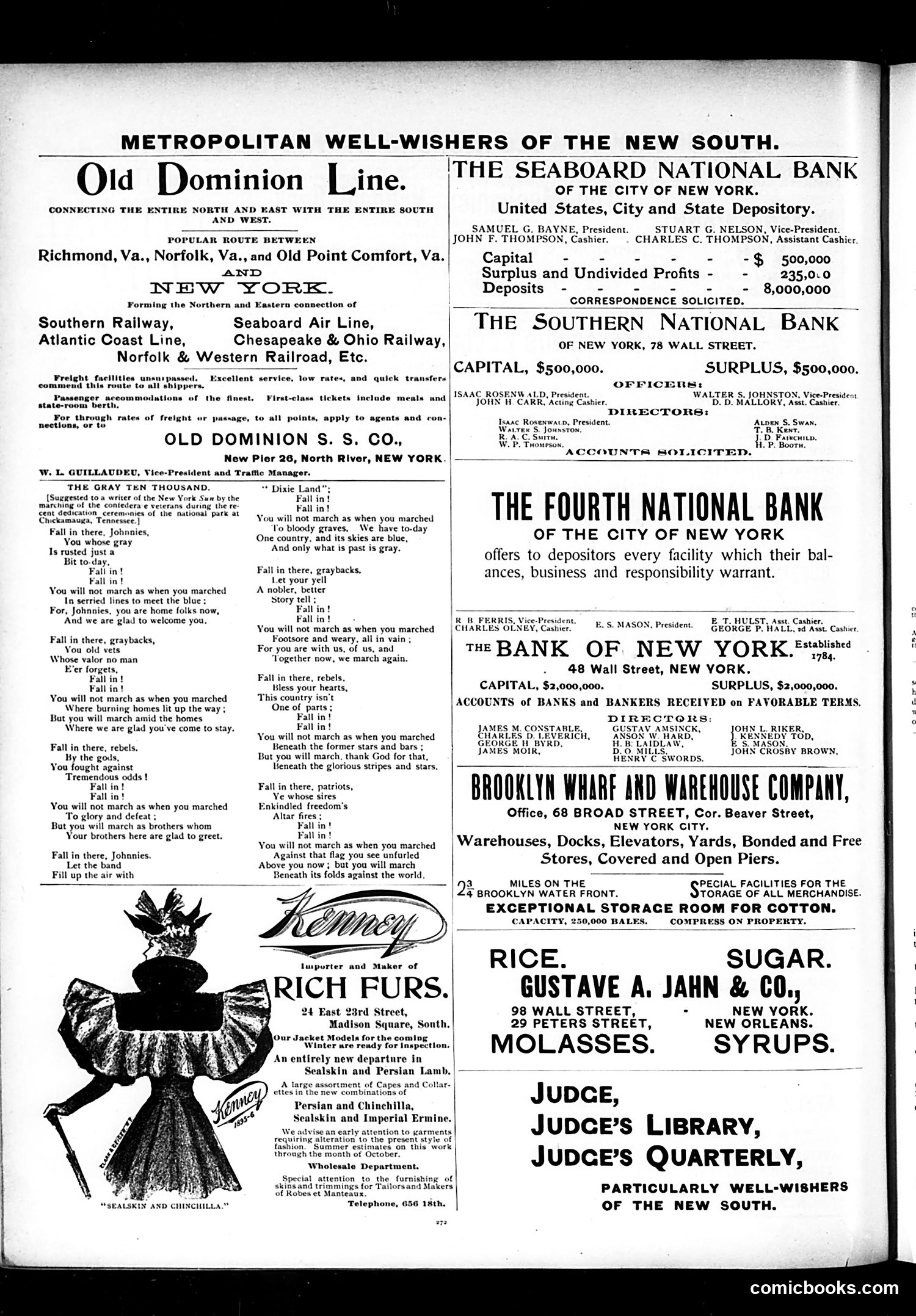
This is primarily an advertising page rather than a satirical cartoon page. However, it does contain one substantial poem titled "The Gray Ten Thousand." The poem responds to Confederate veterans marching during dedication ceremonies at Chickamauga, Tennessee. It's a Reconstruction-era reconciliation piece that repeatedly urges former Confederate soldiers ("Johnnies," "graybacks," "rebels") to rejoin the American nation. The repeated refrain "Fall in" repurposes military language to invite reunion. Key points: the soldiers fought "tremendous odds," will no longer march "to glory and defeat" or toward "burning homes," and importantly—the final stanzas shift their allegiance from "former stars and bars" (Confederate flag) to the American "glorious stripes and stars." This reflects late-19th-century sentiment promoting sectional healing after the Civil War, treating former enemies as "brothers." The reconciliation message is reinforced by the page's numerous bank advertisements emphasizing Northern-Southern business connections, particularly the "Old Dominion Line" shipping route linking Virginia to New York.
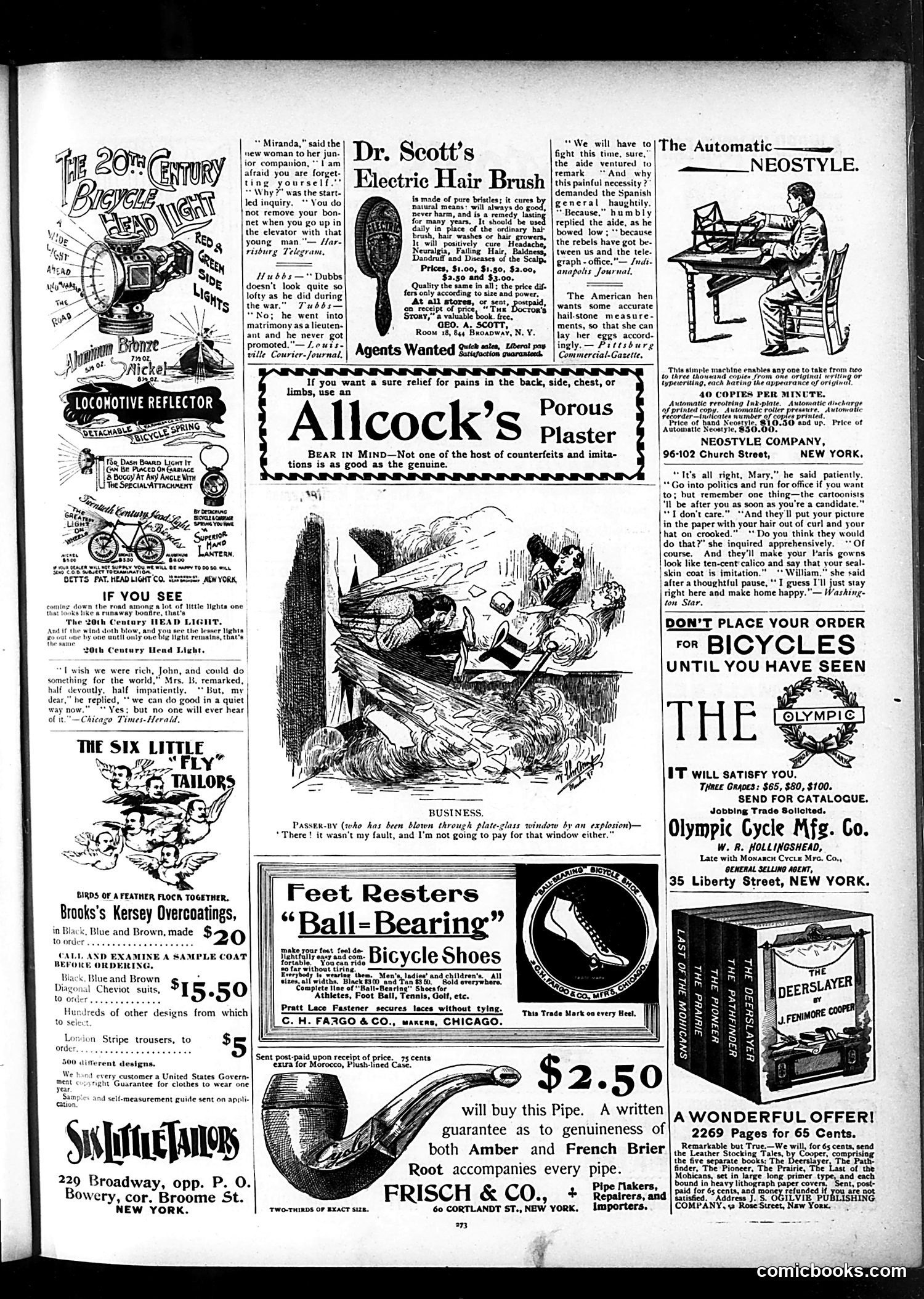
This page is primarily **advertisements and comic vignettes** rather than a unified political cartoon. Key content: **The main cartoon** (center): Shows a man who's been blown through a plate-glass window by an explosion, complaining he won't pay for the damage—obvious absurdist humor about shirking responsibility. **The comic snippets** (text-based jokes) satirize social pretension and wartime attitudes: - A "new woman" corrects her junior for removing her bonnet in an elevator with a man (mocking Victorian propriety) - "Dubbs" lost his wartime rank pretensions through marriage (satirizing social climbers) - A hen needing "accurate hail-stone measurements" for egg-laying (nonsensical humor) **The advertisements** dominate, hawking period products: electric hair brushes, overcoatings, bicycle shoes, and copying machines—typical of Judge magazine's revenue model. **Context**: This reflects early 1900s concerns with etiquette, gender roles, and commercialism, with gentle satirical jabs at social conventions rather than sharp political commentary.
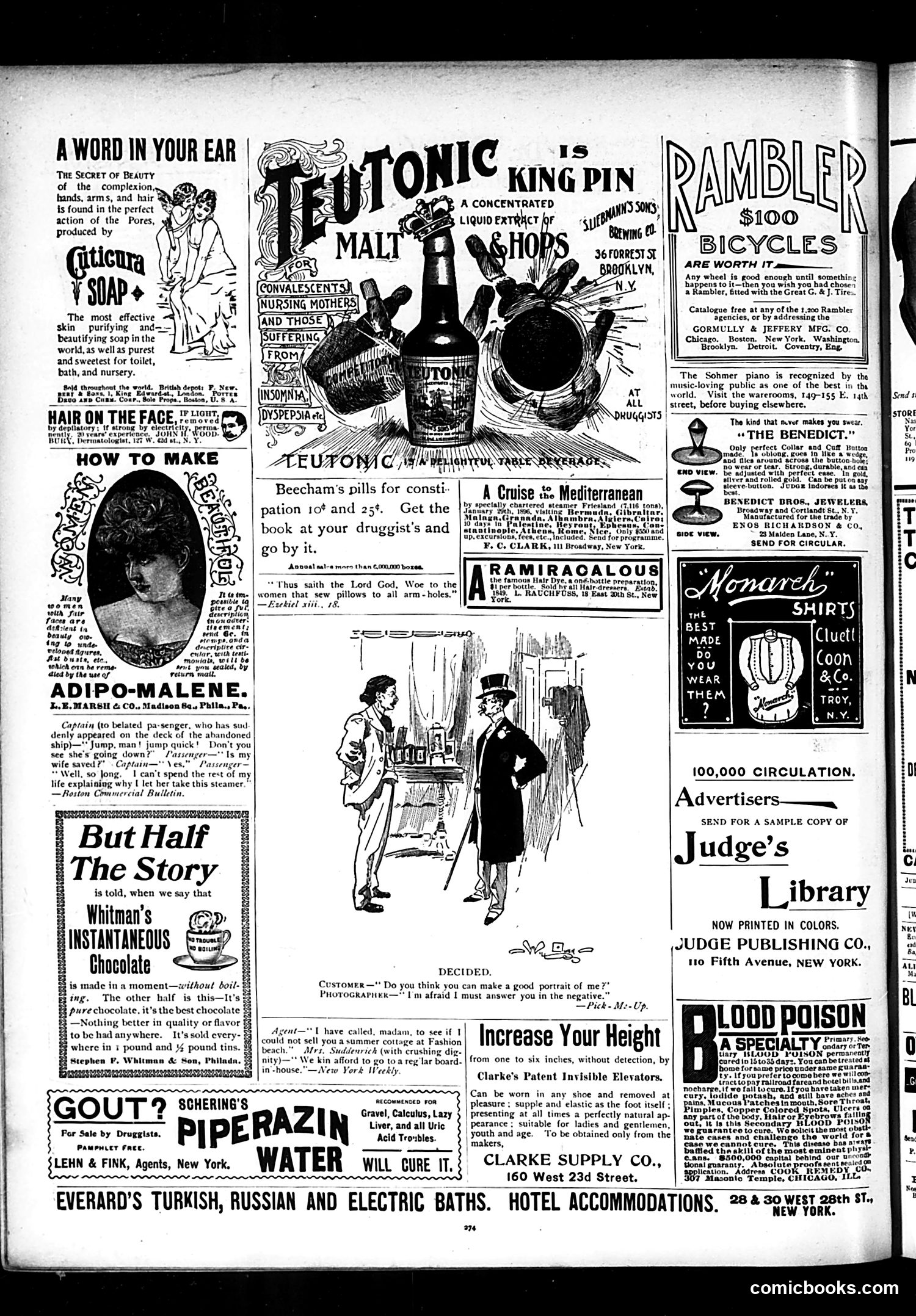
This is primarily a **page of advertisements and filler content** rather than political satire. However, it contains one notable cartoon: ## The Main Cartoon ("DECIDED") A photographer refuses to make a portrait of a society woman, saying "I'm afraid I must answer you in the negative." The satire plays on a **double meaning**: photographic negatives (technical term) versus the photographer's actual refusal. The unstated joke likely concerns the subject's appearance—implying she's too plain or unflattering to photograph successfully. ## Context The page dates to the early 1900s (based on product advertisements). It reflects **Edwardian-era anxieties**: beauty products, "invisible height elevators" (shoe lifts), and a presumption that women especially needed cosmetic interventions. The crude body-shaming humor was standard for Judge, a satirical magazine aimed at middle-class readers. The remaining content is commercial advertising—soap, chocolate, pills, pianos, bicycles—typical of such publications, which relied heavily on ads for revenue.
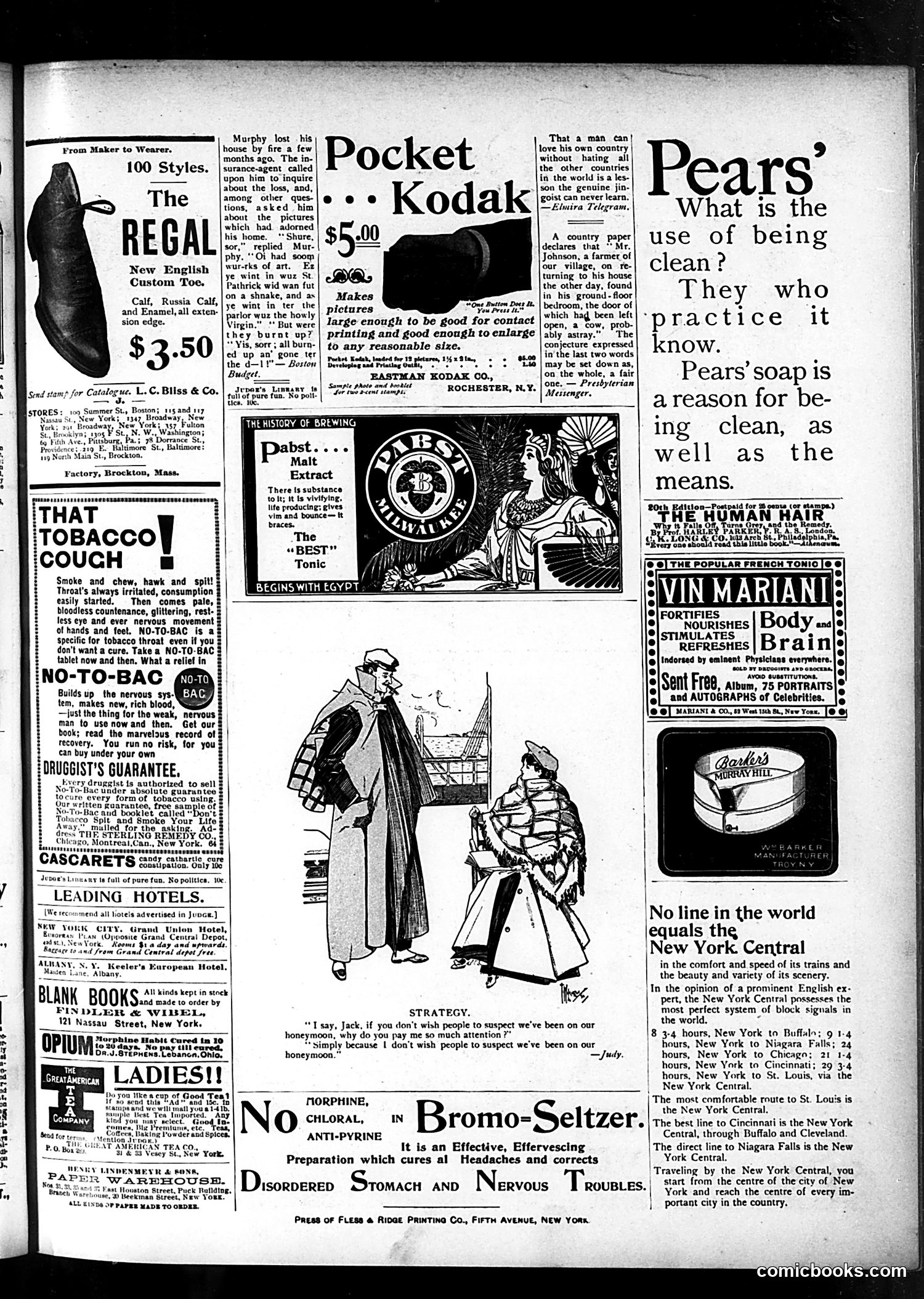
This page is primarily **advertising**, typical of early 20th-century magazines. The main cartoon depicts a domestic "strategy" scene where a newlywed couple discusses how to hide their honeymoon from others—the husband suggests excessive public attention to his wife is actually *less* suspicious than neglect. It's gentle marital humor about newlyweds' self-consciousness. The sidebar contains an Irish-immigrant dialect story ("Murphy lost his house by fire") using period stereotypes—the humor relies on phonetic Irish-English speech patterns ("Shure," "sor") and appeals to contemporary audiences familiar with such caricatures. The bulk of the page showcases period advertisements: Kodak cameras, Pears' soap, NO-TO-BAC (a tobacco-cessation product), Bromo-Seltzer, and the New York Central Railroad. These ads reflect early-1900s consumer concerns: photography, hygiene, tobacco addiction, digestive remedies, and rail travel. The content requires no political interpretation—it's entertainment and commerce aimed at Judge's middle-class readership.
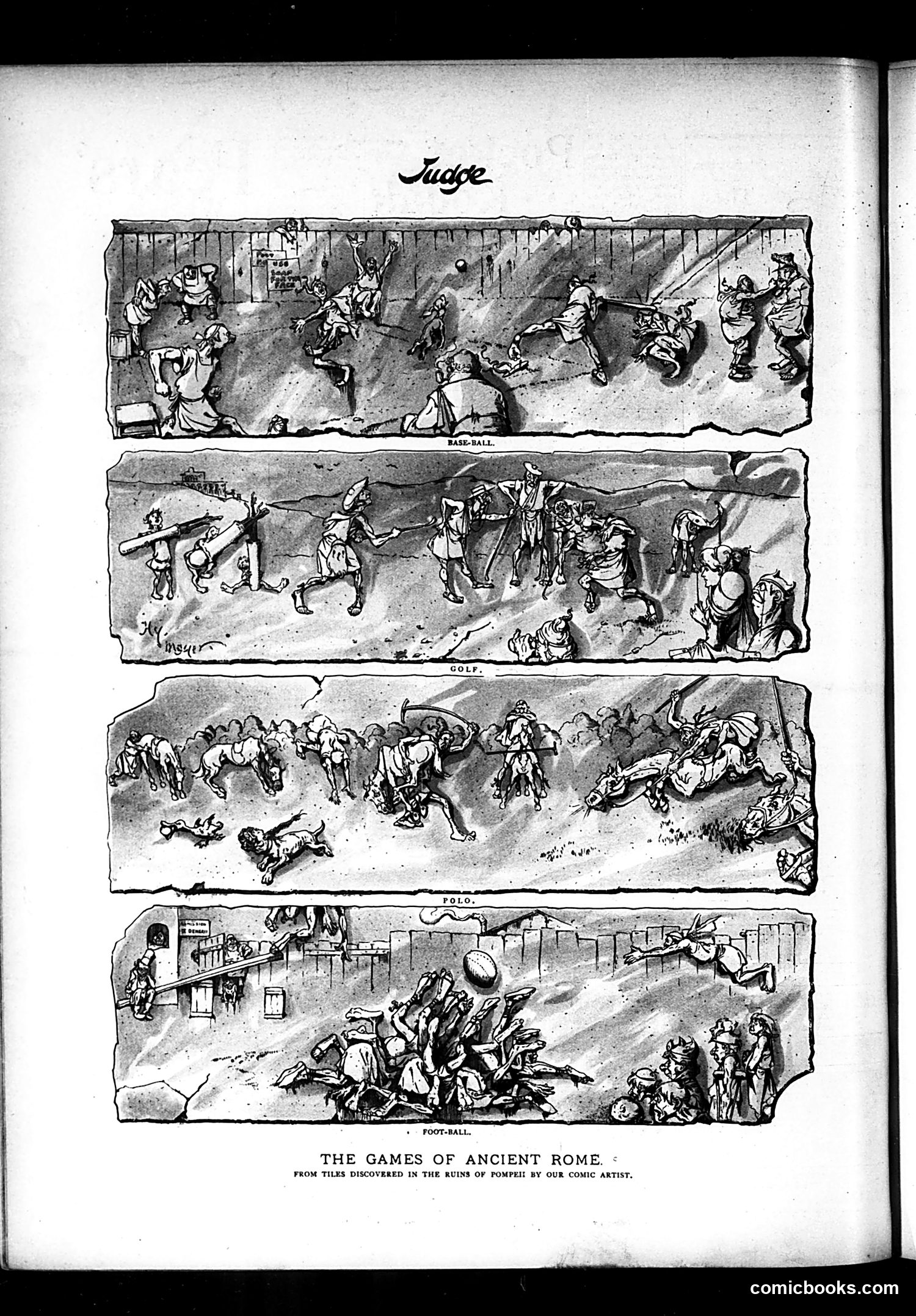
This Judge page presents four panels depicting ancient Roman games—baseball, golf, polo, and football—supposedly discovered as tile artwork in Pompeii's ruins. The satire is straightforward: the comic artist anachronistically depicts Romans engaging in modern American sports, treating them as historical fact. The humor relies on absurdist contradiction—claiming archaeological evidence for impossible scenarios. This satirizes both credulous acceptance of "ancient discoveries" and perhaps contemporary American attitudes about sport as universal or timeless. By presenting modern games in classical settings with serious caption language ("discovered in the ruins"), Judge mocks pseudo-scholarly claims and the human tendency to project present culture onto the past. The comic exaggeration suggests skepticism about sensationalized archaeological narratives popular in the era.