
A complete issue · 16 pages · 1895
Judge — June 15, 1895
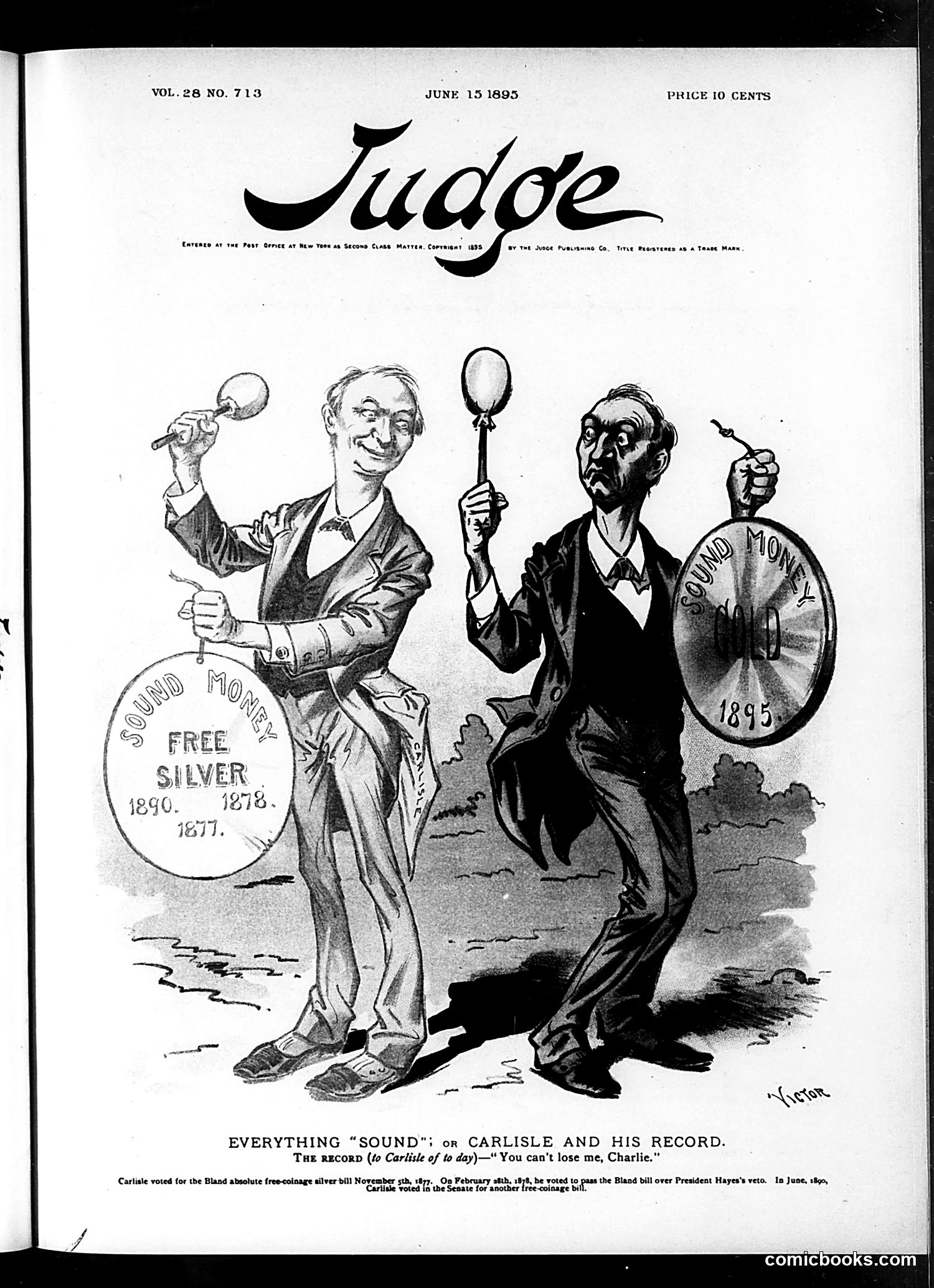
This June 1895 *Judge* cartoon satirizes **John G. Carlisle**, likely Treasury Secretary or a prominent politician. The left figure, cheerful and juggling, represents Carlisle promoting "sound money" and free silver policies (references to 1890, 1877, 1878 dates on the drum). The right figure, grimacing and holding a clock marked "1895," appears to represent political opposition or the consequences of these policies. The caption's phrase—"You can't lose me, Charlie"—suggests ironic commentary on Carlisle's political record and consistency (or inconsistency) regarding monetary policy. The contrasting expressions emphasize satirical critique of his positions on the divisive free-silver debate that dominated 1890s American politics.
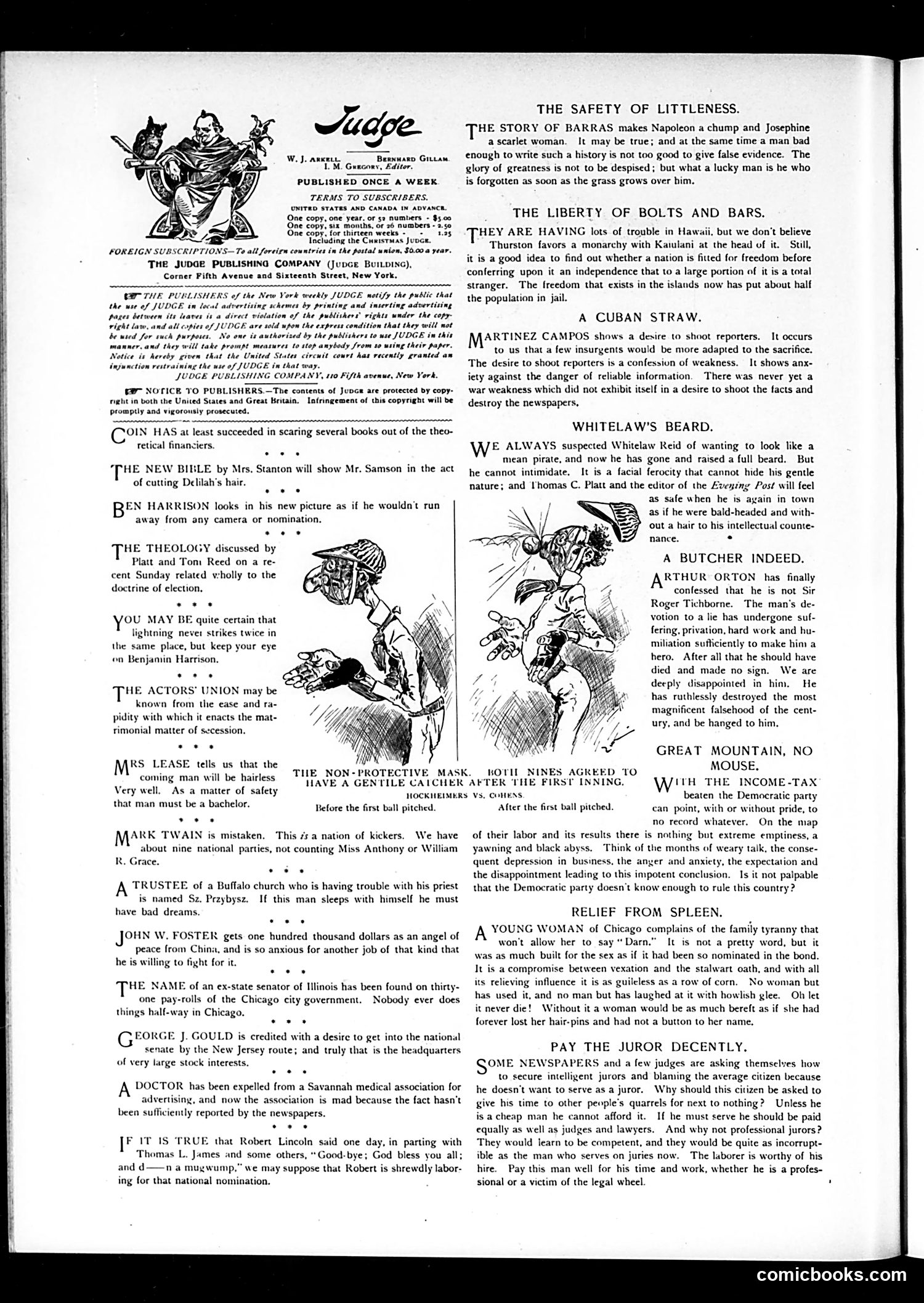
This page contains brief editorial commentary rather than political cartoons. The visible cartoon illustrates "The Non-Protective Mask," showing two figures in what appears to be a fencing or combat pose, suggesting commentary on protective measures that fail to protect. The text snippets mock various topics: political figures' vanity (Ben Harrison's appearance), religious hypocrisy, journalism ethics, and social pretense. One item ridicules "Mrs. Lease" for claiming safety while behaving recklessly—likely referring to Mary Elizabeth Lease, a Populist Party speaker known for fiery rhetoric. The final piece "Pay the Juror Decently" argues jurors deserve fair compensation, criticizing newspapers that expect jurors to sacrifice time without adequate pay. Overall, this represents Judge's typical satirical approach: brief, pointed jabs at public figures and social contradictions of the Gilded Age era.
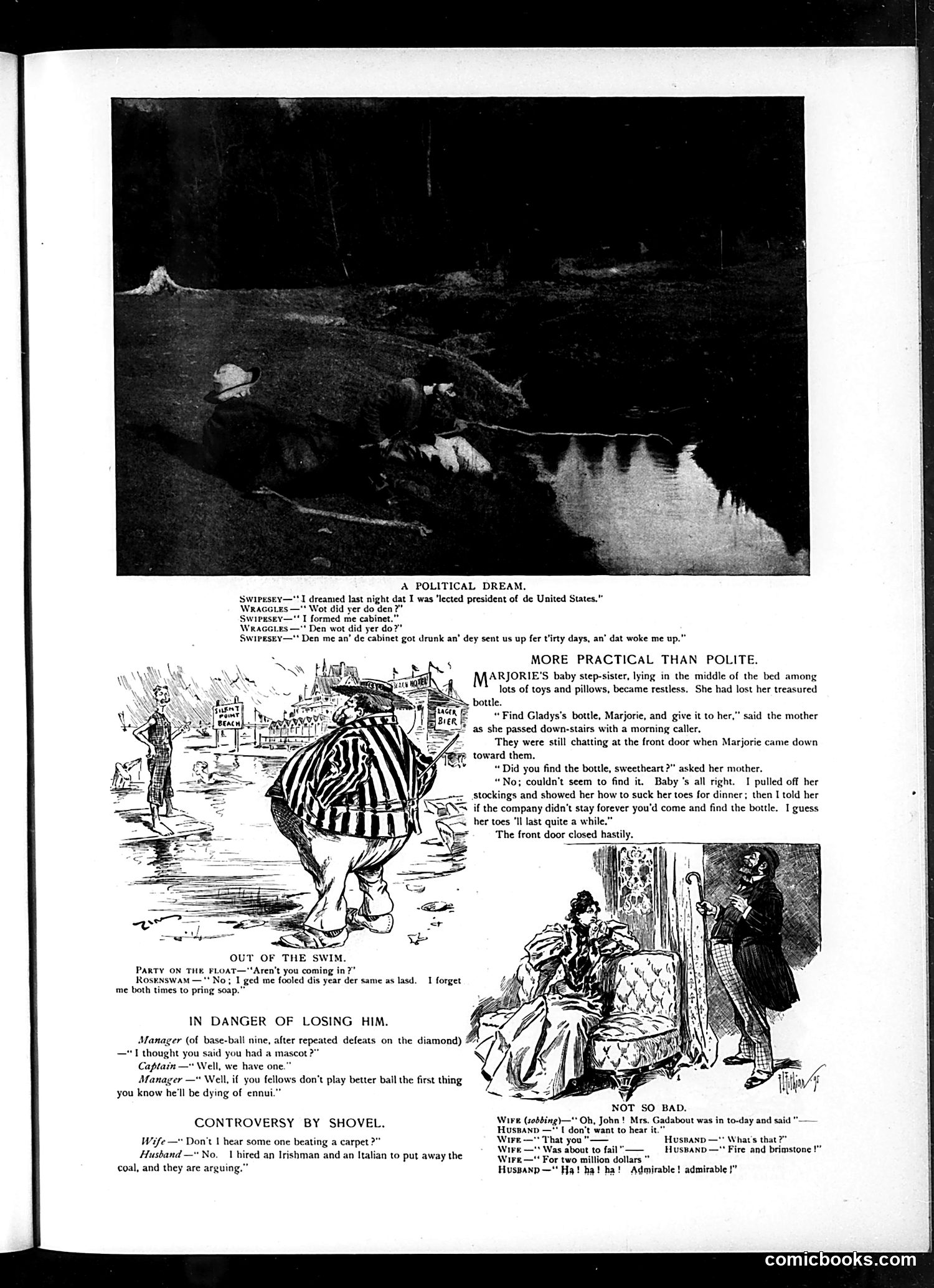
This page contains several unrelated short humor pieces rather than unified political cartoons. **"A Political Dream"** depicts someone dreaming of becoming U.S. president—likely satirizing political ambition or the drinking habits of politicians. **"More Practical Than Polite"** is domestic humor about a mother teaching her daughter practical skills (finding a lost bottle, sucking her toes for dinner) rather than etiquette—mocking working-class pragmatism versus upper-class politeness conventions. The remaining sections ("Out of the Swim," "In Danger of Losing Him," "Controversy by Shovel," "Not So Bad") are brief domestic and workplace jokes about relationships, baseball, hiring laborers, and marital arguments. These appear to be miscellaneous filler humor rather than pointed political satire. The page reflects Judge's mixed content approach combining social observation with everyday domestic comedy.
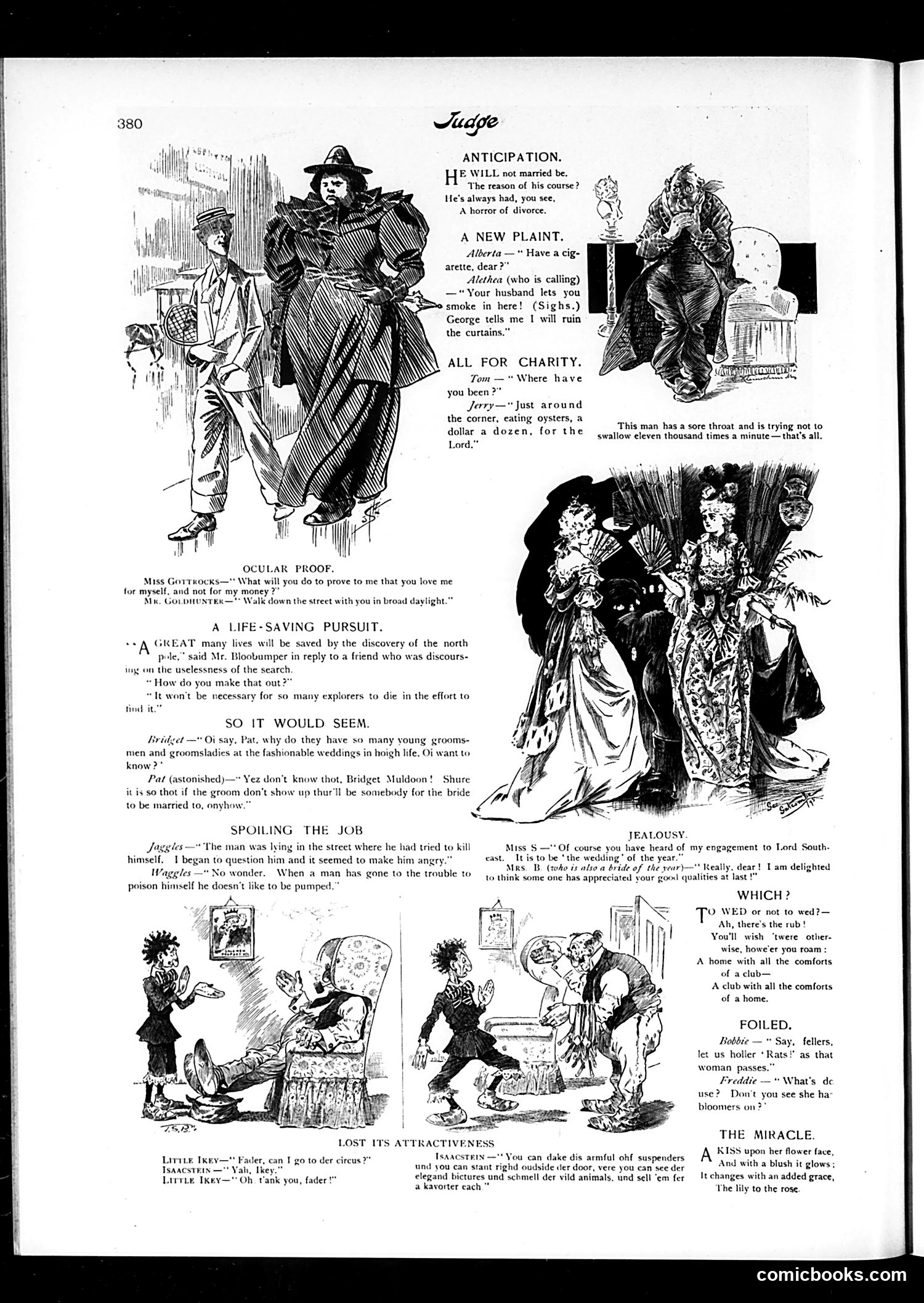
This page from Judge (American satirical magazine) contains multiple short humorous comics satirizing social conventions of the era: **"Anticipation"** mocks divorce anxiety among the wealthy—a man won't marry because he fears eventual divorce proceedings. **"A New Plant"** satirizes women's limited domestic freedoms; one wife cannot smoke because her husband forbids it, controlling even household décor. **"Ocular Proof"** jokes about marrying for money—a man proves his love by publicly appearing with his wealthy fiancée in daylight, risking social judgment. **"So It Would Seem"** features Irish servants (Bridget and Pat, stereotypical characters) discussing upper-class weddings, with Pat's joke suggesting grooms are disposable at fancy weddings. **"Jealousy"** depicts two brides competing over who has the more prestigious wedding. **"Which?"** poses the bachelor's dilemma: marry for a home or join a club? The joke presents them as mutually exclusive. The page satirizes class divisions, marriage anxieties, women's lack of autonomy, and nouveau-riche social climbing—common Judge targets.
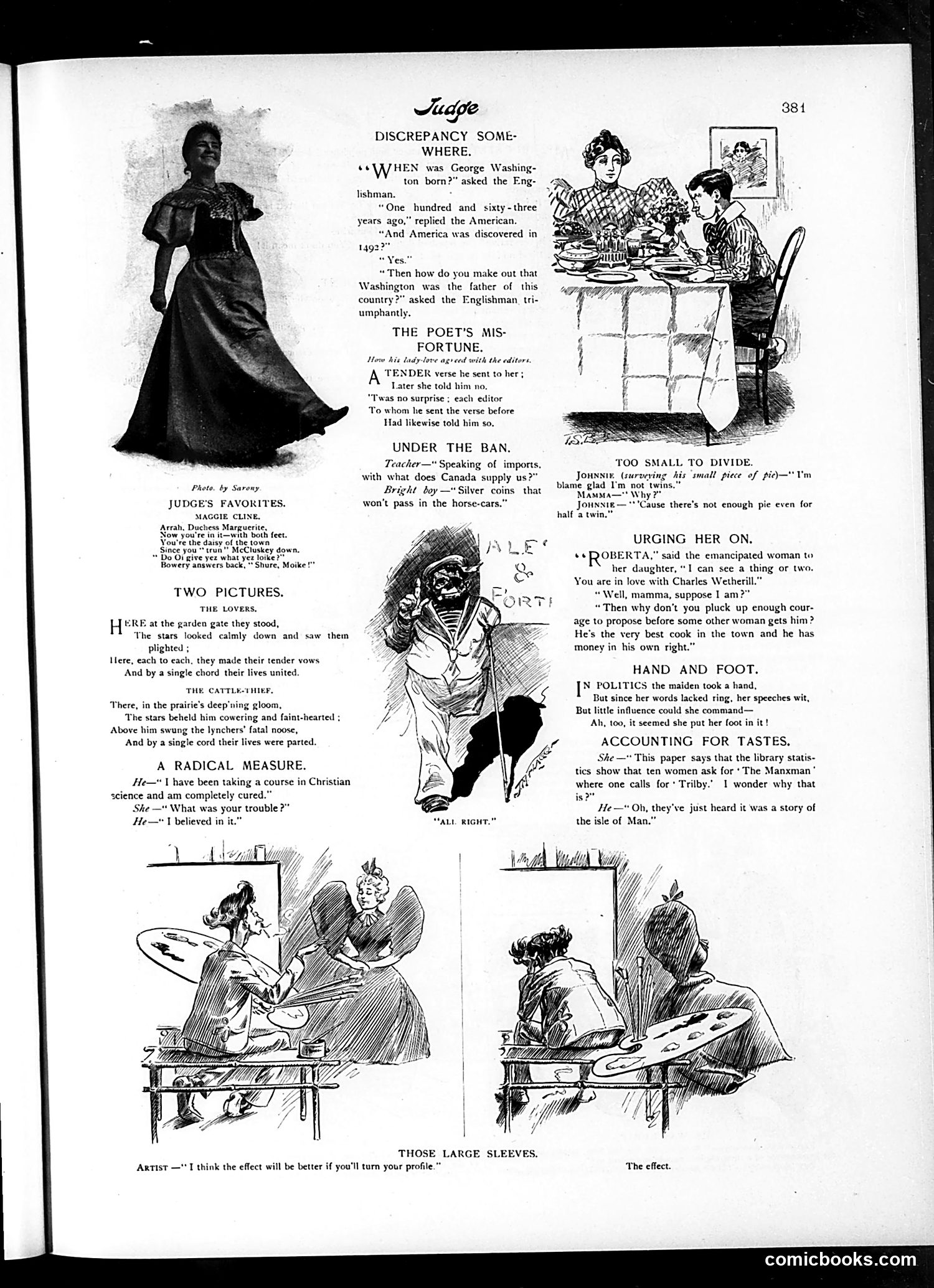
This page from *Judge* magazine contains multiple satirical pieces mocking various social issues of the era (likely 1890s): **"Discrepancy Somewhere"** jokes about American historical ignorance—an Englishman catches an American in a logical error: if America was discovered in 1492 and Washington was born 163 years ago, he couldn't be the "father" of the country. **"The Poet's Misfortune"** satirizes the publishing world: a poet's verse is rejected repeatedly—first by editors, then by the woman it was meant for. **"Under the Ban"** references Canadian silver coins that weren't accepted in American horse-cars (streetcars)—a joke about cross-border commerce friction. **"Urging Her On"** mocks the "New Woman" movement: a progressive mother pressures her daughter to propose to a man primarily because he's wealthy and cooks well, satirizing feminist rhetoric applied to traditional domestic goals. **"Hand and Foot"** critiques women's entry into politics, suggesting their political participation was ineffectual despite good intentions. The humor relies on period-specific references to commerce, gender roles, and nationalist attitudes unfamiliar today.
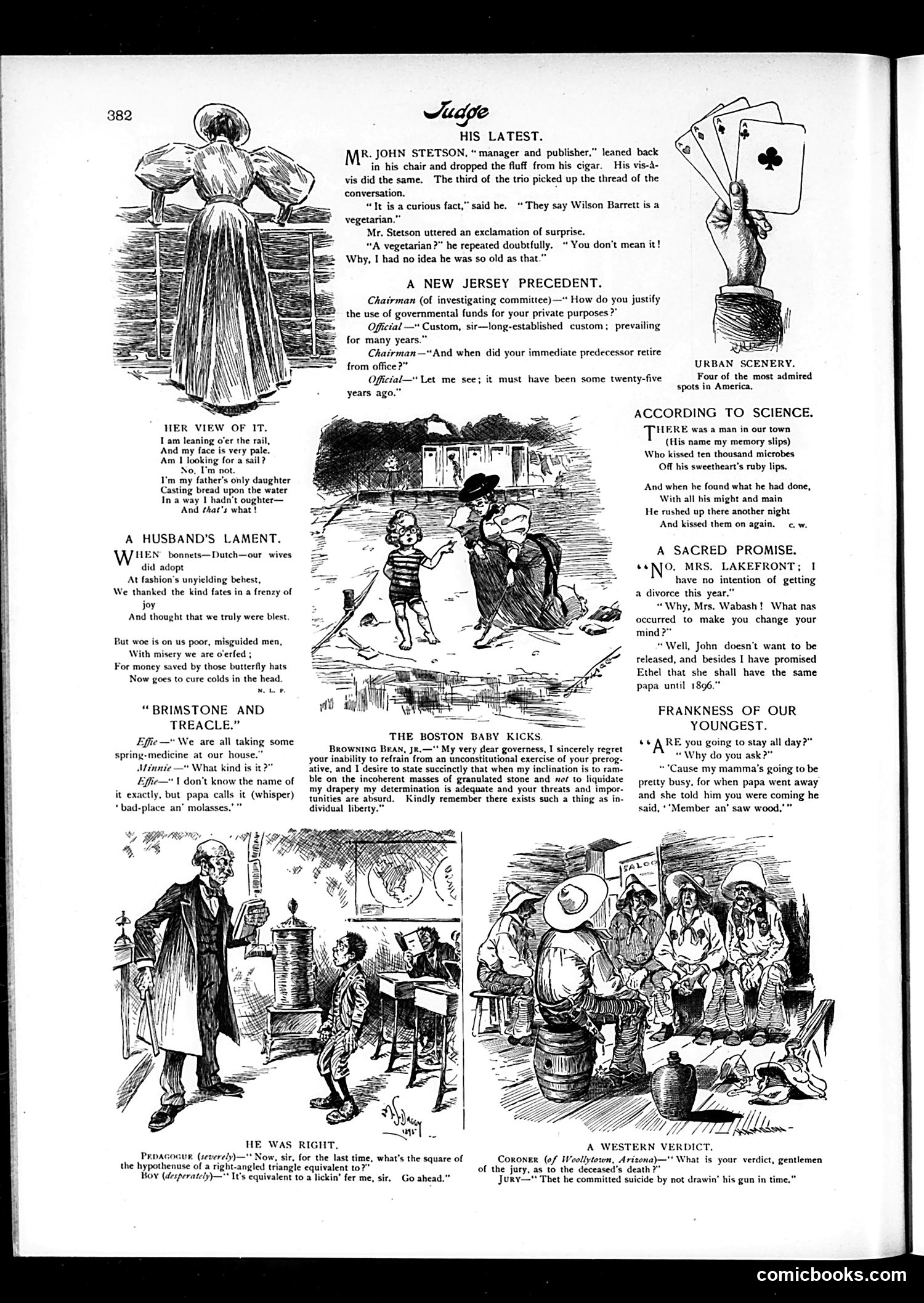
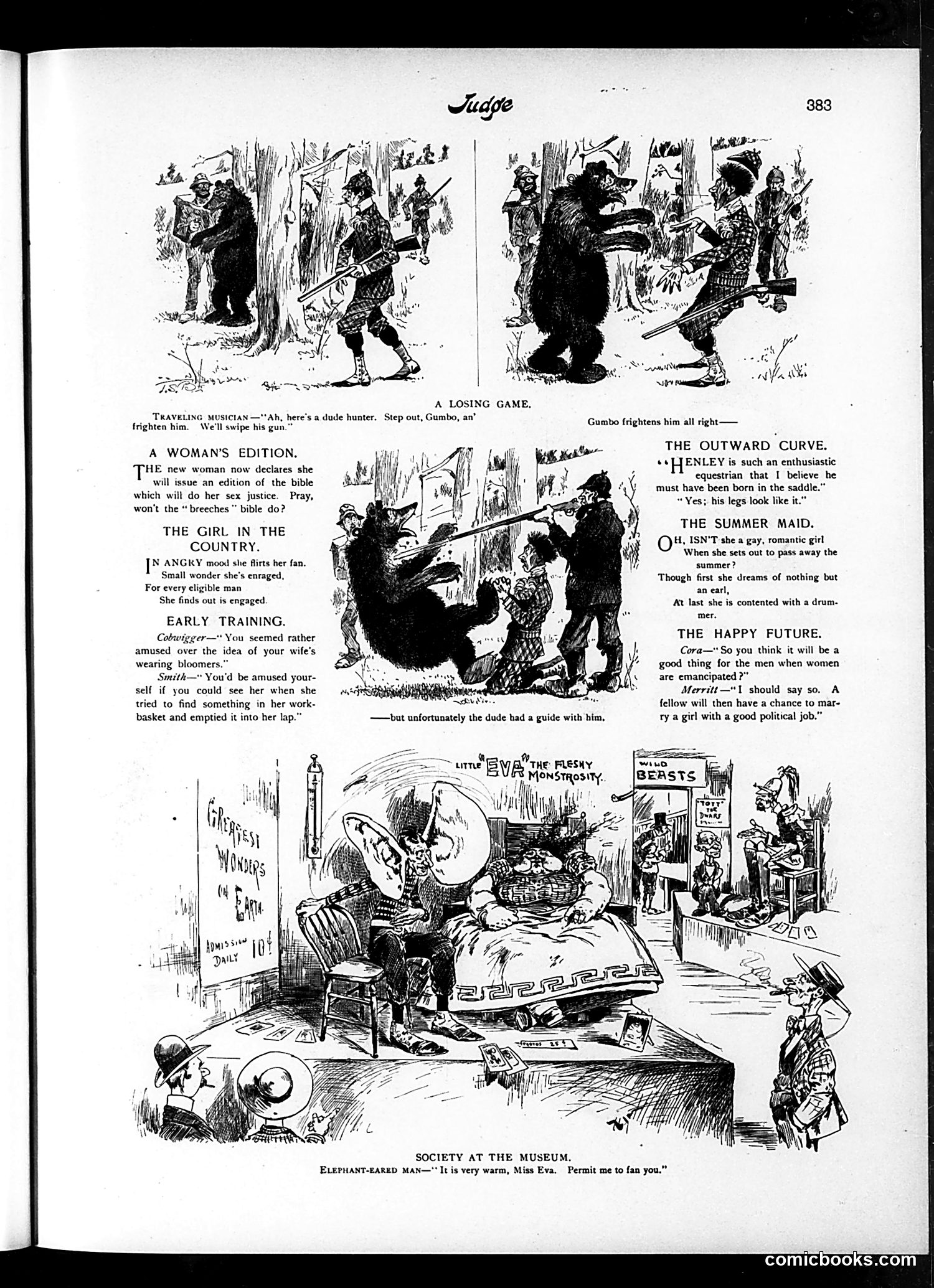
This page contains multiple satirical cartoons and brief humorous sketches mocking social trends of the era (appears to be late 19th/early 20th century): **"A Woman's Edition"** jokes about the "New Woman" movement, suggesting educated women want to edit the Bible to remove language unfavorable to them—specifically the "breeches Bible" (a historical edition). **"The Girl in the Country"** mocks romantic disappointment: a woman in rural areas finds all eligible bachelors already engaged. **"Early Training"** jokes about women's fashion (bloomers) and their disorganized domestic habits. **"Society at the Museum"** depicts a sideshow exhibit of an elephant-eared man, satirizing both sensationalist entertainment and flirtation. **"The Happy Future"** anticipates women's suffrage/emancipation, cynically suggesting men will only benefit by marrying women with political jobs—mocking both feminism and mercenary marriages. The overall tone is anti-"New Woman"—conservative satire of women's increasing independence and ambitions.
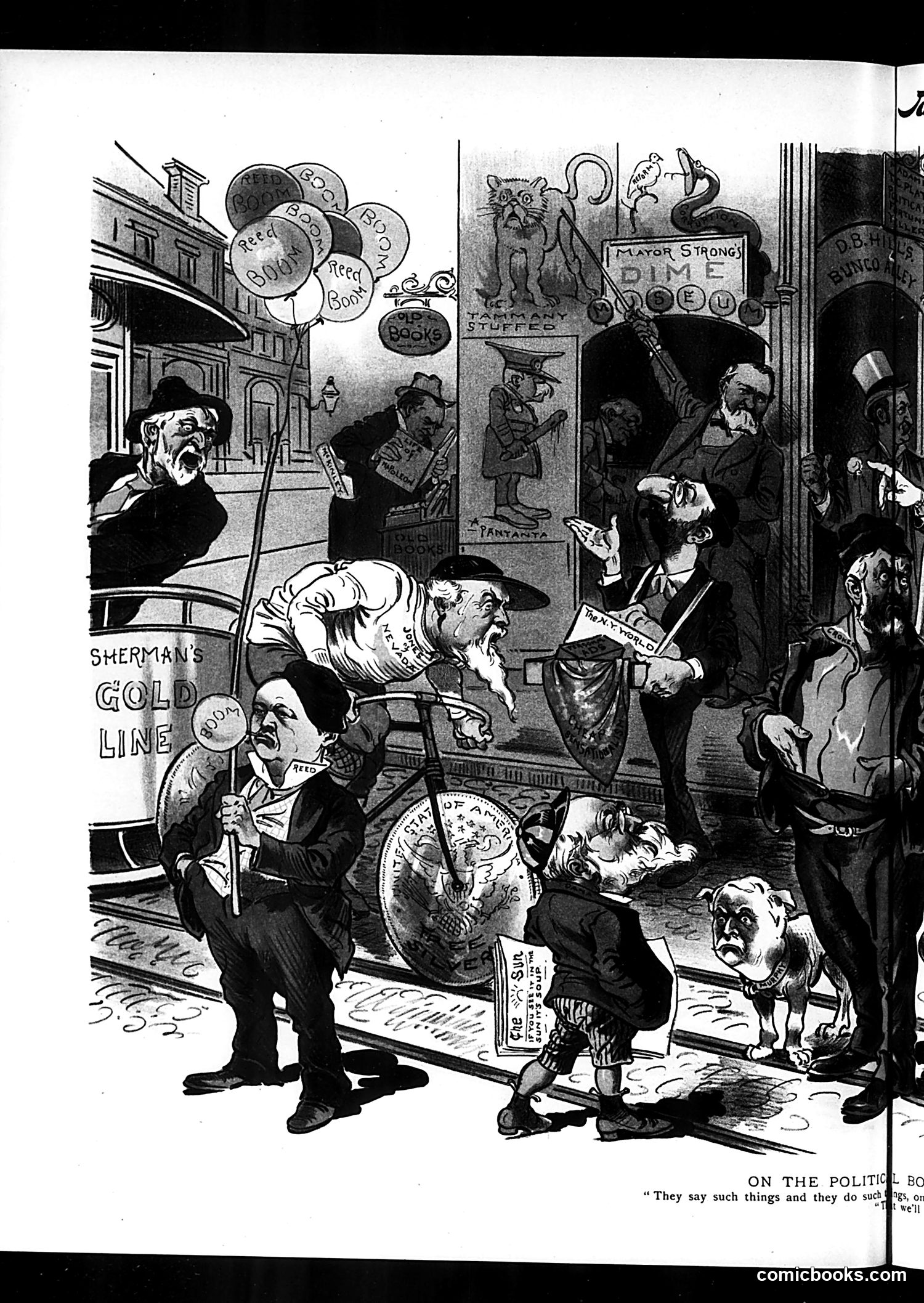
This is a satirical cartoon titled "On the Political [Board]" depicting a chaotic street scene with caricatured political figures. The visible labels reference "Sherman's Gold Line" and "Mayor Strong," suggesting this critiques New York City politics, likely from the 1890s when William O'Brien Strong served as mayor. The cartoon shows various well-dressed men (politicians) in a tumultuous scene with exaggerated facial features typical of period political satire. Dogs and scattered objects suggest disorder and corruption. The phrase "They say such things and they do such a..." (text cuts off) implies hypocrisy—politicians making promises they don't keep. The "Gold Line" reference likely critiques financial scheming or corruption. Without the complete caption, the specific political scandal or policy being mocked remains unclear, though the overall message condemns political dishonesty and chaos.
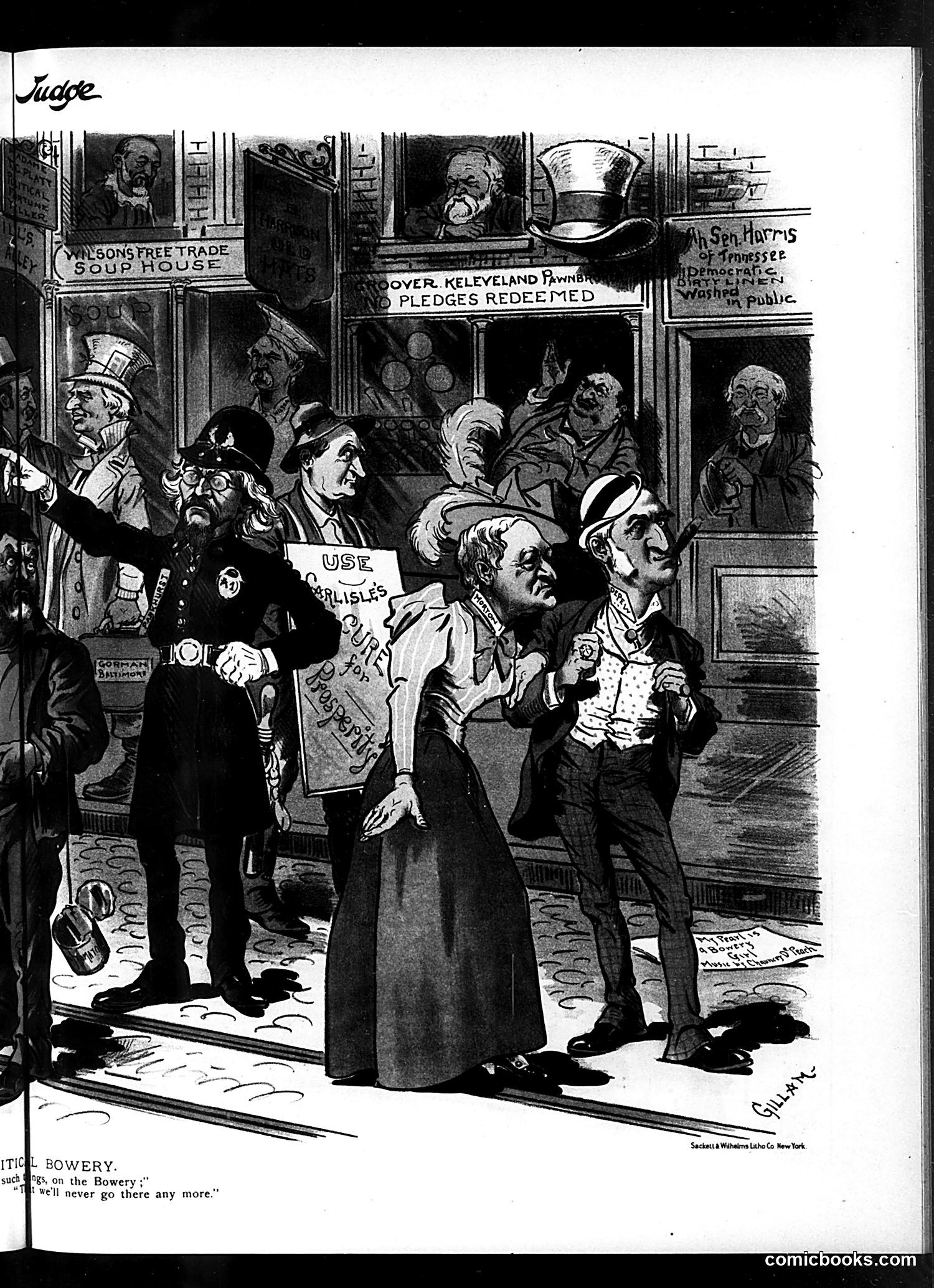
This Judge cartoon satirizes conditions on New York's Bowery, a neighborhood known for poverty and vice. The scene shows street-level chaos with various figures—including what appears to be immigrants, destitute people, and shopkeepers. Visible signage references "free trade soup house" and "Over Kleveland pamphlet pledges redeemed," suggesting political commentary about Cleveland administration policies and their effects on poor communities. A figure at top right labeled "Senator Harris of Tennessee" observes the squalor. The caption—"'Oh, on the Bowery... we'll never go there any more'"—implies darkly ironic resignation about urban poverty. The cartoon critiques both the failure of political promises to help the poor and the grim reality of Bowery life during this period.
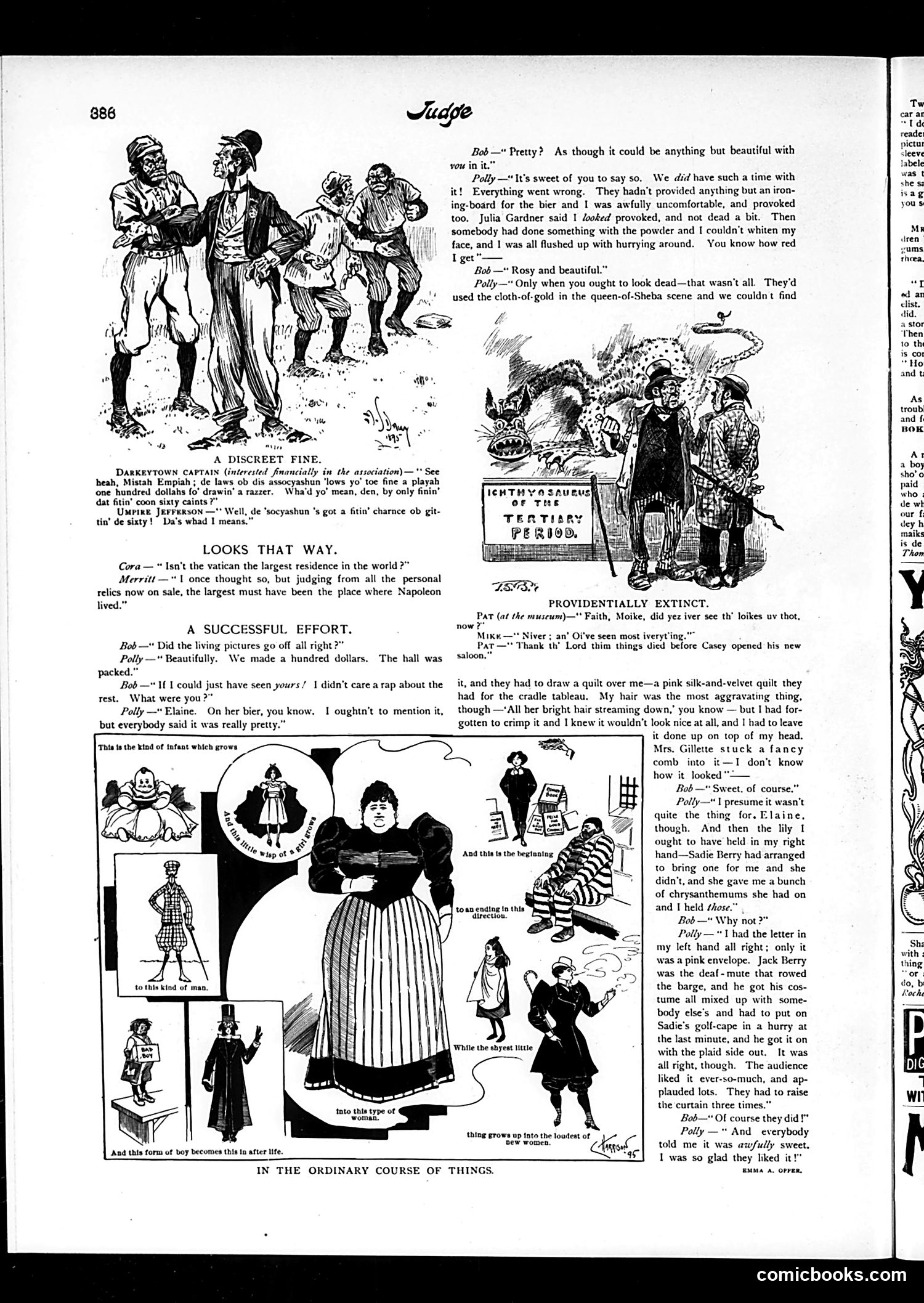
This page contains several brief satirical sketches typical of early 20th-century humor magazines: **"A Discreet Fine"** mocks segregation-era baseball, using racist dialect to depict a Black team captain who deliberately under-fines a player he favors, claiming the association will benefit from the player's fighting skills. **"Looks That Way"** jokes about Napoleon memorabilia being sold from his residence, implying the collection is so vast it must have come from somewhere larger than the Vatican. **"A Successful Effort"** and **"Providentially Extinct"** are light romantic/domestic humor: a young woman describes her mishaps performing as the dead Elaine in a theatrical "living picture" tableau; a museum scene features Irish immigrants viewing an extinct prehistoric fish (Ichthyosaurus). **"In the Ordinary Course of Things"** uses small figure sketches to satirize how childhood behaviors predict adult types—fashion-obsessed girls become vain women; certain boy types become specific adult male stereotypes. The page reflects period attitudes toward race, class, and gender stereotypes presented as humor.
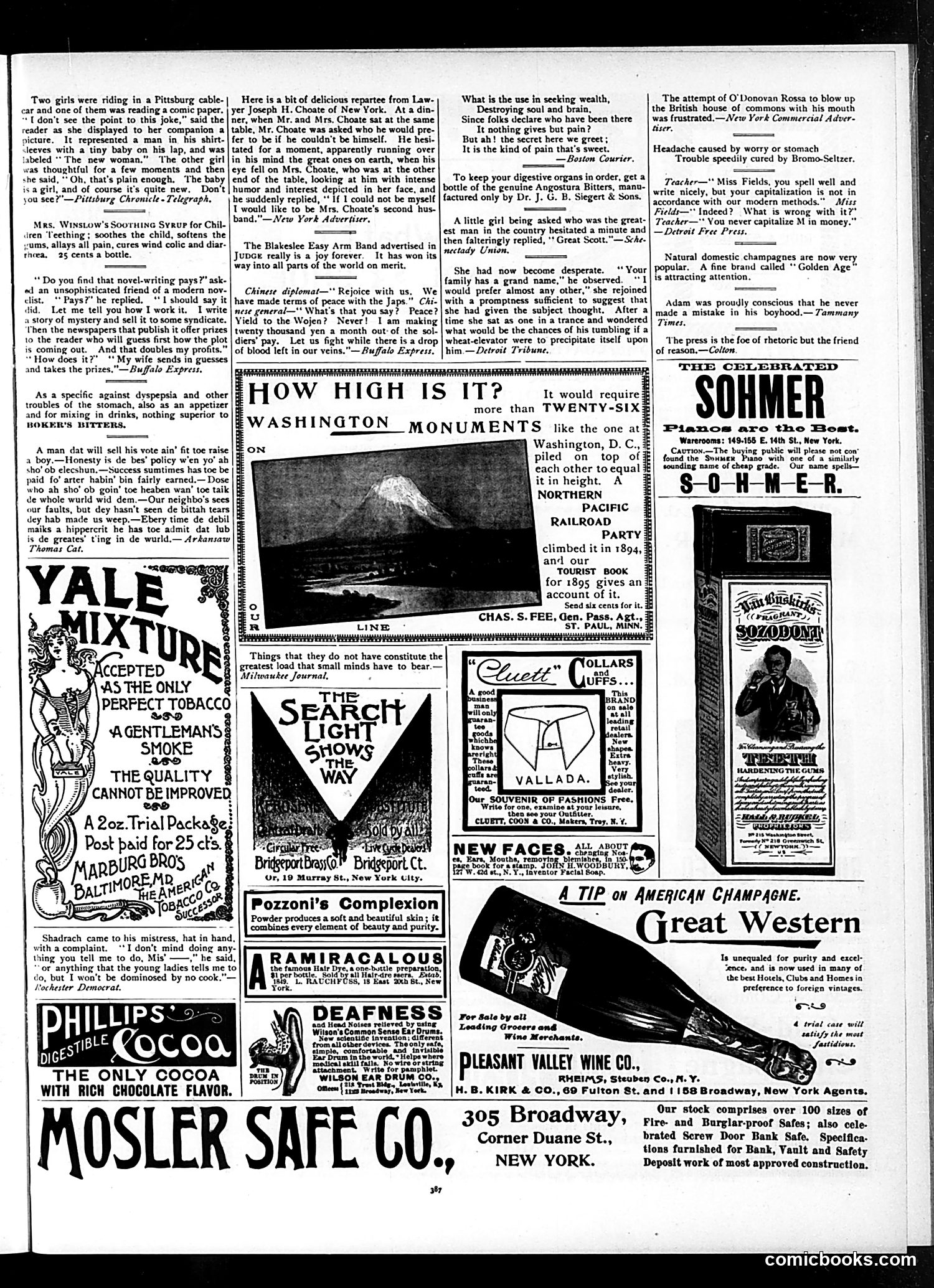
This page from *Judge* magazine consists primarily of **advertisements and brief satirical anecdotes** rather than political cartoons. The notable content includes: 1. **"The New Woman" joke**: A comic anecdote about two girls on a Pittsburgh cable-car discussing a cartoon showing a man holding a baby. The punchline plays on emerging "New Woman" concepts—the second girl misses that the joke is actually about gender roles. 2. **Joseph Choate anecdote**: A witty exchange where lawyer Joseph H. Choate, asked whom he'd prefer to be, replies he'd want to be "Mrs. Choate's second husband"—a self-deprecating jab at marriage. 3. **Various short humor pieces** mocking contemporary figures (Chinese diplomats, novelists, etc.) with light satire typical of *Judge's* style. The page is otherwise dominated by period advertisements for tobacco, cocoa, pianos, wine, and patent medicines—standard for late 19th-century magazines. The humor reflects genteel, middle-class concerns rather than serious political satire.
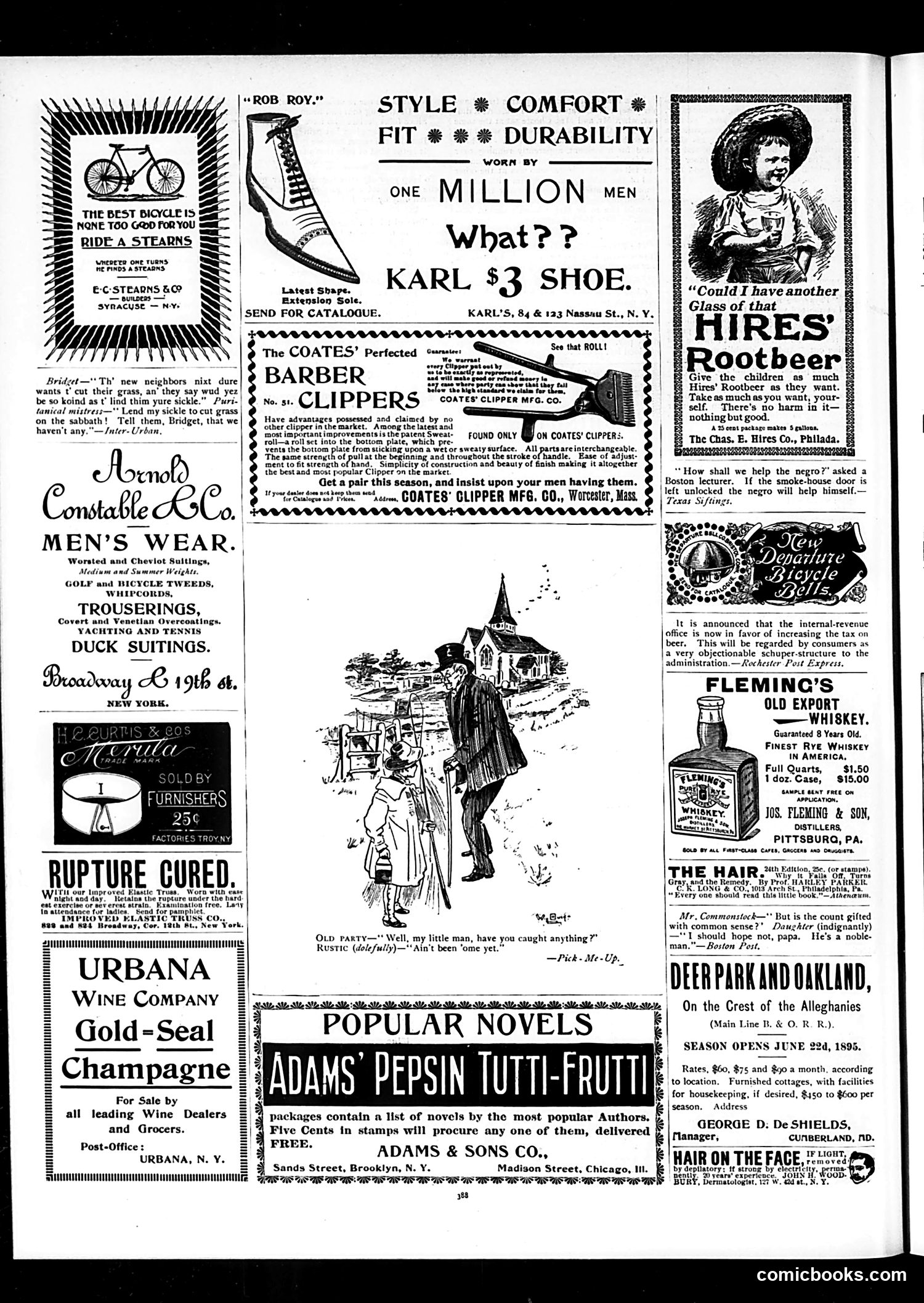
This is primarily an **advertising page** from Judge magazine, featuring numerous commercial advertisements for products like bicycles, shoes, clippers, champagne, and whiskey. The page contains **two brief comic captions**: 1. **"Bridget" dialogue**: An Irish servant girl asks neighbors to lend a sickle to cut grass on Sunday. Her employer refuses, claiming they have no sickle—the joke being religious hypocrisy. The employer won't lend tools for Sunday work (Sabbath violation) but frames it as mere lack of possession. 2. **"Old Party" fishing joke**: A man asks a boy if he's caught anything. The boy replies he "ain't been 'ome yet"—implying he's been away from home so long he couldn't have fished. Both jokes rely on **ethnic/class stereotypes** (Irish servants, rural yokels) and **wordplay**—common humor conventions of the 1890s. The cartoons are minimal; the page's primary purpose is **revenue generation through advertising**, typical of Judge's business model.
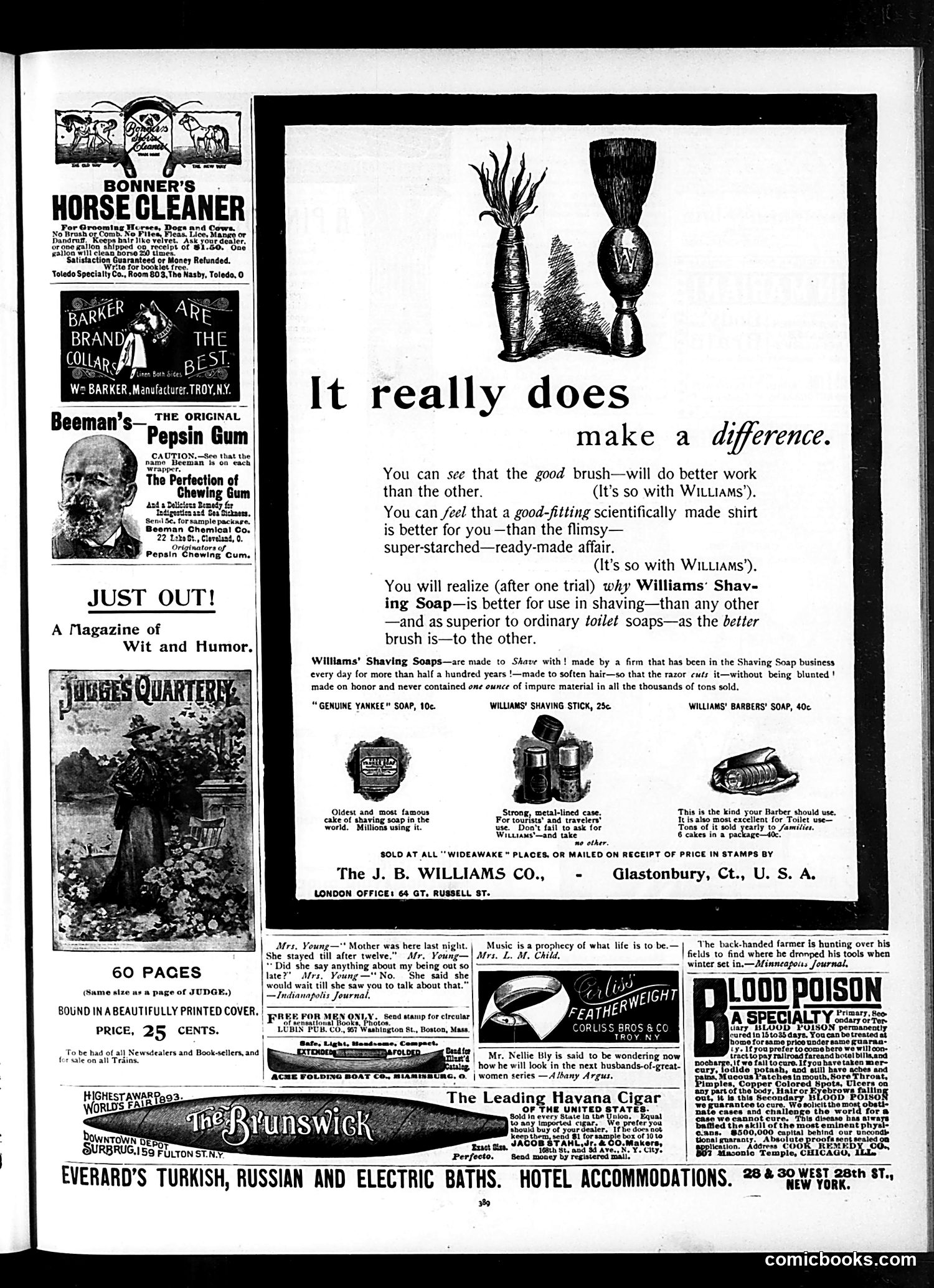
This page is primarily **advertising**, not satirical commentary. The dominant feature is a large Williams' Shaving Soap advertisement centered on the page, emphasizing product quality through comparative rhetoric ("It really does make a difference"). The ad targets male consumers, highlighting superior brushes, scientifically-made shirts, and shaving soaps. The surrounding advertisements are typical period products: Bonner's Horse Cleaner, Beeman's Pepsin Gum, and various patent medicines and services (Turkish baths, blood poison cures). Small humor items appear scattered throughout—brief jokes about marital life and a reference to "Nellie Bly," the famous female journalist, humorously wondering "how he will look in the next husbands-of-great-women series," playing on her well-known reporting. The page represents typical Judge content: satirical advertisements mixed with product promotions, aimed at affluent male readership interested in grooming, novelties, and remedies.
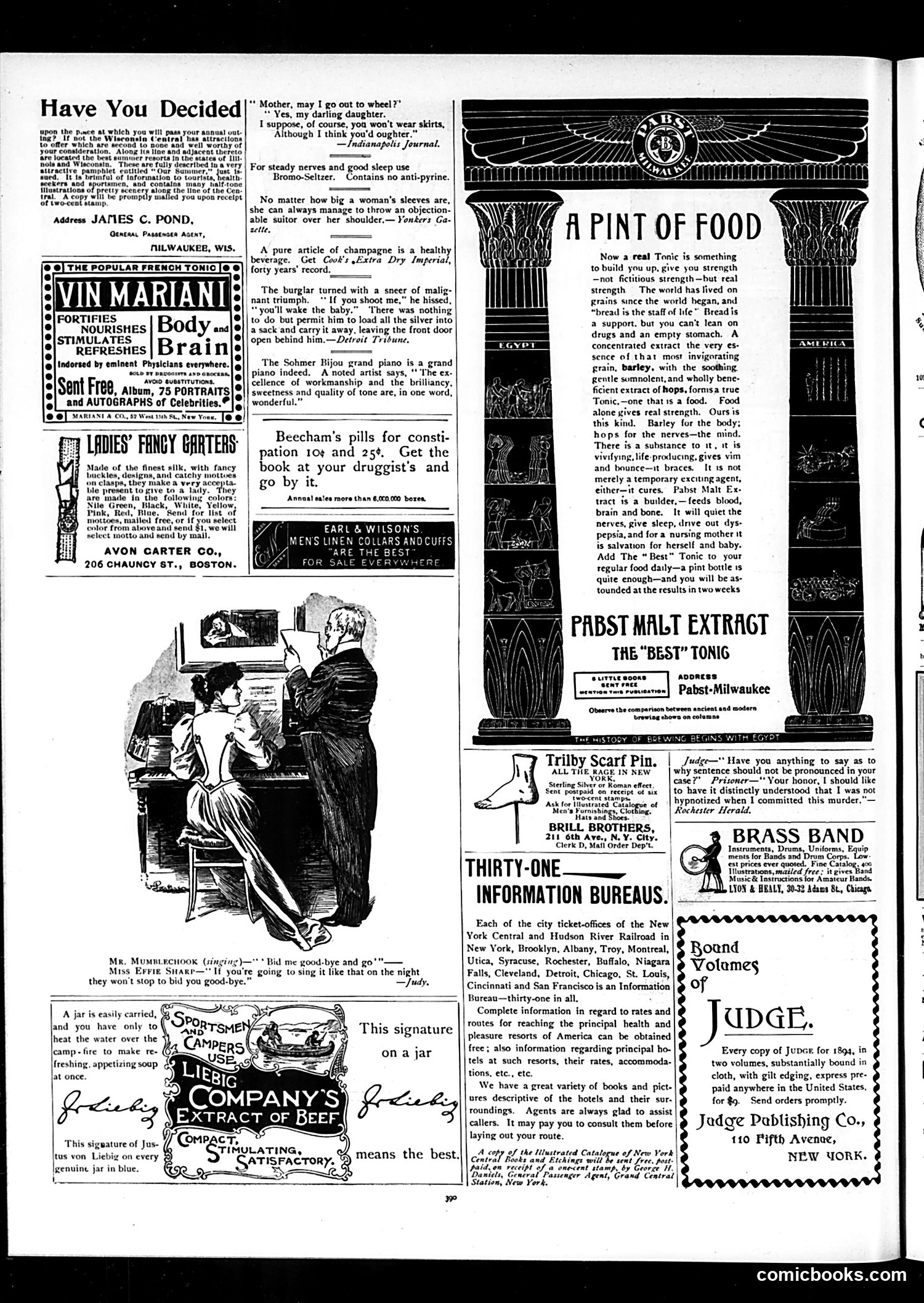
This page is primarily **advertising** with minimal editorial content. The main cartoon depicts a domestic scene: a man singing badly to a woman who appears to suffer through his performance—a visual joke about untalented amateur musicians subjecting captive audiences. The scattered text jokes target contemporary social conventions: women's fashion (large sleeves, skirt debates), courtship dynamics (throwing suitors over shoulders), and domestic situations (burglars avoiding waking babies). These reflect early 1900s concerns about women's changing roles and evolving social norms. The remainder is product advertising—typical for *Judge* magazine—promoting patent medicines (Bromo-Seltzer, Beecham's pills), beverages (Cook's champagne, Pabst Malt Extract), and consumer goods. The medical endorsements reflect the era's unregulated pharmaceutical industry before FDA oversight. The magazine itself served affluent readers through humor targeting urban middle-class anxieties.
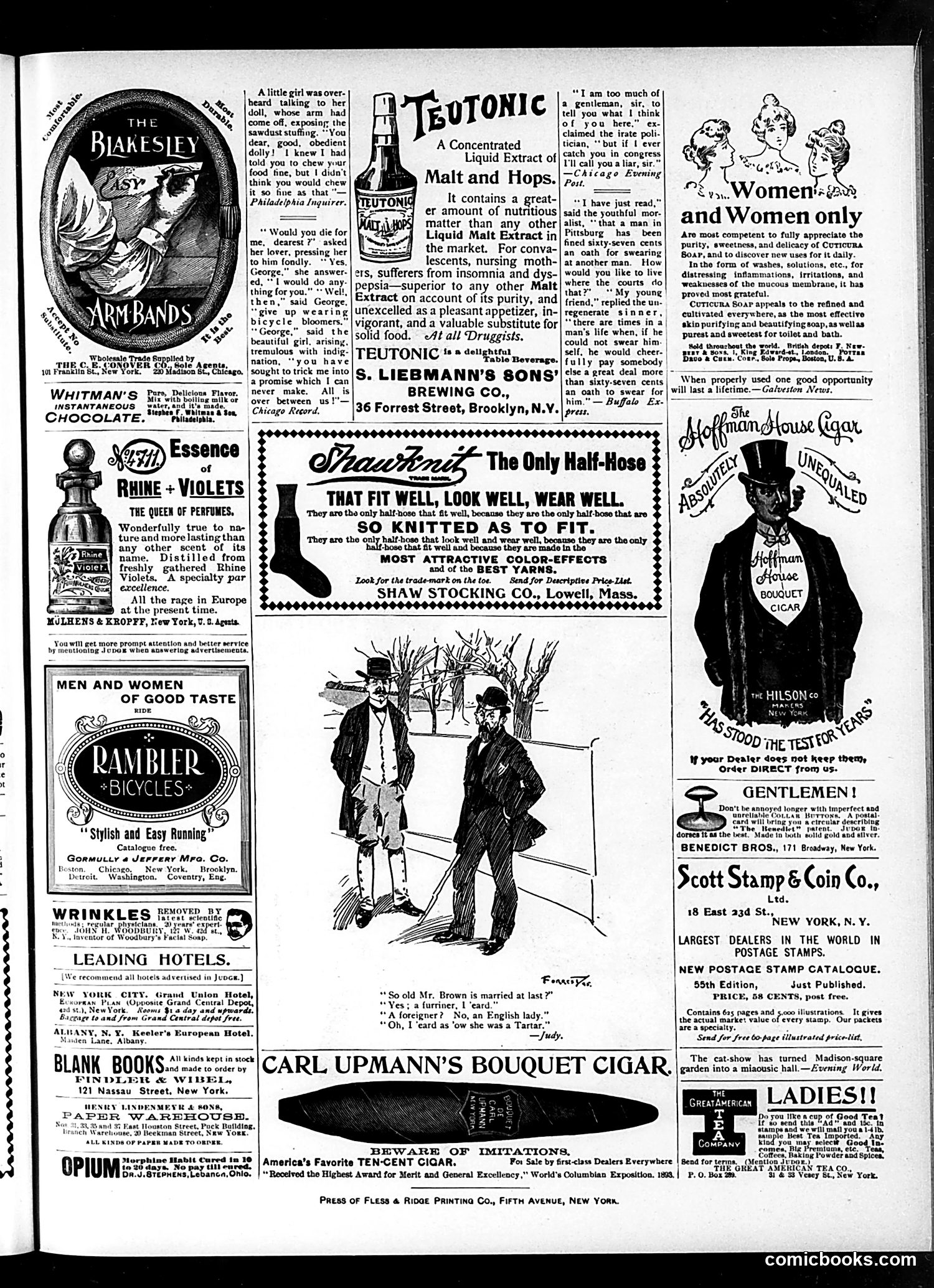
This is primarily an **advertising page** with minimal editorial content. The few cartoon snippets serve as framing devices for ads rather than constituting serious political satire. The visible cartoons are brief, domestically-focused **social humor**: 1. A child scolding her doll for chewing its stuffing—a gentle joke about parental discipline and children's logic. 2. A couple's argument where the man tries to trick his girlfriend into accepting his marriage proposal by framing it as a hypothetical—satirizing romantic manipulation and courtship conventions. 3. A politician claiming he'd call someone a "liar" in Congress but not in public—mocking congressional incivility and the performative nature of political discourse. 4. A man defending his desire to swear, joking he'd pay others to do it for him—commentary on social propriety and creative workarounds to etiquette. These are **light social satire** typical of Judge's era: domestic relations, manners, and political theater rather than hard-hitting political commentary. The page is dominated by patent medicines, bicycles, and cigars.
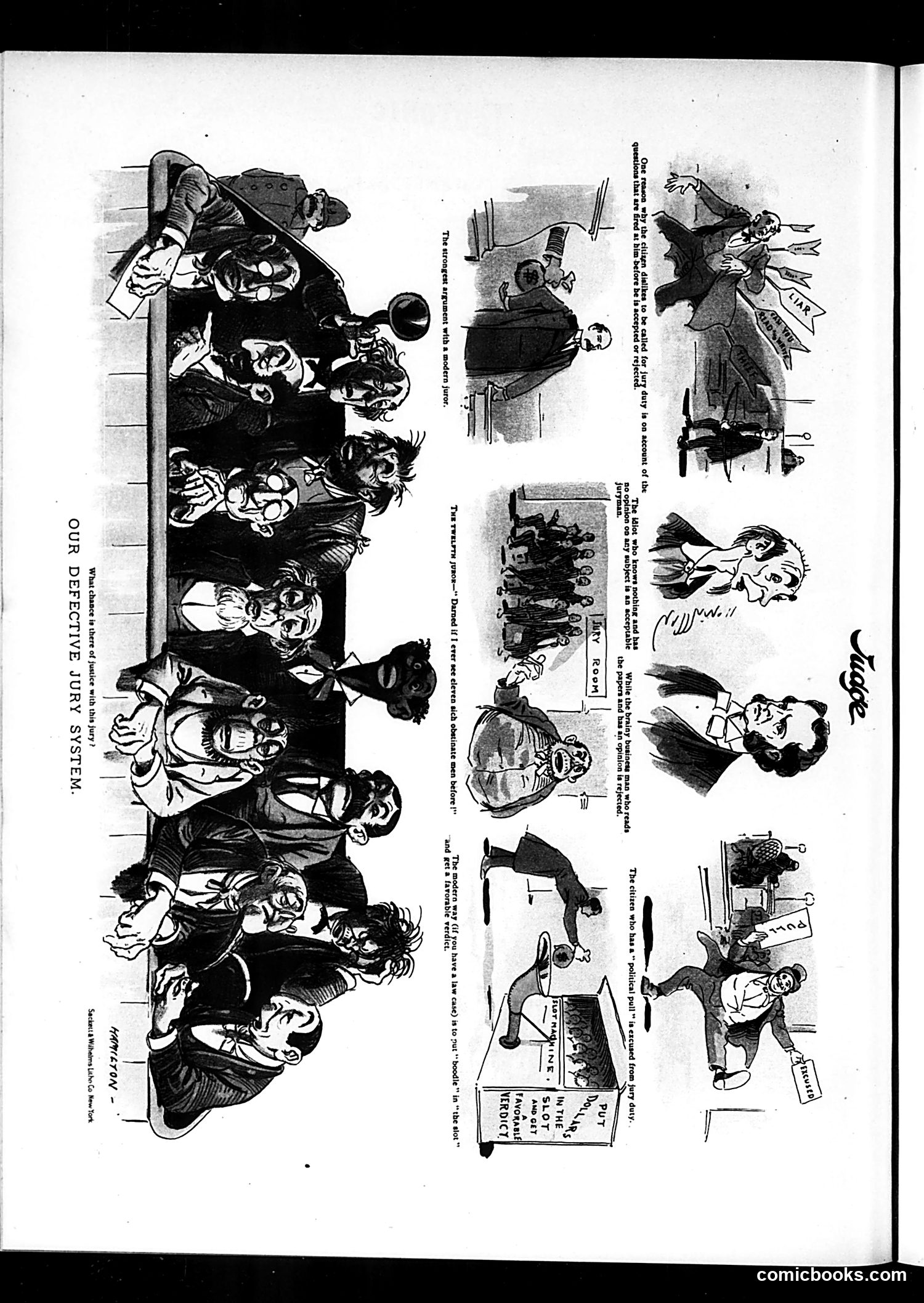
This Judge magazine cartoon satirizes the American jury selection process. The left panel shows a vertical lineup of jurors being questioned, with text explaining the absurd contradiction: ignorant men with no opinions are accepted as jurors, while educated businessmen who read newspapers and hold informed views are rejected. The implication: the legal system *wants* uninformed jurors who can be easily manipulated. The right panel offers darker commentary—"The modern way" to win a case is to put "boodle" (slang for bribes) "in the slot" to secure a favorable verdict, suggesting corruption undermines justice entirely. The bottom quote, attributed to Hamilton, expresses frustration at finding eleven obstinate jurors. Overall, the cartoon criticizes both jury selection practices and widespread courtroom bribery as systemic failures in American justice.