
A complete issue · 16 pages · 1895
Judge — May 18, 1895
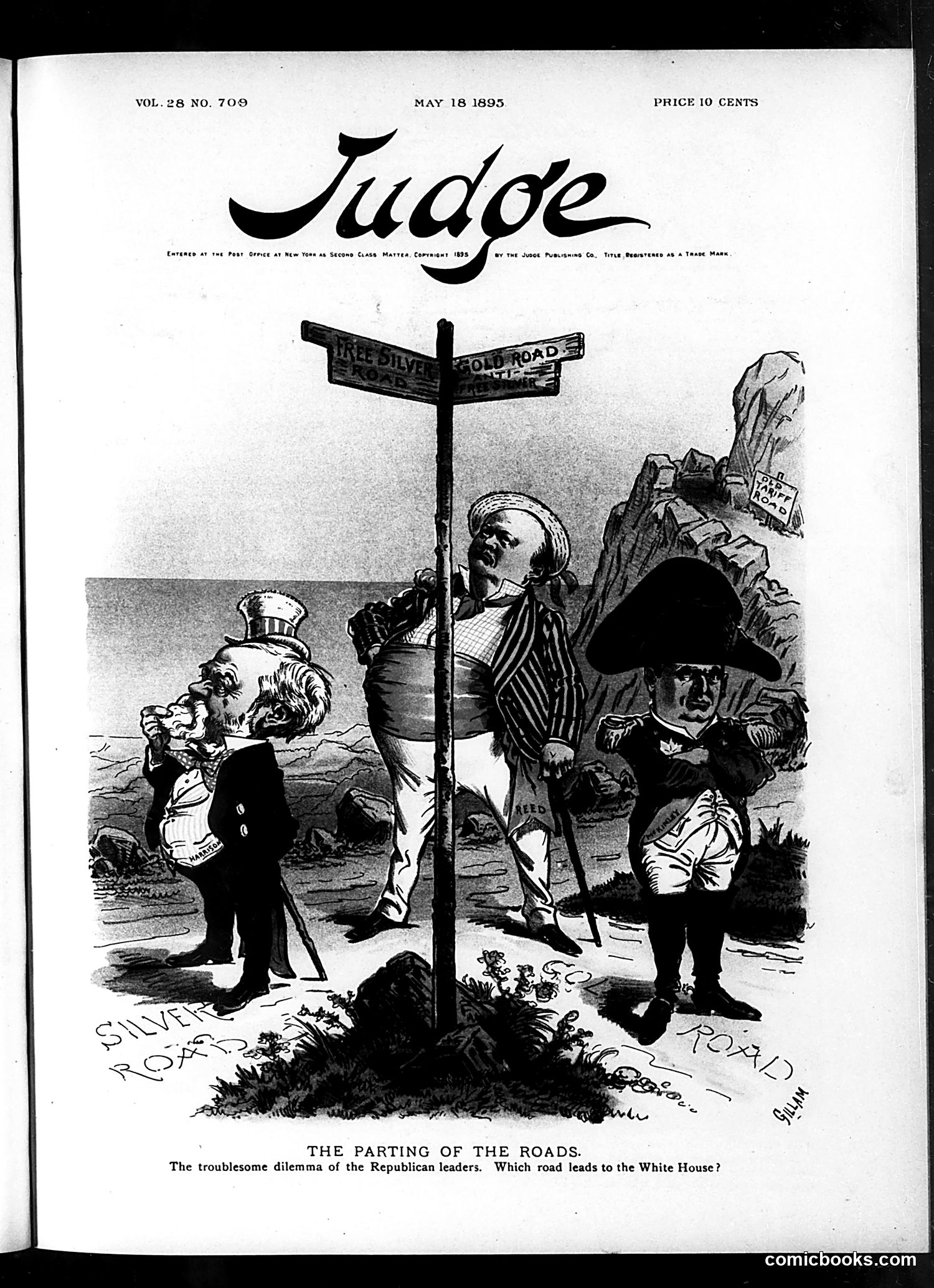
This May 1895 cartoon satirizes Republican Party divisions over which direction to take toward the White House. The signpost shows "SILVER ROAD" and "GOLD ROAD," referencing the intense monetary policy debate splitting Republicans at that time—whether to support free silver coinage or maintain the gold standard. The caricatured figures appear to be Republican leaders at a crossroads, uncertain which path to follow. The caption's question—"Which road leads to the White House?"—suggests the party was fractured and confused about its political strategy heading toward the 1896 presidential election. This reflects the real historical split between Republican factions over monetary policy that dominated late-1890s American politics.
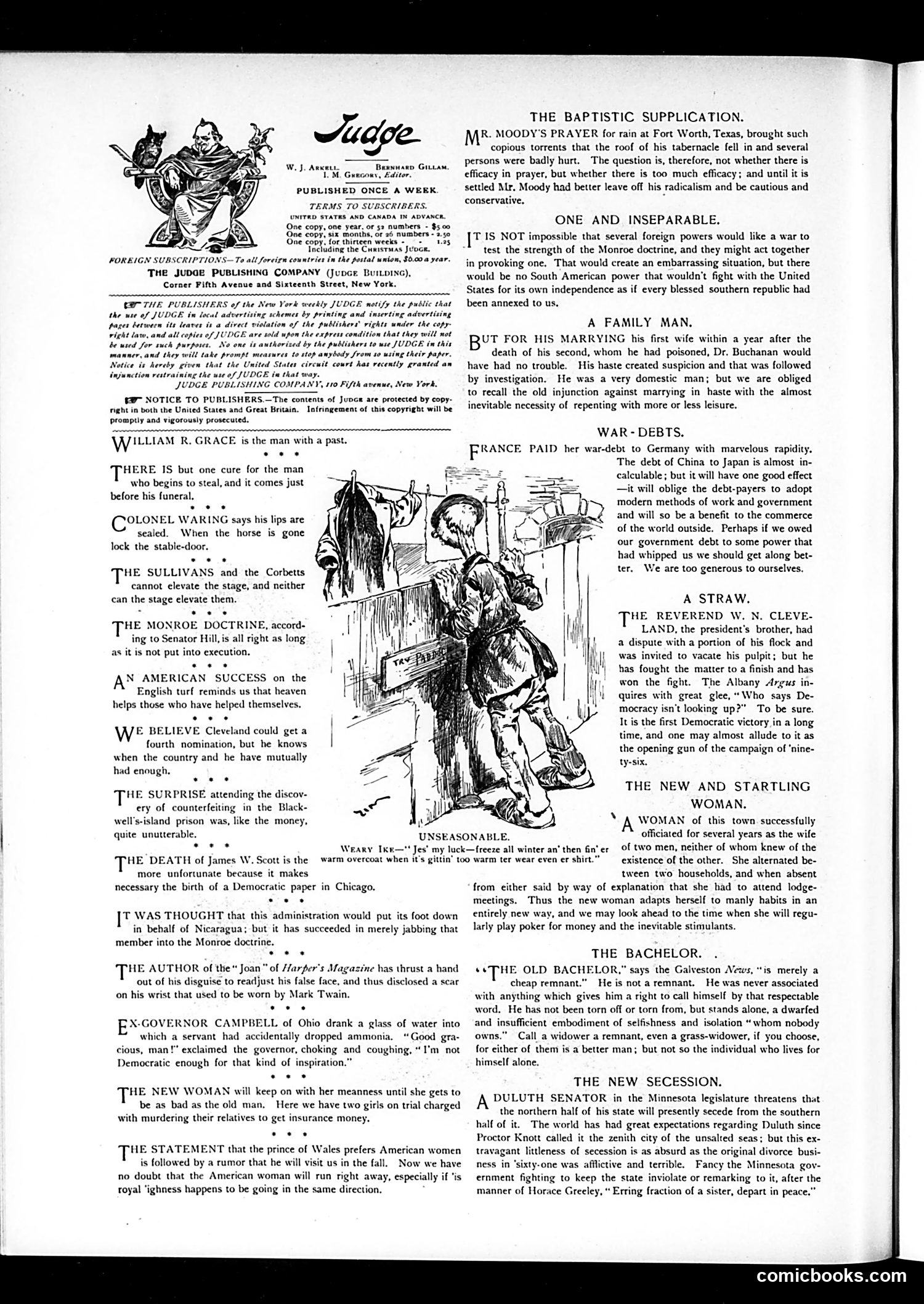
The central cartoon depicts a figure labeled "Tax Payer" being literally crushed under the weight of various financial burdens—representing different government expenses or debts. The accompanying text sections critique contemporary issues: Moody's prayer for rain at Fort Worth; concerns about foreign wars draining resources; and satirical commentary on Cleveland and Democratic politics. The cartoon's message is straightforward: ordinary taxpayers bear an unsustainable burden from government spending and debt. The imagery—a hunched figure struggling under a physical load—was a common Judge visual metaphor for fiscal burden during this era (appears to be late 19th century based on style and references). The surrounding editorial commentary uses sharp wit to mock politicians and policies affecting ordinary citizens' wallets.
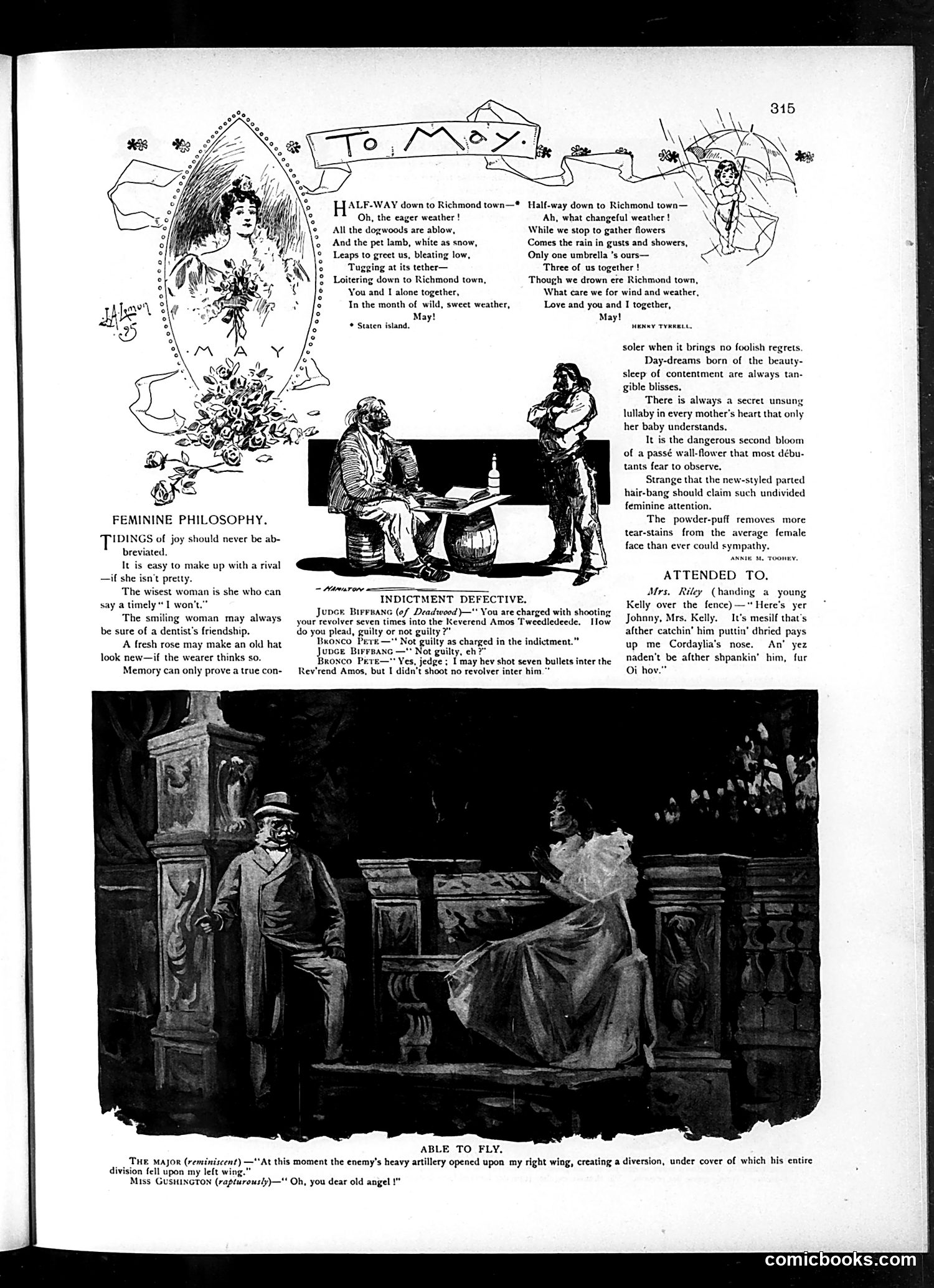
This page contains three separate satirical pieces: 1. **"Feminine Philosophy"** (top left): A humorous section offering cynical observations about women's behavior and appearance, typical of early 20th-century Judge magazine's somewhat misogynistic humor. 2. **"Indictment Defective"** (middle): A legal satire featuring characters named Judge, Bronco Pete, and Reverend Amos, appearing to mock courtroom incompetence or corrupt legal proceedings—though the specific case referenced is unclear without additional context. 3. **"Attended To"** and **"Able to Fly"** (bottom): Illustrated comedic scenarios involving domestic or romantic situations, with dialogue suggesting slapstick humor about interpersonal conflicts. The page exemplifies Judge's blend of social satire, gender-focused comedy, and illustrated humor typical of early American satirical magazines.
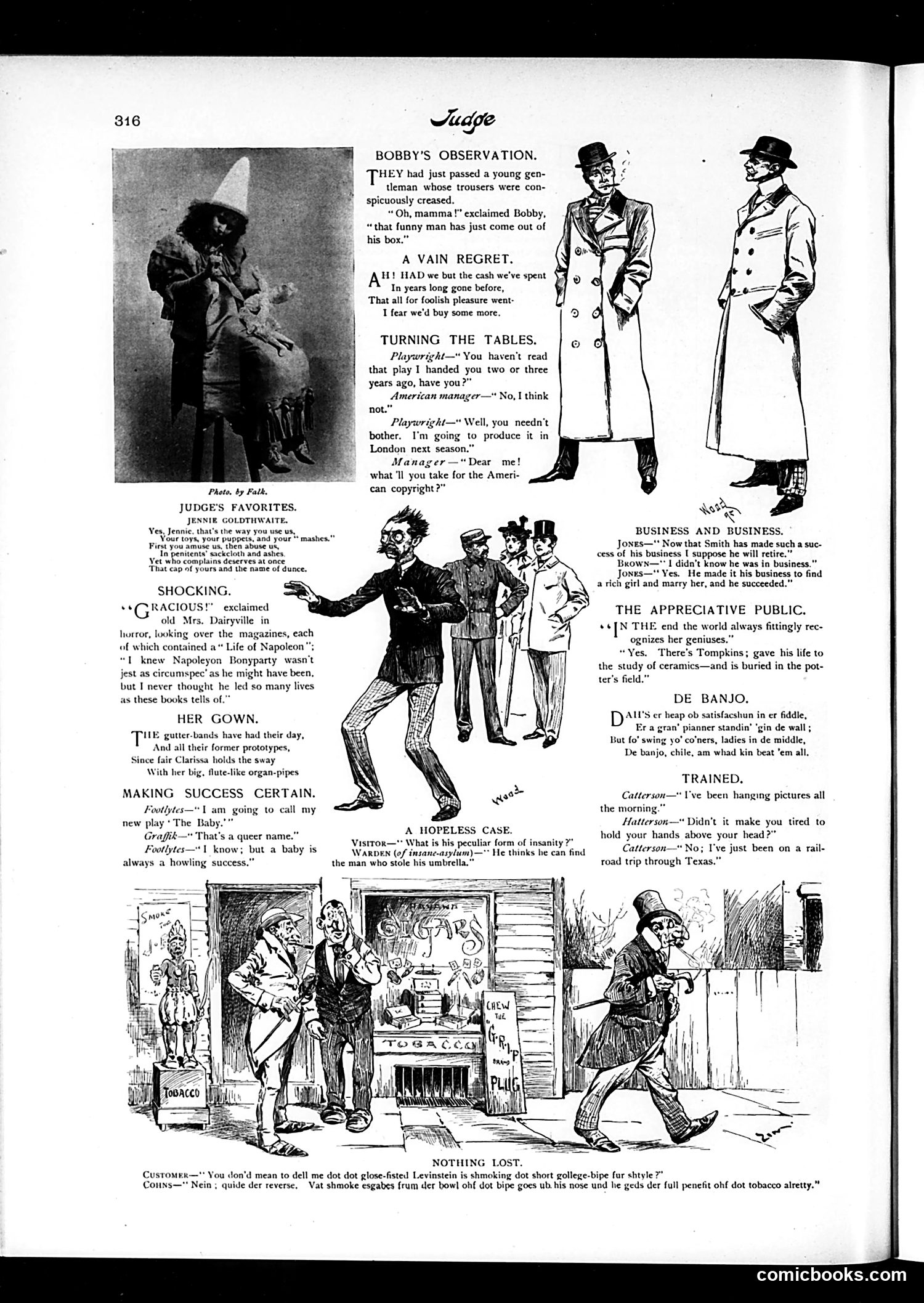
This page from Judge magazine (circa 1880s-1890s) contains multiple satirical vignettes mocking contemporary society: **"Bobby's Observation"**: A child notices a well-dressed man's conspicuously creased trousers, joking he's just emerged from a box—mocking the fashion obsession with crisp trouser creases. **"Turning the Tables"**: A playwright and American theater manager negotiate; the playwright threatens to produce a rejected play in London, reversing their power dynamic. Satirizes theatrical business practices and American cultural insecurity. **"Nothing Lost"**: A Yiddish-accented tobacco shop scene where a customer smokes a cheap pipe but the smoke escapes through his nose rather than providing enjoyment—so he "loses nothing" buying cheap tobacco. Uses ethnic caricature for humor. **"De Banjo"**: Uses racist dialect to celebrate the banjo as superior to piano and fiddle. Reflects period entertainment stereotypes. **Other items**: Brief quips mocking vanity, success, and social pretense typical of Judge's satirical style. The page prioritizes ethnic/social caricature and observational humor over political commentary.
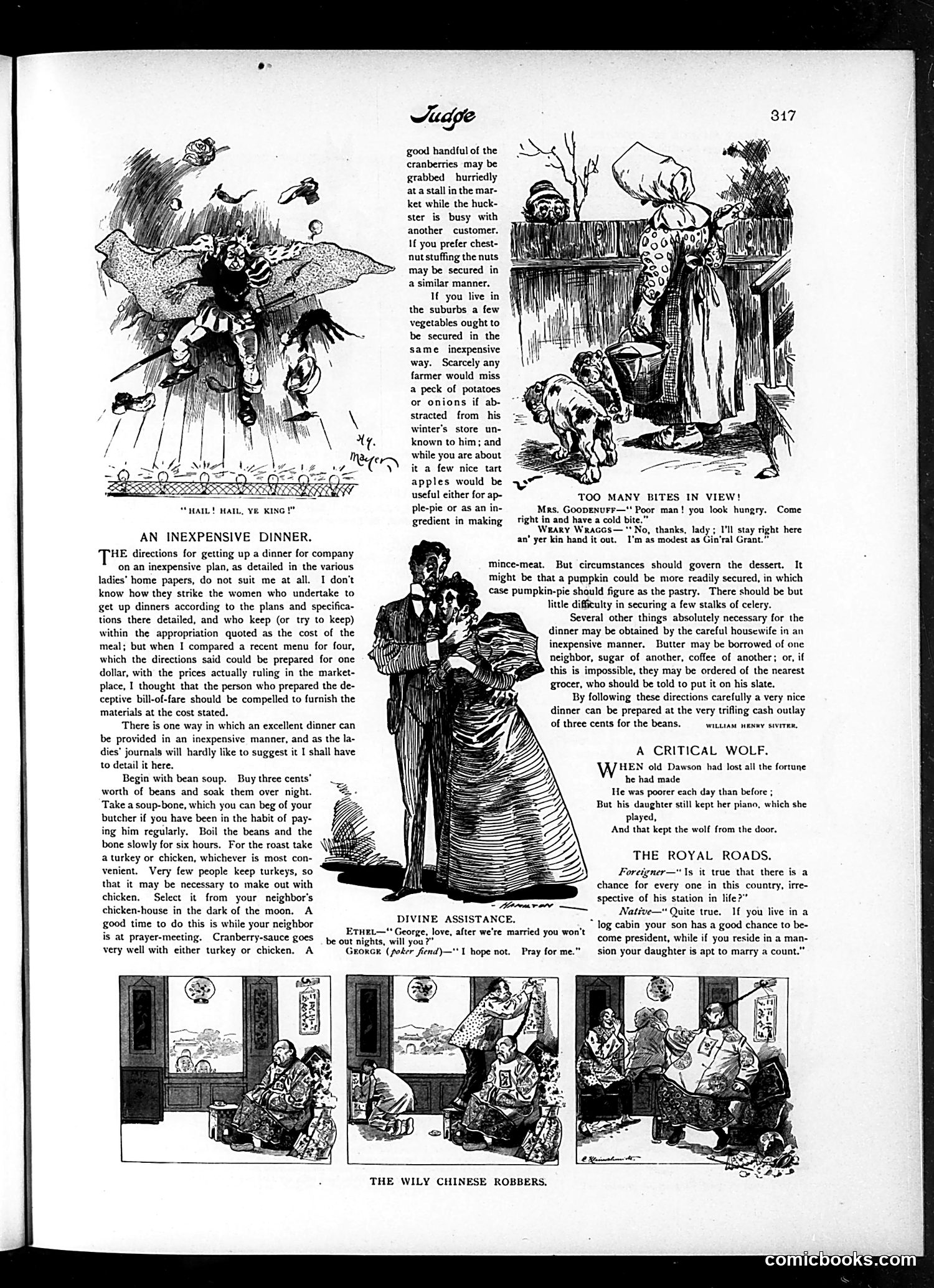
This *Judge* page satirizes late 19th-century domestic economy through multiple pieces: **"An Inexpensive Dinner"** mockingly details preparing a meal for one dollar by essentially advocating theft—borrowing/stealing beans, vegetables, chicken, and cranberries from neighbors and farms "unknown to him." The satire exposes the hypocrisy of ladies' home magazines claiming impossible budgets by suggesting the only realistic method is petty larceny. **"Too Many Bites in View"** shows a thin man at a door; Mrs. Goodenuff's charity offer of "a cold bite" is undercut by the caption's implication he represents multiple potential thieves ("bites"). **"A Critical Wolf"** uses the idiom "keep the wolf from the door" literally—a poor man's daughter maintains a piano despite poverty, symbolizing how genteel pretense persists regardless of financial reality. **"The Royal Roads"** satirizes class mobility myths: the wealthy believe poor people have better chances at advancement, while the poor understand their daughters' prospects depend on their father's station. The page collectively mocks American hypocrisy about wealth, charity, and class aspiration.
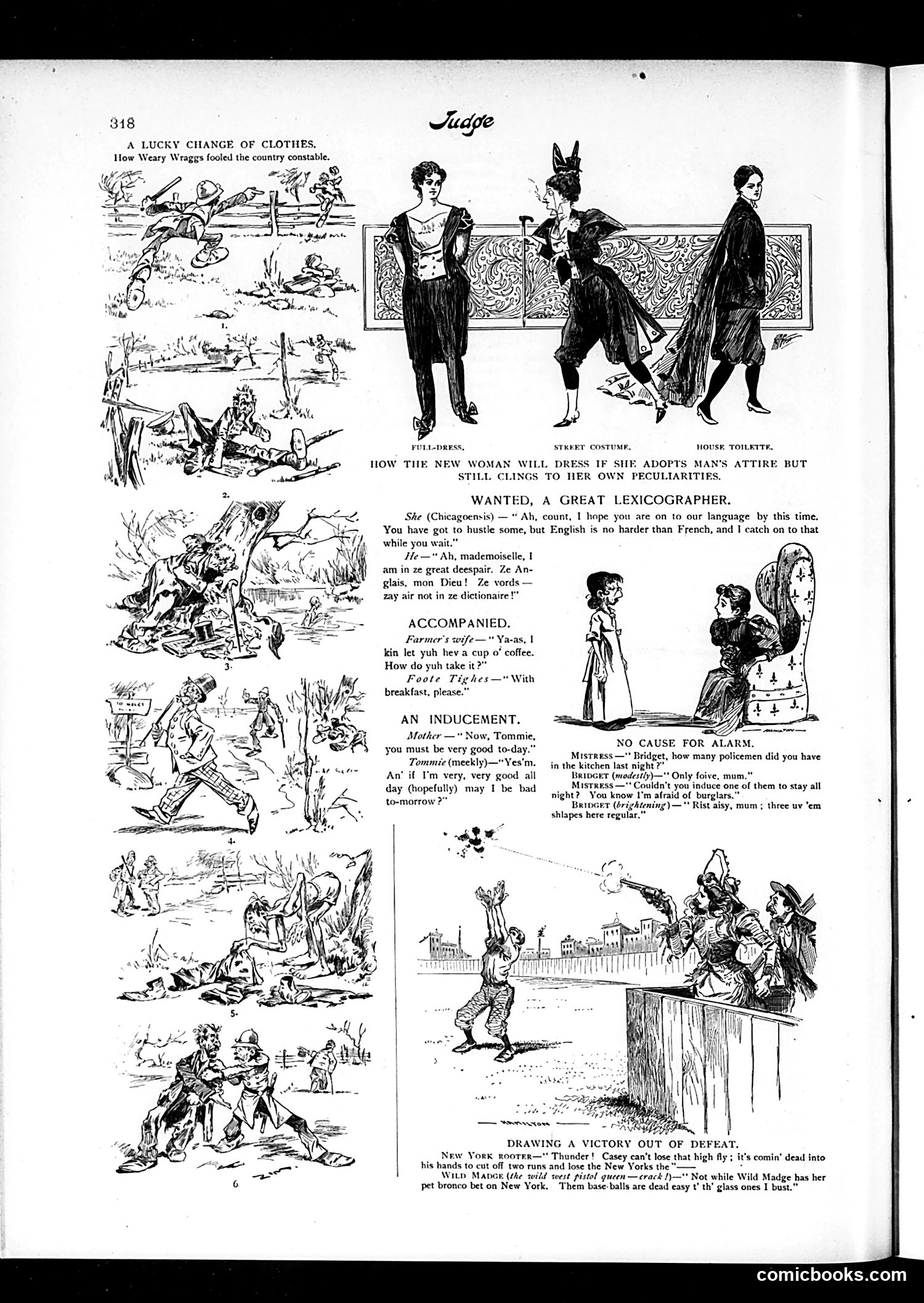
This page contains several unrelated humor pieces typical of Judge magazine's satirical format: **"A Lucky Change of Clothes"** (left): A narrative comic about "Weary Wraggs" fooling a country constable—likely a reference to a contemporary criminal or folk character, though the specific reference is unclear. **"The New Woman"** (top right): Satirizes the "New Woman" movement of the era. Three panels show how women adopting men's clothing would still maintain feminine peculiarities—poking fun at early feminists and dress-reform advocates who challenged Victorian gender norms. **Other short humor pieces** include dialect jokes about a Chicago woman struggling with English, rural characters, and child behavior. **"Drawing a Victory Out of Defeat"** (bottom right): A baseball joke featuring "Wild Madge," apparently a Wild West character with a pet bronco, placing bets on New York baseball games. The page reflects Judge's satirical approach to contemporary social changes—particularly women's liberation movements and evolving urban/rural cultural differences in early 20th-century America.
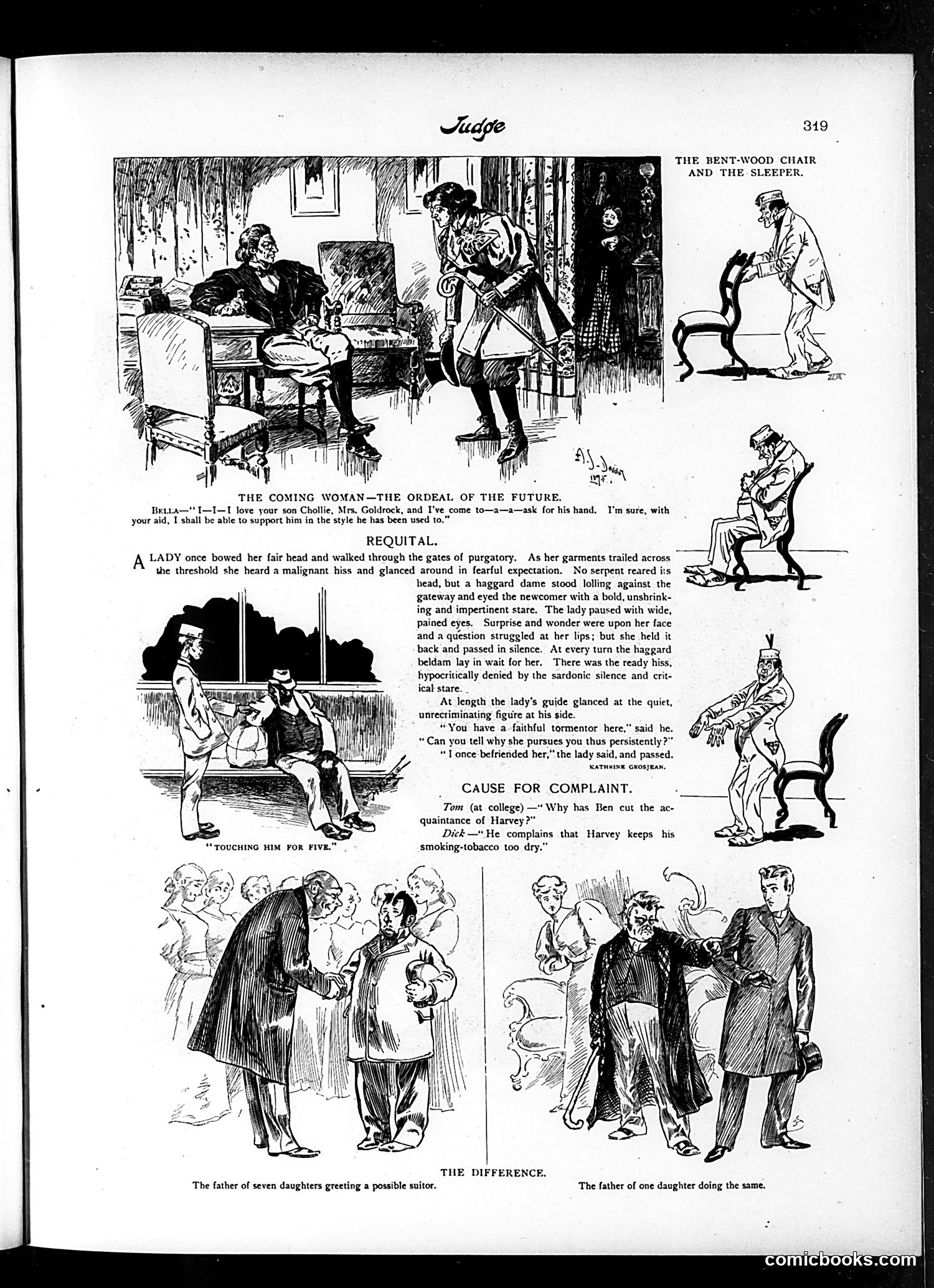
This page contains several Victorian-era satirical sketches: **"The Coming Woman"** mocks the emerging "New Woman" of the 1890s. A woman named Bella proposes to her suitor's mother, boasting she'll *support* him financially—inverting traditional gender roles. The satire targets women seeking economic independence and marriage equality, presented as absurdly emasculating. **"Requital"** is a literary morality tale about a lady in purgatory tormented by a woman she once befriended but apparently wronged. It illustrates themes of karmic justice popular in Victorian fiction. The smaller cartoons make quick social jokes: one contrasts how a father of seven daughters eagerly greets a potential suitor versus a father with one daughter (suggesting desperation to marry off multiple girls versus protective possessiveness). Another jokes about college friendships over tobacco preferences. The bent-wood chair sketches on the right appear to show physical comedy with furniture. The overall tone reflects upper-class anxieties about changing women's roles and marriage customs in the 1890s.
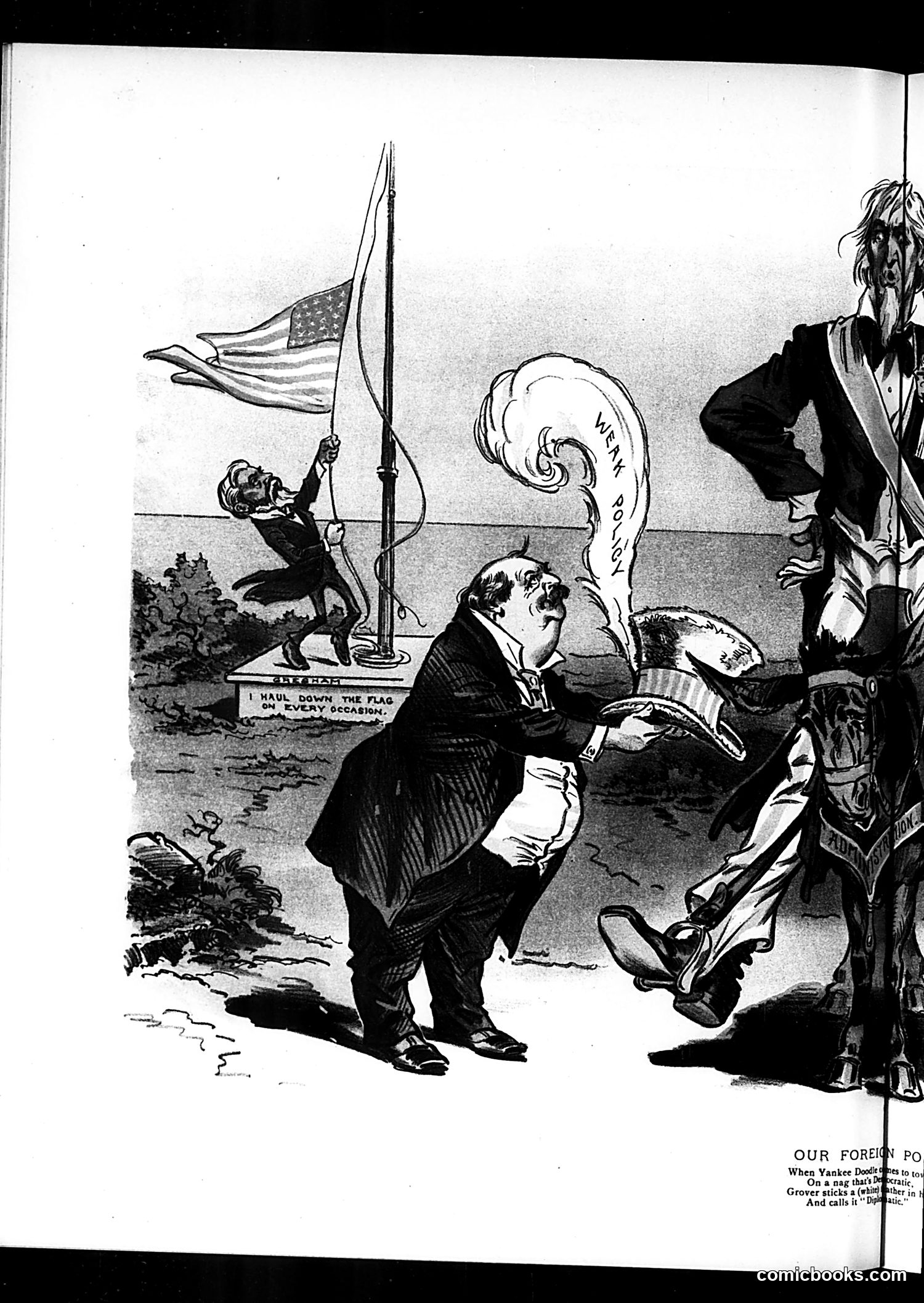
This appears to be a satirical cartoon about American foreign policy, likely from the early 20th century. The central figure is a rotund politician in formal dress, seemingly struggling or floundering. Behind him, a small figure waves an American flag energetically. To the right stands Uncle Sam in his characteristic form. The text references "Yankee Doodle" and someone who "hauls down flag on every occasion," suggesting the cartoon criticizes inconsistent or wavering American diplomatic positions. The struggling central figure likely represents a specific politician or policy approach that Judge magazine deemed hypocritical or ineffectual regarding foreign affairs. The satire appears to mock political opportunism or flip-flopping in foreign policy decisions, using the flag-waving as ironic contrast to the actual conduct being criticized.
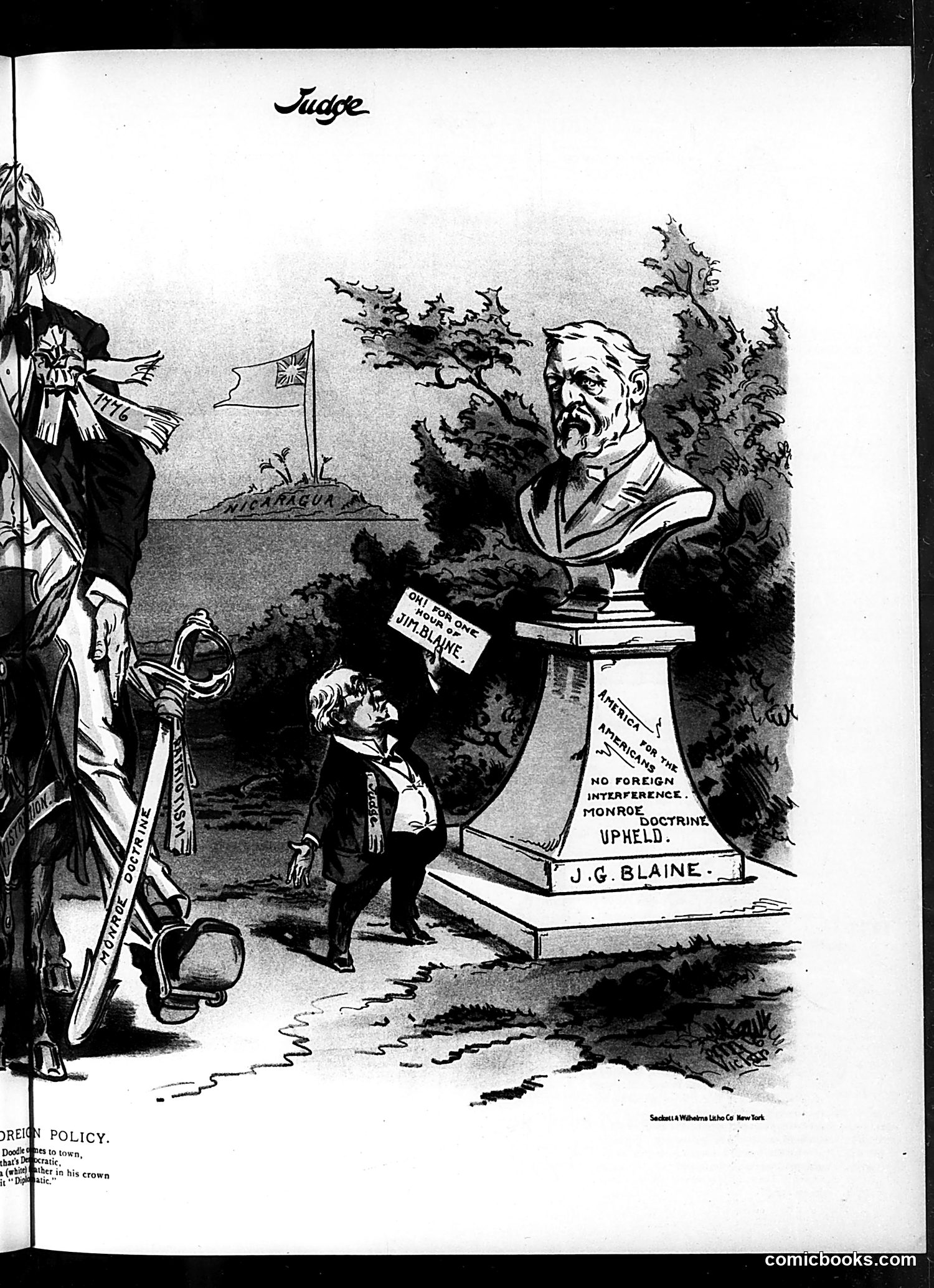
This **Judge** magazine cartoon satirizes American foreign policy during the era of the Monroe Doctrine. The central figure is a bust labeled "J.G. BLAINE," likely Secretary of State James G. Blaine, depicted as a monument to the doctrine of "no foreign interference." On the left stands **Britannia** (the British lion symbolizing Britain), holding a sword and appearing constrained or warned away from a pedestal bearing the Monroe Doctrine inscription. A smaller figure—possibly representing a Latin American nation or the U.S. itself—gestures at a sign reading "KEEP OUT" regarding the doctrine. The cartoon criticizes American assertiveness in the Western Hemisphere, suggesting the U.S. uses the Monroe Doctrine to maintain dominance while excluding European (particularly British) influence from the Americas.
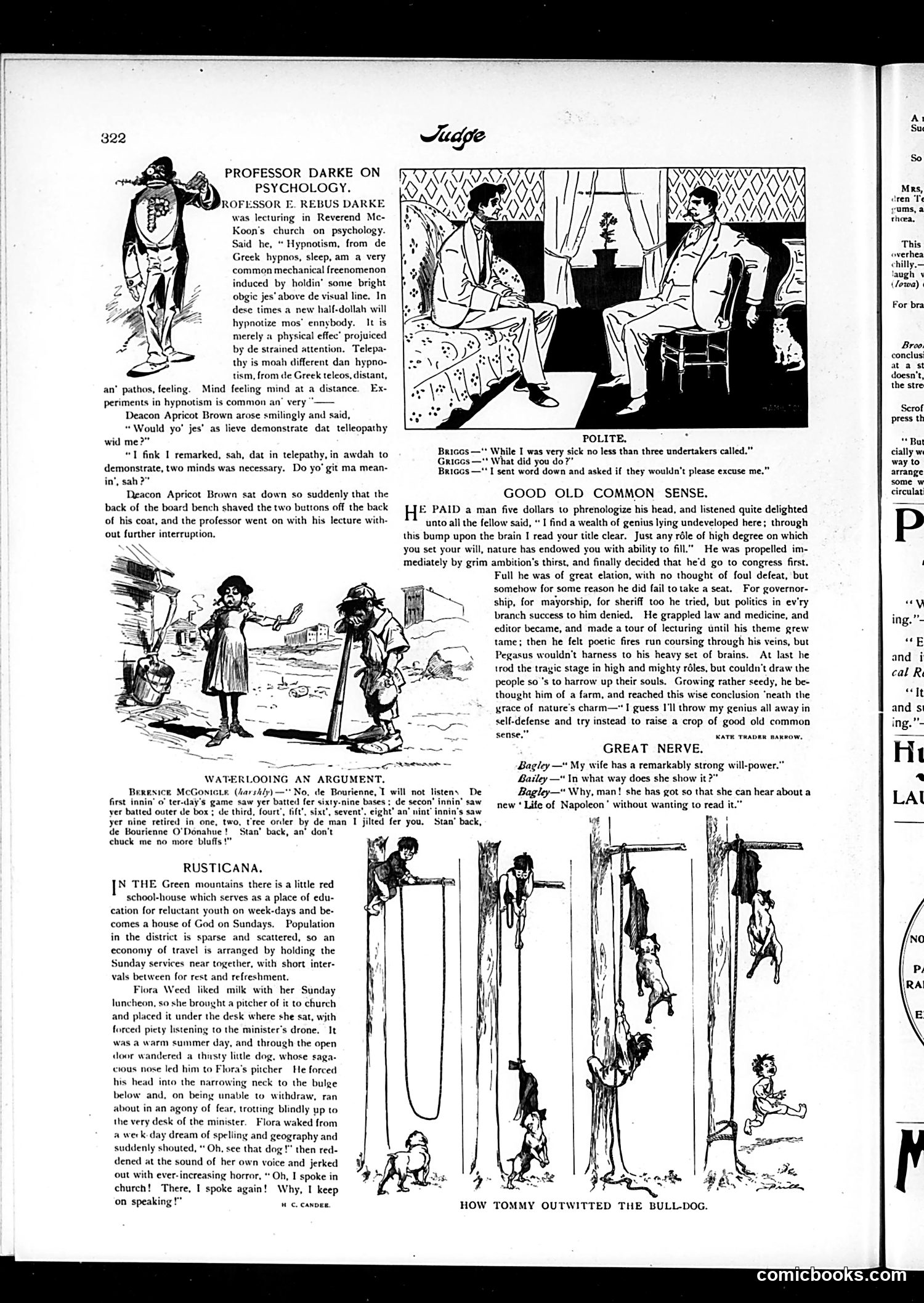
This page contains several satirical pieces mocking late 19th-century fads and human nature: **"Professor Darke on Psychology"** ridicules pseudoscientific lecturing. A Black dialect character lectures on hypnotism and telepathy using pseudo-Greek terminology. When challenged to demonstrate telepathy, he exposes the con—telepathy requires "two minds," implying his challenger lacks one. The satire targets both charlatan psychology lecturers and gullible audiences. **"Waterlooing an Argument"** depicts a woman (Berenice McGonigle) rejecting a man who batted poorly in baseball, noting the man she jilted him for pitched nine perfect innings. The title suggests she's decisively defeating his romantic appeal through sports performance. **"Rusticana"** humorously describes a dog getting its head stuck in a milk pitcher at a church service, forcing Flora Weed to shout in the sanctuary—violating decorum she desperately regrets. **"Good Old Common Sense"** satirizes phrenology (reading bumps on heads for character) by showing a man paying for such "analysis," becoming overly ambitious, yet consistently failing at politics, law, and medicine—suggesting natural limitations trump pseudoscientific encouragement.
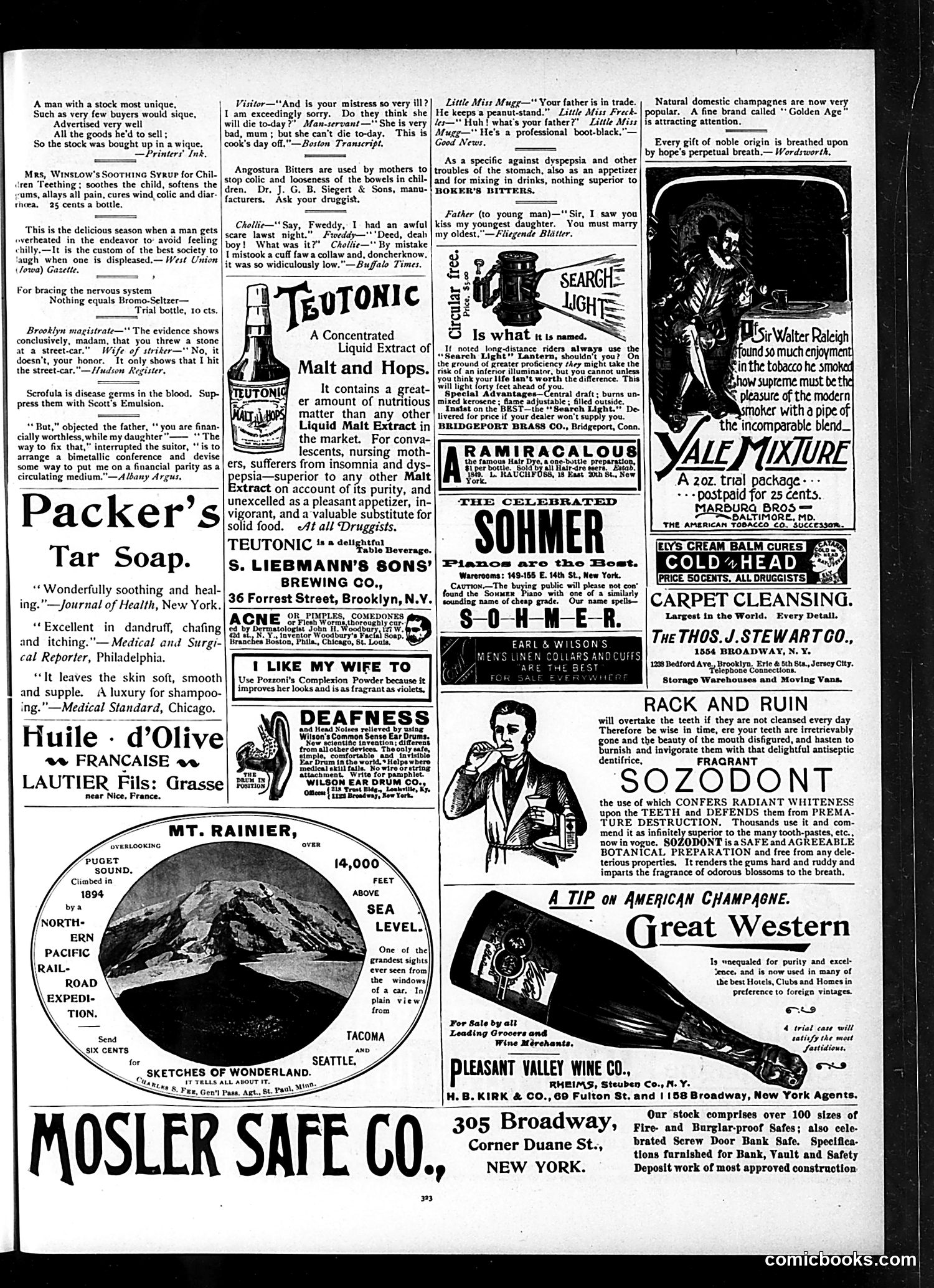
This page is primarily **advertising with brief comic vignettes** rather than political cartoons. The advertisements dominate (Packer's Tar Soap, Teutonic Malt Extract, Mosler Safe Co., etc.). The small comics illustrate **social humor of the era**: 1. **"Cook's day off"** — Satirizes servant hierarchies; a man-servant claims his mistress cannot die today because it's the cook's day off, suggesting domestic staff schedules trump medical emergencies. 2. **"Professional boot-black"** — Mocks class anxiety; a girl brags her father is a "professional boot-black" (shoe shiner) to impress peers, inverting social shame into false pride. 3. **"Bimetallic conference"** — References the 1890s political debate over currency standards; a suitor jokes that financial inequality with his girlfriend's father requires a "bimetallic conference" (currency reform discussion) to establish parity. These are **gentle social satire** targeting Victorian class consciousness, servant culture, and contemporary political buzzwords used humorously in domestic situations.
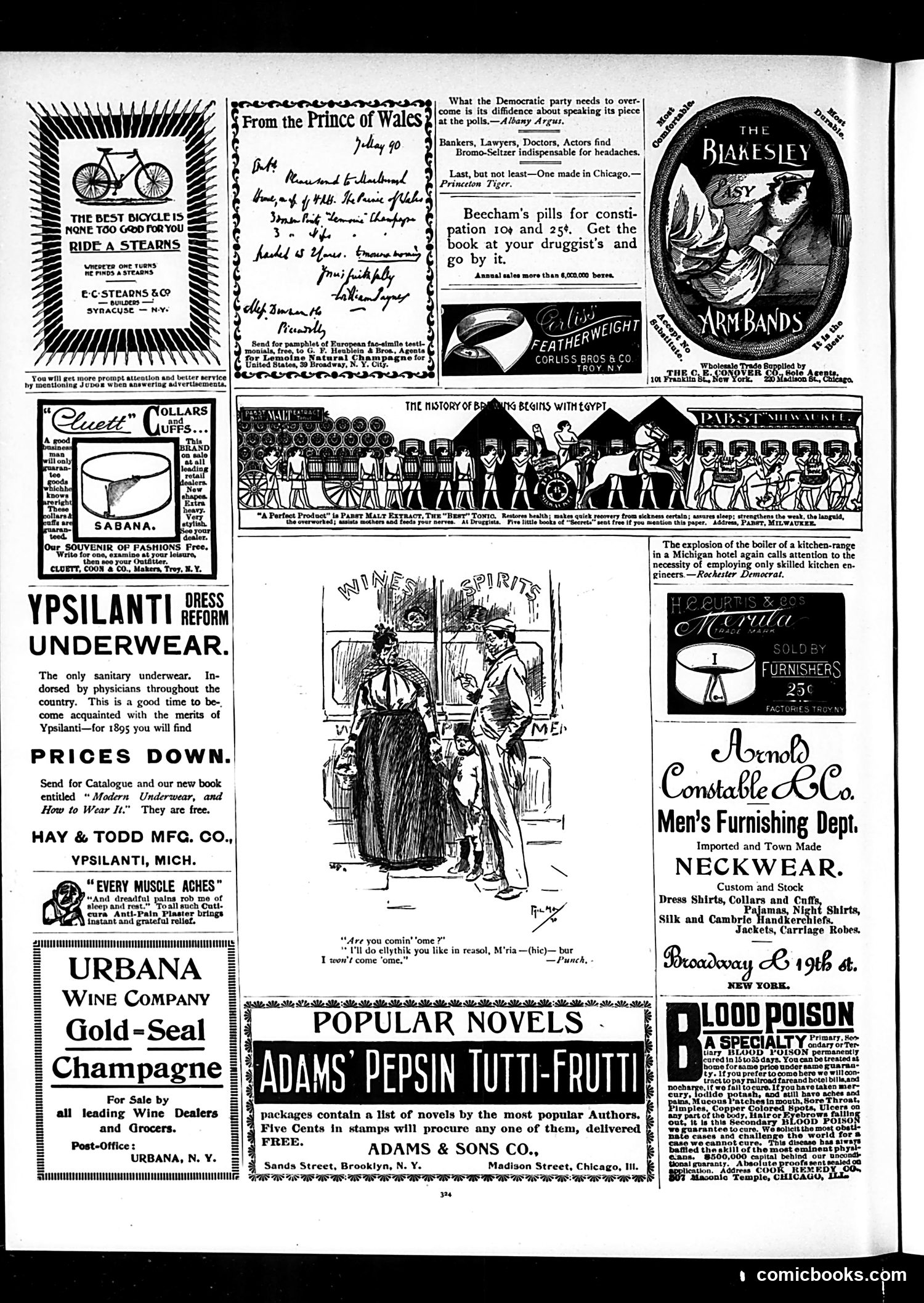
This page is primarily **advertising**, typical of 1890s publications. The key satirical content is minimal: **The Main Cartoon** (center): A sketch titled "Wines & Spirits" showing two figures in what appears to be a domestic dispute. The caption reads: "Are you comin' 'ome?" / "I won't come 'ome" — a humorous commentary on marital discord, likely suggesting alcohol's role in domestic problems. The style mimics Punch magazine's satirical approach to working-class life. **Editorial Snippets** (top): Brief political quotes, including one about what the Democratic Party needs, and another from *Albany Argus* — these are typical filler commentary found in Judge. **Historical Context for Modern Readers**: The ads reflect 1890s consumer products (bicycles, patent medicines like Beecham's pills, underwear reforms, wine) marketed to middle-class readers. The "Every Muscle Aches" pain remedy ad is particularly period-specific. The page demonstrates how 19th-century magazines blended advertising with light satire and social commentary.
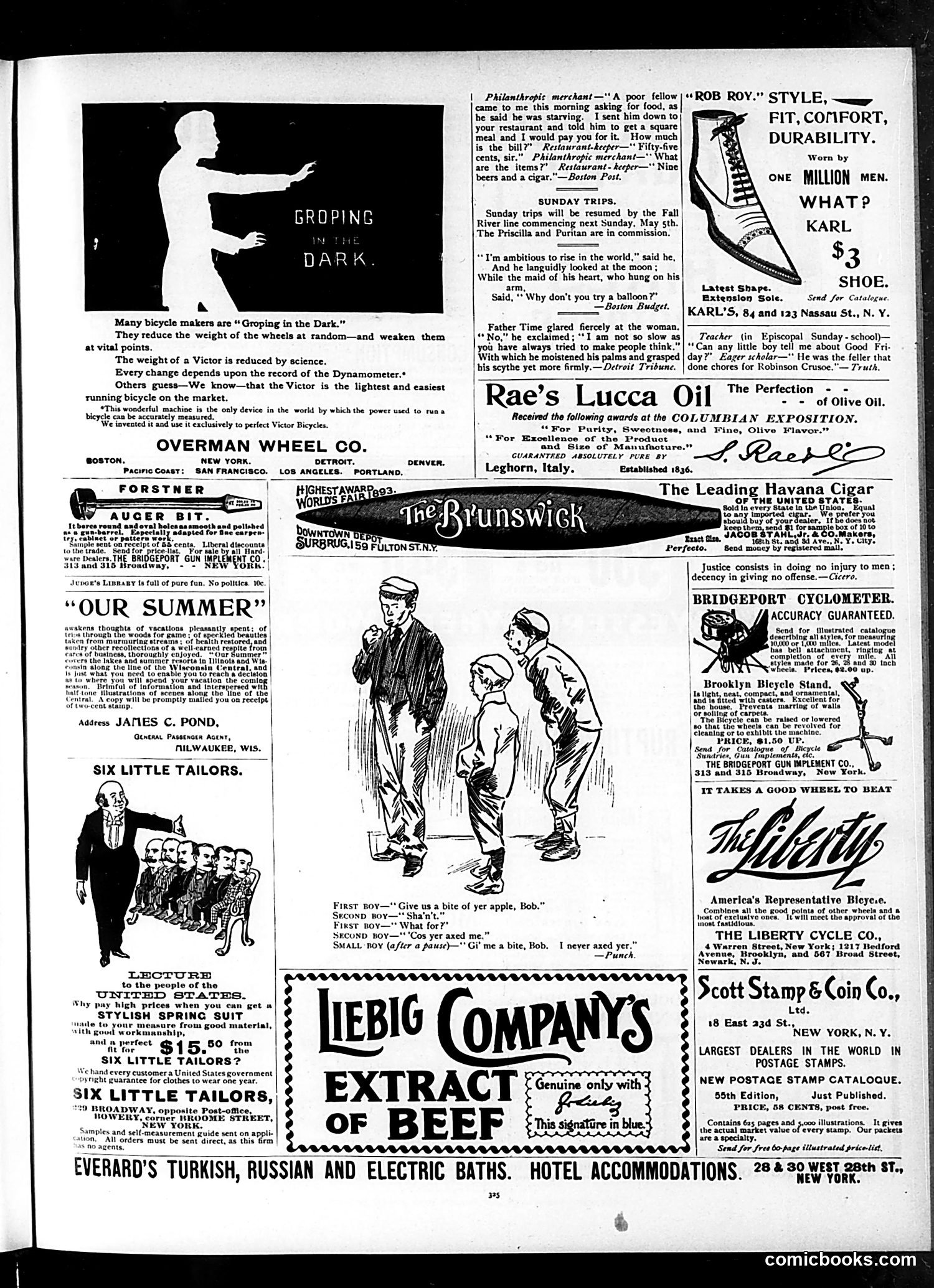
This page consists primarily of **advertisements and brief humorous anecdotes** rather than political cartoons. The main satirical content includes: **"Grooping in the Dark"** - A bicycle industry critique. Competitors allegedly reduce wheel weight randomly, weakening bicycles. Victor bicycles, by contrast, use scientific measurement (a "Dynamometer") to improve design. This mocks competitors' trial-and-error approaches. **Restaurant joke** - A philanthropist sends a starving man to eat, expecting a modest bill. It totals fifty cents for "nine beers and a cigar"—satirizing either the man's poor priorities or the restaurant's inflated prices for such items. **Sunday school joke** - A child confuses Good Friday with Robinson Crusoe's servant "Friday," missing the religious reference entirely. This gentle humor mocks children's literal-mindedness. **Time and the Woman** - Personified Time (typically depicted as elderly/slow) angrily defends himself against accusations of slowness, humorously treating abstract concepts as characters in domestic disputes. The page is otherwise dominated by bicycle, shoe, food extract, and other consumer product advertisements typical of the era.
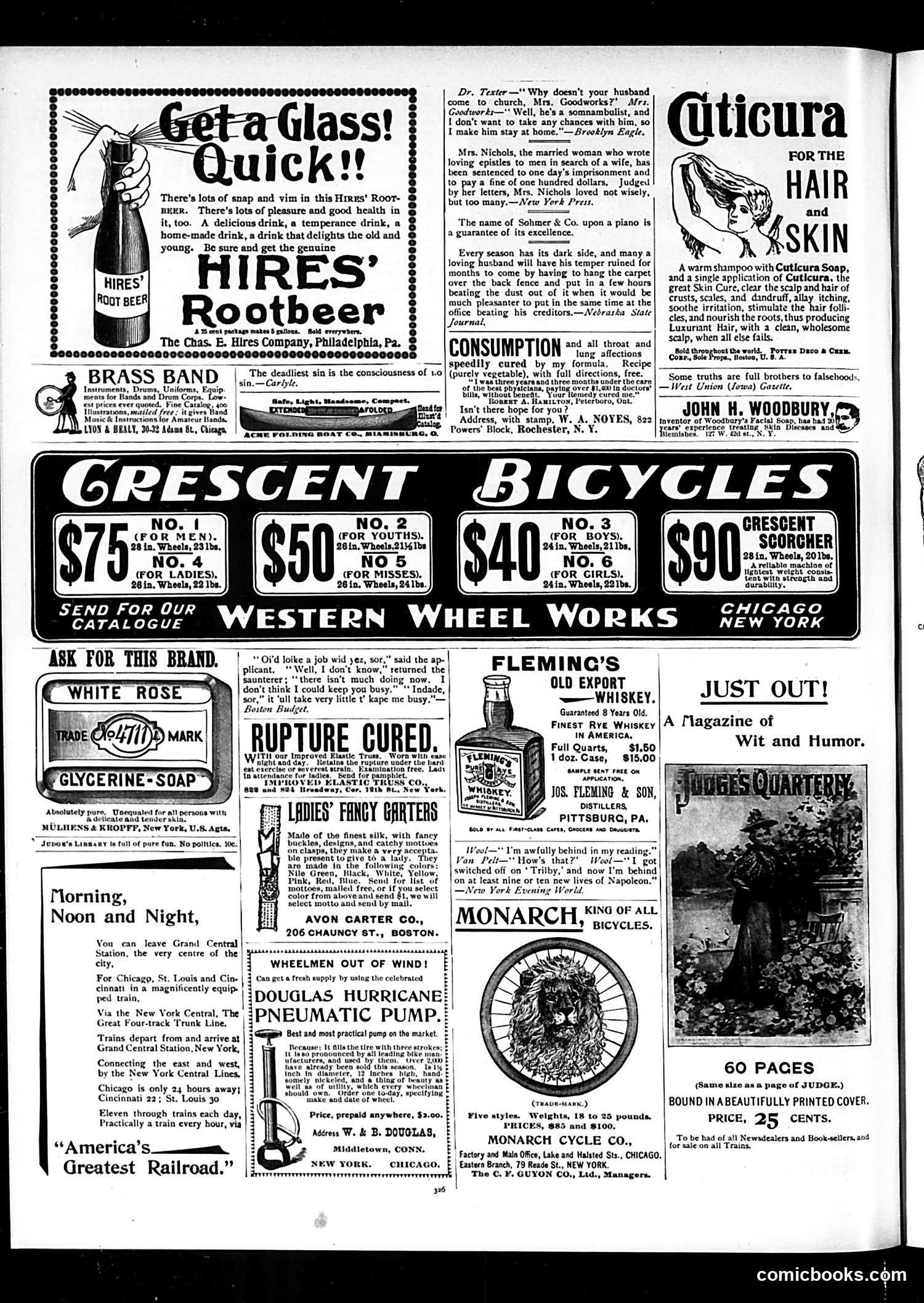
This is primarily an **advertising page** from Judge magazine, with minimal editorial content. The few satirical items present are brief: **Visible humor/satire:** 1. A doctor joke about a wife who won't let her "somnambulist" husband attend church—mocking either her concern or his sleepwalking condition as an excuse. 2. A brief item about Mrs. Nichols, a woman who wrote romantic letters to men seeking wives. She was sentenced to one day in jail and a fine, with the commentary "loved not wisely, but too many"—satirizing overeager matrimonial solicitation. 3. A humorous observation about husbands resenting carpet-beating season because it cuts into office time (presumably to avoid creditors). **Dominant content:** The page is filled with period product advertisements—bicycles, soap, root beer, pianos, and medical remedies—typical of Judge's revenue model. The advertising far outweighs any satirical commentary, making this primarily a commercial publication page rather than a showcase for political or social satire.
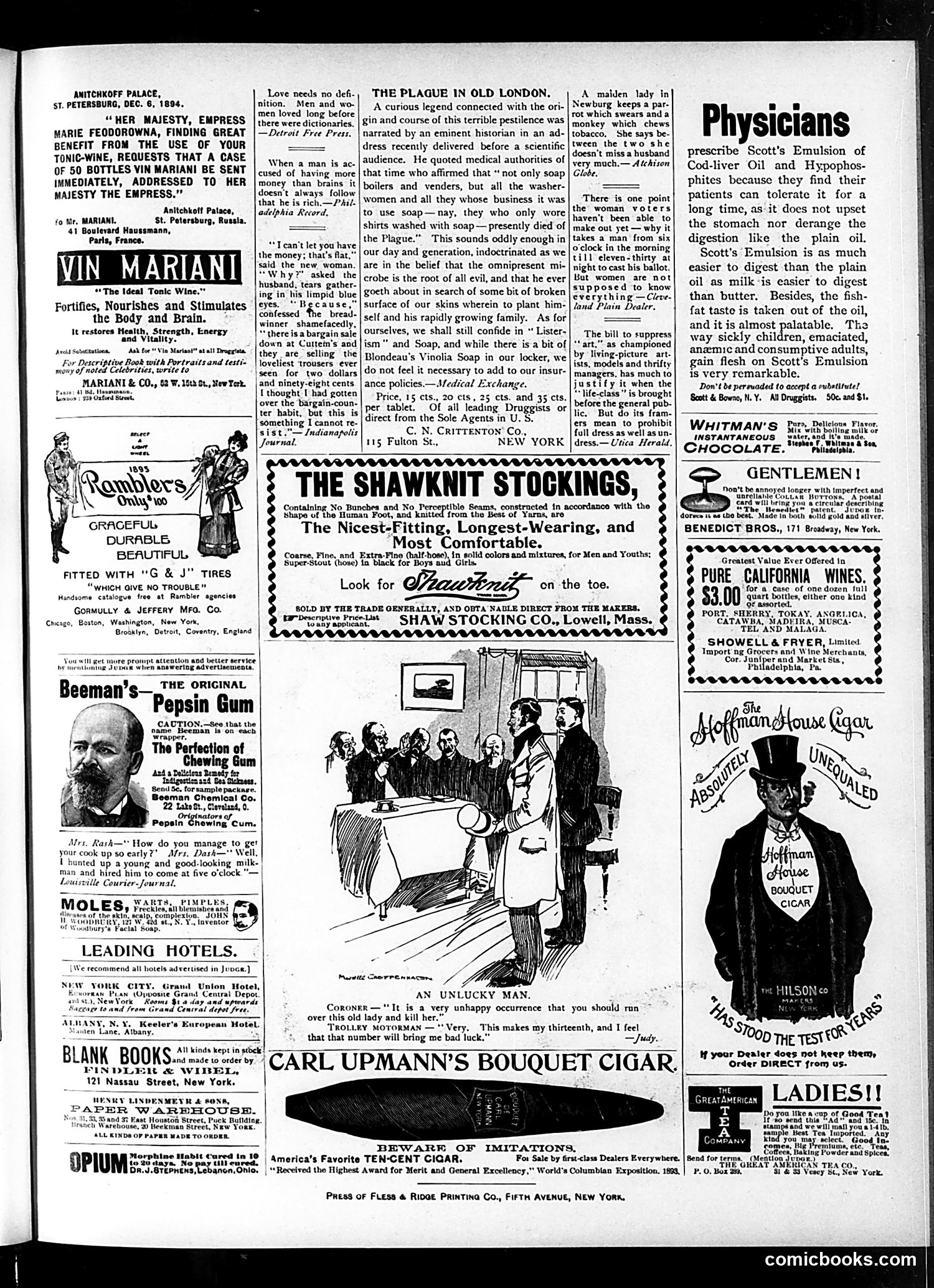
This page is primarily **advertising**, with one notable satirical cartoon titled "An Unlucky Man" showing a man being confronted by an angry woman—apparently he's run over her with a vehicle, and she threatens to kill him. The joke plays on the woman's disproportionate rage and his deadpan response about "bad luck." The ads showcase period products: Vin Mariani (a cocaine-wine tonic endorsed by the Russian Empress), Rambler bicycles, Beeman's Pepsin Gum, and Carl Upmann cigars. These reflect late-19th-century consumer culture. A brief satirical snippet mocks women's independence: a husband asks his cook's punctuality secret; the wife reveals she hired an attractive milkman to wake her early—a dig at the "New Woman" and changing gender dynamics. The page also discusses a historical legend about London's plague, and includes commentary on "living picture art" (early performance/photography), suggesting Victorian anxieties about morality and propriety.
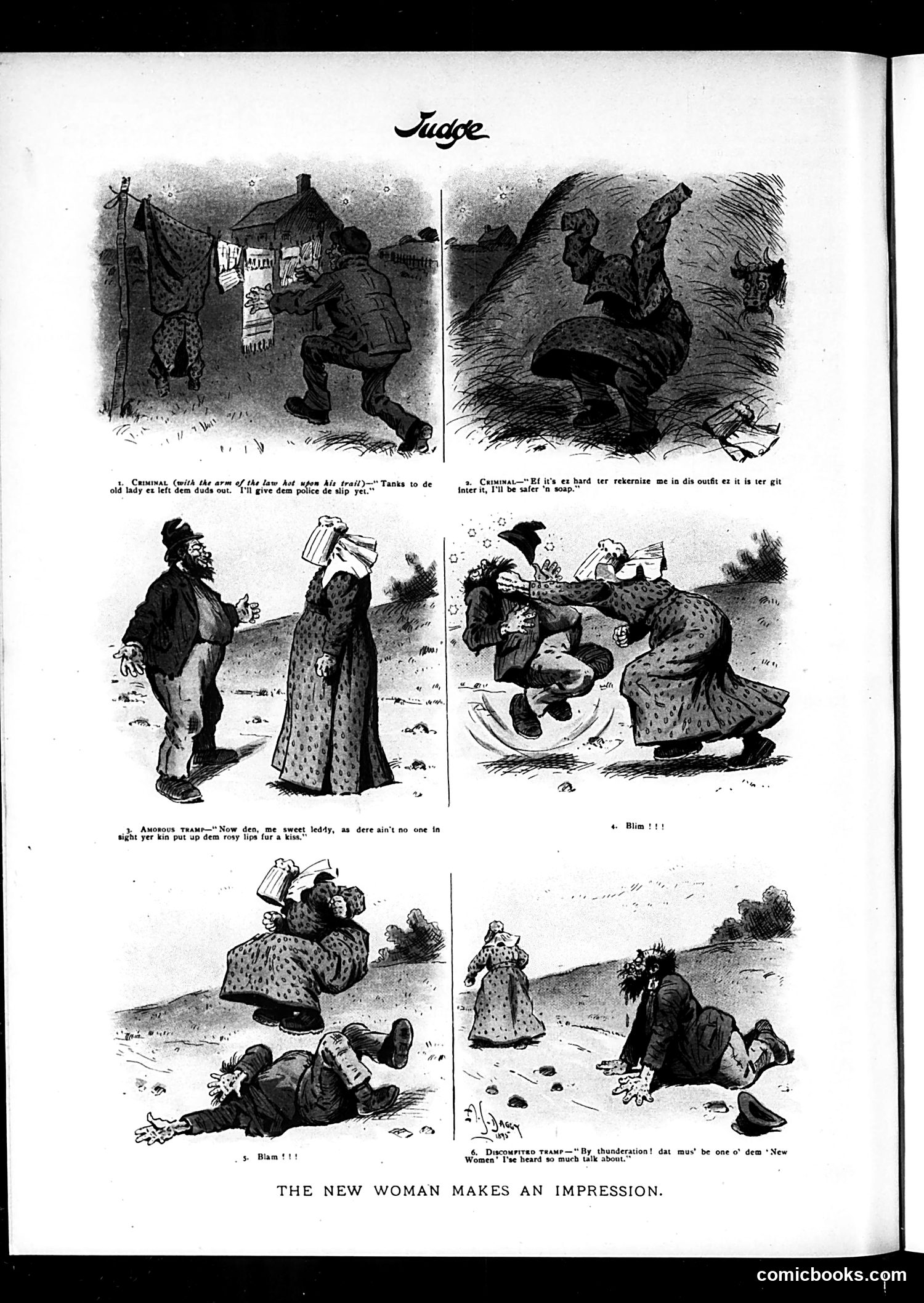
This satirical comic strip mocks the "New Woman"—a late-19th-century figure representing women gaining independence, education, and social freedoms. The six panels show a woman in modern dress physically overpowering men in various scenarios: A criminal evades police; a woman disguised as a man fools authorities. A would-be romantic suitor is violently rejected. A "discouraged tramp" is shocked when the "New Woman" aggressively attacks him instead of being victimized. The satire's point: the emerging independent woman threatens traditional male dominance and Victorian gender roles. By depicting her as physically violent and masculine, the cartoonist ridicules feminist progress as unnatural and dangerous. The exaggerated dialect and slapstick suggest this "New Woman" is a social disruption worthy of mockery rather than a legitimate social development.