
A complete issue · 16 pages · 1895
Judge — April 27, 1895
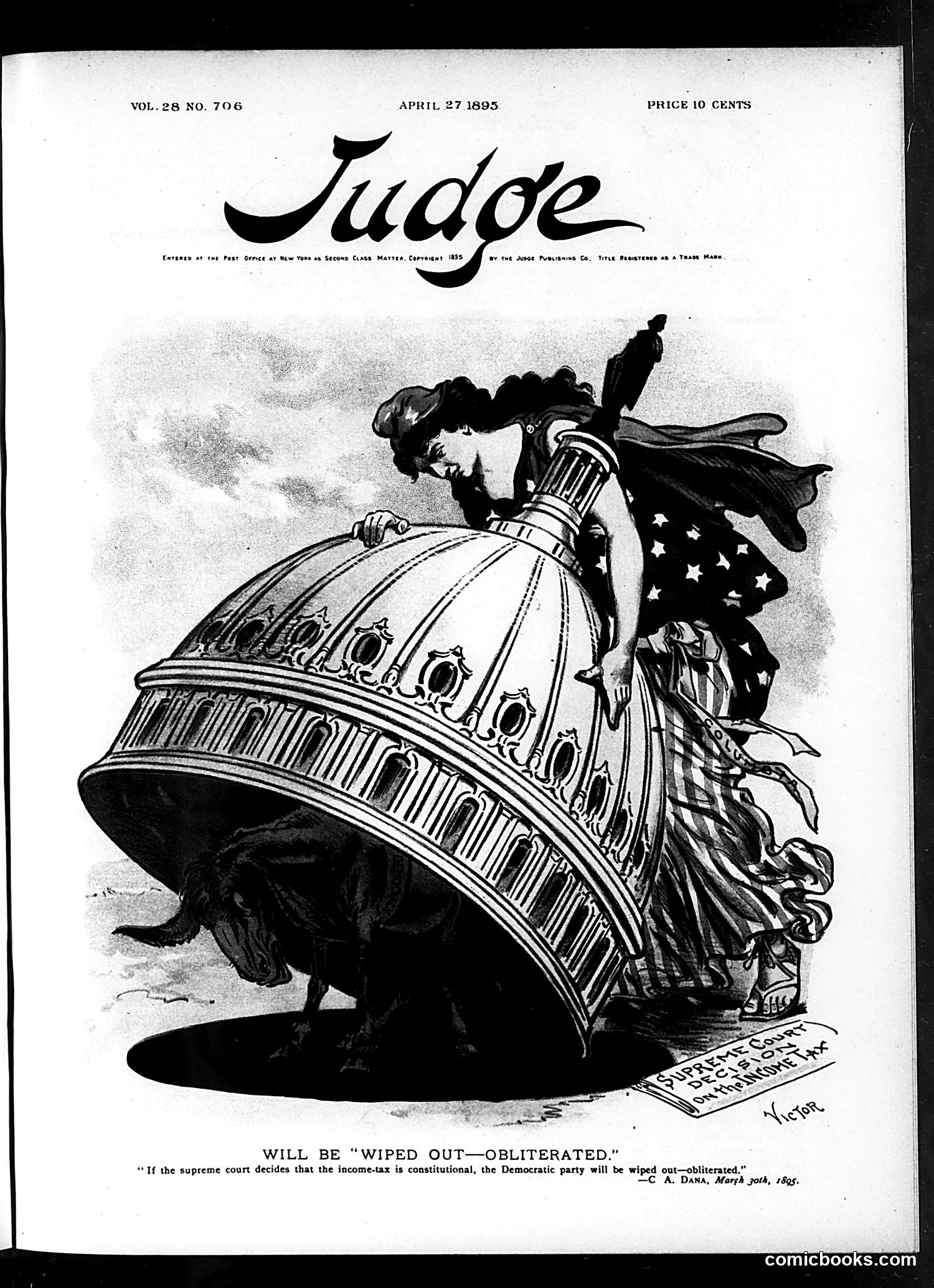
This cartoon depicts Lady Liberty (identifiable by her starred cape and classical dress) precariously balanced atop the U.S. Capitol dome, which rests on an elephant—the Republican Party symbol. She appears to be falling or losing her footing. The caption quotes C.A. Dana from March 30th, 1895: "If the supreme court decides that the income-tax is unconstitutional, the Democratic party will be wiped out—obliterated." The satire mocks Dana's prediction by visually suggesting that instead, *Republican* control of the government (symbolized by the elephant) endangers American liberty itself. The cartoon argues that Republican policies—particularly their anticipated Supreme Court decision against the income tax—threaten democratic principles, not the Democratic Party.
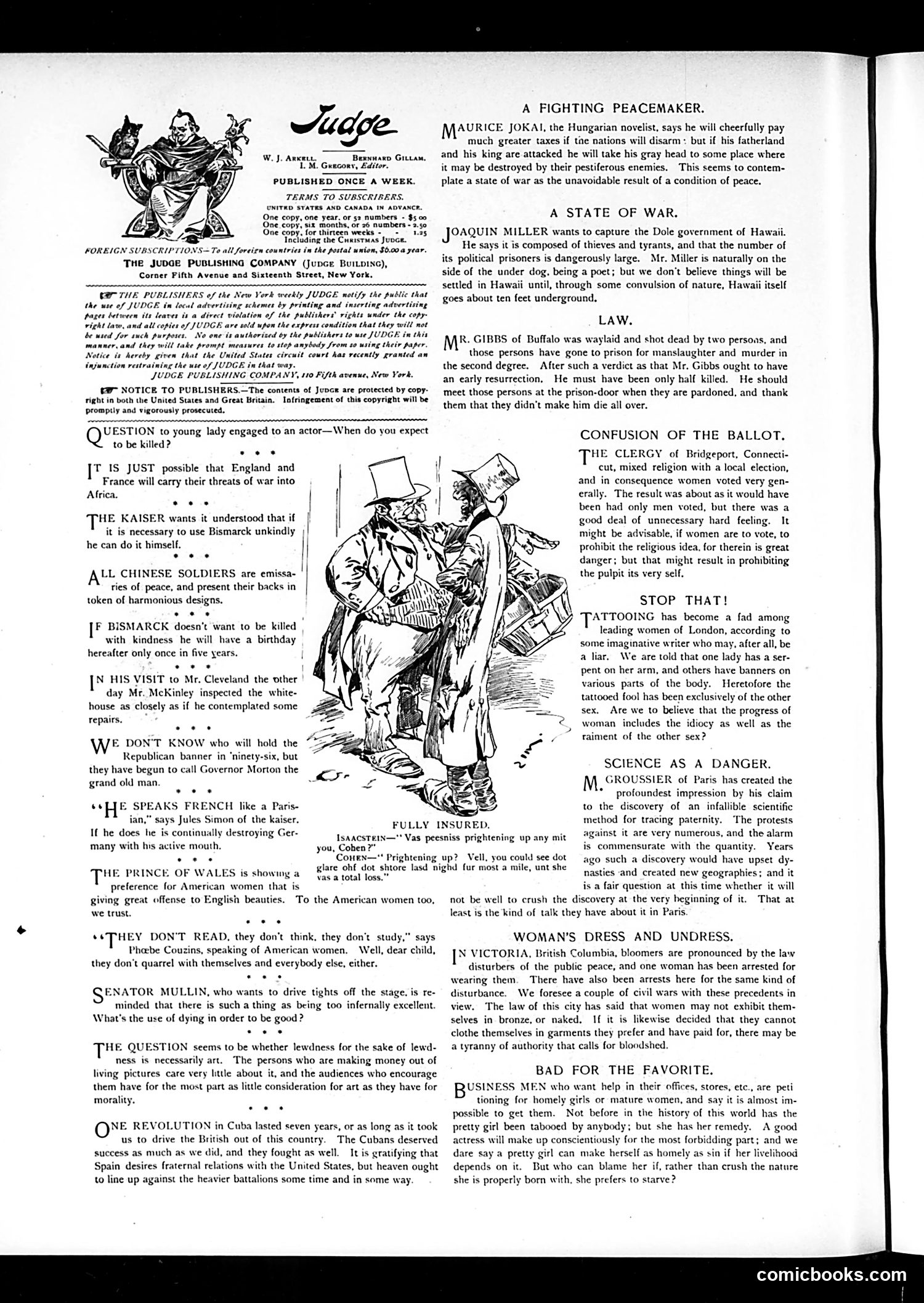
The main cartoon depicts a **ballot-box confusion scene** illustrating the "Confusion of the Ballot" article. It shows multiple figures struggling with voting materials—one woman appears bewildered while men gesture animatedly around ballot boxes and papers. The satire concerns a **Connecticut clergy controversy**: local clergy mixed religion with voting, causing women to vote unusually broadly. The cartoon mocks the resulting chaos and "unnecessary hard feeling," suggesting that mixing religious authority with electoral participation produced confusion and poor judgment. The surrounding brief items target various figures: Maurice Jokai (Hungarian novelist), Joaquin Miller (poet seeking Hawaiian political office), and commentary on women's suffrage, Bismarck, and American politics. The overall tone satirizes political incompetence and social disorder.
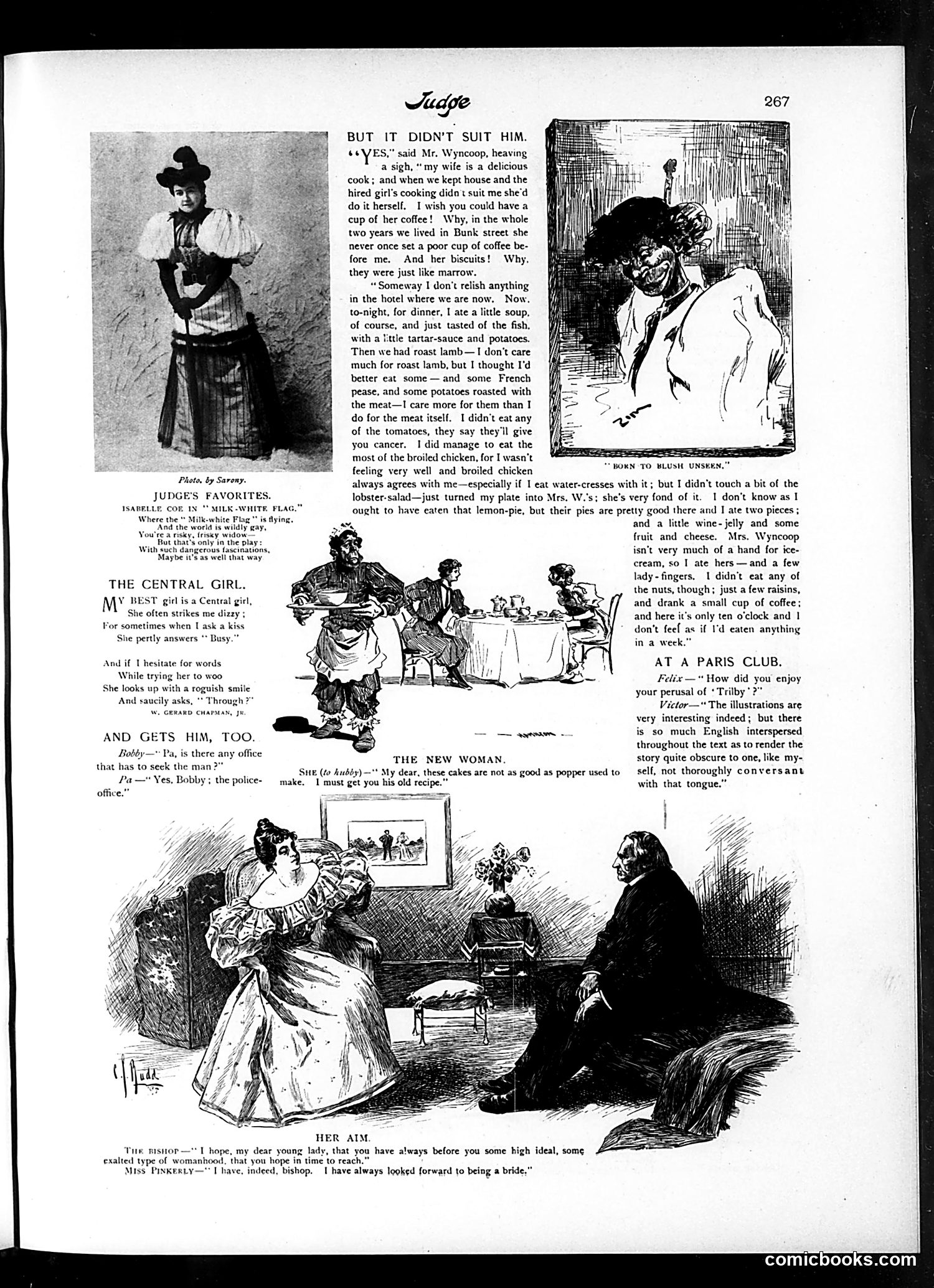
This page contains several humorous sketches and poems satirizing social attitudes toward women and marriage around the turn of the 20th century. "The Central Girl" mocks a young woman who plays coy while actually pursuing marriage. "The New Woman" depicts a wife criticizing her husband's cooking, suggesting anxieties about women's changing domestic roles. "Her Aim" shows a bishop advising a young lady to maintain "high ideals" before marriage—satirizing how society's romantic rhetoric contrasts with reality. The sketches present women as either manipulative, overly opinionated, or unrealistically idealistic. The humor targets both female ambitions and male anxieties about women's evolving independence during this period of social change.
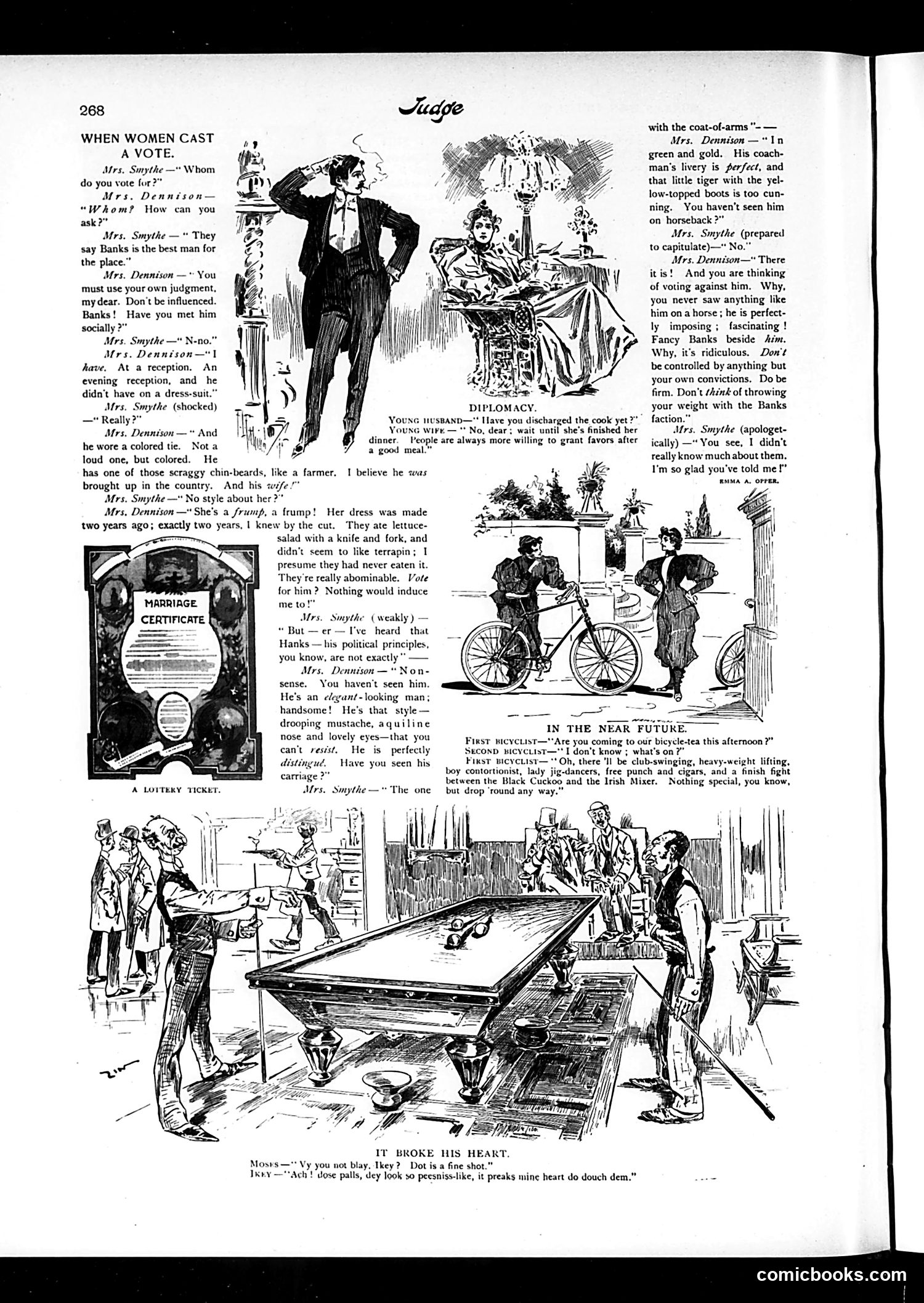
This page satirizes early women's suffrage and female political participation. The main dialogue between Mrs. Smythe and Mrs. Dennison mocks women voters as superficial and easily swayed by irrelevant factors. Mrs. Dennison explicitly tells Mrs. Smythe to vote based on a candidate's personal appearance, social graces, and carriage rather than political principles—then contradicts herself by insisting Mrs. Smythe think independently. The joke exposes the hypocrisy: women are portrayed as intellectually unfit for voting because they care only about fashion, dining etiquette, and a politician's handsome appearance. The surrounding cartoons reinforce domestic themes: "Diplomacy" jokes about manipulating a cook; the bicycle scene depicts women's leisure activities. The satire suggests that newly enfranchised women lack serious political judgment and will undermine democratic processes through vanity and emotional reasoning.
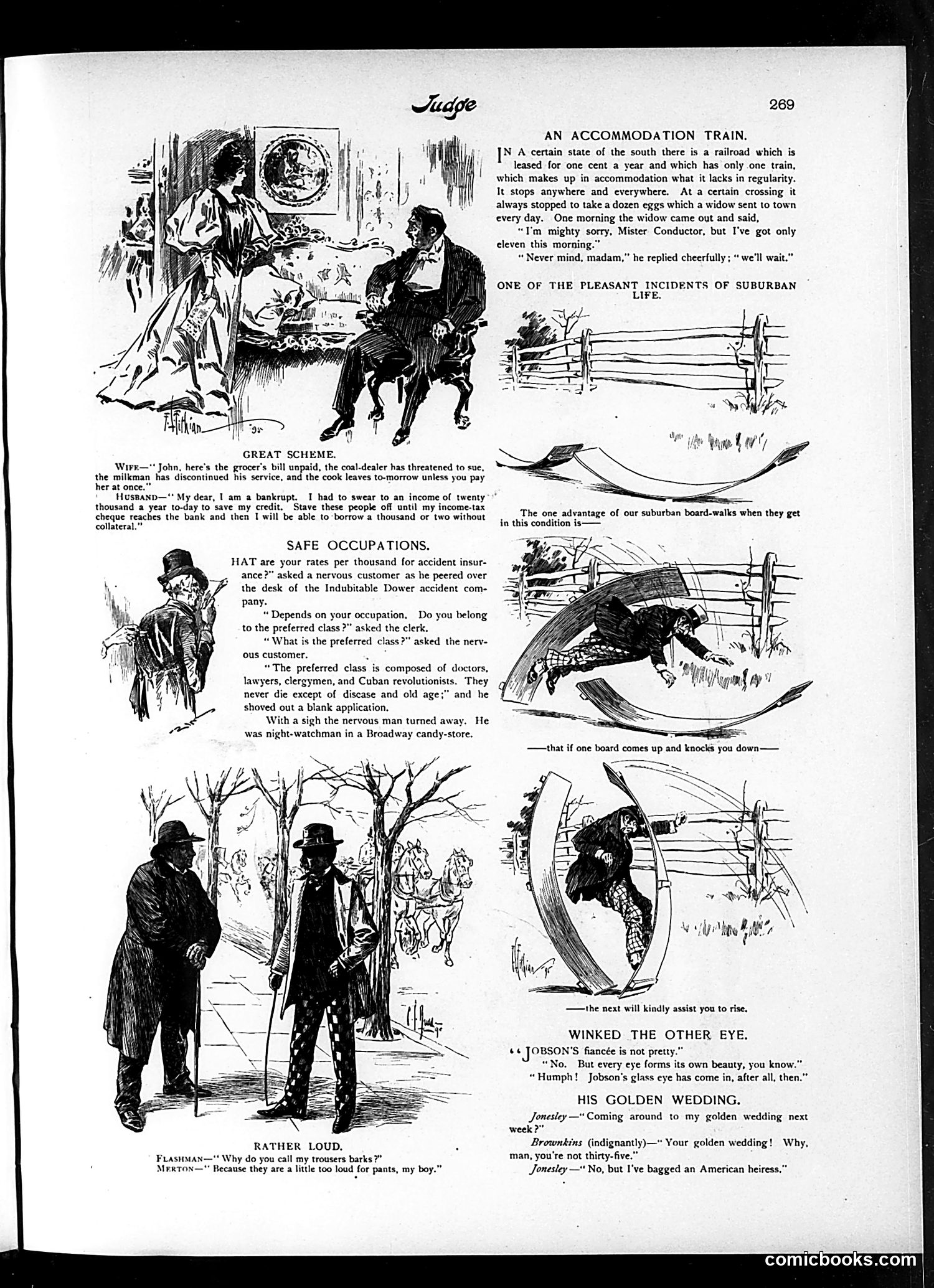
This page contains multiple satirical sketches typical of late 19th/early 20th-century American humor: **"Great Scheme"**: A husband admits bankruptcy while proposing to delay paying servants and creditors until his income-tax refund arrives—satirizing financial irresponsibility and the then-novel income tax system. **"Safe Occupations"**: An insurance clerk lists "preferred" low-risk professions (doctors, lawyers, clergy, and Cuban revolutionists), leaving a night-watchman rejected. This likely mocks American sympathy for Cuban independence fighters and the absurdity of calling revolutionists safer than ordinary workers. **"Rather Loud"**: A pun on "loud" trousers (garish patterns). **"An Accommodation Train"**: Southern railroad humor about a train so slow it stops for a widow's eggs—gentle mockery of rural Southern inefficiency. **"Winked the Other Eye"**: A joke about a man with a glass eye whose fiancée isn't pretty. **"His Golden Wedding"**: A man celebrates his "golden" wedding (50 years) at age 35 because he married for money—satirizing wealthy American heiresses as marriage prizes.
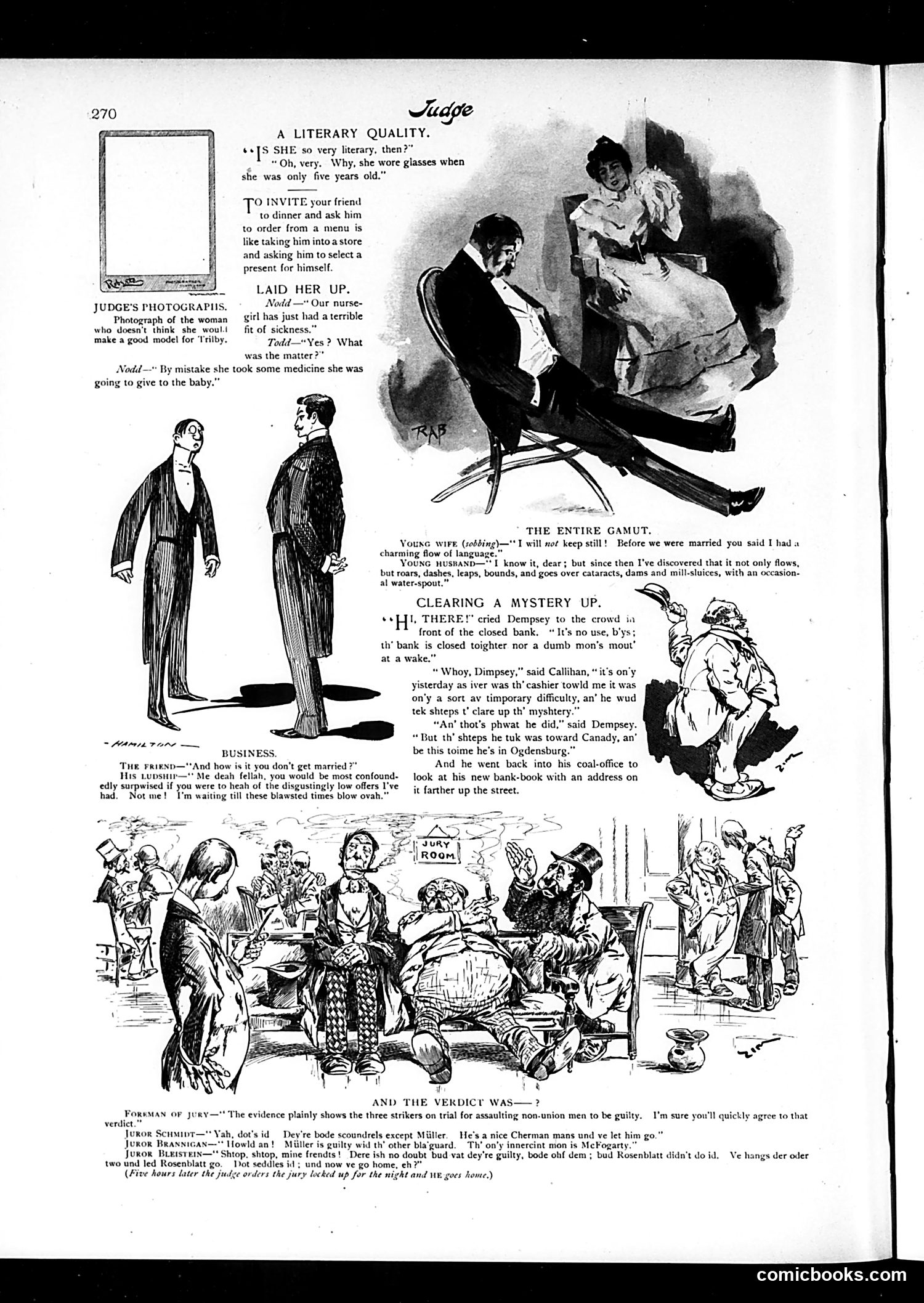
This page collects multiple satirical sketches typical of Judge's humor: **"A Literary Quality"** mocks pretentious women who adopt affectations (wearing glasses at age five) to appear intellectual. **"The Entire Gamut"** depicts marital discord—a wife complains her husband no longer appreciates her "charming flow of language," which he now describes as an "water-spout," satirizing how romance deteriorates in marriage. **"Clearing a Mystery Up"** jokes about a bank cashier who disappears during a financial crisis, with Irish-accented characters realizing he fled to Canada/Ogdensburg to escape responsibility—commentary on embezzlement and financial instability of the era. **"And the Verdict Was—?"** features a jury with heavy immigrant accents (rendered phonetically) reaching a verdict in a labor dispute involving strikers assaulting non-union workers. The foreman's illogical decision to acquit most defendants while convicting one innocent man satirizes both labor tensions and immigrant jurors' perceived incompetence. The crude dialect humor reflects period prejudices against immigrant populations.
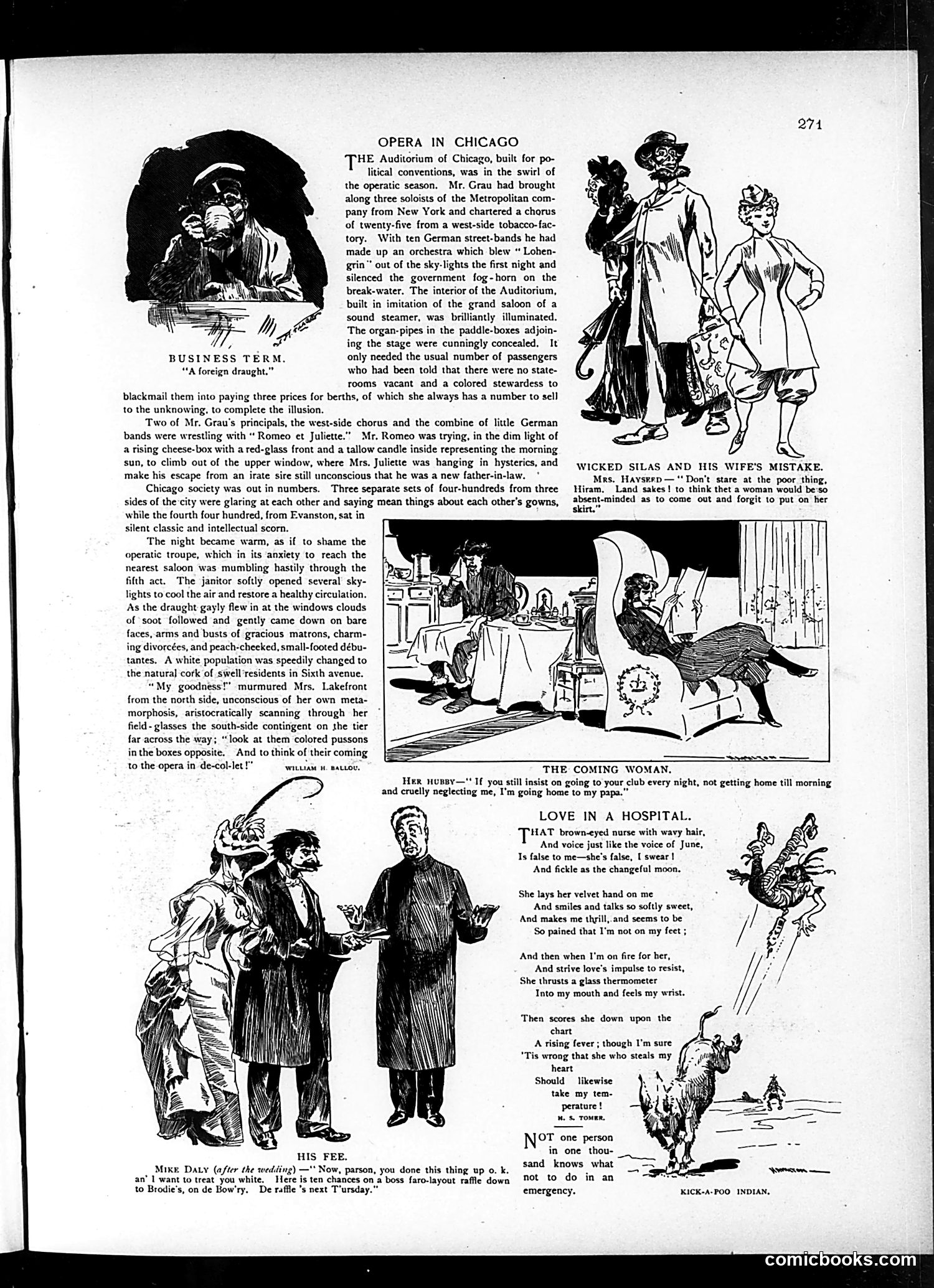
This page from Judge satirizes Chicago's operatic pretensions and social hierarchies circa early 1900s. **"Opera in Chicago"** by William H. Ballou mocks Mr. Grau's hastily assembled production at the Auditorium—chorus members from a tobacco factory, street bands as orchestra. The satire targets Chicago society itself: multiple competing "four-hundred" (elite) social sets glaring at each other while Evanston's wealthy sit in "silent classic and intellectual scorn." The punchline: when janitors open skylights for ventilation, soot rains on the fashionable crowd, turning their white skin the color of "cork of swell residents in Sixth avenue"—a racial dig suggesting pretentious northside society lady Mrs. Lakefront mistakes the soot-covered audience for Black attendees, horrified they're at the opera in revealing dress. **Other cartoons** include domestic humor ("Wicked Silas," "The Coming Woman," "Love in a Hospital") about marriage, infidelity, and courtship—standard Judge fare. These satirize gender relations and romantic entanglement without specific political reference. The page primarily mocks Chicago's cultural aspirations and class anxieties through opera-season social climbing.
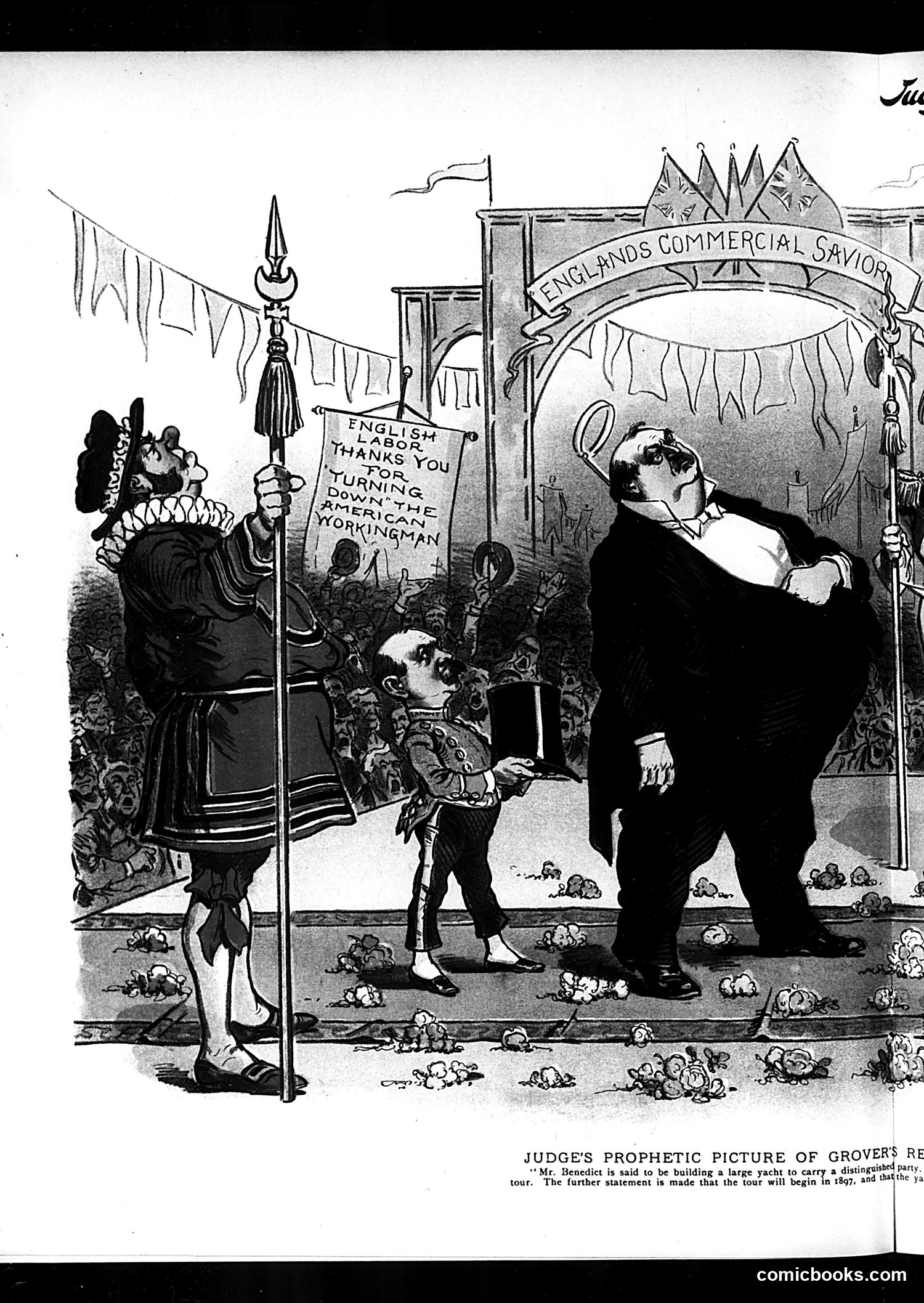
This Judge magazine cartoon satirizes **Grover Cleveland** (referenced as "Grover" in the title), likely commenting on rumors about a yacht tour he supposedly planned. The image shows a formal diplomatic scene at what appears to be an "England's Commercial Savior" reception. The cartoon's "prophetic picture" mocks Cleveland's potential absence from America—the elaborate British ceremonial setting suggests the magazine is joking that he'll abandon his presidential duties for leisure travel. The sign reading "English Labor Thanks You for Turning the American Workingman" indicates satire about economic policy, possibly referencing Cleveland's tariff positions or labor relations. The 1897 date mentioned suggests this appeared before that year, predicting Cleveland's hypothetical departure. The elaborate, mocking tone typical of Judge's political commentary suggests this was critical commentary on Cleveland's leadership or personal choices.
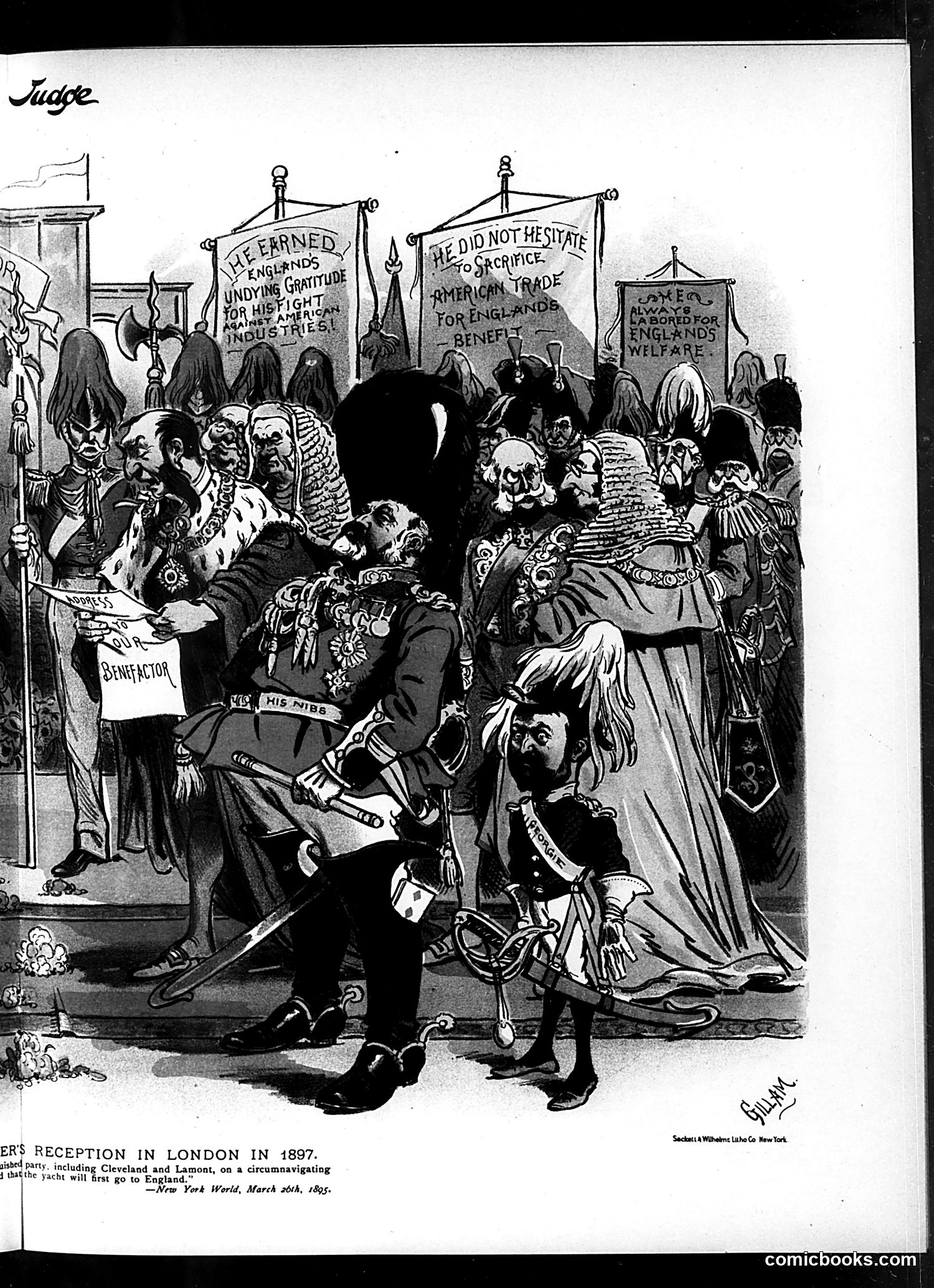
This Judge cartoon satirizes an American expedition's reception in England. The banners held by British dignitaries praise American industrial achievement and trade benefits ("He earned England's undying gratitude for his American industries" and "He did not hesitate to sacrifice American trade for England's benefit"). The satire is double-edged: it mocks both British flattery toward American success and suggests American leaders are being seduced by English praise into sacrificing American economic interests. The cartoon appears to reference a circumnavigating expedition (possibly involving Cleveland or Lamont, as mentioned in the caption), critiquing how American businessmen or politicians might be compromised by European diplomacy. The elaborate British ceremony and exaggerated praise expose what the cartoonist viewed as manipulative foreign relations.
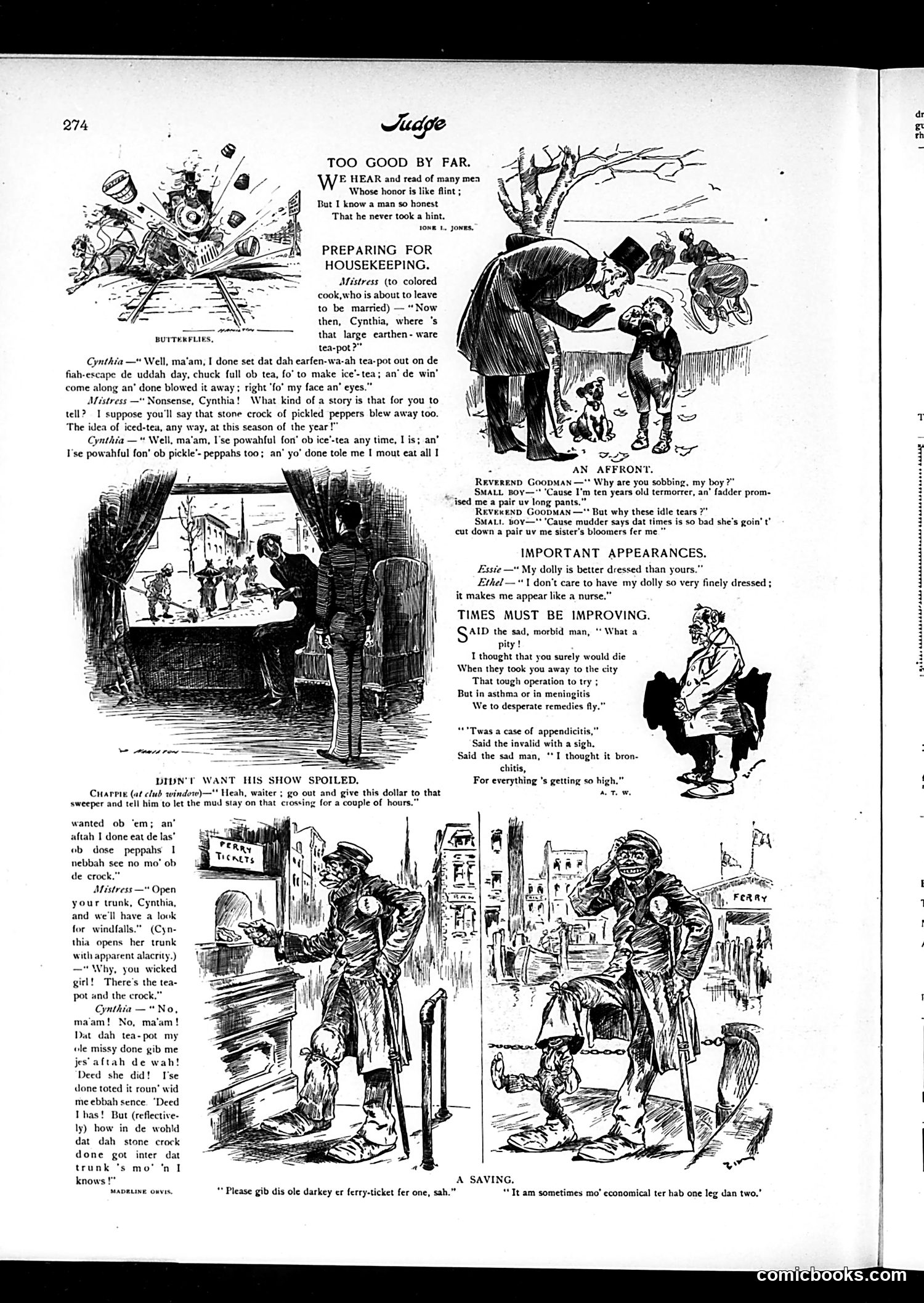
This page contains several comic sketches satirizing late-19th century American society: **"Preparing for Housekeeping"** (main cartoon): A white mistress interrogates her Black cook Cynthia about missing household items. Cynthia offers implausible excuses (wind blew away a teapot), yet the items mysteriously appear in her trunk. The satire targets both the dishonest servant stereotype and the mistress's naive gullibility—she's "too good" to suspect theft. **Other sketches** mock contemporary concerns: a boy upset about wearing his sister's hand-me-down bloomers instead of long pants (economic hardship); children's vanity about doll clothing; complaints about rising costs; and a disabled man's grim joke about amputation as economy. The dialect and racial caricature reflect period prejudices. The humor relies on servant dishonesty tropes and class/gender anxiety common to Gilded Age American magazines.
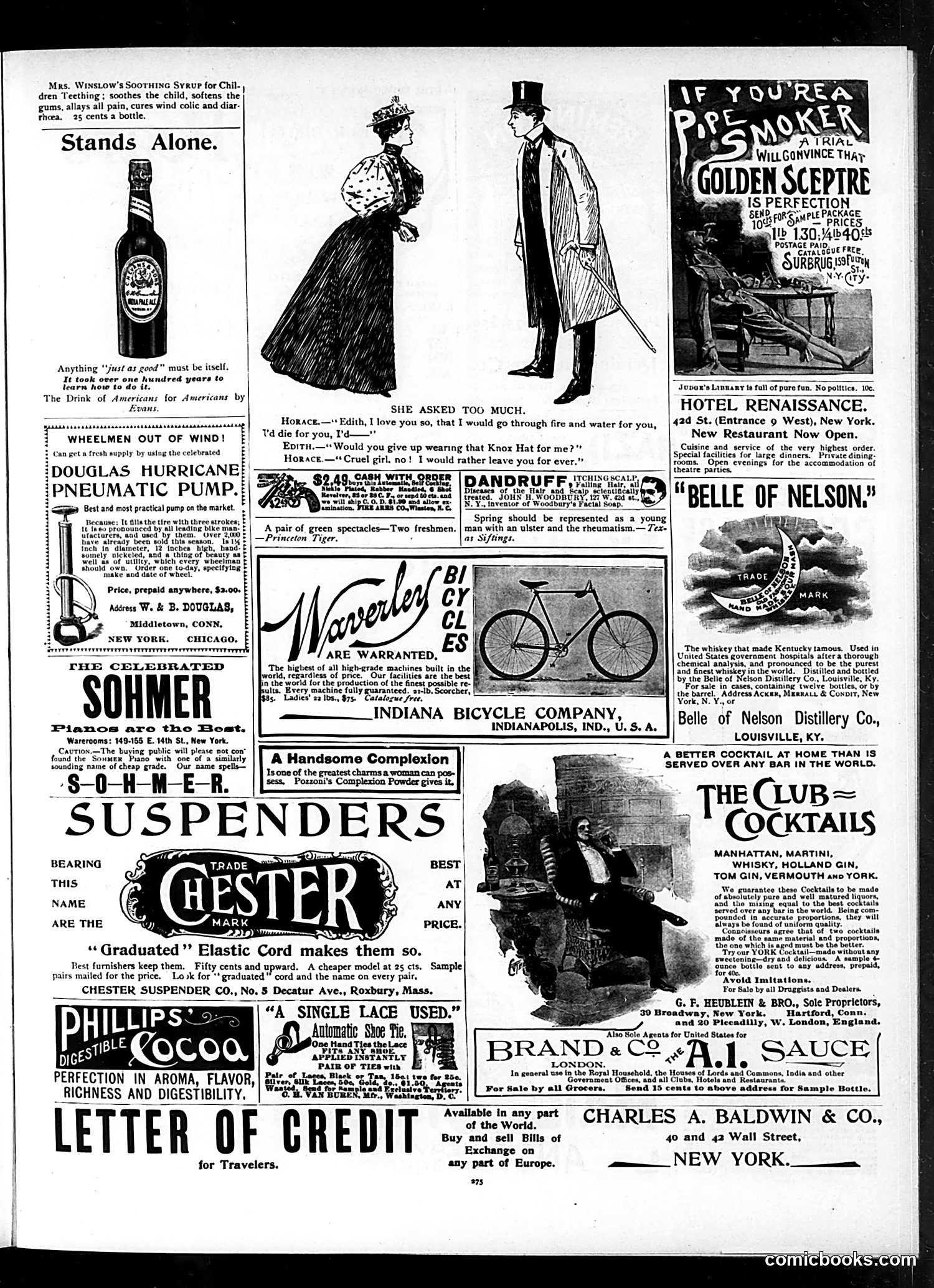
This is primarily an **advertisement page** from Judge magazine, not a satirical cartoon. However, it contains one small comic dialogue titled "She Asked Too Much." ## The Comic Section The single joke depicts a romantic conversation between a man (Horace) and woman (Edith). Horace declares he'd "die for you," but when Edith asks him to give up wearing his Knox Hat, he refuses—stating he'd "rather leave you for ever." **The satire**: This mocks male vanity and the era's obsession with fashionable hats as status symbols. It satirizes the gap between romantic declarations and actual sacrifice—a man will profess unlimited devotion but won't surrender material possessions or fashion choices for love. The humor lies in the absurdity of prioritizing a hat over a woman. ## Surrounding Content The page is dominated by period product advertisements (pianos, bicycles, whiskey, cocoa, suspenders) typical of 1890s-era magazines. These ads provide historical context about consumer goods and marketing practices of the era, but contain no political or social satire themselves.
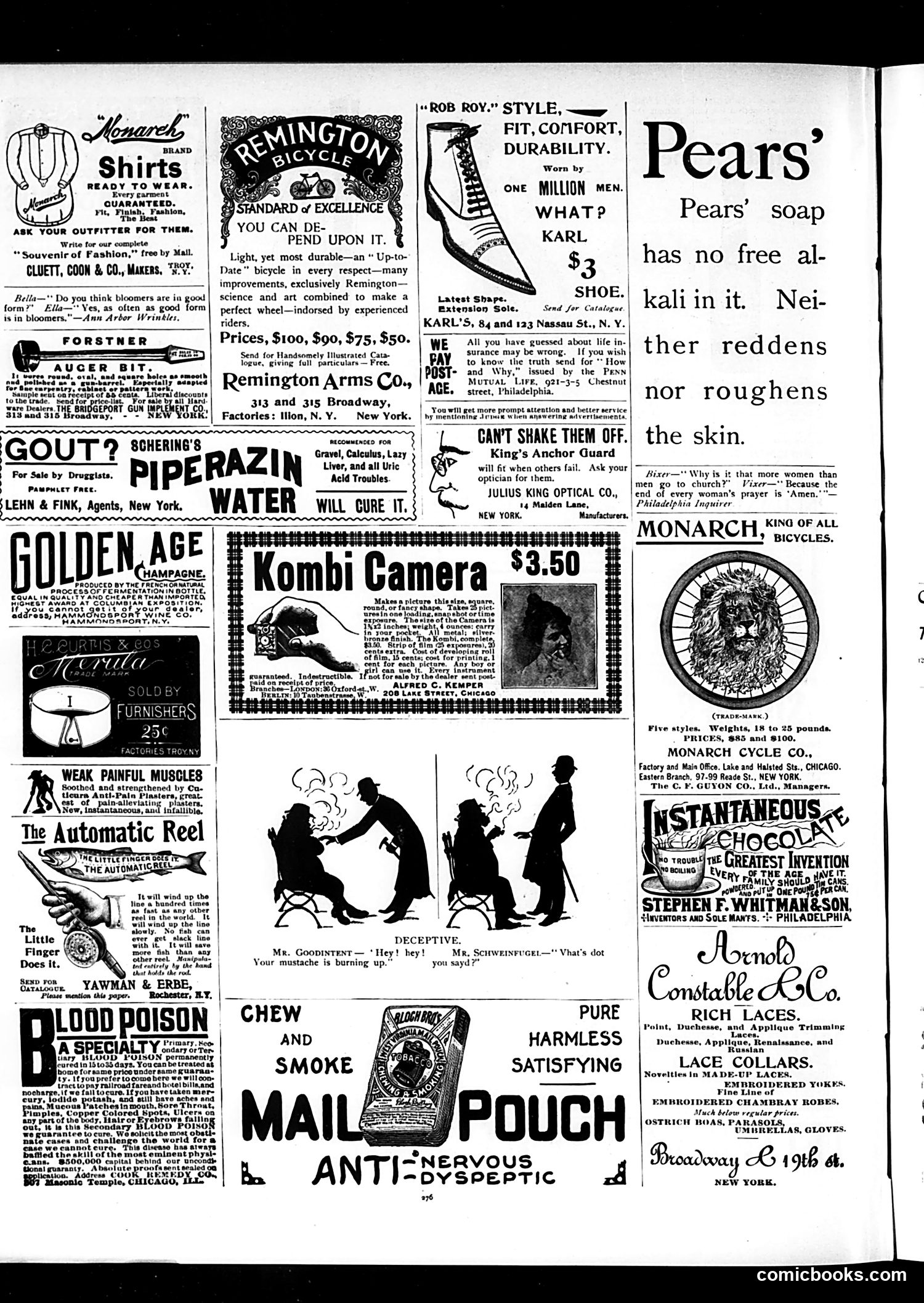
This page is primarily **advertising**, typical of early 1900s magazines. Notable satirical content includes: **"DECEPTIVE" Cartoon**: A visual joke depicting two men with their mustaches on fire. Mr. Goodintent says "Hey! hey! Your mustache is burning up," while Mr. Schweinfurfel replies "What's dot you sayd?"—a play on German accent humor common in period satire. The joke's point is unclear without additional context, but likely mocks either vanity about facial hair or ethnic stereotypes. **"Bloomers" Joke**: A brief exchange between "Bella" and "Ella" about whether bloomers are "in good form"—satirizing the controversial women's garment of the era and the double meaning of "form" (fashion vs. physical appearance). This reflects contemporary debates over women's dress reform. The rest consists of patent medicines, bicycle advertisements, and shoe/clothing promotions typical of Judge's revenue model, without apparent satirical content.
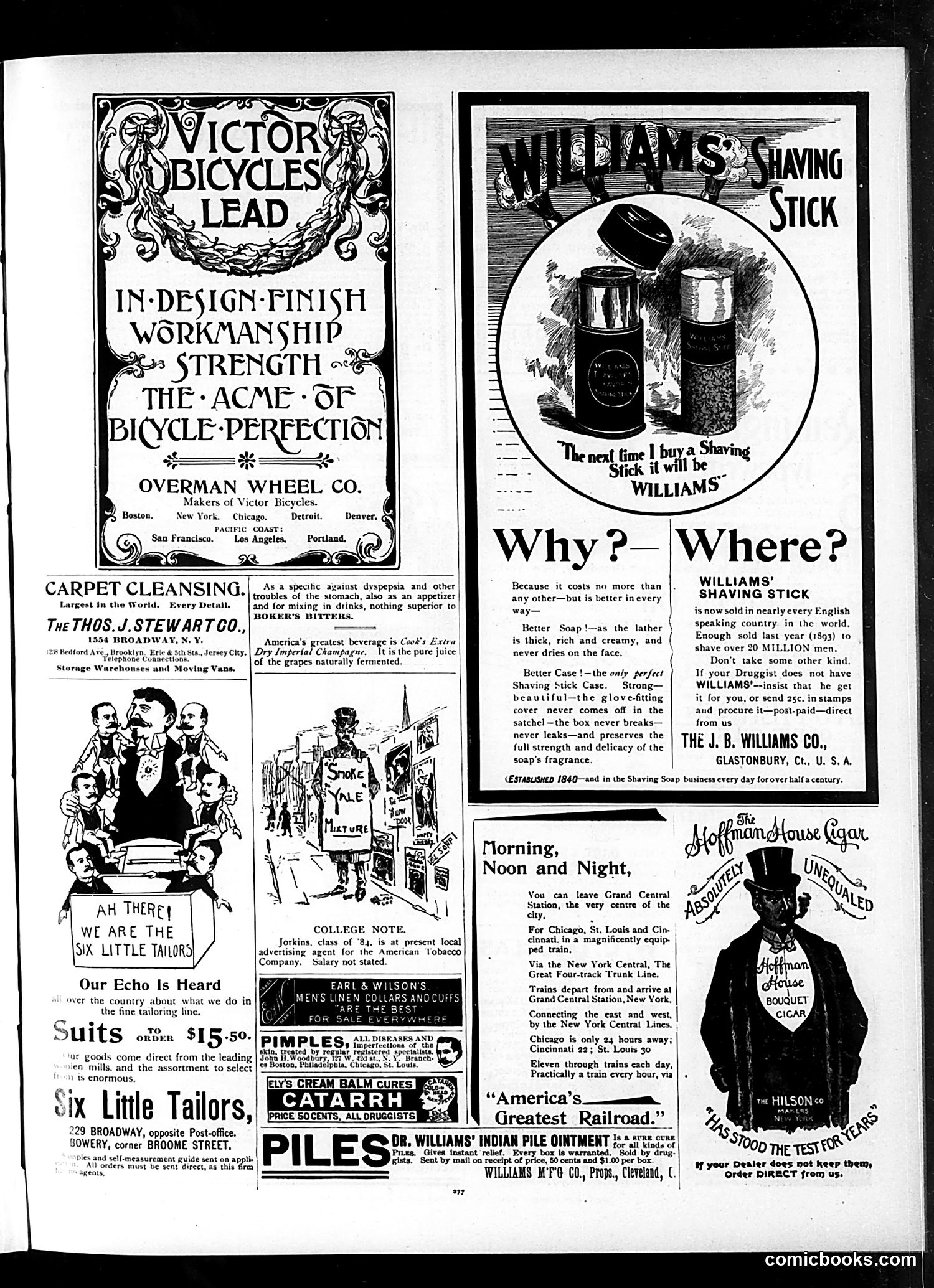
This page is primarily **advertising**, not political satire. It contains multiple product advertisements from the 1890s era, including: **Key Advertisements:** - Victor Bicycles (Overman Wheel Co.) — emphasizing quality and perfection - Williams' Shaving Stick — boasting it's sold in English-speaking countries and used by 20 million men annually - Six Little Tailors — a tailor shop advertising $15.50 suits - New York Central Railroad — promoting frequent service to major cities - Various patent medicines (Boker's Bitters, Dr. Williams' Indian Pile Ointment, Ely's Cream Balm) **Minor Cartoon Content:** A small illustration captioned "AH THERE! WE ARE THE SIX LITTLE TAILORS" shows men in formal dress — this appears to be self-promotional humor for the tailor shop rather than political commentary. The page reflects late-19th century consumer culture with heavy emphasis on rail travel, personal grooming products, and ready-made clothing — innovations of that era. There is **no apparent political satire or social commentary** on this particular page.
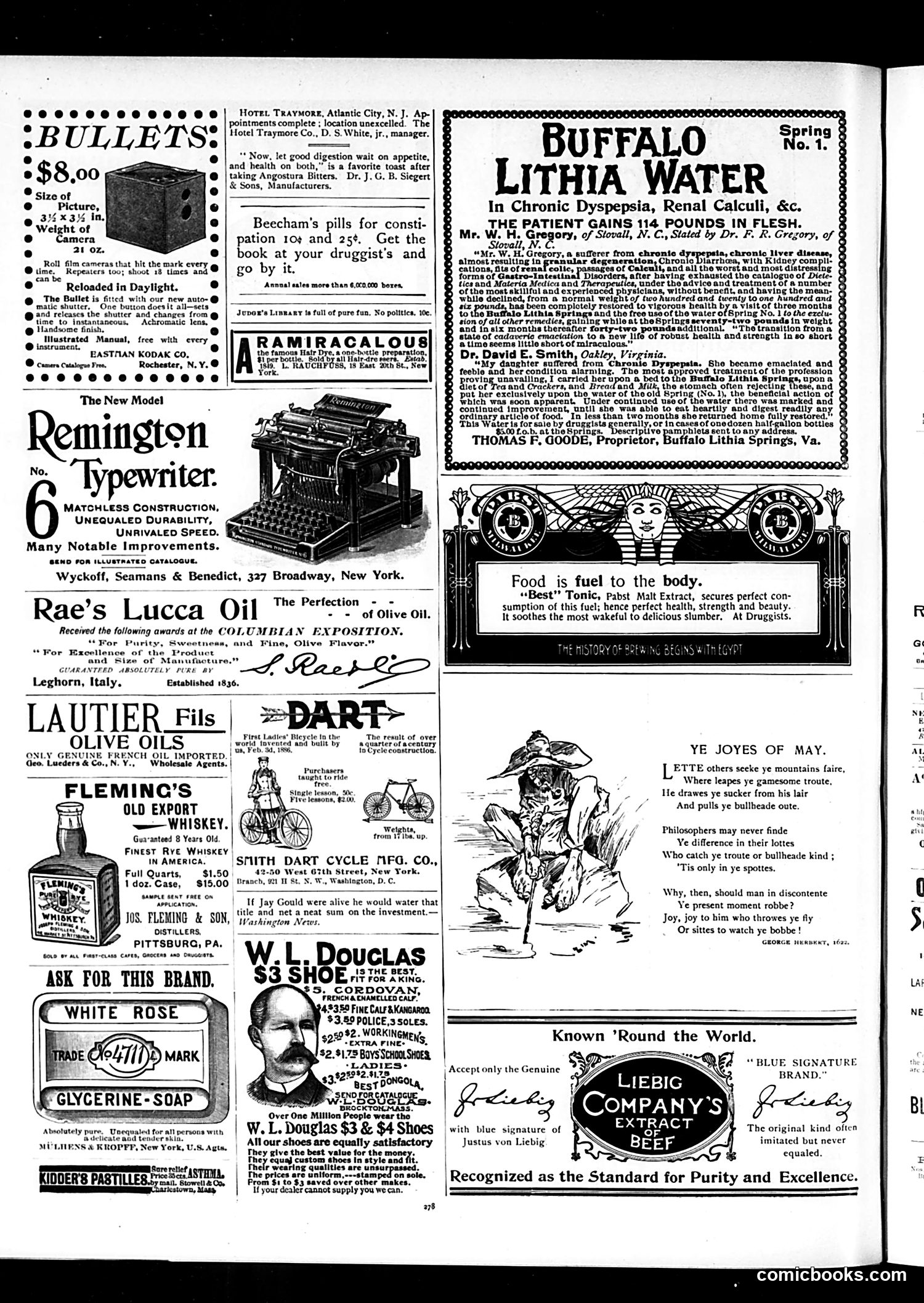
This page is primarily **advertising**, typical of Judge magazine's revenue model. However, the notable cartoon is the central illustration titled **"Ye Joyes of May,"** credited to George Hermann. The cartoon depicts a figure in period costume (possibly colonial or Elizabethan dress) riding a bicycle—likely a satirical contrast between "ye olde" romanticized past and modern technology. The accompanying verse mocks idealized notions of spring and nature with bawdy humor ("pulls ye toothache out," "sits to watch ye bobbe"). The joke appears to be **deflating sentimental romanticism about May** by juxtaposing flowery poetic language with crude physical realities (tooth extraction, discomfort). The bicycle itself represents modernity intruding on nostalgic fantasies. The rest of the page consists of era-typical advertisements for typewriters, whiskey, shoes, olive oil, and patent medicines—including the prominent "Buffalo Lithia Water" claiming medical benefits. These ads reflect early 1900s consumer culture and unregulated health claims.
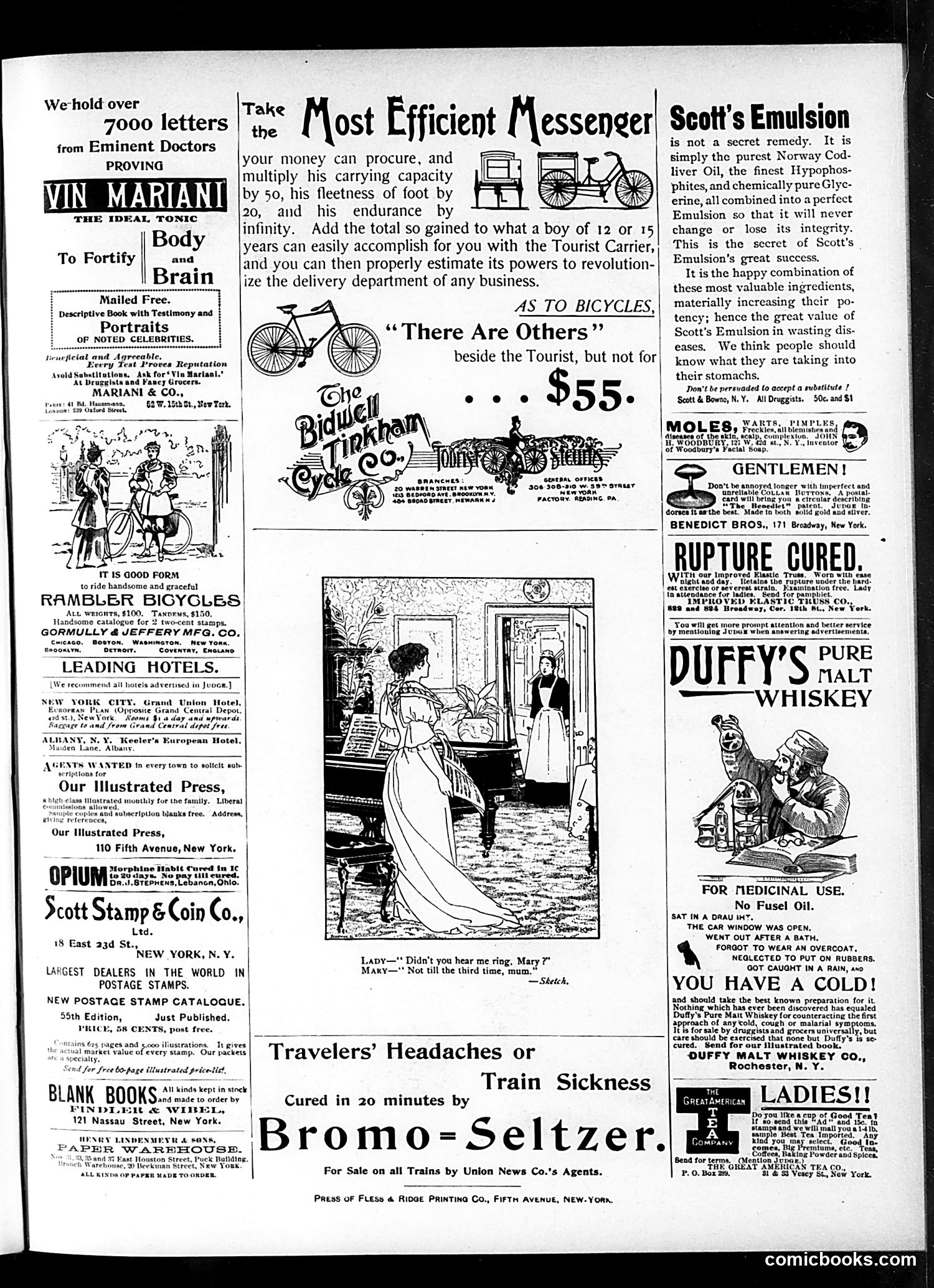
This page is primarily **advertising**, not satirical cartoons. It's a collection of patent medicine, product, and service advertisements typical of early 20th-century magazines. The one small cartoon visible depicts a domestic scene (labeled "Sketch") where a lady scolds her maid Mary for not responding to the bell until the third ring—a lighthearted jab at servant negligence, a common theme in period humor. The advertisements themselves reveal period attitudes: Vin Mariani (a cocaine-laced tonic), Bromo-Seltzer for travel sickness, Scott's Emulsion (cod-liver oil), Duffy's Pure Malt Whiskey "for medicinal use," and remedies for rupture, warts, and other conditions. These ads reflect how early 1900s patent medicines made unregulated health claims, and how products containing today's controlled substances were openly marketed as tonics and cure-alls. The page demonstrates the commercial landscape and medical misconceptions of the era rather than containing significant political or social satire.
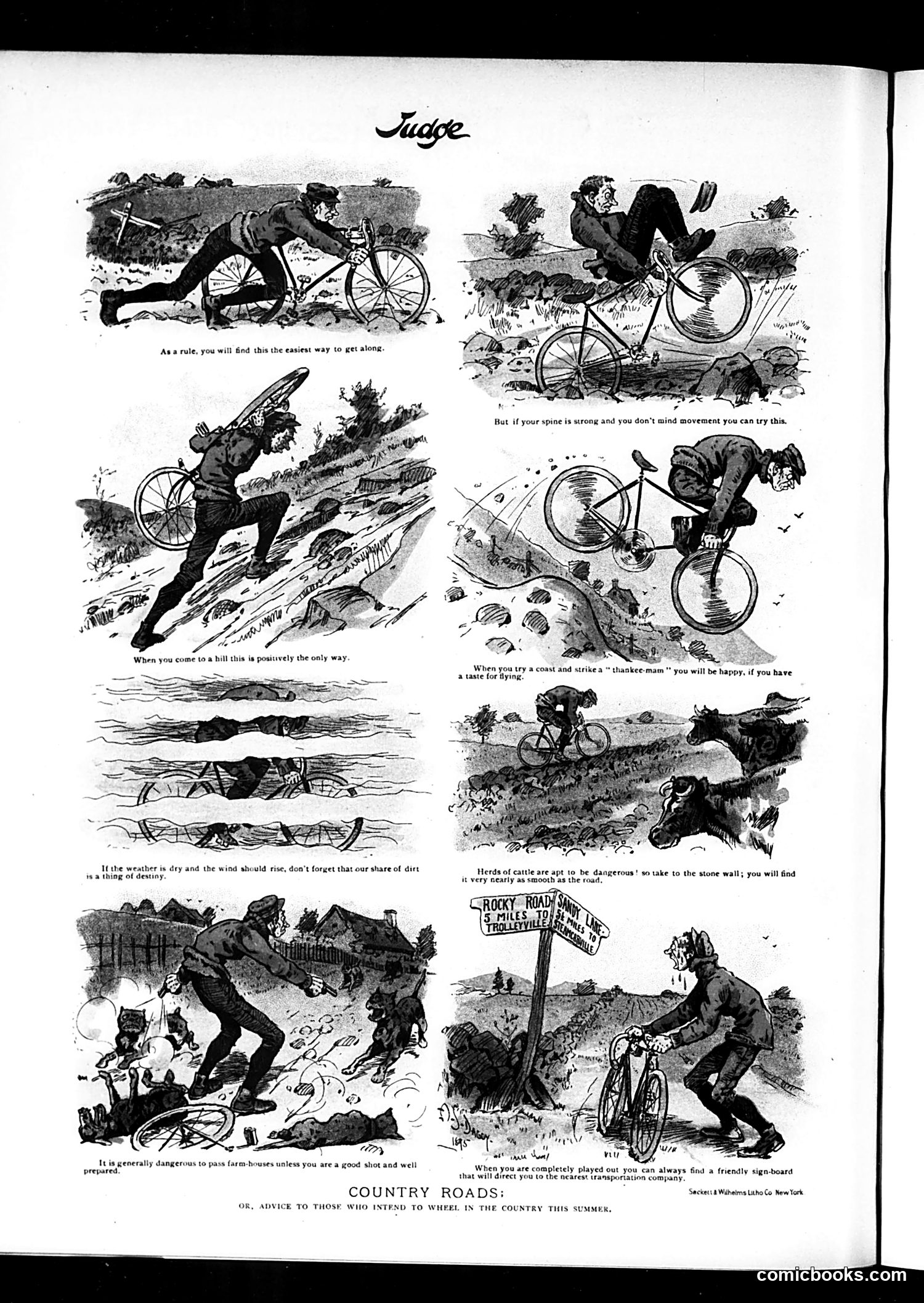
This is a humorous instructional guide for cyclists ("wheelers") attempting to ride bicycles on rural roads—a relatively new recreational activity in the late 19th century. The cartoons satirize the numerous hazards cyclists faced beyond city streets: treacherous terrain, dust clouds, steep hills requiring dismounting, aggressive cattle, unpredictable weather, and the general chaos of poorly maintained country roads. The joke targets both the naive confidence of urban cyclists venturing into unfamiliar rural environments and the actual dangers they encountered. By presenting absurd "advice" (like "have a taste for flying" when striking a rut, or being "a good shot" to pass farms safely), the cartoonist mocks the growing cycling craze while documenting real obstacles—animals, farmers, weather, road conditions—that made country cycling genuinely perilous and comical to contemporary readers.