
A complete issue · 16 pages · 1895
Judge — February 16, 1895
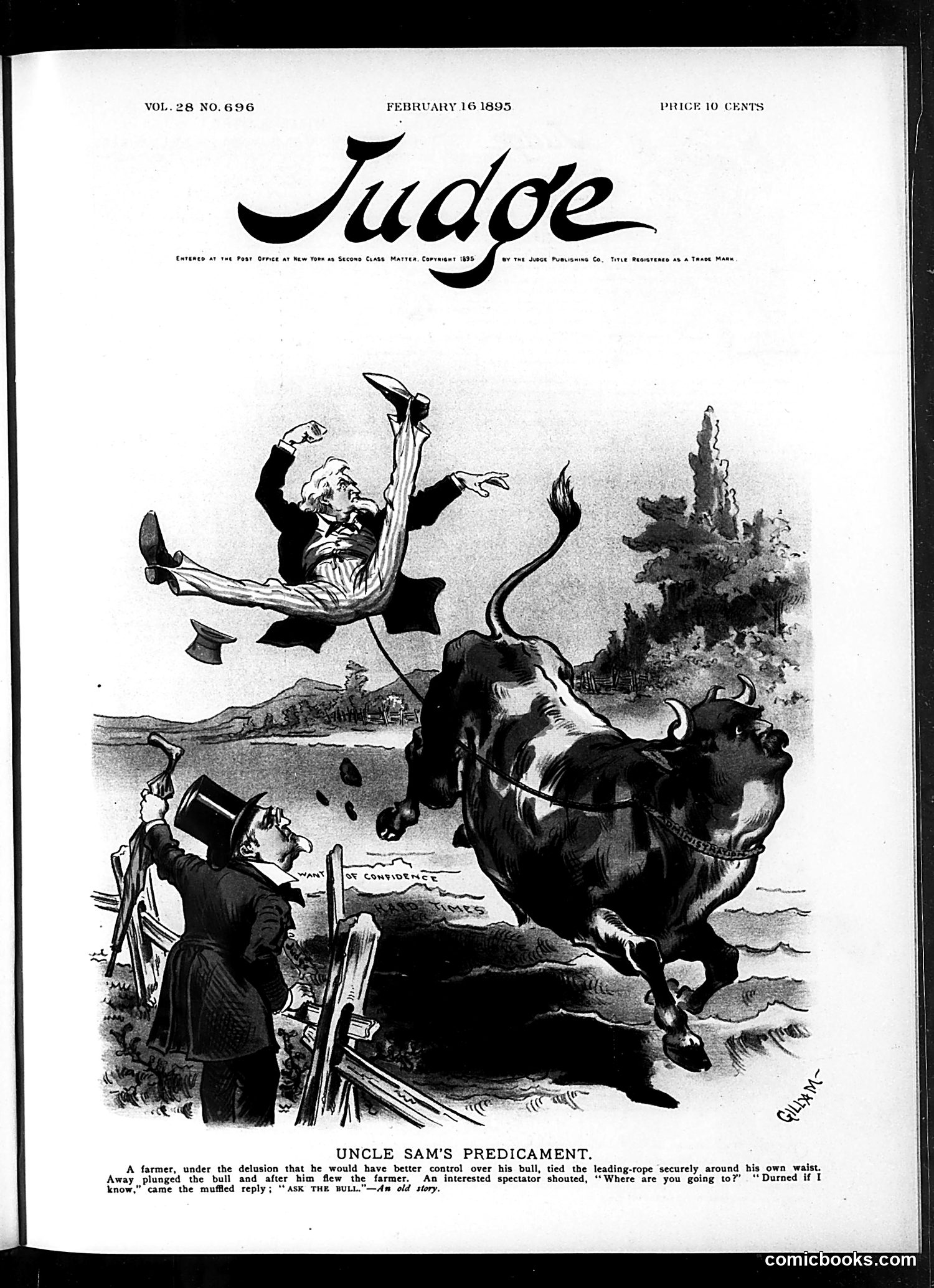
This political cartoon satirizes American foreign policy anxieties in the 1890s. Uncle Sam (the tall figure being tossed) has lost control of a "bull" labeled with text that appears reference trade or commerce issues—likely the economic instability or market volatility of the period. The farmer and spectator watch helplessly as Uncle Sam is bucked off, suggesting the government has mismanaged economic or trade policy and lost control of the situation. The caption indicates a farmer expected better control but instead faces chaos. The cartoon critiques government incompetence during an era of economic uncertainty and shifting American global involvement, reflecting contemporary concerns about whether U.S. leadership could manage emerging economic and political challenges.
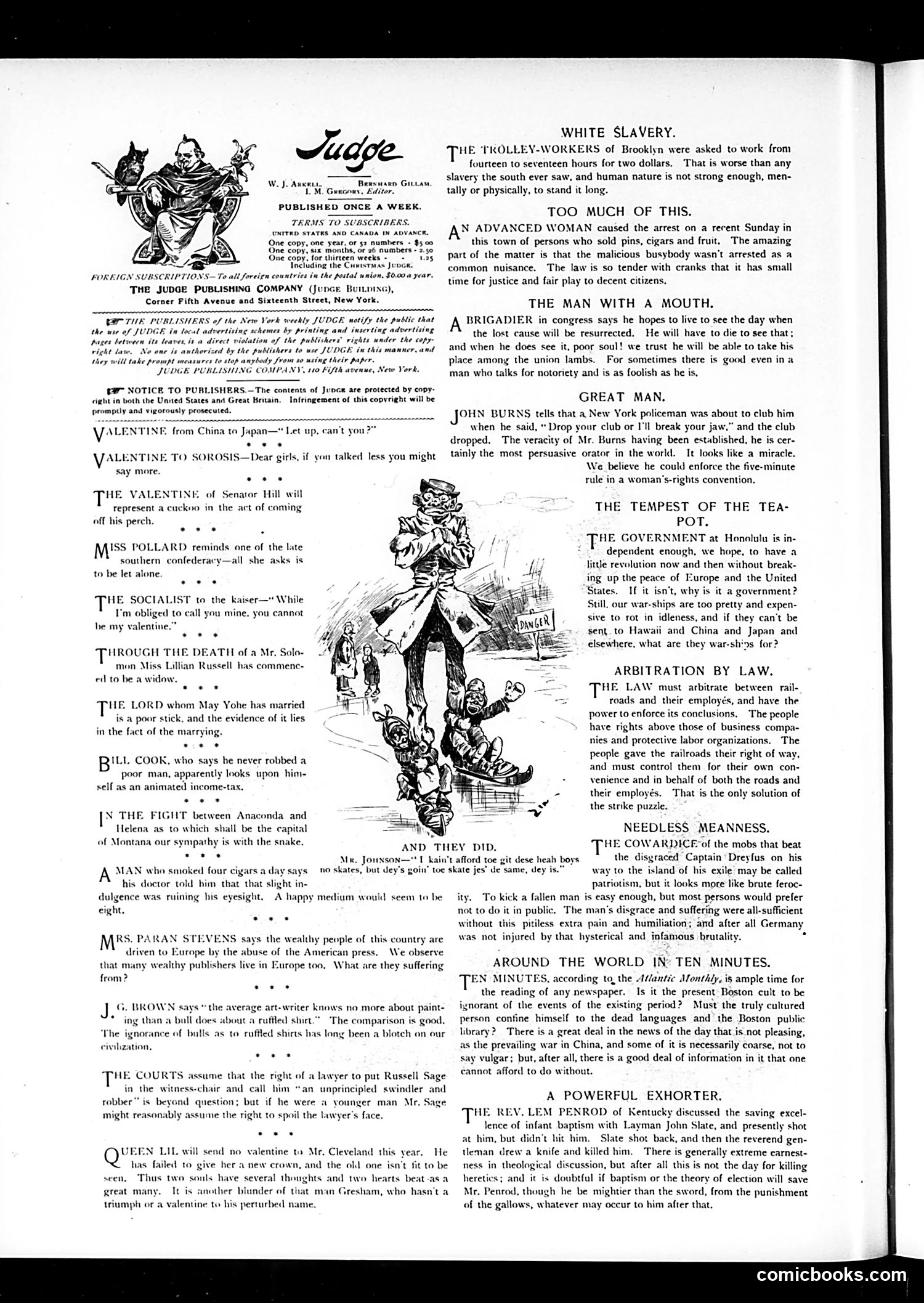
This page contains a political cartoon showing a figure labeled "ANARCHY" standing atop a chaotic pile of smaller figures representing workers or citizens. The image satirizes labor unrest and social disorder. The accompanying text columns—including sections titled "White Slavery," "Too Much of This," and "The Man with a Mouth"—critique various social issues: exploitative labor practices (trolley workers forced to work excessive hours), mob violence, and inflammatory political rhetoric. The cartoon's message appears to be that anarchist agitation is exploiting legitimate worker grievances to foment chaos. Judge, a conservative publication, used such imagery to associate labor activism with dangerous radicalism—a common rhetorical tactic during periods of early-20th-century labor unrest in America.
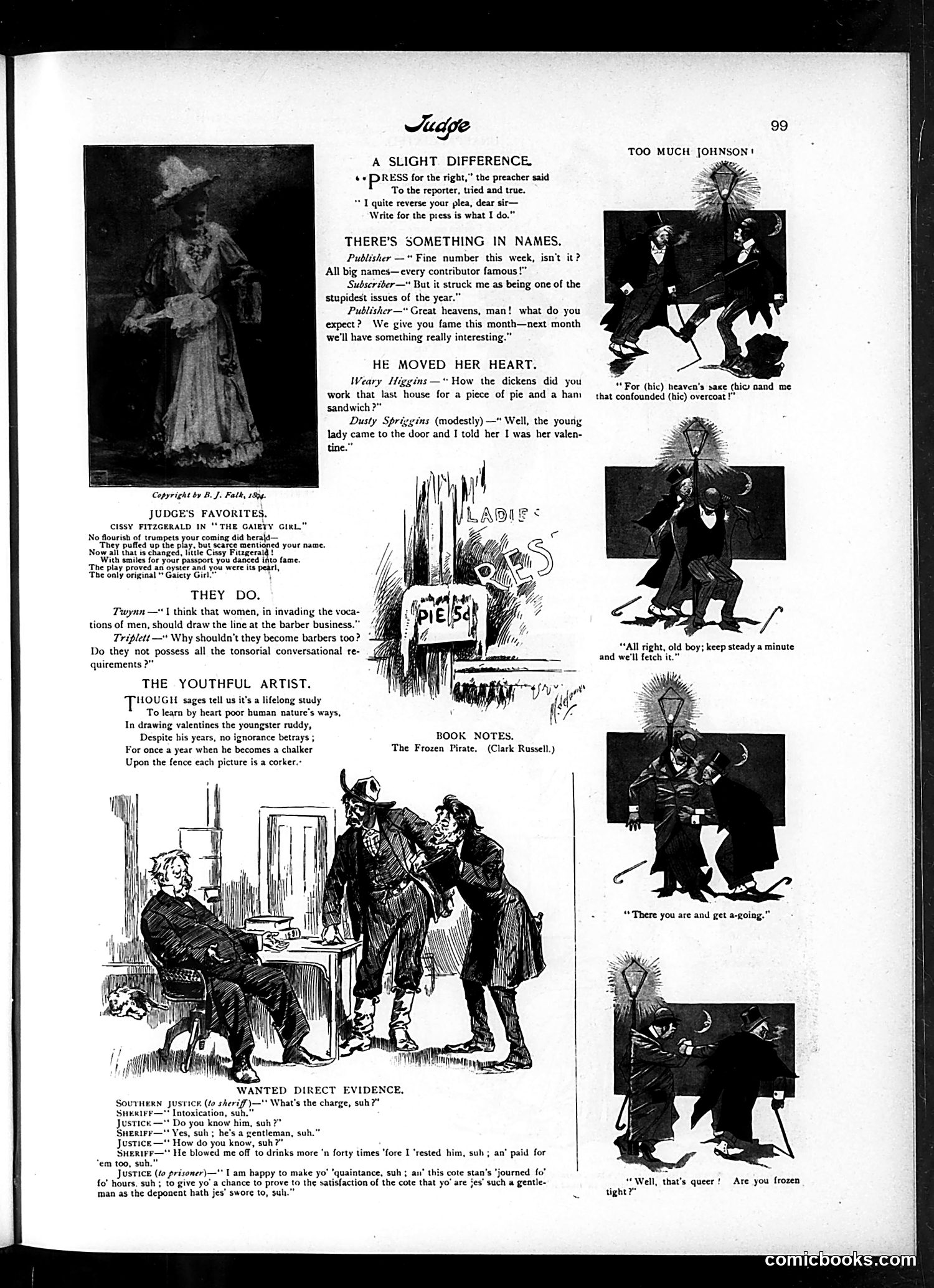
This page contains several satirical pieces and illustrations typical of Judge magazine's humor. The main content includes: **"A Slight Difference"** – A preacher's exchange with a reporter about "dressing for the right," suggesting commentary on clerical hypocrisy or appearance versus substance. **"There's Something in Names"** – A dialogue between publisher and subscriber about famous contributors, likely poking fun at magazine pretensions. **"He Moved Her Heart"** – A domestic humor piece about working-class life (mentions pie, ham sandwich). **"Book Notes"** featuring *The Frozen Pirate* – Reviews literary works. The cartoons include sketches of various social situations with accompanying humorous captions. The overall tone reflects late 19th/early 20th-century American satire targeting middle-class manners, literary pretension, and domestic life. Without clearer identification of specific figures or dates, precise political references remain unclear.
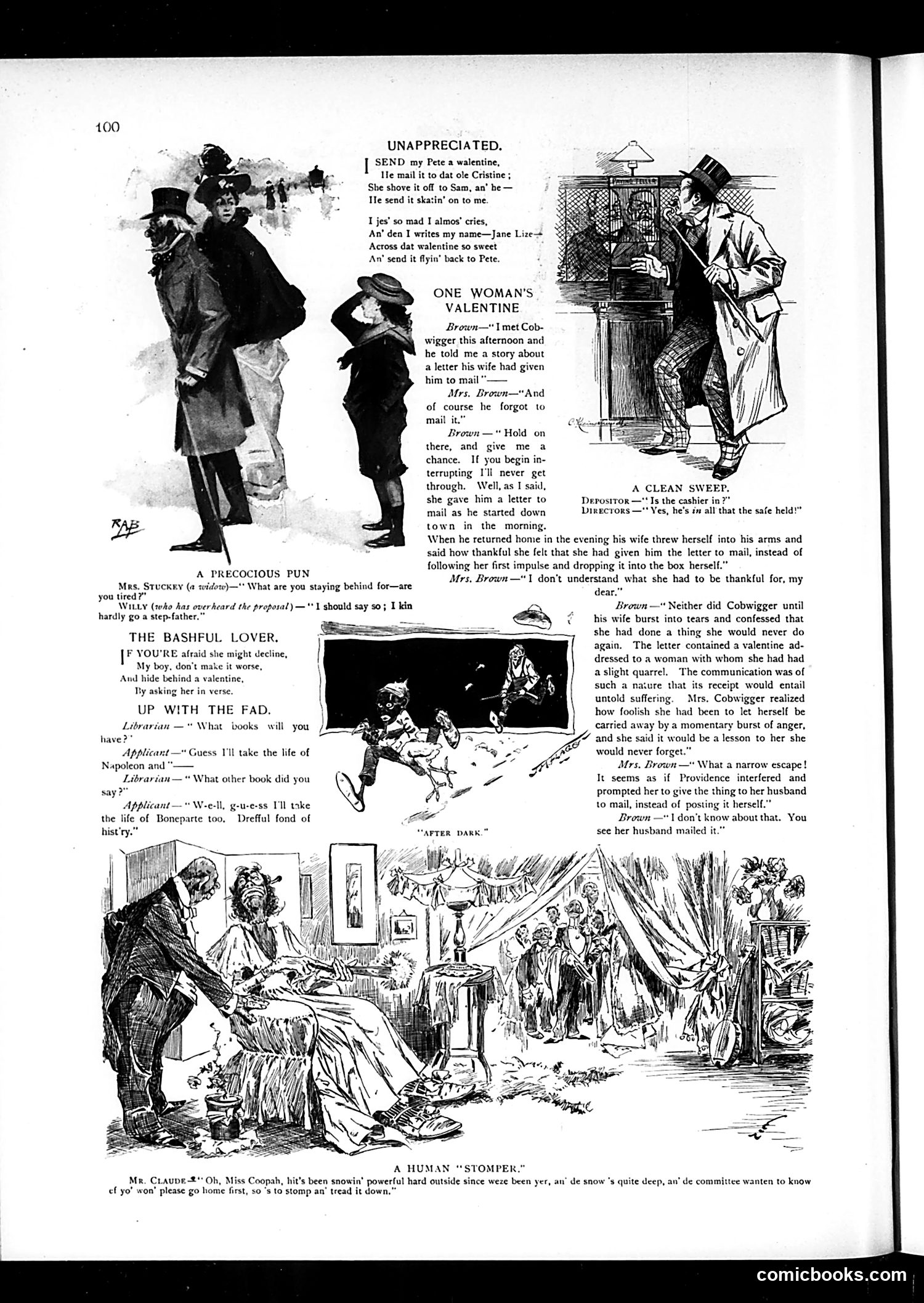
This page contains several Valentine's Day-themed humorous sketches satirizing romance and courtship customs of the era. **"One Woman's Valentine"** depicts the irony of a wife's attempt to prevent her husband from mailing a hastily-written valentine to a woman she'd quarreled with. She gives it to him to post instead of mailing it herself, fearing her "momentary burst of anger" would cause "untold suffering." The joke mocks both her emotional volatility and the notion that giving the letter to her husband somehow solves the problem—when he simply mails it anyway. **"The Bashful Lover"** and **"Up with the Fad"** offer brief comedic observations on romantic hesitation and literary pretension, respectively. **"A Human Stomper"** appears to be a racial caricature using dialect humor, likely depicting an African American character being asked to compact snow—a dehumanizing joke treating a person as a tool. The sketches use sentimental romance as a vehicle for satirizing human foolishness, emotional irrationality, and social absurdities of the period.
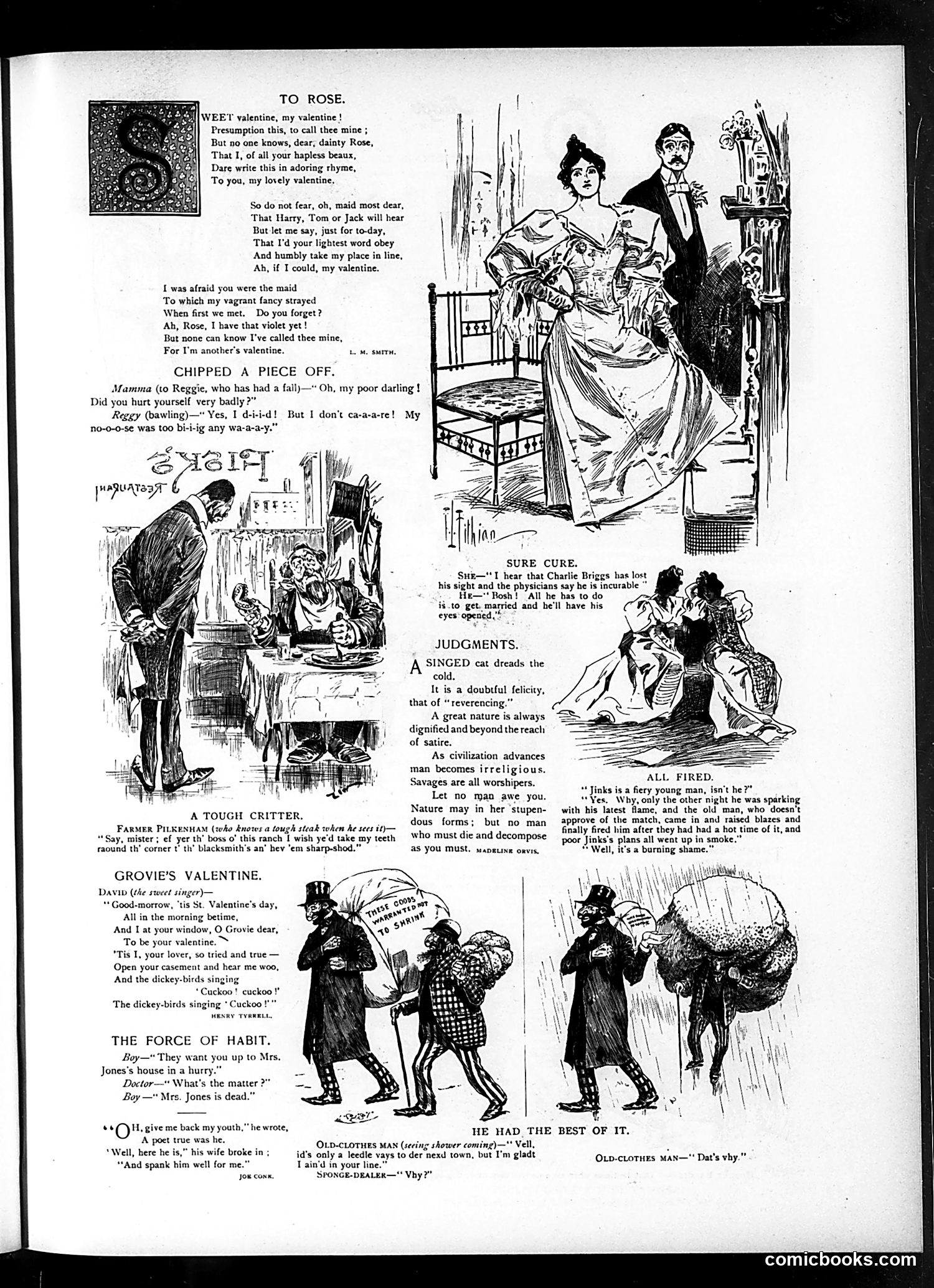
This is a Valentine's Day-themed satirical page from Judge magazine featuring multiple short humorous pieces and illustrations typical of late 19th/early 20th-century American humor. **Key content:** - **"To Rose"**: A sentimental poem about unrequited love, with the twist that the speaker is already engaged ("I'm another's valentine")—satirizing Victorian romantic conventions. - **"Chipped a Piece Off"**: A child's mishap joke playing on British pronunciation ("ca-a-a-re"). - **"Sure Cure"**: Dark humor suggesting marriage will restore a blind man's sight—mocking both marriage and medical helplessness. - **"Judgments"**: Philosophical observations, some contradictory, parodying pretentious wisdom literature. - **"A Tough Critter"** and **"Grovie's Valentine"**: Rural/working-class character sketches with dialect humor and physical comedy. The page emphasizes wordplay, class-based humor, and sentimental parody—standard Judge fare. No specific political references are evident; the satire targets universal social foibles rather than current events.
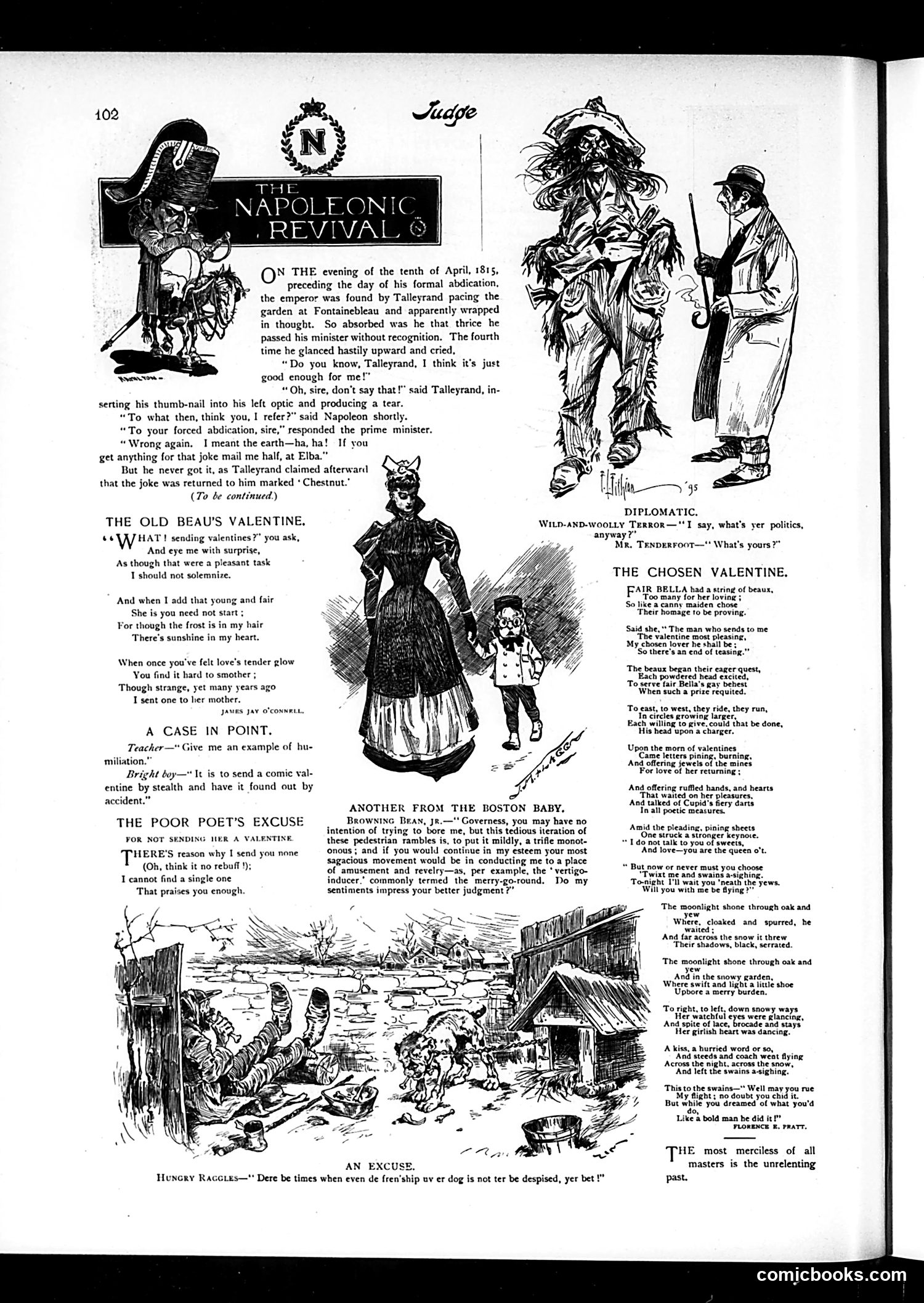
This *Judge* page combines political satire with Valentine's Day humor. **Top section:** "The Napoleonic Revival" mocks Napoleon's 1815 abdication through a fictional dialogue with his minister Talleyrand. The joke turns on Napoleon's cryptic remark about something being "good enough for me"—Talleyrand assumes he means his forced abdication, but Napoleon clarifies he meant "the earth" (a terrible pun). Talleyrand supposedly rejected this joke as too stale ("marked Chestnut"), satirizing both Napoleon's ego and bad humor. **Lower sections:** Various Valentine's Day verses and cartoons, including: - A sentimental poem about elderly love - A "case in point" about embarrassing comic valentines - A humorous poem from a "Boston Baby" complaining about boring walks - A tender narrative poem about a maiden choosing suitors The satire targets sentimental Victorian romance conventions and social pretension. The scattered cartoon illustrations depict these scenarios with characteristic *Judge* exaggeration and caricature.
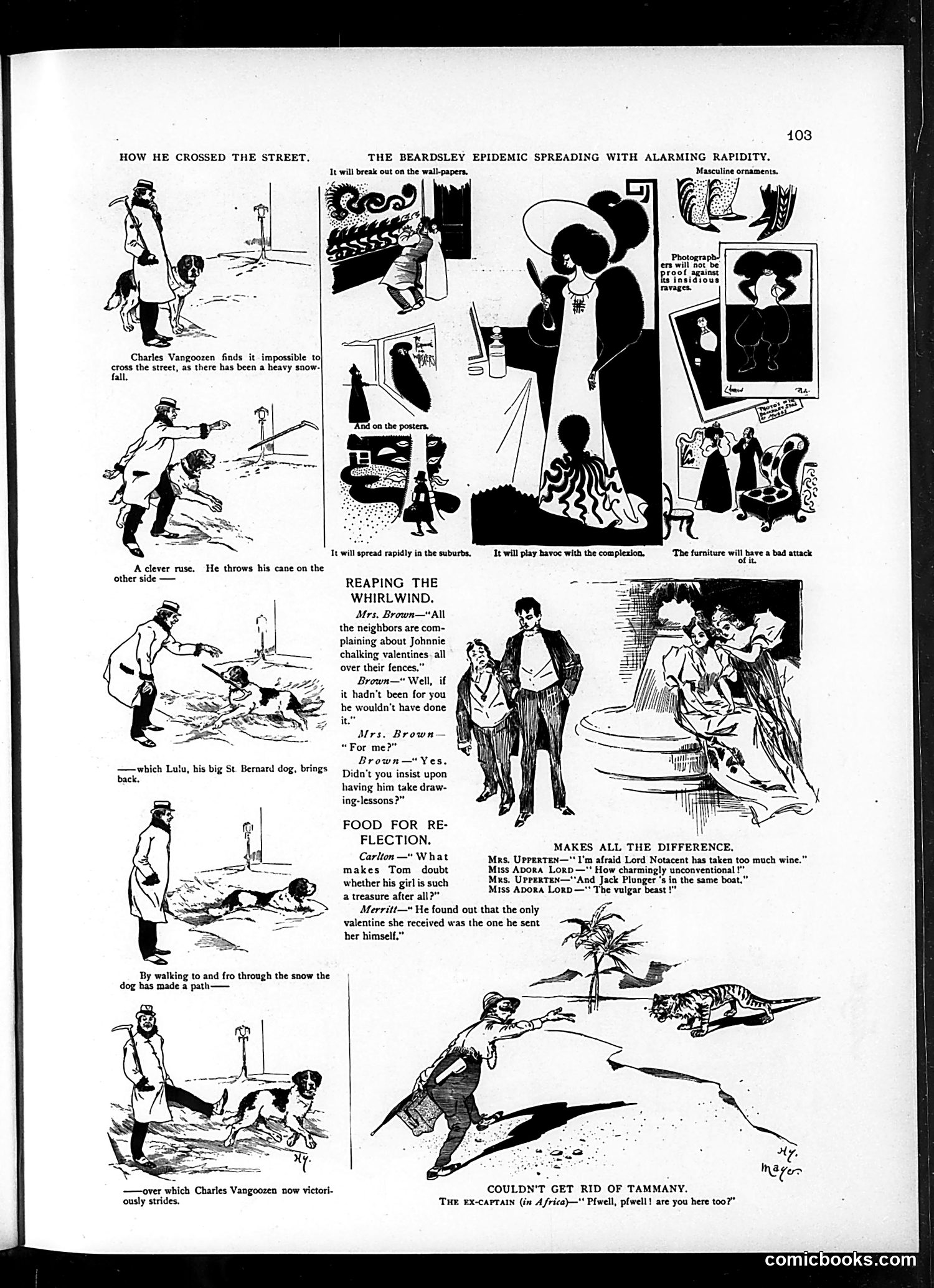
This page contains multiple satirical cartoons from an American humor magazine, likely early 1900s based on style and references. **"How He Crossed the Street"**: A practical comedy sequence where Charles Vangoozen solves a snow-crossing problem by throwing his cane across, then repeatedly walking back and forth until his dog's footprints create a usable path—he exploits the dog's labor to solve his own problem. **"The Beardsley Epidemic"**: Satirizes the influence of Aubrey Beardsley's distinctive artistic style (known for bold black silhouettes and dramatic designs). The cartoon warns that his aesthetic is spreading from high art into wallpapers, ornaments, and furniture—mocking both the style's pervasiveness and society's anxious over-adoption of fashionable artistic trends. **Other vignettes** include domestic humor about a boy's drawing lessons backfiring, romantic disappointments, and social commentary on class pretense (tolerating drunkenness if the drunk is titled). **"Couldn't Get Rid of Tammany"**: References Tammany Hall, New York's powerful Democratic political machine, suggesting its corruption was inescapable even in Africa.
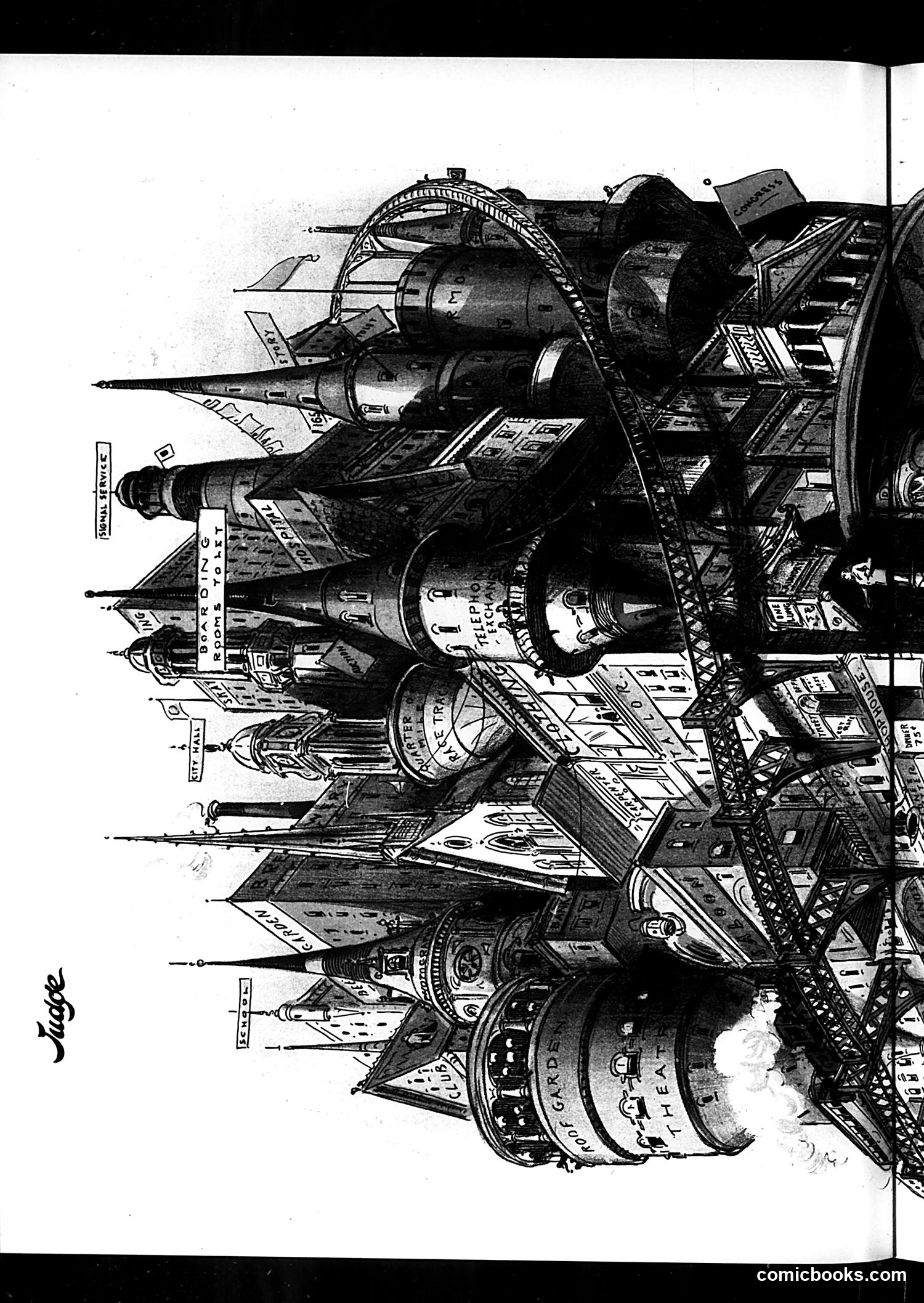
This page appears to be a technical diagram or patent illustration rather than a traditional satirical cartoon. The image shows detailed mechanical drawings of what looks like industrial or military machinery, with various labeled components, cylinders, gears, and structural elements rendered in black and white cross-hatching. The OCR text is largely illegible garbled characters, providing no clear context. Without readable labels or captions identifying the specific machinery, the political or social subject matter, or any accompanying explanatory text, I cannot determine what satire or commentary this illustration was intended to convey to Judge's contemporary readers. To accurately explain the meaning for a modern audience, clearer OCR text or visible labels would be necessary.
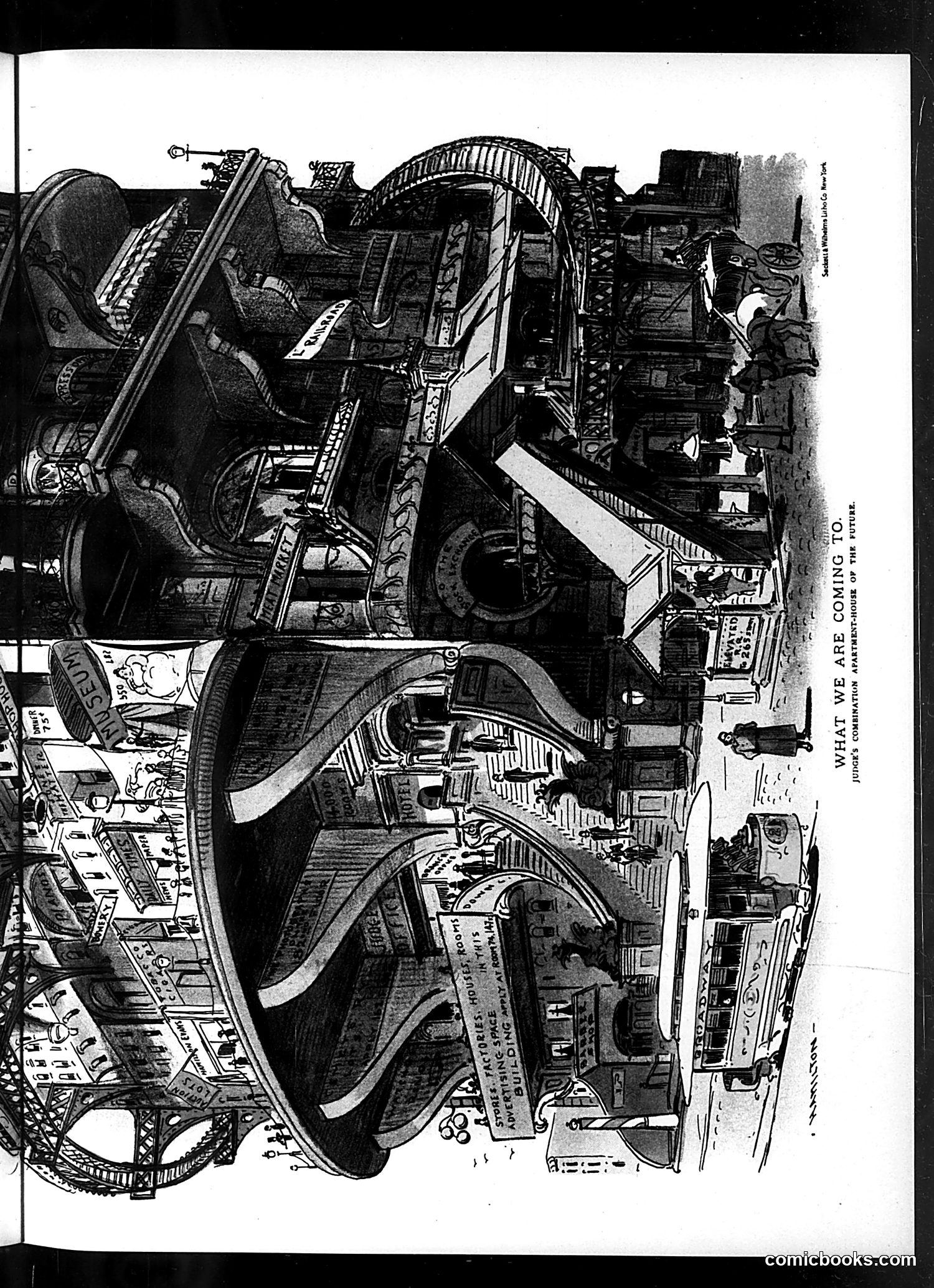
I can see this is a Judge magazine page, but the image quality and orientation make it difficult to read the specific text clearly. The OCR'd text appears to be corrupted or illegible ("wokenay, oD oun SURO ETIEES" etc.). From the visual content, I can see what appears to be detailed black and white satirical illustrations in Judge's characteristic style, but I cannot reliably identify the specific figures, political references, or the satire's point without being able to read the accompanying text or captions clearly. To properly explain this cartoon's meaning to a modern reader, I would need either: a clearer image, legible text/captions identifying the subjects, or confirmation of the publication date. I cannot responsibly guess at the identities or political context.
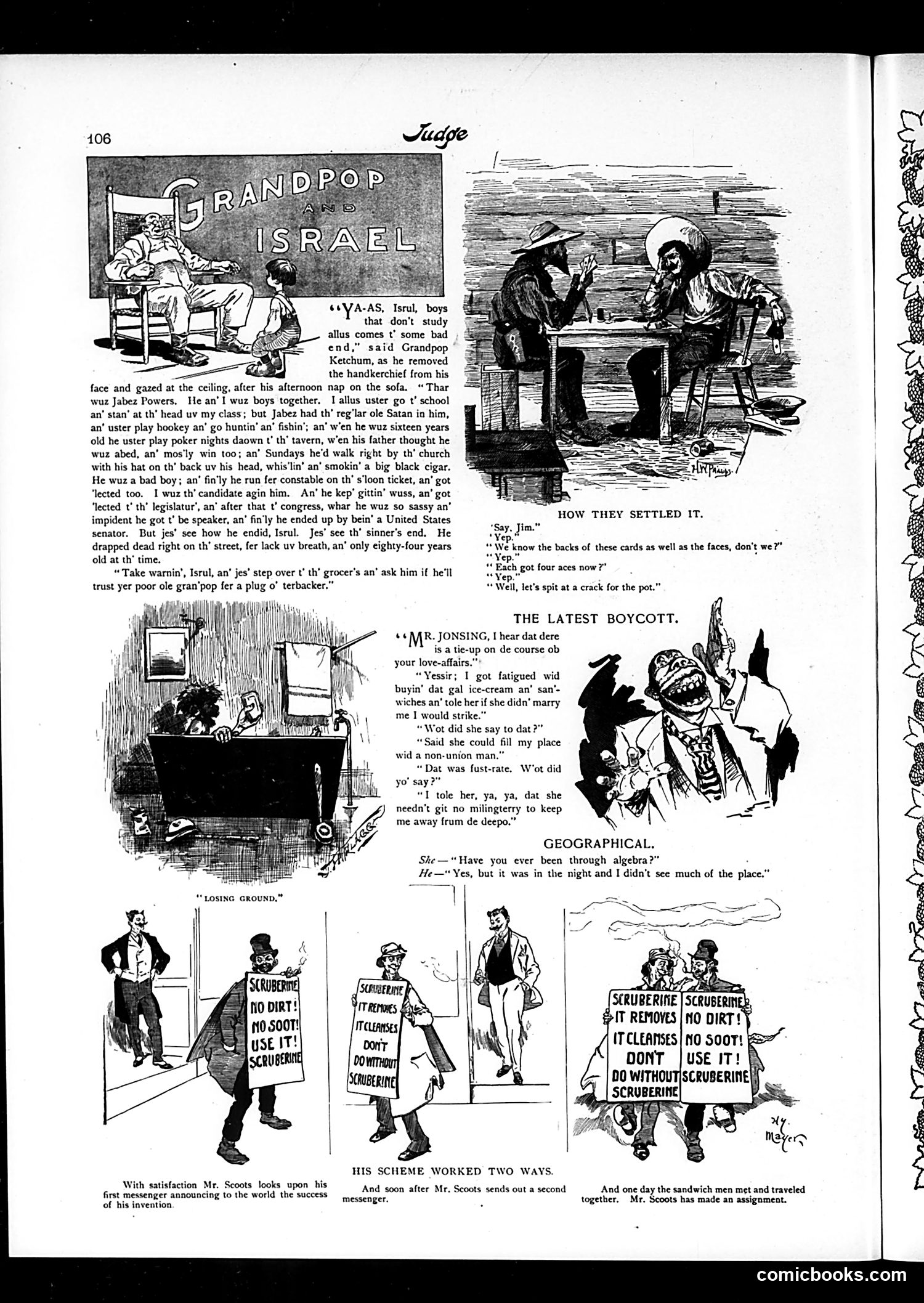
This page contains several satirical pieces typical of late 19th-century American humor: **"Grandpop and Israel"**: A dialect-heavy monologue where an elderly rural character warns against idleness by recounting how Jabez Powers—a childhood troublemaker who played hooky, gambled, and smoked—ironically *succeeded* politically, becoming a senator despite (or because of) his bad behavior. The joke subverts the moral lesson: the "sinner" prospered for 84 years. The punchline reveals Grandpop's real concern: cadging tobacco from the grocer. **"The Latest Boycott"**: A labor-dispute joke where a Black man threatens to strike from courting unless his girlfriend marries him. She replaces him with a "non-union man"—a pun on labor terminology applied to romance. **"His Scheme Worked Two Ways"**: A wordless comic strip about sandwich-board advertisers for "Scruberine" (a cleaning product). The scheme backfires when rival sandwich men meet and pool resources, forcing the advertiser into bankruptcy. The page reflects period attitudes toward labor disputes, dialect humor, and commercial satire.
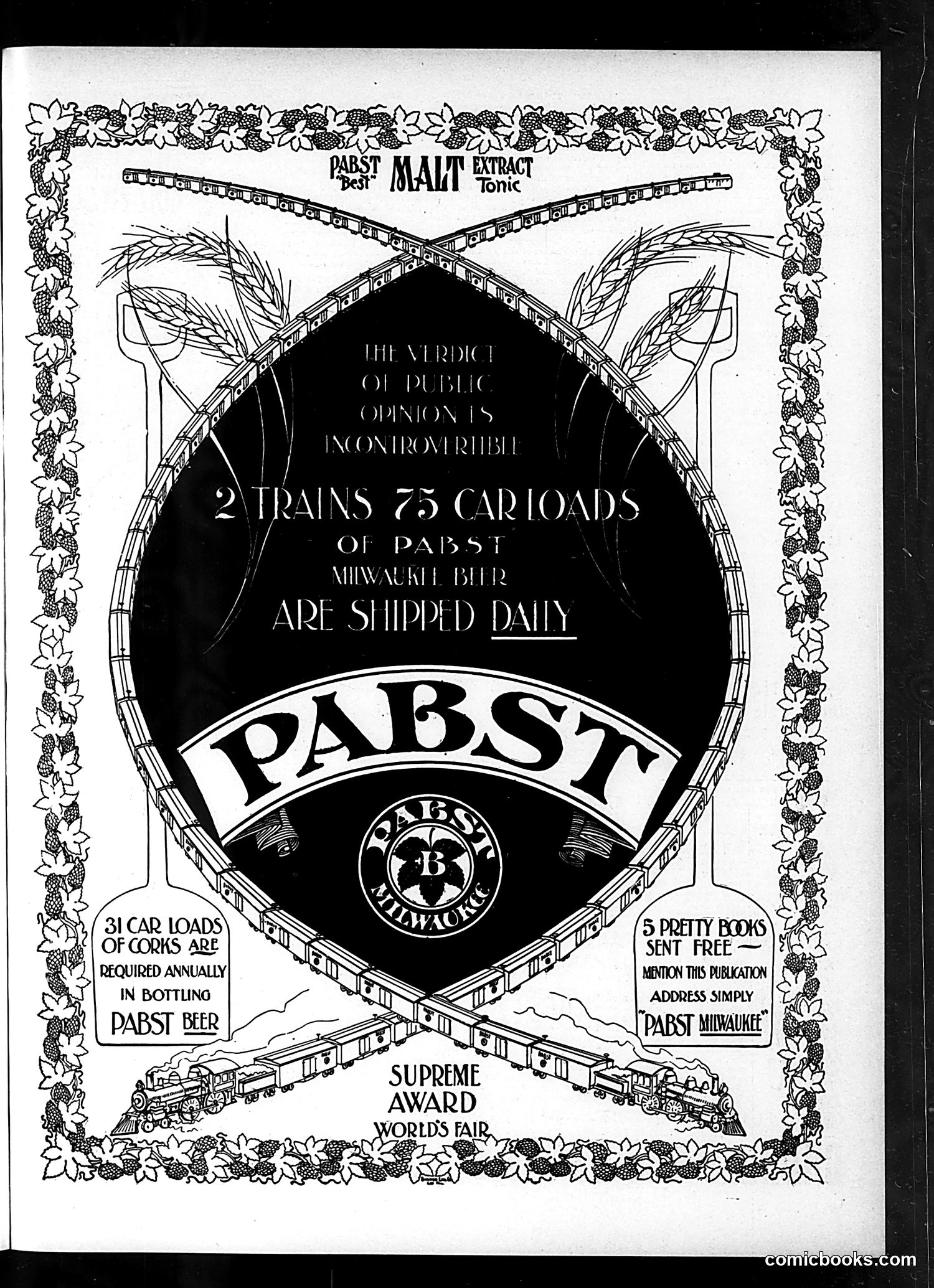
This is primarily a **Pabst beer advertisement**, not a political cartoon. The page promotes Pabst Milwaukee beer as a "Supreme Award" winner, claiming "the verdict of public opinion is incontrovertible" based on shipment volumes—two trains and 75 carloads daily. The decorative border features hops and grain imagery, reinforcing the beer product. Two smaller notices promise incentives: 31 carloads of corks needed annually for bottling, and five "pretty books" sent free to readers mentioning the publication. This represents **early 20th-century advertising** in Judge magazine, using hyperbolic claims about popularity and sales volume as proof of product superiority—a common marketing technique of the era. There is no evident political satire or social commentary here.
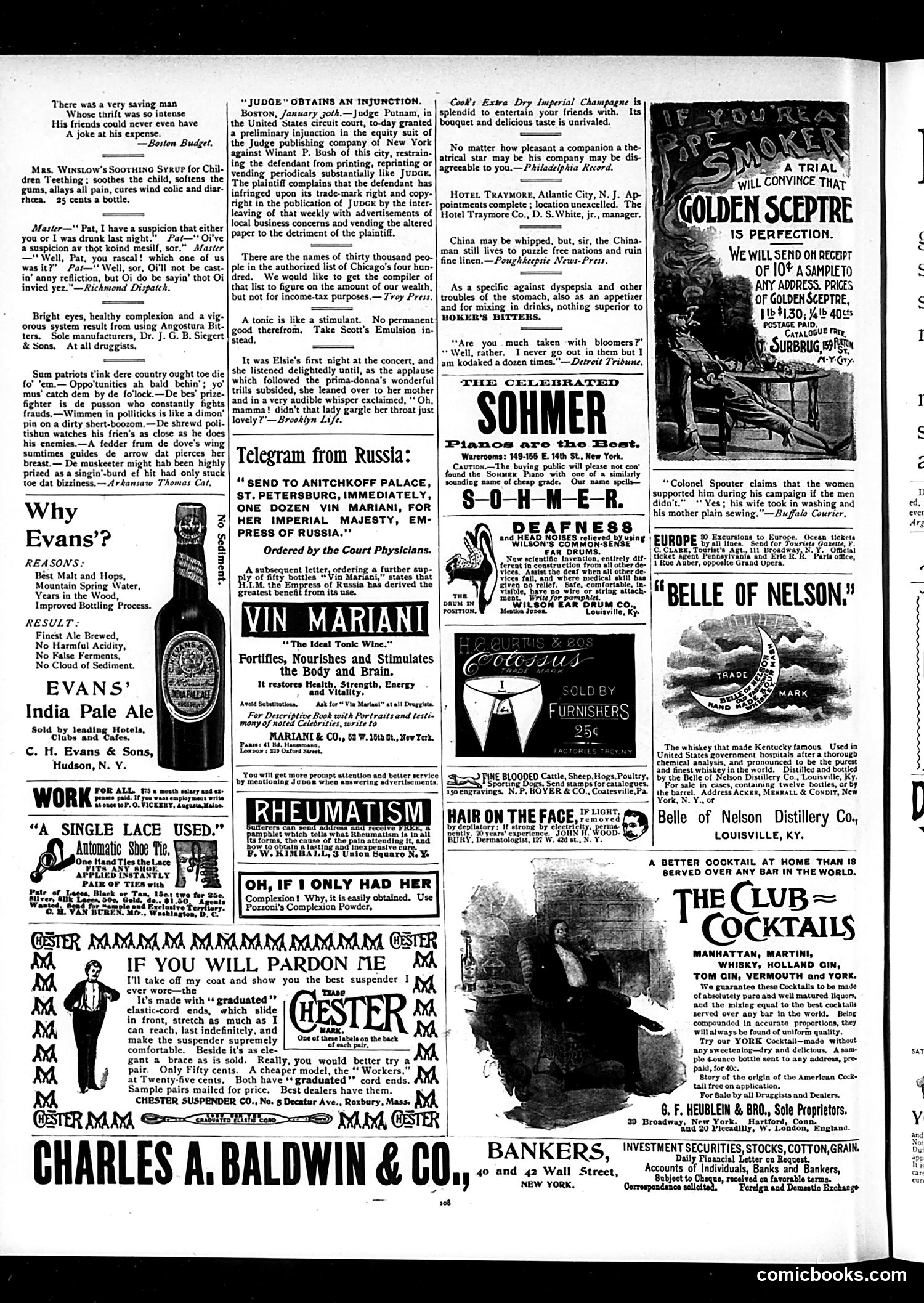
This page is primarily **advertising and humor content** rather than political cartoons. The main items are: 1. **"Why Evans'?" Beer Advertisement**: Lists reasons Evans' India Pale Ale is superior (best ingredients, proper aging, no sediment). 2. **"Judge" Legal Notice**: Reports that the *Judge* publishing company obtained a court injunction against competitor Winant P. Bush for creating knockoff publications with similar layouts and advertising—an early **trademark/copyright infringement case**. 3. **Vin Mariani Advertisement**: Features a telegram claiming Russia's Empress ordered this "tonic wine" on doctors' orders, implying royal endorsement to boost sales. 4. **Chester Suspender Advertisement**: Humorous pitch for elastic suspenders. 5. **Miscellaneous Jokes**: Scattered humor about thrift, Irish servants, and social observations—typical period comedy. The page reflects **turn-of-century commercial culture** where dubious health claims, celebrity endorsements, and patent medicines dominated advertising.
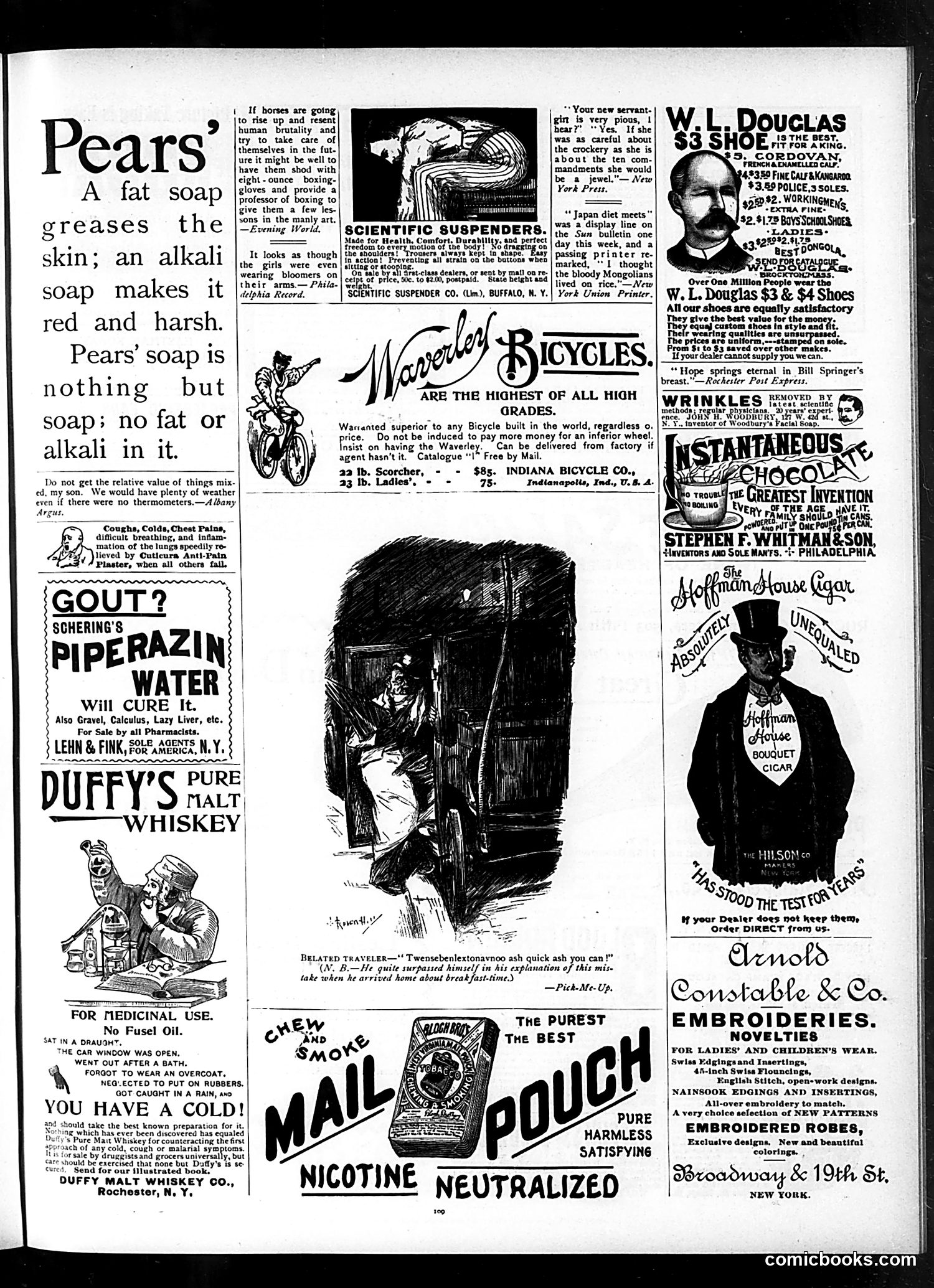
This page is primarily **advertising**, typical of Judge magazine's revenue model. Key ads include: **Satirical/Humorous Content:** - Small boxed jokes mock servant religiosity, Japanese diets, and bloomers on women's arms - A cartoon showing a "belated traveler" leaving a carriage, with absurdist humor about his poor preparation (open windows, no coat, no rubbers) - "Scientific Suspenders" ad features mock pseudo-scientific claims about freedom and shoulder strain **Social Context:** These jokes reflect turn-of-century American attitudes: casual xenophobia toward Japan, humor about women's emerging fashion (bloomers were controversial), and domestic servant stereotypes. **Medical Claims:** Numerous ads ("Piperazin Water for gout," "Duffy's Malt Whiskey for colds") showcase the patent-medicine era's unregulated health claims—products marketed as cure-alls that modern readers would recognize as fraudulent or even dangerous. The page captures Judge's mix: satirical commentary on contemporary life alongside advertising reflecting the era's unchecked marketing practices and social prejudices.
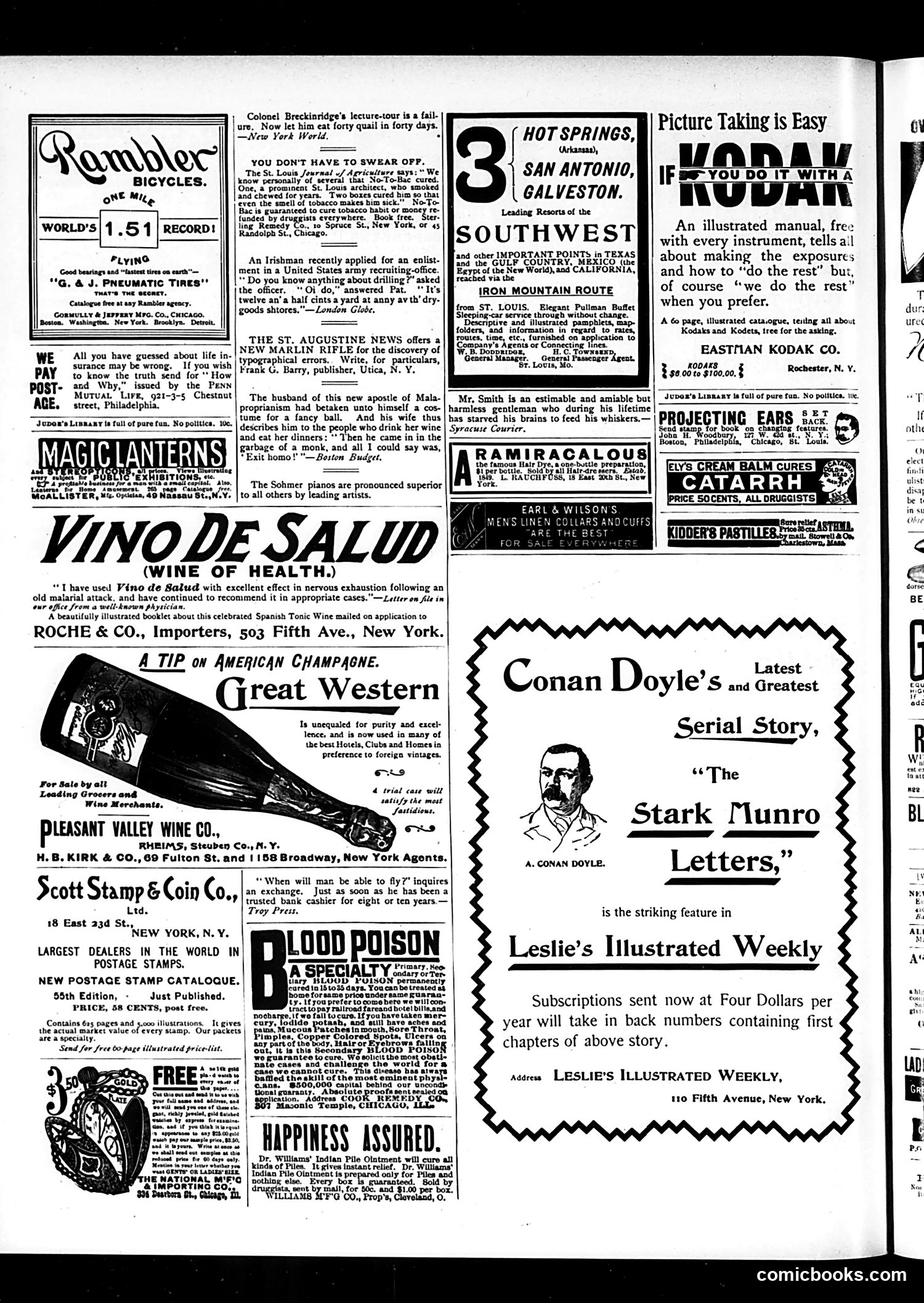
This page is primarily **advertising**, not political satire. It contains dozens of commercial advertisements for products like bicycles, wine, stamps, and patent medicines typical of early 1900s America. The few non-advertising items include: **A joke about Colonel Breckinridge** (top left): References his failed lecture tour, suggesting he should instead eat "forty quail in forty days"—likely mocking his poor public speaking or performance. **An Irish recruitment office joke**: A stereotypical Irish character misunderstands "drilling" as fabric pricing, playing on anti-Irish immigrant humor common in the era. **A malapropism anecdote**: A woman describes her husband's monk costume as "garbage" instead of proper dress terminology—a mild domestic humor piece. These scattered jokes use period stereotypes (Irish immigrants, malapropisms) but lack the sharp political commentary one might expect from Judge magazine. The page's dominant purpose is generating advertising revenue rather than delivering satire.
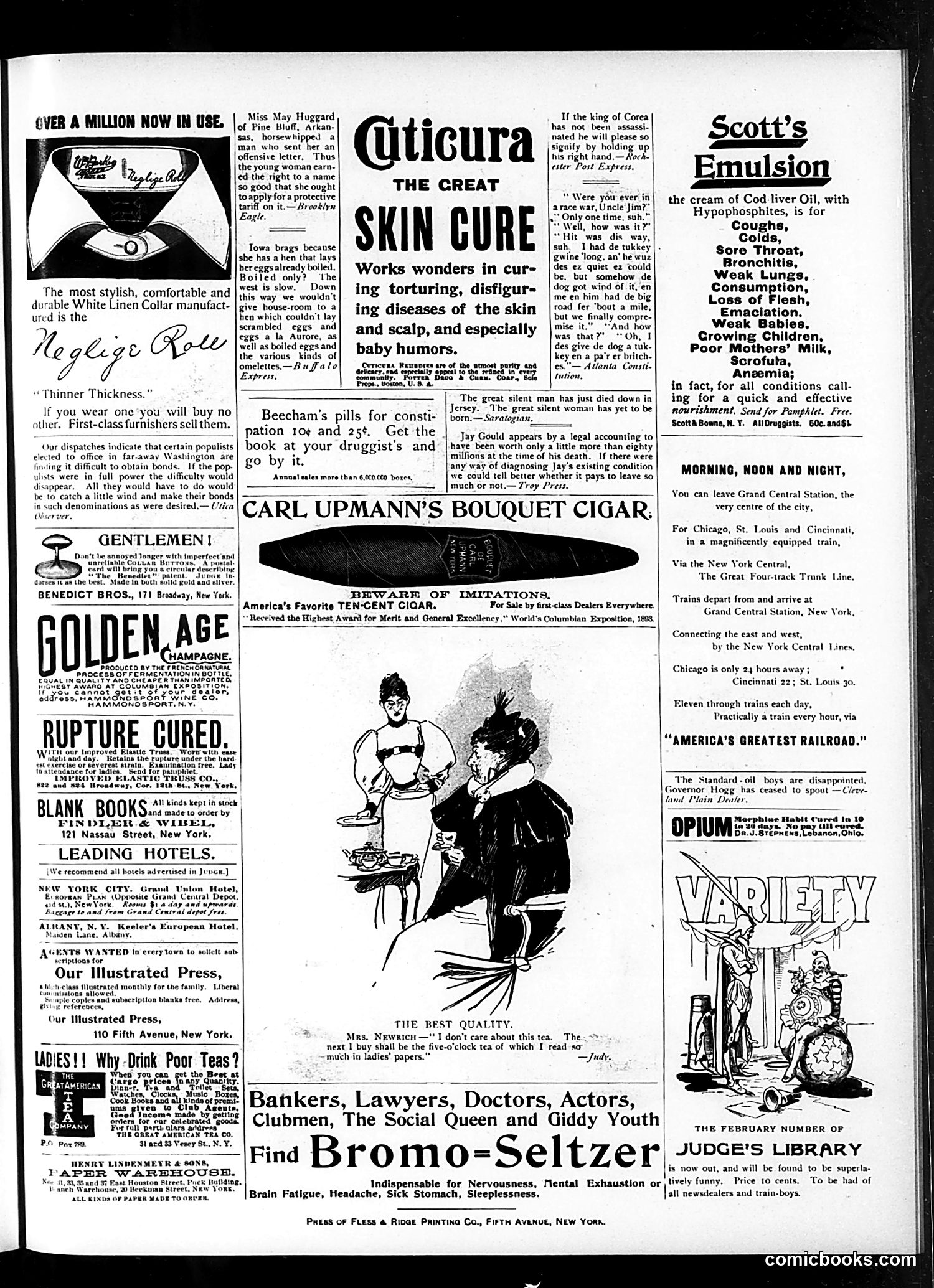
This is primarily an **advertising and miscellaneous content page** rather than satirical cartoons. The main elements include: **Central cartoon**: A domestic scene showing a woman serving tea to a seated guest. The caption emphasizes "THE BEST QUALITY," promoting tea as a desirable product—straightforward product advertising rather than satire. **Racial humor anecdote**: A dialect-written exchange about a "race war" involving a turkey and dog, appearing under the Cuticura skin cure ad. This reflects the period's casual use of African American vernacular humor, though the "joke" is unclear to modern readers—it seems to conflate animal conflict with racial conflict as entertainment. **Advertisements dominate**: Scott's Emulsion (cod liver oil), Cuticura (skin treatment), Beecham's Pills, Carl Upmann's cigars, Bromo-Seltzer, and hotel listings fill the page. **Minor political reference**: A brief note about Washington officials having bond trouble, suggesting minor government corruption commentary. The page lacks sustained satirical cartooning; it's primarily a commercial product showcase typical of Judge's revenue model.
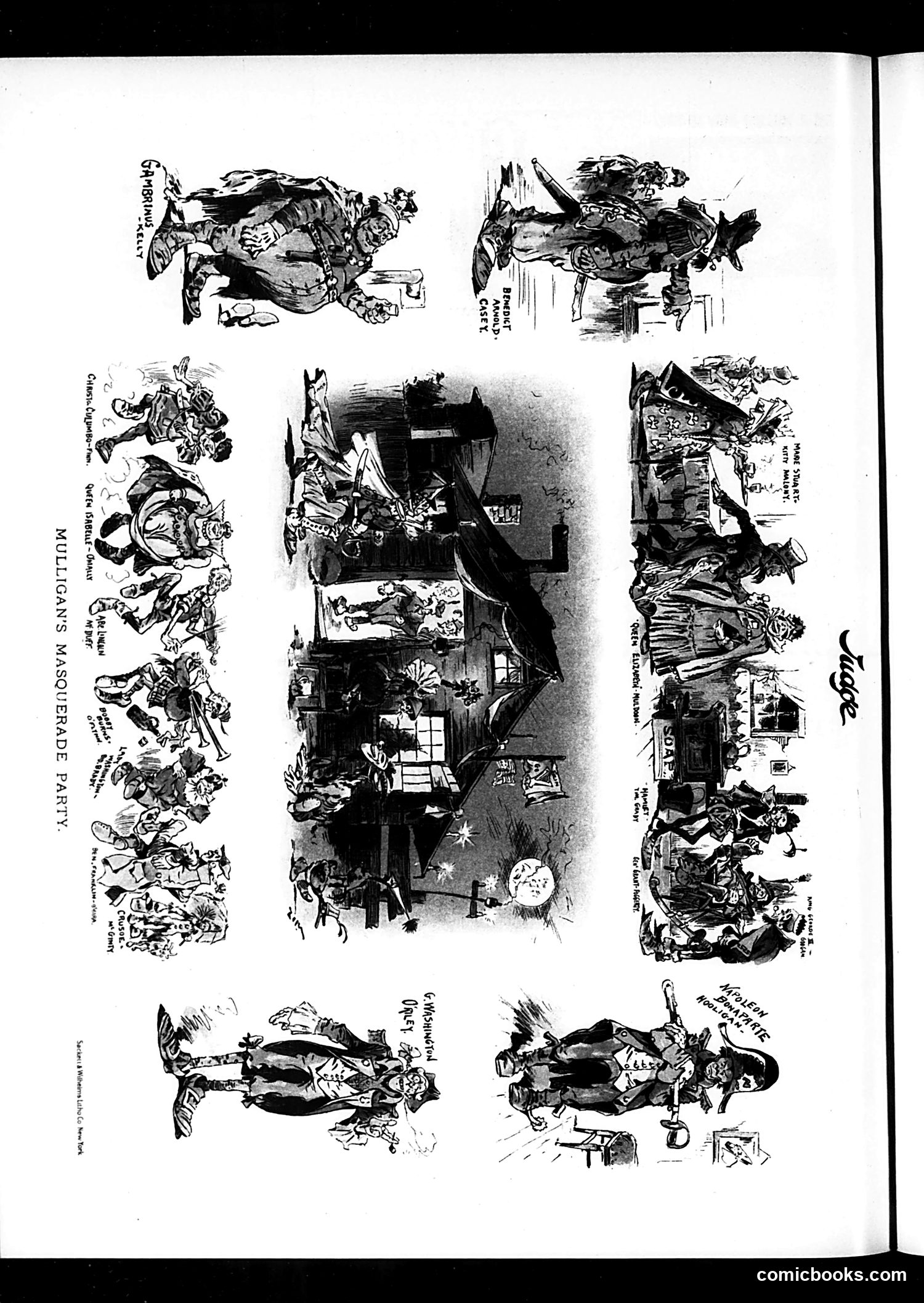
This page depicts "Mulligan's Masquerade Party," likely referencing Boss William O'Brien "Mulligan" Tweed or similar Tammany Hall political figures of Gilded Age New York. The central image shows a chaotic masquerade ball, with figures in various disguises and costumes mingling in revelry. The surrounding vignettes appear to show the "true identities" behind the masks—exposing political corruption, fraud, and scandal hidden beneath respectable appearances. The satire suggests that corrupt politicians and their associates hide their unethical dealings behind social pretense and elaborate costumes. The page critiques how Tammany Hall operatives conducted corrupt political business while maintaining facades of respectability, typical of *Judge* magazine's anti-corruption stance during the Progressive Era.