
A complete issue · 16 pages · 1895
Judge — January 19, 1895
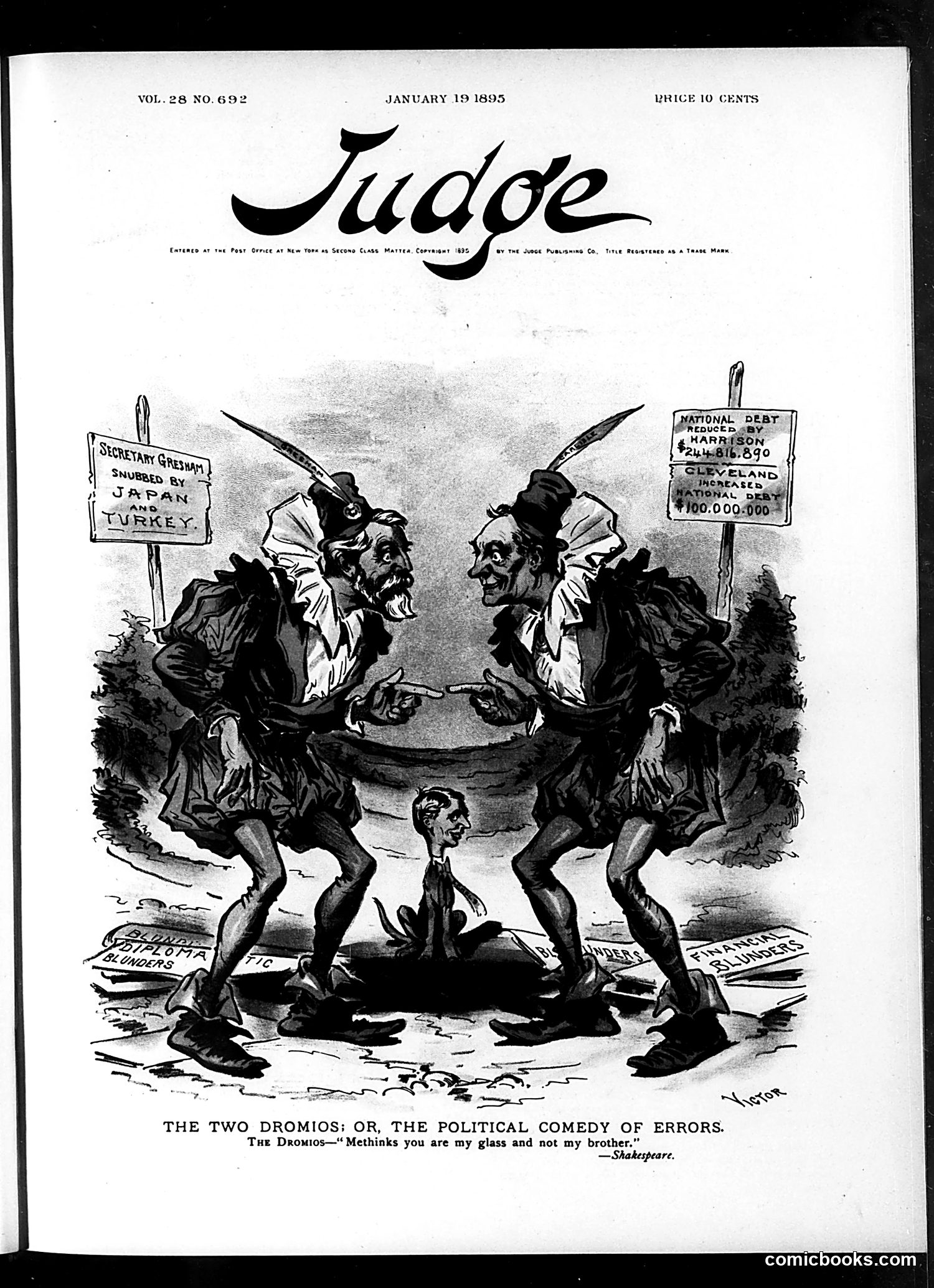
This January 1895 *Judge* cartoon references Shakespeare's "Comedy of Errors" to satirize American political blunders. Two grotesque figures (likely representing political rivals or administrations) are depicted as mirror images—the classical "Dromios" (identical twins from the play). The left sign references "Secretary Gresham snubbed by Japan and Turkey," while the right mentions "Cleveland increased National Debt" by $100,000,000. The small human figure between them appears trapped or confused by these errors. The satire suggests that American political leadership has become a farcical repetition of mistakes—both foreign policy humiliations and fiscal mismanagement—making the nation's government appear as comedically bungled as Shakespeare's mixed-up twins. The overall message: political incompetence creates chaos.
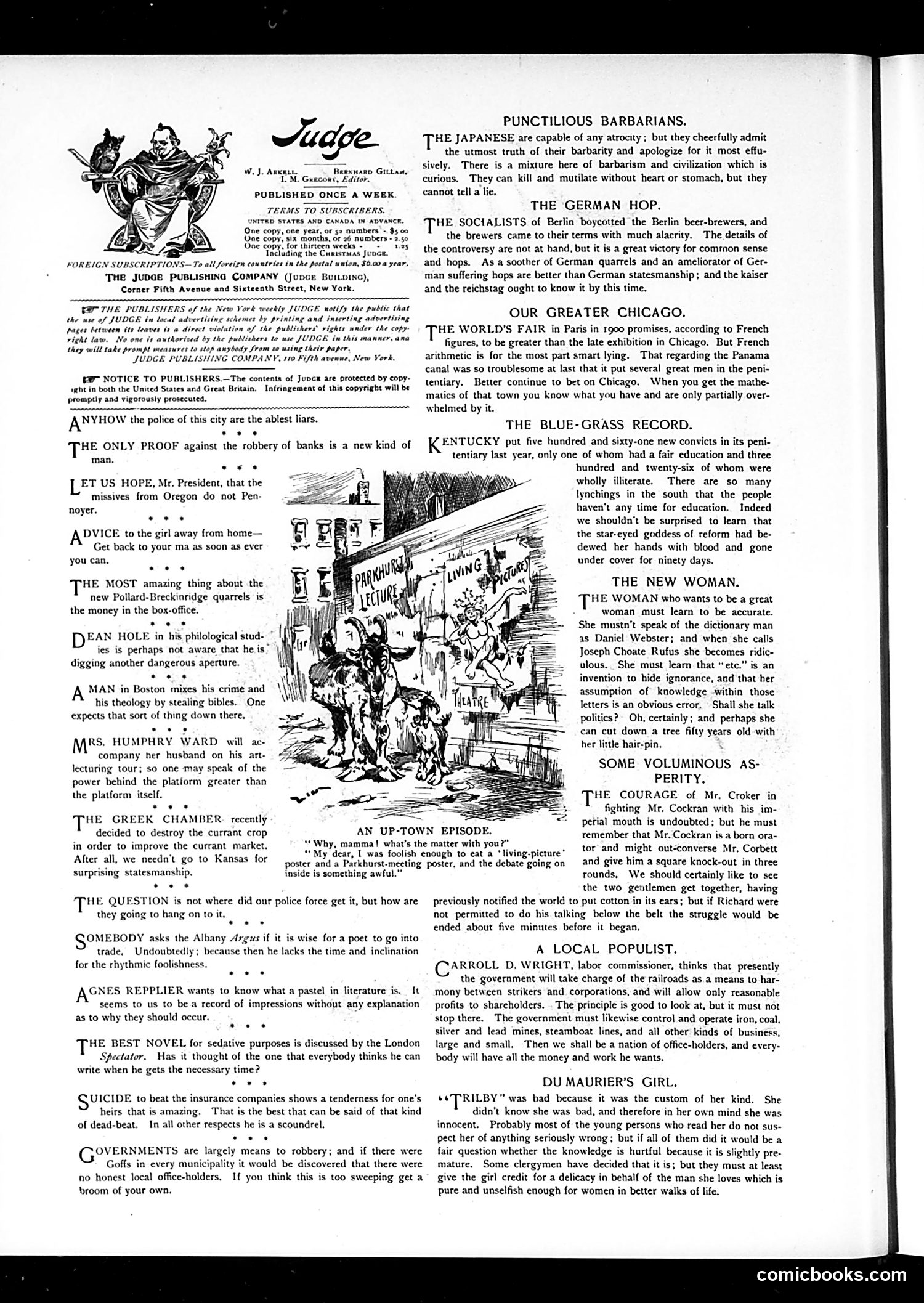
The central cartoon depicts a crowded street scene outside what appears to be a theater or lecture hall. The accompanying text presents a domestic dialogue: a woman asks her husband why he's leaving, and he responds that he was "foolish enough to get a 'living-picture' show" but found it disappointing—"the picture going on inside is something awful." The satire targets the quality and moral concerns surrounding early motion pictures ("living pictures"), which were viewed with suspicion by respectable society. The joke relies on the husband's implied complaint that the film itself is poor quality or morally objectionable, contrasted with the husband's apparent willingness to view such entertainment despite its dubious reputation. This reflects turn-of-the-century anxieties about cinema as a lowbrow, potentially corrupting amusement.
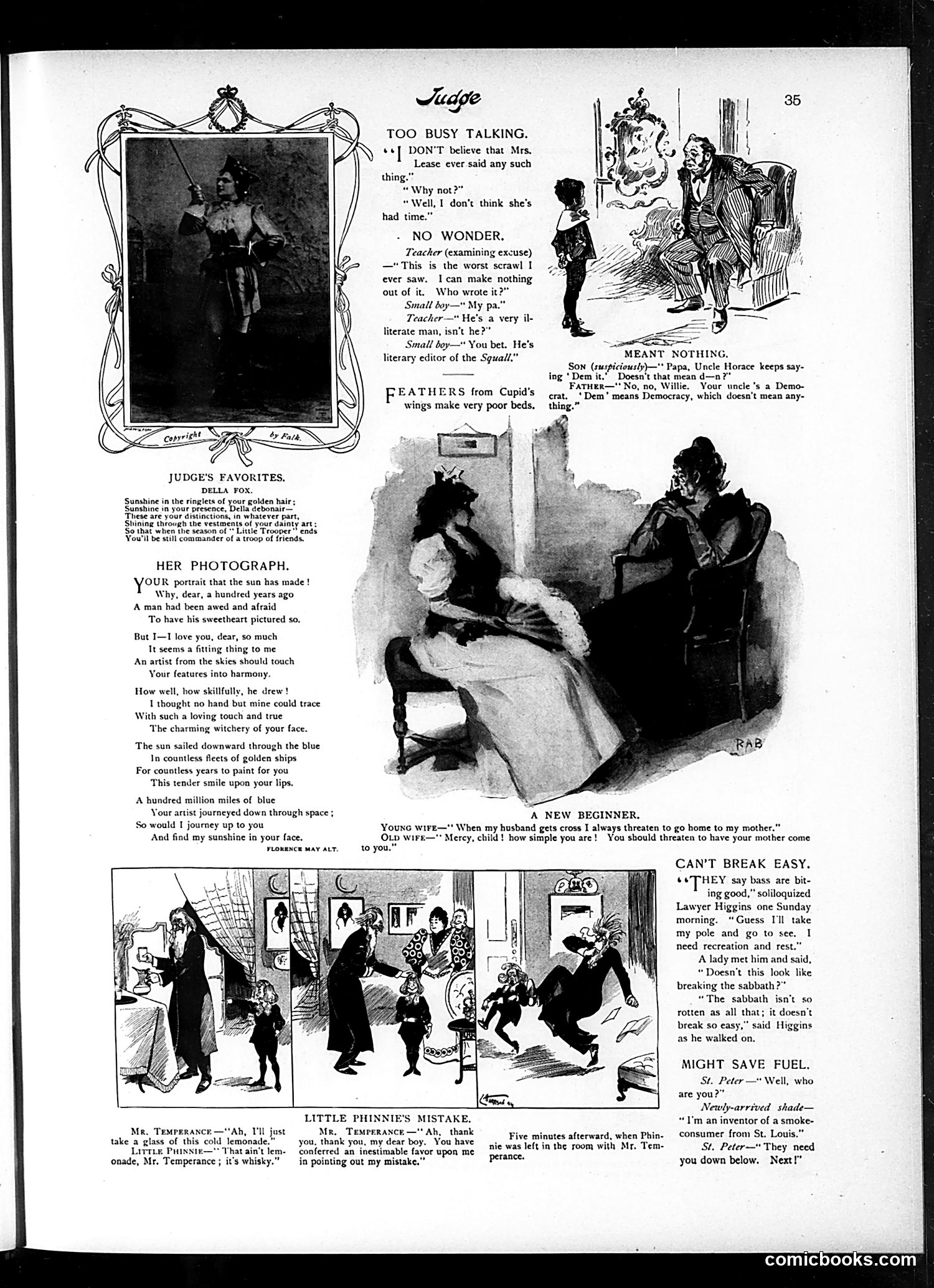
This page contains several unrelated satirical items typical of Judge magazine's format: **"Too Busy Talking"** and **"No Wonder"** are brief dialogue jokes about a teacher unable to grade papers due to constant interruptions, with a pun about a newspaper's "literary editor" being illiterate. **"Judge's Favorites"** is a complimentary poem about "Della Fox," likely a contemporary actress or performer. **"Her Photograph"** is a sentimental poem about a painted portrait. The multi-panel cartoon at bottom depicts a domestic scene with "Little Phinnie's Mistake," showing a child's misadventure while an adult guest visits, resulting in spilled lemonade and confusion. **"A New Beginner,"** "Can't Break Easy," and **"Might Save Fuel"** are brief humorous anecdotes about marital life, religious observance, and a smoke-consuming invention. These appear to be general-interest humor pieces rather than political satire.
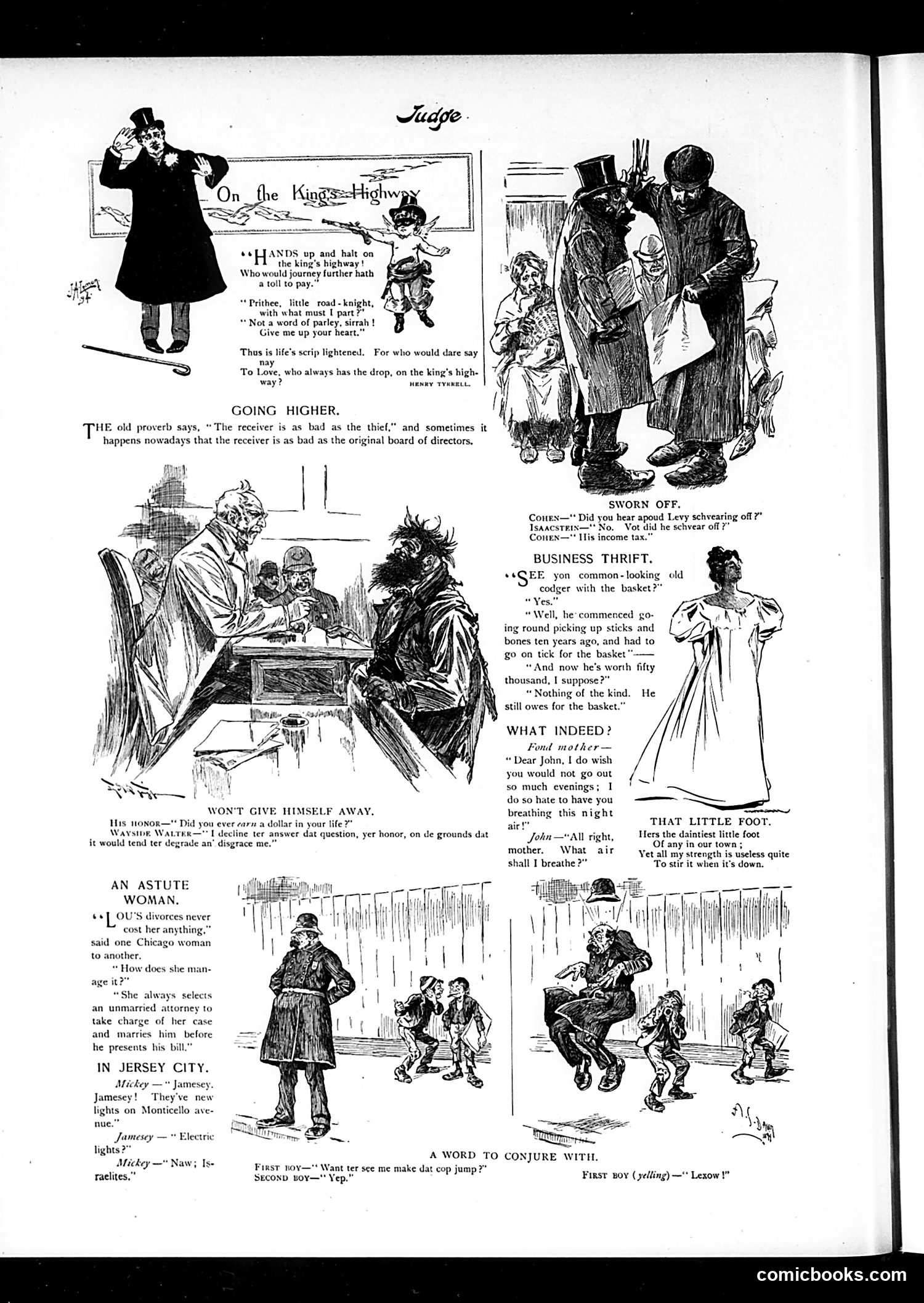
This page contains multiple satirical vignettes typical of Judge magazine's social commentary: **"On the King's Highway"** - A romantic poem using medieval robbery imagery as metaphor for love's conquests, suggesting love takes what it wants without negotiation. **"Going Higher"** - Satirizes corporate corruption, suggesting receivers of bankrupt companies are as dishonest as the original board of directors who mismanaged them. **"Sworn Off," "Business Thrift," "Won't Give Himself Away"** - Brief ethnic-stereotype jokes (Levy character) and commentary on financial desperation and legal evasion. **"An Astute Woman"** - Satirizes divorce as transactional: a woman deliberately hires an unmarried lawyer, then marries him before he bills her—avoiding payment through matrimony. **"In Jersey City" and "A Word to Conjure With"** - Children's street humor, with the final reference to "Lexow" likely alluding to the Lexow Committee (1894 investigation into NYC police corruption), where simply shouting "Lexow" reportedly terrified corrupt officers. The page reflects late-19th-century American preoccupations: corruption, class anxiety, and urban crime.
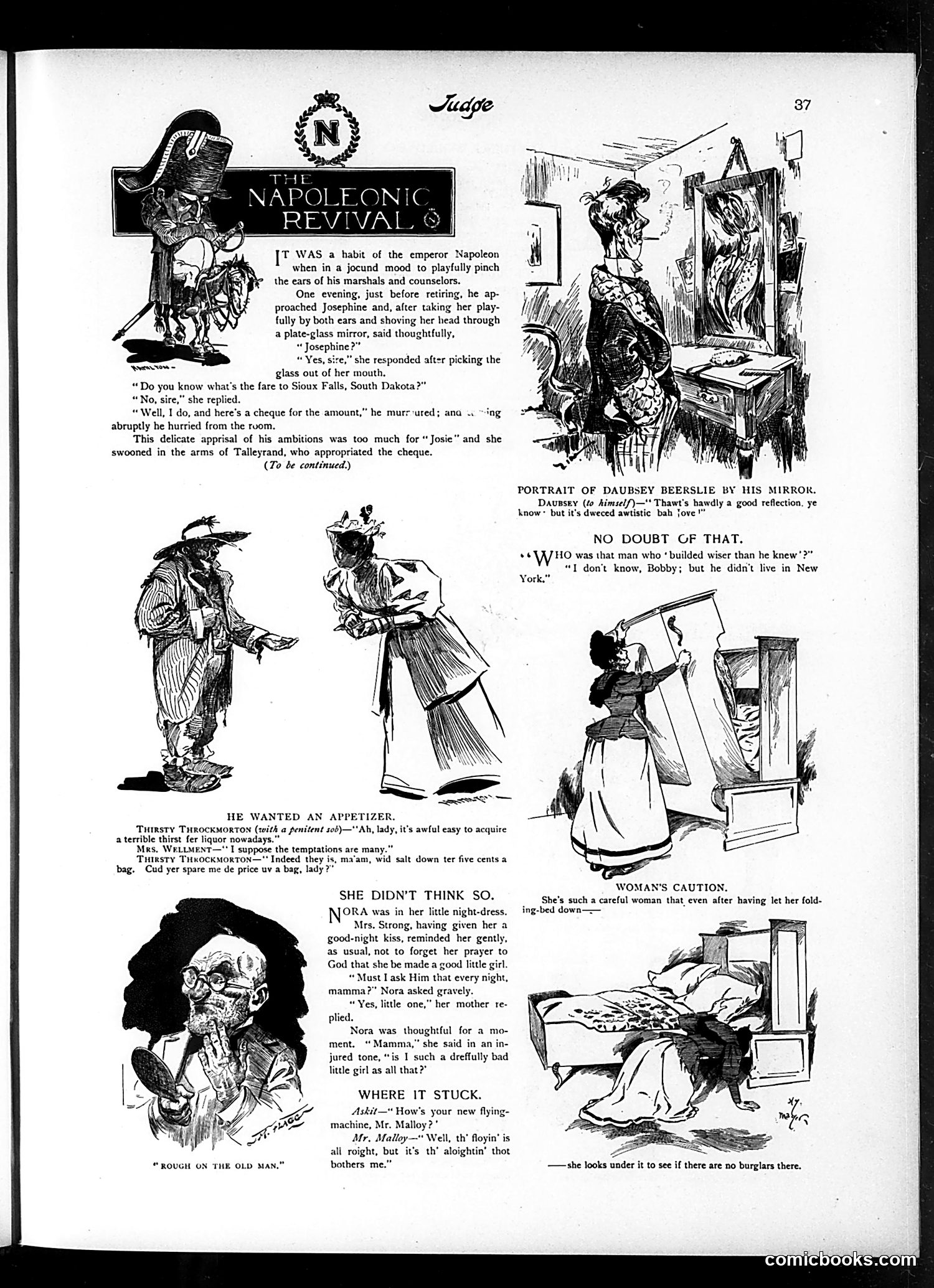
This page contains several unrelated satirical sketches typical of Judge's humor circa early 1900s: **"The Napoleonic Revival"** mocks pretentious social climbers by imagining Napoleon abruptly abandoning romance to ask Josephine about Sioux Falls fares—absurdist humor deflating grandiose behavior. **"He Wanted an Appetizer"** features working-class dialect humor: a drunk man asks a lady for money for salt, conflating alcohol temptation with cheap condiments—playing on period stereotypes about Irish immigrants and drinking. **"She Didn't Think So"** is sentimental domestic humor about a child questioning why she must nightly pray to become good, implying either maternal exaggeration or childish innocence. **"Where It Stuck"** uses Irish-accented malapropism ("aloightin'") to joke about aeronautical troubles during the early aviation craze. **"Woman's Caution"** satirizes neurotic female anxiety through exaggeration—a woman checking under her folding bed for burglars after lowering it. The page demonstrates Judge's blend of class-based humor, ethnic caricature, and domestic satire targeting early 20th-century American anxieties.
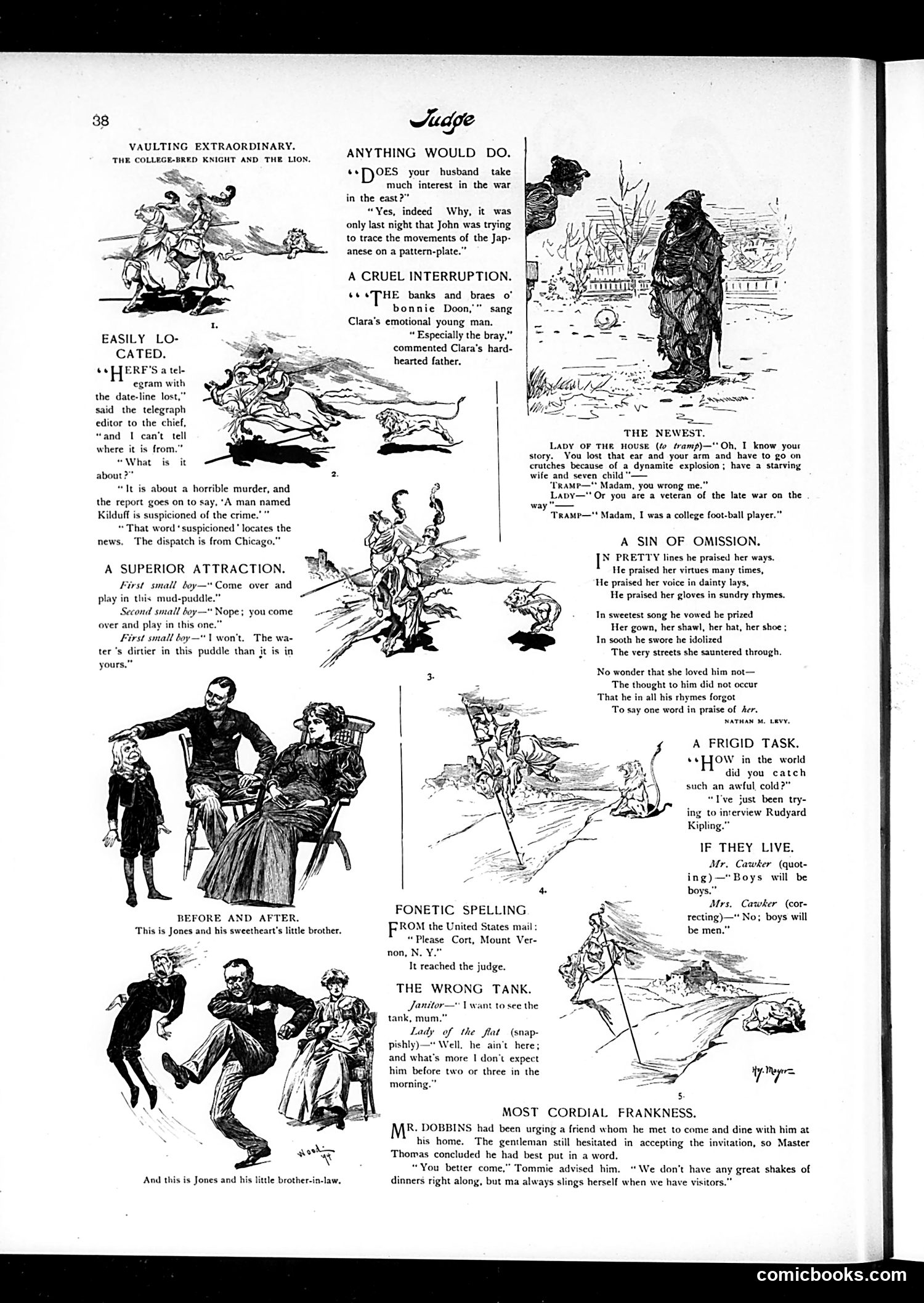
This page contains multiple brief satirical cartoons and jokes typical of early 1900s American humor: **"Anything Would Do"** mocks wives' indifference to husbands' war interests—a woman dismisses her husband's engagement with the Russo-Japanese War as mere pattern-tracing. **"A Cruel Interruption"** depicts a sentimental young man's romantic recitation interrupted by the girl's father's crude comment, deflating the sentiment. **"The Newest"** jokes about a tramp's implausible excuse—claiming he lost limbs as a college football player rather than in war, inverting expected sympathy narratives. **"A Sin of Omission"** is a poem about a man who praises every aspect of a woman *except* the woman herself, explaining her indifference. **"A Frigid Task"** references the famous writer Rudyard Kipling, suggesting his company causes literal illness. The cartoons collectively satirize social pretension, romantic hypocrisy, and male obtuseness through domestic and everyday scenarios. The art style is characteristic of Judge's pen-and-ink aesthetic.
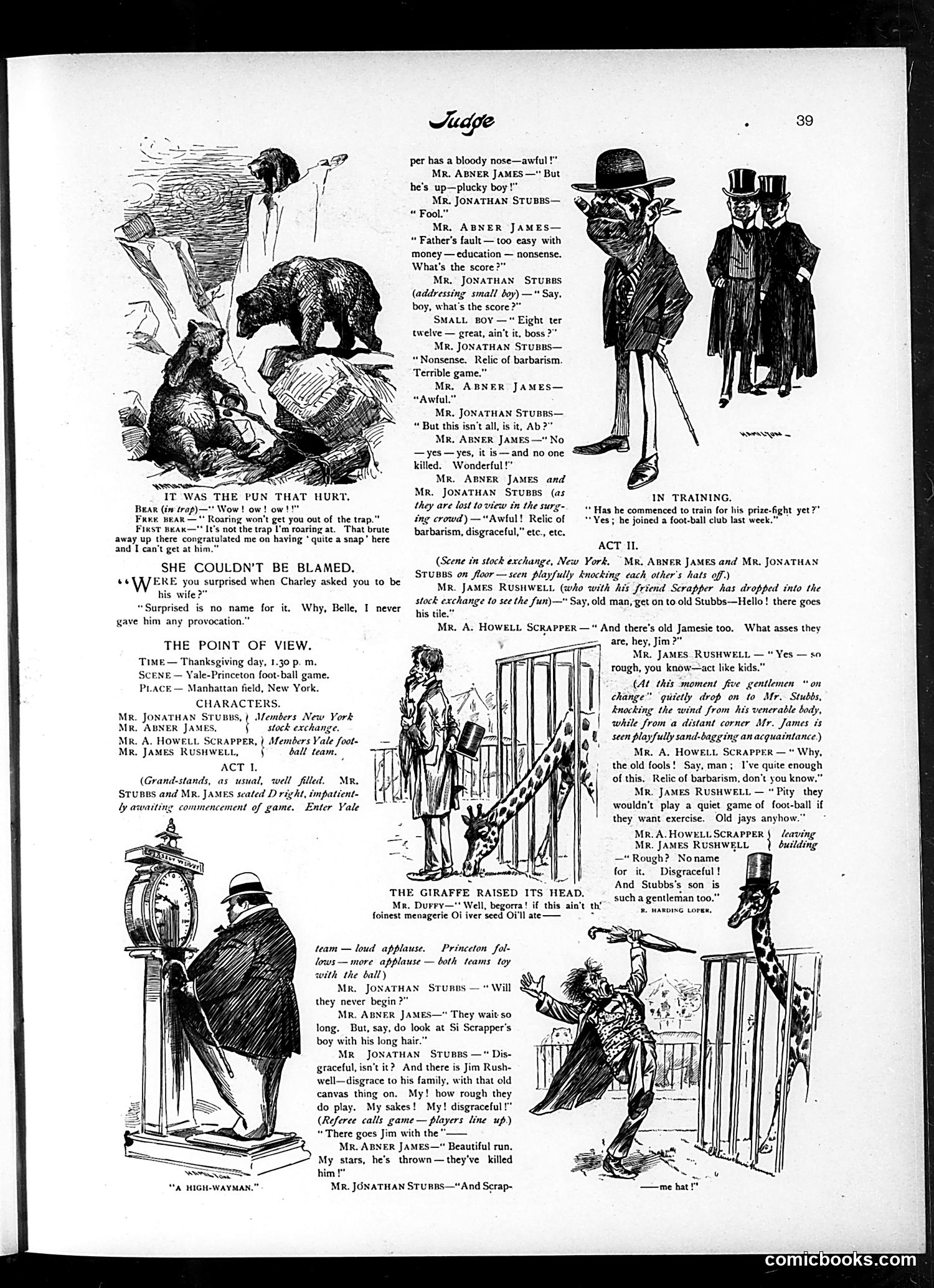
This page satirizes Victorian-era hypocrisy regarding athletics and masculinity. Two elderly gentlemen, Mr. Jonathan Stubbs and Mr. Abner James, attend a Yale-Princeton football game where they denounce the sport as a "relic of barbarism" and "disgraceful." The joke hinges on their moral contradiction: while condemning football as violent and crude, these same men later appear in a stock exchange scene *literally engaged in rough-housing*—knocking hats off and sand-bagging each other playfully. Meanwhile, younger men (including Scrapper and Rushwell, who join a football club for "training") are mocked as rougher and less civilized. The satire exposes how respectable elders criticize youth athletics while themselves behaving rowdily, revealing their judgment as baseless social posturing rather than genuine principle. The title "In Training" ironically suggests the older generation's own need for discipline.
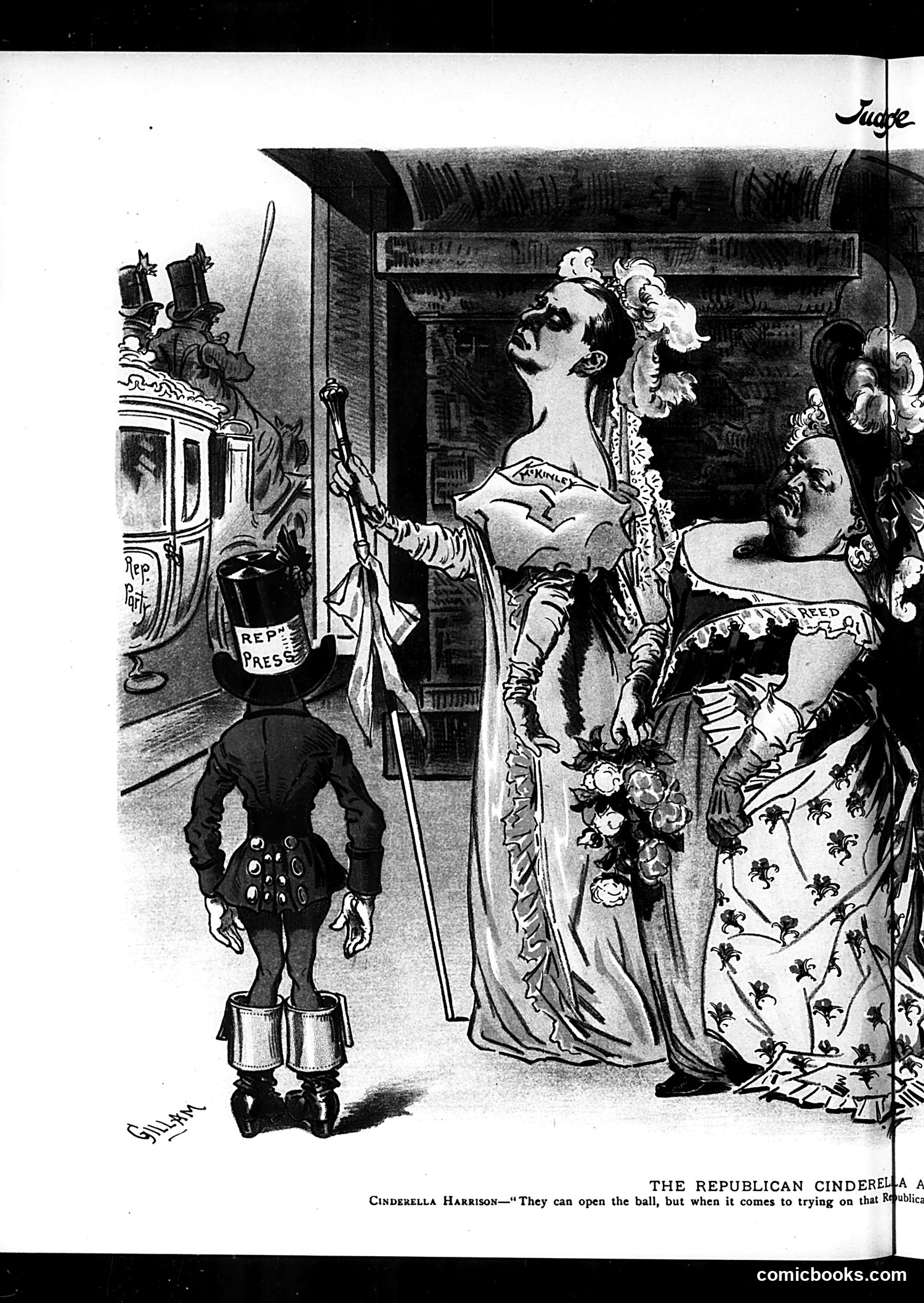
This is a satirical cartoon titled "The Republican Cinderella" featuring President Benjamin Harrison (recognizable from the caption "Cinderella Harrison"). The cartoon uses the fairy tale metaphor to critique Republican political power. Harrison, depicted as Cinderella in a ball gown, stands center stage while well-dressed aristocratic figures surround him. A small uniformed figure (likely representing the Republican party or its apparatus) stands apart, holding a sword/staff. The caption's incomplete text suggests the joke concerns Republicans' ability to "open the ball" (hold power/govern) but struggle with practical execution or "trying on" their policies. The Cinderella reference implies temporary power—suggesting Harrison's presidency or Republican control is fleeting and contingent, dependent on external forces rather than genuine strength. The satire mocks Republican governance as superficial spectacle rather than substantive leadership.
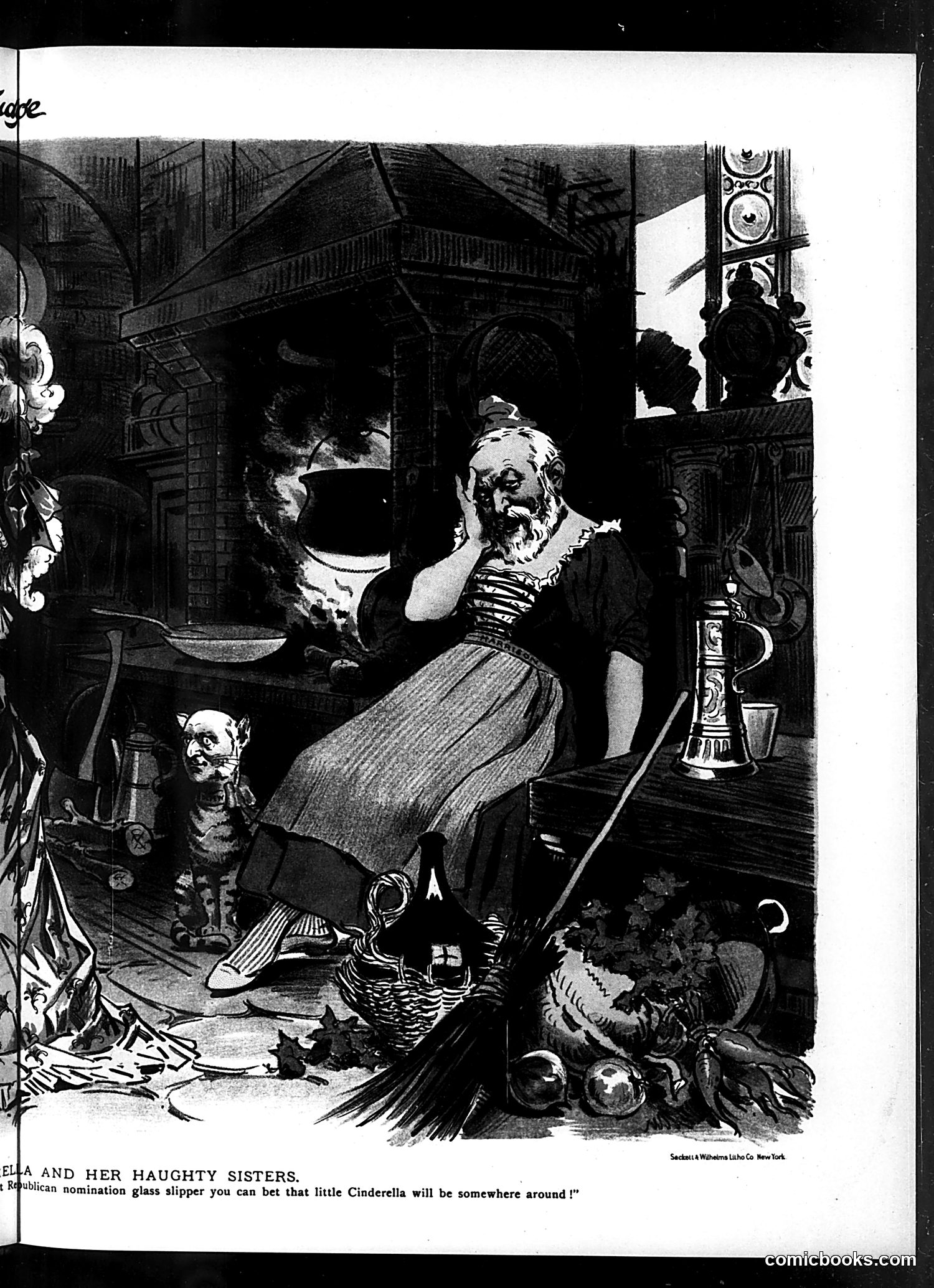
This political cartoon satirizes the 1884 Republican presidential nomination race using the Cinderella fairy tale. The figure labeled "Ella" (likely referring to a political candidate or faction) is depicted as Cinderella among her "haughty sisters" — representing rival Republicans competing for the nomination. The caption's reference to a "glass slipper" suggests the nomination itself is the prize that will fit only one candidate. The joke implies that despite being overlooked or underestimated ("Cinderella"), this particular candidate will ultimately succeed in winning the coveted nomination, just as Cinderella unexpectedly wins the prince. The elaborate Gothic setting and ornate details typical of Judge's illustration style enhance the fairy-tale metaphor, making Republican party politics appear as a domestic drama of rivalry and eventual triumph.
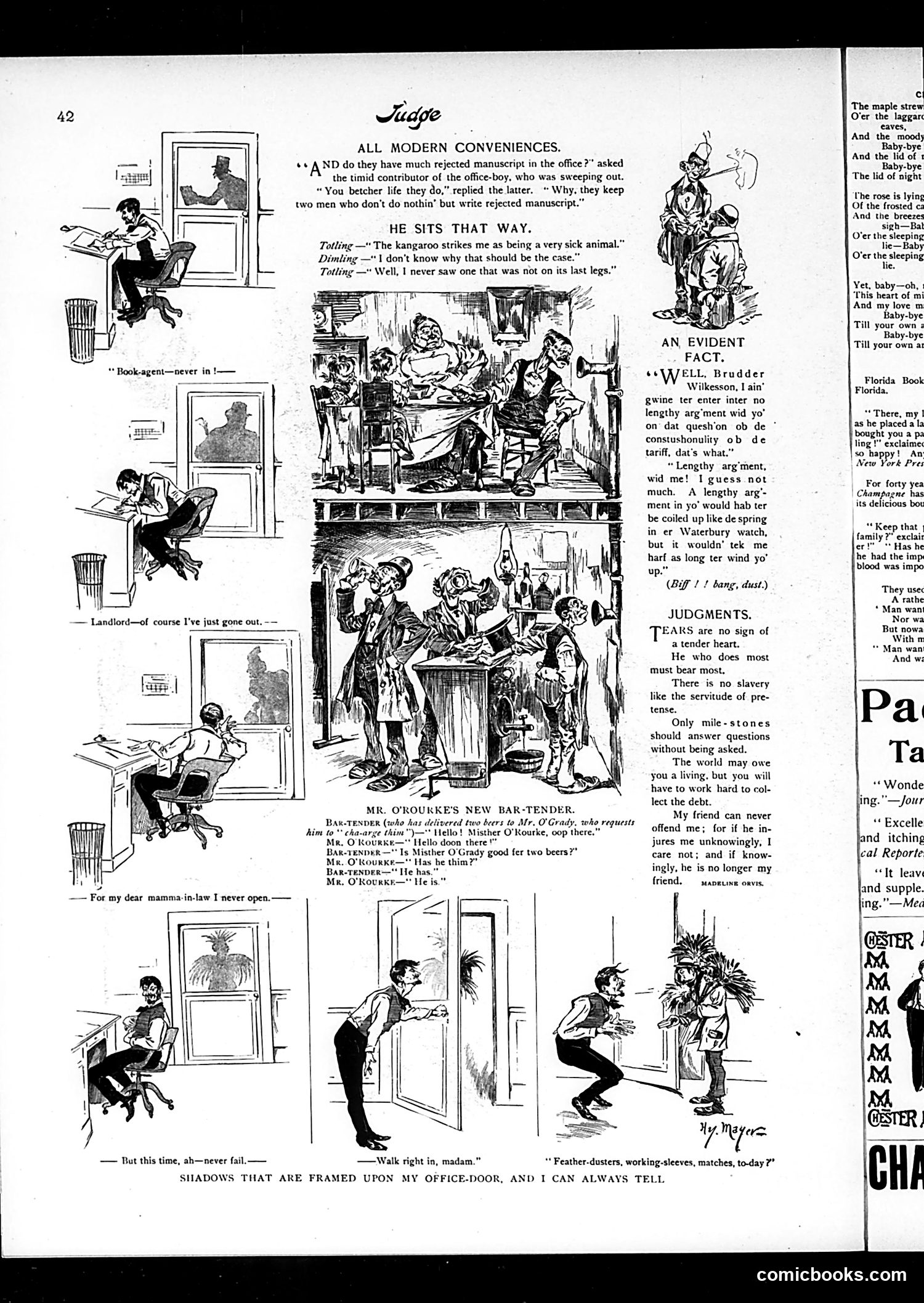
This page from *Judge* contains multiple satirical pieces mocking American office culture and social pretensions circa early 20th century. **"All Modern Conveniences"** ridicules publishing rejection through exaggeration—the office-boy claims two men work full-time writing rejection letters, suggesting publishers reject so many manuscripts they need dedicated staff. **"He Sits That Way"** makes a simple visual joke: a kangaroo appears perpetually exhausted because it naturally stands upright on its hind legs. **"Mr. O'Rourke's New Bar-Tender"** appears to satirize Irish-American dialect humor common to the era, depicting bar patrons with thick accents. **"An Evident Fact"** shows two Black men debating tariff policy in exaggerated dialect, likely mocking both political complexity and contemporary racial stereotypes through caricature. The bottom panels show office-door silhouettes with various scenarios—rejecting book agents, avoiding landlords—suggesting the widespread experience of dodging unwanted visitors. The page reflects *Judge*'s style: satirizing contemporary social anxieties through caricature, dialect humor, and visual gags.
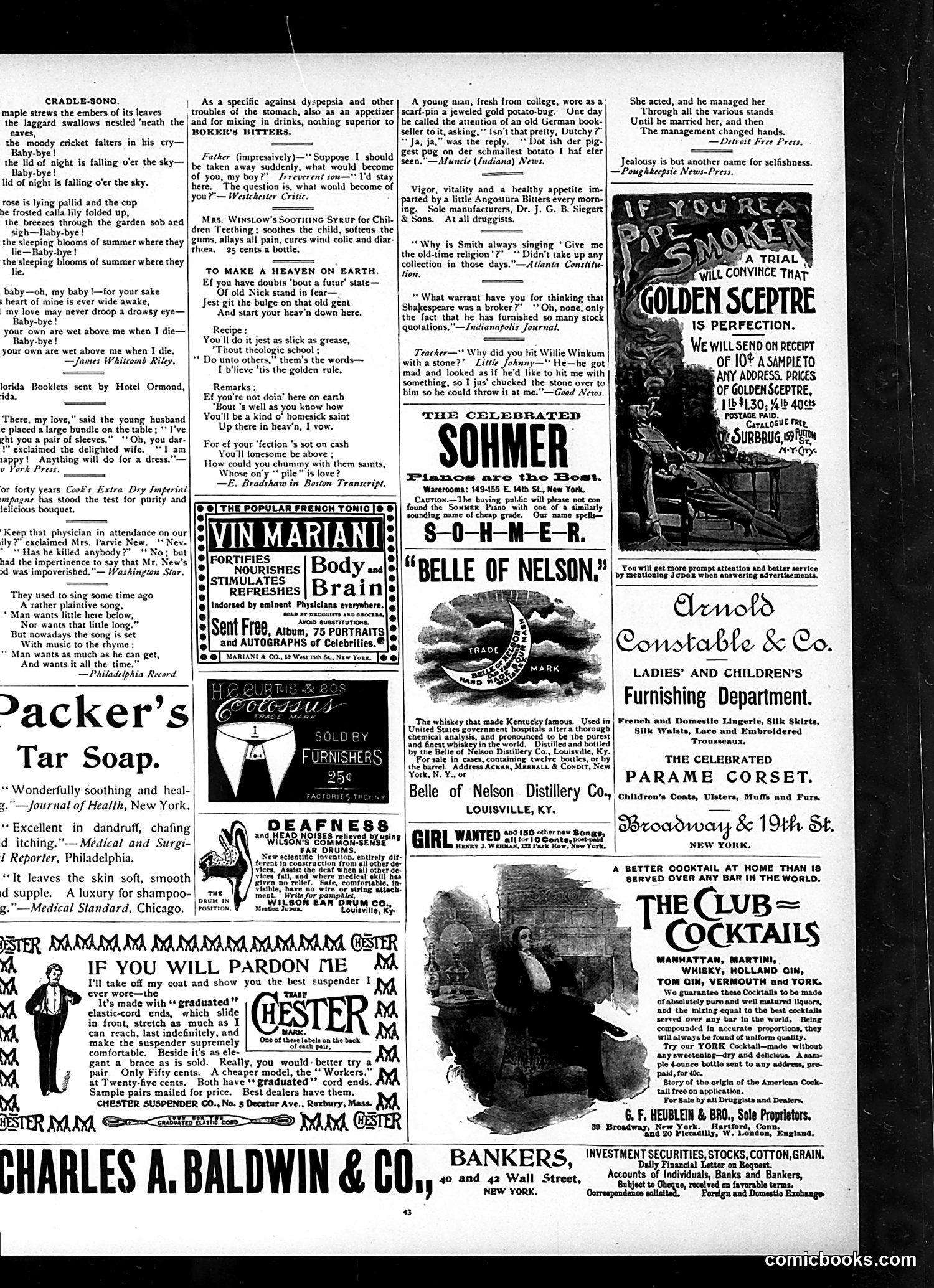
This is primarily an **advertising-heavy page** from an early 20th-century satirical magazine, with several short humorous pieces interspersed. **Content includes:** - **"Cradle-Song"** and other brief poems/jokes about domestic life and relationships—typical Judge humor about marriage and family dynamics - **Product advertisements** for patent medicines (Vin Mariani wine tonic, Boker's Bitters) and personal goods (Packer's Tar Soap, Chester Suspenders)—common in this era - **Short jokes** poking fun at husbands, physicians, and social pretension **Context for modern readers:** The advertising reflects pre-FDA regulation America, when alcohol-based "tonics" were marketed as cures for digestion and general vitality. The jokes reflect middle-class anxieties about money, marriage, and social respectability typical of the period. The page shows Judge's dual function as both satirical publication and advertising vehicle, with humor aimed at recognizable social types rather than specific political figures or events.
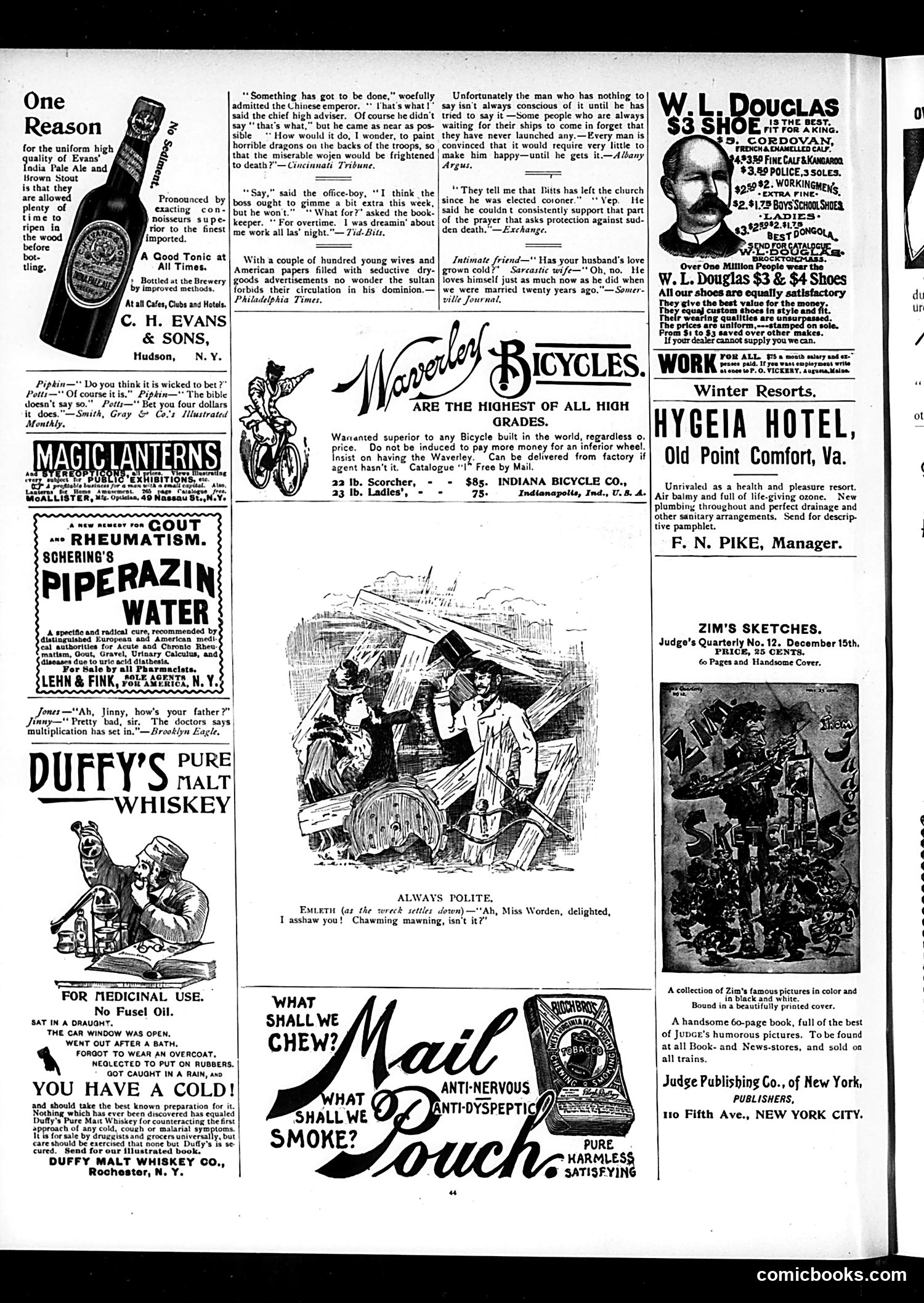
This is primarily an **advertising page** from Judge magazine, with several brief humorous anecdotes interspersed among ads. The cartoons and jokes are short, topical quips rather than sustained satire: - One anecdote mocks a Chinese emperor's adviser suggesting painting dragons on troops to frighten enemies—satirizing absurd military solutions - Another jokes about an office boy expecting overtime pay for daydreaming - A brief item about American newspapers' "seductive" advertisements for goods, contrasting with a sultan's ban—likely commentary on American consumerism - Small domestic humor pieces about marriage and courtship The **advertisements dominate**: W.L. Douglas shoes, Waverley bicycles, Duffy's whiskey (marketed "for medicinal use"), Schering's water for rheumatism, and a winter resort. The satire is **mild and disconnected**—typical of Judge's miscellaneous humor format. No sustained political commentary or caricature of specific public figures is evident. The page reflects turn-of-century American anxieties about consumption, health remedies, and domestic life, but nothing requires specialized historical knowledge beyond recognizing this as period advertising copy.
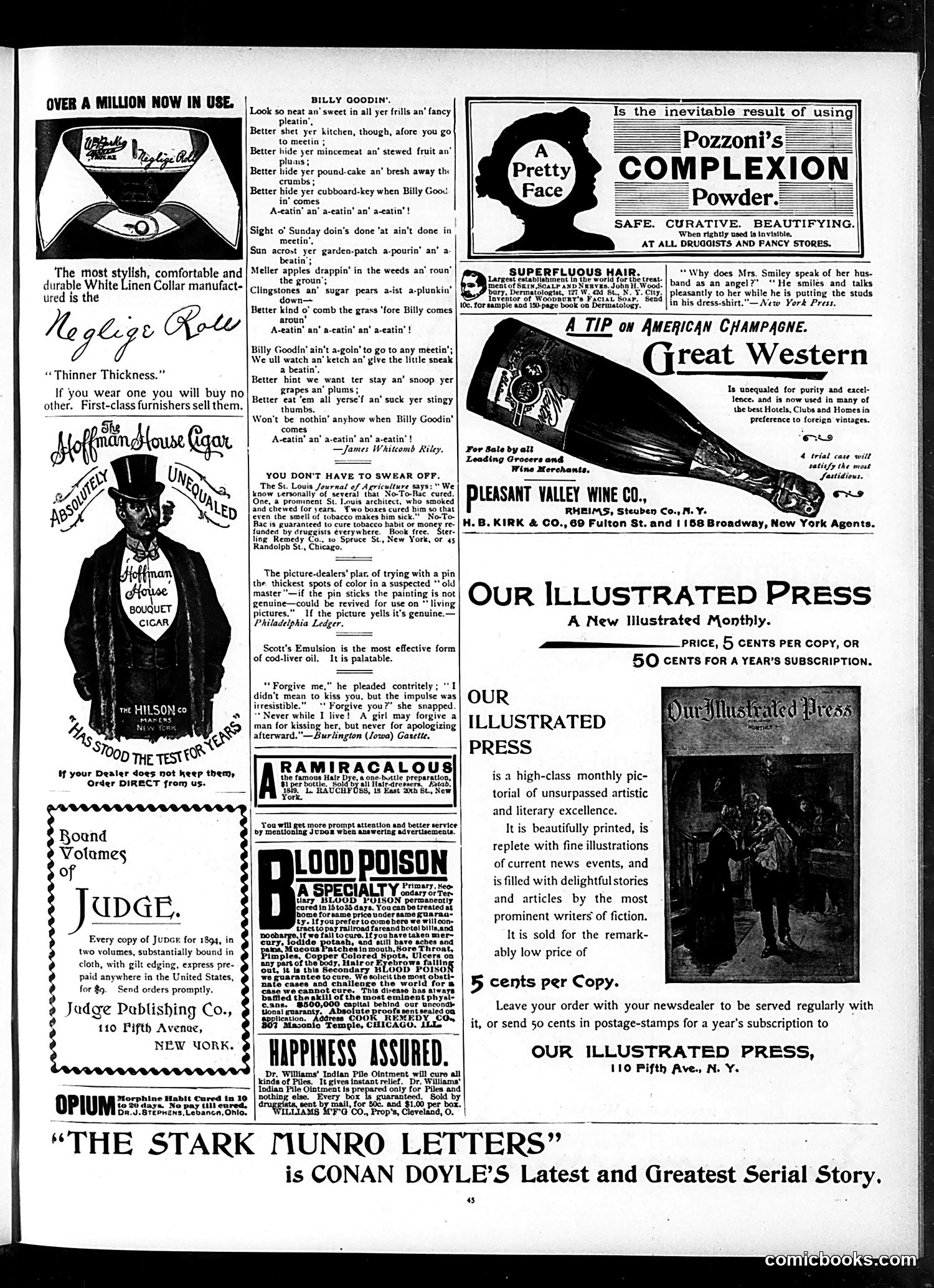
This is primarily an **advertising page** from Judge magazine, not a political cartoon. The content consists of various product advertisements typical of the era, including: **Notable ads:** - **"Billy Goodin'" poem** (by James Whitcomb Riley): A humorous dialect verse about a gluttonous character who eats everything at social gatherings—satirizing poor table manners and greed through rural/vernacular speech. - **Tobacco cessation product** (No-To-Bac): Reflects early 20th-century concerns about smoking addiction. - **Medical "cures"**: Blood poison treatments and opium remedies—indicating the era's unregulated patent medicine market and serious health issues. - **Beauty products**: Pozzoni's complexion powder and hair removal treatments, reflecting period beauty standards. **Historical context:** These ads reveal what concerned ordinary Americans: addiction, venereal disease, appearance anxiety, and dubious medical solutions. The language and imagery are period-specific (dialect poetry, formal advertising style). There is **no significant political satire** on this page—it's a snapshot of commercial culture and social anxieties circa 1900s.
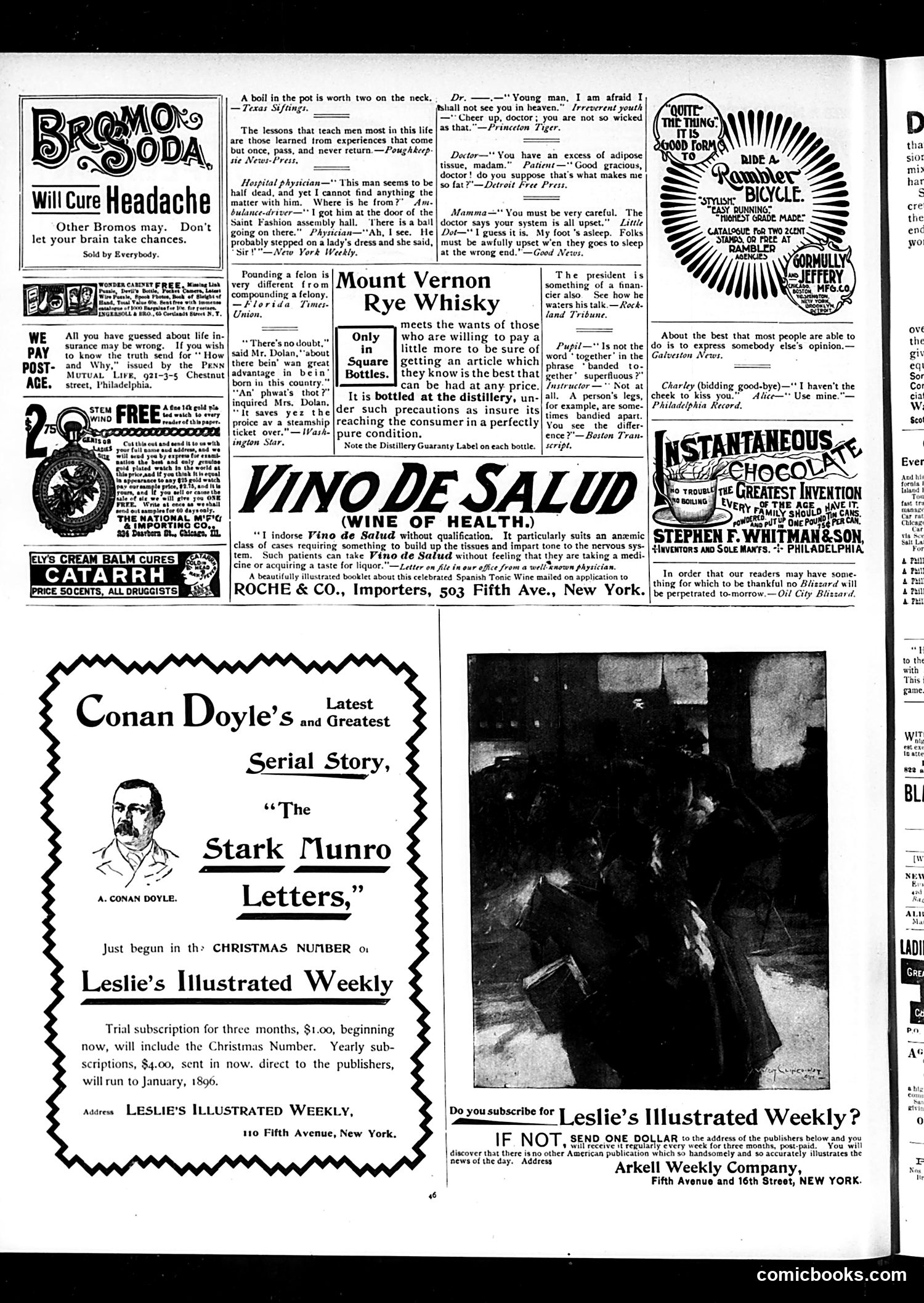
This is primarily an **advertising page** from Judge magazine featuring patent medicines and serialized entertainment (Conan Doyle's "Stark Munro Letters"). The small comic jokes scattered throughout are typical period humor with minimal political content. They include: - Doctor jokes playing on 1890s medical ignorance (adipose tissue, "upset" digestive systems) - A pun about "pounding a felon" vs. "compounding a felony" - Courtship jokes **The main advertising pitches** promote dubious remedies: Bromo-Soda for headaches, Vino de Salud (wine claiming medicinal benefits for anemia), and Instantaneous Chocolate. These reflect the **unregulated patent medicine industry** of the era—products making exaggerated health claims we'd now recognize as fraudulent. The page shows how Judge mixed satire with profitable advertising, and reveals contemporary attitudes toward medicine, advertising, and entertainment before FDA regulations.
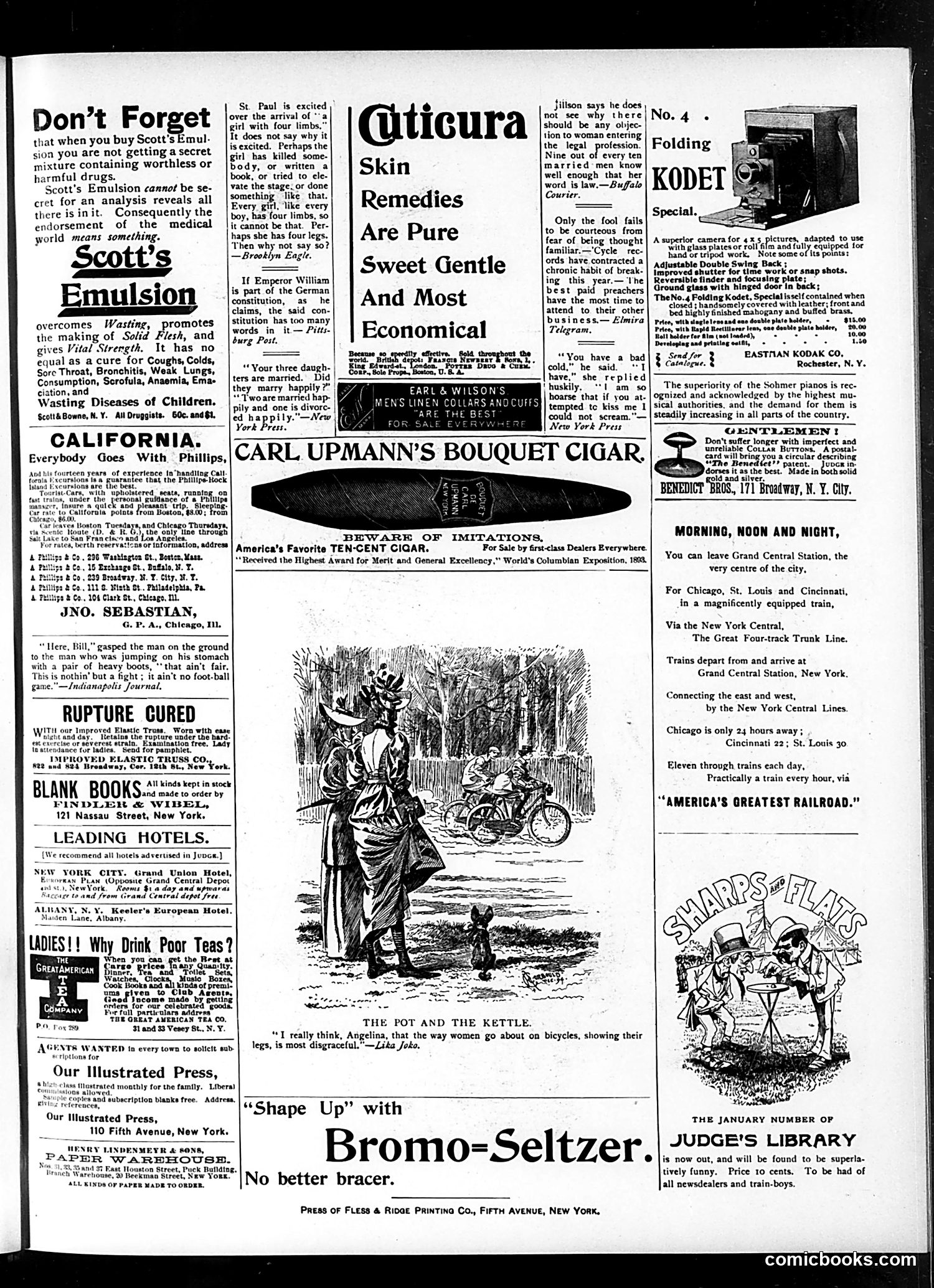
This page is primarily **advertising and filler content** rather than political satire. The dominant elements are commercial advertisements for products like Scott's Emulsion (a patent medicine), Phillips California excursions, Cuticura skin remedies, and Carl Upmann cigars. The only cartoon present is titled **"The Pot and the Kettle,"** depicting a woman on a bicycle with a child, captioned with criticism of women cyclists showing their legs—considered immodest by Victorian standards. The joke mocks prudish attitudes: the caption sarcastically suggests women on bicycles display themselves indecently, reflecting genuine turn-of-the-century anxieties about bicycle-riding women challenging social conventions around female modesty and mobility. A small text joke criticizes "Emperor William" (likely Kaiser Wilhelm II of Germany) for claiming to be "part of the German constitution," suggesting the constitution is bloated with unnecessary elements. The page reflects early 1900s concerns: women's changing roles, medical skepticism, and transportation innovation.
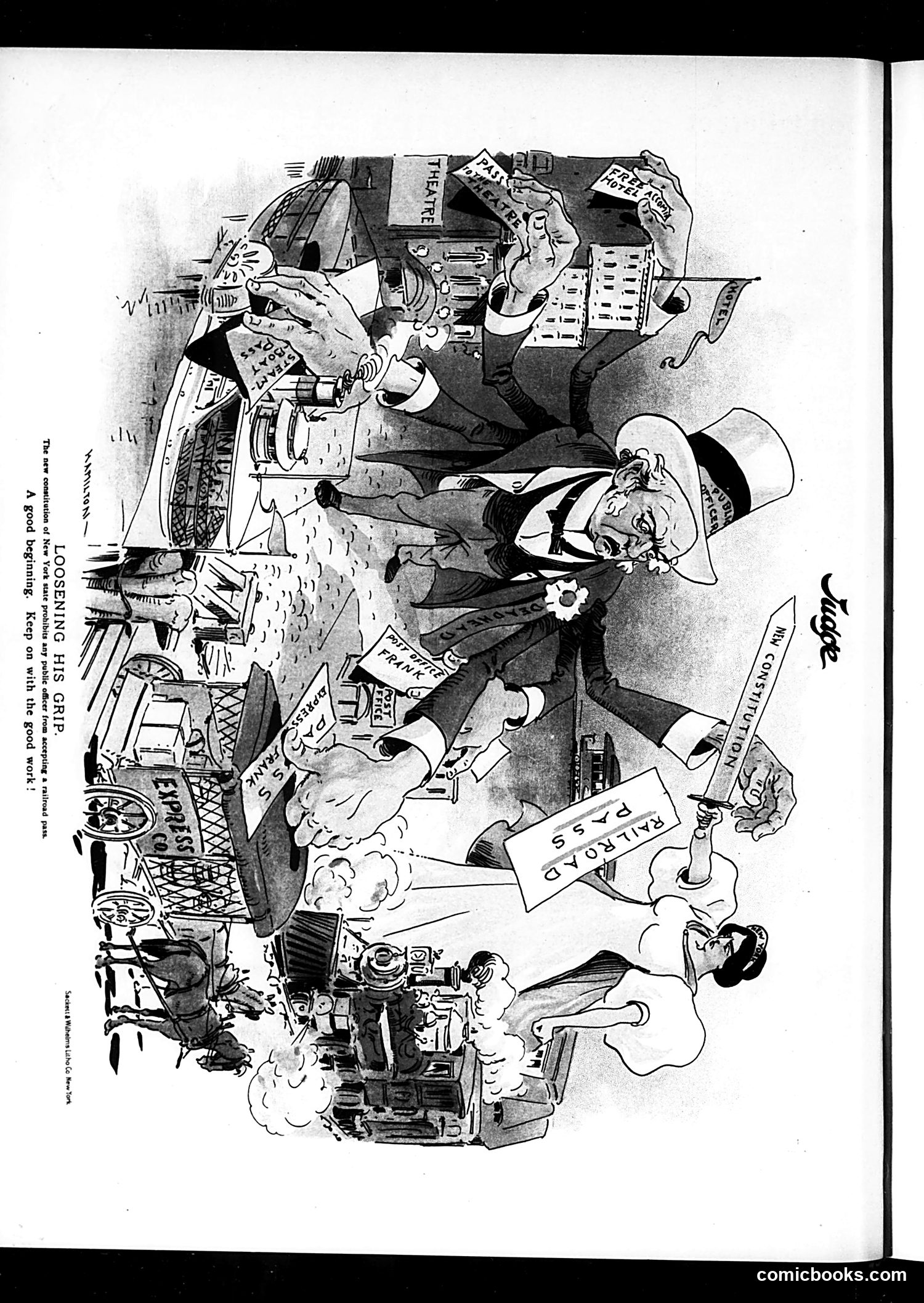
This political cartoon satirizes railroad corruption in New York state politics. The image depicts a figure (likely representing railroad interests or a corrupt politician) being forced to loosen his grip on the state, represented by the woman labeled "New York." The caption explains that New York's new state constitution now prohibits public officials from accepting railroad passes—a common form of bribery and corruption. The cartoon celebrates this reform as "a good beginning," suggesting that while this is progress, more work remains to clean up government corruption tied to railroad monopolies. The satirical point: railroads had previously controlled politicians through gifts and favors, and this constitutional provision represents the public finally wresting control back from corporate influence.