
A complete issue · 16 pages · 1894
Judge — November 17, 1894
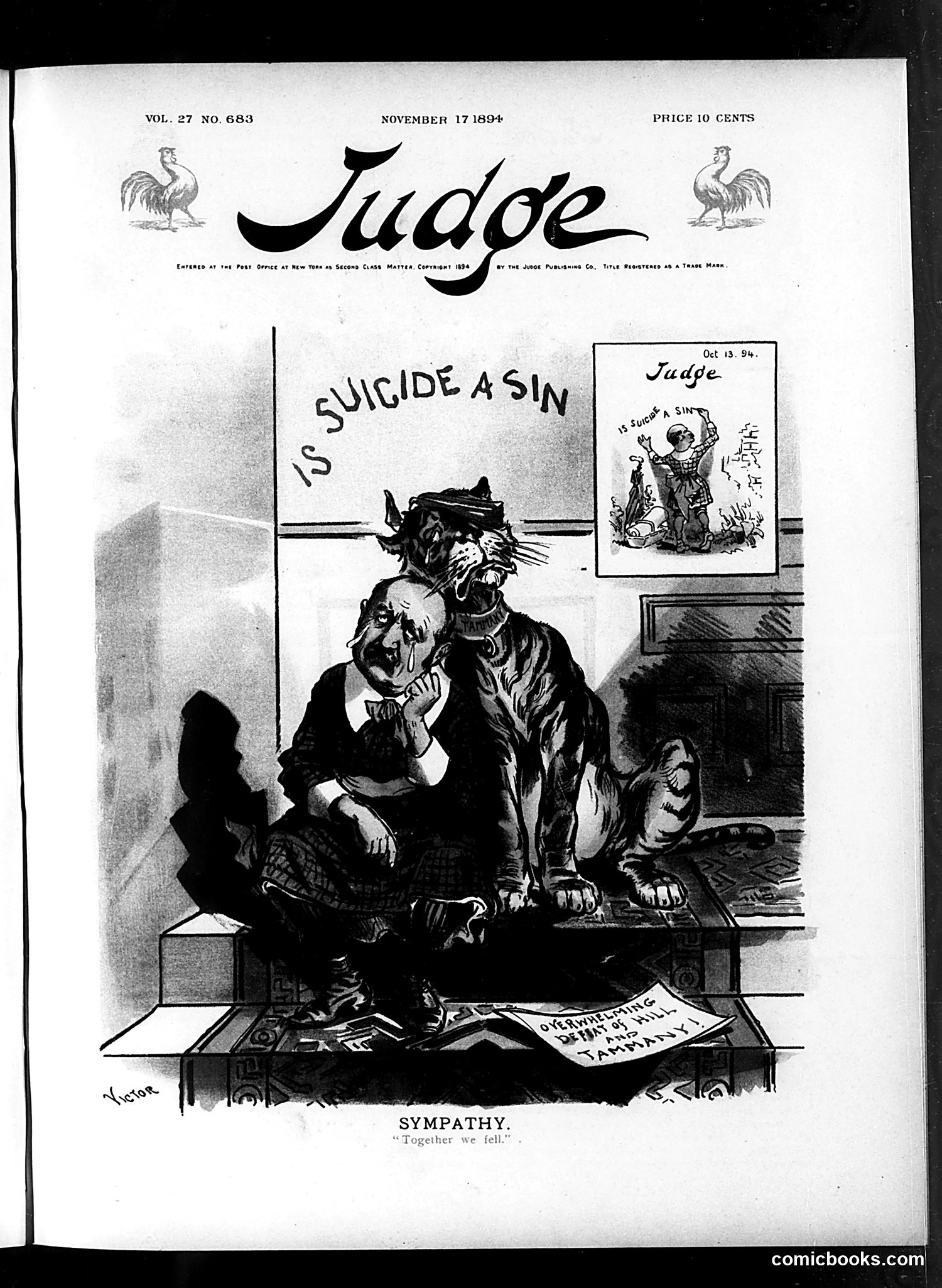
This November 17, 1894 *Judge* cartoon satirizes suicide as a social contagion. The central image depicts a distressed figure comforting what appears to be a demon or death personification, with a sign reading "IS SUICIDE A SIN" visible above them. The caption "Together we fell" suggests mutual moral collapse. The cartoon criticizes what the artist saw as widespread suicide occurring in society, treating it as a shared social malady affecting both the desperate individual and moral/religious authority. The small inset cartoon labeled "Judge" dated October 13 appears to reference related commentary. The satire likely responds to actual suicide epidemics reported in 1890s newspapers, which often sparked public debate about whether publicizing such deaths encouraged imitation. The cartoon warns against moral complicity in these tragedies.
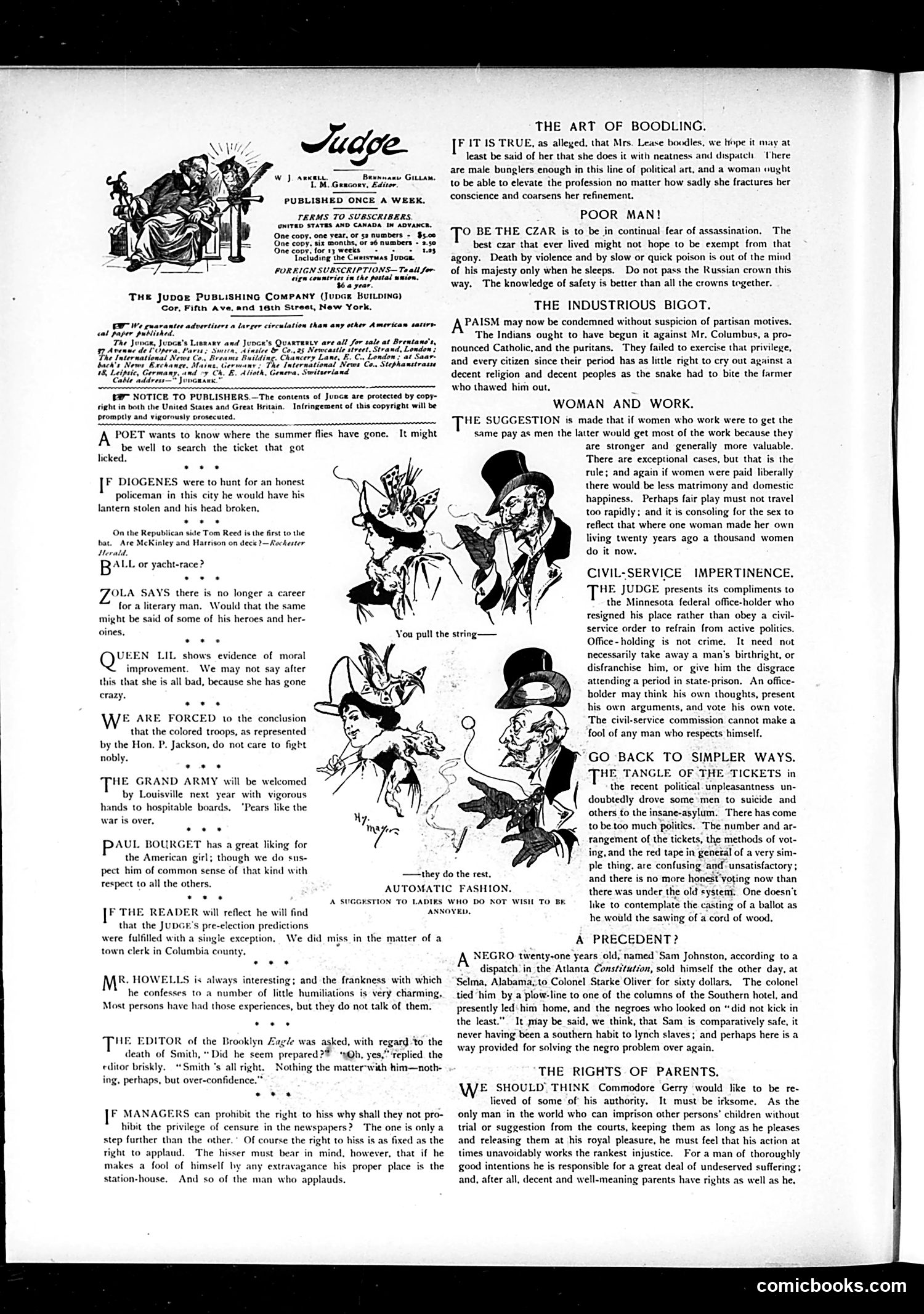
This page contains brief satirical commentary on contemporary issues rather than a unified cartoon. The central illustration shows figures in exaggerated dress performing what appears to be a social dance or fashion critique, labeled "Automatic Fashion: A Suggestion to Ladies Who Do Not Wish to Be Annoyed." The text sections mock various topics: political corruption ("The Art of Boodling"), fears about czarist assassination, Indian-Catholic relations, wage equality for women, and civil-service reform. One item ridicules a Black man named Sam Johnston who allegedly sold himself into slavery for sixty dollars—likely satirizing either slavery's lingering effects or questionable news reporting. The overall tone is characteristic of Judge's approach: quick jabs at social absurdities, political hypocrisy, and contemporary scandals, relying on readers' familiarity with 1890s-era news and debates.
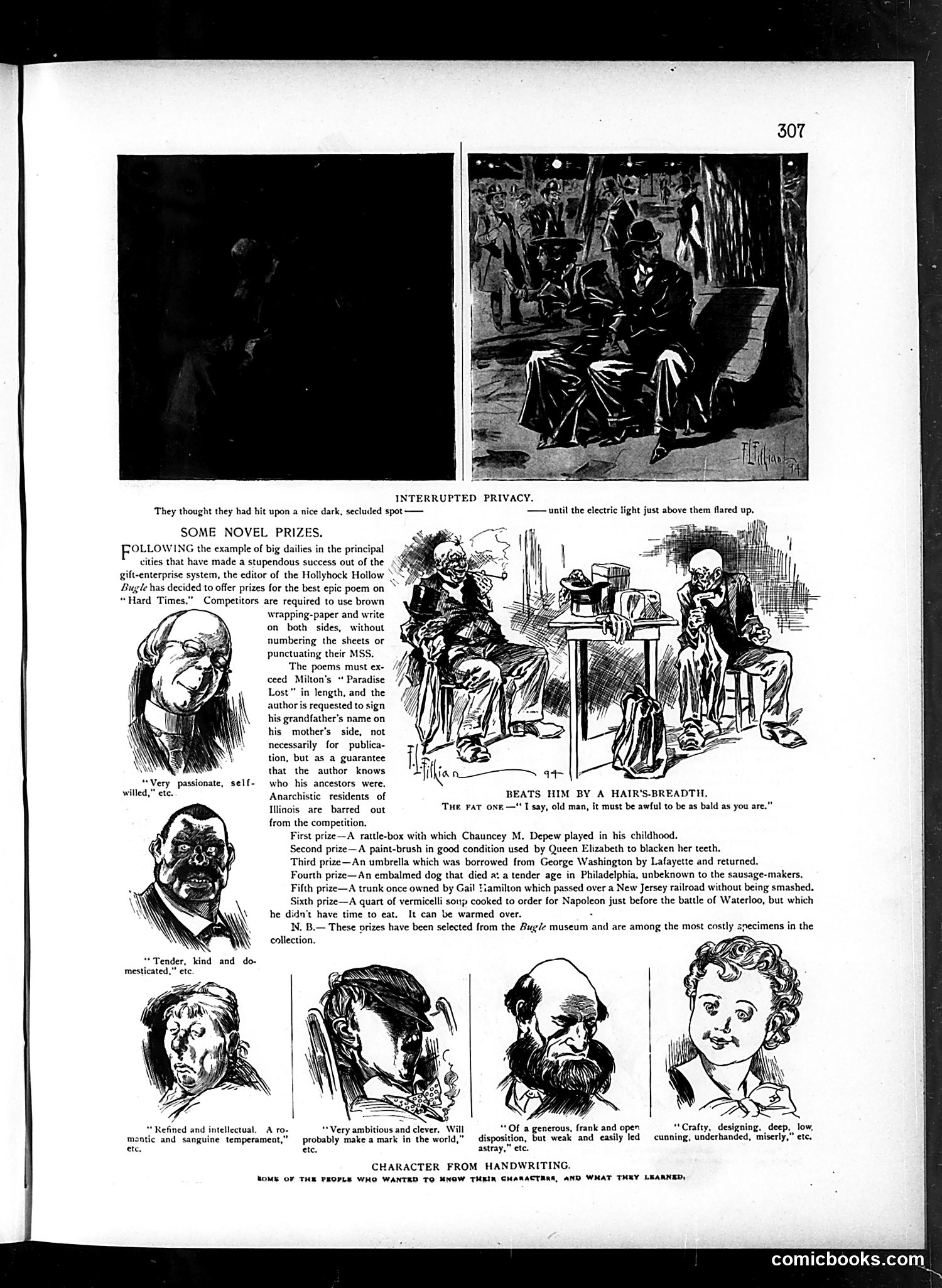
This page contains two distinct sections: **Top ("Interrupted Privacy"):** A humorous illustration showing two men in a dark, secluded spot suddenly exposed by an electric light flaring up—the joke being their private moment interrupted by modern technology. **Main Content ("Some Novel Prizes"):** Judge announces satirical literary prizes, playfully mocking the era's serious literary competitions. The prizes parody real objects (Chaucer's rattle-box, Queen Elizabeth's paint-brush, George Washington's umbrella, etc.) supposedly connected to historical figures. **Bottom ("Character from Handwriting"):** Four caricatured faces with personality assessments derived from handwriting analysis—a popular pseudoscience of the era. The descriptions are humorous character judgments supposedly revealed through handwriting examination. The overall tone mocks both literary pretension and the period's fascination with amateur psychology and character determination.
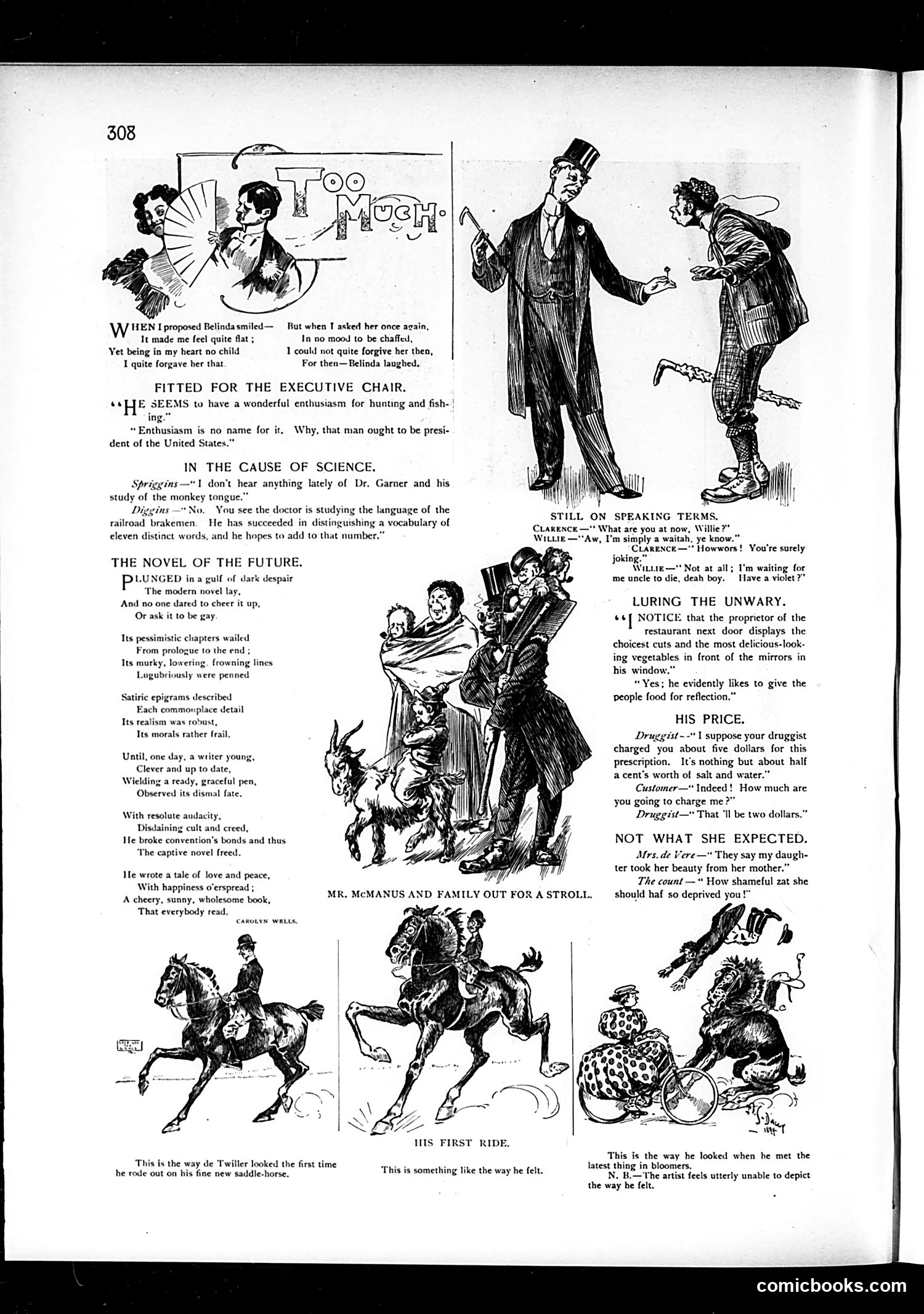
This page contains multiple unrelated satirical sketches typical of Judge's format: **"Fitted for the Executive Chair"** mocks a man's hunting enthusiasm as qualification for the U.S. presidency—satire on unfit political candidates. **"In the Cause of Science"** jokes that a doctor studying monkey language has switched to studying railroad brakemen's vocabulary, implying workers speak as unintelligibly as animals. **"The Novel of the Future"** parodies contemporary literary trends: dark, pessimistic "realist" novels with poor morals, celebrating a young writer who breaks free with cheerful, wholesome stories—satirizing both literary pretension and reform. **Recurring gag sketches** include romantic rejection humor ("Belinda"), class/accent comedy (Willie the waiter), restaurant deception, pharmaceutical price-gouging, and a final series about a man's mortified reaction to meeting a woman in bloomers (then-scandalous athletic wear). The humor targets: literary snobbery, medical fraud, class pretension, and anxiety about changing women's fashion—all early 1900s preoccupations.
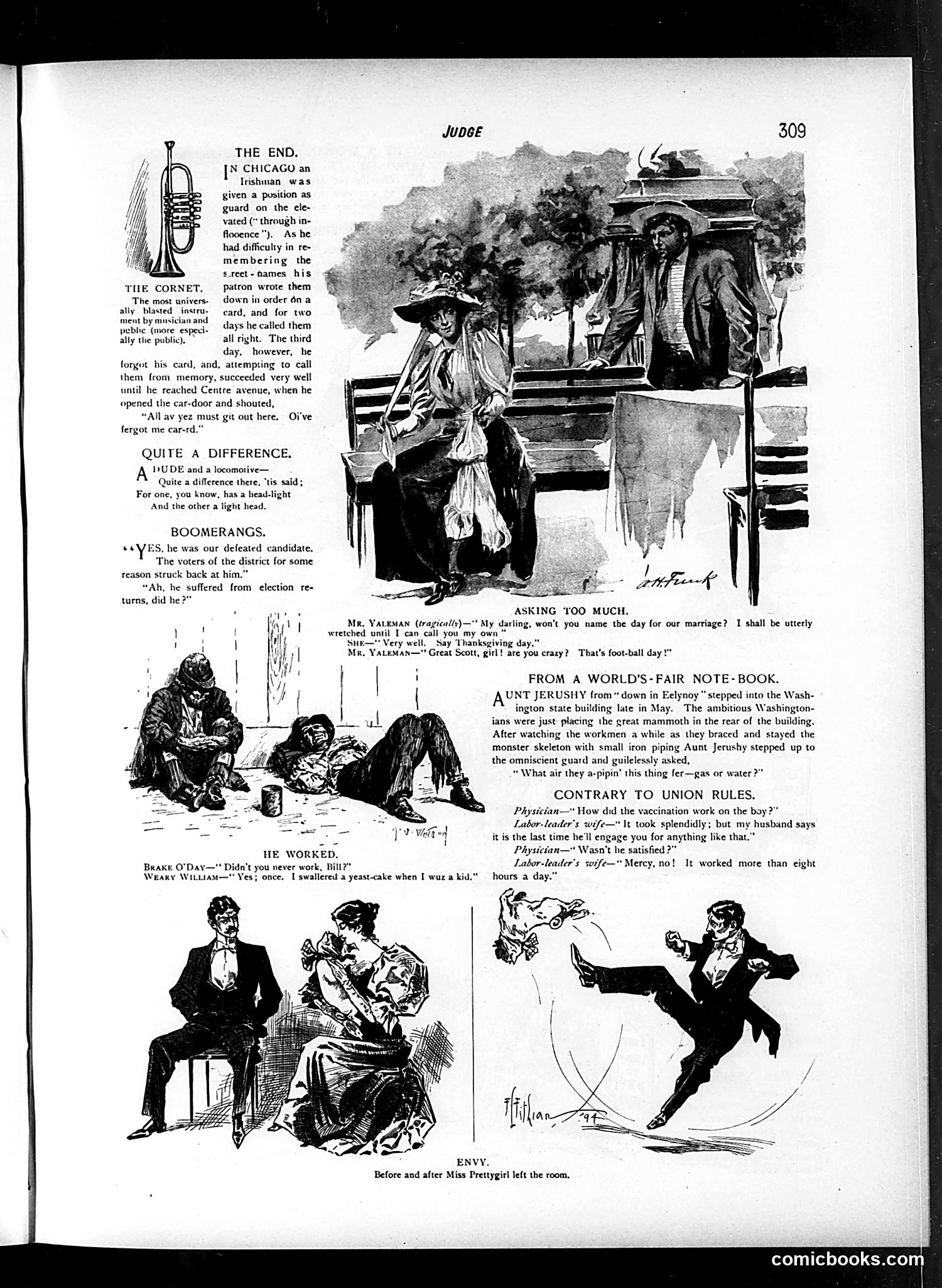
This page contains several brief satirical pieces typical of Judge's humor: **"The End"** mocks Irish immigrant workers, portraying an Irish guard on Chicago's elevated train who relies on a written card to announce stops but, forgetting it, shouts nonsensical station names—ethnic humor based on stereotyped Irish dialect and perceived incompetence. **"Asking Too Much"** jokes about a man proposing marriage, with the woman naming Thanksgiving as their wedding day. He rejects it because Thanksgiving coincides with football season—satirizing Americans' (especially upper-class men's) obsession with the sport over romantic commitment. **"From a World's-Fair Note-Book"** presents a rural Southern woman (Aunt Jerushy) touring the Washington state building at what appears to be a World's Fair, asking a guard whether the mammoth skeleton is being "piped" for gas or water—humor from rural naïveté contrasted with urban progress. **"Contrary to Union Rules"** jokes about a labor leader's wife refusing future vaccination services because the doctor worked on her husband—satirizing union rigidity and resistance to non-union services. The page's humor relies on ethnic stereotypes, class differences, and contemporary social anxieties.
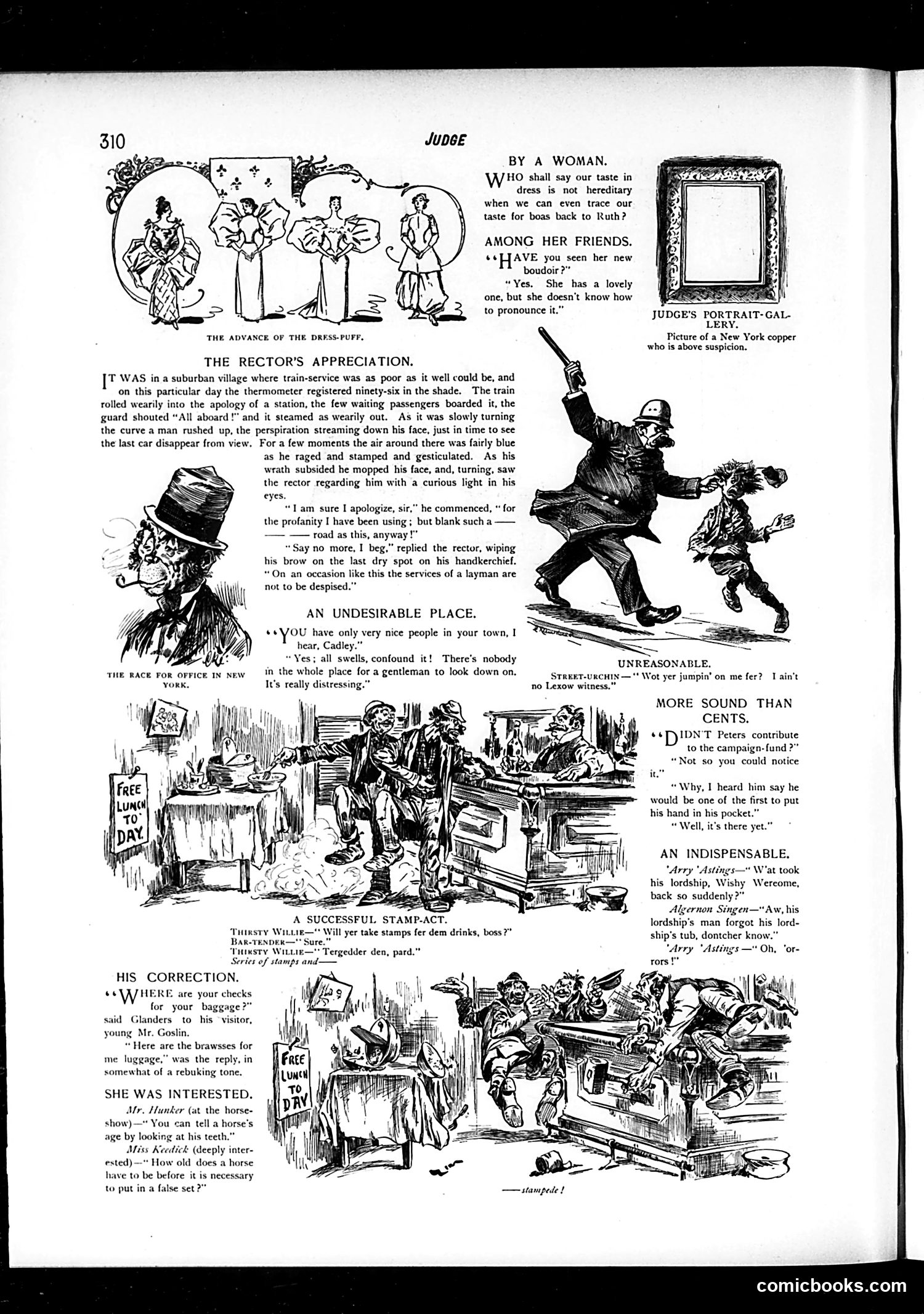
This page contains multiple brief satirical sketches typical of Judge's humor: **"By a Woman"** jokes about fashion and pronunciation, reflecting period upper-class concerns about dress trends (particularly the "dress-puff" mentioned in illustrations) and affected speech. **"The Rector's Appreciation"** satirizes hypocrisy: a man curses profusely when missing his train in sweltering heat; a clergyman witnesses it and admits the layman's profanity was entirely justified—mocking religious pretense about moral superiority. **"An Undesirable Place"** ridicules snobbish class consciousness—a gentleman complains his town lacks social inferiors to look down upon, making his position feel undermined. Other brief sketches mock political campaign donations (contributions lacking real substance), working-class speech patterns, social pretension, and gender stereotypes about women's knowledge. The overall tone targets Victorian-era affectation, hypocrisy, and class anxiety through absurdist humor.
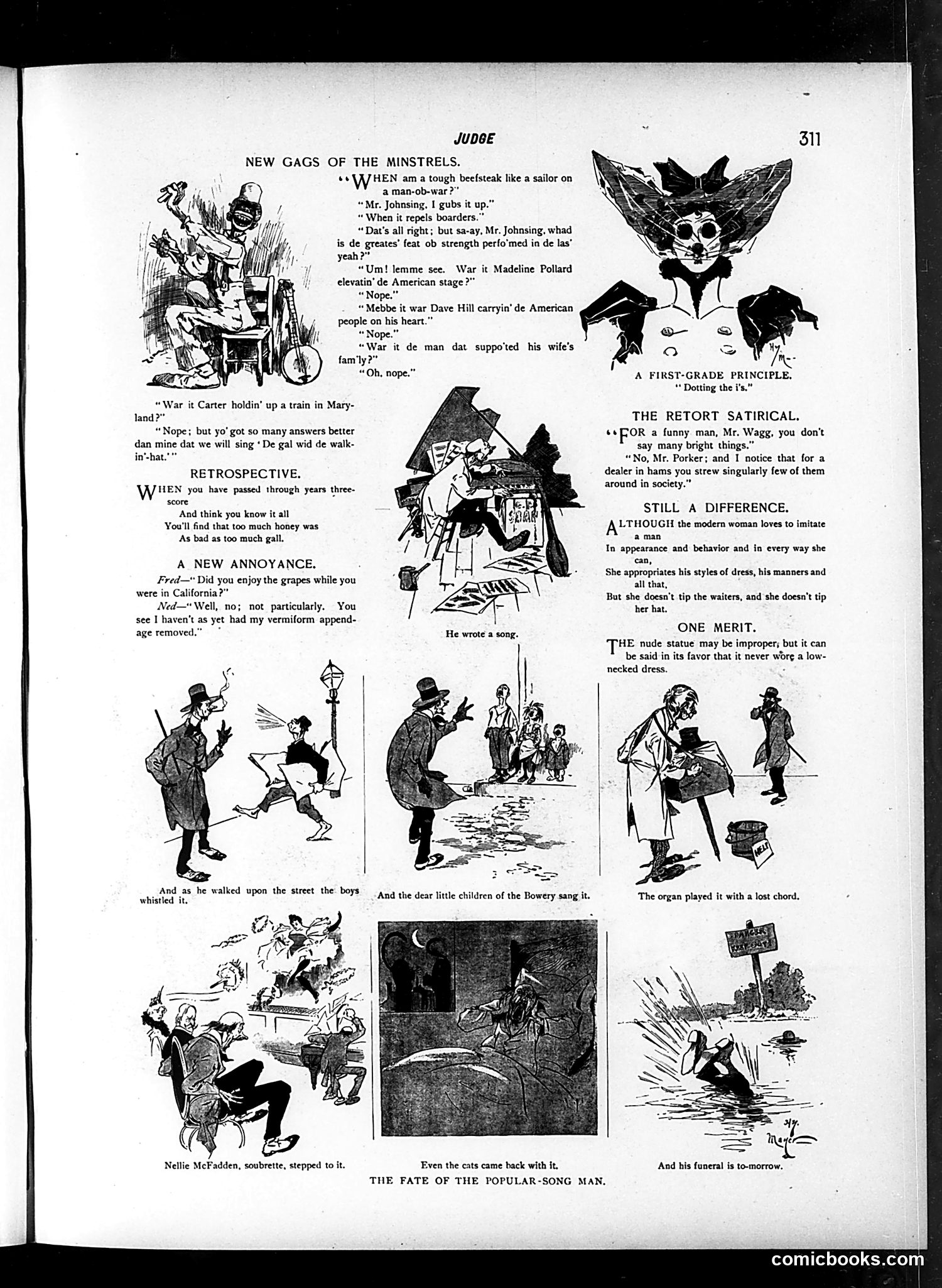
This page collects brief satirical humor pieces typical of Judge magazine's format. The "New Gags of the Minstrels" section mimics blackface minstrel-show dialogue (a popular entertainment form of the era), with racist dialect humor attempting to play on double meanings. References include **Madeline Pollard** (likely the actress/dancer prominent in 1890s American theater) and **Dave Hill** (unclear without additional context). Other pieces mock contemporary social trends: "A New Annoyance" jokes about the appendicitis craze (a fashionable medical concern of the period); "Still a Difference" satirizes the women's liberation movement by noting modern women imitate men except in tipping etiquette; "One Merit" takes a dig at artistic nudity in statuary. The bottom sequence, "The Fate of the Popular-Song Man," shows a musician whose catchy tune becomes so ubiquitous (whistled by street boys, performed by soubrettes like Nellie McFadden, even adopted by cats) that he's driven to suicide—satirizing mass-culture conformity and commercialism.
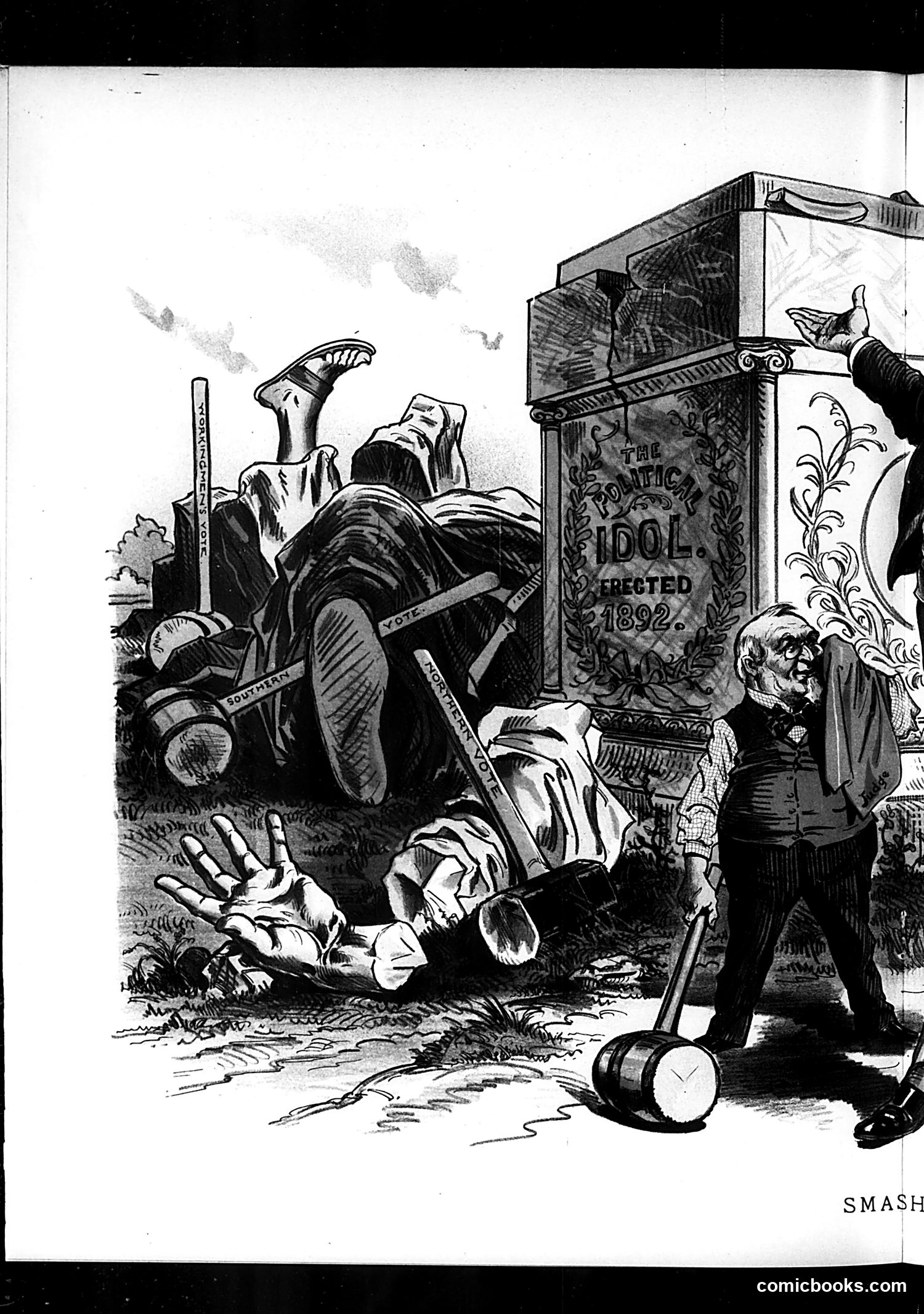
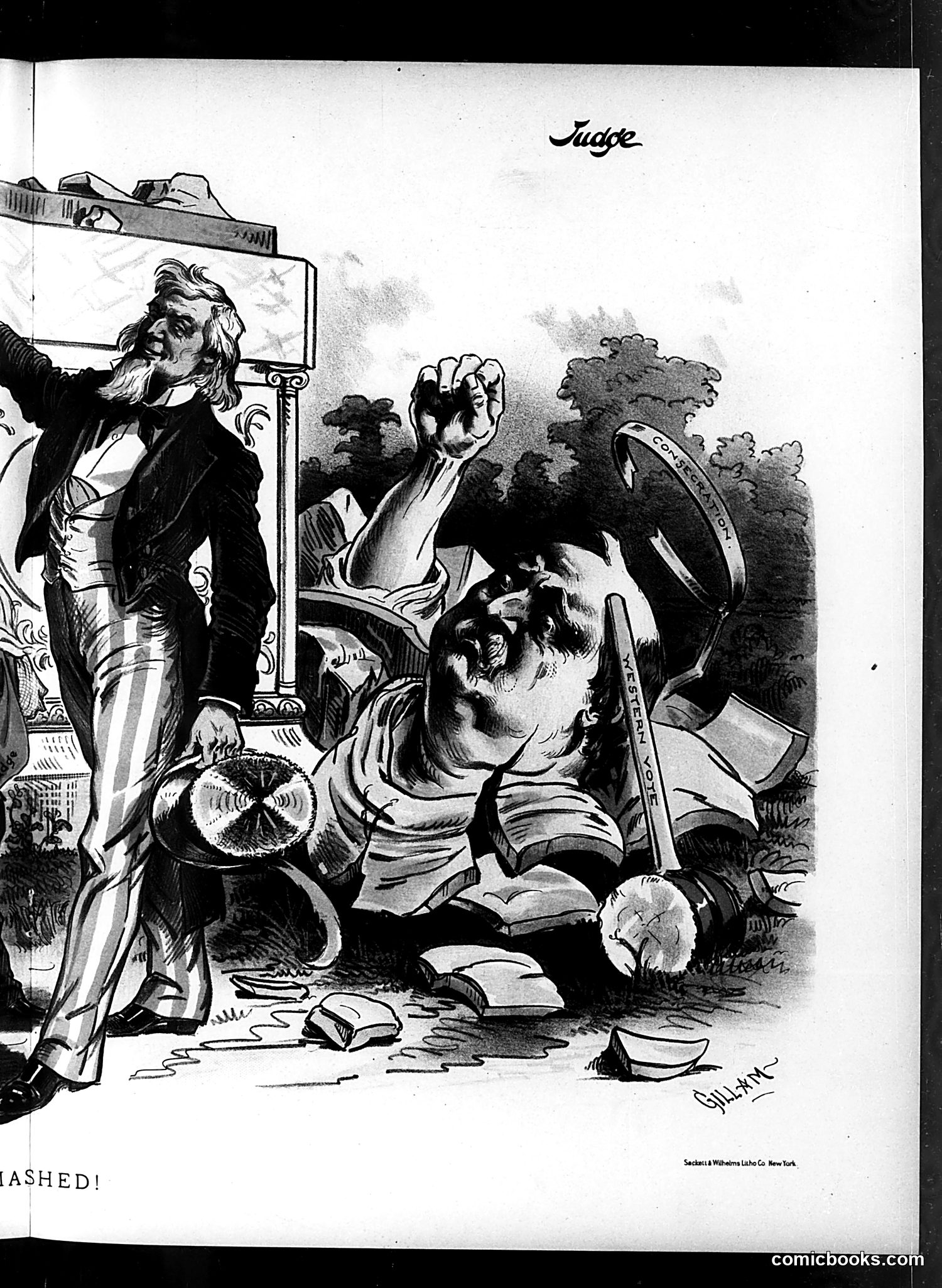
This **Judge** magazine cartoon depicts the destruction of "The Politician Idol" (monument dated 1892). A figure lies crushed beneath a toppled statue while others observe—one wielding a sledgehammer labeled "VOTE," another holding what appears to be a ballot or reform tool. The satire critiques political corruption and the veneration of dishonest politicians. The "idol" monument represents how society elevated corrupt politicians to revered status. The cartoon advocates for voter action ("VOTE") as the mechanism to tear down this corrupt establishment. The figure crushed beneath appears to represent the politician himself—suggesting his downfall through electoral accountability. This reflects 1890s Progressive Era sentiment criticizing machine politics and demanding reform through voting power.
This political cartoon, titled "LASHED!" depicts a figure being whipped by what appears to be Lady Justice or a judicial authority (left, holding scales). The seated figure being punished holds an axe labeled "CORRUPTION" and clutches scattered papers and coins, suggesting financial malfeasance or bribery. The satirical point concerns judicial punishment of corruption—likely targeting a specific political or corporate figure caught in graft. The visual metaphor of "lashing" emphasizes harsh consequences for wrongdoing. Without the publication date visible, the specific identity of the corrupt official remains unclear, though the cartoon exemplifies Judge's crusading anti-corruption editorial stance typical of late 19th/early 20th-century American satirical journalism.
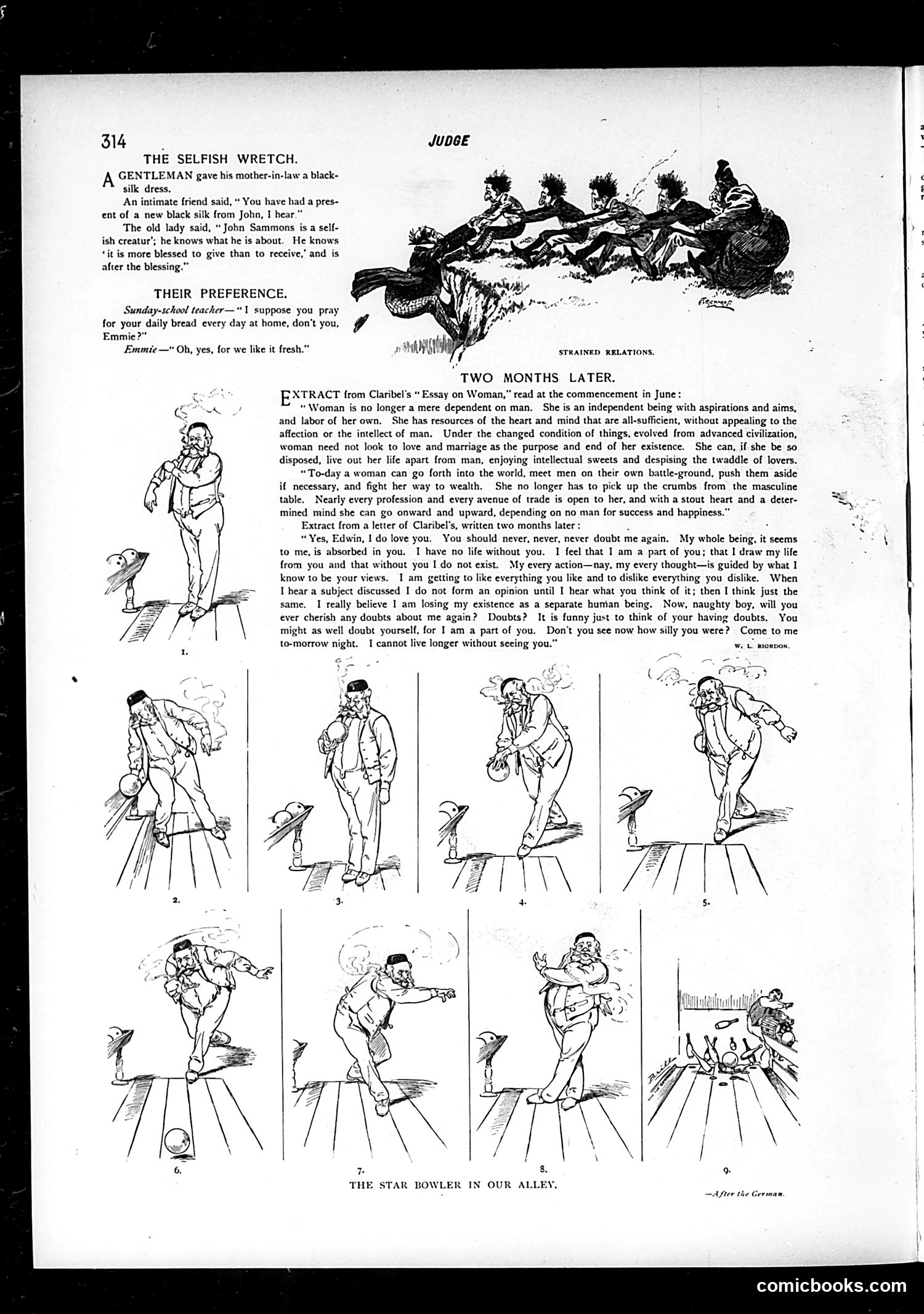
This page satirizes **hypocrisy and inconsistency in women's independence claims**. The main piece contrasts a public lecture by "Claribel" championing women's financial independence and self-sufficiency—delivering an essay declaring women need not depend on men for happiness or success—with her private letter written two months later. In the letter, she abjectly declares her complete emotional and intellectual dependence on her suitor Edwin, unable to form opinions without him and claiming she cannot live without his presence. The satire targets the gap between feminist rhetoric and actual behavior, suggesting that women's stated independence is hollow performance. The piece ridicules both Claribel's contradiction and the romantic notion that love should override personal autonomy. The shorter anecdotes at top ("The Selfish Wretch," "Their Preference") are unrelated humorous brief jokes about gift-giving and children's honesty. The bottom section, "The Star Bowler in Our Alley," appears to be a sequential comic about bowling, credited "After the German."
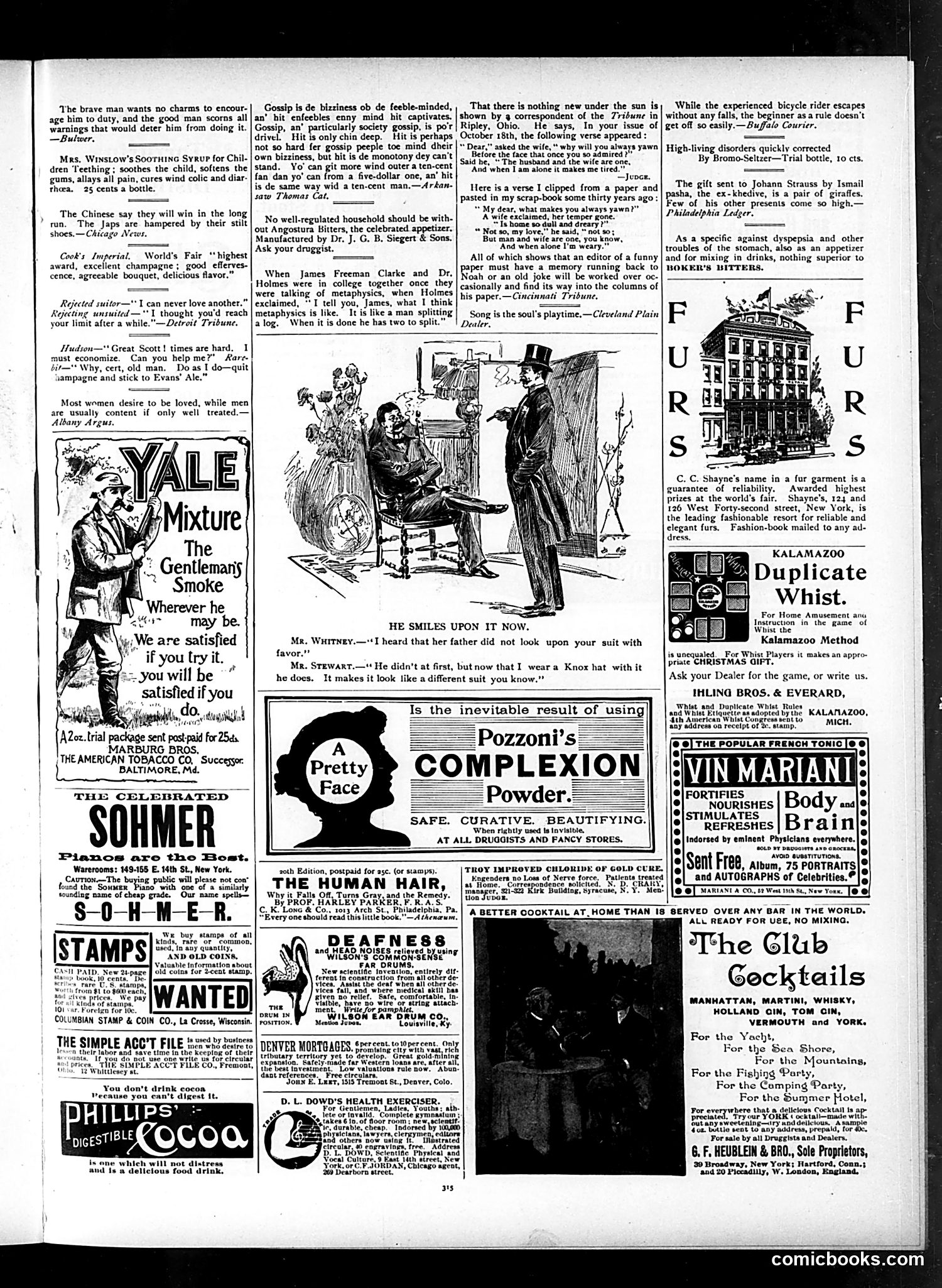
This page from *Judge* magazine is primarily **advertising and brief humor**, not political satire. The content includes: **Main Elements:** - Multiple product advertisements (tobacco, champagne, cocoa, powder, hair products, etc.) - Short humorous anecdotes and jokes interspersed between ads - One cartoon titled "HE SMILES UPON IT NOW" showing a man and woman discussing a suit and Knox hat **The Cartoon's Humor:** The brief sketch jokes about a Knox hat's transformative power. A man explains that his suit initially displeased the woman's father, but now that he wears a Knox hat with it, the father approves—because the hat makes "it look like a different suit." The humor relies on the hat's supposed status/respectability to improve appearance and social standing. **Context for Modern Readers:** Knox was a premium hat brand; the joke assumes hats significantly affected social perception of respectability and class. This reflects early 20th-century conventions where quality hats were markers of status. The page overall reflects *Judge's* mixed format of light social commentary, puns, and commercial advertising typical of the era.
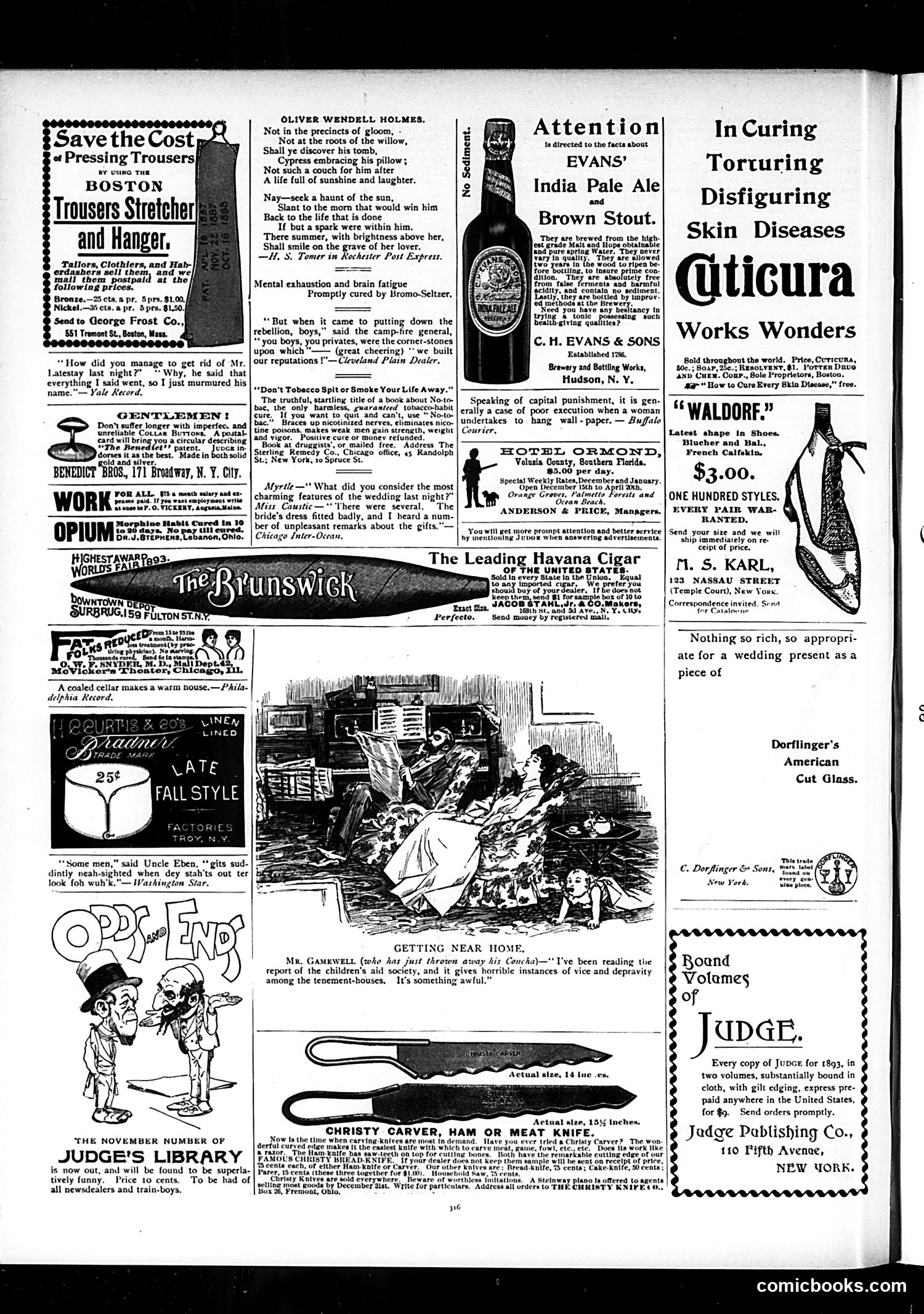
This page is primarily **advertising and filler content** typical of late-19th-century magazines. The few editorial elements are minor jokes and a sentimental poem about Oliver Wendell Holmes (likely commemorating his death). The dominant content includes advertisements for patent medicines (the "Bromo-Seltzer" and tobacco-cessation products were ubiquitous in this era), domestic products (trouser presses, collar buttons), and resort hotels. These ads reflect contemporary consumer anxieties about health, appearance, and leisure. The brief jokes scattered throughout—a camp-fire general taking credit for soldiers' work, a woman hanging wallpaper poorly—use mild social satire typical of *Judge*'s era: gentle mockery of gender incompetence and military pretension. The sole illustration labeled "Getting Near Home" appears to reference tenement housing conditions, suggesting working-class urban hardship, though the caption is partially cut off and unclear. Overall, this is a commercial magazine page where advertising substantially outweighs satirical content.
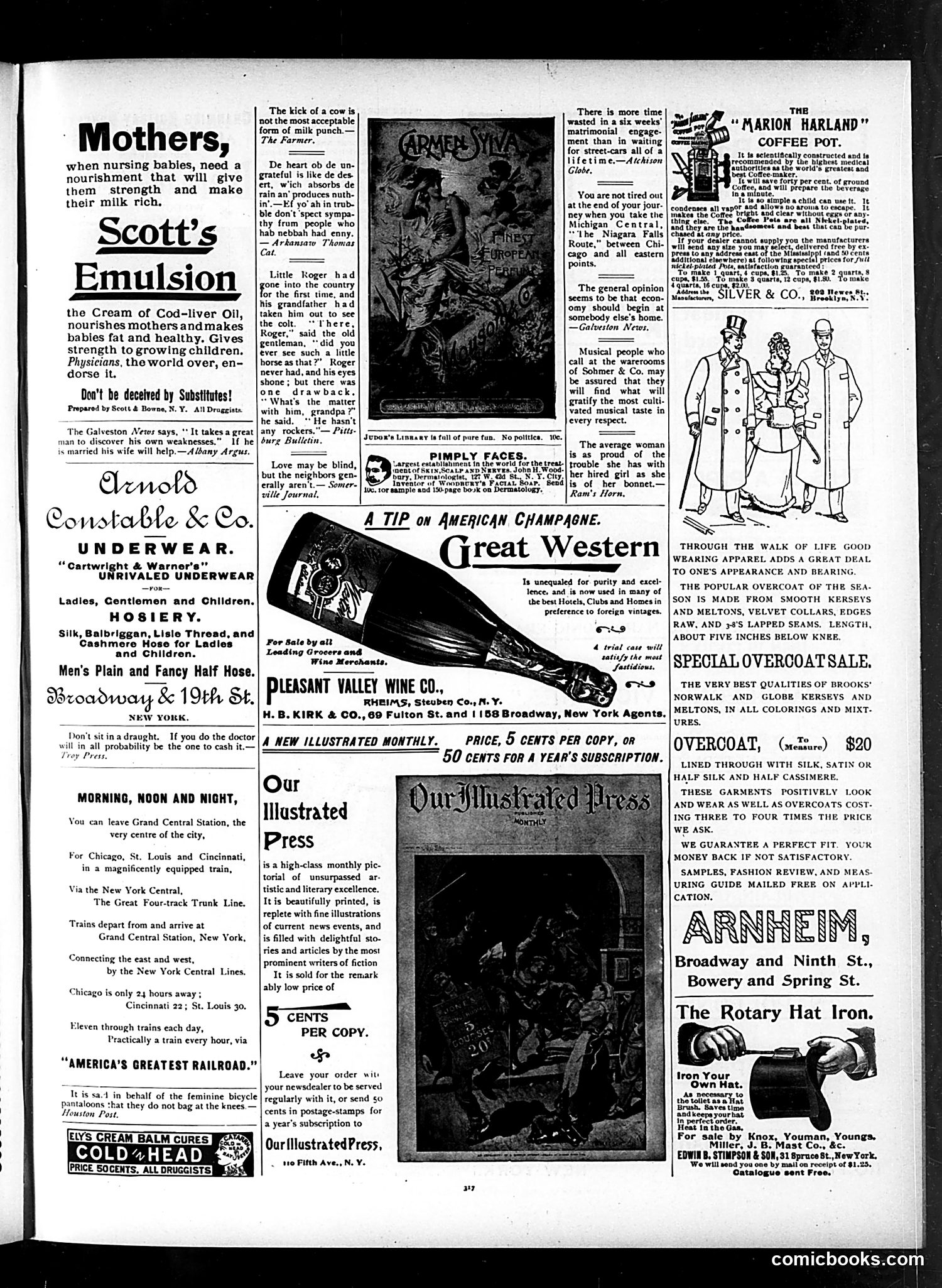
This is primarily an **advertising page** with scattered humor fillers rather than political satire. The page features numerous product advertisements (Scott's Emulsion, Arnold Constable underwear, Great Western champagne, railway services) interspersed with brief, unrelated jokes. These jokes mock everyday absurdities: a child expecting rockers on a horse, the observation that neighbors notice romantic blindness, and commentary on domestic economy and women's vanity. There is **no coherent political cartoon** on this page. The single large illustration appears to be an engraving labeled "Jester's Library" but lacks clear satirical intent or identifiable political figures. The humor is mild, domestic, and era-typical—reflecting turn-of-the-century sensibilities about marriage, family, and social propriety rather than engaging substantive political commentary. This page exemplifies Judge's use of advertising revenue with supplementary light entertainment rather than serious satire.
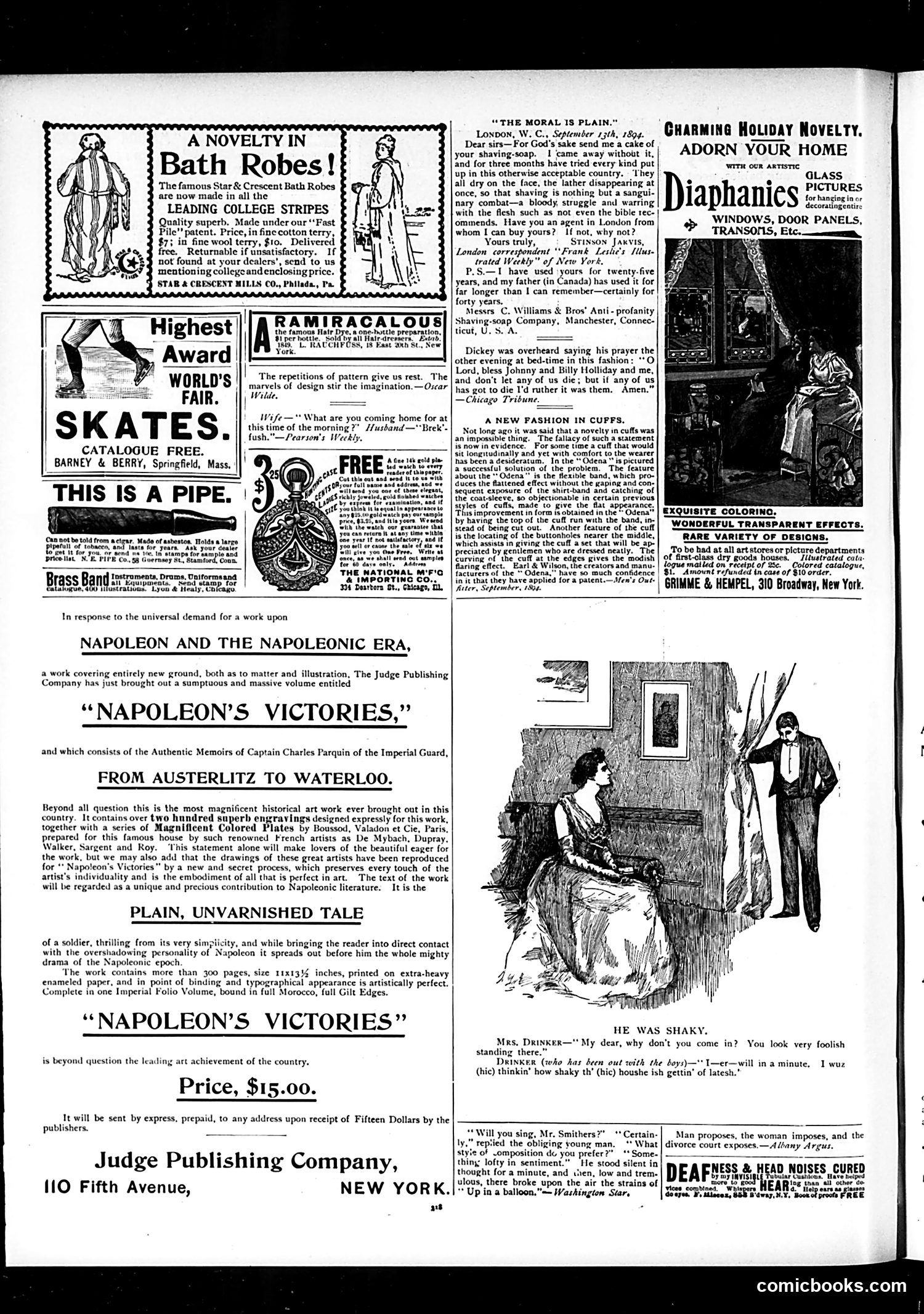
This page is primarily **advertising and promotional content** rather than political satire. The main items include: **Bath robes and college merchandise** — Star & Crescent advertises robes in "leading college stripes," targeting affluent students. **Novelty products** — An asbestos pipe (marketed as durable), ice skates, and a brass band instrument. **Humorous filler items** — Brief jokes: a husband returning home at dawn, a child's bedtime prayer wishing death on playmates instead of himself, and observations about shaving soap and shirt cuffs. **The "Odena" cuff advertisement** — A detailed description of an improved shirt cuff design with flexible bands and repositioned buttonholes. **Napoleon book promotion** — *Napoleon's Victories*, a lavishly illustrated historical work priced at $15. The page reflects **late 1890s consumer culture** and middle-class aspirations. The asbestos pipe is notable historically—asbestos was then considered a miracle material, before its dangers were known. Overall, this is a **typical Judge magazine page mixing light humor with advertisements**, not satirical commentary.
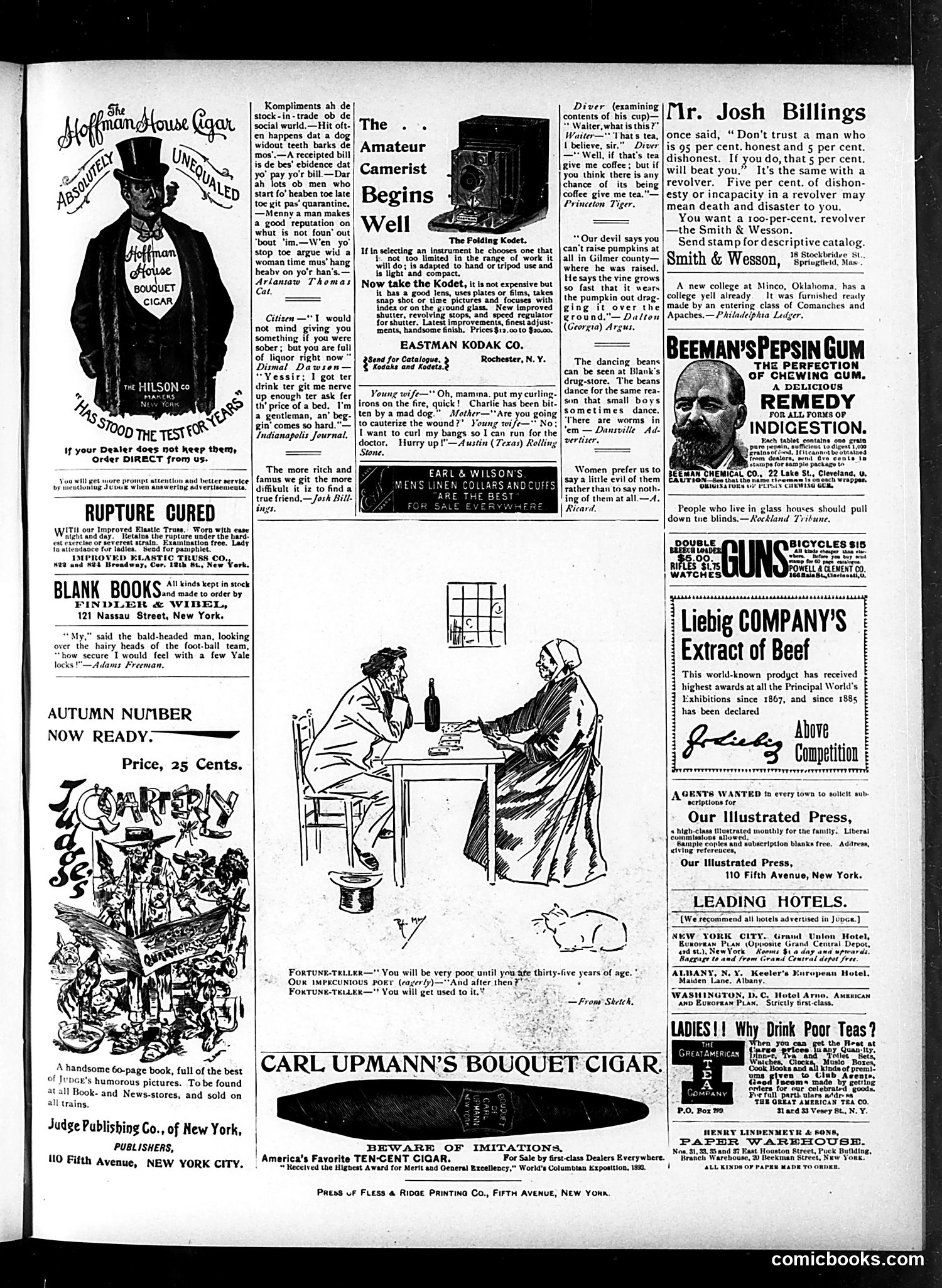
This page is primarily **advertisements and filler content** rather than focused political satire. The main elements include: **The Cartoon**: A fortune-teller and an impoverished man discuss his financial future—a straightforward joke about poverty, with no specific political target evident. **Notable Content**: - Multiple **aphoristic quotes attributed to "Arkansas Thomas"** and **Josh Billings** (a real 19th-century humorist)—folk wisdom and humorous observations about human nature - An **"Amateur Camerist" section** promoting the Eastman Kodak folding camera - Numerous ads for products (cigars, trusses, blank books, extract of beef) - Small humor snippets mocking wives, servants, and doctors **What's Missing for Modern Readers**: This appears to be from an **advertisement-heavy section** of the magazine. The "Arkansas Thomas" quotes use stereotypical African American dialect of the era—a period convention now recognized as offensive minstrelsy. The overall tone emphasizes consumer products and light domestic humor rather than biting social or political commentary. This is essentially a **commercial page** with scattered period humor, not substantive satire.
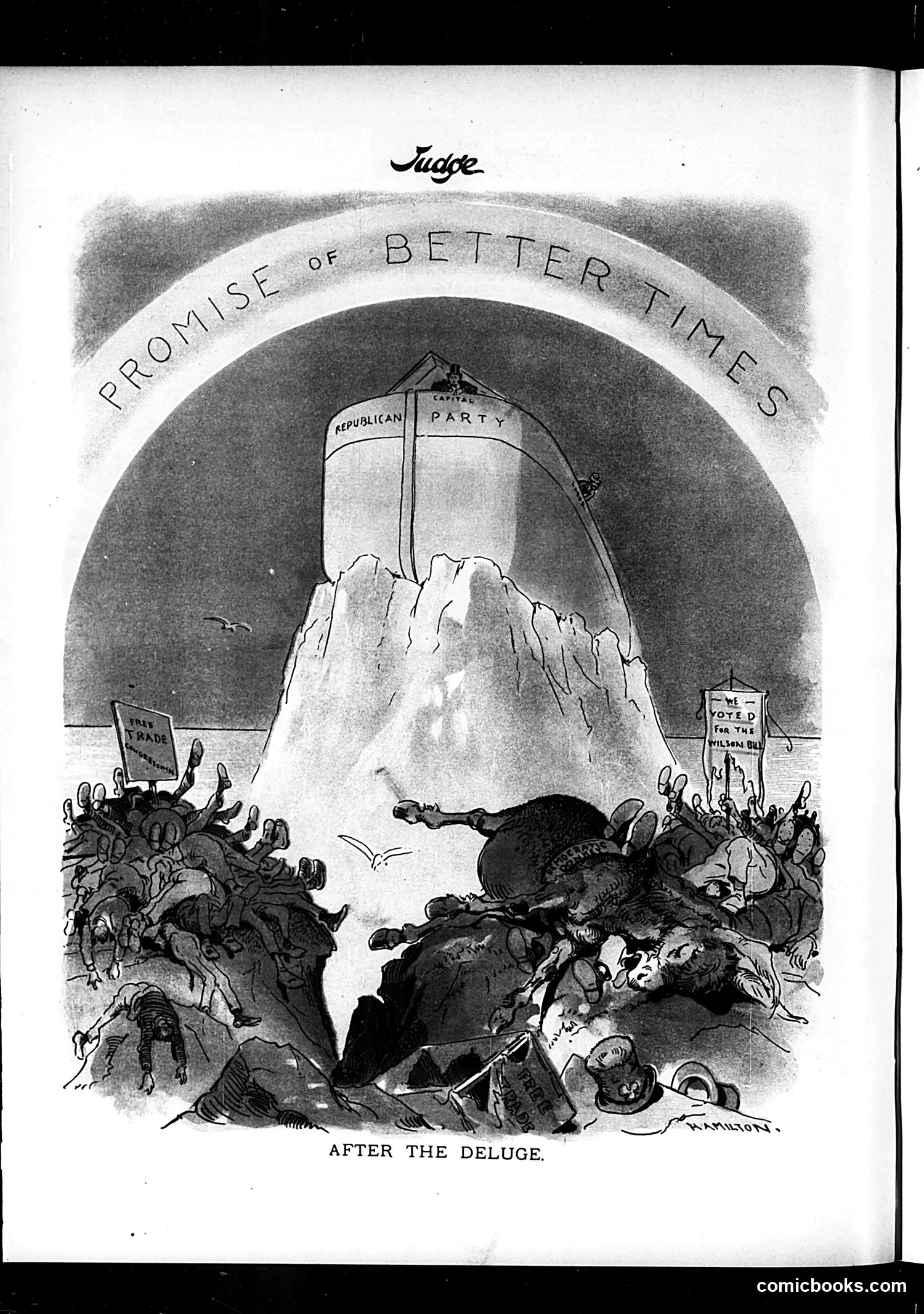
This Judge magazine cartoon satirizes the Republican Party's political prospects following a devastating electoral defeat. The building labeled "Republican Party Capital" sits partially submerged in floodwaters, with party members struggling in the wreckage below. Signs visible in the crowd reference trade issues and Wilson (likely President Woodrow Wilson), suggesting this depicts the Republican Party's collapse after losing power to Wilson's Democrats. The "Promise of Better Times" arc above ironically frames the disaster—the promised improvement never materialized. The cartoon uses the biblical flood metaphor to convey total political devastation, with drowning figures representing Republican fortunes at their lowest point. This appears to be post-election commentary on Republican electoral failure.