
A complete issue · 16 pages · 1894
Judge — November 10, 1894
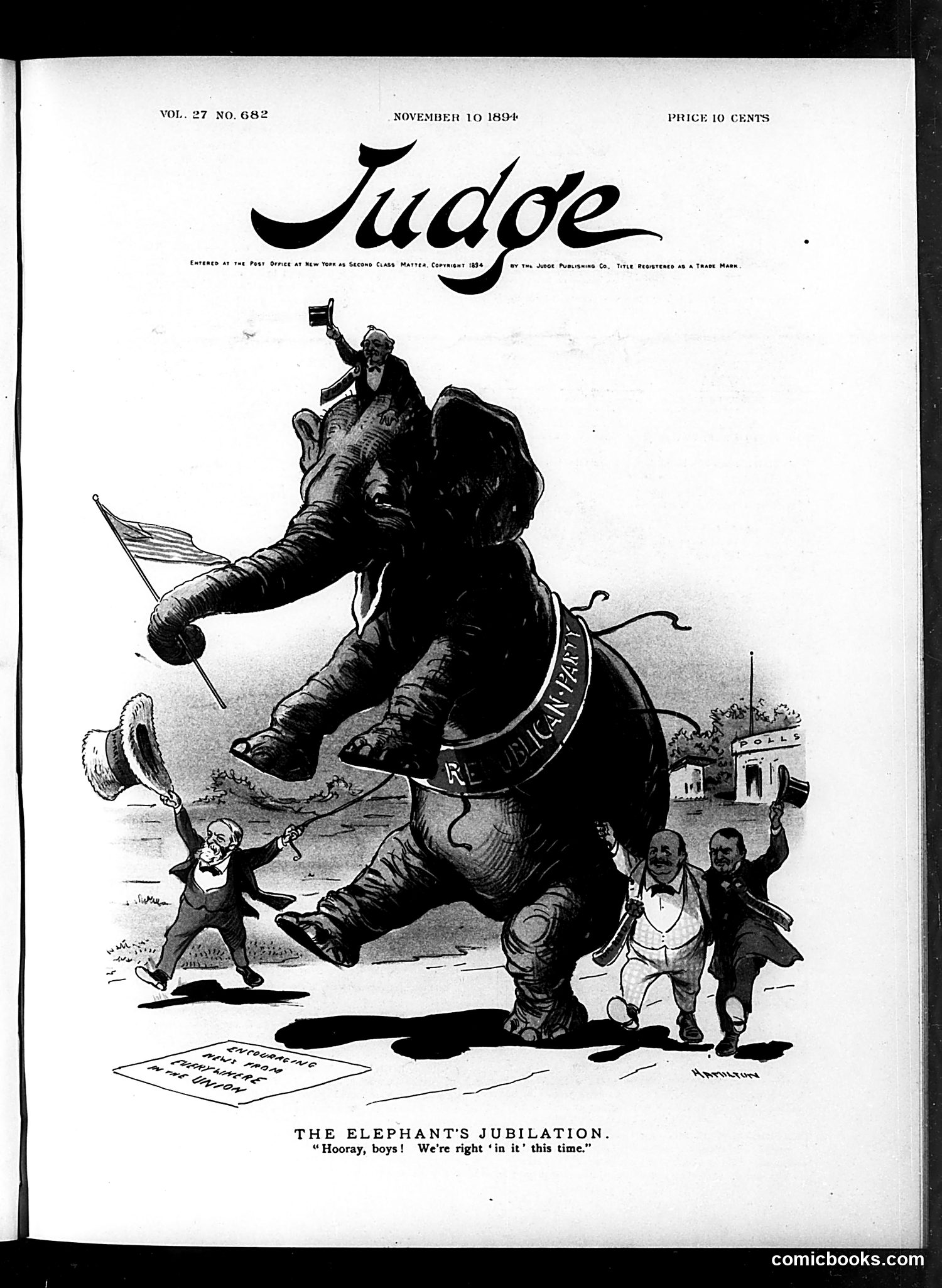
This is a Judge magazine cover from November 10, 1894. The elephant represents the Republican Party (its traditional mascot). The cartoon depicts Republican jubilation following electoral success, with the caption "Hooray, boys! We're right 'in it' this time." The elephant wears a band labeled "Republican Party" and holds an American flag. A figure rides atop it (likely a Republican politician or leader), while smaller figures below—appearing to represent political opponents or the general public—react to the elephant's triumphant display. The satire likely comments on Republican confidence following recent electoral victories, possibly referencing the 1894 midterm elections. The "jubilation" mocks what the cartoonist views as premature or excessive Republican celebration of their political position.
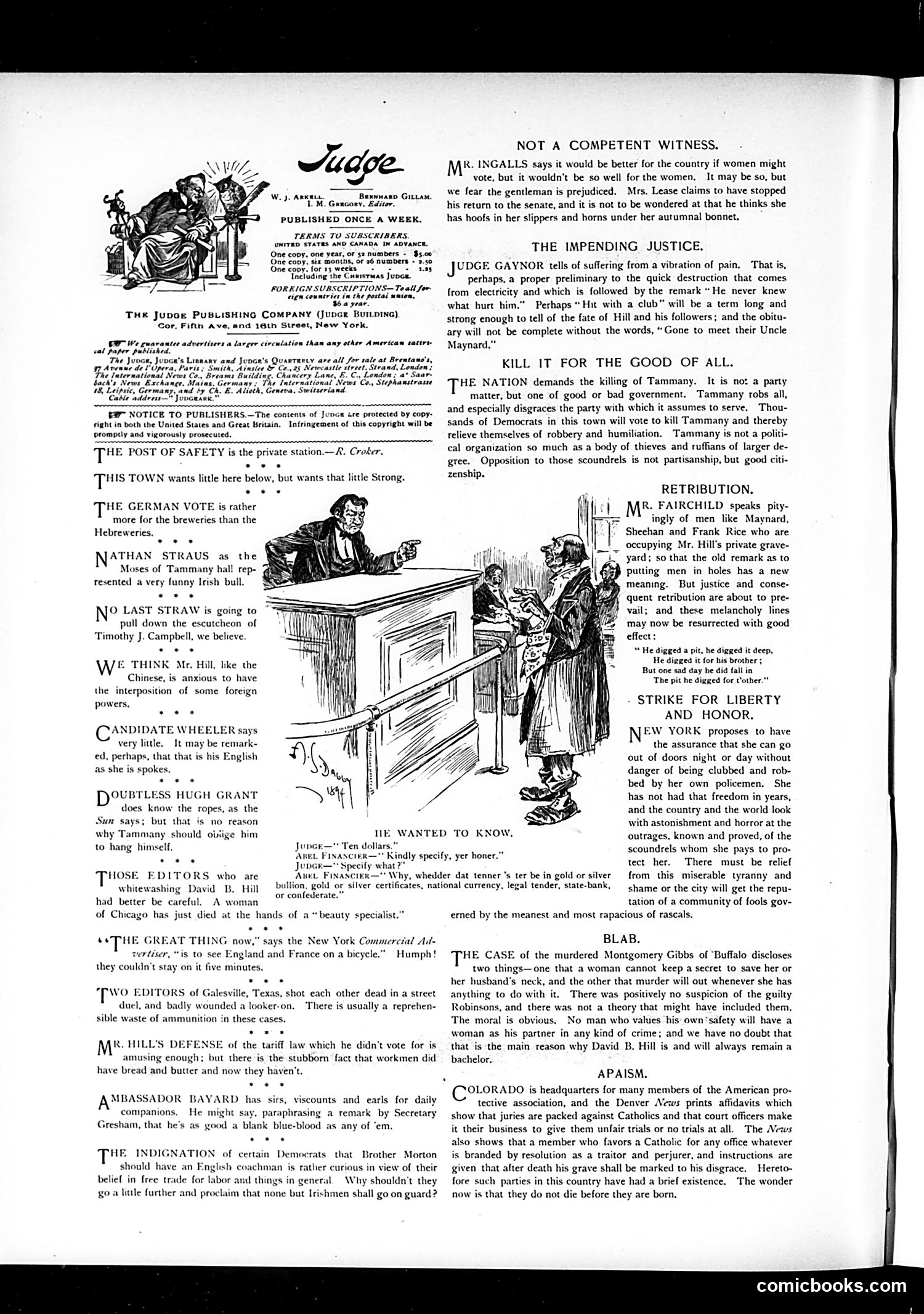
The main cartoon titled "HE WANTED TO KNOW" depicts a judge questioning a defendant about currency. The judge asks if the defendant's tenner (ten-dollar bill) is "gold or silver bullion, gold or other certificates, national currency, legal tender, [or] standard." This satirizes late 19th/early 20th-century American monetary confusion—the nation had multiple competing currency types (gold, silver, certificates, greenbacks) without clear standardization. The cartoon mocks how confusing this system had become, suggesting even legal authorities couldn't determine what counted as legitimate money. The surrounding editorial snippets address various political topics (Tammany Hall corruption, women's voting rights, press freedom), but the main cartoon's focus is monetary chaos through humorous legalism.
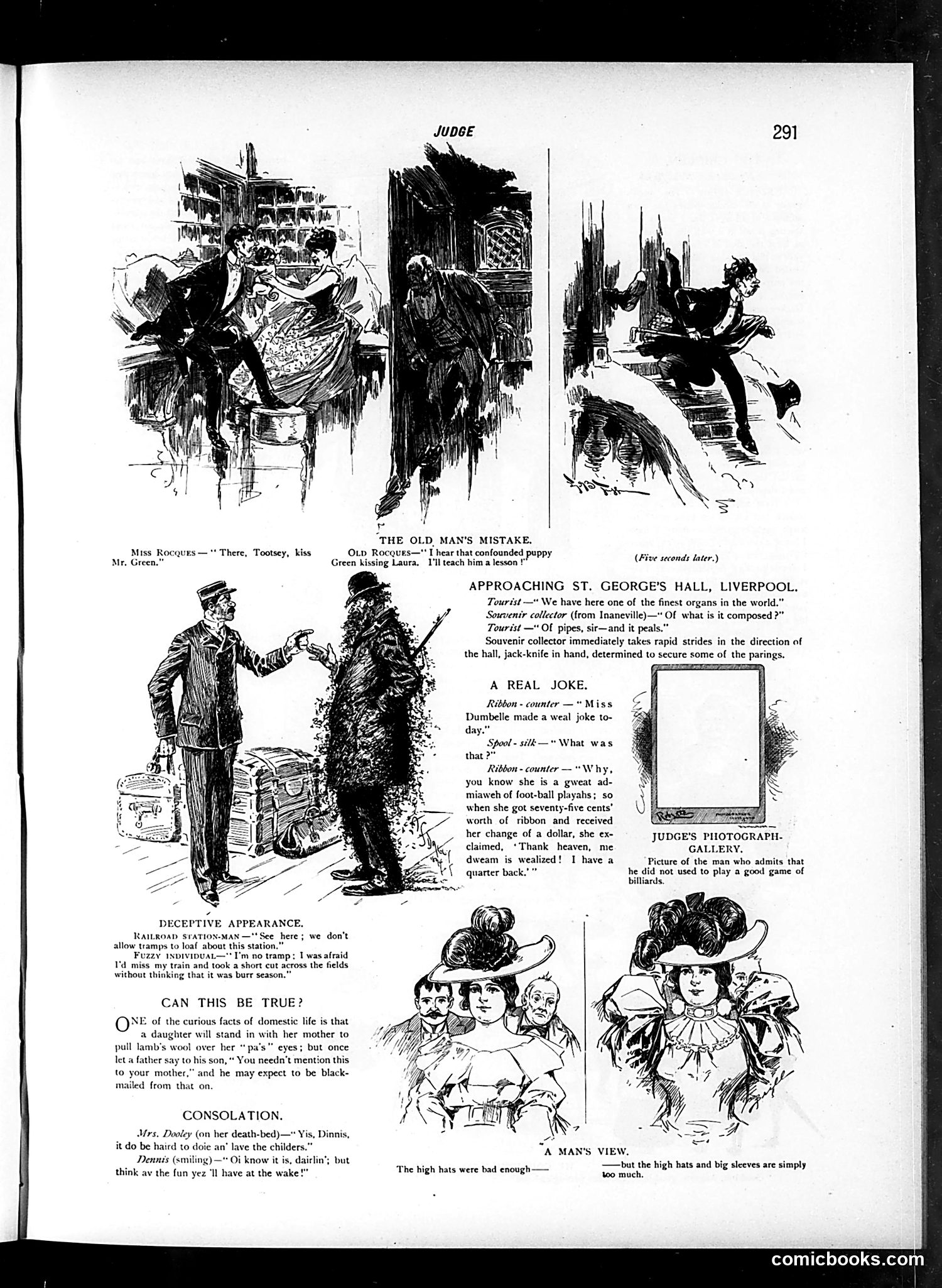
This page contains several unrelated satirical sketches and humorous anecdotes typical of Judge's format. "The Old Man's Mistake" depicts a man being corrected by a woman about kissing, with a follow-up scene showing the consequences of his error. "A Real Joke" presents a dialogue where a counter clerk explains that a woman received change after purchasing ribbon, then spent that dollar on foot-ball play tickets—the humor lying in the unexpected outcome. "A Man's View" critiques women's fashion, specifically high hats and large sleeves, suggesting these styles are excessive. Other titled sections include "Approaching St. George's Hall, Liverpool" (describing organ music), "An Inviting Appearance" (about tramps), "Can This Be True?" (about domestic behavior), and "Consolation" (a brief dialogue). The page is primarily comedic social commentary rather than political satire, reflecting late-19th-century American attitudes toward gender, class, and fashion.
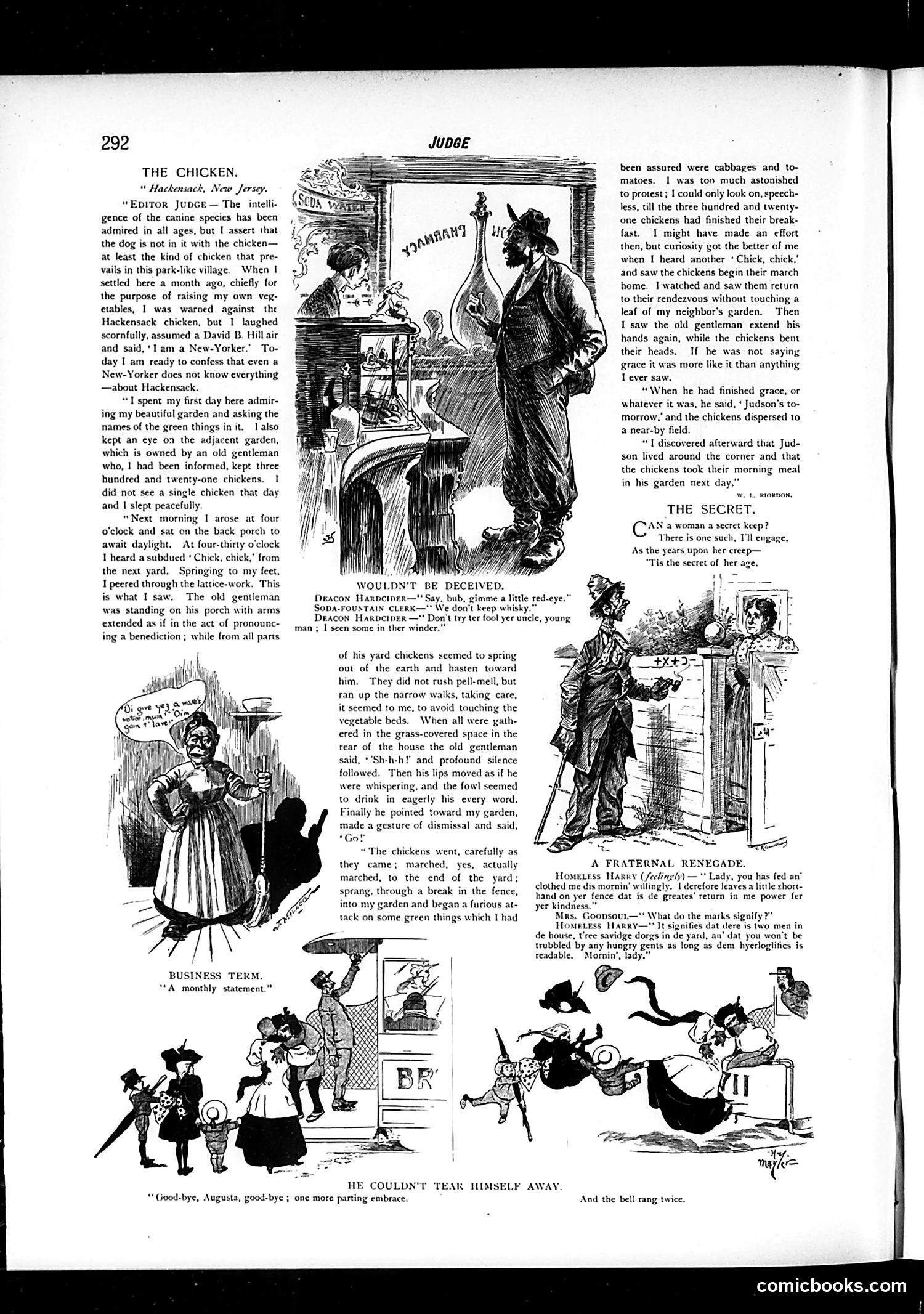
This page contains humor pieces from *Judge* magazine satirizing small-town life and human nature around 1890s America. **"The Chicken"** is a humorous letter describing a New Yorker's shock at discovering his Hackensack, New Jersey neighbor's 321 chickens are remarkably disciplined—they respond to silent commands, march in formation, and systematically raid only the writer's garden (not their owner's), suggesting almost military-like organization. The joke mocks both the suburban newcomer's ignorance and the implausible intelligence attributed to common farmyard chickens. **Other sketches** include mild satire: a soda fountain clerk attempting to deceive a customer ("Deacon Hardie"), a woman departing a suitor with multiple embraces, and a homeless man's appeal for assistance. "The Secret" is a brief poem about women keeping the secret of their age. The cartoons employ exaggerated Victorian illustrations and gentle social commentary typical of *Judge*'s style—poking fun at class pretensions, rural simplicity versus urban sophistication, and domestic situations rather than hard-hitting political satire.
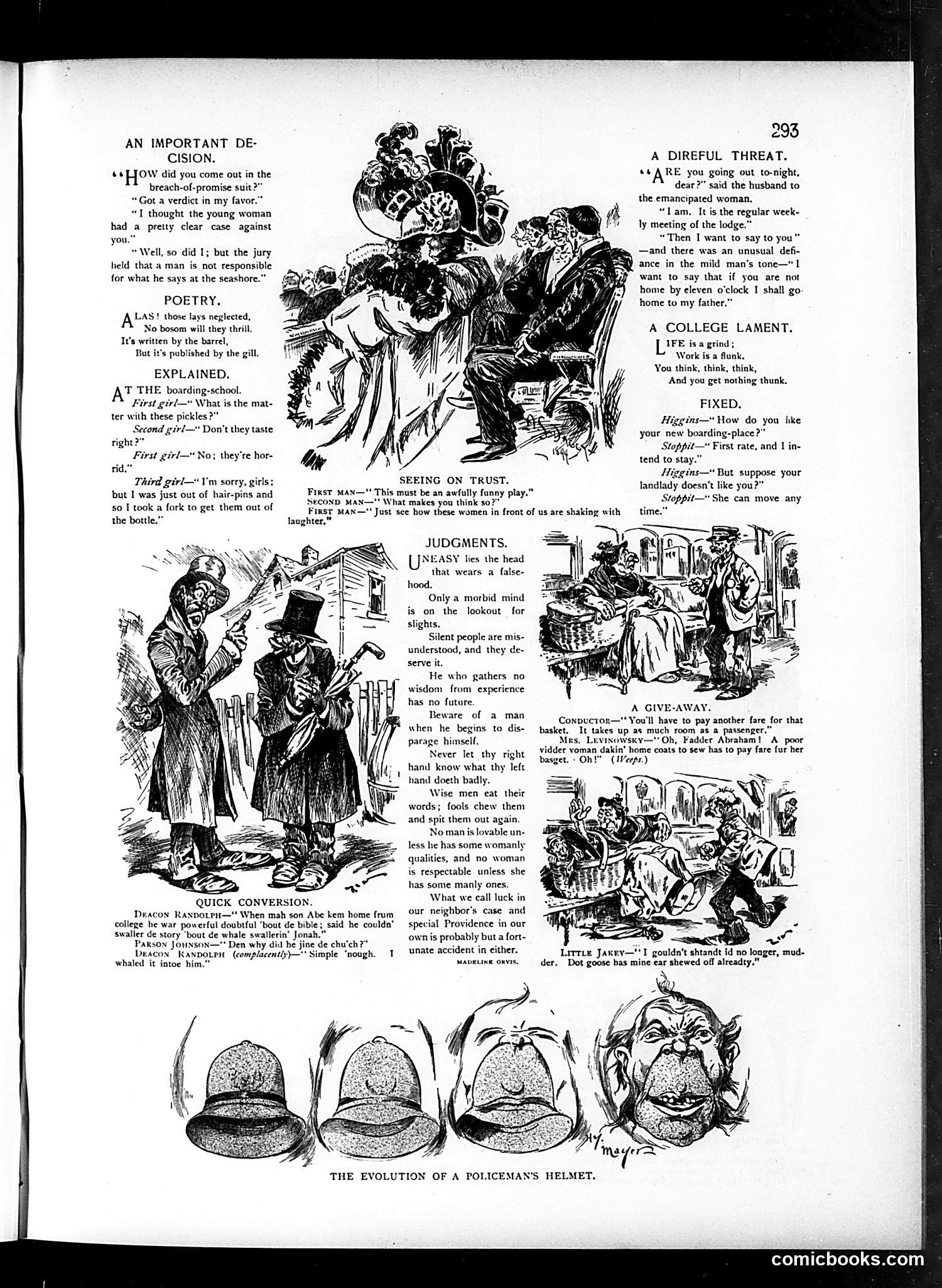
This page comprises several short humorous pieces satirizing Victorian-era society: **"An Important Decision"** mocks breach-of-promise lawsuits (common legal actions by jilted women) by suggesting a man escaped responsibility because "what he says at the seashore" shouldn't count—implying seaside flirtations were conventionally understood as insincere. **"A Direful Threat"** ridicules the "New Woman" movement. An emancipated woman attends lodge meetings while her meek husband threatens—ironically—to leave *her* if she's late, reversing traditional gender power dynamics for comic effect. **"A Give-Away"** depicts a Jewish widow (stereotypically portrayed) arguing with a conductor over basket fare, accidentally revealing poverty while trying to maintain dignity. **"Quick Conversion"** uses dialect humor: a Southern deacon converts his skeptical son to faith through physical punishment ("whaled it into him"), treating religion pragmatically rather than spiritually. The bottom illustration, "Evolution of a Policeman's Helmet," shows progressive coarsening of facial features across helmet designs—a visual joke about police brutality or moral degradation.
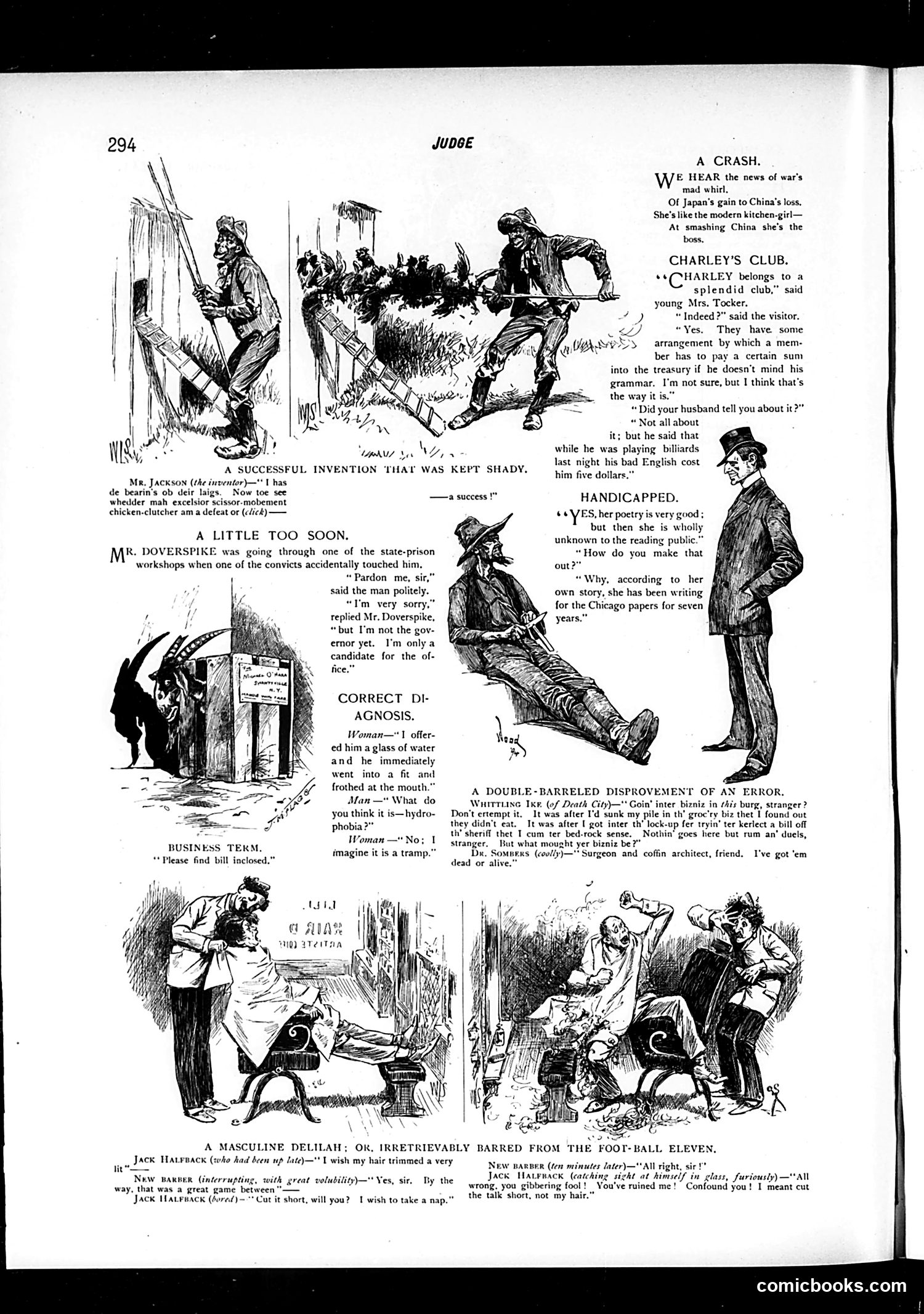
This page contains several brief satirical vignettes typical of Judge magazine's humor: **"A Crash"** opens with commentary on Japan's military victory over China, comparing Japan to a modern kitchen maid skilled at "smashing China." **"Charley's Club"** jokes about an exclusive club with a peculiar rule: members must pay fines to the treasury for grammatical errors—a satirical jab at linguistic pretension. **"A Little Too Soon"** mocks a political candidate (Doverspike) seeking the governorship, who deflects a prisoner's apology by noting he's "only a candidate for the office" yet. Other sketches mock barbers' chattiness, misdiagnosis of tramps as hydrophobes, and frontier characters. The cartoons use dialect humor and visual gags characteristic of 1890s American satire, targeting linguistic affectation, political ambition, and social pretension. The Japanese-Chinese war reference dates this to 1894-1895.
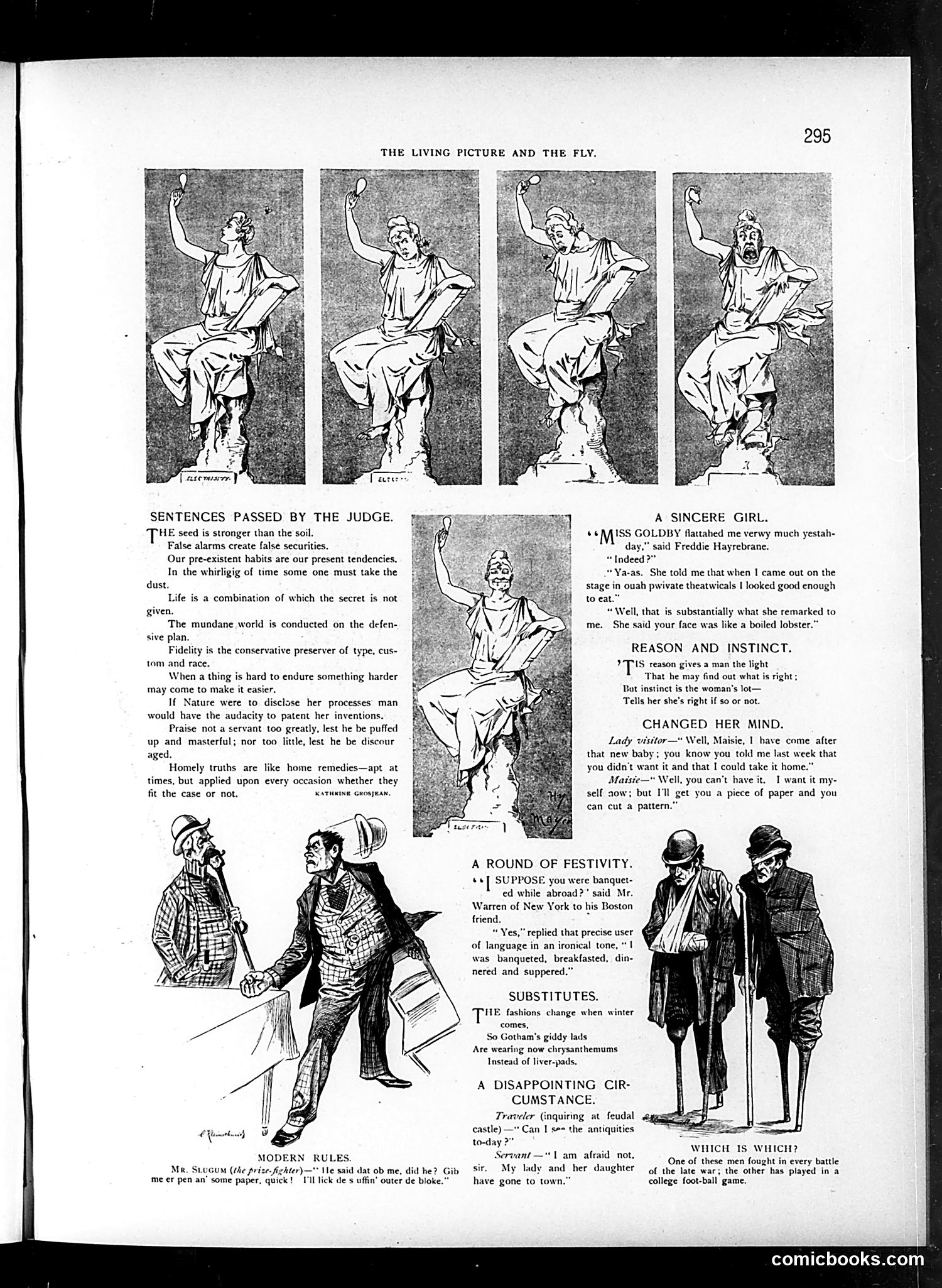
This page contains multiple unrelated satirical items typical of Judge's format. The top features five classical statue images titled "Sentences Passed by the Judge"—philosophical aphorisms rendered as visual puns. The scattered short humor pieces mock social pretensions and gender stereotypes common to the era: - "A Sincere Girl" jokes about compliments being insulting (comparing a man's face to a "boiled lobster") - "Reason and Instinct" suggests women lack rational judgment, relying only on intuition - "Changed Her Mind" depicts a working-class woman contradicting her earlier offer to give away a baby - "A Round of Festivity" mocks Bostonian formality through neologisms like "dinnered" - "Modern Rules" and other sketches satirize fashion changes and social climbing The cartoons and text reflect period attitudes toward class, gender, and American regional stereotypes. The overall effect is lighthearted social satire aimed at Judge's educated, urban readership.
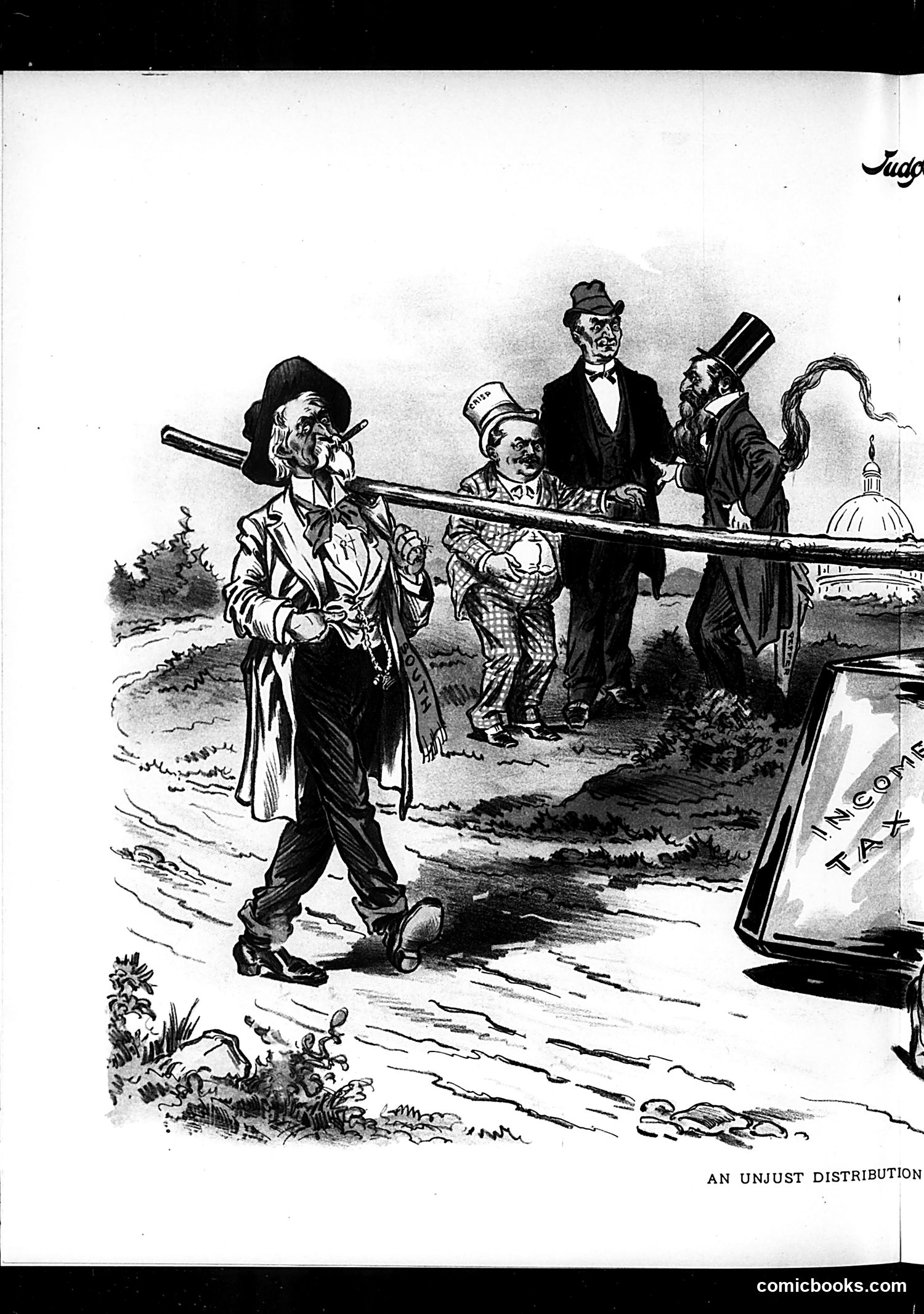
This political cartoon depicts a wealthy gentleman in a top hat (center, appearing to supervise) while working-class figures carry an enormous telescope or surveying instrument labeled "TANK COPY" (text unclear in OCR). The scene suggests the unequal burden of taxation or public expenses—wealthy interests control the apparatus while laborers bear the physical weight. The Capitol building visible in the background indicates this concerns federal policy. The satire critiques how financial or infrastructural responsibilities fall disproportionately on ordinary workers while the elite direct operations from a distance. The "unjust distribution" likely references tax burden, military spending, or public works allocation—common Judge magazine targets during the late 19th/early 20th century. The caricatured working-class figures emphasize class disparities in Gilded Age America.
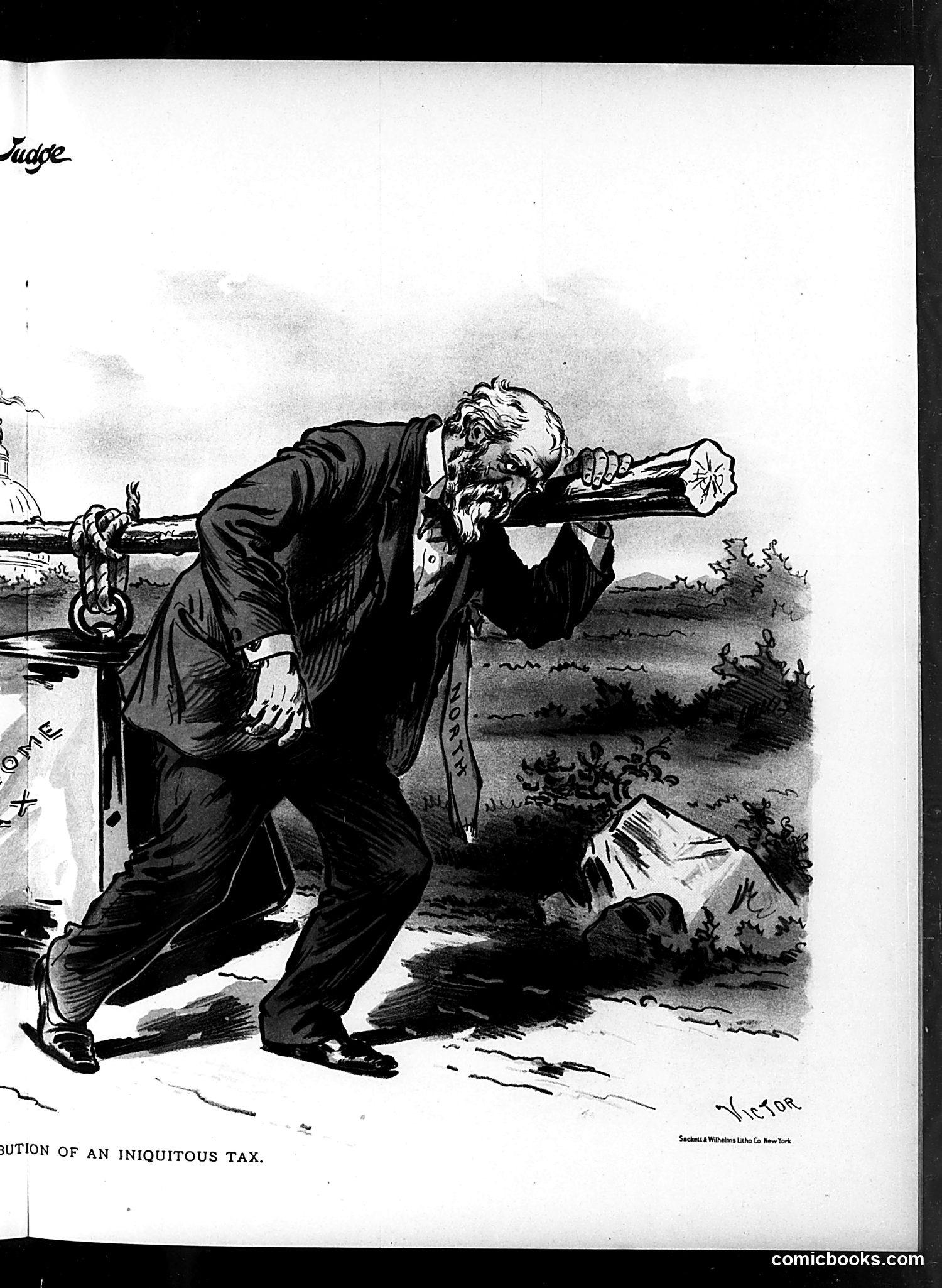
This satirical cartoon depicts a bearded man in formal dress wielding a telescope or spyglass while kneeling or crouching. The title references abolishing an "iniquitous" (wicked/unjust) tax. A barrel labeled "ROME" sits nearby, suggesting this concerns Roman Catholic Church taxation or financial practices. The figure appears to be a political or religious authority examining or surveying something, possibly critiquing how tax policy was being implemented or enforced. Without the magazine's date visible, the specific tax cannot be confirmed, but Judge magazine frequently satirized both governmental and ecclesiastical financial policies in the late 19th/early 20th centuries. The cartoon likely mocks either a tax's abolition as insufficient reform or its implementation as hypocritical.
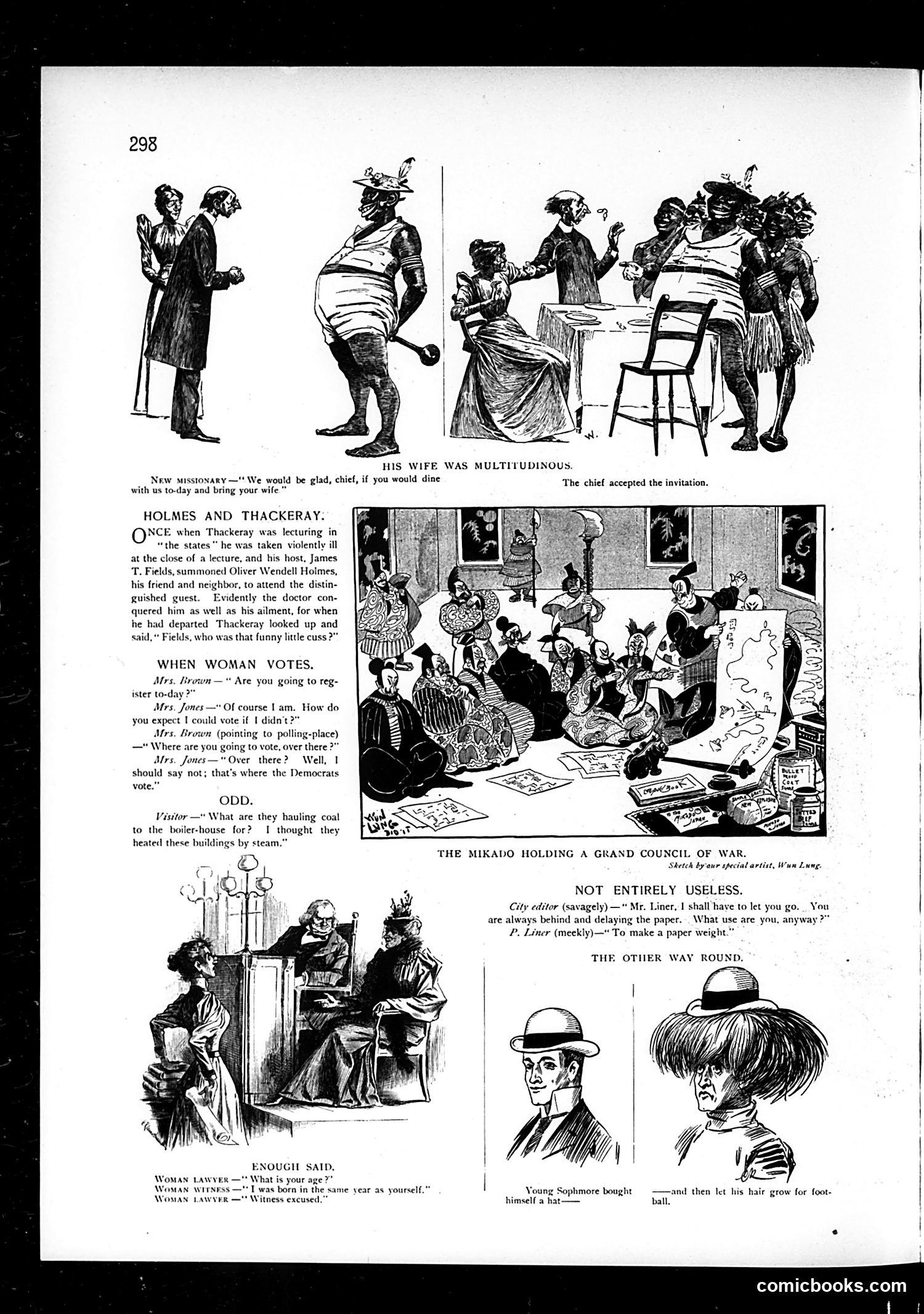
This page collects brief satirical vignettes mocking contemporary social issues: **"His Wife Was Multitudinous"** ridicules missionary work and racial stereotypes, depicting a colonial encounter where a chief arrives with numerous wives—the humor aimed at perceived exotic polygamy. **"Holmes and Thackeray"** is an anecdote about the writer Thackeray's illness during an American lecture tour, treated humorously by Oliver Wendell Holmes. **"When Woman Votes"** satirizes newly enfranchised women, suggesting female voters are so partisan they'll avoid polling places where Democrats vote—mocking both women's political awareness and partisan divisions. **"The Mikado"** appears to reference Japanese military affairs (likely Russo-Japanese War era), using "Wun Lung" as a mock-Oriental artist's name. **"Not Entirely Useless"** jokes about a newspaper employee's incompetence being useful only as a "paperweight." **"Enough Said"** mocks a female lawyer's questioning of a witness's age. **"The Other Way Round"** ridicules a young man buying a hat to justify growing his hair long for football. The page targets women's political engagement, workplace incompetence, and fashion absurdities.
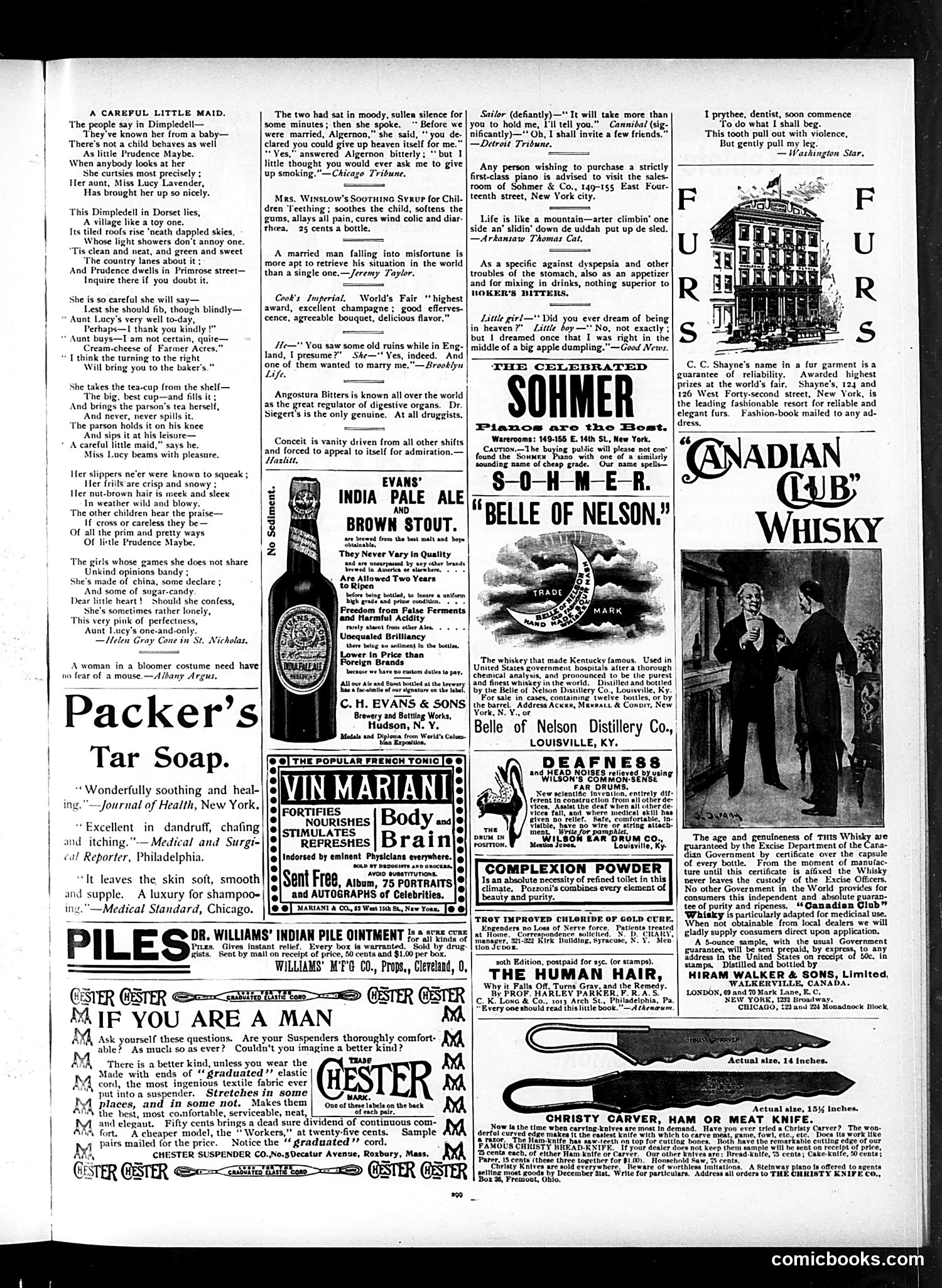
This page is **primarily advertisements interspersed with short humorous anecdotes and poems**—not political cartoons. The content reflects late 19th/early 20th-century American domestic humor: **Main pieces:** - "A Careful Little Maid" (poem about an obedient village girl) - Brief romantic/marital comedy vignettes (couples bickering about smoking, etc.) - Various one-liners about marriage, dining, and social situations **Key context for modern readers:** The humor relies on: - **Gender roles**: Women as obedient, careful; men as reluctant to quit smoking or behave properly - **Class commentary**: References to servants, "Farmer Acres," parsons - **Domestic tensions**: Marriage complaints, particularly about habits **Advertisements dominate**, hawking: - Packer's Tar Soap, Dr. Williams' Ointment, Sohmer Pianos, Canadian Club Whisky, and various patent medicines (Mrs. Winslow's Soothing Syrup, Angostura Bitters) These ads reveal period concerns: teething remedies, digestive complaints, dandruff—and the era's unregulated marketing of alcohol and opiates as medicine. The page reflects *gentle domestic satire*, not serious political commentary.
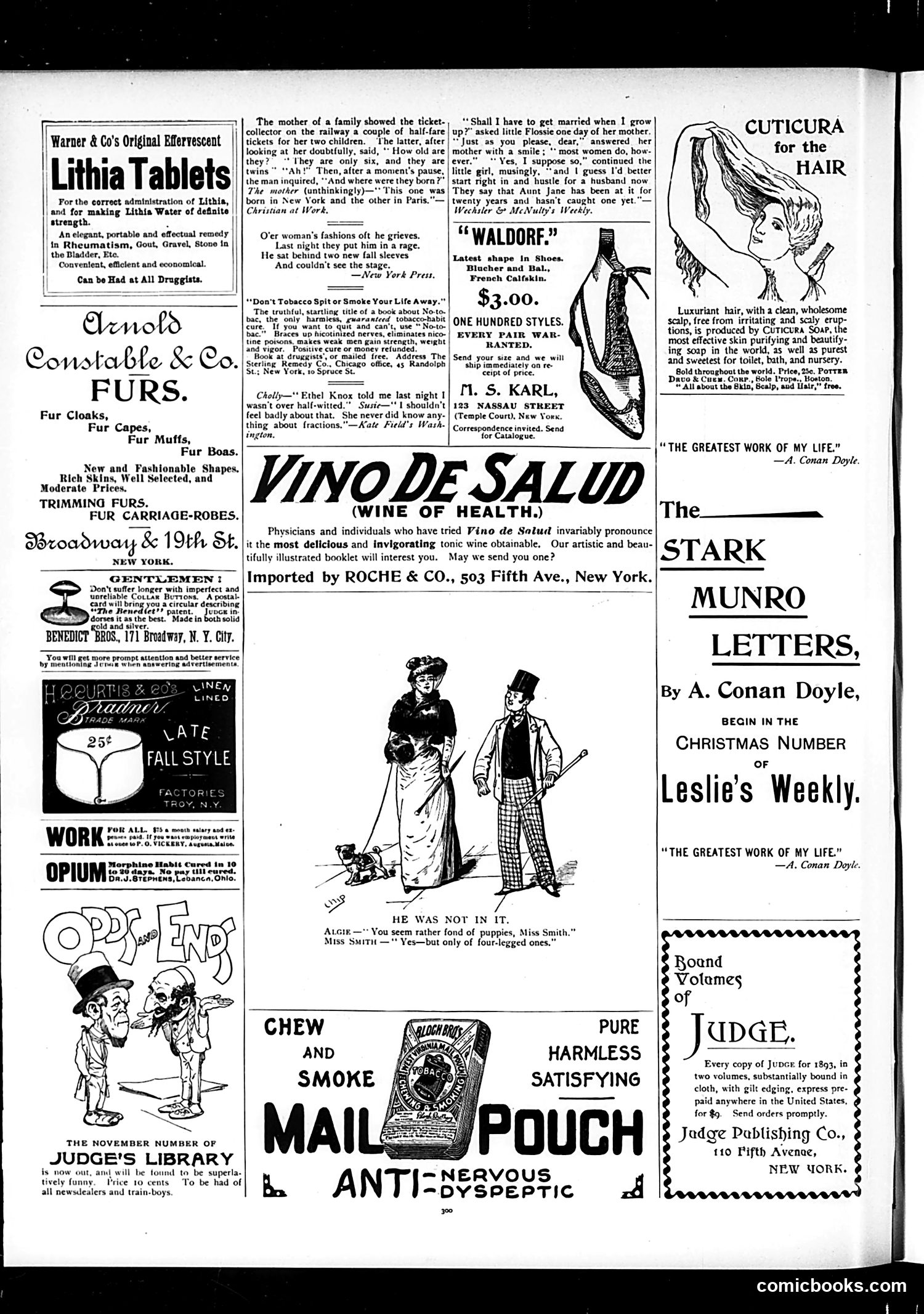
This is primarily an **advertising page** from Judge magazine, with minimal editorial content. The notable satirical elements are: **"He Was Not In It"** — A small cartoon showing a well-dressed man and woman with a small dog. The joke plays on "four-legged ones" — the woman prefers puppies to men, implying the man lacks desirable qualities or masculinity. It's gentle Victorian-era gender humor. **Joke excerpts** scattered among ads mock social pretensions: - A railroad conductor's absurd question about where twins were born (one in New York, one in Paris) - "Cholly" being insulted about his intelligence by Ethel Rae - A young girl's cynical view that marriage requires decades of effort The page is overwhelmingly **commercial**, advertising lithia tablets, fur coats, shoes, wine tonics, hair treatments, and tobacco cessation products — typical late-19th/early-20th-century patent medicines and luxury goods. The humor serves mainly as filler between advertisements.
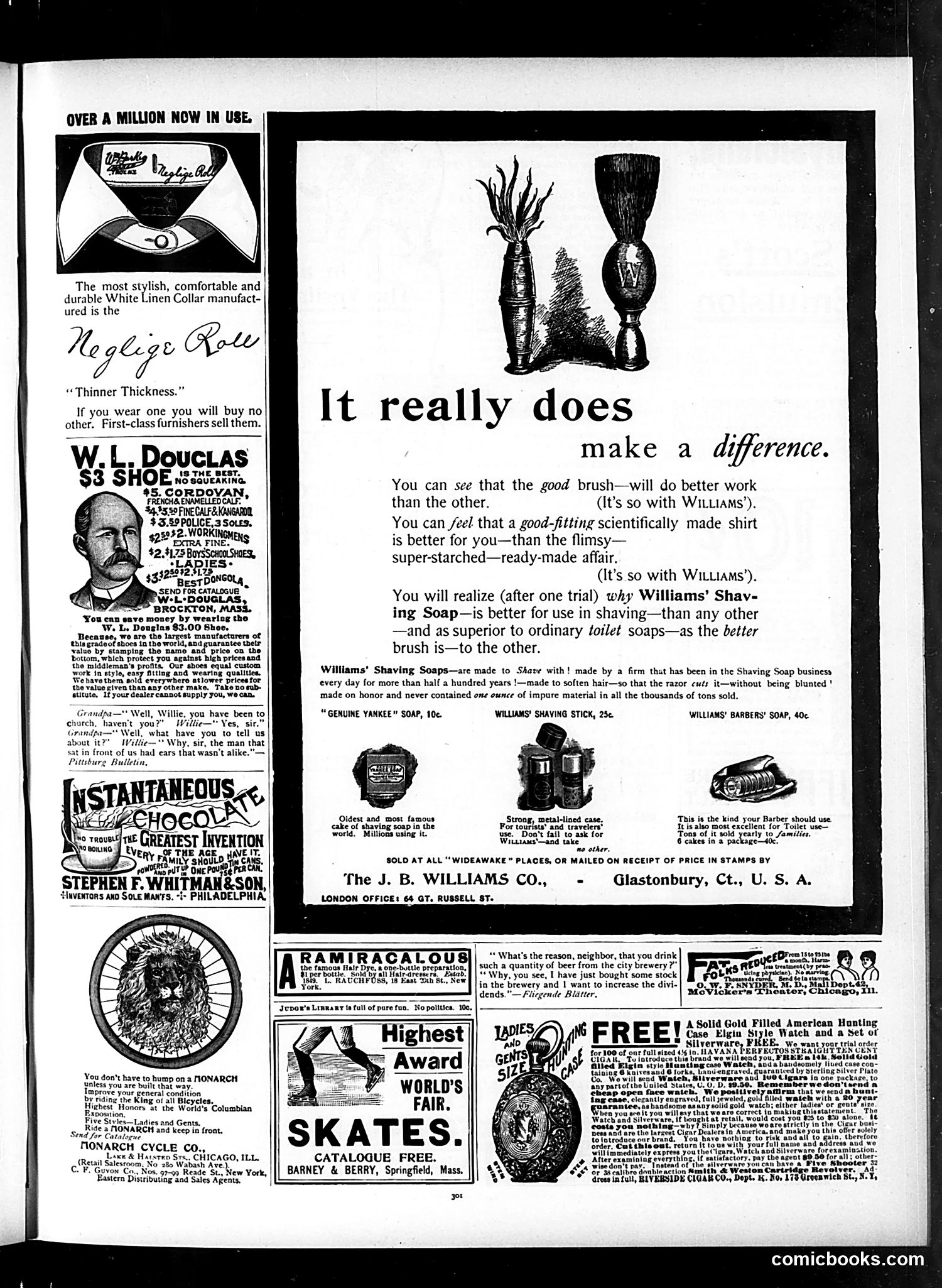
This page is primarily **advertising** rather than satirical content. It consists of product advertisements typical of early 20th-century magazines. The major ads include: - **Nolegee Row collars** and **W.L. Douglas shoes** (left column) - **Williams' Shaving products** (center, dominant) - **Monarch bicycles** (bottom left) - **Various other products**: skating skates, chocolate, watches, and beer stock The only satirical element is a brief **joke** about a man buying brewery stock to increase dividends by drinking more beer—a commentary on self-interested investment behavior. The Williams' Soap ad uses a comparative argument ("it really does make a difference") highlighting quality and manufacturing standards—common advertising rhetoric emphasizing superiority over competitors. The page reflects **turn-of-the-century consumer culture** and marketing strategies, with no significant political satire visible.
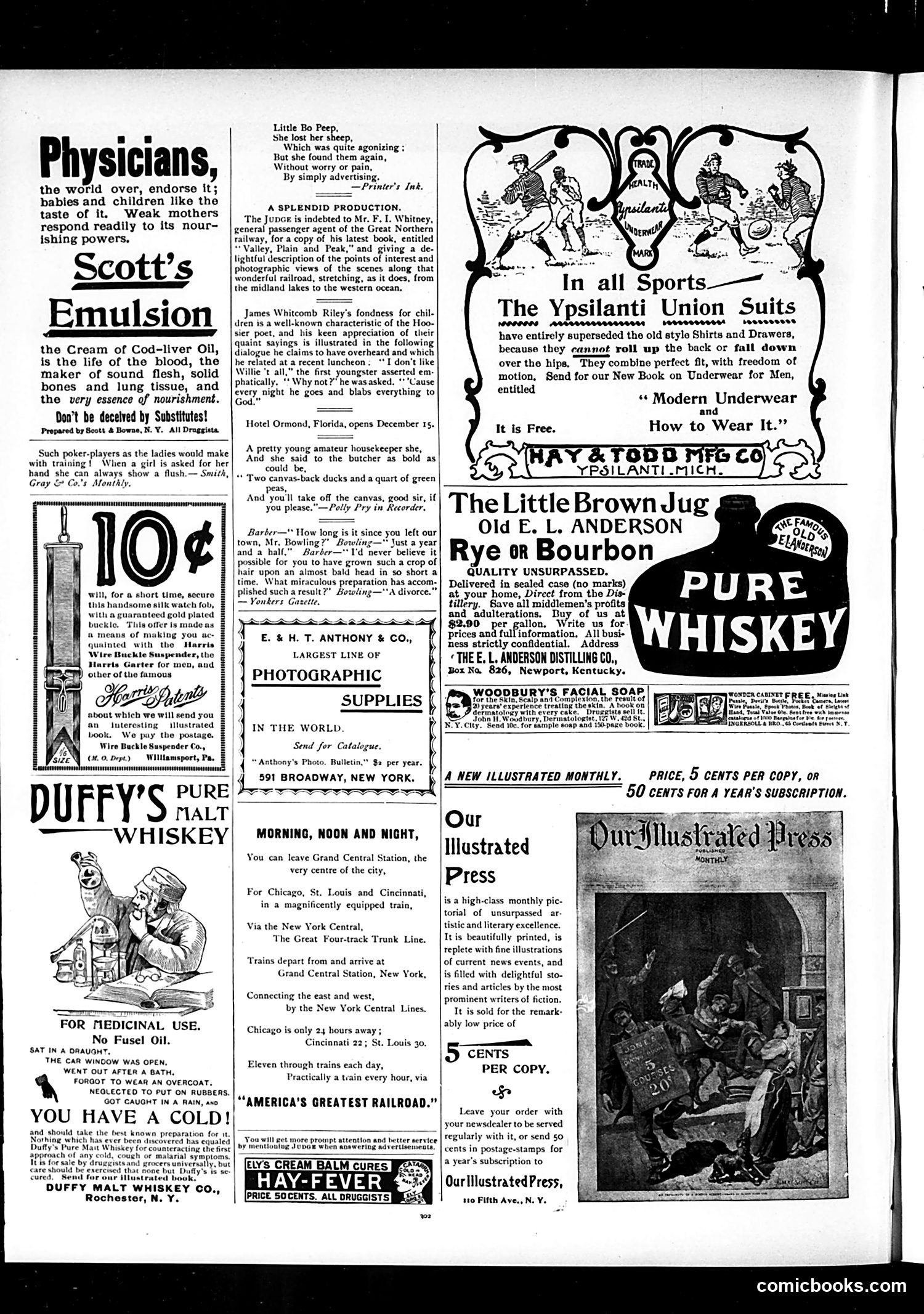
This page is **primarily advertising**, with minimal editorial cartoon content. The main items of note: **The one clear joke/cartoon:** A brief humor item titled "Little Bo Peep" plays on the nursery rhyme—a woman lost her "sheep" (suitors), then found them again "by simply advertising" in *Printer's Ink* (a trade publication). This is gentle satire about matrimonial advertising, which was common and somewhat scandalous in this era. **The cartoons/illustrations** are mostly product advertisements for patent medicines (Scott's Emulsion, Duffy's Malt Whiskey), suspenders, and photographic supplies—typical Judge magazine filler that mixed humor with commerce. **Social context:** The page includes anecdotes attributed to poet James Whitcomb Riley about children's speech, and various jokes about barbers, housekeeping, and poker—representative of genteel turn-of-the-century humor. The page reflects Judge's business model: satirical commentary wrapped around lucrative advertising space.
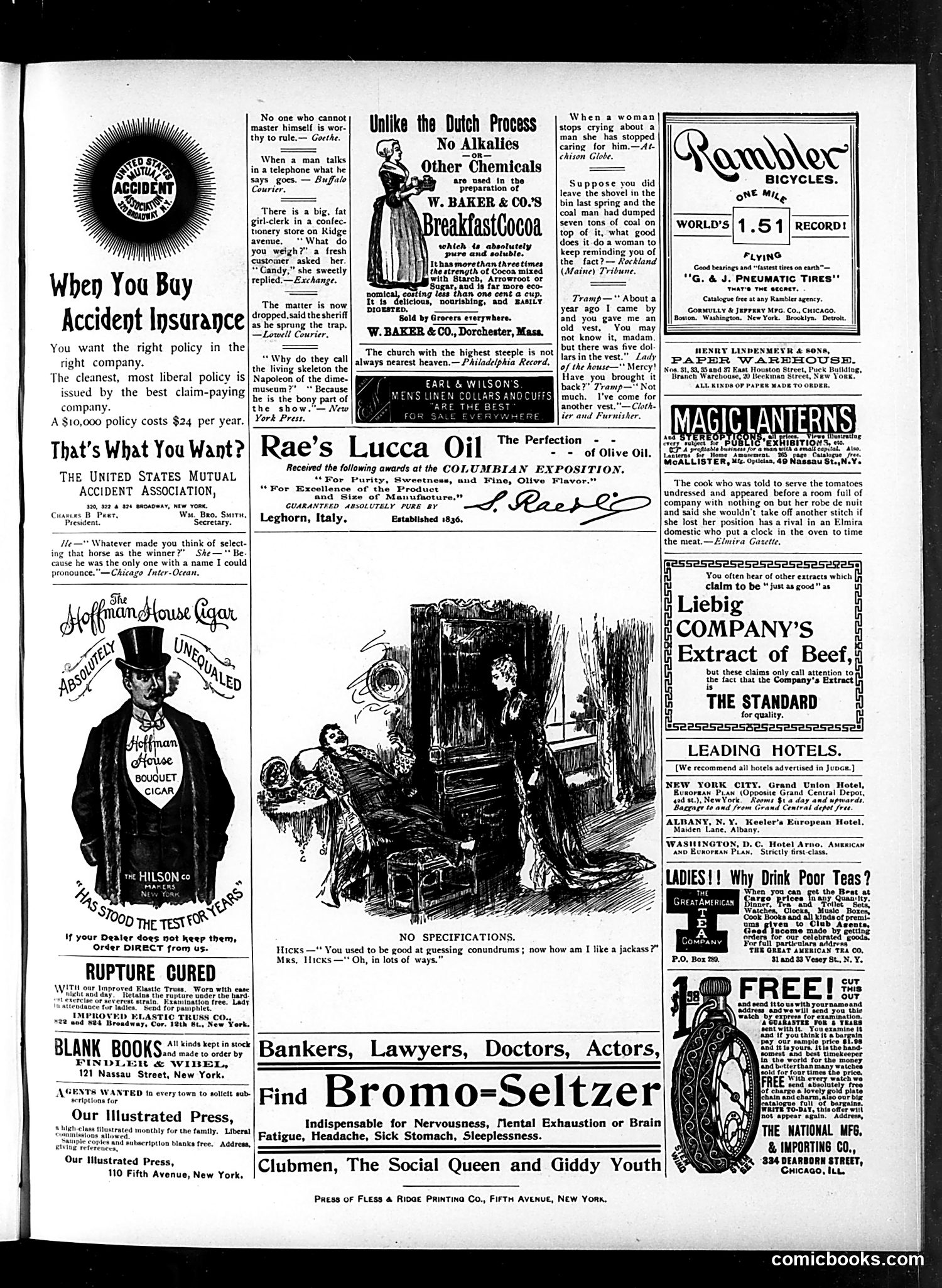
This is primarily an **advertising page** from *Judge* magazine, with minimal satirical content. The page consists almost entirely of product advertisements (cocoa, olive oil, bicycles, cigars, patent medicines, insurance) typical of late 19th-century publications. The only cartoon is a small sketch titled "NO SPECIFICATIONS," showing a domestic scene where a woman confronts a man about his poor guessing abilities, comparing him unfavorably to a jackass. It's mild domestic humor with no political significance. The scattered short jokes throughout are lighthearted observations: a fat candy-store clerk, a church's height not indicating holiness, a telephone operator's predictable behavior—typical filler content. **Key context for modern readers:** This page reflects an era when magazines relied heavily on advertising revenue and filled remaining space with brief jokes and product endorsements. The content is apolitical and commercially driven, quite different from *Judge's* more pointed satirical cartoons that appeared elsewhere in the publication.
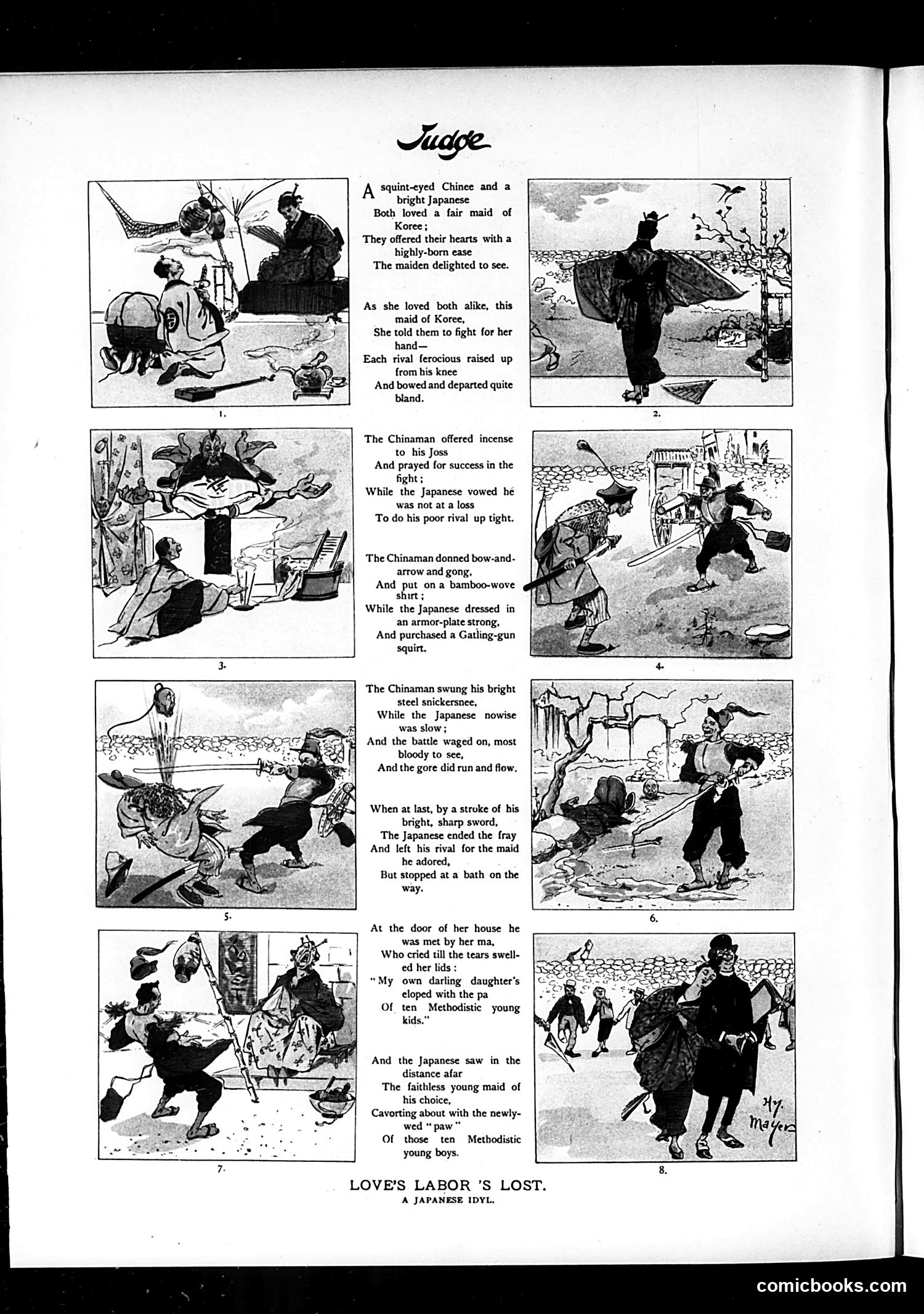
This eight-panel comic tells a satirical story of romantic competition between a Chinese man and a Japanese man vying for a Korean woman's hand. The joke satirizes stereotypical depictions: the Chinese suitor uses "primitive" weapons (bow, arrow, gong, bamboo shirt) while the Japanese competitor purchases modern military technology (armor-plate, Gatling gun). After the Japanese man defeats his rival through superior firepower, the satirical punchline emerges: the Korean maiden has eloped not with either suitor, but with a Methodist missionary (the "paw" of ten Methodist boys)—suggesting Western Christian influence "wins" over both Asian powers. The satire likely comments on competing imperial interests in Korea during the 1890s, with the absurd outcome implying Western/Christian influence ultimately triumphs over Asian colonial ambitions. The comic uses exaggerated ethnic caricatures and period stereotypes throughout.