
A complete issue · 16 pages · 1894
Judge — October 27, 1894
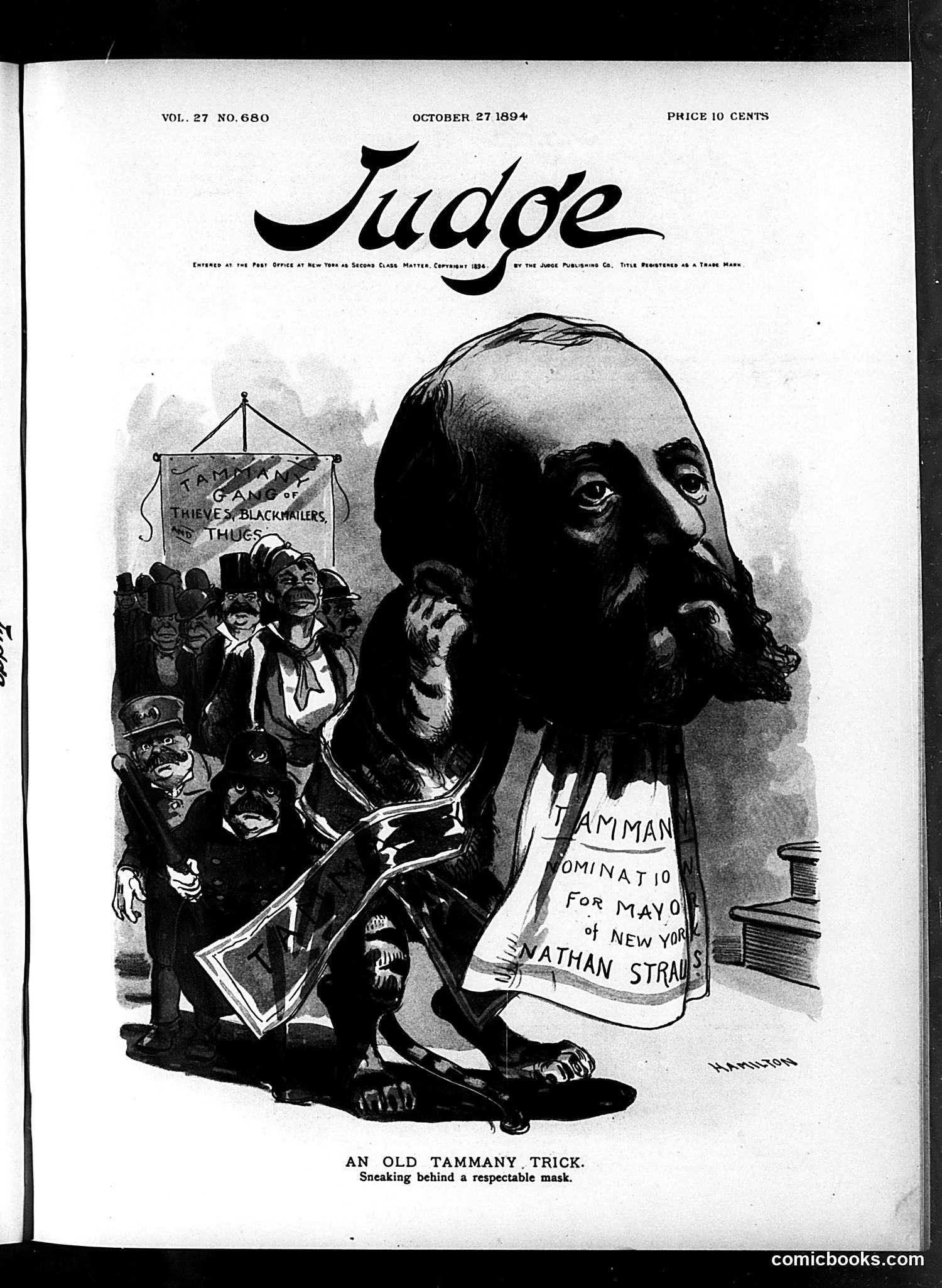
This 1894 *Judge* cartoon satirizes Tammany Hall, the powerful Democratic political machine that controlled New York City. The large bearded head represents a Tammany operative, wearing a document labeled "Hammany Nomination for Mayor of New York: Nathan Straus." Behind this "respectable mask" lurks a crowd of caricatured figures associated with Tammany corruption—depicted as criminals ("Thieves, Blackmailers, and Thugs"). The cartoon's point is that Tammany conceals its corrupt nature behind legitimate candidates and nominations. By running respectable figures like Nathan Straus for mayor, Tammany attempts to hide the criminal elements that actually control the organization. The satire suggests voters shouldn't be fooled by the façade.
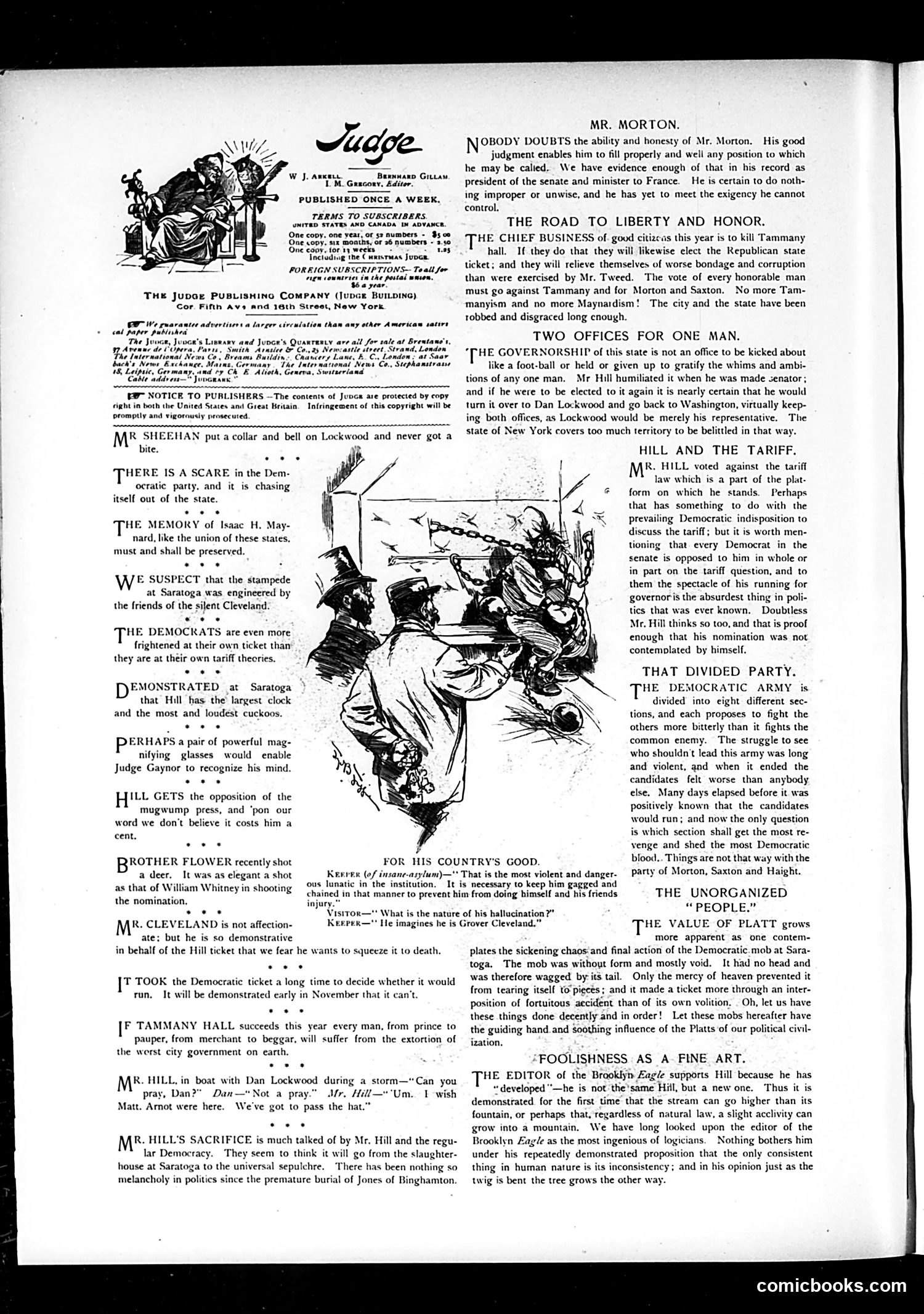
This page satirizes Democratic Party infighting during what appears to be a late 19th-century election cycle. The central cartoon depicts a chaotic fight among Democratic figures, illustrating the column "That Divided Party," which states the Democratic Army is "divided into eight different sections" fighting each other more bitterly than fighting Republicans. Key targets include: - **Mr. Morton** (praised for honesty and judgment) - **Mr. Hill** (criticized for supporting tariffs and lacking Democratic unity) - **Tammany Hall** (the corrupt New York political machine) - **Grover Cleveland** (referenced dismissively) The satire's point: Democratic internal divisions over policy (tariff, governance) and corruption make them ineffective opponents, consumed by factional warfare rather than unified political strategy.
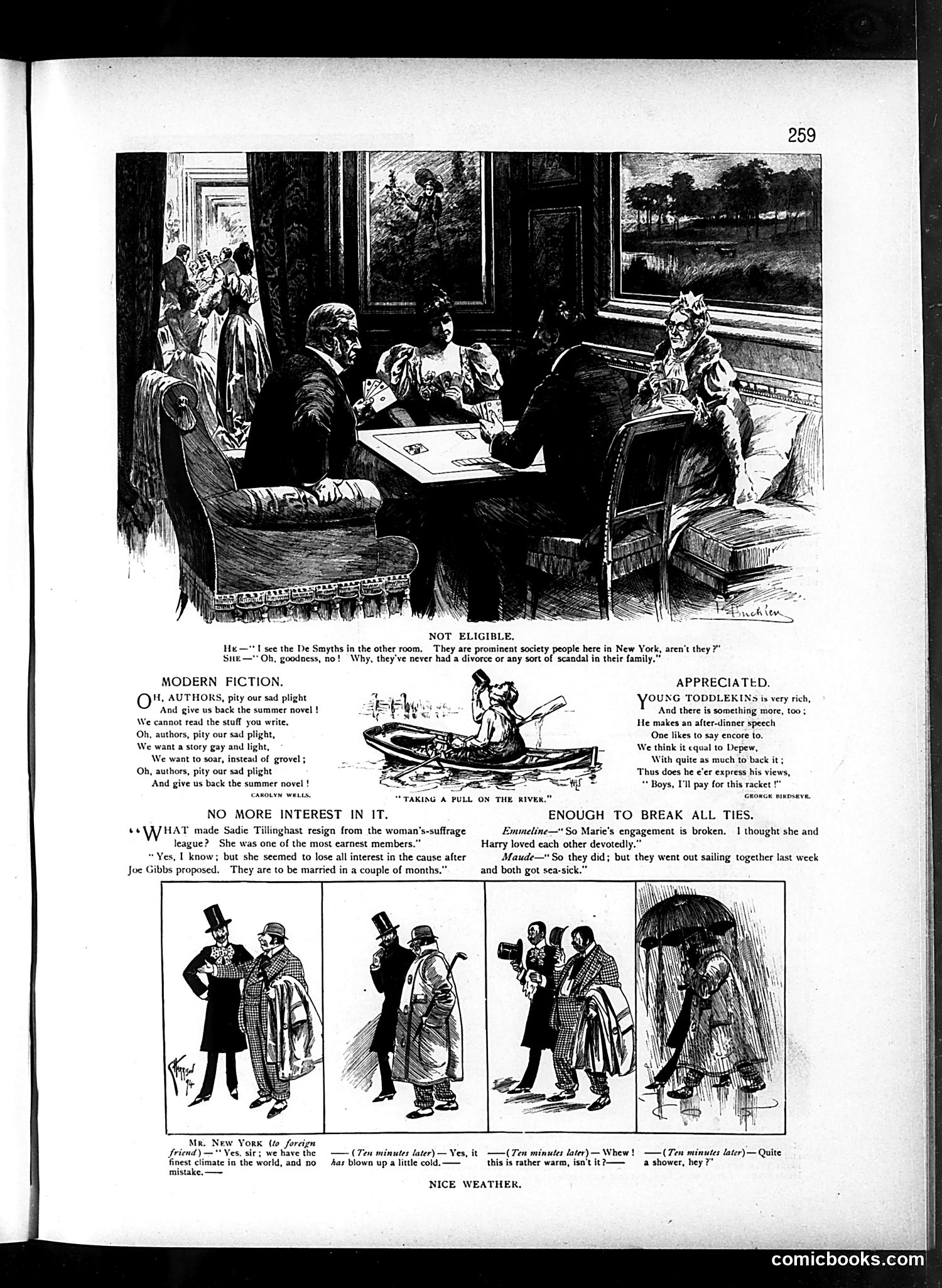
This page contains several short satirical pieces typical of Judge magazine's humor: **"Not Eligible"** (top): Satirizes New York's elite social circles, mocking prominent families who claim superiority while hiding scandals. The joke is that the Smiths, despite their prominence, are "ineligible" for exclusive society due to undisclosed family issues. **"Modern Fiction"** and related poems mock contemporary literature's melodrama and predictability. **"No More Interest in It"** jokes about Sadie Tillinghast's lost interest in an engagement after Joe Gibbs proposes—a commentary on women's changing attitudes toward marriage. **"Nice Weather"** (bottom comic strip): A sequential gag showing a man and woman's different reactions to temperature—he finds it cold, she finds it warm. The final panel suggests a romantic resolution, poking fun at courtship conventions and gendered perspectives.
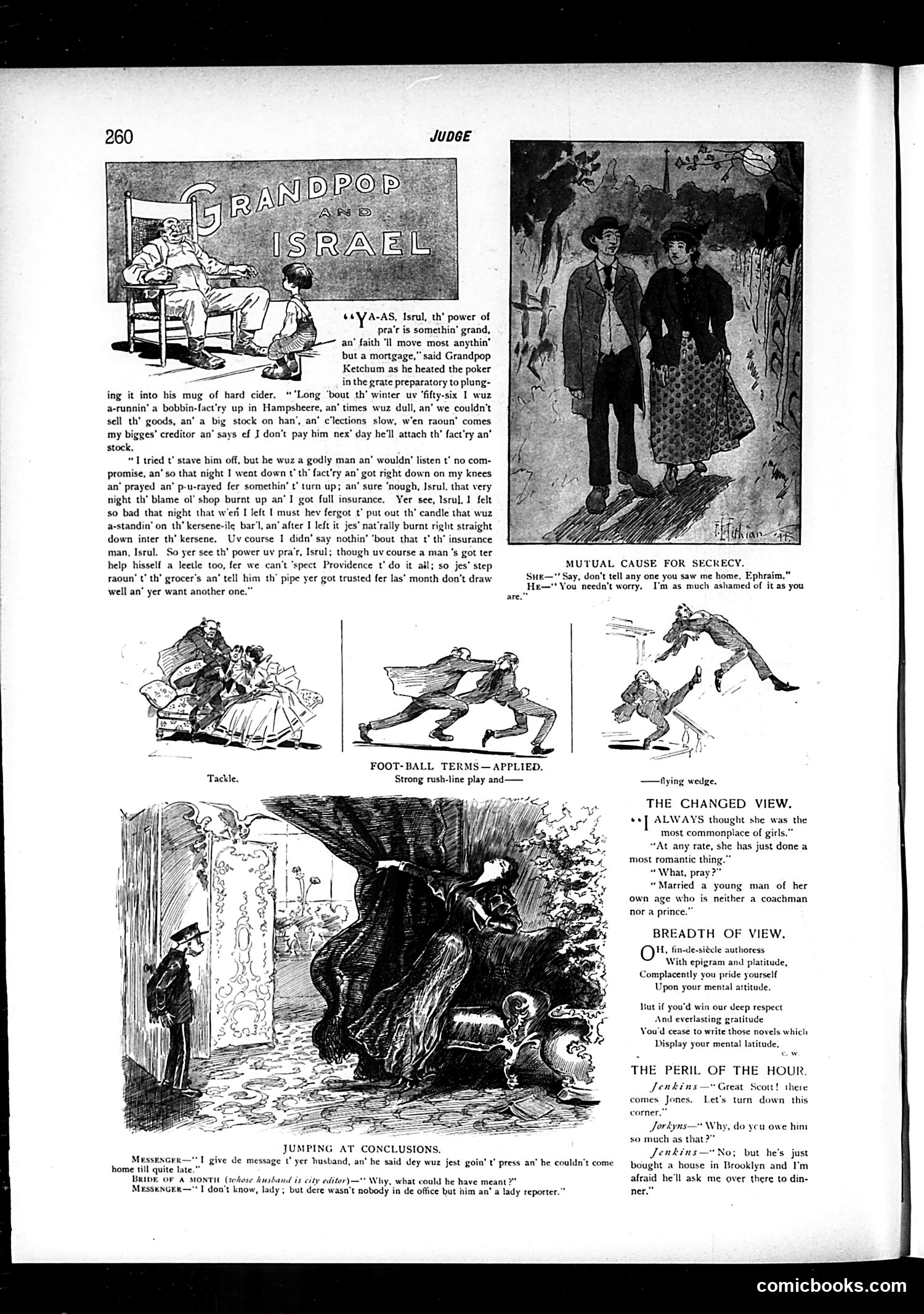
This page from *Judge* contains multiple satirical pieces targeting American social hypocrisy and modern anxieties circa early 1900s. **"Grandpop and Israel"** mocks rural religiosity: an old farmer credits prayer for a factory fire that conveniently destroyed his financial troubles—then admits he "forgot" to remove the kerosene lamp, implying accidental arson covered by insurance. The satire targets the convenient marriage of faith and self-interest. **"Mutual Cause for Secrecy"** jokes about shared shame—two men don't want to be seen together socially, suggesting either impropriety or embarrassing class association. **"The Changed View"** satirizes romantic pretension: a woman considered "commonplace" becomes "romantic" merely by marrying an ordinary peer rather than a coachman or prince, mocking how society measures women's worth by marriage status. **"The Peril of the Hour"** suggests social anxiety about debt and creditors. The cartoons reflect *Judge*'s mockery of American prudishness, financial ethics, and the gap between professed values and actual behavior.
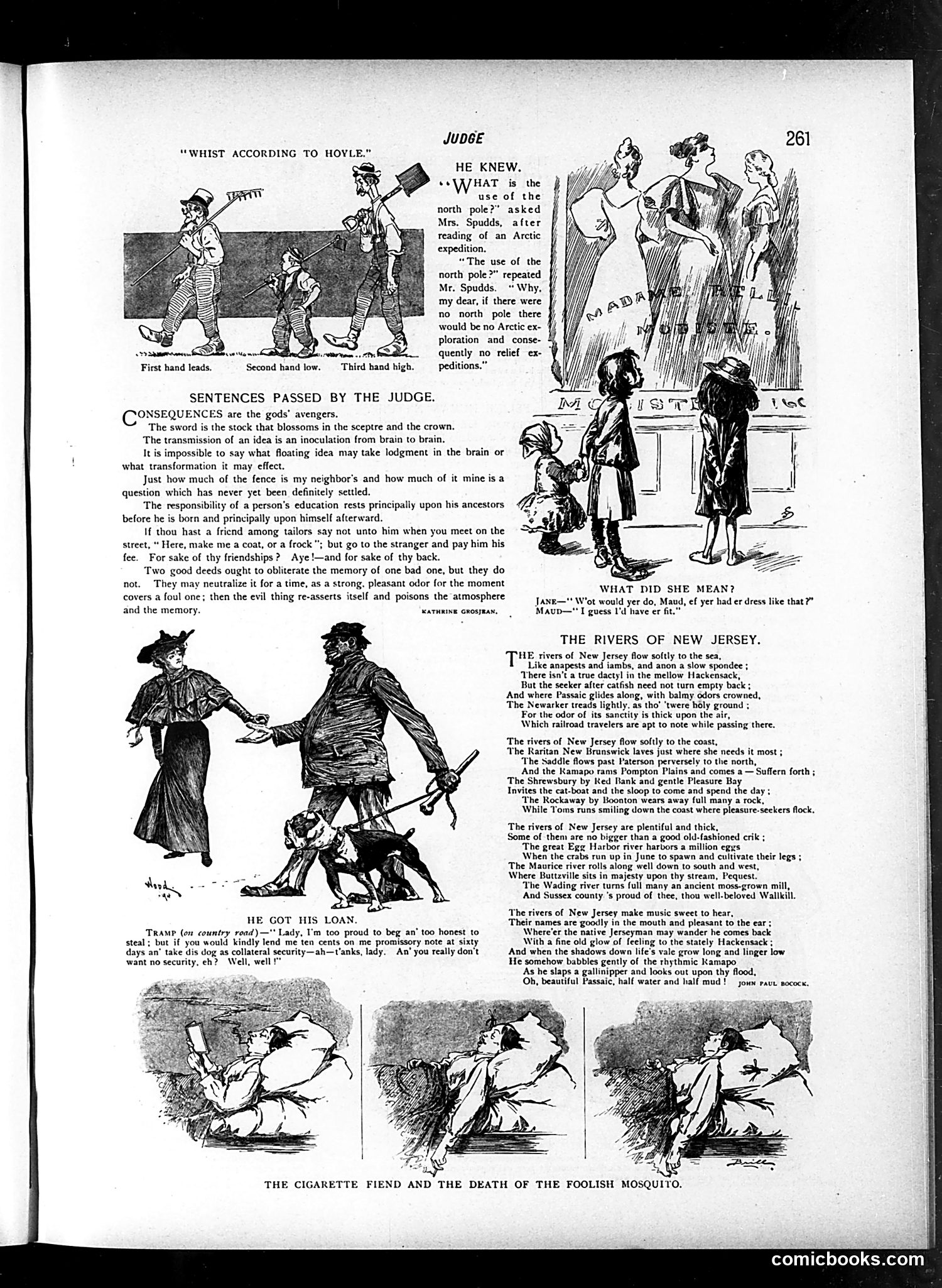
**"Whist According to Hoyle"** (top left): A humorous comic strip about card game hand positions, seemingly unrelated to politics—pure entertainment. **"Sentences Passed by the Judge"** (center): Philosophical musings on consequences, morality, and social responsibility, presented as wise pronouncements. This appears to be editorial commentary rather than satire of a specific figure. **"What Did She Mean?"** (right): A brief domestic humor joke about women's fashion, with no political content. **"The Rivers of New Jersey"** (bottom right): A lengthy poem satirizing New Jersey's rivers through deliberately awkward poetic meter and crude wordplay (references to pollution, "Buttzville," etc.). This mocks both the rivers' actual condition and overwrought nature poetry generally. **"He Got His Loan"** (bottom left): A tramp character attempts to borrow money using a dog as collateral—social satire about poverty and desperation. Overall, this page mixes light domestic humor with gentle social commentary, lacking sharp political satire of identifiable figures or events.
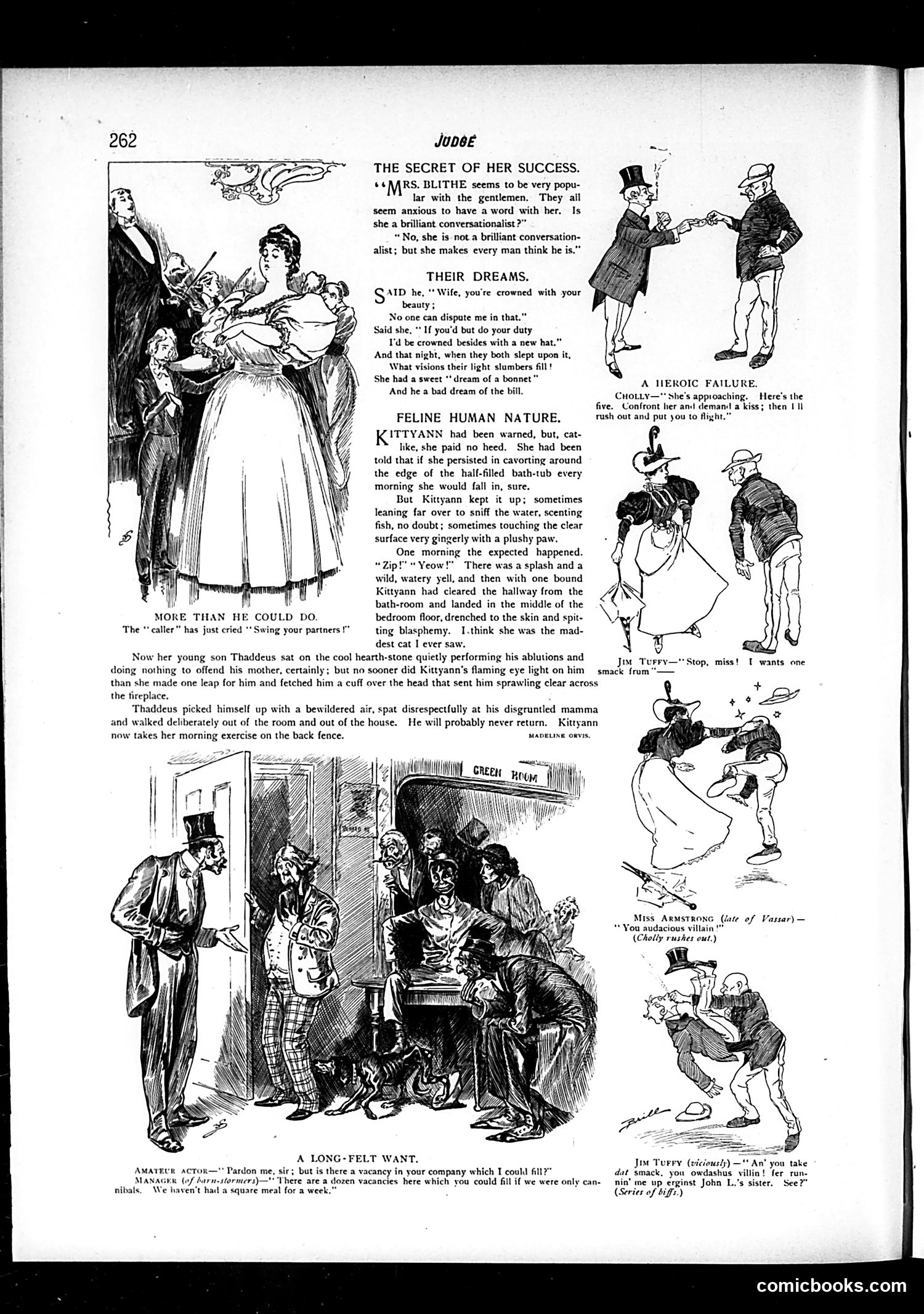
This page contains several Victorian-era social humor cartoons: **"The Secret of Her Success"** mocks social pretense: Mrs. Blithe's popularity stems not from brilliance but from flattering men into believing *they* are clever—a satire on superficial courtship and masculine vanity. **"Their Dreams"** contrasts marital desires: the husband dreams of his wife's beauty; she dreams of a new hat. The punchline reveals their actual concern—his anxiety about the expense—satirizing both feminine materialism and masculine financial burden. **"Feline Human Nature"** uses a cat's behavior as moral lesson: Kittyann ignores warnings, falls in the bath, then displaced her anger onto her innocent son who leaves home. It's a darkly comic commentary on how people irrationally punish the wrong targets when frustrated. **"A Long-Felt Want"** jokes about theatrical unemployment: an amateur actor seeking work is offered "vacancies" only as an extra body to fill the company—he's wanted as literal space, not talent. These reflect turn-of-century concerns with courtship rituals, domestic economics, and social aspiration.
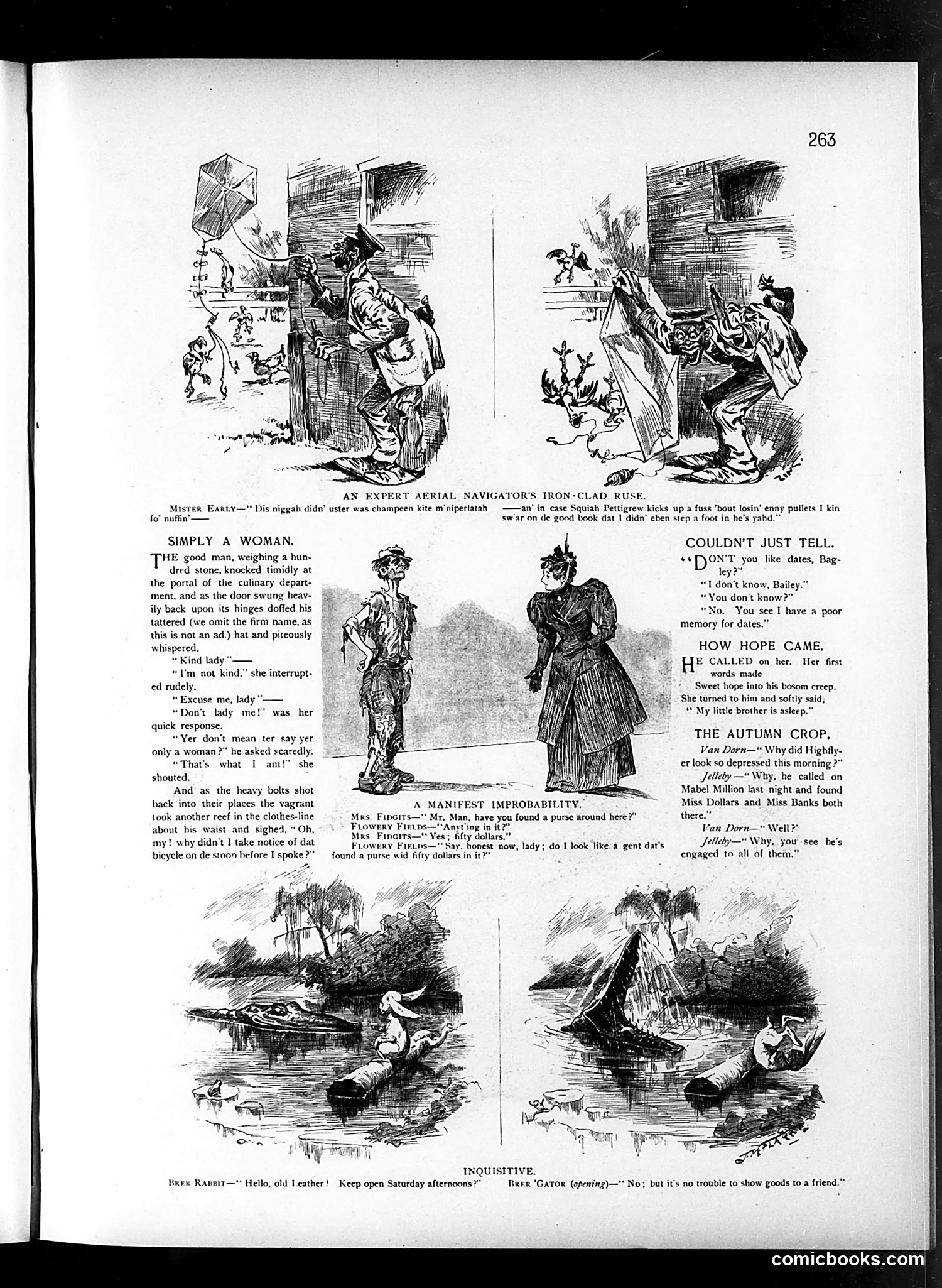
This page contains multiple brief satirical sketches typical of Judge's humor: **"Simply a Woman"** mocks domestic power dynamics—a hungry vagrant seeks food from a cook, who aggressively corrects his polite address ("lady," "kind lady"). The joke: she's domineering and the man regrets not noticing her bicycle earlier (implying he could've avoided her). **"A Manifest Improbability"** plays on honesty—three characters discuss finding a purse with fifty dollars, each claiming they wouldn't keep it, but the final character sarcastically asks if he "looks like a gent" who'd be honest. **Other brief sketches** cover romantic disappointment, courtship miscues, and social awkwardness typical of the era's comedy. The language includes period slang and dialect humor. Overall, the page satirizes class relations, gender dynamics, and human dishonesty through exaggerated character types rather than topical political commentary.
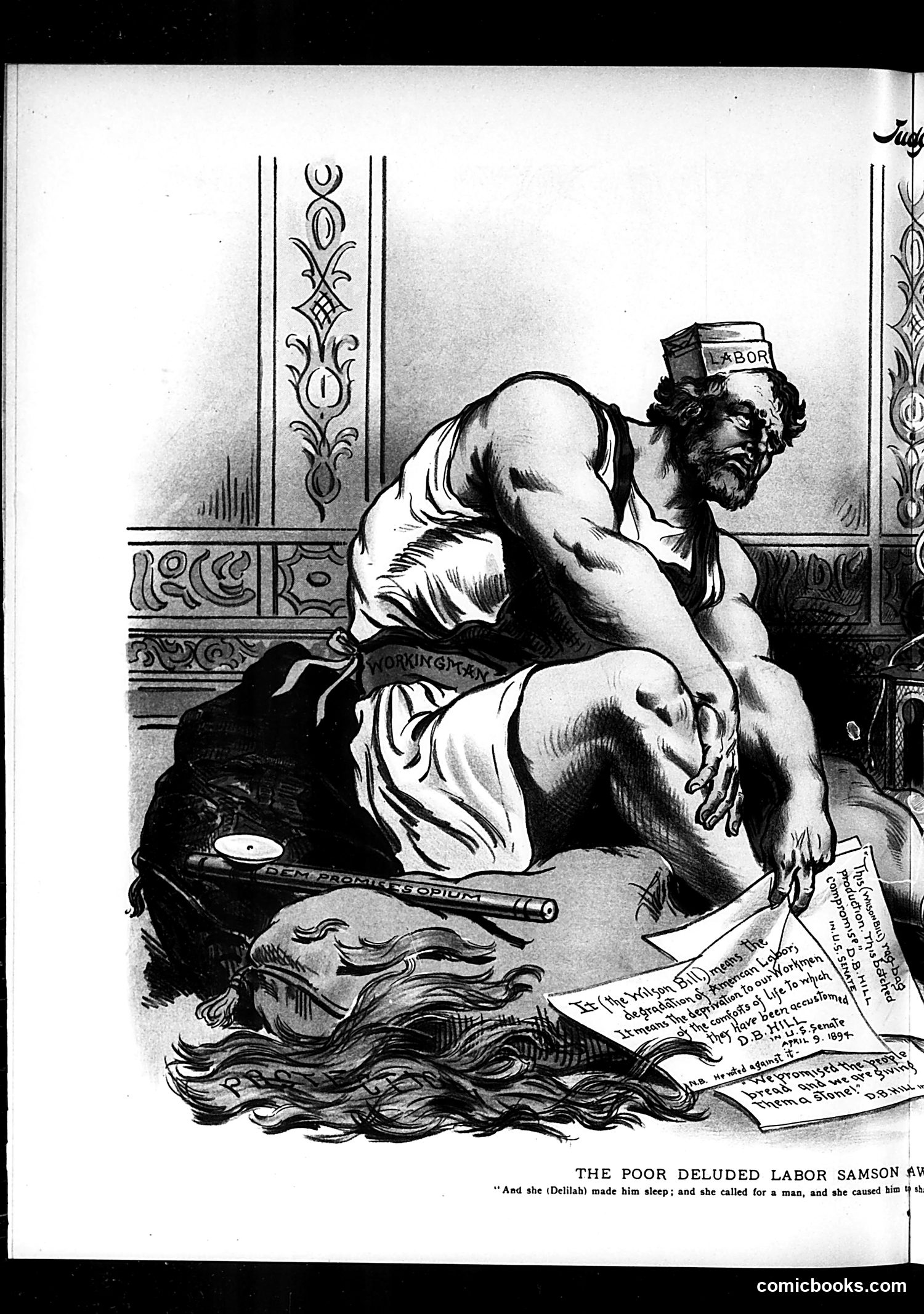
This political cartoon uses the biblical allegory of Samson and Delilah to critique labor movements. A muscular man labeled "LABOR" wears a headband marked "LABOR" while sleeping, vulnerable and being shorn of his hair (source of strength) by a woman representing "Delilah." The cartoon suggests that labor leaders are being deceived and weakened by hostile forces—likely capitalist interests or corrupt politicians portrayed as the scheming Delilah. The scattered documents and papers around them appear to reference legislative or contractual matters. The satire warns that organized labor, despite its power, is being manipulated into surrender through deception, losing its strength piece by piece. This reflects Judge magazine's skepticism toward labor activism during the era of labor-capital conflicts in America.
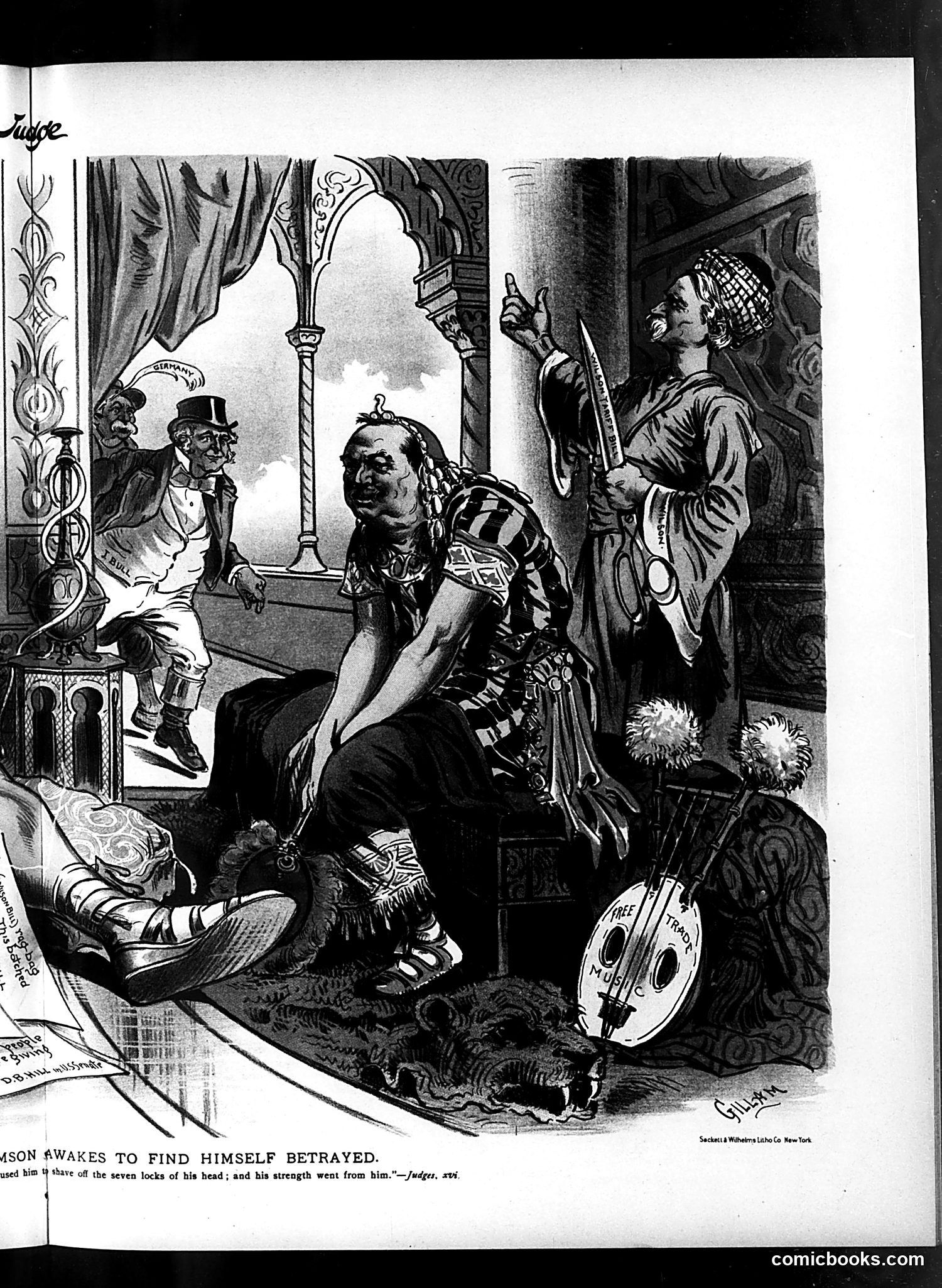
This cartoon adapts the Biblical story of Samson and Delilah as political allegory. The muscular central figure represents Samson (likely a political leader or nation), shown weakened after his hair—symbolizing his power or strength—has been cut. The scene depicts betrayal: attendant figures surround him in an ornate interior, with musical instruments visible, suggesting decadence and corruption. The caption directly quotes Judges 16:19, emphasizing how Samson lost his strength through treachery. Without the publication date clearly visible, the specific political target remains unclear, but the cartoon criticizes how a powerful figure or nation was weakened through internal betrayal or misguided trust. The elaborate setting suggests court intrigue or political manipulation leading to national decline.
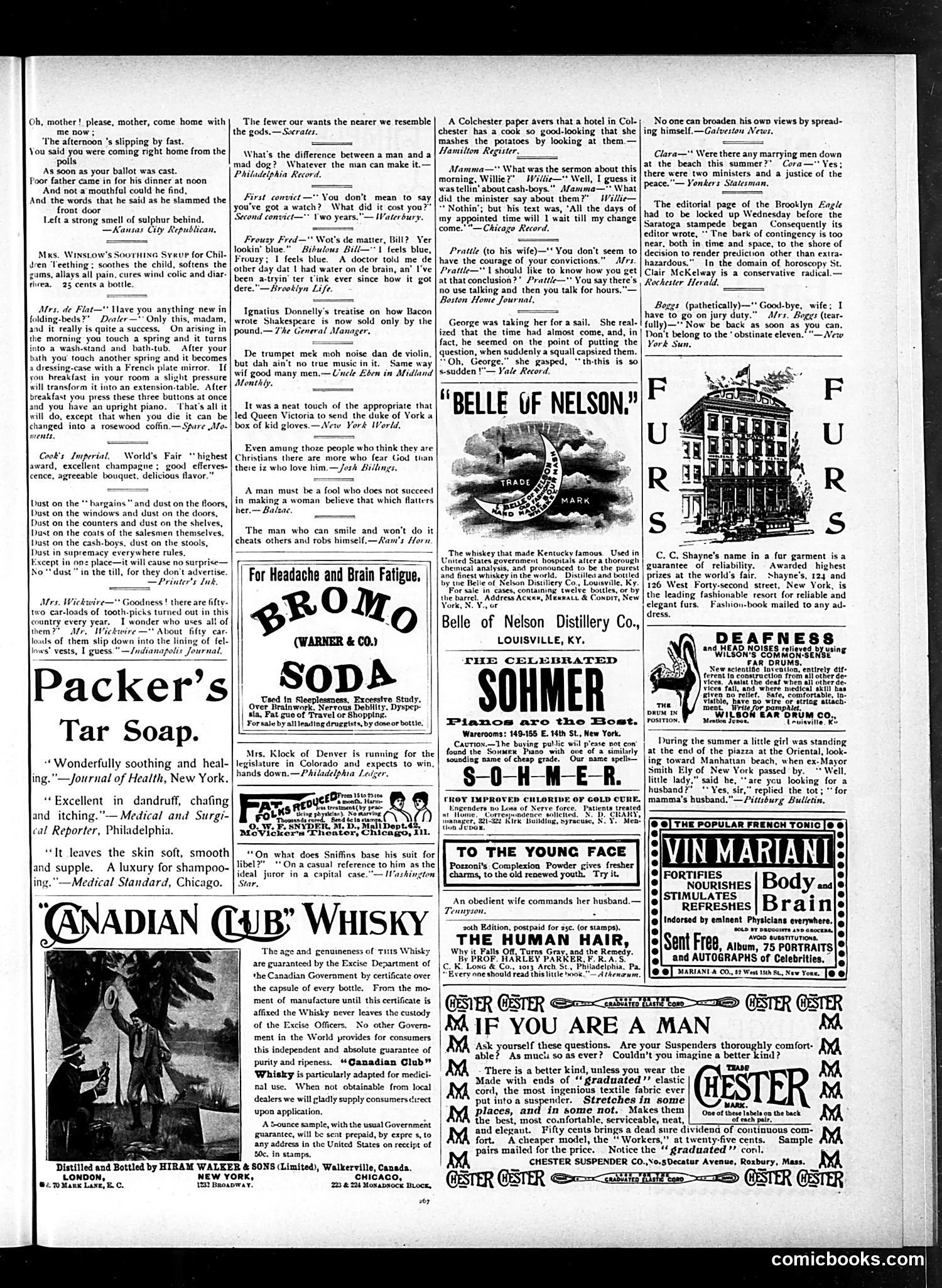
This page is primarily **advertisements and light humor** rather than political cartoons. The notable satirical content includes: **"Oh, Mother! Please Come Home"** (top left): A poem mocking women's newly gained voting rights. A child complains his mother stayed at the polls too long, leaving father without dinner. He's so angry he "left a strong smell of sulphur behind"—implying his profane rage. The satire suggests women voting is irresponsible neglect of domestic duties, reflecting anti-suffrage sentiment of the era. **Other humor pieces** mock everyday life: a man's suspenders perpetually slipping, office dust everywhere except the till (no advertising = no profits), and toothpicks disappearing into vest linings. The remainder consists of period product advertisements (soap, whisky, medicines) typical of 1890s-era magazines. No specific political figures are caricatured on this page.
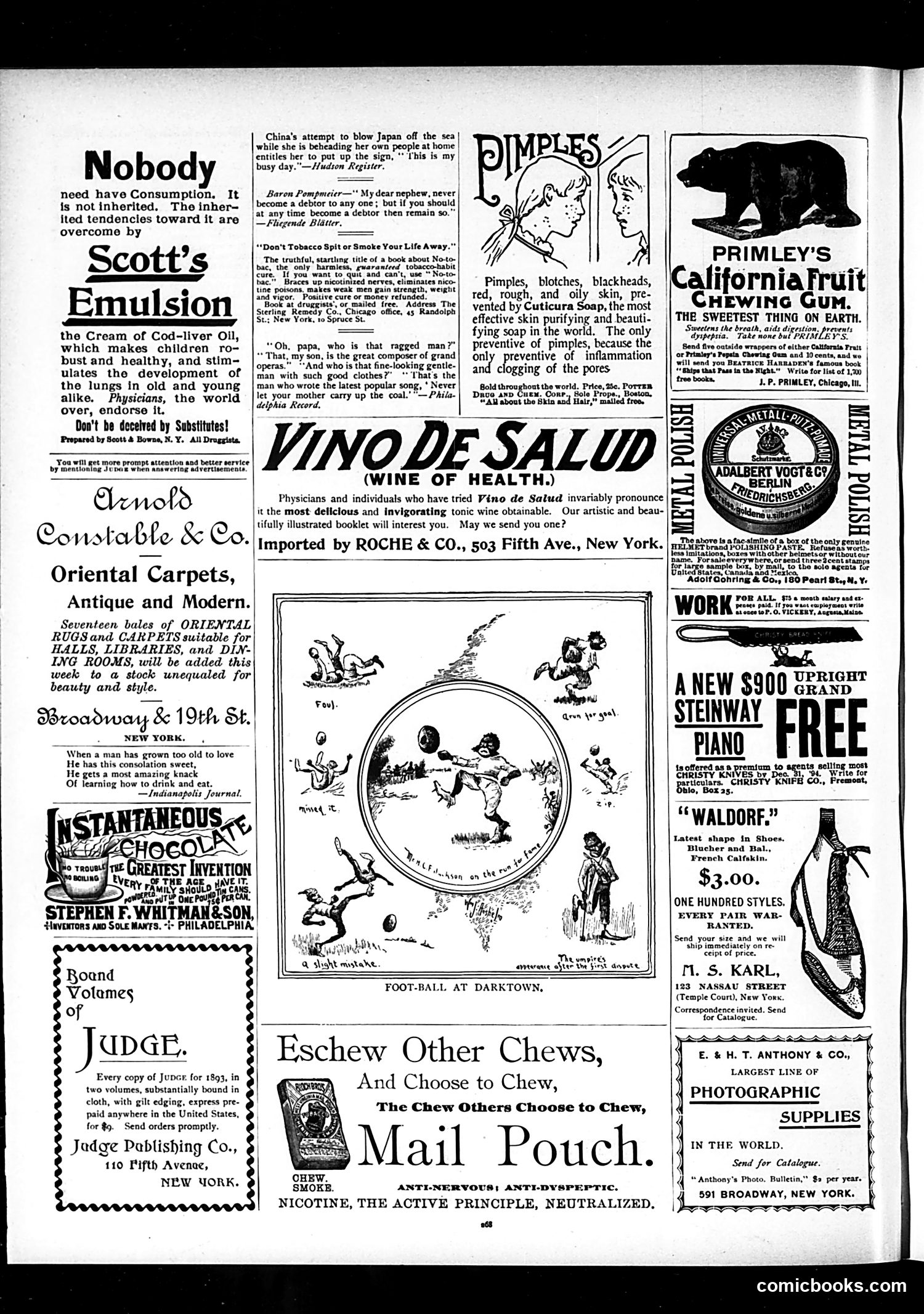
This page is primarily **advertisements** with one cartoon titled "Foot-Ball at Darktown." The cartoon depicts Black figures playing football in a chaotic, exaggerated style typical of late-19th-century American periodicals. The humor relies on **racist caricature**: the figures are drawn with exaggerated features and shown in slapstick, undignified poses—tumbling, colliding, and generally portrayed as comically incompetent. The caption's pun on "Darktown" (a derogatory term for Black neighborhoods) combined with the crude drawings reflects the casual racism embedded in Judge magazine's entertainment. For modern readers, this represents the grotesque minstrel-show aesthetic that dominated American popular culture of this era. It's not satire with a point beyond mockery—it's ethnic caricature presented as inherent humor, reflecting deep prejudices of the 1890s that we'd recognize today as overtly offensive and dehumanizing.
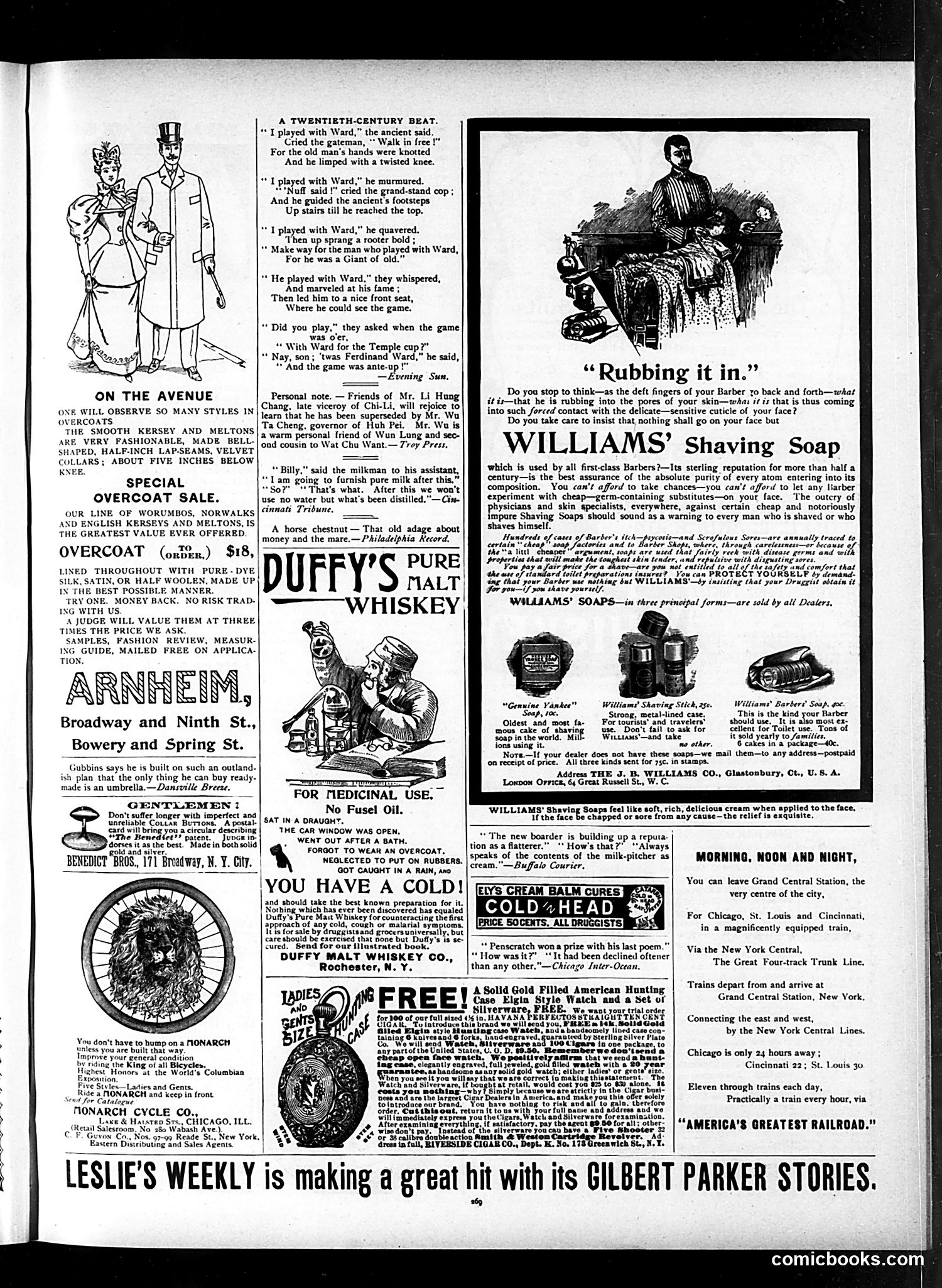
This page is primarily **advertising-heavy** rather than featuring significant political cartoons. The main satirical content is "A Twentieth-Century Beat," a poem about an elderly man gaining free admission and special treatment at a baseball game by claiming he "played with Ward." The punchline reveals "Ward" refers to **Ferdinand Ward**, a notorious 1880s financier whose schemes defrauded investors—making the man's admission worthless. The joke satirizes how people uncritically revere anyone associated with a famous name, even when that name represents fraud and failure. It's also a commentary on the gullibility of crowds. The page otherwise contains fashion advice about overcoats ("On the Avenue"), a brief note about Chinese officials (likely dated commentary), and extensive advertisements for **Williams' Shaving Soap**, emphasizing purity and warning against cheap imitations that cause skin infections. The historical context: Ferdinand Ward's 1884 financial collapse was still fresh enough in public memory to serve as satirical reference material.
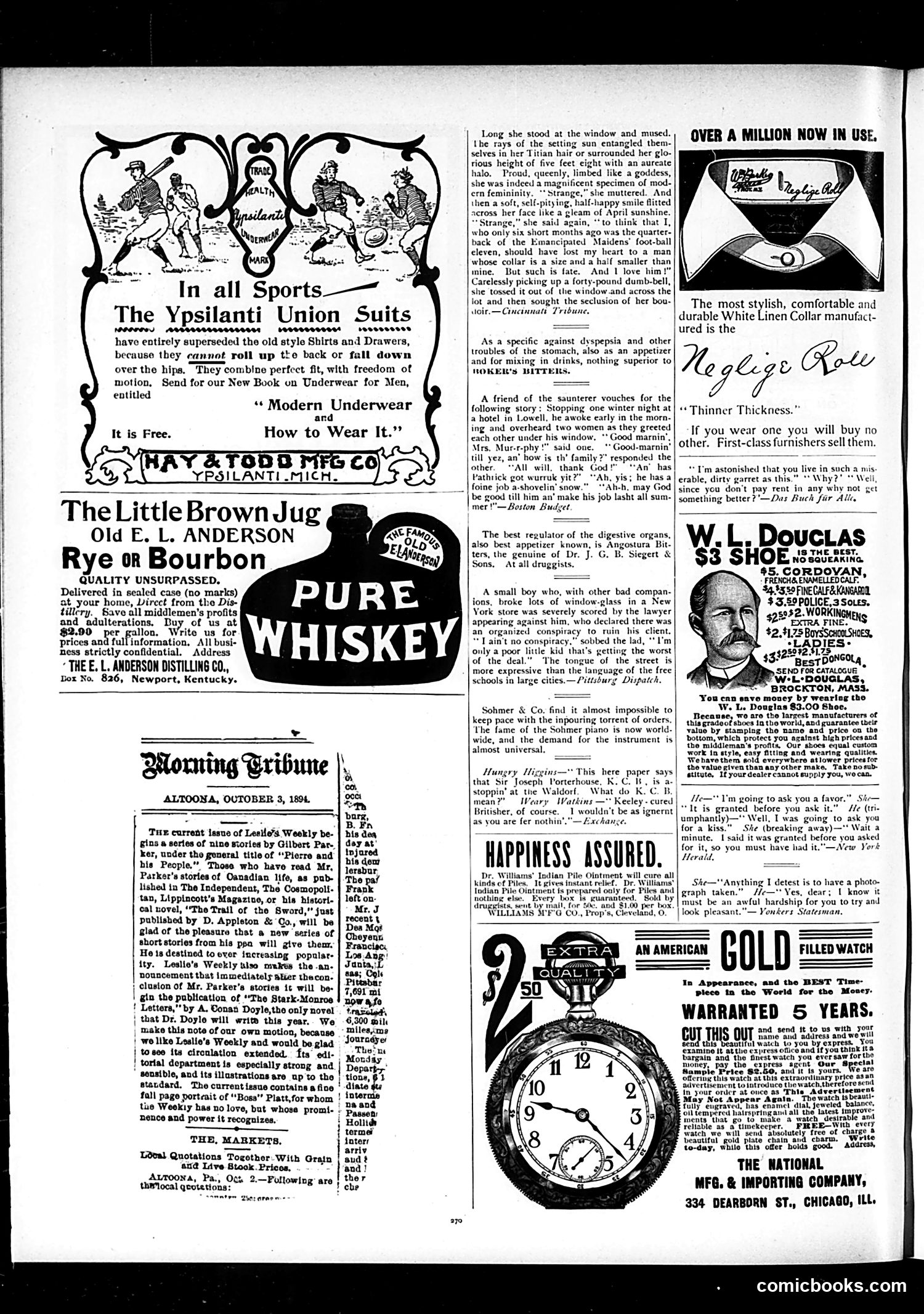
This page from Judge magazine (October 3, 1894) is primarily **advertising-focused** rather than political satire. The decorative header cartoon shows figures in period dress but carries no clear satirical message—it appears merely ornamental for the "Ypsilanti Union Suits" underwear advertisement. The most substantive content is a **fictional excerpt** (from Cincinnati Tribune) featuring satirical humor about gender roles: a tall, athletic woman—formerly a football player—has fallen in love with a man shorter than herself. The joke mocks both the "New Woman" movement (women's sports participation, independence) and evolving courtship norms. Her tossing a forty-pound dumbbell casually underscores the comic inversion of Victorian femininity. Otherwise, the page contains **product advertisements** (whiskey, watches, shoe polish, patent medicine) and a brief editorial note about forthcoming serialized stories in Leslie's Weekly. There is no political cartoon or substantive social commentary beyond the embedded gender-role humor in the fictional vignette.
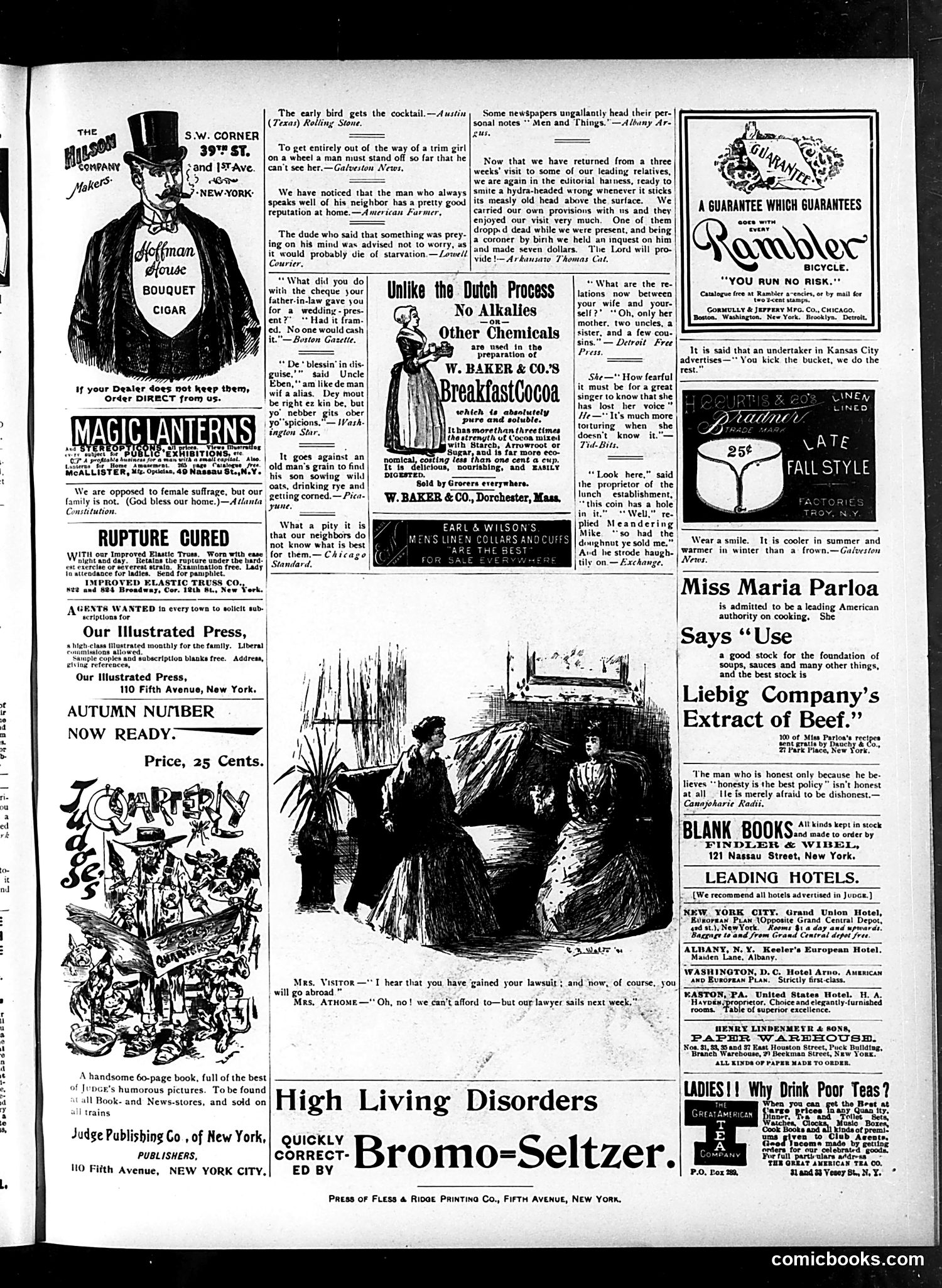
This is primarily an **advertising and miscellaneous content page** from Judge magazine, with minimal narrative cartooning. The main illustrated cartoon shows two women in Victorian dress having a conversation, captioned "Mrs. Visitor" and relating to marital relations—a common domestic humor topic of the era. The page consists mostly of **short humorous observations** (filler quotes) from various newspapers, targeting familiar turn-of-the-century topics: women cyclists ("trim girl on a wheel"), dudes, gossip columns, and social pretension. One recurring theme mocks personal advice columns and neighbors' judgments. The **advertisements** dominate: rupture trusses, illustrated magazines, blank books, hotels, and notably **Bromo-Seltzer** for "High Living Disorders"—suggesting hangover relief for upper-class excess. One quote directly references **female suffrage opposition**, indicating this was a contemporary political debate. The page reflects Gilded Age concerns: matrimony, respectability, urban life, and middle-class anxieties—typical Judge magazine fare blending light satire with consumer messaging.
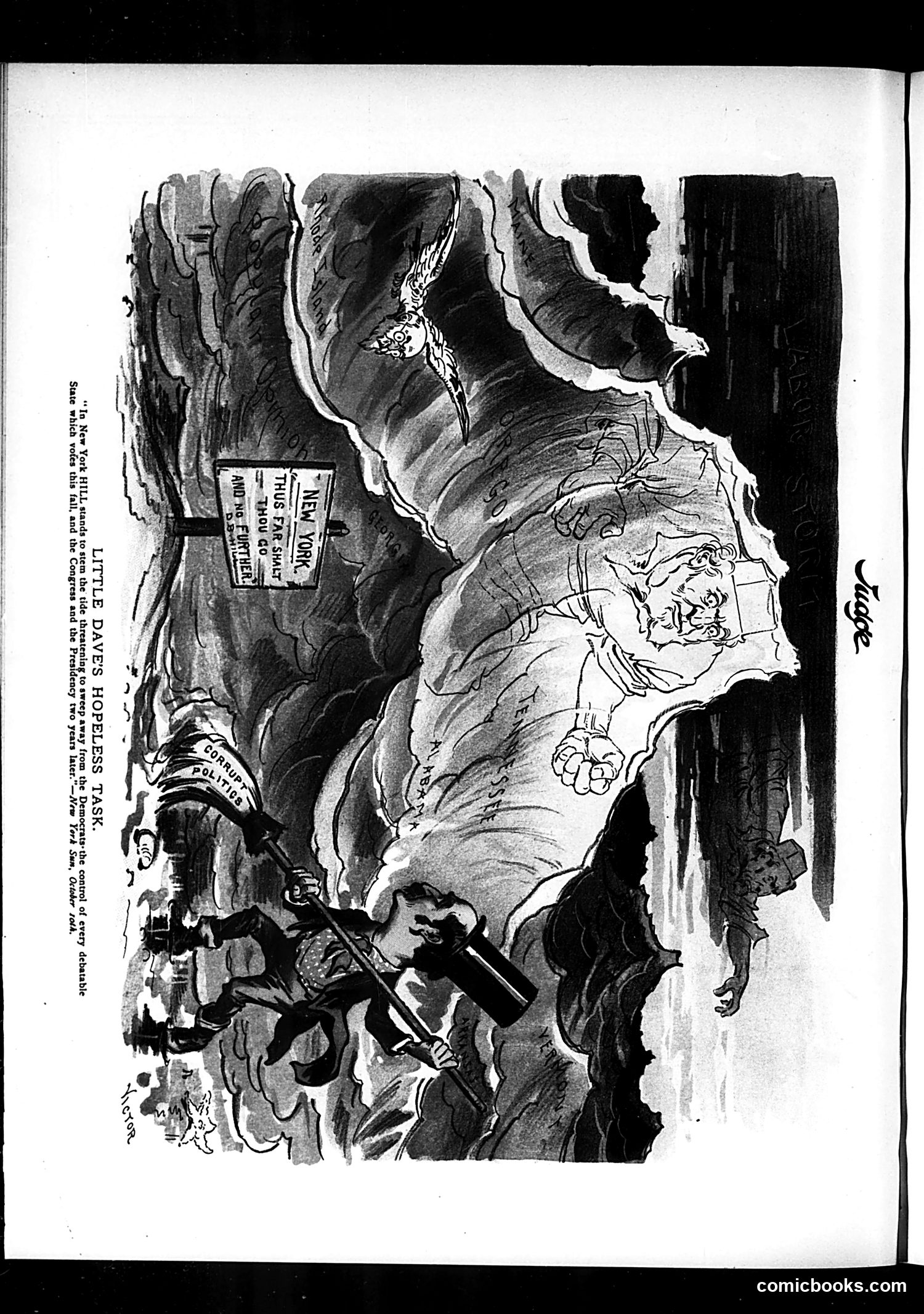
This cartoon satirizes David B. Hill (likely "Little Dave"), a prominent New York Democratic politician, attempting an impossible task. The image shows Hill as a tiny figure trying to hold back a massive tidal wave labeled with Democratic losses and electoral defeats threatening to sweep away Democratic control of key swing states, Congress, and the presidency in upcoming elections. The satire mocks Hill's powerlessness against larger political forces—specifically a Republican surge. The "hopeless task" reference underscores the futility of his efforts to stem what appears to be an inevitable Democratic electoral collapse. The cartoon uses the wave metaphor to visualize overwhelming political momentum that no single figure can resist. This reflects October 1890 political anxiety about Democratic prospects.