
A complete issue · 16 pages · 1894
Judge — August 11, 1894
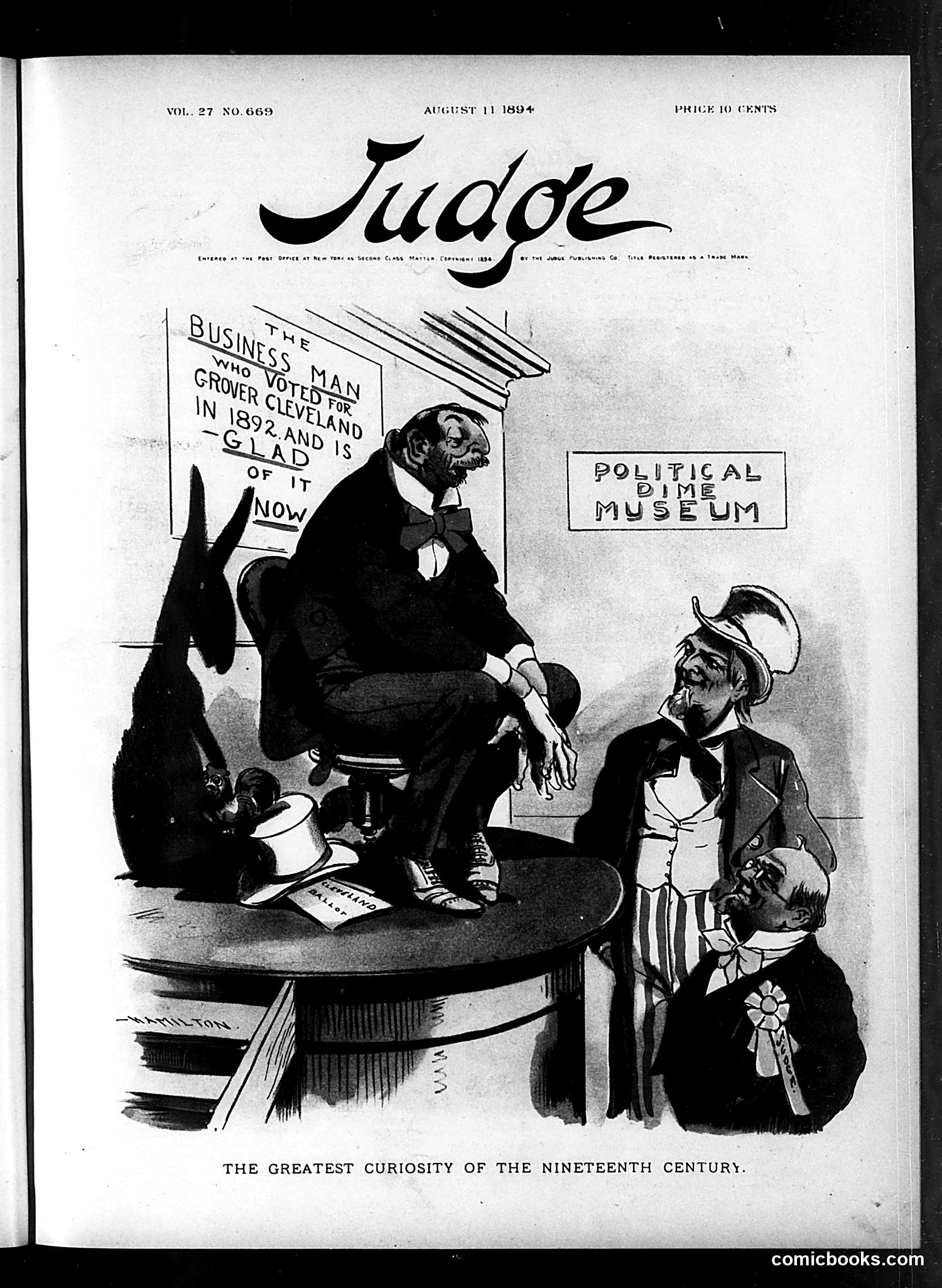
This 1894 *Judge* cartoon satirizes a businessman who voted for Grover Cleveland in 1892 and now regrets it, displayed as a museum curiosity—"The Greatest Curiosity of the Nineteenth Century." The figure on the pedestal, labeled as this repentant businessman, is presented like a freak show attraction in a "Political Dime Museum." The cartoon mocks Cleveland's first term (1885-1889) and his return to office in 1893, suggesting his policies disappointed business interests. The attendants examining this "curiosity" represent the public and political observers finding it remarkable that any businessman would support Cleveland twice. The satire targets both Cleveland's unpopularity with commercial interests and the absurdity of such political reversals.
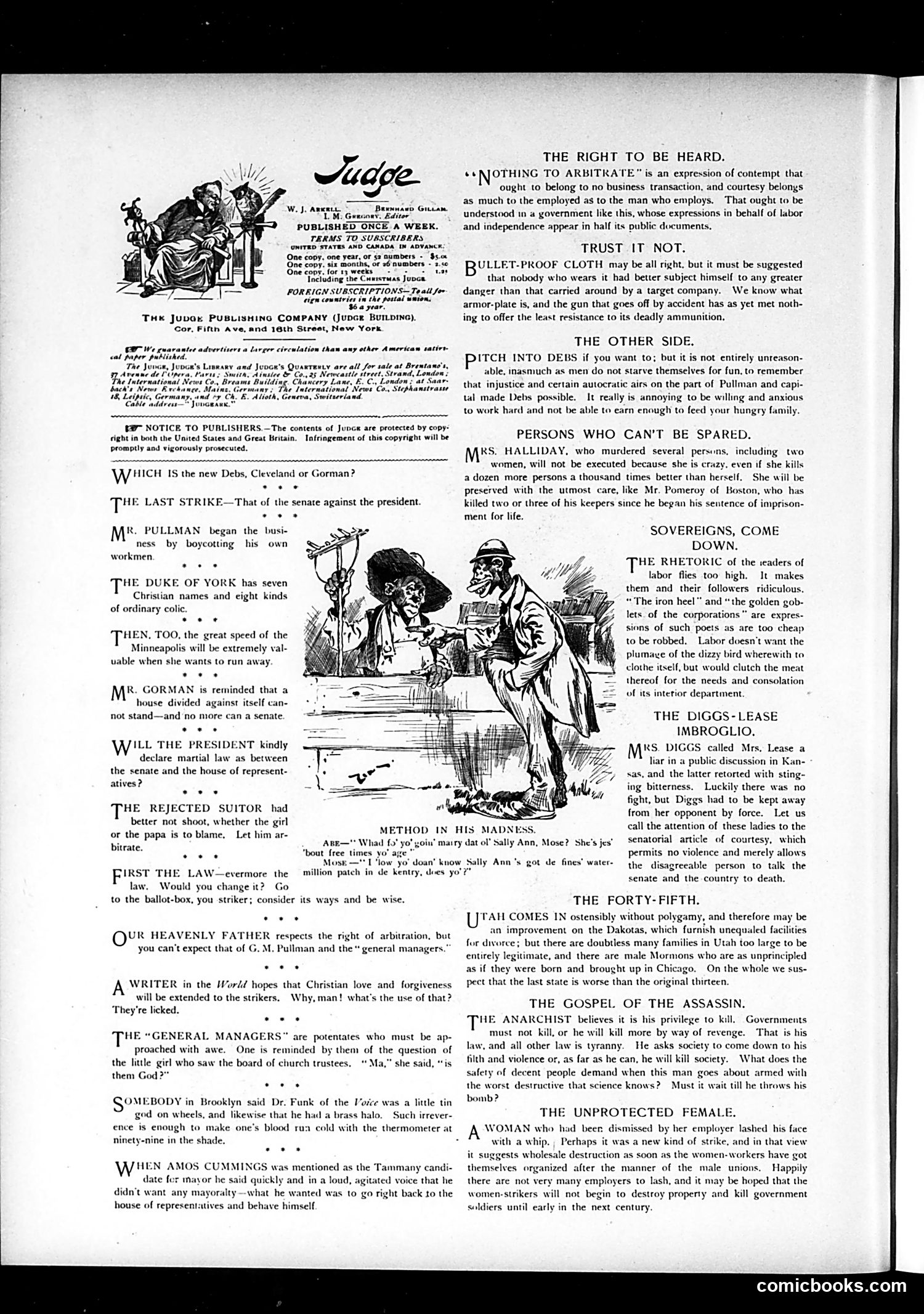
This page contains satirical commentary on early 20th-century labor and social issues. The central cartoon, titled "METHOD IN HIS MADNESS," depicts two figures in conversation—likely representing labor agitators and workers discussing strikes or labor organizing tactics. The surrounding text columns mock various political figures and movements: references to Senate strikes against a president, mentions of "general managers," and commentary on anarchist rhetoric about violence and property destruction. The satire targets both radical labor activists (depicted as dangerous agitators) and their rhetoric about violence, while also mocking government and business responses. The tone is conservative, dismissive of labor radicalism, and concerned with social disorder. Without clearer identification of specific figures or dates, precise historical references remain uncertain, but the page clearly reflects anxieties about labor unrest and radical politics of that era.
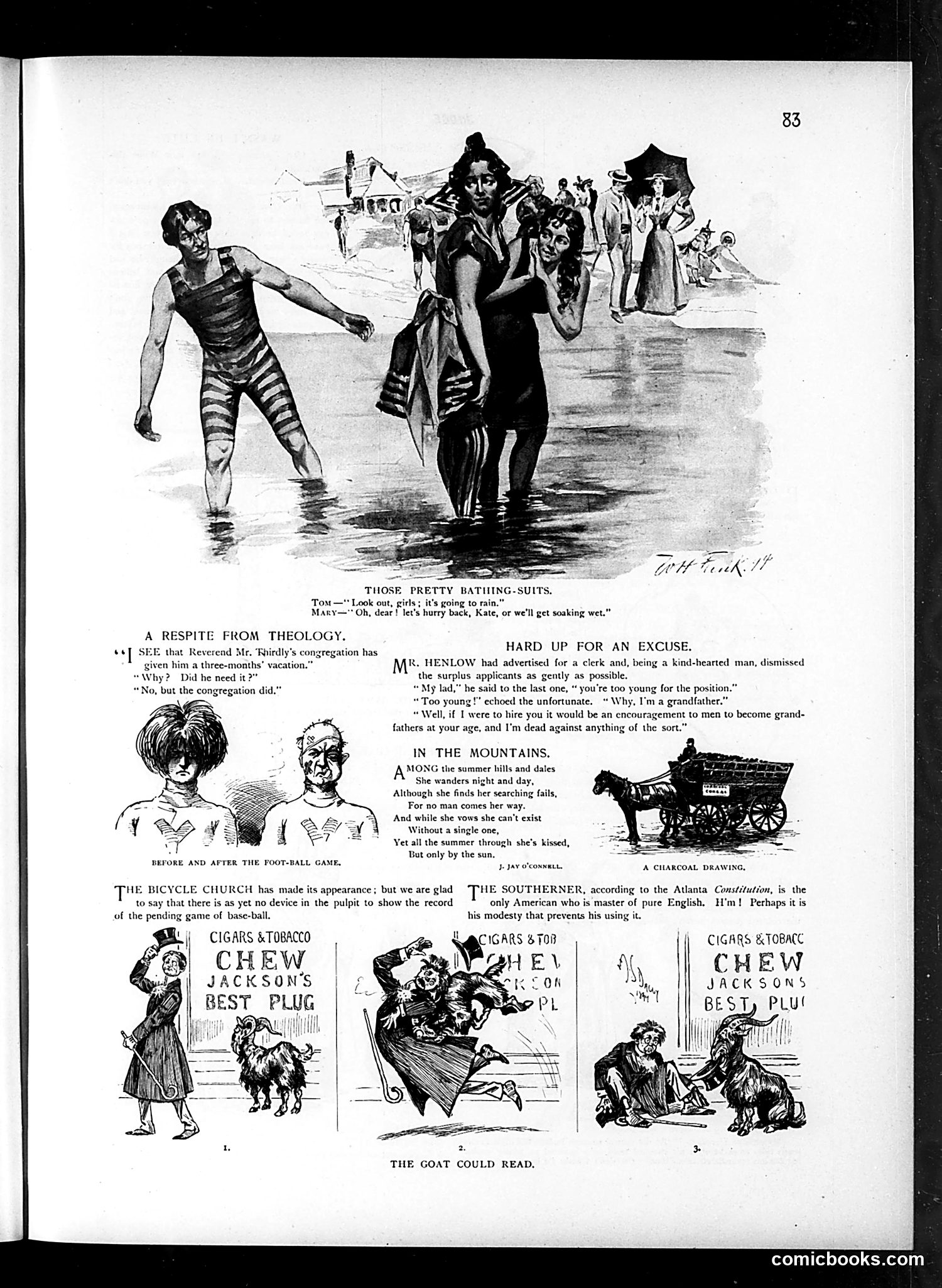
This page contains several unrelated satirical pieces typical of Judge magazine's miscellaneous humor format. **Top cartoon** ("Those Pretty Bathing-Suits"): Mocks women's beach attire, with characters debating whether new swimming costumes will get wet—a joke about the impracticality of fashionable beachwear. **Middle sections** include brief joke items: "A Respite from Theology" (religious humor), "Hard Up for an Excuse" (employment humor), and "In the Mountains" (sentimental verse). **"The Bicycle Church"** and **"The Goat Could Read"** are advertisements for Jackson's Best Plug chewing tobacco, using illustrated vignettes to promote the product. These ads were common revenue sources for magazines. The page lacks overt political content, instead offering general social satire and commercial advertising typical of late-19th or early-20th century Judge issues.
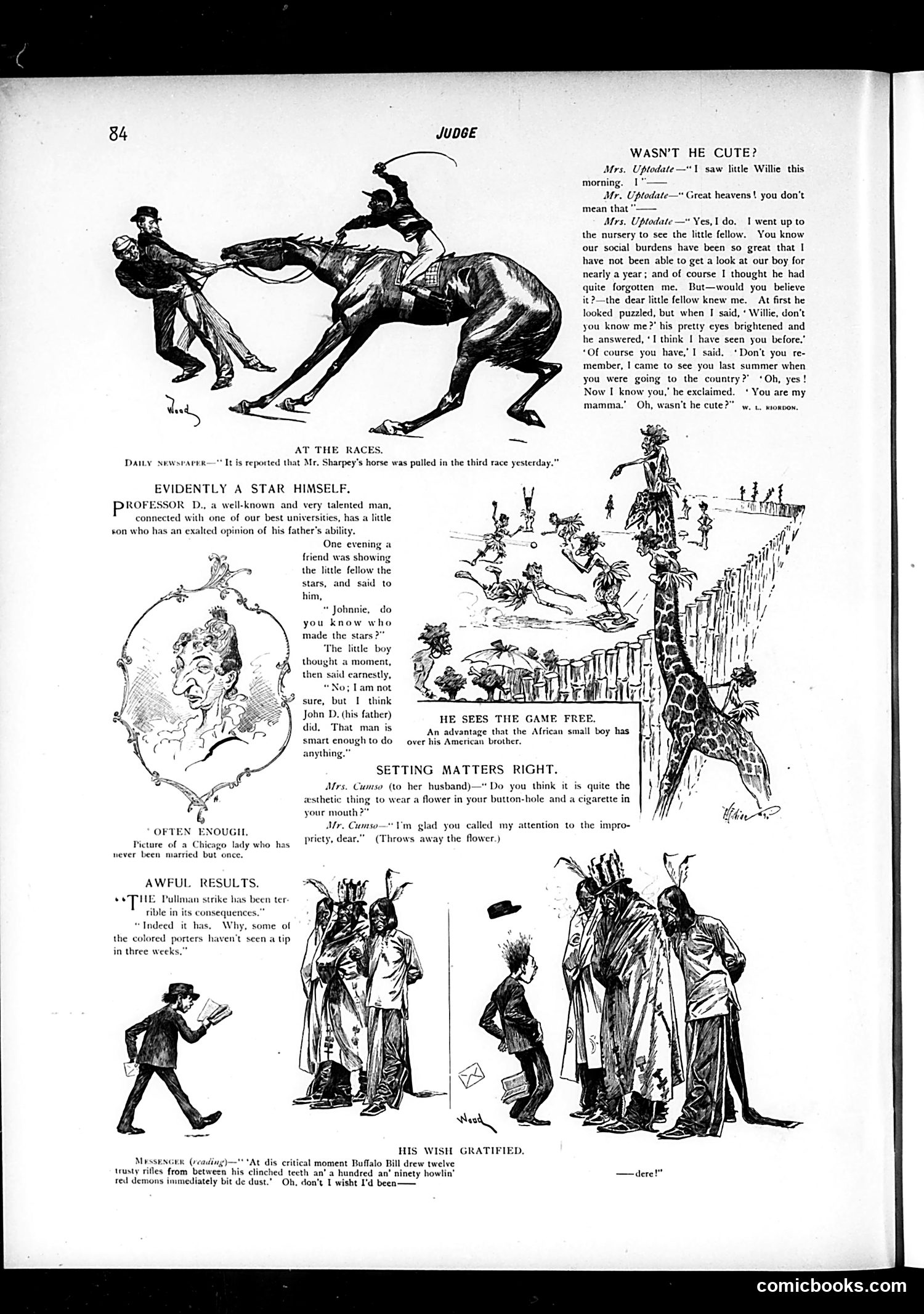
This page contains several disconnected satirical sketches typical of Judge magazine's humor: **"Wasn't He Cute?"** mocks wealthy society mothers so consumed with social obligations they neglect their own children. The joke: a mother hasn't seen her son in a year and he barely recognizes her—yet she finds his confused response adorable rather than alarming. **"At the Races"** appears to reference horse racing fraud or fixed races, with a horse being "pulled" (deliberately slowed) during competition. **"Evidently a Star Himself"** satirizes academic pomposity: a university professor's young son assumes his father is so talented he must have created the stars themselves. **"He Sees the Game Free"** contrasts African and American children—the meaning is unclear without additional context but likely comments on differing circumstances or opportunities. **"Setting Matters Right"** jokes about masculine vanity: a man abandons aesthetic pretense (flowers) when his wife criticizes him. **"Awful Results"** and **"His Wish Gratified"** reference the Pullman strike and Buffalo Bill, commenting on labor disputes and popular entertainment culture respectively.
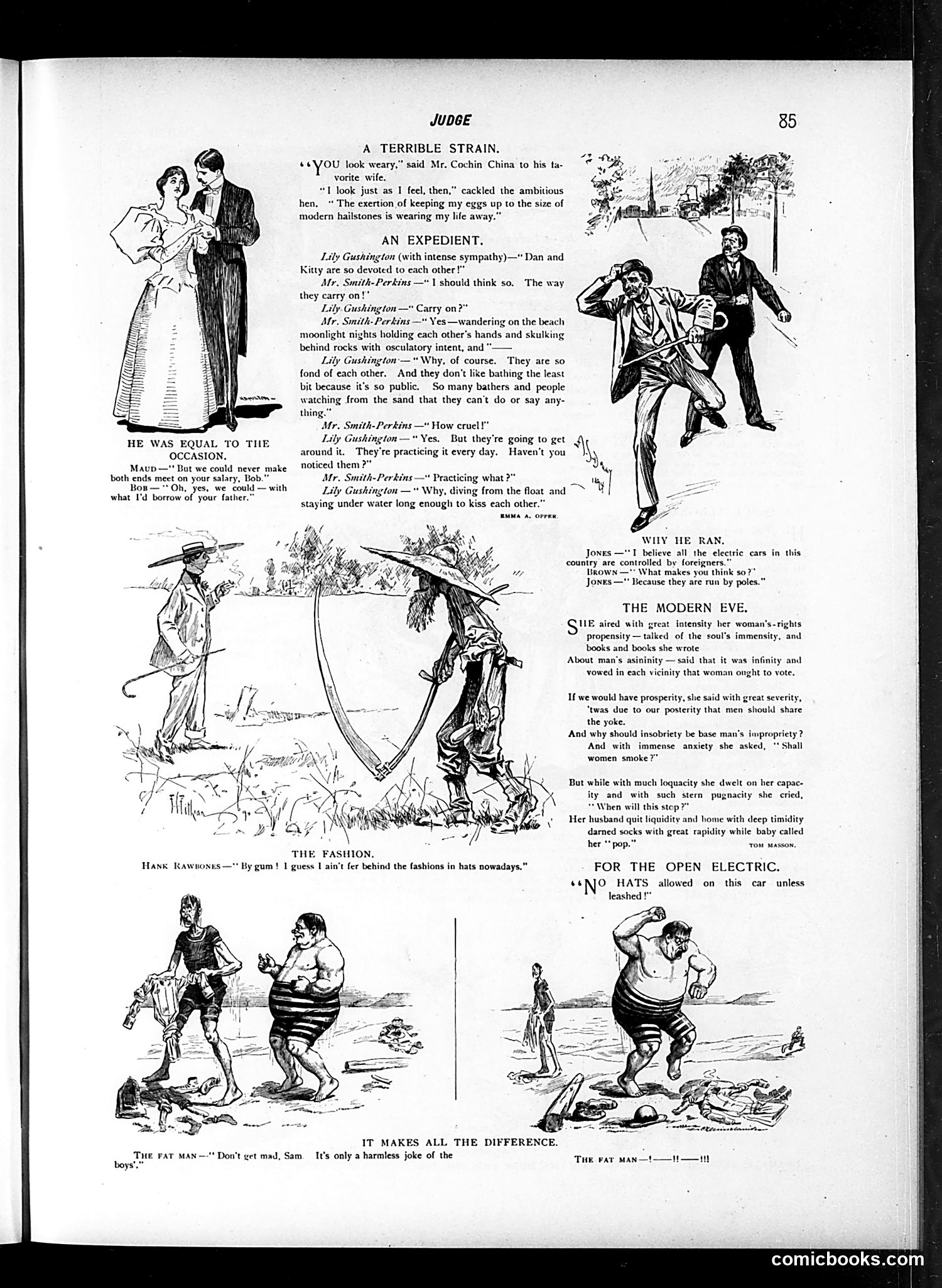
This page collects multiple satirical comic strips and jokes typical of early 20th-century Judge magazine: **"A Terrible Strain"** mocks ambitious modern women through a hen struggling to lay oversized eggs—commentary on women's expanding social roles. **"An Expedient"** satirizes young couples' public displays of affection at beaches, with characters debating whether their constant romantic behavior is admirable devotion or annoying excess. **"The Modern Eve"** directly attacks women's suffrage and emerging feminism. The poem ridicules a woman loudly advocating for voting rights, equal treatment, and even smoking—while her husband timidly stays home darning socks and caring for their baby. The satire suggests women's liberation causes domestic role-reversal and emasculation. **"Why He Ran"** contains a pun about electric cars being controlled by "poles" (electrical poles). **"It Makes All the Difference"** contrasts a fat man's embarrassing beach appearance with clothed dignity. These pieces reflect pre-suffrage anxieties about changing gender roles and women's rights activism.
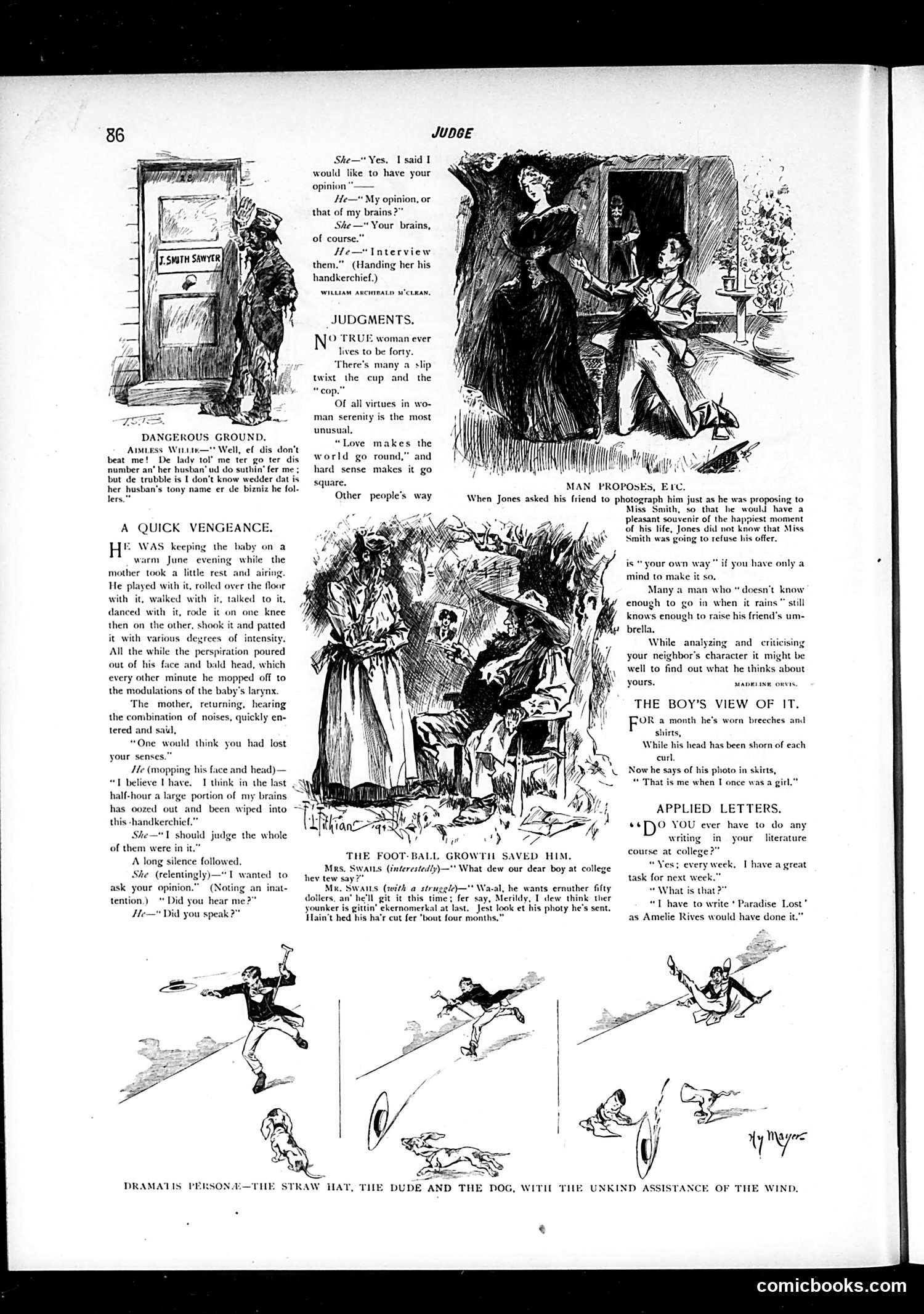
This page from *Judge* contains multiple satirical pieces typical of the publication's humor: **"Dangerous Ground"** mocks a domestic worker's confusion about whether a man's name or profession is being referenced—playing on period class anxieties about servants and employment. **"A Quick Vengeance"** depicts a husband exhausted from childcare who, when his wife criticizes him as brainless, retorts by handing her his sweat-soaked handkerchief, implying she can retrieve what he's "lost." The satire targets both marital tensions and the era's assumption that childcare is "women's work." **"The Foot-Ball Growth Saved Him"** shows rural characters discussing a college boy who demands money; the implication is that his athletic prowess justifies financial support. **"Man Proposes, Etc."** includes a caption joke: a man wants a photograph of his proposal, unaware his girlfriend will reject him. The lower cartoons humorously depict children and social pretension. Overall, the page reflects turn-of-century American anxieties about class, gender roles, and courtship conventions.
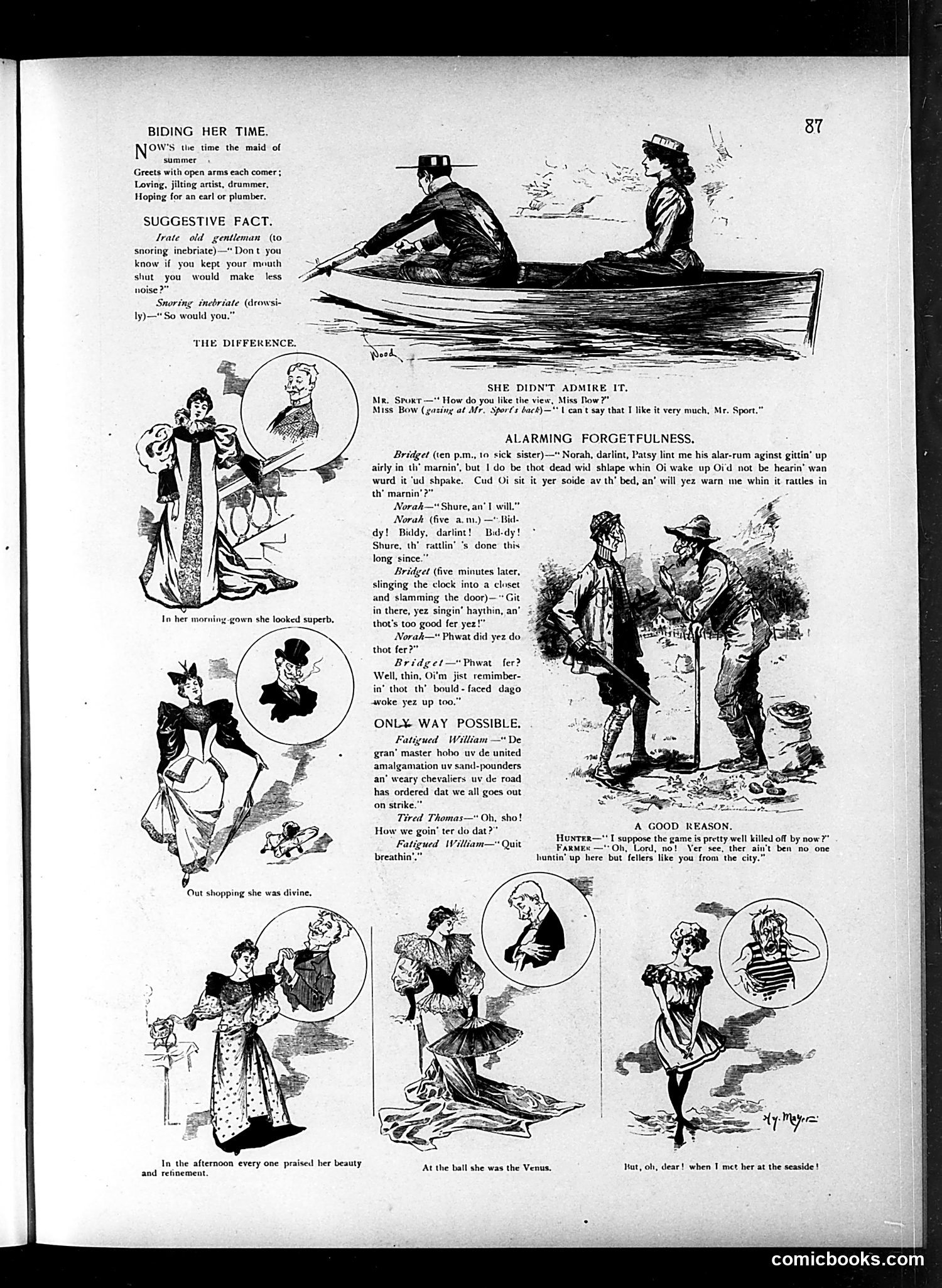
This page contains multiple satirical sketches typical of early 20th-century American humor: **"Biding Her Time"** mocks a working-class maid's romantic opportunism, presented as willing to marry any man—from artistic types to laborers to nobility. **"The Difference"** jokes about a woman (Miss Bow) finding her male companion (Mr. Sport) visually unappealing, likely referencing his physique or appearance. **"Alarming Forgetfulness"** features Irish immigrant domestic servants (Bridget and Norah) in heavy dialect, depicting them as scatter-brained—Bridget forgets to set an alarm clock and angrily tosses it away when it works too well. **"Only Way Possible"** satirizes hobos discussing a strike, suggesting they're too disorganized to actually accomplish it. **"A Good Reason"** contrasts a woman's refined appearance at social events with her shabby appearance at the seaside, mocking pretense. The page uses period stereotypes—Irish maids, street vagrants—for comic effect typical of Judge's satirical approach.
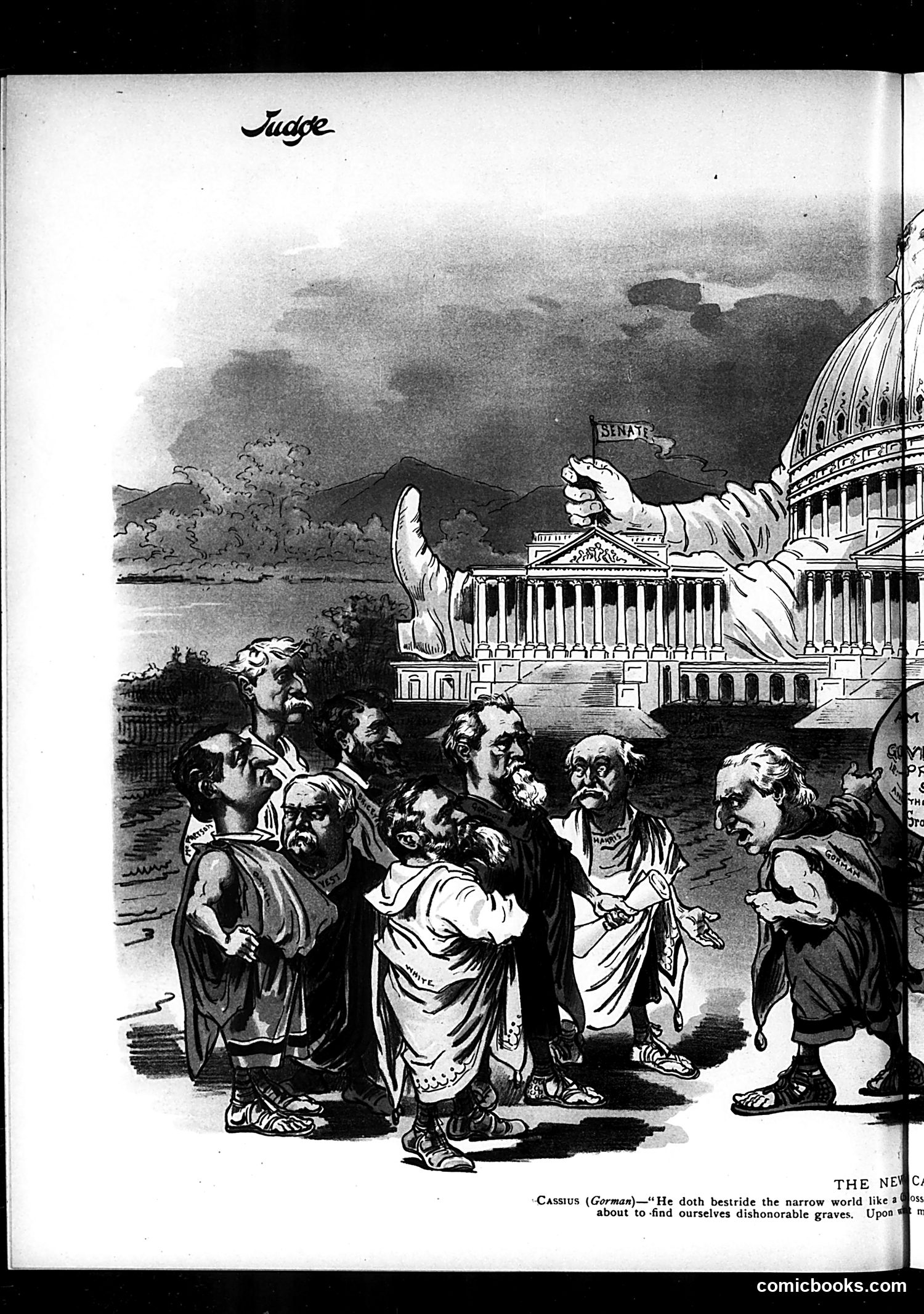
This Judge cartoon depicts a giant hand emerging from the Capitol building, looming over a group of cowering senators or politicians below. The caption references "Cassius (Gorman)" and quotes Shakespeare's *Julius Caesar* ("He doth bestride the narrow world like a Colossus"). The satire appears to criticize an individual—likely a powerful senator or political figure named Gorman—for wielding excessive influence over Congress. The senators below are portrayed as intimidated and powerless ("about to find ourselves dishonorable graves"), suggesting they're being coerced or dominated politically. The Shakespeare allusion emphasizes the figure's outsized power relative to democratic institutions. Without the publication date visible, the specific context remains unclear, but the cartoon critiques authoritarian political behavior and the Senate's apparent capitulation to one powerful individual's will.
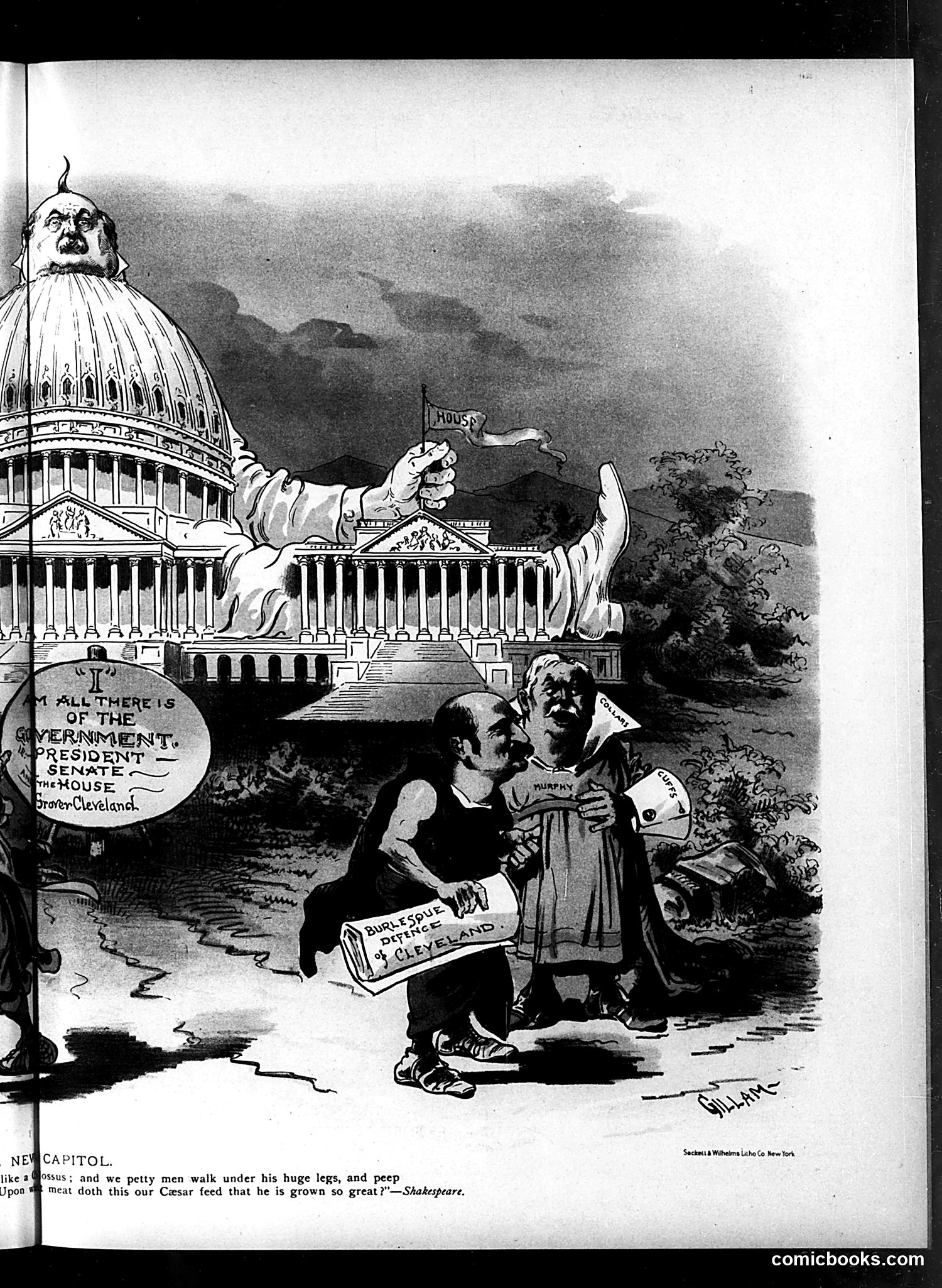
This political cartoon satirizes an oversized government figure dominating the Capitol building. The giant represents bloated federal authority, while tiny figures below—labeled as the President, Senate, and House—appear insignificant beneath its massive form. The cartoon references President Cleveland's administration and criticizes how the government has grown so enormous that elected officials seem powerless within it. The Shakespeare quote reinforces this critique: ordinary citizens ("petty men") are dwarfed by an incomprehensibly large governing structure, questioning how the government became so vast and powerful. This appears to be commentary on Gilded Age concerns about government expansion and the diminished influence of individual branches of government relative to federal bureaucratic growth.
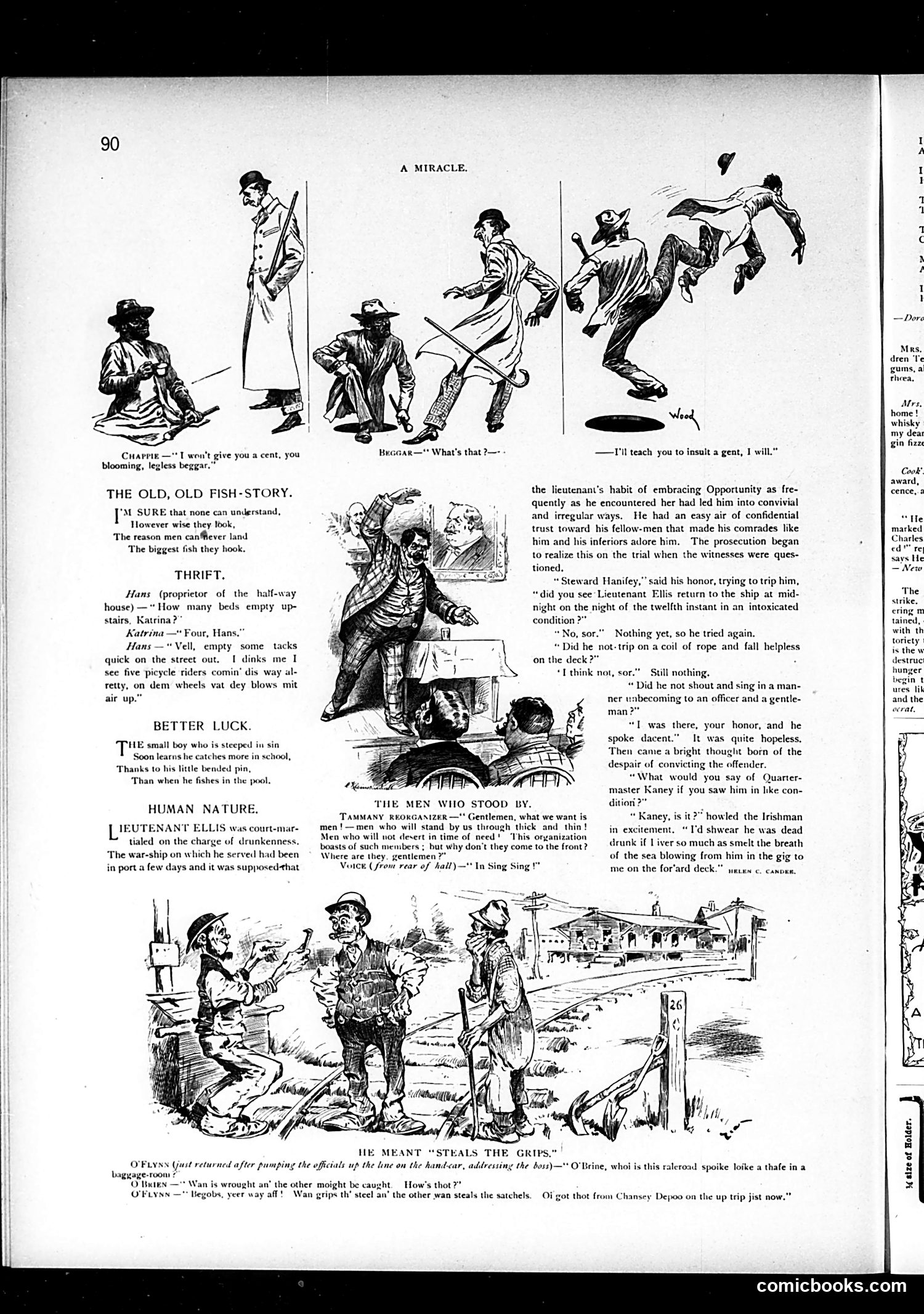
This page contains multiple satirical sketches mocking working-class Irish immigrants and small-time criminals. The top cartoon "A Miracle" depicts an Irish laborer being literally kicked and beaten by a gentleman, with the caption promising to "teach you to insult a gent." It satirizes class hierarchy and immigrant deference. Below, "The Men Who Stood By" shows a Tammany Hall political organizer (New York's notorious Democratic machine) seeking loyal members. A heckler shouts they're "In Sing Sing!"—the state prison—mocking Tammany's recruitment of criminals and corrupt officials. The story "The Old, Old Fish-Story" and other sketches use ethnic humor (exaggerated Irish dialect, Jewish characters) typical of 1890s-1900s Judge magazine satire. The railroad workers' dialogue in the bottom cartoon similarly trades on stereotypical immigrant speech patterns. Overall, the page reflects the era's casual ethnic stereotyping combined with anti-corruption sentiment toward urban political machines.
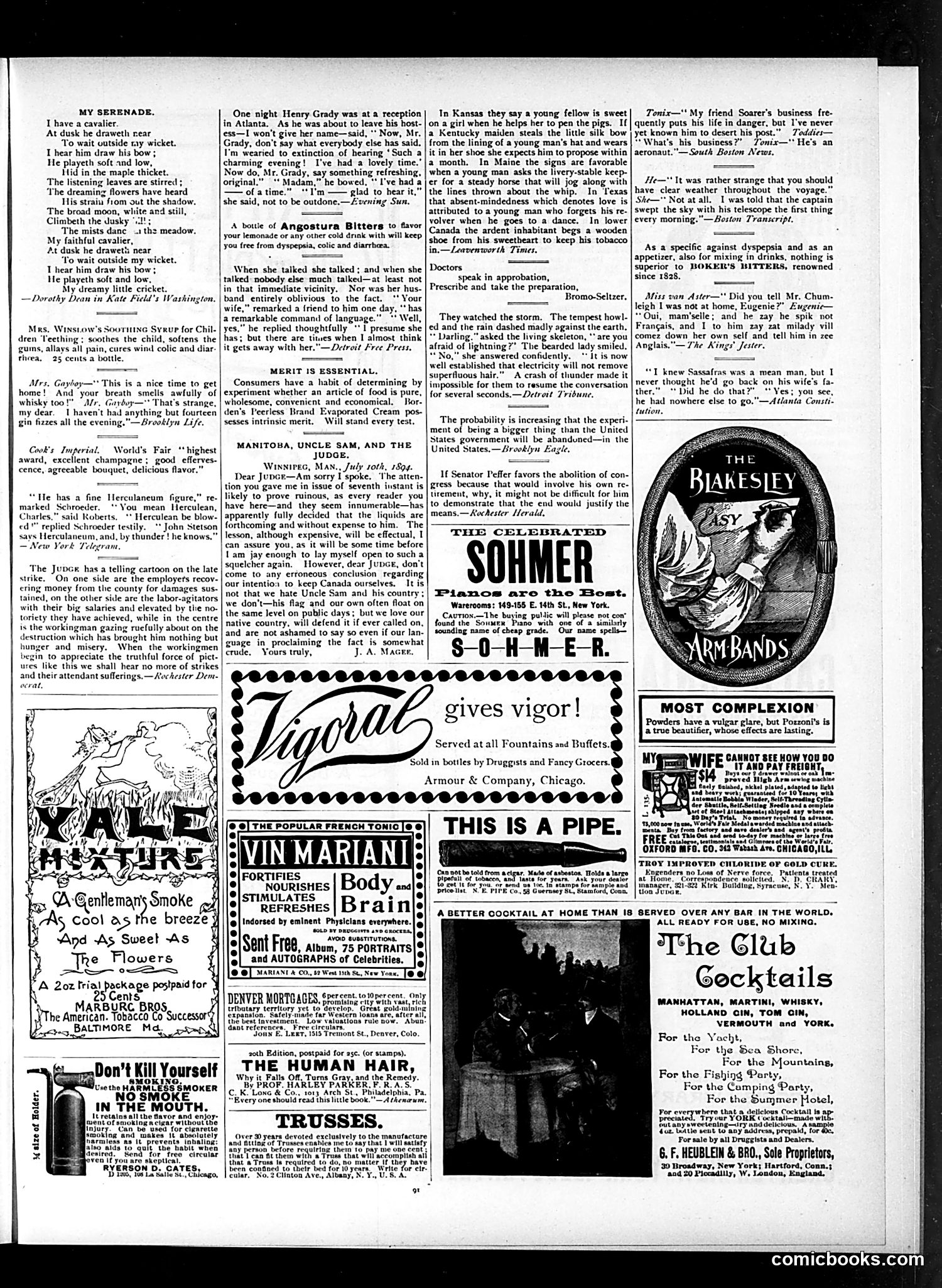
This page is primarily **advertising and light humor**, not political satire. The content includes: **Literary Content:** A romantic poem "My Serenade" about a suitor playing music outside a woman's window, plus several brief humorous anecdotes (a woman mistaking "Herculean" for "Herculaneum," a husband's comment about his talkative wife). **Advertising:** The page is dominated by patent medicines and consumer products typical of the era—Angostura Bitters, Lyoral (a tonic), Vin Mariani (a fortified wine), Mrs. Winslow's Soothing Syrup, and various anti-smoking devices. One ad features "The Celebrated Sohmer Pianos." **Visual Elements:** A small illustration of a couple ("A Gentleman's Smoke") and typical period advertising graphics. **No significant political satire is present.** This appears to be a standard issue page mixing light entertainment with commercial advertising—the magazine's primary revenue source. The humor is gentle domestic comedy rather than social commentary.
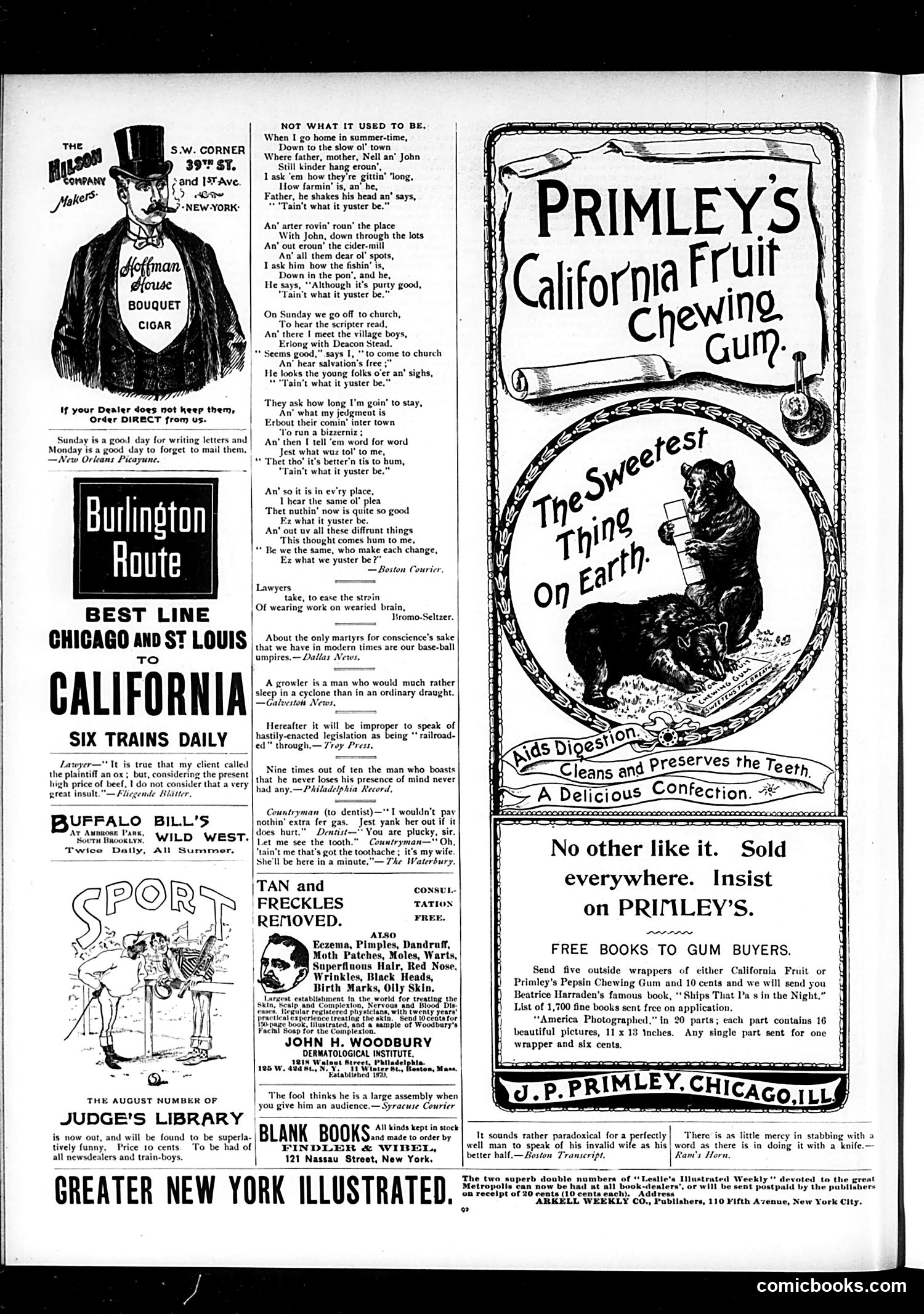
This page is primarily **advertisements and humorous filler content** typical of Judge magazine, with no significant political satire. The main content includes: **"Not What It Used to Be"** — A nostalgic poem about a man visiting his hometown and hearing repeated complaints that things aren't as good as they used to be. The irony: he realizes *people themselves* haven't changed, yet they blame external circumstances. This reflects common turn-of-century anxiety about modernization. **Scattered one-liners** satirize contemporary absurdities: baseball umpires as "martyrs for conscience," railroad legislation being "railroaded" through (pun on process), and men who boast about composure despite never facing real pressure. **Advertisements dominate:** Burlington Route trains, Primley's California Fruit Chewing Gum, Buffalo Bill's Wild West show, and dermatological treatments (tan/freckle removal). The page reflects early 1900s concerns—nostalgia for rural life, railroad expansion, entertainment venues—but contains no identifiable political figures or sustained satirical commentary.
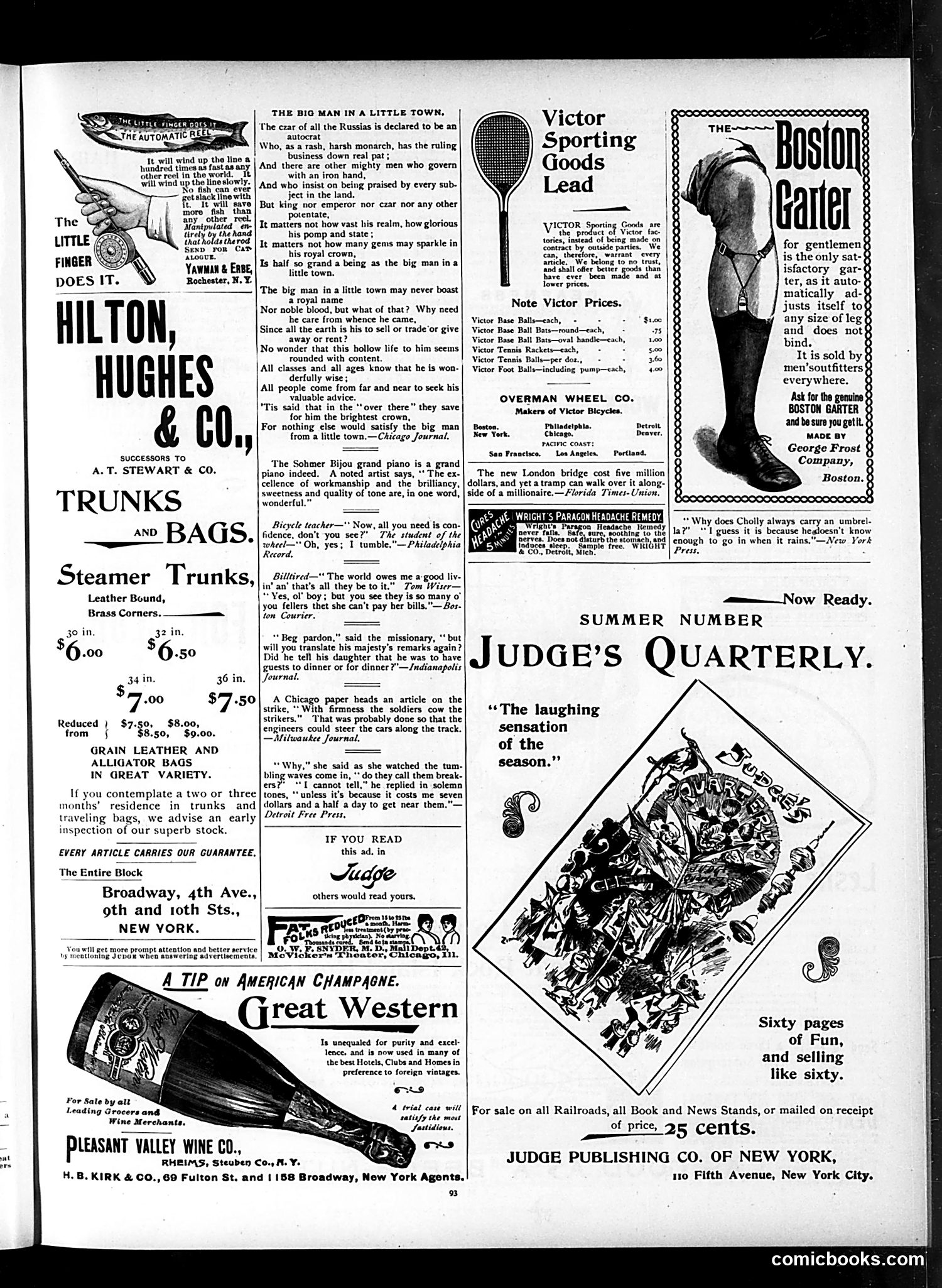
This poem satirizes the inflated self-importance of small-town notables. The piece contrasts emperors and czars (likely referencing Russian autocracy, a common Judge target) with an unnamed "big man in a little town" who, despite lacking royal lineage or actual power, considers himself superior. The satire's point: local small-town figures — businessmen, politicians, or social leaders — believed their provincial influence made them genuinely important, when in reality they were petty and self-deluded. The poem mocks how townspeople fawned over these men for "valuable advice," treating them as wise oracles. The phrase "over there" suggests European grandeur they could never match. By placing this man alongside actual autocrats, Judge ridicules the absurd gap between perceived and actual importance — a common American satirical theme mocking small-town pomposity and social pretension. The surrounding advertisements (trunks, pianos, bicycles) are typical magazine filler, not part of the satire.
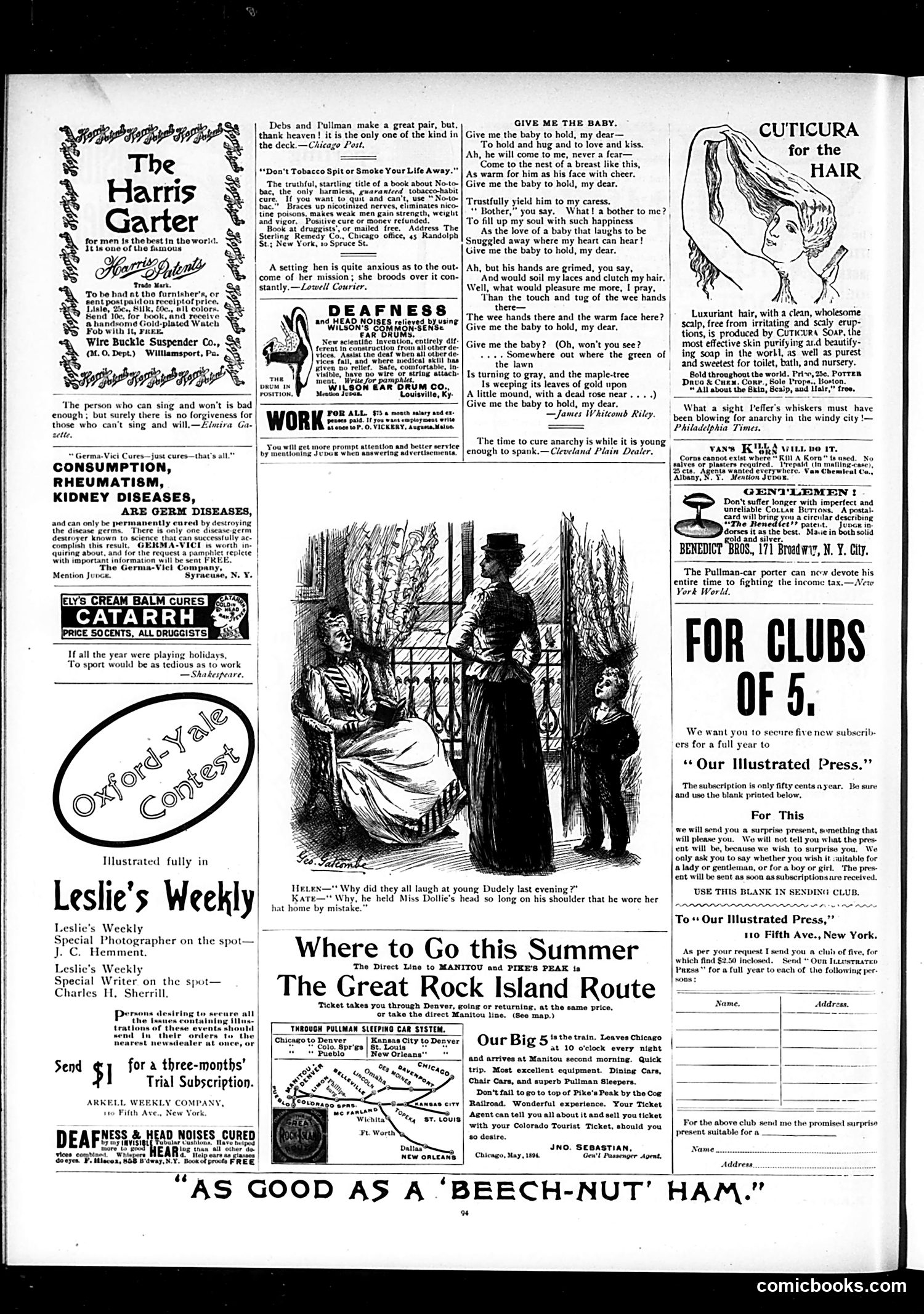
This page is primarily **advertising and light humor**, not political satire. The main content includes: **"Give Me the Baby"** — A sentimental poem about maternal affection, accompanied by an illustration of a woman with children. Standard Victorian domestic sentiment, not satirical. **One Political Reference**: A brief quip mentions "Debs and Pullman make a great pair"—likely referencing Eugene Debs (labor activist) and George Pullman (railroad magnate) as opposing figures in labor disputes, presented as an unlikely pairing. **Bulk Content**: Patent medicine advertisements (cataract cures, tobacco cessation), travel promotions (Rock Island Route railroad), and subscription offers for Leslie's Weekly magazine. **Humor**: Mild wordplay about hens and setting eggs; a joke about a man wearing home a woman's hat after holding her head too long. This appears to be a typical Judge page from the 1890s-1900s mixing sentimental verse, minimal political commentary, and commercial advertising rather than sustained satirical content.
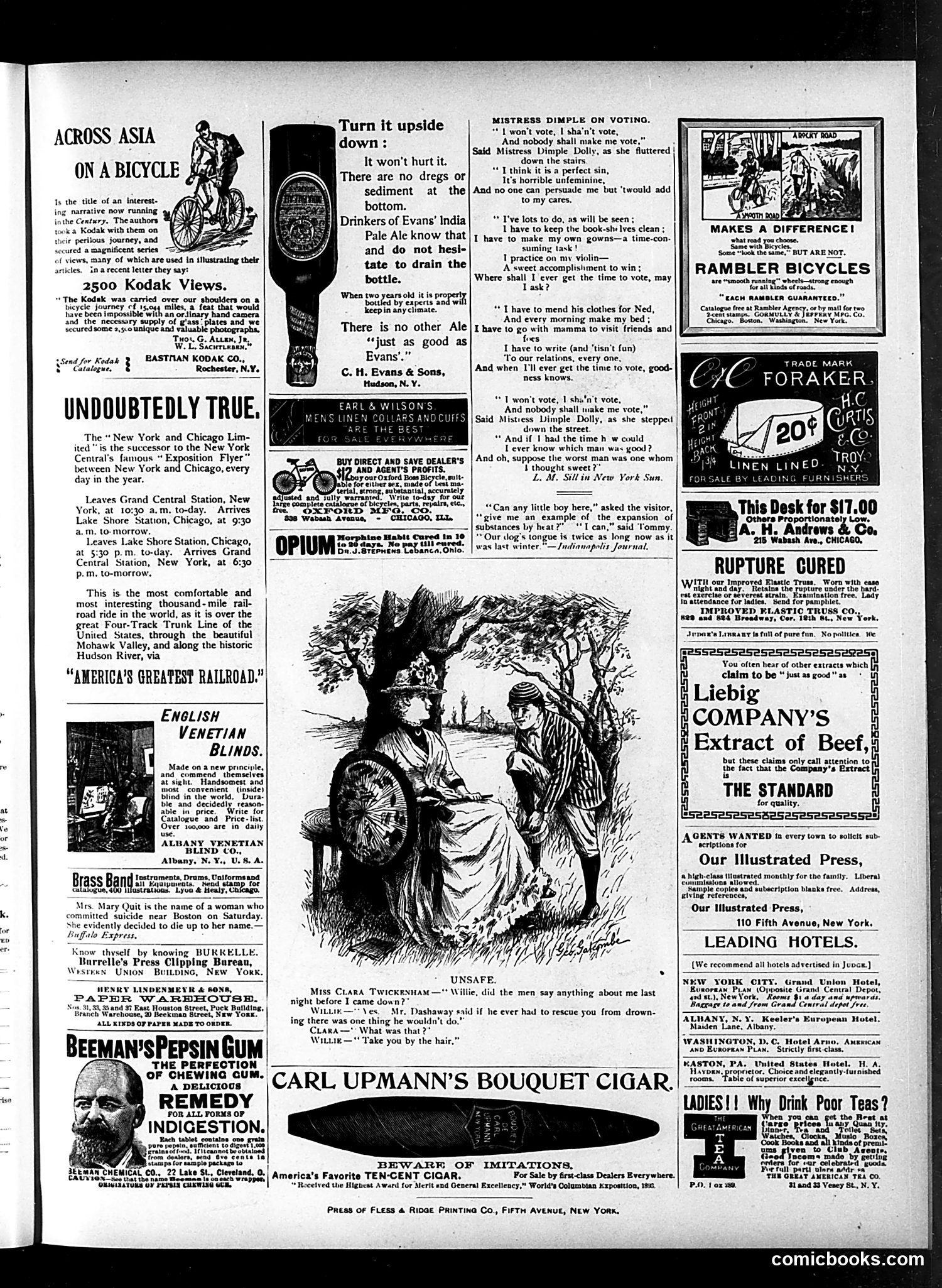
This page is primarily **advertising** with some satirical content. The main cartoon depicts two figures—a woman and man—in a Victorian-era scene labeled "UNSAFE," illustrating a joke about rescue and propriety. The humor relies on the woman's concern about being rescued by a man who might grab her hair—a commentary on Victorian anxieties about physical contact and decorum. The "Mistress Dimple on Voting" section satirizes women's resistance to suffrage. The character lists household duties (cleaning bookshelves, sewing) as reasons why voting would add to her "cares," mocking anti-suffrage arguments that voting was impractical for women managing domestic responsibilities. This reflects early-1900s debates over women's voting rights, where opponents claimed women lacked time or interest in politics. The remainder is commercial advertising for products (Kodak cameras, railroad service, ale, cigars, patent medicines) typical of Judge's revenue model.
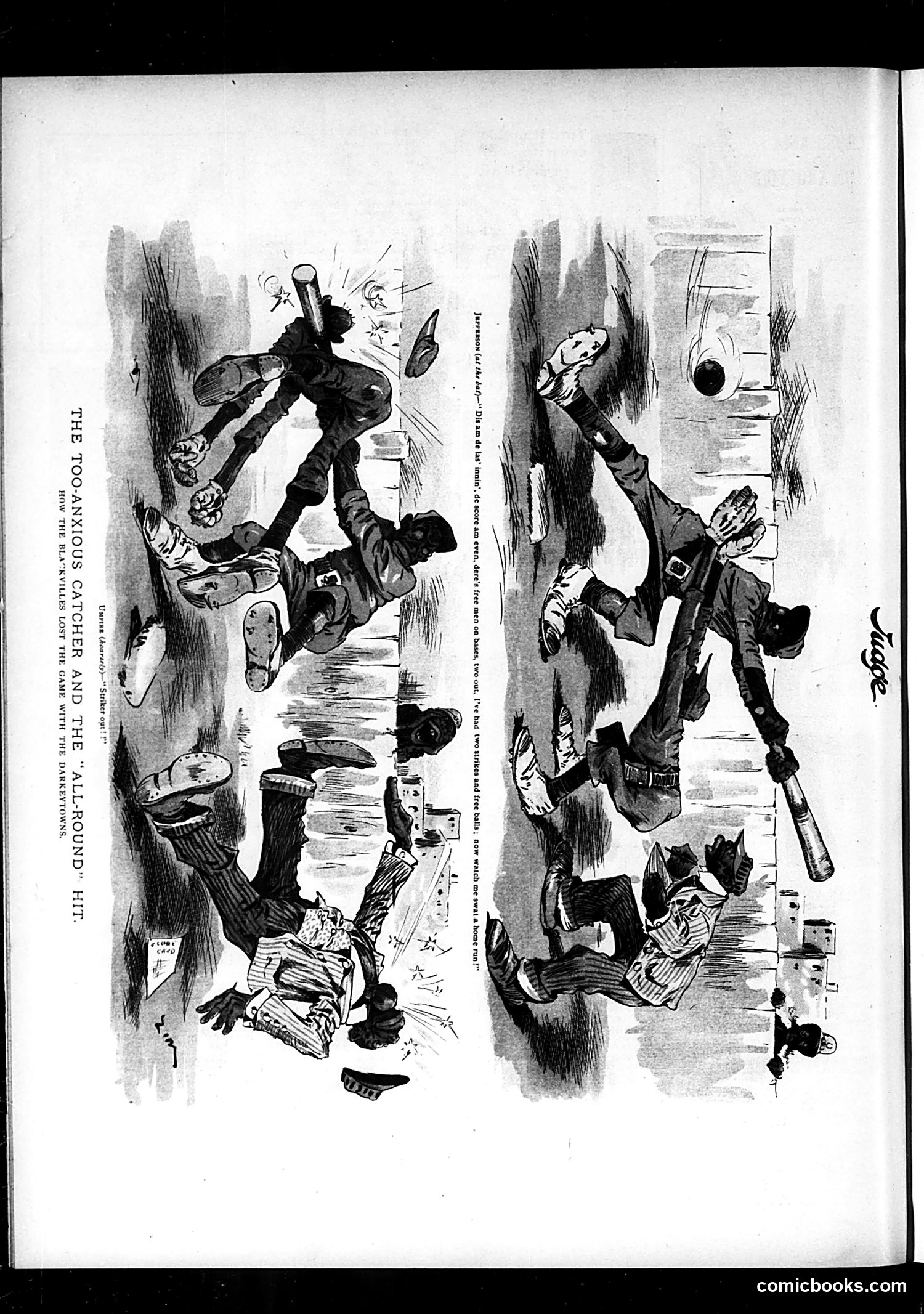
This page from *Judge* magazine contains two vertically-oriented cartoons satirizing incompetent politicians or officials. Both depict figures in formal dress being literally caught off-guard or falling—one appears to be tumbling through a doorway while papers scatter, the other catching a ball or object mid-fall. The title references "THE TOOLANDROUS CATCHER AND THE BALLROOM" (text partially unclear due to OCR errors), suggesting wordplay on incompetence. The cartoons appear to mock political figures failing at their duties—the scattered papers and physical chaos suggesting disorganization, corruption, or bungling of public responsibilities. Without clearer text or date information, I cannot identify specific individuals targeted, but the visual metaphor of falling/catching suggests fumbling leadership typical of Gilded Age political satire.