
A complete issue · 16 pages · 1894
Judge — July 28, 1894
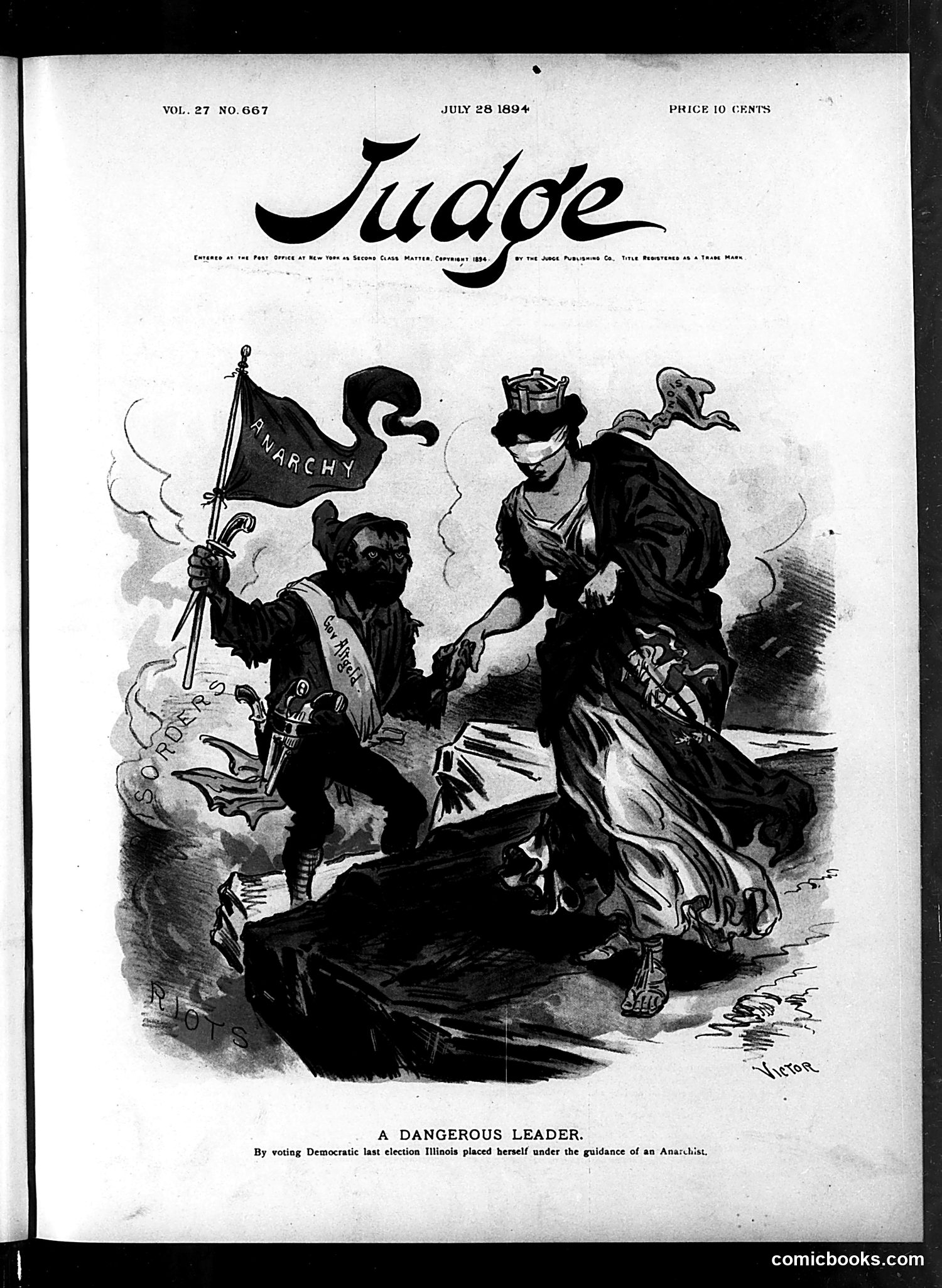
This political cartoon satirizes Illinois's Democratic voting choices. The caption states: "By voting Democratic last election Illinois placed herself under the guidance of an Anarchist." The illustration depicts a woman (representing Illinois) being led by a figure holding an "Anarchy" flag. The cartoon associates the Democratic party with anarchism—a radical political ideology. This reflects the intense anti-anarchist sentiment following the 1893 Haymarket affair's aftermath and the broader labor unrest of the 1890s. The imagery suggests Democrats are dangerous radicals unfit to govern. Judge magazine, a Republican publication, used such caricatures to discredit Democratic candidates by linking them to anarchism and violent radicalism, a common fear-mongering tactic in Gilded Age politics.
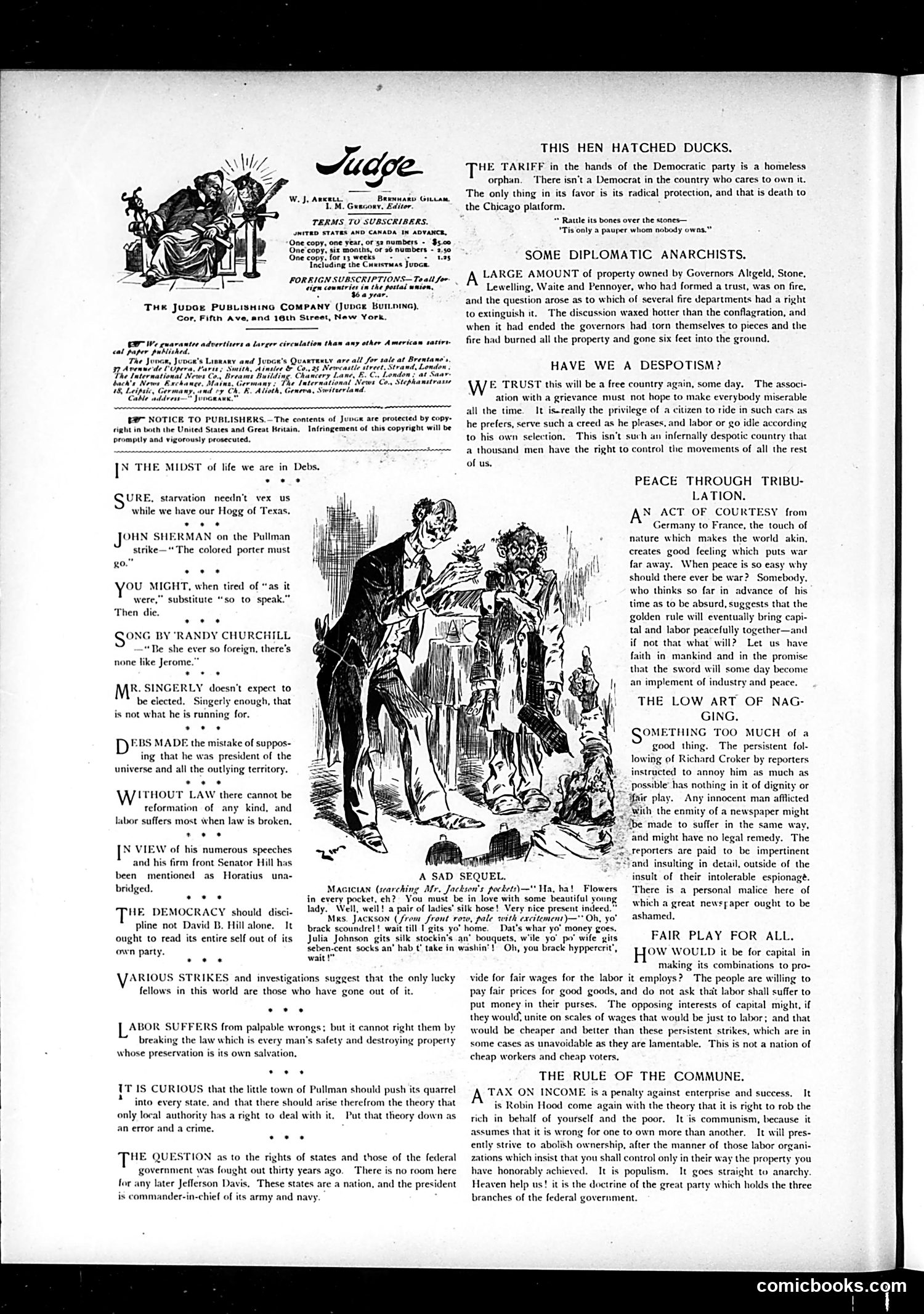
The main cartoon, titled "A Sad Sequel," depicts a magician (labeled as "conjuring Mr. Jackson's pockets") addressing a woman named Flowers. The text beneath suggests a romantic scenario—the magician boasts of producing various luxuries from his pockets to impress her, promising wealth and romance. This appears to satirize Andrew Jackson's financial policies or personal wealth claims. The "magician" metaphor suggests Jackson is performing political sleight-of-hand—making false promises of prosperity to the electorate, particularly women voters (represented by Flowers). The cartoon critiques what Judge saw as Jackson's empty rhetoric masking economic mismanagement or deception. The surrounding editorial text addresses labor issues, federal vs. state power, and economic policies of the era, contextualizing the cartoon's political critique.
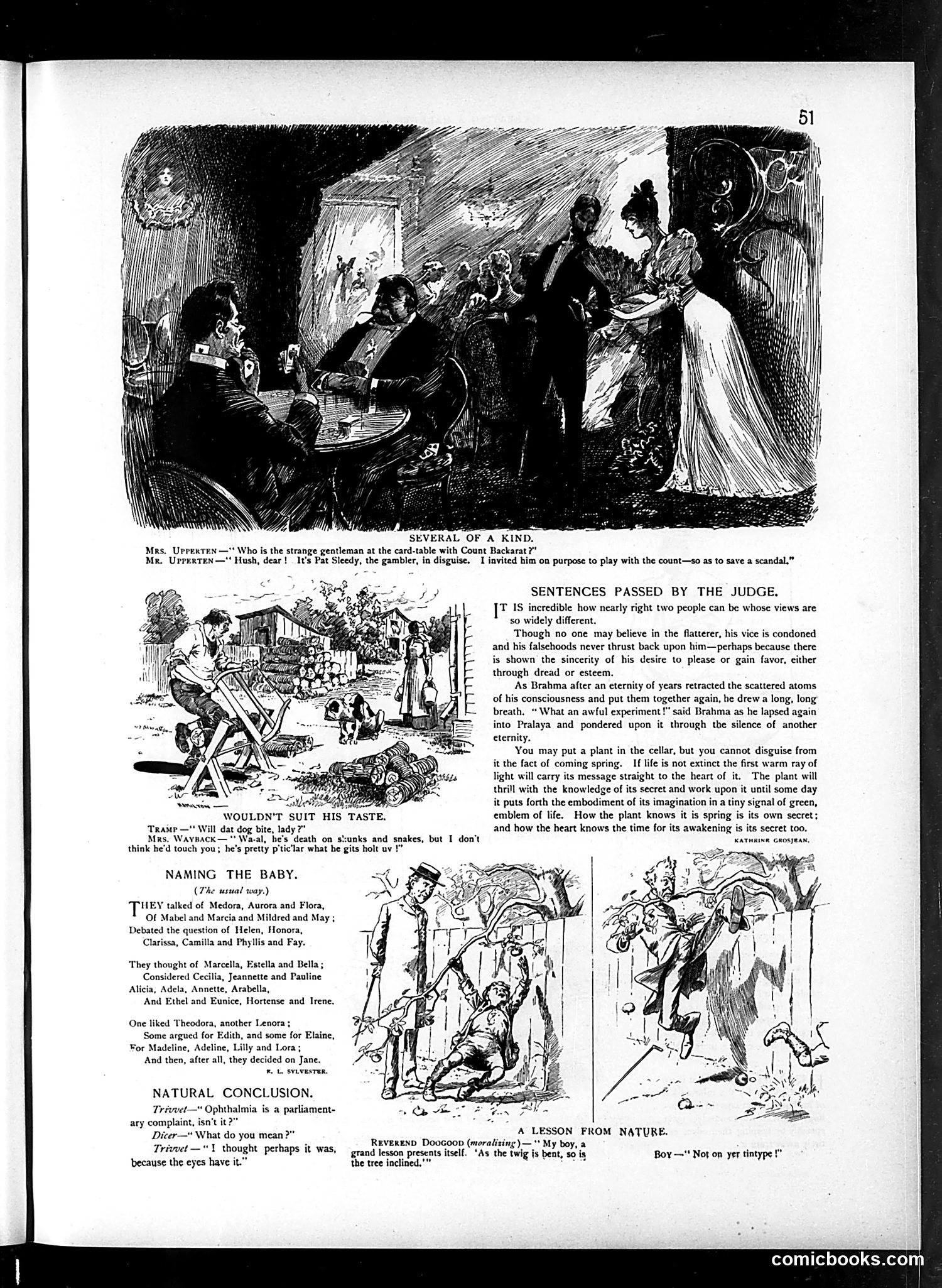
This page contains several humorous sketches and text pieces unrelated to politics: **"Several of a Kind"** (top): A drawing-room scene where Mrs. Upperton explains inviting a gambler ("Fat Steedy") in disguise to a card game with Count Backarat to prevent scandal—social satire about Victorian propriety and deception among the upper classes. **"Sentences Passed by the Judge"**: A philosophical piece about human nature and moral flattery, illustrated with a countryside scene. **"Wouldn't Suit His Taste"**: A brief dialogue joke about tramps and snakes. **"Naming the Baby"** and **"Natural Conclusion"**: Humorous verses about baby-naming debates and an ophthalmologist joke. **"A Lesson from Nature"**: A simple joke about tree inclination. The page is primarily **social/domestic humor** rather than political satire, typical of Judge's lighter content.
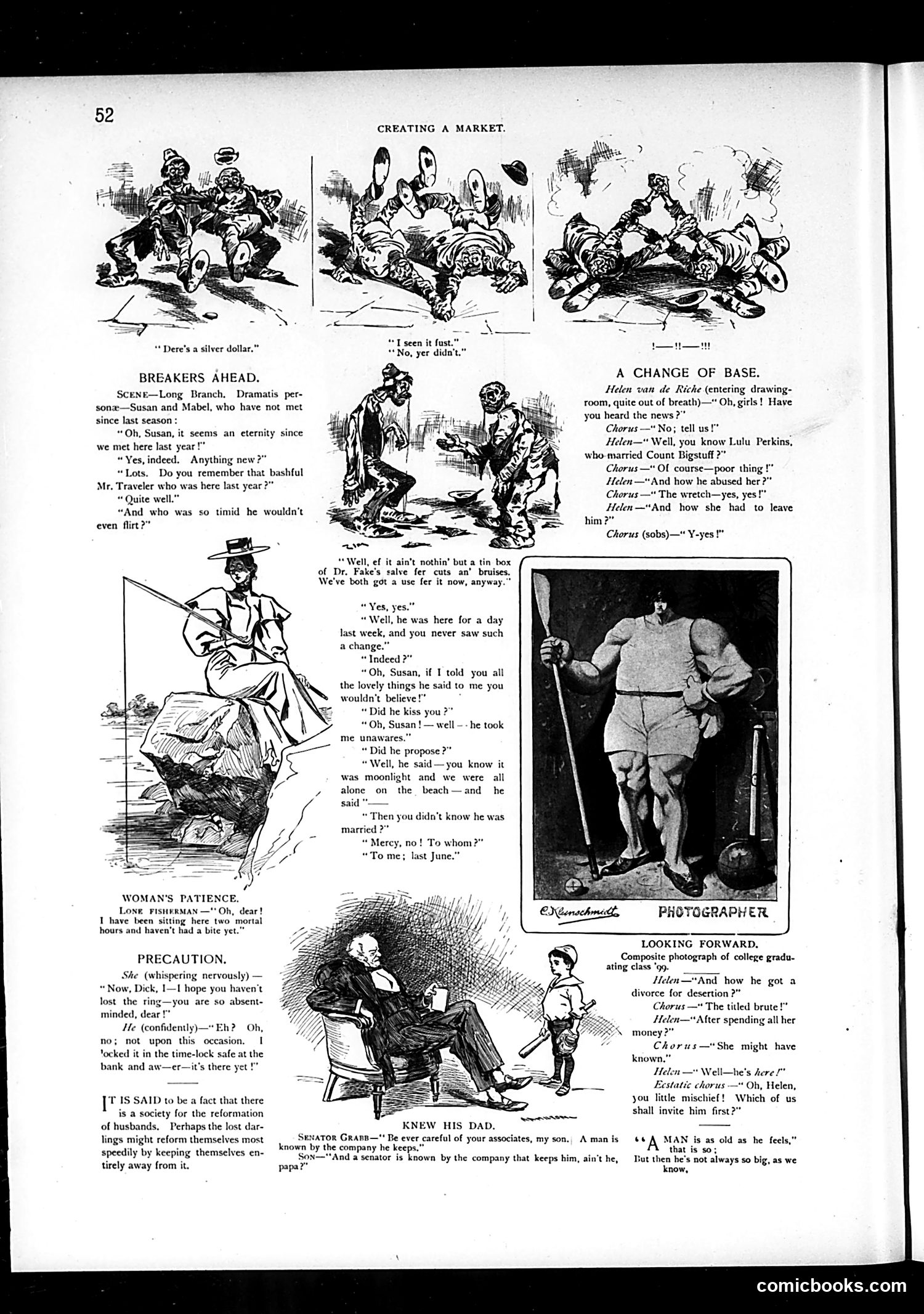
This page contains multiple satirical sketches typical of late 19th-century American humor. The main themes include: **"Breakers Ahead"** mocks romantic deception: two socialites at Long Branch (a fashionable resort) discuss a previously timid gentleman caller who suddenly became bold, proposed via moonlight, then revealed he was already married—a scandal. **"A Change of Base"** satirizes infidelity and class-climbing: Lulu Perkins married a "Count Bigstuff" who mistreated and abandoned her. Upon his sudden reappearance, the gossiping women excitedly compete to invite him—suggesting they value his title despite his documented cruelty, critiquing both female materialism and aristocratic pretension. **Other sketches** ("Woman's Patience," "Precaution," "Knew His Dad") offer brief comic observations about marriage, absent-mindedness, and paternal influence. **"Looking Forward"** is a composite photograph labeled as a college graduating class, with accompanying dialogue about divorce and romantic pursuit—likely mocking youthful naïveté about marriage. The humor targets period social anxieties: fortune-hunting, titled foreigners, infidelity, and women's vulnerability.
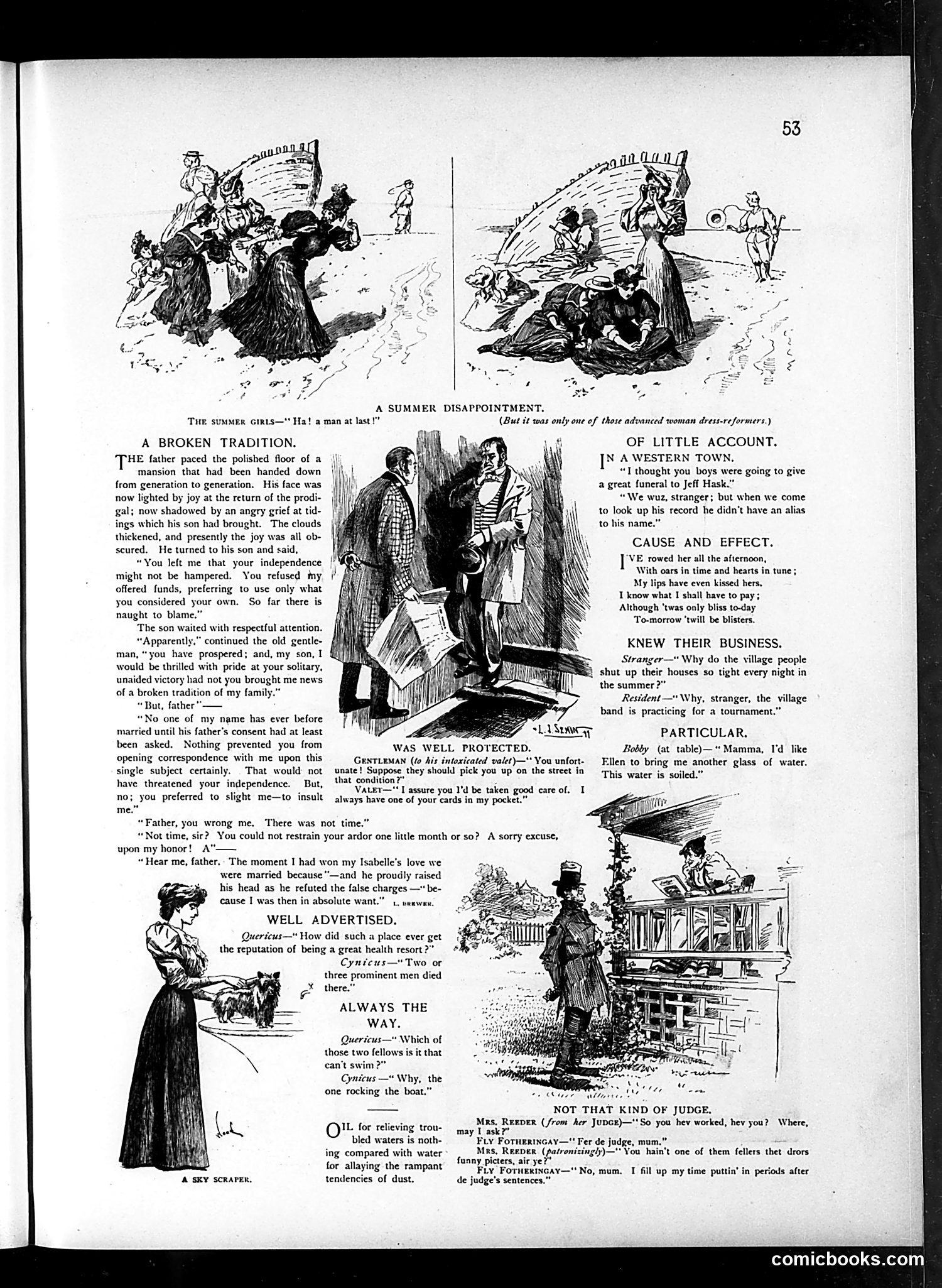
This page contains multiple satirical vignettes typical of late-19th-century American humor: **"A Broken Tradition"** mocks upper-class pretension. A wealthy father is furious that his son married without paternal consent—a supposed family tradition—only to be deflated when the son reveals he married *because* he was poor and in love, making the union actually noble rather than rebellious. **"A Summer Disappointment"** depicts women at a beach spotting a man, only to be let down—likely a visual gag about romantic expectations versus reality. **"Was Well Protected"** jokes darkly about class: a drunk servant is unworried about arrest because he carries his employer's business card, suggesting the card provides protection through association. Other brief sketches mock: small-town funeral customs (needing an "alias" to be notable), romantic consequences, village bands, and a judge who apparently doesn't draw "funny pictures" but merely punctuates sentences. The overall tone reflects Gilded Age social satire targeting wealth, class pretension, romance, and small-town American life.
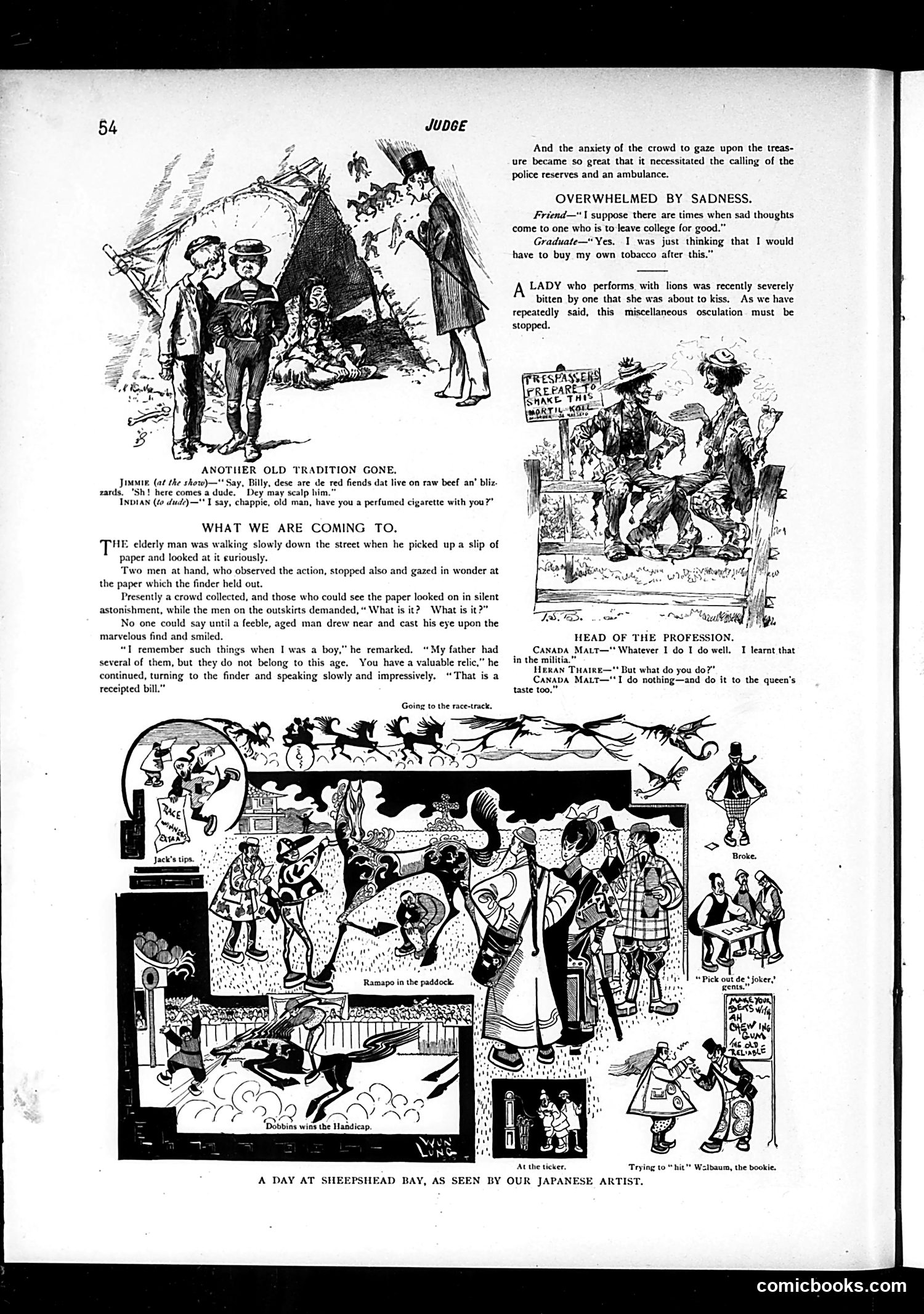
This page contains several short satirical pieces lampooning American social trends circa early 1900s: **"Another Old Tradition Gone"** mocks the erosion of authentic frontier culture—a Native American encounters "dudes" (wealthy, affected urbanites) seeking perfumed cigarettes rather than rough outdoor life. **"What We Are Coming To"** satirizes modern commerce's decline: finding a "receipted bill" (a paid invoice) becomes so rare that crowds gather and police are needed—suggesting credit and unpaid accounts have become the norm. **"Overwhelmed by Sadness"** jokes about graduates' dependency: the graduate's sadness about leaving college isn't existential but purely practical—he'll have to buy his own tobacco. Minor items mock a lion-tamer's dangerous kissing habit and feature wordplay about Canadian malt (likely beer). **"A Day at Sheepshead Bay"** shows a full comic strip of racetrack chaos, drawn in exaggerated Japanese woodblock style, satirizing the gambling culture and disorder at the famous Brooklyn horse-racing venue.
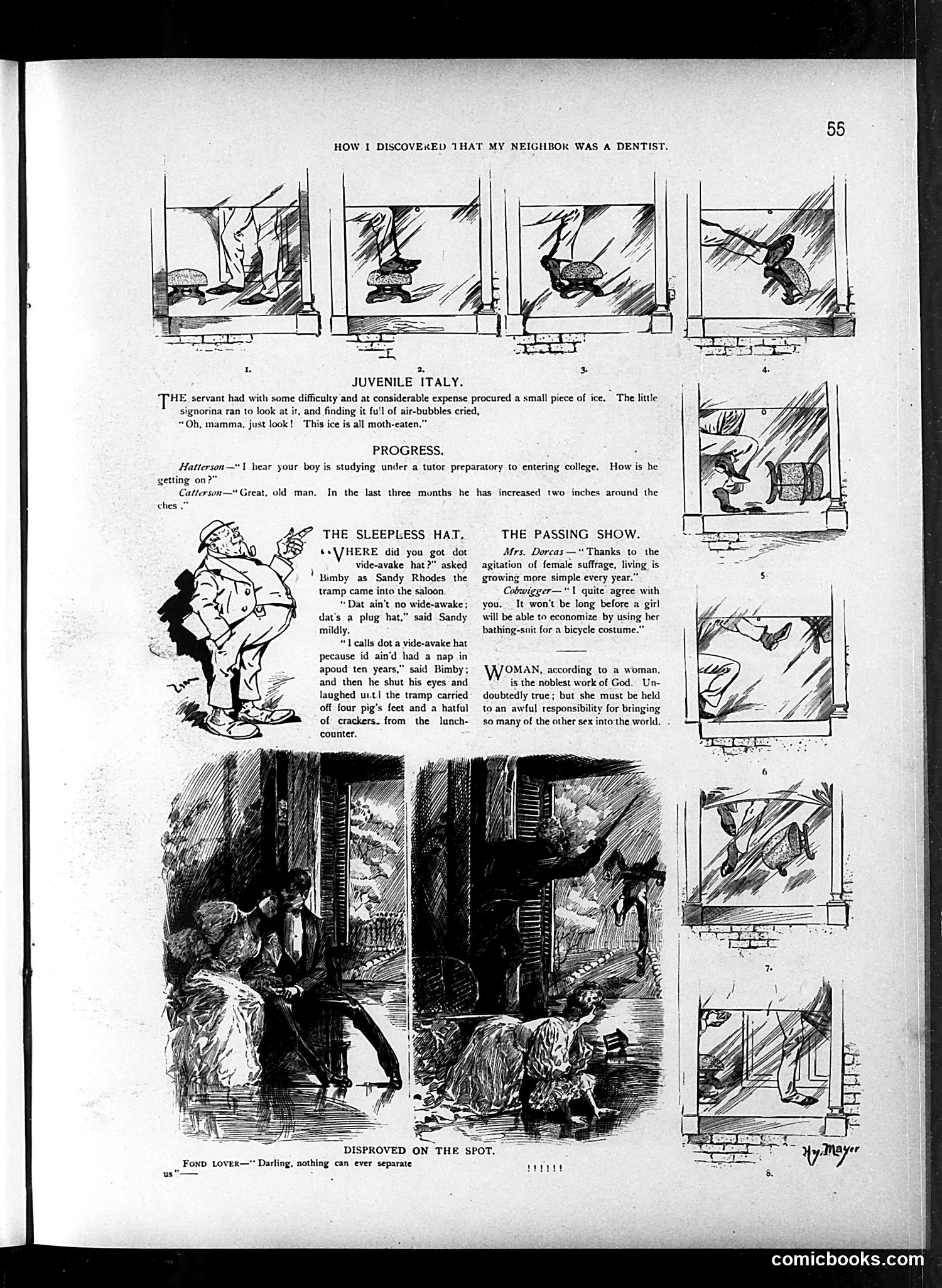
This page from *Judge* contains multiple brief satirical sketches typical of late 19th/early 20th-century American humor magazines. **Top comic strip** ("How I Discovered That My Neighbor Was a Dentist"): A visual gag showing someone discovering their neighbor's profession through increasingly painful encounters—likely depicting dental work or chair-related mishaps. **"Juvenile Italy"**: Satirizes Italian immigrant children, depicting stereotypical speech patterns and cultural misunderstandings (a servant's child mistakes air bubbles in ice for moth damage). **Other sketches** include wordplay about hats, progress (a boy gaining weight rather than knowledge), female suffrage jokes, and romantic humor. "The Passing Show" mocks women's suffrage by suggesting women will economize by wearing bathing suits as bicycle costumes—implying women's liberation will lead to absurd practicality. The overall tone reflects period attitudes toward immigrants, gender roles, and educational aspiration—humor that relied on ethnic caricature and anti-feminist sentiment now considered offensive.
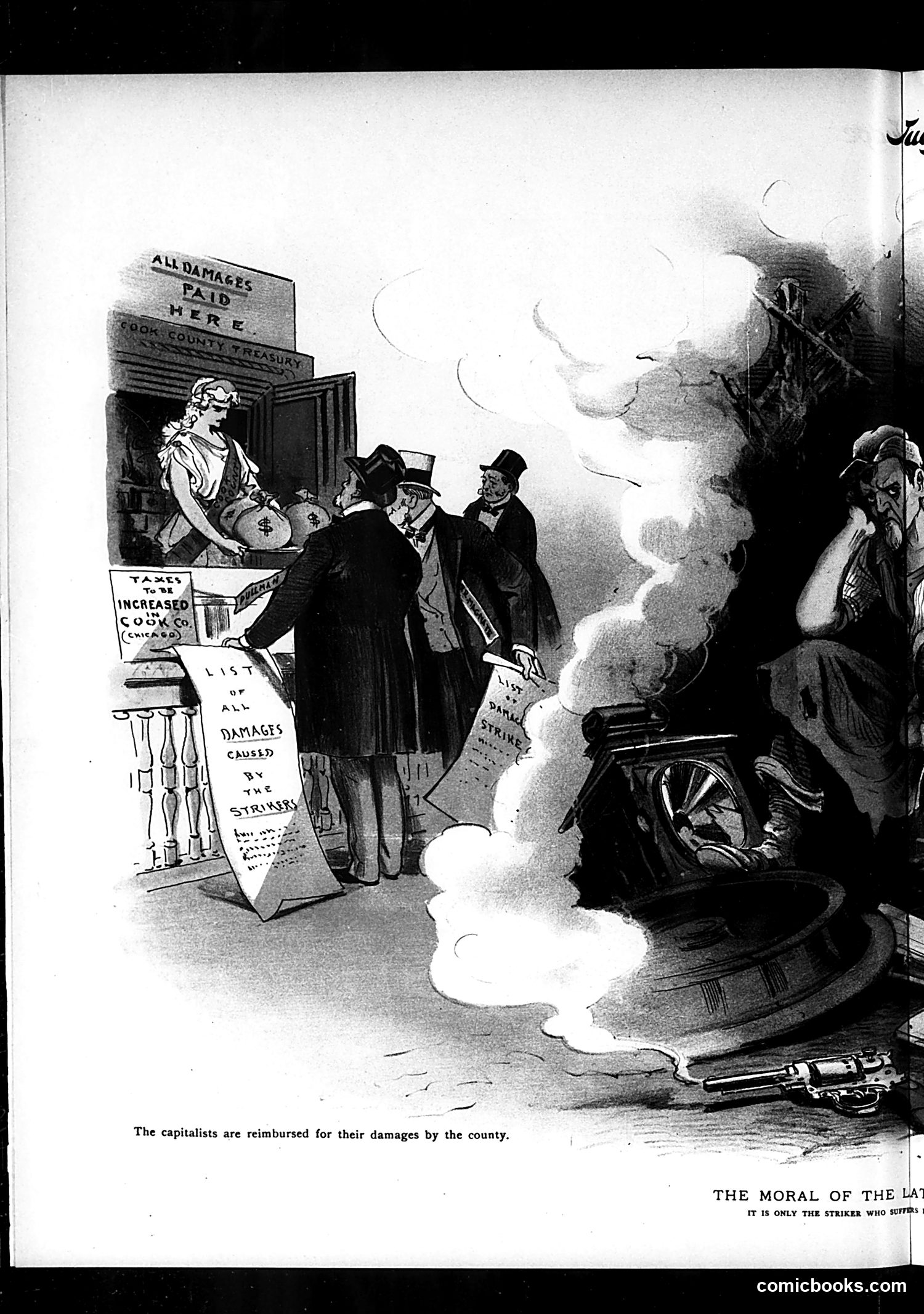
This cartoon satirizes inequality in labor dispute compensation. It depicts county officials paying capitalists (factory owners) for damages allegedly caused by strikers, while the incomplete text at bottom suggests strikers themselves bear the actual burden. The image shows a "Cook County Treasurer" office window where well-dressed capitalists receive reimbursement for strike-related damages. Meanwhile, on the right, impoverished figures (likely workers) suffer amid smoke and wreckage—suggesting they endure the real consequences without compensation. The satire criticizes how legal systems favored business owners over laborers during industrial strikes, allowing capitalists to recover losses through county funds while striking workers received nothing. This reflects early 20th-century labor tensions and Judge magazine's commentary on class inequality in American justice.
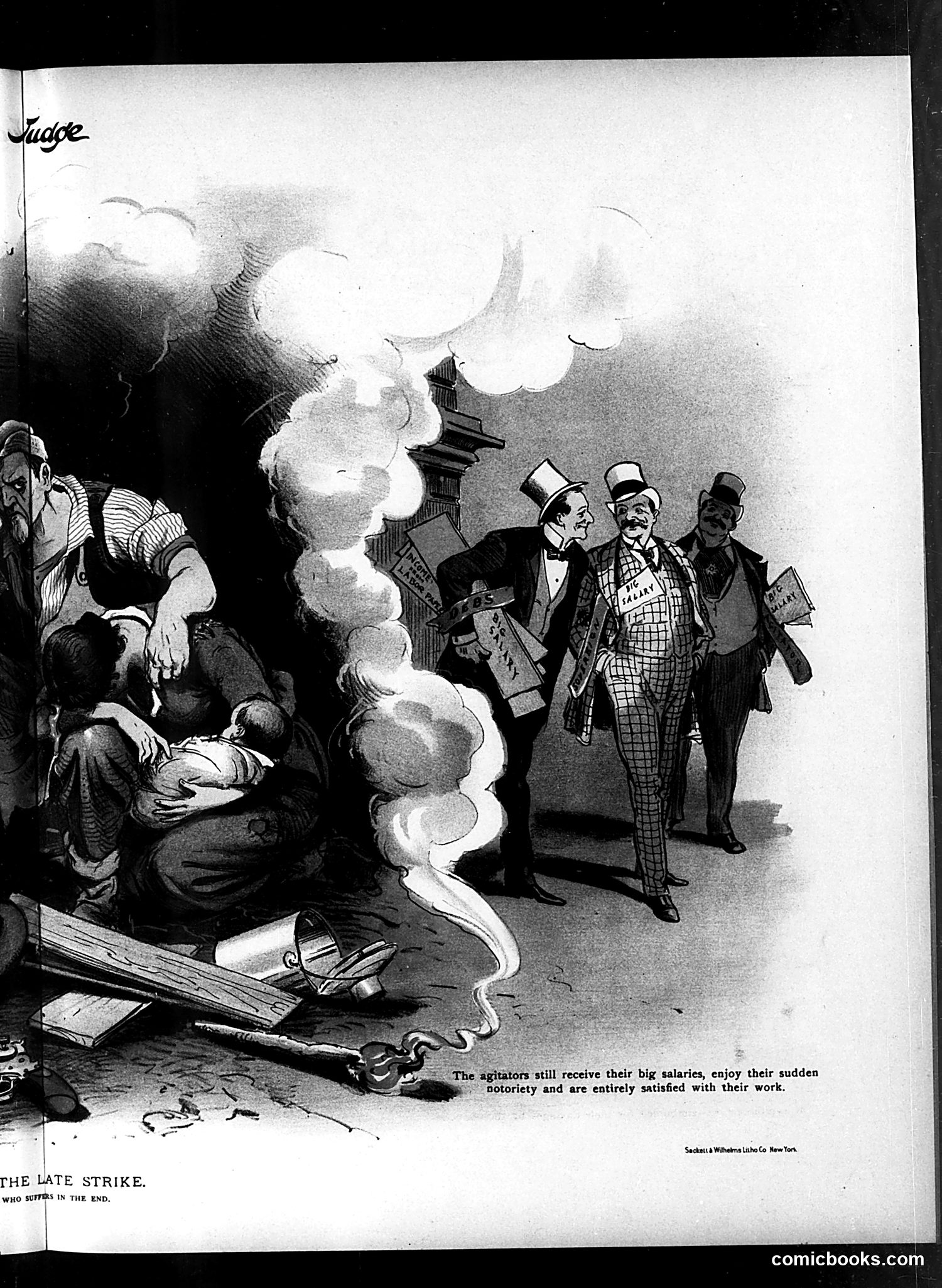
This Judge magazine cartoon satirizes labor strike leadership. The image shows well-dressed agitators or union organizers on the right, smoking cigars and appearing satisfied, while on the left sits a suffering figure amid debris and destruction—likely representing the working class or general public harmed by the strike. The satire's point: strike leaders grow wealthy and gain fame ("big salaries, enjoy their sudden notoriety") while ordinary people suffer the economic consequences. The cartoon suggests labor agitators exploit workers' grievances for personal gain rather than genuine reform. The title "Who Suffers in the End" directly poses this ironic question, implying the answer is everyone except the organizers themselves. This reflects common conservative critiques of labor movements in the late 19th/early 20th century.
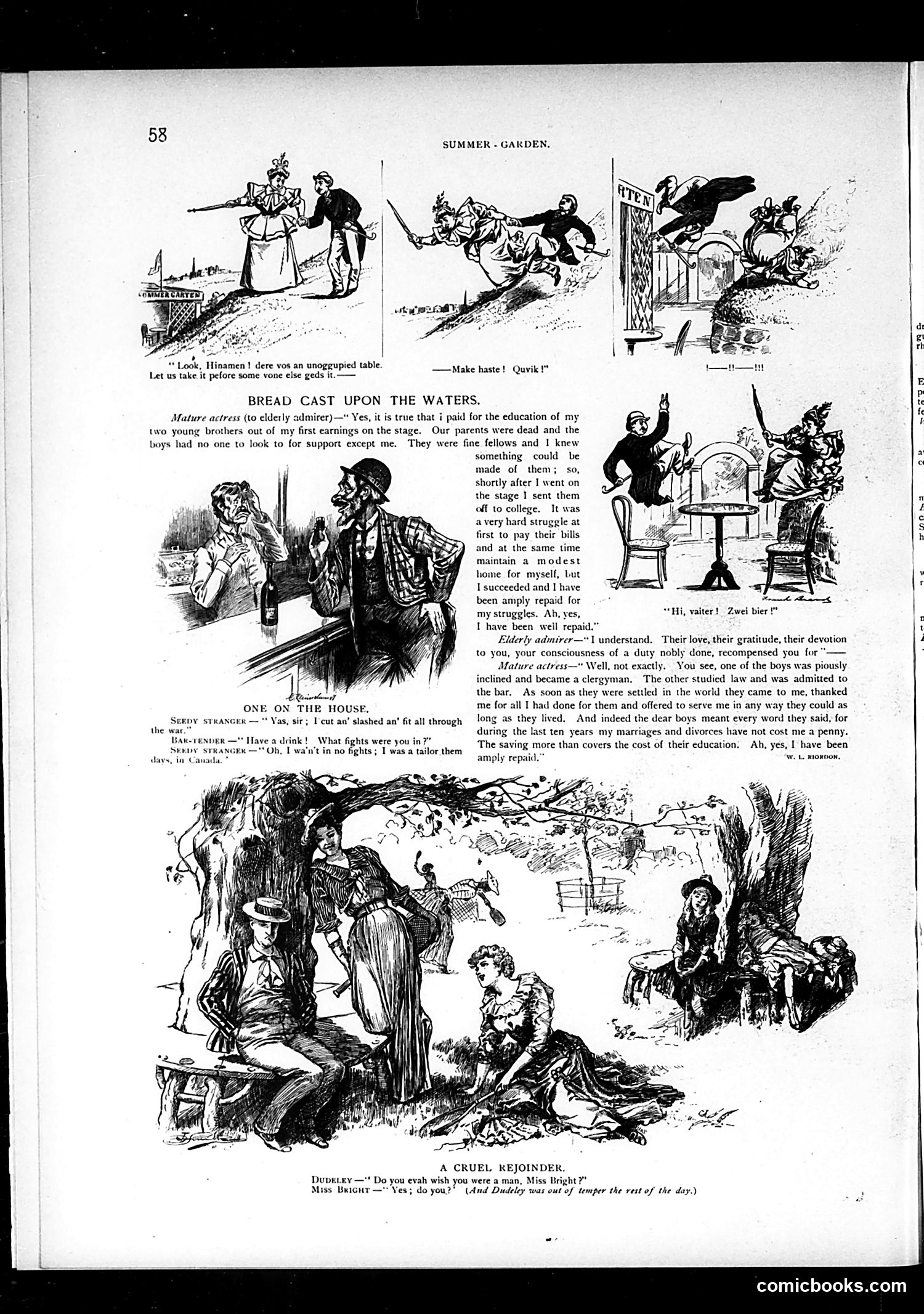
This page contains three satirical cartoons from *Judge* magazine mocking social hypocrisy and gender dynamics of the era. **"Bread Cast Upon the Waters"** depicts a mature actress boasting about sacrificing to educate her brothers, expecting gratitude. The punchline reveals her real "repayment": one brother became a clergyman (offering spiritual comfort), the other a lawyer (providing legal services during her multiple marriages and divorces)—savings that far exceed their education costs. The satire targets wealthy women's self-congratulatory charity and the ironic material benefits gained from familial obligation. **"One on the House"** shows a drunk man bragging about bar fights to a bartender, illustrating working-class masculine posturing. **"A Cruel Rejoinder"** features a woman (Miss Bright) asked if she wishes she were a man, responding "Yes; do you?"—implying the man is insufficiently masculine, a stinging insult that ruins his mood. This mocks both the questioner's assumption about female desire and female wit in comebacks. All three emphasize self-interest, failed expectations, and verbal sparring as social currency.
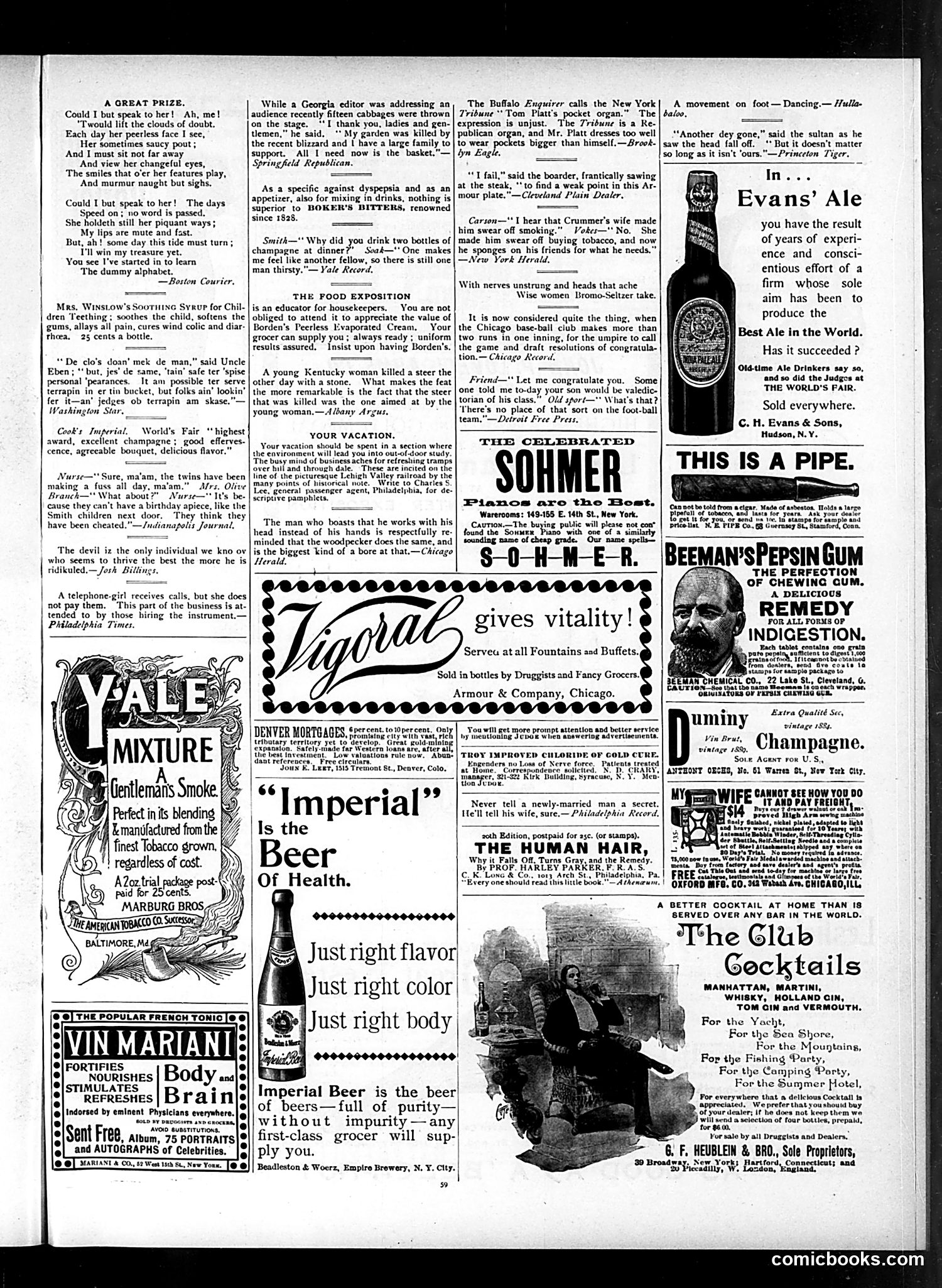
This page is primarily **advertising**, with occasional humorous short pieces interspersed. The cartoons and jokes are minor elements among product advertisements for alcohol, tobacco, and patent medicines. The notable content includes: **"A Great Prize"** (poem): A romantic piece about a man learning sign language ("dummy alphabet") to communicate with a silent woman he admires—playing on the genteel romantic conventions of the era. **Political/Social References**: Brief mentions include a Georgia editor thanking an audience for throwing cabbages after a blizzard destroyed his garden (mocking political theater), and a jab at the New York *Tribune* being controlled by Republican politician Tom Platt. **Advertisements dominate**: Evans' Ale, Sohmer pianos, Imperial Beer, Vigoral tonic, Beeman's Pepsin Gum, Vin Mariani fortified wine, and tobacco products. These ads reflect turn-of-century consumer goods and patent medicines marketed with dubious health claims. The page reflects Judge's typical blend of light satire, sentimental verse, and commercial promotion aimed at affluent readers.
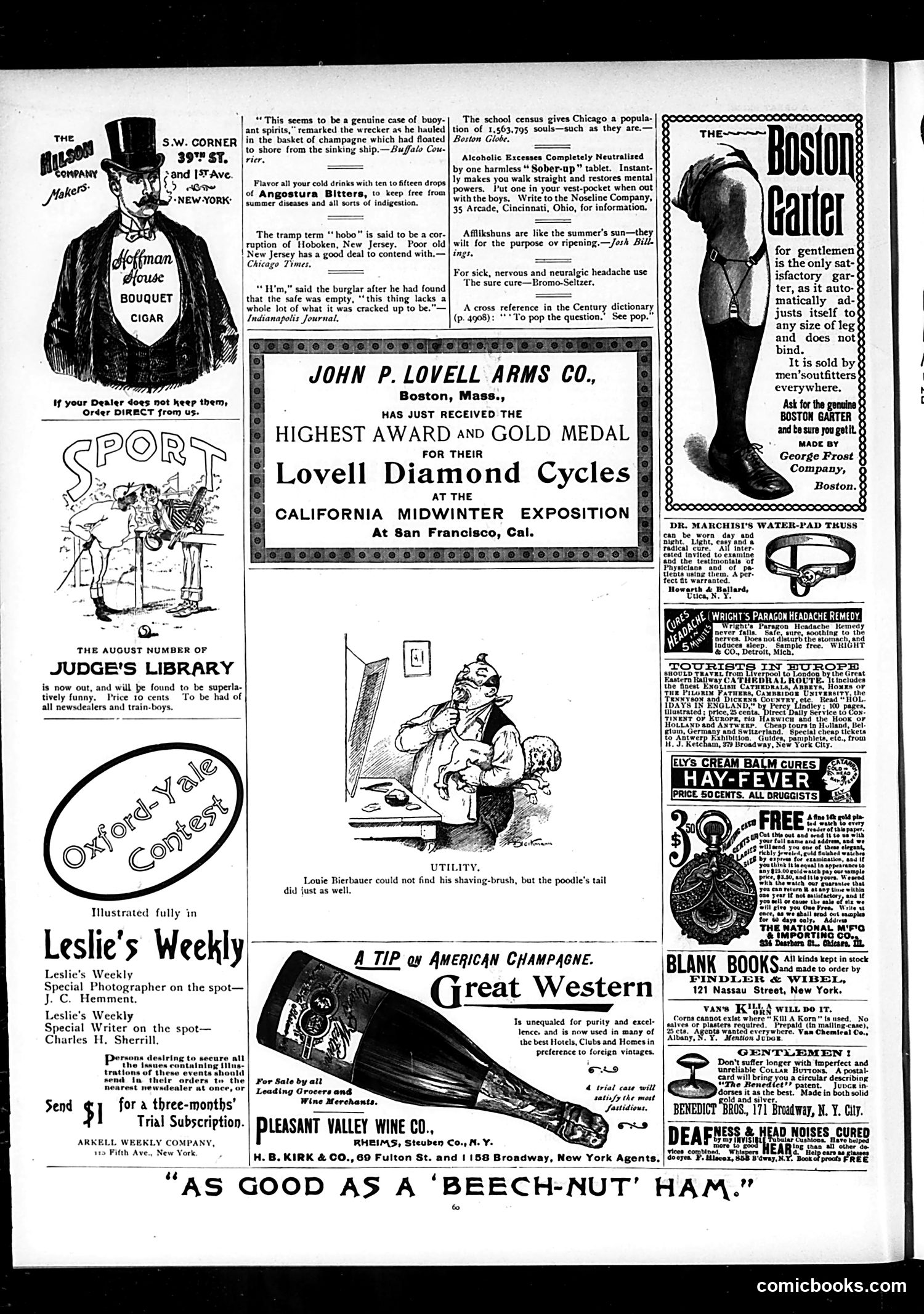
This page is primarily **advertising**, typical of Judge magazine's revenue model. The central cartoon shows a man using a dog's tail as a shaving brush—a crude visual joke about utility and desperation. The scattered text jokes reference period concerns: Chicago's large population (presented skeptically as "such as they are"), the term "hobo" and vagrancy, and burglary. One item mocks New Jersey's problems. Another advertises a "Sober-up" tablet to help drunk men walk straight—suggesting heavy drinking among the magazine's male readership. The substantive content includes promotions for Lovell bicycles (which won an award), various patent medicines (Bromo-Seltzer, hay fever remedies), wine, and blank books. **Context**: Judge was a humor magazine for middle and upper-class men, filled with advertisements alongside satirical commentary. The jokes assume readers recognize references to current events, slang, and social anxieties of the era—here, urbanization, alcoholism, and the emerging "hobo" phenomenon.
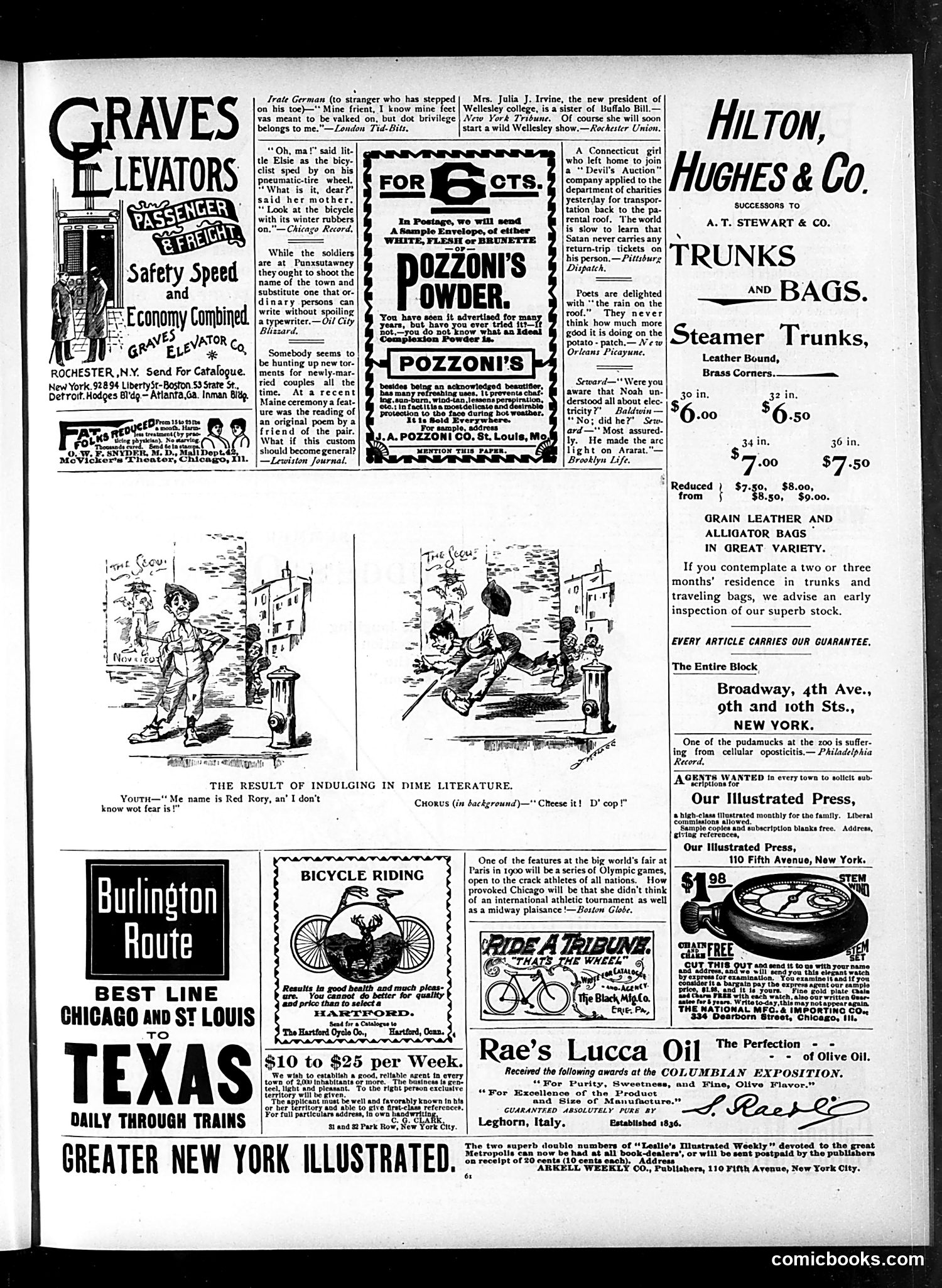
This page from Judge magazine (circa 1893, based on the Columbian Exposition reference) contains several brief satirical items rather than one major cartoon: **Main Cartoon:** "The Result of Indulging in Dime Literature" depicts youth reading pulp fiction (likely adventure stories like "Red Rory"), satirizing how cheap sensational literature supposedly corrupted young readers' minds, making them foolhardy and dangerous. **Other Jokes:** Brief satirical quips mock: - German immigrants' accented English ("Mine frient") - A Connecticut girl running away to join a theatrical troupe - The town of Punxsutawney, Pennsylvania (mocking its odd name) - Newly-married couples enduring tedious poetry readings - A poet's romanticization of rain (he'd hate real experience) **Context for modern readers:** This reflects late-Victorian anxieties about mass media corrupting youth and immigrant cultural stereotypes common in period humor. The page is predominantly advertisements (elevators, trunks, bicycles, trains), with satire squeezed between commercial notices.
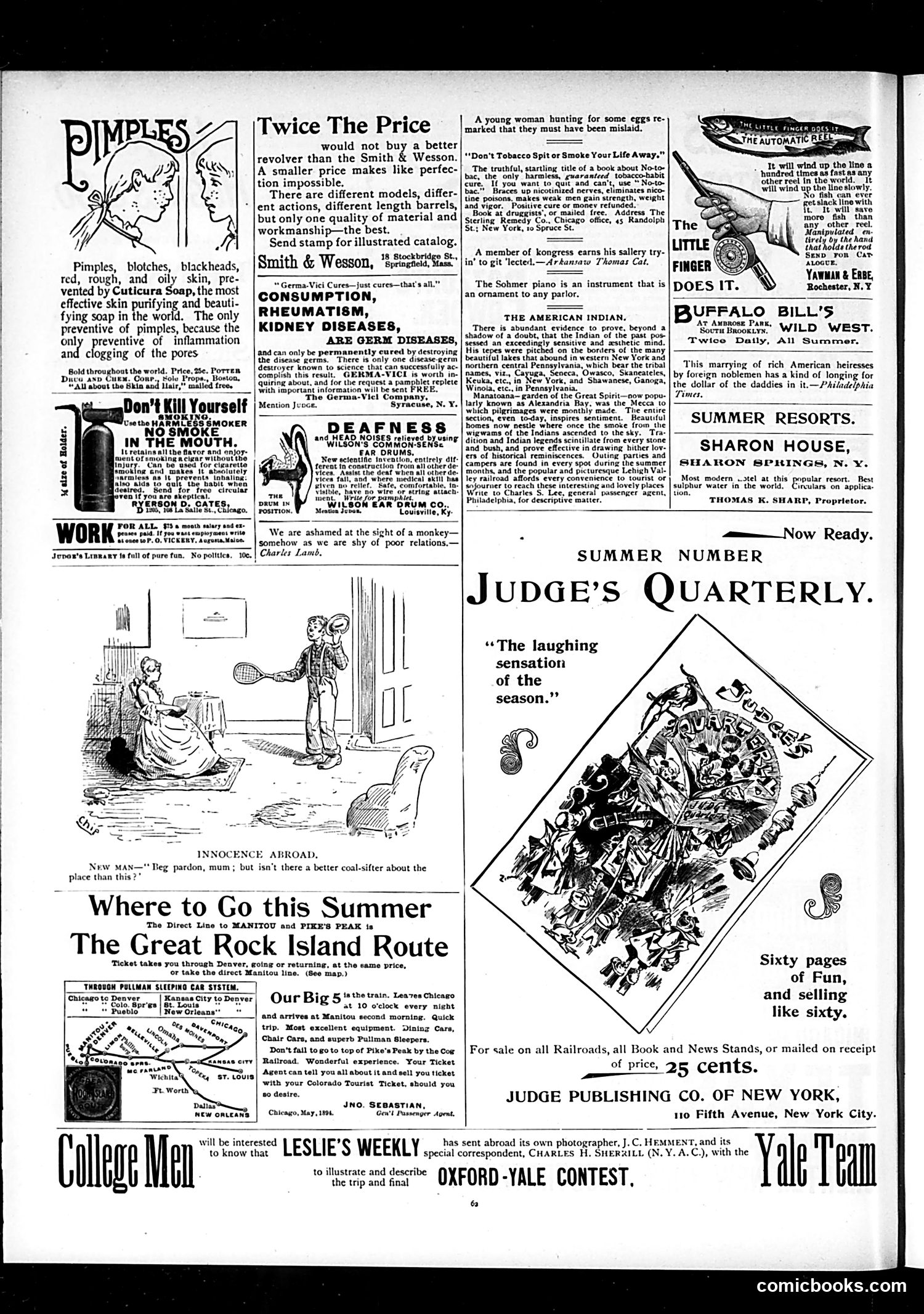
This page is primarily **advertising and promotional content** rather than political cartoons. The satirical material is minimal. The one notable cartoon is titled "**Innocence Abroad**"—a brief humorous sketch showing a naive American woman (likely a tourist) asking a servant if there's a "better coal-sifter about the place" than the one she's seen. The joke satirizes American travelers abroad as culturally ignorant and tactless, confusing household items with unfamiliar foreign objects. The page otherwise consists of patent medicine ads (for germ-cure treatments, tobacco cessation), product advertisements (Smith & Wesson revolvers, Cuticura soap), and tourism promotions for Colorado's Pike's Peak via the Rock Island Route. A Charles Lamb quote about shame and poor relations appears decoratively but lacks clear satirical context on this page. The overall content reflects late-19th-century American commercial culture and advertising practices more than political satire.
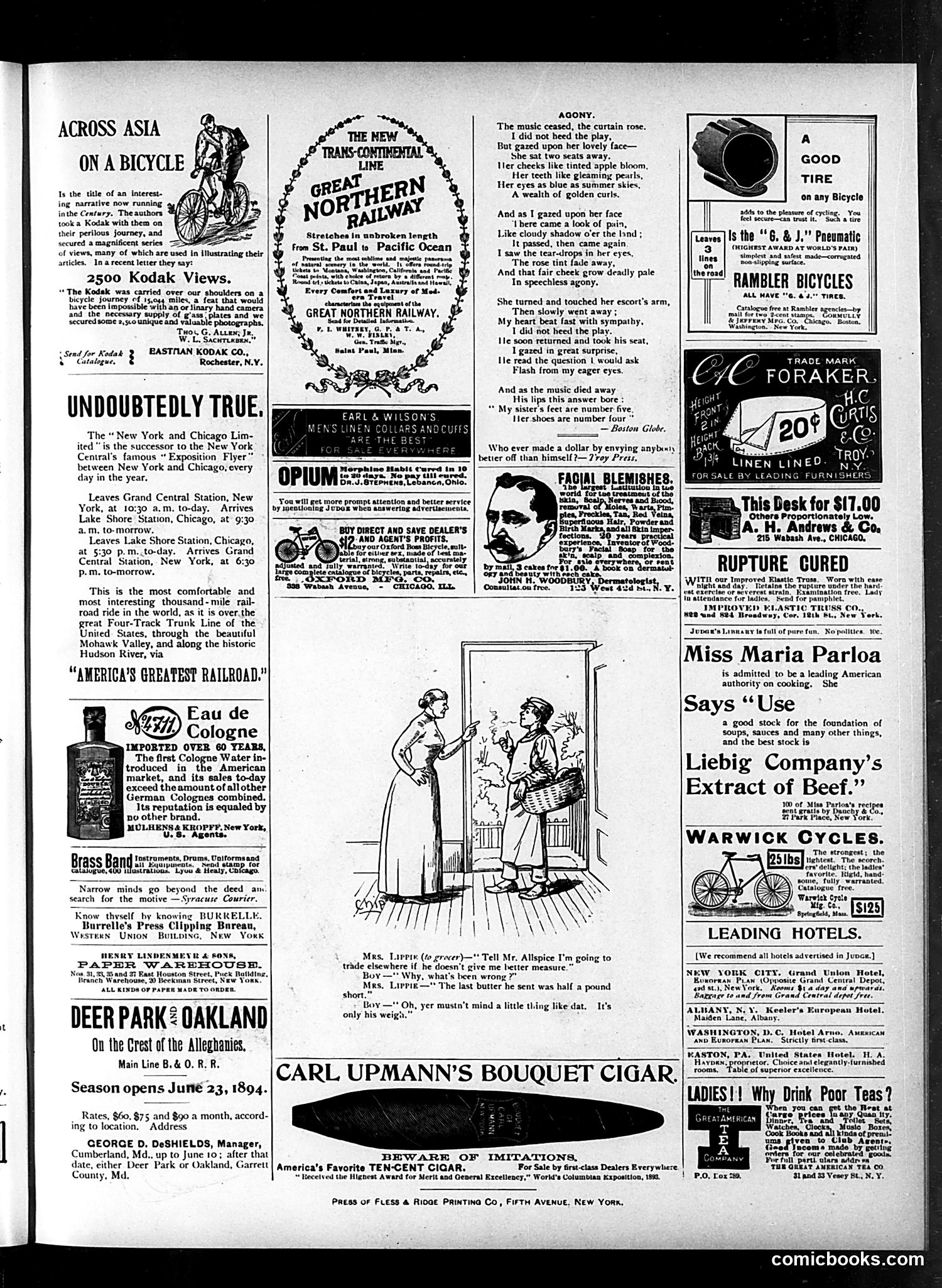
This page is primarily **advertisements and filler content** from Judge magazine (circa 1894), with minimal satirical cartoon content. The main illustrated piece is a small cartoon showing a domestic scene where a woman tells her escort: "Tell Mr. Aliphie I'm going to the theatre with him to-night; give me better measure." The humor is mild social satire about a woman prioritizing entertainment quality over her actual companion—a gentle jab at female consumerism and social priorities. The rest of the page consists of period advertisements for bicycles, railroads (Great Northern, New York Central), cologne, cigars, furniture, and patent medicines (opium/morphine treatments, rupture cures). These ads are historically notable for their claims and products we'd now consider dangerous or fraudulent, but the page itself contains no political satire or significant commentary worth analyzing for modern readers. The page represents typical magazine filler rather than Judge's satirical mission.
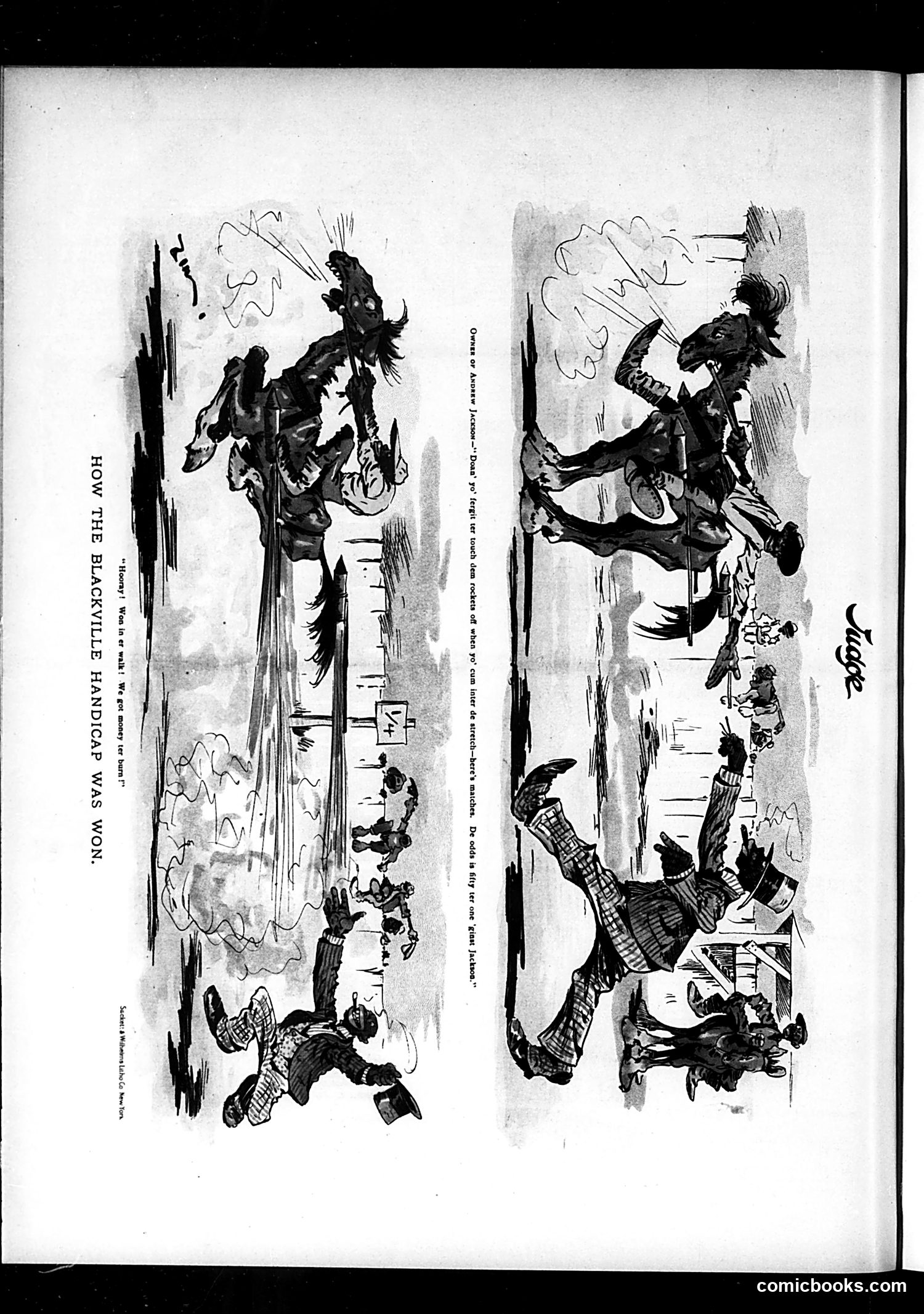
This appears to be a humorous sports cartoon titled "How the Blackville Handicap Was Won," likely from Judge magazine's satirical sports section. The cartoon depicts a horse race scene rendered sideways/upside-down on the page, showing jockeys and horses in chaotic motion. The caption "Hooray! Won in er walk! We got money ter burn!" suggests the joke involves unexpected or comedic victory—possibly satirizing rigged races, amateur riders, or the absurdity of gambling outcomes. The "Blackville" reference likely indicates this is a cartoon in Judge's recurring series about the fictional African American community called "Blackville," popular in late 19th/early 20th century American periodicals. These were often crude satires reflecting period racial stereotypes. The frantic, sideways composition emphasizes chaos and comedic disorder typical of Judge's slapstick humor style.