
Judge, 1894-07-28 · page 5 of 16
Judge — July 28, 1894 — page 5: what you’re looking at
What you’re looking at
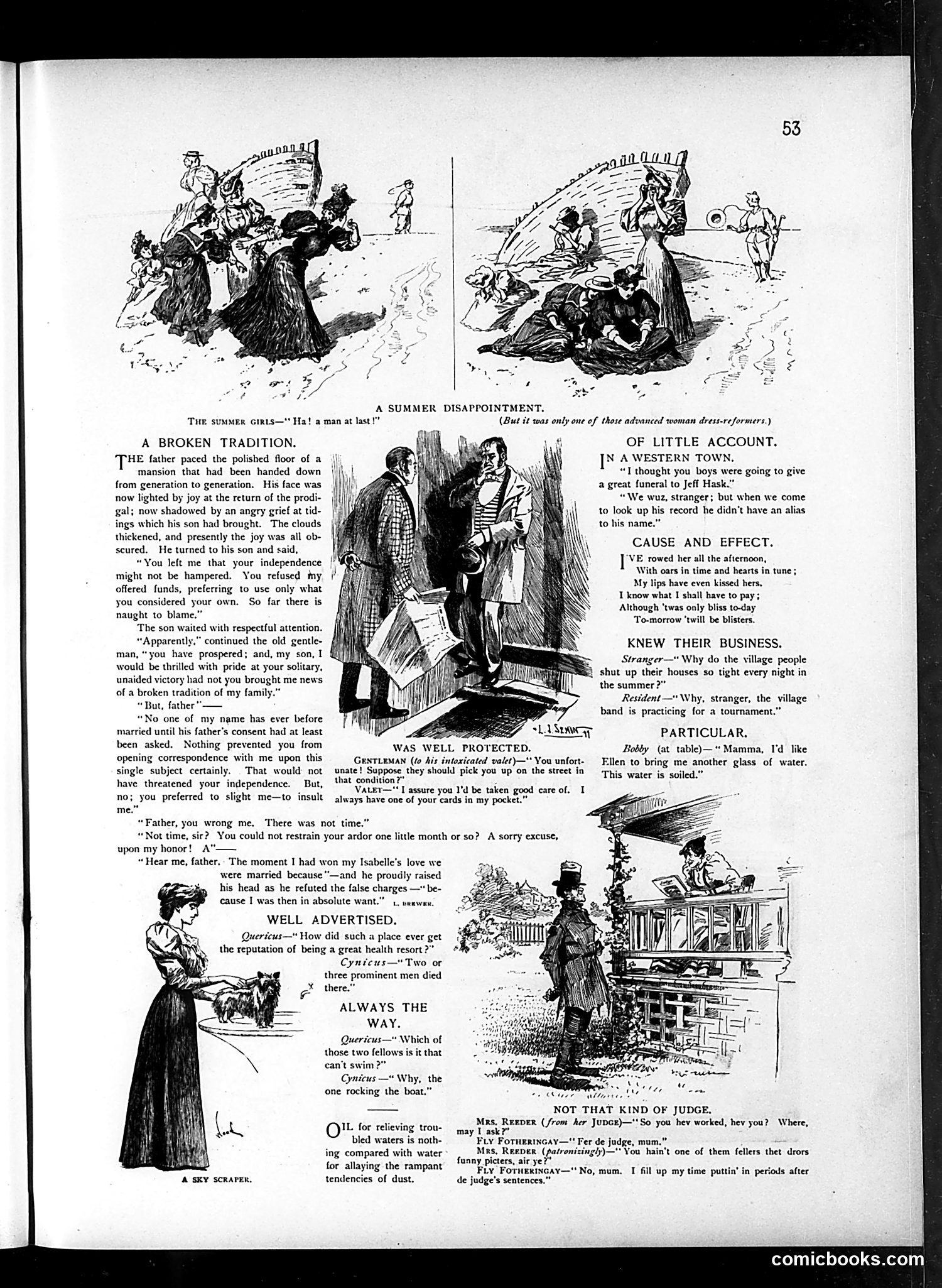
This page contains multiple satirical vignettes typical of late-19th-century American humor: **"A Broken Tradition"** mocks upper-class pretension. A wealthy father is furious that his son married without paternal consent—a supposed family tradition—only to be deflated when the son reveals he married *because* he was poor and in love, making the union actually noble rather than rebellious. **"A Summer Disappointment"** depicts women at a beach spotting a man, only to be let down—likely a visual gag about romantic expectations versus reality. **"Was Well Protected"** jokes darkly about class: a drunk servant is unworried about arrest because he carries his employer's business card, suggesting the card provides protection through association. Other brief sketches mock: small-town funeral customs (needing an "alias" to be notable), romantic consequences, village bands, and a judge who apparently doesn't draw "funny pictures" but merely punctuates sentences. The overall tone reflects Gilded Age social satire targeting wealth, class pretension, romance, and small-town American life.
📄 Transcribed text from this page (OCR, searchable)
Machine-transcribed from the original scan — historical spelling and the odd misread are preserved.
A SUMMER DISAPPOINTMENT, Tue suMMER GIRLS—*' Ha! a man at last!” A BROKEN TRADITION. THE father paced the polished floor of a mansion that had been handed down from generation to generation. His face was now lighted by joy at the return of the prodi- gal; now shadowed by an angry grief at tid- ings which his son had brought. The clouds thickened, and presently the joy was all ob- scured. He turned to his son and said, “You left me that your independence might not be hampered. You refused iny offered funds, preferring to use only what you considered your own. So far there is naught to blame.” The son waited with respectful attention. “Apparently,” continued the old gentle- man, “you have prospered; and, my son, I would be thrilled with pride at your solitary, unaided victory had not you brought me news of a broken tradition of my family.” “But, father "— jo one of my name has ever before married until his father’s consent had at least been asked. Nothing prevented you from opening correspondence with me upon this WAS WELL PROTECTED. GENTLEMAN (fo his intoxicated valet)—"* You unfort- single subject certainly. That would not unate! Suppose they should pick you up on the street in have threatened your independence. But, that condition?” Vatet—"'I assure you I'd be taken good care of. I no; you preferred to slight me—to insult always have one of your cards in my pocket.” me.” “Father, you wrong me. There was not time.” “Not time, sir? You could not restrain your ardor one little month or so? A sorry excuse, upon my honor! A"— “ Hear me, father.» The moment I had won my Isabelle’s love we were married because "—and he proudly raised his head as he refuted the false charges —“* be- cause I was then in absolute want.” 1. veawsx. WELL ADVERTISED. Quericus—" How did such a place ever get the reputation of being a great health resort ?” Cynicus—'Two or ALWAYS THE WAY. Quericus—" Which of those two fellows is it that can't swim Cunicus —* Why, the one rocking the boat.” (But it was only one of thore advanced woman dressreformers.) OF LITTLE ACCOUNT. ]§ A. WESTERN TOWN. “I thought you boys were going to give a great funeral to Jeff Hask.” “We wuz, stranger; but when we come to look up his record he didn’t have an alias to his name.” CAUSE AND EFFECT. [VE rowed her all the afternoon, With oars in time and hearts in tune; My lips have even kissed hers, I know what I shall have to pay; Although ‘twas only bliss to-day ‘To-morrow ‘twill be blisters. KNEW THEIR BUSINESS. Stranger—" Why do the village people } shut up their houses so tight every night in the summer ?” Resident —" Why, stranger, the village band is practicing for a tournament.” PARTICULAR. Bobby (at table)—“ Mamma, I'd like Ellen to bring me another glass of water. This water is soiled.” We NOT THAT KIND OF JUDGE. OF: for relieving trou- bled waters is noth- ing compared with water for allaying the rampant tendencies of dust. may I ask?” funny picters, air ye?” ‘A SKY SCRATER. de judge's sentences.” Mrs, Reever (from her Jupce)—"' So you hev worked, hev you? Where, Fry Fornertncay—'* Fer de judge, mum.” Mrs. Reever (pa/ronizingly)}—" You hain't one of them fellers thet drors Fiy Fornexincay—"No, mum. I fill up my time puttin’ in periods after comicbooks.com