
A complete issue · 16 pages · 1894
Judge — June 2, 1894
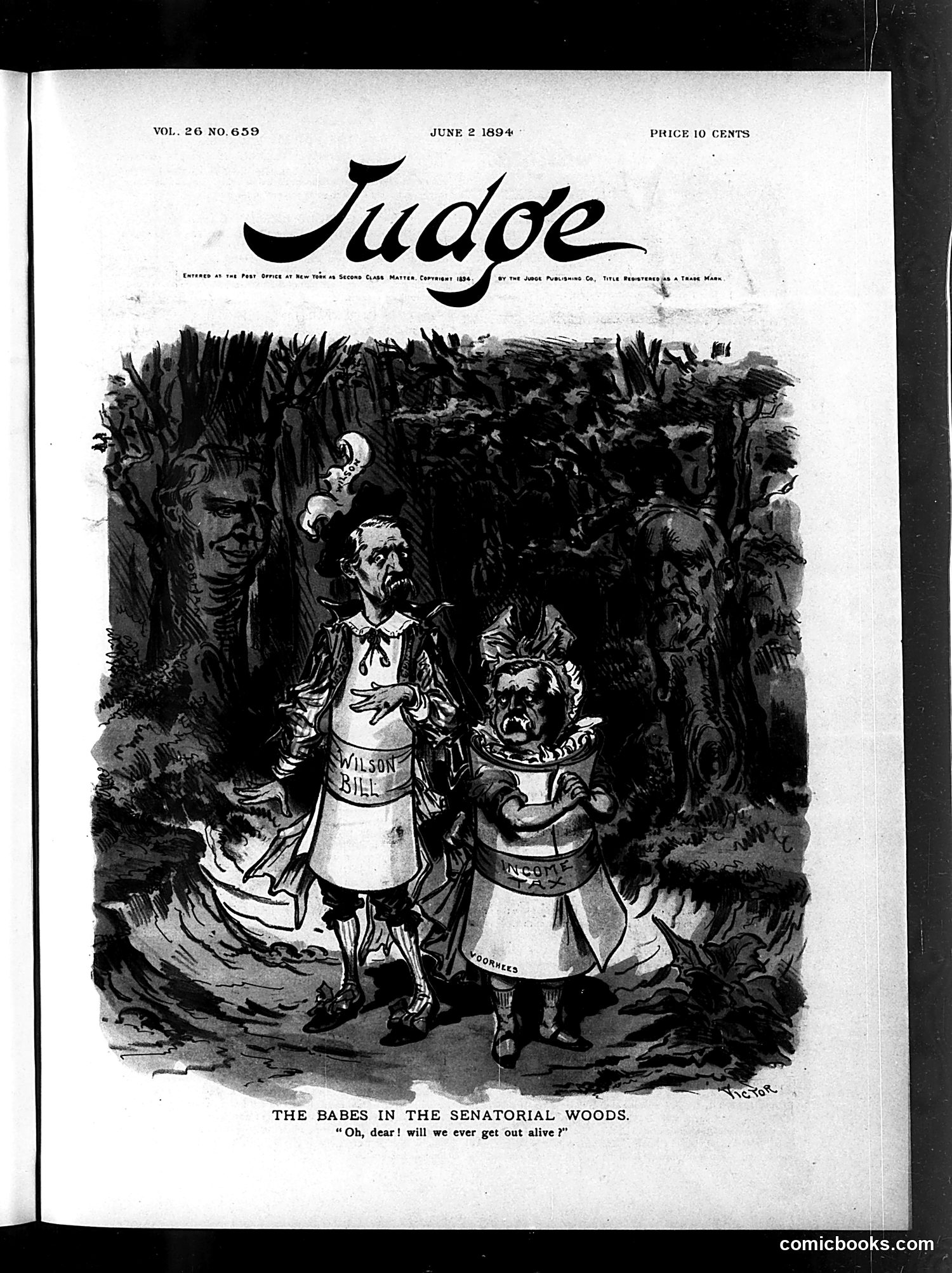
This June 1894 cartoon satirizes what appears to be inexperienced or inadequate politicians struggling in legislative matters. The title references the fairy tale "Babes in the Woods," suggesting these figures are lost and helpless. The figures wear bands labeled "WILSON BILL" and "MCKINLEY," indicating they represent legislation from these periods. The dark, tangled forest setting emphasizes their predicament—they're "lost" in the complexities of senatorial politics. The caption ("Oh dear! will we ever get out alive?") reinforces the cartoon's message that these bills face uncertain passage or that their sponsors lack the political skill to navigate Congress successfully. This reflects contemporary anxieties about legislative competence during the McKinley-Cleveland era.
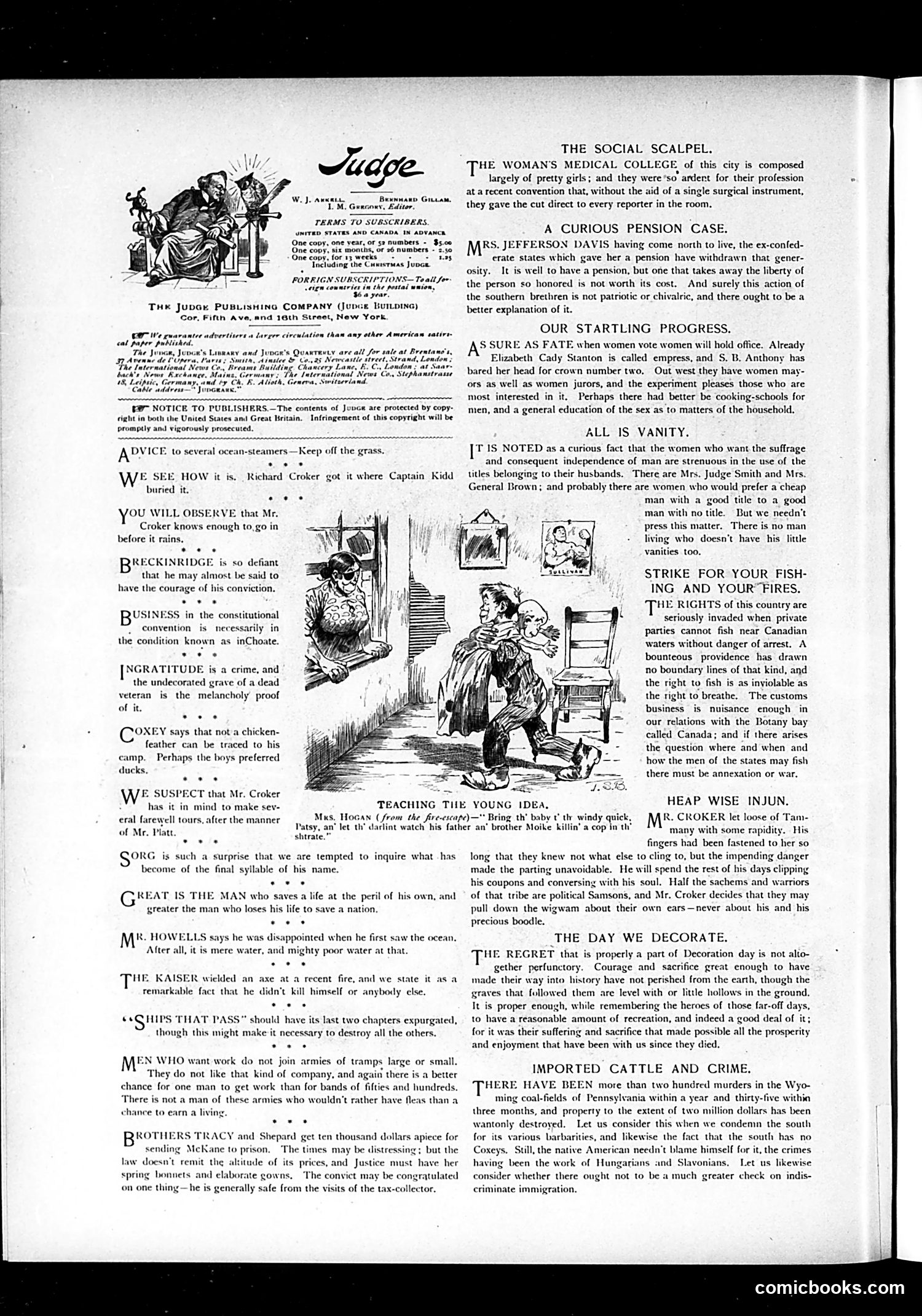
The central cartoon depicts a domestic scene where a mother instructs her young child on proper behavior. The accompanying text (from the *Pictorials*) reads: "Bring th' baby! It's windy quick, Patsy, or he'll strain watch his father an' brother Moike killin' a cop in th' street." This is satirizing Irish-American immigrants, stereotyped as lawless and violent. The joke cruelly suggests that Irish families normalize criminal violence—here, murder of police officers—as everyday instruction for children. It reflects widespread anti-Irish prejudice common in late 19th-century America, portraying Irish immigrants as inherently criminal and unfit for civilized society. The thick dialect reinforces ethnic caricature stereotypes prevalent in Judge's editorial stance.
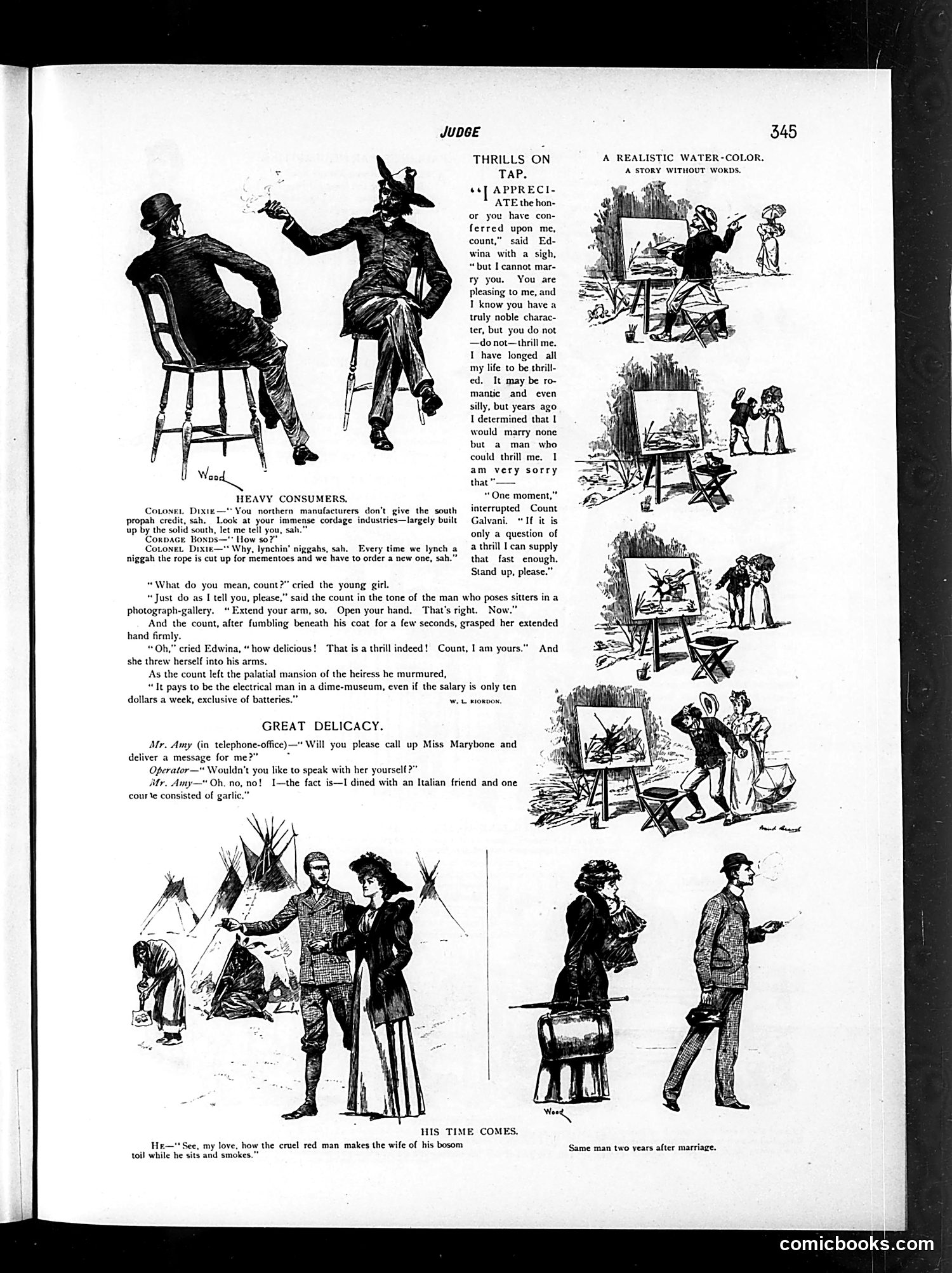
**"Heavy Consumers"** satirizes Southern industrialists' complaints about Northern manufacturing advantages. Colonel Dixie and Colonel Cord-Wood-Rope engage in a circular conversation about supply chain problems—each blames the other for inefficiency, yet both remain dependent on the other's products. The joke is that despite their grievances, they're locked in mutual reliance. **"Great Delicacy"** depicts a humorous misunderstanding about dining with an Italian friend—the courier assumes the message requires personal delivery, but it's just about game dishes. **"His Time Comes"** and **"Same man two years after marriage"** show a man's transformation from romantic suitor (courting in a tent) to domesticated husband (carrying luggage, appearing harried). These are primarily humor pieces rather than political commentary.
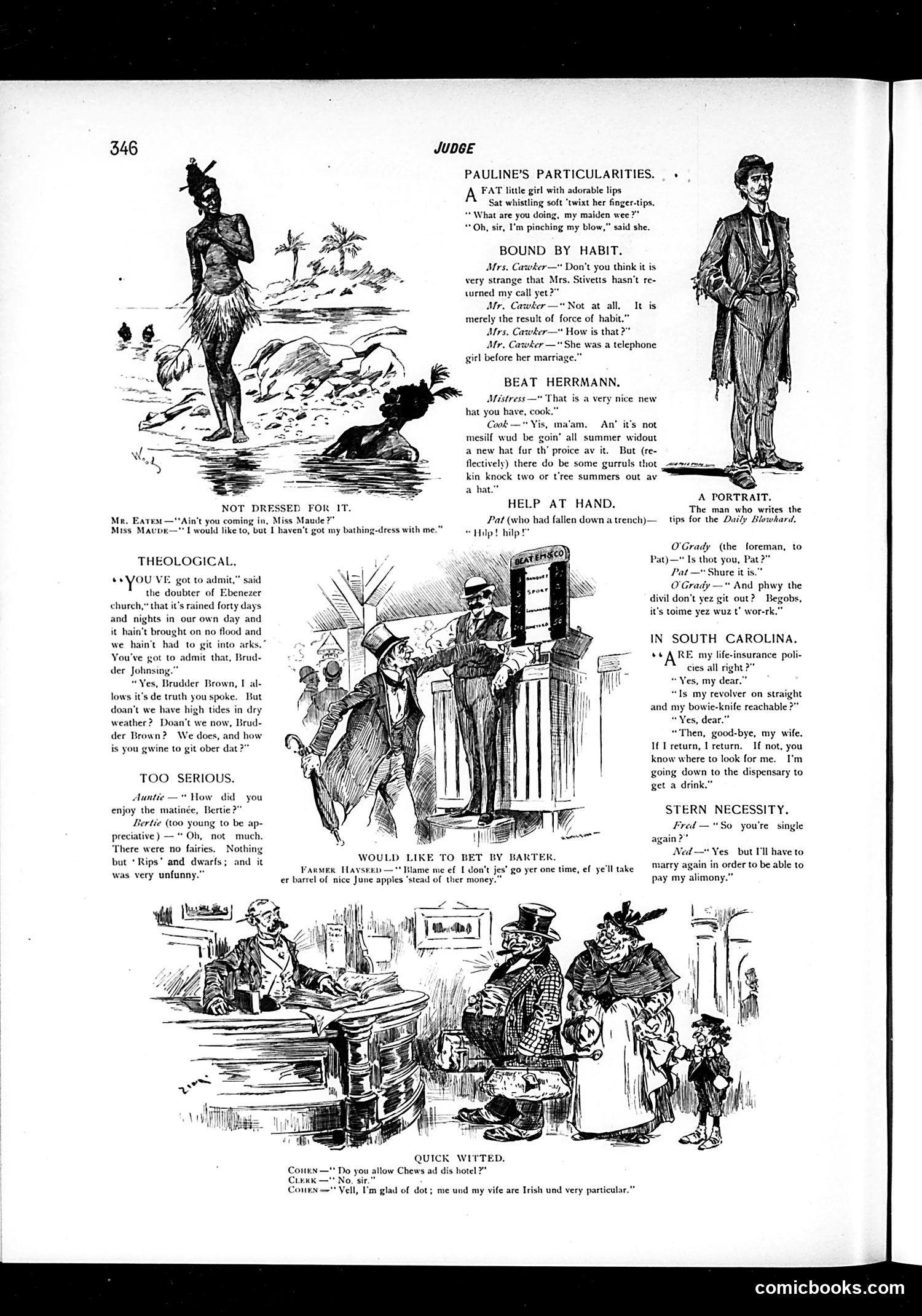
This page collects brief humorous vignettes typical of Judge magazine's satirical style. The jokes target various social types and situations: **"Theological"** mocks rural dialect speakers debating religious logic about rainfall and floods—absurdist humor about common folk. **"Bound by Habit"** satirizes a woman's compulsive telephone behavior, suggesting modern technology creates involuntary social patterns. **"Beat Herrmann"** jokes about a cook's reluctance to try new recipes—conservative domestic resistance to change. **"In South Carolina"** stereotypes Southern masculine culture (life insurance, guns, bowie-knives, dispensaries) as violent and reckless—regional mockery common to Northern satirical magazines. **"Quick Witted"** presents ethnic humor: an Irish immigrant's illogical preference against "Chews" (Jews) while being equally particular himself—typical period anti-Semitic and anti-immigrant satire. The illustrations throughout employ exaggerated caricature. These sketches reflect Judge's audience: educated urbanites amused by stereotypes of rural, immigrant, and regional "others."
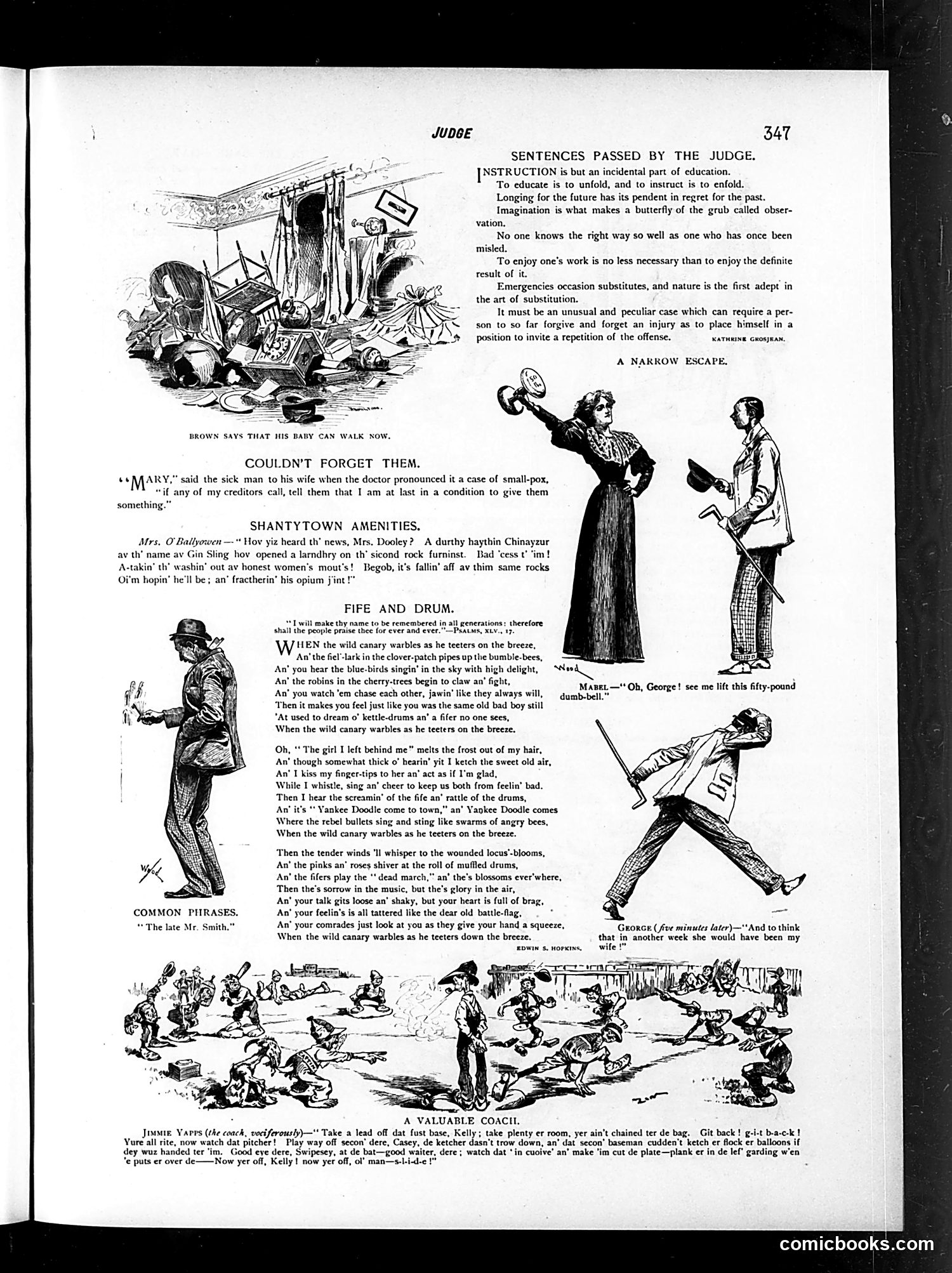
This page from *Judge* contains several satirical pieces and humorous sketches reflecting late 19th-century American life: **"A Narrow Escape"** depicts a domestic scene where a woman threatens a man with what appears to be a rolling pin—likely satirizing marital discord or henpecked husbands, a common *Judge* theme. **"Shantytown Amenities"** uses Irish immigrant dialect to mock working-class prejudices. Two Irish women gossip about a Chinese laundry owner ("Gin Sling"), reflecting period anti-Chinese sentiment while simultaneously mocking Irish speech patterns for comedic effect. **"Fife and Drum"** is a sentimental Civil War poem romanticizing military service, contrasting youthful dreams of glory with the harsh reality of battle and loss—likely appealing to post-war nostalgia while subtly critiquing war's true costs. The page's humor relies on ethnic caricature, domestic comedy, and Civil War sentimentality—typical *Judge* content reflecting contemporary prejudices and preoccupations of its educated, largely white readership.
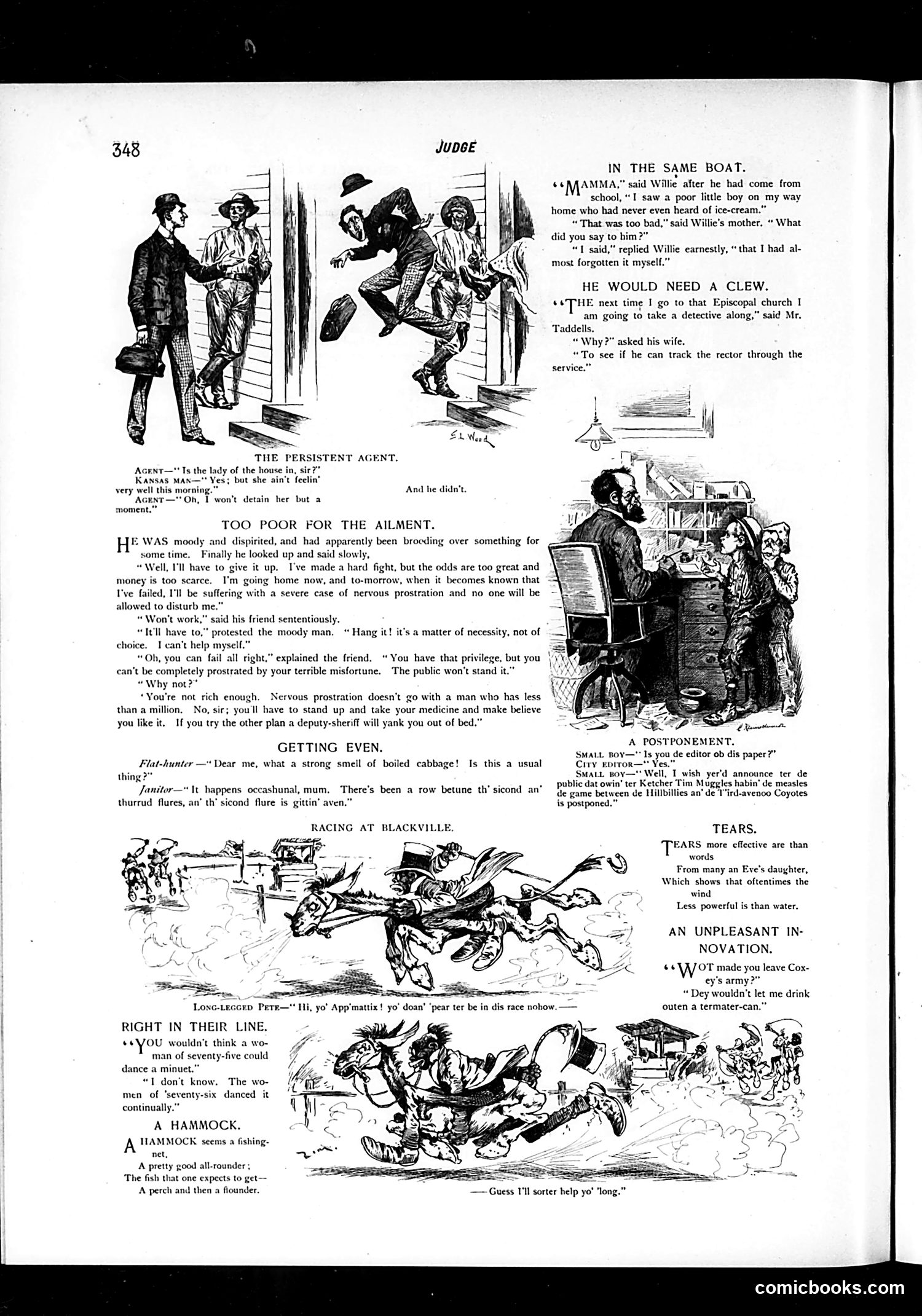
This page contains multiple brief satirical cartoons typical of the 1890s Judge magazine: **"In the Same Boat"** mocks child hypocrisy—Willie claims sympathy for a poor boy who's never had ice-cream, then admits he himself has almost forgotten it, suggesting his concern is performative rather than genuine. **"He Would Need a Clew"** jokes about an absent-minded Episcopal rector, implying the clergyman is so distracted during services that a detective would be needed to follow him. **"Too Poor for the Ailment"** satirizes class-based social expectations: a poor man cannot credibly claim "nervous prostration" (a fashionable Victorian ailment signaling wealth and sensitivity) because society only accepts such afflictions from the rich. The deputy-sheriff reference suggests only the impoverished face legal consequences for hardship. **"Racing at Blackville"** and other cartoons use dialect humor and slapstick imagery typical of the era's entertainment pages. The reference to "Coxey's army" appears to reference the 1894 march protesting unemployment. Overall, the page satirizes American social hypocrisy, class divisions, and pretension common to 1890s concerns.
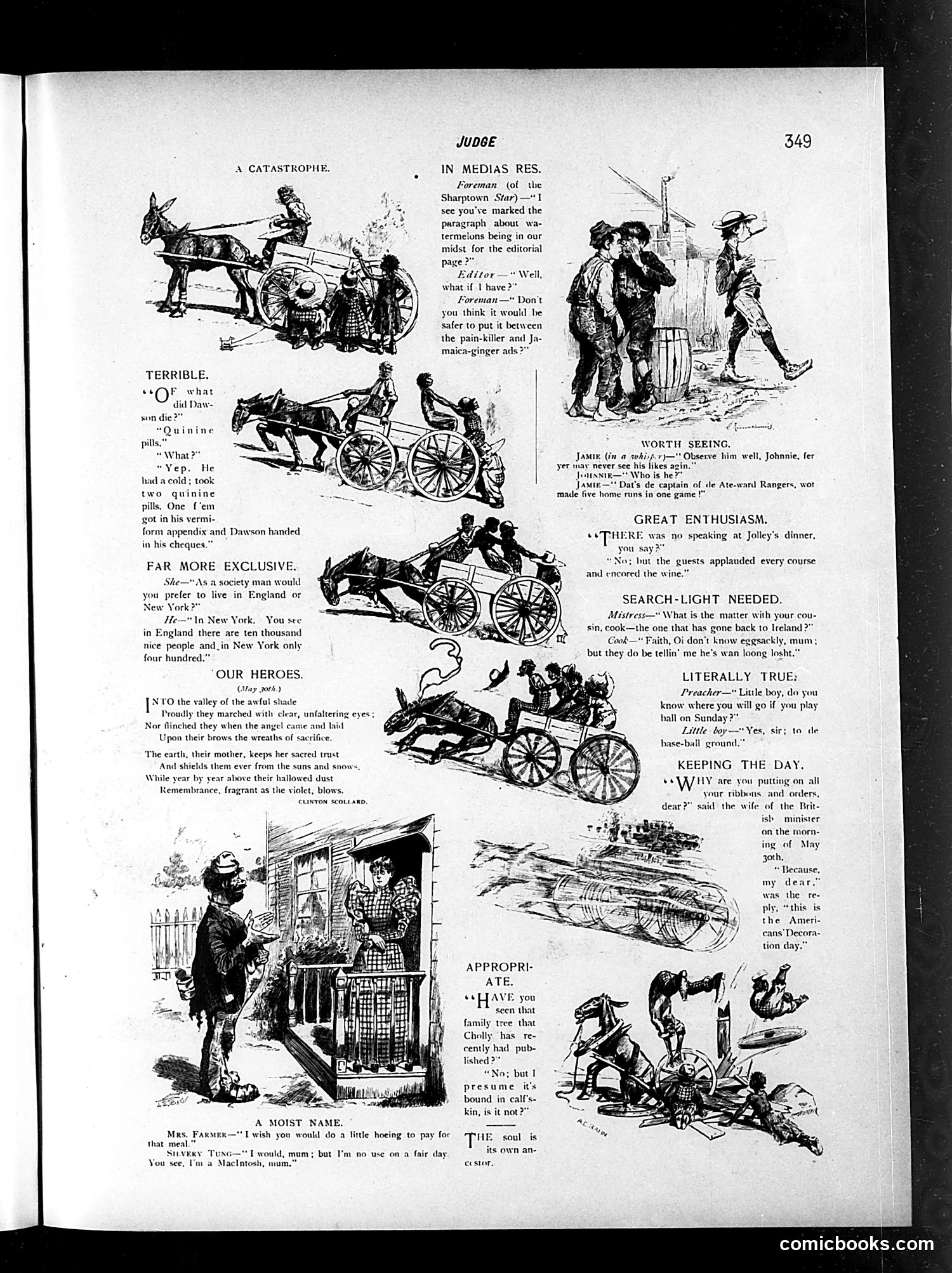
This page contains multiple brief satirical jokes typical of early 20th-century American humor magazines: **"A Catastrophe"** jokes about a man dying from quinine pills lodged in his appendix—dark humor about medical incompetence. **"Far More Exclusive"** satirizes American social snobbery: a man claims New York is superior to England because it has "ten thousand nice people" versus England's "four hundred"—mocking the pretension that America could ever match European aristocracy. **"Our Heroes"** appears to be a Memorial Day (May 30th) tribute to fallen soldiers, treating the holiday solemnly. **"A Moist Name"** jokes that "Shivery Tunc" won't work on fair days because he's "a MacIntosh"—a pun on the mackintosh raincoat, suggesting he only functions in wet weather. **"In Medias Res"** satirizes newspaper editorial judgment: a foreman questions whether a watermelon story should be positioned between pain-killer and ginger ale advertisements for better placement. The remaining items are brief quips about advertising, Irish servants, baseball, and British decorations—typical period humor targeting immigrants, class pretensions, and Anglophilia.
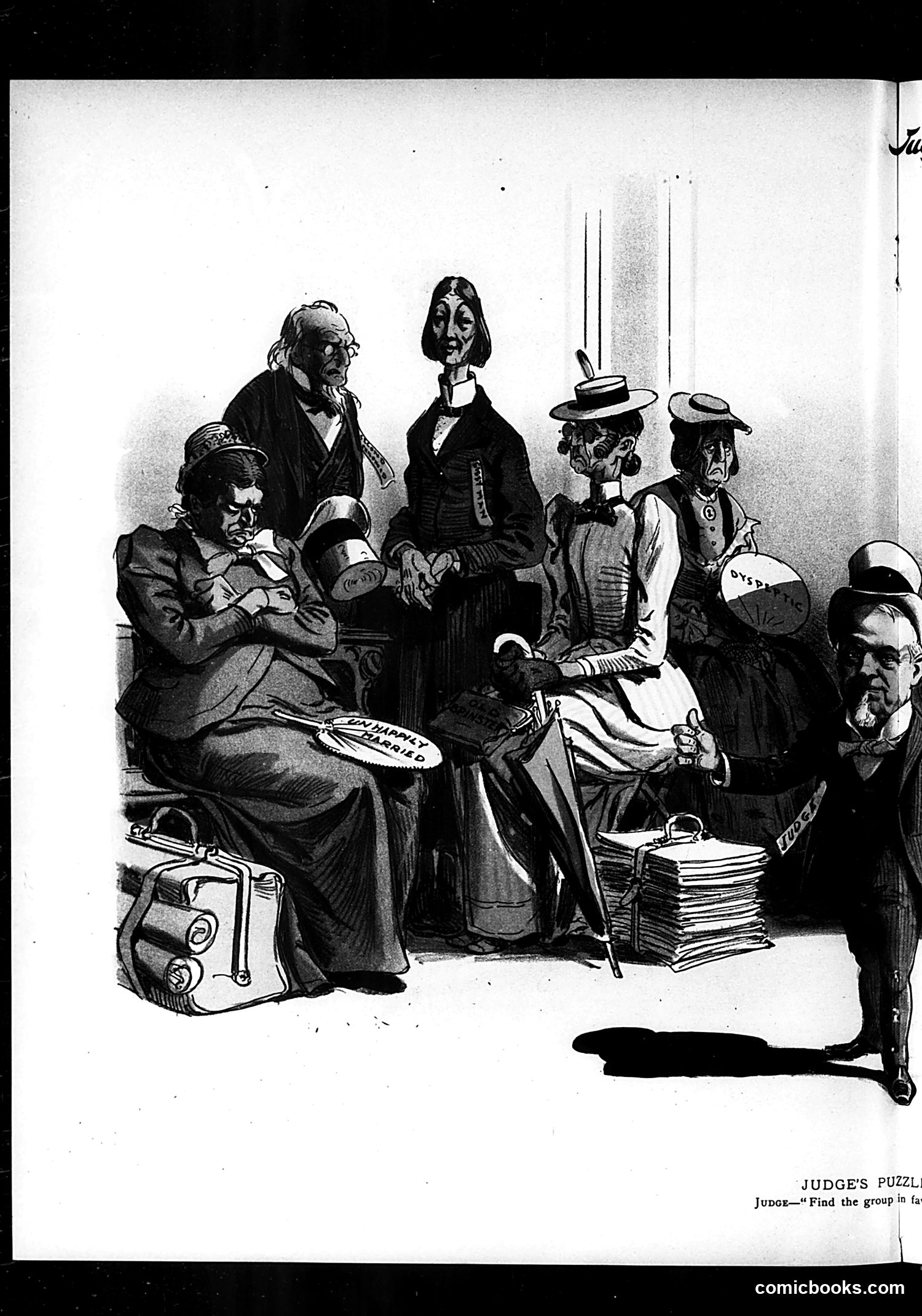
This is a visual puzzle from *Judge* magazine asking readers to "Find the group in fa[vor]" (text cut off). The cartoon depicts seven figures in 19th-century dress gathered around luggage and documents, with exaggerated facial features typical of period caricature. The composition suggests a satirical commentary on immigration or travel, with the assembled group appearing to represent different social types or nationalities. The suitcases and stacked papers indicate movement or processing of some kind. Without the complete caption or publication date, the specific political target remains unclear—this could reference immigration policy, a particular ethnic group's arrival, or a satirical commentary on travelers or bureaucratic processes of the era. The puzzle format invited readers to identify the group being mocked.
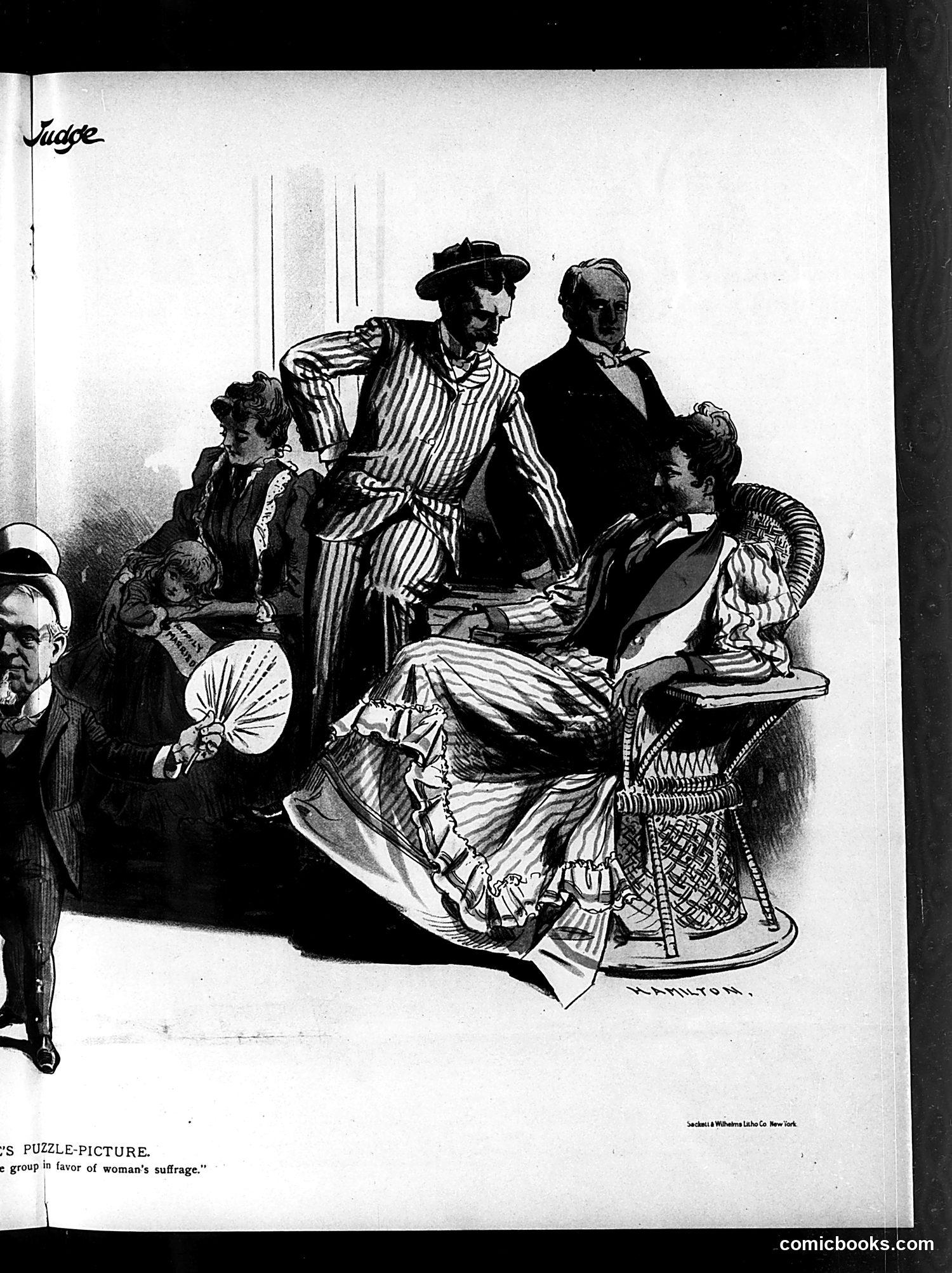
This appears to be a satirical cartoon titled "A Puzzle-Picture" depicting "a group in favor of woman's suffrage." The illustration shows several well-dressed figures from what appears to be the early 20th century engaged in discussion or debate. The cartoon likely mocks suffrage supporters through caricature and composition. The positioning and exaggerated features suggest ridicule of the movement's advocates. Without identifying specific individuals, the formal dress and interior setting suggest this targets educated, middle-class suffragists. Judge magazine consistently opposed women's voting rights during this era, using humor as a weapon against the movement. This cartoon exemplifies that editorial stance, presenting suffrage supporters as subjects of mockery rather than serious political actors. The "puzzle" framing invites readers to interpret and laugh at the depicted group.
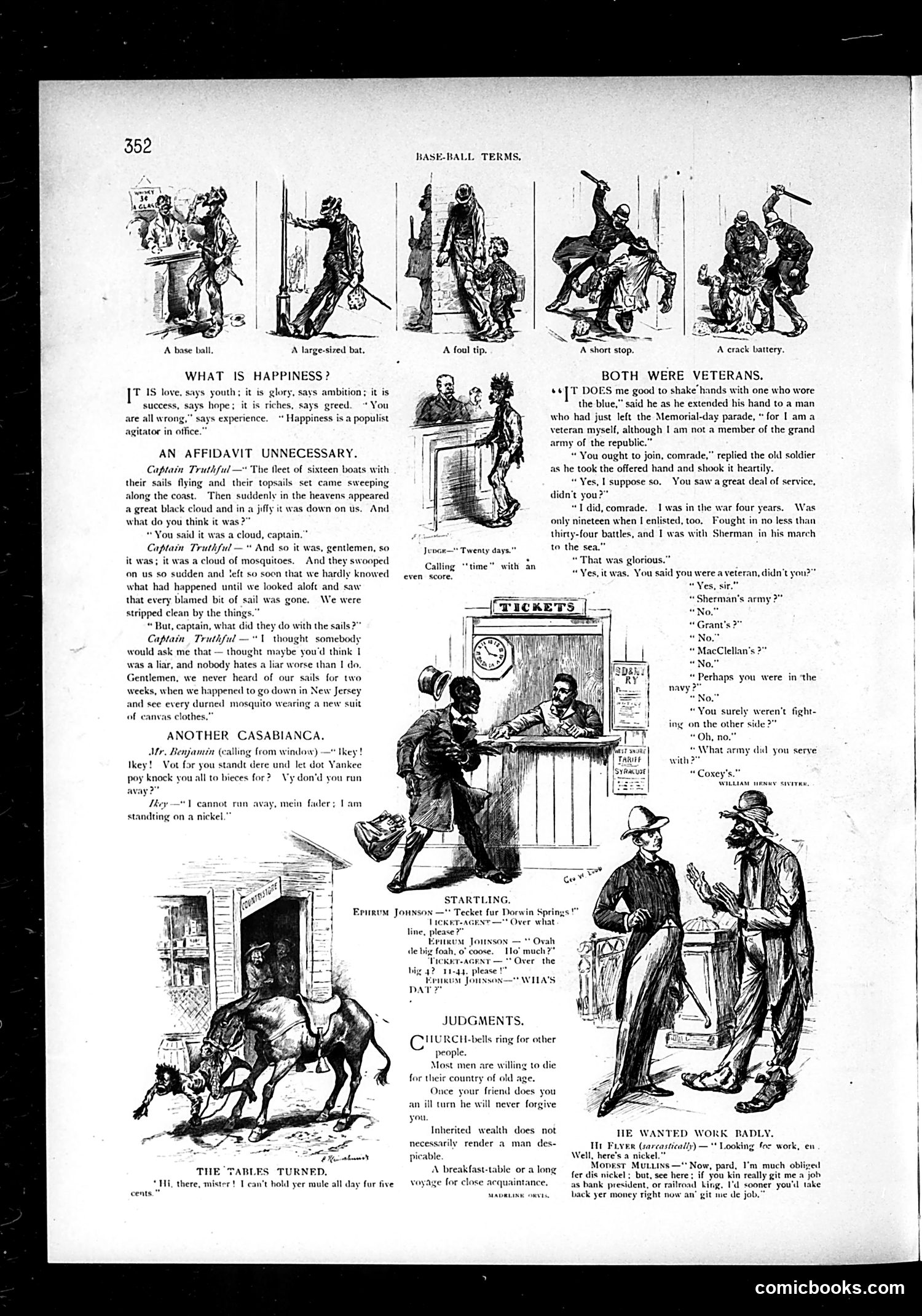
This page contains multiple unrelated humorous pieces typical of Judge magazine's format. **Top section**: "Base-Ball Terms" illustrates baseball positions/plays as physical comedy—slapstick drawings of players in exaggerated poses labeled "A base ball," "A large-sized bat," "A short stop," and "A crack battery." **Main stories include**: - "What is Happiness?"—a brief philosophical joke - "Both Were Veterans"—two Civil War veterans meet; one admits he wasn't actually in the war but claims veteran status anyway, then reveals he served under "Coxey's" (likely Coxey's Army, a 1894 labor protest march) - "An Affidavit Unnecessary"—an exaggerated tall tale about mosquitoes stealing sails - "Another Casabianca"—a Jewish immigrant boy (dialect humor) won't move from a spot because he's standing on a nickel - "Startling," "Judgments," and "He Wanted Work Badly"—brief joke dialogues The humor relies on period stereotypes, dialect comedy, and situational absurdism rather than political commentary.
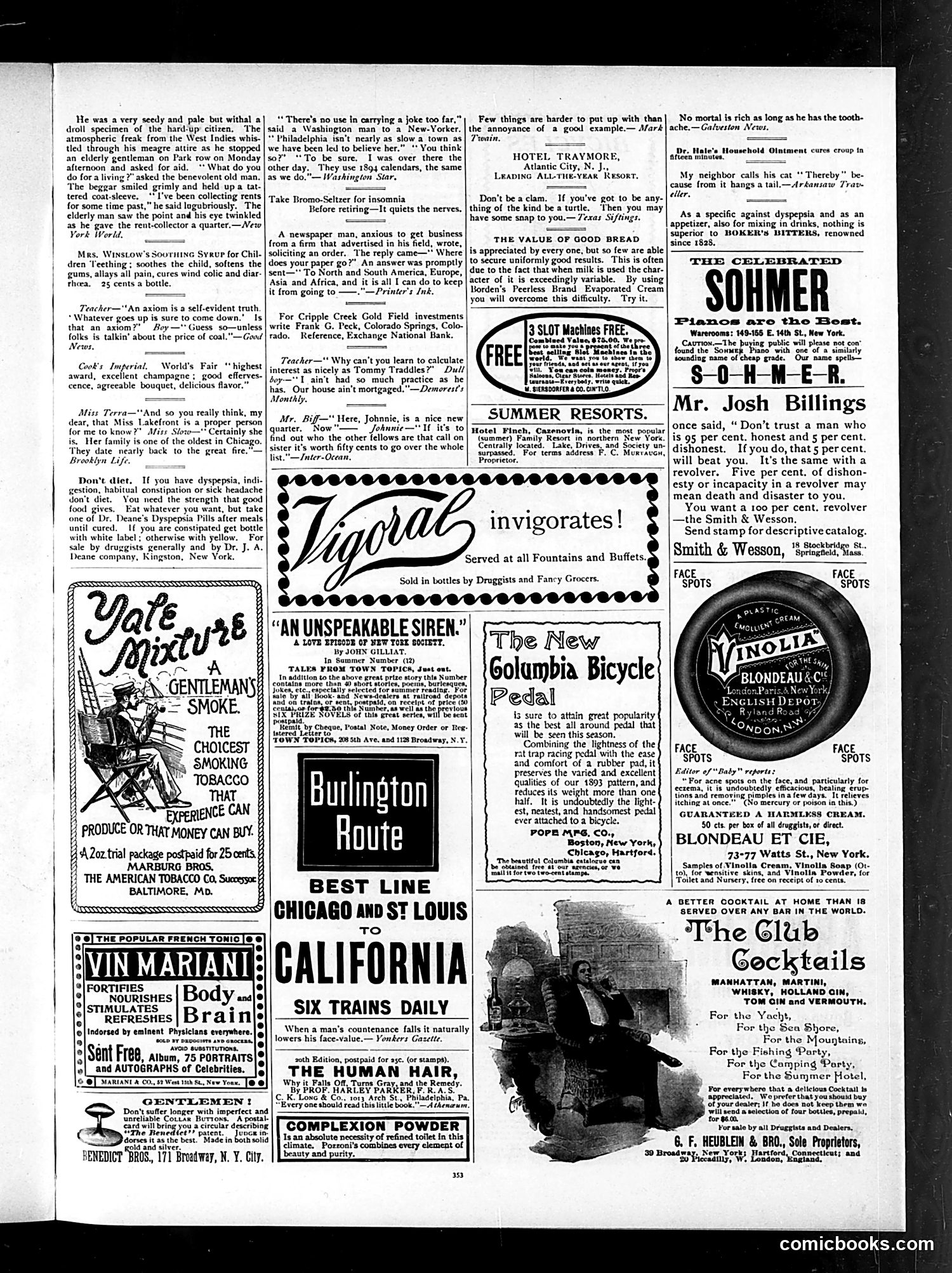
This page from Judge magazine is primarily **advertising**, with a few short humorous anecdotes interspersed. The cartoons/jokes are brief, conversational pieces rather than visual cartoons: **The humor pieces** are workplace and social satire reflecting turn-of-the-century American concerns: - A beggar's wordplay about being a "rent-collector" - A boy's quip about coal prices being an axiom that "goes up" but doesn't come down (economic commentary on rising costs) - A teacher-student exchange mocking mortgage debt - Regional rivalry between Philadelphia and Washington, D.C. over modernization (Philadelphia still using 1894 calendars) **The advertisements** promote products typical of the era: tobacco, champagne, dyspepsia pills, cough syrup, complexion powder, and patent medicines—reflecting both consumer culture and contemporary health anxieties. Judge's satirical voice appears mainly in the advertising copy itself.
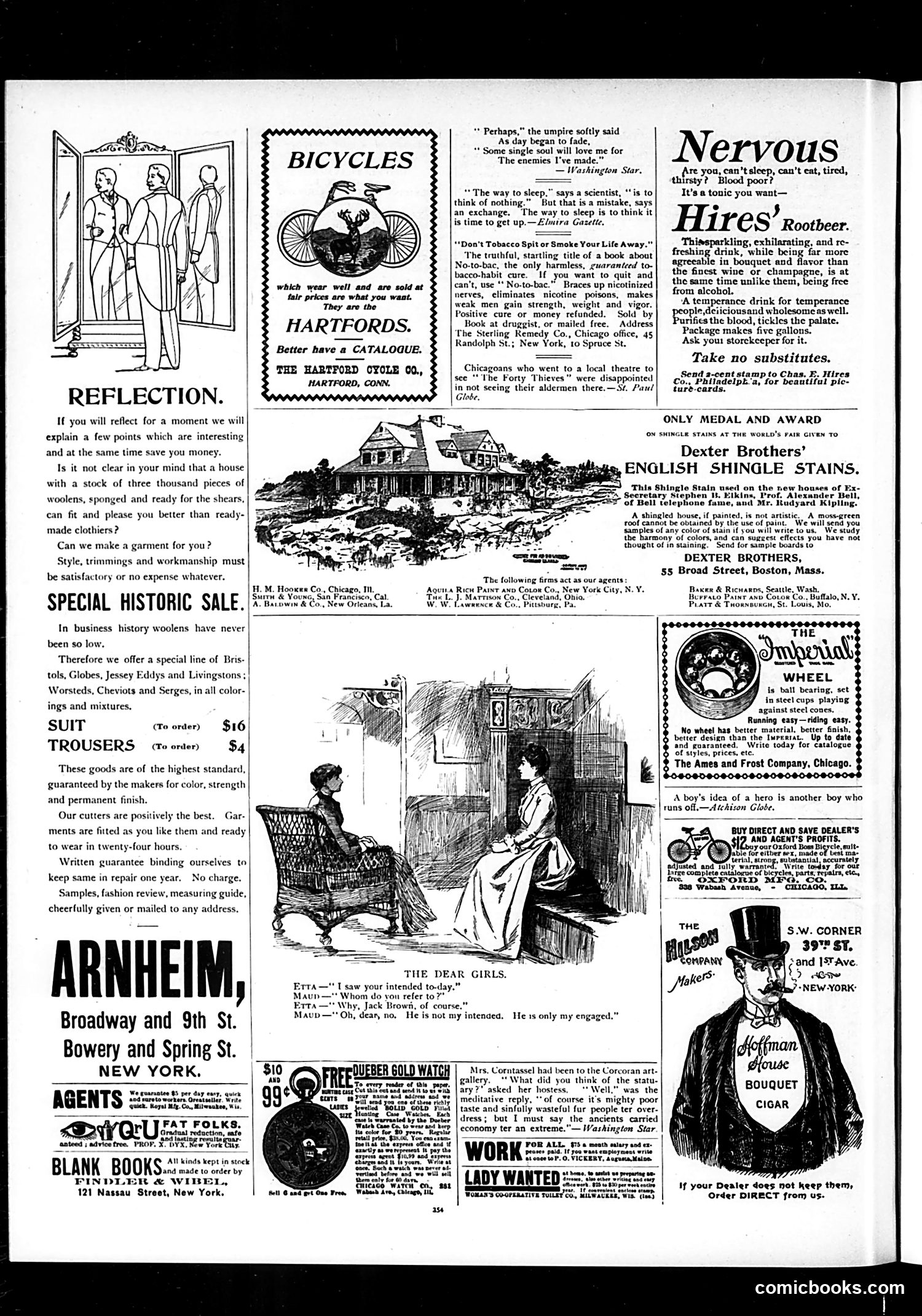
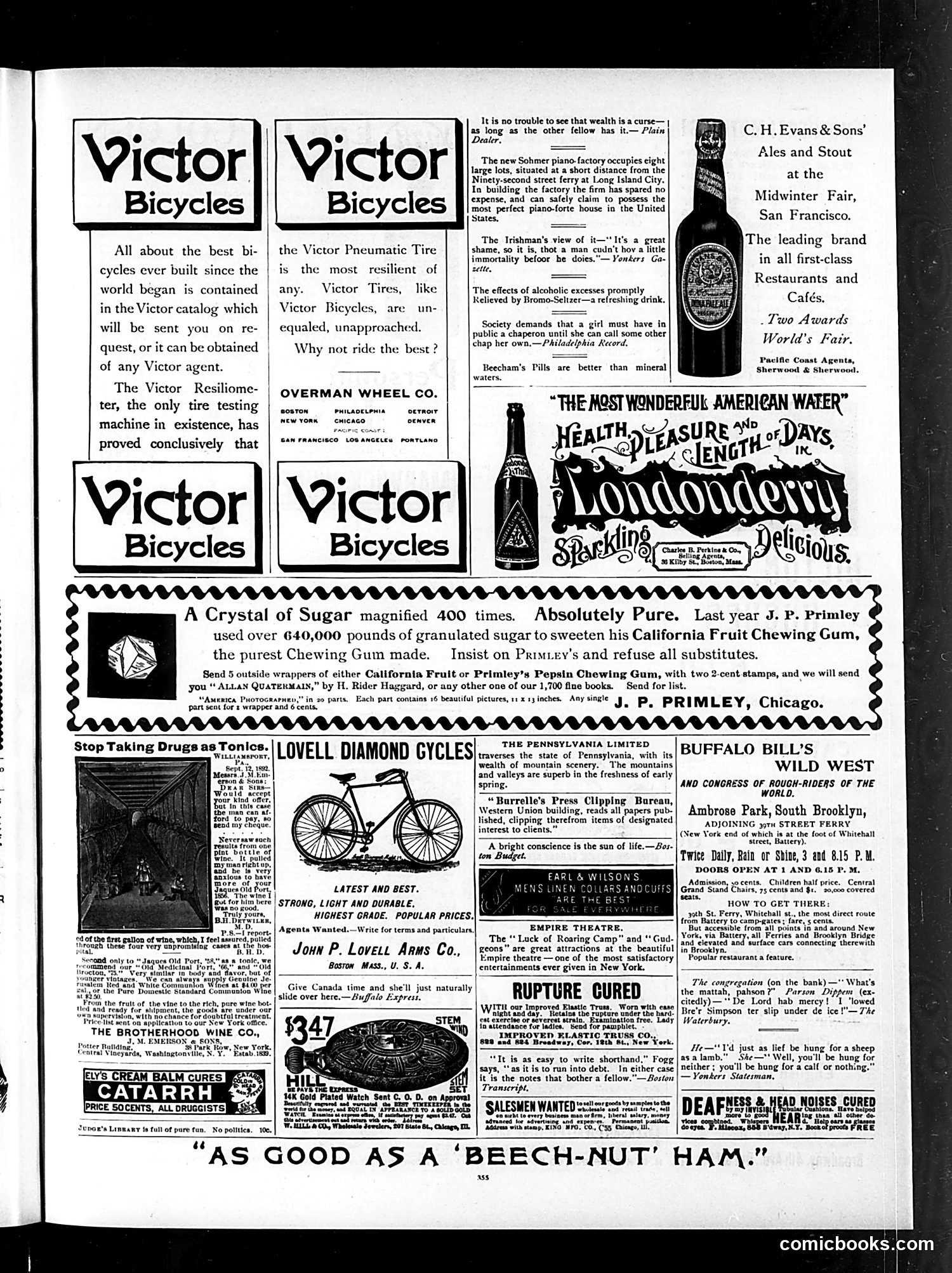
This page is primarily **advertising**, not political satire. It contains multiple commercial advertisements for bicycles (Victor, Lovell Diamond), chewing gum (Primley's), beverages (ale, wine), and other products typical of late 19th-century publications. The small quoted sections interspersed are brief satirical observations rather than cartoons: - An Irish stereotype joke about wanting "immortality" before death - A comment on wealth being a "curse" when someone else possesses it - Social commentary on women needing chaperones These represent the magazine's characteristic light satire—gentle, class-conscious humor poking at social conventions and ethnic stereotypes common to the era. However, **no specific political figures or events are referenced** on this page. The content reflects Judge's typical mix of advertising revenue and social observation rather than hard-hitting political cartooning.
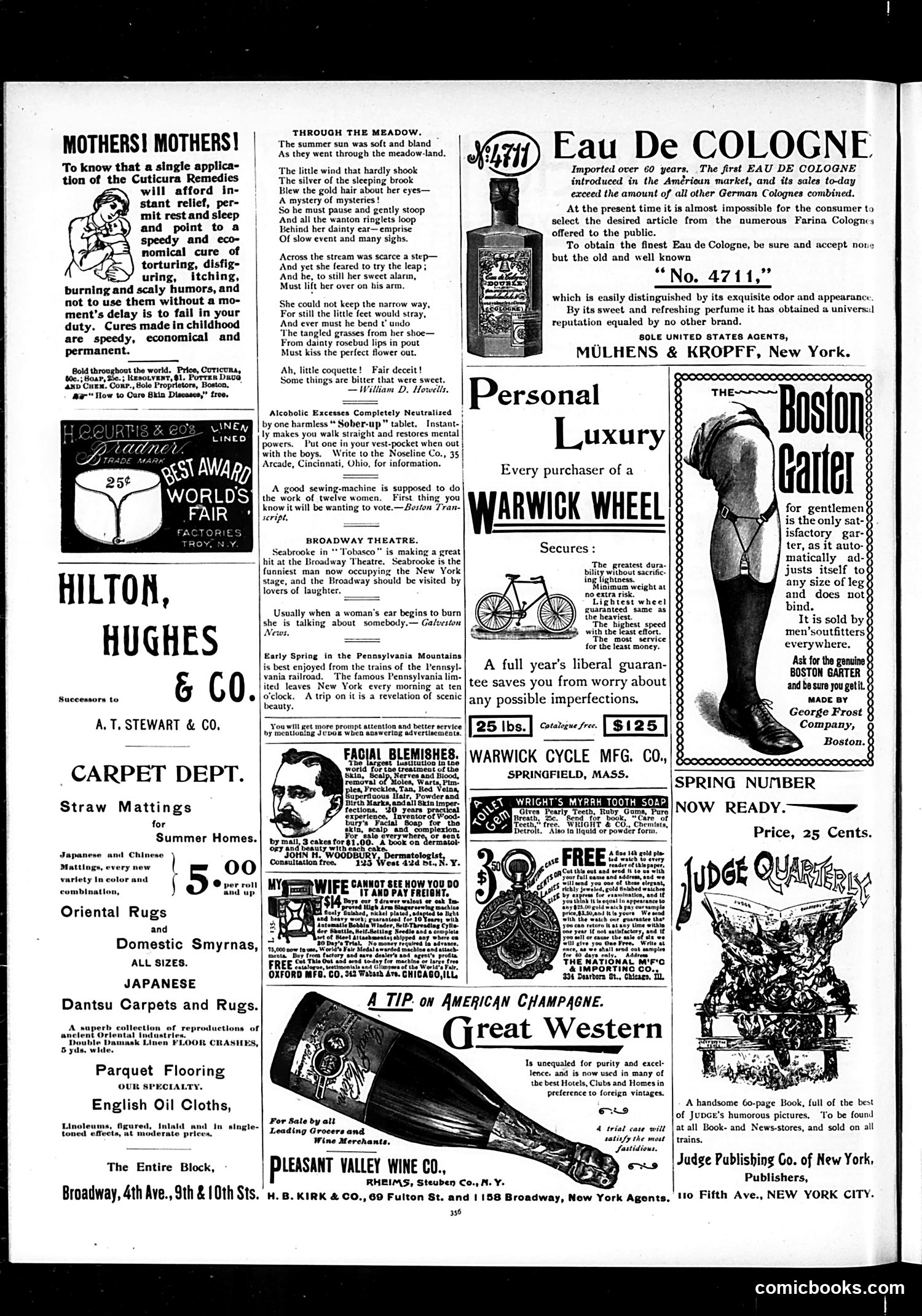
This is primarily an **advertising page** from Judge magazine, not a political cartoon. The page contains multiple commercial advertisements for products and services typical of the era, including: - **Cuticura Remedies** (skin treatments for children) - **Carpet and home furnishings** (Hilton, Hughes & Co.) - **Eau de Cologne** (imported fragrance) - **Warwick bicycles** (with a full-year guarantee) - **Boston Garter** (men's hosiery) - **Facial blemish treatments** and a "Sober-up" tablet The page also includes a **sentimental poem** titled "Through the Meadow" by William D. Howells about courtship. There are scattered **brief satirical quips** (typical of Judge's style): - A joke suggesting sewing machines will want voting rights - Commentary on women's gossip causing "burning ears" The page reflects **turn-of-century consumer culture** and advertising rather than substantive political satire or cartooning.
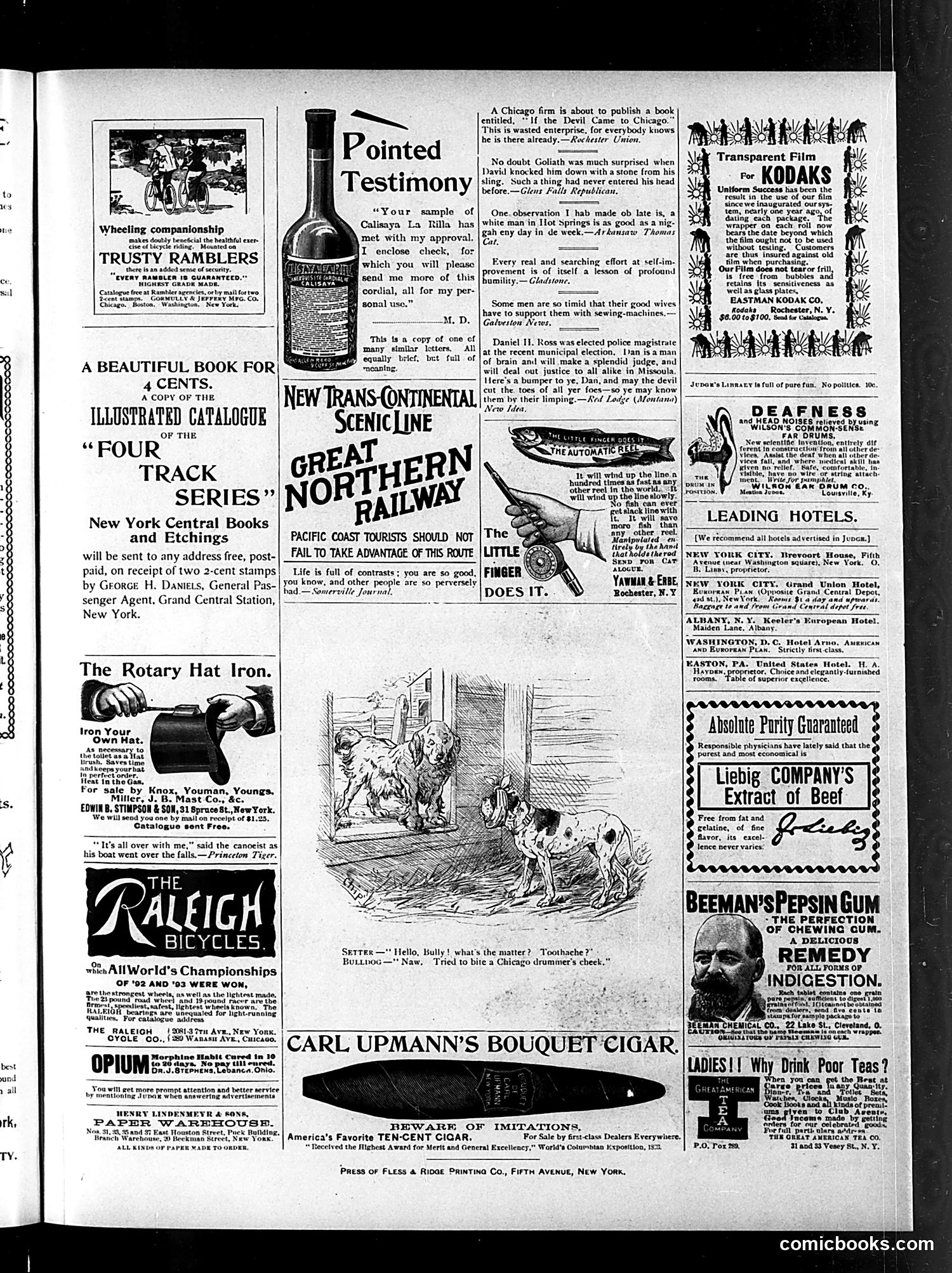
This page is primarily **advertisements interspersed with editorial passages**, not a coherent cartoon. The central feature—"Pointed Testimony"—shows testimonial quotes from newspapers and individuals endorsing products (Calisaya cordial, etc.). These brief excerpts mock small-town newspaper writing and provincial attitudes. The editorial snippets themselves contain light satirical observations: one sardonically notes a Chicago firm wasting effort publishing "If the Devil Came to Chicago" when "everybody knows he is there already"; another uses a racial slur while making commentary on class hierarchism in Hot Springs. The **bottom cartoon** shows a bulldog and setter dog—the setter boasts it bit a "Chicago drummer" (traveling salesman) in the cheek, implying these salesmen were stereotypically rude or obnoxious figures worthy of animal retaliation. Overall, this is a typical Judge page mixing advertisements with brief satirical commentary targeting small-town America, traveling salesmen, and urban pretension.
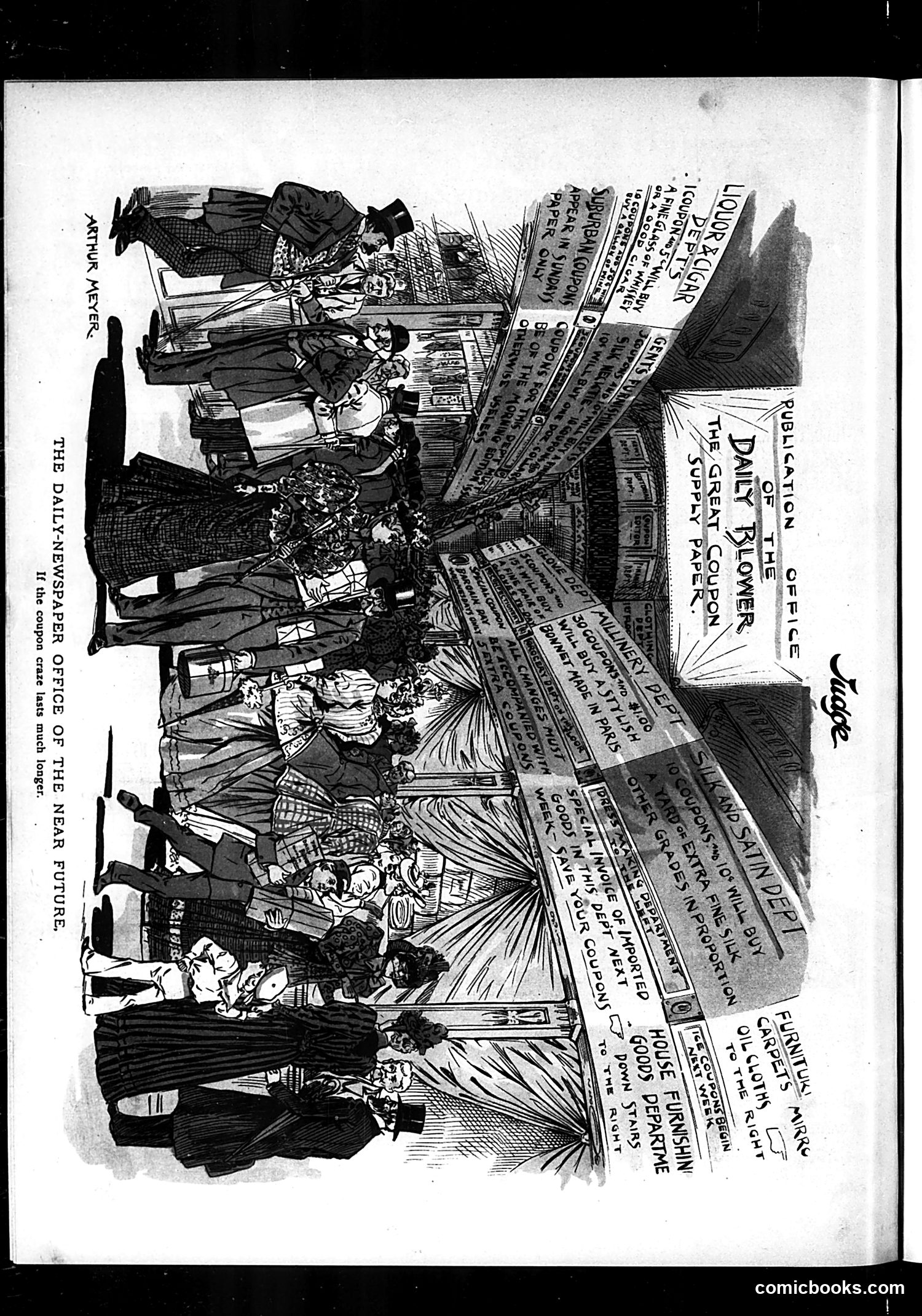
This cartoon by Arthur Meyer satirizes the "coupon craze" of the early 20th century. It depicts a newspaper office buried under an avalanche of paper coupons—promotional vouchers that newspapers printed to boost circulation and advertising revenue. The joke warns that if coupon proliferation continues unchecked, newspaper offices will be completely overwhelmed by the physical volume of these paper promotions, making actual newspaper work impossible. The staff appears dwarfed by towering stacks labeled with coupon offers and savings deals. This reflects genuine anxiety about how commercial gimmickry was transforming journalism. The satire suggests the coupon trend, while profitable short-term, threatens to consume and destroy the newspaper industry itself—a prophetic concern about prioritizing marketing over editorial integrity.