
A complete issue · 16 pages · 1894
Judge — January 6, 1894
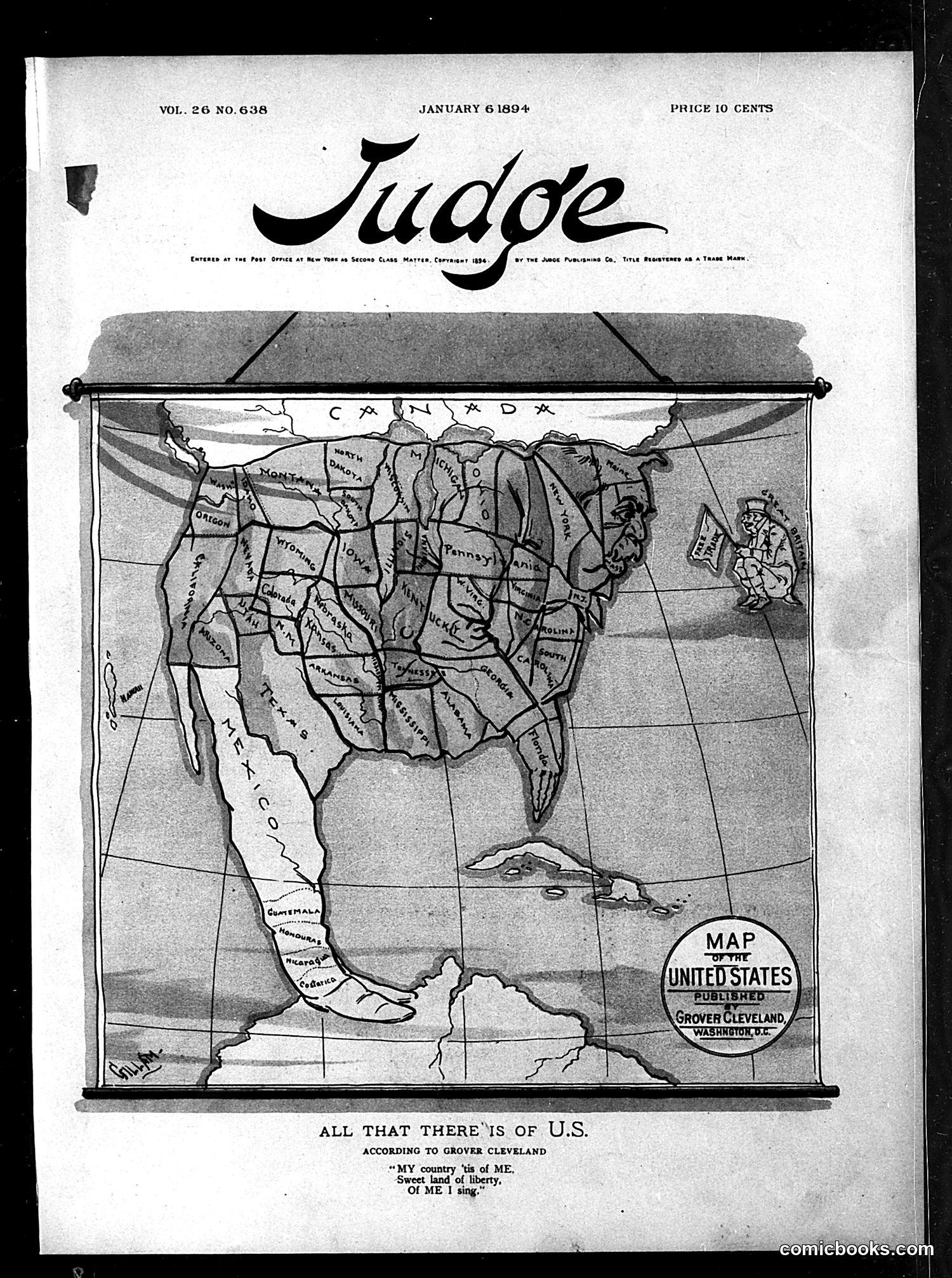
This satirical map from Judge magazine presents a distorted view of the United States titled "All That There Is of U.S. According to Grover Cleveland," with the quote "My country 'tis of ME. Sweet land of liberty, Of ME I sing." The cartoon mocks President Grover Cleveland by suggesting he views the entire nation as his personal property. The exaggerated map shows the continental U.S. with Cleveland's face prominently featured in the northeast, implying his egocentrism or overreach of presidential power. The 1894 date places this during Cleveland's second term, likely criticizing his handling of economic policy during the Panic of 1893 or his controversial political appointments. The satire suggests Cleveland prioritized personal interests over national welfare.
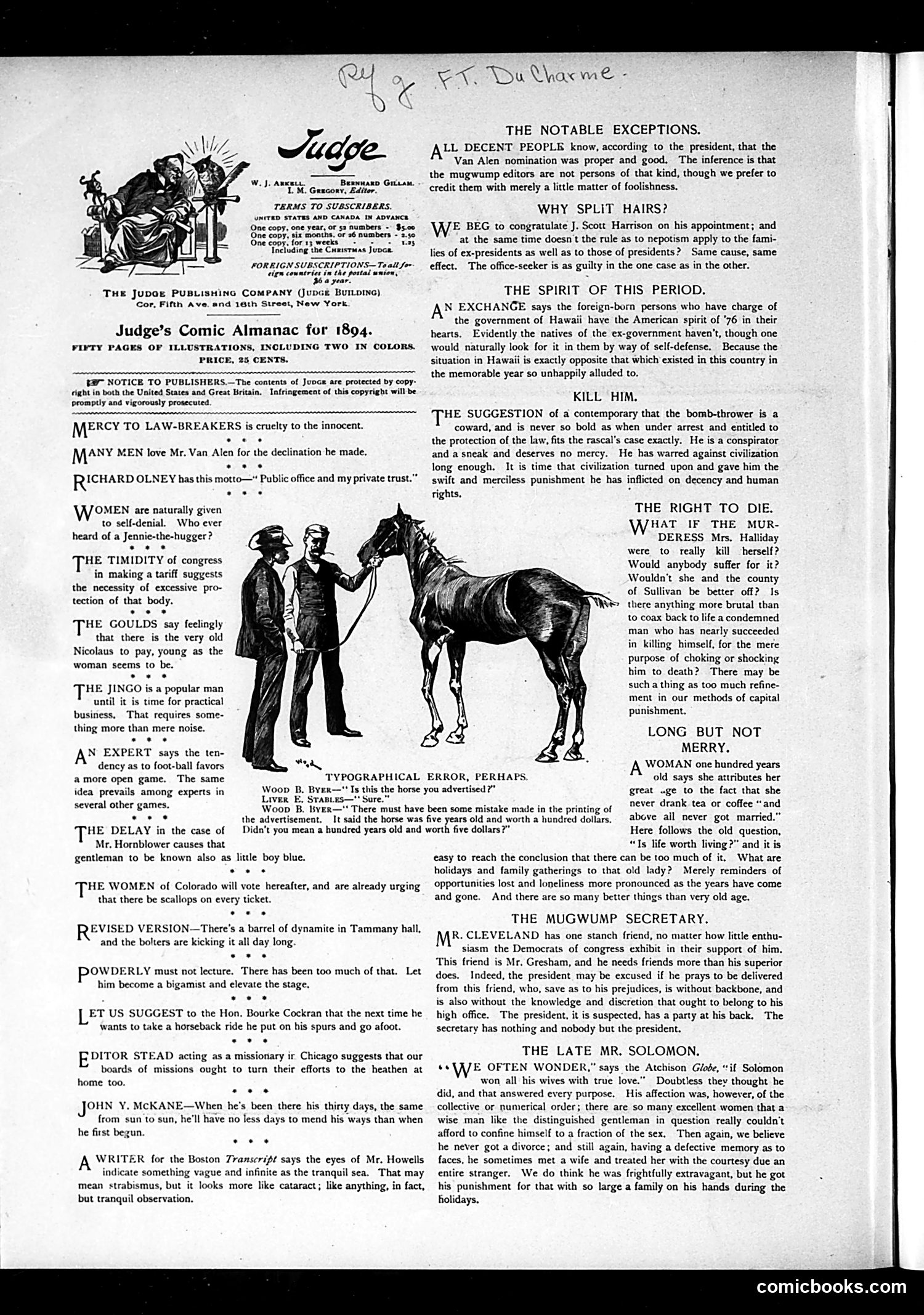
This page contains editorial commentary and satirical pieces rather than a primary political cartoon. The main illustrated content shows two men examining a horse, captioned "TYPOGRAPHICAL ERROR, PERHAPS," mocking a newspaper advertisement error—the horse was described as five years old and worth a hundred dollars, but the ad accidentally reversed these numbers. The text pieces target various subjects: Van Allen's presidency nomination, congressional tariff protection, women's voting rights, and capital punishment debates. One section discusses whether condemning someone like Mrs. Halliday to death for murder is justified, questioning if execution is "too much refinement" for punishment. The page reflects Judge's role as social and political satire aimed at educated readers of the 1880s, addressing governance, justice, and contemporary controversies.
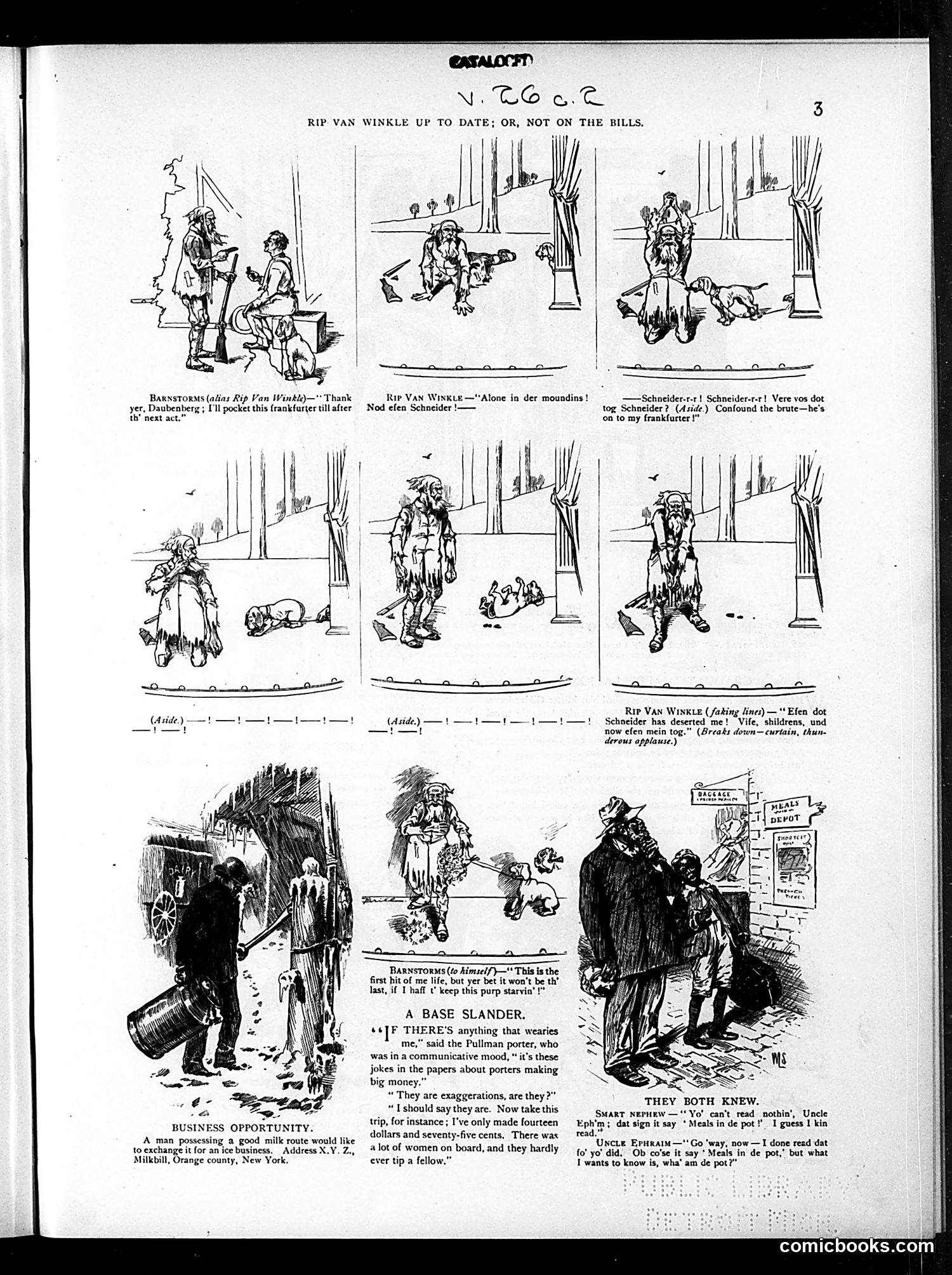
This page satirizes the legendary Rip Van Winkle character as a destitute vagrant in contemporary urban settings. The sequential comic strips show Rip encountering various people—a Schneider, Barstorm, and others—who don't recognize him or offer help. The joke appears to be about economic hardship and social indifference: even a famous (fictional) person becomes invisible when poor and without resources. The lower sections include unrelated content: "A Base Slander" mocks Pullman porters' tipping practices, while "They Both Knew" presents a dialogue about meat prices at the market. "Business Opportunity" advertises a milk route sale. The overall theme reflects Gilded Age anxieties about poverty, forgotten people, and economic precarity amid urban indifference.
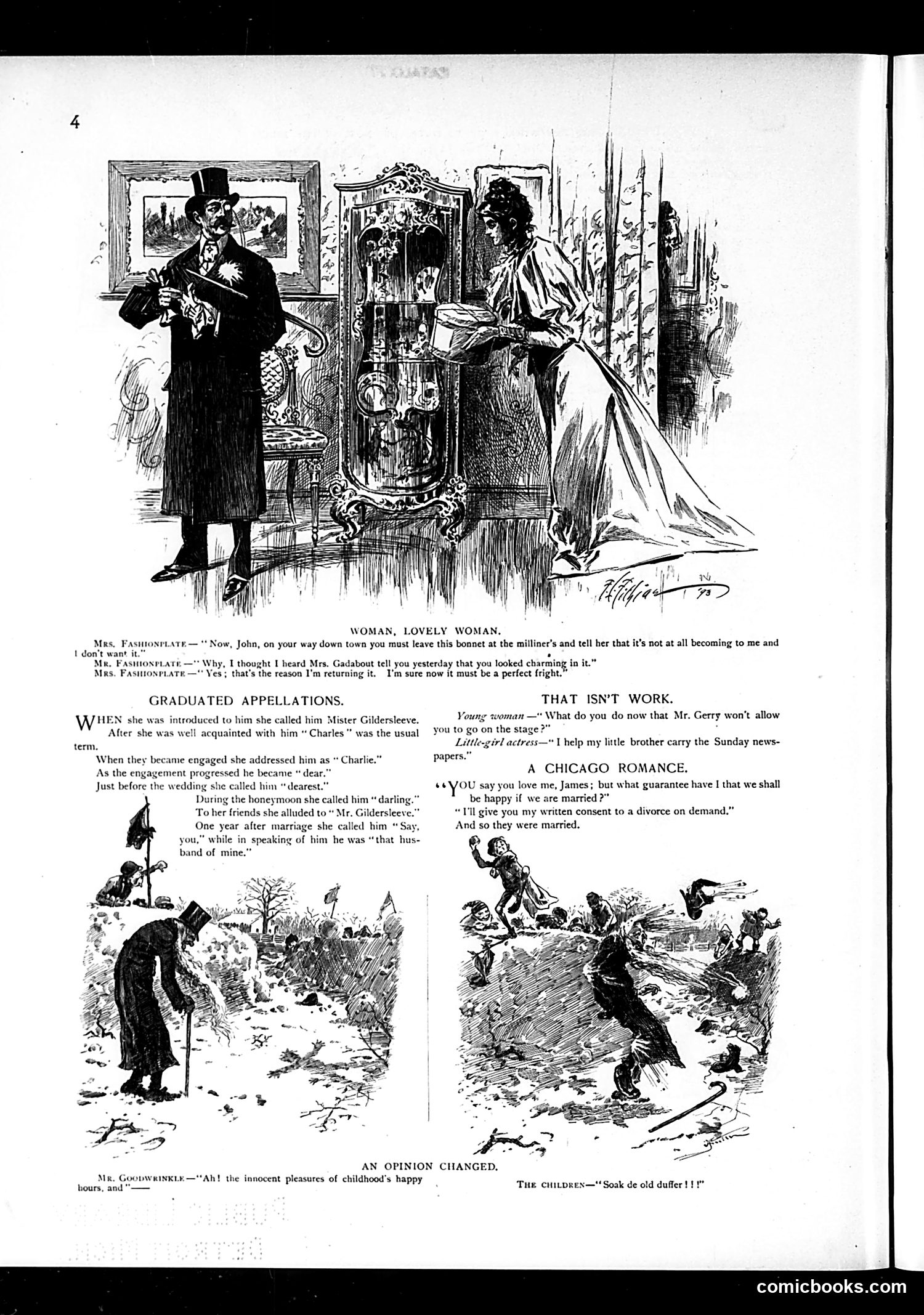
This page contains several satirical vignettes mocking courtship, marriage, and social conventions of the era. **"Woman, Lovely Woman"** ridicules a wife's vanity—she rejects a fashionable bonnet solely because a rival (Mrs. Gadabout) complimented her in it, preferring to appear unfashionable rather than agree with another woman. **"Graduated Appellations"** traces how a woman's terms of endearment for her husband devolve from formal ("Mr. Gildersleeve") through intimacy ("darling") back to dismissive ("that husband of mine"), satirizing how marriage cools romantic ardor. **"That Isn't Work"** jokes darkly about child labor—a girl whose theatrical ambitions were thwarted now works as a newspaper carrier. **"A Chicago Romance"** mocks modern pragmatism: a couple marries only after the groom provides written divorce consent, reducing marriage to a business transaction. **"An Opinion Changed"** shows children rudely rejecting an adult's sentimental nostalgia about childhood innocence, suggesting children themselves are uncouth. The overall tone critiques vanity, marital disillusionment, and cynicism in contemporary American society.
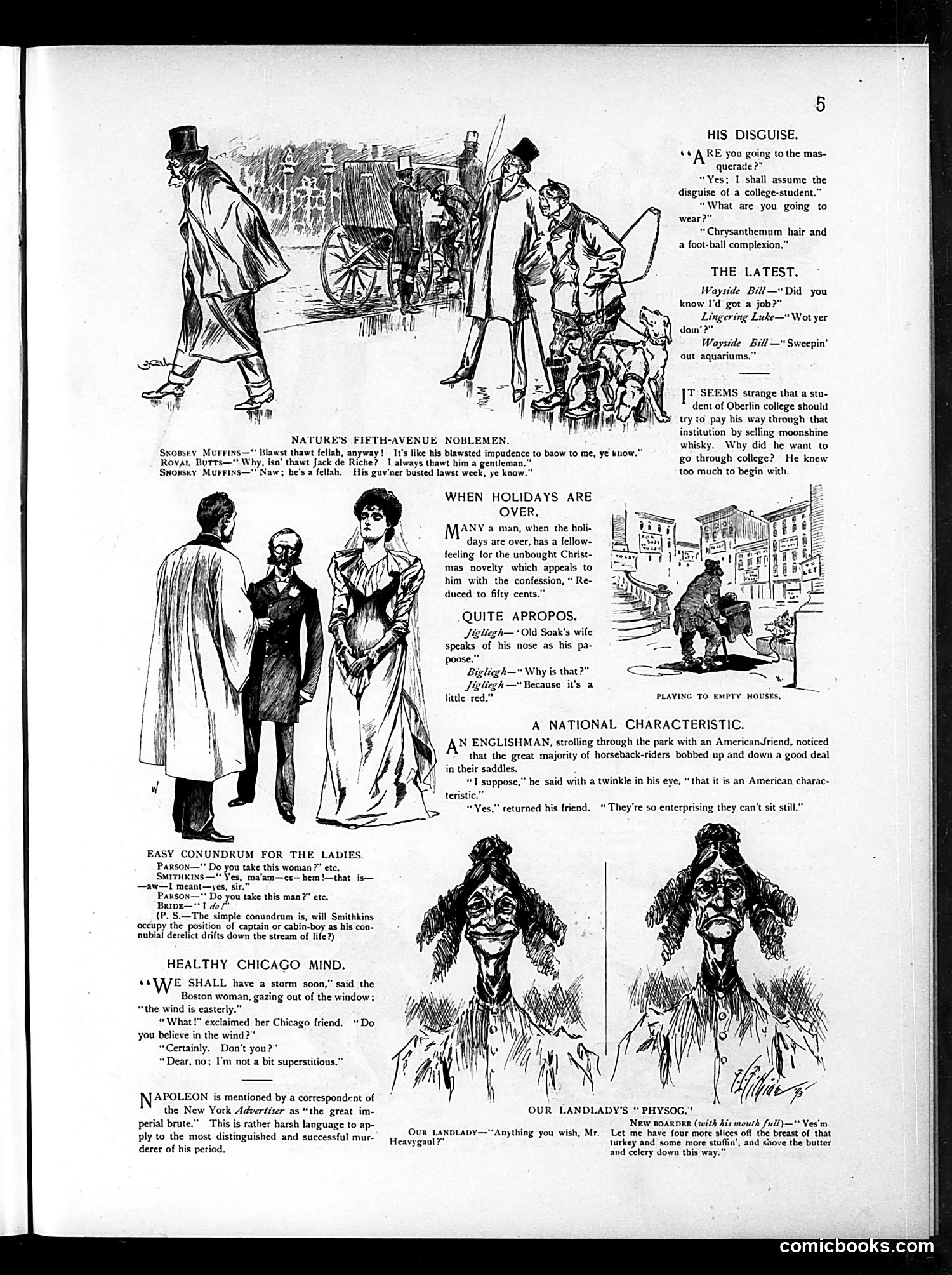
This page contains multiple brief satirical pieces typical of late 19th/early 20th-century humor: **"His Disguise"** mocks college students by suggesting the ultimate disguise is dressing as one—implying students are recognizable by their distinctive appearance (wild hair, athletic complexion). **"Nature's Fifth-Avenue Noblemen"** uses exaggerated upper-class British accents to satirize wealthy aristocrats concerned with social status, particularly those whose fortunes have recently collapsed. **"A National Characteristic"** contrasts American and British horseback-riding styles, suggesting Americans' constant fidgeting reflects national restlessness and inability to be still—a common contemporary stereotype. **"Healthy Chicago Mind"** ridicules Chicagoans as superstitious by inverting logic: a Bostonian's belief in wind is called superstition by the Chicago woman, who ironically claims not to be superstitious while displaying illogical thinking. The page primarily uses social observation humor targeting class pretensions, regional characteristics, and collegiate life, with minimal political content.
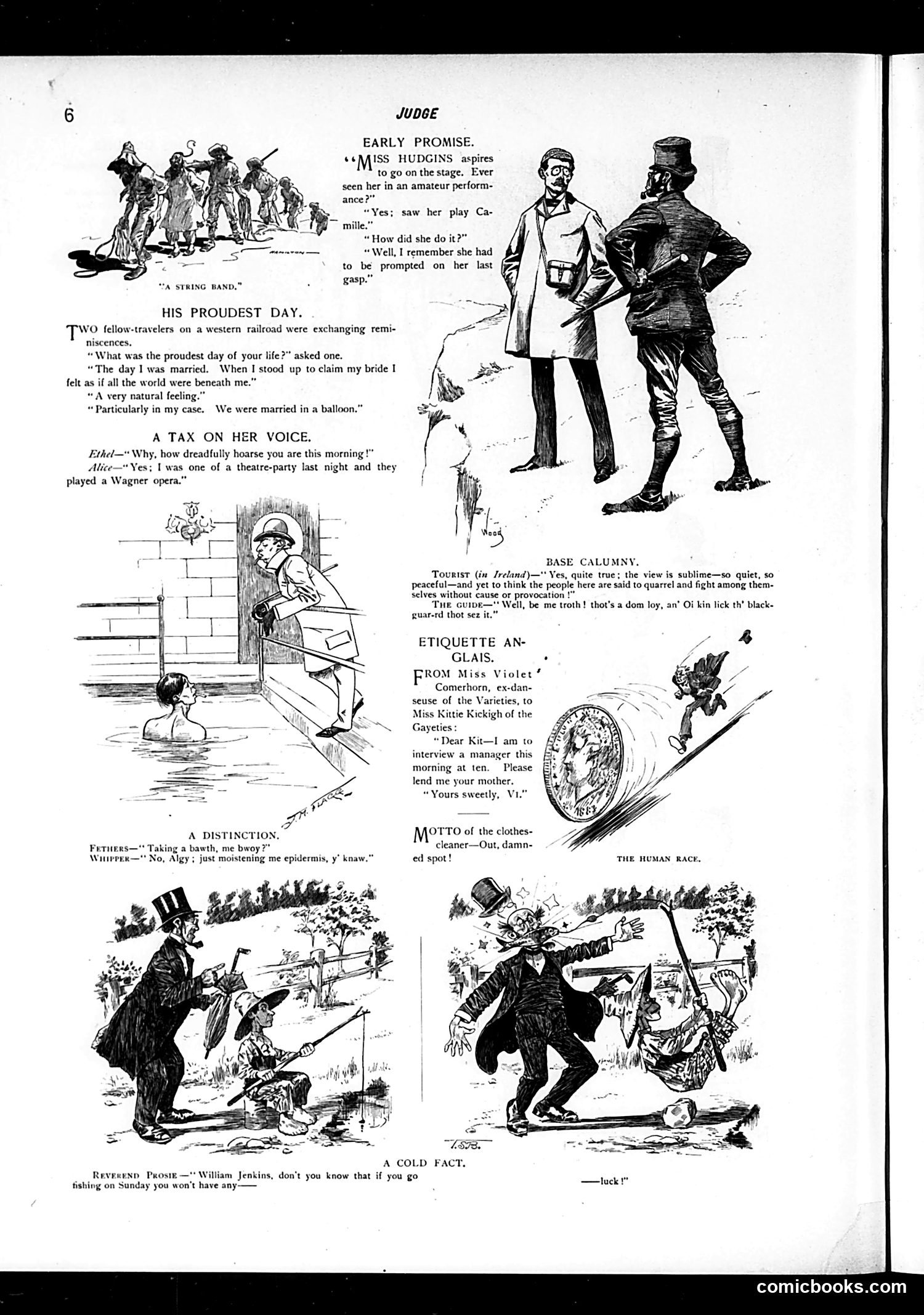
This page contains several short humorous sketches typical of late 19th/early 20th-century American satire: **"Early Promise"** mocks amateur performers—Miss Hudgins aspires to stage acting but needs prompting, suggesting she lacks talent. **"His Proudest Day"** jokes about a man married in a balloon, feeling superior while literally elevated above the world. **"A Tax on Her Voice"** satirizes Wagner's opera as so demanding it causes hoarseness—a common complaint about Wagner's notoriously difficult, loud compositions. **"Base Calumny"** stereotypes Irish people as quarrelsome, with an Irish guide immediately proving the slander by threatening violence. **"Etiquette Anglais"** satirizes wealthy social climbers: a former dancer borrows another woman's mother to appear respectable during a manager interview. **Lower sketches** contain class humor about bathing and fishing superstitions. The page reflects period prejudices and social anxieties about theater, class status, ethnicity, and cultural sophistication.
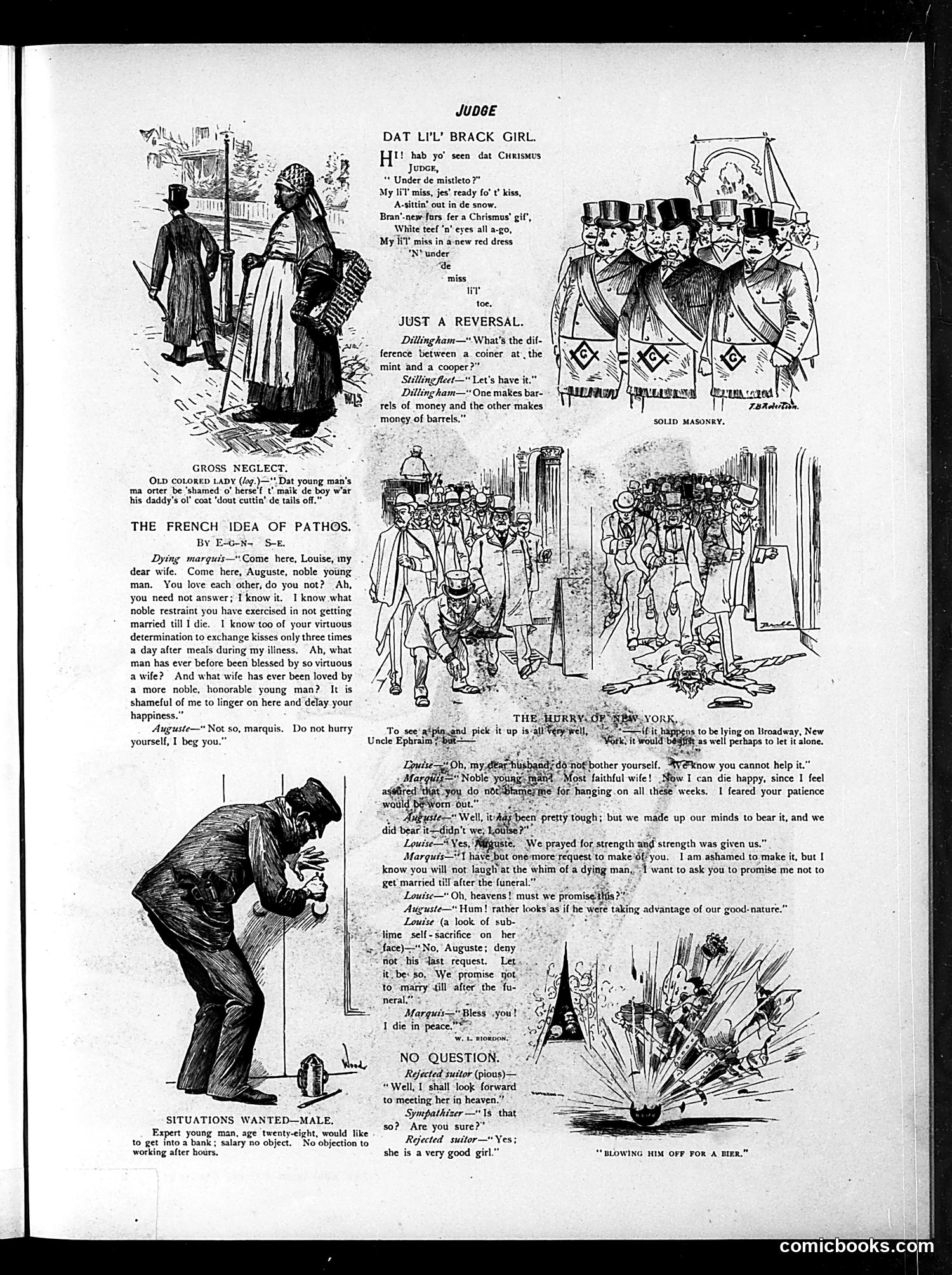
This page contains several satirical pieces typical of late-19th-century American humor: **"Dat Li'l' Brack Girl"** uses racist dialect humor, a common (and deeply offensive) comedic convention of the era, depicting Black characters in stereotypical situations. **"Just a Reversal"** is a simple wordplay joke about coiners versus coopers, playing on "barrels of money" versus "money of barrels." **"The French Idea of Pathos"** satirizes French melodrama—mocking the overwrought sentimentality of French romantic literature where a dying marquis nobly encourages his wife and young lover to marry after his death, with exaggerated emotional declarations. The satire suggests French dramatic conventions are absurdly self-sacrificial and theatrical. **"No Question"** and **"Situations Wanted"** are brief joke items about courtship and employment. The cartoons throughout use Victorian-era illustration styles depicting social situations. The overall page reflects Judge's satirical approach to contemporary culture, literature, and social customs, though much content relies on ethnic stereotyping now recognized as offensive.
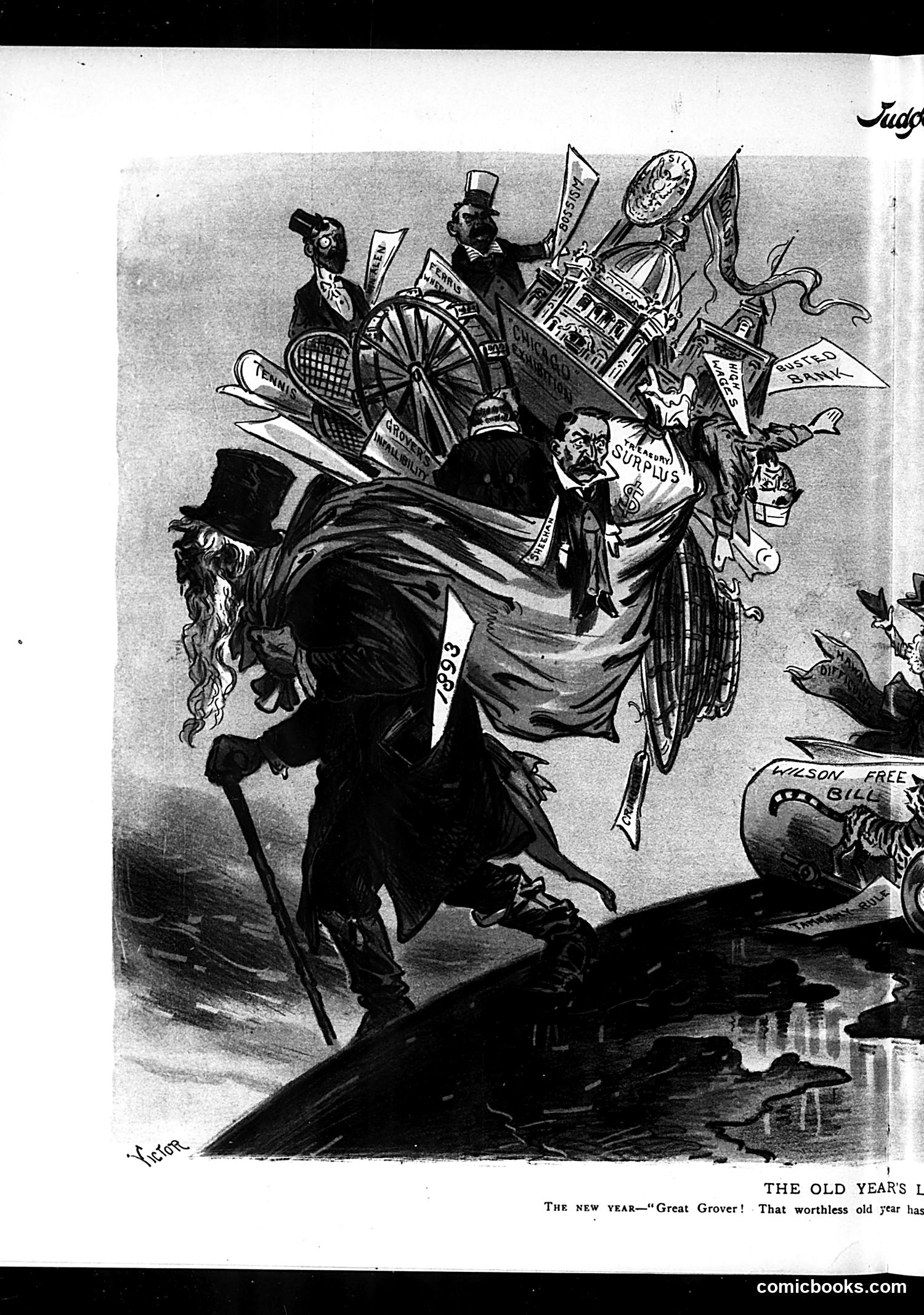
This is a New Year's themed political cartoon from *Judge* magazine. An elderly, decrepit figure labeled "1893" (the old year) struggles beneath a massive burden of various items and figures representing the year's problems and scandals. A demonic or devilish character carries this chaotic load, suggesting the old year has been laden with troubles. The caption references "Great Grover" (likely President Grover Cleveland), expressing relief that the problematic year is departing. The cartoon satirizes 1893—a year marked by economic depression, financial panic, and political turmoil during Cleveland's presidency. The visual metaphor of casting off a burdensome, worthless year comments on public dissatisfaction with recent events and political failures, hoping the new year will bring improvement.
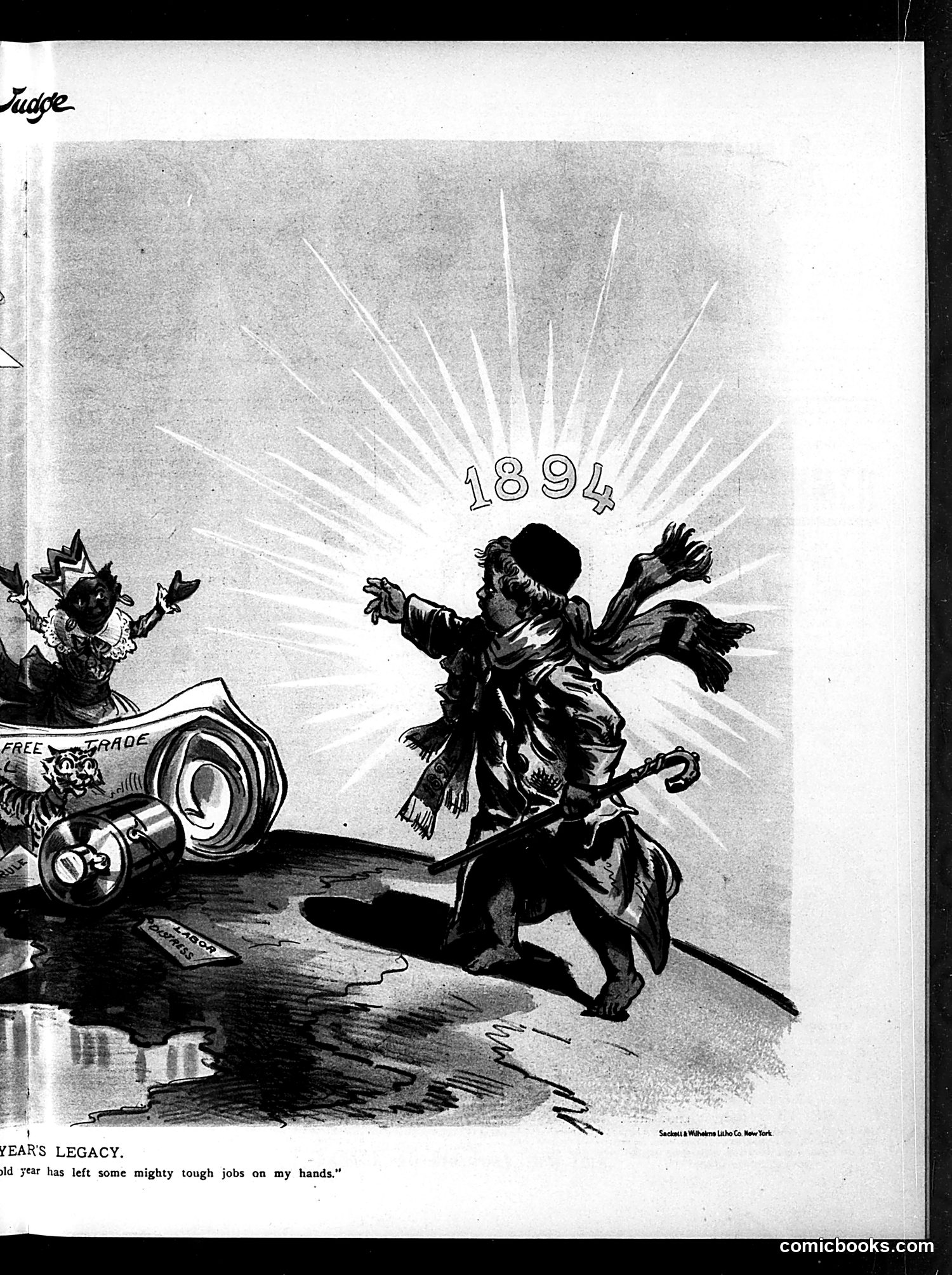
This political cartoon depicts the transition between years, showing an outgoing figure (representing the "old year") passing responsibilities to an incoming one (the "new year," labeled "1894"). The exhausted departing figure, dressed in tattered clothing and appearing disheveled, gestures helplessly at various problems he's leaving behind—depicted as explosive devices or troublesome objects scattered on the ground. The caption—"The old year has left some mighty tough jobs on my hands"—emphasizes that the incoming year inherits significant unresolved challenges from its predecessor. This was a common satirical format in Judge magazine, using personified years to comment on ongoing political and social crises America faced. The specific problems of 1893-1894 remain unclear without additional context, but likely reference economic hardship, labor disputes, or political controversies of that era.
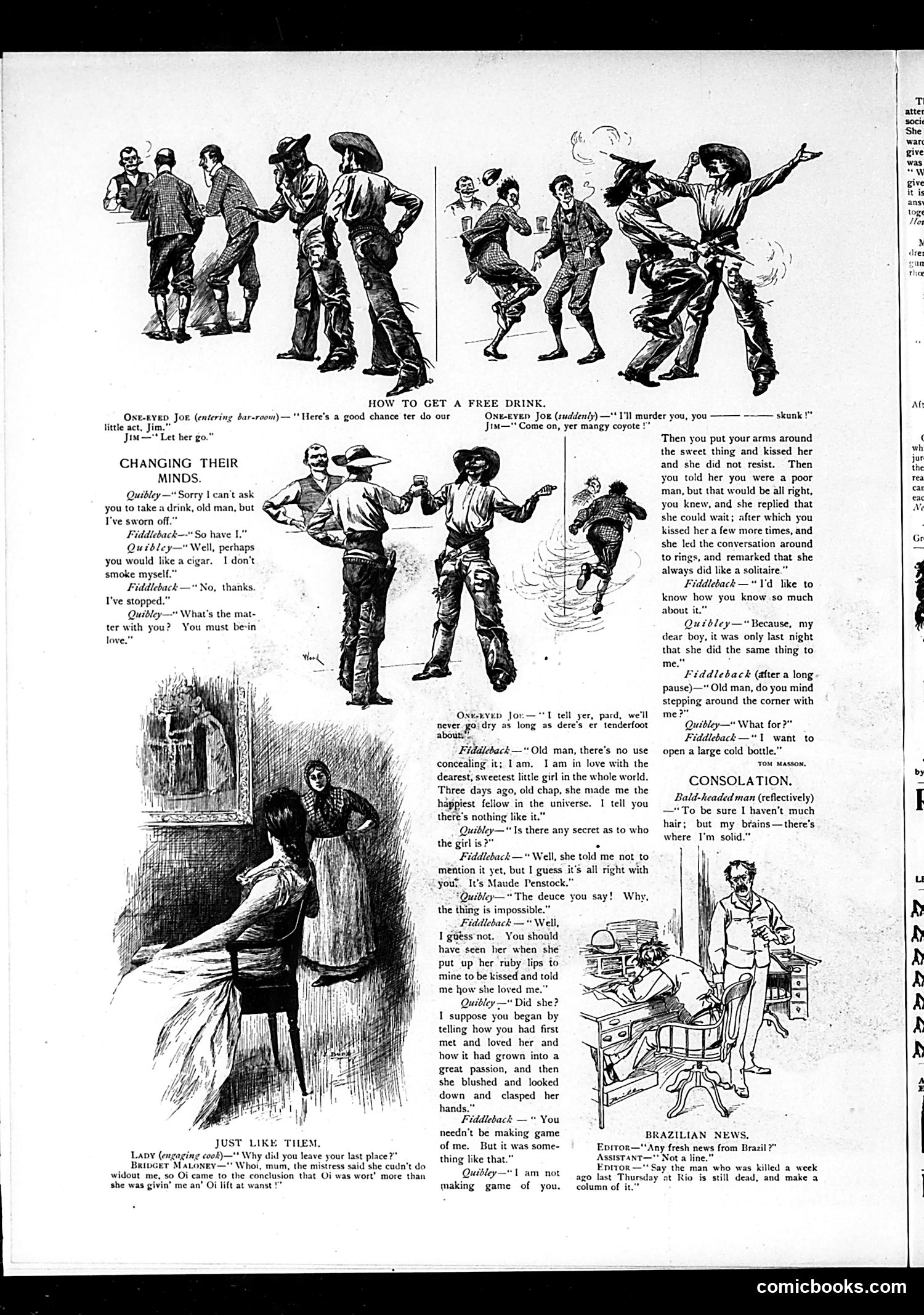
This page contains several standalone comic dialogues satirizing romantic deception and male behavior in the late 19th/early 20th century. **"Changing Their Minds"** mocks men who claim to have reformed (sworn off drinking/smoking) but abandon their principles when tempted. The humor lies in their hypocrisy. **"How to Get a Free Drink"** depicts saloon roughnecks staging a fake fight to impress a bartender into giving them free drinks—satirizing working-class saloon culture and masculine posturing. **"Just Like Them"** shows a dismissive employer (likely upper-class) rejecting a servant's (Irish, suggested by dialect) request for a raise, indifferent to her hardship. The central dialogue about "Fiddleback" and "Quibley" mocks serial seduction—both men have seduced the same woman (Maude Penstock) using identical romantic manipulation tactics, suggesting men's rehearsed, interchangeable courtship performances. **"Brazilian News"** is a brief joke about journalistic padding—reporting a man's death as ongoing "news" for lack of actual stories. The satire targets masculine dishonesty, class indifference, and period journalism conventions.
This is primarily an **advertising page** from Judge magazine, interspersed with brief humorous anecdotes rather than political cartoons. The notable content includes: **The anecdotes** are gentle social humor: a child's innocent religious rebuttal about docking horses' tails; a Wellesley girls' poem joking about wanting men ("World without men—ah, me!"); and a juror refusing to deliver a verdict without payment—satirizing venal courtroom practices. **The advertisements** reflect late 19th/early 20th-century consumer products: Packer's Tar Soap for skin conditions, Mrs. Winslow's Soothing Syrup for teething, Bromo-Seltzer hangovers, and various patent medicines—some of dubious efficacy by modern standards. One item mentions **Jennie A. Taylor**, a missionary going to Congo with dental tools and Bibles—gently mocking missionary zeal by combining evangelism with dentistry. There is **no significant political satire** on this page—it's largely commercial, aimed at selling products to Judge's middle-class readership.
This is primarily an **advertising page** from Judge magazine, with minimal editorial content. The few non-commercial items are brief humorous quips typical of the era: **Notable editorial content:** - A jab at **Liliuokalani**, Hawaii's last reigning monarch (deposed 1893), sarcastically praising her for "allowing the men to do all the talking"—mocking both women's limited political voice and colonial attitudes toward Hawaiian sovereignty. - Generic jokes about church socials, "calamity-howlers," and unwise men. **Advertising dominance:** The page features patent medicines ("Duffy's Pure Malt Whiskey," "Vin Mariani" wine tonic), household goods, and upscale products targeting prosperous readers. These ads reveal period attitudes: alcohol marketed as medicinal cure-all, and decorative glass as status symbols for "Private Residences." The page reflects Gilded Age consumer culture and casual imperialism, but contains no sustained satirical cartoons—Judge here functions primarily as a revenue vehicle rather than commentary vehicle.
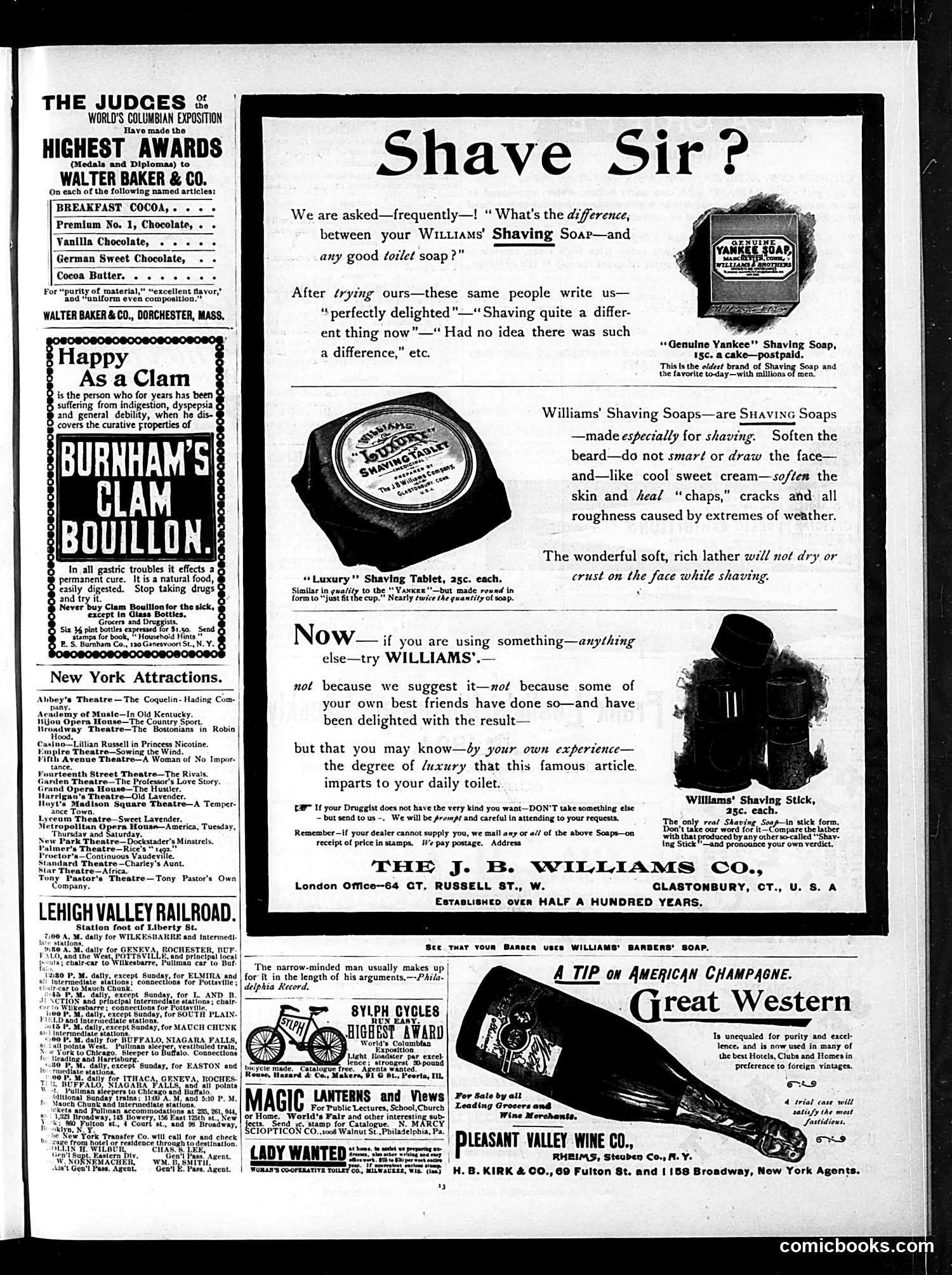
This is **primarily an advertising page**, not a satirical cartoon. The page showcases advertisements for various products marketed to men, reflecting late 19th-century consumer culture. **Main Content:** The dominant advertisement promotes **Williams' Shaving Soaps**, with the headline "Shave Sir?" The ad addresses a common customer question about what differentiates Williams' product from ordinary toilet soap. It emphasizes that Williams' soap is specially formulated for shaving—it softens beards without smarting or drawing the face, and produces a rich lather that won't dry or crust during shaving. **Supporting Advertisements:** - Walter Baker & Co. chocolate products (winning World's Columbian Exposition medals) - Burnham's Clam Bouillon (marketed for digestive ailments) - Lehigh Valley Railroad schedules - Various New York theater attractions - Glyph Cycles bicycles - Magic Lanterns and other products The page reflects consumer aspirations and the emerging modern advertising approach of the 1890s, emphasizing product specialization and testimonial-based marketing rather than satire.
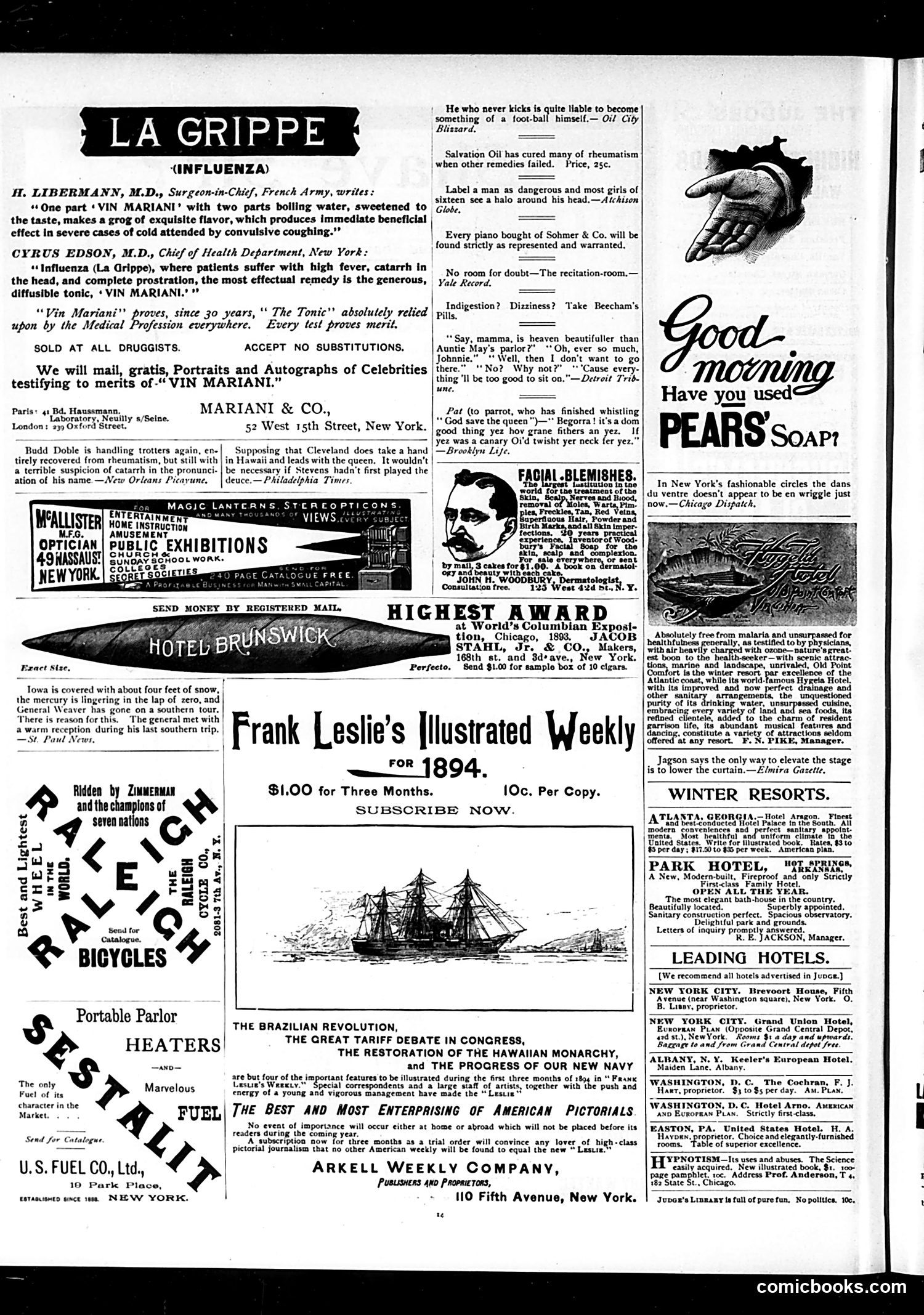
This page is dominated by an advertisement for "Vin Mariani," a patent medicine marketed as a cure for influenza (La Grippe). The ad quotes prominent physicians, including New York's Chief Health Officer Cyrus Edson, endorsing the tonic for treating the flu's symptoms—fever, catarrh, and exhaustion. The satire here is implicit rather than explicit: Judge magazine's inclusion of such dubious medical endorsements reflects contemporary skepticism about quack remedies and the ease with which doctors lent credibility to ineffective tonics. The "testimonials" likely struck readers as absurd—particularly the notion that wine-based medicine could cure a serious illness. Surrounding the main ad are brief humorous notices and advertisements typical of the magazine's format. This 1894 issue also advertises Frank Leslie's Illustrated Weekly and various consumer goods (bicycles, heaters, cigars). The page exemplifies how 1890s magazines blended genuine editorial content with patent medicine advertising, a practice that would eventually face regulatory scrutiny.
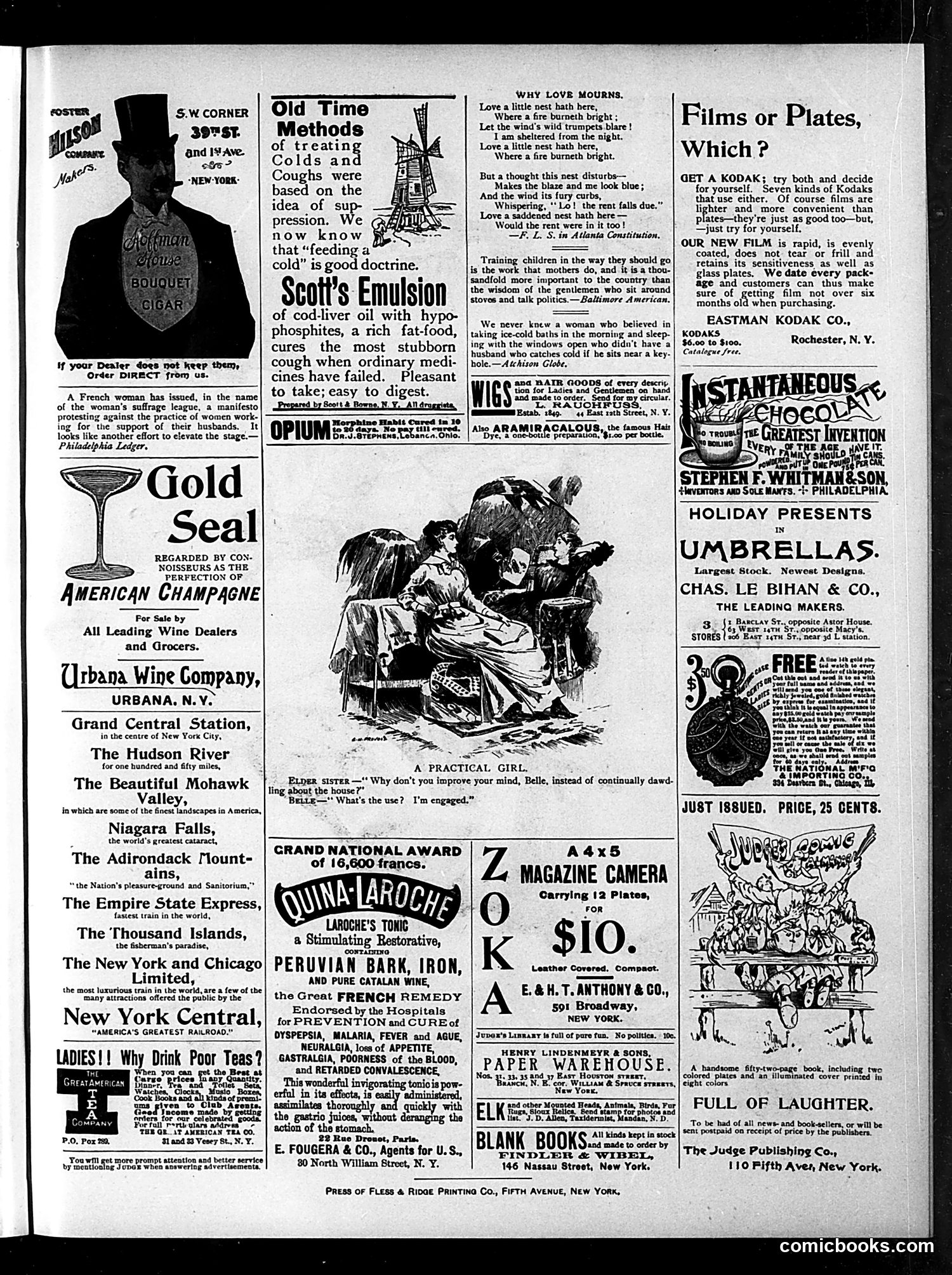
This single-panel cartoon satirizes women's education and ambition. A man criticizes a woman named Belle for "dawdling about the house" instead of improving her mind through study. Belle's response—"What's the use? I'm engaged"—is the joke's punchline. It mocks the prevailing assumption that women needed not develop their intellect since marriage was their ultimate destiny. Once engaged, further self-improvement became pointless. The satire targets both traditional gender roles *and* women who accepted them uncritically. By having Belle dismiss intellectual development so casually upon securing a husband, the cartoon implies this attitude is absurd, even as it reflects actual social expectations of the era. This reflects early-1900s debates over women's education and suffrage, referenced elsewhere on the page in advertisements and editorial snippets about women's roles.
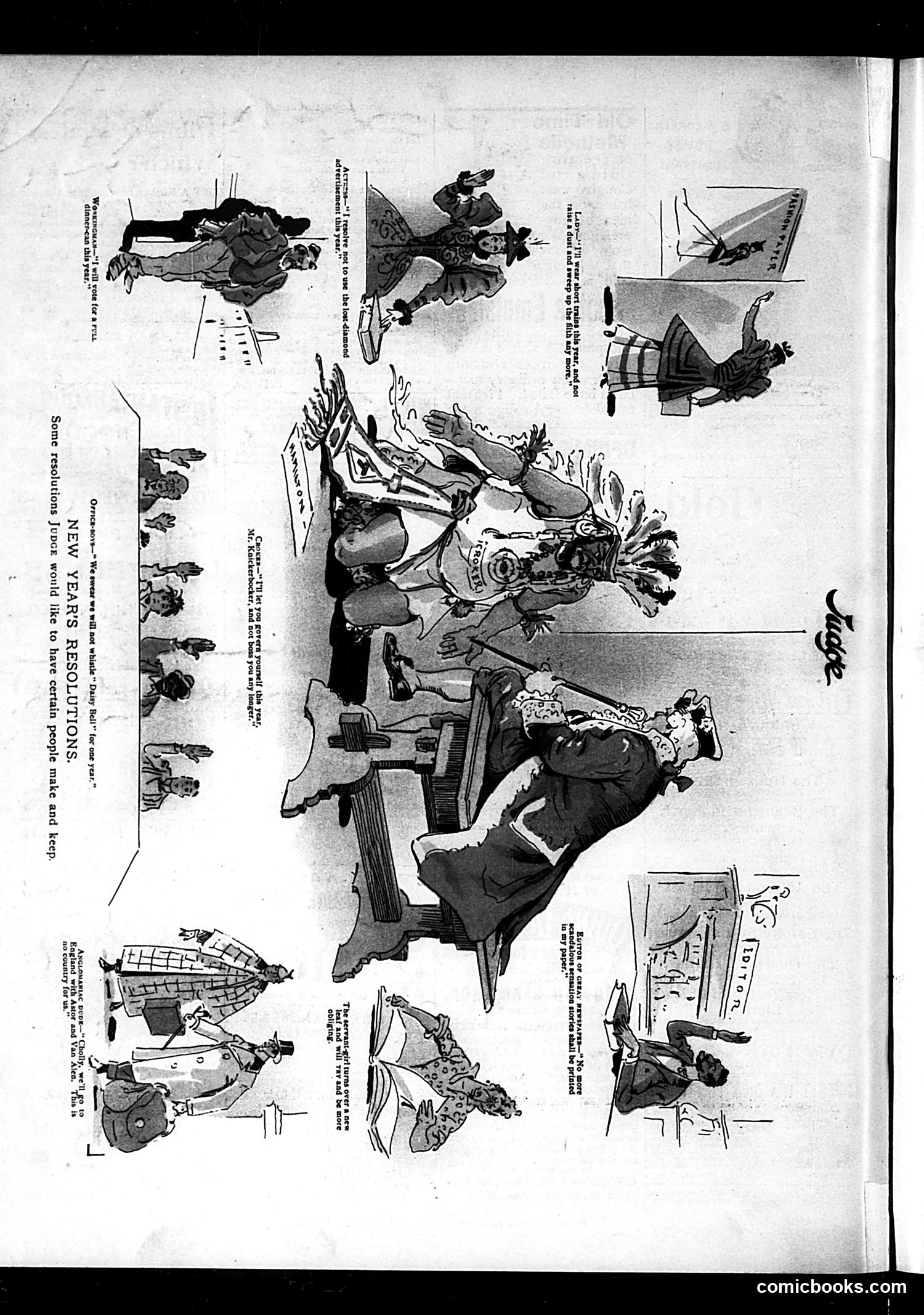
This satirical page presents mock "New Year's Resolutions" that Judge magazine wishes various public figures and types would actually make and keep. The cartoon mocks what these people *should* resolve to do but likely won't. The targets include: - A **Lady** who should wear shorter trains (excessive clothing was fashionable but impractical) - An **Actress** addicted to lost-diamond publicity stunts - A **Workingman** who should vote responsibly rather than be manipulated - **Croker** (likely Richard Croker, Tammany Hall boss), asked to stop controlling people - **Office boys** who won't stop whistling the popular song "Daisy Bell" - An **Editor of a daily newspaper** printing sensational, false stories - A **Servant girl** needing to be more helpful The satire assumes these resolutions are absurdly unlikely—that vanity, dishonesty, political corruption, and irresponsibility are so entrenched that genuine reform is impossible. It's cynical social commentary dressed as humor.