
A complete issue · 16 pages · 1893
Judge — October 21, 1893
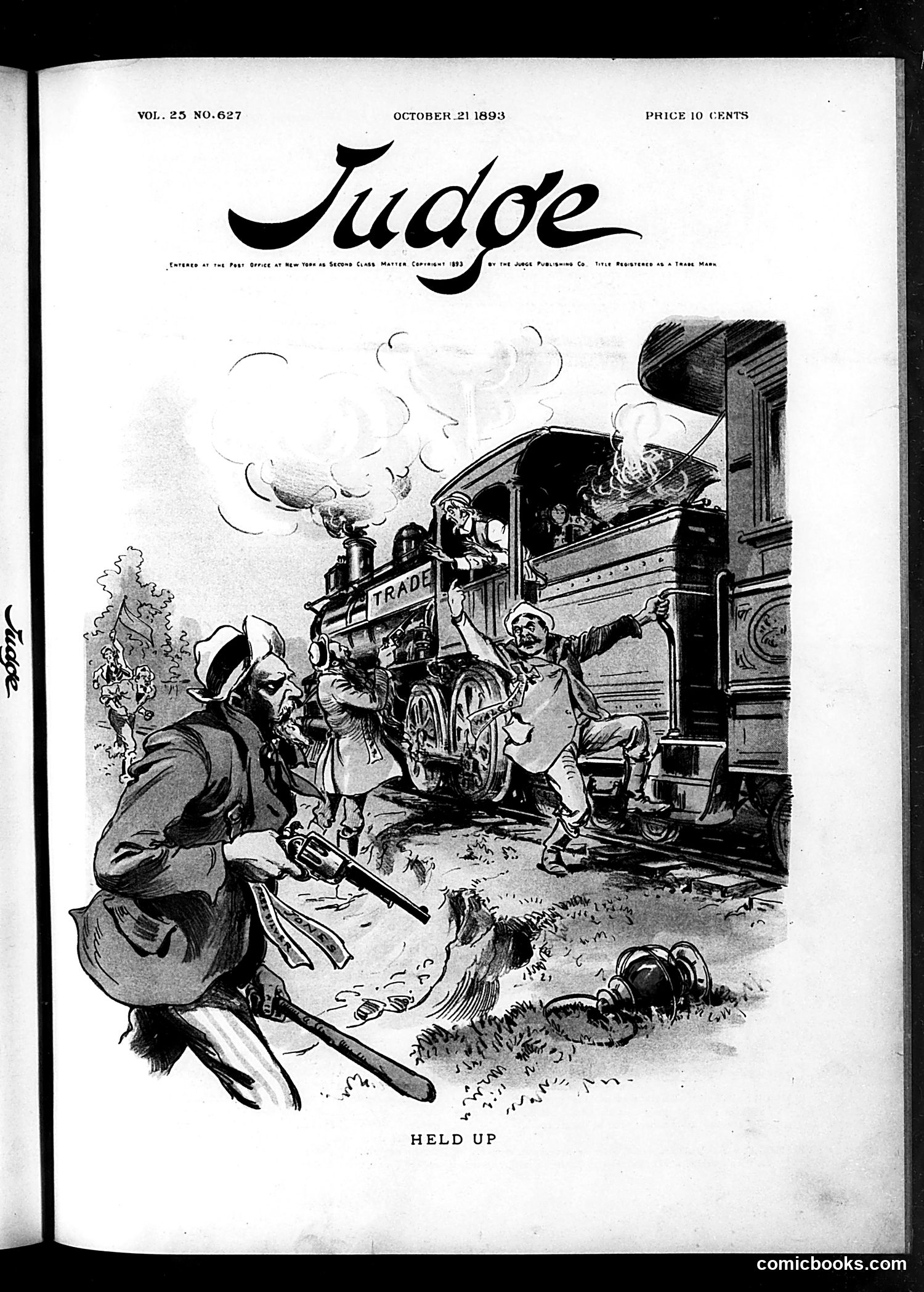
This cartoon depicts a train robbery scene labeled "TRADE." A bandit with a gun confronts a train conductor while the locomotive (marked "TRADE") emits heavy smoke. The imagery satirizes American commerce and economic disruption during the early 1890s, a period of severe financial panic and recession. The "held up" train likely represents disrupted trade and commerce—the cartoon suggests legitimate business is being robbed or halted by economic forces. The armed bandit probably symbolizes either labor unrest, monopolistic practices, or tariff policies that were crippling American trade during this economically turbulent decade. Without additional text or captions, the exact target of criticism remains somewhat unclear, though the satire addresses threats to American commercial stability.
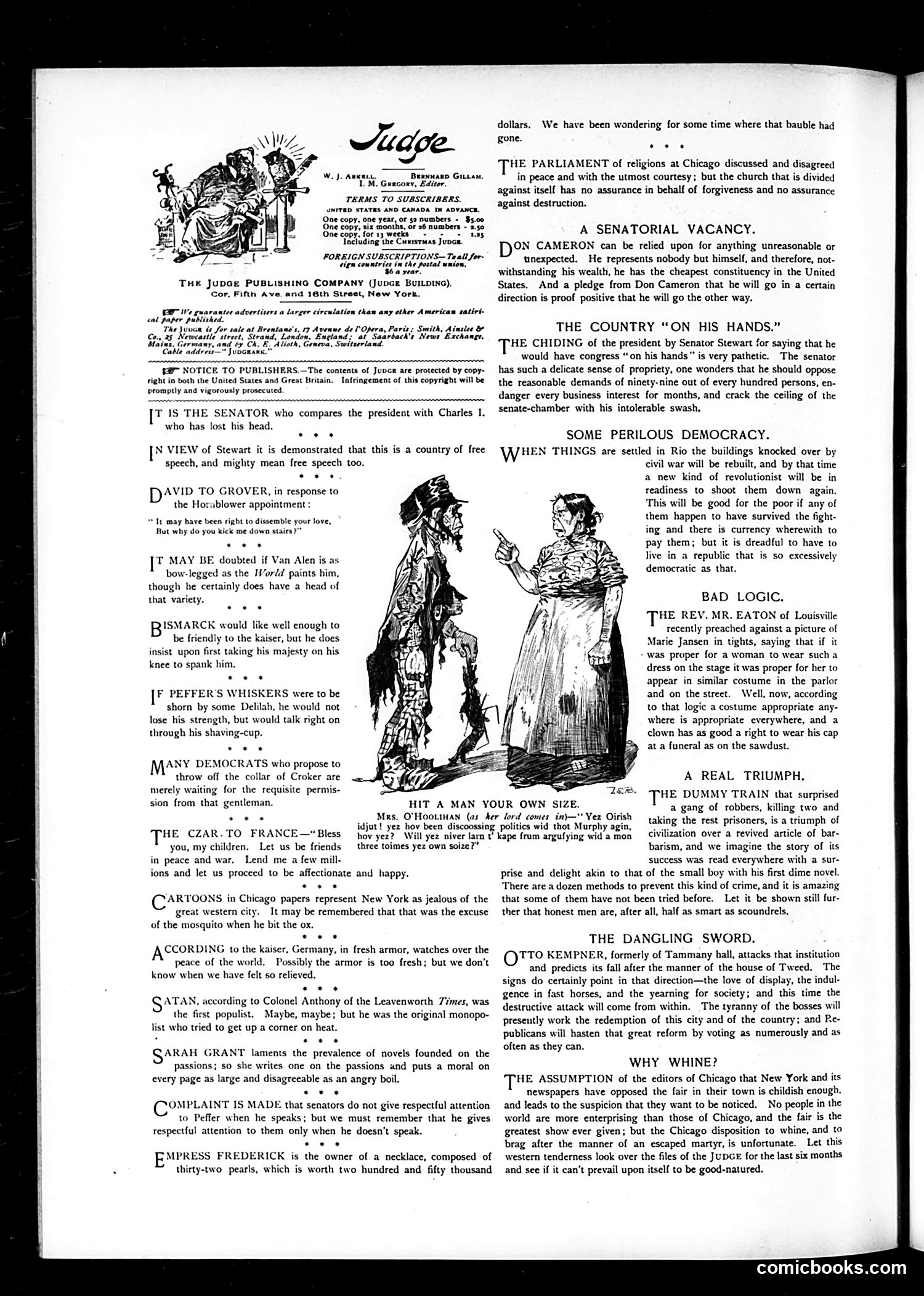
This page contains political commentary and satire typical of Judge magazine. The central cartoon titled "HIT A MAN YOUR OWN SIZE" depicts two figures in conversation—likely representing political or social figures in conflict, though their specific identities aren't entirely clear from the image alone. The surrounding text includes brief satirical pieces critiquing various topics: Senator Stewart's patriotism, Democratic politics, and a preacher's logic regarding women's costume choices on stage versus streets. "A REAL TRIUMPH" celebrates a "dummy train" that outsmarted robbers, while "THE DANGLING SWORD" references Otto Kempner's attack on an unnamed institution, suggesting internal corruption or tyranny. The overall tone mocks political hypocrisy, social inconsistencies, and contemporary public figures through sharp wit typical of Gilded Age satire.
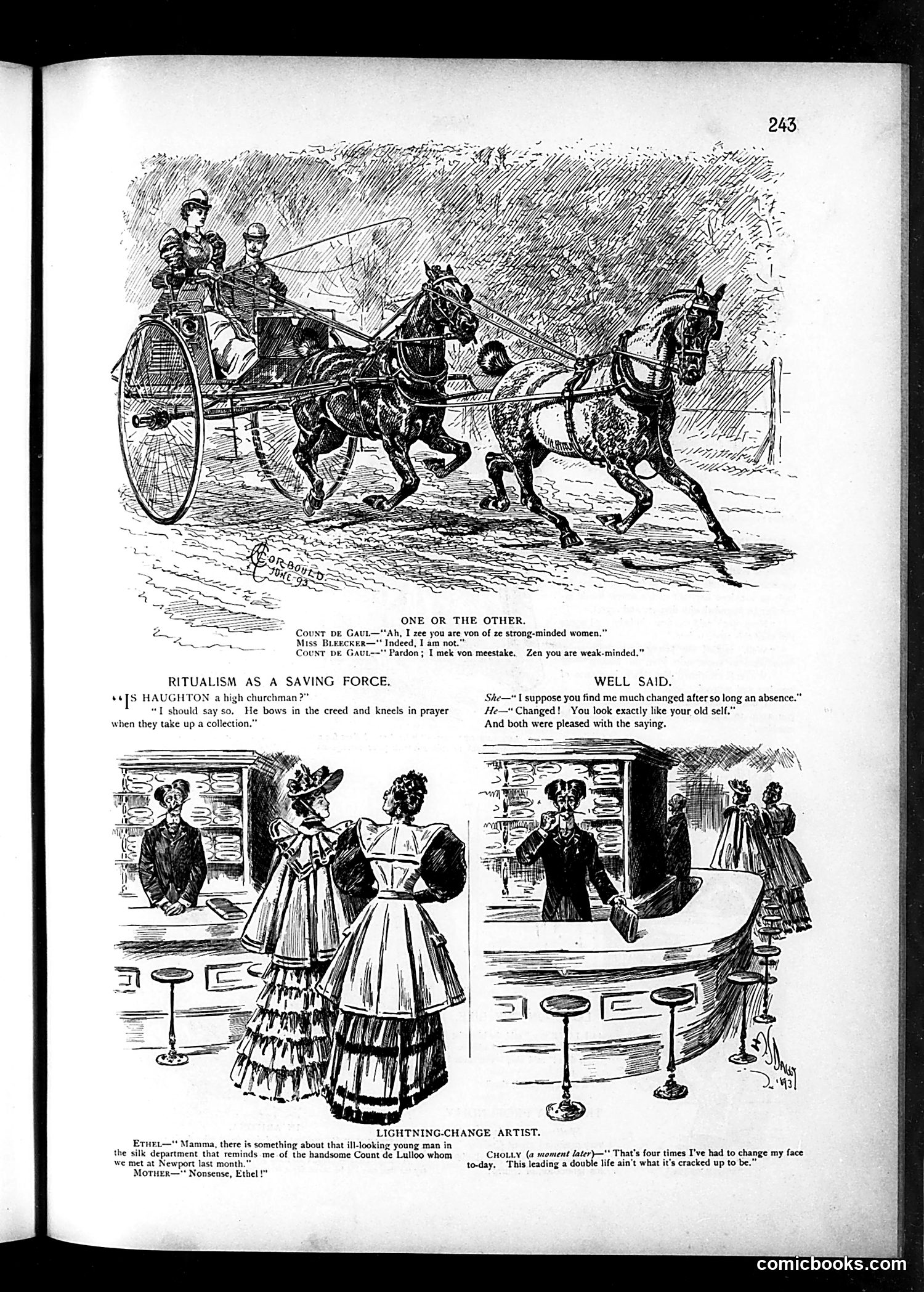
**Top Cartoon ("One or the Other"):** Features a horse-drawn carriage with two passengers debating women's intelligence. The "Count de Gaul" claims women are "strong-minded," while "Miss Bleckner" counters she is "weak-minded," with the Count insisting "Pardon; I meet you mistake. Zen you are weak-minded." The joke satirizes contradictory gender stereotypes and condescending male attitudes toward women's intellectual capacity. **Lower Cartoons:** Three separate domestic humor sketches depicting women's vanity and social anxieties—including ritualistic prayer, a woman's concern about her appearance during an absence, and a "lightning-change artist" undergoing four facial transformations daily due to social pressures. These collectively mock Victorian women's preoccupation with appearance and propriety.
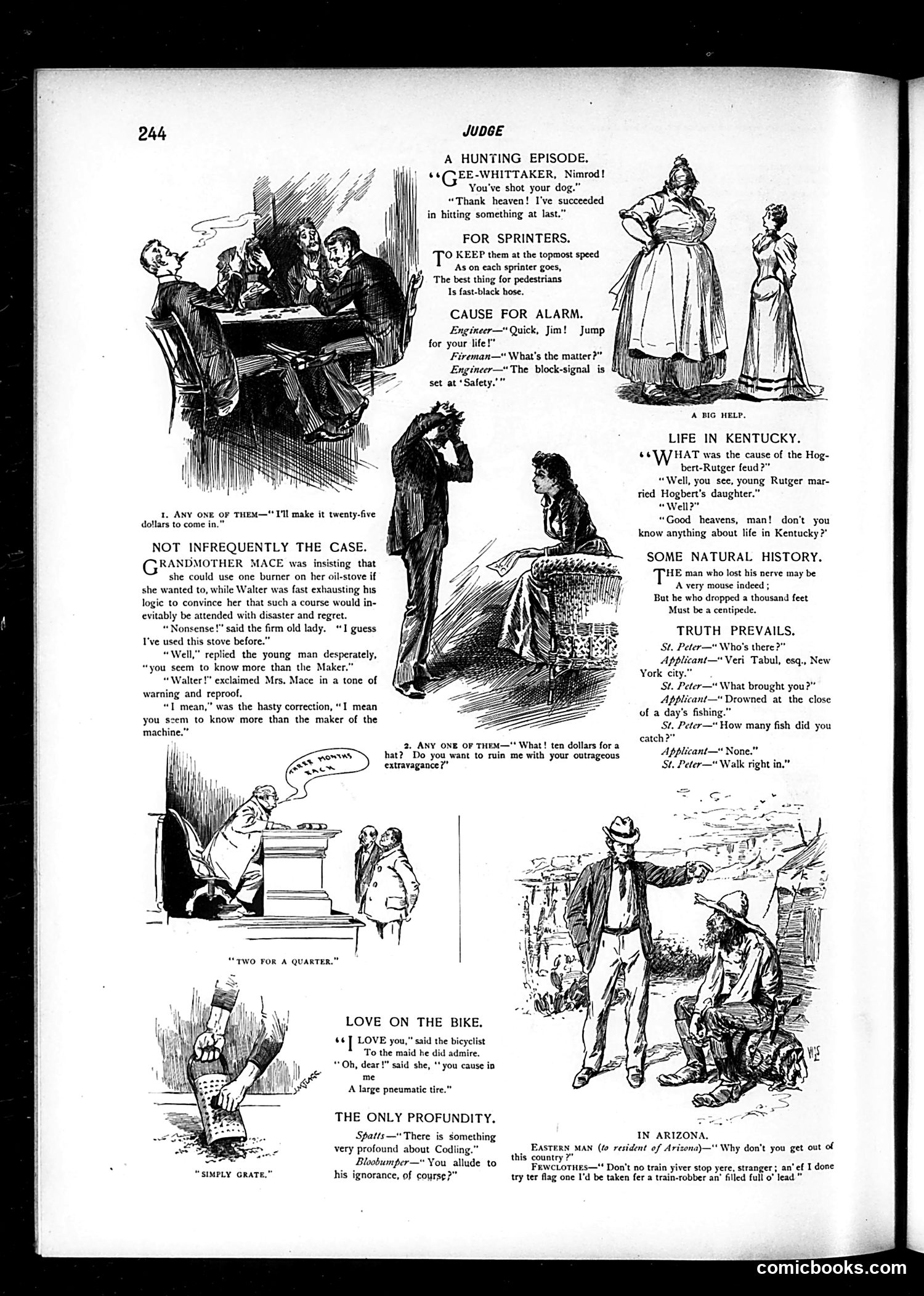
This page contains multiple satirical vignettes typical of late 19th-century humor: **"A Hunting Episode"** mocks incompetent hunters—the joke being the protagonist accidentally shot his own dog instead of game, yet celebrates it as finally hitting "something." **"Grandmother Mace"** satirizes generational conflict over new technology (oil stoves). The young man Walter attempts to warn the stubborn elderly woman of danger, but she dismisses his expertise—a common theme about resistance to modernity. **Smaller jokes** include: - A railway safety joke (ironic alarm at the "Safety" signal) - Bicycle romance wordplay ("pneumatic tire") - Kentucky feuding stereotypes (suggesting violent regional culture) - "Truth Prevails": A man who drowned fishless enters heaven—satire on honesty **"In Arizona"** plays on frontier lawlessness stereotypes, where a resident fears being mistaken for a train robber if he attempts to flag a train. The page reflects Judge's formula: domestic squabbles, technological anxiety, regional caricatures, and wordplay humor targeting turn-of-the-century American anxieties and pretensions.
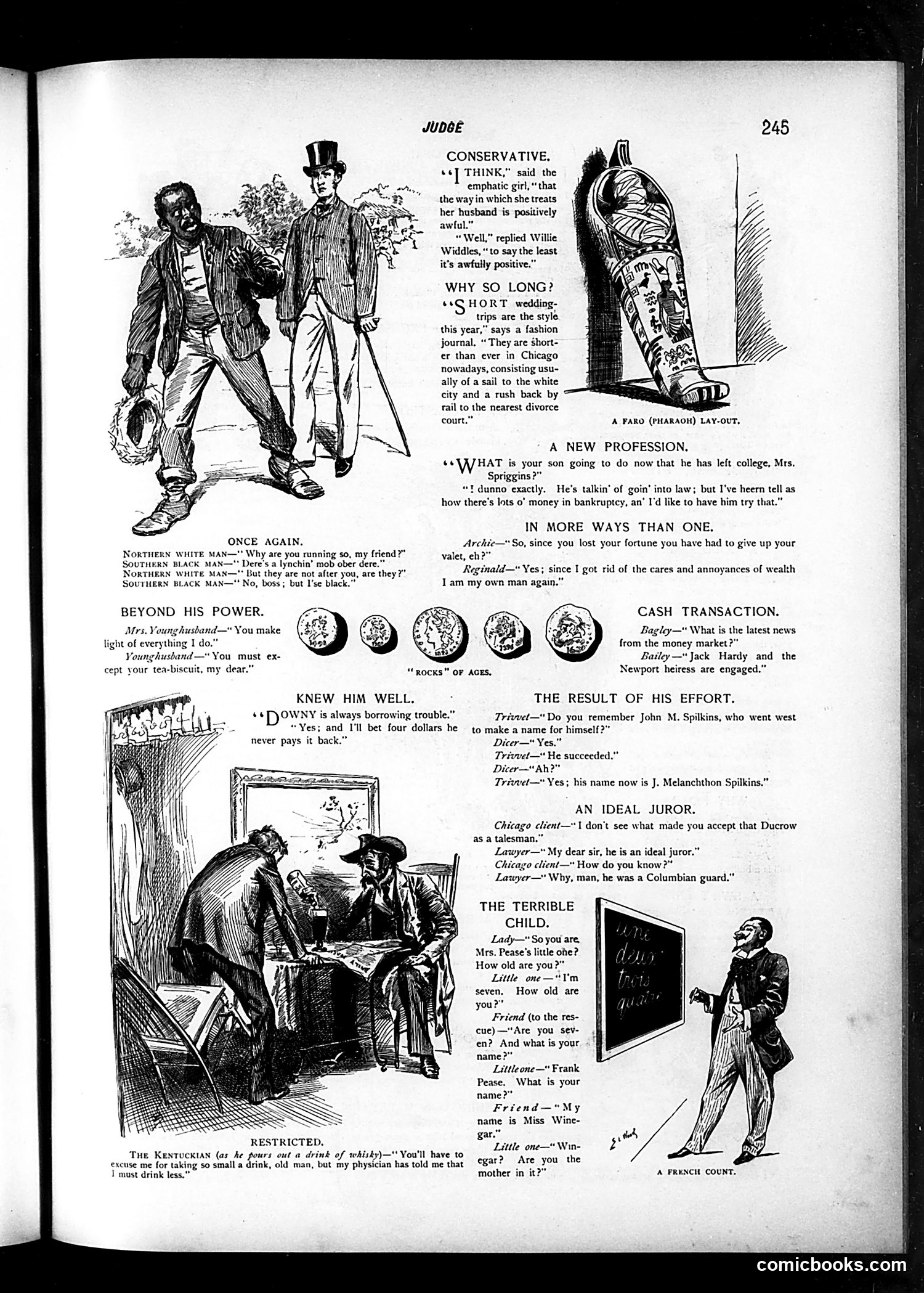
This page contains multiple brief satirical jokes typical of Judge magazine's style, targeting social trends and behaviors of the era. **Key satire:** - **"Why So Long?"** mocks Chicago's high divorce rates, suggesting short honeymoons end immediately in divorce court—commentary on marital instability. - **"Once Again"** appears to reference racial stereotypes and social attitudes (the OCR is unclear, but contrasts "Northern white man" and "Southern black man"). - **"Beyond His Power"** jokes about class and domestic dynamics—a husband cannot control his wife's spending habits. - **"Cash Transaction"** satirizes that even wealthy heiresses are now treated as financial transactions ("engaged" like a business deal). - **"Knew Him Well"** ridicules someone who went west seeking fortune and only achieved a pretentious name change. - **"An Ideal Juror"** implies a Columbian Guard (from the 1893 World's Columbian Exposition) is ideal simply for being easily impressed/gullible. - **"The Terrible Child"** depicts a precocious child with adult wit, making awkward observations about names. The humor relies on period-specific references to divorce trends, wealth, westward migration, and the recent World's Fair.
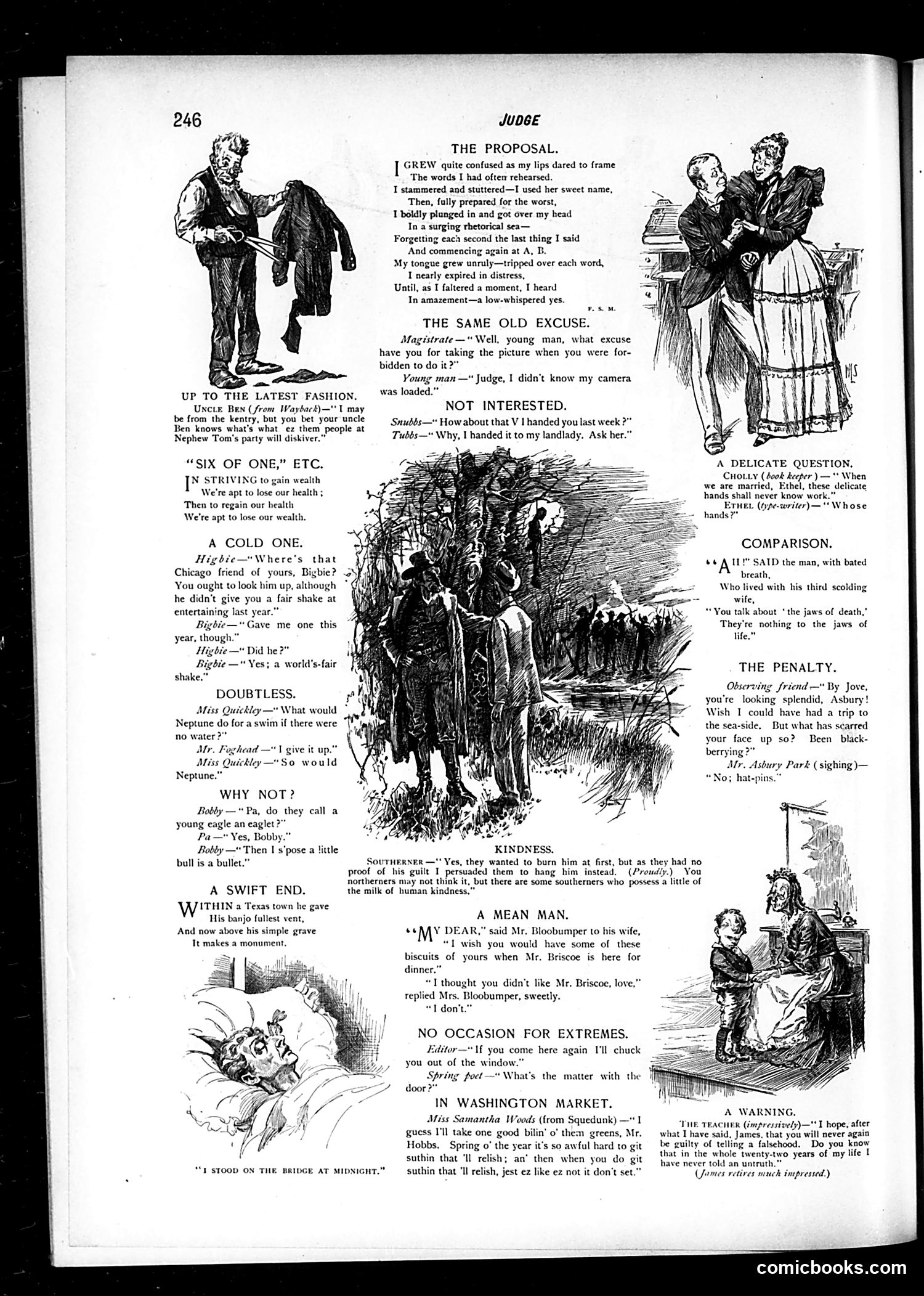
This page contains multiple brief satirical sketches typical of Judge magazine's humor style. The main targets are: **Social pretension**: "Up to the Latest Fashion" mocks rural characters trying to appear sophisticated at city social events. **Urban life absurdities**: Several pieces play on miscommunication and modern inconveniences—a man unknowingly photographing someone while his camera was unloaded; a woman unable to enjoy spring vegetables because digestive issues prevent her from relishing food she finally craves. **Marriage and domestic life**: Recurring theme attacking both spouses—the "Mean Man" joke about Mr. Bloobumper wishing his wife make good food for guests she suspects he dislikes; the "Comparison" piece joking that a wife's nagging is worse than death itself. **Class commentary**: A book keeper (Cholly) promises a typist (Ethel) her delicate hands needn't work—satirizing hollow courtship promises and gender role pretense. The humor relies on wordplay, irony, and observations of everyday social friction rather than specific political events. These sketches represent Judge's typical satirical approach to American middle-class life and manners.
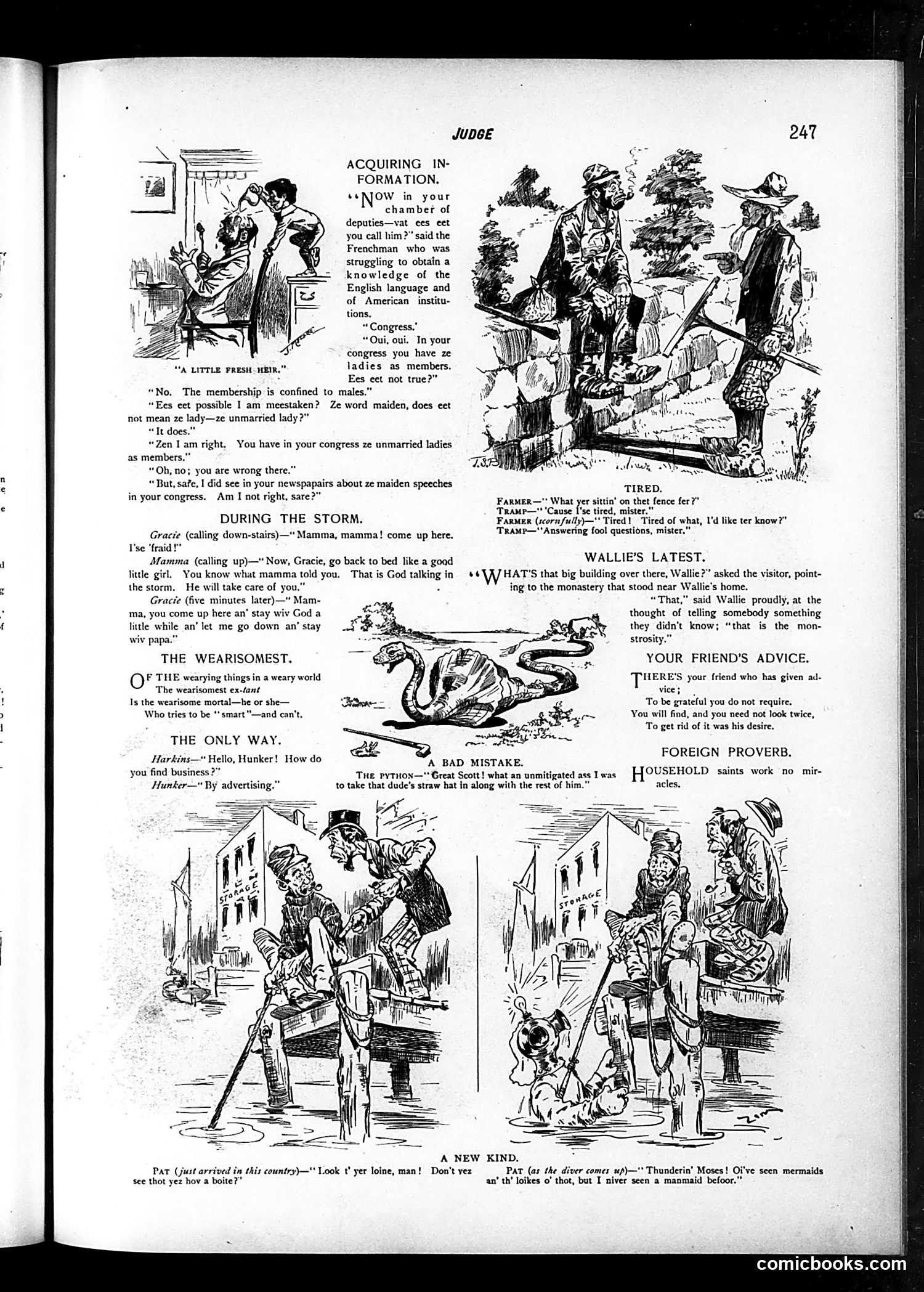
This page contains several satirical cartoons and jokes typical of late 19th/early 20th-century American humor: **"Acquiring Information"**: A Frenchman's linguistic confusion provides the joke—he misinterprets "maiden speeches" (a legislator's first speech) as evidence that unmarried women serve in Congress, confusing the term "maiden" with female legislators. **"During the Storm"**: A child's logic joke—Gracie reasons that if God is in the storm (comforting her), her father should stay with God while she goes downstairs to be with her father. **"Wallie's Latest"**: A child mispronounces "monastery" as "monstrosity," creating innocent humor from youthful malapropism. **"A Bad Mistake"**: A python ate a man wearing a straw hat and regrets it—satirizing social pretension (the "dude" with his fashionable hat). **"A New Kind"**: Irish immigrants confuse "mermaid" with "manmaid" (a made-up creature), playing on dialect humor and immigrant unfamiliarity with English. The page emphasizes wordplay, children's innocent mistakes, and immigrant/class-based humor typical of the era.
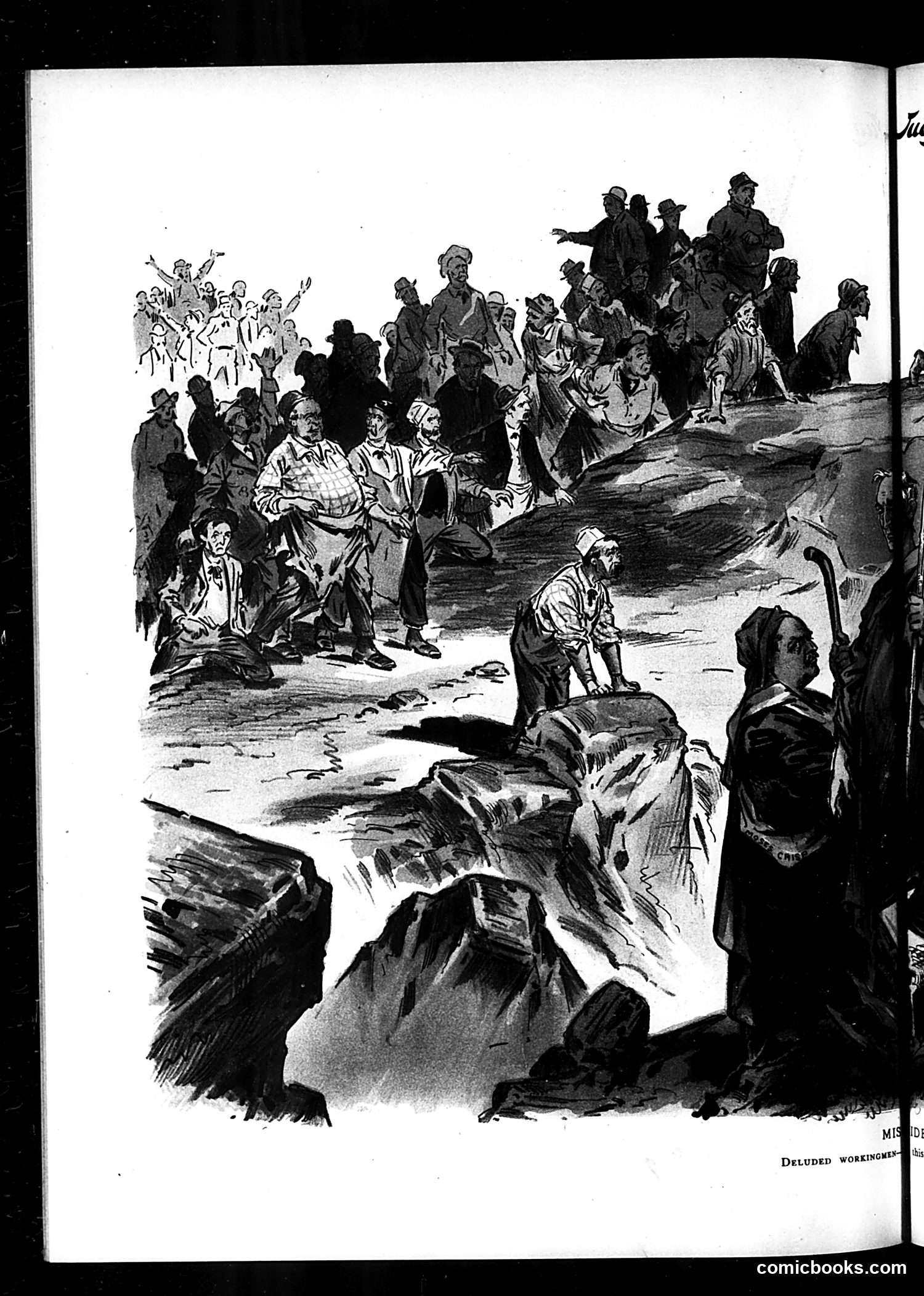
This is a satirical illustration titled "Deluded Workingmen" depicting a gathering of laborers and working-class people. The cartoon shows workers being led or gathered by figures on elevated ground (upper right), while bodies lie on the ground in the foreground—suggesting casualties or fallen workers. The satire appears to criticize working-class political movements or labor organizing of the period. The "deluded" workingmen are portrayed as being manipulated by leaders or politicians standing above them, while the depicted bodies suggest the human cost of their involvement in labor disputes, strikes, or radical political action. This reflects *Judge* magazine's generally conservative stance toward labor movements and working-class activism in late 19th/early 20th-century America.
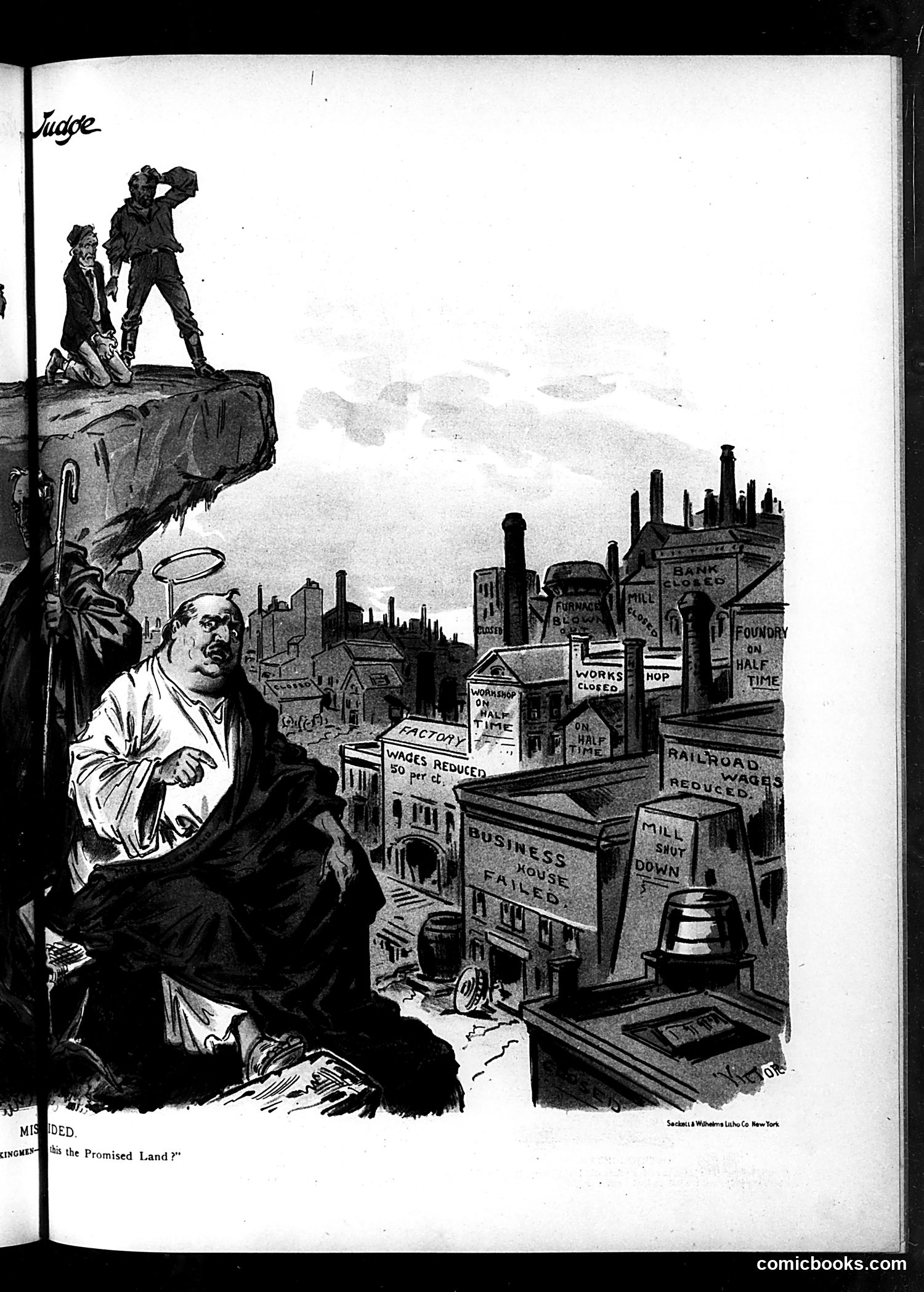
This appears to be a Judge magazine cartoon criticizing industrial economic conditions, likely from the late 19th or early 20th century. The main figure—a distressed worker shown in the lower left—gazes upward at two figures on a cliff representing wealth or leadership. Below him stretches an industrial cityscape filled with signs reading "Factory Wages Reduced," "Mill Shut Down," "Business House Failed," "Works Closed," and "Railroad Wages Reduced." The cartoon's title, "Is This the Promised Land?", sarcastically questions whether America's industrial economy delivers prosperity to workers. The contrast between the elevated wealthy figures and the devastated industrial landscape below critiques the broken promises of American economic opportunity during an apparent recession or depression period. The satire targets industrial capitalism's failure to provide stable employment or fair wages.
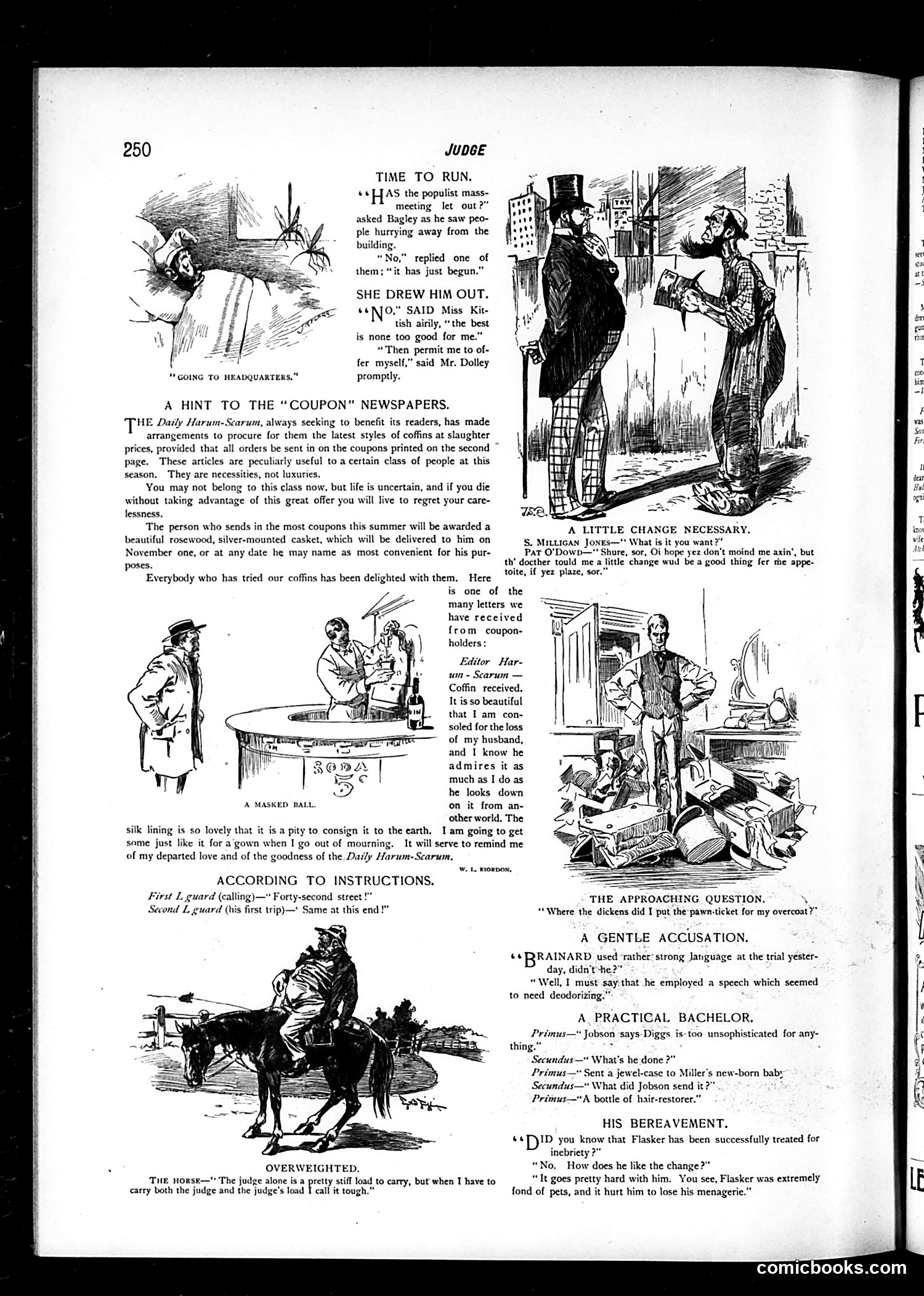
This satirical page from *Judge* contains multiple brief comic sketches mocking contemporary social types and institutions: **Main Satire:** "A Hint to the Coupon Newspapers" ridicules the *Daily Haram-Scarum* (a fictional paper mimicking real penny-press publications) for offering coffins via mail-order coupons. The joke: it's darkly absurd marketing—advertising death as a bargain product to readers, especially "a certain class of people." The accompanying letter from a widow admiring her coffin's silk lining extends the morbid comedy. **Other sketches** include: - Populist meetings running too long - An Irish immigrant ("Pat O'Dowp") seeking "change" from a doctor (likely a pun on money/medicine) - A bachelor sending a jewel-case to someone's newborn baby - A man reformed from alcoholism who misses his drinking companions ("menagerie") **Context:** These represent typical *Judge* humor—class-conscious satire targeting working-class immigrants, sensationalist newspapers, and urban types. The tone is cynical, assuming readers share contempt for "lower" social elements.
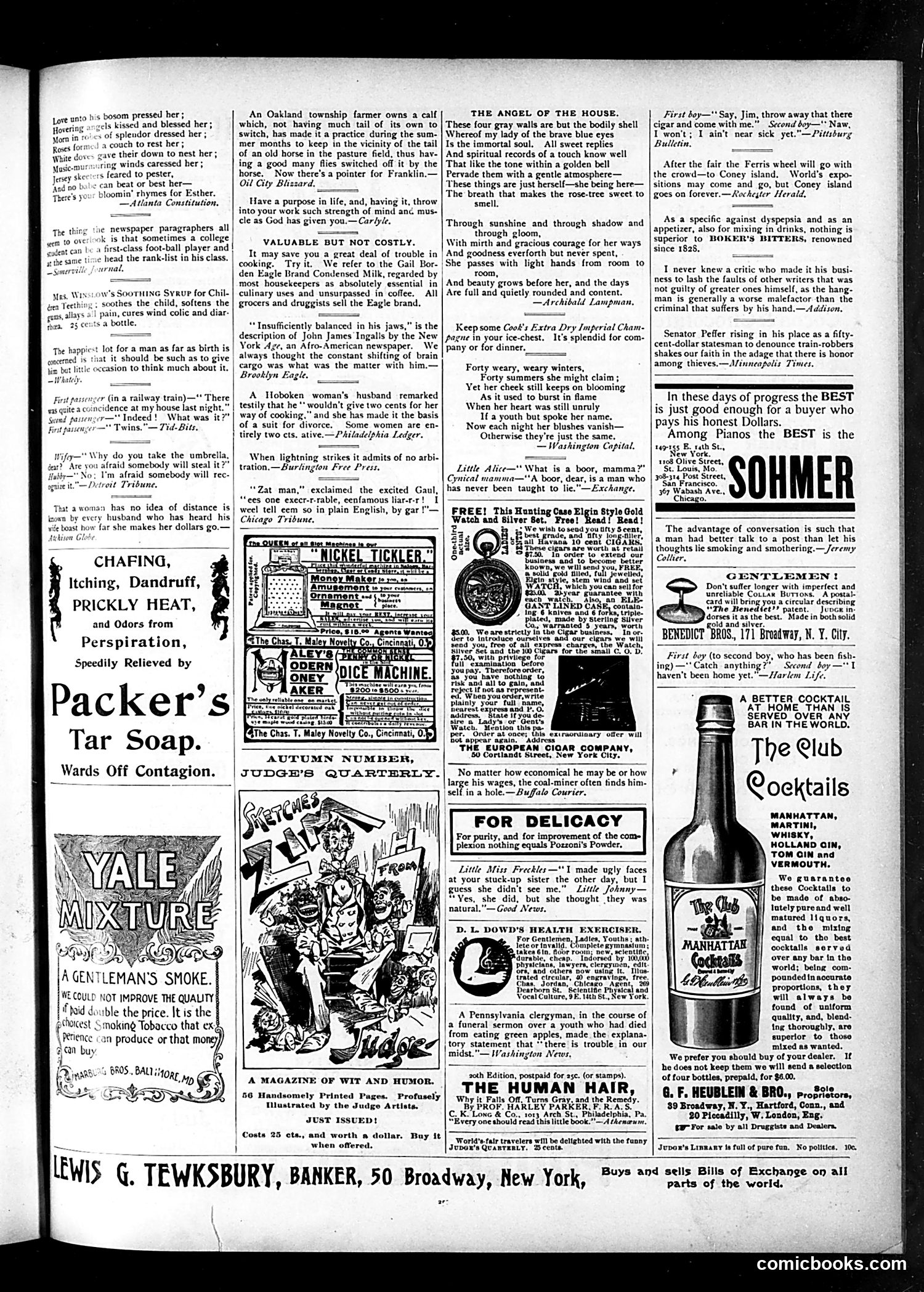
This page from *Judge* (a satirical humor magazine) is primarily **advertising and miscellaneous content** rather than political cartoons. The notable satirical items are brief **editorial jokes** scattered throughout: - A quip about an **Oakland farmer's calf** borrowing a horse's tail to swat flies—a "pointer for Franklin" (unclear reference, possibly a politician or public figure) - A jab at **John James Ingalls**, an Afro-American newspaper's description of him as "insufficiently balanced in his jaws," which the *Judge* writer sarcastically attributes to his "constant shifting of baggage" - A humorous anecdote about a **Hoboken woman suing for divorce** because her husband insulted her cooking The page is dominated by **product advertisements** (Packer's Tar Soap, Sommer brand, The Club Cocktails) and poetry ("The Angel of the House"). No major political figures or events are clearly referenced.
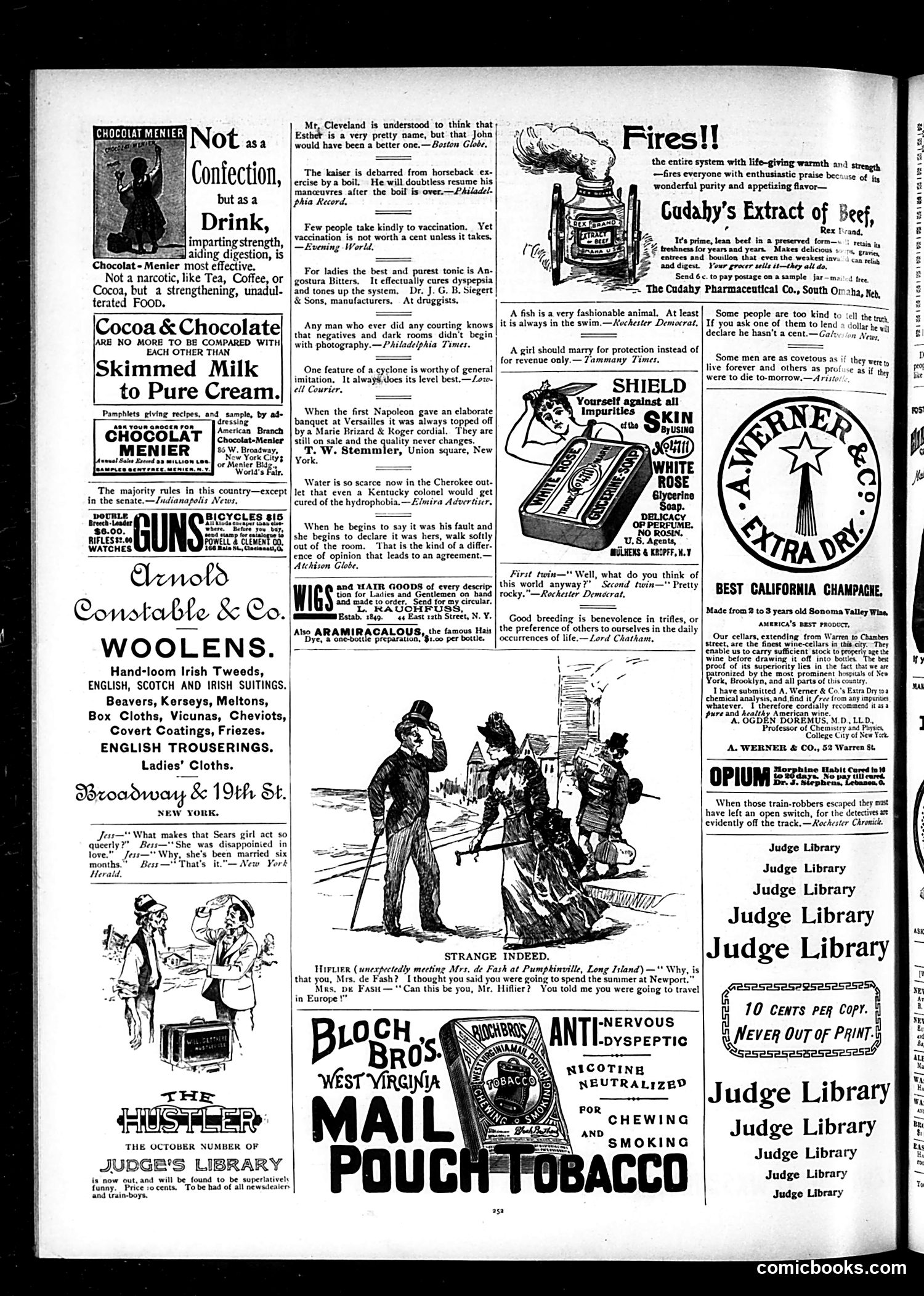
This page from *Judge* magazine is primarily **advertisements and brief satirical quips** rather than a coherent political cartoon. The main illustrated cartoon shows three figures in winter clothing on what appears to be a snowy landscape, captioned "STRANGE INDEED." The dialogue references "Mrs. de Fash at Pumpkinville, Long Island" and "Hitler"—likely satirizing wealthy socialites and their pretentious summer plans, though the specific reference is unclear without fuller context. The bulk of the page contains **commercial advertisements** (Chocolat-Menier, woolens, beef extract) interspersed with **one-liner jokes** typical of *Judge's* format—brief, often cynical observations about marriage, human nature, and current events (references to Cleveland, the Kaiser's boil, vaccination debates). No major political figures are clearly caricatured. The satirical intent is diffuse: mocking social pretension, courtship awkwardness, and human folly generally rather than addressing specific contemporary events. This appears to be a typical *Judge* page mixing commerce with light social satire.
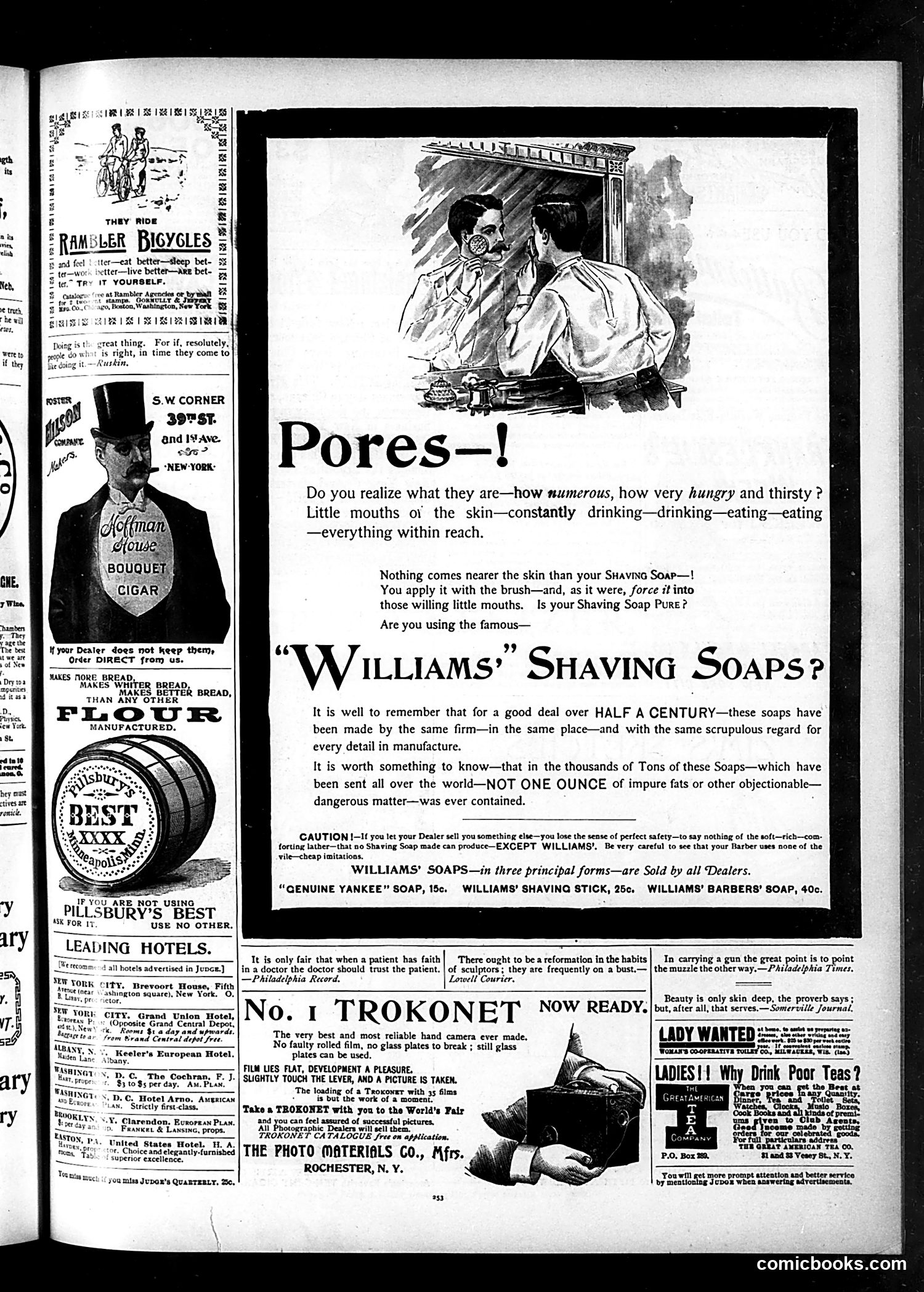
This page is primarily **advertising**, not political satire. The main content is a large advertisement for Williams' Shaving Soaps, which uses a pseudo-scientific argument: the ad personifies skin pores as "little mouths" that are "hungry and thirsty," constantly "drinking—eating—eating," and therefore need Williams' soap forced into them via brush application. The pitch emphasizes purity and longevity—over half a century of manufacture with "not one ounce of impure fats." It warns against cheap imitations and urges customers to ensure their barbers use Williams' brand exclusively. The page also contains hotel listings, bicycle and flour advertisements, and smaller notices about cameras and patent medicines—typical Judge magazine filler. There are brief humorous quotations unrelated to the advertisements. No identifiable political figures or satire are present; this is straightforward period advertising using exaggerated health claims common to early 20th-century marketing.
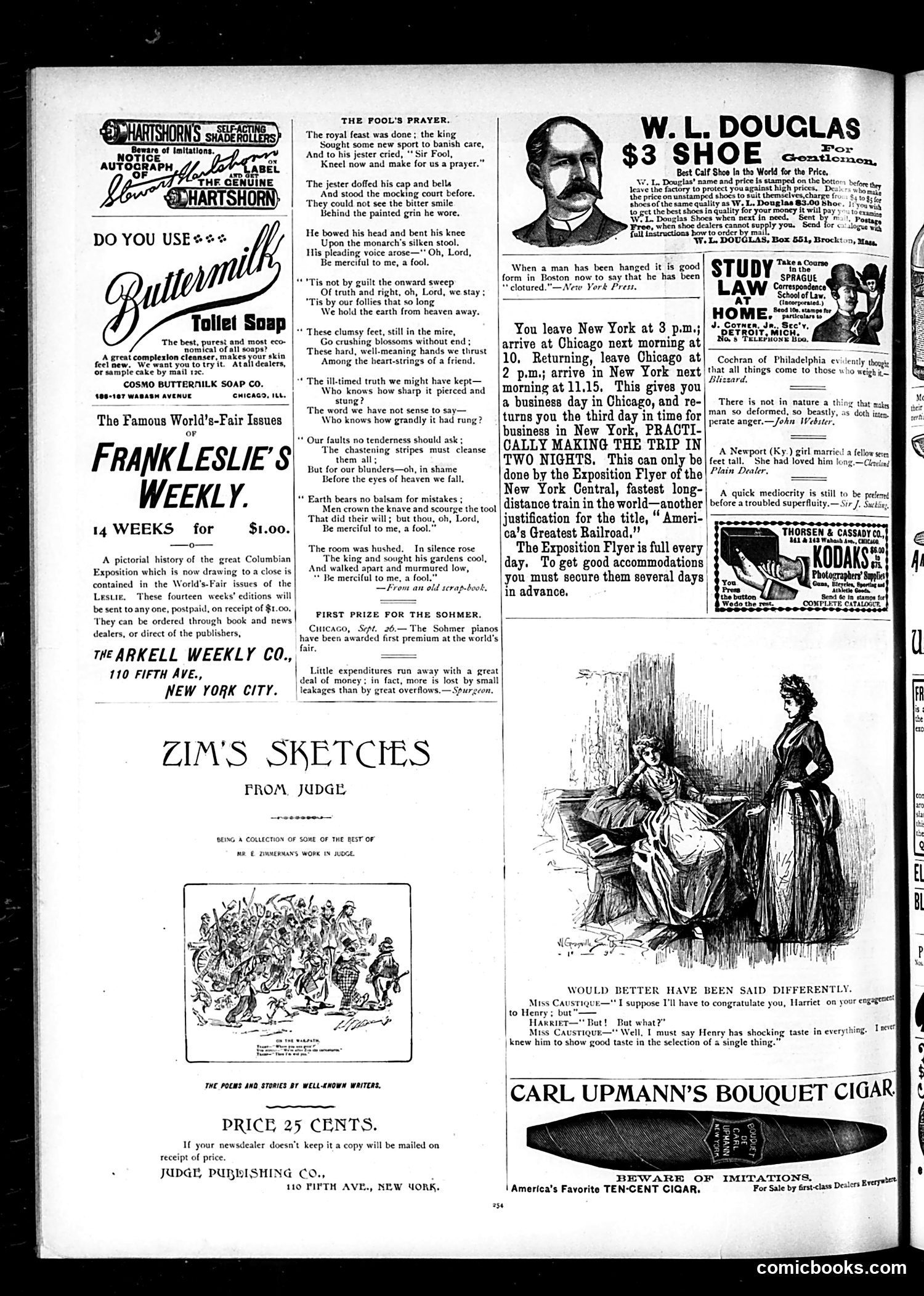
This is primarily an **advertising and literary page** rather than political satire. The main content includes: **"The Fool's Prayer"** — a lengthy poem about a court jester who humbly prays for divine mercy, asking forgiveness not for intentional sins but for human blunders and thoughtless mistakes. The jester's wisdom moves the king to introspection. This appears to be reprinted classic literature, not original satire. **Advertisements** dominate: W.L. Douglas shoes, Buttermilk soap, Frank Leslie's Weekly (promoting World's Fair coverage), and Carl Upmann cigars. **Minor editorial content** includes a brief joke about Boston political etiquette regarding executions (using "clotured" as euphemism) and a New York Central Railroad advertisement promoting fast Chicago travel. The **Zim's Sketches** section advertises a 25-cent collection of Judge's cartoons and stories. The single visible sketch shows a crowded scene but lacks clear political context in this cropped view. Overall, this reads as a standard **late-1890s magazine mix of literature, humor, and commerce** rather than pointed political commentary.
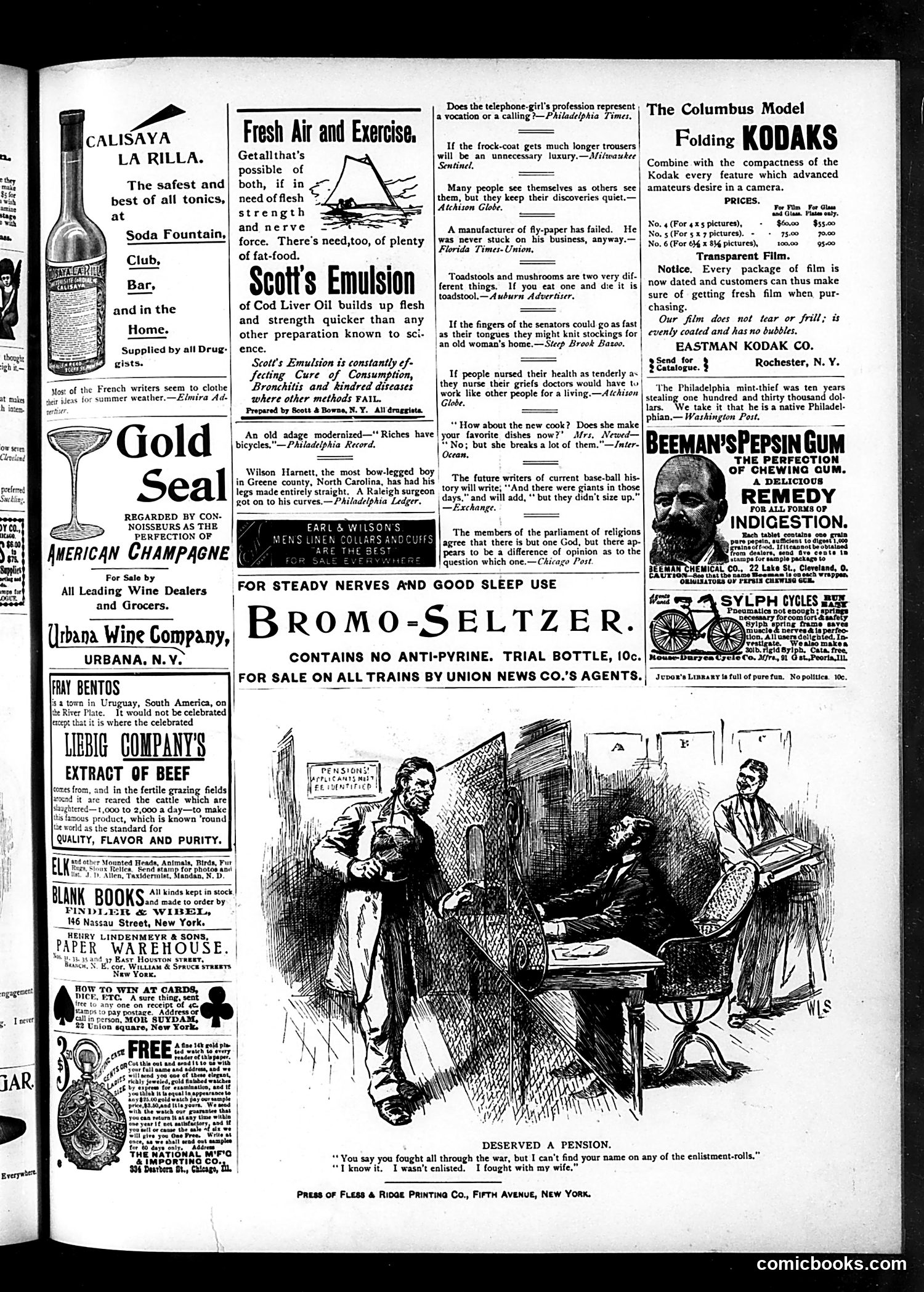
The cartoon depicts a Civil War veteran (identifiable by his military bearing and the "Pension" caption) confronting a bureaucrat at a desk. The veteran explains: "You say you fought all through the war, but I can't find your name on any of the enlistment-rolls. I know it, I wasn't enlisted." **The satire targets the U.S. pension system** for its bureaucratic inflexibility. The joke—and social criticism—is that a man who clearly served in combat cannot receive a pension because his paperwork was never properly filed, despite his evident service. The bureaucrat's response is absurdly literal-minded: no name on official rolls = no pension, regardless of actual service. This reflects real Gilded Age frustrations with pension administration, where many veterans struggled with red tape and documentation requirements. The cartoon mocks both the rigid bureaucracy and the apparent indifference to a soldier's genuine sacrifice.
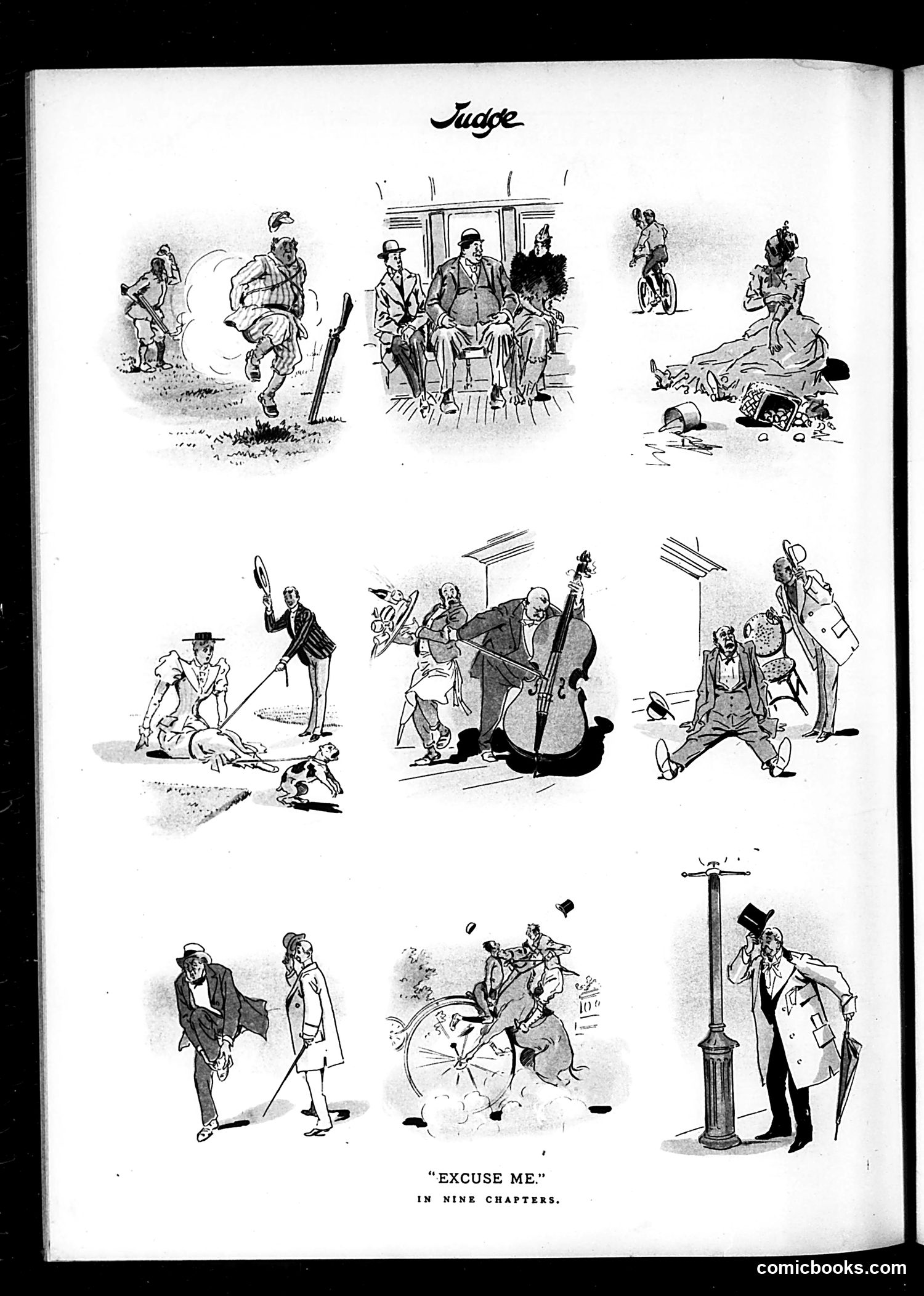
This satirical comic strip presents nine scenes depicting various social situations where someone offers an apology or excuse. The scenes appear to mock everyday rudeness and inconsiderate behavior across different contexts: someone interrupting outdoor activities, people on public transportation, someone disrupting a musical performance, interrupting a conversation, and other moments of social interference. The title "Excuse Me in Nine Chapters" suggests ironic commentary on how people use hollow apologies as justification for inconsiderate acts rather than actually changing their behavior. Each vignette likely illustrates how an "excuse me" serves as a perfunctory phrase that doesn't prevent thoughtless actions. The satire targets middle and upper-class social hypocrisy—how politeness phrases mask ongoing rudeness and disregard for others' space and comfort.