
Judge, 1893-10-21 · page 6 of 16
Judge — October 21, 1893 — page 6: what you’re looking at
What you’re looking at
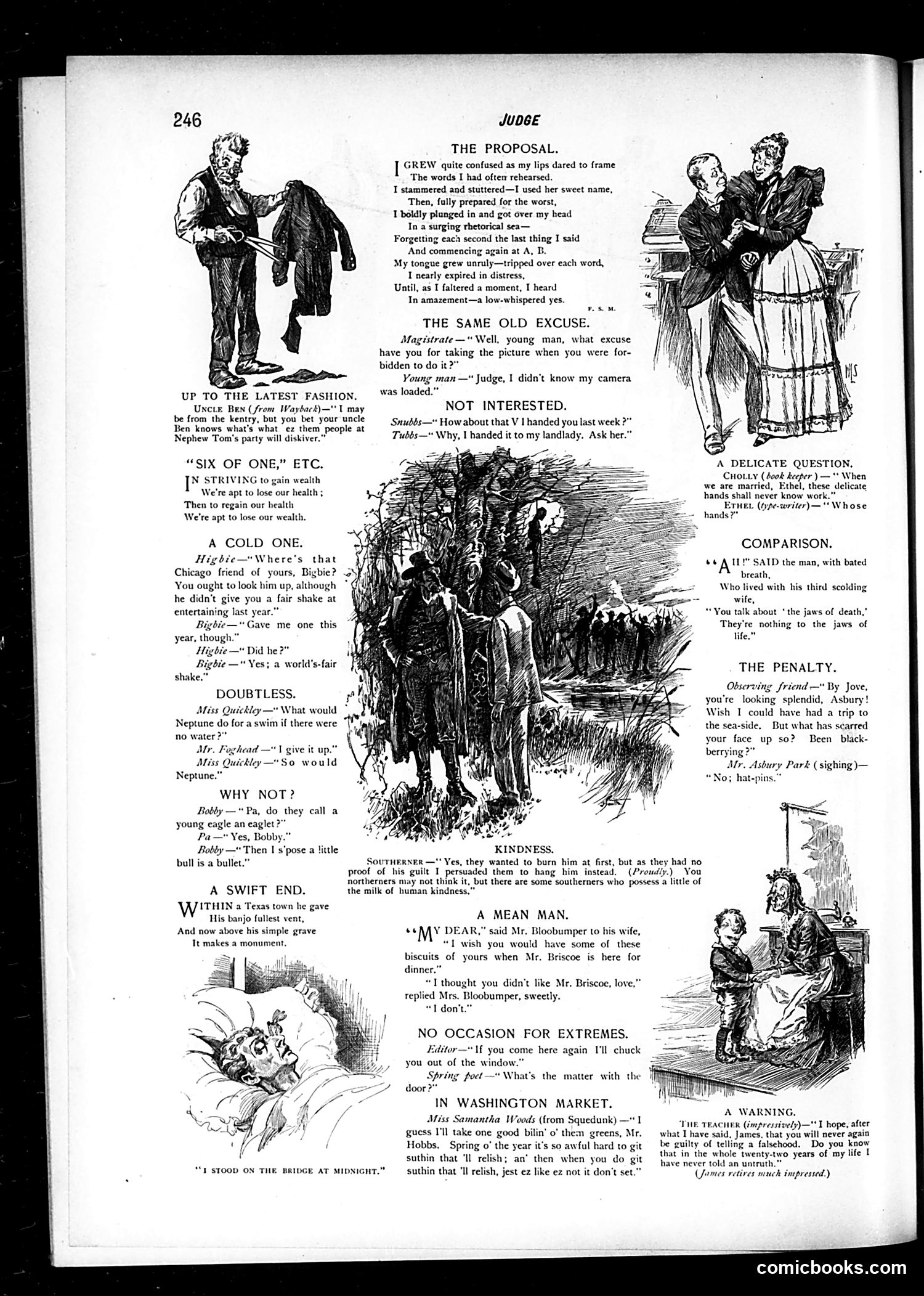
This page contains multiple brief satirical sketches typical of Judge magazine's humor style. The main targets are: **Social pretension**: "Up to the Latest Fashion" mocks rural characters trying to appear sophisticated at city social events. **Urban life absurdities**: Several pieces play on miscommunication and modern inconveniences—a man unknowingly photographing someone while his camera was unloaded; a woman unable to enjoy spring vegetables because digestive issues prevent her from relishing food she finally craves. **Marriage and domestic life**: Recurring theme attacking both spouses—the "Mean Man" joke about Mr. Bloobumper wishing his wife make good food for guests she suspects he dislikes; the "Comparison" piece joking that a wife's nagging is worse than death itself. **Class commentary**: A book keeper (Cholly) promises a typist (Ethel) her delicate hands needn't work—satirizing hollow courtship promises and gender role pretense. The humor relies on wordplay, irony, and observations of everyday social friction rather than specific political events. These sketches represent Judge's typical satirical approach to American middle-class life and manners.
📄 Transcribed text from this page (OCR, searchable)
Machine-transcribed from the original scan — historical spelling and the odd misread are preserved.
UP TO THE LATEST FASHION. UNCLE Ben (from Wayback)—"" | may be from the kentry, but you bet your uncle Ben knows what's what ez them people at Nephew Tom's party will diskiver.” “SIX OF ONE,” ETC, [8 STRIVING to gain wealth We're apt to lose our health ; Then to regain our health We're apt to lose our wealth, A COLD ONE. Higbie—"Where’s that Chicago friend of yours, Bigbie? You ought to look him up, although * he didn’t give you a fair shake at entertaining last year.” Bigbie—“ Gave me one this year, though. F Did he?” world’s-fair DOUBTLESS. Miss Quickley —* What would * Neptune do fora swim if there were no water?” Mr. Foghead ~ Miss Quickley Neptune.” WHY NOT? Bobby —" Pa, do they call a young eagle an eaglet ?” Pa—" Yes, Bobb: Bobby —" Then | s‘pose a little bull is a bullet.” I give it up.” o would proof of his northern A SWIFT END. the milk WITHIN a Texas town he gave His banjo fullest vent, And now above bis simple grave Tt makes a monument, “E STOOD ON THE BRIDGE AT MIDNIGHT.” JUDGE THE PROPOSAL. GREW quite confused as my lips dared to frame ‘The words I had ofte rehearsed. I stammered and stuttered—I used her sweet name, ‘Then, fully prepared for the worst, I boldly planged in and got over my head In a surging rhetorical sea— Forgetting eac’a second the last thing I said And commencing again at A, B. My tongue grew unruly—tripped over each word, I nearly expired in distress, Until, as I faltered a moment, I heard In amazement—a low-whispered yes. THE SAME OLD EXCUSE. Magistrate —" Well, young man, what excuse have you for taking the picture when you were for- bidden to do it? Young man —" Judge, | didn’t know my camera was loaded.” NOT INTERESTED. Snubbs—* How about that V I handed you last week Tubbs—" Why, | handed it to my landlady. Ask her.” KINDNESS. Sournerner —"' Yes, they wanted to burn him at first, but as they had no uilt I persuaded them to hang him instead. ers may not think of human kindness. A MEAN MAN. “MY DEAR,” said Mr. Bloobumper to his wife, “I wish you would have some of these biscuits of yours when Mr. Briscoe is here for dinn Ithought you didn’t like Mr. Briscoe, lov replied Mrs. Bloobumper, sweetly. “don't.” NO OCCASION FOR EXTREMES. Editor—"\f you come here again I'll chuck you out of the window. Spring poet —" What's the matter with the door?” IN WASHINGTON MARKET. Miss Samantha Woods ({rom Squedunk) —“ 1 guess I'll take one good bilin’ o' them greens, Mr. Hobbs. Spring o' the year it’s so awful hard to git suthin that ‘Il relish; an’ then when you do git suthin that ‘Il relish, jest ez like ez not it don’t set.” (Proudly.) ut there are some southerners who possess a little of A DELICATE QUESTION, CHOLLY (book keeper) —* When J, Ethel, these delicate hands shall never know work.” ETHEL ({yfe-writer)—"* Whose COMPARISON. . ‘Au !" SAID the man, with bated breath, Who lived with his third scolding wife, “You talk about ‘the jaws of death,’ They're nothing to the jaws of life.” THE PENALTY. Observing friend —" By Jove, you're looking splendid, Asbury! Wish I could have had a trip to the seaside, But what has scarred your face up so? Been black- berrying?” Mr. Asbury Park (sighing )— “No; hat-pins.”” You A WARNING. ‘Tie, TRACHER (impressively)—"* I hope, after what I have said, James, that you will never again be guilty of telling a falsehood. Do you know that in the whole twenty-two years of my life I have never told an untruth.” (James retires much impressed.) comicbooks.com