
A complete issue · 16 pages · 1893
Judge — September 2, 1893
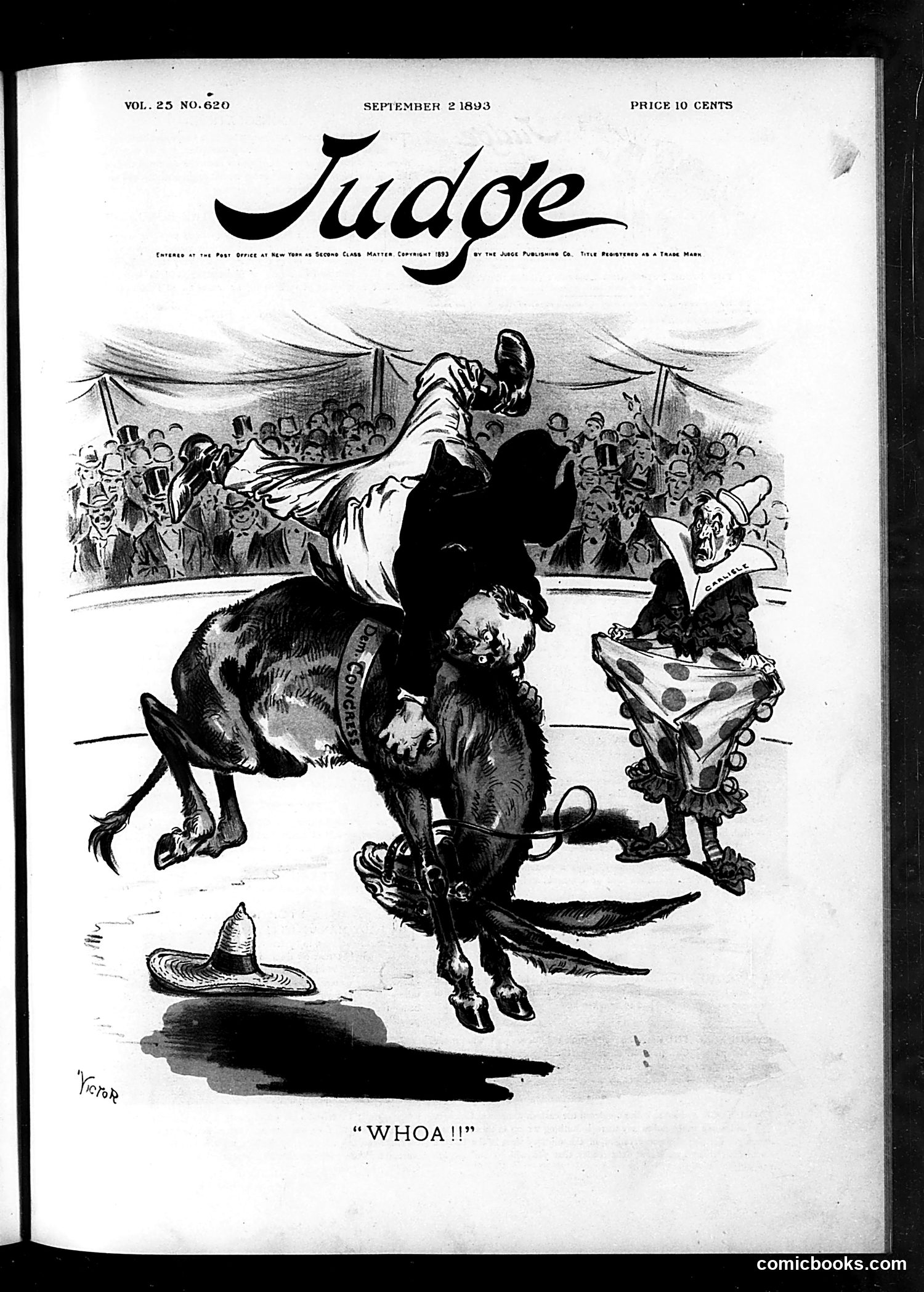
This Judge magazine cover from September 2, 1893 depicts a circus scene titled "WHOA!!" A bucking horse throws its rider (a man in formal dress) while a clown or carnival performer watches nearby. The crowd fills the tent background. The cartoon likely satirizes a political or social figure of 1893 who has lost control of a situation—the "bucking" representing unexpected chaos or failure. The circus setting suggests incompetence or loss of dignity in a public spectacle. Without clearer identifying marks or text, the specific target remains unclear, though the satirical intent—mocking someone's inability to manage circumstances—is evident. The artist's signature reads "Verdi" or similar.
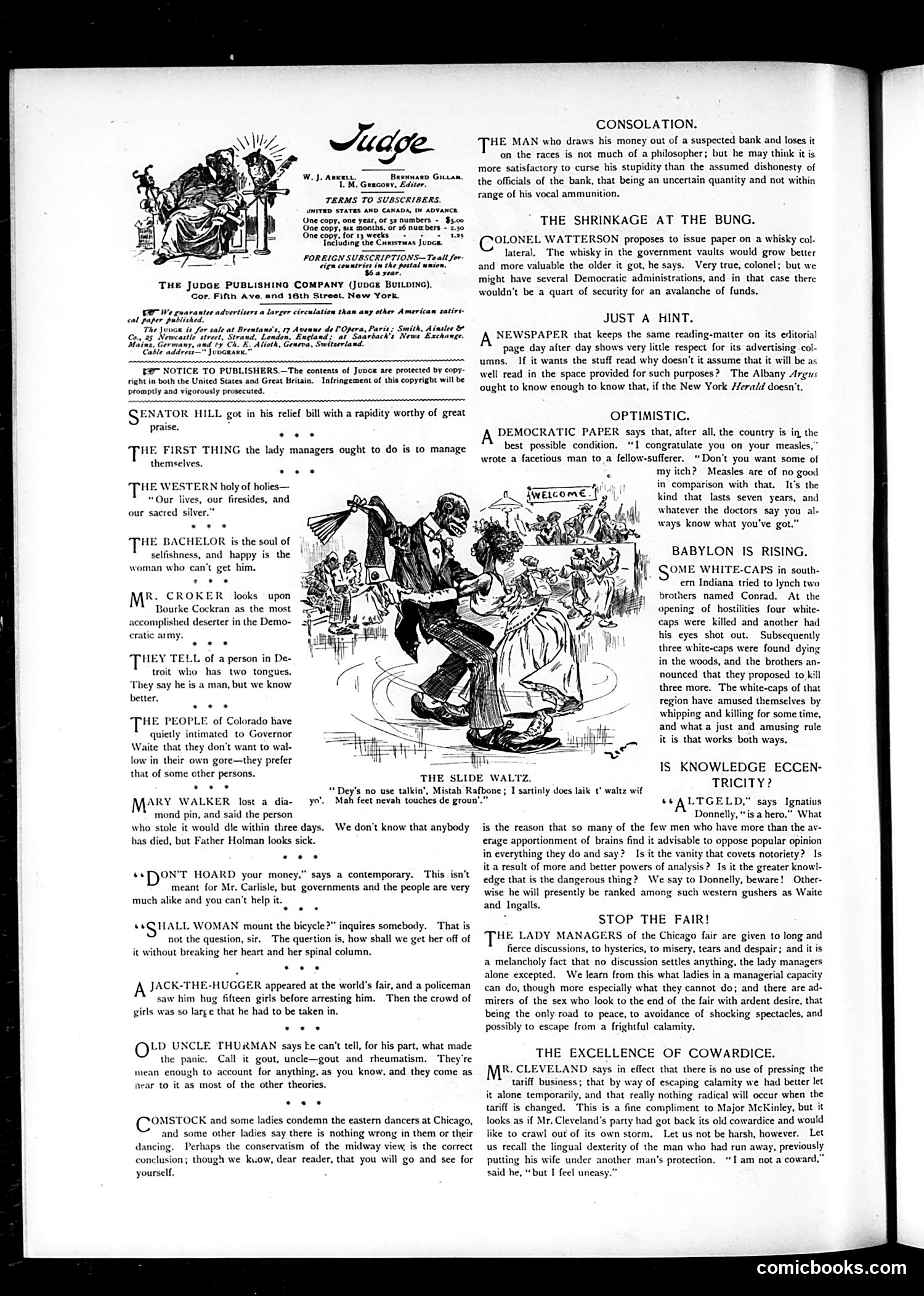
This cartoon depicts a social dance scene titled "The Slide Waltz," captioned with the quote: "Don't no use talkin', Mistah Raffbone; I samtly does talk t' waltz wif Mistah Hen-tresh touches de groun'." The satire appears to mock fashionable dancing trends of the era, particularly a new dance style where partners maintain minimal contact with the floor—a "sliding" waltz. The dialect-heavy caption suggests the figure is an African American character expressing skepticism or complaint about the dance's demands. The cartoon satirizes both the absurdity of elite social dancing fads and likely contemporary anxieties about modern dance styles, presenting the new waltz as impractical or undignified compared to traditional dancing standards.
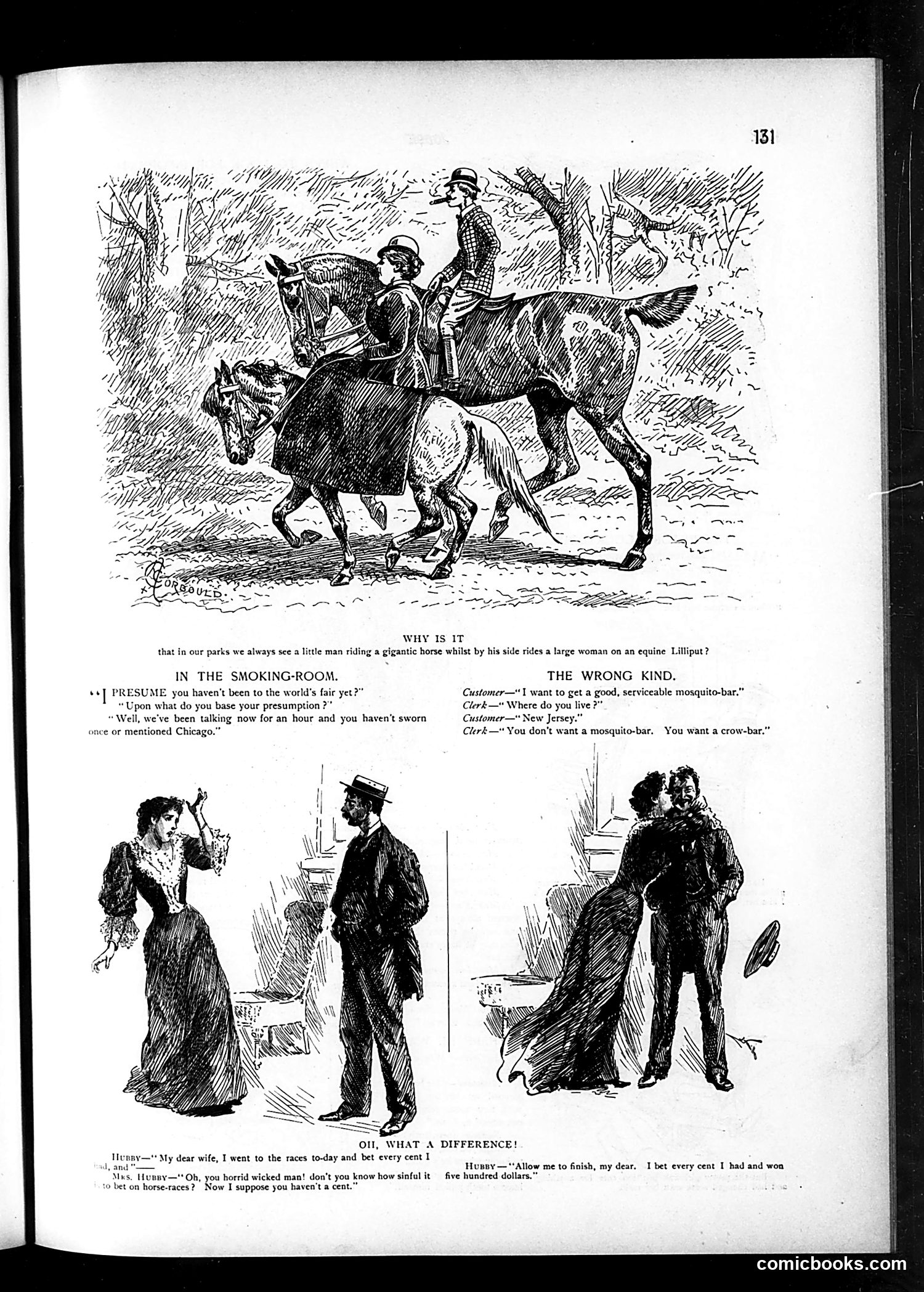
This page contains three unrelated satirical sketches from Judge magazine: **Top cartoon** ("Why is it..."): Mocks the absurdity of gender roles in equestrian activities—a small man rides a large horse while a large woman rides a tiny horse ("Lilliput"), inverting typical expectations. **"In the Smoking-Room"**: A man presumes another hasn't visited "the place" (likely Chicago), creating a joke about regional assumptions. **"The Wrong Kind"**: A clerk and customer miscommunicate—the customer wants a "mosquito-bar" (bed netting) but is offered a "crow-bar" (tool), playing on homophonic confusion. **"Oh! What a Difference!"**: A husband loses money at horse races; his wife scolds him for the loss while revealing she won five hundred dollars betting herself—satirizing female hypocrisy about gambling. The page targets gender conventions, regional stereotypes, and marital dynamics typical of Victorian-era humor.
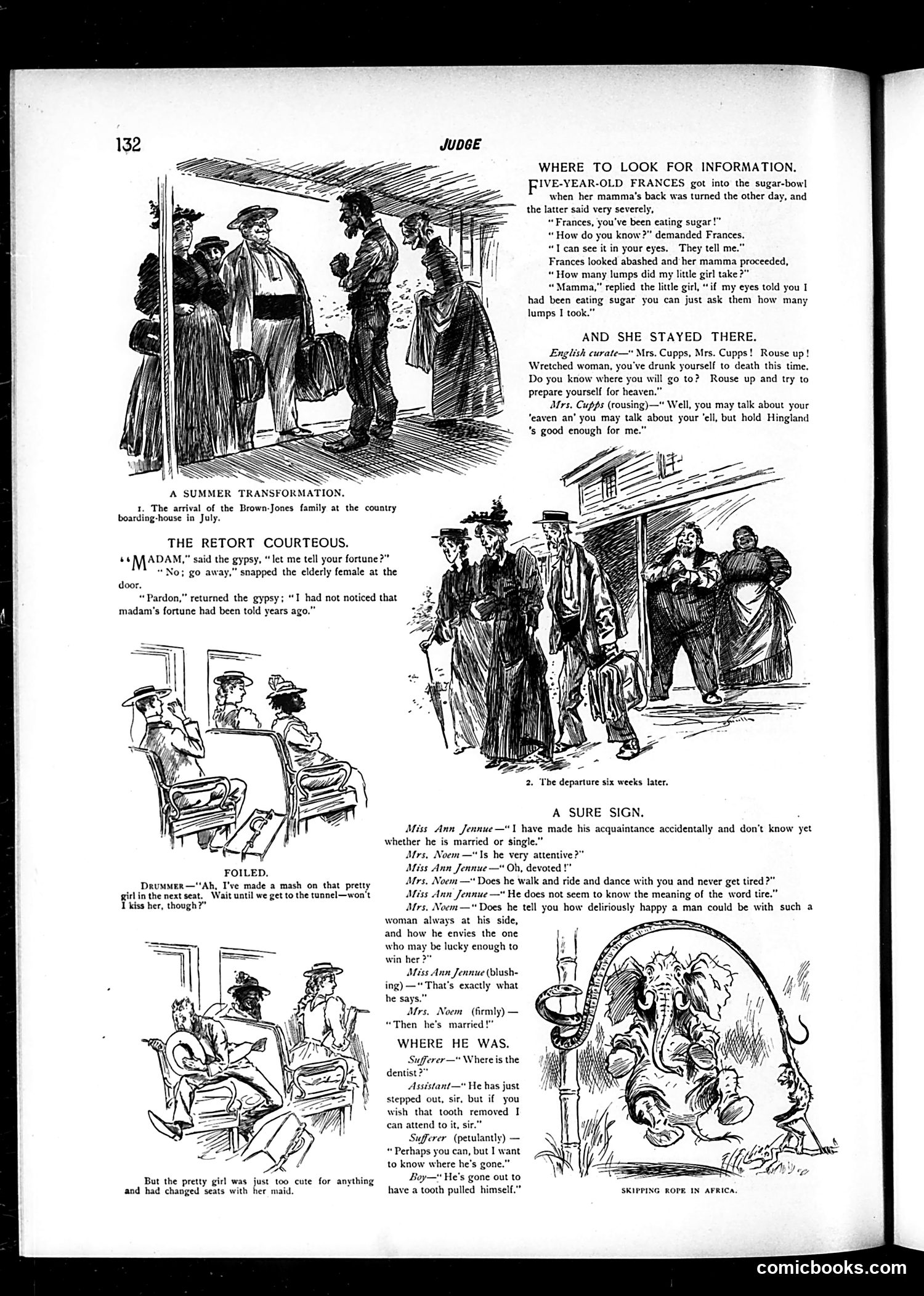
This page contains multiple brief satirical sketches typical of late-19th-century American humor: **"Where to Look for Information"** mocks children's logic: a girl caught eating sugar argues her mother should ask her eyes (which "told" on her) how many lumps she took—a clever deflection. **"And She Stayed There"** satirizes class attitudes: a stern English clergyman lectures a working-class woman (Mrs. Cupps) about heaven and hell, but she insists England itself is "good enough"—implying earthly life matters more than religious promises. **"The Retort Courteous"** shows a gypsy fortune-teller cleverly insulting an elderly woman by suggesting her "fortune" was already determined long ago (i.e., she's old and past hope). **"A Sure Sign"** plays on courtship conventions: when a man shows such devoted attention without mentioning his happiness, Mrs. Noem concludes "he's married"—implying married men perform such attentiveness as a cover. The remaining sketches use similar quick-joke formats about dentists and romance. The humor relies on period-specific social observations about class, gender roles, and Victorian propriety.
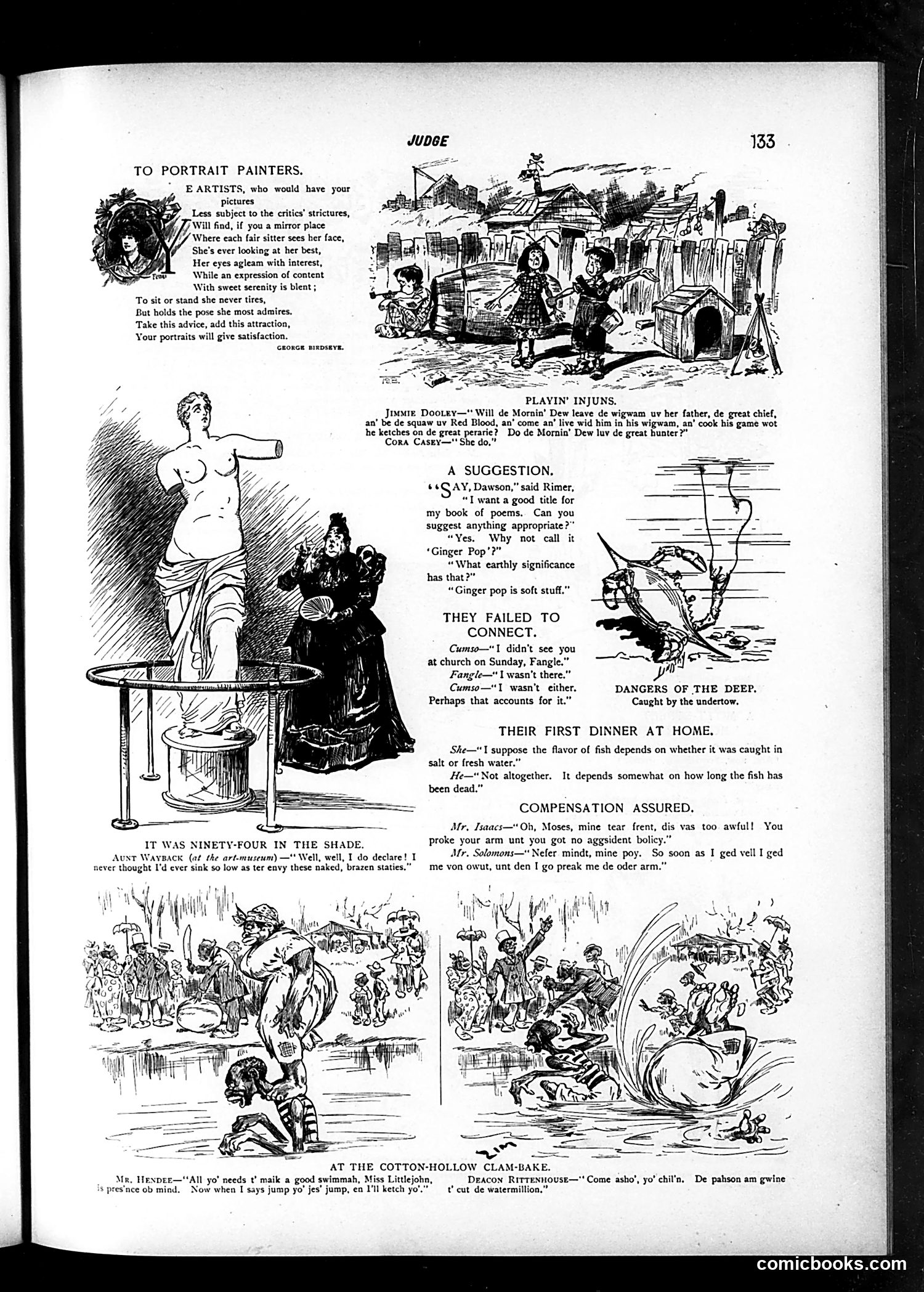
This page contains multiple unrelated short humorous pieces typical of 1890s-era Judge magazine: **"To Portrait Painters"** offers practical advice: place mirrors so subjects see themselves looking their best, ensuring satisfied portrait clients. **"Playin' Injuns"** shows two children roleplaying Native American characters with exaggerated dialect humor common to the era—reflecting period attitudes toward Indigenous peoples. **"A Suggestion"** is a mild pun: suggesting "Ginger Pop" as a book title because "ginger pop is soft stuff" (weak/worthless). The remaining items are brief domestic comedies: couples discussing fish freshness, a workplace injury leading to insurance fraud, a swimming lesson, and a clam-bake scene. **The dialect humor and racial caricatures** throughout reflect Judge's satirical approach to ethnicity and social class—targeting immigrants, African Americans, and other groups through exaggerated speech patterns that modern readers would recognize as offensive stereotyping.
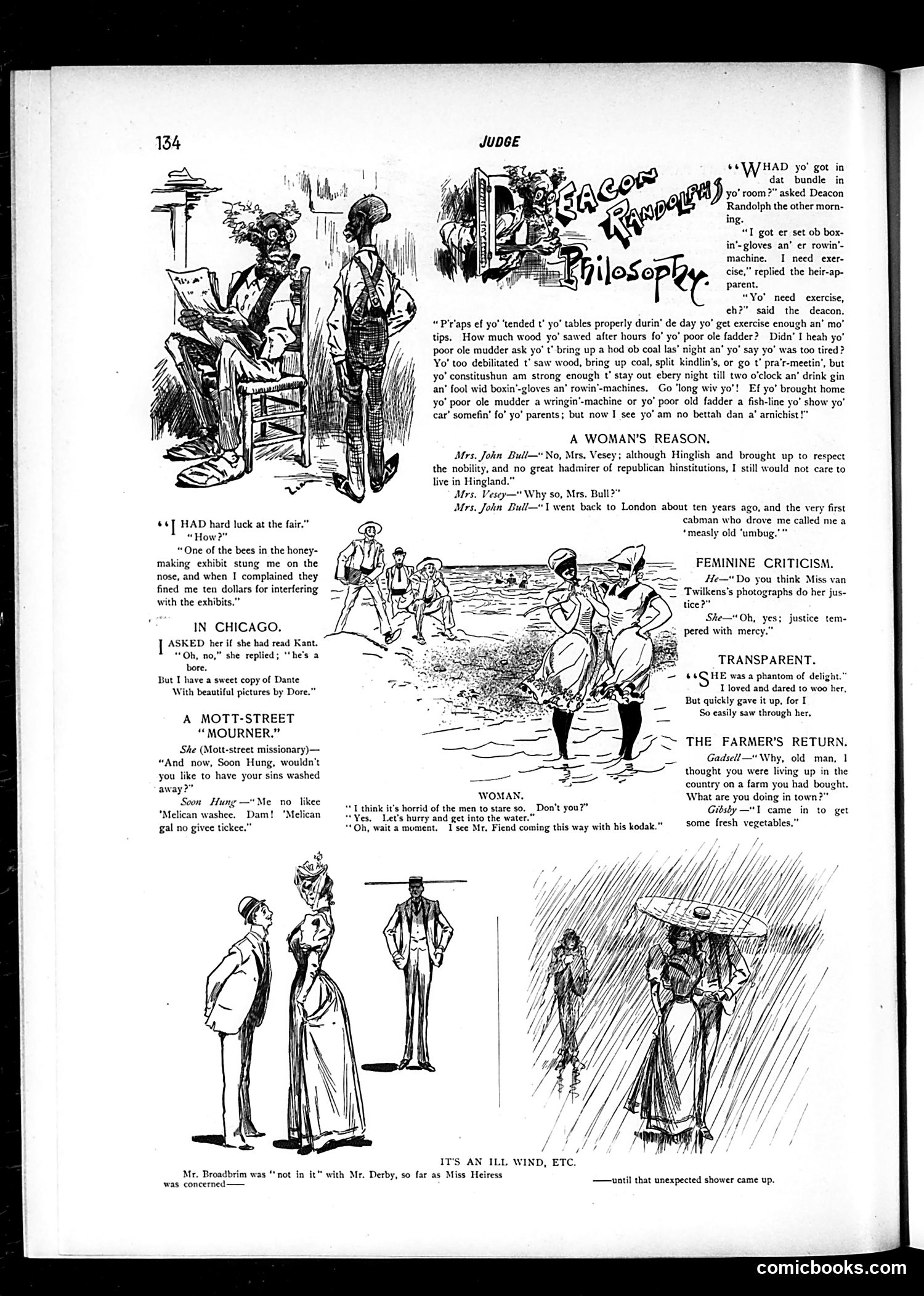
This page collects brief humorous anecdotes and satirical observations typical of Judge's format. Key pieces include: **"Slack Philosophy"** mocks a deacon lecturing his son about exercise—the heir wants a boxing machine and rowing machine but refuses manual labor. The satire targets wealthy African Americans adopting leisure pursuits while neglecting family responsibilities. **"A Woman's Reason"** satirizes British snobbery through two society women; Mrs. Bull won't live in England because a London cabman called her a "measly old humbug"—deflating pretensions about British class respect. **"The Farmer's Return"** jokes about rural life's impracticality—a farmer abandons his purchased farm to visit town for fresh vegetables. **"It's an Ill Wind"** depicts a shy suitor (Mr. Broadbrim) overshadowed by a fashionable one (Mr. Derby) until rain forces them to share shelter, giving him unexpected advantage. The smaller jokes mock various absurdities: fairs, philosophy, missionary work, and photography. The overall tone is light social commentary on American pretension and behavior circa early 1900s.
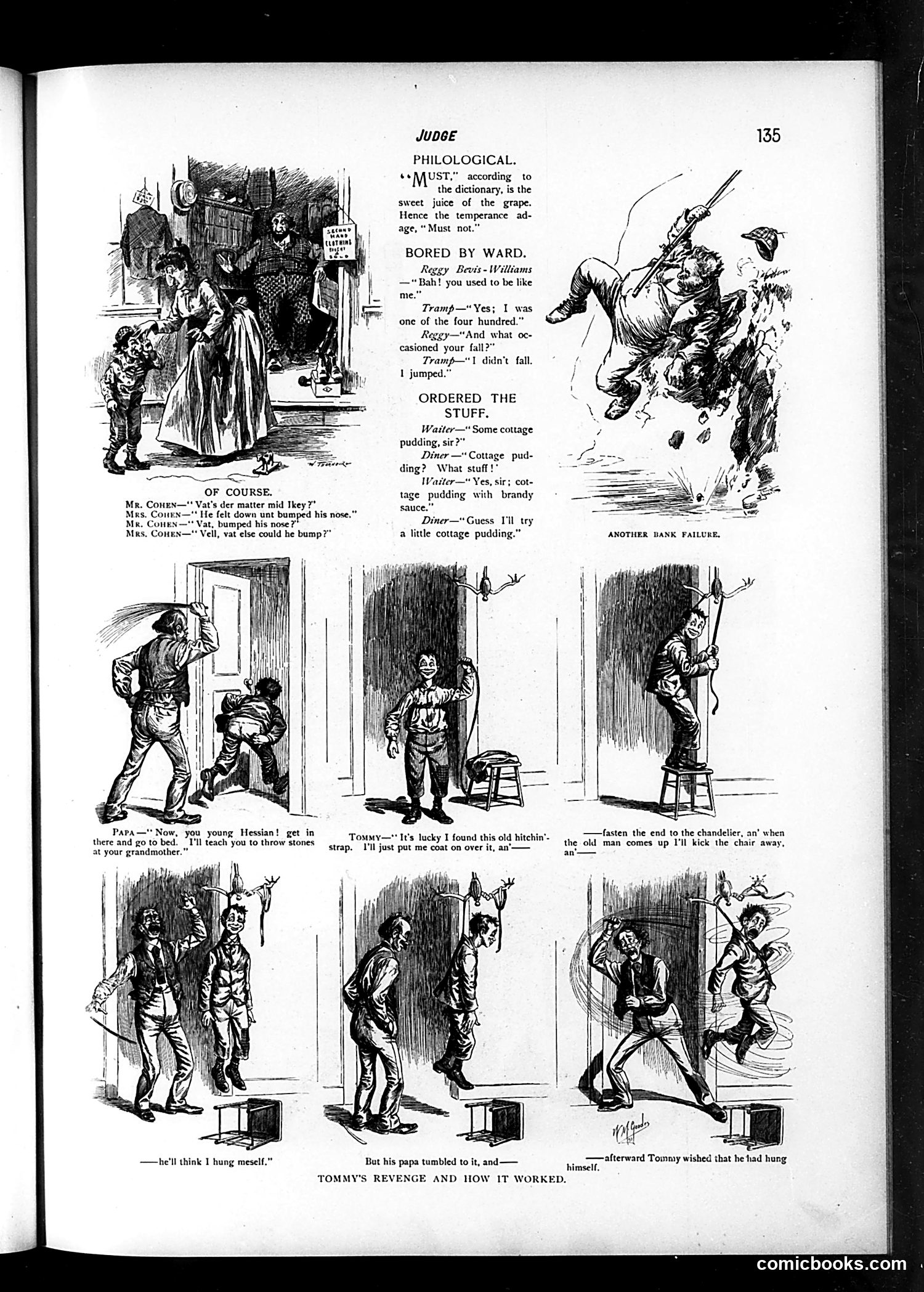
This page contains several unrelated humorous items typical of late-19th/early-20th century American satirical magazines: **"Philological"** is a pun on the temperance movement: "must" (grape juice) sounds like "must not" (alcohol prohibition). **"Bored by Ward"** mocks the upper-class "Four Hundred" (elite New York society). A vagrant claims he was once wealthy but deliberately jumped from his status—satirizing how quickly fortunes could reverse. **"Ordered the Stuff"** jokes about cheap restaurant food disguised by sauce. A diner rejects "cottage pudding" until told it's served with brandy, suddenly finding it acceptable—mocking pretension and hypocrisy. **"Tommy's Revenge"** is a slapstick sequence where a boy plans to hang himself from a chandelier to frame his father, but the father discovers the trick and tumbles into it instead. It's dark humor about family conflict and childhood mischief, typical of period comedy. The cartoon illustrates working-class and immigrant characters (suggested by dialect), youth rebellion, and social commentary through crude practical jokes.
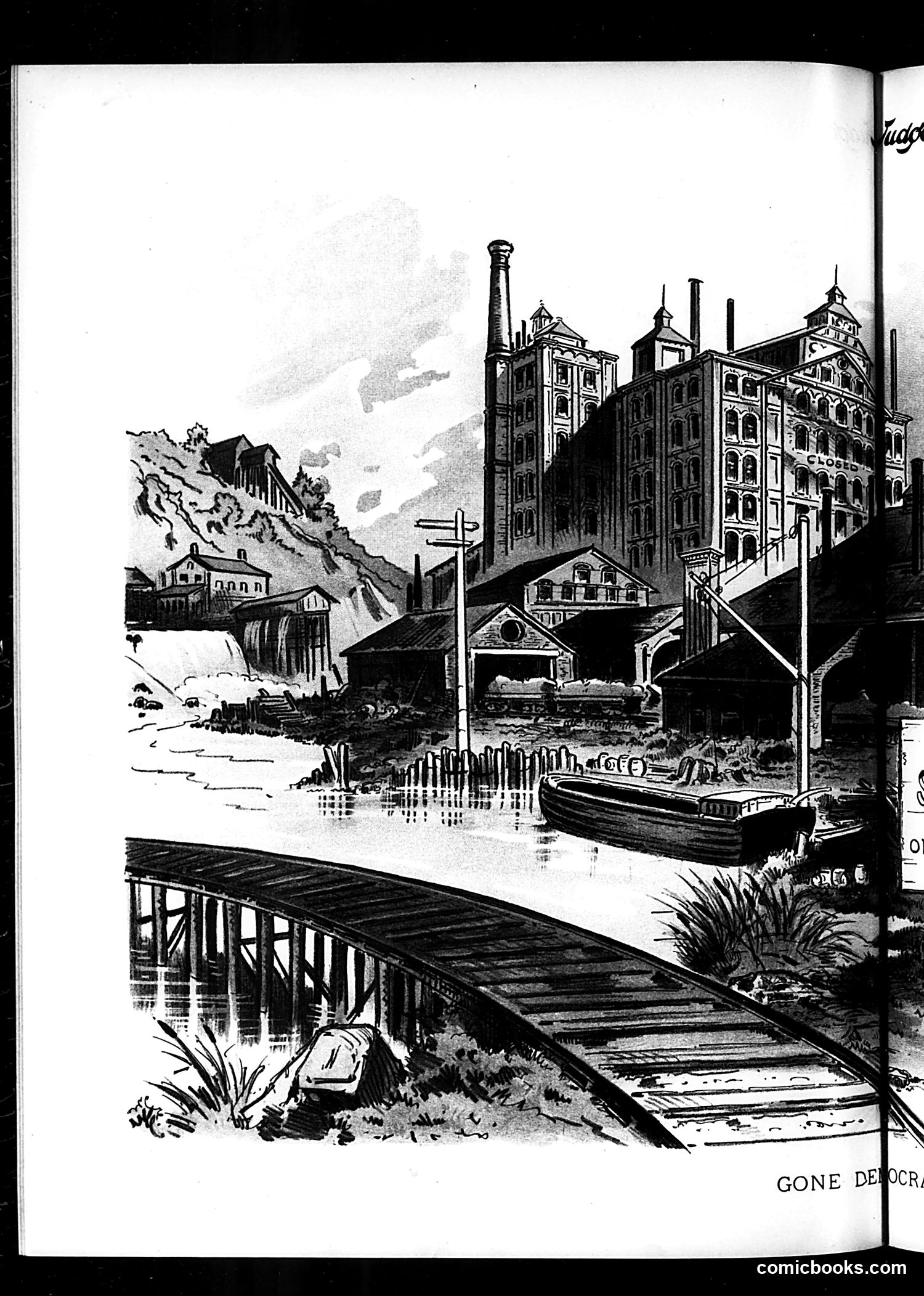
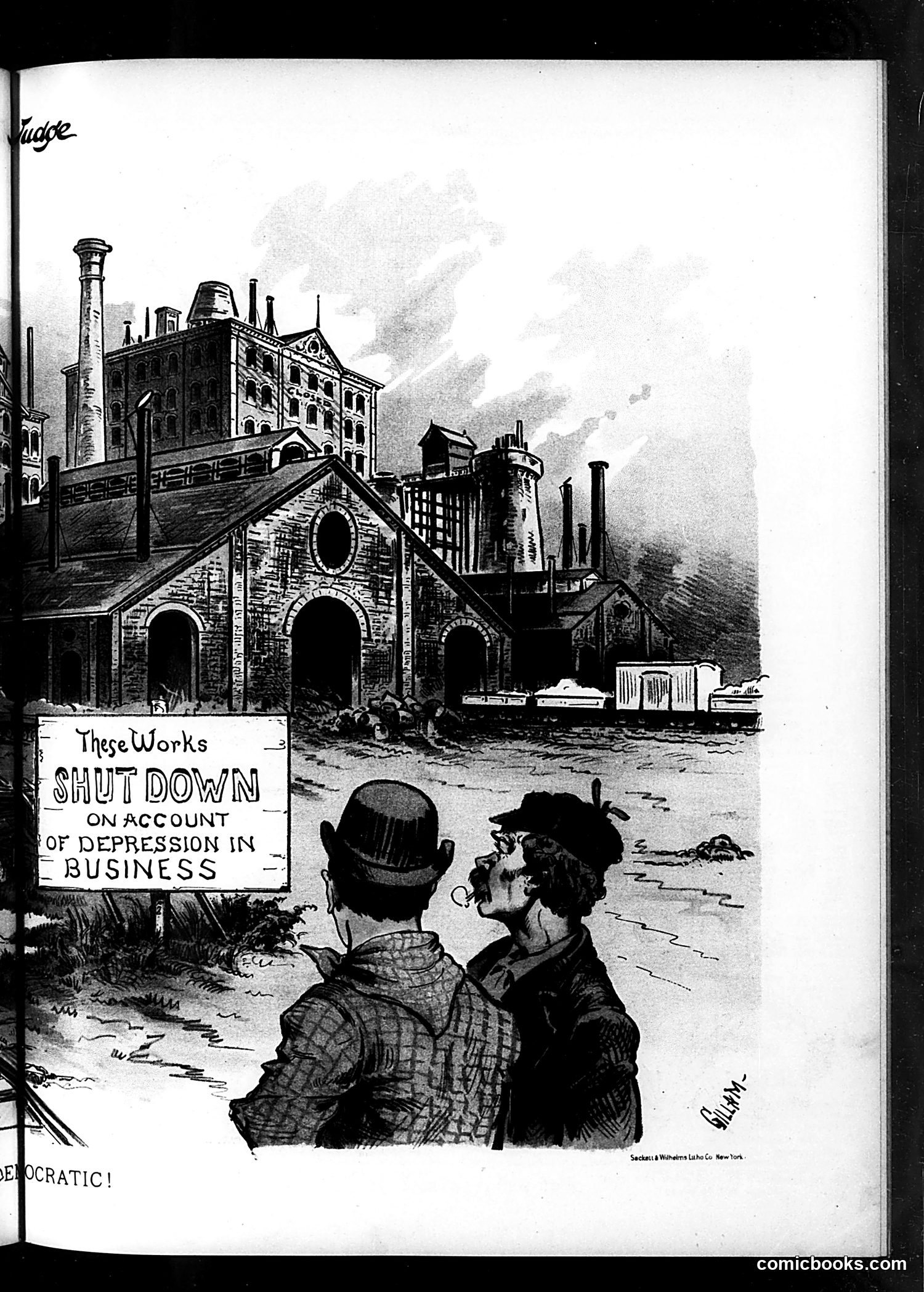
This page contains a detailed black and white illustration of an industrial waterfront scene, showing wooden docks in the foreground, a moored boat, and substantial factory or mill buildings with multiple smokestacks in the background. The style and composition suggest this depicts late 19th or early 20th-century industrial America. The visible text "GONE DEMOCRAT" appears to be a caption or title, though the OCR is largely corrupted. Without clearer text or additional context, the specific political satire is difficult to determine with certainty. The image may be commenting on industrial development, labor conditions, or political changes affecting industrial regions—possibly suggesting Democratic policies' impact on industrial towns. However, without more legible accompanying text or clearer historical context, the precise satirical point remains unclear.
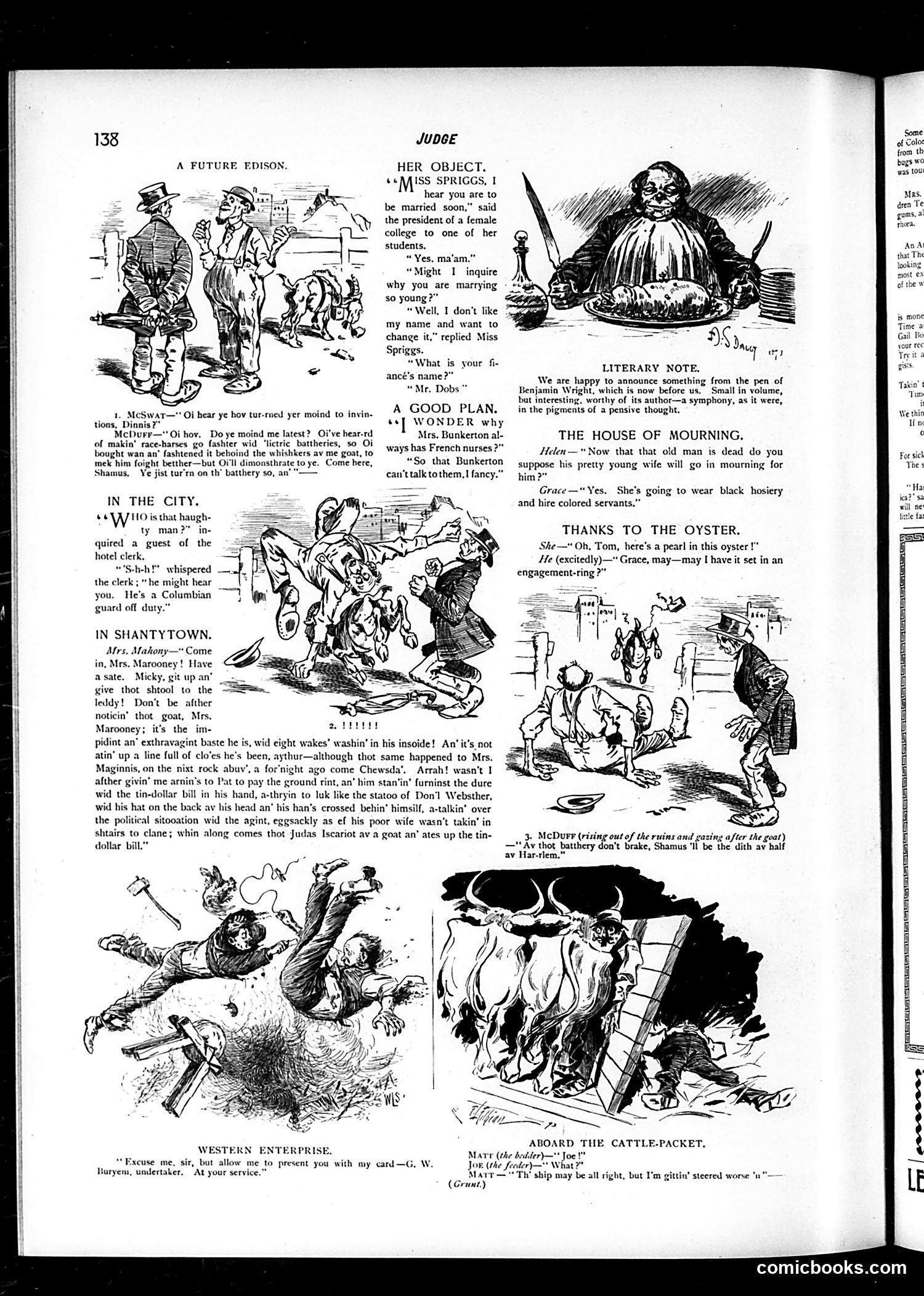
This page from *Judge* contains several satirical pieces mocking late-19th-century social types and ethnic stereotypes: **"A Future Edison"** ridicules Irish immigrants (indicated by heavy dialect: "Oi hear," "whishkers") attempting to adopt American innovation, showing a man attaching a battery to a goat—absurd pseudo-scientific thinking. **"In Shantytown"** features an exaggerated Irish working-class domestic scene with thick brogue dialect, depicting poverty and the misfortunes of tenement life (a goat eating rent money). **"Her Object"** jokes about a woman marrying solely to escape an unflattering surname, satirizing women's limited autonomy and marriage motivations. **"Thanks to the Oyster"** presents genteel courtship humor—a woman finds a pearl, her suitor proposes using it for an engagement ring. **"Aboard the Cattle-Packet"** shows ship workers discussing navigation problems in dialect. The page employs ethnic caricature and vernacular speech to mock working-class immigrants, particularly Irish Americans, while offering mild social commentary on marriage and courtship among educated classes. This reflects *Judge*'s typical editorial bias toward established American elites.
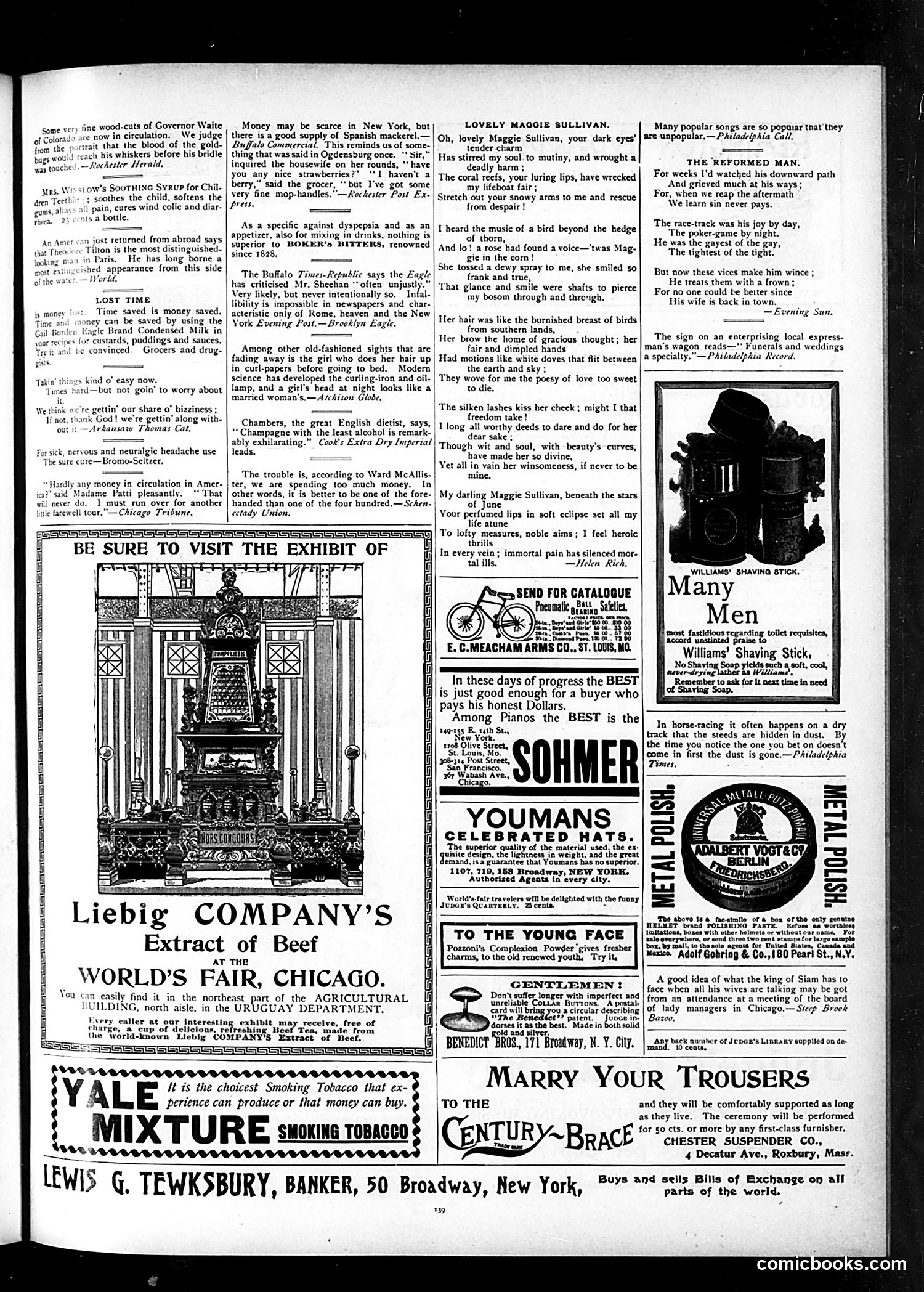
This page is primarily **advertising and poetry**, not political satire. The main content includes: **Poetry Section**: "Lovely Maggie Sullivan" is a sentimental romantic poem about a man's infatuation with a woman named Maggie—typical Victorian-era verse found in such magazines. **Brief Humor/Commentary**: The scattered text snippets are light social observations about money scarcity, food supplies, and etiquette—unremarkable period humor without clear political targets. **Advertisements**: The page features numerous ads for products (Liebig's Beef Extract, Yale Smoking Tobacco, Williams' Shaving Stick, pianos, etc.), which dominated Judge's pages. There's no identifiable political cartoon visible in the image. The reference to "Governor Waite" at the page's top appears to be a throwaway joke about Colorado's governor, but context is lost due to OCR errors and fragmentation. **Bottom line**: This is a typical late-19th-century magazine page mixing light verse, social commentary, and commercial advertising rather than substantive political satire.
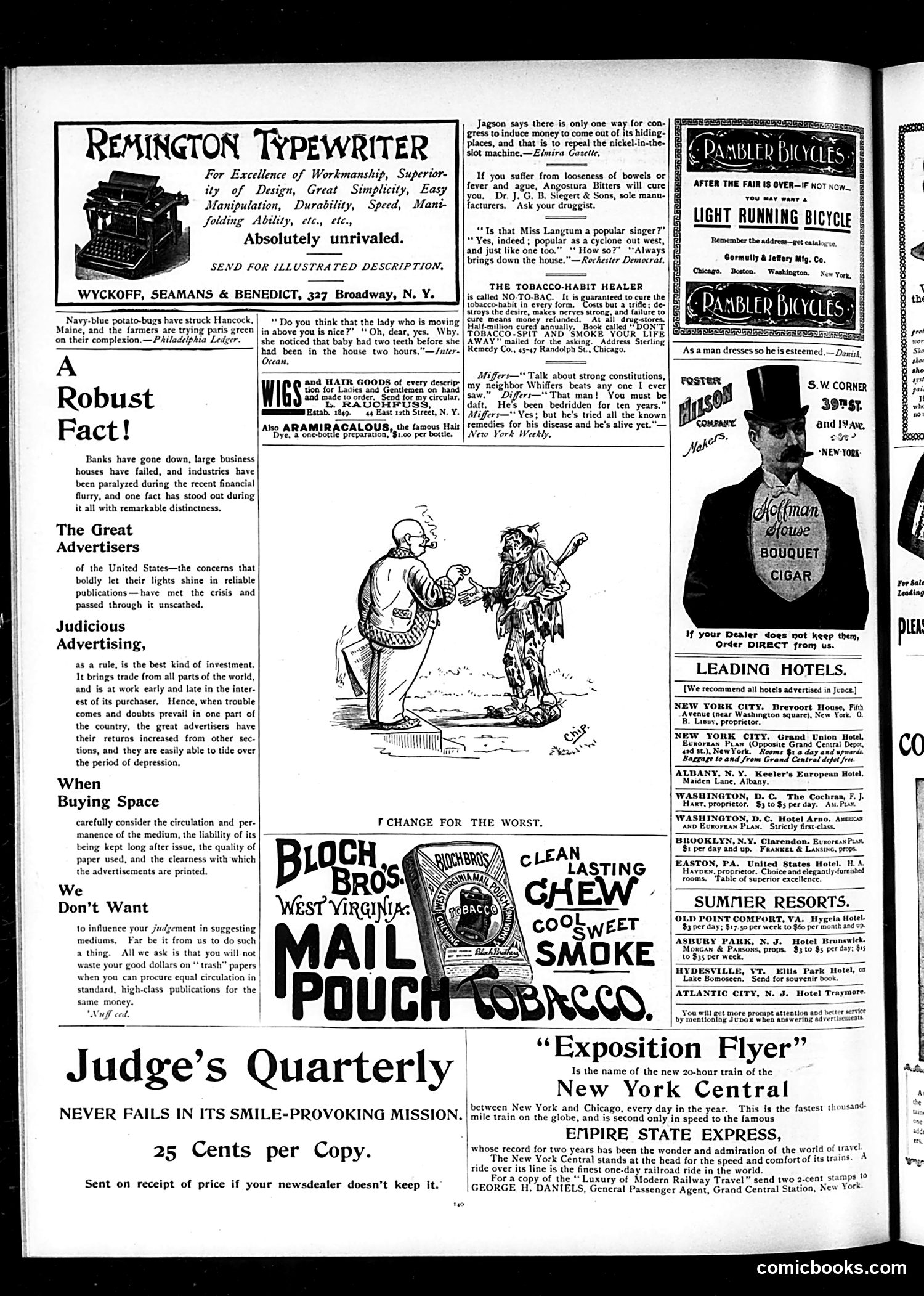
This page is primarily **advertising and filler content** rather than political satire. Judge was a humor magazine that relied heavily on paid advertisements to support publication. The main illustrated cartoon (center-left) depicts a simple domestic joke: a man asking a neighbor about the lady moving in upstairs, who replies that she's "nice" because she noticed his baby had two teeth before she'd been in the house two hours—a joke about the baby's rapid development or the woman's keen observation. The page includes various **patent medicine and consumer product advertisements** typical of the era (typewriters, bicycles, cigars, tobacco-habit cures, hair goods), mixed with short humorous one-liners and jokes about topics like potato bugs, popular singers, and constitutions. **No clear political content** is evident. The "Robust Fact!" section merely praises advertising's resilience during recent financial troubles. This appears to be a standard late-19th or early-20th-century magazine page balancing editorial humor with commercial revenue.
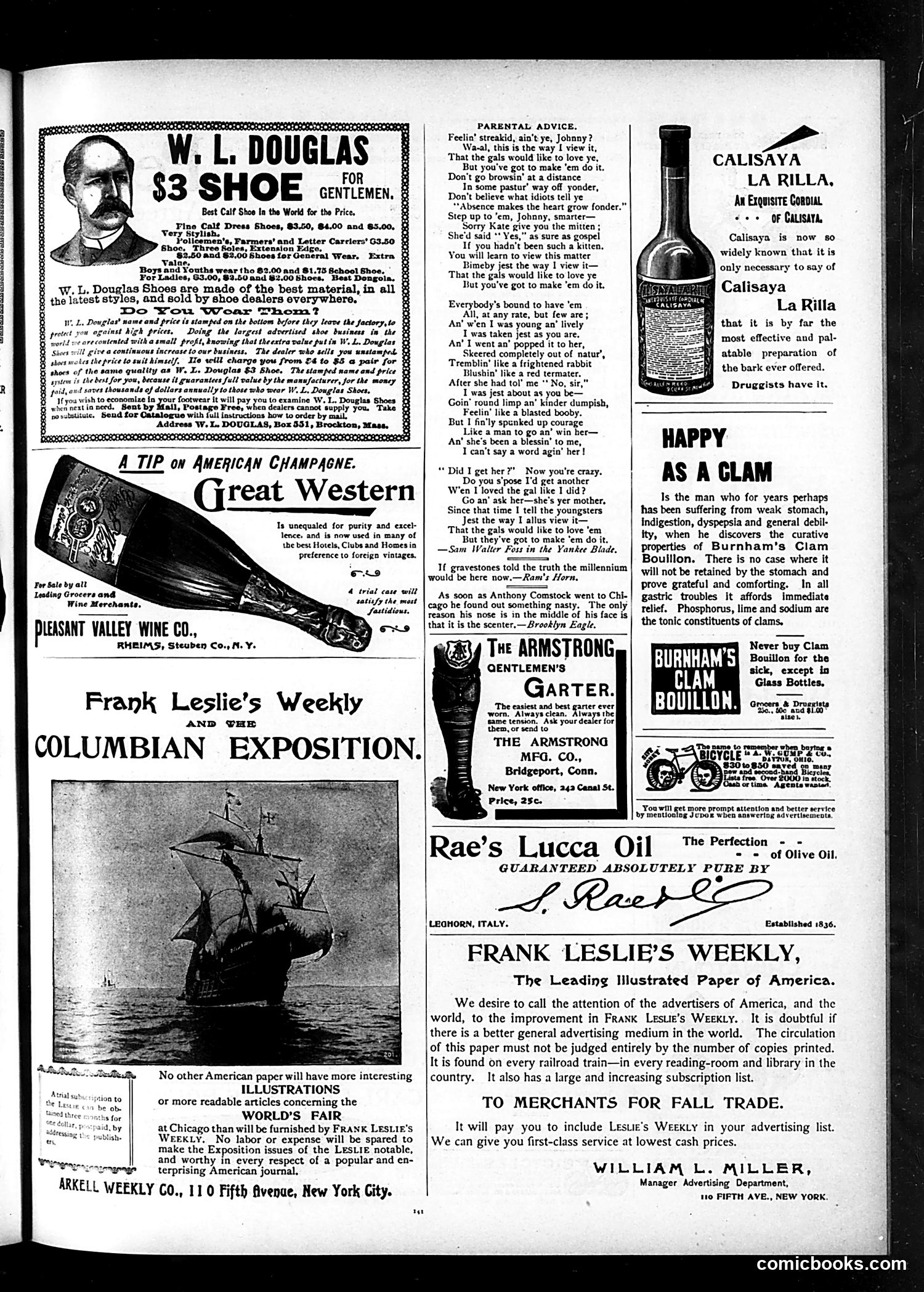
This is primarily an **advertising page** rather than political satire. The content consists of: 1. **W.L. Douglas Shoe Advertisement** - A major ad featuring the shoe manufacturer's portrait and detailed product information about affordable men's shoes ($3). 2. **"Parental Advice" Poem** - A rustic father figure offers courtship advice to his son Johnny, using dialect humor. The message: don't be passive or distant in romance; take initiative with women or you'll lose them. It's sentimental Victorian-era relationship advice presented as folk wisdom. 3. **Various Patent Medicine Ads** - Including Calisaya La Rilla (a quinine-based tonic), Burnham's Clam Bouillon (for digestive complaints), and Rae's Lucca Oil (olive oil). 4. **Frank Leslie's Weekly cross-promotion** - Advertising the magazine itself. The page reflects late-19th-century advertising conventions: mixing product promotion with moralistic or humorous editorial content to fill space and attract readers.
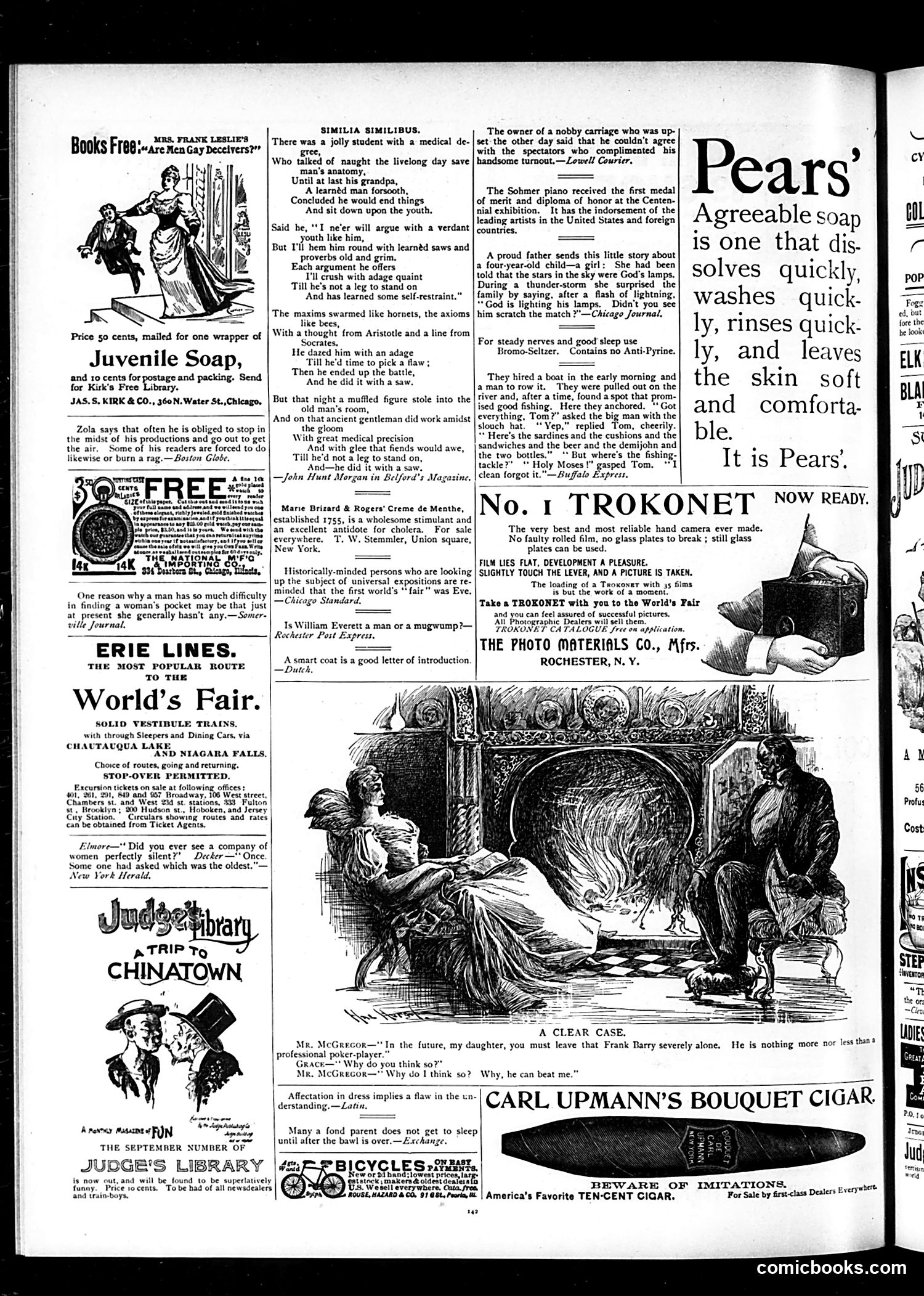
This page contains primarily **advertisements and humor shorts**, not political cartoons. The main illustrated content is "A Clear Case," a sketch showing what appears to be a domestic dispute—a woman reclining while a man stands confronting her, with another figure present. The caption indicates a disagreement about whether the woman should see a man named Frank Barry alone, with the woman asserting the man "can beat me," suggesting marital conflict played for dark humor. Most other content consists of **short jokes** mocking contemporary figures (Zola the writer, William Everett a politician/mugwump) and **product advertisements** for soap, pianos, rail lines to the World's Fair, cigars, and medicines—typical of Judge magazine's revenue model. The poetry "Similia Similibus" tells of a medical student lectured by his grandfather using old maxims, then retaliated against at night—a revenge narrative playing on academic pomposity. The page reflects **1890s-era advertising culture** blended with light satirical commentary on daily life and minor public figures.
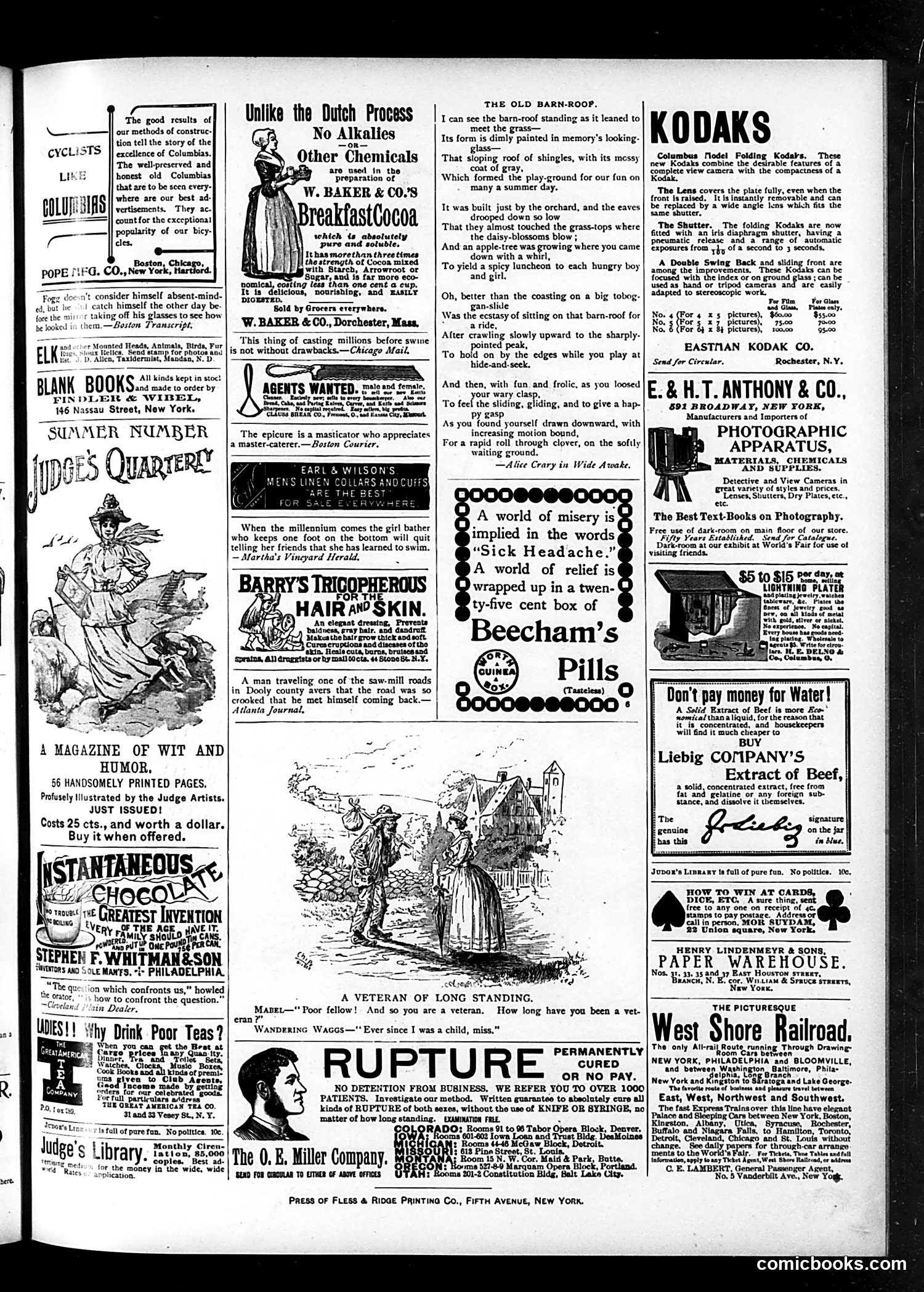
This page is primarily **advertising and filler content** typical of late 19th-century American magazines, with minimal political satire. The main notable element is a nostalgic poem, "The Old Barn-Roof," depicting idealized rural childhood memories—climbing roofs, sliding down, playing hide-and-seek. This reflects period sentimentality about agrarian life as industrialization advanced. The advertisements reveal period concerns: patent medicines (Beecham's Pills for "sick headache"), food products (Baker's Cocoa emphasizing no "alkalies"), and medical services (rupture cures with guaranteed treatments). The recurring theme of health remedies suggests anxieties about bodily ailments common to the era. A brief joke about a girl swimmer's exaggeration pokes gentle fun at vanity. Otherwise, the page lacks sharp political commentary—it's primarily commercial space and sentimental verse padding out Judge's satirical content, aimed at middle-class readers interested in consumer goods and wholesome humor.
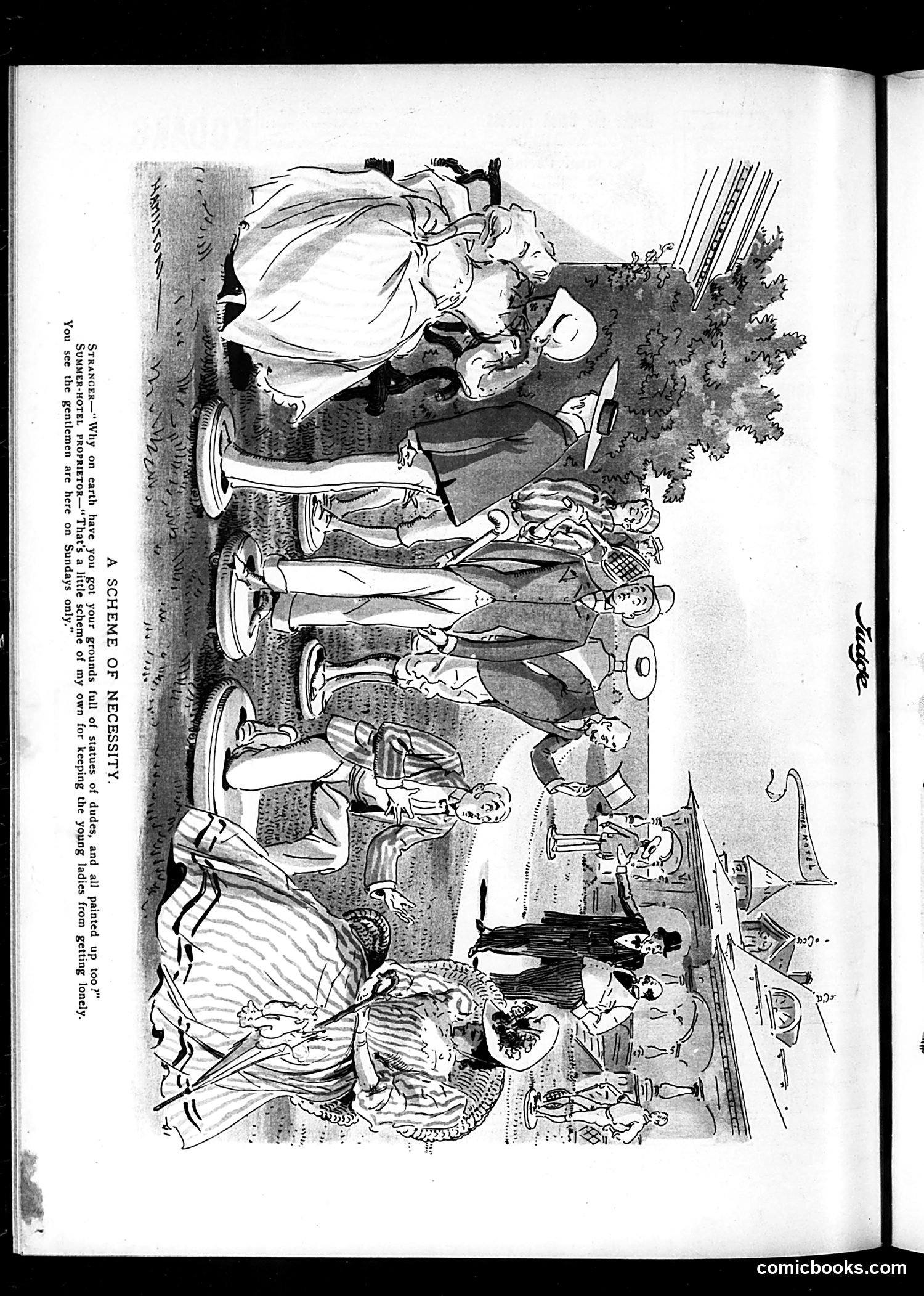
This cartoon satirizes summer hotel proprietors' efforts to entertain female guests. The joke hinges on a gender imbalance: wealthy men could only visit their summer hotel retreats on weekends, leaving female guests—who stayed longer—without male companionship during weekdays. The proprietor's "scheme" is to display painted statues of men around the grounds as decorative company for bored women. It's a tongue-in-cheek commentary on the leisure habits of the Gilded Age upper class, where summer resorts were popular destinations and the separation of genders by work schedules created social awkwardness. The humor derives from the absurdity of substituting statuary for actual male attention—a practical (if ridiculous) solution to a real social problem of the era.