
A complete issue · 16 pages · 1893
Judge — June 24, 1893
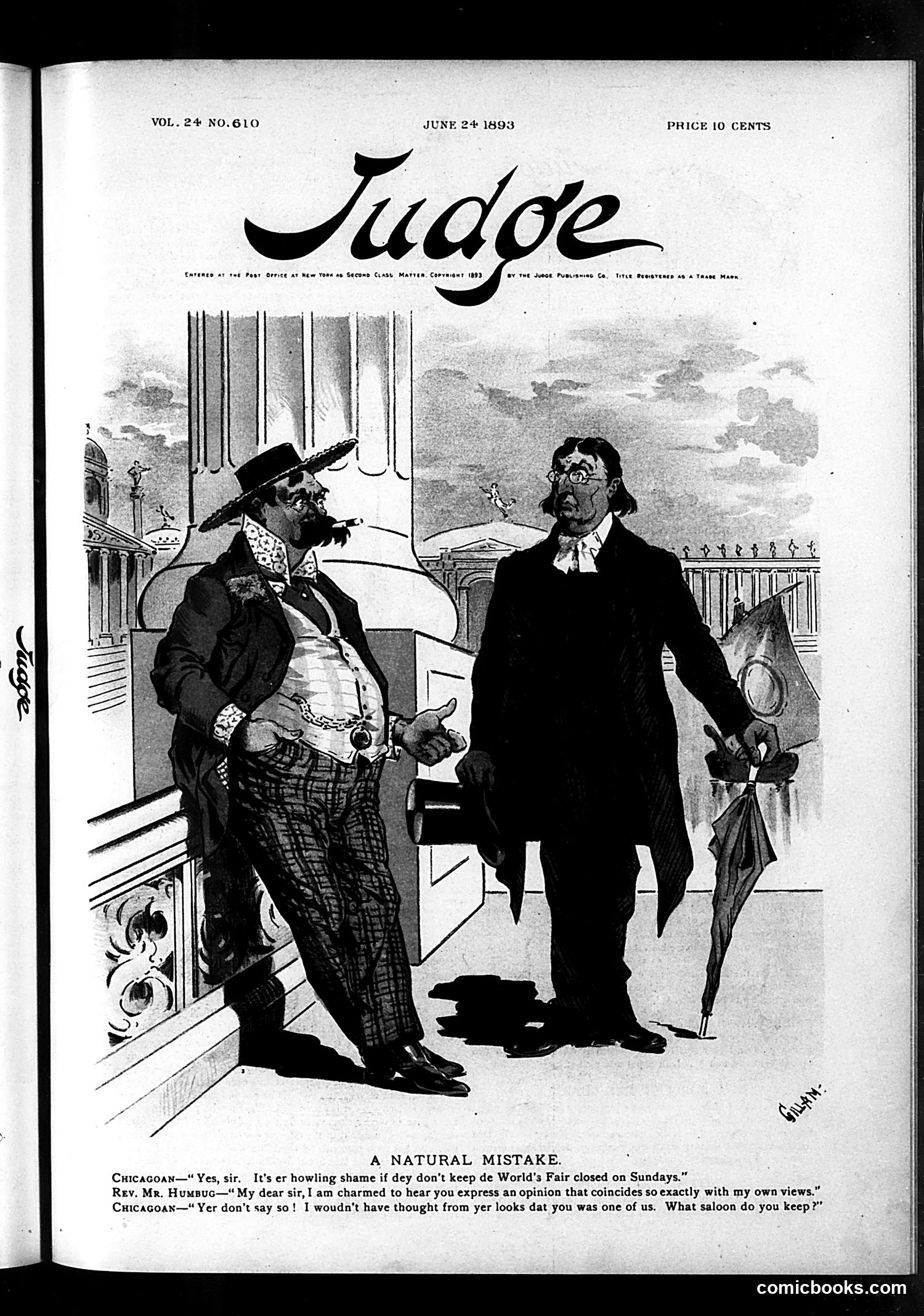
This cartoon satirizes a meeting between two figures at what appears to be the World's Fair (likely the 1893 Chicago World's Columbian Exposition). The figure on the left, labeled "Chicagoan," wears flashy, ostentatious clothing with a wide-brimmed hat and ornate vest—stereotypical caricature of a wealthy but uncultured Chicago businessman. The refined figure on the right appears to be a clergyman or intellectual (Rev. Mr. Higinbotham, based on OCR text). The joke hinges on class and regional prejudice: the Chicagoan mistakes the reverend for someone of his own social circle, assuming shared views about closing the Fair on Sundays. The reverend's shocked response—saying the Chicagoan doesn't "look" like "one of us"—mocks both Chicago's nouveau riche pretensions and religious hypocrisy about Sabbath observance during the exposition.
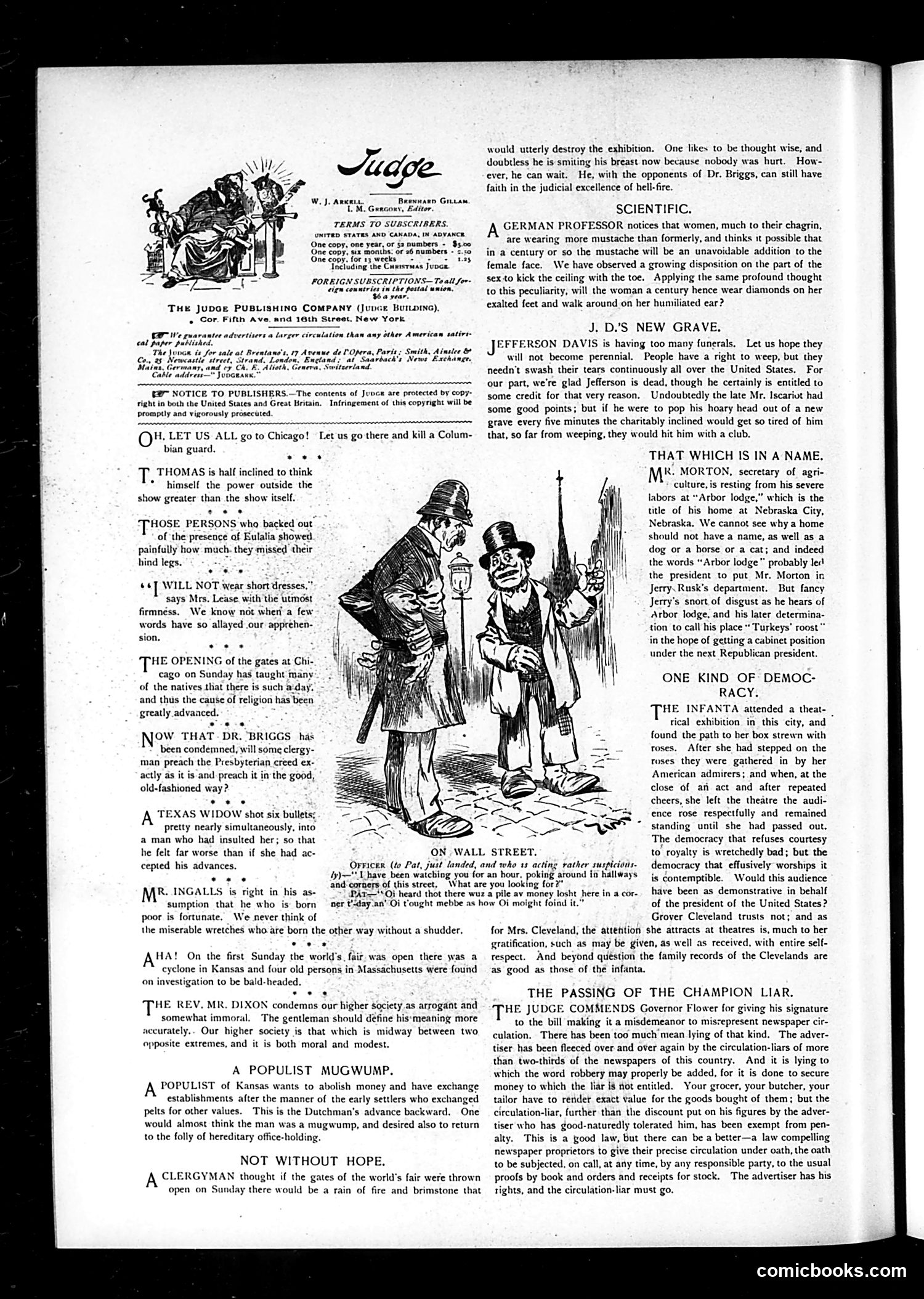
This cartoon depicts two men on a city street, with one appearing to be a confidence man or swindler accosting another. The accompanying caption suggests a con artist has been "watching you for an hour, picking around in hallways and around the street" and asks what the victim is "looking for?" The satire targets **Wall Street fraud and financial deception** during the Gilded Age. The well-dressed figures represent the sophistication of urban cons—not crude street crimes, but schemes perpetrated by seemingly respectable men. The joke critiques how easily New Yorkers could be duped by smooth-talking operators posing as legitimate businessmen. This reflects broader Progressive-era concerns about unchecked financial manipulation and the moral hazards of unregulated capitalism.
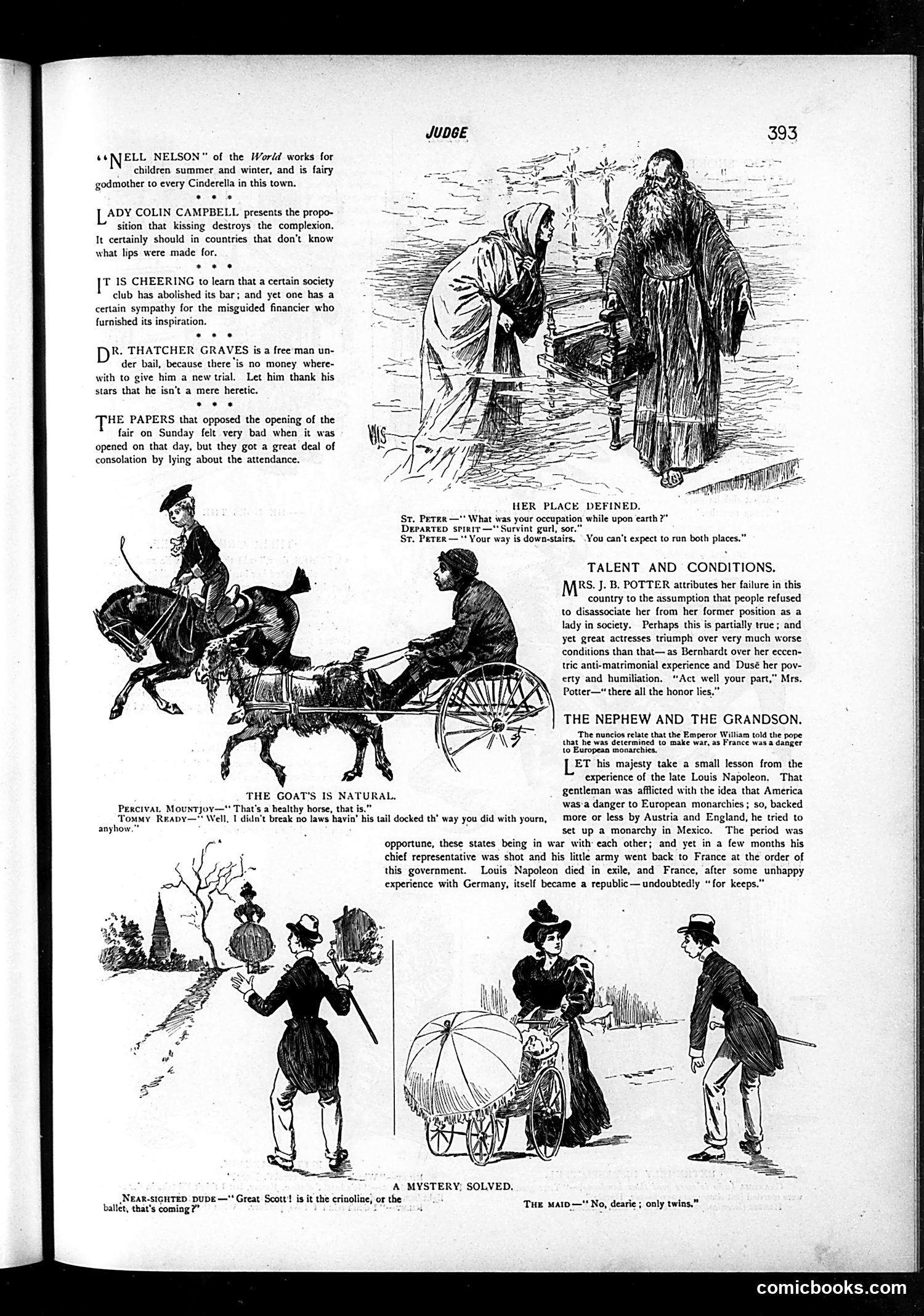
This page contains several brief satirical items and illustrations typical of Judge's style: **"Her Place Defined"** (top): A dialogue between St. Peter and a "Departed Spirit" about a woman's place in the afterlife, with a woman figure. This appears to be social satire about women's roles and expectations. **"The Goat Is Natural"** (left): A comic dialogue between "Percival Moneybag" and "Tommy Brady" about breaking laws, likely satirizing wealthy people's ability to evade consequences. **"A Mystery, Solved"** (bottom): Shows a woman with a baby carriage; a "Near-sighted Dude" mistakes it for something else (unclear what), while "The Maid" corrects him—a slapstick joke about mistaken identity. **"Talent and Conditions"** and **"The Nephew and the Grandson"** (right): Brief prose satires about social pretension and European politics, referencing Louis Napoleon. The page mixes visual humor with social commentary typical of Gilded Age satirical journalism.
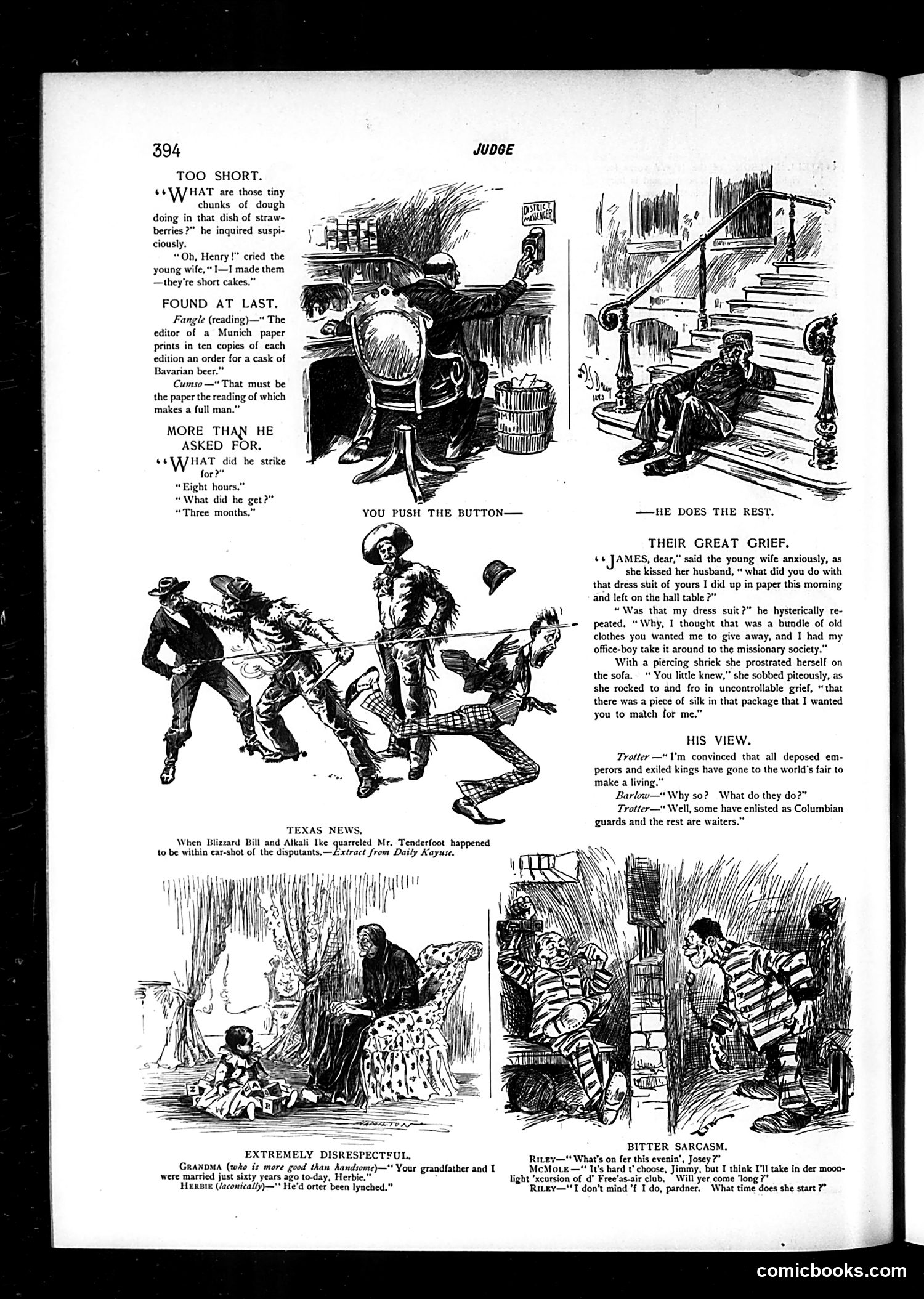
This page contains multiple unrelated satirical jokes typical of late-19th/early-20th century humor: **"Too Short"** and **"Found at Last"** are domestic wordplay jokes with no political content—simple puns about "short cakes" and a newspaper editor. **"More Than He Asked For"** appears to reference labor strikes, with the punchline suggesting an activist gets more consequences than intended. **"Their Great Grief"** satirizes middle-class domestic life: a husband mistakenly donates his wife's dress suit to charity, thinking it's old clothes. Her distress is mocked as absurdly disproportionate—she cares only about recovering a silk swatch to match, not the expensive suit itself. This ridicules women's priorities. **"His View"** makes dark humor about "deposed emperors" (likely referring to exiled European royalty) reduced to menial labor as guards or waiters—commentary on fallen aristocracy. The bottom cartoons appear to be unrelated domestic/cowboy humor. Overall, this is a mixed page of social satire focused on domestic absurdities and class commentary, with no single coherent political theme.
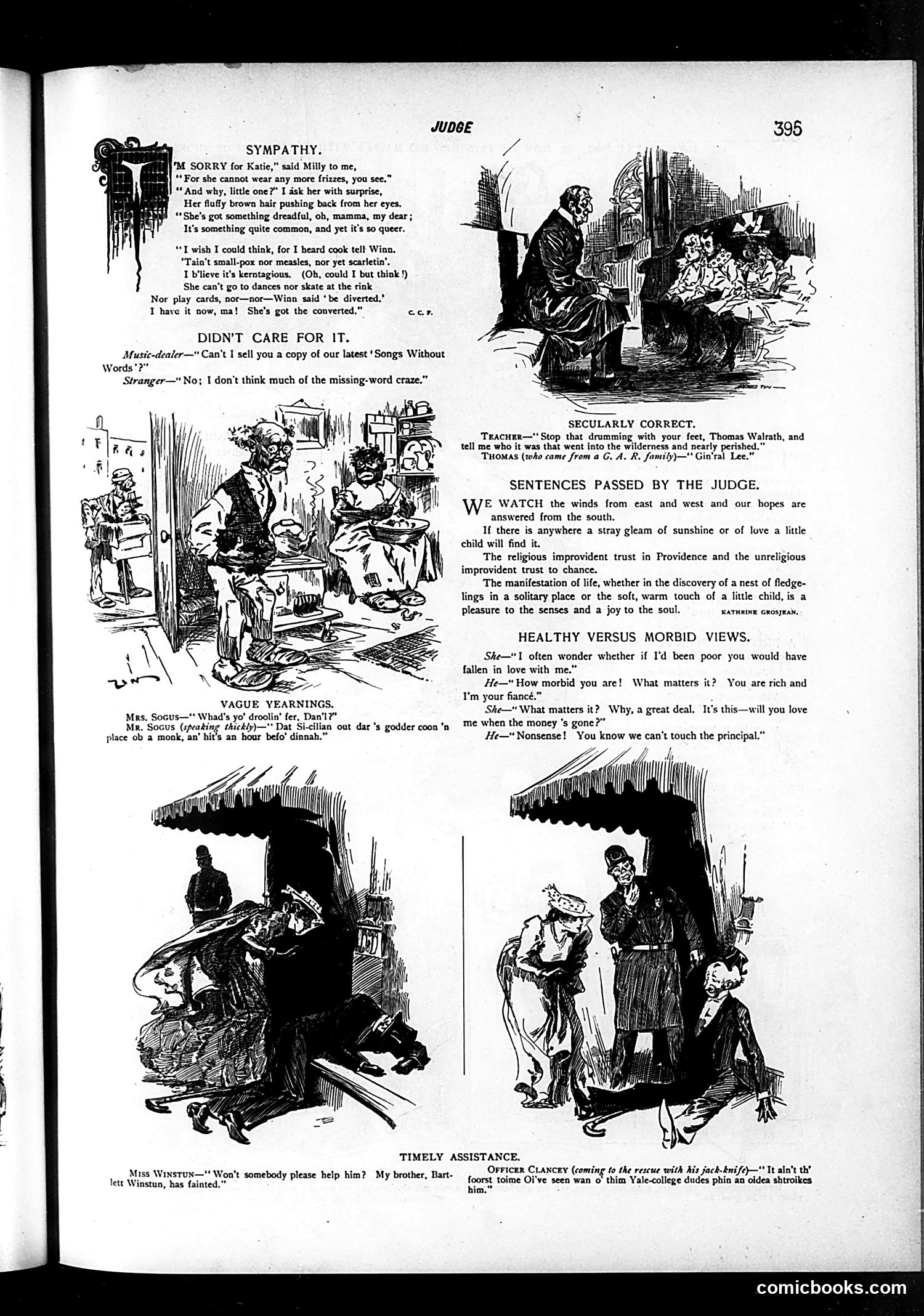
This page contains several brief satirical pieces typical of late-19th/early-20th-century American humor: **"Sympathy"**: A child misunderstands "converted" (likely religious conversion) as a contagious disease afflicting her friend Katie, conflating it with genuine illnesses. **"Didn't Care for It"**: A music dealer tries selling "Songs Without Words"—a real musical genre—but the customer dismisses it as following a "missing-word craze," a joke about contemporary fads. **"Vague Yearnings"**: Dialect humor depicting a Black servant admiring a Sicilian worker's cooking skills (offensive racial caricature typical of the era). **"Secularly Correct"**: A schoolchild from a G.A.R. (Grand Army of the Republic—Union veterans) family answers a Bible question about wilderness hardship by naming "General Lee" instead of a biblical figure—satirizing how Northern Republican families framed Civil War history. **"Healthy versus Morbid Views"**: Satirizes a wealthy fiancé's callous dismissal of his bride's financial concerns, joking he can't lose money since they "can't touch the principal." **"Timely Assistance"**: An Irish policeman stereotypically responds to a fainting Yale student with crude first aid.
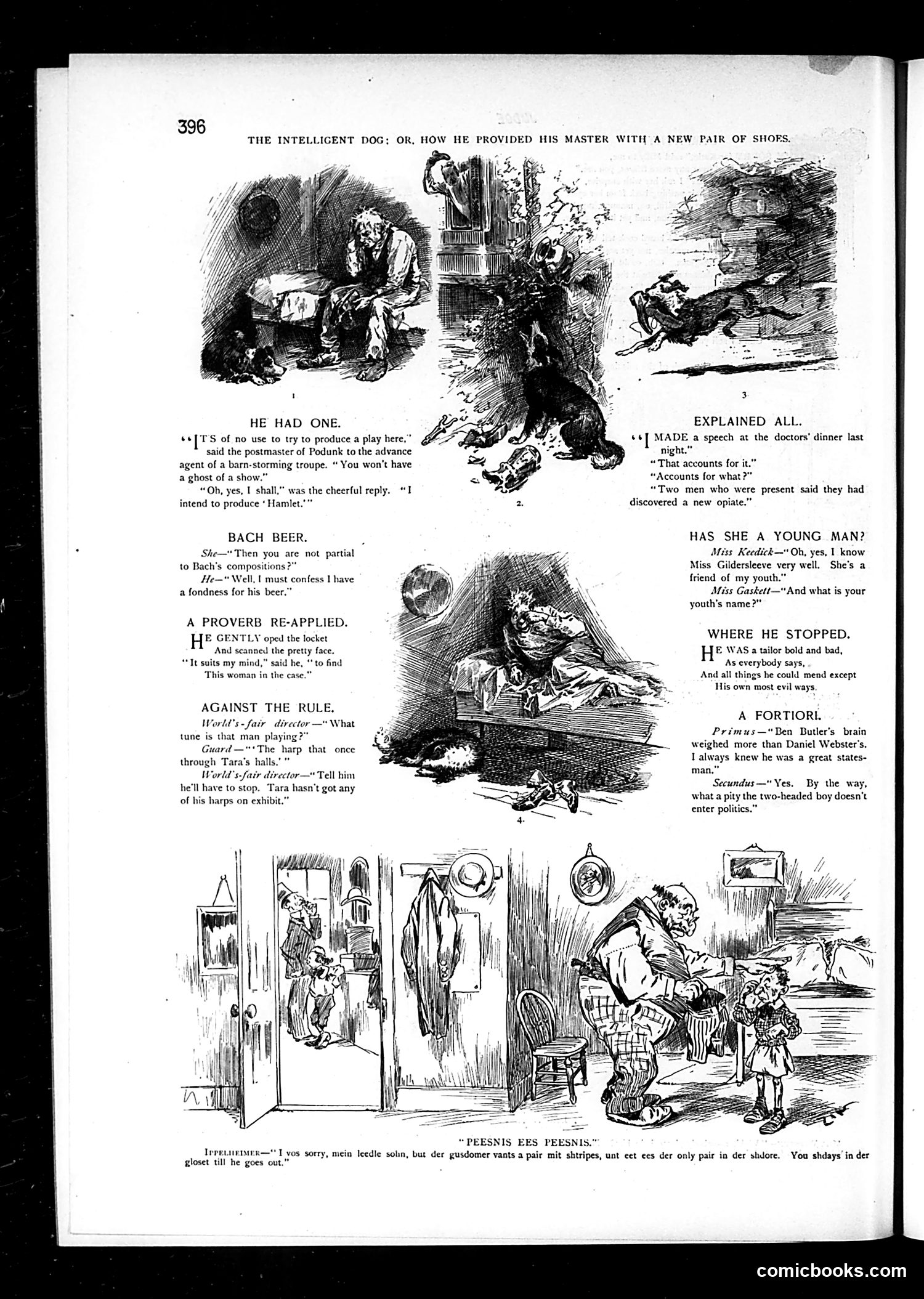
This page contains multiple unrelated satirical vignettes typical of Judge magazine's format. Key items include: **"The Intelligent Dog"** (title/illustrations): A narrative about a dog helping his master obtain shoes, though the specific satire isn't clear from the fragments shown. **"Bach Beer"**: A pun joke where a man claims to like "Bach" (the composer) but actually means "beer." **"A Proverb Re-Applied"**: A man finding a woman's picture in a locket, with wordplay on "the woman in the case." **"Against the Rule"**: World's Fair officials forbid playing Irish harp music because Ireland isn't exhibiting harps—absurdist bureaucratic humor. **"Peesnis Ees Peesnis"**: A German-accented shopkeeper apologizes for lacking striped pants, written in exaggerated dialect—reflecting period ethnic humor stereotyping. **"A Fortiori"**: Political satire comparing Ben Butler's and Daniel Webster's brains, with a dark joke about a two-headed boy entering politics (likely referencing political incompetence). The page is primarily humor/satire rather than unified political commentary.
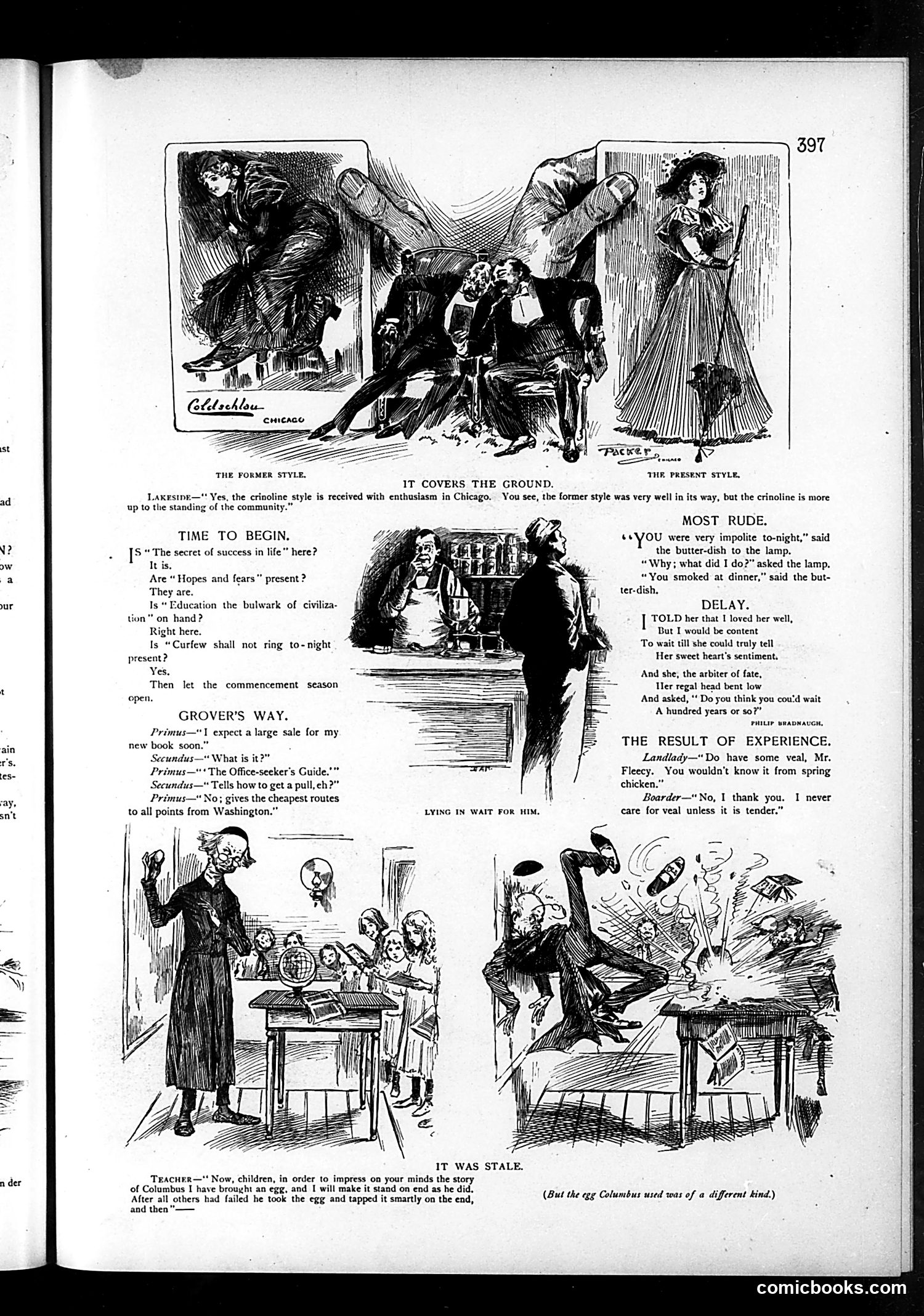
This page contains multiple satirical vignettes typical of 1880s-90s American humor magazines: **"It Covers the Ground"** mocks fashion trends, contrasting outdated crinoline (hoop skirt) styles with modern dress, suggesting Chicago society adopts fashions to maintain social standing. **"Grover's Way"** references President Grover Cleveland, satirizing political patronage through a fictional "Office-seeker's Guide" that advertises cheap routes to Washington—implying widespread corruption and the expectation that job-seekers must bribe officials or pull political connections. **"It Was Stale"** presents a teacher attempting the Columbus egg legend (demonstrating ingenuity by making an egg stand on end), but a student reveals the trick was already well-known—a commentary on tired educational anecdotes. The remaining sketches offer light domestic humor unrelated to political commentary. The Cleveland reference suggests this dates to his presidency (1885-1889 or 1893-1897), when political machine corruption was a satirical target.
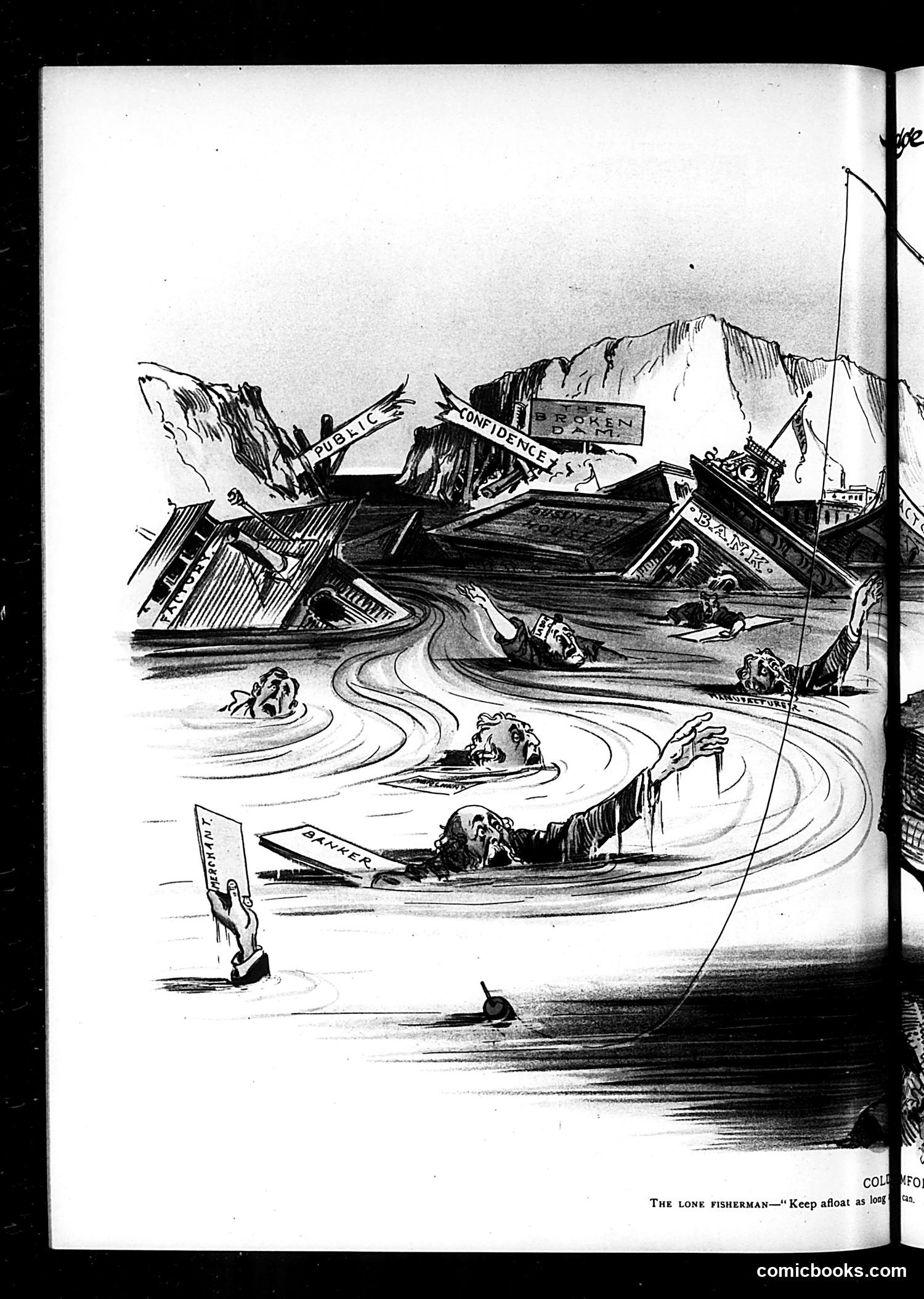
This political cartoon depicts a drowning scene with multiple figures struggling in turbulent water surrounded by wrecked vessels labeled "POLICE," "CONFIDENCE," and "BANK." The caption reads "The Lone Fisherman—'Keep afloat as long...'" (text cuts off). The cartoon appears to satirize institutional collapse—likely banking or financial crisis—showing representatives of law enforcement, public confidence, and banking literally sinking. The "lone fisherman" attempting rescue suggests individual efforts to salvage these institutions or maintain order amid systemic failure. Without the publication date visible, the specific crisis referenced is unclear, though the imagery suggests commentary on early 20th-century American financial scandals or corruption within police and banking sectors. The multiple drowning figures represent simultaneous institutional breakdown.
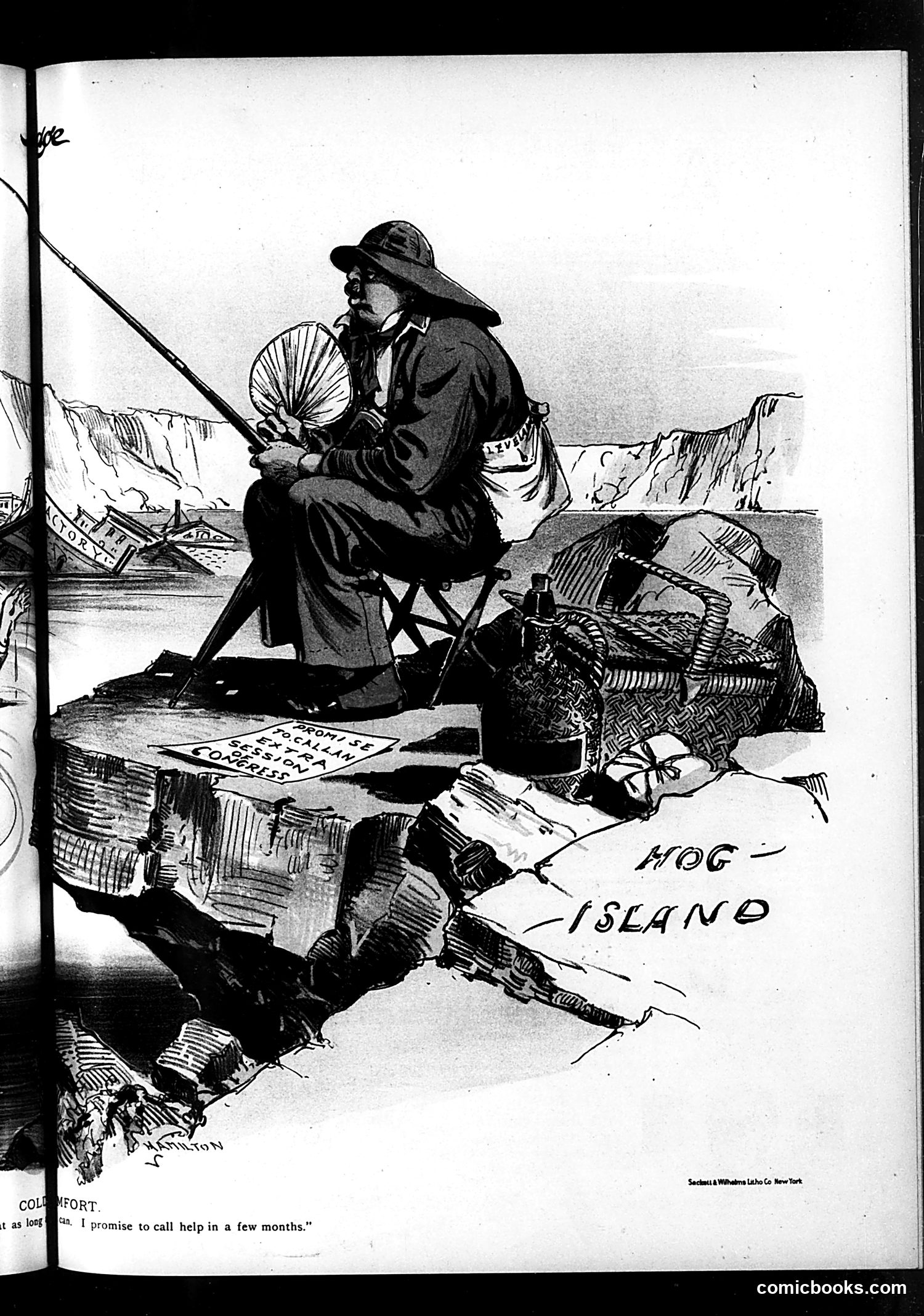
This cartoon satirizes Irish immigration and settlement in America, likely from the early 20th century. The central figure appears to be an Irish immigrant (identified by stereotypical caricature features and clothing) sitting on "Hog Island" with belongings scattered about. The label and the immigrant's promise to "call help in a few months" suggest mockery of Irish chain migration—the practice where established immigrants would sponsor family members to follow. The satire likely criticizes both Irish immigration patterns and American attitudes toward Irish arrivals, portraying the immigrant as isolated and struggling while planning to bring more family members to equally difficult circumstances. The cartoon reflects period nativist anxieties about immigrant communities clustering together and perpetuating ethnic enclaves rather than assimilating into broader American society.
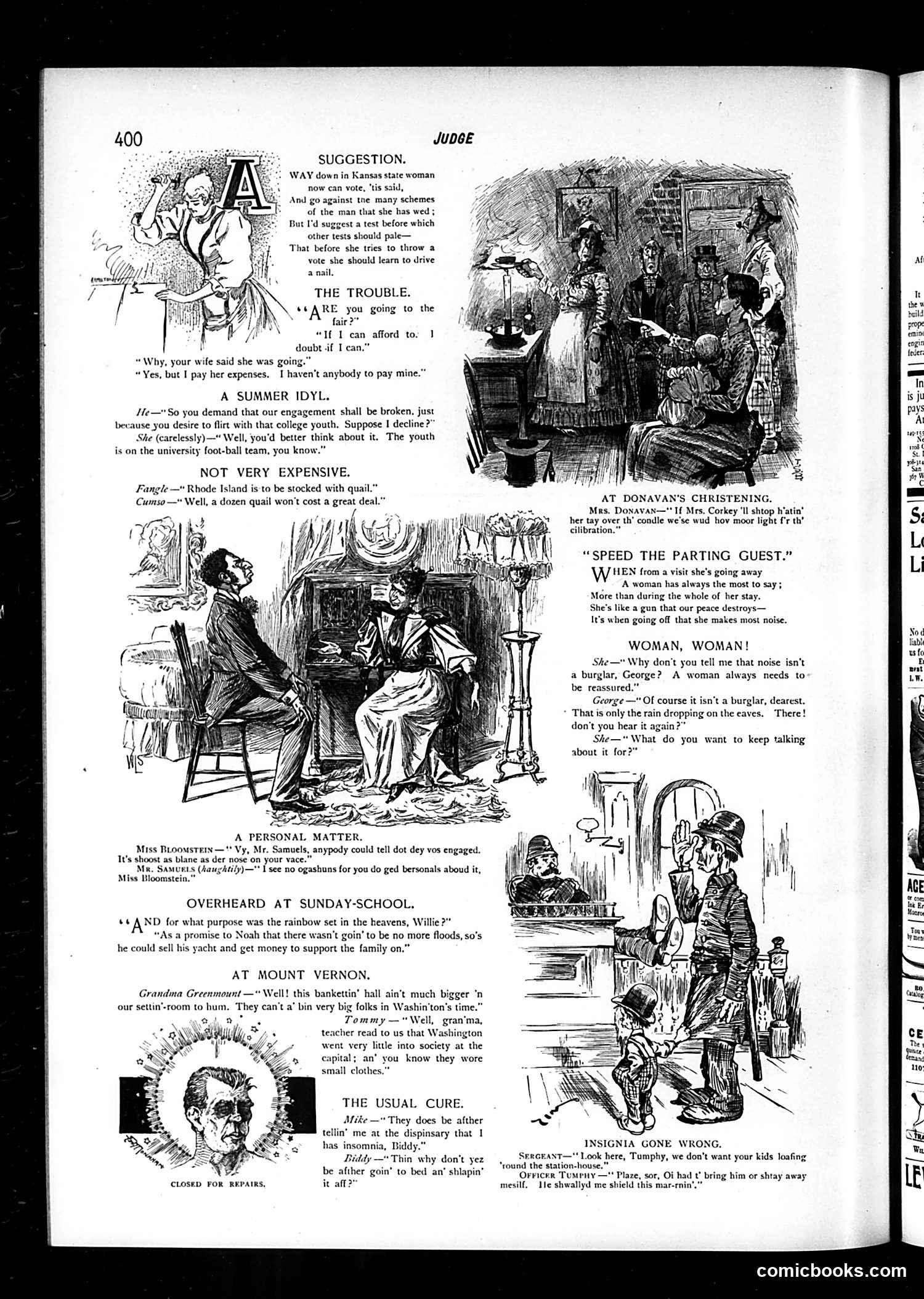
This page contains multiple brief satirical sketches typical of Judge magazine's humor: **"Suggestion"** mocks women's newly gained voting rights in Kansas by suggesting women first learn practical skills (driving a nail) before voting—a dismissive jab at female suffrage. **"The Trouble"** presents marital financial tension: a husband cannot afford the fair while his wife can, because he supports her expenses entirely. **"A Summer Idyl"** jokes about a woman threatening to break an engagement unless the man accepts her flirting with a college football player—implying the athlete's physical prowess intimidates him. **"Overheard at Sunday-School"** satirizes a child's mercenary misunderstanding: the rainbow promised Noah no more floods so he could sell his yacht for family support. **"At Mount Vernon"** uses period dialect humor: an old woman dismisses George Washington's mansion as small, then a child notes Washington wore "small clothes" (knee breeches)—a crude joke. Other sketches mock Irish and Jewish immigrant characters through exaggerated dialect, ethnic stereotyping common to era publications. The humor relies on period-specific class anxieties, gender relations, and ethnic caricature.
This is primarily an **advertising page** from Judge magazine, with scattered short humorous anecdotes rather than political cartoons. The few satirical items include: **"Duke de Veragua" anecdote**: References a Spanish nobleman stopped at the 1893 World's Fair in Chicago for lacking admission credentials. The joke mocks his unfamiliarity with American rules—he's "not greatly disconcerted" because he's already been "sand-bagged" (robbed) in Chicago, so minor inconveniences don't bother him. This plays on Chicago's rough reputation. **Matthew S. Quay reference**: Notes Pennsylvania's senator pushed through Sunday-closing legislation, then closed Pennsylvania's building on Sunday—hypocritical self-righteousness. **Minor quips**: Include observations about women (three mentions of a man's name = romance), telephone service requiring payment, and dyspepsia remedies. The page is overwhelmingly dominated by product advertisements (cigars, life insurance, pianos, hair products, etc.), which was typical Judge revenue. The satire is gentle social commentary rather than hard political critique.
This page is primarily **advertising**, not political satire. It contains numerous product advertisements interspersed with brief aphorisms and one cartoon. The visible cartoon features a man's head labeled "I KEEP COOL" drinking Hires Root Beer, illustrating an advertisement for the beverage. This is straightforward product marketing rather than political commentary. The page includes advertisements for: - Menier Chocolate (emphasizing its presence at the World's Fair) - Hires Root Beer - Bicycles - New York Central Railroad trains - Various remedies (Bromo-Seltzer, Beecham's, No-to-Bac tobacco cure) - Hotels and resorts The scattered aphorisms ("A stove-pipe looks shabby...") are generic observations without political targets. There is no discernible political satire or social commentary on this particular page—it functions as a typical late 19th-century periodical advertising section.
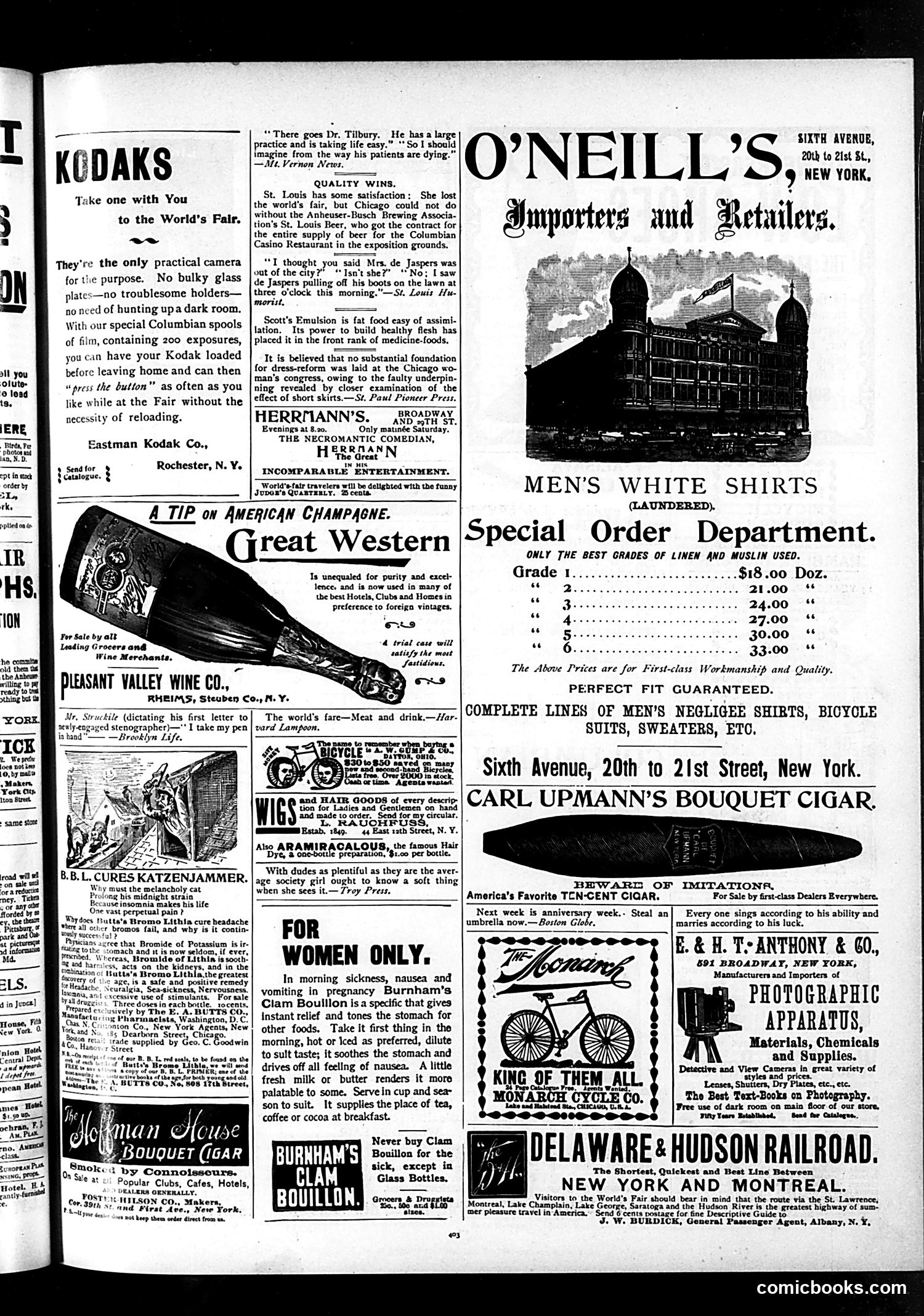
This is primarily an **advertising page** from Judge magazine, likely from the 1890s-early 1900s (references to the World's Columbian Exposition in Chicago suggest 1893). The page contains **brief satirical jokes and advertisements**, not political cartoons: - **Medical/social humor**: Jokes mock doctors, marital infidelity, and fashion reform - **Product placements**: Kodak cameras, champagne, hair products, and medical tonics (notably "Bromide of Lithium" for hangovers and nervousness—reflecting period attitudes toward pharmaceutical remedies) The few **comic illustrations** are simple and generic—mostly showing everyday situations or products. **Key historical context for modern readers**: This represents medicinal advertising practices that would be illegal today; the casual references to marital deception and women's fashion reform reflect contemporary social anxieties; and the prominence of alcohol and sedatives in "health products" shows how unregulated pharmaceuticals were in this era. The content reflects **class-conscious humor** targeting affluent urban readers, not serious political satire.
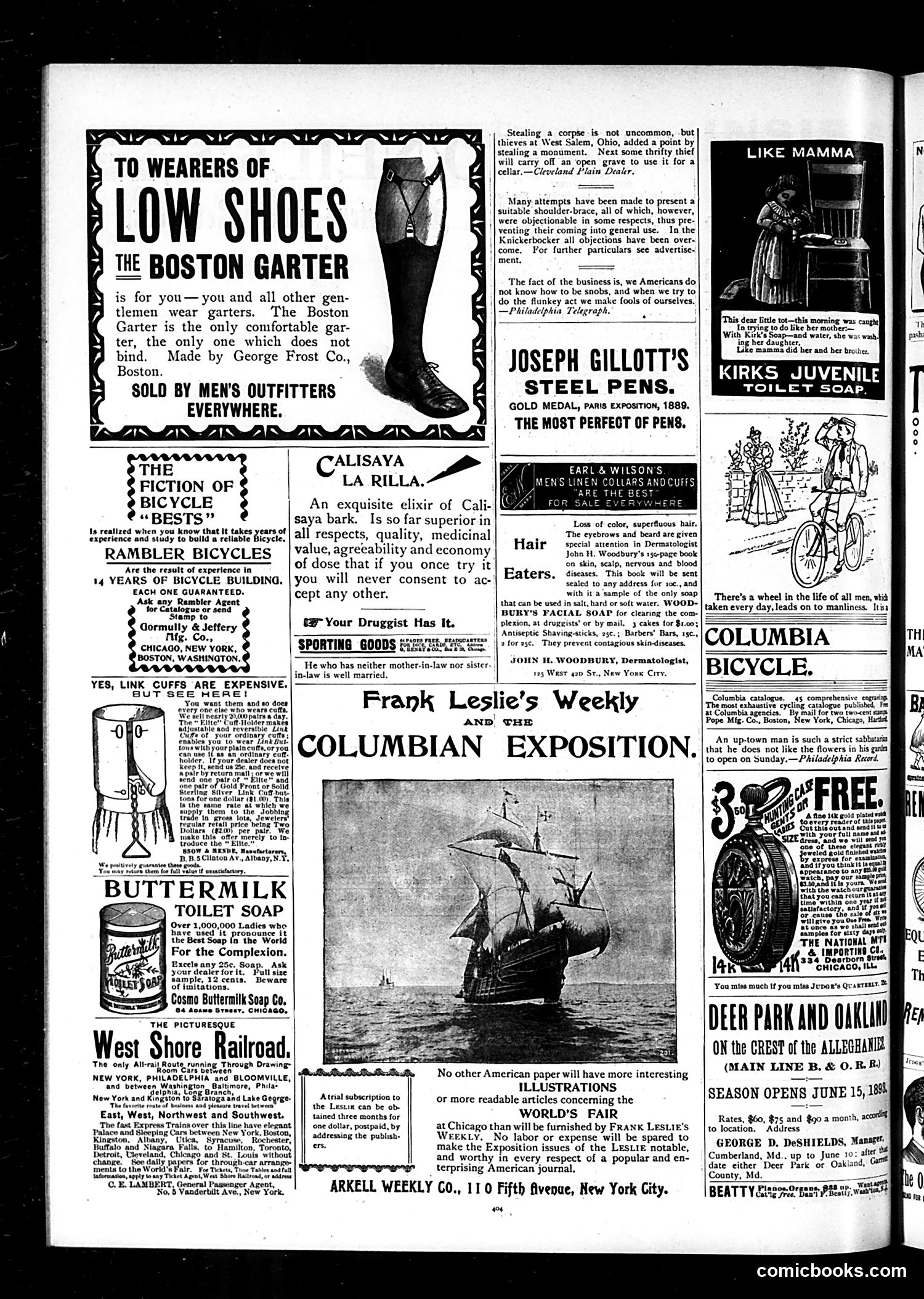
This page is primarily **advertising**, typical of Judge magazine's revenue model. Rather than political satire, it features commercial advertisements for late-1890s consumer goods: garters, bicycles, soap, pens, collars, and railroad services. The few editorial items include brief satirical observations: a Cleveland Plain Dealer quote mocking grave-robbers who steal monuments for cellars, and a Philadelphia Telegraph jab that Americans "make fools of ourselves" when attempting snobbery. The page's humor is gentle social commentary rather than partisan politics. The "Like Mamma" Kirk's Soap advertisement uses sentimental domestic imagery rather than caricature. The bicycle advertisements reference the 1890s cycling craze. Notable is the **Columbian Exposition reference**—Frank Leslie's Weekly promises coverage of Chicago's 1893 World's Fair, positioned as entertainment for readers. This dates the page to the early 1890s, when the fair dominated American cultural conversation. Overall, this represents **commercial magazine content** with light satire, not political cartooning.
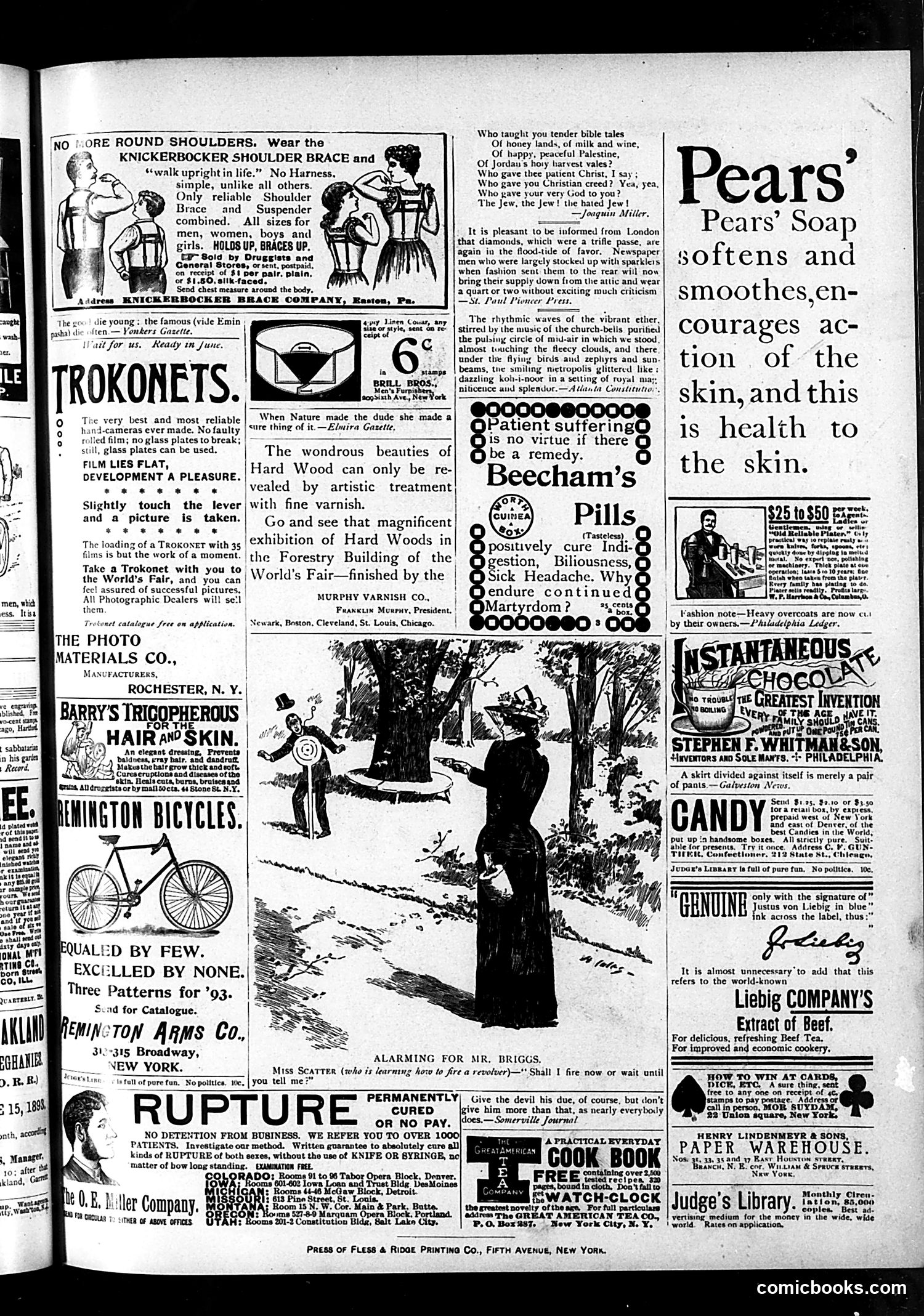
This page from *Judge* magazine is primarily **advertising**, with one notable satirical element. The main cartoon shows **"Alarming for Mr. Briggs"**—a humor piece about a woman learning to shoot. Miss Scatter asks whether to fire a revolver while aiming at an unseen target, implying accidental danger to Mr. Briggs. The satire reflects late-19th-century anxieties about women's independence and participation in formerly male-exclusive activities (shooting sports), presented as comedic and slightly threatening. The page otherwise features product advertisements typical of the period: cameras, bicycles, hair treatments, shoulder braces, and patent medicines (Beecham's Pills). Notably, at the page's top appears a poem by Joaquin Miller about Jews, emphasizing their historical role in Christianity—likely included to critique antisemitism, though the context remains unclear from this excerpt alone. The advertisements reveal contemporary consumer concerns: posture correction, photographic equipment, and remedies for digestive complaints.
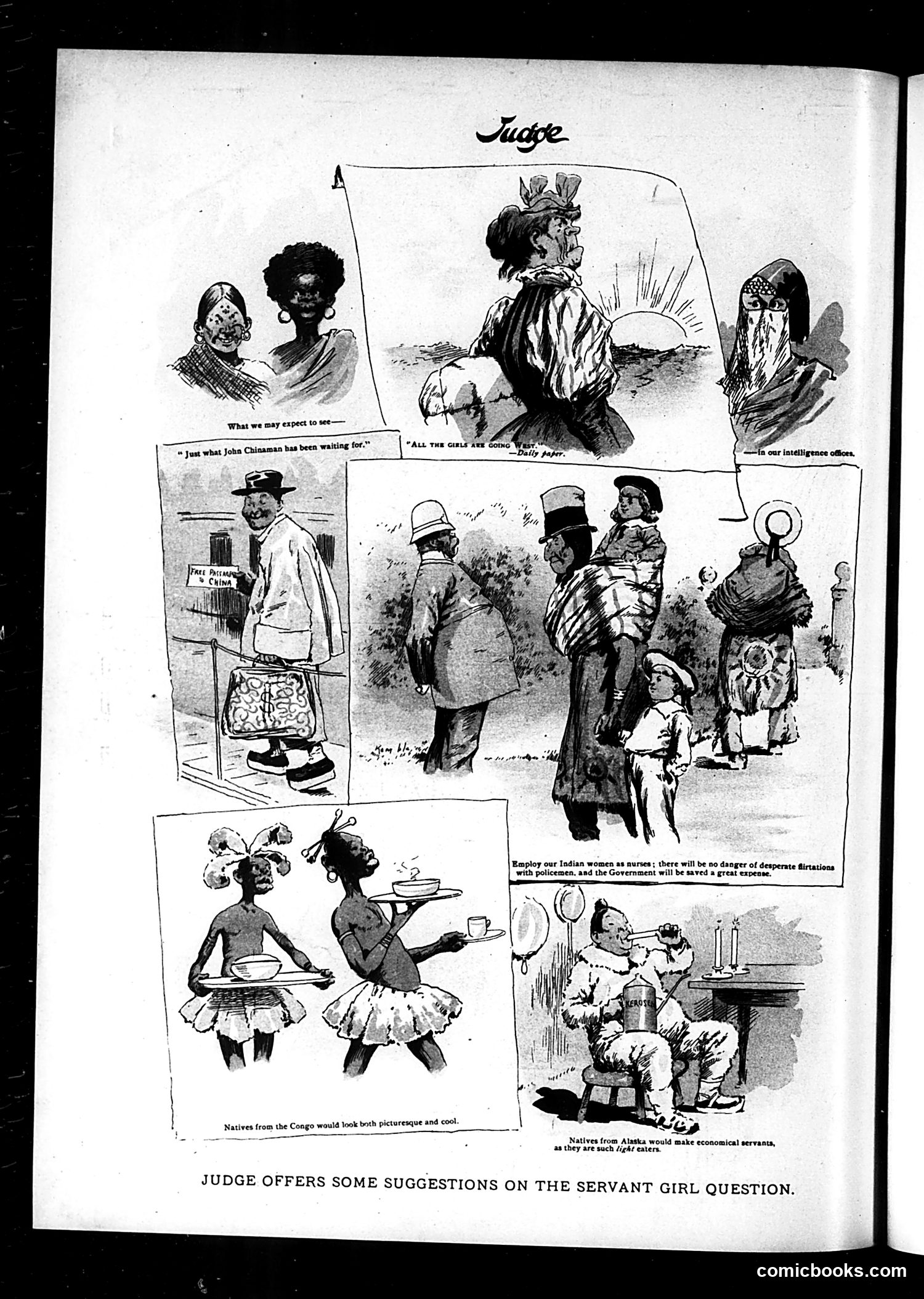
This Judge magazine satire addresses a contemporary labor shortage—apparently a debate about hiring domestic servants. The cartoon mocks proposed "solutions" through racist stereotypes. The central figure represents "John Chinaman" (a period slur for Chinese immigrants), depicted as eagerly awaiting domestic work opportunities. Additional panels sarcastically propose alternatives: Indigenous women from the Congo as nurses, and Alaskan Natives as servants "economical" because they eat little. The satire works on two levels: it ridicules both actual proposals to import foreign labor and the racist assumptions underlying them. The exaggerated caricatures—depicting non-white groups as inherently suited to servile roles—expose the dehumanizing logic behind such schemes. The "intelligence office" reference suggests employment agencies involved in these debates. Judge uses grotesque imagery to mock those seriously entertaining such discriminatory hiring practices, though the satire itself relies heavily on the same racial stereotypes it ostensibly critiques.