
A complete issue · 16 pages · 1893
Judge — June 17, 1893
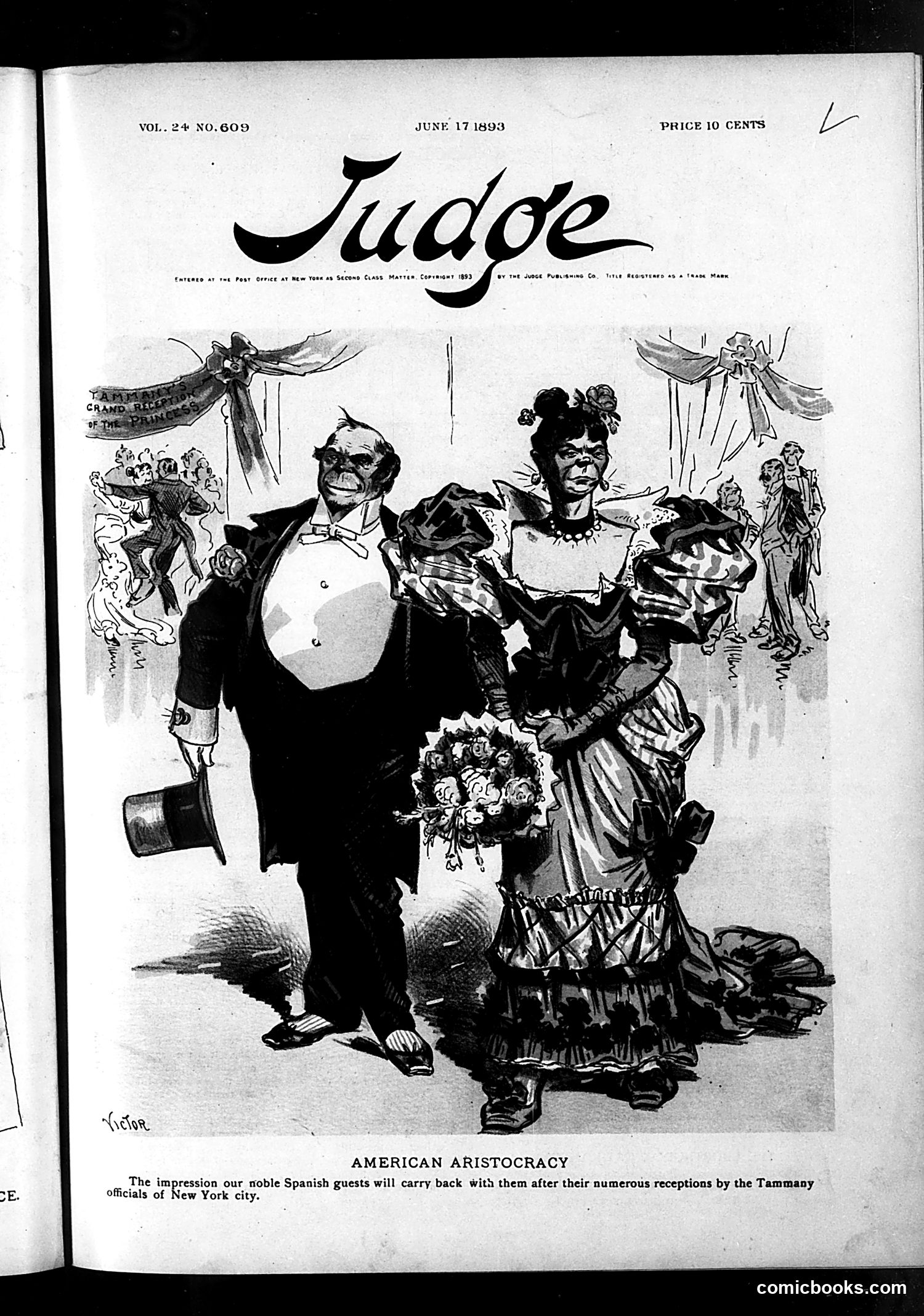
This satirical cartoon mocks American social pretension. The caricatured couple in formal dress represents wealthy Americans eager to impress "Spanish guests" visiting New York. The caption notes these guests will carry home impressions of American aristocracy based on receptions by Tammany Hall officials—the corrupt Democratic political machine that controlled New York City. The satire targets two audiences: the American wealthy, portrayed with exaggerated, ape-like features suggesting their lack of genuine breeding, and Tammany Hall politicians, implying that corrupt political operatives represent American "nobility" to foreigners. The flying insects above suggest the scene's disgust factor. The joke: American wealth and political power lack authentic aristocratic refinement.
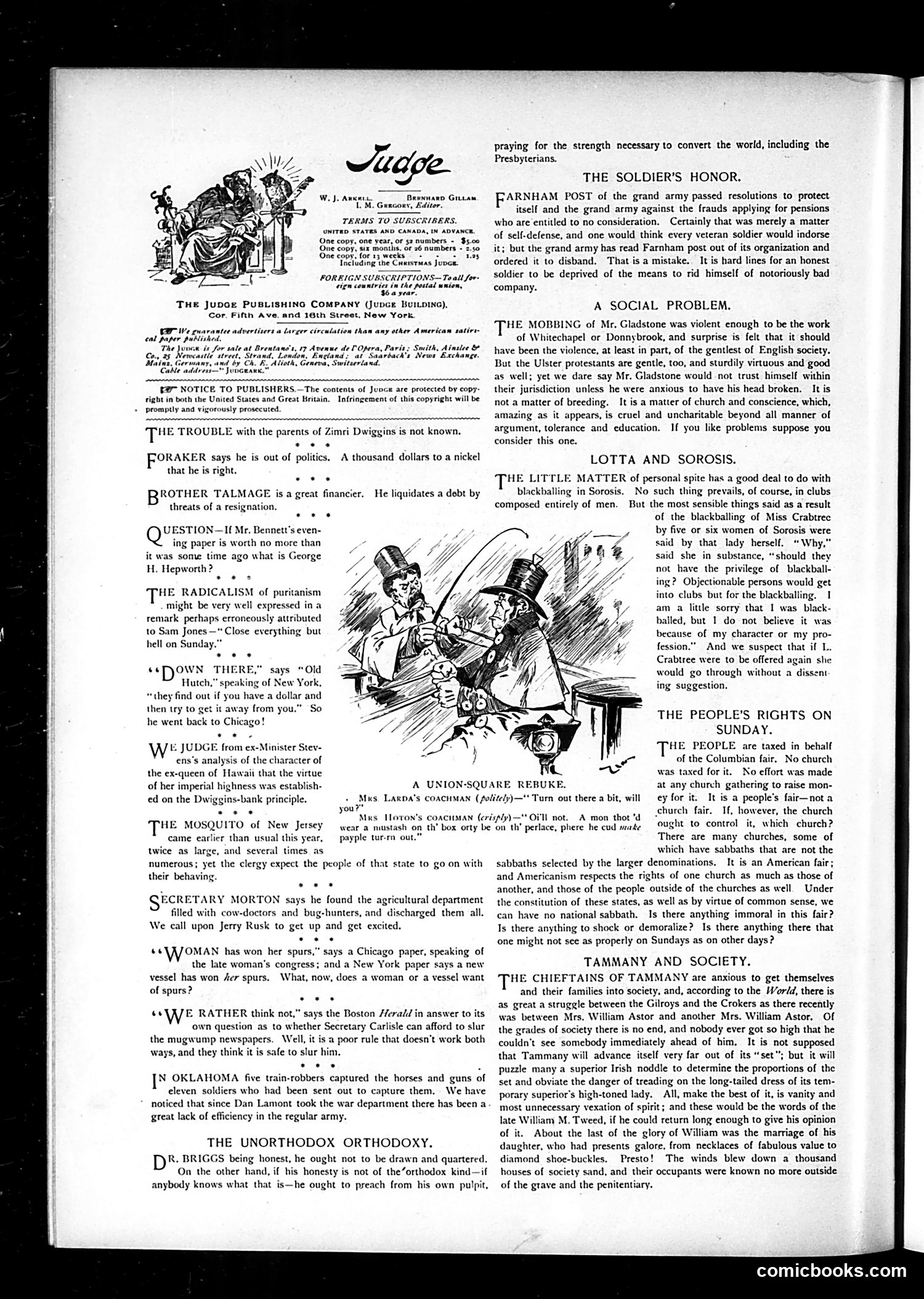
The page features a cartoon titled "A Union-Square Rebuke" depicting two figures in conversation. Based on the caption, one appears to be "Miss Laura Coachman (Pinkerton)" and the other "Miss Holton's Coachman (Gould)." The satire likely addresses labor relations and class tensions of the Gilded Age. The Pinkerton reference suggests labor disputes (Pinkertons were notorious strikebreakers), while "Gould" likely refers to the wealthy industrialist. The "Union Square" location was a known gathering place for workers and radicals. The cartoon mocks the interactions between wealthy employers' servants, using their conversation to satirize broader class and labor conflicts. The exact dialogue and specific historical context remain somewhat unclear from the image quality.
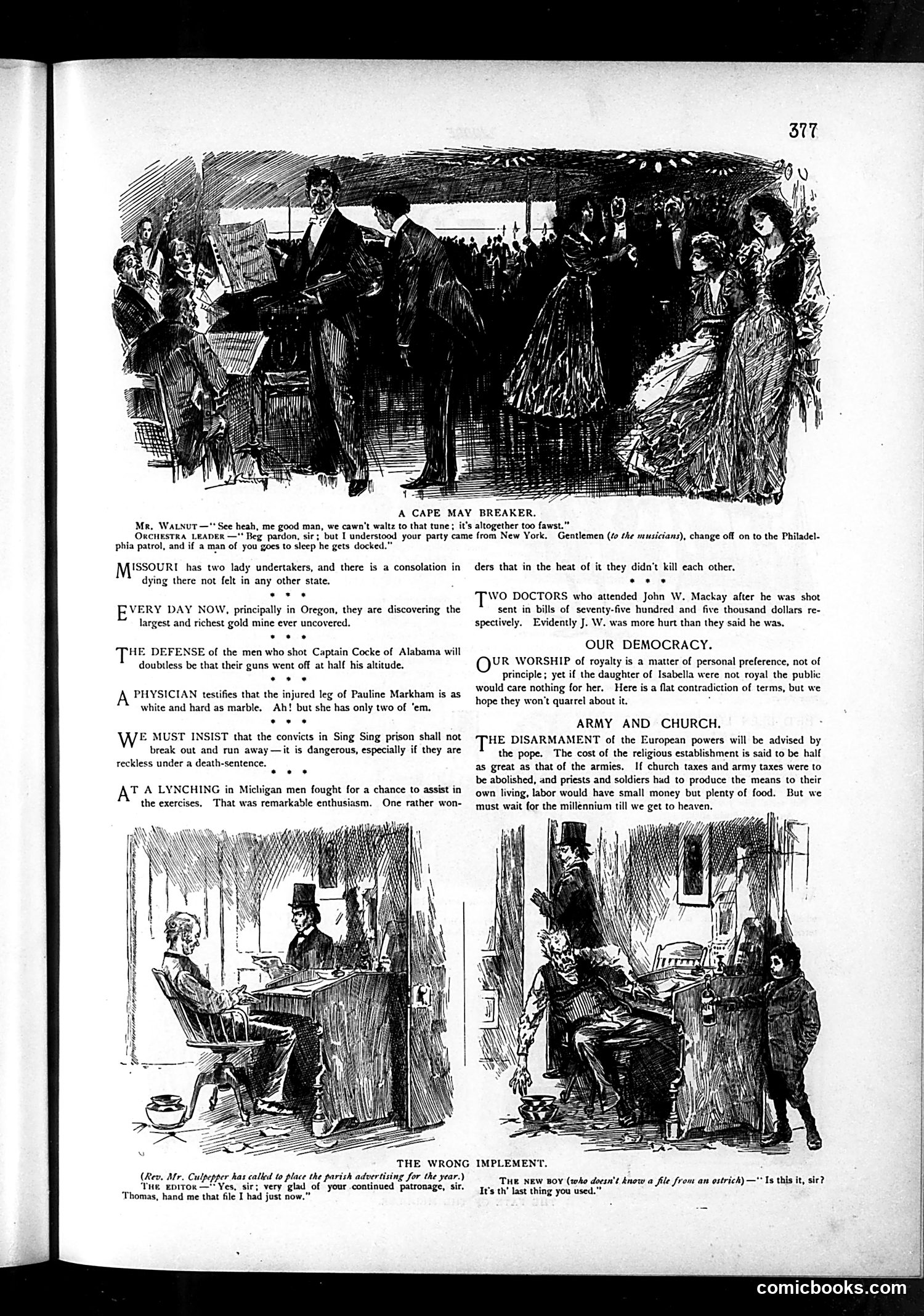
This page from *Judge* contains several brief satirical items and two cartoon panels titled "The Wrong Implement." **Top cartoon ("A Cape May Breaker"):** Shows well-dressed people at what appears to a social gathering. The dialogue involves a woman refusing to dance to a tune deemed "altogether too fast," while an orchestra leader and others discuss a party arriving from New York. The satire mocks upper-class social pretension and rigid dancing etiquette. **Bottom cartoons ("The Wrong Implement"):** These paired scenes depict domestic/bureaucratic humor. One involves a parish advertising editor; the other shows a new boy in an office who doesn't know what tool to use. Both satirize incompetence and misunderstanding of proper procedures. The page also includes brief news-style commentary items on topics like Missouri, Oregon gold mining, and military convictions—typical of *Judge*'s mixed-format satirical commentary.
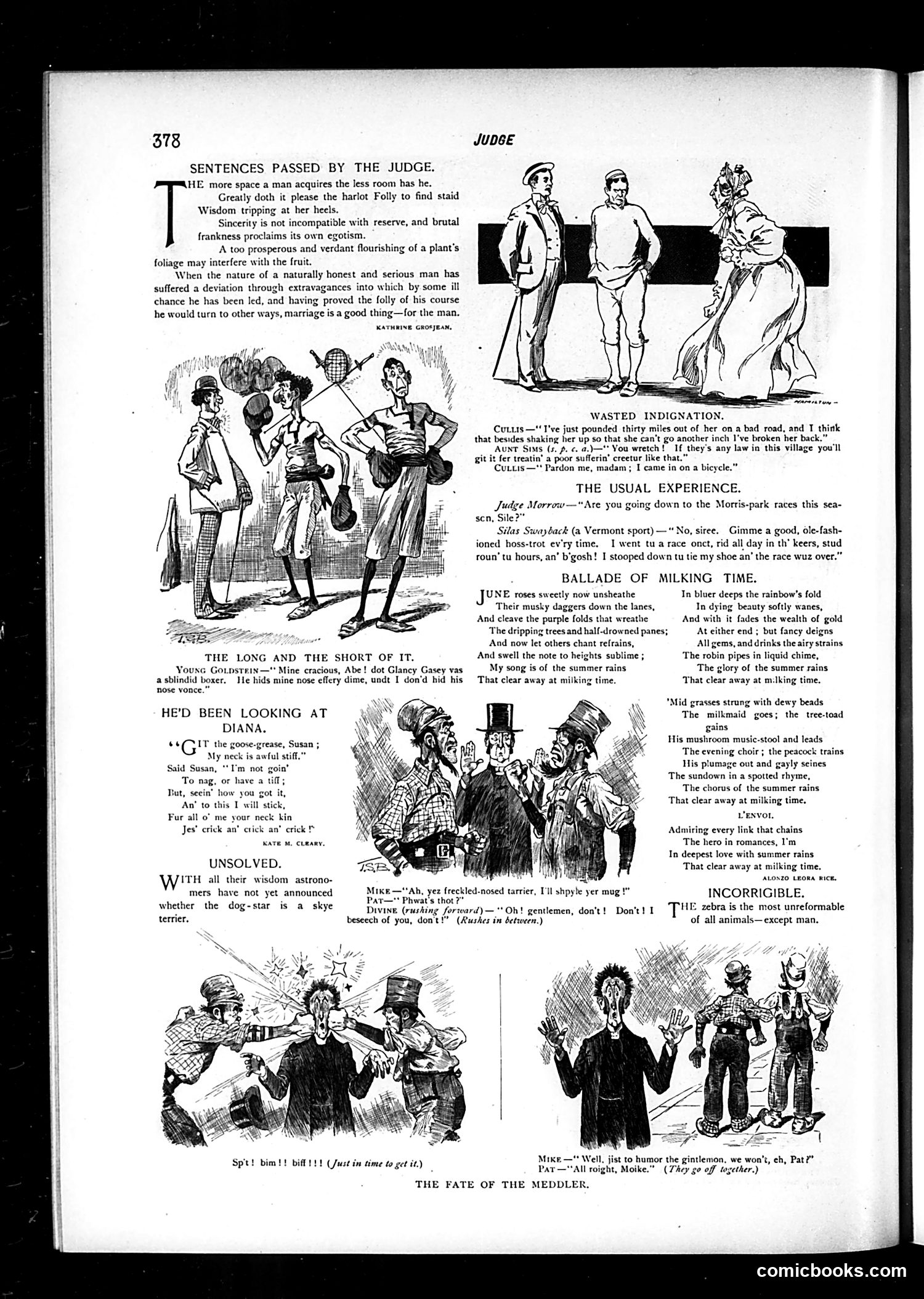
This page contains multiple satirical pieces typical of Judge's format. The top section includes philosophical "sentences" on human nature—observations about wisdom, sincerity, and marriage as reform for wayward men. The cartoons mock various social types: a Jewish boxer exaggerating his fighting prowess with Yiddish dialect; a rural Vermont man whose trip to the races was ruined by stopping to tie his shoe; Irish laborers (likely Mick and Pat, recognizable by dialect and caricature) fighting, with a woman trying to stop them; and a "meddler" getting beaten. "Wasted Indignation" depicts someone complaining about harsh treatment of a bicycle—the joke being the listener's moral outrage is misdirected. The page also includes a pastoral poem about milking time. The satire targets immigrant stereotypes (Jewish and Irish characters), rural simplicity, and human folly. The cartooning style and broad ethnic caricatures reflect Judge's late-19th/early-20th-century approach to humor.
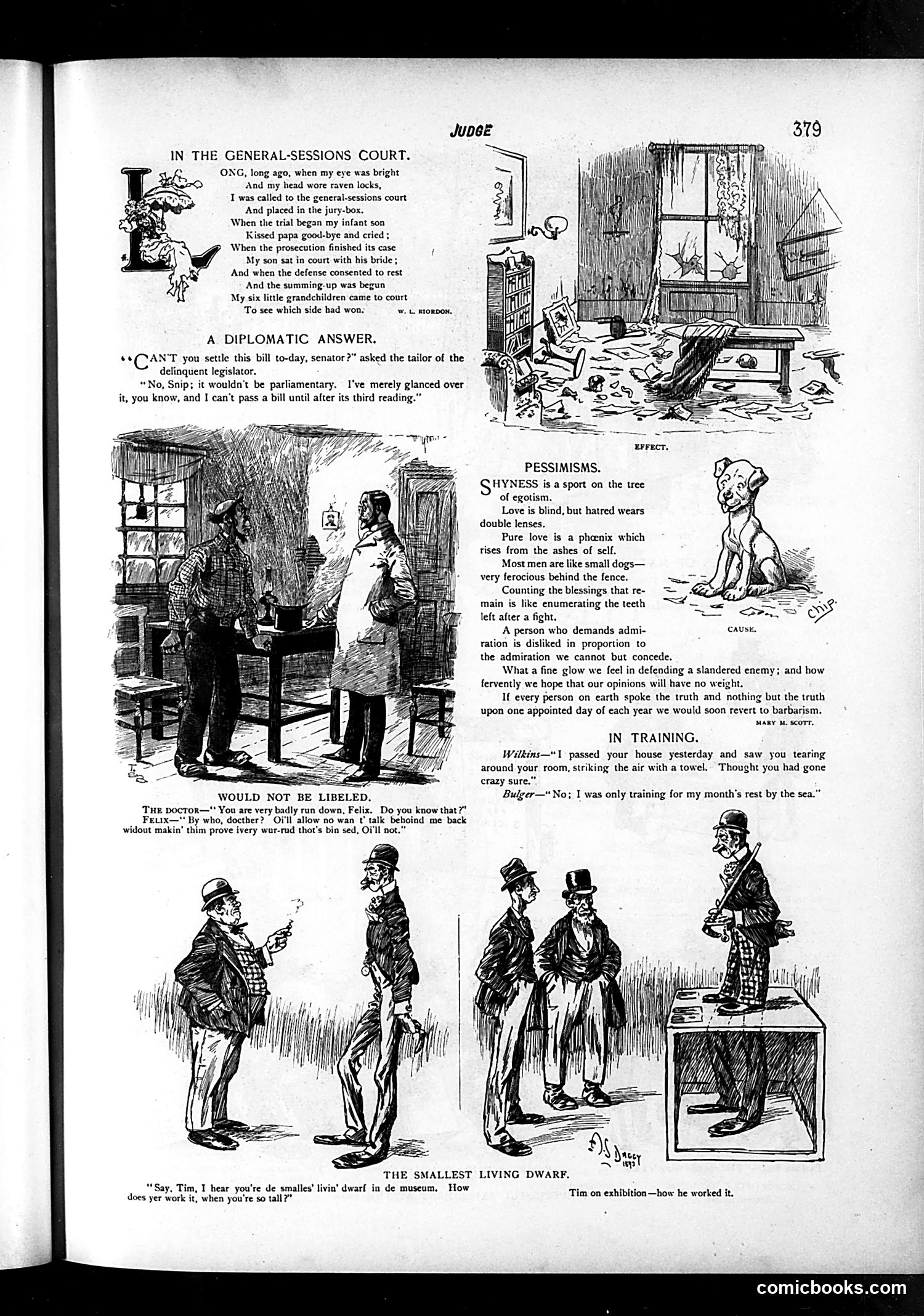
This page contains several unrelated satirical pieces typical of Judge magazine's humor: **"In the General-Sessions Court"** mocks legal proceedings' glacial pace—a jury trial spanning a man's entire lifetime, from youth through grandchildren. **"A Diplomatic Answer"** satirizes legislative evasion: a tailor demands payment, but the senator claims parliamentary procedure requires three readings before passing a bill—a joke about politicians using technicalities to avoid obligations. **"Would Not Be Libeled"** features an Irish immigrant character refusing medical diagnosis, threatening to sue anyone spreading claims about his health without proof—satirizing both Irish dialect humor (common in period comics) and litigiousness. **"Pessimisms"** offers cynical aphorisms about human nature and self-interest. **"The Smallest Living Dwarf"** jokes about circus/museum exhibitions of people with dwarfism, playing on the contradiction of someone "smallest" being quite tall. These represent Judge's mix of legal, political, and social satire with period-typical ethnic caricature.
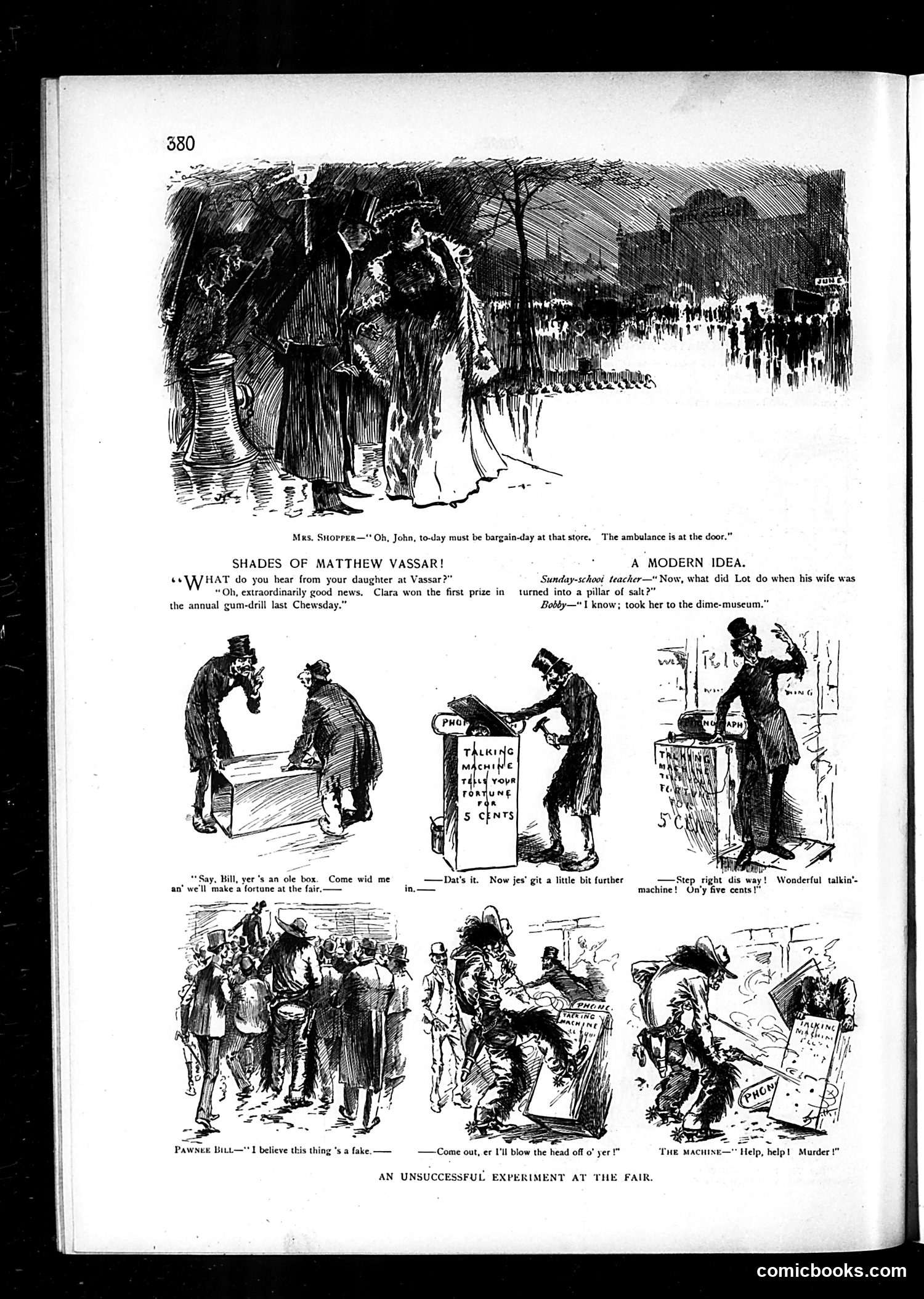
This page contains multiple unrelated satirical sketches mocking early 20th-century American culture and trends. **Top cartoon**: Mrs. Shopper warns her husband that today's bargain sale is so chaotic an ambulance waits outside—satirizing the dangerous shopping frenzies at department stores. **"Shades of Matthew Vassar"**: Mocks women's education by having a parent boast his daughter won a "gum-drill" prize (chewing gum contest) at Vassar College—implying women's colleges produce trivial rather than serious accomplishment. **"Modern Idea"**: A Sunday school teacher asks a biblical question; the child references a "dime-museum" (cheap tourist attraction)—satirizing declining religious knowledge and education. **Fair cartoons (bottom half)**: Multiple sketches show people at a fair encountering a "talking machine" (early phonograph or similar device). The machine malfunctions, leading to chaos and violence—satirizing both fair attractions and the novelty of new technology failing spectacularly. The overall theme critiques modern American life: consumerism, education quality, and technology.
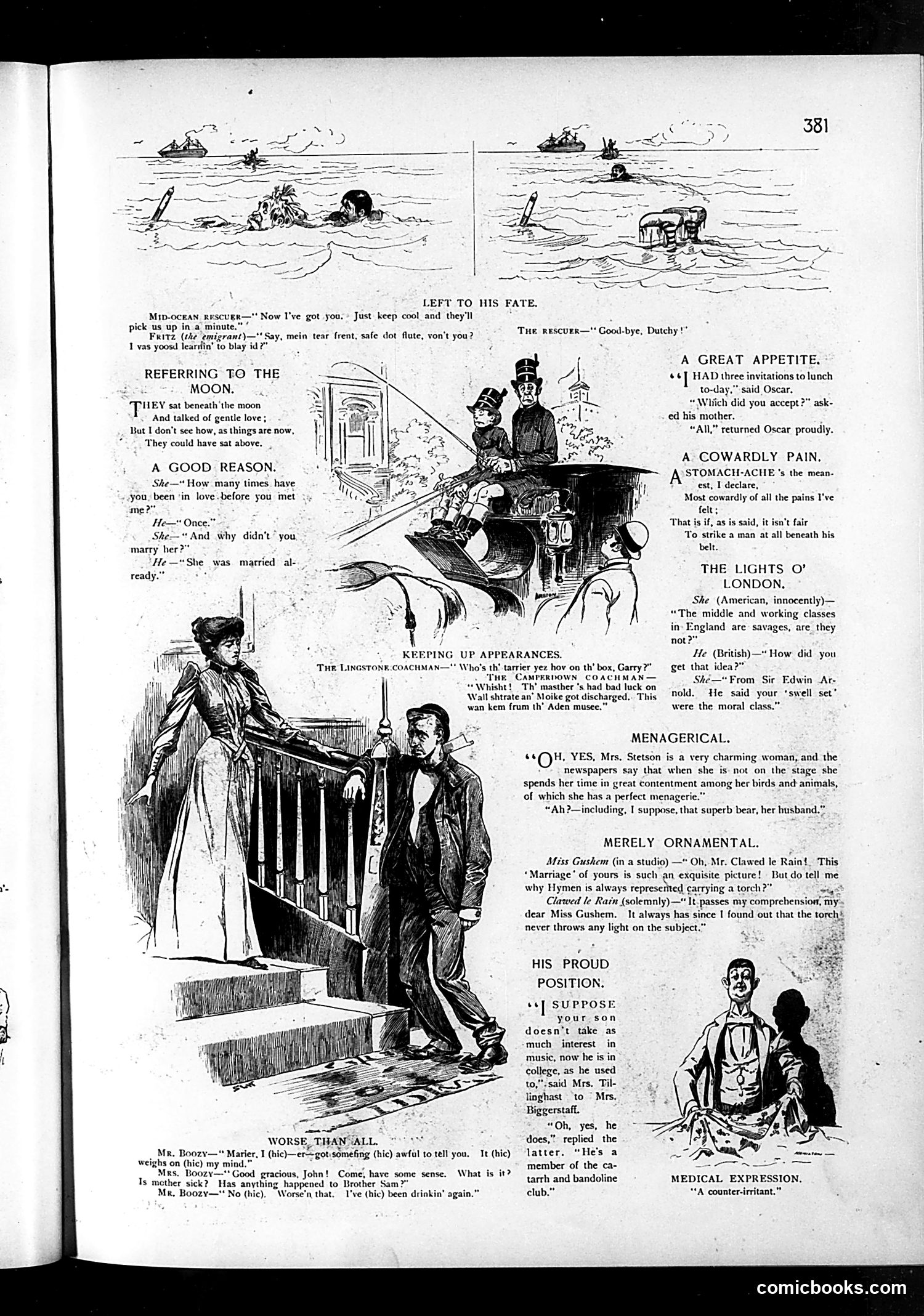
This page collects various short humorous pieces typical of Judge's satirical format: **Main Cartoons:** - "Left to His Fate" depicts a rescue at sea where Fritz (a German immigrant stereotype, identifiable by dialect) worries about his flute while being rescued—mocking immigrant concerns and accents. - "Keeping Up Appearances" shows a coachman and footman discussing their employers' pretensions, satirizing class-conscious social climbing. **Joke Sections:** - "A Cowardly Pain" makes a crude pun about stomach-ache being "below the belt" - "The Lights o' London" presents transatlantic class commentary—an American woman insults English working classes; a British man counters that her own "swell set" are immoral - "Menagerical" mocks a woman's animal collection by calling her husband a "superb bear" - "Merely Ornamental" jokes that marriage (represented by Hymen's torch) sheds no light on the subject **Overall:** The page reflects turn-of-the-century American satirical humor targeting immigrants, class pretension, gender roles, and Anglo-American social differences. The tone is lighthearted rather than biting.
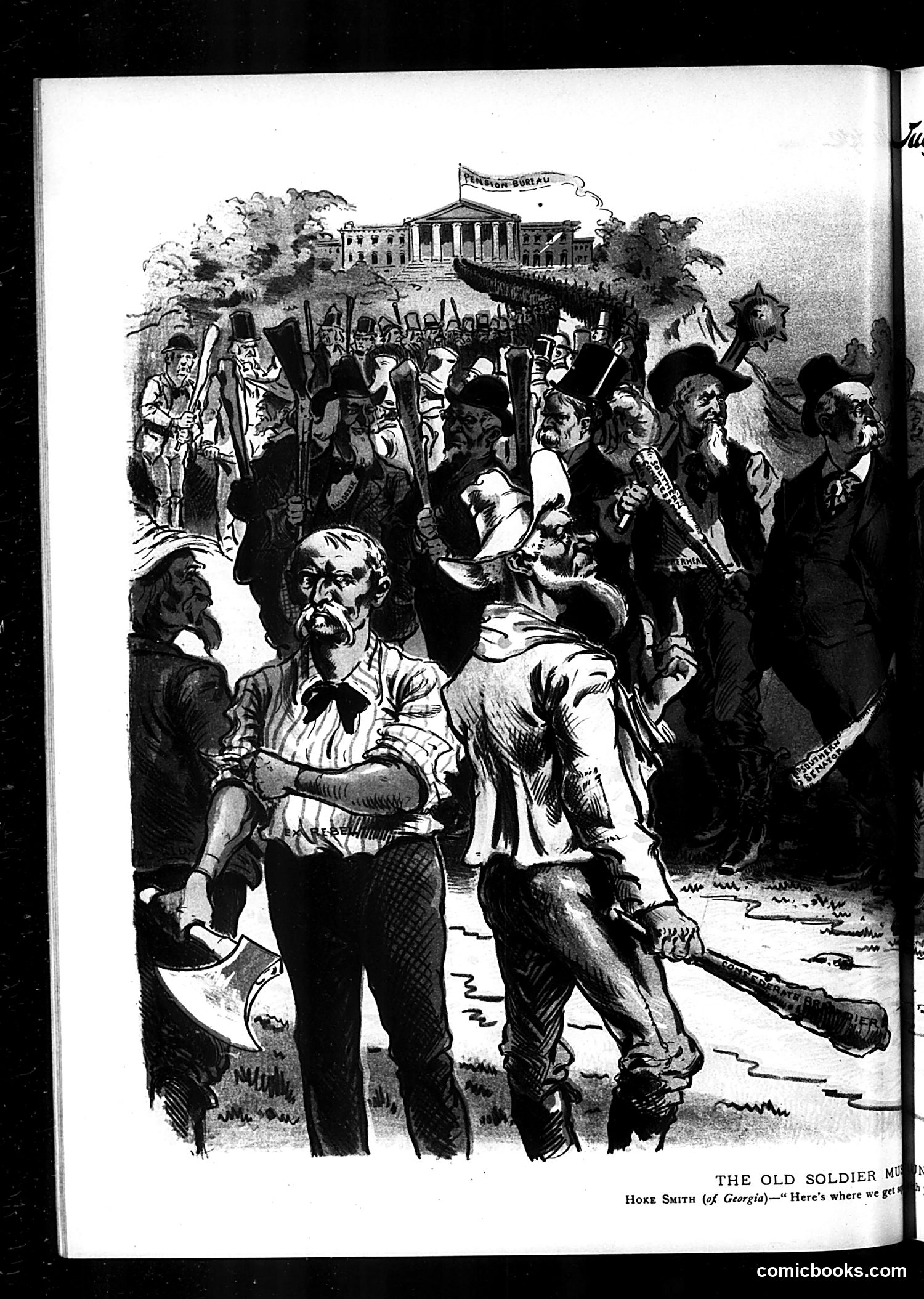
This political cartoon depicts a confrontation between a Confederate veteran (labeled "Hoe Suit of Georgia") and an angry mob armed with clubs and weapons outside what appears to be a government building. The caption's incomplete text ("Here's where we...") suggests the veteran is about to make a stand or declaration. The cartoon satirizes post-Reconstruction era tensions in Georgia, likely commenting on aging Southern soldiers attempting to reassert political power or resist federal authority. The mob represents either Republican/Union forces or citizens opposing Confederate resurgence. The building in the background suggests this concerns state government control—a central conflict during the contested Reconstruction period when Southern Democrats sought to regain political dominance.
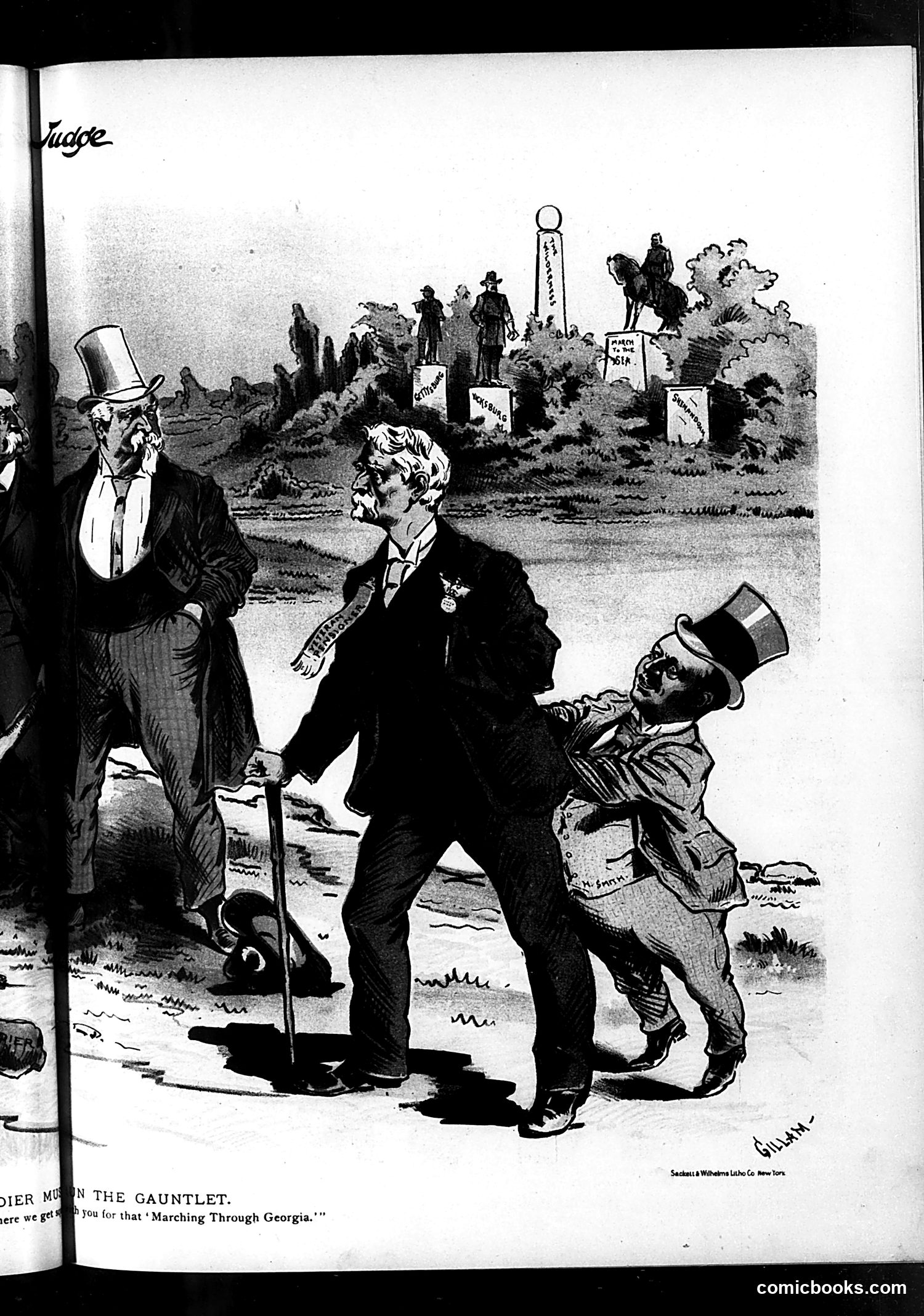
This political cartoon titled "Soldier Mimon the Gauntlet" references the Civil War song "Marching Through Georgia," which celebrated Union General Sherman's destructive 1864 campaign through Georgia. The cartoon depicts what appears to be a Union soldier being confronted by three well-dressed gentlemen (likely representing Northern political or business figures) in a desolate landscape with graves and mourning figures visible in the background. The satire critiques how Northern society honored or profited from Sherman's campaign while ignoring its human devastation—the graves and grieving people behind them. The soldiers' challenge ("Where we get you for that") suggests accountability for the war's brutality, mocking the disconnect between celebratory rhetoric and actual suffering. This reflects post-Civil War tensions over how the conflict should be remembered.
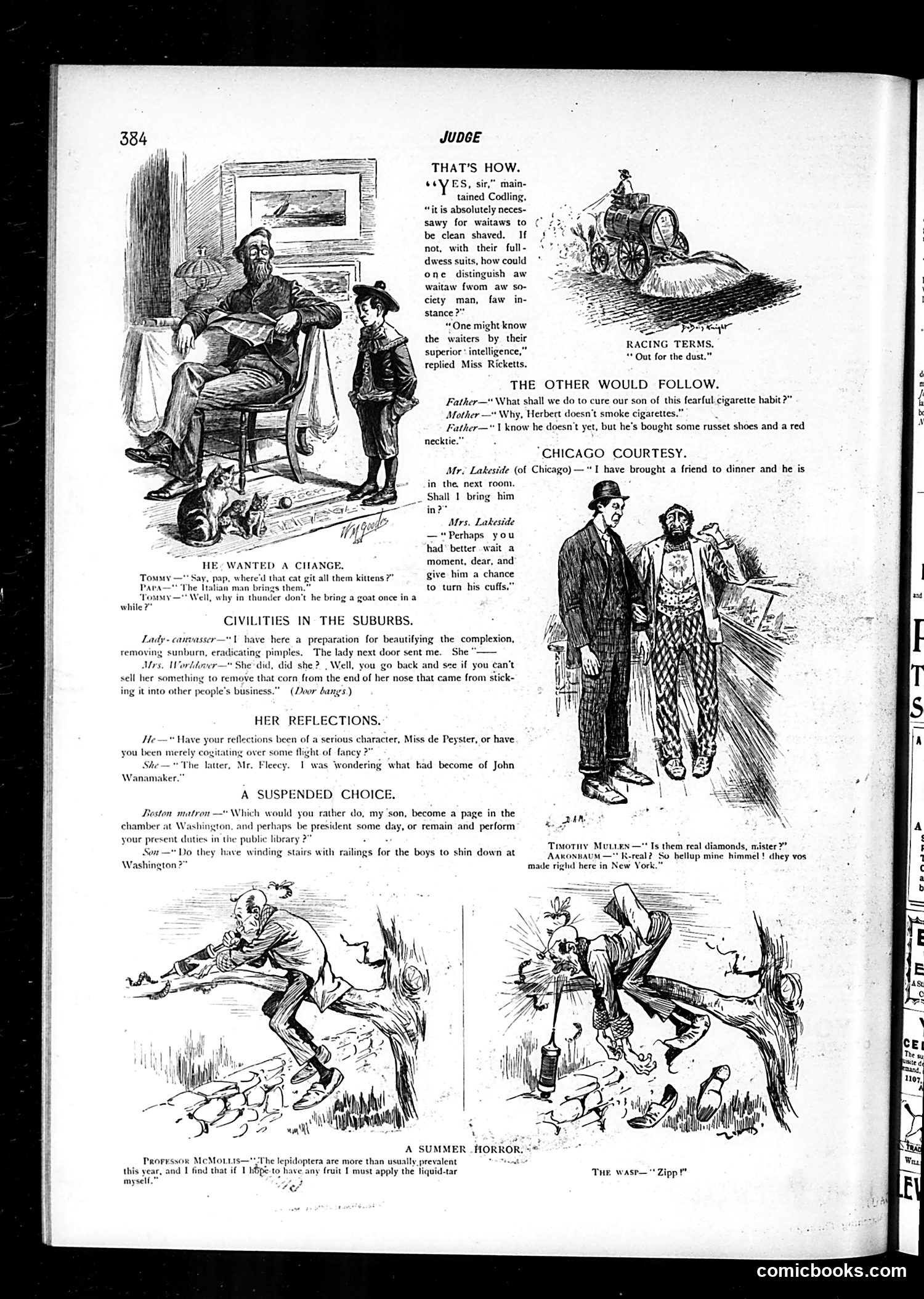
This page contains multiple short satirical cartoons mocking social pretensions and domestic absurdities of the era: **"That's How"**: A gentleman argues waiters must be clean-shaven to be distinguished from society men—Miss Ricketts sarcastically suggests their superior intelligence might suffice. **"The Other Would Follow"**: Parents worry their son smokes cigarettes, but the real concern is his russet shoes and red necktie—suggesting fashion choices indicate moral decay. **"Chicago Courtesy"**: A host delays introducing his dinner guest to his wife, implying Chicagoans are rudely inhospitable. **"Civilities in the Suburbs"**: A cosmetics saleswoman mentions a neighbor sent her; the wife responds that same neighbor is so nosy she should remove the corn from her nose caused by sticking it in others' business. **"Her Reflections"**: A woman admits she was daydreaming about what became of the department store magnate John Wanamaker—a non sequitur joke on idle female thoughts. The cartoons target middle-class social anxiety, regional stereotypes (Chicago), and gender roles with gentle, period-specific humor.
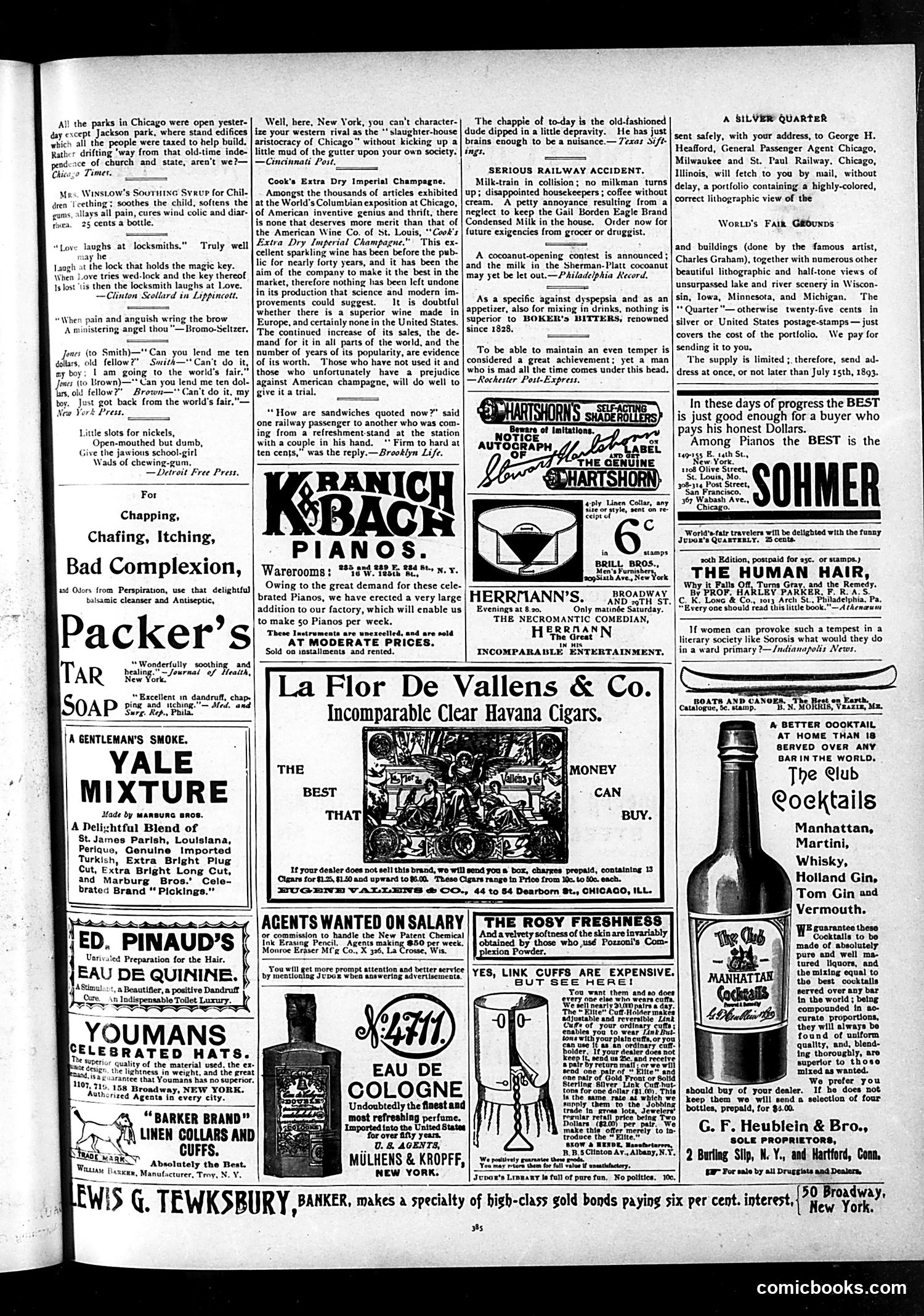
This is primarily an **advertising page** from Judge magazine, with minimal editorial content. The visible jokes and commentary are brief filler pieces between ads. The few satirical items present mock: 1. **Chicago's pretensions**: A note criticizes New York for calling Chicago the "slaughter-house aristocracy" while overlooking its own "gutter" society—a jab at both cities' snobbery during the Gilded Age. 2. **The World's Columbian Exposition** (1893): Referenced approvingly as showcasing American ingenuity, particularly Cook's champagne. 3. **Minor social observations**: Brief jokes about modern types—the "chappie" (young dandy) lacking sense, disappointments with transportation and services. The page reflects **late 19th-century consumer culture**, dominated by patent medicines, tobacco, alcohol, and grooming products. The advertising shows what Judge's affluent male readership valued: luxury goods, gentlemanly pursuits, and remedies for ailments (real or invented). No specific political figures or events are caricatured here—this is lifestyle satire aimed at urban sophistication.
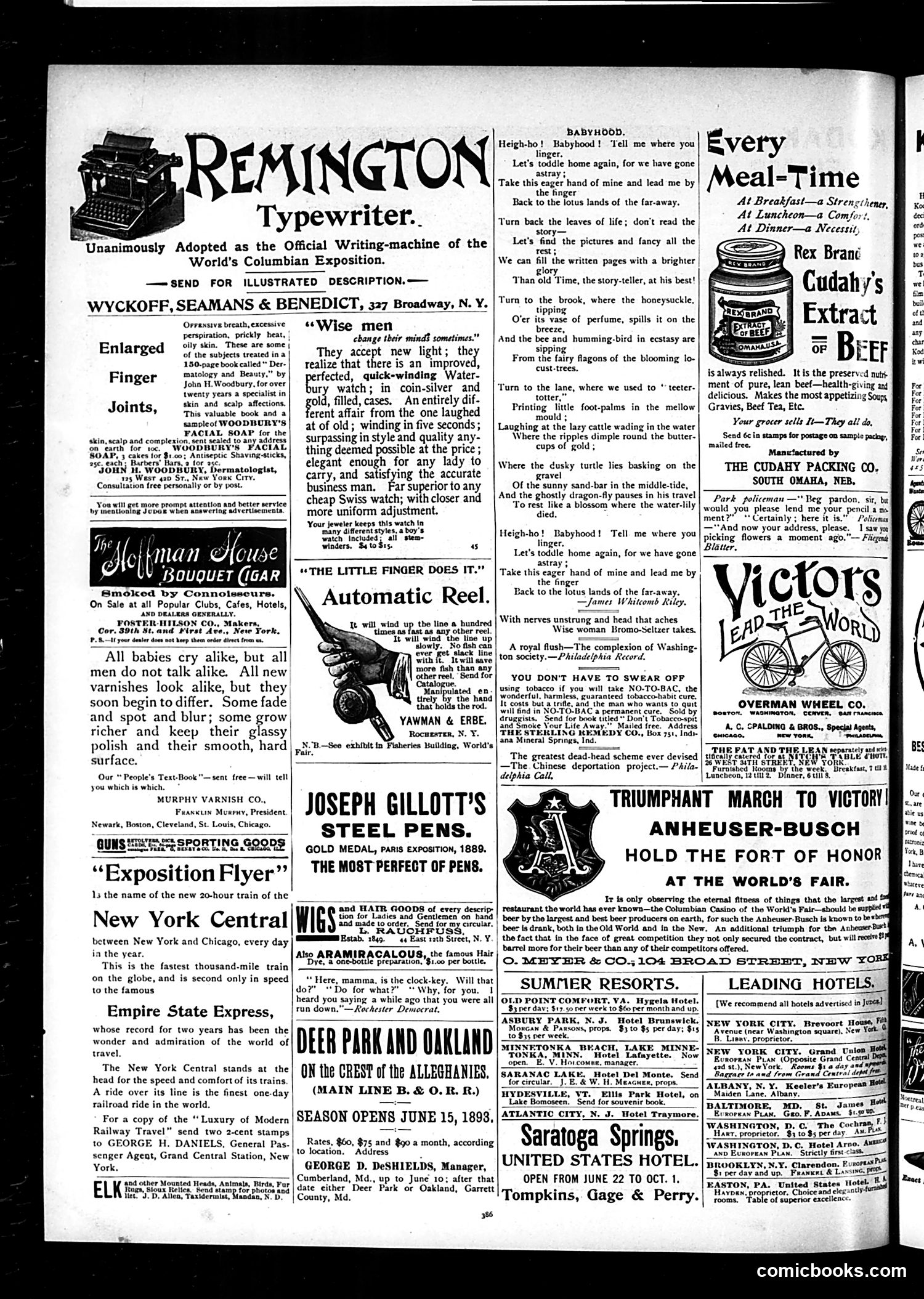
This appears to be primarily an **advertising page** from Judge magazine, likely from around 1893 (based on World's Columbian Exposition references). The dominant content includes commercial advertisements for: - **Remington Typewriter** (official machine of the 1893 World's Fair) - Various personal care and consumer goods (Woodbury's Facial Soap, varnishes, guns) - Transportation (New York Central railroad trains) - Specialty items (fishing reels, steel pens) There are **no significant political cartoons** visible on this page. The few text elements include a poem titled "BABYHOOD" and another piece titled "THE LITTLE FINGER DOES IT," but these appear to be advertising copy or filler content rather than satirical commentary. The page's primary function is **commercial promotion**, capitalizing on the World's Fair's popularity to sell products to affluent Judge readers. This reflects Judge's business model of combining satire with lucrative advertising.
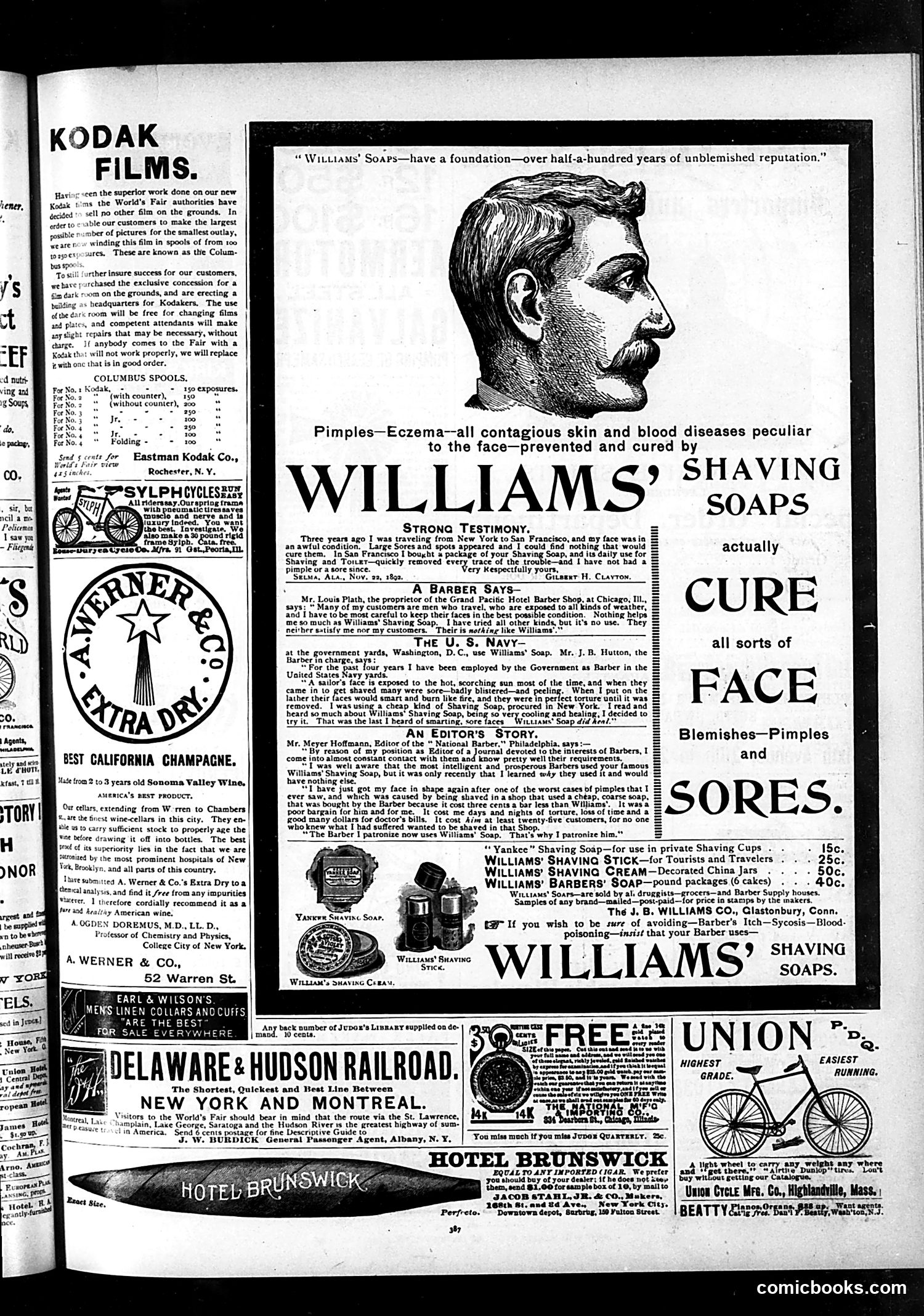
This page is primarily **advertising**, not satire or political commentary. It features multiple advertisements including Kodak film, bicycles, and railroads, but is dominated by a large **Williams' Shaving Soaps advertisement**. The advertisement includes testimonials from various figures claiming the soap cures facial ailments—pimples, eczema, sores, and blistering. Testimonials come from a traveling salesman, a Chicago hotel barber, a U.S. Navy barber, and a magazine editor. **For modern readers**: This represents 19th-century advertising practices—making exaggerated medical claims (curing contagious diseases) without FDA regulation. The testimonial format mimics modern advertising but lacks any scientific basis. No satire is evident; Judge simply accepted such claims as normal advertising copy of the era. The portrait of a bearded man's face serves as product branding, common in period advertisements.
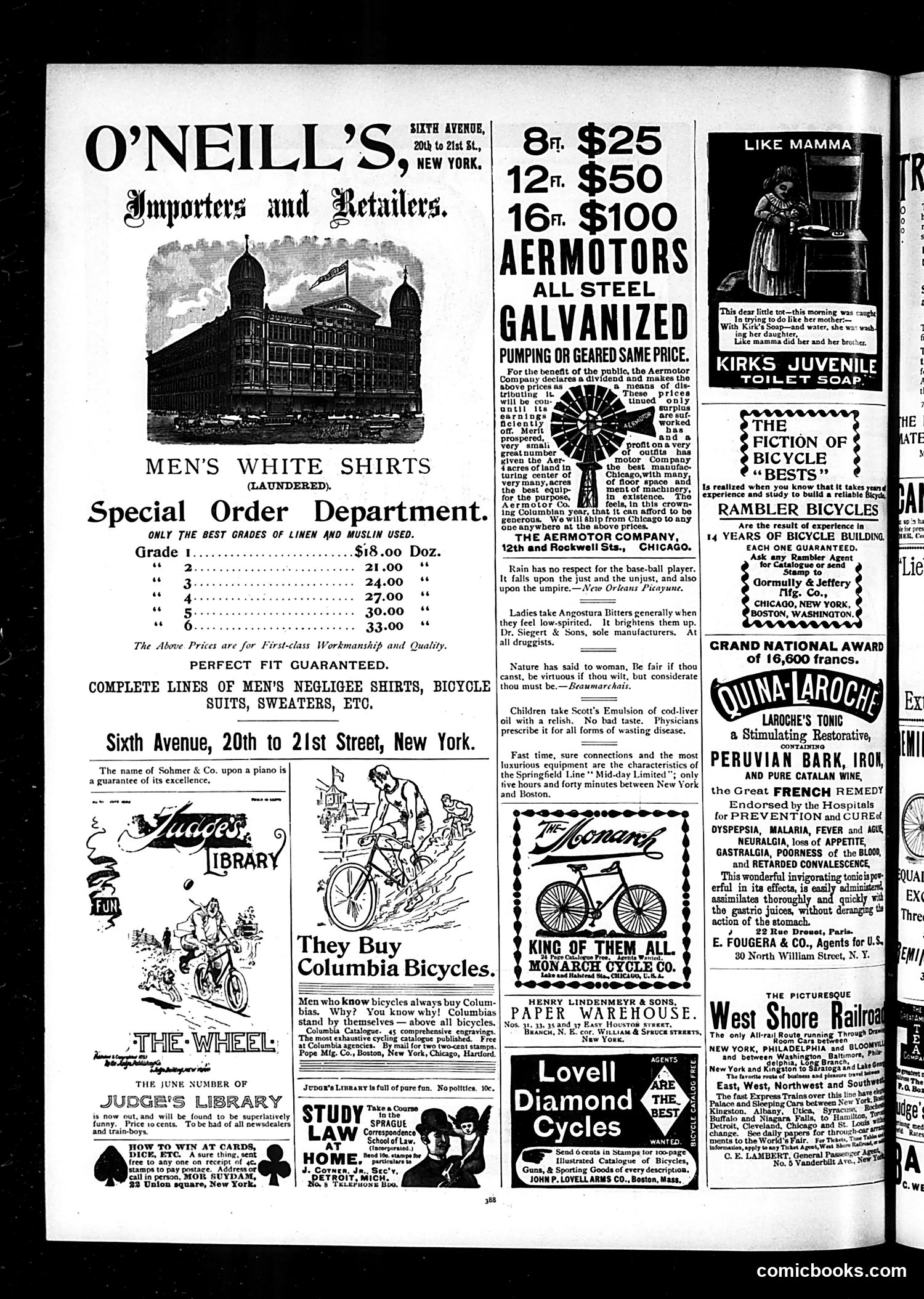
This page is primarily advertising, typical of Judge magazine's revenue model. The layout includes advertisements for: **Main content:** O'Neill's clothing store (men's shirts), Aermotor windmills, and various bicycle manufacturers (Columbia, Rambler, Lovell Diamond, Monarch). **Small cartoons/jokes:** Include one about a child imitating her mother with Kirk's soap (product tie-in humor), and a baseball reference about rain affecting umpires. **Notable:** The advertisements themselves contain brief humorous copy—like quotes about women using Angostura Bitters "when they feel low-spirited" to brighten up. These are typical period advertising strategies mixing product promotion with mild social commentary. The page lacks any coherent political satire or major cartoon. It functions as a commercial vehicle showcasing late-19th-century consumer goods (bicycles were a popular novelty), with scattered advertisements exploiting everyday situations for humor.
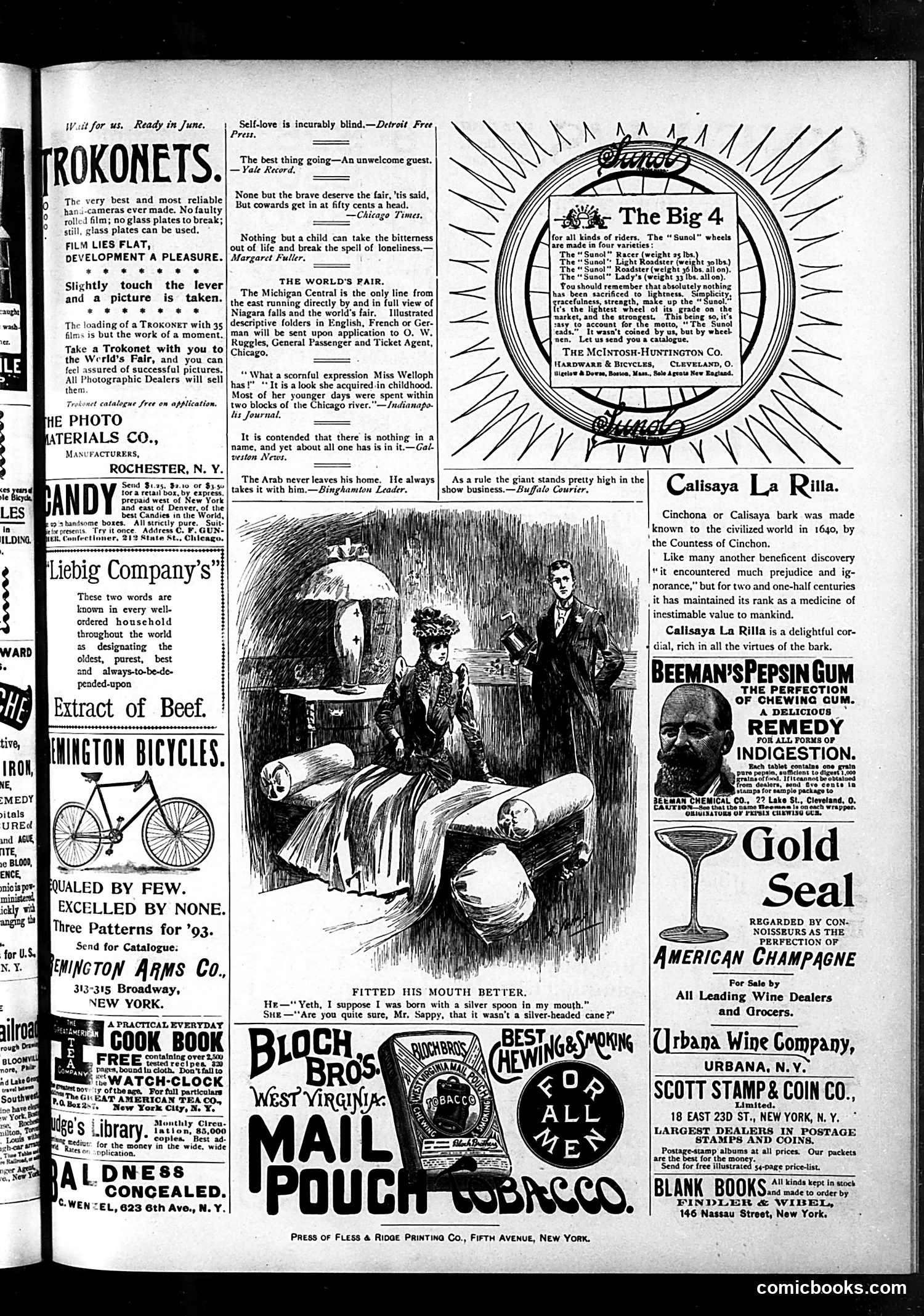
This page is primarily **advertising**, with minimal satirical content. The one cartoon present—titled "Fitted His Mouth Better"—depicts a social satire about pretension. ## The Cartoon The sketch shows a man boasting about being born with a silver spoon in his mouth (a metaphor for wealth/privilege). A woman replies sarcastically, suggesting he was actually born with a silver-*headed cane*—implying he's arrogant and foolish rather than genuinely privileged. The joke mocks social climbing and false gentility. ## The Advertisements The page features numerous late-19th-century product ads: cameras (Trokonets), bicycles (Sunol wheels, Remington Arms), beef extract (Liebig), champagne (Gold Seal), medicinal products (Beeman's Pepsin Gum for indigestion), and tobacco products. These reflect contemporary consumer culture and Judge's commercial focus. The content is typical of 1890s American magazines, blending light humor with commercial promotion.
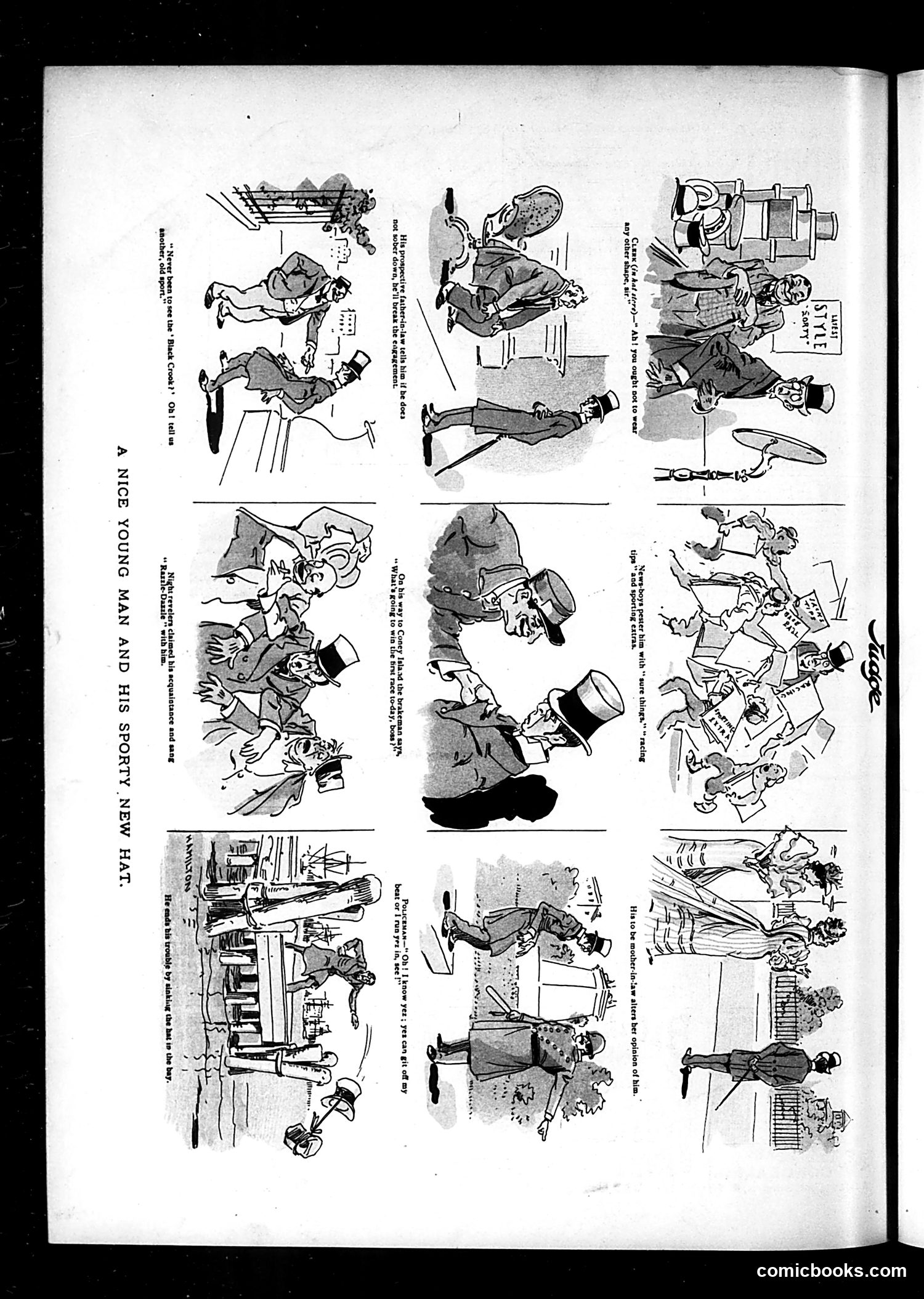
This multi-panel cartoon satirizes a young man's obsession with a fashionable new hat and the social chaos it creates. The sequence shows newsboys pestering him with betting tips and sporting information, his prospective father-in-law warning him to sober up or lose the engagement, and a brakeman's confused reaction during a trip to Coney Island. The joke culminates when the protagonist solves his mounting troubles by throwing the hat into the bay. The satire targets both the vanity of following fashion trends and the era's culture of gambling/sporting speculation. The hat becomes a symbol of frivolous materialism that attracts bad influences and disrupts his life. The absurdist ending—that destroying the hat solves everything—mocks how young men prioritize appearance over responsibility and stability.