
Judge, 1893-06-17 · page 2 of 16
Judge — June 17, 1893 — page 2: what you’re looking at
What you’re looking at
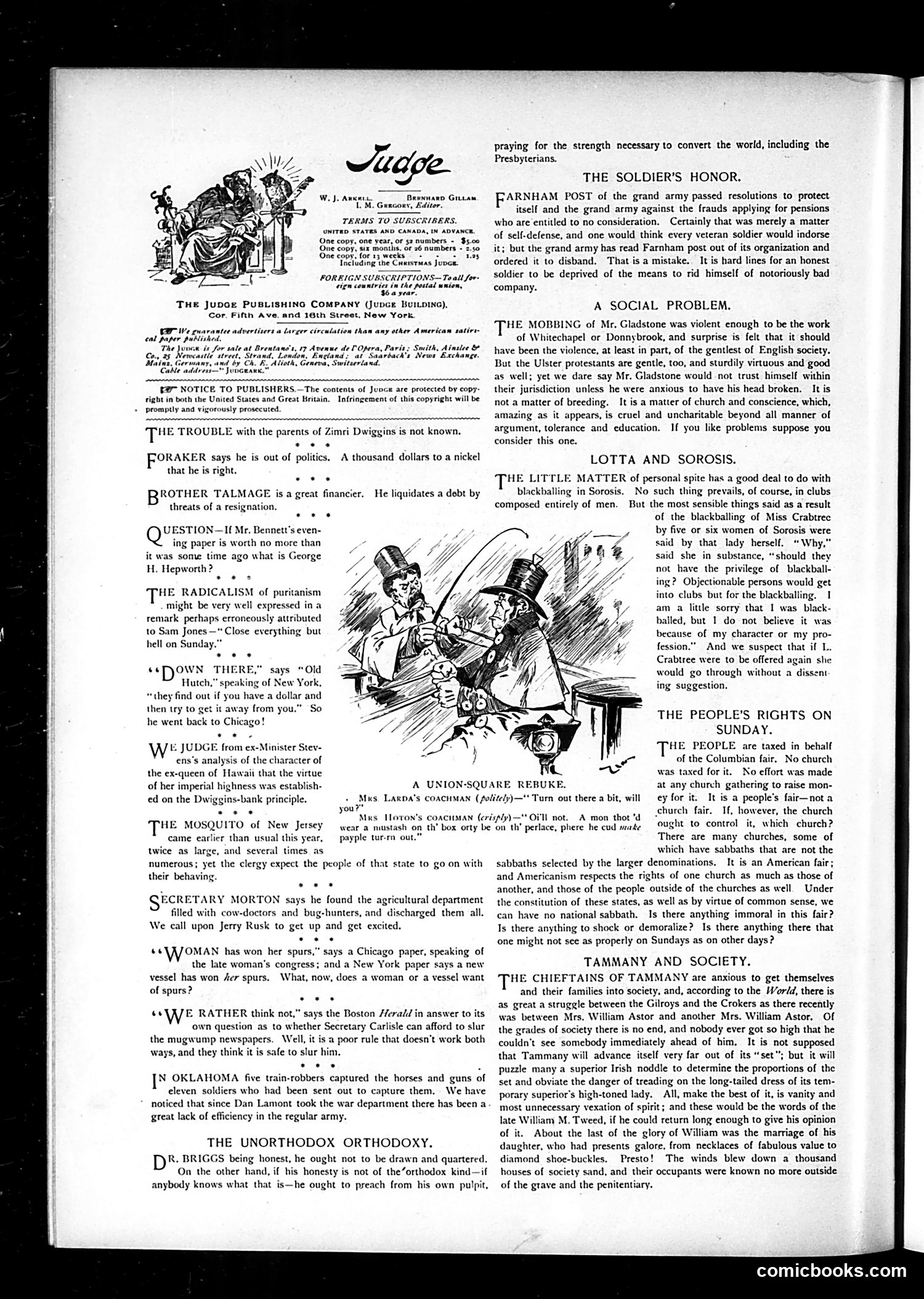
The page features a cartoon titled "A Union-Square Rebuke" depicting two figures in conversation. Based on the caption, one appears to be "Miss Laura Coachman (Pinkerton)" and the other "Miss Holton's Coachman (Gould)." The satire likely addresses labor relations and class tensions of the Gilded Age. The Pinkerton reference suggests labor disputes (Pinkertons were notorious strikebreakers), while "Gould" likely refers to the wealthy industrialist. The "Union Square" location was a known gathering place for workers and radicals. The cartoon mocks the interactions between wealthy employers' servants, using their conversation to satirize broader class and labor conflicts. The exact dialogue and specific historical context remain somewhat unclear from the image quality.
📄 Transcribed text from this page (OCR, searchable)
Machine-transcribed from the original scan — historical spelling and the odd misread are preserved.
TERMS TO SUBSCRIBERS. UNITED STATES AND CANADA, IM ADVANCE. One copy, one year, or s2 numbers - $5.00 One copy, six months. or 26 numbers - #40 One copy. for iy weeks = es bay Tnclading the Caistsas Jupce. FOREIGN SUBSCRIPTIONS—Toall for- Gigm countries im the pottal union, ‘$64 year. THE JUDGE PUBLISHING COMPANY (Jupce BUILDING), Cor. Fifth Ave. and 16th Street, New York. We gus cal paper publish The Juve is for sale at Brentane's, 17 Avenue del Ope Con, 25 Neweastle street, E Main Cate tee advertisers a larger circulation than any other American satirs- Paris; Smith, Ainslee & News Exchange. rrmany, and by ‘addr est" JUDGRAW £27 NOTICE TO PUBLISHERS.—The contents of Juoce are protected by copy: Fight in both the United States and Great Britain. Infringement of this copyright will be + promptly and vigorously prosecuted. THE TROUBLE with the parents of Zimri Dwiggins is not known. FORAKER says he is out of politics. A thousand dollars to a nickel that he is right. BROTHER TALMAGE is a great financier. threats of a resignation. He liquidates a debt by Qu" TION —If Mr. Bennett's even- ing paper is worth no more than it was some time ago what is George H. Hepworth? THE. RADICALISM of puritanism might be very well expressed in a remark perhaps erroneously attributed to Sam Jones—“ Close everything but hell on Sunday.” ePOWN THERE,” says “Old Hutch,” speaking of New York, “they find out if you have a dollar and then try to get it away from you.” So he went back to Chicago! : JUDGE from ex-Minister Stev- ens’s analysis of the character of the ex-queen of Hawaii that the virtue of her imperial highness was establish- ed on the Dwiggins-bank principle. UITO of New Jersey ye: + than usual this year, twice as large, and several times as numerous; yet the clergy expect the people of that state to go on with their behaving. you? HE MOS came ear! payple tur-rn out. SECRETARY MORTON says he found the agricultural department filled with cow-doctors and bug-hunters, and discharged them all. We call upon Jerry Rusk to get up and get excited, says a Chicago paper, speaking of anew # © YVOMAN has won her spurs, the late woman's congress; and a New York paper vessel has won /ter spurs. What, now, does a woman or a vessel want of spurs? SOWVE RATHER think not,” says the Boston Herald in answer to its own question as to whether Secretary Carlisle can afford to slur the mugwump newspapers, Well, it is a poor rule that doesn’t work both ways, and they think it is safe to slur him, N OKLAHOMA five train-robbers captured the horses and guns of eleven soldiers who had been sent out to capture them. We have noticed that since Dan Lamont took the war department there has been a great lack of efficiency in the regular army. THE UNORTHODOX ORTHODOXY. R. BRIGGS being honest, he ought not to be drawn and quartered. On the other hand, if his honesty is not of the‘orthodox kind—if anybody knows what that is—he ought to preach from his own pulpit, A UNION-SQUAK Mus. Lagpa’s coacnan (politely Mus Horton's CoACHMAN (crisply) —"* OF not, a miustash on th’ box orty be on th’ perlace, phere he cud make praying for the strength necessary to convert the world, including the Presbyterians. THE SOLDIER’S HONOR. FARNHAM POST of the grand army passed resolutions to protect itself and the grand army against the frauds applying for pensions who are entitled to no consideration. Certainly that was merely a matter of self-defense, and one would think every veteran soldier would indorse it; but the grand army has read Farnham post out of its organization and ordered it to disband. That is a mistake. It is hard lines for an honest soldier to be deprived of the means to rid himself of notoriously bad company. A SOCIAL PROBLEM. HE MOBBING of Mr. Gladstone was violent enough to be the work of Whitechapel or Donnybrook, and surprise is felt that it should have been the violence, at least in part, of the gentlest of English society. But the Ulster protestants are gentle, too, and sturdily virtuous and good as well; yet we dare say Mr. Gladstone would not trust himself within their jurisdiction unless he were anxious to have his head broken. It is not a matter of breeding, It is a matter of church and conscience, which, amazing as it appears, is cruel and uncharitable beyond all manner of argument, tolerance and education. If you like problems suppose you consider this one. LOTTA AND SOROSIS. THE LITTLE MATTER of personal spite has a good deal to do with blackballing in Sorosis. No such thing prevails, of course, in clubs composed entirely of men. But the most sensible things said as a result of the blackballing of Miss Crabtree by five or six women of Sorosis were said by that lady herself. “Why,” said she in substance, “should they not have the privilege of blackball- ing? Objectionable persons would get into clubs but for the blackballing. 1 am a little sorry that I was black- balled, but I do not believe it was because of my character or my pro- fession.” And we suspect that if L. Crabtree were to be offered again she would go through without a dissent ing suggestion. THE PEOPLE'S RIGHTS ON SUNDAY. THE PEOPLE are taxed in behalf of the Columbian fair. No church was taxed for it. No effort was made at any church gathering to raise mon- ey for it. It is a people’s fair—not a church fair. If, however, the church ought to control it, which church? There are many churches, some of which have sabbaths that are not the sabbaths selected by the larger denominations. It is an American fair; and Americanism respects the rights of one church as much as those of another, and those of the people outside of the churches as well. Under the constitution of these states, as well as by virtue of common sense, we can have no national sabbath, Is there anything immoral in this fair? Is there anything to shock or demoralize? Is there anything there that one might not see as properly on Sundays as on other days? TAMMANY AND SOCIETY. HE CHIEFTAINS OF TAMMANY are anxious to get themselves and their families into society, and, according to the World, there is as great a struggle between the Gilroys and the Crokers as there recently was between Mrs. William Astor and another Mrs. William Astor. Of the grades of society there is no end, and nobody ever got so high that he couldn't see somebody immediately ahead of him. It is not supposed that Tammany will advance itself very far out of its “set”; but it will puzzle many a superior Irish noddle to determine the proportions of the set and obviate the danger of treading on the long-tailed dress of its tem- porary superior’s high-toned lady. All, make the best of it, is vanity and most unnecessary vexation of spirit; and these would be the words of the late William M. Tweed, if he could return long enough to give his opinion of it. About the last of the glory of William was the marriage of his daughter, who had presents galore, from necklaces of fabulous value to diamond shoe-buckles. Presto! The winds blew down a thousand houses of society sand, and their occupants were known no more outside of the grave and the penitentiary. REBUKE. * Turn out there a bit, will A mon thot 'd comicbooks.com