
A complete issue · 16 pages · 1893
Judge — February 11, 1893
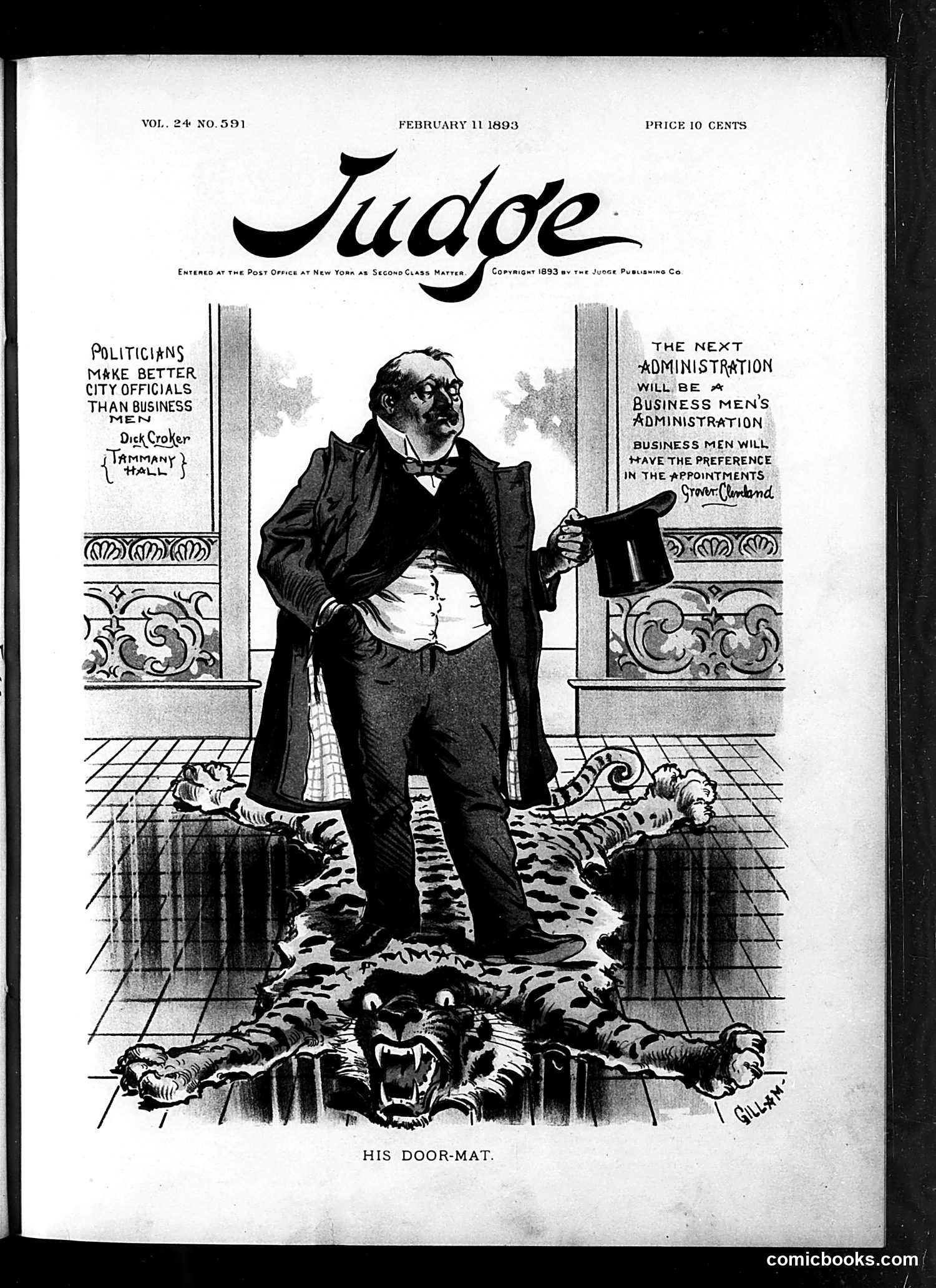
This cartoon satirizes the incoming administration's approach to political appointments. The central figure, a portly businessman, stands on a fierce tiger labeled "TAMMANY" (the corrupt Democratic political machine in New York City). The left panel quotes Der Croker (likely Richard Croker, Tammany Hall boss), claiming "POLITICIANS MAKE BETTER CITY OFFICIALS THAN BUSINESS MEN." The right panel counters that the next administration will be a "BUSINESS MEN'S ADMINISTRATION" with business preference in appointments—directly contradicting Croker's position. The tiger doormat represents Tammany Hall being literally walked upon and subordinated under the new business-focused administration, mocking the old political establishment's loss of power.
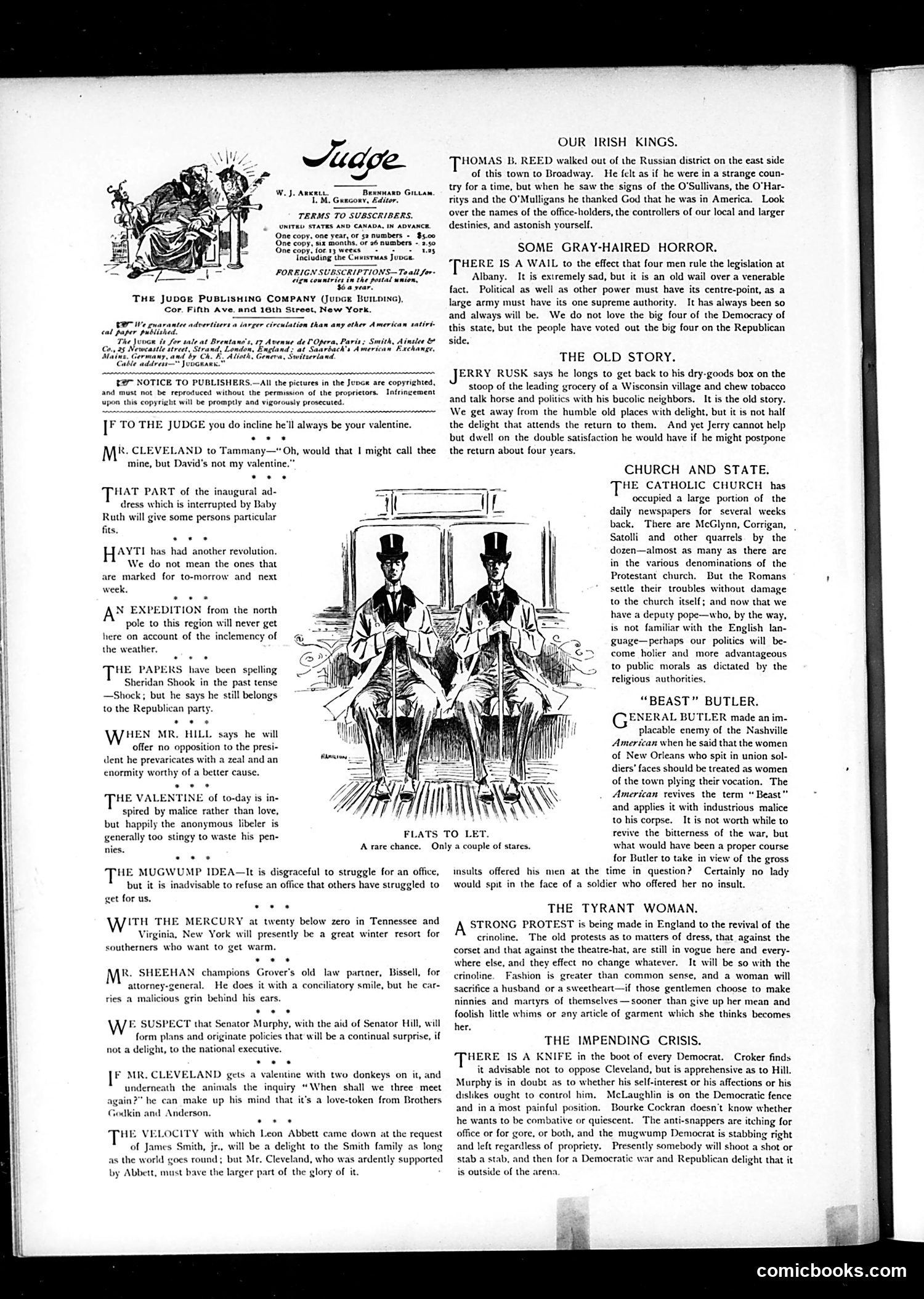
The central cartoon depicts two identical figures in formal dress and top hats, labeled "FLATS TO LET. A rare chance. Only couple of stares." This appears to be political satire about Democratic leadership during the Cleveland administration. The text references tensions between Cleveland, Hill, Murphy, and other Democratic figures competing for power and influence. The "rare chance" caption suggests these leaders are interchangeable or indistinguishable—that Democratic positions are essentially vacant despite occupants. The repeated identical figures emphasize the satire's point: that these feuding Democratic politicians lack meaningful differences or individual character. The "flats to let" (apartments for rent) metaphor implies their heads are empty of original ideas, making them vacant vessels rather than distinct leaders.
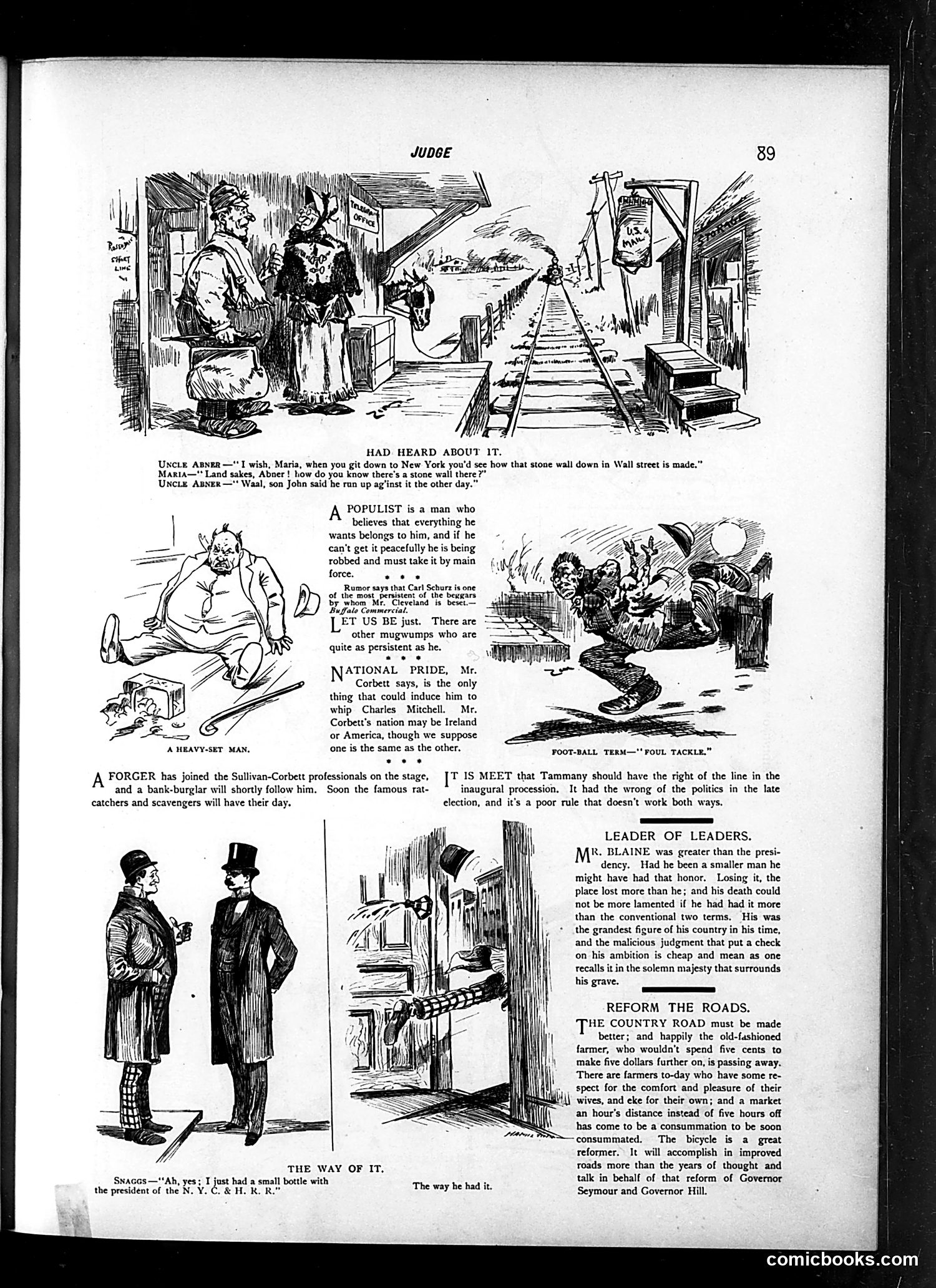
This page contains political and social commentary from the Gilded Age era. The top cartoon "Had Heard About It" references Wall Street financial scandals, with Uncle Abner discussing a "stone wall" metaphor about financial collapse in New York. The "Populist" definition satirizes the Populist political movement, characterizing its supporters as wanting to seize property by force rather than negotiate peacefully. This reflects elite anxieties about agrarian and labor movements challenging wealthy interests. Other cartoons mock prizefighting professionals (Sullivan-Corbett reference), banking corruption, and political leadership failures. The "Reform the Roads" section critiques infrastructure while praising bicycles as agents of modernization. The satire targets: populist politics, financial fraud, prize-fighting corruption, and poor governance—reflecting Judge's conservative, pro-establishment perspective during America's tumultuous 1890s.
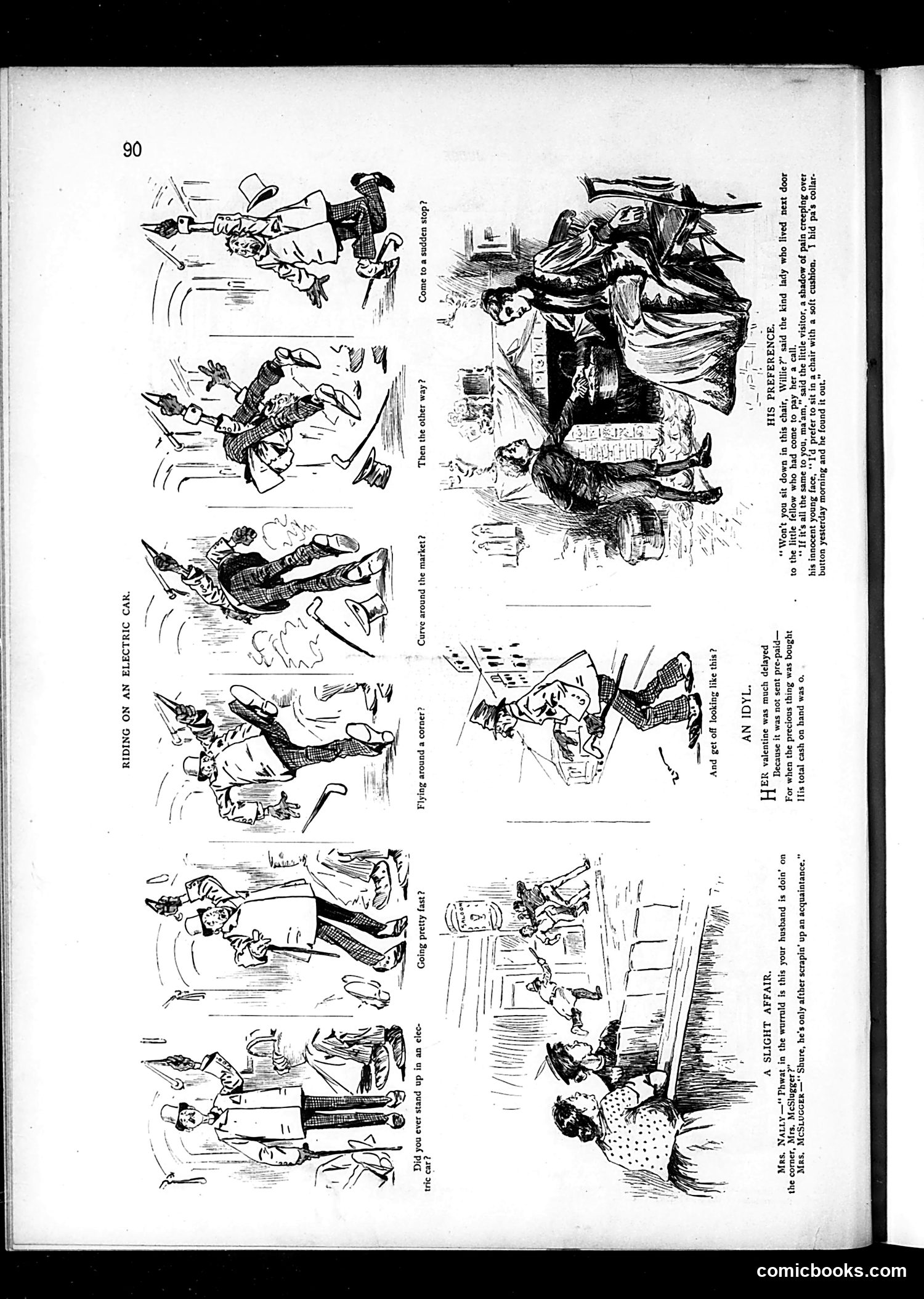
I cannot reliably decode this page due to severe OCR corruption making the text largely illegible. The OCR appears to have inverted or scrambled the original text, rendering it unreadable for historical context. Visually, the page contains multiple sketch-style cartoon panels typical of Judge magazine's satirical format. The drawings appear to depict various social scenes with multiple figures in different situations, suggesting commentary on contemporary manners, behaviors, or social issues common to Judge's content from the late 19th or early 20th century. Without legible captions or text, I cannot identify specific figures, political references, or the satirical points intended. To properly explain this page's meaning to modern readers, the original printed text would be required.
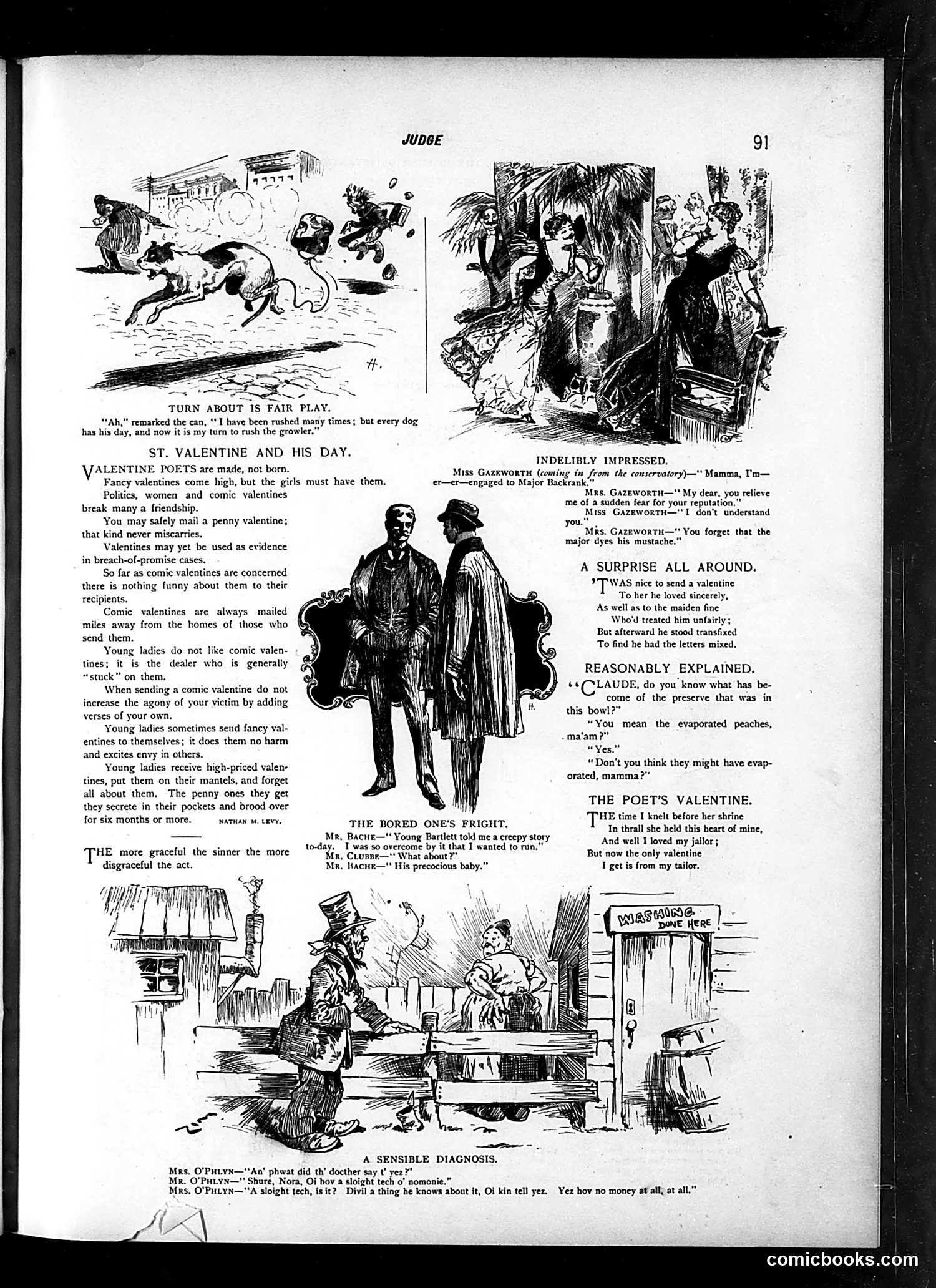
This page collects Valentine's Day humor and satirical observations typical of late 19th/early 20th-century Judge magazine. **Main content themes:** The "St. Valentine and His Day" section offers cynical observations about valentines as social custom—fancy ones impress, cheap penny valentines get cherished longest, and comic valentines damage friendships. The humor targets both senders (who mail them anonymously from far away) and recipients (young women secretly treasure cheap ones). **Individual cartoons satirize:** - **"Turn About Fair Play"**: A can remarks it's finally getting its turn to rush (chase) a growler (milk can), reversing typical roles. - **"Miss Gazeworth" dialogue**: A mother relieved her daughter's engagement to Major Backrank won't damage reputation—because "the major dyes his mustache" (suggesting vanity undermines his respectability). - **"The Poet's Valentine"**: A man now receives valentines only from his tailor (bill collector), implying financial ruin. - **"A Sensible Diagnosis"**: Irish-accented dialogue joking that poverty explains medical symptoms. The satire reflects period attitudes toward class, courtship rituals, and gender dynamics.
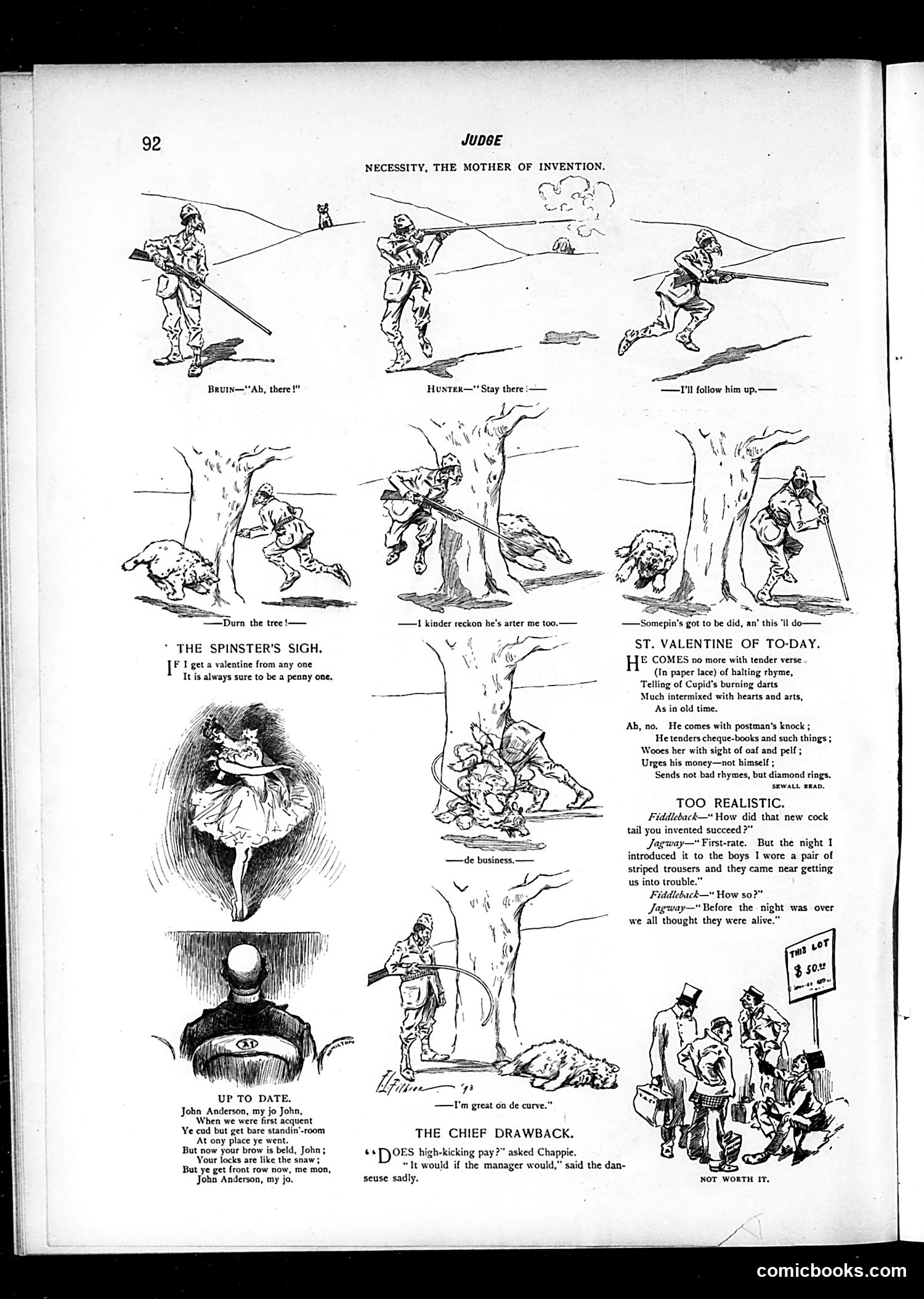
This page contains several unrelated satirical pieces typical of Judge's format: **"Necessity, the Mother of Invention"** depicts hunters improvising a rifle from a long stick—visual humor about makeshift solutions. **"The Spinster's Sigh"** jokes that unmarried women only receive cheap penny valentines, commenting on social status and romantic neglect. **"St. Valentine of To-Day"** contrasts old-fashioned romantic valentines with modern courtship: today's suitor woos with checkbooks and diamond rings rather than poetry—satirizing materialism and the commercialization of romance. **"Up to Date"** modernizes a Scottish folk song, noting that while the aging John Anderson once drew crowds, he now easily gets front-row seating because people no longer want to see him—dark humor about aging and obsolescence. **"Too Realistic"** and **"The Chief Drawback"** are brief joke vignettes about a failed cocktail invention and a dancer's pay dispute. The overall theme emphasizes how modern life—materialism, aging, invention—displaces traditional values and romance.
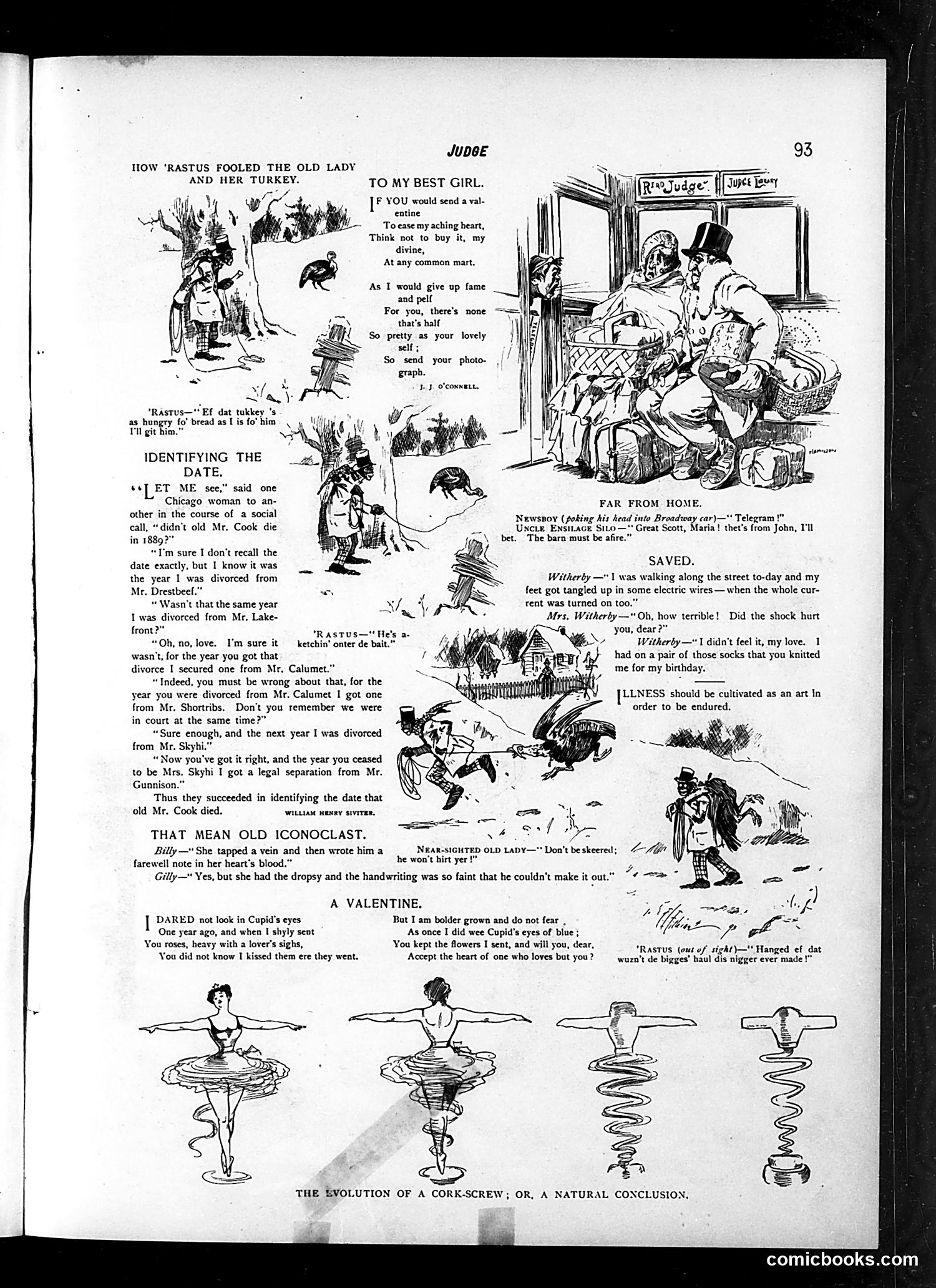
This page contains several satirical pieces typical of late-19th-century American humor: **"How 'Rastus Fooled the Old Lady"**: A racist dialect-humor piece featuring a Black character ("'Rastus") stealing a turkey—common minstrelsy-style content of the era. **"Identifying the Date"**: Social satire mocking upper-class Chicago women whose multiple divorces have become so routine they use them as calendar markers ("the year I divorced Mr. Drestbeef"). The joke criticizes both the frequency of divorce and women's (supposed) frivolousness. **Other sections** include mild domestic humor ("Saved"—a wife's electrocution rescue; "A Valentine"—romantic verse) and the "Evolution of a Cork-Screw" visual gag comparing a woman's posture to mechanical spiraling. The "Near-sighted Old Lady" caption appears to reference a separate illustration about safety. Overall, the page reflects Judge's satirical approach: mocking contemporary social issues (divorce, modernity's dangers like electric wires) while relying heavily on period-typical racist stereotypes and gender stereotypes.
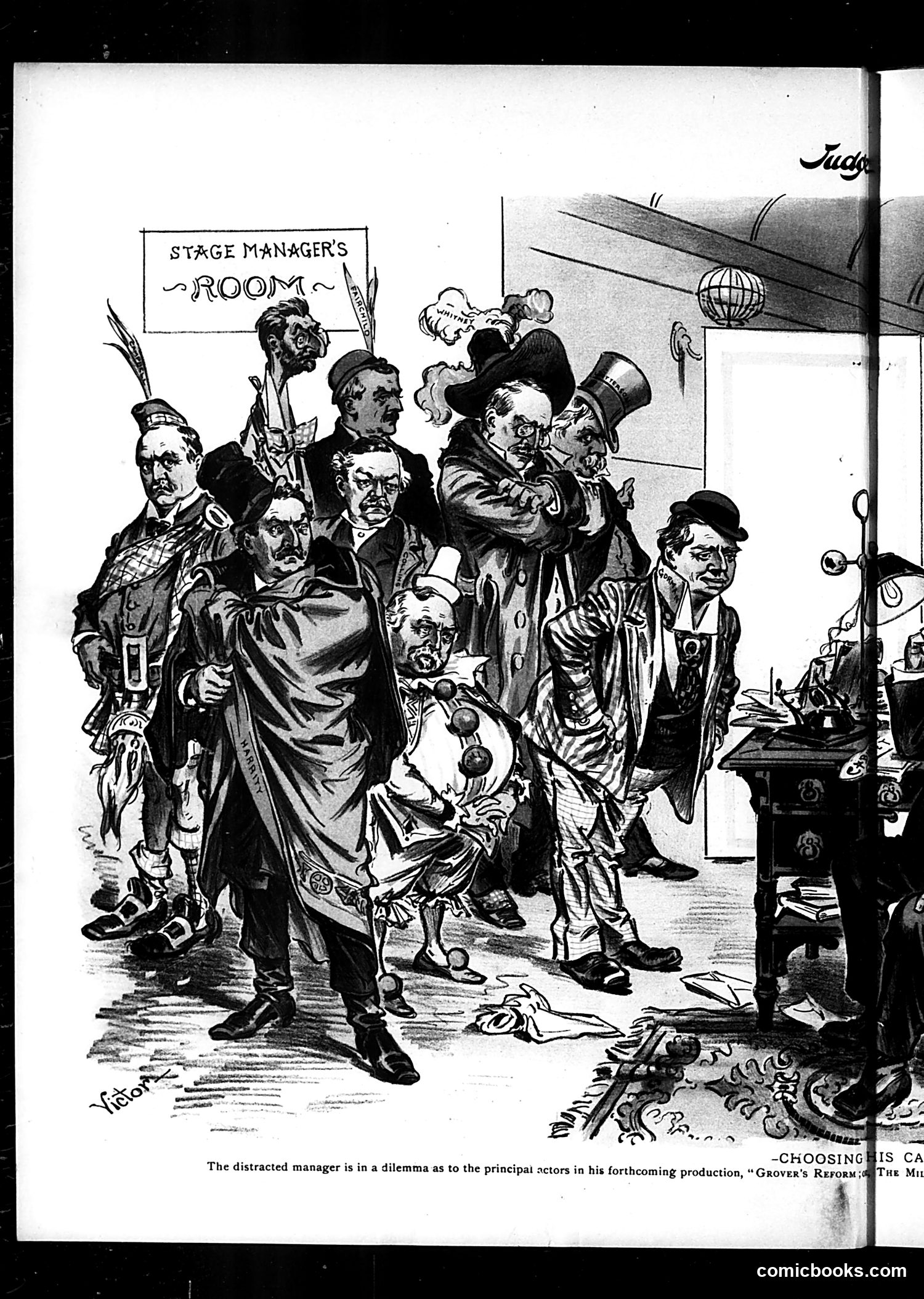
This satirical cartoon depicts a **Stage Manager's Room** where a theatrical producer faces a casting dilemma for an upcoming production titled "Grover's Reform." The cartoon uses theatrical metaphor to critique political leadership. The crowded scene shows numerous caricatured figures—likely politicians or public figures of the era—jostling around the distracted manager, apparently competing for principal roles. The artist suggests confusion and difficulty in selecting appropriate leaders for implementing reform policies associated with someone named Grover (likely President Grover Cleveland). The satire implies that choosing honest, capable officials for reform initiatives is complicated by competing interests and unsuitable candidates. The theatrical setting cleverly comments on politics as performative spectacle, with various figures "auditioning" for positions of power while the manager struggles with selection.
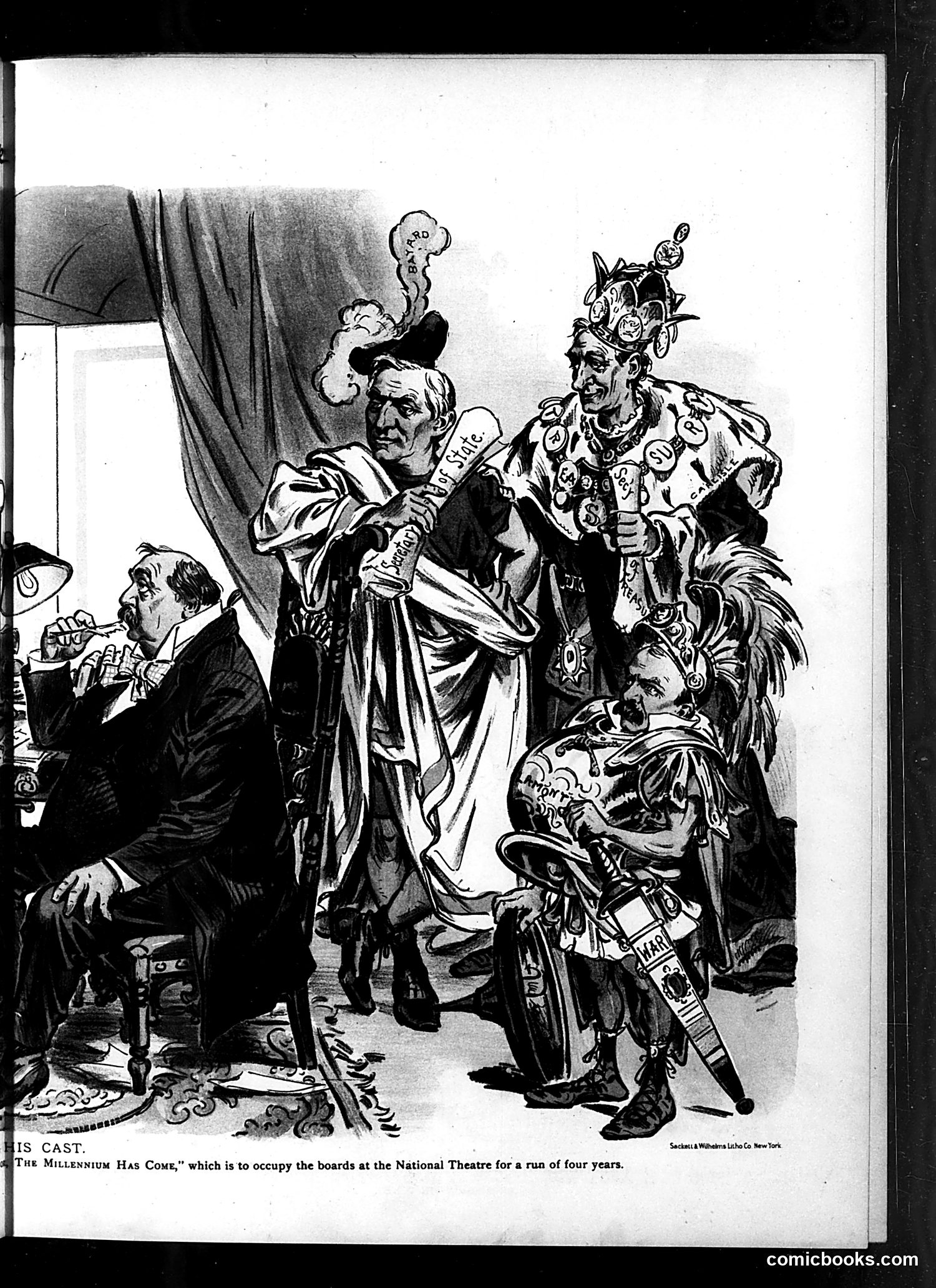
This is a theatrical satire from Judge magazine depicting the cast of a play called "The Millennium Has Come," scheduled for a four-year run at the National Theatre. The illustration shows elaborately costumed figures in exaggerated, fantastical dress—one wearing an ornate headdress with decorative elements, another in regal robes holding a staff. A plainly-dressed man on the left observes the theatrical spectacle. The satire appears to mock either the play's pretentiousness or contemporary theatrical productions generally. The "millennium" reference suggests millennial-themed entertainment popular around 1900. The contrast between the ordinary observer and the absurdly decorated performers emphasizes the ridiculousness of the production's apparent self-importance. The joke likely critiques overblown theatrical productions and their four-year commitment.
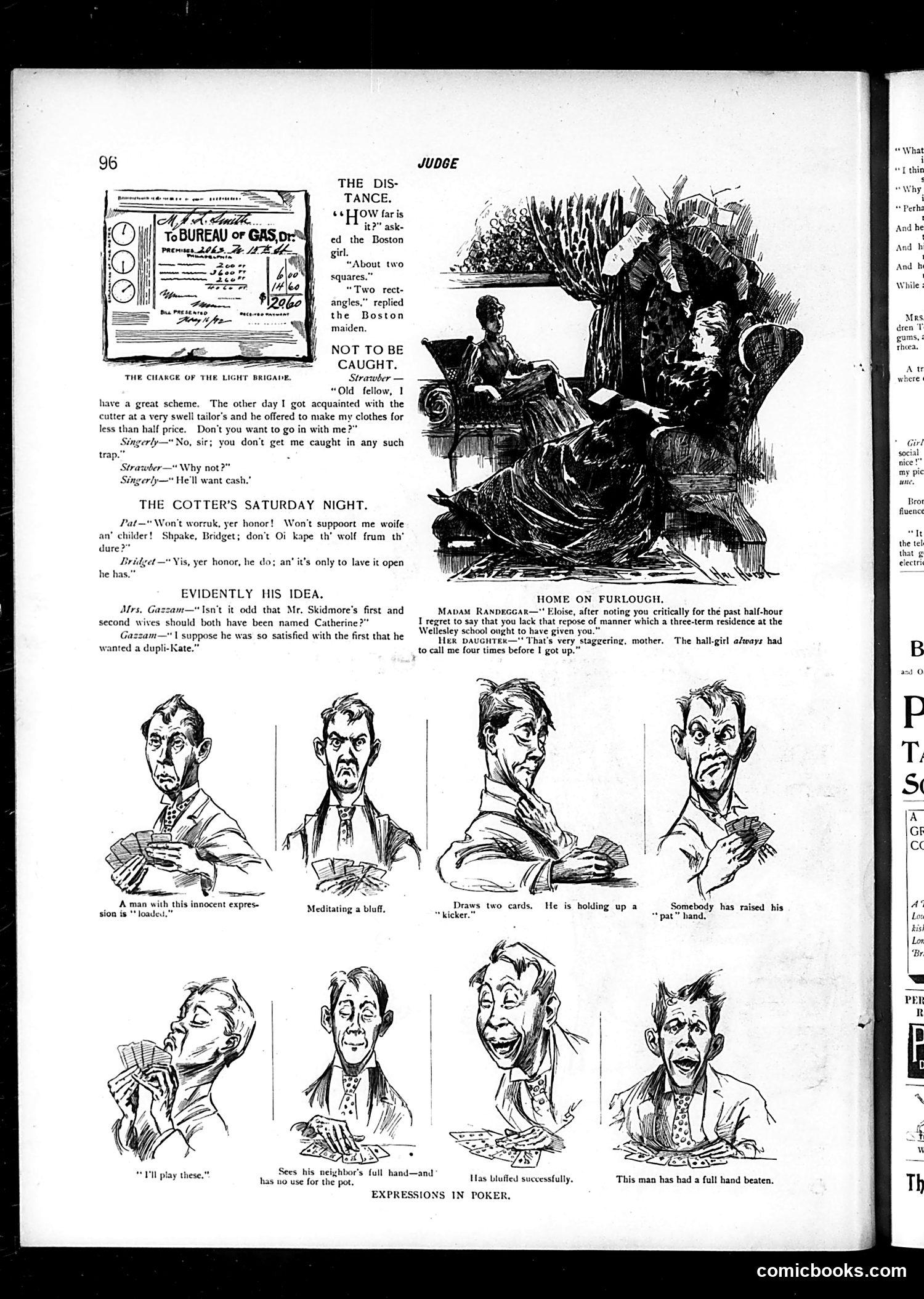
This page contains multiple unrelated satirical pieces typical of Judge magazine's format. The main items include: **"The Distance"** and **"Not to Be Caught"**: Brief dialogue jokes about a Boston girl's geometric descriptions and a tailor's discount scheme. **"The Cotter's Saturday Night"** and **"Evidently His Idea"**: Satirical vignettes—one depicting an Irish laborer's domestic concerns (using period Irish dialect stereotypes), the other mocking a man's naming choices for wives. **"Home on Furlough"**: A joke about a Wellesley-educated daughter's pretensions being deflated by her mother's observation about her lack of refinement. **"Expressions in Poker"**: Eight caricatured facial expressions illustrating different poker player behaviors—bluffing, winning, losing, etc. The page exemplifies Judge's mixture of social satire targeting class anxieties, ethnic stereotypes, and genteel manners, alongside comic illustrations. The cartoons assume readers understood period social hierarchies and gender roles.
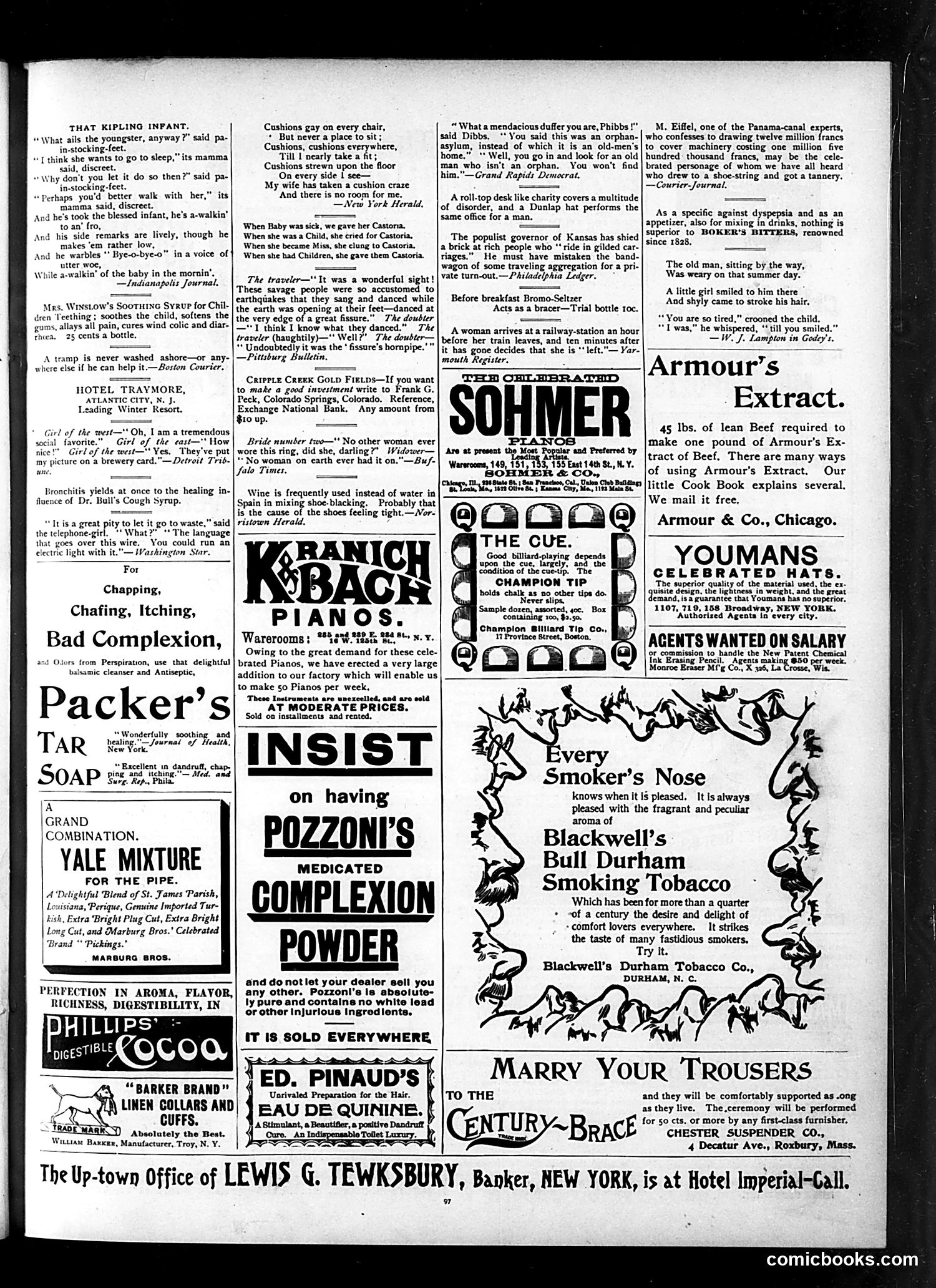
This page is **primarily advertising** with some short humorous pieces typical of Judge magazine's satirical content. The main notable cartoon/text piece is "That Kipling Infant," referencing **Rudyard Kipling's poem "The Barrack-Room Ballad"** (likely "Mandalay" or similar work featuring military themes). The joke appears to be a domestic parody: a father must walk a fussy infant at night, mimicking soldiers' experiences. The humor lies in treating mundane household duties with the overwrought drama of Kipling's military verse. Other brief satirical items include jokes about: - A "girl of the west" being printed on brewery cards (social commentary on women's dignity) - A pun about telephone language being "wasted" - Wordplay on Spanish shoe-blacking containing wine The remainder consists of period advertisements for patent medicines, tobacco, pianos, and personal grooming products—typical of Judge's revenue model. The page reflects late 19th/early 20th-century American consumer culture and literary references contemporary readers would recognize.
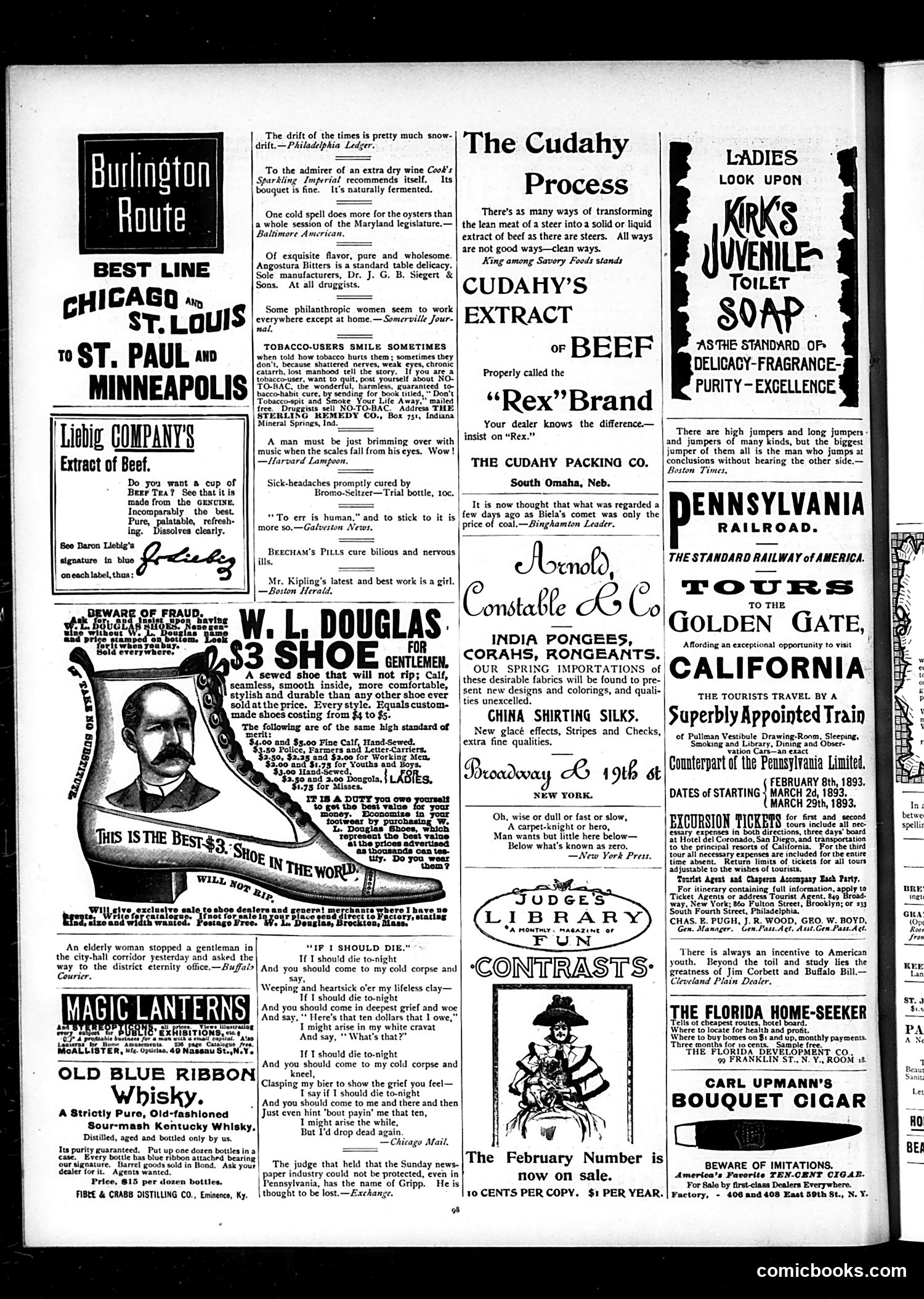
This page is **primarily advertising** with minimal editorial cartoons. The layout consists almost entirely of product advertisements (shoes, whisky, beef extract, bitters, etc.) interspersed with short humorous quotations and one brief poem. The only substantive satirical content is **"If I Should Die To-Night,"** a poem playing on debt collection. The joke: a deceased person's ghost would rise from the dead if a debtor finally came to pay an owed ten dollars—but would immediately drop dead again upon hearing the payment hint. This satirizes the common trope of deathbed reconciliations while cynically suggesting that financial obligation transcends even mortality. The scattered quotations mock minor social hypocrisies: philanthropic women neglecting their own homes, men's inability to stick to admissions of error, and weather affecting oyster quality. The page reflects **Judge's** mixed editorial-advertising business model of the 1890s, where satirical content served primarily as filler around commercial messaging.
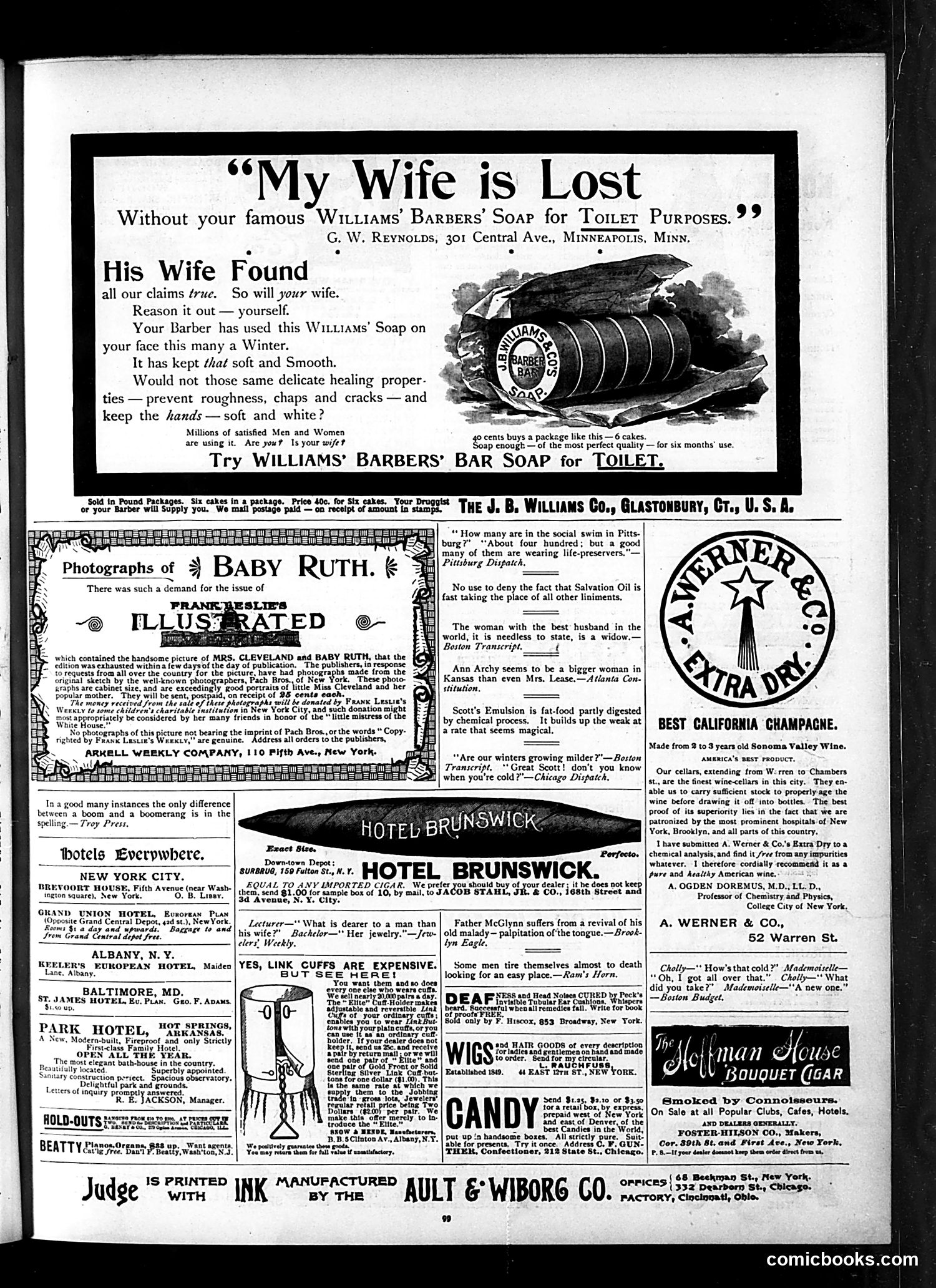
This page is primarily **advertising**, not political satire. The dominant feature is a large advertisement for Williams' Barbers' Soap, which uses testimonial copy from a Minneapolis man ("My Wife is Lost Without...") and promises the product will keep wives' hands "soft and white"—a period-typical beauty claim. Below that are hotel advertisements and miscellaneous classified ads typical of Judge magazine's back pages. The only satirical content appears to be brief, captionless quips scattered throughout—jokes about Pittsburgh's "social swim," widows having the best husbands, and winters getting milder. These are generic humor fillers, not commentary on specific figures or events. There is **no identifiable political cartoon or caricature** on this page. The reference to "Baby Ruth" (the Cleveland daughter) in the "Photographs of Baby Ruth" section is historical documentation, not satire.
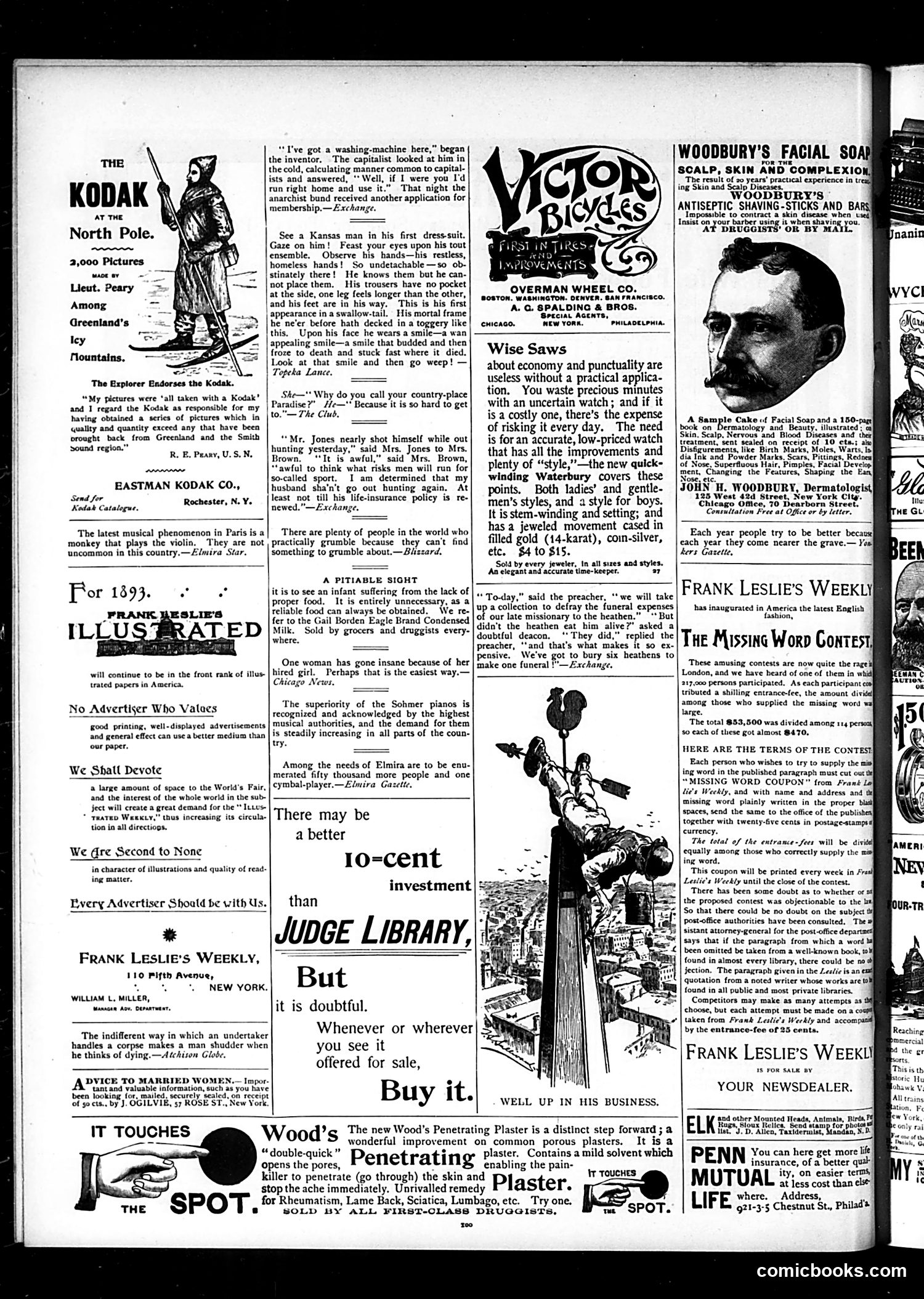
This page is primarily **advertising and self-promotion**, not political satire. It features: **Key Content:** - **Kodak endorsement** by Lt. Peary, Arctic explorer, legitimizing the camera brand through his expedition credentials - **Frank Leslie's Weekly self-promotion**, claiming superiority in illustrations and circulation - **Multiple humorous anecdotes** about everyday life: a Kansas man uncomfortable in formal dress, a wife preventing her husband from hunting after his insurance expires, a monkey playing violin in Paris - **Product advertisements** for washing machines, pianos, and condensed milk **The Satire:** The humor targets social absurdities—a capitalist dismissing an inventor's washing machine, people who complain without cause, the anxiety of wearing unfamiliar formal clothing. These are gentle, domestic jokes rather than political commentary. **For Modern Readers:** This reflects late-19th-century advertising's use of celebrity endorsements (Peary/Kodak), the prominence of domestic servants in household discussions, and period anxieties about social class performance—particularly navigating formal dress codes.
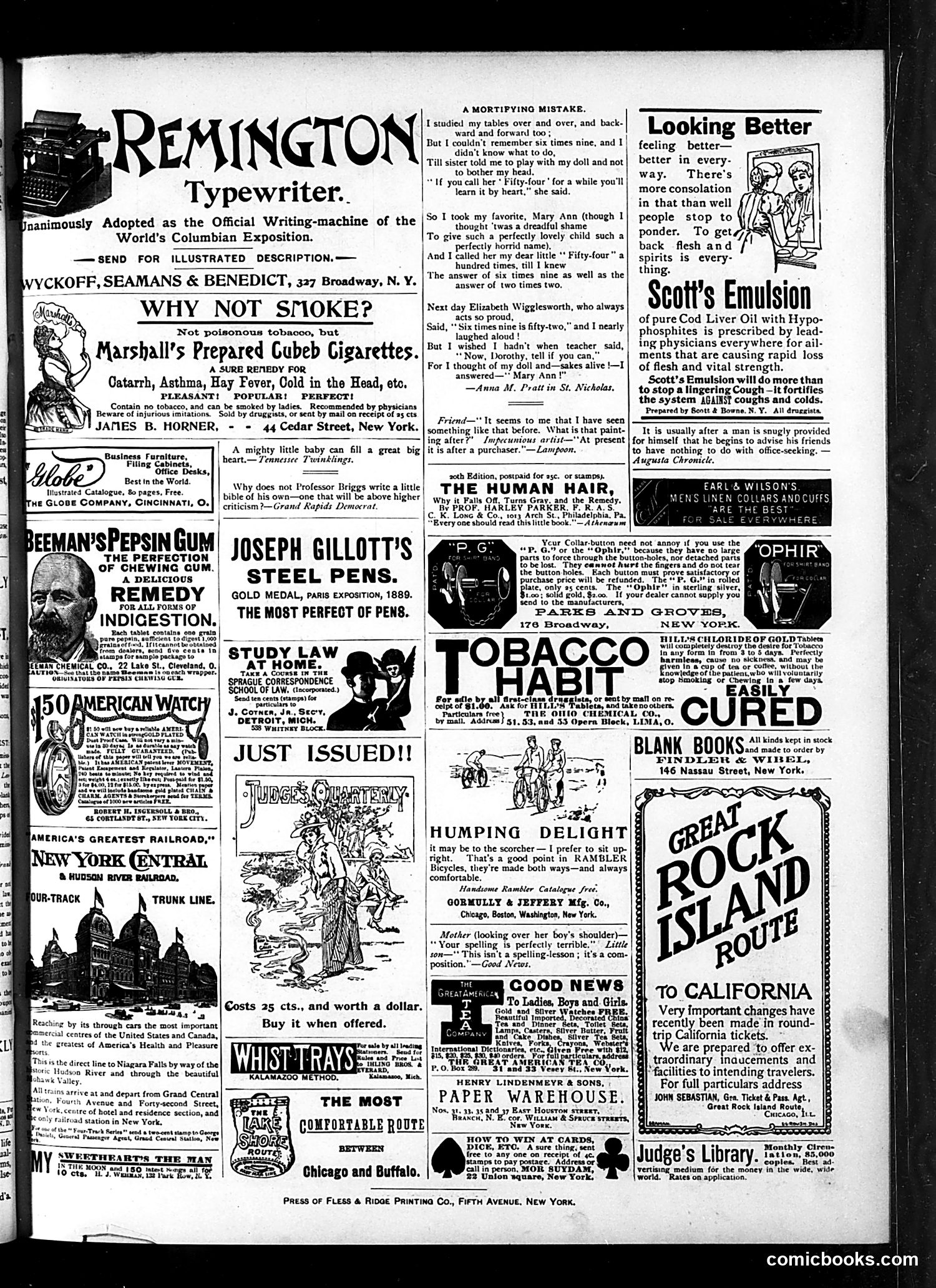
This page is primarily **advertisements and filler content**, not political satire. It's from Judge's World's Columbian Exposition issue (1893), mixing ads for products like Remington typewriters, Marshall's cigarettes, and railroads with brief humorous anecdotes. The main illustrated content is a short poem titled "A Mortifying Mistake" about a girl who memorizes "six times nine" by calling her doll "Fifty-four," then accidentally answers "Mary Ann" when the teacher asks the math problem. It's gentle domestic humor—no political dimension. The page reflects the magazine's typical mix: **commercial advertisements** (steel pens, chewing gum, watches, railroads) alongside **light humor and verse** aimed at middle-class readers. There are no identifiable political figures or social commentary visible. This appears to be a standard issue page rather than featuring editorial satire, which was Judge's usual strength.
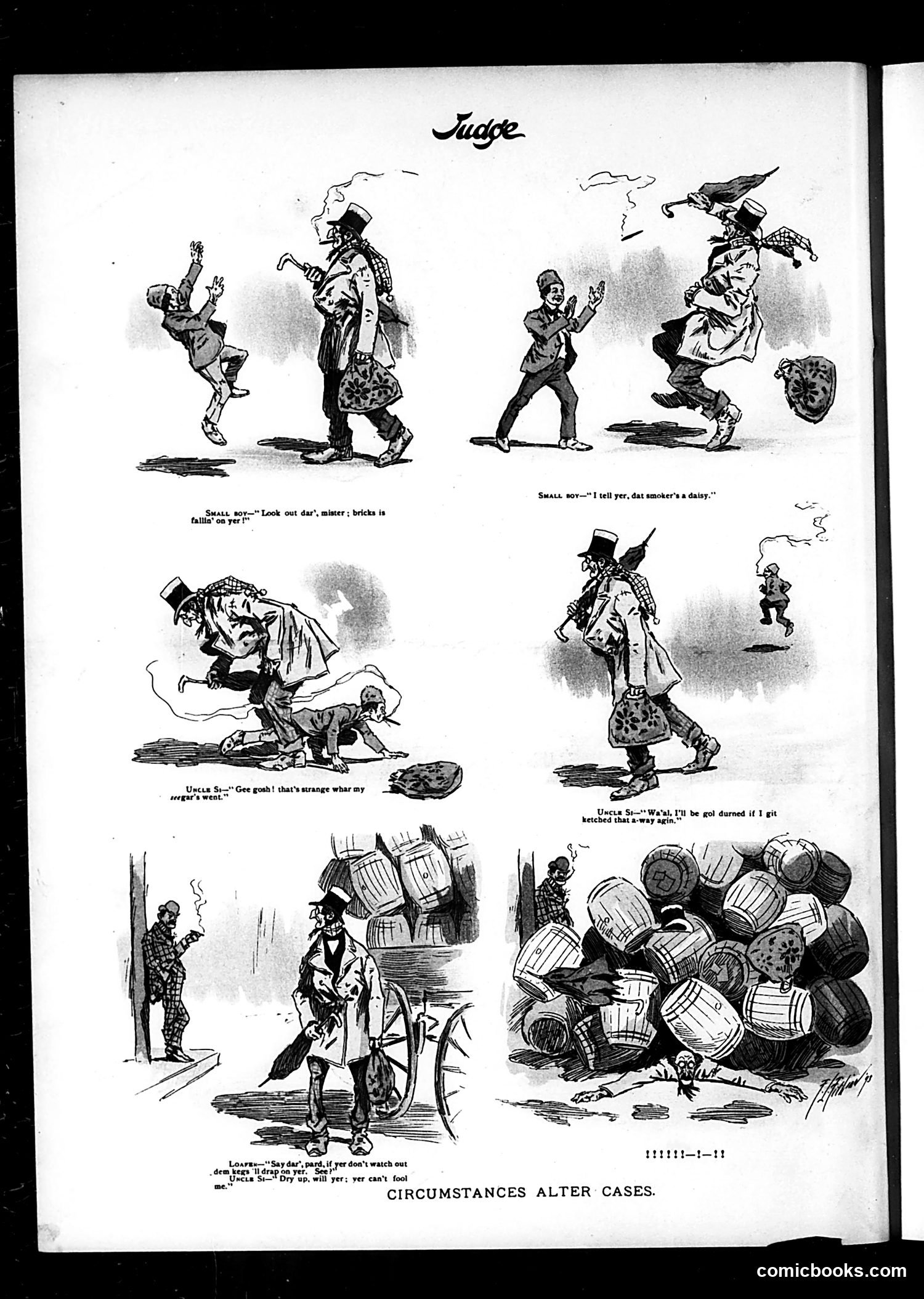
This Judge cartoon satirizes Irish immigrant stereotypes through dialect humor. The six panels depict "Small Boy" and "Uncle Si" (likely representing working-class Irish characters, evident from the phonetic dialect spelling: "dat," "yer," "gol durned") in various situations involving cigars, bricks, and barrels. The title "Circumstances Alter Cases" suggests the joke is that the same person changes their behavior or excuses depending on context. In one panel, Uncle Si blames a missing cigar on "strange" circumstances; in another, he's caught red-handed near barrels and makes excuses. The cartoon mocks working-class Irish men as dishonest opportunists who rationalize theft or misbehavior based on convenience. This reflects late 19th-century American prejudices common in publications like Judge, which frequently lampooned Irish immigrants as crude, dim-witted, and morally suspect.