
A complete issue · 16 pages · 1892
Judge — October 29, 1892
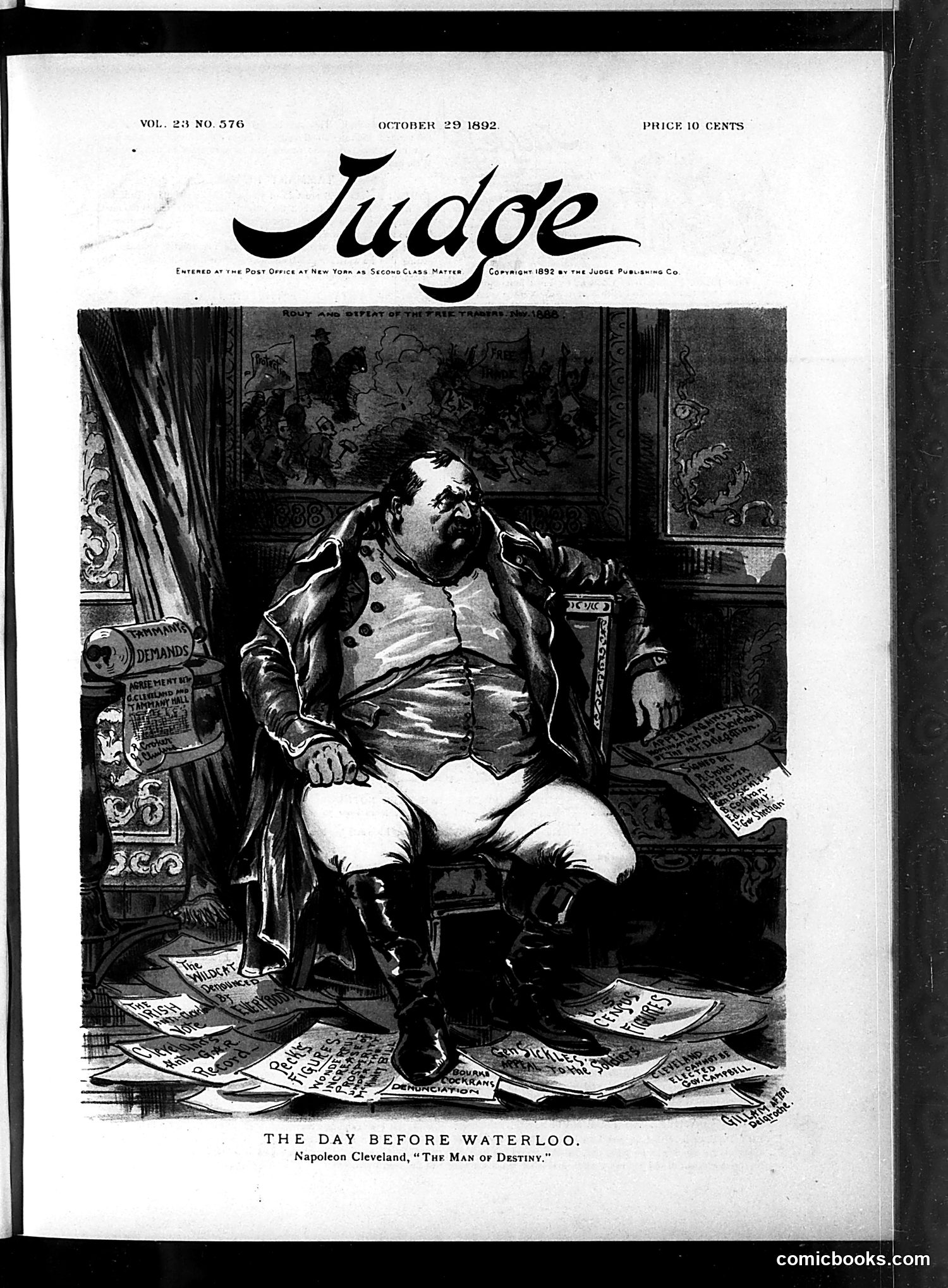
This political cartoon depicts a portly man labeled "Napoleon Cleveland" with the subtitle "The Man of Destiny." The figure sits surrounded by scattered papers and demands, appearing anxious or contemplative in an ornate interior. This is satirical commentary on President Grover Cleveland shortly before the 1892 election. The "Waterloo" reference suggests the cartoonist predicted his electoral defeat—Cleveland would indeed lose his re-election bid to Benjamin Harrison that November. The "Napoleon" comparison mocks Cleveland's perceived arrogance or grandiosity, while the scattered documents around him represent the various political pressures and crises facing his administration. The satire suggests Cleveland's political downfall was imminent.
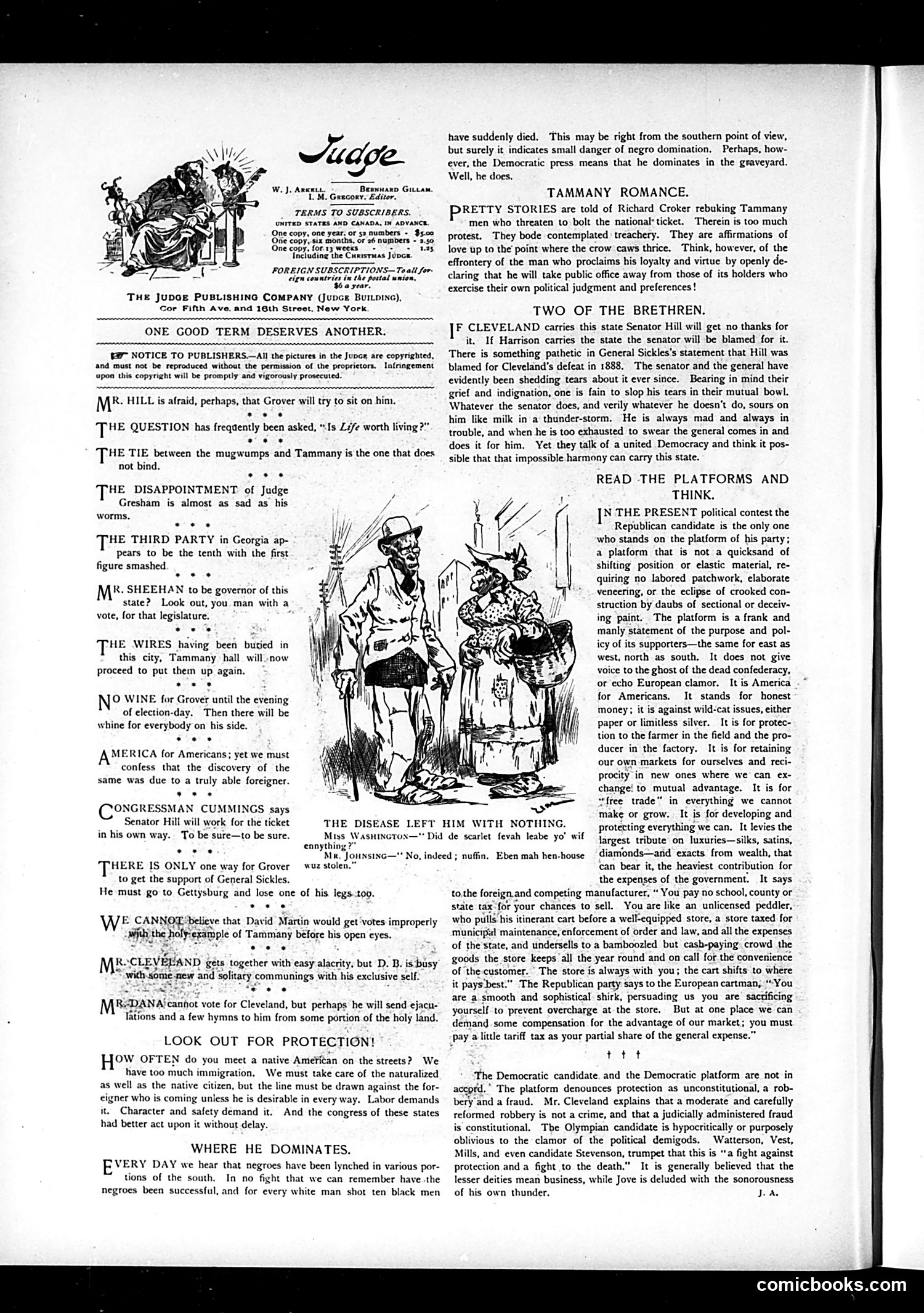
This page contains political commentary on the 1888 U.S. presidential election. The main cartoon depicts a figure labeled "THE DISEASE LEFT HIM WITH NOTHING" confronting what appears to be a beggar or poor person, likely satirizing Cleveland's economic policies or the effects of Democratic governance. The text discusses General Sackles, Senator Hill, and references to "Tammany" (the corrupt New York Democratic machine), critiquing Democratic candidates. The right column argues Republicans offer a coherent platform of protectionism and national development, while Democrats offer only patronage and corruption. The satire attacks Democratic economic management and corruption, positioning Republicans as the party of principled governance and prosperity. References to "negro domination" and racialized anxieties reflect the era's divisive political rhetoric.
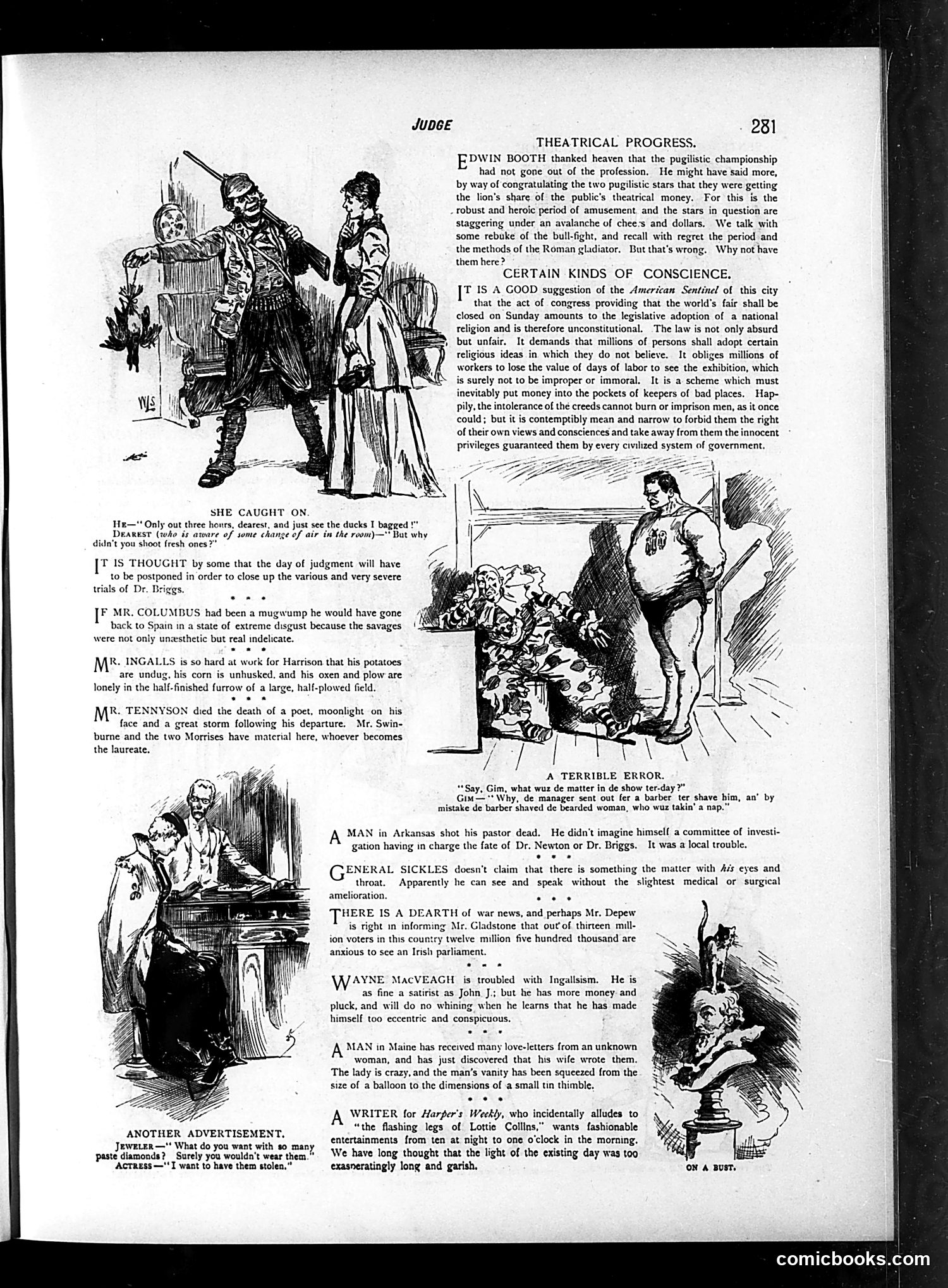
This page contains several short satirical items rather than a single unified cartoon: **"Theatrical Progress"** critiques Edwin Booth's congratulations to two pugilists (boxers), sarcastically noting that boxing has become more profitable than theater—a commentary on entertainment industry priorities. **"Certain Kinds of Conscience"** attacks proposed Sunday closing laws as unconstitutional overreach, arguing that forbidding religious observance violates citizens' rights. The remaining items are brief satirical notes about various figures and situations—a politician's agricultural troubles, a death, ingratitude among laureates—typical of Judge's miscellaneous gossip-style humor. The illustrations depict generic scenes of social interaction rather than specific identifiable figures, making them illustrative rather than targeted caricature work.
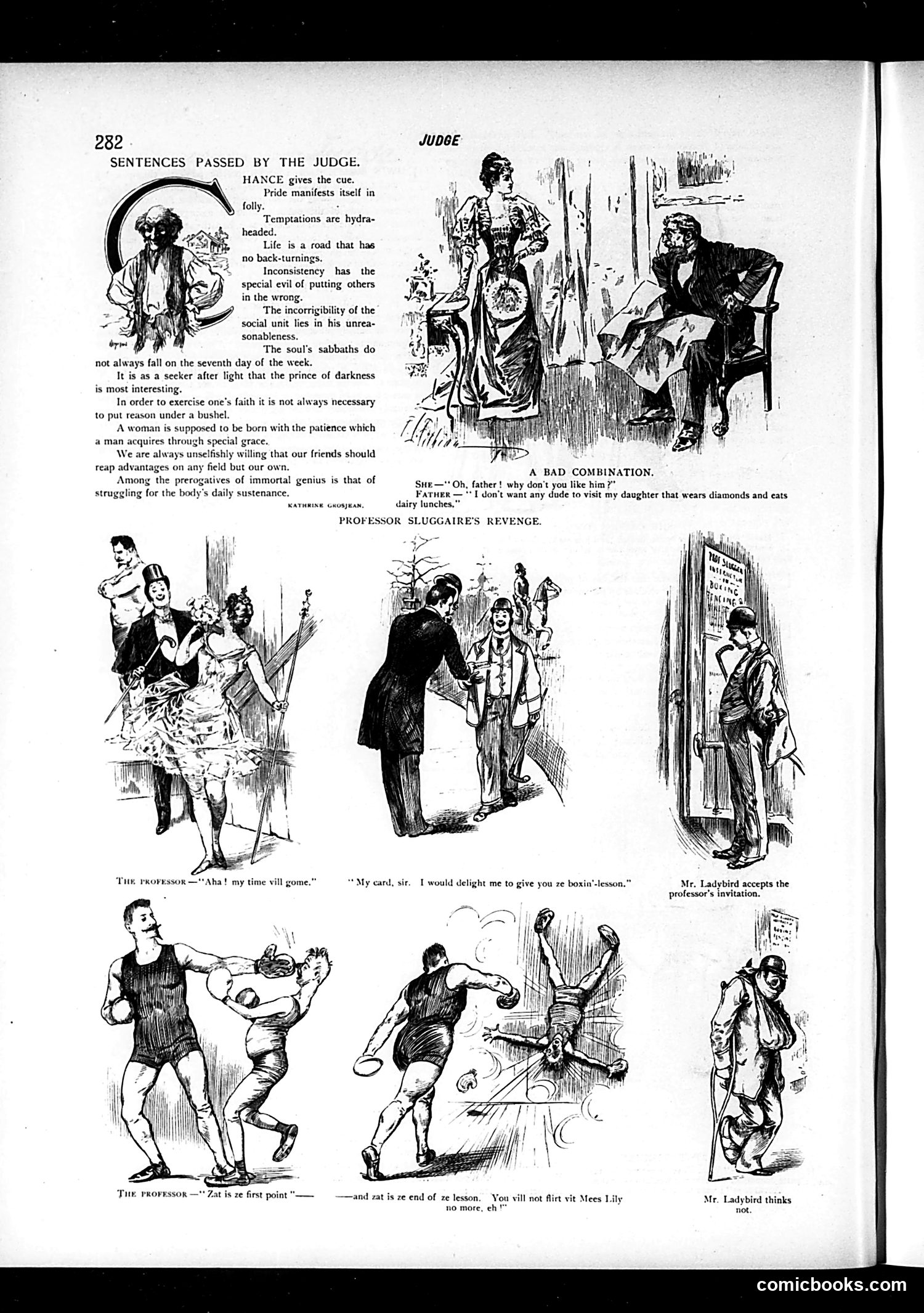
**Top Section:** "Sentences Passed by the Judge" presents moral aphorisms—philosophical observations on human nature (pride, temptation, inconsistency, etc.). These are presented as witty pronouncements, typical of Judge's editorial commentary. **"A Bad Combination":** A father rejects a suitor because he wears diamonds and frequents "dairy lunches"—a humorous class critique. The joke satirizes the inconsistency of snobbish parental standards: the father wants wealth (diamonds) but finds the suitor's casual dining habits unacceptable, conflating material status with respectability. **"Professor Sluggaire's Revenge":** A series depicting a boxing instructor extracting revenge on a man (Mr. Ladybird) who was flirting with his student (Miss Lily). The professor offers "boxing lessons" as a pretense, then systematically beats him. The captions use a comedic foreign accent. This is straightforward slapstick humor—physical comedy with romantic jealousy as the motivation. The page combines satirical social commentary with light physical humor typical of Judge's era.
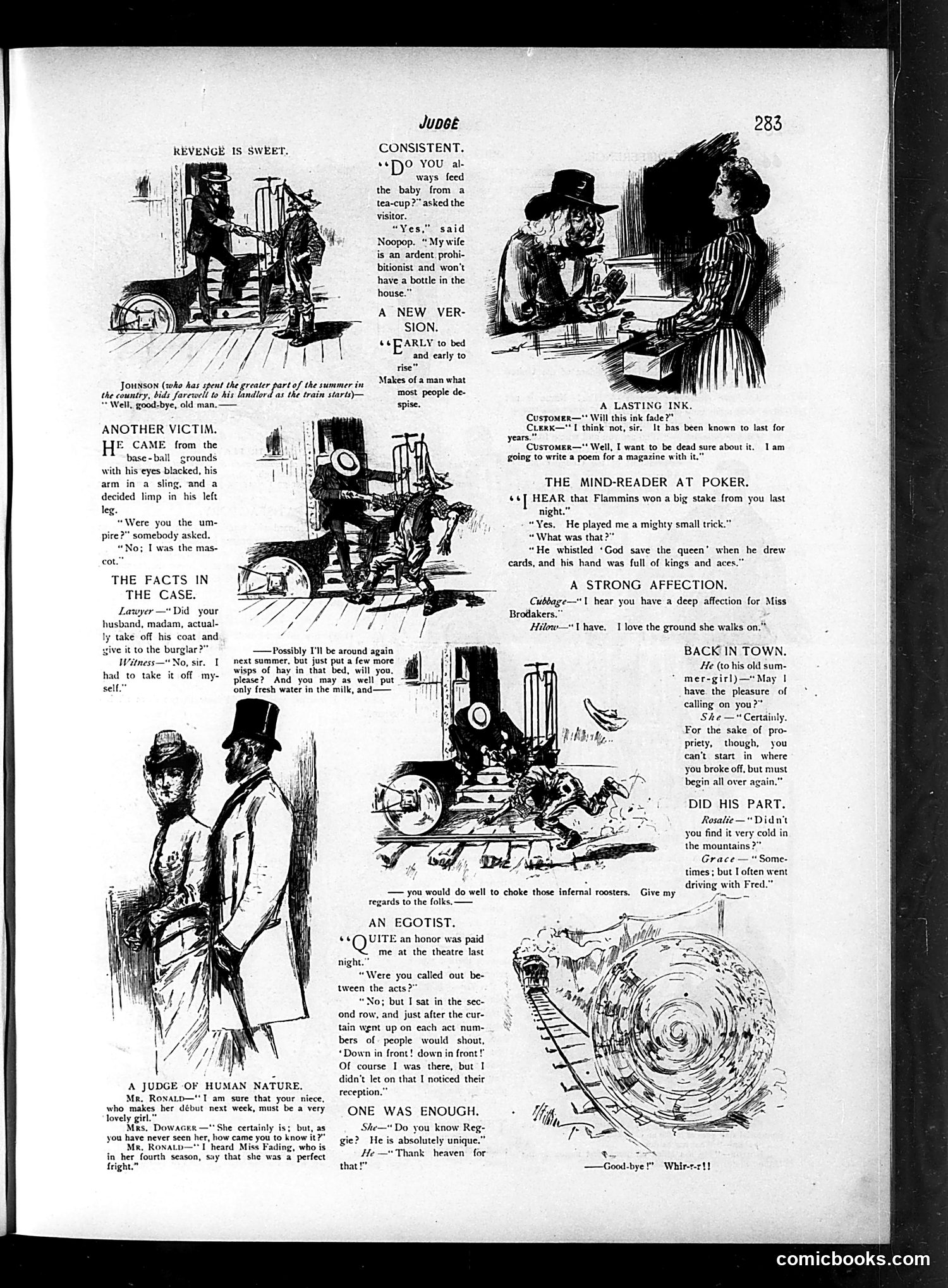
This page from *Judge* magazine collects brief comedic anecdotes and cartoons poking fun at American social conventions and human nature circa the early 20th century. Key jokes include: a prohibition-advocate father feeding his baby from a teacup rather than a bottle (satirizing rigid temperance ideology); a customer demanding ink that will "last" because he's writing poetry for a magazine (mocking pretentious writers); a mind-reader winning at poker by whistling "God Save the Queen" to distract opponents; and a theater-goer sitting in the front row, deliberately ignoring audience members shouting "Down in front!" (satirizing egotism). The cartoons use exaggerated facial features and physical comedy typical of the era. The humor targets social pretension, prohibition extremism, vanity, and absurd logic. Most jokes rely on wordplay or situational irony rather than political content—this page emphasizes entertainment over commentary on specific events or figures.
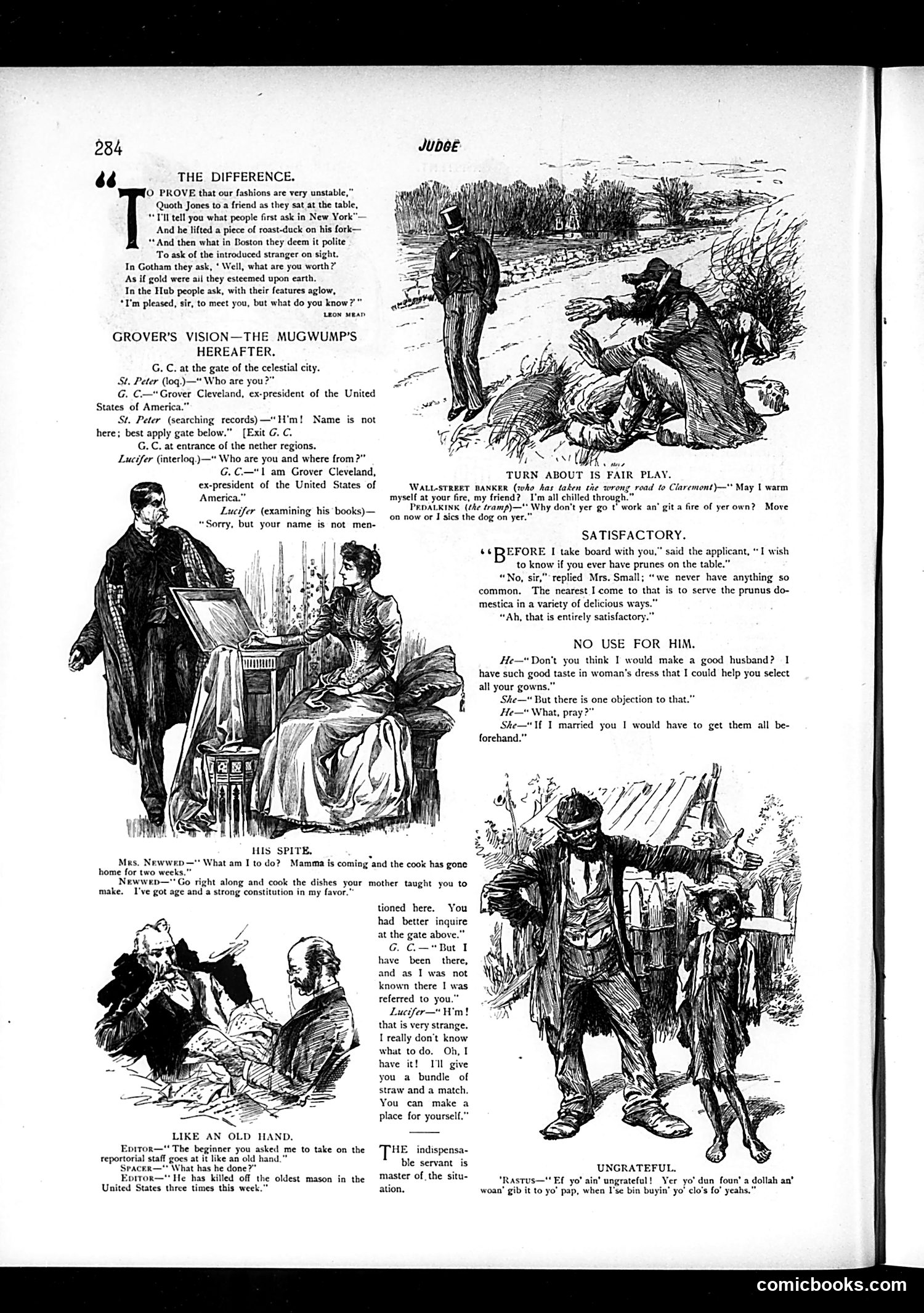
This page contains multiple satirical cartoons and jokes typical of late 19th-century American humor: **"Grover's Vision"** mocks ex-President Grover Cleveland (identifiable by name). The cartoon depicts Cleveland being rejected from heaven and sent to hell, where even the Devil finds him worthless—a harsh political attack suggesting Cleveland was corrupt or unfit for high office. **"Turn About is Fair Play"** reverses typical class relations: a Wall Street banker asks a tramp for fire, and the tramp lectures him about getting work—satirizing either economic hypocrisy or role reversals during economic hardship. The remaining items are genteel domestic humor: jokes about Boston vs. New York manners, a woman's satisfaction with expensive fruit preparations, marital doubts, and servant incompetence. These reflect period concerns about social pretension and gender roles. The cartoons employ caricature and visual gags typical of Judge's satirical approach, mixing political commentary with everyday social observation.
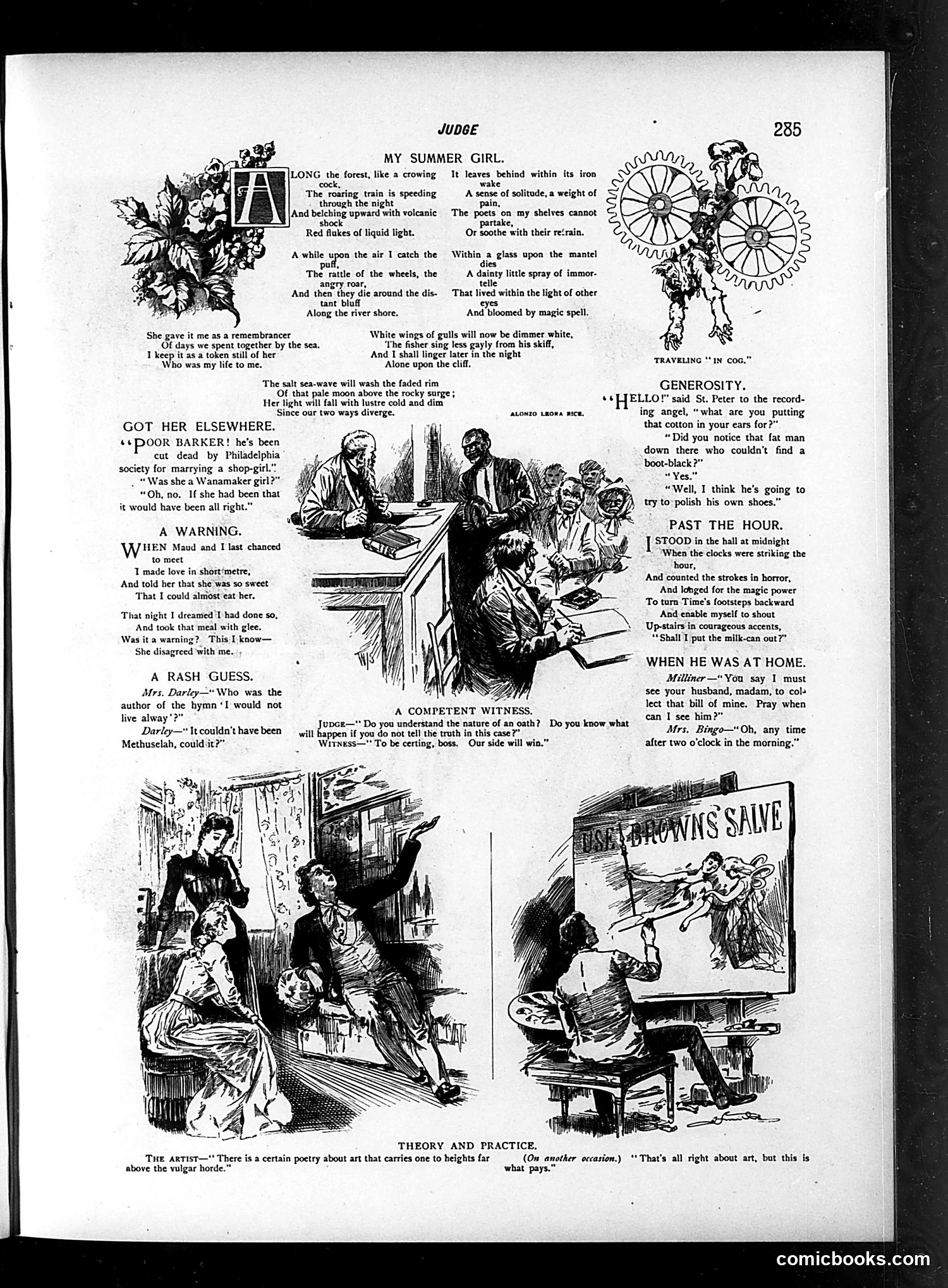
This page from *Judge* contains multiple unrelated short humorous pieces typical of the magazine's format. **"My Summer Girl"** is a sentimental poem about lost love, with the speaker keeping a memento from a seaside romance interrupted by the woman's departure by train. **Social satire pieces** mock class anxieties: "Got Her Elsewhere" jokes that a Philadelphia man's marriage to a shop-girl ruined his social standing—unless she'd worked at the prestigious Wanamaker department store, suggesting even "shop-girls" had hierarchies of respectability. **Comic anecdotes** include marital humor ("A Warning," "When He Was at Home") and courtroom satire ("A Competent Witness"), where a witness assumes his side will win regardless of truth-telling. **"Theory and Practice"** contrasts an artist's pretentious claims about art's nobility with the reality that commercial success ("what pays") matters more. **"Generosity"** presents heavenly irony: an angel expects a generous act (a poor man polishing his own shoes) worthy of attention. The page reflects early 20th-century concerns: class mobility, marital discord, and the gap between ideals and reality.
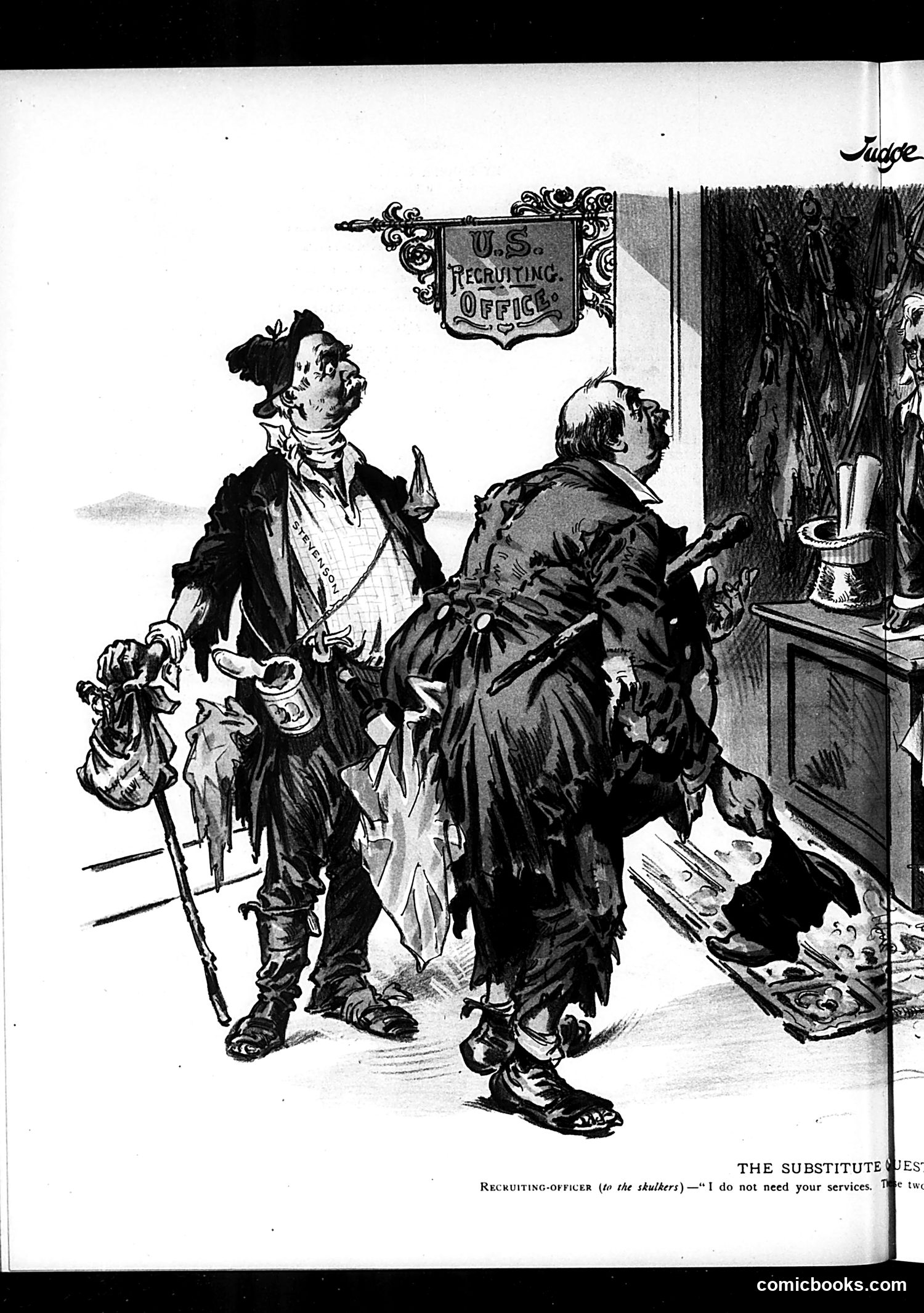
This Judge magazine cartoon satirizes Civil War-era draft evasion. A U.S. Recruiting Officer stands at his office rejecting a disreputable, poorly-dressed man offering his services as a substitute soldier. The joke targets "shulkers" (draft dodgers who hid to avoid military service) and the practice of hiring substitutes to serve in one's place—a loophole available to wealthier men. The recruiting officer's disdain suggests even he has standards; this substitute is so deplorable that he's unusable. The satire criticizes both the draft-avoidance system and those desperate enough to exploit it. The cartoonist mocks the absurdity of allowing wealthy citizens to purchase exemptions while poorer men either fought or became disreputable substitutes.
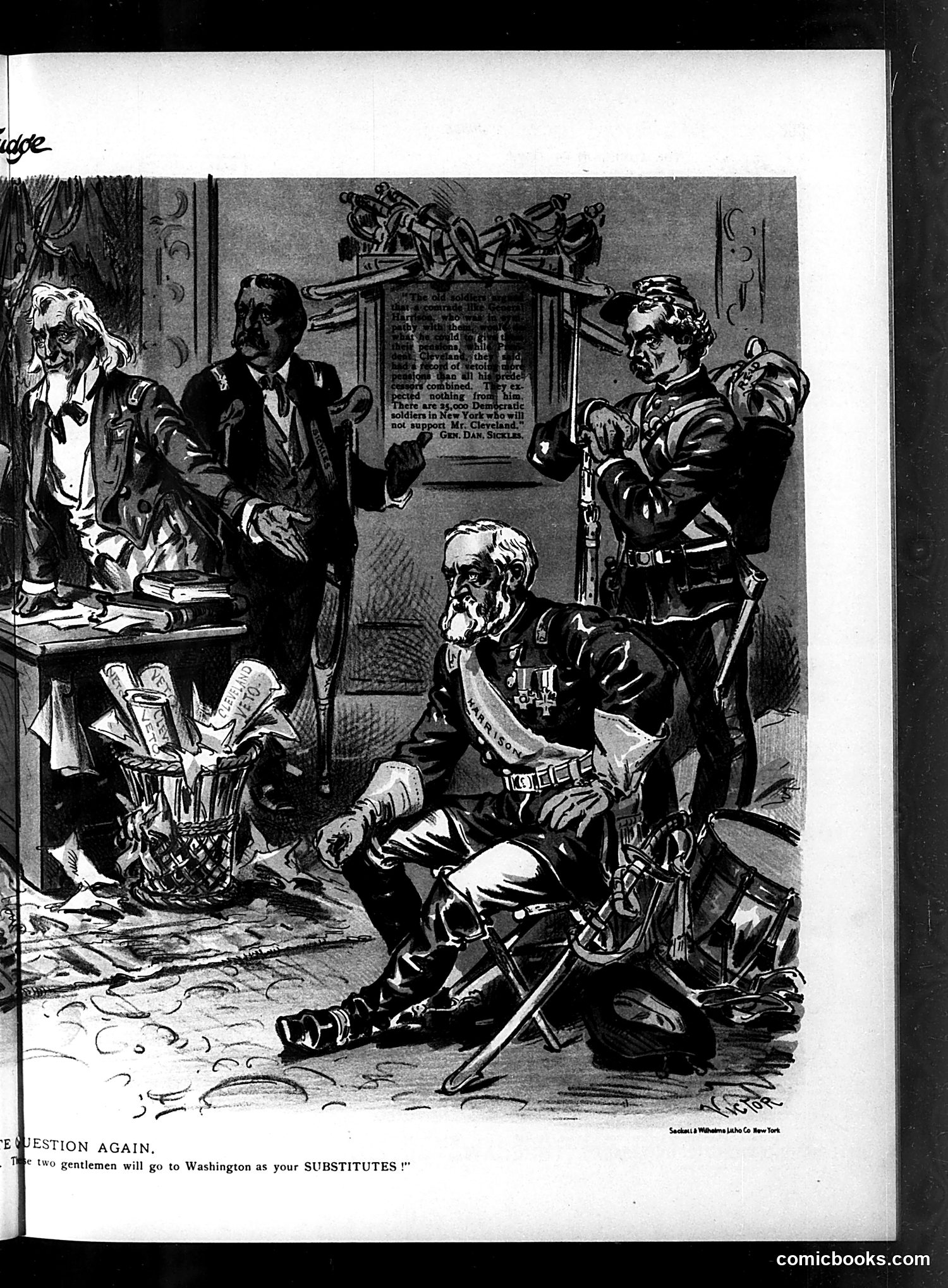
This cartoon depicts a military or diplomatic scene where a seated dignitary (likely a general or high official, identifiable by his uniform and medals) is being confronted by three standing figures in formal dress. The seated figure appears to be rejecting a proposal, as indicated by the caption's reference to "substitutes" going to Washington. The satire critiques what appears to be a political arrangement or backroom deal—the implication being that someone is trying to send replacements to handle official business rather than attending personally. The formal military setting and the figures' body language suggest this involves questions of duty, authority, or political maneuvering. Without clearer identification of the specific figures or visible date, the exact political context remains unclear, though the cartoon clearly mocks some form of political evasion or shirking of responsibility through substitution.
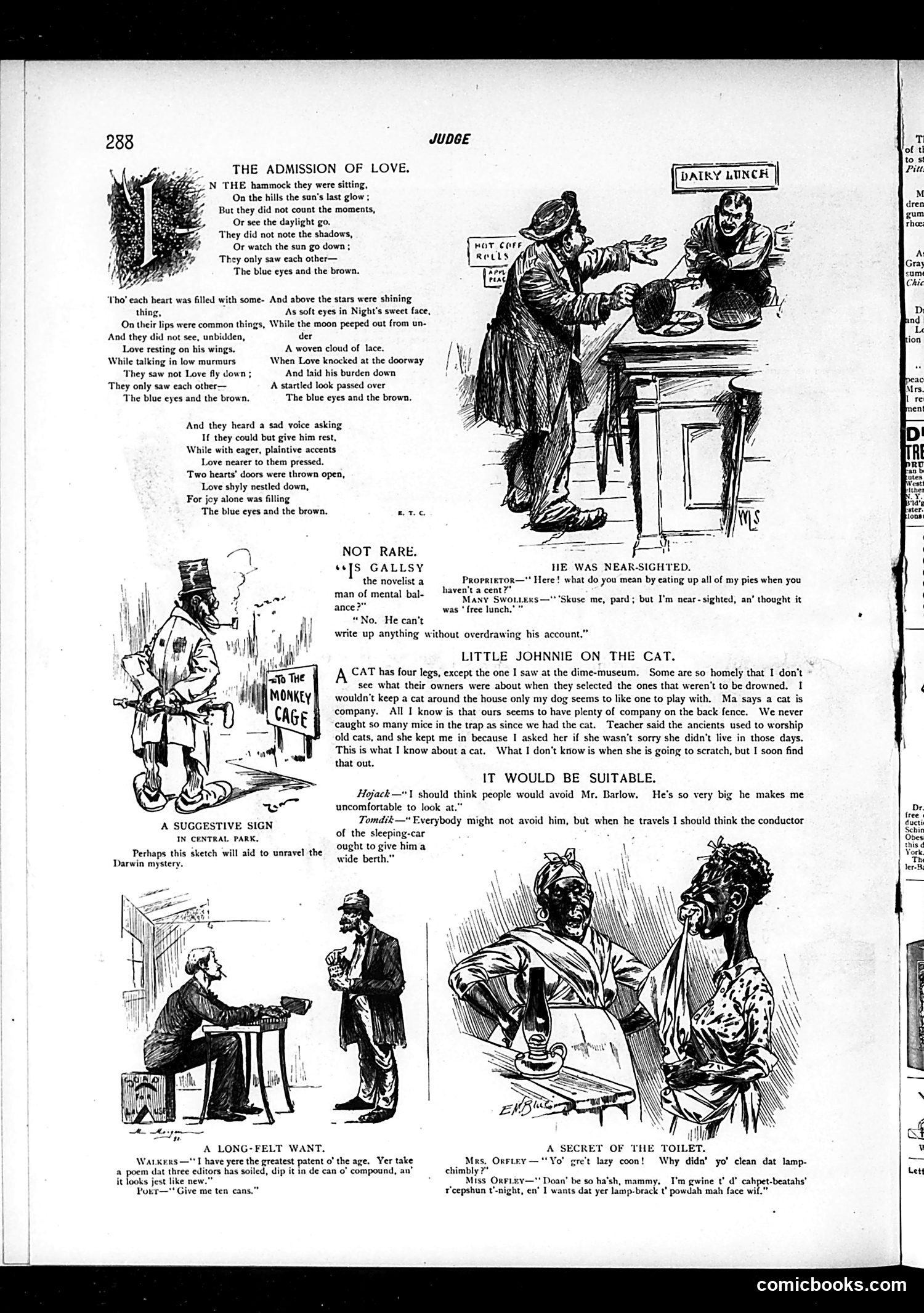
This page contains several brief satirical sketches and a romantic poem typical of late 19th-century American humor: **"The Admission of Love"** is a sentimental poem about young lovers in a hammock, repeated emphasis on "blue eyes and brown" showing romantic preoccupation. **"Not Rare"** jokes that novelist Gallsy lacks mental balance—a dig at a contemporary literary figure (identity unclear from context alone). **"A Suggestive Sign"** appears to reference Darwin's evolution theory through a park sketch, likely satirizing public debate over Darwinism. **"A Long-Felt Want"** mocks editors rejecting poetry by showing an invention to restore rejected poems to "new" condition—satirizing editorial gatekeeping. **"He Was Near-Sighted"** is a simple pun: a vagrant ate free lunch pies, claiming he mistook them for actual "free lunch" offerings. **"Little Johnnie"** presents a child's observations about cats with mild irreverence (the teacher punishment joke about ancient cat worship). **"It Would Be Suitable"** jokes that an uncomfortable large man (Barlow) should ride in a sleeping car. **"Secret of the Toilet"** uses dialect humor between Black domestic workers about using lamp soot as face powder—reflecting period minstrelsy conventions.
This page is primarily **advertising**, with minimal editorial or satirical content. The advertisements showcase consumer goods typical of the 1890s: whiskey, tobacco, patent medicines (Castoria, cough syrup), cologne, and watches. The only identifiable satirical content appears in brief jokes interspersed among ads: - A quip about a coroner newly elected with "no practice yet," suggesting incompetence in political appointees - References to Cleveland-era politics (mention of "ex-Governor Gray") - A joke about multiple marriages, mocking the frequency of divorce The page reflects **late-19th-century advertising culture** and concerns: obesity treatments, alcohol, tobacco products sold without regulation, and patent medicines making dubious health claims. These ads would be banned or heavily regulated by modern standards. The satirical commentary is minimal here; Judge's primary function on this page appears commercial rather than political.
This page is primarily a collection of advertisements with no clear political cartoons or satirical commentary visible. The layout resembles a typical magazine advertisement section from the early 1900s, featuring various consumer products and services: railroads (Burlington Route), beverages (Cook's Imperial Champagne), medicines (Beecham's Pills for liver disorders), furniture, bicycles, and breakfast cereals. There is one mild satirical joke about an Irishman remarking that unhappy New Yorkers are those who don't live there—a standard period humor type. Otherwise, the content consists of testimonials and product pitches reflecting turn-of-the-century commercial culture, with emphasis on patent medicines and household goods. No identifiable political figures or social commentary requiring historical context appears on this page.
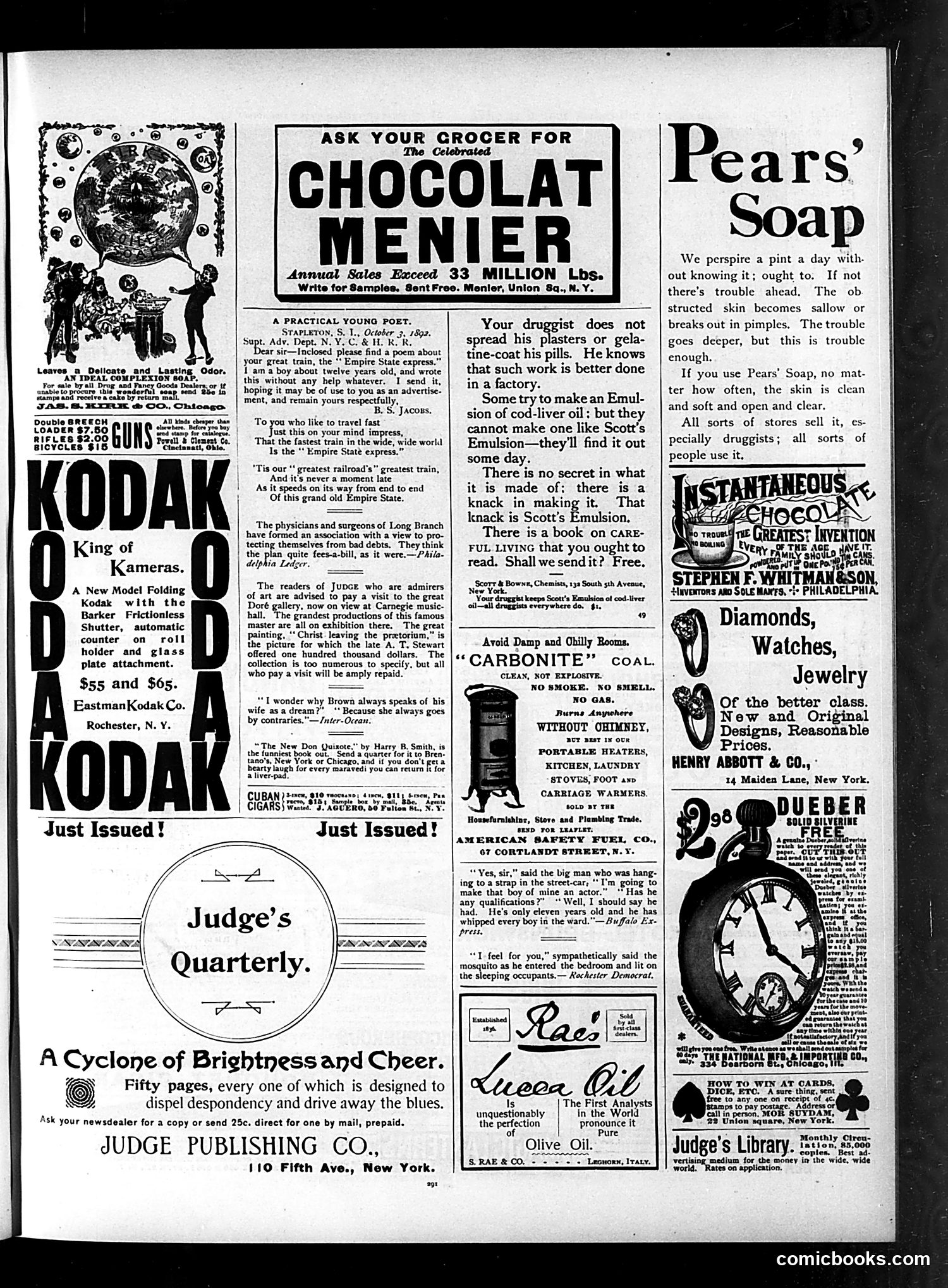
This page is primarily **advertising with minimal editorial cartoons**. The main content consists of period advertisements (Kodak cameras, Chocolat Menier, Pears' Soap, jewelry, heating stoves) interspersed with brief humorous anecdotes rather than political satire. The few notable items: **"A Practical Young Poet"** presents a child's earnest poem about the "Empire State Express" train—likely satirizing both the railroad's self-promotion and the saccharine sentimentality of Victorian-era advertising copy disguised as genuine correspondence. **Scattered jokes** mock minor social pretensions (doctors forming debt-collection associations, wives compared to dreams) in the tradition of light social humor. The page reflects Judge's typical late-19th-century format: a mix of paid advertisements subsidizing satirical content. The satire here is gentle and commercial rather than political—targeting everyday consumer culture rather than major social or political issues.
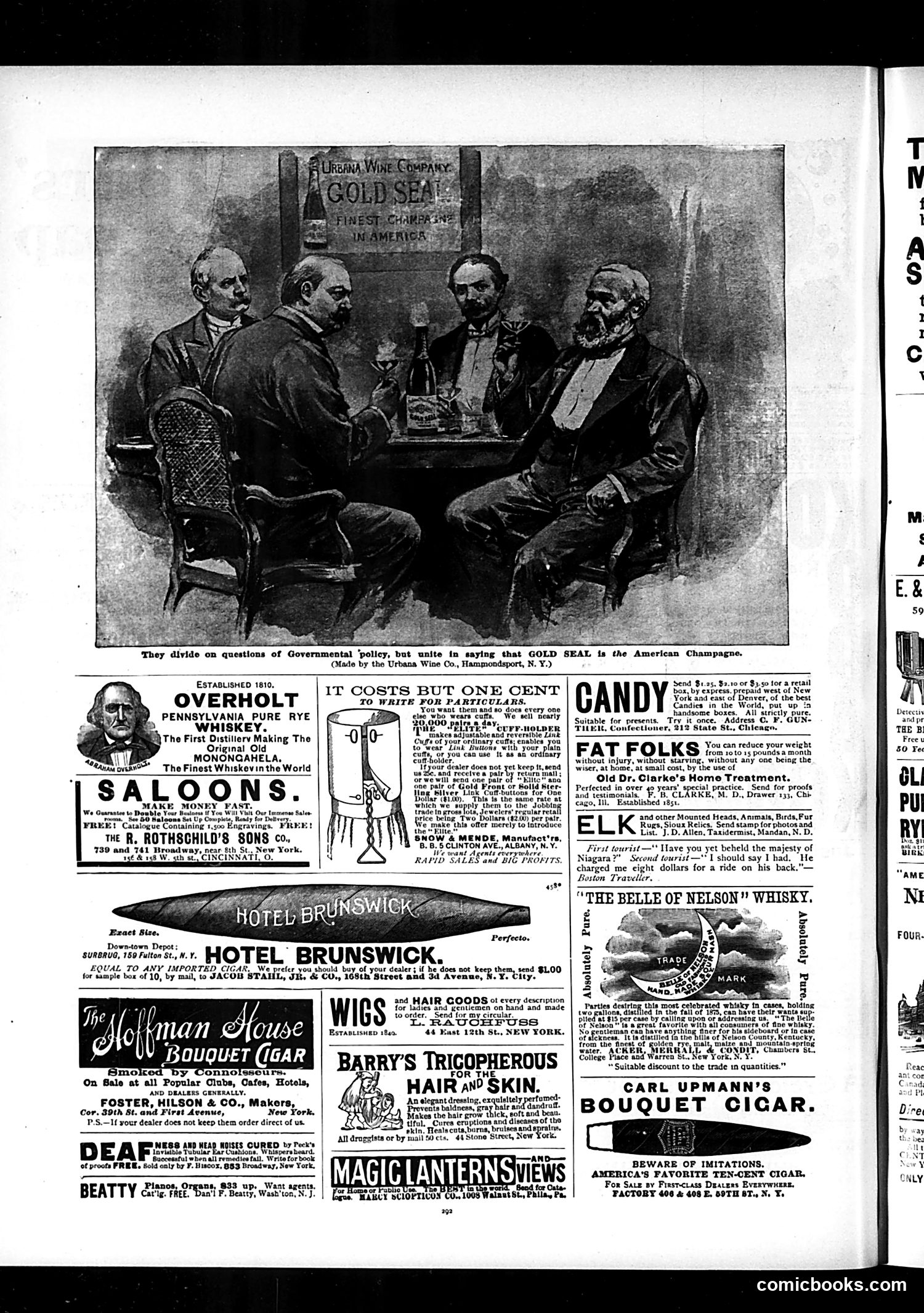
This page is primarily **advertisements** with one political cartoon at the top. ## The Main Cartoon The illustration shows four men in formal dress seated around a table with a bottle of "Gold Seal" champagne, beneath a sign reading "URBANA WINE COMPANY." The caption states they "divide on questions of Governmental policy, but unite in saying that GOLD SEAL is the American Champagne." **The satire:** This appears to reference deep political divisions of the era (likely 1880s-90s based on Judge's publication history), suggesting that despite partisan disagreements, all sides agree on this product's quality. The specific politicians depicted are unclear from the image alone, but the joke emphasizes bipartisan agreement on commercial excellence as a rare consensus point. The remainder of the page consists of period product advertisements (whiskey, cigars, hair treatments, dental cushions, etc.), typical of Judge magazine's revenue model. These ads reflect late-19th-century commercial culture and consumer products.
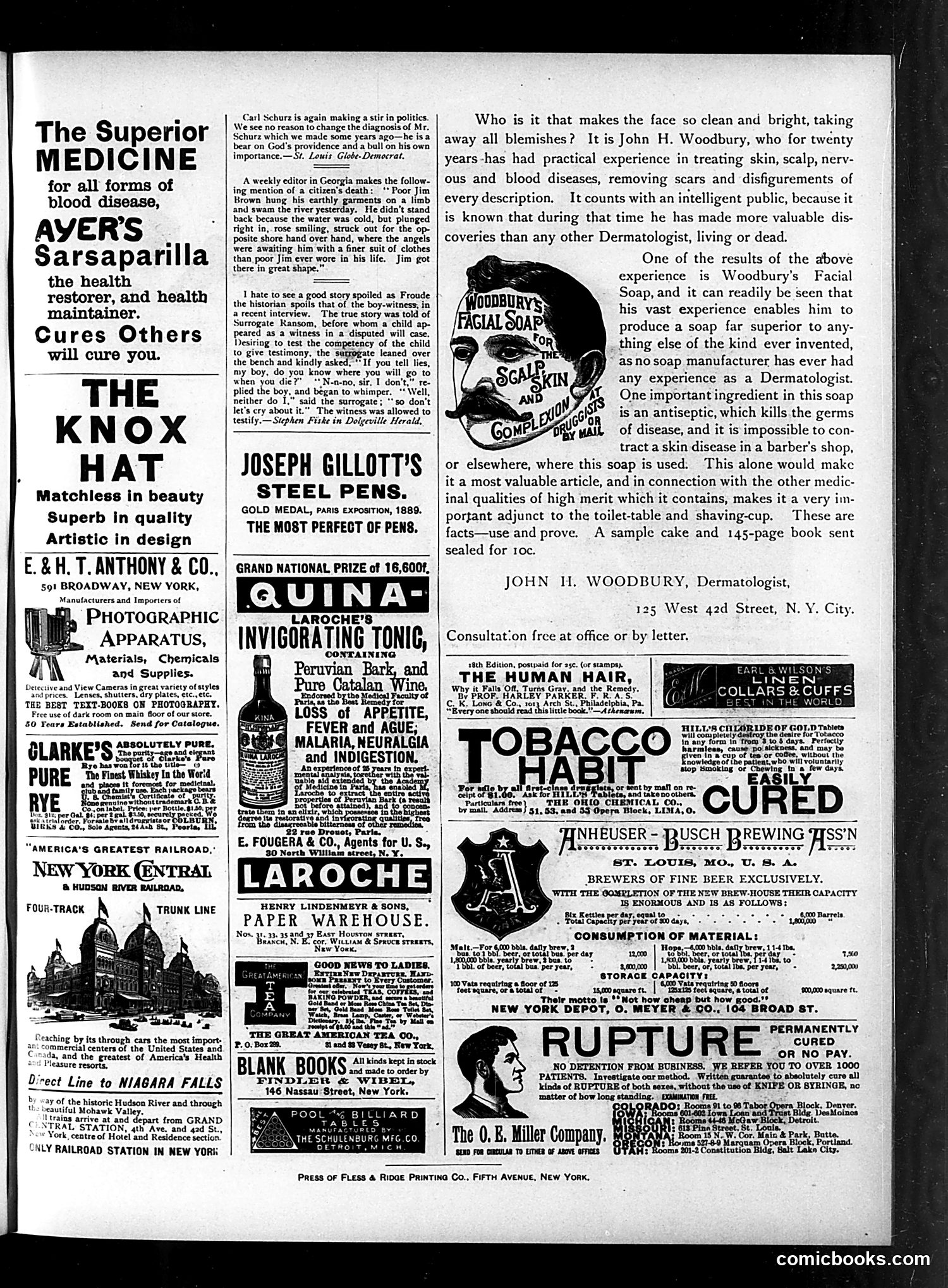
This page is primarily **advertisements** with minimal editorial content. The notable text items are brief anecdotes rather than political cartoons: **Political Reference**: A short quoted criticism of Carl Schurz, a prominent German-American politician and intellectual. The St. Louis Globe-Democrat sarcastically describes him as "a bear on God's providence and a bull on his own importance"—meaning Schurz doubts divine providence while overestimating his own significance. This reflects late 19th-century debates about Schurz's influence in Republican politics. **Other Content**: Two humorous anecdotes about death and child testimony, neither politically significant. **Advertising**: The page is dominated by ads for patent medicines (Ayer's Sarsaparilla, Quina-Laroche tonic), railroad services, steel pens, and other products typical of 1890s magazines. Woodbury's Facial Soap receives prominent space with a dermatologist endorsement. **No Political Cartoons Visible**: Despite Judge's satirical reputation, this particular page contains no illustrated political commentary or caricatures.
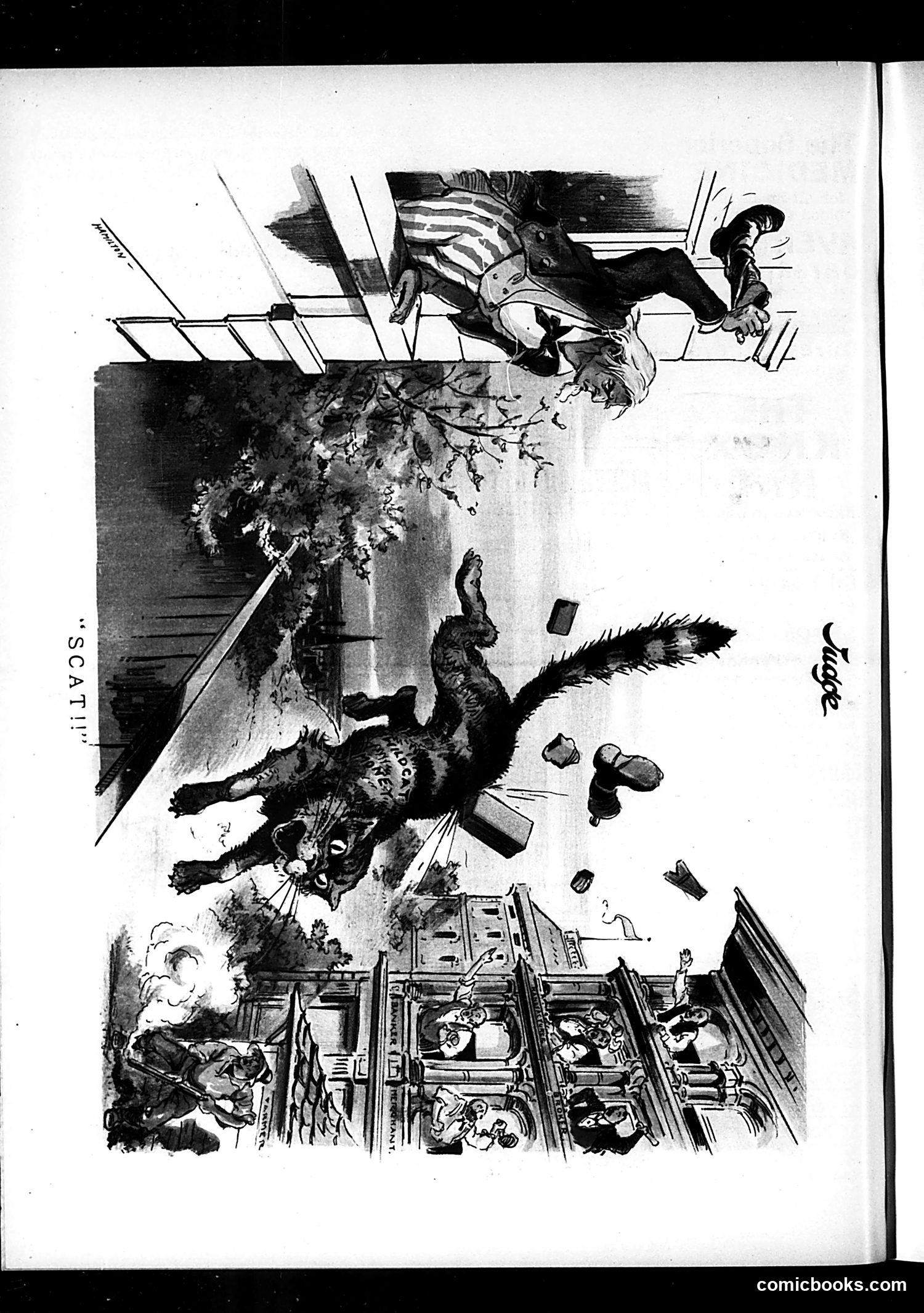
This appears to be a satirical illustration from *Judge* magazine showing a chaotic domestic scene. The image depicts what seems to be a violent domestic dispute, with figures engaged in physical conflict amid overturned furniture and household items scattered about. A woman appears to be falling or being thrown, while a man is shown in an aggressive posture. Below, additional figures observe from what appears to be a street or lower level. The specific political or social commentary is unclear without additional context or visible text. The illustration likely satirizes contemporary social issues—possibly marital discord, class conflict, or public behavior—common subjects for *Judge's* satirical commentary. However, without clearer identifying details or accompanying article text, the precise target and point of the satire cannot be definitively determined from the image alone.