
A complete issue · 16 pages · 1892
Judge — October 15, 1892
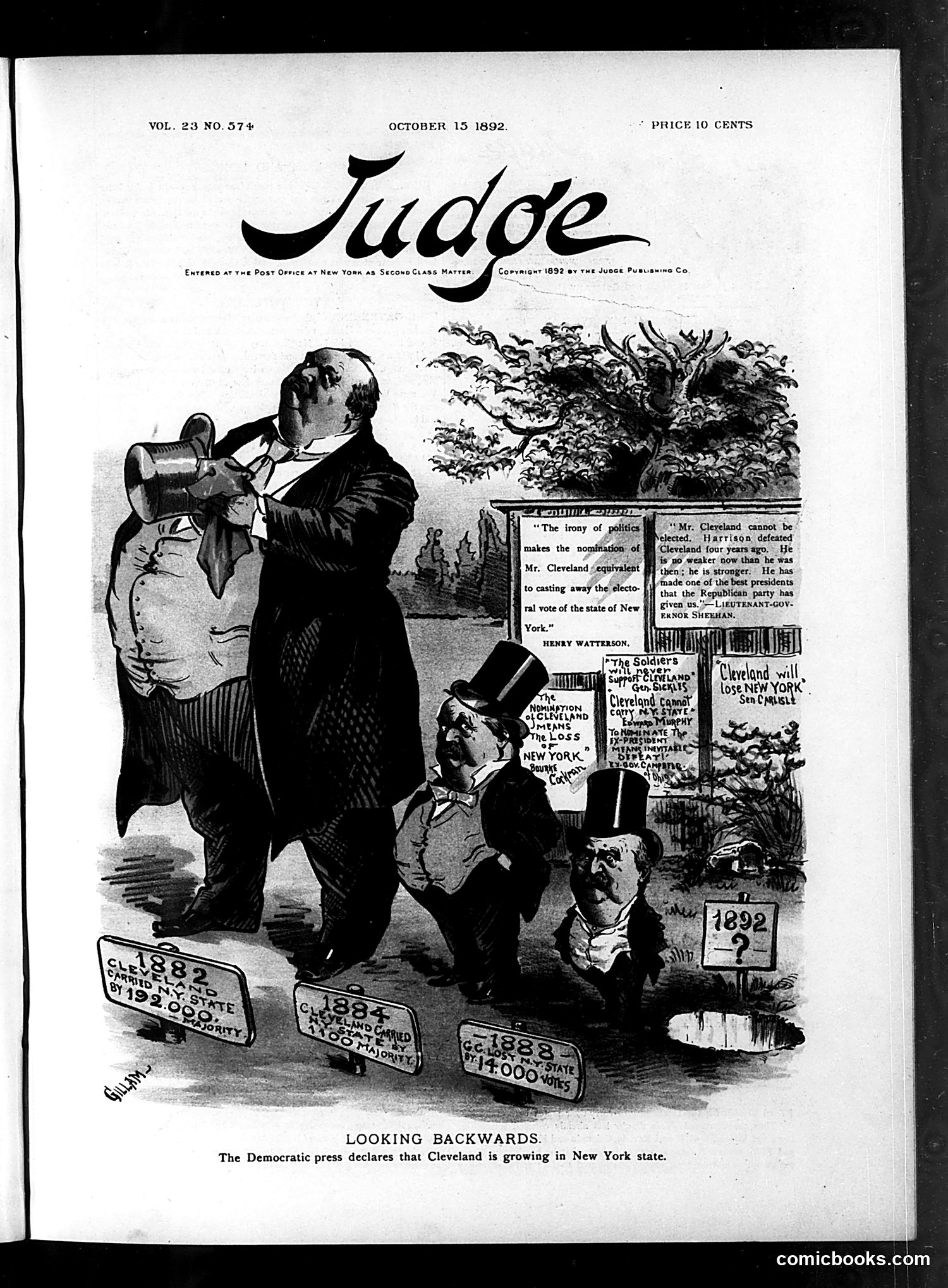
This political cartoon satirizes Democratic claims that President Cleveland is gaining support in New York state. The central figure with a megaphone announces Cleveland's supposed growth, while smaller caricatured figures below represent past electoral defeats (marked 1882, 1884, 1888) with grave markers showing increasingly large vote losses. The satire's point: Cleveland's campaign rhetoric about political momentum contradicts the historical record of his declining performance. The "looking backwards" title and cemetery imagery mock Democratic optimism by literally showing Cleveland's buried electoral history. The cartoon critiques election-year propaganda, suggesting Democrats are ignoring documented losses to promote a false narrative of resurgence. The text emphasizes this ironic disconnect between claimed progress and actual precedent.
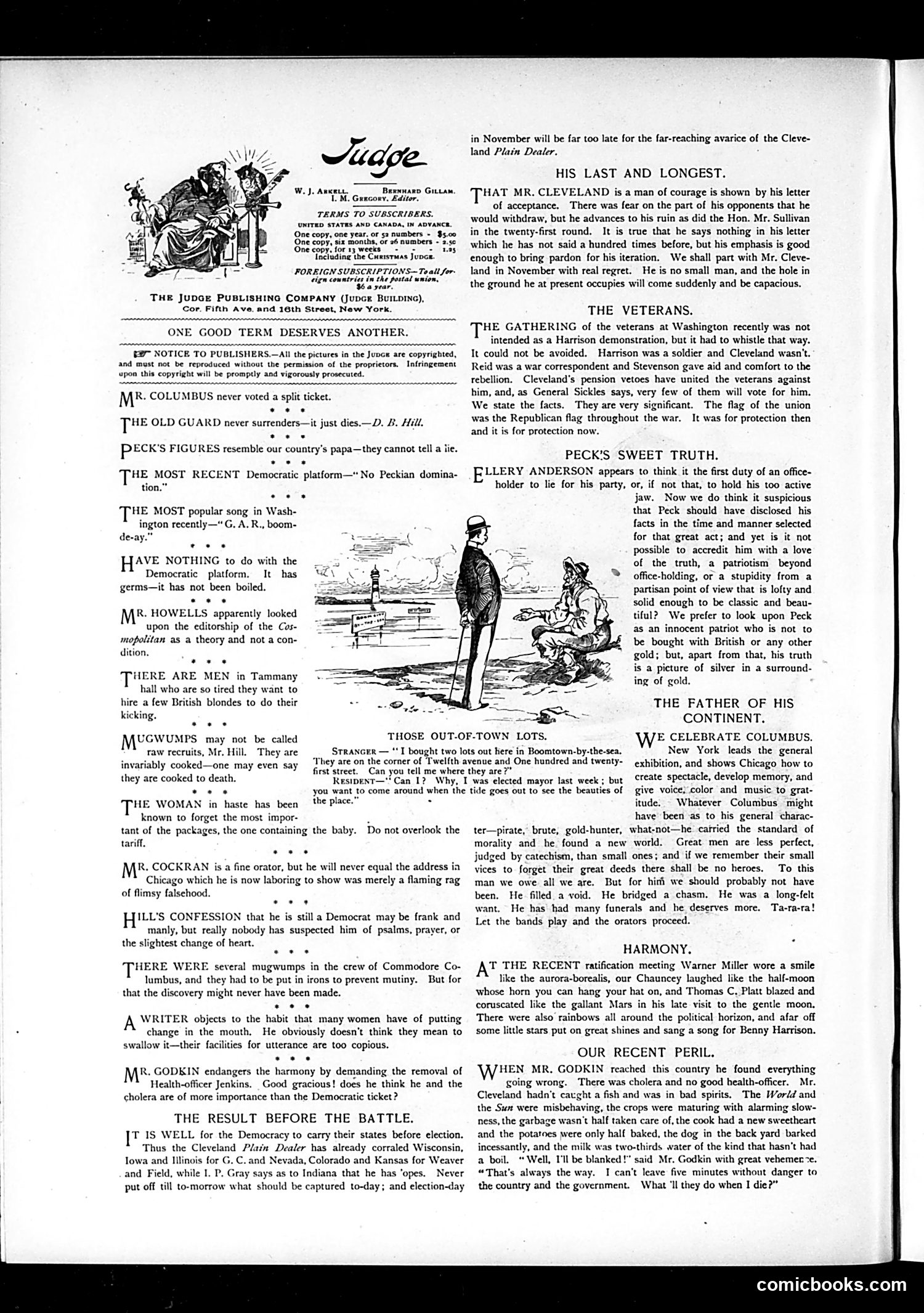
The main cartoon titled "Those Out-of-Town Lots" depicts a well-dressed stranger pitching worthless real estate to a naive buyer near the water. The stranger claims the lots are "on the corner of Twelfth avenue and One hundred and twenty-first street" in what appears to be Manhattan, encouraging the buyer to visit "when the tide goes out to see the beauties of the place." The satire targets **land fraud schemes** common in the Gilded Age, where con artists sold swampy, unusable, or underwater property to gullible investors by misrepresenting its value and location. The implication that the land is underwater (visible "when the tide goes out") exposes the scam: the lots are essentially worthless, yet the smooth-talking swindler markets them as desirable real estate.
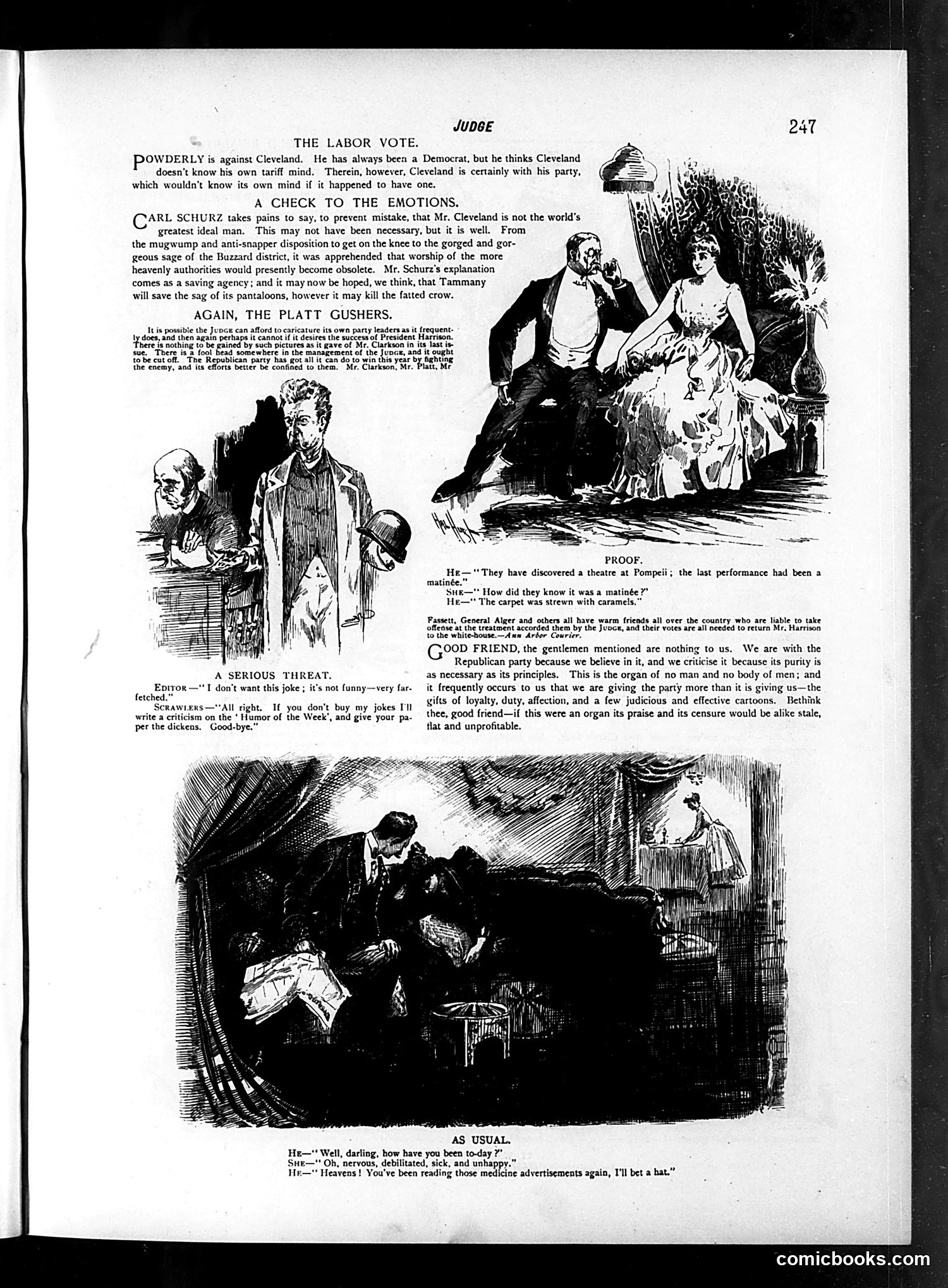
This page contains political commentary attacking President Cleveland's tariff policies and Democratic leadership. **"The Labor Vote"** section criticizes Cleveland for inconsistency on tariffs, suggesting he doesn't understand his own party's positions. **"A Check to the Emotions"** references Carl Schurz's defense of Cleveland, calling it a "saving agency" against idol-worship of political leaders—cautioning against blind loyalty. **"Again, The Platt Gushers"** appears to mock Democratic figures (likely including Senator Platt) over management disputes, suggesting their conflicts benefit Republicans. **"A Serious Threat"** presents an editor-scrambler exchange as a joke about criticism. **"A Good Friend"** argues the Republican party, though imperfect, provides necessary organization and loyalty—preferable to Democratic chaos. The overall message: Democrats are disorganized; Republicans offer stability.
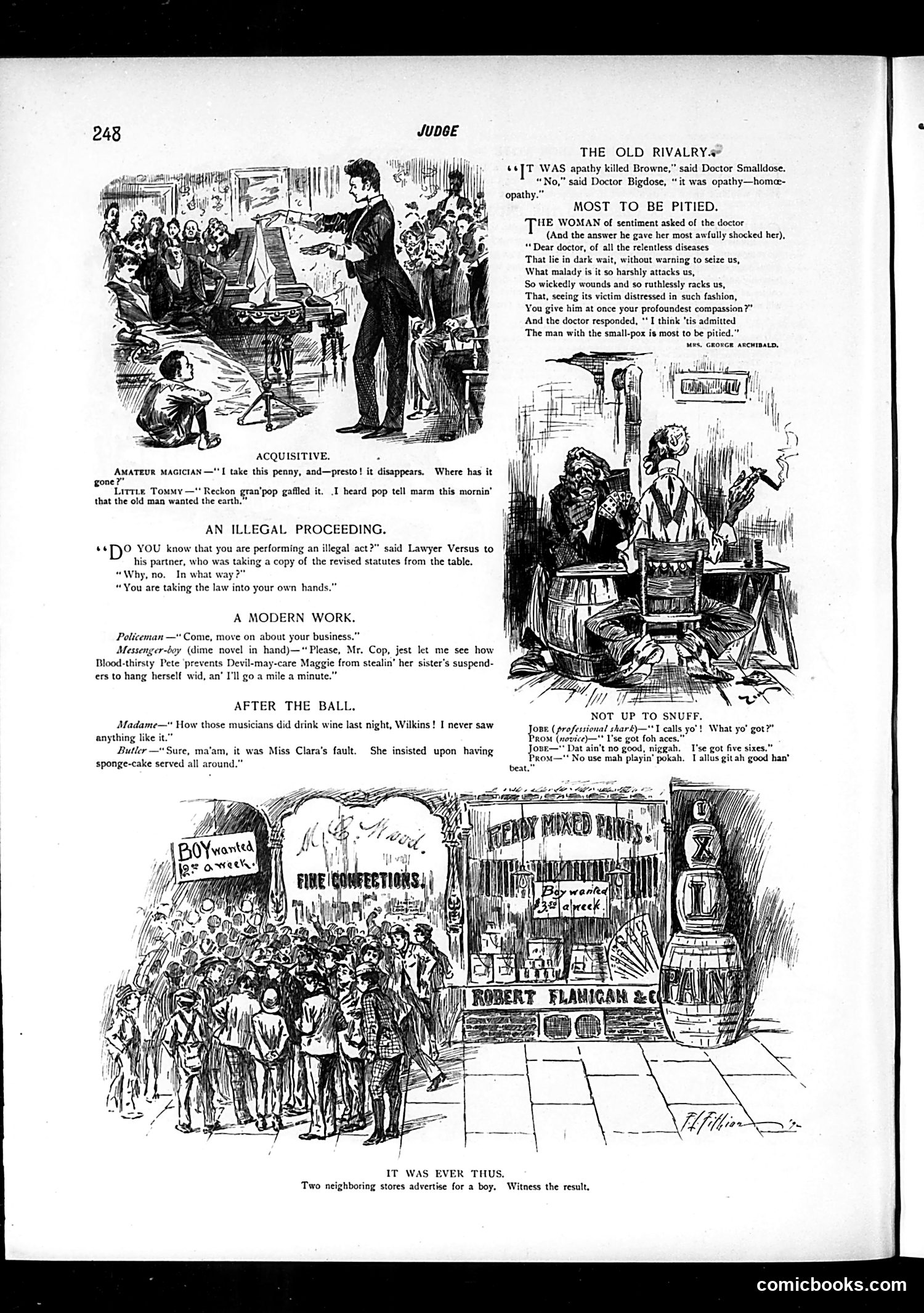
This page contains multiple satirical sketches typical of late-19th-century American humor: **"The Old Rivalry"** mocks competing medical philosophies—"allopathy" (conventional medicine) versus "homeopathy" (alternative treatment using diluted substances). The joke presents doctors Smalldose and Bigdose arguing over which approach killed a patient named Browne. **"Most to Be Pitied"** is a sentimental poem where a compassionate woman asks a doctor which disease deserves most sympathy. The ironic answer: smallpox—a common, devastating affliction of the era. **Other brief sketches** satirize everyday absurdities: a child stealing a magician's "disappearing penny," lawyers joking about taking "the law into your own hands," a messenger boy distracted by dime novels, and intoxicated musicians. **"It Was Ever Thus"** depicts competing storefronts advertising for a boy—resulting in a crowded mob of applicants, satirizing competitive business practices. The page emphasizes working-class life, professional pretension, and social ironies through accessible, visual humor aimed at Judge's middle-class readership.
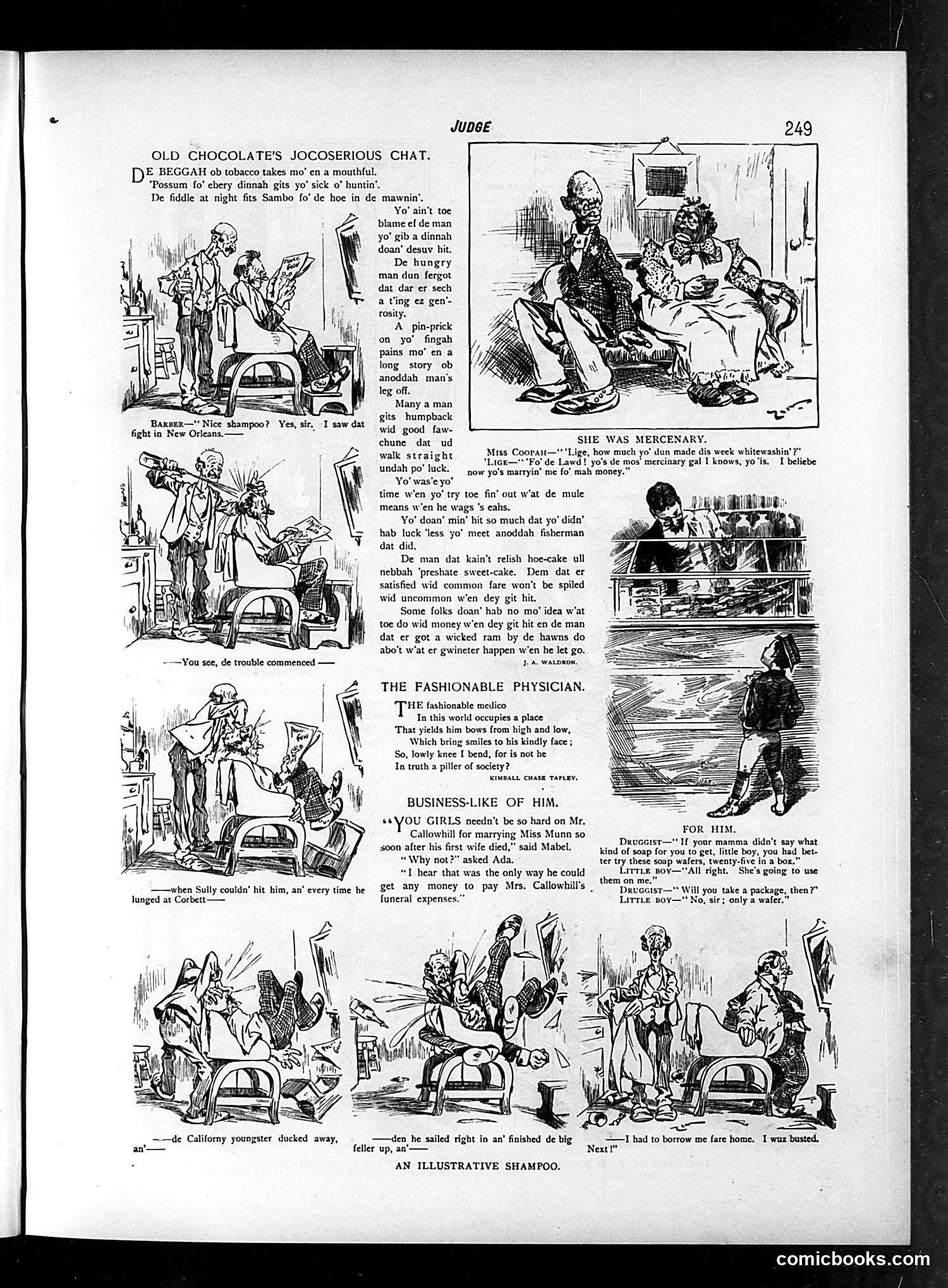
This page contains several satirical pieces typical of late 19th-century American humor: **"Old Chocolate's Jocoserious Chat"** features dialect humor presenting African American folk wisdom in exaggerated plantation speech. The character dispenses homespun philosophy about poverty, resilience, and human nature—a common (though now offensive) format of the era. **"The Fashionable Physician"** mocks wealthy doctors as pillars of society who primarily serve the elite, satirizing class-based medical practice. **"Business-Like of Him"** jokes darkly about a widower marrying quickly to pay his first wife's funeral expenses—commenting on economic desperation among the working class. **"She Was Mercenary"** uses dialect humor to satirize materialism in courtship, with a woman accused of marrying for money. **"An Illustrative Shampoo"** depicts barber-shop gossip, with a fight story (possibly the Corbett-Sullivan boxing match) interrupting a haircut. The page reflects Gilded Age attitudes: class mockery, racial caricature through dialect, and cynicism about marriage and social climbing. The art style is typical 1890s woodcut-style illustration.
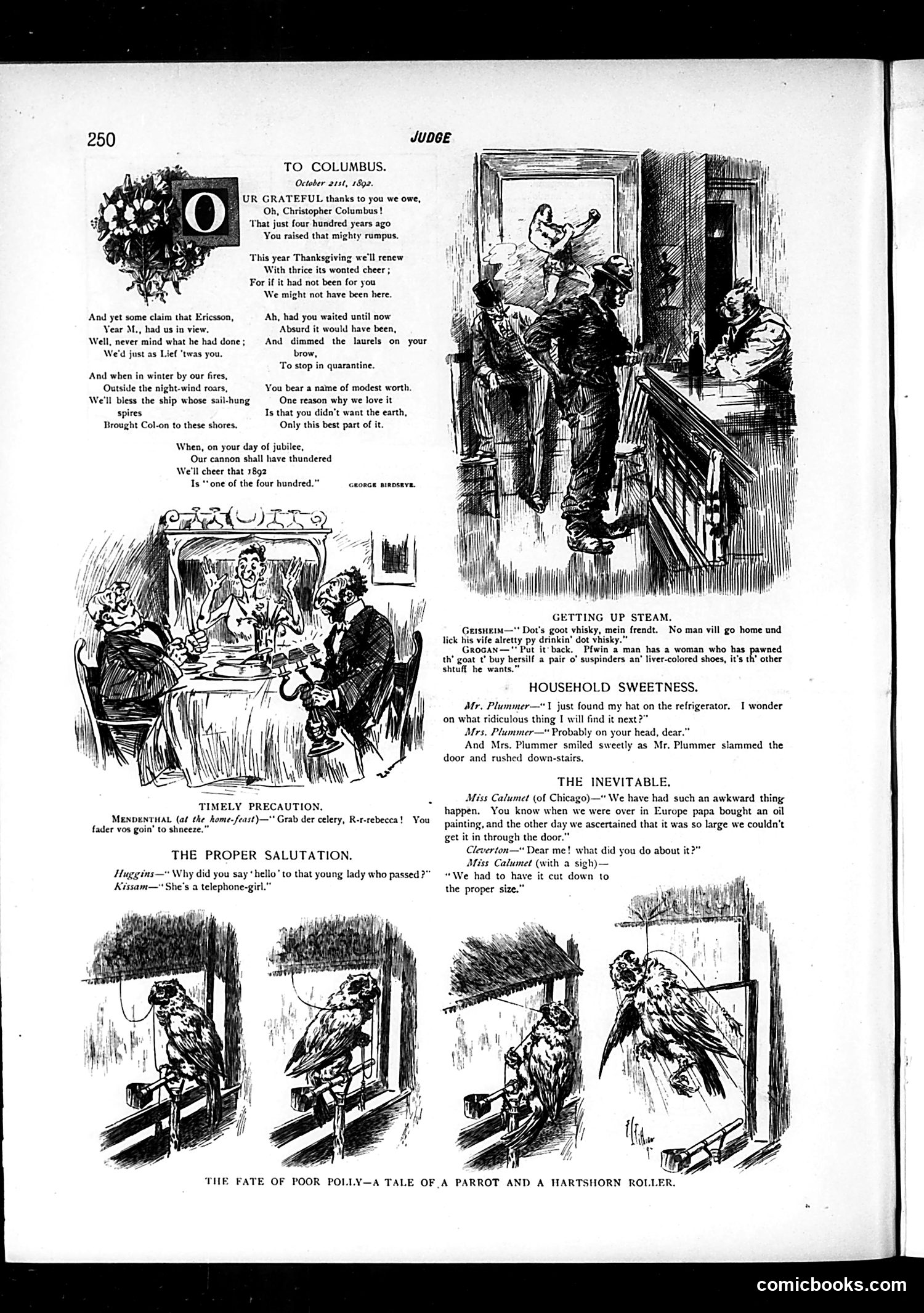
This page commemorates the 400th anniversary of Columbus's 1492 voyage. The main poem "To Columbus" offers patriotic gratitude while dismissing rival claims (likely referencing Norse explorer Leif Erikson). It jabs at quarantine regulations—suggesting Columbus arriving in 1892 would face modern health restrictions, making his discovery impossible today. The scattered jokes employ ethnic stereotypes typical of the era: German-accented characters ("Mendenthal," "Geisueim," "Grocan") appear in crude dialect humor about sneezing, whiskey, and domestic life. "The Proper Salutation" shows a bird performing increasingly exaggerated head movements—satirizing telephone operators' supposed affectations when greeting customers. "The Inevitable" mocks wealthy Chicago society: a woman's family purchased an oversized European painting but had to cut it down to fit their doorway—suggesting vulgar materialism and impractical pretension among the nouveau riche. The humor relies heavily on period stereotypes and social class mockery rather than political commentary.
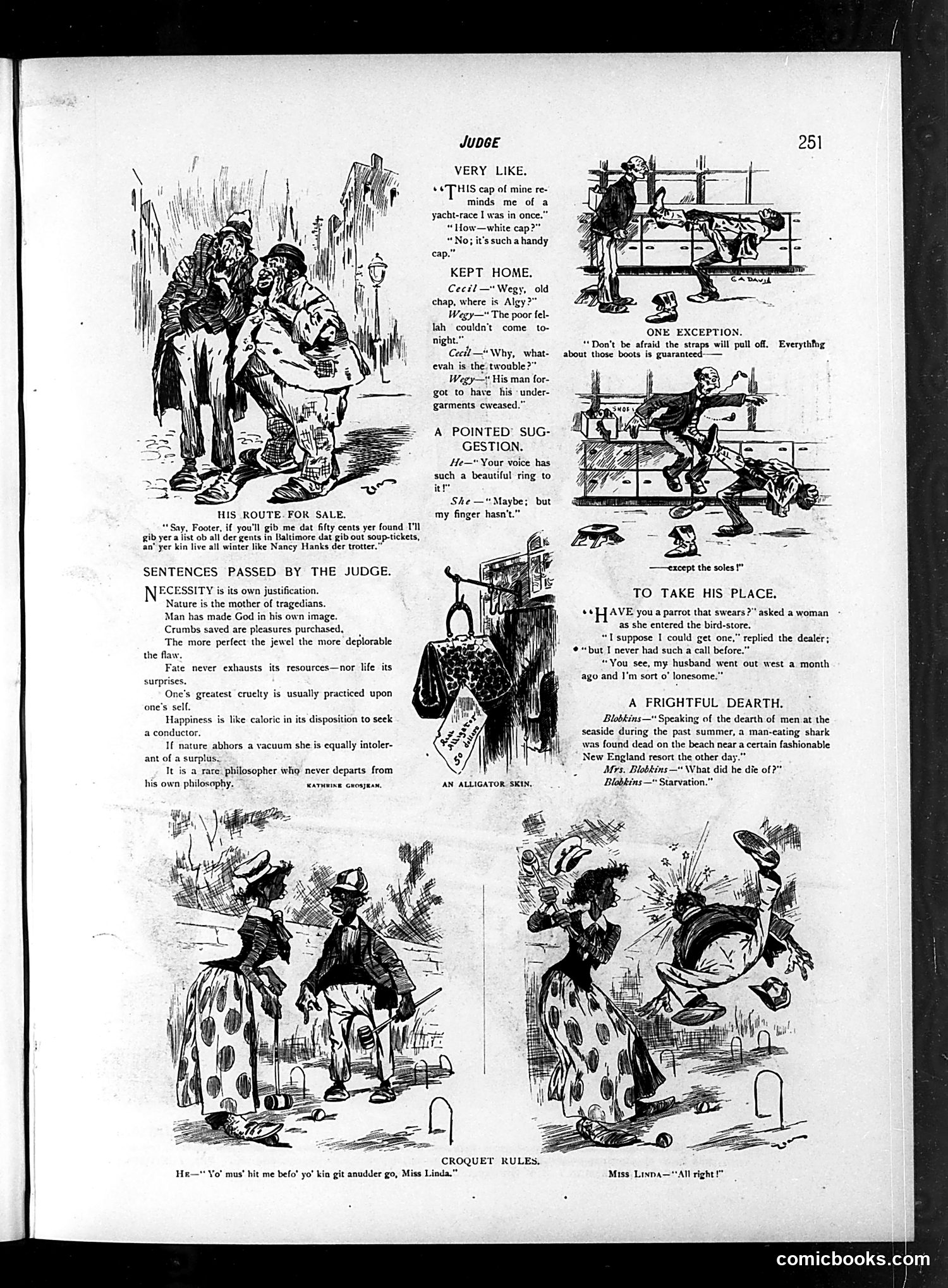
This page contains several unrelated satirical sketches typical of Judge magazine's format: **"His Route for Sale"** mocks urban poverty, depicting a beggar offering to sell information about Baltimore charitable soup-ticket distributors to another poor man—implying survival depends on exploiting welfare systems. **"Kept Home"** satirizes upper-class affectation, where a man cannot attend social events because his servant forgot to press his undergarments, mocking the leisure class's dependence on servants for basic tasks. **"One Exception"** jokes about shoe quality—the boots are "guaranteed" except for the soles, the very component that wears out, poking fun at fraudulent advertising claims. **"To Take His Place"** presents dark humor: a woman seeking a parrot to replace her absent husband suggests wives viewed husbands as mere companionship providers. **"A Frightful Dearth"** offers grim comedy about a man-eating shark starving at a beach resort, implying the shortage of suitable men (for romance/marriage) is so severe that even predators cannot find victims. The "Sentences by the Judge" are philosophical aphorisms offering general commentary on human nature and fate.
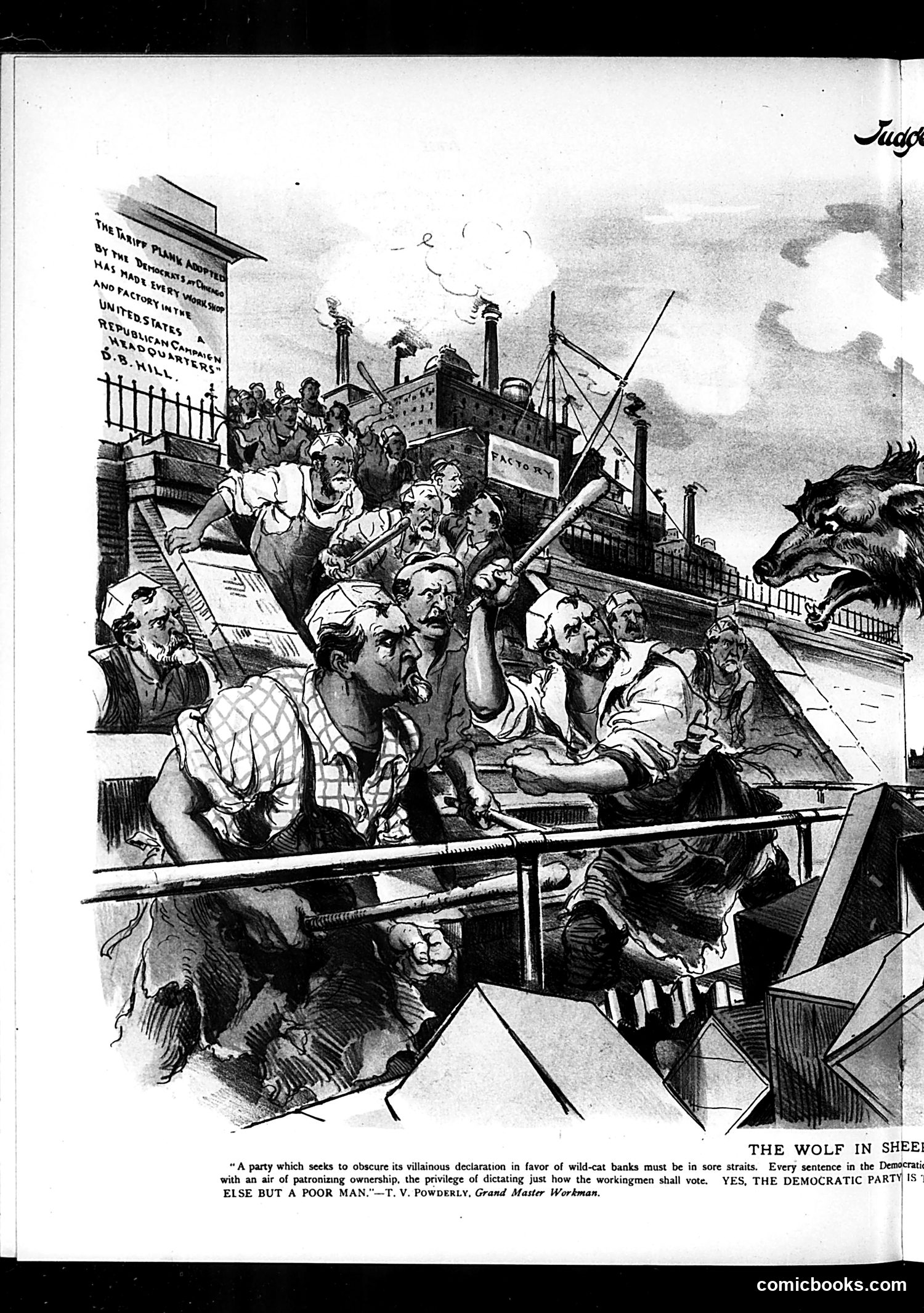
This Judge magazine cartoon attacks the Democratic Party as hypocritical regarding working-class interests. The title "The Wolf in Sheep's Clothing" frames Democrats as deceptively disguising their true nature. The quoted text is attributed to T.V. Powderly, Grand Master of the Knights of Labor (a major late-19th-century labor union), criticizing Democrats for supporting "wild-cat banks" while patronizingly claiming to represent workers. Powderly argues the party merely dictates how workingmen should vote without genuinely serving their interests. The cartoon depicts industrial workers and factory imagery, emphasizing the disconnect between Democratic rhetoric and actual labor policies. Judge's satirical point: Democrats exploit working-class votes while serving banking interests opposed to workers' welfare.
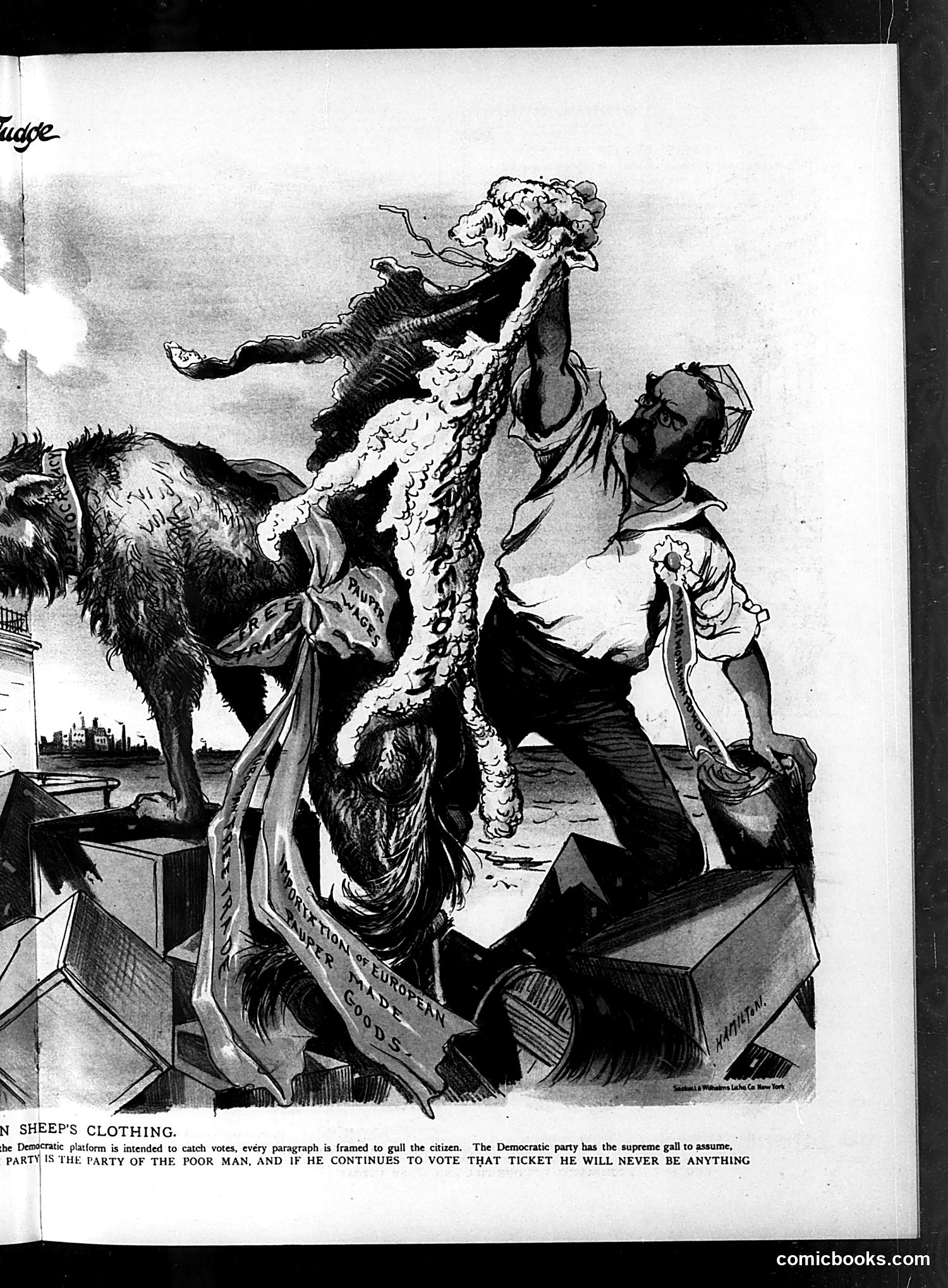
This Judge magazine cartoon satirizes the Democratic Party as deceptive. The central figure—a well-dressed woman representing the Democratic platform—is disguised in sheep's clothing, suggesting false innocence. She's being presented to working-class men (one notably carrying a goat, symbolizing the working poor) by manipulative figures. The satire claims Democrats cynically frame their platform to deceive voters, particularly the poor, with false promises. The text asserts the Democratic Party claims to represent working men while actually keeping them impoverished through continued voting for their ticket. This reflects Republican campaign rhetoric attacking Democratic appeals to working-class voters as dishonest manipulation—a common partisan attack during the Gilded Age/Progressive Era.
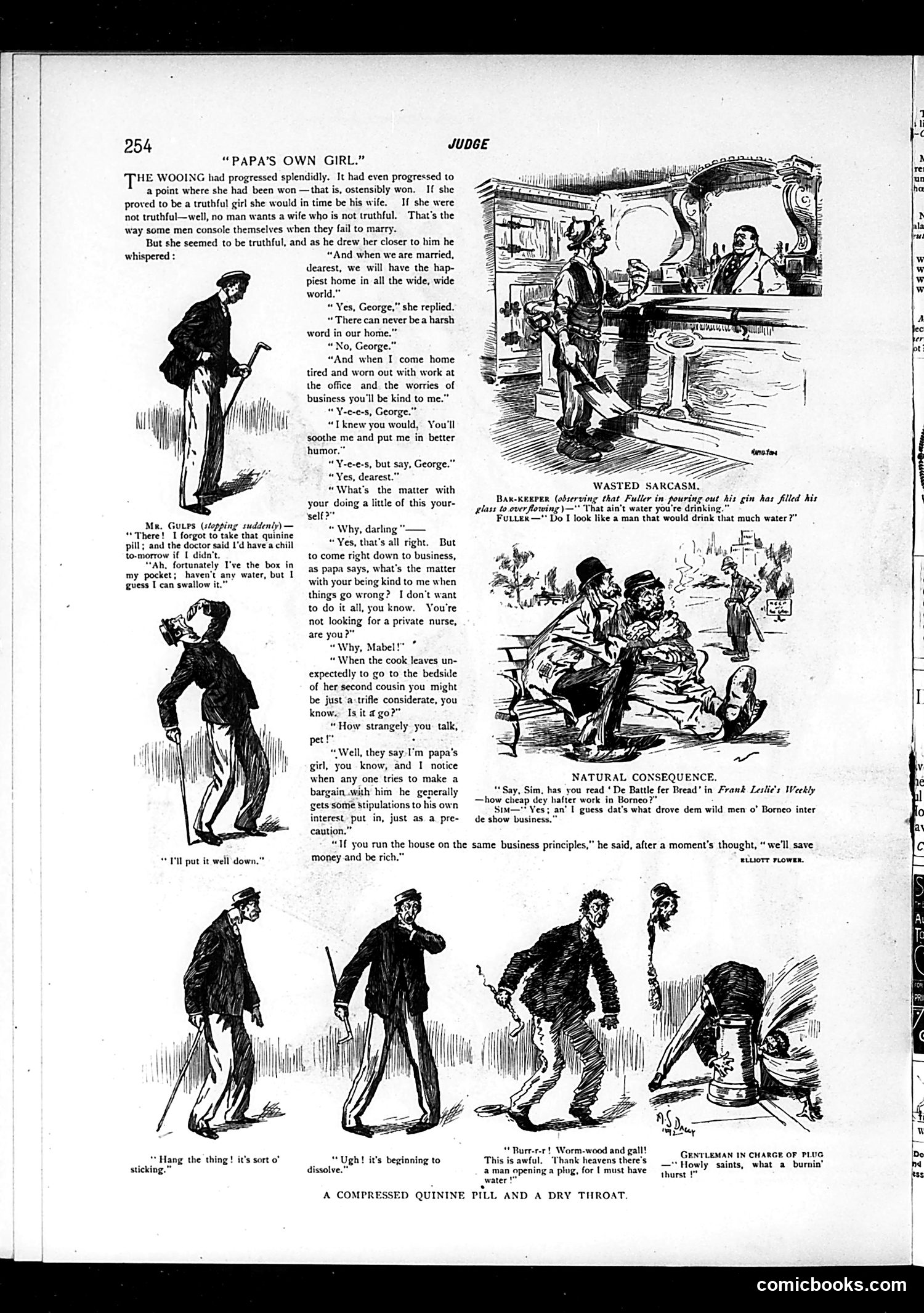
This page contains multiple satirical sketches mocking gender relations and domestic expectations in turn-of-the-century America. The main story "Papa's Own Girl" depicts a romantic couple where the woman deflates her suitor's idealized vision of married life. She challenges his assumption that she'll solely comfort and care for him after work, pointing out she won't be his "private nurse." The satire targets men's naive expectations of wives as unconditional caregivers—she insists on reciprocal kindness "when things go wrong." The lower cartoons employ crude humor about bodily discomfort: men struggling to swallow quinine pills without water, and references to constipation remedies. One sketch jokes about cheap labor in Borneo driving workers to desperation. The overall message critiques both romantic delusion and working-class desperation, using physical comedy and domestic conflict to expose societal hypocrisies about marriage and labor.
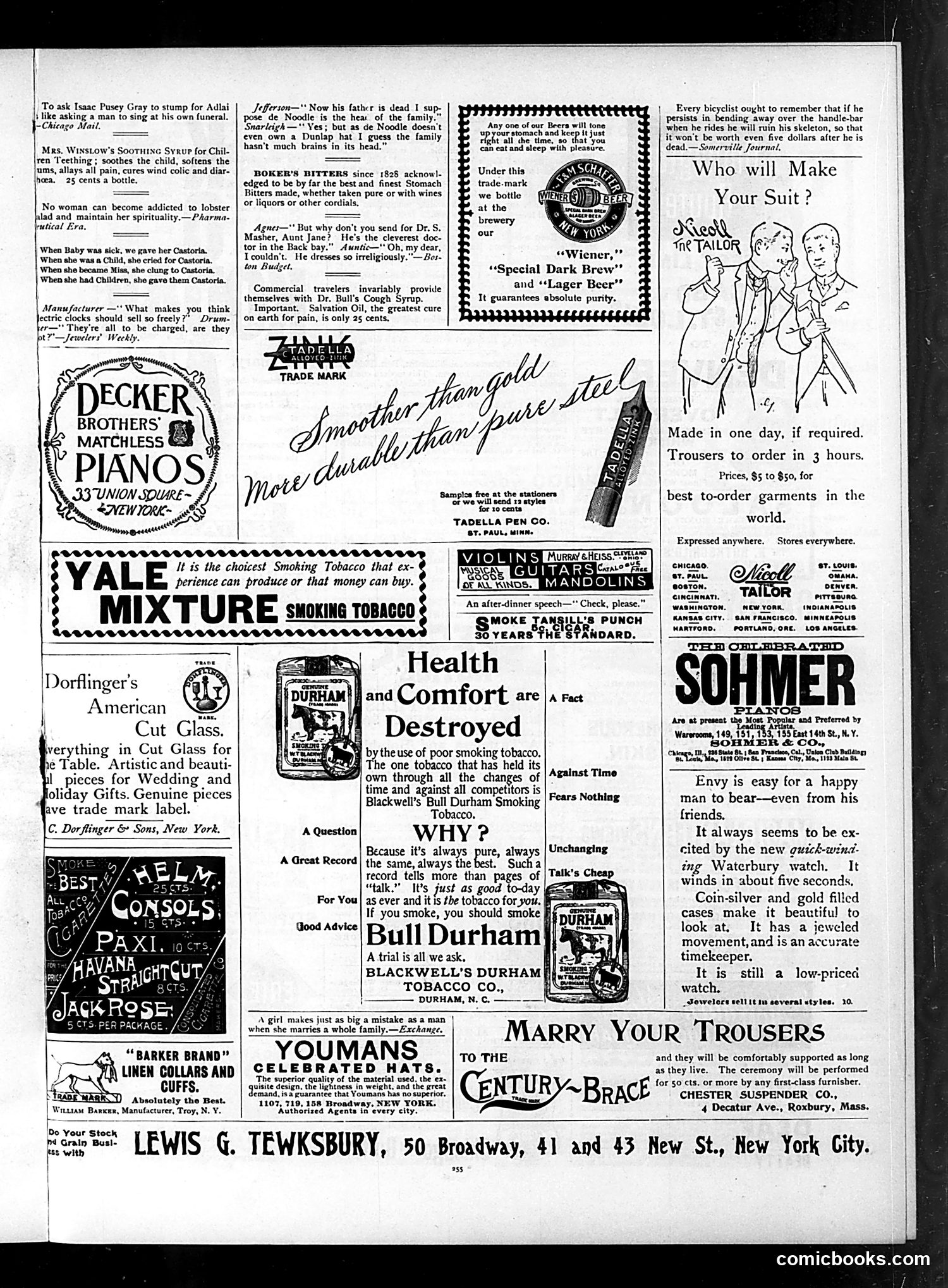
This page is primarily **advertising with brief satirical snippets** rather than political cartoons. The small jokes scattered throughout mock social pretensions and domestic life typical of 1890s-era humor. **Notable content:** The opening quip references **Isaac Pusey Gray** and **Adlai** (likely Adlai Stevenson), making a joke about political campaigning—comparing asking Gray to stump for Stevenson to asking someone to sing at their own funeral, implying their cause is hopeless. Another joke mocks Back Bay Boston society: a woman won't call a doctor because "He dresses so irreligiously"—satirizing upper-class hypocrisy and superficiality. A third joke plays on class anxiety: someone asks why "de Noodle" can't lead his family, noting he doesn't even own a "Dunlap hat" (a fashionable brand), so "the family hasn't much brains." **Bulk of page:** Dense advertisements for pianos, tobacco, patent medicines, cut glass, and clothing—reflecting Gilded Age consumer culture and the magazine's primary revenue source.
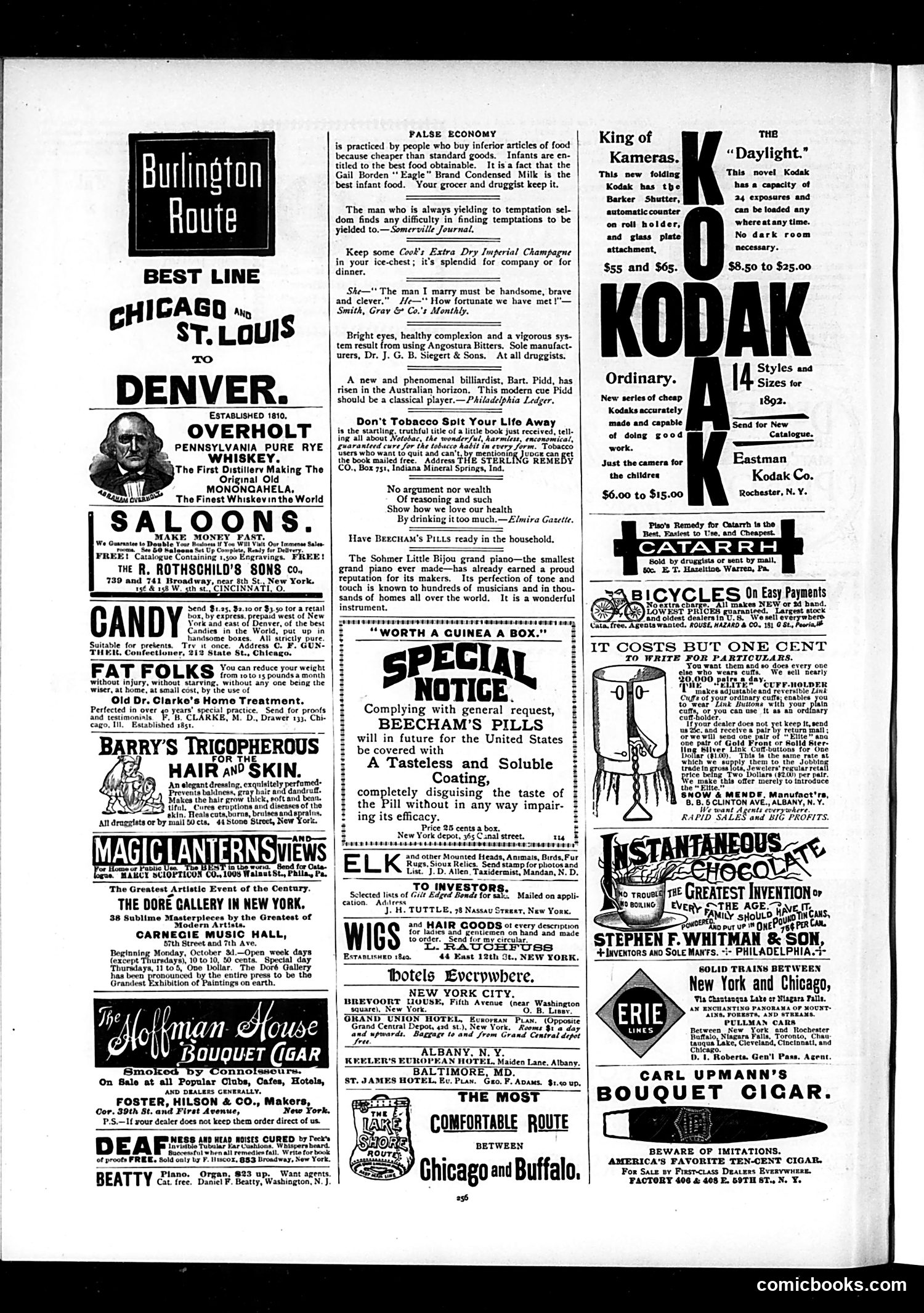
This page from *Judge* is primarily **advertising and editorial commentary**, not political cartoons. The layout mixes product advertisements with short satirical observations about contemporary consumer behavior and social habits. The lead editorial section titled "FALSE ECONOMY" criticizes people buying cheap inferior food products when better quality alternatives exist—specifically promoting Gail Borden "Eagle Brand" Condensed Milk for infants. The page includes numerous short, witty quips on topics like temptation, marriage expectations, tobacco use, and champagne consumption—typical of *Judge*'s satirical editorial voice. The remaining content is **commercial advertising** for various late-19th-century products: whiskey, candy, weight-loss treatments, cigars, hair products, pianos, and railroad routes. There are no identifiable political figures or cartoons requiring historical explanation on this particular page.
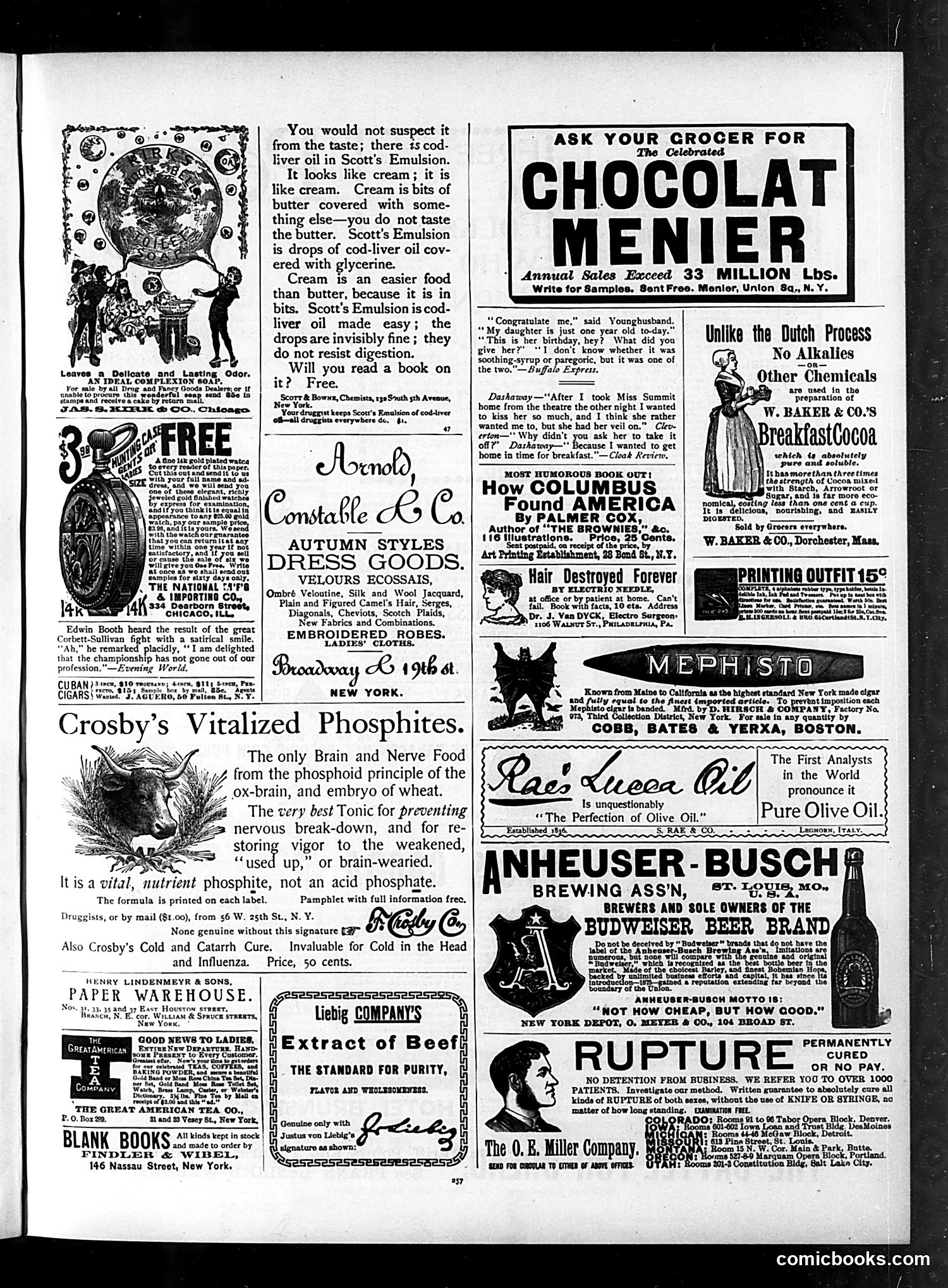
This page is primarily **advertising**, typical of Judge magazine's revenue model. It contains no political cartoons or satirical content requiring historical context. The only item with potential humor is a brief anecdote about actor Edwin Booth responding to the Corbett-Sullivan boxing match with a joke about the championship remaining "in our profession"—suggesting boxers and actors are equally worthy of respect (or equally disreputable). This is mild wordplay rather than satire. The rest consists of period product advertisements: Scott's Emulsion (cod-liver oil supplement), clothing, breakfast cocoa, beer, olive oil, and medical treatments. These ads reflect late-19th-century consumer culture and available products, but contain no satirical commentary. The page represents Judge functioning as a commercial publication rather than as political satire.
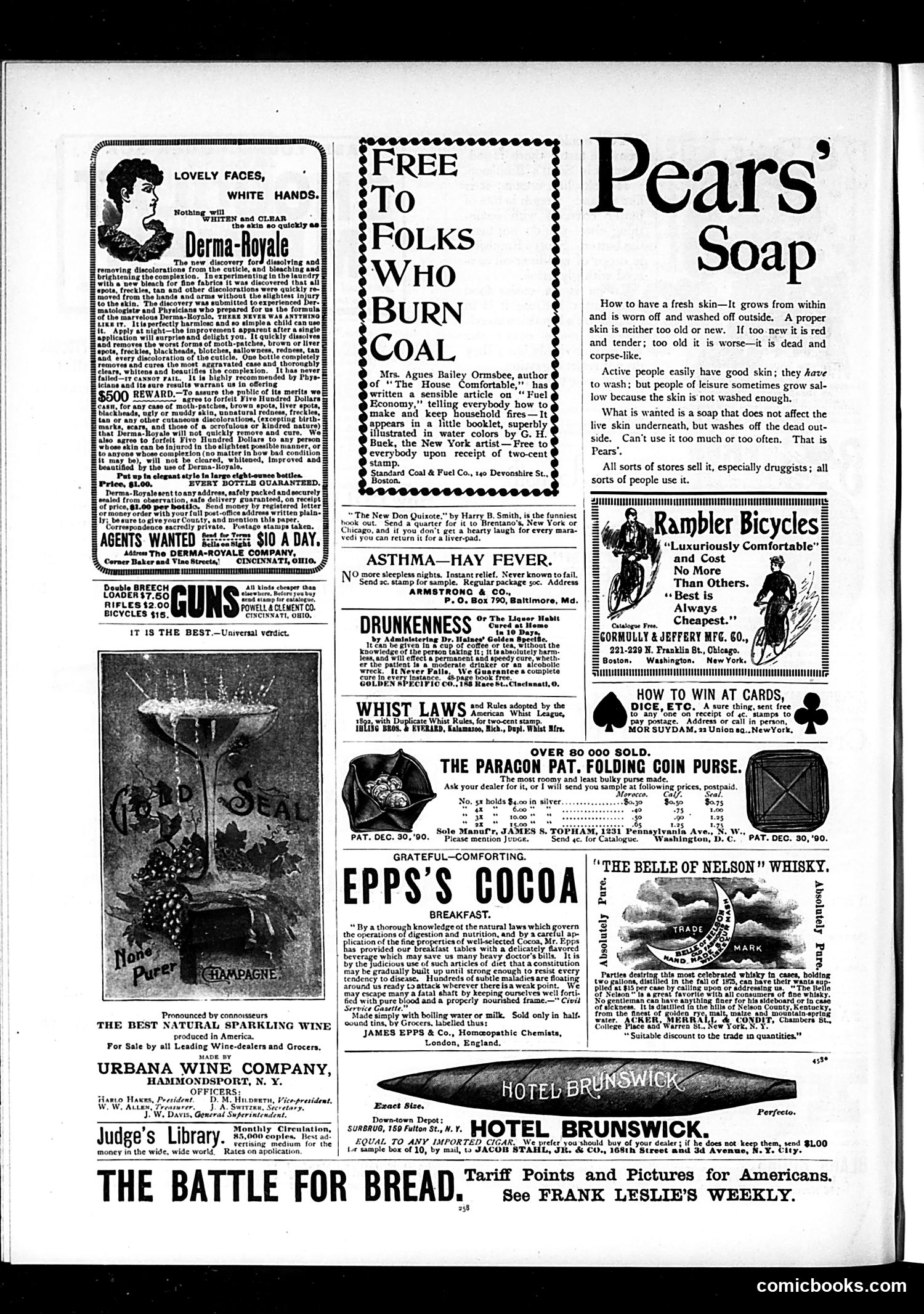
This is primarily a **advertising page**, not a satirical cartoon. It contains commercial advertisements typical of late 19th-century American magazines, including: **Notable ads:** - **Derma-Royale**: A skin-bleaching product promising to remove freckles, tan, and "discolorations"—reflecting contemporary beauty standards that prized pale skin - **Coal fuel economy pamphlet**: Free literature on household heating efficiency - **Asthma/hay fever cure**: Patent medicine promising instant relief - **"Golden Specific"**: Advertised as a secret alcohol addiction treatment - Various firearms, bicycles, wine, whiskey, and other goods **Historical context**: The Derma-Royale ad is particularly notable as it reflects 19th-century racism—the product explicitly targets skin lightening, suggesting discriminatory beauty ideals. The patent medicine ads show an era before FDA regulation, when unproven treatments made extravagant claims. The page demonstrates how Judge relied on advertising revenue and reveals the consumer culture and medical pseudoscience of the period rather than satirical content.
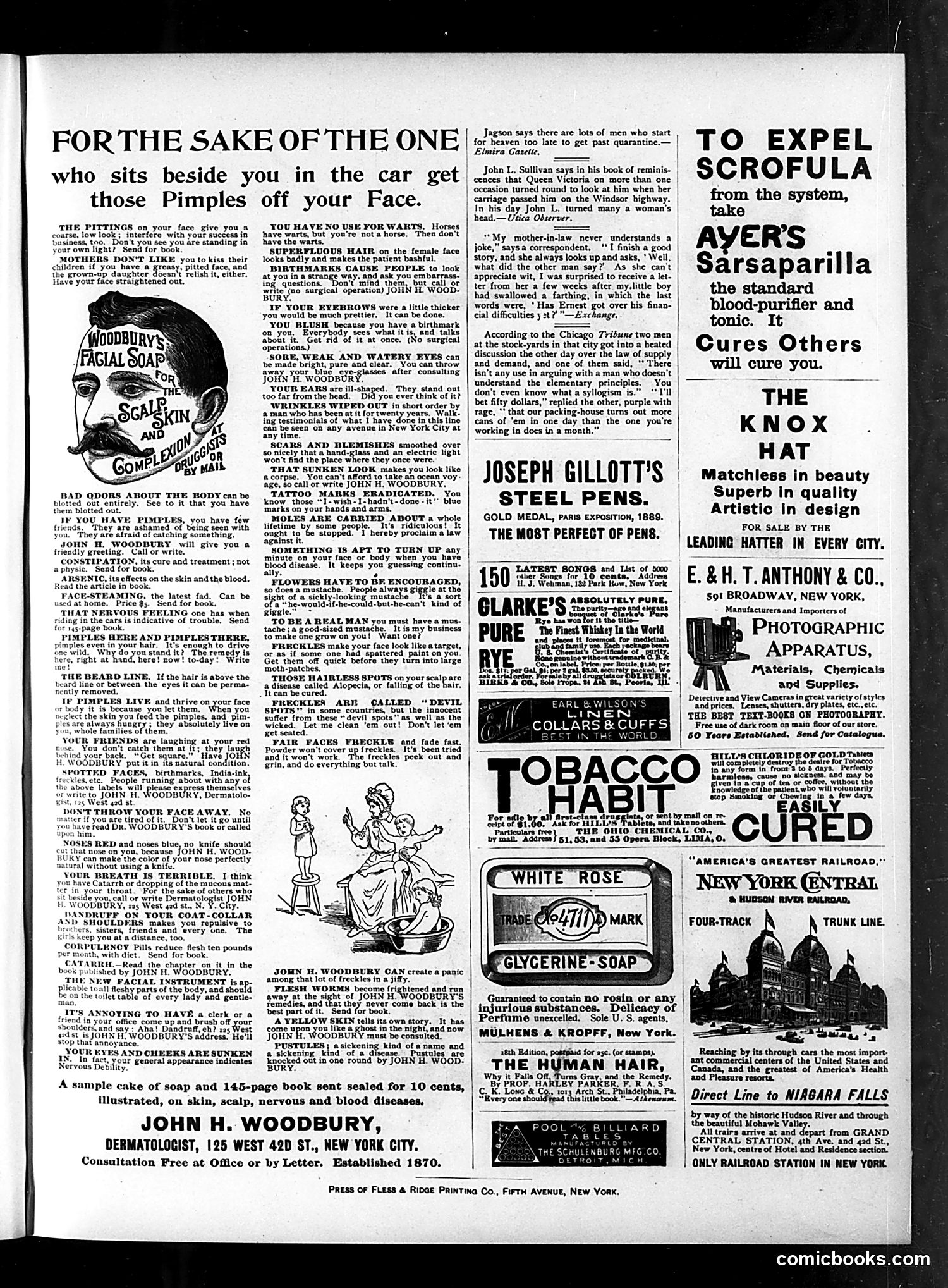
This page is predominantly **advertising for John H. Woodbury's dermatology services** (125 West 42nd St., New York). Rather than traditional satirical cartoons, it uses repetitive, emphatic advertising copy to mock social anxieties and vanity. The humor operates through **exaggeration and social shaming**: Woodbury's ads relentlessly catalogue skin and appearance flaws—pimples, dandruff, red noses, superfluous hair, warts—claiming each makes one socially repulsive. Lines like "MOTHERS DON'T LIKE you to kiss their children" and "Your friends are laughing at your red nose" weaponize embarrassment to sell treatments. The satirical edge lies in how **extreme and absurd the claims become** (dandruff makes siblings keep distance; pimples mean "you have few friends"). This appears to be Judge magazine mocking the aggressive fear-based marketing tactics of the era, where advertisers exploited insecurities about appearance and social acceptance. The surrounding ads for Ayer's Sarsaparilla, Knox Hats, and other products reflect typical 1870s-era advertising on the page.
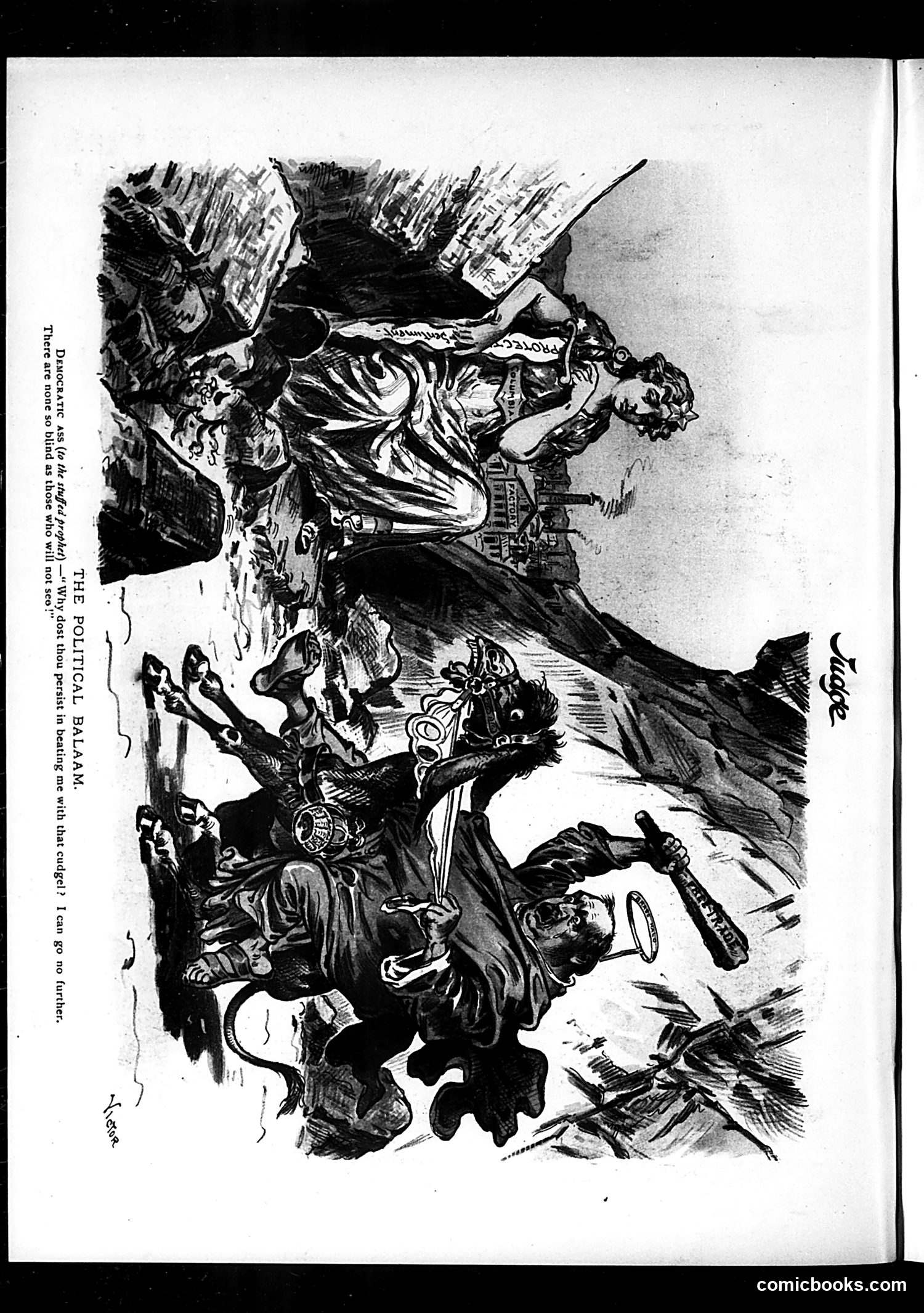
This political cartoon satirizes political corruption and hypocrisy. The central figure appears to be a politician or public official portrayed as "Balaam" (a biblical figure known for compromised morality). The image shows him elevated above common citizens and politicians below, who appear to be scheming or gesturing toward him. The satire likely critiques how politicians accept bribes or compromises ("speaking for gold") while maintaining a facade of respectability. The biblical allusion to Balaam—who was hired to curse Israel but blessed them instead—suggests someone whose principles are for sale to the highest bidder. The crowd below represents the various interests (business, political machines) competing for the politician's favor and influence. The overall message condemns the corruption inherent in American politics during Judge magazine's era, showing how public officials could be purchased by special interests.